REWARD SYSTEMS, JOB SATISFACTION, ORGANIZATIONAL COMMITMENT AND EMPLOYEE PERFORMANCE IN PUBLIC HIGHER
INSTITUTIONS OF LEARNING IN UGANDA
TURINAWE HUMPHREY
2009/HD10/17522U PLAN A
A DISSERTATION SUBMITTED TO MAKERERE UNIVERSITY BUSINESS SCHOOL IS PARTIAL FULFILLMENT OF THE REQUIREMENTS FOR
THE AWARD OF A MASTERS DEGREE OF HUMAN RESOURCE MANAGEMENT OF MAKERERE UNIVERSITY
DECLARATION
I, TURINAWE HUMPHREY, declare that to best of my knowledge, this research proposal is my original work and has never been presented to any university or any other authority for the award of a degree or any other award. Where it is indebted to the work of others, the acknowledgements have been made.
Signed……….. Date………..
TURINAWE HUMPHREY
APPROVAL
This is to certify that this dissertation has been submitted in partial fulfilment of the requirements for the award of Masters of Human Resource Management Degree with our approval as University supervisors.
……… ……….
Dr. Mohammad Ngoma Dr. Samuel Mafabi
DEDICATION
ACKNOWLEDGEMENT
I would like to extend my sincere gratitude and appreciation to all those who assisted me in making this study a success. Special thanks go to Dr. Ngoma, Mr. Mafabi and Dr. Kibanja for their commitment and professional advice, when supervising my work. May God reward you all.
My heartfelt thanks go to Eng. Turinawe for advice provided from time to time. I thank all the academic and administrative staff from Kyambogo University and Makerere University Business School who participated in this study for without them the research endeavour would have been a failure.
Finally I extend my appreciation to all my family members for their encouragement and support through the years. There are many others, not mentioned but have assisted me with information, comments and ideas which have enabled me to finish this work. I thank all of them.
LIST OF TABLES
Table 1 Showing Cronbach’s alpha values for study variables
Table 2 Distribution of respondents by categories.
Table 3 Distribution of respondents by Sex
Table 4 Distribution of respondents by being on the government pay roll
Table 5 Distribution of respondents by Age
Table 6 Distribution of respondents by higher education level attained Table 7 Correlation between reward systems, job satisfaction,
organizational commitment and employee performance
TABLE OF CONTENTS Declaration……… i Approval………ii Dedication……… iii Acknowledgement………iv List of tables…..………...v Table of Contents………..vi Abstract………..…………...ix CHAPTER ONE………...1 INTRODUCTION………1 Background……… 1
Statement of the problem………..3
Purpose of the study……….3
Objectives of the study……….3
Research questions………4
Significance of the study………...4
Scope of the study……….5
Conceptual framework………..6
Explanation of conceptual framework………. 6
CHAPTER TWO………7
LITERATURE REVIEW……….. 7
Reward systems and job satisfaction…...………. 7
Reward systems and organizational commitment………..………….. 9
Reward systems and employee performance………..11
Job satisfaction and organizational commitment………12
Job satisfaction and employee performance………15
Organizational commitment and employee performance………17
METHODOLOGY………... 19
Introduction ……….……… 19
Research design……….………19
Target population……….……... 19
Sample design……….……….. 20
Target sample size……….… 20
Measurement of variables………...21
Procedure for data collection……….……….22
Data processing and analysis………...22
Reliability of the instrument………22
Research procedure……….23
Ethical consideration…..……….24
Justification of study………...24
CHAPTER FOUR………25
DATA PRESENTATION AND INTERPRETATION………...25
Introduction………..……...25
Cross tabulation of background characteristics…..………..26
Correlation of variables………..……….32
Regression analysis of variables………..35
CHAPTER FIVE……….37
DISCUSSION, CONCULSION AND RECOMMENDATION……….37
Introduction………..37
Discussion of findings……….37
Reward systems and job satisfaction………...37
Reward systems and organizational commitment………...38
Reward systems and employee performance………..39
Job satisfaction and organizational commitment………39
Job satisfaction and employee performance………40
Conclusion of findings………42
Recommendation………..43
Areas of future research………..44
References………...46
ABSTRACT
The objective of the study was to investigate the relationship between reward systems, job satisfaction, organizational commitment and employee performance among academic and administrative staff of public higher institutions of learning in Uganda. The study involved 300 respondents selected from two institutions in Uganda that is Kyambogo University and Makerere University Business School. Data was collected using self administered questionnaires. In order to answer the research questions, the research used SPSS 19 version for data operation and analysis.
Cross tabulation was used to describe the demographic sample used in the study. The results of Pearson correlation showed a significant positive relationship between the variables (reward systems, job satisfaction, organizational commitment and employee performance). The regression analysis showed that almost 38% of the variance in employee performance can be accounted for by reward systems, job satisfaction and organizational commitment with reward systems as the significant predictor of employee performance.
Therefore the researcher concluded that in addressing employee performance among academic and administrative staff in these institutions it’s important to first manage the reward systems given, understand how to build job satisfaction and address the levels of organizational commitment.
Chapter One
Introduction
Background
Employee performance has become one of the significant indicators in determining organizational performance and success (Wall, Michie, Patterson, Wood, Sheehan, Clegg, & West, 2004). Employees however, in higher public institutions of learning in Uganda continue to exhibit levels of poor performance such as withholding students’ results, strikes, absenteeism, turnover, disregard for managers and late submission of students’ results (Terry, 2005). Employee performance is influenced by a number of factors and these include reward systems, job satisfaction and organizational commitment (Sims 2002).
In most organizations poor reward systems lead to lower satisfaction and in turn produces very low organizational commitment (Caruth & Handlogten, 2001). Employees who experience job satisfaction are more likely tobe productive, effective performers and committed to the organization. Research has shown that increased job satisfaction improves employees' organizational commitment, performance and creativeness, and reduces absenteeism and turnover (Oshagbemi, 2010). Reward systems are made up of compensation, incentives and benefits provided for the employee as a reward for their contribution to the organization (Sims 2002). Poor reward packages are seen by employees as a source of unfairness in the system which causes the employees to become dissatisfied with their jobs resulting into lack of commitment thus affecting their overall performance (Bratton & Gold, 2007). Higher public institutions of learning in Uganda have continued to suffer the effects of strikes
as the employees complain about salaries which have affected their performance for example holding of students results and not lecturing.
From interaction with lecturers and administrative staff in Makerere University business school, it was noted that over the years, the university has lost a large number of talented employees to other universities and other organizations due to poor reward packages compared to other universities. They also cited late payment of salaries and lack of benefits as some of the problems they are facing (Report of Exit interviews, 2008, MUBS HRM records, 2009). Academic staffs are not committed to these institutions; they use the excuse of leave of absence, study leave, and sabbatical leave as exit routes (Bragg, 2005). Furthermore, the records show that of all the employees who go on different kinds of leave, only 44% of these return, while the rest of the senior lectures either are on leave of absence or sabbatical, ranging from two, five years which eventually becomes indefinite (Ghanaweb, 2005). In 2008, a part time lecturer in the Department of Geography at Makerere University since 2000 on the tourism program threatened to withhold dissertations and marks of 200 students because he had not been paid for a year by the university. In a letter dated October 15, the lecturer wrote to the head of department saying the faculty had failed to pay him Shs 630,000 for marking dissertations in the year 2006/007 and other unpaid claims including marking coursework, examinations and field reports amounting to about Shs 830,000 (http://www.adjunctnation.com/?p=690).
Managers of higher public institutions of learning in Uganda need to understand and correlate the factors that influence employee performance. Justification for the research is the need to investigate how reward systems, employees' job satisfaction and organizational commitment can lead to employee performance.
Statement of the Problem
Employee performance is critical for the success of organizations and the quality of services provided by organizations to their clients. However higher public institutions of learning in Uganda continue to fail to achieve their aims and objectives due to poor performance of their employees for example withholding of students results, absenteeism, late coming for lectures, disregard for authority, absence from meetings, staff turnover and strikes
This poor performance can be attributed to improper reward systems, lack of organizational commitment and low job satisfaction.
Purpose of the Study
The study sought to examine the relationship between reward systems, job satisfaction, organizational commitment and employee performance with particular reference to public higher institutions of learning in Uganda.
Objectives of the Study
The following were the objectives of the study:
1. To investigate the relationship between reward systems and organizational commitment.
2. To examine the relationship between reward systems and job satisfaction
3. To examine the relationship between reward systems and employee performance
4. To establish the relationship between job satisfaction and organizational commitment
5. To determine the relationship between and job satisfaction and employee performance
6. To establish the relationship between organization commitment and employee performance
7. To establish the relationship between reward systems, job satisfaction, organizational commitment and employee performance.
Research questions
1. What is the relationship between reward systems and organizational commitment?
2. What is the relationship between reward systems and job satisfaction?
3. What is the relationship between reward systems and employee performance?
4. What is the relationship between job satisfaction and organizational commitment?
5. What is the relationship between job satisfaction and employee performance?
6. What is the relationship between organizational commitment and employee performance?
Significance of the Study
This research hopes to discover how reward systems in higher public institutions of learning in Uganda contribute to job satisfaction and organizational commitment of
employees in order to reduce staff turnover, negative behaviours like absenteeism and poor performance.
This study will support further studies in the field of assessment of the improving performance among employees in organizations.
This study could make recommendations and help managers understand the importance of reward systems, job satisfaction, and organizational commitment as drivers of employee performance.
The study will help to create knowledge and information for academicians and other researchers on the impact of reward systems, job satisfaction and organizational commitment on employee performance.
Scope of the Study Geographical scope
The research was conducted in the following public higher institutions of learning in Uganda: Kyambogo University and Makerere university business school. The study focused on administrative and academic staff from the institutions.
Content scope
The research analyzed the relationship reward systems, job satisfaction, organizational commitment and employee performance in relation to the academic and administrative staff in the institutions. The researcher focused on task performance of the employees in relation to employee performance.
Time scope
The research covered a period of 2 years that is 2010-2011. 2010 was period used to write a proposal and collect data. 2011 period was used to analyse the data and comply a report.
Conceptual framework
Source: Literature Review
Explanation of the conceptual framework
Existence of proper and effective reward systems in these institutions not just salary, will lead to job satisfaction, organizational commitment and employee performance. When employees are satisfied with their jobs then this builds organizational commitment. When employees exhibit job satisfaction, they will improve their performance. When employees are commitment to the organization they will strive to perform the tasks and duties attached to their positions thus effective employee performance.
Reward systems
Job satisfaction
Organizational Commitment
Employee performance
Chapter Two
Literature Review Reward Systems and job satisfaction
In present day, among manager’s tasks is to create an environment which motivates people to perform satisfactorily and to be a profitable asset, that they can foster the organization’s growth. In a wider context, there is an increased emphasis on people as a key source of competitive advantage, often being regarded as the key differentiator between organizations. Many managers try to comprehend the complexities of motivating people at work so as to build job satisfaction. For this reason, increased emphasis is given to financial and non-financial rewards for employees (Georgakopoulos, Sotiropoulos, & Dimitris. 2010).
Increasingly, organizations are realizing that in order to build on employee’s job satisfaction, they have to establish an equitable balance between the employee’s contribution to the organization and the organization’s contribution to the employee. Establishing this balance is one of the main reasons to reward employees. This means that employees can not be satisfied with their jobs unless they are motivated by effective reward systems (Pratheepkanth, 2011).
In many cases, reward systems are closely related to motivation theories and job satisfaction. The term of job satisfaction has become a very significant one, now that managers seek for practices which are likely to make people more satisfied and therefore, more productive. Though several papers within the latest literature, it is easy to understand that job satisfaction is quite difficult to measure while it is considered as major determinant of organizational performance (Riketta, 2002) and effectiveness (Laschinger, 2001).
Clifford’s study (Rehman, Khan, Ziauddin, & Lashari., 2010), stated there is a strong relationship between reward systems and job satisfaction. Research shows how rewards systems are strong determinant of job satisfaction. There is no one definition that sums up job satisfaction. Crudely defined, job satisfaction refers to “the degree to which people like their jobs” (Spector, 1997). Scholars use the concept to show a combination of employee feelings towards the different facets of job satisfaction such as the nature of the work itself, level of pay, promotion opportunities, and satisfaction with co-workers (Schermerhorn, Hunt, & Osborn, 2005:158).
Research shows how reward systems are strong determinant of job satisfaction. Gerald and Dorothee (2004) found that rewards are significantly related to professionalism and job satisfaction. They supported the argument that job satisfaction for professionals is derived in part from what professional perceives from job. Job satisfaction is influenced by the reward systems.
According to Thorpe and Homan (2000), one of the most fundamental debates in the field of rewards system management, concerns the extent to which employees are motivated by money. At that point there is an extensive discussion about whether or not money is a motivator and can influence the levels of job satisfaction. In relating reward systems and job satisfaction, Armstrong and Murlis’ study in 1998 (Georgakopoulos, Sotiropoulos, & Dimitris, 2010), looked at reward systems as motivational factors towards employee job satisfaction. Furthermore, theories of motivation focus on satisfaction of the needs for autonomy, competence and relatedness (Gagne & Deci, 2005). Equitable rewards are another work-related factor that affects job satisfaction. Employees are satisfied when they feel that the rewards they receive from their jobs correspond to their skills and effort. It is not solely about
the amount of money they receive. They are satisfied when they feel that they have been fairly treated and when the rewards they receive are equal to the ones their colleagues who have the same skills, expertise and effort, receive. As Equity Theory suggests “perceived equity seems to lead to greater job satisfaction and organizational commitment” (Huczynski & Buchanan, 2001)
Therefore Satisfaction with reward system is one of the drivers of organizational commitment. For an employee to be satisfied with his/her pay, a few basic elements need to be present. People have to believe that the pay they earn is fair in relation to the work they do. They also must feel that their compensation, including salary, incentives and benefits, compares favorably with the realities of the market, especially in comparison to people doing the same work in similar circumstances (Parker & Wright, 2001).
Reward systems and organization commitment
Reward systems are a fundamental function of human resource management that deal with the assessment of job values, the design and management of payments, performance management, employees’ benefits and pensions including the management of rewards procedures. Furthermore, reward systems take into account organizational goals, values and strategies (Armstrong, & Murlis, 1998). Therefore every company needs a reward system for employees that addresses four key areas: compensation, benefits, recognition and appreciation (Sarvadi, 2005). When business owners think of reward systems, they typically put compensation at the top of the list (Rynes, Colbert, & Brown, 2002). Bratton and Gold, (2007) state that reward systems are more than just compensation or monthly salaries. Reward systems are all of the
monetary, non-monetary, and psychological payments that an organization provides for its employees. Milkovich and Newman (2002) look at reward systems as an exchange strategy. They state that: "Employees may see reward systems as a return in exchange between their employer and themselves, as an entitlement for being an employee of the company, or as a reward for a job well done." The way the employee views this exchange determines their levels of organizational commitment.
Lawler (2003) argued that the relationship between reward systems and organizational commitment depends on two factors; first is the amount of reward which is given and the second is the weight age an individual gives to a certain reward. Deeprose (1994) is of the view that “Good managers reward people by doing things that acknowledge their accomplishments and they reward people by giving them something tangible.” Fair chances of promotion according to employee’s ability and skills make employee more committed to their work and become a source of pertinent workability for the employee. Incentives, rewards and recognition are the key parameters of today’s commitment programs according to most of the organizations as these bind the success factor with the employees’ performance.
Therefore, reward systems remain a critical issue for organizations because of the financial investment in paying people. Likewise, fostering organizational commitment in employees through reward systems is crucial to attracting, motivating and retaining the human capital necessary for corporate success. Although a relationship exists between reward systems and organizational commitment, it has to be considered as one of the pieces in a complex puzzle towards employee performance. Nevertheless, without a comprehensive and responsive reward strategy, companies will fail to maximize the potential of their employees (Parker & Wright, 2001).
Reward systems and employee performance
Many experts in management believe that there is a strong relationship between reward systems and employee performance as reward systems are one of the key forces that drive organizational and employee performance because they differentiate between the less productive and the highly productive employees (Lawler, 2003). Furthermore, an effective reward system will contribute to better performance, increased product quality, and the resolution of organizational problems (Lawler, 2003).
Reward systems fall under what is termed as an employment exchange (Rynes & Gerhart, 2000). Employment is typically characterized as an exchange relationship. Employees provide organizations with something of value (their labor) and in return receive something of value. (Rynes, Colbert, & Brown, 2002) work can offer many valuable outcomes to employees including the opportunity to use their abilities to make contributions and in this are rewarded resulting into satisfaction with the employment exchange.
Reward systems are a human resource management function that deals with every type of reward individuals receive in exchange for performing organizational tasks (Sims, 2002). Commentators in the field have shown that rewards, particularly extrinsic rewards are powerful factors impelling motivation and employee performance (Taylor, 1967; Wiley, 1997). As an effort to stimulate employees’ creativity, many managers have used extrinsic rewards (for example monetary incentives and recognition) to motivate their employees (Fairbank & Williams, 2001; Dijk & Ende, 2002). Organisations can use reward systems to improve the performance of employees by incorporating appraisal or promotion for employees
who have a good record of performance. This can be done by the managers being on the look out for employees who perform well. For instance cleaners who always arrive at work in good time and who carry out their responsibilities well without supervision can be promoted to become leaders of the entire staff in charge of sanitation. This makes the rest of the staff to improve their performance knowing that they would be rewarded by being promoted also. This plays a big role in improving the performance in an organization (Legge, 1995). Further more, Thomson, and Rampton, (2003), stated that there is positive relationship between reward systems and employee performance basing on the fact that when the rewards are often, employee's performance is greatly improved as compared to having the rewards only once in a year. This is because when the reward is carried out often, employees tend to easily relate it to the performance than when managers wait to reward them later on. This is normally more effective.
Maund (2001) writes a paper which looks at how organizations can use reward systems to improve the performance of their staff. One way through which organizations can use reward systems to improve employee performance is by setting targets in relation to the job. Any employee that meets the target is given a specific amount of money. Another way is through praise. Research shows that when human beings are appreciated and praised then intern it will improve their performance Torrington & Hall (2006).
Job Satisfaction and organizational commitment
The need to attract, motivate, develop and retain employees is critical to any organization’s prosperity today. Creating an environment in which employees feel truly committed connected to the organization’s goals and objectives, and satisfied
with their jobs has never been more crucial. The traditional costs involved in hiring and developing a new worker have always pointed to the importance of retaining employees (Parker & Wright, 2001). Analyzing the relationship between job satisfaction and organizational commitment is particularly crucial nowadays, as people often do not work at the same organization or job throughout their lifetime (Cote & Heslin., 2003).
Organizational commitment refers to the degree to which a person identifies with, and feels part of an organization or company (Schenmehorn, Hunt, & Osborn, 2002). An individual who has high organizational commitment is considered very loyal, which brings about a number of organizational benefits such as higher productivity, better work quality, higher employee morale, reduced turn over and more employee willingness to exert extra effort (Willemse, 2002).
Allen and Meyer (1990) developed a measure of organizational commitment with three major components: i) Affective component of organizational commitment refers to employees’ emotional attachment, identification and involvement in the organization; ii) the Continuance component refers to commitment based on the costs that employees associate with leaving the organization; and iii) Normative commitment reflects an employee’s feeling of obligation to remain with the organization (Sarmad, 2007; Ayeni & Phopoola., 2007, Omar., Olffen.,& Roe, 2007). Lee and Olshfski, (2002) in trying to understand the relationship between job satisfaction and organizational commitment, studied the behavior of organizational commitment of the firefighters in New York and their study led to believe that organizational commitment offers considerable promise in describing the positive behaviors. Furthermore, Individuals take jobs, they identify with the role attached to
the job, they become committed to doing the job, and they behave according to the expectations attached to that job.
When employees are sure that they will grow and learn with their current employers, their level of commitment to stay with that particular organization is higher (Opkara, 2004). In order to make employees satisfied and committed to their jobs, there is a need for strong and effective motivational strategies at various levels of the organization.
Ayeni and Phopoola, (2007) found a strong relationship between job satisfaction and organizational commitment. According to them Job satisfaction is mostly determine how well the organization meets employees expectations.
The relationship between job satisfaction and organizational commitment is very crucial now-a-days because people now often do not prefer to stay with the same organization for long. It has become hard for the organizations to exercise influence on the employees for retaining them. If employees exhibits different levels of job satisfaction and if this satisfaction leads to the organization commitment, obviously organizations would want to hire employees with the higher levels of organizational commitment. Employers normally expect that people with higher levels of job satisfaction will have higher levels of organizational commitment. The reason why satisfaction will lead to the commitment is that a higher level of job satisfaction may lead to good work life and reduction in stress (Cote & Heslin, 2003).
Similarly, if employees are highly satisfied with their work, coworkers, pay, and supervision and derive high level of overall job satisfaction with their jobs they are more likely to be committed to the organization than if they are not satisfied. The focus on these two key concepts cannot be over stated because job satisfaction and
commitment are primary determinants of employee turnover, performance, and productivity (Opkara, 2004). Committed and satisfied employees are normally high performers that contribute towards organizational productivity (Samad, 2007).
Job satisfaction and employee performance
Managing the performance of employees forms an integral part of any organizational strategy and how they deal with their human capital (Meyer & Kirsten, 2005). Task performance is the proficiency with which job holders perform core technical activities that are important to their jobs (Boyazis, 2002). Carmeli., shalom and Weisberg (2007) postulate that task performance is how well an employee performs the required tasks associated with his/her job and the extent to which they meet the official expectations. Nowell and Dopson (2000) found that where employees were committed in form of working longer hours and are satisfied with the work conditions they exhibit effective performance.
Attempting to understand the nature of job satisfaction and its effects on employee performance is not easy. For at least 50 years industrial/organizational psychologists have been wrestling with the question of the relationship between job satisfaction and job performance. (Buchanan, 2006). Researchers argue that the results are equally inconclusive with respect to the hypothesis that there is no such relationship.
A number of studies indicate a weak link (Iaffaldano and Muchinsky, 1985) while others (Caldwell and O’Reilly, 1990; Spector, 1997) suggest a potential relationship between satisfaction and performance. The cause and effect determinants are still unclear and it cannot be assumed that satisfaction leads to high performance, or that high performers are necessarily satisfied with their jobs (Euske 1980).
Wright and Wefald, (2009), look at the relationship between job satisfaction and employee performance in terms of results and importance of having happy employees. They state that when employees have high levels of job satisfaction, they perform better and are less likely to leave their job -- making happiness a valuable tool for maximizing organizational outcomes and effective employee performance. Researchers have put a considerable amount of effort into attempts to demonstrate that the two are positively related in a particular fashion: a happy worker is a good worker and a performer. Although this sounds like a very appealing idea, the results of empirical literature are too mixed to support the hypothesis that job satisfaction leads to better performance and happy workers or even that there is a reliable positive correlation between these two variables (Wright & Wefald, 2009).
The relationship between job satisfaction and performance is an issue of continuing debate and controversy. One view, associated with the early human relation's approach, is that satisfaction leads to performance (Spector, 1997). An alternative view is that performance leads to satisfaction. However, a variety of studies suggest that research has found only a limited relationship etween satisfaction and work output and offer scant comfort to those seeking to confirm that a satisfied worker is also a productive one. (Buchanan, 2006). Labor turnover, poor performance and absenteeism are commonly associated with dissatisfaction, but although there may be some correlation, there are many other possible factors. When employees have low levels of job satisfaction, they are more likely to quit their job. (Wright & Wefald, 2009) No universal generalizations about worker dissatisfaction exist, to offer easy management solutions to problems of turnover and absenteeism.
Somersl and Birnbaum (1998) studied the relationship of organizational commitment to employee performance effectiveness and reported a positive relationship. Previous studies conducted in different settings have proved a positive association and relationship between organization commitment and employee performance Suliman and Lles (2002). Meyer et al (1989) concluded that organizational commitment is positively associated with employee performance. Luchak and Gellatly (2007) found that affective commitment was positively associated with work efforts and performance.
Suliman and Lles (2002) also found that all three dimensions of organizational commitment; affective, normative and continuance were positively correlated with employee performance. They further found a positive relationship between continuance commitment and employee performance. Chen, Silverthrone and Hung (2006) studied the relationship of the organizational commitment, communication and employee performance. Their research findings indicated that there are positive relationships between organizational communication, organizational commitment and employee performance. This finding suggested that companies strengthen their communication channels and processes in order to strength their accounting professionals’ organizational commitment and employee performance.
Muhammad, Ziauddin, Farooq, and Ramay (2010) who took a sample of 153 public and private sector employees of oil and gas sector in Pakistan found that affective commitment is positively correlated with employees’ performance. Furthermore, workers who are committed to their organization are happy to be members of it, believe in and feel good about the organization and what it stands for, and intend to do what is good for the organization
Chapter Three
Methodology Introduction
This section includes the methods used to obtain data from the respondents. It provided the research design adopted, the population studied, the sampling method and size, the measurement of variables, data processing and analysis, how reliability and validity was established. The section shall also present the data collection methods and the limitations that may be encountered throughout the study.
Research design
The research was carried out using a cross sectional survey design. The researcher used quantitative methods of data collection during the process of data collection and analysis.
Target population
The target population comprised of 1,173 respondents from the administrative and academic staff from Kyambogo University (367 academic staff and 130 administrative staff) and Makerere university business school (299 academic staff and 377 administrative staff). The sample was taken from this population as it is further clarified by Saunders, Lewis & Thornhil (1996), who indicate that cases from which a sample is taken is referred to as population.
Sample design
The researcher applied stratified random sampling method to collect data from the administrative and academic staff of Kyambogo University and Makerere university business school.
Target sample size
Yamane (1967: 886) provided a simplified formula 2
1
N n
N e to calculate sample sizes. (e) is the level of precision representing 95% confidence level meaning that 95 out of 100 the sample had the true population value which is represented by .05. (N) represented the total population; (n) represented the desired sample size. Using this formula as the stratification factor, the researcher determined the target sample size and applied it to the study groups (administrative and academic staff) inorder to get a distribution pattern in the respondents.
Out of a target population of 676 staff members in Makerere university business school from the respective groups (299 academic staff and 377 administrative staff), the instrument was administered on a total sample size of 160 respondents from this institution.
Out of a target population of 497 staff members from the respective groups in Kyambogo University (367 academic staff and 130 administrative staff), the instrument was administered on a total sample size of 140 respondents. The total sample size is 300 respondents.
Measurement of Variables and Instruments
The researcher used a structured self-administered questionnaire instrument in collection of data. The questionnaires were built on a Likert scale with scales that varied according to a particular measuring tool. The questionnaires helped the researcher get quantifiable data.
1. From literature review, reward systems was measured using the attitude statements of a 5 – point Likert type ranging from strongly disagree (1) to strongly agree (5) of Munene, (2000) local measure.
2. Job satisfaction was measured using Baron and Byrne, (1999) measure of intrinsic and extrinsic job satisfaction, an improvement from the measure whose responses range from strongly disagree as response 1 to strongly agree as response 5.
3. Commitment was measured using Allen and Meyer, (1990). The tool was used to measure the three patterns of commitment that is affective, normative and continuance. The respondents were required to show levels of agreement to the statement about commitment to the job using a five point Likert scale ranging from strongly agree to strongly disagree.
4. Employee performance focused on task performance. Employee performance was measured using Sanjay, (2001). The measurement of this was self-evaluation questions regarding the respondent’s own performance and productivity, as well as their own performance compared with their colleagues. They were rated on a 5 point Likert scale ranging from I strongly agree (1) to I strongly disagree (5)
Procedure for Data Collection
The researcher distributed and retrieved the questionnaires from the respondents.
Data Processing and Analysis
The data was coded, cleaned, polished, cleaned and organized for consistency, accuracy and effectiveness. The results were then computed using SPSS (Statistical package for social scientists). Through the quantitative method the relationship reward systems, job satisfaction, organizational commitment and employee performance will be gauged using; cross tabulation correlation and regression.
Reliability of the Instruments
In order to ensure reliability of the instruments and increase confidence that the instrument would yield acceptable results, reliability analysis of the scales in the research instrument s was carried out.
The Reliability level was determined using Cronbach’s Alpha. The alpha value for each variable exceeded 0.7 (value ≤ 0.7) and this is considered acceptable for further analysis. All the variables had their alpha coefficients above 0.7. Thus the reliability of the instruments was high the individual alpha values for the various tools are shown below.
Table 1: Showing Cronbach’s alpha values for study variables
Variables No of items Cronbach’s Alpha
Reward Systems 7 .84
Job Satisfaction 15 .88
Organizational Commitment 23 .75 Employee Performance 9 .91 Source: Primary Data
Research procedure
The researcher obtained an introductory letter from Makerere university business school which he presented to the different departments and respondents seeking their permission to participate in the research. The introductory letter was to permit the researcher to carry out research in the specified organization. The researcher distributed and retrieved the questionnaires from the respondents. The researcher distributed 300 questionnaires to the sample population.175 questionnaires were returned fully answered.
Ethical Consideration
The researcher assured the respondents that the information obtained would be kept confidential and strictly for the research purpose. The respondents were also informed that they were free to participate or withdraw from the study at their free will.
Justification of the study
Following the continued strikes by lecturers and administrators in the public run institutions, the researcher was complied to study ways of how to address these problems because these problems or actions had an impact on not only the reputation
of the institutions but also the performance levels of the employees. The researcher sought to build a relationship between the improper reward systems, lack of job satisfaction and lack of organizational commitment and the poor performance of the staff in these institutions.
Using the academic and administrative staff as my study group was because their performance is vital to the success of these institutions.
Selecting of Kyambogo University and Makerere University business school was based on the similarity in age of the institutions and the similarity in the number of programs given at these institutions.
Chapter four
DATA PRESENTATION AND INTERPRETATION
Introduction
In this chapter results are presented and interpreted according to the objectives and hypothesis of the study.
Cross tabulation
Cross tabulation was used to describe the background characteristics of the sample in terms of category of respondents, sex, if they are on government pay roll, age and education level attained by the respondents in the different institutions.
Background characteristics
The background characteristics was presented based on the respondents from the same size in the two public higher institutions of learning, covering department category, sex, status of employment, government payroll, time spent with organization, age and higher education level attained.
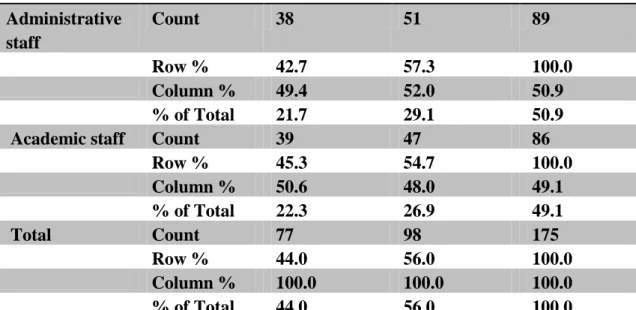
Table 2: Distribution of respondents by categories Category Makerere University Business School Kyambogo University Total Administrative staff Count 38 51 89 Row % 42.7 57.3 100.0 Column % 49.4 52.0 50.9 % of Total 21.7 29.1 50.9
Academic staff Count 39 47 86
Row % 45.3 54.7 100.0 Column % 50.6 48.0 49.1 % of Total 22.3 26.9 49.1 Total Count 77 98 175 Row % 44.0 56.0 100.0 Column % 100.0 100.0 100.0 % of Total 44.0 56.0 100.0
Source: primary data
Out of the 89 administrative staff involved in the study, 38 were from Makerere university business school representing 42.7% of the total administrative staff involved in the study and 51 were from Kyambogo University representing 57.3% of the total administrative staff involved in the study.
Out of the 86 respondents who were academic staff, 39 were from Makerere university business school representing 45.3% of the total academic staff and 47 were from Kyambogo university representing 54.7% of the total academic staff. Out of the total population of the respondents, Makerere university business school provided 77 respondents representing 44% of the total population and Kyambogo University provided 98 respondents representing 56% of the total population.
Table 3: Distribution of respondents by Sex Sex of respondent Makerere University Business School Kyambogo University Total Male Count 40 52 92 Row% 43.5 56.5 100.0 Column % 51.9 53.1 52.6 % of Total 22.9 29.7 52.6 Female Count 37 46 83 Row % 44.6 55.4 100.0 Column % 48.1 46.9 47.4 % of Total 21.1 26.3 47.4 Total Count 77 98 175 Row % 44.0 56.0 100.0 Column % 100.0 100.0 100.0 % of Total 44.0 56.0 100.0
Source: primary data
Out of the total male count of 92, 40 were from Makerere university business school representing 43.5% of the total and 52 were from Kyambogo University representing 56.5% of the total.
Out of the total female count of 83, 37 were from Makerere university business school representing 44.6% of the total and 46 were from Kyambogo University representing 55.4% of the total. Comparing the numbers there were more male respondents than female respondents. The research also noted that both institutions had more men employees in both categories of the respondents than women.
Table 4: Distribution of respondents by being on the government pay roll Being on the government pay roll Makerere University Business School Kyambogo University Total Yes Count 68 78 146 Row % 46.6 53.4 100.0 Column % 88.3 79.6 83.4 % of Total 38.9 44.6 83.4 No Count 9 20 29 Row % 31.0 69.0 100.0 Column % 11.7 20.4 16.6 % of Total 5.1 11.4 16.6 Total Count 77 98 175 Row % 44.0 56.0 100.0 Column % 100.0 100.0 100.0 % of Total 44.0 56.0 100.0
Source: Primary data
Out of the total number of 146 respondents on government pay roll 68 were from Makerere university business school and 78 were from Kyambogo University. Out of 29 respondents not of government pay roll 9 were from Makerere university business school and 20 were from Kyambogo University.
The research showed that the institutions had more respondents on government payroll and Kyambogo University had more respondents who were not on government payroll. The results also showed that there are more employees on government pay roll as compared to those who are not. Kyambogo University had more employees on government pay roll as compared to Makerere university business school.
However again the results also showed that Kyambogo University had more respondents who are not on government pay roll than Makerere university business school.
29
Table 5: Distribution of respondents by Age
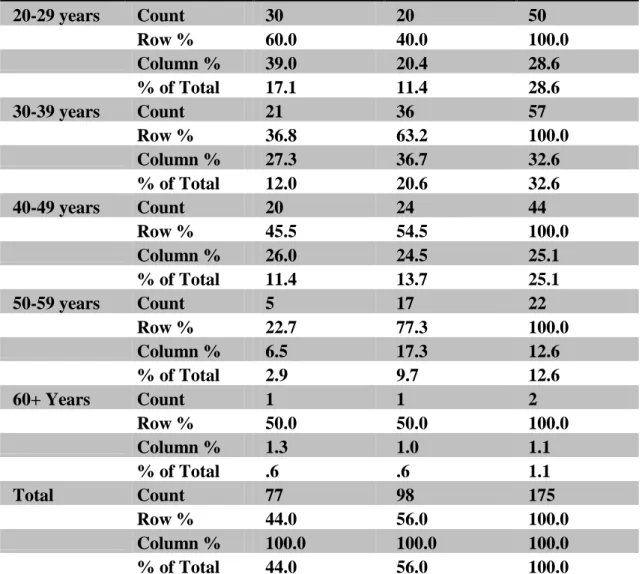
Age Makerere University Business School Kyambogo University Total 20-29 years Count 30 20 50 Row % 60.0 40.0 100.0 Column % 39.0 20.4 28.6 % of Total 17.1 11.4 28.6 30-39 years Count 21 36 57 Row % 36.8 63.2 100.0 Column % 27.3 36.7 32.6 % of Total 12.0 20.6 32.6 40-49 years Count 20 24 44 Row % 45.5 54.5 100.0 Column % 26.0 24.5 25.1 % of Total 11.4 13.7 25.1 50-59 years Count 5 17 22 Row % 22.7 77.3 100.0 Column % 6.5 17.3 12.6 % of Total 2.9 9.7 12.6 60+ Years Count 1 1 2 Row % 50.0 50.0 100.0 Column % 1.3 1.0 1.1 % of Total .6 .6 1.1 Total Count 77 98 175 Row % 44.0 56.0 100.0 Column % 100.0 100.0 100.0 % of Total 44.0 56.0 100.0
Source: Primary data
The study revived that most of the respondents are in the age group of 30-39 years. However, in the age group 20-29 years, Makerere university business school had more in this group than Kyambogo University. In the age group of 60+ years the institutions had the same number.
Table 6: Distribution of respondents by higher education level attained Age Makerere University Business School Kyambogo University Total Certificate Count 1 3 4 Row % 25.0 75.0 100.0 Column % 1.3 3.1 2.3 % of Total .6 1.7 2.3 Diploma Count 10 10 20 Row % 50.0 50.0 100.0 Column % 13.0 10.2 11.4 % of Total 5.7 5.7 11.4 Degree Count 20 35 55 Row % 36.4 63.6 100.0 Column % 26.0 35.7 31.4 % of Total 11.4 20.0 31.4 Post graduate qualification Count 46 50 96 Row % 47.9 52.1 100.0 Column % 59.7 51.0 54.9 % of Total 26.3 28.6 54.9 Total Count 77 98 175 Row % 44.0 56.0 100.0 Column % 100.0 100.0 100.0 % of Total 44.0 56.0 100.0
Source: primary data
Both institutions had more employees in the group of post graduate qualification. Kyambogo University and Makerere University business school had the same number of respondents in the group of diploma.
Correlations of the variables
This carried out to determine the degree of relationship between the variables. The researcher used Pearson’s correlation coefficient. Basically Pearson’s coefficient carried out to answer the research questions below;
1. What is the relationship between reward systems and job satisfaction?
2. What is the relationship between reward systems and organizational commitment?
3. What is the relationship between reward systems and employee performance?
4. What is the relationship between job satisfaction and organizational commitment?
5. What is the relationship between job satisfaction and employee performance?
6. What is the relationship between organizational commitment and employee performance?
Table 8: Correlation between reward systems, job satisfaction, organizational commitment and employee performance
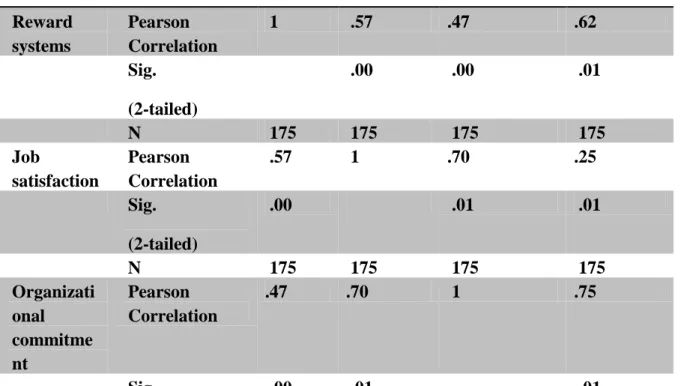
Variables Reward systems Job satisfactio n Organization al commitment Employee performanc e Reward systems Pearson Correlation 1 .57 .47 .62 Sig. (2-tailed) .00 .00 .01 N 175 175 175 175 Job satisfaction Pearson Correlation .57 1 .70 .25 Sig. (2-tailed) .00 .01 .01 N 175 175 175 175 Organizati onal commitme nt Pearson Correlation .47 .70 1 .75 Sig. (2-tailed) .00 .01 .01 N 175 175 175 175 employee performan ce Pearson Correlation .61 .25 .75 1 Sig. (2-tailed) .01 .01 .01 N 175 175 175 175 p ≤ 0.01
Source: primary data
What is the relationship between reward systems and job satisfaction?
The study discovered that reward systems had a significant positive correlation with the job satisfaction (r=.57, p ≤ .00)
This shows that any change in the levels of reward system given to academic and administrative staff of these two institutions is associated with the level of job satisfaction.
What is the relationship between reward systems and organizational commitment?
The study discovered that reward systems had a significant positive correlation with organizational commitment (r=.47, p ≤ .00).
This finding shows that the study agrees with the assumption that changes in the reward systems are associated to the level of organizational commitment among the study group.
What is the relationship between reward systems and employee performance? The findings showed that there is a significant positive relationship between reward systems and employee performance. (r=.62, and p≤.01).
This means that any change in the rewards given has an associated effect on the performance of these employees.
What is the relationship between job satisfaction and organizational commitment?
The findings showed a strong correlation between job satisfaction and organizational commitment which was r=.70. The finding also showed a significant relationship between job satisfaction and organizational commitment of p≤.01. This means that rate of job satisfaction associated to the organizational commitment of the employees in these institutions.
What is the relationship between job satisfaction and employee performance? The results showed a strong correlation between job satisfaction and employee performance of r=.25 and the study also discovered the significant relationship between the variables of p≤.01. Thus a change in the level of job satisfaction is associated to the change in employee performance levels.
What is the relationship between organizational commitment and employee performance?
The results showed a positive significant relationship and correlation between the variables with r=.75 and p≤.01.
This finding means that a change in organizational commitment is associated to the levels of employee performance.
Regression analysis
This was used to find the influence of the independent variables (reward systems, job satisfaction and organizational commitment) on the dependent variable (employee performance).
Table 9: Regression analysis
A Dependent Variable: Employee Performance Source: primary data
The table shows that;
The R Square at .38 and adjusted R Square at .31, means that the variables indicate a 38.4% prediction potential for employee performance which represents that the model has a 38.4% prediction and reliability capacity. Hence reward systems, job
Coefficientsa Model Unstandardized Coefficients Standardized Coefficients t Sig. Rsq Adjusted r F Sig .38 .31 3.393 0.3 B Std. Error Beta 1 (Constant) 2.0 .66 3.12 .00 Reward systems .40 .18 .36 2.21 .04 Job satisfaction .12 .22 .10 .54 .11 Organizational commitment 7.40 .17 .07 2.56 .43
satisfaction and organizational commitment can predict 31.3% of the variance in employee performance.
Reward systems with B=.40, t= 2.21, Beta= .39, p=.04, is the most statistically significant predictor of employee performance. Well as the other variables of job satisfaction with B= .12, t =.54, Beta =.10 p=.11 and organizational commitment with B = .7.40, t =.2.56, Beta=.07, p=.43 are not significant predictors of employee performance.
A combination of these independent variables appear as statistically significant predictors of engagement (Sig. = .03).
Chapter Five
Discussions, conclusion and recommendations
The study focused on the relationship between reward systems, job satisfaction, organizational commitment and employee performance. This study was carried out in such a way as to indentify whether reward systems, job satisfaction, organizational commitment have an affect on the levels of performance of academic staff and administrative staff of public higher institutions of learning in Uganda.
Discussion of findings
The discussion was guided by the hypothesis relationships:
Reward systems and job satisfaction
The findings of the study discovered that there is a positive relationship between the two variables indicating that a change in rewards given to the academic and administrative staffs in these institutions have a significant effect on their levels of job satisfaction. This means that when the rewards are poor then the level of job satisfaction among these groups will also be low. This finding is supported by other studies which are in agreement with this finding. Painter (1994), states that the salaries given to employees are identified as an important predictor of the level of job satisfaction. Salary was found to be the prime factor for the motivation and job satisfaction of salaried employees of the automobile industry from the results of the survey by Kathawala, Moore and Elmuti (1990).
The survey by Kathawala, Moore, and Elmuti, (1990), tried to asses the various job characteristics and the way the employees ranked them as motivators and
satisfiers. The results showed that rewards given to employees were ranked as the number one job element for job satisfaction. Chong and Nakesvari (2010) in their study of the satisfaction level of Peneng private colleges lecturers found that in order to increase job satisfaction among this group its important to address the rewards and compensation given to these lecturers.
Santhapparaj and Alam (2005) examined the relationship between pay, promotion, fringe benefit, working condition, support of research, support of teaching, and gender with job satisfaction among the academic staffs in private universities in Malaysia. The result showed that pay, promotion, working condition and support of research significantly and positively related to job satisfaction. Olivier and Venter’s (2003) research amongst teachers revealed that teachers were most dissatisfied with their salaries, especially taking into account the after-hours input their jobs demand from them and how negatively their salaries compare with those of people in the private sector and other government departments.
Reward systems and organizational commitment
The study discovered a significant relationship between these variables meaning that reward systems have a significant effect on the levels of organizational commitment among the study population. It is consistent with the results of many studies carried out on the influence of reward systems on organizational commitment. According to McElroy (2001), providing high reward packages could lead to higher organizational commitment through a variety of reasons. First, it allows the organizations to attract a larger pool of applicants from which to selectively recruit. Second, high compensation serves as an indication of how much an organization values its people, thereby enhancing their self-worth and feelings of importance.
Third, tying compensation to performance motivates the employees to exert more effort on behalf of the organization. For these reasons, rewards that are tied to organizational performance are predicts to lead to increased levels of organizational commitment.
Reward systems and employee performance
The findings show that reward systems are significantly correlated with employee performance with positive relationships. This indicates that, reward systems are significant in determining the employee performance of academic and administrative staff of these institutions. A possible explanation of these significant findings is that the respondents attach great value to the rewards given to them by the organizations as a major driver of their performance. Reward systems are considered as number one motivators of their performance. This finding is supported by scholars for example, Brundney and Coundry (1993) in their study on pay for performance, describe various variables that could affect employee performance. These are attitudes towards merit pay, importance of monetary rewards, linkage between pay and performance of an employee and fairness of pay system. They concluded that there is a strong relationship between the type of pay that employees get and their performance.
Job satisfaction and organizational commitment
The research indicates that job satisfaction is positively related to organizational commitment. This suggests that there is a positive link between job satisfaction and organizational commitment. This finding can be supported by the findings of earlier research studies.
Nasurdin and Ramayah (2003) noted that there are few studies that investigated job satisfaction with work commitment among educators. It is believed that satisfied workers will be committed to their job and remain in the organization while
dissatisfied workers will intend to quit. Basically, if the job dimensions meet their needs, the employees will give full commitment. They found no reason for quitting from the organization as they can get what they want. Samad (2005) studied 584 managerial-level of employees in Telekom Malaysia, and reported that job satisfaction did play a positive moderating role in the relationship between organizational commitment and employee performance. When employees are dissatisfied at work, they are less committed and will look for other opportunities to quit. If opportunities are unavailable, they may emotionally or mentally “withdraw” from the organization. Thus, organizational commitment and job satisfaction are correlated and important attitudes in assessing employees’ intention to quit and the overall contribution of the employee to the organization. Many studies across different industries and geographical regions revealed strong correlations between organizational commitment with job satisfaction (Yousef, 2001., Chen, 2007., Lok and Crawford, 2001). Researchers (Maehr, 1989; Rosenholtz, 1989) suggest that the personal investment of employees at all levels is necessary for any effective organisation. Recent research on school effectiveness emphasizes the importance of personal investment and commitment of teachers (Rosenholtz, 1989). Other researchers (Csikzentmihalyi & McCormack, 1986) along with Rosenholtz (1989) indicate that if teachers are dissatisfied with their work lives and lack commitment to their organisations, not only will teachers suffer, but their students will suffer as well. Job satisfaction and employee performance
The study uncovered a positive causal relationship between the two variables. There is positive correlation between job satisfaction and employee performance. This finding is supported by earlier researchers for example Bono, and Patton (2001) found between job satisfaction and employee performance higher among complex jobs for
example professional jobs than for less complex jobs. Therefore job satisfaction is, in fact, predictive of employee performance. Employees, who satisfy with their job, may exert high effort to organization wish to satisfy their employees for getting effective more work done (Nimalathasan, 2010).
Organizational commitment and employee performance
There study also found a strong positive correlation between the two variables. This means that organizational commitment has a strong significant effect on the performance of academic and administrative staff in the institution. The respondents attach their performance heavily on their levels of organizational commitment. Scholars like Kumar Sharad (2006) stated that committed workers always keep the interest of the organization at the top and are not carried by the restraining forces of organizational culture. Venkatachalam (1998) recognized that the concept of Organizational Commitment proved its usefulness not only as a theoretical, empirical predictor, but also as a powerful tool, it can also be used as an aid to achieve higher levels of performance and discipline in an organization. He found that it related to many important outcome variables like employee performance, absenteeism and personnel turnover but more importantly employee performance. Suliman and Lles (2002) also found that all three dimensions of organizational commitment (affective, continuous and normative) were positively correlated with employee performance. Sommersl and Birnbaum (1998) studied the relationship of organizational commitment to employee performance and reported a positive relationship. A study conducted by Chughtai and Zafar (2006), among university teachers of Pakistan concluded that highly committed teachers out perform visa-a-visa uncommitted teachers. Chen, Silverstone and Hung (2006) studied the relationship of the organizational commitment and employee performance. Their research findings