Licensed under Creative Common Page 140
http://ijecm.co.uk/
ISSN 2348 0386
THE EFFECT OF ORGANIZATIONAL CLIMATE ON
ORGANIZATIONAL COMMITMENT WITH JOB
SATISFACTION AS MEDIATING VARIABLE
Swastadiguna
Faculty of Economics and Business, Udayana University, Bali, Indonesia
I Gusti Ayu Manuati Dewi
Faculty of Economics and Business, Udayana University, Bali, Indonesia [email protected]
Abstract
The purpose of this study was to determine the effect of organizational climate and job
satisfaction on organizational commitment and explain the mediating role of job satisfaction on
the effect of organizational climate on organizational commitment. This research was conducted
at Perusahaan Daerah Pasar Kota Denpasar, Bali, Indonesia. Proportionate random sampling is
used to determine the number of samples and the sample are 84 employees. The data were
collect by interview and questionnaires distribution which contain several statements from each
indicator of every variable in this study. Partial Least Square technique is used to analyse the
data. The results showed that organizational climate had positive and significant impact on
organizational commitment that mediated by job satisfaction. The implication of this study are
(1) to support the theoretic concept, literature and previous study results, of which specify that
organizational climate positively and significantly affect job satisfaction and organizational
commitment, (2) the company should pay more attention and create a better organizational
climate as well as the employees job satisfaction so that the employees can show a better
organizational commitment.
Licensed under Creative Common Page 141
INTRODUCTION
Perusahaan Daerah Pasar Kota Denpasar (later called PD Pasar Denpasar) is a regional
company that manages the traditional market in Denpasar, Bali and it participates in improving
the economy especially traditional traders, accommodating labors and creating job. The main
task of their employees is to foster, manage, develop and organize every activity that relate to
the marketing field. Meanwhile employees which are important assets of the company that
should be able to encourage the progress of their company, show low level of commitment with
a low level of attendance. Hanisch and Hulin (1991) state that a low level of attendance can be a reflection of the employee’s low commitment. The importance of employee commitment to the
company should be increased to achieve the vision and mission of the company. This can be
done in various ways, one of which is to create an organizational climate and job satisfaction for
employees. Affandi (2002) stated that organizational climate influences commitment, a good
organizational climate can strengthen employee commitment to work as well as possible. But a
poor organizational climate will weaken employee commitment. Meanwhile Aydogdu and Asikgil
(2011) stated that job satisfaction has a significant positive effect on organizational commitment.
Aside from influencing organizational commitment, organizational climate also affects job
satisfaction. Based on the results of research from Kustianto and Iskhak (2015), organizational
climate has a positive and significant effect on employee job satisfaction.
In other circumstances, the organizational climate can affect organizational commitment
indirectly. Organizational climate can influence organizational commitment by achieving job
satisfaction first, in this case job satisfaction plays a role in mediating the organizational climate
and organizational commitment (Bhaesajsanguan, 2010). This study aims to explain the
influence of organizational climate and job satisfaction on organizational commitment and the
influence of organizational climate on organizational commitment mediated by job satisfaction.
LITERATURE REVIEW
Organizational Climate
Organizational climate is the core circle of human environment within the boundaries of where
the employees in an organization work. Further explained that climate affects every activity in an
organization directly or indirectly and is affected by almost everything that happens in the
organization. The survival and growth of any organization is directly affected by a favorable
climate. Meanwhile Motlagh (2012) defines an organizational climate (sometimes called a
corporate climate) as a process of measuring the “culture” of an organization and the
Licensed under Creative Common Page 142 directly or indirectly by employees, which is assumed to be the main force in influencing
employee behavior.
Job Satisfaction
Job satisfaction according to Yeh (2014) is an important factor for service industry employee
because job satisfaction is assumed as front-line employee attitudes and behavior that
substantially affect costumer perceptions of the service. Job satisfaction is a complex
multi-dimensional concept. Job satisfaction is a positive feeling about work, which results from an
evaluation of its characteristics (Robinns and Judge, 2015). Job satisfaction can be formulated
as a general response of workers in the form of behavior displayed by employees as a result of
perceptions about the matters relating to their work (Johan, 2002).
Organizational Commitment
Allen and Meyer (1991) describe organizational commitment as a psychological state of
employee relations with the organization and it has implications for the decision to continue or
terminate its membership in an organization. Organizational commitment according to Tella et
al. (2017) is a mental condition that binds an individual to a company, a strong desire to remain a member of a particular organization, a person’s readiness to fight and a strong trust and
acceptance of the principles and goals of the organization or company. Azeem (2010) defines
organizational commitment as the level of identification and involvement of employees in an
organization.
Figure 1. Conceptual Framework
HYPOTHESES
The Effect of Organizational Climate on Organizational Commitment
Noordin et al. (2010) in his research stated that the correlation between the majority of
dimensions of the organizational climate and organizational commitment shows that the
Organizational
Climate
Licensed under Creative Common Page 143 organizational climate significantly and positively influences the environment of Malaysian
telecommunication employees. This shows that the better the organizational climate of a
company, the higher the organizational commitment of its employees.
H1: Organizational climate has a positive and significant effect on organizational commitment
The Effect of Organizational Climate to Job Satisfaction
Research conducted by Jyoti (2013) shows that corporate environments that have
administration, regulations and policies, and good treatment of their employees will create a
good organizational climate which can increase employee job satisfaction.
H2: Organizational climate has a positive and significant effect on job satisfaction
The Effect of Job Satisfaction on Organizational Commitment
Azeem (2010) in his research found that job satisfaction is a significant predictor of
organizational commitment. Suma and Lesha (2013) found that the dimensions of the work
itself, boss, promotion and coworkers of job satisfaction variables had a positive effect on
employee organizational commitment, where job satisfaction was one of the important
antecedents of organizational commitment, in other words positive job satisfaction affects
organizational commitment.
H3: Job satisfaction has a positive and significant effect on organizational commitment
The Role of Job Satisfaction in Mediating the Effect of Organizational Climate on
Organizational Commitment
In a study conducted by Bhaesajsanguan (2010) on telecommunications industry employee in
Thailand, there is a positive relationship between organizational climate through job satisfaction
affecting organizational commitment, where organizational commitment is the main result of job
satisfaction. Further explained that the organizational climate does not directly affect
organizational commitment, but the organizational climate still plays an important role and has a
major influence on organizational commitment through job satisfaction, where with better
support and improved working conditions, in this case a conducive organizational climate will
affect employee satisfaction which then causes the employee to become more committed to
their organization.
Licensed under Creative Common Page 144
RESEARCH METHOD
For the survey design, the research instrument used to collect data is a questionnaire consisting
of various statements related to each variable measured on a Likert scale of 1 to 5 scale
(1=strongly disagree, 5=strongly agree). This study used a sample of 84 people from the total
population of 525 employees, calculated by the Slovin method and the sampling technique used
in this study was proportionate random sampling.
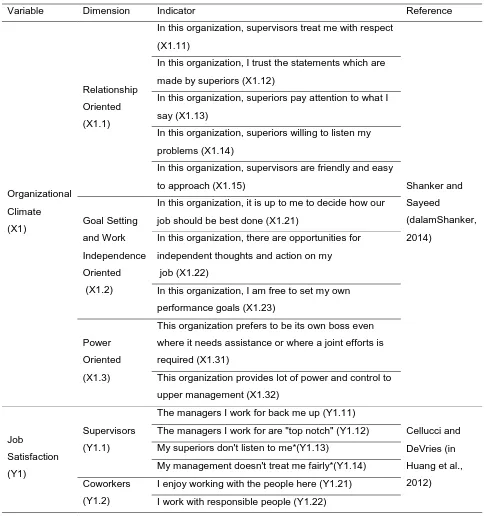
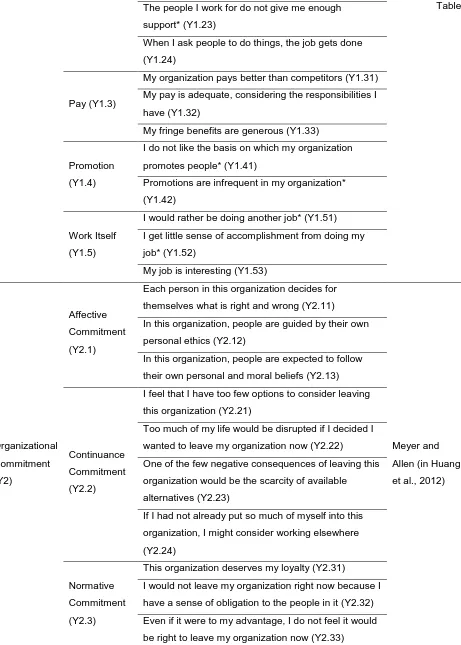
Table 1. Variable Measurement
Variable Dimension Indicator Reference
Organizational Climate (X1) Relationship Oriented (X1.1)
In this organization, supervisors treat me with respect (X1.11)
Shanker and Sayeed
(dalamShanker, 2014)
In this organization, I trust the statements which are made by superiors (X1.12)
In this organization, superiors pay attention to what I say (X1.13)
In this organization, superiors willing to listen my problems (X1.14)
In this organization, supervisors are friendly and easy to approach (X1.15)
Goal Setting and Work Independence Oriented (X1.2)
In this organization, it is up to me to decide how our job should be best done (X1.21)
In this organization, there are opportunities for independent thoughts and action on my job (X1.22)
In this organization, I am free to set my own performance goals (X1.23)
Power Oriented (X1.3)
This organization prefers to be its own boss even where it needs assistance or where a joint efforts is required (X1.31)
This organization provides lot of power and control to upper management (X1.32)
Job
Satisfaction (Y1)
Supervisors (Y1.1)
The managers I work for back me up (Y1.11)
Cellucci and DeVries (in Huang et al., 2012) The managers I work for are "top notch" (Y1.12)
My superiors don't listen to me*(Y1.13)
My management doesn't treat me fairly*(Y1.14) Coworkers
(Y1.2)
Licensed under Creative Common Page 145 The people I work for do not give me enough
support* (Y1.23)
When I ask people to do things, the job gets done (Y1.24)
Pay (Y1.3)
My organization pays better than competitors (Y1.31) My pay is adequate, considering the responsibilities I have (Y1.32)
My fringe benefits are generous (Y1.33)
Promotion (Y1.4)
I do not like the basis on which my organization promotes people* (Y1.41)
Promotions are infrequent in my organization* (Y1.42)
Work Itself (Y1.5)
I would rather be doing another job* (Y1.51) I get little sense of accomplishment from doing my job* (Y1.52)
My job is interesting (Y1.53)
Organizational Commitment (Y2) Affective Commitment (Y2.1)
Each person in this organization decides for themselves what is right and wrong (Y2.11)
Meyer and Allen (in Huang et al., 2012) In this organization, people are guided by their own
personal ethics (Y2.12)
In this organization, people are expected to follow their own personal and moral beliefs (Y2.13)
Continuance Commitment (Y2.2)
I feel that I have too few options to consider leaving this organization (Y2.21)
Too much of my life would be disrupted if I decided I wanted to leave my organization now (Y2.22)
One of the few negative consequences of leaving this organization would be the scarcity of available alternatives (Y2.23)
If I had not already put so much of myself into this organization, I might consider working elsewhere (Y2.24)
Normative Commitment (Y2.3)
This organization deserves my loyalty (Y2.31)
I would not leave my organization right now because I have a sense of obligation to the people in it (Y2.32) Even if it were to my advantage, I do not feel it would be right to leave my organization now (Y2.33)
Licensed under Creative Common Page 146
ANALYSIS AND RESULTS
Data were collected at PD Pasar Denpasar, Bali. Based on age characteristics, the majority of
respondent are more than 41 years of age as many as 48 people (46.4%). Respondents are
dominated by female employee of 58.3% or as many as 49 people. Meanwhile the level of
education of respondents dominated by employees with high school education level as many as
55 people (54.8%) and the working period of employees over 9 years dominated by 69% or as
many as 58 people, followed by employees with working period of less than 4 years are 12
people (14.3%), 5-8 years are 14 people (16.7%).
The goodness of fit is a structural model of the inner model tested using predictive value – relevance (Q2). Q-Square predictive relevance can measure how well the observation value is
generated by the model and its estimated parameters. The R2 value of each endogenous
variable in this study can be seen in Table 2 below.
Table 2. R-square
Endogenous Variable R-Square
Job Satisfaction (Y1) 0,368 Organizational Commitment (Y2) 0,546
It is necessary to calculate Q-square to measure how well the observation value is generated by
the model and also the parameter estimation as follows: Q2 = 1 – (1 – R12) (1 – R22) = 1 – (1 – 0,368) (1 – 0,546)
Q2 = 0,7131
Based on the calculation above, the predictive – relevance value is 0.7131 where this value>0,
it can be said that 71.31% variation in the organizational commitment variable is explained by
the variables used in the model. The remaining 28.69% is explained by the other factors outside
the model. Therefore it can be concluded that this model has relevant predictive values.
The hypotheses of this study were tested using Partial Least Square (PLS). The results
are shown in Table 3 below.
Table 3. Hypotheses Testing Result
Independent Variable Dependent Variable Path
Coefficients t-statistics Result
Licensed under Creative Common Page 147 Direct effect of organizational climate to organizational commitment with value 0.357 and
statistics 3.094. Direct effect of organizational climate to job satisfaction with value 0.606 and
t-statistics 8.715. Direct effect of job satisfaction to organizational commitment with value 0.465
and t-statistics 3.486. From these results, it can be seen that all hypotheses have significant
value greater than the t-table value (>1.960). Therefore it can be stated that all hypotheses with
direct effect are significant which means that all hypotheses are accepted.
Table 4. Hypotheses Testing Result
Path
Coefficients t-statistics p-values Result
Organizational Climate (X1) ->Job Satisfaction (Y1) Organizational Climate (X1) ->
Organizational Commitment (Y2) 0,282 3,426 0,001 Significant Job Satisfaction (Y1) ->
Organizational Commitment(Y2)
From Table 4, it can be seen that t-statistics is greater than 1.960 (t-table) and p-values of 0.001
which is smaller than 0.05. It can be concluded that the fourth hypothesis is acceptable, which is
the organizational climate has a positive effect on organizational commitment mediated by job
satisfaction.
Another method can be used to examine the mediating effect between variables, the
method applied by Hair et al. (2010). This method is carried out through four steps below:
a. Examine the effect of independent variables on the dependent variable on the model by
involving mediating variable (A effect).
b. Examine the effect of independent variables on the dependent variable on the model
without involving mediating variable (B effect).
c. Examine the effect of independent variables on the mediating variable in the model (C
effect).
d. Examine the effect of mediating variables on the dependent variable on the model (D
Licensed under Creative Common Page 148 Table 5. Path Coefficients Results with PLS
Original Sample (O)
Sample Mean (M)
Standard Deviation (STDEV)
t-statistics
Organizational Climate
->Job Satisfaction 0.606 0.615 0.07 3.094 Organizational Climate
->Organizational
Commitment 0.357 0.37 0.116 8.715
Job Satisfaction ->
Organizational Commitment 0.465 0.452 0.134 3.486
From Table 5, organizational climate effect on job satisfaction has a greater t-statistic value than
1.96, so the C effect is significant (hypothesis 2). The effect of job satisfaction on organizational
commitment has a greater value than 1.96, so the D effect is significant (hypothesis 3). Based
on the results, the effect of organizational climate on organizational commitment that mediated
by job satisfaction has a greater t-statistics value than 1.96, the A effect is significant
(hypotheses 4), so the A, C and D effect are significant indicating that job satisfaction mediates
the effect of organizational climate on organizational commitment partially.
DISCUSSION AND CONCLUSION
Based on the H1 hypothesis test, organizational climate has a positive and significant effect on
organizational commitment which means that a good organizational climate in a company can
improve organizational commitment. When a company shows a good relationship between
employees and superiors, well enough setting goals and employee work independence and
good enough power in the company, then the organizational commitment will be better.
Employees that feel a good organizational climate will feel comfortable and that will make them
feel committed to the company or organization. Suarningsih et al. (2013) (2013) in his research
stated that there was a significant and positive direct effect of the organizational climate effect
on organizational commitment.
The Partial Least Square test result of H2 hypotheses in this also supported by the
previous study research by Hashemi & Sadeqi (2016) which states that there is a significant
relationship between elements of the organizational climate and job satisfaction where high job
Licensed under Creative Common Page 149 well. This means a good organizational climate management will be able to improve employee
job satisfaction.
Based on the result of the H3 hypotheses test, job satisfaction has a positive and
significant effect on organizational commitment. When employees are satisfied with aspects of
job satisfaction such as attitudes of superiors, coworkers' support, salaries, promotions and the
work itself, the employee's commitment will be even higher which is indicated by the attitude of
employees who will maintain their membership, high loyalty and sacrifice for the company.
These results are in line with the research of Azeem (2010) that the dimensions of job
satisfaction are work itself, salary, boss, promotion opportunities and co-workers have an
influence on organizational commitment
And the last hypotheses test result on H4 show the companies that are able to form a
good organizational climate will be able to improve employee job satisfaction and then this high job satisfaction will create employees’ organizational commitment for the better. This result is in
line with research from Kesawa et al. (2016) which states that job satisfaction becomes a
mediating indirect effect between organizational climate and organizational commitment. Further
explained that to maintain employee organizational commitment, management must pay close
attention to the conducive organizational climate and fulfillment of employee job satisfaction. In
addition to the results of the that study, Kustianto et al. (2013) in his research also mentions a
conducive climate will lead to high job satisfaction so that it will create a high sense of
organizational commitment to employees.
LIMITATIONS AND FUTURE RESEARCH
This research has several weaknesses in general. (1) The scope of this study is small with a
small number of samples, the future research need to increase the scope of study, not only in
one area and increase the number of samples to generalize the results of study. Increasing the scope of research will reach the characteristic of other respondents, which aren’t only in the
regional market service sector. (2) Analyze the results of the data using second order method to
obtain more results in describing the relationship between dimensions of the research variables.
IMPLICATIONS
The implication of this study are (1) to support the theoretic concept, literature and previous
study results, of which specify that organizational climate positively and significantly affect job
satisfaction and organizational commitment, (2) the company should pay more attention and create a better organizational climate as well as the employee’s job satisfaction so that the
Licensed under Creative Common Page 150
REFERENCES
Affandi, H.M. 2002. PengaruhIklimOrganisasiTerhadapKepuasanKerja, KomitmendanKinerjaPegawai (StudiKasusPadaPegawai Di LingkunganPemerintah Kota Semarang). Tesis. Program Magister ManajemenUniversitasDiponegoro.
Aydogdu, S. and Asikgil, B. 2011. An Empirical Study of The Relationship Among Job Satisfaction Organizational Commitment And Turnover Intention. International Review of Management and Marketing, Vol. 1, No. 3, pp. 43-53. Azeem, S.M. 2010. Job Satisfaction and Organizational Commitment Among Employees in The Sultanate of Oman. Psychology, Vol. 1, pp. 295-299.
Azwar, S. 2013. Metode Penelitian. Yogyakarta: Pustaka Pelajar.
Bahrami, M.A., Barati, O., Ghoroghchian, M., Montazer-alfaraj, R. and Ezzatabadi, M.R. 2016. Role of Organizational Climate in Organizational Commitment: The Case of Teaching Hospitals. Osong Public Health Res Perspect, Vol.7, No. 2, pp. 96-100.
Bhaesajsanguan, S. 2010. The Relationships Among Organizational Climate, Job Satisfaction And Organizational Commitment In The Thai Telecommunication Industry. E-Leader Singapore.
Bungin, B. 2015. MetodologiPenelitianSosialdanEkonomi: Format-format KuantitatifdanKualitatifuntukStudiSosiologi, KebijakanPublik, Komunikasi, Manajemen, danPemasaran. Jakarta: Prenadamedia Group.
Carson, C.M. 2005. A Historical View of Douglas McGregor’s Theory Y. Management Decision, Vol. 43, No. 3, pp. 450-460.
Fitriastuti, T. 2013. PengaruhKecerdasanEmosional, KomitmenOrganisasionaldanOrganizational Citizenship BehaviourterhadapKinerjaKaryawan. JurnalDinamikaManajemen, Vol. 4, No. 2, hal. 103-114.
Gbadamosi, L. and Nwosu, J.C. 2011. Entrepreneurial Intention, Organizational Justice and Job Satisfaction as Determinants of Employees’ Organizational Commitment: Evidence from Babcock University Nigeria. Proceedings of Informing Science & IT Education Conference (InSITE), pp. 205-211.
Ghozali, I. 2005. Aplikasi Analisis Multivariat dengan Program SPSS. Semarang: Badan Penerbit Universitas Diponegoro.
Goi, M. T. 2014. Impact of Organizational Climate on Intentions to Leave and Job Satisfaction. World Journal Of Management, Vol. 5, No. 2, pp. 14-24.
Hair, J.F.J., Black, W.C., Babin, B.J., and Anderson, R.E. 2010. Multivariate Data Analyze, 7th Edition. New York: Pearson.
Hammer, T.H., Landau, J.C., and Stern, R.N. 1981. Absenteeism When Worker Have a Voice: The Case of Employee Ownership. Journal of Applied Psychology, Vol. 66, No. 5, pp. 561-573.
Hanisch, K.A. and Hulin, C.L. 1991. General Attitudes and Organizational Withdrawal: An Evaluation of Causal Model. Journal of Vocational Behaviour, Vol. 39, pp. 110-128.
Hashemi, J. and Sadeqi, D. 2016. The Relationship Between Job Satisfaction and Organizational Climate: A Case Study of Government Departments in Divandarreh. World Scientific News, Vol. 45, No. 2, pp. 373-383.
Hassan, S., Wright, B.E., and Yukl, G. 2014. Does Ethical Leadership Matter in Government ? Effects on Organizational Commitment, Absenteeism, and Willingness to Report Ethical Problems. Public Administration Review, Vol. 74, Iss. 3, pp. 333-343.
Huang, C.C., You, C.S., and Tsai, M.T. 2012. A Multidimensional Analysis of Ethical Climate, Job Satisfaction, Organizational Commitment, and Organizational Citizenship Behaviors. Nursing Ethics, Vol. 19, No. 4, pp. 513-529. Husein, U. 2009. Metode Penelitian untuk Skripsi dan Tesis Bisnis, Edisi Kedua. Jakarta: PT.Raja Grafindo Persada. Indriantoro, N. danSupomo, B. 2012. MetodologiPenelitianBisnis. EdisiPertama. Yogyakarta: FakultasEkonomika&Bisnis UGM.
Johan, R. 2002. KepuasanKerjaKaryawanDalamLingkunganInstitusiPendidikan. JurnalPendidikanPenabur, No.01/Th.I/Maret 2002, hal. 6-31.
Joo, B.K. and Park, S. 2009. Career Satisfaction, Organizational Commitment And Turnover Intention: The Effects Of Goal Orientation, Organizational Learning Culture And Developmental Feedback. Leadership & Organization Development Journal, Vol. 31, No. 6, pp. 482-500.
Licensed under Creative Common Page 151
Kesawa, M.W., Supartha, W.G., danSubudi, M. 2016.
PengaruhIklimOrganisasiterhadapKepuasanKerjadanKomitmenOrganisasionalpada PT. SukaPandawa.E-JurnalEkonomidanBisnisUniversitasUdayana, Vol. 5, No. 8, hal. 2665-2694.
Kusmaningtyas, A. 2013. PengaruhIklimOrganisasi Dan KepemimpinanTerhadapKepuasanKerjaKaryawan PT. Persada Jaya Indonesia Di KabupatenSidoarjo. JurnalMitraEkonomi Dan ManajemenBisnis, Vol. 4, No. 1, hal. 107-120.
Kustianto, F. danIskhak, A.A. 2015.
PengaruhIklimOrganisasiTerhadapKomitmenKaryawanDenganKepuasanKerjaSebagaiVariabel Intervening Pada PT Garam (Persero). JurnalIlmuManajemen MAGISTRA, Vol. 1, No. 1, hal. 42-55.
Luthans, F. 2006. PerilakuOrganisasiEdisiSepuluh. Andhika, V. (Penerjemah). Yogyakarta: Andi.
Mangkunegara, A.P. 2005. ManajemenSumberDayaManusia, CetakanKeenam. Bandung: PT. RemajaRosdakarya. Meyer, J.P. and Allen, N.J. 1991. A Three Component Conceptualization of Organizational Commitment. Human Resources Management Review, Vol. 1, No. 1, pp. 61-89.
Motlagh, F.S. 2012. The Relationship Between Organizational Climate, Job Involvement And Organizational Trust With Organizational Justice: A Case Study Of Hospital Systems Of Isfahan City, Iran. African Journal of Business Management, Vol. 6, No. 9, pp. 3262-3266.
Noordin, F., Omar, S., Sehan, S. and Idrus, S. 2010. Organizational Climate And Its Influence On Organizational Commitment. International Bussiness& Economics Research Journal, Vol. 9, No. 2, pp. 1-11.
Patterson, M.G., West, M.A., Shackleton, V.J., Dawson, J.F., Lawthom, R., Maitlis, S., Robinson, D.L., Wallace, A.M. 2005. Validating The Organizational Climate Measure: Links To Managerial Practices, Productivity And Innovation. Journal of Organizational Behavior, Vol. 26, pp. 379–408.
Powell, D.M. and Meyer, J.P. 2003. Side-Bet Theory and The Three-Component Model of Organizational Commitment. Journal of Vacational Behavior, Vol. 65, pp. 157-177.
Purwanto. 2010. MetodologiPenelitianKuantitatifUntukPsikologi Dan Pendidikan. Yogyakarta :PustakaPelajar. Rahimic, Z. 2013. Influence Of Organizational Climate On Job Satisfaction In Bosnia And Herzegovina Companies. International Business Research, Vol. 6, No. 3, pp. 129-139.
Rehman, K., Rehman, Z., Saif, N., Khan, A.S., Nawaz, A. and Rehman, S. 2013. Impact of Job Satisfaction on Organizational Commitment: A Theoretical Model for Academicians in HEI of Developing Country like Pakistan. International Journal of Academic Research in Accounting, Finance and Management Sciences, Vol. 3, No. 1, pp. 80-89.
Riduwan. 2005. Belajar Mudah Penelitian untuk Guru, Karyawan dan Peneliti Pemula. Bandung: Salemba Empat. Robbins, S.P. dan Judge, T.A., 2015. Organizational Behaviour, 16th ed. RatnaSaraswati&FabriellaSirait (Penerjemah). PerilakuOrganisasi, Edisi 16. Jakarta: SalembaEmpat.
Saputra, A. danWibawa, A. 2018. PengaruhKepuasanKerja, KeadilanOrganisasional, danPemberdayaanKaryawanterhadapKomitmenOrganisasionalKaryawan. E-JurnalManajemenUnud, Vol. 7, No. 6, hal. 3201-3229.
Setyanto, A., SuharnomodanSugiono. 2013.
AnalisisPengaruhKepuasanKerjadanIklimOrganisasiTerhadapKeinginanKeluar (Intention to Quit) (Pada Perusahaan Perkebunan KelapaSawitTeladan Prima Group). JurnalStudiManajemen&Organisasi, Vol. 10, No. 1, hal.75-81. Shanker, M. 2014. A Study on Organizational Climate in Relation to Employees’ Intention to Stay. Journal of Psychosocial Research, Vol. 9, No.2, pp.389-397.
Singh, R.R., Chauhan, A., Agrawal, S., and Kapoor, S. 2011. Impact of Organizational Climate on Job Satisfaction: A Comparative Study. International Journal of Computer Science and Management, Vol. 11, Iss. 02, pp. 9-18.
Suarningsih, N.L.P., Alamsyah, A., danThoyib, A. 2013. PengaruhIklimOrganisasiTerhadapKomitmenOrganisasional Dan KinerjaKaryawan Di RumahSakit. JurnalAplikasiManajemen, Vol. 11, No. 2, hal. 233-240.
Sugiyono. 2013. StatistikaUntukPenelitian. Bandung: CV Alfabeta.
Licensed under Creative Common Page 152 Suma, S. and Lesha, J. 2013. Job Satisfaction and Organizational Commitment: The Case of Shkodra Municipality. European Scientific Journal, Vol. 9, No. 17, pp. 41-51.
Surachim, A. danFirdaus, T. 2008.
PengaruhIklimOrganisasiTerhadapKepuasanKerjaKaryawanPadaDivisiPharmaserve Di PT. Combiphar Jakarta. Jurnal Strategic, Vol. 7, No. 13, hal. 59-64.
Susanty, E. 2012. PengaruhIklimOrganisasiTerhadapKepuasanKerjadanKomitmenKaryawanpadaUniversitas Terbuka. JurnalOrganisasidanManajemen, Vol. 8, No. 2, hal. 121-134.
Tella, A., Ayeni, C.O., and Popoola, S.O. 2007. Work Motivation, Job Satisfaction, and Organizational Commitment of Library Personnel in Academic and Research Libraries in Oyo State, Nigeria. Library Philosophy and Practice. Waspodo, A., Handayani, N. C., danParamita, W. 2013. PengaruhKepuasanKerja Dan StresKerjaTerhadapTurnover Intention PadaKaryawan PT. Unitex Di Bogor. JurnalRisetManajemenSains Indonesia, Vol. 4, No. 1, hal. 97-115. Wibisono, A. 2011. PengaruhIklimOrganisasiterhadapKepuasanKerja (StuditentangPengaruhIklimOrganisasiterhadapKepuasanKerjaPegawaiPuskesmasTuren di Malang). JurnalAplikasiManajemen, Vol. 9, No. 3, hal. 1000-1010.
Yamin, S. dan Kurniawan, H. 2009. Structural Equation Modeling. Belajar Lebih Mudah Teknik Analisis Data Kuesioner dengan Lisrel-PLS. Jakarta: Salemba Infotek.
Yeh, Y.P. 2014. Exploring The Impacts Of Employee Advocacy On Job Satisfaction And Organizational Commitment: Case Of Taiwanese Airlines. Journal of Air Transport Management, Vol. 36, pp. 94-100.