University of Louisville
University of Louisville
ThinkIR: The University of Louisville's Institutional Repository
ThinkIR: The University of Louisville's Institutional Repository
Faculty Scholarship
2019
An Explainable Autoencoder For Collaborative Filtering
An Explainable Autoencoder For Collaborative Filtering
Recommendation
Recommendation
Pegah Sagheb Haghighi
University of Louisville
Olurotimi Seton
University of Louisville
Olfa Nasraoui
University of Louisville, [email protected]
Follow this and additional works at:
https://ir.library.louisville.edu/faculty
Part of the
Computer Engineering Commons
, and the
Computer Sciences Commons
ThinkIR Citation
Haghighi, Pegah Sagheb; Seton, Olurotimi; and Nasraoui, Olfa, "An Explainable Autoencoder For
Collaborative Filtering Recommendation" (2019). Faculty Scholarship. 429.
https://ir.library.louisville.edu/faculty/429
This Article is brought to you for free and open access by ThinkIR: The University of Louisville's Institutional Repository. It has been accepted for inclusion in Faculty Scholarship by an authorized administrator of ThinkIR: The University of Louisville's Institutional Repository. For more information, please contact [email protected].
An Explainable Autoencoder For Collaborative Filtering
Recommendation
Pegah Sagheb Haghighi
Knowledge Discovery and Web Mining Lab, Dept. of Computer Science and Engineering, University
of Louisville Louisville
Olurotimi Seton
Knowledge Discovery and Web Mining Lab, Dept. of Computer Science and Engineering, University
of Louisville Louisville
Olfa Nasraoui
Knowledge Discovery and Web Mining Lab, Dept. of Computer Science and Engineering, University
of Louisville Louisville
ABSTRACT
Autoencoders are a common building block of Deep Learning archi-tectures, where they are mainly used for representation learning. They have also been successfully used in Collaborative Filtering (CF) recommender systems to predict missing ratings. Unfortunately, like all black box machine learning models, they are unable to ex-plain their outputs. Hence, while predictions from an Autoencoder-based recommender system might be accurate, it might not be clear to the user why a recommendation was generated. In this work, we design an explainable recommendation system using an Autoencoder model whose predictions can be explained using the neighborhood based explanation style. Our preliminary work can be considered to be the first step towards an explainable deep learning architecture based on Autoencoders.
KEYWORDS
recommender systems, explainability, neural networks, autoen-coder, deep learning
1
INTRODUCTION
The use of information filtering tools that discover or suggest rele-vant and personalized items has become essential to avoid informa-tion overload. For instance, recommender systems assist users by providing them with personalized suggestions. They recommend items in a variety of domains (music, movies, books, travel rec-ommendation, etc). However, the most accurate recommendation models tend to be black boxes [7] that cannot justify why items are recommended to a user. The ability of a recommender system to explain the reasoning of its recommendation can serve as a bridge between humans and recommender systems. Explanations can serve different purposes such as building trust, improving trans-parency and user satisfaction and helping users make informed decisions [7, 14]. Latent factor models have been the state of the art in Collaborative Filtering recommender systems. For instance, Matrix Factorization (MF) learns hidden interactions between enti-ties to predict possible user ratings for items. However, a common challenge with this method is the difficulty of explaining recommen-dations to users using the latent dimensions. To solve this problem, some explainable recommendation algorithms have recently been proposed. For instance, Explicit factor models (EFM) [17] generate explanations based on the explicit features extracted from users’ reviews. Explainable Matrix Factorization (EMF) [1, 3] is another algorithm that uses an explainability regularizer or soft constraint
in the objective function of classical matrix factorization. The con-straining term tries to bring the user and explainable item’s latent factor vectors closer, thus favoring the appearance of explainable items at the top of the recommendation list. When it comes to Autoencoder recommender models however, very little research has been conducted to address the explainability of the predictions. In this paper, we propose an Autoencoder model that finds topn
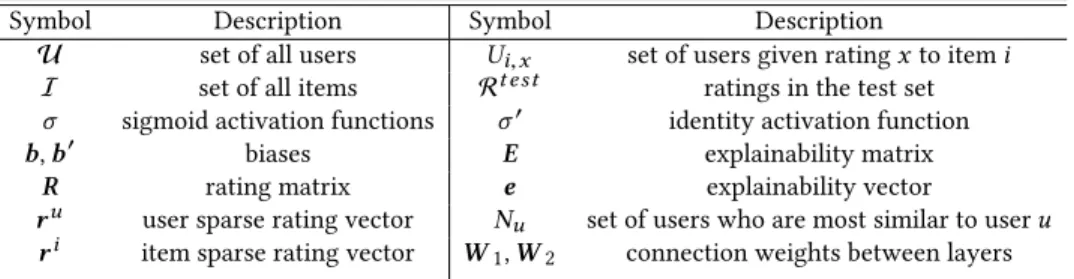
accurate recommendations that are explainable without the use of additional data modalities such as content. The rest of the paper is organized as follows: Section 2 reviews related work, Section 3 presents a novel explainable Autoencoder for Collaborative Filter-ing. Section 4 presents the experimental results. Finally, Section 5 concludes the paper. For clarity, all notations used in this paper are summarized in Table 1.
2
RELATED WORK
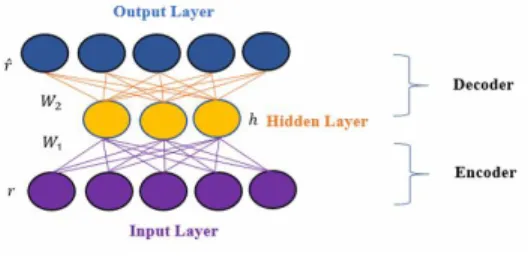
Recently, a growing body of research has involved using neural networks such as Autoencoders for collaborative filtering. An Au-toencoder is an unsupervised learning model and a form of neural network which aims to learn important features of the dataset. Ar-chitecturally, an Autoencoder is a three-layer feed-forward neural network consisting of an input layer, a hidden layer and an output layer. Figure 1 depicts a classical Autoencoder architecture. An Autoencoder consists of two parts, an encoder and a decoder. The encoder maps input features into a hidden representation and the decoder aims to reconstruct the input features from the hidden features [8]. The encoder and decoder may each have a deep archi-tecture which consists of multiple hidden layers. It is worth noting that the output layer has the same dimension or number of neurons as the input layer.
Figure 1:An Autoencoder Architecture
A collaborative filtering based Autoencoder was introduced by Sedhain et al. [11] and Ouyang et al. [10]. They achieved a better
Table 1: Summary of notations
Symbol Description Symbol Description
U set of all users Ui,x set of users given ratingxto itemi
I set of all items Rtest ratings in the test set
σ sigmoid activation functions σ′ identity activation function
b,b′ biases E explainability matrix
R rating matrix e explainability vector
ru user sparse rating vector Nu set of users who are most similar to useru
ri item sparse rating vector W1,W2 connection weights between layers
accuracy than current state-of-the-art methods such as Matrix Fac-torization to predict missing values of the user-item matrix. Their model worked as follows: Given a hidden layer, the encoder sec-tion of an Autoencoder takes the ratings datarof each user and maps it to a latent representationh, see Eq.(1). User preferences are encoded in a sparse matrix of ratingsRϵRm×n, wheremand
nare the number of users and items, respectively.U ={1, ..,m}
represents the set of all users andI = {1, ..,n}represents the set of all items. Each useru ϵUis represented by a sparse vector
r(u)={Ru1, ...,Run}, and each itemi ϵIis represented by a sparse
vectorr(i)={R1i, ...,Rmi}. The hidden or latent representation is
given by
h=σ(W1.r+b) (1)
whereσ is the activation function - in this case the sigmoid function (1+e1−x),W1is a weight matrix, andbis a bias vector.
The decoder maps the latent representationhinto a reconstruc-tion outputrˆgiven by
ˆ
r=σ′(W2.h+b′) (2)
whereσ′is an activation function - in this case Identity. The goal of the Autoencoder is to minimize the reconstruction error by minimizing a reconstruction loss function as follows
minÕ u ∥ru−rˆu ∥2+λ 2.(∥W1 ∥ 2 F +∥W2 ∥F2) (3)
whereλis the regularization term coefficient and||.||is the Frobenius norm.
Wu et al. [15] introduced the Collaborative Denoising Auto-Encoder (CDAE) which has one hidden layer that encodes a latent vector for the user. Strub and Mary [13] proposed a Stacked De-noising AutoEncoders neural network (SDAE) with sparse inputs for recommender systems. [16] developed an Autoencoder model which learns feature representations from side information to im-prove recommendations.
When it comes to neural network models, there are a few re-lated works that focus on explainable recommender systems. Seo et al. [12] designed an interpretable Convolutional Neural Network (CNN) model that predicts ratings using text reviews and ratings data. The authors used two attention layers: a local attention layer and a global attention layer. The local layer learns which keywords
are more informative, whereas the global layer learns word se-quences from the original review. Finally, the outputs of these two layers are combined and passed through the fully connected layers. Costa et al. [6] presented a model based on Long Short Term Memory (LSTM) Recurrent Neural Network (RNN) to automatically generate natural language explanations for recommender systems. The authors tried to improve the work proposed by [9] by consid-ering a vector of auxiliary data instead of only one dimension of auxiliary information. The vector of auxiliary data in their model is a set of rating scores for different features of items.
Chen et al. [5] used both implicit feedback and textual reviews to introduce a visually explainable recommendation. By combining images and reviews, their model generated natural language expla-nations, which could describe the highlighted image regions to the user.
Recently, Bellini et al. [4] introduced the SEM-AUTO approach which makes use of Autoencoders and semantic information via the DBpedia knowledge graph. The authors mapped a set of categorical features of an item into the hidden layers for each user. As a result, this model is capable of retrieving the categorical information of the items rated by the user. The proposed model aims to capture the shared side information of all the items rated by a user. Hence, the information associated with positively rated items get a high value (close to 1), and for those with negatively rated items will tend to be closer to 0. This approach can therefore help Autoencoders find the potential features that match userâĂŹs tastes.
To summarize our review, neural network models and in partic-ular Autoencoders, have recently received increasing attention in the Recommender Systems field. However, like other latent factor models, Autoencoders are black-box models that are unable to pro-vide an explanation for their output. The research questions that we are trying to answer are: (1) Can we generate an explainable Col-laborative Filtering recommender system using the Autoencoder architecture? (2) Can the explainable Autoencoder maintain an accuracy that is comparable to the classical Autoencoder?
3
THE EXPLAINABLE AUTOENCODER
(E-AUTOREC)
Our work is inspired by U-AutoRec [11] and [16] with one im-portant distinction where we feed an explainability vector of the same size as the ratings to additional input layer units in a way that is similar to adding an explainability layer to the Explainable Restricted Boltzmann Machine [2]. The architecture of our model is shown in Figure 2. In [13], the rationale for adding side information
to the Autoencoder inputs in the form of an additional (hybrid) modality such as user profile features, was that when many input ratings are missing, the side information would take over to solve the cold start problem or to alleviate the sparsity of the ratings. In our case, the side information consists of the explainability scores, which likewise can help compensate for the sparsity of the ratings, but unlike the hybrid side information in [13], our side information makes up for lack of rating data using the explainability of an item to a user, which is itself a byproduct of the ratings only and not external or hybrid data. In fact the explainability of an item to a user is derived directly from the rationale of collaborative filtering by aggregating the nearest neighboring usersâĂŹ ratings on that item. In the following, the reader should refer to Table 1 as a reference for all the notation symbols used in our equations.
Figure 2:Explainable AutoEncoder (E-AutoRec)
The proposed encoder takes as input each userâĂŹs ratings vectorrϵRn and a userâĂŹs explainability score vectoreϵRn that is pre-computed offline for each user (calculated as explained in Eq.(6)-(8), similarly to the explainability scores in [3]) and maps them to the latent feature vectorhϵRk, wherekis the number of hidden units, as follows
h=σ(Wr+e1 .(r+e)+b) (4) While both the output, see Eq. (2), and the loss function, see Eq. (3), remain the same. It is worth noting thatW1r+eϵR2×n×kis the connection weight matrix between the hidden layer and the input layer accepting both the ratings and the explainability scores.
We computed the explanation scores offline based on a collabo-rative filtering neighborhood rationale. The nearest neighbors are determined based on the cosine similarity. The explainability score for the user-based neighbor explanation [3] is given by:
Exp.Score(u,i)=E(ru,i|Nu)=
Õ xϵX x×Pr(ru,i =x|u ϵ Nu) (5) where Pr(ru,i =x|v ϵ Nu)= |Nu∩Ui,x| |Nu| (6)
ru,i is the rating userugave to itemi,Ui,xis the set of users who have given the same ratingxto itemi, andNu is the set of neighbors for useru.
The explainability matrix,E, is a thresholded version of the neighborhood explanation scores [3], as follows
Eu,i =
(
Exp.Score(u,i) ifExp.Score(u,i)>θ
0 otherwise (7)
whereθis a user-defined threshold value to accept if itemiis explainable to useru.Exp.Score(u,i)is the expected value calculated
in Eq. (5).
4
EXPERIMENTAL RESULTS
4.1
Data and Metrics
We tested our approach on the MovieLens benchmark data. This dataset consists of 100K ratings on a scale of 1-5, given by 943 users to 1682 movies, where each user has rated at least 20 movies. The rating data was randomly split into 90% training and 10% testing subsets and the ratings were normalized between 0 and 1. We com-pared our results with the user-based AutoRec baseline method [11] which uses the same input as our Autoencoder (that is, ratings). We did not compare to [13] and [16] because they are hybrid ap-proaches benefiting from an additional user feature modality, unlike our pure rating-based collaborative filtering approach. To assess the rating prediction accuracy, we use the Root Mean Squared Error
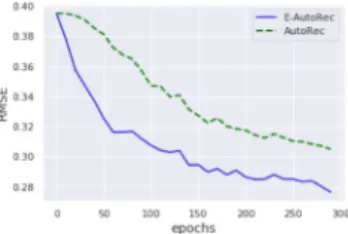
(RMSE), see Eq. (8), for both the AutoRec baseline and the proposed E-AutoRec (Explainable Autoencoder) (as shown in Figure 3) and the Mean Average Precision (MAP) score Eg. (10). We also mea-sured the explainability of the models using the Mean Explainable Precision (MEP) given in Eq. (9), as proposed by [1].
RMSE= r 1 |Rtest| Õ (ru,i−rˆu,i)2 (8)
where|Rtest|is the total number of ratings in the test set,ru,i is the true rating and ˆru,i is the predicted rating for useruand itemi.
Figure 3:RMSE vs epochs on test-set
The Mean Explainability Precision(MEP)for the top-n recom-mended listIur ecis computed as follows: letIur ec be the top-n rec-ommended list for useruandEur ecbe the set of explainable items.
MEP@n= 1 |U | Õ u∈U |Iexp∩ Ir ec| |Ir ec| (9)
whereIexpis the set of explainable items for useru,Ir ecis the set of items in the top-n recommendation list for useru,|Iexp∩ Rr ec|is the number of explainable items present in the top-n rec-ommendation list for useru, and|U |is the number of users in the test-set.
Finally, to evaluate the top-n recommendation performance, we compute the Mean Average Precision(MAP)shown in Figure 4.
4.2
Analysis of Results
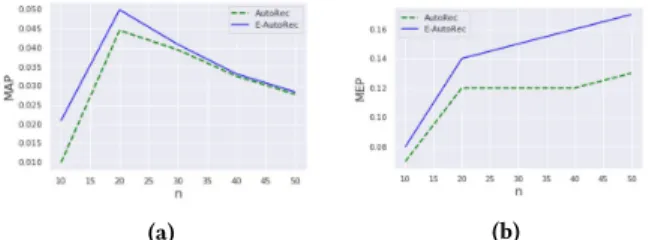
The results in Figure 3-Figure 6, show that the proposed Explainable Autoencoder (E-AutoRec) succeeds to make predictions that are at least as accurate as the baseline Autoencoder (AutoRec), while pro-moting the explainability of the items in the top-n recommendation list (MEP is higher across all tested parameter ranges).
Figure 4 shows the metrics MAP (a) and MEP (b) for both mod-els, as the number of recommended items(n)increases. In all ex-periments where we varied a parameter, we fixed the remaining parameters as follows: The explainability thresholdθ=0, the neigh-borhood size|Nu|=50 and the number of hidden unitsk=300. In the case of top-n recommendations, both models appear to perform well up to a top 20 recommendation list, beyond which both suffer a significant drop in performance (Figure 4a). However, the MEP for both models improves well beyond the top 20 recommended items (Figure 4b).
(a) (b)
Figure 4: (a) MAP and (b) MEP vs.n, the size of the top-n recommendation list
To study the effect of the number of hidden units and neigh-borhood size (used for generating the Explainability Matrix(E)), we varied both values and measured the resulting MAP and MEP metrics, as shown in Figure 5 and Figure 6. These results confirm that the accuracy and explainability are significantly better in E-AutoRec, compared to the baseline E-AutoRec, across all parameter ranges. Although at first, oneâĂŹs intuition is that accuracy has to pay a price for each increase in explainability, this does not occur in E-AutoRec. This is because the explainability values are integrated within the actual machine learning process, and the learning pro-cess is based on the same reconstruction loss function for rating prediction, thus maintaining the prediction accuracy. However ex-plainability is enhanced because the explainabilty scores are used as side information, thus compensating for sparse inputs, and as a re-sult effectively enhancing both the accuracy and the explainability of the predictions.
(a) (b)
Figure 5: (a) MAP and (b) MEP vs. number of hidden units
(a) (b)
(c)
Figure 6: (a) MAP and (b) MEP vs. number of neighbors used to compute the explainability scores (c) MEP vs explainabil-ity thresholdθ
It is worth noting that the neighborhood size used to compute the explainability scores acts like a control parameter that could lead to a trade-off between accuracy and explainability: Notice how more neighbors increases the explainability precision (MEP) but only slightly (and slowly) reduces MAP; however even with this small decrease, MAP for E-AutoRec remains higher than for the non-explainable baseline (AutoRec). We also investigated the effect of the explainability thresholdθon the explainability met-ric(Figure 6c). While our proposed E-AutoRec model maintains its higher explainability in comparison with the conventional AutoRec, the explainability decreases for both methods as we impose more restrictions (higherθ) on the explainability score. This result is ex-pected since a higher threshold reduces the number of explainable items relative to a user (resulting in more zeros in the explainability matrixE).
5
CONCLUSION
We proposed an explainable Autoencoder approach (E-AutoRec) which incorporates user ratings into both the inputs to be recon-structed and user-neighborhood collaborative filtering justified explainability scores as side information. Our experiments showed that E-AutoRec outperforms the baseline in terms of RMSE, ex-plainability and MAP metrics for a wide range of tested parameters. The results demonstrate that using the pre-computed explainability scores as an additional side information fed to the input layer helps the Autoencoder to make predictions that are simultaneously more accurate and explainable. Thus there was no sacrifice in accuracy to pay for the increase in explainability of E-AutoRec. This is be-cause the explainability values are integrated within the actual machine learning process, which keeps the same reconstruction loss function as the pure AutoRec model. However explainability is enhanced specifically because the explainabilty scores are used as side information to compensate for sparse inputs in the Autoen-coder architecture, thus effectively enhancing both the accuracy and the explainability of the predictions. In the future, we plan to
compare the proposed model with additional baseline models and investigate additional explainable Deep Learning architectures.
REFERENCES
[1] Behnoush Abdollahi and Olfa Nasraoui. 2016. Explainable matrix factorization for collaborative filtering.Proceedings of the 25th International Conference Companion on World Wide Web. International World Wide Web Conferences Steering Committee.
(2016), 5–6. https://doi.org/10.1145/2872518.2889405
[2] Behnoush Abdollahi and Olfa Nasraoui. 2016. Explainable restricted Boltzmann machines for collaborative filtering.arXiv preprint arXiv:1606.07129(2016). [3] Behnoush Abdollahi and Olfa Nasraoui. 2017. Using explainability for constrained
matrix factorization.Proceedings of the Eleventh ACM Conference on Recommender Systems. ACM,(2017).
[4] Vito Bellini, Vito Walter Anelli, Tommaso Di Noia, and Eugenio Di Sciascio. 2017. Auto-Encoding User Ratings via Knowledge Graphs in Recommendation Scenarios. InProceedings of the 2nd Workshop on Deep Learning for Recommender Systems. ACM, 60–66.
[5] Xu Chen, Yongfeng Zhang, Hongteng Xu, Yixin Cao, Zheng Qin, and Hongyuan Zha. 2018. Visually Explainable Recommendation.arXiv preprint arXiv:1801.10288
(2018).
[6] Felipe Costa, Sixun Ouyang, Peter Dolog, and Aonghus Lawlor. 2018. Auto-matic Generation of Natural Language Explanations. InProceedings of the 23rd International Conference on Intelligent User Interfaces Companion. ACM, 57. [7] Jonathan L Herlocker, Joseph A Konstan, and John Riedl. 2000. Explaining
collaborative filtering recommendations.Proceedings of the 2000 ACM conference on Computer supported cooperative work(2000), 241–250.
[8] Geoffrey E. Hinton and Ruslan R. Salakhutdinov. 2006. Reducing the di-mensionality of data with neural networks. science 313.5786(2006), 504–507. https://doi.org/10.1126/science.1127647
[9] Zachary C Lipton, Sharad Vikram, and Julian McAuley. 2015. Capturing meaning in product reviews with character-level generative text models.arXiv preprint arXiv:1511.03683(2015).
[10] Yuanxin Ouyang and et al. 2014. Autoencoder-based collaborative filtering.
International Conference on Neural Information Processing. Springer, Cham(2014), 284–291.
[11] Suvash Sedhain, Aditya Krishna Menon, Scott Sanner, and Lexing Xie. 2015. Autorec: Autoencoders meet collaborative filtering. InProceedings of the 24th International Conference on World Wide Web. ACM, 111–112.
[12] Sungyong Seo, Jing Huang, Hao Yang, and Yan Liu. 2017. Interpretable convo-lutional neural networks with dual local and global attention for review rating prediction. InProceedings of the Eleventh ACM Conference on Recommender Sys-tems. ACM, 297–305.
[13] Florian Strub and Jeremie Mary. 2015. Collaborative filtering with stacked de-noising autoencoders and sparse inputs."In NIPS Workshop on Machine Learning for eCommerce."(2015).
[14] Nava Tintarev and Judith Masthoff. 2007. Effective explanations of recommenda-tions: user-centered design.Proceedings of the 2007 ACM conference on Recom-mender systems(2007), 153–156.
[15] Yao Wu, Christopher DuBois, Alice Zheng, and Martin Ester. 2016. Collaborative denoising auto-encoders for top-n recommender systems. Proceedings of the Ninth ACM International Conference on Web Search and Data Mining. ACM,(2016), 153–162. https://doi.org/10.1145/2835776.2835837
[16] Shuai Zhang, Lina Yao, Xiwei Xu, Sen Wang, and Liming. Zhu. 2017. Hybrid collaborative recommendation via semi-autoencoder.International Conference on Neural Information Processing. Springer, Cham(2017).
[17] Yongfeng Zhang, Guokun Lai, Min Zhang, Yi Zhang, Yiqun Liu, and Shaoping Ma. 2014. Explicit factor models for explainable recommendation based on phrase-level sentiment analysis. InProceedings of the 37th international ACM SIGIR conference on Research & development in information retrieval. ACM, 83–92.