RIT Scholar Works
RIT Scholar Works
Theses12-7-2020
Secure Outsourced Computation on Encrypted Data
Secure Outsourced Computation on Encrypted Data
Asma Aloufi [email protected]
Follow this and additional works at: https://scholarworks.rit.edu/theses Recommended Citation
Recommended Citation
Aloufi, Asma, "Secure Outsourced Computation on Encrypted Data" (2020). Thesis. Rochester Institute of Technology. Accessed from
This Dissertation is brought to you for free and open access by RIT Scholar Works. It has been accepted for inclusion in Theses by an authorized administrator of RIT Scholar Works. For more information, please contact [email protected].
Secure Outsourced Computation on Encrypted Data
by
Asma Aloufi
A dissertation submitted in partial fulfillment of the requirements for the degree of
Doctor of Philosophy
in Computing and Information Sciences
B. Thomas Golisano College of Computing and Information Sciences
Rochester Institute of Technology Rochester, New York
by Asma Aloufi
Committee Approval:
We, the undersigned committee members, certify that we have advised and/or supervised the candidate on the work described in this dissertation. We further certify that we have reviewed the dissertation manuscript and approve it in partial fulfillment of the requirements of the degree of Doctor of Philoso-phy in Computing and Information Sciences.
Dr. Peizhao Hu Date
Dissertation Advisor
Dr. Stanisław Radziszowski Date
Dissertation Committee Member
Dr. Matthew Wright Date
Dissertation Committee Member
Dr. Sumita Mishra Date
Dissertation Committee Member
Dr. Anurag Agarwal Date
Dissertation Defense Chairperson Certified by:
Dr. Pengcheng Shi Date
Ph.D. Program Director, Computing and Information Sciences
iii
© 2020 Asma Aloufi All rights reserved.
by Asma Aloufi Submitted to the
B. Thomas Golisano College of Computing and Information Sciences Ph.D. Program in Computing and Information Sciences
in partial fulfillment of the requirements for the Doctor of Philosophy Degree
at the Rochester Institute of Technology
Abstract
Homomorphic encryption (HE) is a promising cryptographic technique that supports computations on encrypted data without requiring decryption first. This ability al-lows sensitive data, such as genomic, financial, or location data, to be outsourced for evaluation in a resourceful third-party such as the cloud without compromising data privacy. Basic homomorphic primitives support addition and multiplication on ci-phertexts. These primitives can be utilized to represent essential computations, such as logic gates, which subsequently can support more complex functions. We propose the construction of efficient cryptographic protocols as building blocks (e.g., equal-ity, comparison, and counting) that are commonly used in data analytics and machine learning. We explore the use of these building blocks in two privacy-preserving ap-plications. One application leverages our secure prefix matching algorithm, which builds on top of the equality operation, to process geospatial queries on encrypted locations. The other applies our secure comparison protocol to perform conditional branching in private evaluation of decision trees.
There are many outsourced computations that require joint evaluation on pri-vate data owned by multiple parties. For example, Genome-Wide Association Study (GWAS) is becoming feasible because of the recent advances of genome sequencing technology. Due to the sensitivity of genomic data, this data is encrypted using dif-ferent keys possessed by difdif-ferent data owners. Computing on ciphertexts encrypted with multiple keys is a non-trivial task. Current solutions often require a joint key setup before any computation such as in threshold HE or incur large ciphertext size (at best, grows linearly in the number of involved keys) such as in multi-key HE. We
v
propose a hybrid approach that combines the advantages of threshold and multi-key HE to support computations on ciphertexts encrypted with different keys while vastly reducing ciphertext size.
Moreover, we propose the SparkFHE framework to support large-scale secure data analytics in the Cloud. SparkFHE integrates Apache Spark with Fully HE to support secure distributed data analytics and machine learning and make two novel contributions: (1) enabling Spark to perform efficient computation on large datasets while preserving user privacy, and (2) accelerating intensive homomorphic computa-tion through parallelizacomputa-tion of tasks across clusters of computing nodes. To our best knowledge, SparkFHE is the first addressing these two needs simultaneously.
There are many people who I would like to thank for their significant roles through-out this dissertation journey.
My deepest gratitude is to my dissertation advisor, Dr. Peizhao Hu, for his contin-uous guidance, constructive advice, endless patience, and rich learning opportunities throughout my Ph.D. research. I would also like to thank my dissertation committee members, Dr. Stanisław Radziszowski, Dr. Matthew Wright, and Dr. Sumita Mishra, for their invaluable help, insightful feedback, and continuous encouragement.
Further, I would like to thank the Ph.D. program director, Dr. Pengcheng Shi, and the Ph.D. program staff for all the help and advice they provided. I would like to extend my sincere thanks to my collaborators and fellow graduate students with who I had the honor to work and learn from.
Finally, I’m deeply indebted to my family and my friends, my spectacular support system, for their tremendous encouragement and cheering. My gratitude would not be complete without thanking my husband, Rashed, for his unwavering love, faith, and support through this journey, and my beloved son Yazan, who supported me with hugs and joy.
Dedicated to my parents, who taught me to never stop learning, and to my husband Rashed, who supported me through every step of the way.
Contents
1 Introduction 1
1.1 Privacy-preserving Computation . . . 1
1.2 System Models . . . 3
1.3 Security Considerations . . . 5
1.4 Research Questions and Outcomes . . . 6
1.5 Organization . . . 10
2 Background 11 2.1 Lattices and Basis . . . 11
2.2 The Learning with Errors Problem (LWE) . . . 13
2.3 Homomorphic Encryption Primitives and Techniques . . . 14
2.3.1 Key Switching . . . 15
2.3.2 Bootstrapping . . . 16
2.3.3 Noise Reduction Techniques . . . 17
2.3.4 Distributed Decryption . . . 18
2.4 Homomorphic Encryption Schemes . . . 19
2.4.1 Brakerski-Gentry-Vaikuntanathan (BGV) . . . 19
2.4.2 Cheon-Kim-Kim-Song (CKKS) . . . 22
2.4.3 Discussion . . . 24
3 Secure Evaluation of Geospatial Query 26 3.1 Geo-hashing Using Space-Filling Curves . . . 28
3.1.1 Location Referencing . . . 30
3.1.2 Spatial Cloaking . . . 31
CONTENTS ix
3.1.3 Concealing User’s Location and Preferences . . . 32
3.2 Computing on Encrypted Location . . . 33
3.2.1 Query 1: Where is Alice? . . . 34
3.2.2 Query 2: Who is Nearby? . . . 35
3.2.3 Query 3: How Close are Alice and Bob? . . . 36
3.2.4 Threshold Decryption Protocol . . . 41
3.3 Evaluation and Discussion . . . 42
3.3.1 Empirical Results . . . 42
3.3.2 Security Analysis . . . 45
3.4 Conclusions . . . 52
4 Blindfolded Evaluation of Random Forests 54 4.1 Current Solutions . . . 56
4.1.1 Secure Comparison Protocols . . . 57
4.1.2 Secure Evaluation of Decision Trees . . . 58
4.2 Our Proposed Protocol . . . 60
4.2.1 System and Threat Model . . . 60
4.2.2 Efficiency and Privacy Considerations . . . 61
4.2.3 Overview of Proposed Evaluation Steps . . . 62
4.2.4 Evaluating Encrypted Decision Trees . . . 63
4.2.5 Combining and Retrieving Results of a Forest . . . 65
4.3 Evaluation and Discussion . . . 67
4.3.1 Security Analysis . . . 67
4.3.2 Complexity Analysis . . . 68
4.3.3 Empirical Study . . . 69
4.4 Conclusions . . . 72
5 Multi-key Homomorphic Encryption 74 5.1 Survey of Current Techniques . . . 75
5.1.1 Threshold HE (ThHE) . . . 76
5.1.2 Multi-key HE (MKHE) . . . 83
5.2 Proposed Hybrid MKHE Approach (MKHE+) . . . 90
5.2.1 MKHE+Construction . . . 91
5.2.3 Comparison with Related Work . . . 96
5.3 Conclusions . . . 97
6 Distributed Dataflow Framework with FHE 98 6.1 Cluster Programming vs. Distributed Dataflow . . . 99
6.2 Proposed SparkFHE Framework . . . 101
6.2.1 SparkFHE Architecture . . . 102
6.2.2 Programming Abstractions . . . 104
6.2.3 Modeling Algorithms as Dataflow Graphs . . . 108
6.3 Evaluation and Discussion . . . 113
6.3.1 Empirical results . . . 113
6.3.2 Security analysis . . . 117
6.4 Conclusions . . . 118
7 Conclusions and Future Work 119 7.1 Conclusions . . . 119 7.2 Future Work . . . 120 Appendices 141 A HE Schemes 142 A.1 Brakerski/Fan-Vercauteren (BFV) . . . 142 A.2 Gentry-Sahai-Waters (GSW) . . . 144
List of Figures
1.1 System models for secure computation . . . 4
2.1 Examples of different lattice bases . . . 12
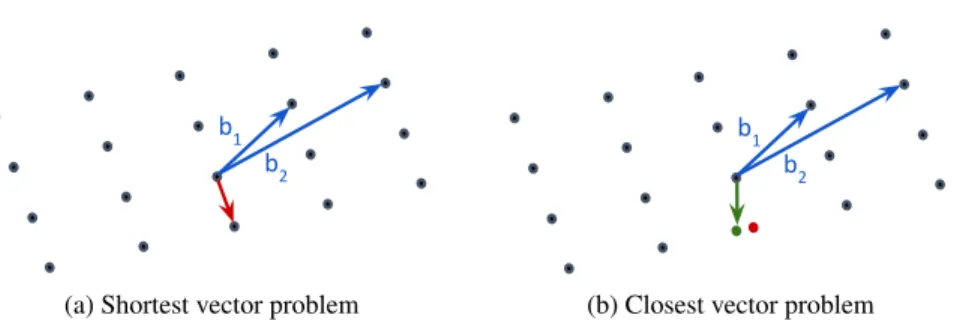
2.2 Illustration of the two lattice problems, SVP and CVP . . . 13
2.3 Example of homomorphic evaluation . . . 14
2.4 Illustration of ciphertext re-scaling in CKKS . . . 24
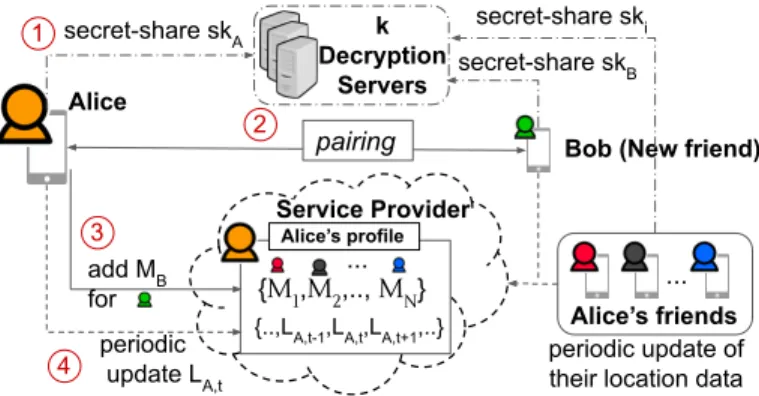
3.1 Secure geospatial query system overview . . . 28
3.2 Illustrations of space-filling curves. . . 29
3.3 Various cases of user-controlled location privacy . . . 31
3.4 System design and resulting masked views for different parties: Bob (d= 18), Eva (d= 12), and Others (d= 10) . . . 35
3.5 Query 2: Who is nearby? . . . 36
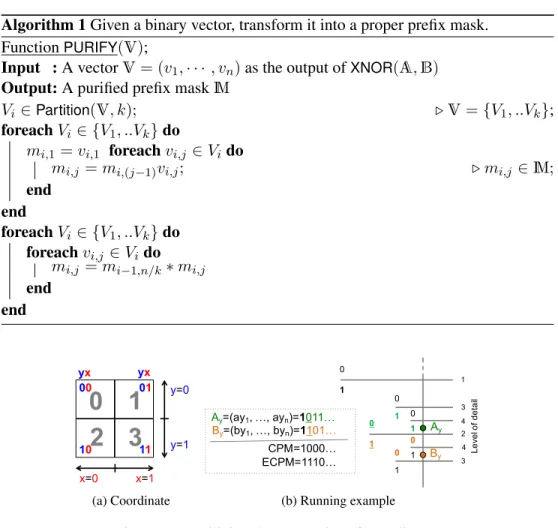
3.6 Illustration of the PURIFY function . . . 37
3.7 Utilizing the properties of coordinates . . . 38
3.8 Securing private keys with secret-sharing . . . 42
3.9 Computation times for different experiments in 2D space . . . 44
3.10 Computation times for different experiments in 3D space . . . 45
3.11 Perspectives of different parties produced by our demo system us-ing the ECPM algorithm (for the inner box) on Alice’s and Bob’s locations. We add the outer box, which is computed by the CPM algorithm, for comparison. . . 46
4.1 System models for collaborative evaluation of random forestsF, con-sisting ofN decision trees: Each decision treeTi with a depth of δ containsmdecision nodesdi ∈ D, and(m+ 1)leaf nodeslk ∈ L.
Each leaf node contains a classification valuevk∈V. . . 55
4.2 Overview of different phases of our proposed system . . . 62
4.3 An example instantiation of SecComp(Equation. 4.1) for 4-bit in-puts, and the corresponding evaluation tree and vector . . . 65
4.4 Empirical results of theSecCompprotocol . . . 70
4.5 Evaluation of different aspects of theSecCountprotocol . . . 71
4.6 Empirical results using synthetic data . . . 73
5.1 Timeline featuring recent developments in HE schemes . . . 75
5.2 Taxonomy of techniques for secure computation on encrypted data . 76 5.3 Single-hop and multi-hop MK-variants of the GSW scheme . . . 86
5.4 The MK-variant of the BGV scheme [42] . . . 89
5.5 Collaborative homomorphic evaluation with multiple keys . . . 90
5.6 Illustration of the four main phases for secure collaborative evalua-tion protocol with multi-key support . . . 92
5.7 An overview of secure decision tree evaluation phases using the pro-posed approach for multi-key support . . . 93
6.1 MapReduce and Distributed Dataflow models . . . 100
6.2 SparkFHE functional view . . . 103
6.3 SparkFHE architecture (proof-of-concept demo, https://bit.ly/2Vas8pN)103 6.4 Level of abstraction (optimization in shaded boxes). . . 107
6.5 Pseudocode and the corresponding dataflow graphs for three example algorithm. All the RDD graphs are mapped to Spark code base as demonstrated in the links. . . 109
6.6 Dataflow graphs in the batching mode . . . 112
6.7 A comparison of homomorphic functions in different supported schemes114 6.8 Speedup rate in strong scaling (N = 103) . . . 115
6.9 Speedup rate in weak scaling (N = 102 per worker) . . . 116
6.10 Parallel speedup and efficiency (N = 106andN = 107“batched”) . 116 6.11 Different programming levels performance (N = 103) . . . 117
List of Tables
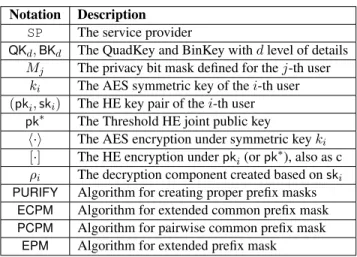
2.1 Notation used throughout the dissertation . . . 20 3.1 Notation used in secure geosocial query system . . . 33 4.1 Notation used in the proposed system . . . 60 4.2 A comparison with the recent work on privately evaluating one
de-cision tree: nis the number of feature,mis the number of decision nodes,`is bit-length of input, andδis the depth of decision tree . . 69 5.1 Notation specific to multi-key approaches . . . 77 5.2 Comparison between proprieties of existing different MKHE schemes. 97 6.1 Set of parameters used in evaluation, whereλis the security level,η
is the polynomial modulus degree,log(q)is the ciphertext modulus bits, andpis the plaintext modulus. . . 113 6.2 Performance times (ms) for element-wise HE primitives on vectors
encrypted with SEAL-BFV . . . 114 6.3 Performance times (ms) for element-wise HE primitives on vectors
encrypted with HELIB-BGV. . . 115
Introduction
Modern data-driven applications involve sensitive data such as genome sequences [164], biometric data including iris scans and fingerprints [169], and users’ location data [90]. The economical efficiency and ubiquitous accessibility of cloud comput-ing have attracted many emergcomput-ing data analytic and machine learncomput-ing applications to outsource data and delegate computations to the cloud. For example, biomedi-cal research may benefit from delegated, joint computations on genome data on a resourceful cloud [114, 138]. Users may be tempted to share their exact locations with geosocial networks, which provide useful location-based services (e.g., discov-ering nearby friends) based on collected locations [16]. Data privacy becomes a crucial concern when outsourcing sensitive data, especially when these data are hard to change or replace once exposed. For instance, leaking the genome data of a person affects not only his privacy but also his family because the DNA data contains infor-mation about his blood-relative [119]. Moreover, strict data protection regulations, such as HIPAA [160] and EU GDPR [67], demand provable security of private data when it is being transmitted, in storage, and being processed. Therefore, privacy-preserving techniques have to be applied to ensure the appropriate level of protection for user data while allowing it to be utilized.
1.1
Privacy-preserving Computation
There are different privacy-enhancing techniques that enable an untrusted party to perform secure computation on private data without having access to its content.
CHAPTER 1. INTRODUCTION 2
These techniques can be adopted on their own or in conjunction with each other. Trusted execution environments (TEE) such as Intel SGX [47] with remote attestation is a hardware-based solution for secure outsourced computations. With this solution, computations are performed on plain data within the minimized and isolated execu-tion environments (enclaves). Secure multiparty computaexecu-tion (MPC) protocols are often coupled with secret-sharing [143] or garbled circuits [14] for interactive com-putations among parties. Differential privacy [64] adds small noise sampled from a uniform distribution, such as Laplace, to hide the contribution of individuals within a dataset. Homomorphic encryption (HE) allows computations on encrypted data without decrypting it first. It is a suitable technique for the secure outsourcing setting discussed in this dissertation.
Recent HE cryptosystems, lattice-based cryptography, are based on the hardness of problems believed to be resistant to quantum attacks, which makes HE a strong candidate for post-quantum cryptography [4, 27]. Due to this quantum-safe assump-tion, HE gains increasing attention from both governmental and academic bodies. For example, the communications security establishment (CSE), the Government of Canada’s national cryptologic agency, has recently called for solutions based on HE to support secure and confidential rule matching [46]. Several government programs (e.g., DARPA PROCEED [53], HECTOR [92], and DPRIVE [54]) are established to investigate practical solutions with HE to compute on encrypted data. Moreover, an annual iDASH competition allocates a special track for secure genotype imputation using HE [93], and it is funded by NIH. On the other hand, there is an ongoing effort for standardizing HE [149]. Likewise, we are motivated in this dissertation by the promising capabilities of HE.
As mentioned, HE supports arithmetic operations, such as addition and multi-plication, to be performed on encrypted data. Specifically, given two messagesm
andm0 and homomorphic addition and multiplication operations⊕and⊗, we have
Enc(m)⊕Enc(m0)which decrypts tom+m0andEnc(m)⊗Enc(m0)which decrypts tom×m0. For simplicity, we will use normal arithmetic operators+,×to represent homomorphic operations in the rest of our description. Generally speaking, any algo-rithm that can be reduced to just these aalgo-rithmetic operations can be homomorphically evaluated on encrypted data.
The first set of HE schemes [15, 65, 81, 126] are efficient but only realized par-tialhomomorphism, which supports either addition or multiplication on ciphertexts but not both, such as Paillier [126] and ElGamal [65] schemes. Boneh-Goh-Nissim scheme [22] supports an arbitrary number of additions and a single multiplication;
hence, it issomewhat homomorphic. There areleveledHE schemes that support a predetermined number of multiplications based on the targeted function. In 2009, Gentry [76] proposed the first plausible construction to achieve a fully HE (FHE) scheme based on ideal lattices that can support an arbitrary number of additions and multiplications.
In lattice-based schemes, the ciphertext contains of a noise element that can prop-agate with evaluations. Homomorphic addition is performed almost free of cost, but multiplication significantly grows the noise elements in the ciphertext because the noise term from multiplying two ciphertexts is the product of the two initial noise components. Hence, it is important to reduce the multiplicative depth (i.e., consec-utive multiplications) of a homomorphic function. When the noise growth in the ciphertext is too large, it is not possible to retrieve the correct message after decryp-tion. Gentry’s FHE scheme, which was built on a leveled HE scheme, can homo-morphically evaluate its own decryption circuit in abootstrappingstep [76]. Hence, it can refresh the embedded noise within an evaluated ciphertext, when the noise level reaches a predefined threshold, to obtain a fresh ciphertext with small noise. In practice, the bootstrapping step is computationally expensive; therefore, most appli-cations can be sufficiently realized by a leveled HE scheme. Also, HE schemes can be designed to be either symmetric (one secret key to encrypt and decrypt) or asym-metric (one key pair, a public key to encrypt, and a secret key to decrypt). For clarity, we will focus our descriptions on the asymmetric HE schemes in this dissertation. We provide a detailed review of common HE schemes and techniques in Chapter 2. Moreover, designing a secure protocol for applications utilizing HE techniques can be based on different system models, and the design requirements may need different security assumptions. We discuss them in the following sections.
1.2
System Models
The ability to compute while encrypted allows sensitive data to be outsourced for computations without revealing the private data. When designing protocols for secure applications, we consider who owns the data and who is performing the computation. The protocol can be designed based on different system models, as illustrated in Fig. 1.1. The simplest system model for secure outsourced computation is in a two-party setting, as depicted in Fig. 1.1a, where Alice (the client) has an input messagex
CHAPTER 1. INTRODUCTION 4 Alice Bob [x] [f(x,y)] input : x input : y Alice Bob [x] [f(x,y)] input : x input : y
(a) Two-party setting
joint computation Charlie Bob Alice joint computation Charlie Bob Alice (b) Multi-party setting
Private or Public Cloud
Alice Bob [x] [f(x,y)] [y] Compute while encrypted Charlie [f] Private or Public Cloud
Alice Bob [x] [f(x,y)] [y] Compute while encrypted Charlie [f] (c) Outsourced setting Figure 1.1: System models for secure computation
trained machine learning model owned by Bob, on the input without having access to it. Bob may also contribute by providing a private inputy. Alice encrypts her input as[x]under her public key, where[·]denotes homomorphic encryption of a message, and sends it to Bob. Then, Bob homomorphically evaluates the function and returns
[f(x, y)]to Alice, who decrypts it using her private key. In this system model, user data privacy is protected against a passive adversary by encryption as long as the functionf does not leak information about Bob’s inputy. For instance, iff(x, y)is summing the two inputs, then Alice may learnyby simply subtracting her input from the result. In this case, HE primitives do not prevent leakage.
The two-party setting can be extended to a more general setting, secure out-sourced computation among multiple parties. As illustrated in Fig. 1.1b, multiple parties may want to perform a joint computation on their encrypted data without revealing sensitive data to each other. This computation model is often based on in-teractive secure MPC protocols, which are characterized by the high communication overhead and require non-colluding parties to participate during the computation.
This dissertation is interested in the emerging outsourcing system model that sup-ports non-interactive computations and suits the cloud computing paradigm we have today. In computation outsourcing to the cloud paradigm, data owners delegate com-putations on their outsourced data to a private or public cloud, as shown in Fig. 1.1c. Similar to the previous system models, data owners do not want to reveal their data to others. Additionally, they do not want to reveal their data to the cloud evaluator. This additional security requirement dramatically increases the complexity of designing practical homomorphic algorithms. Our research focuses on this outsourcing system model in Fig. 1.1c because of its opportunity and challenge. We also study the de-sign and security requirements for this system model to obtain secure yet practical protocols.
1.3
Security Considerations
To design a secure protocol, we need to determine possible threats and attacks that may target a system. Adversaries who launch attacks often aim to compromise secu-rity requirements such as confidentiality, integsecu-rity, and availability. It is essential to understand these threats and attacks and their impacts on security during threat mod-eling. Often active adversaries can launch arbitrary attacks that deviates from the protocol, and it is difficult to protect against every threat. Moreover, some counter-measures may be computationally-intensive and affect the practicality of the protocol. Hence, we make security assumptions as a trade-off for efficiency in our designs. For example, we assume system users are semi-honest, i.e., they strictly follow the proto-col specifications but may passively proto-collect transmitted inputs and try to infer useful information about users’ data.
We focus on designing protocols in the semi-honest model, where adversaries are passive. This model is often used at first then extended to a malicious model with active adversaries. In selected cases, we will discuss active attacks from users, such as probing and colluding. Moreover, we will elaborate more on potential attackers’ goals and capabilities for each proposed protocol throughout this dissertation.
The outsourcing system model we discuss in Fig. 1.1c involve multiple parties who are offloading their private encrypted data to the cloud evaluator. It is important to consider the security of these data and under which cryptographic key they are encrypted. We analyse potential threats related to using single and multiple crypto-graphic keys and how those keys are generated, distributed, and revoked. Although key management is outside the scope of this thesis, we emphasize that it is vital to carefully manage keys throughout their life cycles because poor key management can easily defeat the purpose of using cryptography [69]. For example, in key gen-eration, we must appropriately choose the cryptographic parameters, such as key bit-length, based on a sufficient security parameter to protect against known attacks such as brute-force attacks. Also, the keys should be properly revoked when expired or changed across the system. Therefore, careful design of the security model is critical to achieving a secure yet practical protocol for the given system model.
CHAPTER 1. INTRODUCTION 6
1.4
Research Questions and Outcomes
Our research focuses on supporting outsourced computations (Fig. 1.1c) on cipher-texts in the Cloud. Rather than developing a protocol for each application from scratch, we aim to develop cryptographic protocols to support common building blocks so they can be used as needed in developing various secure applications. We formulate our first research question as follows.
RQ1: How to construct practical cryptographic protocols to support outsourced computations on encrypted data in the Cloud?
As mentioned, any function that can be broken into addition and multiplication is possible to be evaluated on encrypted data homomorphically without requiring de-cryption. Logic gates, such asAND,OR,XOR, andNOT, can be translated into arith-metic forms; for example,XOR(x, y) =x+y−2xy ifx, y∈Zandx, y∈ {0,1}, or simply XOR(x, y) = x +y if x, y ∈ Z2. These operations can be combined
to build advanced circuits and algorithms, such as testing equality and comparison. For instance, we can check the equality of two numbersx, y ∈ Zby performing EQ(x, y) =Q
XNOR(xi, yi)wherexi, yiare encrypted bits of the input numbers and
XNOR(xi, yi) = NOT(XOR(xi, yi)), or simplyEQ(x, y) =x+y+ 1ifx, y ∈Z2.
These algorithms serve as fundamental building blocks for different computations in data processing; e.g., testing equality is an essential primitive for pattern match-ing algorithms, which are used in different applications such as spam filtermatch-ing and biometric authentication [96, 152].
Designing homomorphic algorithms for these building blocks provides a toolbox for developers to utilize in different secure applications. We constructed algorithms to perform equality, comparison, and counting on homomorphically encrypted data. For demonstration, we present two different example applications that leverage our proposed algorithms as building blocks.
The first application targets data analytics on encrypted data. In particular, we construct a secure geospatial query application, with details presented in Chapter 3, that has a prefix matching algorithm at its core to process queries on collected en-crypted locations according to user-defined privacy preferences. A user defines in the preferences different levels of privacy for his friend list that control the granularity of their locations based on whom to share with. Both the precise locations and pri-vacy preferences are encrypted, hence they are protected against passive adversary. We observe that our matching algorithm can be used in other applications such as secure genome sequencing or privacy-preserving spam filtering. Initial results of this
work [90] has been published in the10th ACM Conference on Security and Privacy in Wireless and Mobile Networks (WiSec 2017). An improved algorithm has been proposed in our recent manuscript “Universal Location Referencing and Homomor-phic Evaluation of Geospatial Query” [7], which is accepted for publication in the Elsevier Journal on Computers & Security.
The second application is more focused on outsourced machine learning (ML) on encrypted data. Specifically, we leverage our proposed secure comparison and count-ing protocols to support private evaluation of random forests, which allows multiple model owners to delegate to the Cloud the evaluation of the random forests, resulted in a joint evaluation of individual models. Existing works [24, 154, 166] on this topic follow a two-party model where the evaluator/cloud owns, or has access to, the ML model and the client provides encrypted inputs to start the evaluation. Moreover, some functions used in secure model evaluation (e.g., comparison) are interactive and require both parties to participate in the computation. This dependency on clients represses the full benefit of outsourced system model, where clients only need to sub-mit their input and receive the final encrypted result. Hence, our goal is to enable ML model owner(s) to delegate their encrypted trained model(s) to a semi-honest cloud evaluator, who evaluates the model on clients’ encrypted inputs in ablindfoldedand
non-interactivemanner. Our targeted outsourced system model can be generalized to other ML techniques. We discuss the details of this protocol in Chapter 4. This work [9] has been published in the IEEE Transactions on Dependable and Secure Computing (TDSC 2019). We also investigate the construction of effective activation functions for homomorphic evaluation of deep neural networks and recently pub-lished our findings [121] in the IEEE ACCESS 2020.
Our research efforts in [90] and [9] provided an answer toRQ1. However, our results introduced two compelling research problems. The first problem regards the privacy of encrypted data from different owners, and the second problem regards pushing the limits to provide support for encrypted data processing and machine learning at scale.
In the first problem, multiple parties who delegate their sensitive data or models to the Cloud want to ensure that the Cloud does not learn anything from the encrypted data. Similarly, data owners do not wish to reveal their data to others. Encrypting these data using a single key means all participants have to share the same key; that is, they can see each other’s private data. To achieve stronger security, we should encrypt private data from different individuals under their own keys. This security model allows a group of users to contribute their encrypted data to a cloud evaluator for
CHAPTER 1. INTRODUCTION 8
joint computations without giving away their data privacy. In this research problem, we want to answer the following research question.
RQ2: How to efficiently support secure outsourced computations in which data are encrypted using different keys of the corresponding owners?
To tackle this problem, we conducted a comprehensive survey on the state-of-the-art cryptographic techniques and schemes that support computation with different keys [8], and it is currently under revision for ACM Computing Surveys. Generally speaking, they can be roughly divided into two categories, single-key and multi-key approaches. Single-key approaches offer additional functionalities such as switching to a different key or access control. Proxy re-encryption (PRE) enables transfor-mation of a ciphertext from the encryption of one key to another without exposing the plaintext. Identity-based encryption (IBE) and attribute-based encryption (ABE) schemes provide access control mechanisms where data can be decrypted by autho-rized keys generated based on the user’s identity or attributes. Yet, computations must be performed under the same key, and decryption is done with one secret key. Al-ternatively, multi-key techniques extend HE schemes to support homomorphic eval-uation with data encrypted by multiple keys, but they can be tricky and inefficient. Threshold HE (ThHE) produces a joint key from participants’ keys based on the key additive homomorphism before any computation. Data will be encrypted and evaluated under this joint key. Multi-key HE (MKHE) supports homomorphic com-putations on ciphertexts encrypted under different keys without a joint key setup. Ci-phertexts can be extended “on-the-fly” to a concatenation of participants’ keys. The size, more specifically dimension, of an extended ciphertext increases with respect to the number of involved keys. The most efficient construction of MKHE increases the ciphertext size linearly. In both ThHE and MKHE, users must cooperate to decrypt the evaluated ciphertext.
We observe that the ThHE technique may not be practical for our proposed secure outsourced ML protocol (the second application). Suppose we haveNmodel owners andP clients. For every client, we need to generate a joint key for this client and the group ofN model owners; that is, we will need to produce and maintainP joint keys. This requirement also means that each model owner has to provideP copies of the model, each encrypted under one of theP joint keys, to the Cloud. On the other hand, the MKHE solution will require each ciphertext to be extended toN+ 1
different keys (i.e., the model owners keys plus the key of the requesting client) before any computation. The efficiency of the system is affected, especially if the number of model owners is large because it proportionally increases the ciphertext size. To
address this issue, we propose a hybrid approach that combines the advantages of both ThHE and MKHE to reduce computation complexity and ciphertext size. We present this hybrid approach in chapter 5. Results from this research work [5] have been published at the International Workshop on Privacy Engineering, co-located with the IEEE Symposium on Security and Privacy 2019, and presented at the poster session [6] of the IEEE Symposium on Security and Privacy 2019.
In the other research problem, we seek more practical use-cases where HE can be leveraged. Many data analysis tasks are now outsourced to the Cloud because of the unmatched economic efficiency and ubiquitous accessibility [109, 144]. Cloud computing is becoming indispensable for performing big data analysis and building machine learning pipelines at scale through massive parallelization of tasks across large clusters of computing nodes. In data centers, the large number of computing resources and tasks are managed by distributed data processing frameworks, such as Apache Hadoop, Apache Spark [173], and Apache Flink [33]. These frameworks offer data and programming abstractions that ease the development of data analytics algorithms and provide cluster management and scheduling algorithms that facilitate efficient resource orchestration and task allocation.
While efficiency in big data processing is achieved, outsourcing computation on private data to the Cloud often leads to privacy concerns when the data is sensitive. This issue leads to defining our third research question as follows.
RQ3: Can we extend HE support to existing data processing frameworks to enable large-scale distributed data processing and machine learning on encrypted data?
We propose a new secure data processing framework, SparkFHE. At its core, SparkFHE integrates HE into Apache Spark to achieve two goals: (1) leveraging the capabilities of HE to enable Spark to perform computation on encrypted data with-out decryption, and (2) mapping homomorphic algorithms to the distributed dataflow model [3] to accelerate and scale-up homomorphic computation through paralleliza-tion across large clusters of computing nodes. To our best knowledge, these have not been done previously. Also, our proposed designs are not limited to Spark but can be applied to other distributed dataflow frameworks, such as Apache Flink. We provide details on this proposed framework in Chapter 6.
Results from this work [89] has been accepted at the Privacy Preserving Machine Learning (PPML’20) Workshop, co-located with Conference on Neural Information Processing Systems (NeurIPS’20).
CHAPTER 1. INTRODUCTION 10
1.5
Organization
The rest of this dissertation is organized as follows. Chapter 2 provides background information on HE and its techniques and schemes. We addressRQ1and propose cryptographic protocols for common building blocks and two example applications in Chapter 3 and Chapter 4. We discuss our proposed solution forRQ2on supporting homomorphic computations with different keys in Chapter 5. Chapter 6 addresses
RQ3and discusses our proposed SparkFHE framework, which supports large-scale data processing on encrypted data. Finally, Chapter 7 summarises the dissertation research and discusses future work.
Background
Recently, lattice-based cryptographic schemes are gaining positive attention in cryp-tography research for their simplicity, low computation costs, and most importantly, for their compelling security proofs [112]. They are based on the hardness of prob-lems like shortest integer solution (SIS) [2] and learning with errors (LWE) [136], which can be reduced to well-studied lattice problems such as shortest vector prob-lem (SVP) and closest vector probprob-lem (CVP). In this chapter, we provide background on lattice-based HE schemes and the general homomorphic primitives and techniques used in them.
2.1
Lattices and Basis
Alatticeis a mathematical structure formed of a set of points and corresponds to the vector space generated by all linear combinations on a set of linearly independent vectors, calledbasis[111, 136]. For example, the Euclidean space of all integersZis a lattice where each point is generated as a result of linear operations (i.e., addition, subtraction, and multiplication by integer coefficients) on the unit vectors.
Formally, ann-dimensional latticeLis a discrete additive subgroup ofRn that is generated by a set of basesB = {b1,b2, . . . ,bk}, which are a set of linearly
independent vectors. The latticeLgenerated by the basisBis defined as
L(B) ={ k X i=1 zibi|zi ∈Z} 11
CHAPTER 2. BACKGROUND 12
(a) A basis ofZ2 (b) Another basis ofZ2
Figure 2.1: Examples of different lattice bases
The rank of a lattice is denoted by k, and its dimension is denoted by n. A lattice is called afull-rank latticewhen k = n. We focus on full-rank lattices, but the discussion can be easily extended to other general dimensions [116]. A lattice does not have a unique basis but has infinite number of different bases. Figure 2.1 illustrates two different bases are given for the same 2-dimensional Euclidean space. The lattice points are illustrated in black, and the basis vectors are highlighted in blue. In Fig. 2.1a, the two orthogonal bases are considered “good” as they are short and can easily generate the rest of the points on the lattice. However in Fig. 2.1b, the two bases are narrower and it becomes tricky to use them as generator of all the points.
Without knowing the structure of the the lattice, problems like finding a short vector in the lattice can become hard. In fact, lattices provide computationally hard problems with worst-case security guarantee1, which is extremely useful in cryptog-raphy as security proofs for cryptographic constructions [129]. Examples of these problems include the Shortest Vector Problem (SVP) and the Closest Vector Problem (CVP). Figure 2.2 illustrates these two problems in an-dimensional lattice, where
n = 2. In brief, the SVP states that given a set of bases B (or points) in a lattice
L, find the shortest nonzero vector (highlighted in red in Fig. 2.2a) in that lattice. As mentioned, a short vector is significant because it can be used as a generator for all points in that lattice. Well-known algorithms for lattice basis reduction, such as the Lenstra-Lenstra-Lovasz (LLL) algorithm [102], have a complexity that is expo-nential with the lattice dimension [112, 136]. Hence, the problem becomes NP-hard when the dimension is appropriately large. Moreover, the SVP can become more complex if the given bases (points) were shifted of the lattice by adding small noise. In this case, the problem becomes CVP, or finding theclosestlattice vector (in red in Fig. 2.2b) to the shifted one (in green). Solving the CVP means we can also solve another cryptographic problem called Learning With Errors (LWE), which we define in the next section.
1
(a) Shortest vector problem (b) Closest vector problem Figure 2.2: Illustration of the two lattice problems, SVP and CVP
2.2
The Learning with Errors Problem (LWE)
Many HE schemes base their security on the LWE problem. We present the formal definition of the problem and its ring variation as follows.
Definition 2.2.1(Learning with Errors (LWE) [136]). For a security parameterλ, let
n=n(λ)be a dimension,q =q(λ)≥2be an integer, andχ =χ(λ)be a distribu-tion overZ. Sample a vectorai←Znq,s←Znq, andei←χ. The LWE problem is to distinguish the pair(ai, bi =hai,si+ei)∈Znq+1from a uniformly sampled(ai, b0i) fromZnq+1. The LWE assumption is that LWE problem iscomputationallyinfeasible. This is thedecisionalversion of the LWE problem, which aims to distinguish a vectorbthat is a result of linear combination of two vectors a ands with errore
from a uniformly sampled vectorb0from the same integer spaceZnq. In contrast, the searchversion aims to find the small vectorsbased on the given vectorb. Solving this problem is equivalent to solving the CVP and SVP in lattices because we need to find the vectorha,si(without the error) that is closest tobgivenawithout knowing s. Since solving the lattice problems is infeasible for a large dimension, the LWE problem is also infeasible.
The LWE problem operates in then-dimensional integer spaceZnq and consists of vectors and matrices where elements are integer moduloq. To achieve more efficient computations, the problem can be extended to rings of polynomials with integer co-efficient. This extension is called the ring learning with errors (RLWE) problem. The aim is to significantly reduce the dimension, such thatn = 1, and correspondingly the size of keys and ciphertexts.
Definition 2.2.2(Ring Learning with Errors (RLWE) [108]). For a security param-eterλ, letΦ(x) =xd+ 1be a cyclotomic polynomial whered=d(λ)is a power of 2, andq =q(λ) ≥2be an integer. Define the ringRover polynomials with integer
CHAPTER 2. BACKGROUND 14 Enc(
f
(
m
))
Enc(
m
)
Eval ff
(
m
)
m
DecEnc Dec Enc
Dec
Enc Dec Enc
Enc(
f
(
m
))
Enc(
m
)
Evalf
f
(
m
)
m
Figure 2.3: Example of homomorphic evaluation
coefficients R = Z[x]/(Φ(x)). Let χ = χ(λ) be a discrete Gaussian distribution
over R and bounded by B = B(λ) such that B q. Let a and sbe uniformly sampled elements fromRq, and lete←χbe a sampled error term. The RLWE prob-lem is to distinguish the pair of(ai, bi =ais+e)from any uniformly sampled pair (ai, b0i)←R2q. The RLWE assumption is that the RLWE problem iscomputationally infeasible.
An amortized version of the RLWE problem [11, 108] shows that it is equivalent to samplingsfrom a small distributionχinstead of the ringRq. This yields a smaller secret key in an RLWE-based cryptosystem, e.g., BGV SWHE scheme [27]
2.3
Homomorphic Encryption Primitives and Techniques
Homomorphic encryption (HE) refers to a family of encryption schemes that support specific computations directly on encrypted data, typically addition and multiplica-tion. Given a pair of asymmetric encryption keys(pk, sk)and two messagesmand
m0, these two properties holds: Dec(sk,Enc(pk, m)⊕Enc(pk, m0)) =m+m0 and
Dec(sk,Enc(pk, m) ⊗Enc(pk, m0)) = m ·m0, where ⊕ and⊗ represent homo-morphic addition and multiplication respectively. For most homohomo-morphic encryption schemes⊕tends to be a relatively simple operation, whereas⊗tends to be signifi-cantly more complicated, often involving multi-precision arithmetic of large polyno-mials. Figure 2.3 shows an illustration of homomorphism.
Generally, an HE scheme is defined as a tuple of Probabilistic Polynomial-Time (PPT) algorithms, such thatHE= (KeyGen,Enc,Eval,Dec).
- HE.KeyGen(p) → (pk,sk): The key generation algorithm takes as input public parameterspand outputs a public keypkand a secret keysk.
- HE.Enc(pk, m)→ c: The encryption algorithm takes as input a plaintextm ∈Rt and a public keypkand outputs the ciphertextc.
- HE.Eval(f, c, c0) → cˆ: The deterministic evaluation algorithm takes as input a function (or circuit)f and two ciphertexts and outputs a new ciphertextˆc.
- HE.Dec(sk, c) →m: The decryption algorithm takes as input a ciphertextcand a secret keyskand outputs a plaintextm∈Rt.
Note, theHE.Evalalgorithm homomorphically performs a defined functionf on the ciphertexts. This function is constructed usingHE.AddandHE.Multwhich are ho-momorphic addition and multiplication respectively.
The HE schemes must providecorrectness, where the evaluated ciphertext¯c de-crypts tof(m, m0)with an overwhelming probability. It must also providesemantic security, or ciphertext indistinguishability, where no information about the plaintext message can be learned from its ciphertext. In many HE schemes, semantic security is achieved through the use of randomness in the encryption algorithm.
2.3.1 Key Switching
In many of the (R)LWE-based HE schemes, the initial output of homomorphically multiplying two ciphertexts is a longer ciphertext encrypted under a new secret key elements2. For instance, observe in the BGV scheme [27] presented in Sec. 2.4.1, the product beween two ciphertextsc, c0is
˜ cmult=c·c0 = (c0, c1)·(c00, c 0 1) = (c0·c00, c0·c01+c00·c1, c1·c01) = (˜c0,˜c1,˜c2)∈Rq3
The additional component c˜2 corresponds to the quadratic element s2 resulted
from the multiplication(c0 +c1 ·s)(c00 +c01·s) = ˜c0 + ˜c1 ·s+ ˜c2·s2.This new
ciphertextc˜multis not decryptable by the secret keys. Therefore, HE schemes
em-ploykey switching [27] as a transformation technique to reduce the dimension after each homomorphic multiplication. This transformation is accomplished with the aid of auxiliary information provided as evaluation keyek which encryptss2 under s. The followinggadget toolkitis needed to perform key switching:
- Gadget vector:g= (g0, . . . , g`−1)∈R`
- Decomp(x): Given an elementx ∈ Rq, decompose it into ashort vector u = (u0, . . . , u`−1)∈R`such thathu,gi=x (modq).
For example,(1,2, . . . ,2dlogqe−1)is a gadget vector corresponding to the bit decom-positionBitDecomp:x =P
0≤i<dlogqe2iui 7→ (ui)0≤i<dlogqe. The decomposition function is (informally) denoted byDecomp=g−1to remark thathg−1(x),gi=x
CHAPTER 2. BACKGROUND 16
(modq)for allx. The functionPowersOf2(x)uses the above gadget vector to output a vector of powers of2as(x,2x, . . . ,2dlogqe−1x).
As discussed above, key switching is a commonly used building block of LWE-based HE schemes (e.g. BGV scheme) which reduces the dimension of a long ci-phertext after homomorphic multiplication. Here, we review how to generate an evaluation keyek and perform the key switching operation on a three-dimensional ciphertext˜cencrypted under(1, s, s2).
- EvalKeyGen(s1, s2): In key switching, the evaluation key used is simply an
en-cryption of s1 under the new key s2. In our case, we assume that s1 = s2
and s2 = s. The evaluation key is generated as a set of homomorphism keys
ek = {h0, . . . , hd−1} generated during the scheme setup. Each key hi encrypts
s1 ·gi under s2. For example, in the BGV scheme, hi = (bi, ai) is generated by
ai←Rq,ei←χ,bi =−ai·s2+t·ei+gi·s1 (modq).
- KeySwitch(ek,˜c): Given an evaluated ciphertext ˜c = (˜c0,˜c1,c˜2) encrypted
un-der the secret elements2, and the evaluation keyek = {h0, . . . , hd−1}, compute
Decomp(˜c2) = (u0, . . . , ud−1). Then, return the ciphertext(c0, c1) = (˜c0,˜c1) +
P
0≤i<dui·hi (mod q).
This technique can be generalized and used for other purposes beside dimension reduction. For example, it can be employed in proxy re-encryption to transform a ciphertext from one encrypting a message m under one key s1 to one encrypting
the same messagem under a different key s2. It can also be used to facilitate the
bootstrapping step [31, 76], which accomplishes fully HE scheme from a leveled SWHE scheme.
2.3.2 Bootstrapping
Following the blueprint proposed by Gentry [76], one can construct a fully HE scheme from a somewhat HE scheme. Mainly, when a ciphertext reaches the maximum de-fined level, a bootstrapping technique is applied which recrypts the ciphertext by homomorphically evaluating the decryption circuit and outputting a fresh ciphertext with minimum noise. Given a ciphertext at the maximum level c and the corre-sponding secret key sk = s, encrypt them both under the same key pk and ob-tain a fresh ciphertext by performing cˇ = Bootstrap(Enc(pk, c),Enc(pk,sk)) = Enc(pk,Dec(sk, c)). Generally, this function has to be of a limited depth to be per-formed with the somewhat HE scheme. This mean the degree of the decryption
polynomial must be low for the ciphertext to be bootstrapable [76]. Integer-based schemes, such as Gentry’s scheme [76], require a squashing technique which addi-tionally makes a sparse subset-sum assumption to decrease the degree of the decryp-tion polynomial. Recent LWE-based HE schemes, such as the BV scheme [29], uses relinearization to reduce the ciphertext dimension after each multiplication. As a result, the decryption polynomial has a low degree and does not need squashing.
More technically, the two main algorithms from key switchingBitDecomp(·, q)
andPowersOf2(·, q)can be used to obtain the bootstrapped ciphertext. Let the binary decomposition of the secret keysbeBitDecomp(s, q) = (u0, u1, . . . , ublogqc). Com-pute the powers of base two for the ciphertext elementc0such thatPowersOf2(c0, q) =
(20c0,21c0, . . . ,2blogqcc0). The decryption algorithm is then homomorphically
eval-uated under the encryption of the keypksuch thatc1−P
blogqc
i=0 ui2ic0 =c1−c0s=
mmodq (mod t). This technique can be repeatedly applied to support arbitrary number of homomorphic computations, but it is computationally intensive. How-ever, recent works in the literature show that bootstrapping can be done in less than1
second [62] and can be made even faster to less than0.1second [44] using different cryptographic constructions.
2.3.3 Noise Reduction Techniques
As a result of homomorphic computations, the embedded noise in ciphertexts in-creases in magnitude. For a noise magnitudeB, each homomorphic addition dou-bles the noise as2B, and each homomorphic multiplication squares it asB2.
How-ever, in BFV scheme (Sec. A.1) the noise growth is dominated byI1B+I2Bwhere
Ii = ∆mi−mi is a factor introduced when we scale up the messagesmi with∆. To ensure correct decryption of the evaluated result, the noise must not exceed theq2 range. We briefly discuss some of the noise reduction techniques used in HE schemes and refer the readers to [26, 27, 43] for more details.
Modulus switching Modulus switching is a technique proposed by Brakerski et al. [27] to scale down the noise after each multiplication. For a L-depth circuit (i.e., requires at mostLmultiplications), defineL+1moduli{qL, qL−1, . . . , q0}. After the
i-th multiplication, we can transform a ciphertextcmodqiinto the ciphertextc0 mod
qi−1, whereqi−1 < qi, such that the noise scales down approximately by a factor of qi−1
qi . This brings the noise magnitude back toBand changes to a smaller modulus.
CHAPTER 2. BACKGROUND 18
before the need for bootstrapping.
Scale-invariant A following work of Brakerski [26] proposed the scale-invariant technique which usesonemodulusq to homomorphically evaluateL-depth circuit. This technique completely removes the need for modulus switching, which requires choosingL+ 1decreasing moduli. In a nutshell, a message is scaled at encryption by a factor of∆ =q
t
, whereqis significantly larger thant; hence, the message is scaled up. After each homomorphic multiplication and at decryption, the ciphertext is scaled down by a factor of(q/t), resulting in a significant decrease in the noise magnitude. The original technique was proposed for LWE-based schemes witht= 2, and was later ported [68] to the RLWE assumption for efficiency.
2.3.4 Distributed Decryption
In many HE protocols based on the multi-party computation (MPC) protocol, the in-volved parties may be required to help decrypting the final evaluation result. For ex-ample, in threshold encryption (discussed in Chapter 5), the final result is encrypted under the combination of all the parties’ keys; hence, each party must participate to partially decrypt the result with their own secret key. This process becomes a
distributed decryption protocolsince the decryption now is executed as an MPC pro-tocol. Two algorithms are preformed within this propro-tocol. First, a partial decryption that is performed by each party who locally decrypts the result with their own secret key and shares the output. Then, a final decryption is performed by the designated party who aggregates the shared partial decryptions to obtain the final decrypted re-sult.
Two main security issues have to be addressed for this decryption protocol. First, the shared partially decrypted ciphertext may leak information on the party’s secret key; hence, additional security measures, such asnoise smudging (or noise flood-ing), are considered to prevent this leakage. To make sure that no secret shares can be learned, we need to add larger errors following the Smudging Lemma [12, 115], which states that adding a large noise “smudges out” the small values in the cipher-text. Hence, adding a large noise to the decryption component prevents leaking in-formation about the secret share.
Lemma 2.3.1(Smudging Noise [12]). LetB1 = B1(λ) andB2 = B2(λ) be two
chosen uniformly at random. Then the distribution ofe1isstatistically
indistinguish-able from that ofe1+e0 as long as B1/B2 = , where = (λ) is a negligible
function.
The second security issues is related to the final decryption algorithm, which may leak the encrypted result. Specifically, an attacker who may acquired the shared partial decryptions can perform the final decryption by combining the shares and retrieve the final result.
2.4
Homomorphic Encryption Schemes
Early homomorphic encryption schemes from 2009 and 2010, such as the origi-nal scheme of [77], were extremely inefficient. By 2011, the Brakerski-Gentry-Vaikuntanathan (BGV) scheme [27] was demonstrating enormous performance im-provements by building on more efficient primitives (such as RLWE) and using newly invented techniques, such asmodulus switchingandkey switching[29, 30], and more efficient data encoding techniques [117]. In 2012, Fan and Vercauteren proposed the BFV scheme [68] building upon Brakerski’s scheme [26], which introduced a tech-nique calledscale-invariance. While the above schemes are designed for encrypted binary and modular arithmetic, the problem of efficient encrypted real number arith-metic was addressed by the Cheon-Kim-Kim-Song (CKKS) scheme [43], which sup-ports approximate real or complex number arithmetic. CKKS has been recognized as a better HE scheme for the need of many practical applications. We present details of the BGV and CKKS schemes in the following subsections and defer the discussions on other HE schemes such as BFV and Gentry-Sahai-Waters (GSW) to Appendix A. Common notation are described in Table 2.1.
2.4.1 Brakerski-Gentry-Vaikuntanathan (BGV)
Brakerski et al. [27], proposed an efficientleveledHE scheme to allow arbitrary num-ber of additions butlimited consecutive multiplications determined according to the depth of the evaluated circuit. The BGV scheme is based on the original Braker-ski and Vaikuntanathan’s scheme [29], which is the base of the second generation of HE schemes that improve the efficiency after Gentry’s breakthrough [76]. The BV scheme was the first scheme basing its security solely on the hardness of stan-dard LWE assumption, which has proven to be as hard as solving the shortest vector
CHAPTER 2. BACKGROUND 20 Table 2.1: Notation used throughout the dissertation
Category Notation Description
General
a A vector ofnelements whereai=a[i]is thei-th element. B A matrix of elements wherebi,jis thej-th element of thei-th row.
|a| Thel1-norm of vector,|a|=Pni=0ai.
ha,bi The dot-product of the two vectorsa,basha,bi=Pn i=1(aibi). N Total number of users in the system.
(R)LWE-specific
Φ(x) A cyclotomic polynomialΦ(x) =xd+ 1, wheredis a power of 2. R A ring over polynomials with integer coefficientsR=Z[x]/(Φ(x)). Rt The ring of polynomials with coefficients inZt, wheretis plaintext modulus. Rq The ring of polynomials with coefficients inZq, whereqis ciphertext modulus.
χ The noise distribution overRorZwith small standard deviation.
HE Scheme-specific
` The bit length,`= 0, . . . ,dlogqe.
pp HE scheme’s public parameters including security parameterλand circuit depthL.
pki HE public key of thei-th user. ski HE secret key of thei-th user. eki HE evaluation key of thei-th user.
[m]i HE encryption of a messagemunderpki. Also denoted asc.
problem in lattices [107]. With this reduction, the scheme removes the need for making additional strong assumptions, such as the secret subset sum assumption, and avoids the squashing technique in bootstrapping. The main construction starts with a SHWE scheme of depthL, which also considers the depth of its own decryp-tion circuit, then converts to a fully HE scheme through bootstrapping. The original LWE-based BV scheme encrypts a message bitm∈ {0,1}with the secrets∈Znq as c= (ha,si) +m+ 2e,a)∈Zn+1
q , wherea∈Znq is a random vector andeis a small even noise. Essentially, we observe the pattern of masking the message with a large element and some noise to hold the LWE assumption. To decrypt, we use the secret sand the provided vectora in the ciphertext to compute ha,si, which effectively removes the mask and obtainsm+ 2e. The message is then retrieved by removing the even noise by computingm+ 2e(mod 2). In subsequent BV variants, such as the BGV scheme [27], the message can be an integer inZt, wheretis a chosen plaintext modulus that is significantly smaller thanq. The noise is scaled at-most byt.
The BGV scheme can be instantiated based on LWE or its ring variant RLWE, which operates on a ring or polynomials and is proven to be more efficient. It also applies optimizations such as the Smart-Vercauteren [147] batching technique, which packs multiple plaintext messages into one ciphertext so that computations can be performed in a Single Instruction Multiple Data (SIMD) manner. We summarize the ring variant of the BGV scheme as following.
- BGV.KeyGen(pp): Given the scheme’s public parameterspp= (λ, d, q, t), sample a small elements←χand a small noisee←χ, whereχis a Gaussian distributions overRq. Also uniformly sample a←Rq. Set the secret key as sk = sand the
public key aspk= (as+te,−a)∈R2q.
- BGV.Enc(pk, m): Given a plaintext message m ∈ Rt, a public keypk = (as+
te,−a), uniformly sample a random r←Rt and encrypt the messagem asc = (c0, c1)∈Rq2, wherec0=r(as+te) +mandc1=−ra. For clarity, we omit the
rassociated with the noiserteand writec0=ras+te+m.
- BGV.Dec(sk,c): Given a ciphertextc = (c0, c1)∈ R2q and the secret keysk= s, sets= (1, s) ∈Rq2and decrypt by computinghc,si=c0+c1s. The decryption
of a ciphertext in the BGV scheme is correct if and only if( ˜mmodt=m). - BGV.Add(c,c0): Adding two ciphertexts c = (c0, c1) = (ras+te+m,−ra),
c0 = (c00, c01) = (r0as+te+m0,−r0a)results incadd= ((c0+c00),(c1+c01))∈R2q where,(c0+c00) = (r+r0)as+t(e+e) + (m+m0)and(c1+c01) =−(r+r0)a.
Decryption is still correct because−(r+r0)acan be canceled when using the secret keysk.
- BGV.Mult(c,c0): Given two ciphertextsc,c0 ∈R2q, their homomorphic multiplica-tion yields first an extended ciphertextc˜mult= (ˆc0,cˆ1,ˆc2)that is encrypted under
the elements2. A special evaluation key must be provided as withek= (ˆb,ˆa) = (bi =ais+tei+PowersOf2(s2, q), ai←Rq)to perform relinearization (using key switching) as following.
- Apply Bit Decomposition oncˆ2as described in Sec. 2.3.1.
- Computeu=hˆc2,aˆiandv=hˆc2,ˆbi.
- Output the new relinearized ciphertext ascmult= (ˆc0+v,cˆ1+u)∈R2q. Additive homomorphism is straightforward in BV-type schemes, but multiplica-tive homomorphism is more complicated. Multiplying two ciphertextsc,c0 results in a higher dimensional ciphertext that is now encrypted under s2 rather than s. Additionally, the noise within the ciphertext grows significantly (i.e., e2). With-out control, the noise can grow exponentially with respect to the number of multi-plications. Hence, two new techniques were proposed, namelyrelinearizationand
modulus switching, to address these two issues. We briefly explain here how relin-earization works and defer the modulus switching to the next subsection. The core technique used in relinearization is key switching (described in Sec. 2.3.1), which will transform the encryption from s2 back intos without decryption. Given the ciphertext product Cˆmult = cc0 = (ˆc0,ˆc1,cˆ2) ∈ Rq3, where ˆc0 = c0c00, cˆ1 =
(c0c01 +c00c1), and ˆc2 = c1c01. The latter contains the productmm0 encrypted
un-der s2. Hence, we need an evaluation key ek = (ˆb,ˆa), where aˆ = {ai} ←Rq, ˆb={ais+tei+PowersOf2(s2, q)}, andi∈ {0, . . . ,dlog
CHAPTER 2. BACKGROUND 22
encrypts information about s2 encrypted under s. For stronger security, the secret
s2 should be encrypted under a different secrets0to avoid making the circular secu-rity assumption, which states that the secusecu-rity of the secret key is ensured under the protection of its own public key. The transformation of the ciphertext is done by com-puting the new relinearized ciphertext as following: (1) apply the Bit Decomposition algorithm on the elementˆc2 to output the vectorˆc2 = BitDecomp(ˆc2, q); (2)
com-pute the two dot productsu=hcˆ2,aˆiandv=hˆc2,ˆbi; (3) finally, add the resultsu, v
to the first two elements and output the new ciphertext ascmult= (ˆc0+v,ˆc1+u).
This is essentially a way of homomorphically computing the decryptionhˆc2, s2iwith
secrets2and embedding it in the ciphertext result, so it becomes decryptable withs. 2.4.2 Cheon-Kim-Kim-Song (CKKS)
Previous HE schemes support linear transformations on encrypted integers or bits. However, many machine learning algorithms, such as logistic regression and neu-ral networks, may operate on real numbers (e.g., 123.45). In integer-based HE schemes, these values may be processed and scaled to integers prior to encryption (e.g., 12345×10−2). However during computations, rescaling was not applied to adjust the precision of the underlying message. To ensure correctness of computa-tions, the scheme’s modulus parameterq must be chosen large with respect to the circuit depth. Moreover, the noise is often scaled by a factor oft, the message space modulus, which impacts the most significant bits (MSBs) of the message during ho-momorphic evaluations.
Cheon et al. [43] proposed a HE scheme that supports fixed-point arithmetic over encrypted data. The scheme basis its security on the LWE problem and is constructed based on the BGV scheme. The main intuition of the scheme is treating the noise embedded at encryption as a part of the approximation error that occur in approximate computations. We present the RLWE-based CKKS scheme below. We can see the similarity between homomorphic algorithms, such as key generation, in CKKS and the rest of BV-type schemes.
- CKKS.KeyGen(1λ,1L): Given a security parameterλand a circuit depthL, sample a small elements←χand a small noisee←χ, whereχis a Gaussian distribution overRq. Uniformly samplea←Rq. Output the secret key assk=sand the public key aspk= (as+e,−a)∈R2q.
- CKKS.Enc(pk, m): Given a public keypk and a plaintext messagem, uniformly sample a randomr←Rtand noise elementse1, e2 ∈χ. Encrypt the messagem
asc= (c0, c1)∈R2q wherec0=r(as+e) +e1+mandc1 =−ra+e2.
- CKKS.Dec(sk,c): Given a ciphertextc= (c0, c1)∈R2qand the secret keysk=s, sets= (1, s)and decrypt by computinghc,si=c0+c1s≈m∈Rt.
- CKKS.Add(c,c0): For two ciphertextsc= (c0, c1) = (r(as+e)+e1+m,−ra+e2)
andc0= (c00, c01) = (r0(as+e) +e01+m0,−r0a+e02), the homomorphic addition results incadd = ((c0+c00),(c1 +c01))∈ R2q where,(c0+c00) = (r+r0)(as+
e) + (e1+e01) + (m+m0)and(c1+c01) =−(r+r0)a+ (e2+e02).
- CKKS.Mult(c,c0): For two ciphertextsc,c0 ∈R2
q, their initial homomorphic mul-tiplication yields an long ciphertext˜cmult= (c0, c1, c2)∈R3qencrypted under the secrets2. The ciphertext can be decryption asmm0 ≈ (c0 +c1s+c2s2). With
a provided evaluation keyekcontaining encryption ofs2, the key switching
tech-nique can be used to transform˜cmultinto a normal ciphertextcmult ∈ Rq2that is
decryptable unders.
- CKKS.Rescale(c): For an evaluated ciphertextc = (c0, c1) ∈ Rq2, computec0i =
∆−1ci
fori ∈ {0,1}and a scaling factor∆and return the re-scaled ciphertext c0 = (c00, c01)∈R2q
The CKKS scheme proposed special message encoding and decoding methods to prepare messages for encryption. The encoding method applies a canonical em-bedding map, which maps a vector of complex or real messages into a plaintext polynomial inR. Encoding enables packing up to d/2messages(z1, z2, . . . , zd/2)
in one plaintext polynomial, where d is the degree of the cyclotomic polynomial
Φ(x) = xd+ 1, to enable efficient computations in SIMD manner. If the number of messages is less thand/2, we append zeros. The other half of the total dwill be filled with conjugates during the canonical embedding. Each encoded messagezi is also scaled by a large factor∆, say∆ = 240, to obtain the significand. The output of the encoding method is a plaintextm withd/2scaled encoded messages. At en-cryption, the plaintextmis masked with a randomized public key and a small noise, such thatc=r(as+e,−a) + (e1, e2) +mis added to ensure the security. Choosing
a large enough∆ensures that the message significand is placed in the MSBs of the encoded message, and the small noise are only added to the LSBs. If we decrypt the ciphertext, we obtain the messageDec(sk,c) = m+e, wheree is considered an approximation error.
Homomorphic multiplication causes the scaling factor to square and increases embedded noise. In order to maintain the same precision and prevents the noise to blow up, the result must be rounded homomorphically. To do so, the scheme
pro-CHAPTER 2. BACKGROUND 24
Figure 2.4: Illustration of ciphertext re-scaling in CKKS
posed arescaling method to re-scale the ciphertext after each multiplication. This method can b e viewed as similar to the rounding performed on the plaintexts in ap-proximate computations. In particular, the ciphertextccan is multiplied by the scal-ing factor, such that∆−1c, which discardslog ∆least significant bits as illustrated in Fig. 2.4. As a result, we obtain a ciphertext encrypting the messagemmult/∆with a
reduced noiseemult/Delta, and the modulus is switched toq/Delta. CKKS uses a
technique similar to modulus switching to perform rescaling. For a circuit depthL, choose a large modulusq0and define a decreasing chain of moduliqL, qL−1, . . . , q0,
such that the modulus for a level l ∈ L is defined as ql = q0 ·∆l. A
cipher-text c(modql) is rescaled as
jq
l−1
ql c
m
(modql−1). Based on the definition of the
two moduli, the scaling factor ql−1
ql essentially divides the ciphertext by ∆because ql−1
ql =
q0·∆l−1 q0·∆l =
1
∆. The modulus switching technique is used for a different
pur-pose compared to its use in the BGV. While it preserves the underlying plaintext and manages the noise growth in BGV, it is used in CKKS to remove the LSBs of the ciphertext and maintain the precision. Because of this recurring discard of the LSBs, we need to choose appropriate parameters for the modulusq0 and the scaling factor
∆according to the circuit depthLto prevent precision loss.
2.4.3 Discussion
From studying these base HE schemes, we observe similarities in their design pat-terns and their methods to reduce ciphertext dimension and to deal with noise.
In term of similarity, the most recent HE schemes are constructed based on the LWE problem, or its ring variant, RLWE. The first unique characteristic is in the way that some small noise is added when masking a secret. Another characteristic is that the public key or the ciphertext contains a counter-part that can cancel the large
masking element sampled from some mathematical space. These two characteristics are clearly visible in theKeyGenandEncalgorithms of the presented HE schemes. Homomorphic multiplication is highly inefficient because it often raises the cipher-text dimension from an encryption ofstos2 (except GSW due to its construction) and dramatically increases the embedded noise. Hence, the focus is on designing techniques to reduce the ciphertext dimension and noise.
Chapter 3
Secure Evaluation of Geospatial
Query
In this chapter, we present our work to addressRQ1— how to construct efficient protocols to support outsourced computations on encrypted data. As mentioned, es-sential functions such as logic gates can be supported with HE primitives; hence they can be used to evaluate common operations like equality checking. We explore the capability and limitation of these primitives by constructing a privacy-preserving data analytics application for processing geosocial queries on encrypted locations.
Geosocial applications collect and record users’ precise location data to pro-vide location-based services (LBS). The position of a user or the user’s proximity to nearby objects (or other users) is often used to support position and range queries. For example,Query 1: Bob may ask, “Where is Alice?”, Query 2: Alice may ask, “Which of my friends are nearby?”,Query 3: A social app may inquire, “how ge-ographically close are Alice and Bob?”. Similar queries are also useful in location-based crowdsourcing, where a user may wish to retrieve information or measurements from contributing users within a region. To support these queries, periodic updates of users’ GPS coordinates are usually shared with service providers.
As discussed in Sec. 1, location data is often considered sensitive information, and tracking GPS coordinates can leak private information about users. For example, we can learn where they live, work, shop, play, and much more from their mobility trajectories [98]. Hence, the collected and processed location data should be pro-tected. Conventional encryption protects precise locations when they are transmitted
and stored but they must be decrypted before processing. Generally, users do not mind sharing their coarse-grained location, e.g., the city or a larger geographical re-gion, rather than their exact location such as the building or the zip code area they are currently in [122]. Therefore, they may rely on atrusted service provider to apply
spatial cloaking[75, 124] via obfuscation, anonymization, or resolution reduction to control the granularity of disclosed location according to the user’s privacy prefer-ences. These preferences illustrate the relationships between users; e.g., parents can learn precise location, but colleagues can only learn location at city level. This means the service provider can learn both precise locations and relationships between users. This is potentially a source of data leakage. Recent incidents, such as Facebook Cam-bridge Analytica, also suggest that blindly trusting service providers to do the right thing may not be in the users’ best interest. Many solutions also attempted to remove this trusted third party, but such solutions often depend on precoded location mod-els or specific encoding/decoding methods that are inflexible and not interoperable across geographical areas.
We propose to u