An Operating System for Multicore
and Clouds
Mechanisms and Implementataion
David Wentzlaff, Charles Gruenwald III, Nathan Beckmann, Kevin
Modzelewski, Adam Belay, Lamia Youseff, Jason Miller, Anant Agarwal
(CSAIL, MIT)
Problem Statement
¤
Traditional OS doesn’t
scale
well
¤
Current IaaS push complexity to the user (Management of
VMs
)
¤
Need for a redesigned OS to scale - effectively
harness
unprecedented
computational powe
r potentially provided by
clouds and multi-core processors
Challenges
¤
Heterogeneity
: Current OS requires same ISA for all cores
¤
Scalability
: Locks, locality aliasing reliance on shared memory
¤
Variability of Demand
: Active number of live cores instead
(Space partitioning instead of time partitioning)
¤
Faults
: Hardware (Including Performance Impact from other
entities) & Software (due to programming complexity).
¤
Programming challenges
: Lock-based code, Resource
fos - Factored Operating System
¤
Single System
Image across the cores
¤
MircroKernel
, most of OS services provided in user space
¤
Function-specifi
c services – Each one is distributed, e.g. File
System services, paging service.
¤
Message passing
– common communication primitive, across
Advantages
¤
Ease of
administration
– OS Updates etc
¤
Transparent sharing
– paging across the cloud? How
efficient?
¤
Informed
optimizations
, OS has low-level knowledge, One
system image
¤
Consistent view
– load balancing, process migration
¤
Fault tolerance
– global view
Architecture
Core 1! Core 2! Microkernel! Application! Multicore Blade! Hypervisor! Core 1! Core 2! Proxy-Network Server! Multicore Blade! Namecache! Microkernel! Namecache! Microkernel! Namecache! Libfos! Core 3! Microkernel! Namecache! Hypervisor! Proxy-Network Server!fos Server (a)! fos Server
(b)! Microkernel! 5a! 2 3 4 6a! 5b! 6b! 7b! 8b! 9b! 10b! 11b! 1 Namecache! msg! msg! msg! libc! msg! msg!
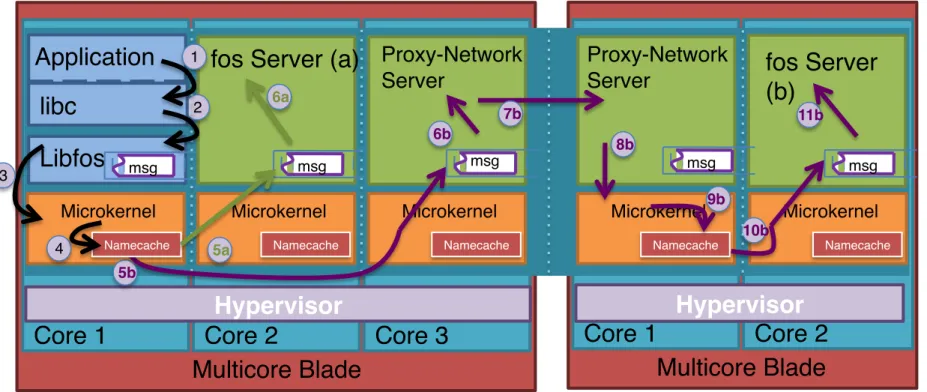
Figure 2: An overview of the fos server architecture, highlighting the cross-machine interaction between servers in a manner trans-parent to the application. In scenario (a), the application is requesting services from “fos Server a” which happens to be local to the application. In scenario (b), the application is requesting a service which is located on another machine.
by adding locks to the OS data structures. There are many prob-lems with locks, such as choosing correct lock granularity for per-formance, reasoning about correctness, and deadlock prevention. Ultimately, programming efficient large-scale lock-based OS code is difficult and error prone. Difficulties of using locks in OSes is discussed in more detail in [26].
Developing cloud applications composed of several components deployed across many machines is a difficult task. The prime rea-son for this is that current IaaS cloud systems impose an extra layer of indirection through the use of virtual machines. Whereas on multiprocessor systems the OS manages resources and scheduling, on cloud systems much of this complexity is pushed into the appli-cation by fragmenting the appliappli-cation’s view of the resource pool.
Furthermore, there is not a uniform programming model for com-municating within a single multicore machine and between ma-chines. The current programming model requires a cloud program-mer to write a threaded application to use intra-machine resources while socket programming is used to communicate with compo-nents of the application executing on different machines.
In addition to the difficulty of programming these large-scale hi-erarchical systems, managing and load-balancing these systems is proving to be a daunting task as well. Ad-hoc solutions such as hardware load-balancers have been employed in the past to solve such issues. These solutions are often limited to a single level of the hierarchy (at the VM level). In the context of fos, however, this load balancing can be done inside the system, in a generic manner (i.e. one that works on all messaging instead of only TCP/IP traffic) and on a finer granularity than at the VM or single machine level. Furthermore, with our design, the application developer need not be aware of such load balancing.
Scalability, elasticity of demand, faults, and difficulty in pro-gramming large systems are common issues for emerging multicore and cloud systems.
3. ARCHITECTURE
fos is an operating system which takes scalability and adaptabil-ity as thefirst order design constraints. Unlike most previous OSes where a subsystem scales up to a given point, beyond which the subsystem must be redesigned, fos ventures to develop techniques and paradigms for OS services which scale from a few to thou-sands of cores. In order to achieve the goal of scaling over multiple
orders of magnitude in core count, fos uses the following design principles:
• Space multiplexing replaces time multiplexing. Due to the growing bounty of cores, there will soon be a time where the number of cores in the system exceeds the number of active processes. At this point scheduling becomes a layout prob-lem, not a time-multiplexing problem. The operating system will run on distinct cores from the application. This gives spatially partitioned working sets; the OS does not interfere with the application’s cache.
• OS is factored into function-specific services, where each is
implemented as a parallel, distributed service. In fos, ser-vices collaborate and communicate only via messages, al-though applications can use shared memory if it is supported. Services are bound to a core, improving cache locality. Through a library layer, libfos, applications communicate to services via messages. Services themselves leverage ideas from col-laborating Internet servers.
• OS adapts resource utilization to changing system needs. The utilization of active services is measured, and highly loaded services are provisioned more cores (or other resources). The OS closely manages how resources are used.
• Faults are detected and handled by OS.OS services are mon-itored by watchdog process. If a service fails, a new instance is spawned to meet demand, and the naming service reas-signs communication channels.
The following sections highlight key aspects of the fos architec-ture, shown in Figure 2. fos runs across multiple physical machines in the cloud. In the figure, fos runs on an IaaS system on top of a hy-pervisor. A small microkernel runs on every core, providing mes-saging between applications and servers. The global name mapping is maintained by a distributed set of proxy-network servers that also handle inter-machine messaging. A small portion of this global namespace is cached on-demand by each microkernel. Applica-tions communicate with services through a library layer (libfos), which abstracts messaging and interfaces with system services.
Architecture
¤
Small
microkernel
on each core, to provide basic messaging
between applications and servers,
capabilities
to restrict access
into the microkernel
¤
Space partitioning
- Belief that there will soon be a time where the
number of cores in the system exceeds the number of active
processes
¤
Name mapping
kept by
distributed
set of proxy-network servers
(Cached by each microkernel) – Leveraging P2P solutions, WIP
¤
Applications communicate through
libfos
to interact with OS
Messaging
¤
Basic
communication
primitive
¤
Operating system services also implemented using
messaging, need to communicate with the servers
¤
Messaging medium can be
network
or
shared
memory
¤
Intra – machine
communication uses shared memory
¤
Across
the cloud, shared memory is first used to send
messages to the local proxy server which then uses the
network
Naming
¤
Processes register a particular name for a
mailbox
¤
OS service provided by several independent processes, these
form a
fleet
, Nameserver picks a member of the fleet on
receiving a request
¤
How this is
cached
,
consistency
etc. still in works – needs to
be extremely low latency but still maintain consistent and
global view of namespace
OS Services
¤
Fleet of servers
– each service implemented as a set of
processes
¤
File System Fleet, naming fleet, scheduling fleet, paging fleet
etc.
¤
Uses a server model –
RPC
semantics (Requires
serialization / deserialization primitives)
¤
Parallel data structures
– managing the state of the service
Main Loop of a server
! ! ! ! ! ! ! ! "# ! ! ! ! "# "# "# "# "# $ $ $ $ $ $ $ $ $ $ $ $ $ $ $ $ $ $ $ $ $ $ $ $ $ $ $ $ $ $ $ !""#$%&'$() !"#$%$&''%()%*+,-% ./)01%'23 *+,-.(,/*$%0(1+0)+# !"#$ %"%&$ 2$#+345,'+*34+06+0 .(,/*$%0(1+0)+# !"#$ %"%&$ "0(%+,,324 0+78+,' *+,-! *+,-" # $ % & ' ( )*+,-Figure 5. Message walkthrough of an example application file system access.
client communicate via microkernel messaging. In order to prevent dependency cycles, the fos-microkernel knows the physical loca-tion of the delegated to client tasks. Also, delegated to client tasks are not dependent on microkernel services which they ultimately provide. Example delegated services are the name server service and the privilege service.
The privilege service is implemented as a fleet of servers in the OS layer. The fos-microkernel requests privilege information from the delegated to privilege manager servers and caches the informa-tion inside of the microkernel in a read only manner. Occasionally privileges change and the privilege manager messages the micro-kernel notifying the micromicro-kernel to invalidate the appropriate stale privilege information. In order for the privilege manager to run as a fos-microkernel client, the fos-microkernel affords privilege man-ager servers static privileges, so that a privilege fixed point can be reached.
3.2.3 Structure of a Server
fos’s servers are inspired by Internet servers. The typical server is designed to process an inbound queue of requests and is transaction-oriented. A transaction consists of a request sent to a server, the server performing some action, and a reply being sent. Most fos servers are designed to use stateless protocols like many Internet services. This means that each request encodes all of the needed data to complete a transaction and the server itself does not need to store data for multiple transactions in sequence. By structuring servers as transaction-oriented stateless processes, server design is much simplified. Also, scalability and robustness is improved as requests can be routed by the name server to differing servers in the same server fleet.
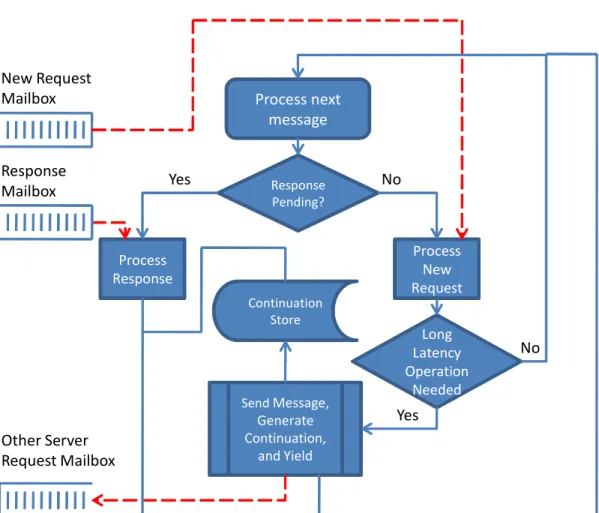
Programming difficulty of a typical server is also reduced be-cause each server processes a transaction to completion without the possibility of interruption. Thus local locking is not required to pre-vent multiple server threads from attempting to concurrently update memory. Some transactions may require a long latency operation to occur, such as accessing I/O or messaging another server. When a long latency operation does occur, a server constructs a continua-tion for the current transaccontinua-tion, which is stored locally. The contin-uation is restarted when a response from the long latency operation is received.
Servers are structured to process two inbound mailboxes. One for new requests and one for responses. The server prioritizes responses over requests. Servers do not preempt transactions, but
!"#$%"&'"() *+,-./0 %"(1/2(" *+,-./0 34/5"(($2"0) 6"((+7" !"#$%&#"' ("&)*&+, !"#$%&&' (%&)#*&% !"#$%&&' +%, (%-.%&/ -%&.*&/0.*%& 1.%2" 8"( !/ 0#*1 02/%*$3' 4)%"2/5#*' +%%6%6 1"&)'!"##$%"& '"(")$*"+ ,-(*.(/$*.-(& $(0+1."20 !/ 8"( 9):"4$;"4<"4 %"&'"()$*+,-./0
Figure 6. The main runloop for a server.
rather use a cooperative model. Figure 6 shows the typical control flow of a server. Servers are designed to acquire all resources needed to complete a transaction before a transaction creates a continuation and yields to the next transaction. By doing so, servers can be designed without local locking.
3.3 Comparison to Traditional OS’s
In this section we evaluate the design of fos to see how it tackles the scalability challenges set forth in Section 2. The first challenge that traditional operating systems face is their utilization of locks to protect access to data which is shared amongst multiple threads. fos approaches the lock problem with a multipronged approach. First, fos is an inherently message passing operating system, there-fore there are no shared memory locks between cores. Second, fos servers are constructed in a non-preemptive manner. Only one thread is ever executing on a server and the server chooses where, when, and if it should yield when a long latency operation occurs. The server writer chooses the yield locations, thus if the data is consistent, no locks are needed. In fos, if a lock is absolutely nec-essary, hardware locking instructions are not used as servers are not preempted.
In fos, servers can be used as lock managers. While this is possi-ble, the message passing nature of fos discourages this usage model by making programming in this manner difficult. If lock managers are used, the OS designer is able to add more lock management resources explicitly rather than relying on the underlying shared memory system and exclusive operations provided by the hard-ware.
Applications and the operating system have largely different working sets. To address this problem and avoid implicitly shar-ing hardware structures such as caches and translation lookaside buffers (TLBs), fos executes the operating system on separate pro-cessing cores from the application. Also, different portions of the operating system are factored apart such that different operating system working sets do not interfere in implicitly accessed data structures.
The third identified problem with traditional OS’s is their de-pendence on shared memory. Being dependent on hardware shared memory limits the applicability of traditional OS’s to multicore hardware architectures which are patterned after symmetric multi-processors (SMPs). Many current multicore multi-processors, future mul-ticore processors, and embedded mulmul-ticores do not support shared
File System as a Service
¤
Application client, fos file system server and block device
driver server – (may) execute on separate cores
¤
fos
intercepts
file system call, and sends it to the
file system
server (requires name server lookup)
¤
File system
server communicates with the
block device driver
server to provide Disk I/O Operations and access to the
physical link.
Discussion
¤
Is this the OS that the Datacenter needs?
¤
Resource Sharing
, Data Sharing
¤
Programming abstraction
?
¤
Provisioning at the
granularity of VMs
– not at the level of
cores. Is the Hypervisor necessary? (NO).
Can the single
system image OS itself provide required isolation?
Discussion
¤
Tessellation
also exploits the idea of Space-Time partitioning
but designed for many-cores only. Can this scale? Seems to
target multi-core systems with more emphasis on
performance prediction. Hardware support?
¤
Microkernel
vs. Multikernel (Barrelfish)
¤
Make inter-core communication explicit (No single abstraction)
The Multikernel: A new OS architecture
for scalable multicore systems
Andrew Baumann
⇤
, Paul Barham
†
, Pierre-Evariste Dagand
‡
, Tim Harris
†
, Rebecca Isaacs
†
,
Simon Peter
⇤
, Timothy Roscoe
⇤
, Adrian Schüpbach
⇤
, and Akhilesh Singhania
⇤
⇤
Systems Group, ETH Zurich
†
Microsoft Research, Cambridge
‡
ENS Cachan Bretagne
ABSTRACT
Commodity computer systems contain more and more processor
cores and exhibit increasingly diverse architectural tradeo
↵
s,
in-cluding memory hierarchies, interconnects, instruction sets and
variants, and IO configurations. Previous high-performance
com-puting systems have scaled in specific cases, but the dynamic nature
of modern client and server workloads, coupled with the
impossi-bility of statically optimizing an OS for all workloads and hardware
variants pose serious challenges for operating system structures.
We argue that the challenge of future multicore hardware is best
met by embracing the networked nature of the machine, rethinking
OS architecture using ideas from distributed systems. We
investi-gate a new OS structure, the
multikernel
, that treats the machine as a
network of independent cores, assumes no inter-core sharing at the
lowest level, and moves traditional OS functionality to a distributed
system of processes that communicate via message-passing.
We have implemented a multikernel OS to show that the
ap-proach is promising, and we describe how traditional scalability
problems for operating systems (such as memory management) can
be e
↵
ectively recast using messages and can exploit insights from
distributed systems and networking. An evaluation of our prototype
on multicore systems shows that, even on present-day machines,
the performance of a multikernel is comparable with a conventional
OS, and can scale better to support future hardware.
Categories and Subject Descriptors:
D.4.7 [Operating Systems]:
Organization and Design
General Terms:
Design, Experimentation, Performance
Keywords:
Scalability, multicore processors, message passing
1. INTRODUCTION
Computer hardware is changing and diversifying faster than system
software. A diverse mix of cores, caches, interconnect links, IO
devices and accelerators, combined with increasing core counts,
leads to substantial scalability and correctness challenges for OS
designers.
Permission to make digital or hard copies of all or part of this work for
personal or classroom use is granted without fee provided that copies are
not made or distributed for profit or commercial advantage and that copies
bear this notice and the full citation on the first page. To copy otherwise, to
republish, to post on servers or to redistribute to lists, requires prior specific
permission and/or a fee.
SOSP’09,
October 11–14, 2009, Big Sky, Montana, USA.
Copyright 2009 ACM 978-1-60558-752-3/09/10 ...$10.00.
x86 Async messages App x64 ARM GPU App AppOS node OS node OS node OS node
State
replica replicaState replicaState replicaState
App Agreement algorithms Interconnect Heterogeneous cores Arch-specific code
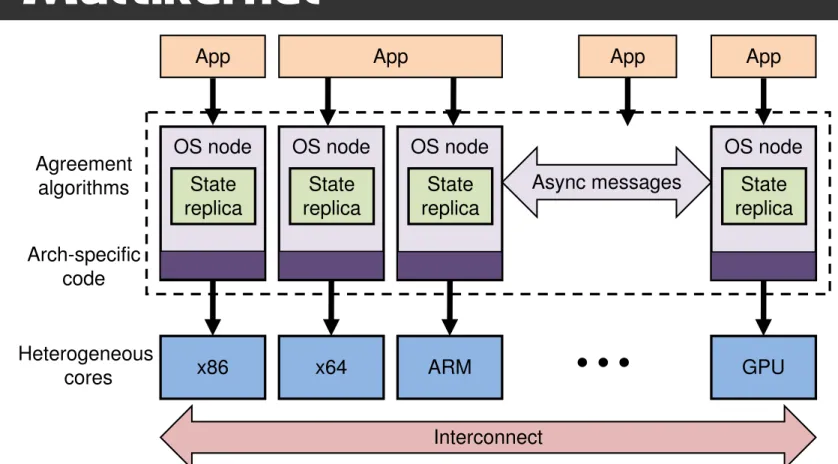
Figure 1: The multikernel model.
Such hardware, while in some regards similar to earlier
paral-lel systems, is new in the general-purpose computing domain. We
increasingly find multicore systems in a variety of environments
ranging from personal computing platforms to data centers, with
workloads that are less predictable, and often more OS-intensive,
than traditional high-performance computing applications. It is
no longer acceptable (or useful) to tune a general-purpose OS
de-sign for a particular hardware model: the deployed hardware varies
wildly, and optimizations become obsolete after a few years when
new hardware arrives.
Moreover, these optimizations involve tradeo
↵
s specific to
hard-ware parameters such as the cache hierarchy, the memory
consis-tency model, and relative costs of local and remote cache access,
and so are not portable between di
↵
erent hardware types. Often,
they are not even applicable to future generations of the same
archi-tecture. Typically, because of these di
ffi
culties, a scalability
prob-lem must a
↵
ect a substantial group of users before it will receive
developer attention.
We attribute these engineering di
ffi
culties to the basic
struc-ture of a shared-memory kernel with data strucstruc-tures protected by
locks, and in this paper we argue for rethinking the structure of
the OS as a distributed system of functional units
communicat-ing via explicit messages. We identify three design principles: (1)
make all inter-core communication explicit, (2) make OS structure
hardware-neutral, and (3) view state as replicated instead of shared.
The model we develop, called a
multikernel
(Figure 1), is not
only a better match to the underlying hardware (which is
net-worked, heterogeneous, and dynamic), but allows us to apply
in-sights from distributed systems to the problems of scale, adaptivity,
and diversity in operating systems for future hardware.
Even on present systems with e
ffi
cient cache-coherent shared
memory, building an OS using message-based rather than
shared-1
Discussion
¤
Per – Node efficiency?
¤
Is efficiency really not a concern? Paging across the cloud?
¤
Akaros – Many core processes (MCP) – gang scheduled
¤
Present applications with finer details of the resources they are
allocated (or provisioned)
¤
Incremental – Data-intensive / processing intensive nodes to run
Thanks!
- Gautam