UC Irvine
UC Irvine Electronic Theses and Dissertations
Title
Global Factor Returns
Permalink
https://escholarship.org/uc/item/3z888825
Author
Viswanathan, Vivek
Publication Date
2019
Peer reviewed|Thesis/dissertation
eScholarship.org
Powered by the California Digital Library
i
UNIVERSITY OF CALIFORNIA,
IRVINE
Global Factor Returns
DISSERTATION
submitted in partial satisfaction of the requirements
for the degree of
DOCTOR OF PHILOSOPHY
in Finance
by
Vivek Viswanathan
Dissertation Committee:
Professor Philippe Jorion, Chair
Professor Zheng Sun
Assistant Professor David C. Yang
ii
ii
DEDICATION
To
Max
Ginger
Mocha
Latte
Java
Dia
Meena
Titan
Moth
iii
TABLE OF CONTENTS
ACKNOWLEDGMENTS v
CURRICULUM VITAE vi
ABSTRACT OF THE DISSERTATION vii
CHAPTER 1: GLOBAL FACTOR RETURNS 1
1.2 Factor Returns 7
1.2.1 Methodology 7
1.2.2 Factor Returns Results Overview 8
1.2.3 Global 9
1.2.4 United States 10
1.2.5 Developed ex US 10
1.2.6 Emerging Markets 11
1.2.7 Factor Equal-Weights 11
1.2.8 Alpha Against United States 14
1.2.9 Post-Sample Returns 14
1.2.10 Covariances vs. Characteristics 15
1.2.11 Long vs. Short Returns 16
1.2.11 Factor Volatilities 17
1.3 Determining Which Factors Deliver Excess Return 17
1.4 Indicators of market efficiency 19
1.5 Are markets becoming more efficient? 20
1.6 Transaction Costs 21
1.5 Conclusion 22
1.7 References 23
CHAPTER 2: HIGH-DIMENSION FACTOR RETURNS 25
2.1 Data 27
2.2 The Capital Asset Pricing Model (CAPM) 27
2.3 Collapsing the Factor Space 28
2.3.1 Fama French 3-Factor Model (FF3) 29
2.3.2 Carhart 4-Factor Model 29
2.3.3 Fama French 5-Factor Model (FF5) 30
2.3.4 Novy-Marx 5-Factor Model (NM) 30
2.3.5 Hou, Xue, and Zhang 4-Factor Model (HXZ) 31
2.3.6 Stambaugh and Yuan 4-Factor Model (SY4) 32
2.3.7 Daniel, Hirshleifer, and Sun 3-Factor Model (DHS) 32
iv
2.3.9 Summary 34
2.4 Principal Component Analysis 35
2.5 Conclusion 36
2.6 References 37
CHAPTER 3: MACHINE LEARNING IN GLOBAL EQUITY MARKETS 39
3.1 Data 40 3.2 Methodology 41 3.2.1 Data Pre-Processing 41 3.2.2 Linear Regression 42 3.2.3 Ridge Regression 43 3.2.4 Gradient Boosting 43 3.2.5 Random Forest 44
3.2.6 Calibration and Prediction 44
3.2.7 Regularization Parameters 46
3.2.8 Ensemble Forecast 46
3.2.9 Portfolio Construction 47
3.3 Results 47
3.3.1 Linear Regression Results 47
3.3.2 Machine Learning Models 49
3.4 Conclusion 51
3.5 References 52
v
ACKNOWLEDGMENTS
I want to thank Professor Philippe Jorion, Professor David Hirshleifer, Professor David Yang, Professor Zheng Sun, and Professor Ivan Jeliazkov for their deep insights into the theory, structure, and empirics of this thesis. Their contributions have both enlightened me and greatly improved this document.
vi
CURRICULUM VITAE
Vivek Viswanathan
2005
B.A. in Economics, University of Chicago
2006
Research Associate, Center for Microfinance, Chennai, India
2007-16
Senior Researcher, Vice President, Research Affiliates, Newport Beach, CA
2009
Masters in Financial Engineering, University of California, Los Angeles, CA
2016-
Global Head of Research, Rayliant Global Advisors, Irvine, CA
2019
Ph.D. in Finance, University of California, Irvine, CA
FIELD OF STUDY
Cross-sectional equity anomalies
PUBLICATIONS
“Two Determinants of Lifecycle Investment Success,” The Journal of Retirement, 2015,
Coauthors: Jason Hsu, Jonathan Treussard, Lillian Wu, Published in (2015)
“A Framework for Assessing Factors and Implementing Smart Beta Strategies,” The Journal of
Index Investing, Summer 2015, Co:authors: Jason Hsu, Vitali Kalesnik
“Momentum and Mean-Reversion in Commodity Spot and Futures Markets,” Journal of
Commodity Markets, September 2016, Coauthor: Denis Chaves
“The Low Volatility Anomaly and the Preference for Gambling,” Risk-Based and Factor
Investing, November 2015, Coauthor: Jason Hsu
“Anomalies in Chinese A-Shares,” Journal of Portfolio Management, Summer 2018, Coauthors:
Jason Hsu, Chenhui Wang, Phillip Wool
“Outperformance through Investing in ESG in Need,” Journal of Index Investing, Summer 2018,
Coauthors: Jason Hsu, Xiaoyang Liu, Keren Shen, Yanxiang Zhao
“Illiquidity and Factor Returns,” Journal of Investment Management, October 2018, Coauthor:
Jason Hsu.
vii
ABSTRACT OF THE DISSERTATION
Global Factor Returns
By
Vivek Viswanathan
Doctor of Philosophy in Finance
University of California, Irvine, 2019
Professor Philippe Jorion, Chair
The 86 of 97 McLean and Pontiff (2016) factors that can be readily tested internationally deliver
higher returns in Developed ex US and yet higher returns in Emerging Markets than in the United
States. An equally weighted portfolio of these factors is highly significant in each region and such
portfolios in Developed ex US and Emerging Markets earn a significant alpha on their US
counterpart. In no region are these factors adequately explained by current models that attempt to
explain factor excess returns. These factors are driven by the underlying characteristics as opposed
to loadings on risk factors demonstrating that these factors are anomalies, not priced risks.
However, there is some evidence that the premia on these anomalies and the characteristics’ ability
to predict return are declining over time.
1
CHAPTER 1: GLOBAL FACTOR RETURNS
The same factors that have been tested in the United States deliver high premia in
developed markets excluding the United States (DevxUS) and yet higher premia in emerging
markets (EM). This suggests that on average, the decline in factor premia in the United States is
primarily a result of greater efficiency and not pure data snooping. In addition, it demonstrates that
the behavioral inefficiencies in the United States are not specific to culture, economic structure, or
regulations but instead reflect apparent failures of human rationality or attention in understanding
universal economic phenomena.
I examine the robustness of factors by testing 86 of the 97 McLean and Pontiff (2016)
factors across global markets and find that while most factors are insignificant in their own right,
an equally weighted portfolio of factors is significant in each region and this portfolio is more
significant in DevxUS than in the United States and more significant in EM than in DevxUS.
Similar to Lu, Stambaugh, and Yuan (2018) for a smaller subset of factors and Jacobs and Müller
(2019), I find that these anomalies are globally robust. Moreover, more factors are individually
significant in EM than in DevxUS and in DevxUS than in the US. In addition, factors are more
often significant and earn higher returns in small stocks than large stocks. Given the lower attention
paid to and lower liquidity in smaller and emerging market stocks, this may be a function of limited
attention or limits to arbitrage due to lower liquidity.
The factor performance in DevxUS and EM is not a mere result of correlation with US
factors. An equally weighted portfolio of factors in DevxUS and an equally weighted portfolio of
factors in EM each earns an alpha significant at a 0.01 level on the US equally weighted portfolio
of factors.
The returns of these 86 factors are driven entirely by characteristics, not covariances. In
other words, they are behavioral anomalies, not risk factors. Few factors built from factor loadings
as opposed to characteristics are significant, whereas numerous factors built from characteristics
are significant. An equally weighted portfolio of factors based on characteristics subsumes an
equally weighted portfolio of factors based on covariances.
Moreover, the fact that 1) 17 principal components are needed to explain 90% of the
variance of factor returns globally and 2) which factors deliver positive excess returns in any given
period is time varying suggests that collapsing many factors into few may not be possible. Further,
predictive regressions of returns demonstrate that the characteristics that predict return vary from
period to period. All told, this suggests factors are robust globally and not subsumable by fewer
factors.
As Harvey, Liu, and Zhu (2016) note, over a hundred factors have been discovered in the
United States, but most no longer work and many never even worked in the sample in which they
were originally investigated. This implies a collective data snooping by the academic and
practitioner finance community. They suggest increasing the required t-stat to 3 for rejecting the
null of 0 factor excess returns at a 0.05 level. However, it’s not clear that such a high t-stat is
actually warranted since many of the equity results they examined are time series claims, not
cross-sectional ones. Moreover, I avoid this high t-stat requirement by equally weighting all factors into
one portfolio in regions outside of the original test and post-sample, effectively collapsing the
multiplicity of factors into one. However, the t-stats for the individual factors should be viewed
with the suitable skepticism.
McLean and Pontiff (2016) examine 97 factor returns and find that t-stats have fallen in
half post-sample. Such a result can either be a result of arbitrage as practitioners implemented
these anomalies or data mining as the high in-sample t-stats collapsed. The results in this paper
suggest the decline is due to arbitrage at least in part.
Instead of looking post-sample, Linnainmaa and Roberts (2016) examine factor returns in
a prior sample before the Compustat coverage period using Moody's Industrial and Railroad
manuals. The pre-sample returns demonstrate that the factor returns were not robust. However, the
United States may be sufficiently different between 1947 and 1965 that the same factors may not
work. Of course, the exact same argument can be leveled against using international stock returns.
Lastly, Novy-Marx (2016) suggests that t-stats that account for multiple hypotheses would
dismiss most false anomalies as data mining. He specifically targets composite factors such as
Piotroski F-Score or Mohanram G-Score which contain multiple metrics in their construction. If a
researcher has the choice to flip each element of a composite score to be positively sorted or
negatively sorted, then even if each element is insignificant, the combination can be extremely
highly significant. This fact remains true irrespective of the results presented here.
Instead of approaching the analysis of factors by looking pre- and post-sample, I choose to
look outside the United States. Such an approach is necessarily riddled with data issues that prevent
proper testing of all 97 McLean and Pontiff factors. In addition, testing the robustness of anomalies
internationally does not have the same clean test of looking pre- and post-sample, since factors are
correlated across regions.
One can rationally argue that investors behave differently in different regions and thus,
different anomalies will naturally arise. This is likely true. Indeed, Arkes, Hirshleifer, Jiang, and
Lim (2008) find cultural differences in reference point adaptation which should affect the
momentum anomaly. Weber and Hsee (1998) and Hsee and Weber (1999) show that Chinese
investors are more risk-seeking than American ones, which would affect the strength of the
volatility, beta, and residual variance anomalies. Ji, Nisbett, and Su (2001) find that Chinese
students are more likely to believe that trends will continue than their American counterparts,
which would affect momentum and reversal anomalies.
Some markets such as those in Taiwan are far more heavily dominated with retail investors
than in the United States where most trading is done by institutions and increasingly by algorithms.
Some countries have stricter accounting rules than others. Some demonstrate far greater earnings
management than others. For example, most emerging markets show a stronger jump around 0%
in a return on equity histogram than in the United States. However, if anomalies reflect something
fundamental about human behavior whether driven by inattention, underreaction, overreaction, or
risk preferences, then we would expect the anomalies to persist globally. In other words, if factors
were not robust globally, it would not inherently suggest that they do not work in the United States.
However, the fact that they do work globally suggests that they reflect something more
fundamental as opposed to something specific to the United States and certainly refutes the notion
that the historical literature on factors is a mere result of data-mining. This result and conclusion
are the same of that of Jacobs and Müller (2019).
A second objection to using international data as a robustness test is that the returns are
correlated with US data. As discussed, while correlated, an equally weighted portfolio of EM or
DevxUS factors earns a significant positive alpha on an equally weighted portfolio of US factors,
suggesting that an orthogonal component of the factors earns excess return.
Unlike many papers, I report large capitalization and small capitalization factor returns
separately. The returns of large capitalization factors are generally lower than those of small
capitalization factors similar to the results found in Hsu and Viswanathan (2018). The
methodology involved in Fama and French (1992) and nearly every other paper on factors of
averaging large and small cap factor returns thus results in an exaggeration of the statistical
significance of factors or at least an exaggeration of what can be practically earned by an investor
of any reasonable size.
1.1 Data
I use Worldscope data for financial data and Datastream for market data. I match the
adjustments that Compustat makes to ensure that the signals are comparably calculated. I choose
Worldscope for financial data over other sources like Thomson Financial because Worldscope
implements a litany of data adjustments to ensure comparability across countries.
I match Worldscope with Datastream through a matching table between DS Company
Code and Worldscope ID, similar to CRSP / Compustat Merged. Country inclusion and
classification into developed and emerging are based on MSCI. All non-OTC exchanges are
included in each country. Country classification is based on country of domicile for the primary
operating business of the firm as opposed to the exchange listing. Results are not sensitive to basing
country designation on exchange.
A currency change in Brazil in the early 1990s results in a large bias in market
capitalizations in the subsequent 4 years. Using other sources of exchange rates from Bloomberg
fail to fully remedy this problem, so I start samples in July 1995.
I compare total returns and price returns for individual stocks. If total return exceeds price
return in a day by more than 500%, then the total return is set to equal the price return. Presumably,
no firm would pay out such a high percentage of its value as a dividend in one day, so such an
observation is likely a data error. Bloomberg and CRSP data verify that such data are likely
erroneous. If price returns ever exceed total returns, then price returns are set to total return. Lastly,
if return exceeds 2500% or is less than -96% in a day that return is set to 0. These values are chosen
for symmetry in effect on geometric return. Again, the presumption is that returns above 2500%
or below -96% are erroneous, which I verify in the US using data from CRSP and Bloomberg. If
any total or price return data are missing, the returns are set to 0.
I use the market capitalization breakpoints for the NYSE from French Data Library. Only
stocks above the 20th percentile are included (all but tiny). The rationale for the exclusion of such
stocks are the sheer number of such stocks and the frequency of outlier returns among such stocks.
I use NYSE breakpoints, since the inclusion of new exchanges in the database affects the
distribution of market capitalizations dramatically. Market capitalizations in USD come from
Datastream.
Certain factors from McLean and Pontiff (2016) are not computed due to lack of data:
Change in Recommendation, which requires analyst recommendations; Debt Issuance, which
requires debt issuance from the cash flow statement; Exchange Switch; IPO + Age, which requires
the initial public offering of the company; Mergers; Ratings Downgrades; SEOs; Spinoffs;
Advertising/MV because advertising is not broken out as a separate line item in Worldscope;
Marketing/MV because marketing is not broken out as a separate line item in Worldscope; and
G-Index, since it requires specific information about corporate governance.
While I do not compute IPO + Age, I do compute the IPO factor and Age factor individually
by using the months since appearance in the database as a proxy. In order to prevent issues arising
from new exchanges being added to Datastream causing a false positive for an IPO, no IPO or Age
signals were calculated for any stocks that were added due to a new exchange being added to the
database.
1.2 Factor Returns
1.2.1 Methodology
I test all anomalies for which data are available in McLean and Pontiff (2016). I choose
McLean and Pontiff (2016) as the baseline because the anomalies are tractable and categorized. I
use the categories merely as a tool for organization. The 86 anomalies tested are shown in Table 1
along with their corresponding citations.
As discussed previously, I remove tiny stocks from our sample as defined by below 20th
percentile NYSE market capitalization. Next, I group stocks into large and small buckets based on
total market capitalization with the NYSE 60th percentile denoting the breakpoint between large
and small. I use 60th percentile as the demarcation point between large and small because the
removal of tiny stocks shifts the market capitalization midpoint.
I sort stocks based on the given characteristic in the direction such that the long portfolio
is expected to generate positive excess returns over the short portfolio. I base the sorting direction
on papers that initially discovered the anomalies cited in McLean and Pontiff (2016). Unlike
Jacobs and Muller (2019) I report the returns, volatilities, and t-stats of the individual factors
including within large cap stocks, within small cap stocks, and the average of the large and small
factors returns. The separation of the results is meant to elucidate the difference in returns of factors
among large and small stocks. I average the large and small returns to produce the factor factors.
I also calculate the equal-weighted portfolio of all factor returns in a given region in the
large, small, and average portfolios. The equally weighted portfolio of all factor returns represents
the combined significance of all factors and is probably the cleanest determinant of whether factors
as whole generate excess returns even if such a test tells us nothing about which factors generate
excess return. Any given factor in a long list of factors can generate positive excess return. The
average of all factor returns in an out-of-sample test represents the ability of these factors to
collectively predict return without the in-sample, outlier, or autocorrelated standard error problems
that would occur with a regression.
For the purposes of the factor results, we construct size exactly as the other factors—top
30% minus bottom 30% within large and small. However, for the purposes of the explanatory
regressions such as the Fama-French 3-Factor model, we construct size as top 40% minus the 20
thto 60
thpercentile.
Unlike Jacobs and Muller (2019), I remove tiny stocks which are largely untradable but
can make up a disproportionate component of stocks in the long and short portfolio as they are
more likely to have extreme financial and market behavior. In addition, I aggregate stocks into the
regions of US, DevxUS, and EM, which permits an interrogation of the orthogonal component of
excess returns from EM with respect to the other regions.
1.2.2 Factor Returns Results Overview
Table 2 shows the number of significant factors in each region and size category. In
general, factors in large capitalization stocks do not show particularly strong significance. At a
0.05 level, global large has 10 significant factors, US large 2 significant factors, DevxUS large 6
significant factors, and EM large 4 significant factors. Small cap stocks show far more significant
factors across regions with 27 factors significant in global small, 8 significant in the US small, 23
significant in DevxUS small, and 36 in EM small. These small stocks generate an outsized
influence on the significance of the average of factor portfolios within large and small. When one
averages the large and small factors, 20 are significant in global, 5 in the US, 15 in DevxUS, and
19 in EM.
In general, the higher frequency of significant factors among small stocks is consistent with
investors arbitraging these factors in large stocks but less so in smaller, more illiquid stocks. The
outperformance among small stocks suggests that the factors are more likely to persist, given the
lower liquidity of such stocks.
Factors are rarely negatively significant. Among the average of large and small factors, 2
are negatively significant at a 0.05 level in global, zero in the US, 3 in DevxUS, and zero in EM.
This asymmetry suggests that the factors are more likely to deliver excess return than not but is
hardly definitive given that many of the factors are highly correlated. I tackle this issue more
rigorously when looking at equally weighted factors.
1.2.3 Global
Table 3 shows factor returns within each region and within large and small. Twenty factor
returns are significantly positive at a 0.05 level or better among the average of large and small
factor returns: change in asset turnover, change in forecast plus accruals, down forecast, one-year
share issuance, total external finance, up forecast, coskewness, industry momentum, cash flow /
MV, earnings-to-price, enterprise multiple, accruals, asset turnover, gross profitability, G-Score,
F-Score, M/B and accruals, percent operating accruals, profitability, and ROE. Only two factors,
bid-ask spread and cash flow variance, are negatively significant at a 0.05 level. Why bid-ask
spread fails is not clear but is likely in part due to the sheer number of factors that are being tested—
if enough tests are run, some are likely to show negative significance regardless of their actual
expected return. Alternatively, it may simply be that illiquidity is not priced by the market. Brennan
and Subrahmanyam (1996), Spiegel and Wang (2005), Ben-Rephael, Kadan, and Wohl (2015),
and Lou and Shu (2014) find weak or no evidence for an illiquidity premium. Firms with low cash
flow variance tend to have low betas and to be growth firms, so the factor does not earn a
significantly negative CAPM alpha or a significant Fama-French 3-Factor alpha.
1.2.4 United States
Factor returns in the United States during this period are weaker than those globally. Given
that we are using a period between 1995 to 2018, our results are consistent with McLean and
Pontiff (2016). That is, factors are relatively weak during this time period in the United States.
A mere 5 factors are positively significant at a 0.05 level when looking at the average of
large and small: change in asset turnover, Mohanram G-Score, leverage, M/B and accruals, and
percent operating accrual. Such a miniscule number of significant factors is consistent with none
of the factors working in the US and the significant ones being the result of imprecise estimation
on a finite sample. Two factors are significant in the large cap space: 5-year share issuance and
NOA. Among small cap stocks, 8 of 86 factors are significantly positive at a 0.05 level, a mere 9%
of tested factors.
The weakness in the US is telling. It is no wonder that numerous publications have claimed
that the factors are likely a result of data mining and that markets are far more efficient than the
sheer number of published factors would suggest. I will show in the Factor Equal-Weights
subsection that there are significant returns to be found in this data and in the Collapsing the Factor
Weights section that there are significant alphas in numerous factors.
No factors are negatively significant in the US.
1.2.5 Developed ex US
DevxUS shows greater factor significance than in the US. Fifteen factors are significant
among the average of the large and small factor returns at a 0.05 level: change in forecast plus
accruals, down forecast, total external finance, up forecast, 52-week high, coskewness, industry
momentum, cash flow / MV, dividend yield, earnings-to-price, enterprise multiple, F-Score, profit
margin, profitability, and ROE. Three factors are negatively significant: bid-ask spread,
Herfindahl, and tax. As globally, bid-ask spread is seemingly priced in the opposite direction. Lev
and Nissim (2004) find that Tax, the ratio of tax-to-book income, predicts subsequent 5-year
earnings growth and suggested that investors are becoming more aware of this relationship. At
least in DevxUS, either this economic relationship has flipped or investors are now overreactingg
to the relationship.
Six factors are positively significant in the large cap space while 23 are significant in the
small cap space.
1.2.6 Emerging Markets
Within EM, 19 factors are significant at a 0.05 level when looking at the average of large
and small cap returns: change in asset turnover, change in forecast plus accruals, down forecast,
post earnings drift, R&D increases, up forecast, coskewness, long-term reversal,
momentum-reversal, book-to-market, cash flow / MV, dividend yield, earnings-to-price, enterprise multiple,
organizational capital, sales / price, asset turnover, operating leverage, and profitability. No factors
are negatively significant in emerging markets for the average of large and small factors.
Within the large cap space, 4 factors are positively significant at a 0.05 level or better,
while in the small cap, 36 are positively significant.
1.2.7 Factor Equal-Weights
A natural issue with the above results is that I am testing numerous hypotheses but still
merely demanding a 1.96 t-stat threshold that would be used for a single hypothesis test. But while
any individual factor cannot be said to be significant at a 5% level with a t-stat of 1.96 given the
many hypotheses that are being tested, an equally weighted portfolio of factors is not subject to
this issue. This same approach was used by Jacobs and Muller (2019). Testing equally weighted
factor portfolios involves 12 correlated hypotheses for each of the four tested regions in large,
small, and the average as opposed to the 1,020 correlated hypotheses involved in testing 86 factors
in four tested regions in large, small, and the average of the two.
This averaging approach also sidesteps the Novy-Marx (2016) objection about testing
multiple signals. This does not involve choosing the factors that have done well in-sample by
flipping the signs of factors if they perform negatively. I simply implement all factors as they are
implemented in their original research in the United States and average them. While this suffers
from publication bias in the United States for all factors published after July 1995, the problem is
far less pronounced outside the United States.
Moreover, this approach handles the issue of the low signal-to-noise ratio for any given
factor. If all factors are equally weighted, the collective signal remains while the individual noise
cancels out.
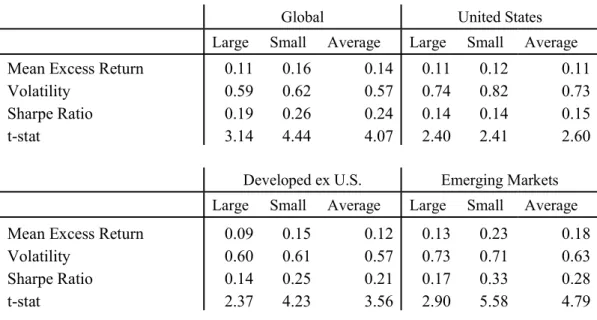
Table 4 shows the results of this analysis and demonstrates that the factors are significant
in every region, are more significant in small cap stocks than large cap stocks, and among average
of large and small factors, are more significant in EM than in developed markets. An equally
weighted portfolio of factors in US Large delivers 11 bps per month which exceeds DevxUS at 9
return, but both are exceeded by EM large at 13 bps. An equally weighted portfolio of factors in
US small earns 12 bps compared to a 15 bps in DevxUS small and 23 bps in EM. In all regions,
the equally weighted portfolio is more significant in small than large.
Note that the magnitude of these returns and volatilities is small due to averaging.
Averaging long 100%, short 100% factors reduces absolute weights greatly over 86 factors.
The significance of the equally weighted factor returns in each region and globally suggests
that the discovery of the myriad factors globally cannot be mere acts of data mining. If that were
so, factors discovered and tested in the United States using CRSP and Compustat data would show
no significance globally. Again, this agrees with Jacobs and Müller (2019). Moreover, the
increasing significance from markets with more attention and liquidity such as large cap US
equities to markets with less attention and liquidity such as small cap emerging market equities
suggests that the factor returns are driven by market inefficiencies and limits to arbitrage.
This finding is in line with limits to arbitrage (Shleifer and Vishny (1997)) and limited
attention (Hirshleifer and Teoh (2003)) such that factor returns are more likely to be strong among
small, illiquid firms that are difficult to short than large, liquid firms where arbitrageurs can easily
exploit anomalies.
Surprisingly, in emerging markets, the volatility of factors is slightly higher among large
cap stocks than among small cap stocks, despite the fact that the volatility of small cap stocks tends
to be higher than that of large cap ones. This may partly be driven by the greater number of
securities in the small cap space, which generates far greater diversification. Alternatively, perhaps
small stocks are more similar to each other and therefore tend to co-move more, resulting in a
long-short portfolio hedging out this risk more greatly in small cap stocks.
On a similar note, the volatility of factor portfolios within EM, though higher than that of
DevxUS, is lower than that of the US. Again, it may be the case that the higher individual stock
volatility in EM is driven by components that are hedged out in a long-short portfolios whereas
the volatility of factors in the US remain undiversified away in long-short portfolios.
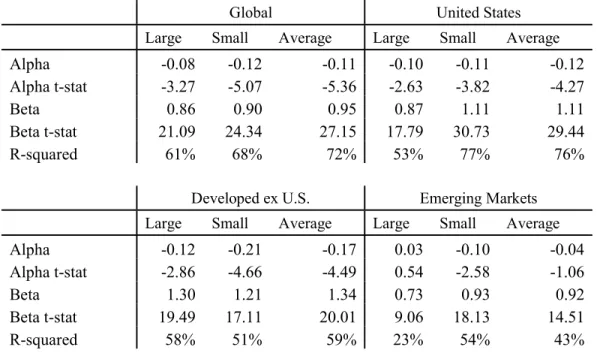
1.2.8 Alpha Against United States
A concern that can be raised to the prior results is that DevxUS and EM factors are
correlated with those of the US and thus these returns are not out-of-sample. To mitigate this issue,
I examine DevxUS and EM equally weighted factor portfolios alphas against the same such
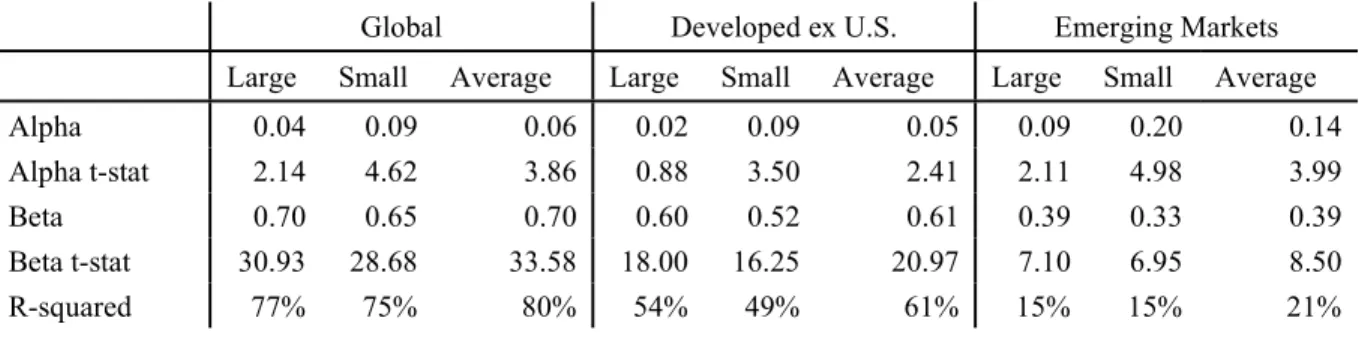
portfolio in the United States in Table 5. All regressions are against the equally weighted factor
portfolio in corresponding size bucket in the US. For example, the equally weighted factor
portfolio in DevxUS large is regressed against the equally weighted factor portfolio in US large.
The only region / size group that fails to earn a statistically significantly positive alpha on
the corresponding US portfolio is DevxUS large, which earns a 2 bp monthly alpha (t-stat: 0.88).
The equally weighted portfolio of factor returns in global large earns a 4 bp monthly alpha (t-stat:
2.14) and EM large a 9 bp monthly alpha (t-stat: 2.11) on the corresponding US large portfolio.
The portfolio in global small earn a 9 bp monthly alpha (t-stat: 4.62) against the US small portfolio.
The DevxUS small portfolio earns a 9 bp monthly alpha (t-stat: 3.50) against the US small
portfolio. The equally weighted portfolio of factor returns in EM small earns 20 bp alpha (t-stat:
4.98) against that of US small. The R-squared of the equally weighted portfolio of factor returns
in a given region regressed against the same portfolio in the US is lower in EM than in DevxUS—
21% in the average portfolio for EM and 61% for DevxUS. Global factors have a high correlation
with US factors because the US makes up a large portion of global market capitalization.
1.2.9 Post-Sample Returns
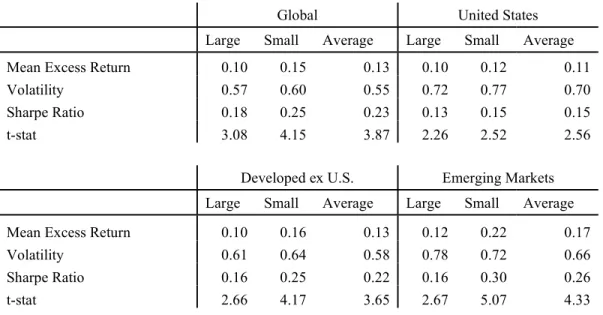
Another potential objection to these results is that they are not post-sample. Table 6 shows
the post-sample equally weighted portfolio results. Post-sample is defined by the first January after
the original paper’s sample period. Sample periods are defined as in McLean and Pontiff (2016).
Similar to Jacobs and Müller (2019), all region / size buckets are significant, though most
buckets have lower significance than in the full sample shown in Table 4.
1.2.10 Covariances vs. Characteristics
Instead of sorting on characteristics, I sort on factor loading in each region in Table 7. For
each stock, I calculate the full period factor loading against the market and one of the 86 factors in
a bivariate regression. I use the average of the large and small factor as the regressor regardless of
whether a large, small, or average factor is tested. I use a full period regression, because I am
testing an asset pricing claim as opposed to a predictive claim. The look-ahead bias in a full period
regression is not relevant since my goal is to test whether the loading on a factor delivers a
particular return as opposed to whether a trader in a given time with the information at hand could
earn excess returns by estimating factor loadings.
When using covariances, far fewer factors are significant. Among global large, three
factors, earnings surprise, profitability, and ROE are significant at a 0.05 level. Among global
small factors and global average factors, earnings surprise, 52-week high, profitability, and ROE
are significantly positive while dividend initiation is significantly negative.
In the US, earnings surprise is significantly positive in the large, small, and average
portfolios. Profitability is positively significant among small stocks. Leverage is negatively
significant in both the small and average portfolios. In DevxUS, earnings surprise, 52-week high,
profitability, and lagged momentum are significant in all size demarcations. Change in profit
margin, profit margin, and ROE are significantly positive in the large and average portfolios.
Earnings consistency is negatively significant in all size demarcations. Percent total accrual is
negatively significant in the large and average portfolios while leverage and size negatively
significant in the small and average portfolios. Momentum-reversal is significantly negative in the
average portfolio.
In EM, dividends are significant at a 0.05 level among small stocks, 52-week high is
significant in the average portfolio, lagged momentum is significantly positive in the large and
average portfolios, momentum is significant in all size categories, and earnings-to-price is
significant among small stocks. Leverage is negatively significant among large stocks.
Table 8 shows that an equally weighted portfolio of factors built from covariances delivers
significantly positive returns in EM small and average but nowhere else. Furthermore, these returns
are subsumed by an equally weighted portfolio of characteristic factors. Table 9 Panel A shows
that in all region / size buckets, except emerging markets large and small a portfolio built from
covariance factors earns a significantly negative alpha, while Table 9 Panel B shows that a
portfolio of characteristic factors earns an alpha on a portfolio of covariance factors in every region
/ size bucket. In other words, factors are driven by characteristics, not covariances.
The results in Table 8 are largely unchanged when using other periods of time to generate
covariance estimates such as trailing 5 year or a 10-year period that includes the trailing and future
5-year period.
1.2.11 Long vs. Short Returns
Numerous papers find that factor returns are driven more by the short side of the portfolio
than the long side. In particular, the return of the capitalization-weighted market portfolio minus
the short portfolio’s return is greater than the long portfolio’s return minus the
capitalization-weighted market portfolio. Table 10 shows the percentage of return that comes from the long side
of the portfolio as a percentage of the total factor return. The number is subject to outliers since
the factor return may be close to 0. However, the median value is above 50% in each region / size
bucket suggesting that most of the return comes from the long and not the short portfolio. In US
Large, the median factor has 50% of the excess return originating from the long and 50% from the
short. In EM Large, the median factor has 63% of the excess return originating from the long and
37% originating from the short. If limits to arbitrage are preventing these factor returns from being
earned, those limits cannot be mere shorting constraints, since the long side of the portfolio
contributes half or more of the excess return.
1.2.11 Factor Volatilities
Table 11 shows the factor volatilities. The long-only market portfolios show a pattern of
increasing volatility from US to DevxUS to EM during this period with a 4.2% monthly volatility
in the US, 4.5% in DevxUS, and 6.4% in EM. While EM factors are the most volatile, DevxUS
factors are less volatile than the US ones. Among the average of large and small factors, 78% are
less volatile in DevxUS than in the US and 23% are less volatile in EM than in the US. The average
of the monthly factor volatilities in the US is 2.80%, in DevxUS 2.29%, and in EM 3.31%.
Table 4 shows that the volatility of the equally weighted factor portfolios is highest in the
US at 0.73%. The equally weighted factor volatility in DevxUS is 0.57% and in EM is 0.63%. In
other words, the correlation among the factors in EM is lower than the correlation among factors
in the US, such that factor diversification benefits in EM are higher. This phenomenon is
manifested again in the principal component analysis performed later in Chapter 2.
1.3 Determining Which Factors Deliver Excess Return
While I show that an equally weighted portfolio of factors deliver returns, I do not indicate
which factors have higher premium. I show here that this question cannot be answered using
historical average return or Sharpe Ratio. In particular, a portfolio that buys the top 30% of factors
with the highest historical mean return and shorts the bottom 30% of factors with the lowest
historical mean return performs does not deliver positive returns generally.
Table 12 shows that in global large and the average of global large and global small, this
strategy of choosing factors that have historically performed well and selling factors which have
historically performed poorly delivers negative insignificant returns. In the United States, such a
strategy produces negative returns in all size categories, significantly so in large stocks. Developed
ex US shows significantly positive returns in small but insignificant returns in large and average.
In Emerging Markets, returns are insignificant in large and average and significantly positive in
small. In short, betting on the factors that delivered the highest historical return does not pay off.
Similarly, inconsistent results hold if we use historical Sharpe Ratio instead of historical
mean return, though in this case, global small, DevxUS small, and EM small all show significantly
positive returns to choosing the best performing factors and shorting the worst performing ones.
The broad conclusion is that future factor return cannot be predicted using inception-to-date mean
return. This isn’t to say that factor returns are unpredictable, just that one cannot determine which
factors will deliver excess returns using historical mean return or Sharpe Ratio, the latter of which
is equivalent to comparing t-stats for factors with equal numbers of observations.
This claim is seemingly inconsistent with the notion that these factors deliver excess
returns, since I claim factors deliver excess return because of their historical excess return and yet
their historical excess return is not an indication of future excess return at any given time. Instead,
what may be occurring is that these factors all have roughly the same positive expected return and
any difference in trailing return is more likely to reflect noise than any particular signal.
1.4 Indicators of market efficiency
I examine aspects of US, DevxUS, and EM markets that might indicate either limits to
arbitrage or lower attention. While such illustrative data is insufficient evidence to make firm
claims, they do support the notion that less attention is paid to emerging markets and that there are
likely greater limits to arbitrage at least as evidenced by lower trading volume in emerging markets.
Using market capitalization-weighted institutional ownership of the top 4000 stocks by
float-adjusted market capitalization from Bloomberg
1, the US has averaged 81% institutional
ownership between April 2010 and November 2018, DevxUS 49%, and EM 49%. Globally,
institutional ownership has averaged 65%. Note that institutional ownership includes state-owned
enterprises, possibly explaining the fact that EM and DevxUS have similar institutional ownership.
Globally, among these stocks, institutional ownership increased from 57% to 72% between
April 2010 and November 2018. In the US, it remained roughly the same dropping from 85% to
84%. It increased from 45% to 56% in DevxUS and from 37% to 55% in EM.
Monthly trading volume summed across all stocks in 1996 averaged $559 billion in the
US, $315 billion in DevxUS, and $84 billion in EM excluding Brazil
2. By 2018, trading volume
averaged $4,752 billion in the US, $1,530 billion in DevxUS, and $780 billion in EM excluding
Brazil. Volume may be a proxy for attention and limits to arbitrage.
I/B/E/S coverage may be a proxy for attention. However, they cover 22,000 active
companies but Worldscope shows 35,201 active companies in fiscal year 2017 among emerging
and developed markets. In the US, IBES coverage starts at 36% in 1995 and increases to 48% by
2018. In DevxUS, IBES coverage starts at 25% in 1995 and drops to 22% by 2018. In EM, IBES
1 The number 4000 was chosen due to Bloomberg download limits. While top 4000 was used as a cutoff for
downloading, as long as a stock was once in the top 4000, it is subsequently used for analysis.
coverage was 21% in 1995 and drops to 16% by 2018. These drops in percentage coverage are due
to new listings that aren’t covered by I/B/E/S or new exchanges being added to the database at
lower coverage, not absolute drops in number of stocks covered.
1.5 Are markets becoming more efficient?
Given the results of McLean and Pontiff (2016), it may be the case that markets are
becoming more efficient over time. I test this hypothesis by regressing equally weighted factor
portfolios and long-short portfolios built from expected returns against time:
𝑅 = 𝛽 + 𝛽
𝐷𝑎𝑡𝑒 + 𝜖
𝑅
is the factor excess return in time
𝑡
and
𝐷𝑎𝑡𝑒
is the date at time
𝑡
represented in days
since January 1, 1900. The dates are divided by one million for scaling. A coefficient of 2
corresponds to a factor excess return decay of 7.3 bps per year.
For
𝑅
, I use each of the following:
1)
an equally weighted portfolio of factors
2)
long-horizon mispricing, a long-short portfolio built from expected returns using
inception-to-date average coefficients of a regression predicting return using anomaly
characteristics
3)
short-horizon mispricing, a long-short portfolio built from expected returns using
the most recent coefficients of a regression predicting return using anomaly characteristics
Table 13 reports the results of these regressions. All coefficients regardless of size, region,
or method of construction are negative, except for the DevxUS small long-short portfolio created
out of inception-to-date average coefficients.
For an equally weighted portfolio of factors, none of the coefficients are significant at even
a 0.10 level though all coefficients are negative. A long-short portfolio of expected returns using
inception-to-date coefficients shows 0.05 significance in DevxUS large and 0.10 significance in
global large and EM large. Using the most recent coefficients,
𝛽
is significant at a 0.01 level
for global small and average and DevxUS large, small, and average.
𝛽
for US small and EM
small and average is significant at a 0.05 level.
𝛽
for global large and EM large is significant
at a 0.10 level.
The decay appears to be stronger when using the most recent coefficients as if the market
has become savvy to the short-term mispricing but not the long-term structural mispricing,
although the evidence remains too weak to make such sweeping generalizations. However, there
is some weak evidence that anomaly returns are decaying over time.
1.6 Transaction Costs
Due to lack of bid-ask spreads for all stocks, I am unable to measure transaction costs
reliably. However, Table 14 shows monthly one-way turnover, which should ceteris paribus be
linearly related to transaction cost. Factors seem to break cleanly into low turnover and high
turnover factors. For example, among global stocks, slow-moving characteristics like 5-year share
issuance, beta, organizational capital, or Herfindahl (industry diversification) generate monthly
one-way turnovers of 5%, 6%, 3%, and 4%, respectively. Fast-moving characteristics like
short-term reversal, down forecast, up forecast, and coskewness generate monthly one-way turnovers of
147%, 110%, 111%, and 144%, respectively. Assuming a 100 bps transaction cost per 100%
one-way turnover, these high turnover factors would universally generate a negative return.
1.5 Conclusion
The results for factor returns globally suggest that factors are not only robust outside of the
United States but are stronger outside the United States and stronger in markets broadly thought
to be less efficient like small capitalization stocks and emerging market stocks. This suggests that
the lower factor returns post-discovery found by McLean and Pontiff (2016) are likely due to
arbitrage as opposed to data mining since the factors deliver excess returns globally
post-discovery.
Moreover, in all regions, even within the US, an equally weighted portfolio of factors earns
a highly significant alpha on every model currently used to explain anomalies. An equally
weighted portfolio of factors in DevxUS and EM earned a significant alpha on such a portfolio in
the US, suggesting the international factor returns arise from an orthogonal source.
I find that factors are driven by characteristics, not covariances. Consequently, factors built
from expected returns based on characteristics subsume simple equally weighted portfolios and
perform best when explaining factor returns.
Taken together, these results demonstrate that factors deliver excess returns globally, that
there are significant components of factor returns outside the United States that are orthogonal to
factor returns in the United States, and that factor returns as a whole cannot be explained by a
handful of factors. The “factor zoo” bemoaned by Cochrane (2011) is even more multitudinous
than previously thought.
1.7 References
Arkes, Hal R., David Hirshleifer, Danling Jiang, and Sonya Lim. "Reference point adaptation:
Tests in the domain of security trading."
Organizational Behavior and Human Decision
Processes
105, no. 1 (2008): 67-81.
Ben-Rephael, Azi, Ohad Kadan, and Avi Wohl. "The diminishing liquidity premium."
Journal of
Financial and Quantitative Analysis
50.1-2 (2015): 197-229.
Brennan, Michael J., and Avanidhar Subrahmanyam. "Market microstructure and asset pricing:
On the compensation for illiquidity in stock returns."
Journal of Financial Economics
41.3 (1996):
441-464.
Carhart, Mark M. "On persistence in mutual fund performance."
The Journal of Finance
52.1
(1997): 57-82.
Cochrane, John H. "Presidential address: Discount rates."
The Journal of Finance
66.4 (2011):
1047-1108.
Daniel, Kent, David Hirshleifer, and Lin Sun. “Short and long horizon behavioral factors.”
Review
of Financial Studies
. Forthcoming.
Fama, Eugene F., and Kenneth R. French. "The cross‐section of expected stock returns."
The
Journal of Finance
47.2 (1992): 427-465.
Fama, Eugene F., and Kenneth R. French. "Incremental variables and the investment opportunity
set."
Journal of Financial Economics
117.3 (2015): 470-488.
Harvey, Campbell R., Yan Liu, and Heqing Zhu. "… and the cross-section of expected
returns."
The Review of Financial Studies
29.1 (2016): 5-68.
Hirshleifer, David, and Siew Hong Teoh. "Limited attention, information disclosure, and financial
reporting."
Journal of Accounting and Economics
36.1-3 (2003): 337-386.
Hou, Kewei, Chen Xue, and Lu Zhang. “Replicating anomalies.” No. w23394. National Bureau of
Economic Research, 2017.
Hsee, Christopher K., and Elke U. Weber. "Cross‐national differences in risk preference and lay
predictions."
Journal of Behavioral Decision Making
12.2 (1999): 165-179.
Hsu, Jason C. and Vivek Viswanathan. “Illiquidity and Factor Returns: Exploring the Intersection
Between Illiquidity, Small Cap and Popular Factors.”
Journal of Investment Management.
Vol.
16, No. 4. (2018).
Lev, Baruch, and Doron Nissim. "Taxable income, future earnings, and equity values."
The
Accounting Review
79.4 (2004): 1039-1074.
Linnainmaa, Juhani T., and Michael Roberts. "The History of the Cross-Section of Stock Returns.”
Review of Financial Studies
. (2016).
Lintner, John. "Security prices, risk, and maximal gains from diversification."
The Journal of
Finance
20.4 (1965): 587-615.
Liu, Ruomeng. “Asset Pricing Anomalies and the Low-risk Puzzle.”
American Finance
Association
Annual Meeting
. (January 2019).
Lou, Xiaoxia, and Tao Shu. "Price impact or trading volume: Why is the Amihud (2002) illiquidity
measure priced."
Available at SSRN
2291942 (2014).
McLean, R. David, and Jeffrey Pontiff. "Does academic research destroy stock return
predictability?."
The Journal of Finance
71.1 (2016): 5-32.
Merton, Robert C. "On the pricing of corporate debt: The risk structure of interest rates."
The
Journal of Finance
29.2 (1974): 449-470.
Novy-Marx, Robert. "The other side of value: The gross profitability premium."
Journal of
Financial Economics
108.1 (2013): 1-28.
Novy-Marx, Robert. "Testing strategies based on multiple signals."
NBER Working Paper No.
21329.
(2016).
Sharpe, William F. "Capital asset prices: A theory of market equilibrium under conditions of
risk."
The Journal of Finance
19.3 (1964): 425-442.
Shleifer, Andrei, and Robert W. Vishny. "The limits of arbitrage."
The Journal of Finance
52.1
(1997): 35-55.
Spiegel, Matthew, and Xiaotong Wang. "Cross-sectional variation in stock returns: Liquidity and
idiosyncratic risk." (2005).
Weber, Elke U., and Christopher Hsee. "Cross-cultural differences in risk perception, but
cross-cultural similarities in attitudes towards perceived risk."
Management science
44, no. 9 (1998):
1205-1217.
CHAPTER 2: HIGH-DIMENSION FACTOR RETURNS
While attempts have been made to collapse the factor space in the United States to a handful
of factors, I find that these models fail to explain factor returns both within the United States and
within Developed ex U.S. (DevxUS) and Emerging Markets (EM). Many such papers attempt to
only explain significant factors, but models that explain returns can give significant alphas to
insignificant anomalies. CAPM is the biggest such culprit. Most factors have a negative CAPM
beta, so controlling for market excess returns immediately generates numerous significant alphas.
It’s generally the case that models aiming to control for factor returns tend to increase rather than
decrease the number of significant factors.
Cochrane (2011) worries about the proliferation of factors which he termed a “factor zoo.”
The rational models of human behavior cannot justify the existence of so many factors. The
literature broadly takes two approaches to tackling this problem: collapsing the factor space into
far fewer factors or showing that the factors never existed and are the mere result of data mining.
McLean and Pontiff (2016), Harvey, Liu, and Zhu (2016), and Linnainmaa and Roberts (2016)
take the latter approach. McLean and Pontiff (2016) show that factor t-stats halved post-sample in
the United States but wearere agnostic as to whether this came from inadvertent and collective
data snooping or from arbitrage post-publication. Harvey, Liu, and Zhu (2016) argue that t-stat
thresholds should be much higher given the number of hypotheses being tested, suggesting that
most factors that have been found do not meet the new t-stat threshold and thus likely do not earn
a premium. Linnainmaa and Roberts (2016) look at pre-sample factor returns and find that many
factors were insignificant pre-sample again suggesting data snooping. However, Jacobs and Müller
(2019) and the first chapter of this thesis show that these factors worked internationally even
out-of-sample suggesting that they cannot be the mere result of data snooping. In addition, I find that
factor premia tend to be more significant in emerging markets and small cap stocks, suggesting
that limits to arbitrage allow the premia to persist in these universes.
If factor premia are not a mere result of data snooping, then the alternative approach to
mitigating the factor zoo is to explain many factors with fewer factors. That is, perhaps the 97
factors of McLean and Pontiff (2016) are really 3, 4, or 5 factors and can be simply explained
away by these fewer factors. Fama and French (1992) explain several other value factors with their
more parsimonious 3-factor model. The Carhart (1997) 4-factor model adds a momentum factor
to explain mutual fund persistence in return. There was a considerable gap in such multi-factor
models meant to collapse the factor space since Carhart (1997) as more papers were published
proliferating the factor space as opposed to attempting to collapse it. The Fama and French (2015)
5-factor model uses market, value, size, operating profitability, and investments to explain factor
returns. Hou, Xue, and Zhang (2017) use market, size, return on assets, and asset growth to explain
returns. Novy-Marx (2013) uses market, size, asset growth, and return on assets. Stambaugh and
Yuan (2014) use market, size, management, and performance, where management and
performance are built from a cluster of factors. Daniel, Hirshleifer, and Sun (2018) use market,
post-earnings announcement drift, and share issuance to explain factor returns.
I show that these models do not explain factor returns in all regions. Moreover, they appear
to generate significant alphas among factors that do not have significant returns in their own right.
This is a key finding, since several of the above papers restricted their analysis to only factors that
earn significant returns in their own right. Coming to a similar vein but using a different approach,
Kozak, Nagel, and Santosh (2018) find that factor returns cannot be explained with a
characteristics-sparse SDF in the U.S. However, they do find that a few principal components of
factor returns can explain factor returns well.
If the multitude of factors cannot be explained by data snooping nor can they be collapsed
by a handful of factors, then factors are indeed multitudinous. An alternative theory is necessary
to explain such behavior. It is unlikely the case that investors have a precise and multitudinous set
of risks that they are price these 97 factors. However, I do not attempt to posit a theory as to how
there can be so many anomalies in the market.
2.1 Data
As in Chapter 1, I use Worldscope data for financial data and Datastream for market data.
I also employ the same data cleaning procedures including only including all but tiny stocks as
defined by stocks with 20
thpercentile NYSE market capitalization and above. Factor returns are
similarly calculated as top 30% minus bottom 30% on a given characteristic.
2.2 The Capital Asset Pricing Model (CAPM)
I devote a section specific to the Capital Asset Pricing Model (CAPM), because numerous
factors that do not have significant returns in their own right have significant CAPM alphas, and
this fact demands an explanation. Consistent with Liu (2019), Table 15 shows that many factors
have predictable and persistent negative betas. For example, highly profitable firms and firms near
their 52-week high have lower betas than less profitable firms and firms far from their 52-week
high. Consequently, the CAPM alphas are higher than the monthly returns of those factors.
Many of the factors that have been discovered are quality factors. Insofar as these good
features push a firm farther away from default, then by Merton (1974), these firms should have
lower volatility and beta
ceteris paribus.
In Table 15, I show that most factors have a negative beta. Speaking just among average
factors, 73% (z-score of 4.27 for difference from 50%) have negative beta among global stocks,
66% score: 2.97) in the United States, 78% score: 5.19) in Developed ex U.S., and 60%
(z-score: 1.85) in Emerging Markets. Because market returns are on average positive, this results in
more factors having significantly positive alphas than significantly positive returns. Even if a
factor’s beta is positive and the factor’s return is insignificant, its CAPM alpha can be significant
since the market beta may explain sufficient variance of the factor to make up for the lower mean
return.
While 18 factors are significant in their own right globally at a 0.05 level, 29 factors have
significant CAPM alphas. In the US, there are 20 significant CAPM alphas compared to only 4
significant factors, in DevxUS, 26 significant CAPM alphas to 12 significant factors, and in EM,
26 significant CAPM alphas to 23 significant factors. Interestingly, though more factors are
significant in EM than any other region, EM does not have more significant CAPM alphas than
other regions. Indeed, this is true of all model alphas, not just CAPM. This suggests that the market
is accounting for more of the variation in the factor returns in the US than in DevxUS than in EM.
However, the introduction of CAPM makes factor returns that much more puzzling. There are
more rather than fewer factors to explain.
2.3 Collapsing the Factor Space
I utilize the methodologies of papers that have attempted to explain factor returns using a
handful of factors. Globally, these results do not hold, but more particularly, factors that are
insignificant can earn significant alpha once controls are added. Hou, Xue, and Zhang (2017)
measure alpha of significant factors against their model but do not look at the alpha insignificant
factors.
Tables 16, 17, 18, and 19 show the global, US, DevxUS, and EM alphas, respectively, of
the 86 factors using various models. The first model we use is CAPM (Sharpe (1964), Lintner
(1965)) which regresses the excess return of the factors on the excess return of the value-weighted
market. In this case, the market is the value-weighted returns in a given region. Because all returns
are stated in USD, I use the USD risk-free rate from the French Data Library. Table 20 shows the
summary data on alpha significance using various models.
2.3.1 Fama French 3-Factor Model (FF3)
The 3-Factor model of Fama and French (1992) includes value in the form of
book-to-market and size as measured by negatively sorted book-to-market capitalization. Surprisingly, there are
more significant FF-3 alphas than CAPM alphas, even in the US.
Globally, there’s no obvious pattern for which factors have significant FF3 alphas but not
CAPM alphas. Post earnings drift, revenue surprises, age-momentum, and operating leverage have
positively significant FF3 alpha but insignificant CAPM alpha.
Overall, there are 38 significant alphas globally at a 0.05 level, 29 in the US, 29 in DevxUS,
and 29 in EM.
2.3.2 Carhart 4-Factor Model
The Carhart (1997) 4-Factor Model adds momentum as defined by past 12-month return
excluding the most recent month. Note that this momentum is different from the momentum
measure used by McLean and Pontiff (2016) and originally Jegadeesh and Titman (1993), who
use the past 6-month return. Market anomalies such as 52-week high, age-momentum,
coskewness, industry momentum, lagged momentum, price, and volume trend are explained by
the addition of momentum.
Carhart performs better than either the CAPM or the FF3 model with 29 significant
anomalies globally, 24 in the US, 20 in DevxUS, and 23 in EM.
2.3.3 Fama French 5-Factor Model (FF5)
The Fama and French (2015) 5-Factor model performs better than FF3 and CAPM but not
the Carhart model. FF5 explains some valuation anomalies like cash flow / MV, dividend yield,
and earnings-to-price, but causes the leverage component of B/P, organizational capital, and
R&D/MV to gain significant alphas that were not significant in FF3 or CAPM. Ironically, despite
having an investment factor in the form of asset growth, the investment factor from Titman, Wei,
and Xie (2004) manages a significant FF5 alpha globally. The Titman, Wei, and Xie (2004)
investment factor is measured by capital expenditures scaled by revenue divided by the average of
the prior 3 years capital expenditures scaled by revenue.
Overall, the FF5 model has 32 significant alphas globally at a 0.05 level, 17 in the United
States, 25 in DevxUS, and 14 in EM.
2.3.4 Novy-Marx 5-Factor Model (NM)
The Novy-Marx (2013) 5-Factor model adds gross profitability to the Carhart 4-Factor
model. It explains seven additional anomalies over the Carhart 4-Factor model but also introduces
significant alphas to eight anomalies which had insignificant Carhart 4 alphas. Factors that have
significant Carhart 4 alphas but are explained by NM include post earnings drift, repurchases,
accruals, asset turnover, forecast dispersion, percent operating accrual, and Z-Score. The nine
anomalies explained by Carhart but not NM are age-momentum, Amihud’s measure, volume,
volume variance, volume / MV, dividends, change in capital expenditures versus the industry
average, and dividend yield.
The NM model has 30 significant alphas in global, 19 in the US, 17 in DevxUS, and 22 in
EM.
2.3.5 Hou, Xue, and Zhang 4-Factor Model (HXZ)
The Hou, Xue, and Zhang (2017) q-factor model includes the market, size, return on assets
(ROA), and investments measured as asset growth. The ROE and investment anomalies are built
using a 3 x 3 x 2 intersection with each other and size broken into large and small. Globally, this
model explains less successfully than CAPM, leaving 34 positively significant anomalies to
CAPM’s 33, but it manages to find 6 negatively significant anomalies versus 2 for CAPM.
Negatively significant factors are theoretically as troublesome as positively significant
ones if we believed them to continue to be negatively significant. Conceptually, it is still an
anomaly—one just needs to flip the implementation. However, without a theoretical justification
for why the factor should deliver a negative alpha after controlling for these specific factors, there
is little sense in flipping the sign. The negatively significant factors under HXZ globally are
dividends (whether the stock paid dividends over the prior 12 months), growth in long-term NOA,
sustainable growth, bid-ask spread, price, seasonality, and volume. Asset growth shows a return
negatively significant at a 0.10 level but is also one of the factors in HXZ. The HXZ
implementation is created by creating a 2 x 3 x 3 intersection with size, asset growth, and return
on equity. The negative alpha suggests that such an implementation subsumes the simple asset
growth implementation with a 2 x 3 intersection with size and asset growth. Bid-ask spread is
already negatively significant under the CAPM. None of the others have any obvious reason to
deliver significantly negative alpha after controlling for the market, size, ROA, and investments.
HXZ leaves 34 factors significantly positive globally, 21 in the US, 9 in DevxUS, and 17
in EM. HXZ is the best at explaining DevxUS anomalies.
2.3.6 Stambaugh and Yuan 4-Factor Model (SY4)
Stambaugh and Yuan (2016) clusters a set of factors and used averages of factor returns
within those two clusters to create a management and performance factor. They use market, size,
management and performance to explain factor returns. Similar to HXZ, SY4 increases the number
of significant alphas globally versus CAPM with 34 significant factors rather than CAPM’s 33.
SY4 suffers most in valuation anomalies, with analyst value, book-to-market, cash flow / MV,
dividend yield, earnings-to-price, enterprise component of B/P, enterprise multiple, and sales /
price all being positively significant while leverage component of B/P and R&D / MV are
negatively significant.
Overall, SY4 leaves 34 factors significantly positive globally, 31 in the US, 24 in DevxUS,
and 27 in EM.
2.3.7 Daniel, Hirshleifer, and Sun 3-Factor Model (DHS)
Daniel, Hirshleifer, and Sun (2018) use the market, post-earnings announcement drift,
which captures short horizon mispricing, and the average of one-year and five-year issuance,
which captures long horizon mispricing. The DHS model is most successful at explaining factors
in the US relative to other models discussed thus far. Globally, among anomalies with significant
CAPM alphas, DHS explains the repurchase anomaly, beta, idiosyncratic risk, max (also called
the lottery effect), volume variance, dividend yield, sales / price, asset turnover, and forecast
dispersion.
I maintain the signal in post-earnings drift until the subsequent announcement date due to
the low I/B/E/S emerging market coverage and the need to calculate a signal in every month
globally. I/B/E/S coverage is not as comprehensive globally as it