F
LEX
J
AVA
: Language Support for
Safe and Modular Approximate Programming
Jongse Park
Hadi Esmaeilzadeh
Xin Zhang
Mayur Naik
William Harris
Georgia Institute of Technology, GA, USA
[email protected]
[email protected]
[email protected]
[email protected]
[email protected]
ABSTRACT
Energy efficiency is a primary constraint in modern systems. Approximate computing is a promising approach that trades quality of result for gains in efficiency and performance. State-of-the-art approximate programming models require extensive manual annotations on program data and operations to guar-antee safe execution of approximate programs. The need for extensive manual annotations hinders the practical use of ap-proximation techniques. This paper describes FlexJava, a small set of language extensions, that significantly reduces the annotation effort, paving the way for practical approximate pro-gramming. These extensions enable programmers to annotate approximation-tolerant method outputs. TheFlexJava com-piler, which is equipped with an approximation safety analysis, automatically infers the operations and data that affect these outputs and selectively marks them approximable while giving safety guarantees. The automation and the language–compiler codesign relieve programmers from manually and explicitly an-notating data declarations or operations as safe to approximate. FlexJavais designed to support safety, modularity, generality, and scalability in software development. We have implemented FlexJavaannotations as a Java library and we demonstrate its practicality using a wide range of Java applications and by con-ducting a user study. Compared to EnerJ, a recent approximate programming system,FlexJavaprovides the same energy sav-ings with significant reduction (from 2×to 17×) in the number of annotations. In our user study, programmers spend 6×to 12×less time annotating programs usingFlexJavathan when using EnerJ.
Categories and Subject Descriptors
D.3.3 [Language Constructs and Features]: Frameworks; D.2.4 [Software/Program Verification]: Reliability
Keywords
Language design, modular approximate programming
1.
INTRODUCTION
Energy efficiency is a primary concern in modern systems. Mo-bile devices are limited by battery life and a significant fraction
of the data center cost emanates from energy consumption. Furthermore, the dark silicon phenomenon limits the historical improvements in energy efficiency and performance [10]. Ap-proximate computing is a promising approach that trades small and acceptable loss of output quality for energy efficiency and performance gains [6, 11, 13, 17, 27, 28, 30, 33]. This approach exploits the inherent tolerance of applications to occasional error to execute faster or use less energy. These applications span a wide range of domains including web search, big-data analytics, machine learning, multimedia, cyber-physical systems, speech and pattern recognition, and many more. For instance, a lossy video codec can tolerate imprecision and occasional errors when processing pixels of a frame. Practical programming models for approximation are vital to fully exploit this opportunity. Such models can provide significant improvements in performance and energy efficiency in the hardware by relaxing the abstraction of full accuracy [2, 8, 24, 39].
Safe execution of programs is crucial to the applicability of such techniques. That is, the programming model needs to guar-antee that approximation will never lead to catastrophic failures such as array out-of-bound exceptions. Recent works on approx-imate programming languages [6, 30] enable these techniques to provide such safety guarantees. These guarantees, however, come at the expense of extensive programmer annotations: pro-grammers need to manually annotate all approximate variable declarations [30] or even annotate the safe-to-approximate op-erations [6]. This need for extensive annotations hinders the practical use of approximation techniques.
In this paper, we propose a small set of language extensions that significantly lowers the annotation effort and paves the way for practical approximate programming. To achieve this goal, we identified the following challenges that need to be ad-dressed. The extensions should enable programmers to annotate approximation-tolerant method outputs. The compiler then should automatically infer the operations and data that affect these outputs and selectively mark them approximable while providing safety guarantees. This process should be automatic and the language–compiler should be codesigned in order to relieve programmers from manually and explicitly annotating data declarations or operations. This paper addresses these challenges through the following contributions:
1. We introduceFlexJava, a small set of extensions that en-ables safe, modular, general, and scalable object-oriented approximate programming. It provides these features by introducing only four intuitive annotations.FlexJava sup-ports modularity by defining a scope for the annotations based on the syntactic structure of the program. Scoping and adherence to program structure makes annotation a natural part of the software development process (Section 3.). Permission to make digital or hard copies of all or part of this work for personal or
classroom use is granted without fee provided that copies are not made or distributed for profit or commercial advantage and that copies bear this notice and the full citation on the first page. Copyrights for components of this work owned by others than ACM must be honored. Abstracting with credit is permitted. To copy otherwise, or republish, to post on servers or to redistribute to lists, requires prior specific permission and/or a fee. Request permissions from [email protected].
Copyright is held by the owner/author(s). Publication rights licensed to ACM.
ESEC/FSE’15, August 30 – September 4, 2015, Bergamo, Italy ACM. 978-1-4503-3675-8/15/08...$15.00
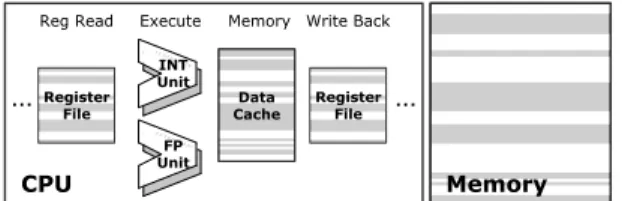
Execute Memory Write Back … … Reg Read Data Cache Register
File Register File INT Unit FP Unit Memory CPU
Figure 1: A processor that supports fine-grained approxima-tion. The shaded units perform approximate operations or store data in approximate storage.
2. TheFlexJava annotations are designed to support both coarse-grained and fine-grained approximation, and enable programmers to specify a wide range of quality requirements, quality metrics, and recovery strategies (Section 3.). 3. The language is codesigned with a compiler that
automati-cally infers the safe-to-approximate data and operations from limited annotations on program or function outputs. The compiler statically enforces safety using a scalable dataflow analysis that conservatively infers the maximal set of safe-to-approximate data and operations. This automated analysis significantly reduces the number of annotations and avoids the need for safety checks at runtime (Section 5.).
4. We implementedFlexJavaannotations as a library to make it compatible with Java programs and tools. We extensively evaluateFlexJavausing a diverse set of programs and by conducting a user study (Section 4. and Section 6.). The results of our evaluation show thatFlexJavareduces the number of annotations (from 2× to 17×) compared to EnerJ, a recent approximate programming language. We also conduct a user study that shows from 6×to 12×reduction in annotation time compared to EnerJ. With fine-grained ap-proximation and small losses in quality,FlexJavaprovides the same level of energy savings (from 7% to 38%) compared to EnerJ. With coarse-grained approximation,FlexJavaachieves even higher benefits—2.2×average energy reduction and 1.8×
average speedup—for less than 10% quality loss.
A growing body of work is proposing new approximation techniques that stand to deliver an order of magnitude benefits in both energy and performance [2, 12, 27, 28, 35]. Our results suggest that practical programming solutions, such asFlexJava, are imperative for making these techniques widely applicable.
2.
BACKGROUND
Approximation techniques are broadly divided into two types: (1) fine-grained techniques that apply approximation at the granularity of individual instructions and data elements, and (2) coarse-grained techniques that apply approximation at the granularity of entire code blocks.FlexJavasupports both types of techniques. We review the literature on these techniques before presenting the design ofFlexJava.
Fine-grained approximation. Architectures support fine-grained approximation by allowing to execute interleaved approximate and precise instructions [6, 11, 19, 30, 34]. As Figure 1 shows, such architectures support both approximate operations and approximate storage. A bit in the instruction opcode identi-fies whether the instruction is the approximate or the precise version. Current proposals for approximate instructions lack room for enough bits to encode multiple approximation levels. As a result, we assume the prevalent binary-level approxima-tion [6, 11, 19, 30, 34], although our approach can take advantage of multi-level approximation.
In this model, an approximate instruction has probabilistic semantics: it returns an approximate value with probabilityp and the precise value with probability 1−p. The approximate value may be arbitrary. The architecture also allows
approxi-Table 1: Error probabilities and energy savings for different op-erations in fine-grained approximation. We consider the three hardware settings of Mild, Medium, and Aggressive from [30].
Operation Technique Mild Medium Aggressive
Timing Error Probability 10-6 10-4 10-2 Energy Reduction 12% 22% 30% Mantissa Bits (float) 16 bits 8 bits 4 bits Mantissa Bits (double) 32 bits 16 bits 8 bits Energy Reduction 32% 78% 85% Read Upset Probability 10-16.7 10-7.4 10-3 Write Failure Probability 10-5.6 10-4.9 10-3 Energy Reduction 70% 80% 90% Per-Second Bit Flip
Probability
Memory Power Reduction 17% 22% 24% Integer Arithmetic/Logic Floating Point Arithmetic DRAM (Memory) Voltage Overscaling Bit-width Reduction Reduced Refresh Rate SRAM Read/Write
(Reg File/Data Cache) Voltage Overscaling
10-9 10-5 10-3
mate storage, i.e., program data can be stored in approximate sections of the memory, cache, or registers. We use three such probabilistic architecture settings, shown in Table 1, that offer increasing energy savings with higher error probabilities. These models are similar to the ones that are used in recent works on approximate programming [6, 30].
Coarse-grained approximation. Coarse-grained approximation techniques concern approximating entire loop bodies or func-tions [3, 12, 33]. Loop perforation [33] is one such technique that transforms loops to skip a subset of their iterations. Green [3] substitutes functions with simpler approximate implementations or terminates loops early. NPUs [12] are a new class of accelera-tors that replace functions with hardware neural networks to approximately mimic the functions behavior. More generally, as the focus of the semiconductor industry shifts to programmable accelerators [15, 26, 36, 37], coarse-grained approximation can pave the way for new classes of approximate accelerators that can deliver significantly better performance and energy savings.
3.
FLEXJAVA
LANGUAGE DESIGN
We have designed a set of language extensions for approximate programming that satisfy four key criteria:
1. Safety.The extensions guaranteesafe execution. In other words, approximation can never lead to catastrophic failures, such as array out-of-bound exceptions.
2. Modularity.The extensions aremodularand do not hinder modular programming and reuse.
3. Generality.The extensions aregeneraland enable utilizing a wide range of approximation techniques without exposing their implementation details.
4. Scalability.The extensions arescalable and let program-mers annotate large programs with minimal effort.
We have incorporated these extensions in the Java language. This section describes approximate programming in the resulting languageFlexJavausing a series of examples. In the examples,
bold-underlinehighlight the safe-to-approximate data and op-erations that theFlexJavacompiler infers automatically from the programmer annotations. Section 5. presents the formal semantics of the annotations and the static analysis performed by the compiler.
3.1
Safe Programming in
FLEXJAVA
Providing safety guarantees is the first requirement for practical approximate programming. That is, the approximation should never affect critical data and operations. The criticality of data and operations is a semantic property of the application that can only be identified by the programmer. The language must therefore provide a mechanism for programmers to specify where approximation is safe. This poses a language-compiler co-design challenge in order to alleviate the need for manually annotating all the approximate data and operations. To address this chal-lenge, we provide two language annotations, calledloosenand
tighten. These annotations provide programmers with full control over approximation without requiring them to manually and explicitly mark all the safe-to-approximate data and operations. Selectively relaxing accuracy requirements. As discussed above, not all program data and operations are safe to approximate. Therefore, FlexJavaallows each data and operation in the program to be either precise or approximate. Approximate data can be allocated in the approximate sections of memory, and an approximate operation is a variant that may generate inexact results. All data and operations are precise by default. The loosenannotation allows to relax the accuracy requirement on a specified variable at a specified program point. That is, any computation and data thatexclusively affects the annotated variable is safe to approximate. For example, in the following snippet, the programmer usesloosen(luminance)to specify that the computation ofluminancecan be safely approximated.
float computeLuminance (float r, float g, float b) { float luminance = r * 0.3f + g * 0.6f + b * 0.1f; loosen(luminance);
return luminance; }
From this single annotation, theFlexJavacompiler automat-ically infers that datar, g, b, and luminance can be safely allocated in the approximate memory. It also infers that all arithmetic operations, loads, and stores that contribute to calcu-latingluminanceare approximable. To provide memory safety and avoid null pointer exceptions, operations that calculate addresses to accessr,g, andbare not approximable. A single annotation thus suffices to relax the accuracy of four variables and nine operations. Our language-compiler codesign alleviates the need to manually annotate all these variables and operations. Control flow safety. To avoid unexpected control flow, Flex-Java keeps all the computation and data that affects control flow precise by default. Consider the following example:
int fibonacci(int n) { int r; if (n <= 1) r = n; else r = fibonacci(n - 1) + fibonacci(n - 2); loosen(r); return r; }
Variableris annotated as an approximate output andnaffects r. But sincenalso affects control flow in the conditional, it is not safe to approximate.
In many cases, conditionals represent simple control flow that can be converted to data dependence. Programmers can add explicitloosenannotations to mark such conditionals approxi-mate. However, to reduce programmer effort, theFlexJava compiler automatically achieves this effect by conservatively converting control dependencies into data dependencies using a standard algorithm [1]. The following example illustrates this optimization:
double sobel(double[][] p){ double x, y, g, r; x = p[0][0] + ...; y = p[0][2] + ...; g = sqrt(x * x + y * y); if (g > 0.7) r = 0.7; else r = g; loosen(r); return r; }
double sobel(double[][] p){ double x, y, g, r; x = p[0][0] + ...; y = p[0][2] + ...; g = sqrt(x * x + y * y); r = (g > 0.7) ? 0.7 : g; l loosen(r); return r; }
In the code snippet on the left, by annotatingr, there are only a few opportunities for approximation sincerdepends ongwhich is used in the conditional. However, theFlexJavacompiler can convert this control dependence to data dependence. This
conversion is illustrated in the snippet on the right using the ternary?: operator. After conversion,ris only data dependent ong, which in turn makesgsafe to approximate. Consequently, as the snippet on the right shows, all data and operations that affectgare also safe to approximate. As this example shows, this automation significantly increases approximation opportunities without the need for extra manual annotations.
Memory safety.Approximating address calculations may lead to memory access violations or contamination of critical data. To avoid such catastrophic failures and provide memory safety, any computation or data that affects address calculations is precise inFlexJava. Similarly, any computation or data that affects object allocation size is also precise. However, objects that do not contribute to address calculations, allocation sizes, or control flow may be allocated in approximate memory in accordance with the programmer annotations. Consider the following example:
int computeAvgRed (Pixel[] pixelArray) { int sumRed = 0;
for(int i = 0; i < pixelArray.length; i++) sumRed = sumRed + (int) pixelArray[i].r; int avgRed = sumRed / pixelArray.length; loosen(avgRed); return avgRed; }
VariablesiandpixelArrayare not approximable since they are used for address calculations. But the contents of the Pixel objects pointed to by the pixelArray elements, e.g., pixelArray[i].r, are approximable due toloosen(avgRed). As discussed before, programmers can always override the default semantics and relax these strict safety guarantees.
Restricting approximation. FlexJavaprovides thetighten an-notation which is dual toloosen. Annotating a variable with tightenmakes any data or operation that affects the variable precise,unlessa precedingloosenmakes a subset of those data and operations approximable. The following examples illustrate the interplay betweenloosenandtighten:
float computeAvg (Pixel p) { float sum= p.r + p.g + p.b; tighten(sum);
float avg = sum / 2.0f; loosen(avg); return avg; }
float computeAvg (Pixel p) { float sum= p.r + p.g + p.b; loosen(sum);
float avg = sum / 2.0f; tighten(avg); return avg; }
In the left example, we relax the accuracy of data and operations that affectavgexcept those that affectsum. Conversely, in the right example, we relax the accuracy of data and operations that affect sumwhile keeping the last step of computingavg precise. TheFlexJavacompiler automatically introducestighten annotations to prevent approximating control flow and address calculations. Thetightenannotation could also be used by pro-grammers when critical data and operations are intertwined with their approximate counterparts. No such cases appeared when annotating the evaluated benchmarks (Section 6.1).
3.2
Modular Approximate Programming
Scoped approximation. Modularity is essential when designing a language since it enables reusability. To make approximate programming withFlexJavamodular, we define a scope for theloosenannotation. The default scope is the code block that contains the annotation; e.g., the function or the loop body within which theloosenannotation is declared. As the following example illustrates, data and operations that are outside of the scope of theloosenannotation are not affected.
int p = 1;
for (int i = 0; i < a.length; i++) p *= a[i];
for (int i = 0; i < b.length; i++) { p += b[i];
Sinceloosen(p)is declared in the second loop that process the barray, the operations outside of this loop (e.g., p *= a[i]) are not affected and cannot be approximated. Assigning scope to theloosenannotation provides separation of concerns. That is, theloosenannotation only influences a limited region of code that makes it easier for programmers to reason about the effects of the annotation. Furthermore, the scope of approximation adheres to the syntactic structure of the program that makes annotating the code a natural part of the program development. To ensure safety, the scope for thetightenannotation is the entire program. All data and operations in the program that affect the annotated variable intightenwill be precise. The same principle applies to the conditionals and pointers. The FlexJavacompiler automatically applies these global semantics and relieves programmers from safety concerns.
Reuse and library support inFLEXJAVA. Composing indepen-dently developed codes to build a software system is a vital part of development. Composability must be supported for the annotations. To this end, we define two variants for theloosen; the default case and the invasive case (loosen_invasive). These variants have different semantics when it comes to function calls. If a function call is in the scope of aloosenannotation and its results affects the annotated variable, it may be approximated only if there areloosenannotations within the function. In other words, the caller’s annotations will not interfere with the annota-tions within the callee and may only enable them. If the callee does not affect caller’s annotated variable, its internalloosen annotations will not be enabled. With this approach, the library developers can develop general approximate libraries indepen-dently regardless of the future specific use cases. The users can use these general libraries without concerning themselves with the internal annotations of the libraries. The following examples demonstrate the effects ofloosenfor function calls.
static int square(int a){ int s = a * a;
loosen(s); return s; }
public static void main (String[] args){ int x = 2 + square(3); loosen(x);
System.out.println(x); }
static int square(int a){ int s = a * a;
loosen(s); return s; }
public static void main (String[] args){ int x = 2 + square(3); System.out.println(x); }
In the left example, as highlighted,loosen(x)declares the local operations with the mainfunction as safe-to-approximate. The annotation also enables approximation in the squarefunction that was called in the scope of theloosen(x)annotation. Within the squarefunction, the approximation will be based on the annotations that are declared in the scope of square. As the right example illustrates, if there are noloosenannotations in the caller function, main, nothing will be approximated in the callee function, square.
An expert user may want to apply approximation to the callee functions even if they do not contain any internal an-notations.FlexJavaprovides theloosen_invasivefor such cases. Theloosen_invasiveenables applying approximation to the con-ventional libraries that are not annotated for approximation. Note thatloosen_invasivedoes not cause control flow or memory address calculations to be approximated as we discussed for loosen. The only difference is how approximation is enforced in the callee function as illustrated below.
static int square(int a){ int s = a * a;
return s; }
public static void main (String[] args){ int x = 2 + square(3); loosen(x);
System.out.println(x); }
static int square(int a){ int s = a * a;
return s; }
public static void main (String[] args){ int x = 2 + square(3); loosen_invasive(x); System.out.println(x); }
In the left example, theloosen(x)annotation approximates the local operations in main function but will not lead to any approximation in the squarefunction since it does not con-tain anyloosenannotations. In contrast, in the right example, loosen_invasive(x)enforces safe approximation in squaresince its return value affects x.
Supporting separate compilation. FlexJavasupports separate compilation [7]. That is, aFlexJavaprogram can link with both annotated and unannotated pre-compiled code without having to re-compile it. If the precompiled code is not annotated, it executes precisely. If the precompiled code is annotated, its annotations are respected and its data and operations are approximated accordingly. Moreover, the annotations in the new program will not approximate any additional operations and data in the precompiled code other than the ones already approximated by annotations in them.
3.3
OO Programming in
FLEXJAVA
To this point, we have described how to useFlexJava an-notations to identify approximate data and operations within methods of a class. This section describes how to declare class fields as approximate and how inheritance and polymorphism interplay with the annotations.
Approximating class fields. Since class fields are not declared in the scope of any of the methods, we allow the programmers to selectively relax their semantics in the constructor of the class. The fields will be allocated in the approximate section of the memory if anouter-levelloosenenables approximation in the constructor. In principle, instantiation of an object involves a function call to the constructor. The outer-levelloosen annotations have the same effect on constructors as they have on other function calls.
class A { float x, y; A (float x, float y) { this.x = x; this.y = y; loosen(x); }
public static void main() { A a = new A(1.5f, 2.0f); float p = 3.5f + a.x; loosen(p); } }
The annotatedp is affected by the instance ofA. Therefore, loosen(p)enables approximation in the constructor. Consequently, thexfield will be allocated in the approximation section of the memory because of theloosen(x)in the constructor. Theyfield will not be allocated in the approximation section since it is not annotated in the constructor.
Inheritance. When inheriting an annotated class, annotations are preserved in methods that are not overridden. Naturally, if the child class overrides a method, the overriding method must be re-annotated if approximation is desired.
Polymorphism due to approximation. Depending on the anno-tations, different instances of a class and different calls to a method may carry approximate or precise semantics. The Flex-Javacompiler generates different versions of such classes and methods using code specialization [9].
3.4
Generality in
FLEXJAVA
: Support for
Coarse-Grained Approximation
The annotations discussed so far enable fine-grained approxi-mation at the level of single operations and data. This section describes another form of annotations, thebegin_loose–end_loose pair, that enables coarse-grained approximation inFlexJava. Any arbitrary code block that is enclosed between this pair of annotations can be approximated as a whole. Both anno-tations have a variable argument list. The first argument of begin_loose, which is a string, identifies the type of approximation that can be applied to the code block. The compiler or the runtime system then can automatically apply the corresponding approximation technique. Some approximation techniques may require programmers to provide more information. For example, function substitution [3] requires the programmer to provide an approximate version of the function. This extra information can be passed to the compiler or runtime system through the arguments ofbegin_looseorend_loose. This approach is flexible enough to enable a variety of coarse-grained approximation tech-niques. We describe how to use the approach with two such techniques: loop perforation [33] and NPUs [12, 16, 21]. Loop perforation. Loop perforation [33] allows the runtime to periodically skip iterations of loops. The programmer can set the initial rate of perforation (skipping the iterations).FlexJava annotations can be used for loop perforation as the following example shows.
begin_loose("PERFORATION", 0.10); for (int i = 0; i < n; i++) { ... } end_loose();
Thebegin_loose("PERFORATION", 0.10)andend_loose() annota-tions identify the loop that can be approximated. The first argument ofbegin_loose,"PERFORATION", declares that the de-sired approximation technique is loop perforation. The second argument,0.10, identifies the rate of perforation.
Neural acceleration. Neural Processing Units (NPU) [2, 12, 13, 16, 21] are a new class of accelerators that replace compute-intensive functions with hardware neural networks. We give an overview of the NPU compilation workflow since we use them to evaluateFlexJava’s coarse-grained annotations. The compiler first automatically trains a neural network on how an approximable code block behaves. Then, it replaces the original block with an efficient hardware implementation of the trained neural network or the NPU. This automatic code transformation also identifies the inputs and outputs of the region. The compiler performs the transformation in four steps:
1. Input/output identification. To train a neural network to mimic a code block, the compiler needs to collect the input-output pairs that represent the functionality of the block. Therefore, the first step is identifying the inputs and outputs of the delineated block. The compiler uses a combi-nation of live variable analysis and Mod/Ref analysis [4] to automatically identify the inputs and outputs of the anno-tated block. The inputs are the intersection of live variables at the location ofbegin_loose("NPU") with the set of variables that are referenced within the segment. The outputs are the intersection of live variables at the location ofend_loose()with the set of variables that are modified within the segment. In the example that follows, this analysis identifiesxandyas the inputs to the block andpandqas the outputs. 2. Code observation.The compiler instruments the program
by putting probes on the inputs and outputs of the block. Then, it profiles the instrumented program using representa-tive input datasets such as those from a test suite. The probes
package edu.flexjava;
abstract class QualityMetric { double acceptableQualityLoss = 0.0;
QualityMetric(double q) { acceptableQualityLoss = q; } abstract void checkQuality(Object... o);
abstract void recover(Object... o); }
Figure 2: An abstract class for defining the quality metric.
package edu.flexjava; class FlexJava {
static void loosen(Object... o) {}
static void loosen_invasive(Object... o) {} static void tighten(Object... o) {}
static void begin_loose(String type, Object... o) {} static void end_loose(Object... o) {}
}
Figure 3: FLEXJAVAannotations are implemented as a library. log the block inputs and outputs. The logged input–output pairs form the training dataset.
3. Training. The compiler uses the collected input–output dataset to configure and train a multilayer perceptron neural network that mimics the approximable block.
4. Code generation.Finally, the compiler replaces the original block with a series of special instructions that invoke the NPU hardware, sending the inputs and receiving the computed approximate outputs.
The following example illustrates the use of FlexJava annota-tions for NPU acceleration.
Double foo(Double x, Double y) { begin_loose("NPU");
p = Math.sin(x) + Math.cos(y); q = 2 * Math.sin(x + y); end_loose();
return p + q; }
The programmer usesbegin_loose–end_looseto indicate that the body of functionfoois a candidate for NPU acceleration. The first argument ofbegin_loose("NPU")indicates that the approxi-mation technique is NPU acceleration.
3.5
Support for Expressing Quality Metrics,
Quality Requirements, and Recovery
Practical and complete approximate programming languages need to provide a mechanism to specify and express quality metrics, quality requirements, and recovery mechanisms. As shown in prior works on approximation, quality metrics are application dependent [3, 11, 12, 30, 33]. For example, an im-age processing application may use signal-to-noise ratio as the quality metric, while the quality metric for web search is rel-evance of the results to the search query. The quality metric for machine learning algorithms that perform classification is the misclassification rate. Consequently, the common practice in approximate computing is for programmers to specify the application quality metric and the acceptable level of quality loss. TheFlexJavaannotations can be naturally extended to express quality metrics and requirements.
As Figure 2 shows, we first provide an abstract class as a template for implementing the quality metric function. The programmer can implement this abstract class and override the checkQualityfunction to implement the quality metric. The constructor of this class can be used to set the acceptable level of quality loss,acceptableQualityLoss. The programmer can also override therecoverto implement a recovery procedure for the occasions that the quality loss is greater than the require-ments. Note that the quality requirement can be expressed as a probability if desired. After implementing theQualityMetric class, the programmer can pass its instance via the last
argu-(real constant) r∈R (variable) v∈V
(real expression) e∈R∪V (operation label) l∈L
(statement)s::=v:=lδ(e1,e2)|loosen(v)|tighten(v) | assume(v)|s1;s2|s1+s2|s∗ Figure 4: Language syntax.
(stack) ρ∈ V→R (tainted set) T ⊆V
(state) ω::= hs,ρ,Ti | hρ,Ti |error |halt
Figure 5: Semantic domains.
ment ofloosen,loosen_invasive, orend_looseto the compiler or the runtime system. Clearly, the programmer need not specify the quality metric in each such annotation; it is usually specified only when annotating the final output or important functions of the application, as illustrated in the following example.
static int cube (int x) { int y = x * x * x; loosen(y);
return y; }
public static void main (String[] args) { int z = cube(7);
loosen(z, new ApplicationQualityMetric(0.10)); System.out.println(z); }
Notice that the quality requirement is not specified in the func-tion or library annotafunc-tions (loosen(y)). It is specified only in the last annotation on the final outputzof the program. In this example, the acceptable quality loss is 10%, which is passed to the constructor as0.10.
4.
FLEXJAVA
IMPLEMENTATION
FlexJava is a small set of extensions to Java that enables safe, modular, general, and scalable object-oriented approx-imate programming. It achieves these goals by introducing only four intuitive annotations:loosen,tighten,loosen_invasive, and thebegin_loose–end_loosepair. In this section, we describe our implementation of these annotations and the development envi-ronment ofFlexJava.
Implementation of annotations. We implemented FlexJava annotations as a library to make it compatible with Java pro-grams and tools. Figure 3 illustrates this library-based imple-mentation that provides the interface between theFlexJava language and compiler. TheFlexJavaclass implements the annotations as empty variable-length argument functions. Con-sequently, compiling aFlexJavaprogram with a traditional compiler yields a fully precise executable. The approximation-aware compiler, however, can intercept calls to these functions and invoke the necessary analyses and approximate transforma-tions.
Integrated highlighting tool. FlexJavais coupled with a static approximation safety analysis that automatically infers the safe-to-approximate operations and data from the programmer an-notations. We have developed an integrated tool that highlights the source code with the result of this analysis. By visualizing the result, this tool further facilitatesFlexJavaprogramming and can help programmers to refine their annotations. In its current form, the integrated tool adds comments at the end of each line showing which of the line’s operations are safe to ap-proximate. It is straightforward to convert this visual feedback to syntax highlighting. In fact, we used the result of this tool to highlight the examples in Section 3..
5.
APPROXIMATION SAFETY ANALYSIS
In this section, we define the formal semantics of approxima-tion safety for annotated programs inFlexJava. We define
a core language withloosenandtightenannotations. We give a concrete semantics parameterized by the set of operations to be approximated in an annotated program in the language. The semantics determines if a given set of operations is approximable. As this problem is undecidable, we develop a static analysis that conservatively infers the largest set of approximable operations in a given annotated program.
5.1
Core Language
Figure 4 shows the syntax of our core language. It supports real-valued data and control-flow constructs for sequential com-position, branches, and loops. We elide conditionals in branches and loops, executing them nondeterministically and using the
assume(v) construct that halts ifv≤0.
We extend the language with annotations loosen(v) and
tighten(v). These annotations arise from their source-level coun-terparts described in Section 3.. Further,tighten(v) is implicitly added by theFlexJavacompiler before each use of variable v in a conditional, an array index, a pointer dereference, or a program output. To statically identify operations that are approximable under the given annotations, each operation has a unique labell.
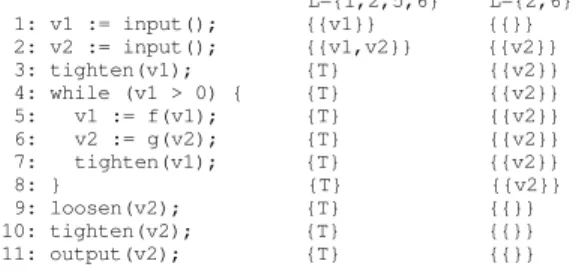
Example. We illustrate the above concepts for the program on the left below. For now, ignore the sets in annotations next to each line of the program.
L={1,2,5,6} L={2,6} 1: v1 := input(); {{v1}} {{}} 2: v2 := input(); {{v1,v2}} {{v2}} 3: tighten(v1); {T} {{v2}} 4: while (v1 > 0) { {T} {{v2}} 5: v1 := f(v1); {T} {{v2}} 6: v2 := g(v2); {T} {{v2}} 7: tighten(v1); {T} {{v2}} 8: } {T} {{v2}} 9: loosen(v2); {T} {{}} 10: tighten(v2); {T} {{}} 11: output(v2); {T} {{}}
The compiler introducestighten(v1) on lines 3 and 7 to en-sure thatv1>0executes precisely, andtighten(v2) on line 10 to ensure that the value ofv2output on line 11 is precise. The programmer relaxes the accuracy ofv2on line 9, which allows the operations writing tov2on lines 2 and 6 to be approximated without violating thetighten(v2) requirement on line 10. How-ever, the operations writing tov1on lines 1 and 5 cannot be approximated as they would violate thetighten(v1) requirement
on line 3 or 7, respectively. 2
5.2
Concrete Semantics
We define a concrete semantics to formalize approximation safety for our language. Figure 5 shows the semantic domains. Each program stateω(except for special stateserrorandhalt
described below) tracks atainted setT of variables. A variable gets tainted if its value is affected by an approximate operation, and untainted ifloosenis executed on it.
Figure 6 shows the semantics as a set of rules of the form: L |= hs,ρ1,T1i ; hρ2,T2i |halt |error
It describes an execution of annotated programswhen the set of approximated operations isL, starting with stack (i.e., valuation to variables) ρ1 and tainted setT1. The rules are similar to information flow tracking: approximated operations inLare sources(ruleAsgn),loosen(v) aresanitizers(ruleLoosen), and
tighten(v) are sinks(rulesTightenPass and TightenFail). The execution ends in stateerrorif sometighten(v) is executed when the tainted set containsv, as described by rule Tighten-Fail. The execution may also end in statehalt, which is normal and occurs whenassume(v) fails (i.e., v≤0), as described by
L|=hv:=lδ(e1,e2),ρ,Ti;hρ[v7→Jδ(e1,e2)K(ρ)],T 0i whereT0= T∪{v} ifl∈Loruses(e1,e2)∩T=6 ∅ T\{v} otherwise (Asgn) L|=hloosen(v),ρ,Ti;hρ,T\{v}i (Loosen)
L|=htighten(v),ρ,Ti;hρ,Ti [ifv /∈T] (TightenPass)
L|=htighten(v),ρ,Ti;error [ifv∈T] (TightenFail)
L|=hassume(v),ρ,Ti;hρ,Ti [ifρ(v)>0] (AsmPass)
L|=hassume(v),ρ,Ti;halt [ifρ(v)≤0] (AsmFail) Figure 6: Concrete semantics of approximation safety. rulesAsmPassandAsmFail. We omit the rules for compound statements and those that propagateerrorandhalt, as they are relatively standard and do not affect the tainted set.
We now define approximation safety formally:
Defn 5..1 (Approximation safety)A set of operationsLin a programsis approximable if∀ρ:L|=hs,ρ,∅i6;error.
To maximize approximation, we seek as large a set of approx-imable operations as possible. In fact, a unique largest set exists, as our semantics satisfies the property that if operation setsL1 andL2 are approximable, then so isL1∪L2.
Example. In the example program, the largest set of approx-imable operations is those on lines 2 and 6. ColumnL={2,6} shows the tainted set as per our semantics after each statement under this set of approximated operations. Theerrorstate is unreachable in any run as the tainted set at eachtighten(v) does not containv. Hence, this set of operations is approximable. 2
5.3
Static Analysis
The problem of determining if a given set of operations is approximable in a given annotated program even in our core language is undecidable. We present a novel static analysis that conservativelysolves this problem, i.e., if the analysis deems a set of operations as approximable, then it is indeed approximable according to Defn. 5..1. Further, we apply an efficient algorithm that uses the analysis to automatically infer the largest set of approximable operations.
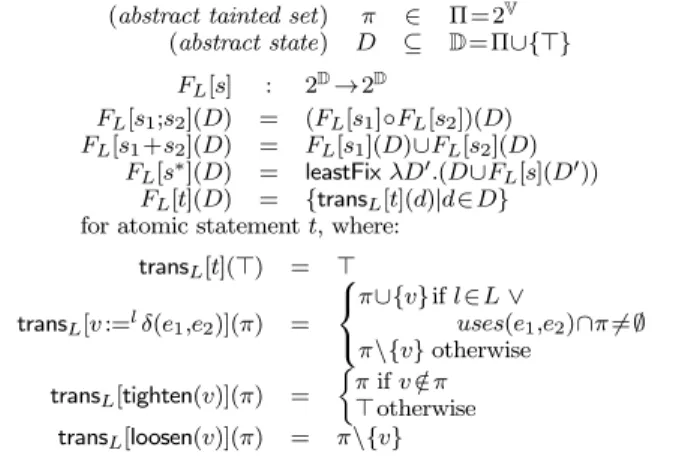
Our static analysis is shown in Figure 7. It over-approxim-atesthe tainted sets that may arise at a program point in the concrete semantics by an abstract stateD, a set each of whose elements is>or anabstract tainted setπof variables.
The analysis is a set of transfer functions of the formFL[s](D) =
D0, denoting that when the set of approximated operations is L, the annotated programstransforms abstract stateD into abstract stateD0. The element>arises inD0 either if it al-ready occurs inDor ifscontains atighten(v) statement and an abstract tainted set incoming into that statement contains the variablev. Thus, the element>indicates a potential violation of approximation safety. In particular, an annotated program does not violate approximation safety if the analysis determines that, starting from input abstract state{∅}, the output abstract state does not contain>:
Theorem 5..2 (Soundness)For each programs, if>∈/FL[s]({∅})
then for each stateρ,L|=hs,ρ,∅i6;error.
Example. For our example from Section 5.1, the columns on the right show the abstract state computed by the analysis after each statement, under the set of approximated operations indicated by the column header. ForL={1,2,5,6}, the final abstract state contains>, and indeed the operations on lines 1 and 5 are not approximable. But forL={2,6}, the final abstract state does not contain>, proving that operations on lines 2 and
6 are approximable. 2
(abstract tainted set) π ∈ Π = 2V (abstract state) D ⊆ D= Π∪{>} FL[s] : 2D→2D FL[s1;s2](D) = (FL[s1]◦FL[s2])(D) FL[s1+s2](D) = FL[s1](D)∪FL[s2](D) FL[s∗](D) = leastFixλD0.(D∪FL[s](D0)) FL[t](D) = {transL[t](d)|d∈D}
for atomic statementt, where:
transL[t](>) = > transL[v:=lδ(e1,e2)](π) = π∪{v}ifl∈L∨ uses(e1,e2)∩π6=∅ π\{v}otherwise transL[tighten(v)](π) = πifv /∈π >otherwise transL[loosen(v)](π) = π\{v}
Figure 7: Approximation safety analysis.
Our static analysis has the useful property that for any anno-tated program, there exists a unique largest set of operations that it considers approximable.
Theorem 5..3 (Unique largest solution)∃Lmax⊆L:>∈/
FLmax[s]({∅}) ∧(>∈/FL[s]({∅})⇒L⊆Lmax).
We use a standard algorithm [40] to infer this largest set of approximable operations. Starting with all operations ap-proximated, it iteratively finds a largest set of approximable operations which passes all thetightenchecks in the program.
6.
FLEXJAVA
EVALUATION
This section aims to answer the following research questions.
• RQ1: CanFlexJavasignificantly reduce the number of manual annotations?
• RQ2: CanFlexJavasignificantly reduce the program-mer effort and annotation time?
• RQ3: CanFlexJavagive significant speedup and energy gains with both fine- and coarse-grained approximation? As the results of the evaluations show, FlexJavareduces the number of annotations (between2×and17×) compared to EnerJ, the leading approximation language. We also conduct a user study that shows from6×to12×reduction in annotation time compared to EnerJ.FlexJava; however, provides the same level of energy savings (from7%to38%) compared to EnerJ with fine-grained approximation. With coarse-grained approximation, FlexJavaachieves2.2×energy reduction and1.8×speedup for under10%quality loss.
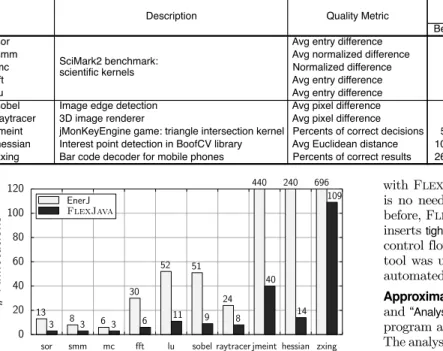
Benchmarks and quality metrics. As Table 2 shows, we eval-uateFlexJavausing10Java programs. Eight are the EnerJ benchmarks [30]. We use two additional benchmarks,hessian andsobel. Five of these come from the SciMark2 suite. The rest arezxing, an Android bar code recognizer;jmeint, an algorithm to detect intersecting 3D triangles (part of the jMonkeyEngine game engine);sobel, an edge detection application based on the Sobel operator; andraytracer, a simple 3D ray tracer. To better study the scalability of our analysis, we added thehessian appli-cation from the BoofCV vision library with10,174lines of code. This application uses the Hessian affine region detector to find interesting points in an image. The code for this application uses Java generics that is not supported by the EnerJ compiler and simulator. However, our safety analysis supports Java generics and was able to analyze this application. Therefore, only for this specific application, our comparisons are limited to annotation effort and safety analysis. Table 2 also shows the application-specific quality metrics. We measure quality by comparing the
Table 2: Benchmarks, quality metrics, and results of safety analysis: analysis runtime and # of approximable data and operations.
sor Avg entry difference
smm Avg normalized difference
mc Normalized difference
fft Avg entry difference
lu Avg entry difference
sobel Image edge detection Avg pixel difference raytracer 3D image renderer Avg pixel difference jmeint jMonKeyEngine game: triangle intersection kernel Percents of correct decisions hessian Interest point detection in BoofCV library Avg Euclidean distance zxing Bar code decoder for mobile phones Percents of correct results
SciMark2 benchmark: scientific kernels
Description Quality Metric
Bench Library Inferred Potential Inferred Potential 36 60K 6 8 14 133 282 38 60K 6 9 17 114 278 59 60K 4 7 13 129 184 168 60K 11 11 14 226 485 283 60K 15 12 19 201 600 163 284K 102 2 5 153 416 174 214K 14 4 9 128 264 5,962 216K 296 71 71 832 943 10,174 261K 6,228 73 119 663 4988 26,171 271K 12,722 996 1,053 2,673 8,454 Analysis Runtime (sec) # of Approximable Data # of Approximated Operations # of Lines 0 20 40 60 80 100 120 #
Annotations
sor smm mc fft lu sobel raytracer jmeint hessian zxing
440 240 696 13 8 6 30 52 51 24 440 240 696 3 3 3 6 11 9 8 40 14 109 EnerJ FlexJava
Figure 8: Number of annotations required to approximate the same set of data and operations using EnerJ and FLEXJAVA. output of the fully precise and the approximated versions of the program. For each benchmark, we use10representative input datasets such as10different images. The quality degradation is averaged over the input datasets.
6.1
RQ1: Number of Annotations
To answer RQ1, we compare the number of EnerJ annotations withFlexJavaannotations. We use EnerJ as a point of com-parison because it requires the minimum number of annotations among existing approximate languages [6, 30]. EnerJ requires programmers to annotate all the approximate data declara-tions using type qualifiers. Then, the EnerJ compiler infers the safe-to-approximate operations for fine-grained approxima-tion. In contrast, our approximation safety analysisinfersboth approximate data and operations from a limited number of FlexJavaannotations on the program or function outputs. We used the Chord program analysis platform [23] to implement our approximation safety analysis. Compared to EnerJ, our analysis infers at least as many number of safe-to-approximate data and operations with significantly fewer number of manual annotations.
Figure 8 shows the number of annotations with EnerJ and FlexJava. As Figure 8 illustrates, there is a significant reduc-tion in the number of annotareduc-tions withFlexJava.FlexJava requires between2×(mc) to17×(hessian) less annotations than EnerJ. The largest benchmark in our suite iszxingwith26,171 lines of code. It requires696annotations with EnerJ,109 anno-tation withFlexJava. Thus,FlexJavareduces the number of annotations by a factor of6×. Thezxingbenchmark needs several loosenannotations to mark its function outputs as approximable. Further, many condition variables are safe to approximate and such variables need to be annotated explicitly. Therefore,zxing requires a number ofFlexJavaannotations that is relatively large compared to all other benchmarks. These results confirm thatFlexJavaannotations and its approximation safety analy-sis can effectively reduce the number of manual annotations.
The results in Figure 8 are with no use ofloosen_invasive. Usingloosen_invasiveonly reduces the number of annotations
withFlexJava. Moreover, in the evaluated benchmarks, there is no need for any manualtightenannotations. As described before,FlexJava’s approximation safety analysis automatically insertstighten annotations for the critical variables to ensure control flow and memory safety. TheFlexJavahighlighting tool was useful since it effectively visualizes the result of the automated approximation safety analysis.
Approximation safety analysis. In Table 2, columns“# of Lines” and“Analysis Runtime (sec)”report the number of lines in each program and the runtime of the approximation safety analysis. The analysis analyzes application code and reachable Java library (JDK) code uniformly although we report their sizes separately in the table. The analysis was performed usingOracle HotSpot JVM 1.6.0on aLinux machine with3.0 GHz quad-coreprocessors and64 GBmemory.
The analysis runtime strongly correlates with the number of potentially approximable data and operations. The potential approximable elements include all the data declarations and all the operations that are not address calculations and jump or branch instructions in the byte code. The number of potential elements is presented in columns“# of Approximable Data-Potential” and“# of Approximable Operations-Potential”, respectively. The anal-ysis determines whether or not each of these elements is safe to approximate with respect to the programmer annotations. The number of all the potential approximable elements defines the search space of the analysis. Thus, the space of possible solutions that the approximation safety analysis explores for zxingis of size 2(1053+8454). Automatically finding the largest set of approximable elements from this huge space justifies the 12,722 seconds(=3 hours and 32 minutes) of running time to analyze zxing. However, the analysis runtime is not exponential with respect to the number of potential elements. That is because in each iteration, the analysis eliminates at least one element from the potentials list.
Naturally, significantly reducing the number of manual anno-tations requires an automated analysis that takes some machine time. That is, the analysis is trading machine time for fewer annotations, potentially saving programmer time. Furthermore, we report the pessimistic runtime when all of the libraries and program codes are analyzed in a single compiler run without separate compilation. Separate compilation may reduce this runtime when precompiled approximate libraries are available.
6.2
RQ2: Programmer Effort/Annotation Time
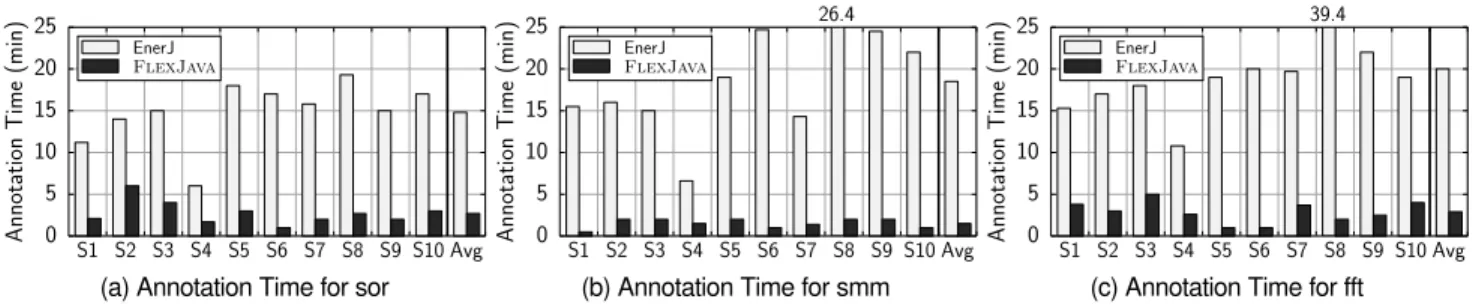
To answer RQ2, we conduct a user study involving ten grammers. The programmers are asked to annotate three pro-grams with both languages. To avoid bias in our study toward FlexJava, we used three programs from the EnerJ benchmark suite [29]. The benchmarks are not large so that the subjects can understand their functionality before annotating them. As presented in Figure 9, we measure the annotation time with EnerJ andFlexJavaand compare the results. The subjects are computer science graduate students who have prior background
0 5 10 15 20 25 Annotation Time (min) S1 S2 S3 S4 S5 S6 S7 S8 S9 S10 Avg EnerJ FlexJava
(a) Annotation Time for sor
0 5 10 15 20 25 Annotation Time (min) S1 S2 S3 S4 S5 S6 S7 S8 S9 S10 Avg 26.4 EnerJ FlexJava
(b) Annotation Time for smm
0 5 10 15 20 25 Annotation Time (min) S1 S2 S3 S4 S5 S6 S7 S8 S9 S10 Avg 39.4 EnerJ FlexJava
(c) Annotation Time for fft
Figure 9: Annotation time with EnerJ and FLEXJAVAfor (a) sor, (b) smm, and (c) fft. The x-axes denotes the user study subjects. in Java programming but have no experience in approximate
programming. We measured the annotation time using the following procedure.
First, we orally explain how to annotate the programs with FlexJavaand EnerJ. Then, we demonstrate the annotation process on a simple benchmark,mc, and show the subjects how to use the tools for both languages. For this study, the subjects then annotate three of benchmarks,sor,smm, andfft, using both languages. Half of the subjects use EnerJ annotations first and the other half useFlexJavafirst. The measured time for EnerJ constitutes annotation plus compilation time. Whereas the measured time forFlexJavaconstitutes annotation time, plus the time for running the approximation safety analysis, plus the time for analyzing the analysis results using the source highlighting tool. We provide the unannotated application and a description of its algorithm for the subjects. We allow the subjects to review each application code prior to annotating it. Our current highlighting tool is enough to check whether or not the analyzed results are equivalent between the two languages. Figure 9 shows the annotation time. On average the annota-tion time withFlexJavais 6×, 12×, 8×less than EnerJ for sor,smm, andfft, respectively. Although we demonstrate how the subjects can use the languages, they need time to gain ex-perience while annotating the first program. Once the subjects acclimate to FlexJavawith the first benchmark (sor), they spend proportionally less time annotating the next benchmark. TheFlexJavaannotation time for the second benchmark (smm) is typically lower than the first benchmark (sor). In contrast, the annotation time with EnerJ does not reduce beyond a certain point even after gaining experience. We believe that this is be-cause EnerJ requires manually annotating all the approximate variable declarations and more. UsingFlexJava,sorandsmm require threeloosenannotation, butfftrequires six. We believe that this explains why the time to annotatefftinFlexJavais greater than the time to annotatesorandsmm. In summary, these results show that FlexJava significantly reduces pro-grammer effort by providing intuitive language extensions and leveraging the automated approximation safety analysis.
6.3
RQ3: Energy Reduction and Speedup
To answer RQ3, we study energy gains and speedup ofFlexJava with both fine- and coarse-grained approximation.
6.3.1
Fine-Grained Approximation
Tools and models. We modify and use the EnerJ open-source simulator [30] for error and energy measurements. The simulator provides the means to instrument Java programs based on the result of the analysis. It allows object creation and destruction in approximate memory space and approximating arithmetic and logic operations. The runtime simulator is a Java library that is invoked by the instrumentation. The simulator records memory-footprint and arithmetic-operation statistics while si-multaneously injecting error to emulate approximate execution
0% 5% 10% 15% 20% 25% 30% 35% 40% Energy Reduction
sor smm mc fft lu sobel raytracer jmeint zxing gmean Mild Medium Aggressive
(a) Energy Reduction
0% 20% 40% 60% 80% 100% Qualit y Loss
sor smm mc fft lu sobel raytracer jmeint zxing Mild Medium Aggressive
(b) Quality Loss
Figure 10: (a) Energy reduction and (b) quality loss when ap-proximating all the safe-to-approximate data and operations. and measure error. The simulator uses the runtime statistics to estimate the amount of energy dissipated by the program. The error and energy measurements are based on the system models described in Table 1. The models and the simulator do not support performance measurements. We measured the error and energy usage of each application over ten runs and average the results.
Figure 10 shows the energy reduction and the output qual-ity loss when the safe-to-approximate data and operations are approximated. These results match those of EnerJ [29]. As shown, the geometric mean of energy reduction ranges from 16%with theMild hardware setting to23%with theAggressive hardware setting. The energy reduction is least forjmeint(7% withMild) and highest forraytracer(38%withAggressive). All the applications show low and acceptable output quality loss with theMild setting. However, in most cases, there is a jump in quality degradation when the hardware setting is changed to Aggressive. If this level of quality is not acceptable (fft), then the application should dial down the hardware setting toMediumor Mild.FlexJavaprovides the same level of benefits and quality degradations as EnerJ while significantly reducing the number of manual annotations.
6.3.2
Coarse-Grained Approximation
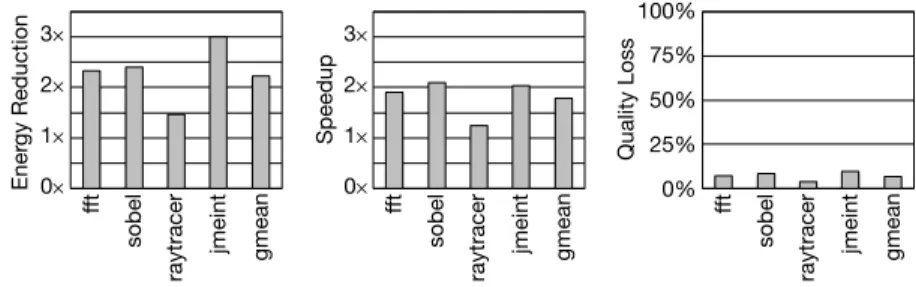
To evaluate FlexJava’s generality, we use the NPU coarse-grained approximation [12]. NPU can only be used to ap-proximate the benchmarksfft,sobel,raytracer, andjmeint. Each benchmark has only one function that can be approximated with NPUs. Each of these functions can be delineated using a single pair ofbegin_loose–end_looseannotation.
Tools and models. We measure the benefits of NPUs in con-junction with a modern Intel Nehalem (Core i7) processor. We use a source-to-source transformation that instruments the
0✕ 1✕ 2✕ 3✕ Quality Loss 0% 25% 50% 75% 100% Speedup Ener gy Reduction ff t sobel raytracer jmeint gmean 0✕ 1✕ 2✕ 3✕ ff t sobel raytracer jmeint gmean ff t sobel raytracer jmeint gmean
Figure 11: Speedup, energy reduction, and output quality loss when the approximate annotated functions using the NPU. benchmarks’ Java code to emit an event trace including memory
accesses, branches, and arithmetic operations. This source-level instrumentation is unaffected by the JIT, garbage collection, or other VM-level systems. Using a trace-based simulator, we gen-erate architectural event statistics. The architectural simulator includes a cache simulation. The simulation process outputs detailed statistics, including the cycle count, cache hit and miss counts, and the number of functional unit invocations. The trace-based CPU simulator is augmented with a cycle-accurate NPU simulator that also generates the statistics required for the NPU energy estimation. The resulting statistics are sent to a modified version of McPAT [18] to estimate the energy consumption of each execution. We model the energy consump-tion of an eight-processing-engine NPU using the results from CACTI 6.5 [22], McPAT [18], and [14].
Figure 11 shows the energy reduction, speedup, and quality loss with the NPU coarse-grained approximation. The baseline executes the precise version of the benchmark on the CPU without any NPU approximation. On average, the benchmarks see a2.2×energy reduction and a1.8×speedup. These bene-fits come for less than10%quality degradation across all the benchmarks, which is commensurate with other approximation techniques [11,16,27,28] and prior NPU works [2,12,21]. The En-erJ system does not provide any coarse-grained approximation results for comparison.
These results demonstrate that coarse-grained approximation may have limited applicability but can provide higher benefits. Whereas, fine-grained approximation is more widely applicable with possibly lower gains.FlexJavasupports both granularities as a general language to maximize opportunities for approxima-tion in a wider range of applicaapproxima-tions.
7.
RELATED WORK
There is a growing body of work on language design, reasoning, analysis, transformations, and synthesis for approximate com-puting. These works can be characterized based on (1) static vs. dynamic, (2) approximation granularity, (3) automation, and (4) safety guarantees. To this end,FlexJava is a language accompanied with an automated static analysis that supports both fine- and coarse-grained approximation and provides for-mal safety guarantees. We discuss the related work with respect to these characteristics.
EnerJ [30] is an imperative programming language that stati-cally infers the approximable operations from approximate type qualifiers on program variables. In EnerJ, all approximable variables must be explicitly annotated. EnerJ works at the granularity of instructions and provides safety but not quality guarantees. Rely [6] is another language that requires pro-grammers to explicitly mark both variables and operations as approximate. Rely works at the granularity of instructions and symbolically verifies whether the quality requirements are satis-fied for each function. To provide this guarantee, Rely requires the programmer to not only mark all variables and operations as approximate but also provide preconditions on the reliability
and range of the data. Both EnerJ and Rely could be a backend forFlexJavawhen it automatically generates the approximate version of the program. Axilog [39] introduces a set of annota-tions for approximate hardware design in the Verilog hardware description language. Verilog does not support imperative pro-gramming constructs such as pointers, structured data, memory allocation, recursion, etc. The lack of these features results in fundamentally different semantics for safe approximation and annotation design.
Chisel [19] uses integer linear programming (ILP) formula-tion to optimize approximate computaformula-tional kernels. A Chisel program consists of code written in an imperative language such as C and a kernel function written in Rely that will be optimized. Several works have focused on approximation at the granularity of functions or loops. Loop perforation [20, 32, 33] is an automated static technique that periodically skips loop iterations. Even though loop perforation provides statistical quality guarantees, the technique is not safe and perforated programs may crash. Green [3] provides a code-centric pro-gramming model for annotating loops for early termination and functions for approximate substitution. The programmer needs to provide the alternative implementation of the function. Green is also equipped with an online quality monitoring system that adjusts the level of approximation at runtime. Such run-time adjustments are feasible due to the coarse granularity of the approximation.FlexJavaprovides the necessary language extensions for supporting these coarse-grained approximation techniques as well as the fine-grained ones.
Similar to EnerJ, Uncertain<T> [5] is a type system for probabilistic programs that operate on uncertain data. It im-plements a Bayesian network semantics for computation on probabilistic data. Similarly, [31] uses Bayesian networks and symbolic execution to verify probabilistic assertions.
8.
CONCLUSION
Practical and automated programming models for approxima-tion techniques are imperative to enabling their widespread applicability. This paper described one such language model that leverages automated program analysis techniques for more effective approximate programming. TheFlexJavalanguage is designed to be intuitive and support essential aspects of modern software development: safety, modularity, generality, and scala-bility. We implementedFlexJavaand its approximation safety analysis and evaluated its usability across different approxima-tion techniques that deliver significant energy and performance benefits. The results suggest thatFlexJavatakes an effective and necessary step toward leveraging approximation in modern software development.
9.
ACKNOWLEDGMENTS
We thank the reviewer and Kivan¸c Mu¸slu for insightful com-ments. This work was supported by a Qualcomm Innovation Fellowship, NSF award #1253867, Semiconductor Research Corporation contract #2014-EP-2577, and a gift from Google.
10.
REPLICATION PACKAGE
The FlexJava tool has been successfully evaluated by the Replication Packages Evaluation Committee and found to meet expectations. The replication package is available at the follow-ing link: http://act-lab.org/artifacts/flexjava.
10.1
Overview
The replication package contains theFlexJavacompiler that supports fine-grained and coarse-grained approximation. All the benchmarks that we used for experiments in the paper are also included in the package.
For fine-grained approximation, the compiler first takes an input program annotated withFlexJavaannotations and per-forms the approximation safety analysis, which finds safe-to-approximate data and operations. The highlighting tool creates a copy of the input program’s source code and marks the analysis results on the copied code in a form of comments. Program-mers can use this tool to observe the analysis results and they may remove or add annotations if the results do not meet their expectations. We also provide the modified EnerJ simulator for quality and energy measurement on whichFlexJavabinaries can be executed.
TheFlexJavalanguage and compiler can support arbitrary types of coarse-grained approximation technologies but this replication package provides the NPU framework as an example of its use. NPiler [12] requires programmers to specify a pro-gram region so that the compiler cantrainthe region with a multi layer perceptron neural network. TheFlexJava annota-tions,begin_looseandend_loose, are capable of delivering all the information needed by NPiler.
10.2
Download Tools
We have created a VHD (Virtual Hard Disk) on VirtualBox [38] so that users can readily download the entire image file and run the experiments without manually installing all the tools and setting up the environment. The link for the VHD file is provided at the aforementionedFlexJavapage. Users who wish to just investigate the source code can access it from the Git repositories on the Bitbucket page: https://bitbucket.org/act-lab. The Bitbucket page has a detailed README file explaining how to setup and run the tools. The source code embedded in the VHD image file has the same version as that in the Git repositories.
10.3
Instructions
These instructions assume that the user has downloaded the VHD file (VM image file) and built the VM environment using a virtualization tool such as VirtualBox. Users who wish to explore the source code may follow the instructions in the Bitbucket pages to setup the necessary environment.
10.3.1
Fine-grained Approximation
Build Tools We have already installed and built all source code necessary to run the analysis and simulation. Users can find these files in ther2.codedirectory under the home directory. TheFlexJavacompiler is a combination of several tools to-gether with a series of compilation steps for the tools that can be executed by running a bash script namedbuild.sh. Benchmarks All the benchmarks are placed under ther2.apps directory. The source code has already been annotated with FlexJavaannotations and it is located under thesrcdirectory of each individual benchmark’s directory.
Running the Approximation Safety Analysis The user can next run the analysis by simply running theanalyze.pyscript. This script will (1) compile the source code, (2) run the analysis, and
(3) perform the source code highlighting (back annotation) on a replicated source directory,src-marked. The user can then observe where approximation was applied in thesrc-marked directory. If unsatisfied with the results, the user may update the annotations under thesrcdirectory and rerun the analysis. Running the Simulation If the analysis results are satisfactory, the user may proceed to the next step,simulation. The script for running simulation,runsimulation.py, takes an argument which specifies a system model to use for the simulation. There are four system models that are supported by the EnerJ sim-ulator: (1) aggressive (2) high (3) medium (4) low. Since the architecture model in the simulator is probabilistic, we ran the experiments multiple times and averaged to obtain the results in the paper. For this reason, the results from the simulation may not exactly match the results provided in the paper. Adding New Benchmarks Users can add a new benchmark by following these five steps:
1. create a new directory under ther2.appsdirectory, named after the benchmark;
2. place its source code in thesrcdirectory;
3. copy abuild.xmlfile from one of the pre-existing bench-marks into the new directory;
4. replace the benchmark name in thebuild.xmlfile (e.g., mc) with the new one; and
5. create symbolic links for four python scripts,analyze.py, runsimulation.py,markJava.py, andInput.py.
10.3.2
Coarse-grained Approximation
Benchmarks The NPU benchmarks and tools used in the pa-per are based on an approximate computing benchmark suite, AxBench (http://axbench.org) and they were ported from C/C++ to Java. The files are under theflexjava.npubench sub-directory in the home directory of the VHD image. The application.javadirectory contains the four benchmarks (fft, jmeint,sobel, andsimpleRaytracer) that have been evaluated in the paper for coarse-grained approximation (NPU). We have pro-vided aMakefilefor each individual benchmark that performs the necessary preprocessing and compiles the processed Java source code.
Running NPU Code We have provided a script that (1) trains the specified approximable region, (2) algorithmically transforms the region into a neural network, and (3) runs the transformed program using a machine learning library, FANN [25]. The running script,run_java.sh, takes two arguments. For training, providerunas the first argument and the benchmark directory name (e.g.,sobel) as the second argument. The script will then show the compilation parameters required for training (e.g., learning rate). The user can supply any values to the parameters to override the following default values:
• Learning rate [0.1-1.0]: 0.1
• Epoch number [1-10000]: 1
• Sampling rate [0.1-1.0]: 0.1
• Test data fraction [0.1-1.0]: 0.5
• Maximum number of layers [3|4]: 3
• Maximum number of neurons per layer [2-64]: 2 Adding New Benchmarks The required steps for adding new benchmarks in coarse-grained approximation are similar to those for fine-grained approximation. The current implementation lacks a well-designed interface that enables programmers to read-ily introduce a new benchmark without modifying theFlexJava makefiles and scripts, which will be updated in the near future.