ORIGINAL PAPER
Comparative transcriptome analysis reveals
the genetic basis underlying the biosynthesis
of polysaccharides in
Hericium erinaceus
Nan Zhang
1,2, Zongfu Tang
1, Jun Zhang
1, Xin Li
1, Ziqian Yang
1, Chun Yang
1, Zhaofeng Zhang
1and Zuoxi Huang
1*Abstract
Background: Hericium erinaceus, also known as lion’s mane mushroom, is a widely distributed edible and medicinal
fungus in Asian countries. H. erinaceus harbors diverse bioactive metabolites with anticancer, immunomodulating,
anti-inflammatory, antimicrobial, antihypertensive, antidiabetic and neuroprotective properties. Although the chemi-cal synthesis processes of these bioactive metabolites are known, the biosynthetic processes remain unknown. Results: In this study, we obtained the transcriptomes of six H. erinaceus strains using next-generation RNA sequenc-ing and investigated the characteristics of the transcriptomes and biosynthesis of bioactive compounds, especially polysaccharides. The transcriptomes ranged in size from 46.58 to 58.14 Mb, with the number of unigenes ranging from 20,902 to 37,259 across the six H. erinaceus strains. Approximately 60% of the unigenes were successfully anno-tated by comparing sequences against different databases, including the nonredundant (NR), Gene Ontology (GO), Kyoto Encyclopedia of Genes and Genomes (KEGG), clusters of orthologous groups for eukaryotic complete genomes (KOG) and Swiss-Prot databases. Most of the transcripts were putatively involved in signal transduction, carbohydrate metabolism, translation, transport and catabolism, and amino acid metabolism. Genes involved in polysaccharide biosynthesis were identified, and these genes encoded phosphoglucomutase (PGM), glucose phosphate isomerase (PGI), UDP-glucose pyrophosphorylase (UGP), glycoside hydrolase family proteins, glycosyltransferase family proteins and other proteins. Moreover, the putative pathway for the intracellular polysaccharide biosynthesis of H. erinaceus was analyzed. Additionally, the open reading frames (ORFs) and simple sequence repeats (SSRs) were predicted from the transcriptome data of the six strains.
Conclusions: Overall, the present study may facilitate the discovery of polysaccharide biosynthesis processes in H. erinaceus and provide useful information for exploring the secondary metabolites in other members of the Basidiomy-cetes genus.
Keywords: Hericium erinaceus, RNA-Seq, Comparative transcriptome, Polysaccharide biosynthesis, Erinacines
© The Author(s) 2019. This article is distributed under the terms of the Creative Commons Attribution 4.0 International License (http://creat iveco mmons .org/licen ses/by/4.0/), which permits unrestricted use, distribution, and reproduction in any medium, provided you give appropriate credit to the original author(s) and the source, provide a link to the Creative Commons license, and indicate if changes were made.
Background
Hericium erinaceus, considered a delicacy in China since ancient times, is a valuable edible mushroom and one of the “top four treasures”, together with cubilose, trepang and shark fins (Huang 2018). The growth of H. erinaceus is strongly influenced by environmental
conditions, such as air circulation, light, temperature, humidity, and pH (Jiang et al. 2014), thus increasing the value of H. erinaceus. In 1959, the artificial cultiva-tion of H. erinaceus was first reported in China (Huang 2018). H. erinaceus is generally a good source of nutri-ents and health-promoting compounds (Cohen et al. 2014; Feeney et al. 2014a; Feeney et al. 2014b). There-fore, H. erinaceus is popular in Asian countries for both culinary and medicinal purposes (Friedman 2015).
Open Access
*Correspondence: [email protected]
1 College of Life Sciences, Neijiang Normal University, Neijiang 641100, People’s Republic of China
Due to its anticancer, immunomodulating, hypolipi-demic, antioxidant, anti-inflammatory, antimicrobial, antihypertensive, antidiabetic and neuroprotective properties (Kim et al. 2011a, b, 2013; Khan et al. 2013), many studies on the chemical isolation and physiologi-cal functions of bioactive metabolites in H. erinaceus have been performed in recent years. Among the bio-active compounds in H. erinaceus, polysaccharides play a major role in the medicinal properties of H. eri-naceus (Chen 2016). Guo et al. (2012) reported that H. erinaceus polysaccharides enhanced cellular immunity and enhanced T cell function inhibited by TGF-β1. Moreover, the study demonstrated that polysaccharides enhanced T cells and macrophages to accelerate antitu-mor effects (Wang et al. 2001). The crude water-soluble polysaccharides of H. erinaceus upregulated certain functional immunomodulating events mediated by acti-vated macrophages, such as the production of nitric oxide (NO) and the expression of cytokines (IL-1β and TNF-β), which might be responsible for the anticancer properties of this mushroom (Lee et al. 2009). Addition-ally, the study revealed that polysaccharides can sig-nificantly reduce the blood glucose concentration and affect the serum triglyceride and total cholesterol con-tents (Wang et al. 2005). In general, H. erinaceus poly-saccharides can improve immunity, provide antitumor, antiaging and other effects and have broad applications.
Although the pharmacological molecular mecha-nisms of bioactive compounds of H. erinaceus have been researched, knowledge of the pathway involved in the biosynthesis of bioactive metabolites is limited by a lack of research. Chen et al. (2017) sequenced the genome in the monokaryotic mycelium, dikaryotic mycelium and fruiting body of H. erinaceus to investigate the biosyn-thesis of bioactive secondary metabolites from H. eri-naceus. Zeng et al. (2018) identified numerous proteins involved in terpenoid, polyketide and sterol biosynthesis by proteome analysis of H. erinaceus. These two stud-ies successfully provided a theoretical basis for elucidat-ing the synthesis of active components. However, these two studies did not predict genes or proteins involved in the biosynthesis of polysaccharides, which are the most important substance in H. erinaceus.
In the present study, six strains (H. erinaceus sample: HT-4903, GT-06, CC-02, PZH-05, TJH-03 and TD-04) from different regions of China were used for transcrip-tome sequencing to investigate the mechanism of H. eri-naceus polysaccharide biosynthesis. The transcriptomes of the six strains were obtained by high-throughput sequencing on an Illumina platform. We identified a set of gene clusters associated with the biosynthesis of bioac-tive compounds, especially polysaccharide biosynthesis. A total of 13 genes involved in polysaccharide biosynthesis
were identified, such as phosphoglucomutase (PGM), glucose phosphate isomerase (PGI) and UDP-glucose pyrophosphorylase (UGP), which are most important to polysaccharide production. Then, functional annotation, expression analysis, and open reading frame (ORF) and simple sequence repeat (SSR) predictions were performed to detect the characteristics of the transcriptome struc-ture. Our study will provide insights into the biosynthetic pathways of bioactive compounds and will be very useful for improving compound production in H. erinaceus.
Methods
Origin of strains and culture conditions
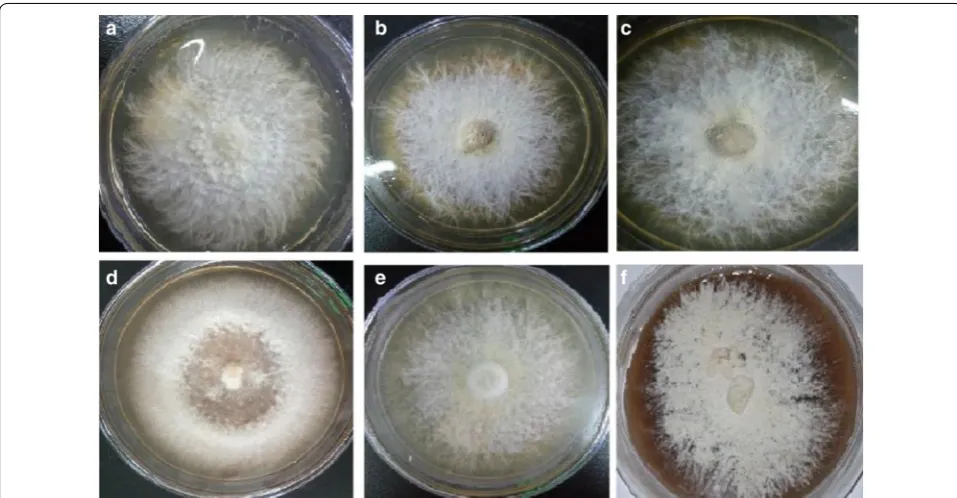
The haploid monokaryotic strains of the H. erinaceus samples included H. erinaceus HT-4903, H. erinaceus CC-02 (purchased from the Jiang du tian da Institute of Edible Fungi, Jiangsu, China), H. erinaceus GT-06 (Fujian, China), H. erinaceus PZH-05 (Sichuan, China), H. erina-ceus TJH-03 (Sichuan, China), and H. erinaerina-ceus TD-04 (Hubei, China). Among these strains, Hericium erinaceus PZH-05 is a mutant strain and is mainly used for liquid fermentation processes. All of these strains were grown on potato dextrose agar (PDA) at room temperature for 3 weeks in darkness. The morphological characteris-tics of the six H. erinaceus strain samples are shown in Fig. 1 and Additional file 1: Table S1. In the third week of growth, mycelium samples were collected by scraping the top of the medium, and the samples were immedi-ately frozen in liquid nitrogen and then stored at − 80 °C for total RNA extraction. Three biological replicates were performed for each H. erinaceus strain.
Estimation of polysaccharide in H. erinaceus
The mycelium polysaccharides were extracted from the six H. erinaceus samples at the third week of growth. The mycelium obtained from each sample was dried after being scraped from the plates of the six strains. The dried mycelium (5 g) after extraction from each sample was further ground into a powder and resuspended in 20 volumes of water at 70 °C for 12 h. The supernatant was collected by centrifugation, concentrated by evaporation under reduced pressure, precipitated with 95% (v/v) eth-anol to reach a final concentration of 80% (v/v) and then incubated at 4 °C for 12 h. The crude polysaccharides of each sample were obtained after centrifuging (4390×g, 20 min) and vacuum-drying (40 °C) the precipitate. The polysaccharide content was measured by the phenol-sul-furic acid method using glucose as a standard.
Library construction and RNA sequencing
manufacturer’s instructions. The purity and concentra-tion of RNA were determined using a NanoDrop-2000 spectrophotometer (Thermo Scientific, USA). Equal amounts of RNA from each sample that belonged to the same strain were pooled for cDNA library construc-tion. Stranded cDNA libraries were constructed using the NEBNext Ultra Directional RNA Library Prep Kit (cat#E7420, NEB, UK) according to the manufacturer’s protocols. Briefly, mRNA was fragmented into 250– 450 bp, followed by first-strand cDNA synthesis. Then, dUTP was added as a marker during the synthesis of the second-strand cDNA. Finally, the double-strand cDNA was digested with uracil—DNA glycocasylase (UDG) before the PCR. Thus, only the first strands of cDNA were retained and sequenced. Transcriptome sequenc-ing was carried out on the HiSeq4000 (Illumina) platform using a paired-end run (2 × 150 bp).
Transcriptome assembly and annotation
Raw reads were filtered by removing the adaptor sequences, reads with quality lower than Q20 and reads with poly-N. De novo transcriptome assembly for each strain was performed with Trinity software (Version 2.2.0) with default parameters (fixed k-mer value of 25) (Zhao et al. 2011). The expression levels of transcripts were normalized by calculating the fragments per kilo-base of exon per million fragments mapped (FPKM) using RSEM software. The CDS and protein sequences
of transcripts were predicted using TransDecoder (http://trans decod er.githu b.io/). The protein sequences were aligned to the four public databases: NCBI nonre-dundant protein sequences (NR; https ://www.ncbi.nlm. nih.gov/refse q/about /nonre dunda ntpro teins /), Eukary-otic Orthologous Groups (KOG; https ://genom e.jgi.doe. gov/Tutor ial/tutor ial/kog.html), Swiss-Prot (a manu-ally annotated and reviewed protein sequence database: http://www.ebi.ac.uk/unipr ot), and Kyoto Encyclopedia of Genes and Genomes (KEGG) Orthology (KO; https ://www.kegg.jp/kegg/ko.html) for functional annotation using the BLASTP program (cut-off E-value < 1 × 10⁻⁵).
The Gene Ontology (GO; http://geneo ntolo gy.org/) annotation of the proteins was carried out using WEGO software based on the NR annotation (Ye et al. 2006). The SSRs were detected using MIcroSAtellite identifica-tion tool (MISA) software (version 1.0). The minimum repeat numbers for motifs of mono-, di-, tri-, tetra-, penta-, and hexanucleotides were set as 10, 6, 5, 5, 5, and 5, respectively.
Prediction of genes involved in polysaccharide biosynthesis in H. erinaceus
A BLAST search was performed for the prediction of genes participating in polysaccharide biosynthesis. Then, the genes involved in sucrose, fructose, mannose, and galactose metabolism and shared across the six strains of H. erinaceus were detected by manual processing.
Fig. 1 The morphological characteristics of H. erinaceus dikaryotic mycelium on PDA medium. aH. erinaceus HT-4903, bH. erinaceus GT-06, cH.
According to the NR database and KEGG annotation, the genes involved in the polysaccharide metabolism path-way were obtained. Additionally, the important genes involved in polysaccharide biosynthesis reported in a previous study were analyzed through the NR annotation results.
Statistical analyses were performed with Excel (2016). All of the data are expressed as the means and standard deviations of three replications.
Quantitative reverse transcriptase‑PCR (qRT‑PCR)
The HiScript® II Q RT SuperMix for qPCR (+g DNA wiper) Kit (Nanjing, China) was used according to the manufacturer’s instructions to generate the first-strand cDNA after extracting total RNA from six samples sub-jected to RNA-Seq. Ten genes were selected to validate the reliability of the RNA-Seq data. The gene-specific primers were produced by Primer 5.0 (Additional file 2: Dataset 1) and synthesized by Sangon Biotech (Shanghai) Co., Ltd. (Shanghai, China). ChamQTM SYBR® Color qPCR Master Mix (10 μL; Vazyme, Nanjing, China) was mixed with the gene-specific primers, sterilized water and the synthesized cDNA in a total reaction volume of 20 μL. Reactions were performed on a qTOWER 2.2 (Analytik Jena AG, Jena, Germany). The two-step quan-titative RT-PCR program was performed at 95 °C for 30 s, followed by 40 cycles of 95 °C for 10 s and 60 °C for 30 s. The 2−∆∆Ct method was used to calculate the relative
expression level of each gene, and actin was selected as the reference gene for normalization (Livak and Schmitt-gen 2001). Each reaction was carried out with three bio-logical replicates and three technical replicates.
Results
Illumina sequencing and de novo assembly
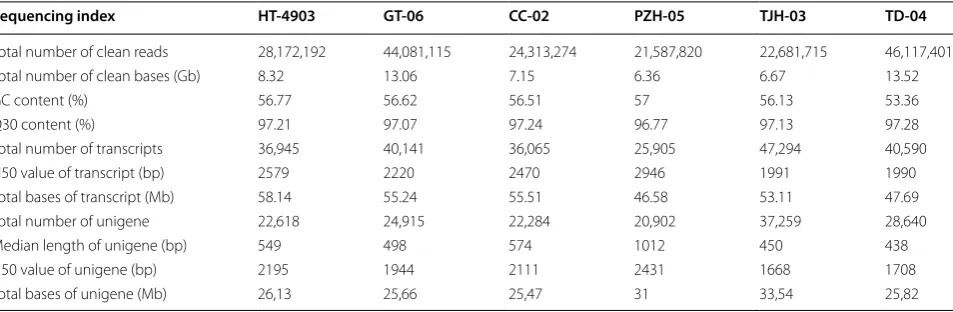
Raw data were generated by sequencing each H. erina-ceus strain. After the reads were filtered and subjected
to quality control, a total of 21 to 46 million clean reads were obtained for H. erinaceus HT-4903, GT-06, CC-02, PZH-05, TJH-03 and TD-04 (Table 1). The quality of most bases along the reads were above Q30, and more than 96% of the reads had a quality score > Q30 (Table 1 and Additional file 1: Fig. S1). The contents of bases A and T were very similar, as well as the C and G con-tents, suggesting a balance among bases across the reads (Additional file 1: Fig. S2). These results suggested that the clean reads with high quality could be used for sub-sequent analyses.
Then, all clean reads in each strain were de novo assembled into 36,945, 40,141, 36,065, 25,905, 47,294 and 40,590 transcripts for H. erinaceus HT-4903, GT-06, CC-02, PZH-05, TJH-03 and TD-04 using Trinity, respec-tively (Table 1). The size of these transcripts ranged from 46.58 Mb in H. erinaceus PZH-05 to 58.14 Mb in H. eri-naceus HT-4903. The N50 values of transcripts in the six strains were 2579 bp, 2220 bp, 2470 bp, 2946 bp, 1991 bp and 1990 bp, respectively. Then, the longest transcript of each gene was used as a unigene. After the redundant transcripts were removed, 22,618, 24,915, 22,284, 20,902, 37,259 and 28,640 unigenes with N50 values of 2195 bp, 1944 bp, 2111 bp, 2431 bp, 1668 bp and 1708 bp were obtained for H. erinaceus HT-4903, GT-06, CC-02, PZH-05, TJH-03 and TD-04, respectively (Table 1).
Functional annotation of the transcripts
Functional annotation of the predicted genes was per-formed using BLAST (Altschul et al. 1990) against the following six databases: GO (Ashburner et al. 2000), KEGG (Kanehisa et al. 2016), KOG (Tatusov et al. 2003), Swiss-Prot (Gasteiger et al. 2001) and NCBI NR pro-tein databases. A total of 19.01–65.98% of transcripts returned a BLAST hit above the E-value cut-off of 10−5
(E-value < 1 × 10⁻⁵) from these five databases (Table 2).
Among these transcripts, only 8729–16,622 transcripts (33.70–40.95% of the total) were not matched with these
Table 1 Summary of the sequencing and assembly of six H. erinaceus strain samples
Sequencing index HT‑4903 GT‑06 CC‑02 PZH‑05 TJH‑03 TD‑04
Total number of clean reads 28,172,192 44,081,115 24,313,274 21,587,820 22,681,715 46,117,401
Total number of clean bases (Gb) 8.32 13.06 7.15 6.36 6.67 13.52
GC content (%) 56.77 56.62 56.51 57 56.13 53.36
Q30 content (%) 97.21 97.07 97.24 96.77 97.13 97.28
Total number of transcripts 36,945 40,141 36,065 25,905 47,294 40,590
N50 value of transcript (bp) 2579 2220 2470 2946 1991 1990
Total bases of transcript (Mb) 58.14 55.24 55.51 46.58 53.11 47.69
Total number of unigene 22,618 24,915 22,284 20,902 37,259 28,640
Median length of unigene (bp) 549 498 574 1012 450 438
N50 value of unigene (bp) 2195 1944 2111 2431 1668 1708
databases (Table 2). Most of the transcripts in six strains were successfully annotated in each database.
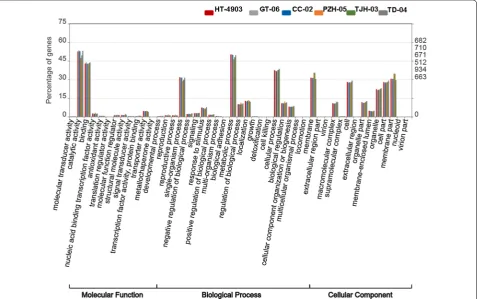
Then, we obtained the GO classification using these transcripts. Intriguingly, the distribution of annotated genes at the level-two GO terms in the six strains showed highly similar patterns (Fig. 2). In the GO classification, all of the genes annotated in the GO database were clas-sified into three main categories and contained 46 level-two GO terms. The top five clustered classes in function were catalytic activity, metabolic process, binding, cellu-lar process and membrane. The percentage of annotated
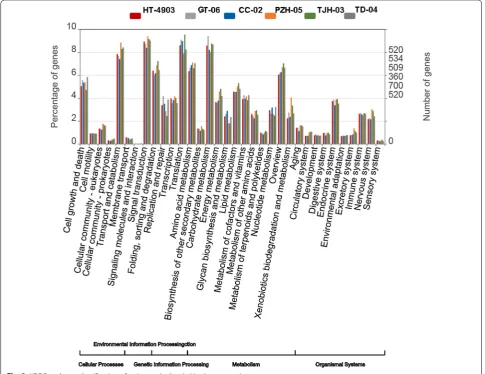
genes in the top five clusters was more than 30% (Fig. 2). These highly enriched GO terms mainly referred to the maintenance of the basic regulation and metabolic func-tions of the six strains. Additionally, we performed KEGG pathway analysis to understand the biological functions and interactions among gene products. A total of 36 pathways in 5 categories were retrieved. In the KEGG pathway analysis, the top five clustered classes were sig-nal transduction, carbohydrate metabolism, translation, transport and catabolism, and amino acid metabolism (Fig. 3).
Table 2 Functional annotations of the de novo transcriptomes for HT-4903, GT-06, CC-02, PZH-05, TJH-03 and TD-04
Database HT‑4903 GT‑06 CC‑02 PZH‑05 TJH‑03 TD‑04
NR 23,116 (62.57%) 24,517 (61.08%) 22,760 (63.11%) 17,093 (65.98%) 30,950 (65.44%) 23,399 (57.65%) GO 15,162 (41.04%) 15,780 (39.31%) 14,917 (41.36%) 11,382 (43.94%) 20,775 (43.93%) 14,755 (36.35%) KO 8662 (23.45%) 8893 (22.15%) 8489 (23.54%) 6004 (23.18%) 11,673 (24.68%) 8668 (21.36%) KOG 9299 (25.17%) 9210 (22.94%) 9085 (25.19%) 7196 (27.78%) 11,383 (24.07%) 8489 (20.91%) Swiss-Prot 7099 (19.22%) 7631 (19.01%) 7118 (19.74%) 7798 (30.10%) 12,695 (26.84%) 8353 (20.58%) Unannotated 13,723 (37.14%) 15,422 (38.42%) 13,239 (36.71%) 8729 (33.70%) 16,256 (34.37%) 16,622 (40.95%) Total 36,945 (100.00%) 40,141 (100.00%) 36,065 (100.00%) 25,905 (100.00%) 47,294 (100.00%) 40,590 (100.00%)
Analysis of expression level and prediction ORFs and SSRs in transcripts
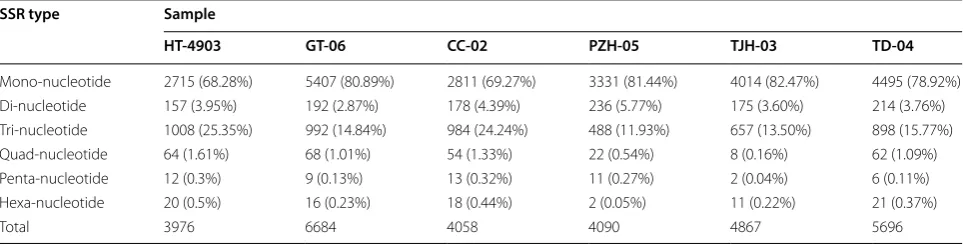
We used TransDecoder and MISA to predict the ORFs and SSRs of the transcripts in the six strains. The aver-age number of ORFs was 24,215, ranging from 18,292 in H. erinaceus PZH-05 to 29,125 in H. erinaceus TJH-03 (Table 3). Then, a search of SSR loci was conducted for these transcripts. The number of transcripts containing SSR sites in each of the six strains was 3691, 6278, 3762, 3770, 4638 and 5302, accounting for 10–17% of the total transcripts. After statistical analysis, we found that the transcriptomes of the six H. erinaceus strains were most
abundant in mono-, di-, tri-, quad-, penta-, hexanucleo-tide repeat motifs. Moreover, the proportion of repeat types varied greatly (Table 4). Among them, mononu-cleotide, dinucleotide and trinucleotide motifs were the predominant repeat motifs. The number of mononucle-otide SSRs was the largest (2715–5407), accounting for 68.28–82.47%, followed by dinucleotides (488–1008) and trinucleotides (157–236), accounting for 11.93–25.35 and 2.87–5.77%, respectively.
To quantify the expression levels of the unigenes, the Bowtie 2 (Langmead 2010) program was applied using RSEM (Li and Dewey 2011). Then, we obtained the
Fig. 3 KEGG pathway classification of unigenes in the six H. erinaceus strains
Table 3 The number of predicted ORFs in six H. erinaceus transcripts
Categories HT‑4903 GT‑06 CC‑02 PZH‑05 TJH‑03 TD‑04
Transcripts with
predicted ORFs 24,398 (66.04%) 25,512 (63.56%) 24,241 (67.21%) 18,292 (70.61%) 29,125 (61.58%) 23,727 (58.46%)
number of mapped reads and separately calculated the FPKM values and ranked the values from high to low from the data of the six strains. The statistical results of gene and transcript expression levels (FPKM) in the six samples are shown in Additional file 1: Table S2. Among the six strains, the proportion of genes and transcripts in different FPKM intervals was similar. The FPKM dis-tribution of the six samples is shown in Additional file 1: Figs. S3 and S4.
Among all FPKM values, we selected the top 10 FPKM values from the six strains to investigate the highly expressed genes (Additional file 3: Dataset 2). The GO annotation revealed that these genes were mainly involved in oxidation-reduction processes, translation, catalytic activity, ATP binding, and protein ubiquitination.
Comparison of polysaccharide metabolism‑related gene expression in six strains
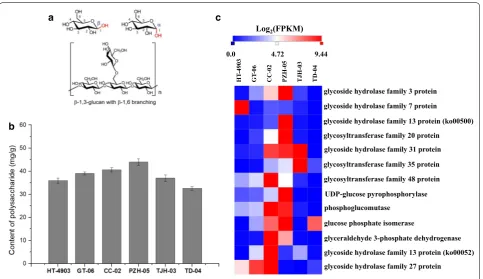
Polysaccharides are considered the major and most-studied active component in H. erinaceus (Lu et al. 2014). H. erinaceus polysaccharides are polymers composed of more than 10 monosaccharides that exist in myce-lia, fruiting bodies and fermentation broth (Zhang et al. 2016). The basic structure of a typical mushroom poly-saccharide is shown in Fig. 4a (Friedman 2016). In this study, we measured the polysaccharide contents in the six strains. As shown in Fig. 4b, the mycelium of strain PZH-05 contained more polysaccharides than other strains. The polysaccharide content in H. erinaceus PZH-05 reached 43.97 mg/g, which was the highest polysac-charide content detected among the strains, followed by H. erinaceus CC-02 (40.63 mg/g), GT-06 (39.07 mg/g), TJH-03 (37.02 mg/g), HT-4903 (35.90 mg/g), and TD-04 (32.57 mg/g). The polysaccharide levels in H. erinaceus PZH-05 were 0.74 times higher than that in TD-04.
Recently, many various polysaccharides have been extracted from fungi of the Hericium genus, and research has revealed that polysaccharides are mainly composed of monosaccharides, such as glucose,
galactose, mannose, arabinose and xylose, as well as rhamnose, fucose and fucose (Jia et al. 2004; Wang et al. 2004). Therefore, to investigate the polysaccha-ride biosynthesis pathway of H. erinaceus, we detected the genes and gene clusters involved in the saccharide unit, such as sucrose, mannose and galactose biosyn-thesis. A comparison of genes involved in polysaccha-ride biosynthesis in the six strains was then conducted. A total of 13 genes involved in saccharide unit metabo-lism was shared among the six strains (Fig. 4c). Among these encoding genes, glycoside hydrolase family 3 pro-tein, glycoside hydrolase family 13 protein and glyco-side hydrolase family 31 protein are the key enzymes for catalyzing the biosynthesis of d-glucose. The genes encoding glycoside hydrolase family 7 protein, glyco-syltransferase family 20 protein, glycoglyco-syltransferase family 35 protein and glycosyltransferase family 48 pro-tein catalyze the biosynthesis of cellobiose, trehalose-6P, α-d-glucose-1P and 1,3-β-glucan, respectively. All of these genes were highly expressed (FPKM value > 1), and the expression patterns were similar (Fig. 4c). Most genes had the highest FPKM value in H. erina-ceus PZH-05, followed by H. erinaerina-ceus CC-02, GT-06, TJH-03, HT-4903, and TD-04. This result paralleled the physiological data and coincided with the trend in poly-saccharide content in the six strains.
Genes involved in starch and sucrose metabolism
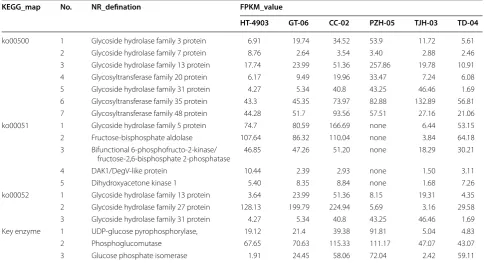
We collected the transcripts involved in sucrose metabo-lism using KEGG annotation. There are 59, 69, 65, 43, 94 and 64 genes annotated in starch and sucrose metabo-lism (ko00500) for H. erinaceus HT-4903, GT-06, CC-02, PZH-05, TJH-03 and TD-04, respectively (Additional file 1: Table S3). Among them, 7 genes were shared among the six strains (Table 5). Figure 5a shows the pathways in which these 7 genes are involved. Genes were identified that encode glycoside hydrolase fam-ily 3 protein, glycoside hydrolase famfam-ily 13 protein and glycosyltransferase family 20 protein, which are the key
Table 4 Distribution of SSR loci in H. erinaceus HT-4903, GT-06, CC-02, PZH-05, TJH-03 and TD-04 transcriptome
SSR type Sample
HT‑4903 GT‑06 CC‑02 PZH‑05 TJH‑03 TD‑04
Mono-nucleotide 2715 (68.28%) 5407 (80.89%) 2811 (69.27%) 3331 (81.44%) 4014 (82.47%) 4495 (78.92%) Di-nucleotide 157 (3.95%) 192 (2.87%) 178 (4.39%) 236 (5.77%) 175 (3.60%) 214 (3.76%) Tri-nucleotide 1008 (25.35%) 992 (14.84%) 984 (24.24%) 488 (11.93%) 657 (13.50%) 898 (15.77%) Quad-nucleotide 64 (1.61%) 68 (1.01%) 54 (1.33%) 22 (0.54%) 8 (0.16%) 62 (1.09%) Penta-nucleotide 12 (0.3%) 9 (0.13%) 13 (0.32%) 11 (0.27%) 2 (0.04%) 6 (0.11%) Hexa-nucleotide 20 (0.5%) 16 (0.23%) 18 (0.44%) 2 (0.05%) 11 (0.22%) 21 (0.37%)
enzymes for the biosynthesis of d-glucose, and the gene encoding glycosyltransferase family 48 protein was iden-tified, which is an important enzyme for 1,3-β-glucan synthases. The expression level data indicated that the 7 genes were highly expressed in the six strains, and the maximum FPKM value reached 257.86 in the strain H. erinaceus PZH-05 (Additional file 4: Dataset 3).
Genes involved in fructose and mannose metabolism
The genes involved in fructose and mannose biosyn-thesis were identified, and a total of 5 genes that were involved in this pathway were identified across all strains except H. erinaceus PZH-05 (Table 5). These five genes encoded glycoside hydrolase family 5 pro-tein, fructose-bisphosphate aldolase, bifunctional 6-phosphofructo-2-kinase/fructose-2,6-bisphosphate 2-phosphatase, DAK1/DegV-like protein and dihy-droxyacetone kinase 1. As shown in Fig. 5b, these genes encode the key enzymes for d-mannose, d-fructose-2,6 P2, β-d-fructose-1,6 P2 and glyceraldehyde-3P biosyn-thesis. The gene encoding glycoside hydrolase family 5 protein had low expression level in H. erinaceus TJH-03 (FPKM value equal 6.44) but was highly expressed in the other 4 strains, with FPKM values greater than 50 (Additional file 4: Dataset 3). A similar pattern of expression levels, in which expression was slightly lower
in the H. erinaceus TJH-03 strain but highly expressed in the other 4 strains, was detected for the 4 genes encoding fructose-bisphosphate aldolase, bifunctional 6-phosphofructo-2-kinase/fructose-2,6-bisphosphate 2-phosphatase, DAK1/DegV-like protein and dihy-droxyacetone kinase 1 (Additional file 4: Dataset 3).
Genes involved in galactose metabolism
We obtained 3 genes shared across the six strains enriched in the galactose metabolism pathway (ko00052) (Table 5). Although these 3 annotated genes occurred in galactose metabolism, the main function of the 3 encoding genes is sucrose, d-glucose and d-fructose bio-synthesis (Fig. 5c). Among them, the gene encoding gly-coside hydrolase family 27 protein was relatively highly expressed in the six H. erinaceus strains (Additional file 4: Dataset 3).
We also collected genes involved in terpenoid biosyn-thesis in the KEGG pathway, such as the encoding genes of mevalonate pyrophosphate decarboxylase, terpenoid synthase, and 3-hydroxy-3-methylglutaryl-coenzyme A reductase. These genes were also highly expressed in the six strains (Additional file 5: Dataset 4). Interest-ingly, Chen also predicted the gene encoding 3-hydroxy-3-methylglutaryl-coenzyme A reductase and found that these genes were highly expressed in the monokaryotic
HT
-4903
GT
-06
CC
-02
PZ
H-05
TJH
-03
TD-0
4
glycoside hydrolase family 3 protein glycoside hydrolase family 7 protein
glycoside hydrolase family 13 protein (ko00500) glycosyltransferase family 20 protein glycoside hydrolase family 31 protein glycosyltransferase family 35 protein glycosyltransferase family 48 protein UDP-glucose pyrophosphorylase phosphoglucomutase
glucose phosphate isomerase
glyceraldehyde 3-phosphate dehydrogenase
Log2(FPKM)
0.0
a c
b
9.44 4.72
glycoside hydrolase family 13 protein (ko00052) glycoside hydrolase family 27 protein
Fig. 4 The basic structure of typical mushroom polysaccharides (a), polysaccharide content (b) and the expression of important genes for
mycelium, dikaryotic mycelium and fruiting body of H. erinaceus (Chen et al. 2017). Similarly, we obtained this expected protein, and KEGG annotation revealed that these genes participated in terpenoid backbone biosyn-thesis (ko00900) and ubiquinone and other terpenoid-quinone biosynthesis (ko00130). We predicted that these genes also play an essential role in the biosynthesis of terpenoids.
Predicting the molecular mechanism of H. erinaceus
polysaccharide biosynthesis
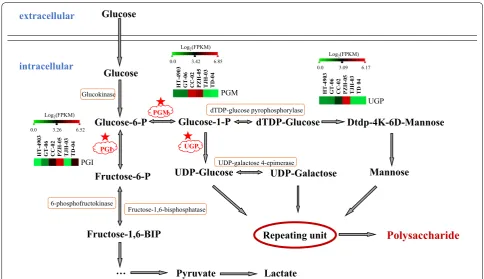
H. erinaceus polysaccharides are glucans that are com-posed of main chains connected by β-(1,3) bonds and branched chains connected by β-(1,6) bonds (Fan and Huang 2008). Currently, due to the complexity of fungal secondary metabolite synthesis, research on polysaccha-ride biosynthesis is mainly focused on bacteria and rarely on fungi (Freitas et al. 2011). Existing studies have shown that the process of the biosynthesis of polysaccharides is conserved, although the structure of polysaccharides var-ies substantially (Ruas-Madiedo et al. 2002). The biosyn-thesis of polysaccharides mainly includes the synbiosyn-thesis of precursor nucleotide sugars (activation of monosaccha-rides), extension and polymerization of repeating units, and output of polysaccharides (Levander and Radstrom 2001; Knirel and Valvano 2013). Figure 6 shows the par-tial pathway for intracellular polysaccharide biosynthesis.
After glucose is converted to glucose-6 phosphate, there are two important metabolism branches, the fructose-6-P branch and the glucose-1-P branch. Therefore, the enzymes that catalyze these two branch reactions are most important in polysaccharide biosynthesis. The study also revealed that PGM, PGI and UGP were the key enzymes affecting the output and types of polysac-charides in Ganoderma lucidum (Liu et al. 2011). In our study, the genes of PGM, PGI and the UGP were identi-fied by the homology sequence search method (BLAST), and the FPKM values were calculated for these three genes (Fig. 6). The results indicated that the expression trends of these 3 encoding genes were similar and had the highest value in PZH-05 (Table 5 and Fig. 6).
Research has shown that the β-glucans are overpro-duced by glyceraldehyde-3-phosphate regulation and that glyceraldehyde-3-phosphate is an important pro-tein in polysaccharide biosynthesis (Chai et al. 2013). Additionally, UGP is regarded as a key enzyme involved in polysaccharide biosynthesis (Yan et al. 2017). We also analyzed the two encoding genes using previous tran-scriptome data. The results showed that the genes encod-ing glyceraldehyde-3-phosphate were highly expressed across the six strains (Additional file 5: Dataset 4). The KEGG annotation of this gene is ko04066 (HIF-1 sign-aling pathway), ko00010 (glycolysis/gluconeogenesis), ko00710 (carbon fixation in photosynthetic organisms), Table 5 Genes and enzymes involved in H.einaceus polysaccharide metabolism in six strains
#FPKM value is the mean expression value of three biological replicates. NR_defination means the protein annotated result of six strains transcripts in NR database
KEGG_map No. NR_defination FPKM_value
HT‑4903 GT‑06 CC‑02 PZH‑05 TJH‑03 TD‑04
ko00500 1 Glycoside hydrolase family 3 protein 6.91 19.74 34.52 53.9 11.72 5.61 2 Glycoside hydrolase family 7 protein 8.76 2.64 3.54 3.40 2.88 2.46 3 Glycoside hydrolase family 13 protein 17.74 23.99 51.36 257.86 19.78 10.91 4 Glycosyltransferase family 20 protein 6.17 9.49 19.96 33.47 7.24 6.08 5 Glycoside hydrolase family 31 protein 4.27 5.34 40.8 43.25 46.46 1.69 6 Glycosyltransferase family 35 protein 43.3 45.35 73.97 82.88 132.89 56.81 7 Glycosyltransferase family 48 protein 44.28 51.7 93.56 57.51 27.16 21.06 ko00051 1 Glycoside hydrolase family 5 protein 74.7 80.59 166.69 none 6.44 53.15 2 Fructose-bisphosphate aldolase 107.64 86.32 110.04 none 3.84 64.18 3 Bifunctional 6-phosphofructo-2-kinase/
fructose-2,6-bisphosphate 2-phosphatase 46.85 47.26 51.20 none 18.29 30.21
4 DAK1/DegV-like protein 10.44 2.39 2.93 none 1.50 3.11
5 Dihydroxyacetone kinase 1 5.40 8.35 8.84 none 1.68 7.26
ko01230 (biosynthesis of amino acids) and ko01200 (carbon metabolism). Moreover, we found that the UGP gene that existed in 5 strains, excluding HT-4903, was expressed at lower levels than glyceraldehyde-3-phos-phate (Additional file 5: Dataset 4).
qRT‑PCR validation
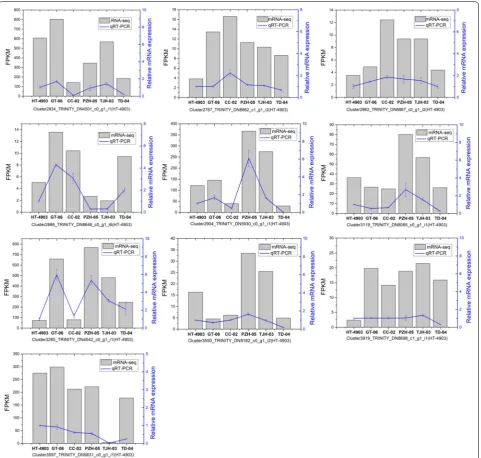
To verify the gene expression level produced by RNA-Seq, we performed qRT-PCR assays with six independ-ent samples for RNA-Seq. We selected 10 genes with varying degrees of expression to validate the RNA-Seq data. Among them, 2 genes were involved in polysaccha-ride biosynthesis. As expected, these genes had similar expression tendencies. The qRT-PCR data for these genes were basically consistent with the RNA-Seq data (Fig. 7). This result indicates that the RNA-Seq data are accurate and valuable.
Discussion
Research in medicine and pharmacology has indicaed proven that polysaccharides of H. erinaceus have certain therapeutic effects on improving immunity, restraining cancer and senescence, reducing blood sugar, and other effects (Illum 1998; Wang et al. 2001; Park et al. 2002; Fan and Huang 2008). Although many studies have unveiled the mechanism underlying the medicinal effect of Hcium polysaccharides, the complex properties of H. eri-naceus polysaccharides and metabolic processes have limited the ability to study the biosynthesis mechanism of polysaccharides in H. erinaceus. However, the develop-ment of RNA-Seq technology has provided new oppor-tunities for the study of the metabolic mechanism of H. erinaceus polysaccharides. RNA-Seq approaches ena-bled the comparative quantification of gene expression in different organisms and is used broadly across diverse
Fig. 5 KEGG mapping of the polysaccharide metabolism pathway identified in H. erinaceus. a KEGG map 00500, b KEGG map 00051, and c KEGG
organisms representing unique physiological processes. The advantages of this technology have enabled the iden-tification of candidate genes involved in a variety of pro-cesses (Wang et al. 2009).
In our research, we carried out de novo transcriptome sequencing, assembly, and annotation of six H. erina-ceus strains. Extensive transcriptome datasets of the six strains were generated. Moreover, functional annotation, expression patterns, and gene clusters involved in the H. erinaceus polysaccharide biosynthesis pathway were con-ducted. The shared genes across the six strains related to the synthesis of sucrose, galactose and mannose, which are the units of polysaccharide biosynthesis, were iden-tified. Our results showed that these genes played an important role in d-glucose, d-mannose, and sucrose biosynthesis. Moreover, we found that the genes encod-ing UGP participated in sucrose synthases with high expression in the six strains. In addition, we mapped the putative pathway for intracellular polysaccharide biosyn-thesis of H. erinaceus. Our study showed that the genes of PGM, PGI and the UGP were highly expressed across the six strains, and the expression pattern was consistent with the polysaccharide content of the six strains. These results strongly indicate that PGM, PGI and UGP are key enzymes for H. erinaceus polysaccharide biosynthesis.
Interestingly, the genes involved in polysaccharide metabolism identified in H. erinaceus PZH-05 were sig-nificantly different from the other five strains of H. eri-naceus. The phenotypic analysis showed that the H. erinaceus PZH-05 grew rapidly, had no aerial mycelia and formed a macroscopic fruit body under suitable con-ditions. On the one hand, we suspected that the differ-ences in polysaccharide metabolism genes were related to the characteristics of H. erinaceus PZH-05; on the other hand, the mechanism of polysaccharide metabo-lism in H. erinaceus PZH-05 was different from the five other strains. The differences in polysaccharide synthesis and phenotypic characteristics of H. erinaceus PZH-05 remain to be further verified and studied.
In addition to the polysaccharide biosynthesis pathway, we also focused on the biosynthesis of erinacines. Our study concluded that 3-hydroxy-3-methylglutaryl-coen-zyme A reductase, terpenoid synthase and mevalonate pyrophosphate decarboxylase are genes predicted to par-ticipate in erinacine biosynthesis. These three genes are highly expressed in the 6 strains, and the range of the FPKM value was 3.02–143.71. Interestingly, 3-hydroxy-3-methylglutaryl-coenzyme A reductase was predicted to be involved in terpenoid biosynthesis, which was consist-ent with the findings of Chen et al., who also suggested
extracellular intracellular UDP-Galactose Glucose Glucose Glucose-6-P Fructose-6-P Fructose-1,6-BIP Glucose-1-P dTDP-Glucose UDP-Glucose Dtdp-4K-6D-Mannose Pyruvate Lactate
Polysaccharide
Mannose … Repeating unit UGP PGM PGI Glucokinase 6-phosphofructokinase Fructose-1,6-bisphosphatase dTDP-glucose pyrophosphorylase UDP-galactose 4-epimerase Log2(FPKM)0.0 3.26 6.52
HT-4903 GT-0 6 CC -02 PZH-05 TJH-03 TD-0 4
0.0 3.42 6.85
0.0 3.09 6.17
PGI
PGM
UGP
Log2(FPKM)
Log2(FPKM)
HT-4903 GT-0 6 CC-0 2 PZH-05 TJH-0 3 TD -0 4 HT-4903 GT-0 6 CC-0 2 PZH-05 TJH -03 TD 04
Fig. 6 Putative pathway for intercellular polysaccharide biosynthesis in H. erinaceus. The red stars indicate the three most important enzymes
that this gene was highly expressed in three tissues of H. erinaceus (Chen et al. 2017).
According to the functional annotation, the transcripts that participated in signal transduction, carbohydrate metabolism, translation, transport and catabolism, and amino acid metabolism were largely enriched. At the level-two GO categories of molecular function, biological process and cellular component, most of the transcripts
were classified into signal transduction, carbohydrate metabolism and translation, indicating the basic func-tions of transcripts. Furthermore, we also predicted the ORFs and SSRs in H. erinaceus transcripts. The results of the predicted ORFs and SSRs supply theoretical support for genetic diversity analyses, genetic linkage map con-struction and marker-assisted selection (Qiu et al. 2014; Nie et al. 2015; Guo et al. 2017; Lei et al. 2017).
Fig. 7 qRT-PCR confirmation of 10 expressed genes in the six H. erinaceus strains. The expression patterns of selected genes were analyzed across
Conclusion
In summary, the analysis of the transcriptome sequences of six H. erinaceus strains via an Illumina platform was a powerful method for investigating the putative genes involved in diverse secondary metabolite biosynthe-sis. In our study, a total of 20,902–37,259 unigenes were obtained from the six H. erinaceus strains. We predicted the genes related to the biosynthetic pathway of bioac-tive compounds, especially polysaccharides. The key enzymes involved in polysaccharide biosynthesis, such as PGM, PGI and UGP, were identified, and the expres-sion levels of these genes were relatively consistent with the polysaccharide contents in the six strains. Moreover, the genes and gene clusters related to the saccharide unit were detected. The GO analysis of transcript and func-tional annotation revealed that signal transduction had the most hits, followed by carbohydrate metabolism, translation, transport and catabolism, and amino acid metabolism. Furthermore, we performed ORF and SSR detection. These datasets will be valuable for the biotech-nology industry in the production and packaging of these metabolites for commercial applications of mushrooms in the future and will improve our knowledge of H. erina-ceus biology.
Additional files
Additional file 1: Figure S1. The distribution of the base quality in six strains sequenced data. A. H. erinaceus HT4903, B. H. erinaceus GT-06, C. H. erinaceus CC-02, D. H. erinaceus PZH-05, E. H. erinaceus TJH-03, F. H. erinaceus TD-04. Figure S2. The distribution of A, T, G, C composition in six strains. A. H. erinaceus HT4903, B. H. erinaceus GT-06, C. H. erinaceus CC-02, D. H. erinaceus PZH-05, E. H. erinaceus TJH-03, F. H. erinaceus TD-04. Figure S3. The distribution of genes FPKM in six strains. A. H. erinaceus HT4903, B. Hericium erinaceus GT-06, C. H. erinaceus CC-02, D. H. erinaceus PZH-05, E. H. erinaceus TJH-03, F. H. erinaceus TD-04. Figure S4. The distribution of transcripts FPKM in 6 strains. A. H. erinaceus HT4903, B. Hericium erinaceus GT-06, C. H. erinaceus CC-02, D. H. erinaceus PZH-05, E. H. erinaceus TJH-03, F. H. erinaceus TD-04. Table S1. The morphological characteristic of six strains in H.erinaceus.Table S2. Statistics of the genes and transcripts number in different expression levels. Table S3. The number of genes enriched to the KEGG pathway.
Additional file 2: Dataset 1. The specific primers of 10 genes selected to qRT-PCR experiment.
Additional file 3: Dataset 2.H. erinaceus-FPKM top10 transcript.
Additional file 4: Dataset 3. 13-co-existed genes involved in polysac-charides biosynthesis and 5 genes involved in fructose and mannose metabolism.
Additional file 5: Dataset 4. The annotated of all transcripts in six H.erinaceus samples.
Acknowledgements
This work was supported by the Scientific Research Fund of the Sichuan Provincial Education Department (No. 17ZA0215).
Authors’ contributions
NZ and ZH designed the experiment. ZY and CY provided the strains, reagents and materials. NZ, ZT, JZ, XL and ZZ performed the experiment. NZ, ZT, ZY and ZZ performed the data mining and statistical analyses. NZ, ZT and JZ interpreted the results of the statistical analyses. NZ drafted the manuscript. ZH made critical comments and revisions to the initial manuscript. ZH had primary responsibility for the final content. All authors read and approved the final manuscript.
Funding
The Scientific Research Fund of the Sichuan Provincial Education Department supported our research and aided in sequencing and purchasing experimen-tal materials.
Availability of data and materials
The datasets generated and analyzed during the current study are available in the NCBI repository (accession number PRJNA503307).
Ethics approval and consent to participate Not applicable.
Consent for publication Not applicable.
Competing interests
The authors declare that they have no competing interests.
Author details
1 College of Life Sciences, Neijiang Normal University, Neijiang 641100, Peo-ple’s Republic of China. 2 Key Laboratory of Regional Characteristic Agricultural Resources, Department of Education, Neijiang 641100, People’s Republic of China.
Received: 22 April 2019 Accepted: 16 July 2019
References
Altschul SF, Gish W, Miller W, Myers EW, Lipman DJ (1990) Basic local align-ment search tool. J Mol Biol 215:403–410. https ://doi.org/10.1016/S0022 -2836(05)80360 -2
Ashburner M, Ball CA, Blake JA, Botstein D, Butler H, Cherry JM, Davis AP, Dolinski K, Dwight SS, Eppig JT, Harris MA, Hill DP, Issel-Tarver L, Kasarskis A, Lewis S, Matese JC, Richardson JE, Ringwald M, Rubin GM, Sherlock G (2000) Gene ontology: tool for the unification of biology. The gene ontol-ogy consortium. Nat Genet 25:25–29. https ://doi.org/10.1038/75556 Chai R, Qiu C, Liu D, Qi Y, Gao Y, Shen J, Qiu L (2013) β-Glucan synthase
gene overexpression and beta-glucans overproduction in Pleurotus ostreatus using promoter swapping. PLoS ONE 8(4):e61693. https ://doi. org/10.1371/journ al.pone.00616 93.s001
Chen H (2016) Advances in the study of chemical constituents and pharmaco-logical activities of Hericium erinaceus. Edible Fungi 6(1):6–8
Chen J, Zeng X, Yang YL, Xing YM, Zhang Q, Li JM, Ma K, Liu HW, Guo SX (2017) Genomic and transcriptomic analyses reveal differential regulation of diverse terpenoid and polyketides secondary metabolites in Hericium erinaceus. Sci Rep 7:10151. https ://doi.org/10.1038/s4159 8-017-10376 -0 Cohen N, Cohen J, Asatiani MD, Varshney VK, Yu HT, Yang YC, Li YH, Mau JL,
Wasser SP (2014) Chemical composition and nutritional and medicinal value of fruit bodies and submerged cultured mycelia of culinary-medicinal higher Basidiomycetes mushrooms. Int J Med Mushrooms 16(3):273–291
Fan WW, Huang HH (2008) Advances on Hericium erinaceus polysaccharides. Sci Food 29(1):355–358
summit proceedings. J Nutr 144(7):1128s–1136s. https ://doi.org/10.3945/ jn.114.19072 8
Feeney MJ, Miller AM, Roupas P (2014b) Mushrooms-biologically distinct and nutritionally unique: exploring a “Third Food Kingdom”. Nutr Today 49(6):301–307
Freitas F, Alves VD, Reis MA (2011) Advances in bacterial exopolysaccharides: from production to biotechnological applications. Trends Biotechnol 29(8):388–398. https ://doi.org/10.1016/j.tibte ch.2011.03.008
Friedman M (2015) Chemistry, nutrition, and health-promoting properties of Hericium erinaceus (Lion’s Mane) mushroom fruiting bodies and mycelia and their bioactive compounds. J Agric Food Chem 63:7108–7123 Friedman M (2016) Mushroom polysaccharides: chemistry and antiobesity,
antidiabetes, anticancer, and antibiotic properties in cells, rodents, and humans. Foods 5(4):80. https ://doi.org/10.3390/foods 50400 80 Gasteiger E, Jung E, Bairoch A (2001) SWISS-PROT: connecting biomolecular
knowledge via a protein database. Curr Issues Mol Biol 3(3):47–55 Guo Y, Cui JL, Zhu N (2012) Effects of hericium polysaccharides on T
lympho-cyte proliferation inhibited by TGF- b1. Chin J Lab Diagn 16(1):48–49 Guo Q, Guo LL, Zhang L, Zhang LX, Ma HL, Guo DL, Hou XG (2017)
Construc-tion of a genetic linkage map in tree peony (Paeonia Sect. Moutan) using simple sequence repeat (SSR) markers. Sci Hortic 219:294–301
Huang LS (2018) The history and culture of Hericium erinaceus. Edible Med Mushrooms 26(1):54–56
Illum L (1998) Chitosan and its use as a pharmaceutical excipient. Pharm Res 15:1326–1331
Jia LM, Liu L, Dong Q, Fang JN (2004) Structural investigation of a novel rham-noglucogalactan isolated from the fruiting bodies of the fungus Hericium erinaceus. Carbohydr Res 339(16):2667–2671. https ://doi.org/10.1016/j. carre s.2004.07.027
Jiang S, Wang S, Sun Y, Zhang Q (2014) Medicinal properties of Hericium erinaceus and its potential to formulate novel mushroom-based phar-maceuticals. Appl Microbiol Biotechnol 98(18):7661–7670. https ://doi. org/10.1007/s0025 3-014-5955-5
Kanehisa M, Sato Y, Kawashima M, Furumichi M, Tanabe M (2016) KEGG as a reference resource for gene and protein annotation. Nucleic Acids Res 44(D1):D457–D462. https ://doi.org/10.1093/nar/gkv10 70
Khan MA, Tania M, Liu R, Rahman MM (2013) Hericium erinaceus: an edible mushroom with medicinal values. J Complement Integr Med. https ://doi. org/10.1515/jcim-2013-0001
Kim SP, Kang MY, Choi YH, Kim JH, Nam SH, Friedman M (2011a) Mechanism of Hericium erinaceus (Yamabushitake) mushroom-induced apoptosis of U937 human monocytic leukemia cells. Food Funct 2(6):348–356 Kim SP, Kang MY, Kim JH, Nam SH, Friedman M (2011b) Composition and
mechanism of antitumor effects of Hericium erinaceus mushroom extracts in tumor-bearing mice. J Agric Food Chem 59(18):9861–9869
Kim SP, Nam SH, Friedman M (2013) Hericium erinaceus (Lion’s Mane) mush-room extracts inhibit metastasis of cancer cells to the lung in CT-26 colon cancer-tansplanted mice. J Agric Food Chem 61(20):4898–4904 Knirel YA, Valvano MA (2013) Bacterial polysaccharide structure and
biosynthe-sis. In: Roberts GCK (ed) Encyclopedia of biophysics. Springer, Berlin, pp 162–168
Langmead B (2010) Aligning short sequencing reads with Bowtie. Curr Protoc Bioinformatics 32(1):11.7.1–11.7.14. https ://doi.org/10.1002/04712 50953 .bi110 7s32
Lee JS, Min KM, Cho JY, Hong EK (2009) Study of macrophage activation and structural characteristics of purified polysaccharides from the fruiting body of Hericium erinaceus. J Microbiol Biotechnol 19(9):951–959 Lei C, Bei W, Wang X, Du X, Jiao Y, Huang R, Wang Q, Deng Y (2017)
Devel-opment of SSR marker by RNA-seq and its application in genotyping pearl sac in pearl oyster Pinctada fucata martensii. Electron J Biotechnol 25:70–74
Levander F, Radstrom P (2001) Requirement for phosphoglucomutase in exopolysaccharide biosynthesis in glucose- and lactose-utilizing Strepto-coccus thermophilus. Appl Environ Microbiol 67(6):2734–2738. https ://doi. org/10.1128/AEM.67.6.2734-2738.2001
Li B, Dewey CN (2011) RSEM: accurate transcript quantification from RNA-Seq data with or without a reference genome. BMC Bioinformatics 12:323. https ://doi.org/10.1186/1471-2105-12-323
Liu GQ, Zhao Y, Wang XL, Zhu ZY (2011) Biosynthesis and fermentation control of polysaccharides from Ganoderma lucidum. Mycosystema 2(30):198–205
Livak KJ, Schmittgen TD (2001) Analysis of relative gene expression data using real-time quantitative PCR and the 2(−Delta Delta C(T)) method. Meth-ods 25(4):402–408. https ://doi.org/10.1006/meth.2001.1262
Lu QQ, Tian JM, Wei J, Gao JM (2014) Bioactive metabolites from the mycelia of the basidiomycete Hericium erinaceum. Nat Prod Res 28(16):1288–1292 Nie H, Niu H, Zhao L, Yang F, Yan X, Zhang G (2015) Genetic diversity and
struc-ture of Manila clam (Ruditapes philippinarum) populations from Liaodong peninsula revealed by SSR markers. Biochem Syst Ecol 59:116–125 Park YS, Lee HS, Won MH, Lee JH, Lee SY, Lee HY (2002) Effect of an
exo-poly-saccharide from the culture broth of Hericium erinaceus on enhancement of growth and differentiation of rat adrenal nerve cells. Cytotechnology 39(3):155–162. https ://doi.org/10.1023/A:10239 63509 393
Qiu Y, Lu H, Zhu J, Chen X, Wang A, Wang Y (2014) Characterization of novel EST-SSR markers and their correlations with growth and nacreous secre-tion traits in the pearl oyster Pinctada martensii (Dunker). Aquaculture 420–421:S92–S97
Ruas-Madiedo P, Hugenholtz J, Zoon P (2002) An overview of the functional-ity of exopolysaccharides produced by lactic acid bacteria. Int Dairy J 12:163–171
Tatusov RL, Fedorova ND, Jackson JD, Jacobs AR, Kiryutin B, Koonin EV, Krylov DM, Mazumder R, Mekhedov SL, Nikolskaya AN, Rao BS, Smirnov S, Sver-dlov AV, Vasudevan S, Wolf YI, Yin JJ, Natale DA (2003) The COG database: an updated version includes eukaryotes. BMC Bioinformatics 4:41. https ://doi.org/10.1186/1471-2105-4-41
Wang JC, Hu SH, Su CH, Lee TM (2001) Antitumor and immunoenhancing activities of polysaccharide from culture broth of Hericium spp. Kaohsi-ung J Med Sci 17(9):461–467
Wang ZJ, Luo DH, Liang ZY (2004) Structure of polysaccharides from the fruit-ing body of Hericium erinaceus Pers. Carbohyd Polym 1(57):241–247 Wang JC, Hu SH, Wang JT, Chen KS, Chia YC (2005) Hypoglycemic effect of
extract of Hericium erinaceus. J Sci Food Agric 85:641–646
Wang Z, Gerstein M, Snyder M (2009) RNA-Seq: a revolutionary tool for tran-scriptomics. Nat Rev Genet 10(1):57–63. https ://doi.org/10.1038/nrg24 84 Yan JK, Pei JJ, Ma HL, Wang ZB, Liu YS (2017) Advances in antitumor
polysac-charides from phellinus sensu lato: production, isolation, structure, antitu-mor activity, and mechanisms. Crit Rev Food Sci Nutr 57(6):1256–1269. https ://doi.org/10.1080/10408 398.2014.98480 2
Ye J, Fang L, Zheng H, Zhang Y, Chen J, Zhang Z, Wang J, Li S, Li R, Bolund L, Wang J (2006) WEGO: a web tool for plotting GO annotations. Nucleic Acids Res 34(2):W293–W297. https ://doi.org/10.1093/nar/gkl03 1 Zeng X, Ling H, Yang J, Chen J, Guo S (2018) Proteome analysis provides
insight into the regulation of bioactive metabolites in Hericium erinaceus. Gene 666(5):108–115. https ://doi.org/10.1016/j.gene.2018.05.020 Zhang J, Zhang JC, Gao ZX, He Z, Huang JC, Liu GP, Huang L (2016) Advance
in Hericium erinaceus active composition research. South China Agric 10(1):186–188
Zhao QY, Wang Y, Kong YM, Luo D, Li X, Hao P (2011) Optimizing de novo transcriptome assembly from short-read RNA-Seq data: a com-parative study. BMC Bioinformatics 12(Suppl 14):S2. https ://doi. org/10.1186/1471-2105-12-S14-S2
Publisher’s Note