The Secured Content-based Image
Retrieval in Cloud Computing
ANKANA. LIKHITA SRI PRIYA M.Tech (CSE) in Department of Computer Science
Engineering, Kakinada Institute of Engineering & Technology For Women, A.P, India
S V KRISHNA REDDY
Asst. Professor, Department of Computer Science and Engineering, Kakinada Institute of Engineering
& Technology For Women, A.P, India
Abstract- Content-based image retrieval (CBIR) applications have been quickly evolved alongside the expansion in the amount, accessibility and significance of images in our day by day life. In any case, the wide organization of CBIR scheme has been restricted by its the serious calculation and capacity necessity. In this paper, we propose a protection safeguarding content-based image retrieval scheme, which permits the information proprietor to redistribute the image database and CBIR administration to the cloud, without uncovering the genuine content of the database to the cloud server. Neighborhood highlights are used to speak to the images, and earth mover's separation (EMD) is utilized to assess the closeness of images. The EMD calculation is basically a straight programming (LP) issue. The proposed scheme changes the EMD issue so that the cloud server can illuminate it without learning the delicate data. Likewise, nearby touchy hash (LSH) is used to improve the pursuit productivity. The security investigation and trials show the security and efficiency of the proposed scheme.
Keywords -Ranking Model; Content Based Image Retrieval (CBIR); Multi-Modal Retrieval; I. INTRODUCTION
Graph based ranking models have been considered profoundly and it is connected in data recovery range, This paper essentially center the issue of applying a novel and effective model for content based image retrieval(CBIR), especially for huge scale image datasets. Customary image recovery framework depends on watchword pursuit, for example, Google, yahoo, Bing is coordinated with the setting of a image incorporating with title archive, and so on. Content-based image recovery is a significant decision to beat the challenges. CBIR framework uses the low level element extraction including worldwide features eg. Network Color Moment, Edge histogram, Gabor Wavelets Texture, Local Binary Pattern, GIST include these are the element extraction [1]. Complex ranking model is the well-known diagram based ranking model that positions the information in tests concerning the inherent geometrical structure that is uncovered by countless is connected I numerous applications that demonstrates the great execution and attainable on assortment of information sorts on the content, image and video[1]. Complex ranking model has its own particular disadvantages to deal with substantial scale datasets; it has costly computational cost in both diagram development and ranking calculation stages. It is obscure to deal with out-ofsample question is proficient under the current system. The first complex ranking is stretched out as proficient complex ranking (EMR) to address the deficiencies of complex ranking from the two points of view: First is versatile graph development; and second is effective ranking calculation [1]. Grapple diagram is worked in the
database rather than k closest neighbor graph, and another contiguousness framework is intended to accelerate the ranking calculation. The modal has two phases independently a disconnected stage and online stage. The EMR can deal with a large number of images to do recovery. Disconnected stage is for learning or building the ranking model and online stage incorporates the phases for dealing with the new inquiry. With EMR the framework can deal with one million images for online recovery with in the brief timeframe. In content based recovery assignments there are assortment of planning errands for extricating low level features and its diverse distance measures, to discover the distance metric/work remains the open test is to investigate distance metric learning (DML).applying machine learning strategies to enhance distance metrics for preparing information data, for example, Historical logs of client significance criticism in content-based image recovery (CBIR) frameworks. Different DML algorithms have been proposed in numerous written works, most existing DML techniques by and large have a place with single-modal DML[2] in that they take in a distance metric either on a solitary kind of highlight or a joined element space by connecting multiple sorts of features together. In certifiable application some methodologies may experience the ill effects of some handy restrictions: (i) a few sorts of features may fundamentally command the others in the DML undertaking, the capacity is to abuse the capability of the considerable number of features; and (ii) The guileless link approach may bring about a consolidated high-dimensional component space. To beat every one of the restrictions, a novel structure of Online Multi-modal Distance Metric
Learning (OMDML) are examined .It takes in the distance metrics from multi-modal information or multiple sorts of features by means of a productive and versatile online learning plan. To address the confinements of the paper a novel plan of online multi-modal distance metric learning is researched and investigates a bound together two-level online learning plan: (i) first is to learn and improve a different distance metric for every modality. (ii)Second is to learn and locate an ideal mix of various distance metrics on multiple modalities. OMDML takes leverage of online systems for high effectiveness and adaptability towards extensive scale learning assignments. To diminish the computational cost and enhance the exactness of distance metric learning, Low Rank Multi-Modal Distance Metric Learning system is utilized, which it can keep away from the need of concentrated positive semi-unequivocal (PSD) projections and it spares a lot of computational cost for DML on high-dimensional information. A novel system of Low rank multi-modal distance metric learning is presented[2], which at the same time learns ideal metrics on every individual modality with the ideal mix of metrics on every individual modality and the ideal mix of the metrics from multiple sort of modalities by means of effective adaptable for online learning. By and large this strategy is utilized as a part of online learning strategies, rather than online handling strategy the disconnected system is utilized. Online learning is to limit the loss of whole succession of got occurrences.
II. RELATED WORK
Comparability/distance metric learning has been broadly contemplated in machine learning group (Yang 2006). Most existing works for DML regularly concentrate on learning a Mahalanobis distance parameterized by a positive semidefinite grid (Shalev-Shwartz, Singer, and Ng 2004; Shental et al. 2002; Schultz and Joachims 2003; Jin, Wang, and Zhou 2009). Enlivened by its applications with regards to ranking, the work in (Weinberger, Blitzer, and Saul 2005) addresses the DML issue together with an extensive edge nearestneighbor classifier. The investigation in (Globerson and Roweis 2005) figured it in a directed setting by including positive imperatives. The works by (Davis et al. 2007) and (Jain et al. 2008) proposed online metric learning algorithms in light of LogDet-regularization with various misfortune capacities. All these methodologies concentrate on the symmetric organization: given two images p1 and p2 they measure closeness through (p1-p2) ⊤M(p1-p2), where the lattice M must be sure semidefinite. In any case, forcing the positive semidefinitiveness requirement regularly
extensive scale genuine applications. Another prominent closeness learning approach plans to advance an unconstrained comparability work in a bilinear frame, for example, OASIS (Chechik et al. 2010). In particular, given two images p1 and p2 they measure closeness by p ⊤ 1 M p1, where framework M is not required to be certain semi-clear. This sort of estimation is more ef-ficient in true applications since it abstains from upholding positive semi-distinct imperatives when learning the similitude work. Not at all like OASIS that utilizations online detached forceful algorithms (Crammer et al. 2006), we investigate the developing Stochastic Dual Coordinate Ascent (SDCA) technique (Shalev-Shwartz and Zhang 2013) for tackling relative closeness learning issue. In this work, we investigate online improvement methods to take in comparability capacities from triplet imperative streams. Online learning works in a consecutive manner, which is ef-ficient and adaptable for expansive scale applications (Hoi, Wang, and Zhao 2014; Rosenblatt 1958; Cesa-Bianchi and Lugosi 2006; Crammer et al. 2006; Dredze, Crammer, and Pereira 2008; Chechik et al. 2010; Zhao, Hoi, and Jin 2011). In this paper, we broaden the SDCA strategy (Shalev-Shwartz and Zhang 2013) to handle the streamlining assignment of relative closeness learning in an online learning setting.
III. COLLECTIVE IMAGE FILE FORMATS ACCESSIBLE
JPEG is a image file produced according to a standard from the Joint Photographic Experts Group, an ISO/IEC group of experts that develops and maintains standards for a suite of compression algorithms for image files. JPEGs usually have a .jpg fileextension.
As one of the technologies to support fast and accurate image search, visual hashing has received huge attention and became a very active research domain in last decade [8], [9].BMP is native file format of the Windows platform is like the parent format to the above three. BMP formats do not allow for image compression.BMP images are crisp and precise, but being pixel dependent they don’t scalewell.
Fig.1 2D-Image Image Acquisition
Image acquisition in image processing can be broadly defined as the process of retrieving an image from some source, usually a hardware based source, so it can be passed through whatever processes need to occur.
Fig.2. Image Acquisition Process
Performing image acquisition in image processing is always the first step in workflow sequence because, without an image, no processing is possible. The input images are taken from file. These images are different format like jpg, tiff, gif mostly we are using jpg format because it will accept black image and colour image.
IV. VISUAL FEATURESEXTRACTION Visual Feature extraction starts from an initial set of measured data and builds derived values determine to be informative and non-redundant. Feature extraction is commonly related to dimensionality reduction and also, visual features usually have high dimensions. Visual Hashing basic idea is to map the raw high-dimensional visual features into binary codes, that visual similarities of images can be efficiently measured by simple but efficient bit-wise operations.
Fig.3. Feature Extraction Process Classification
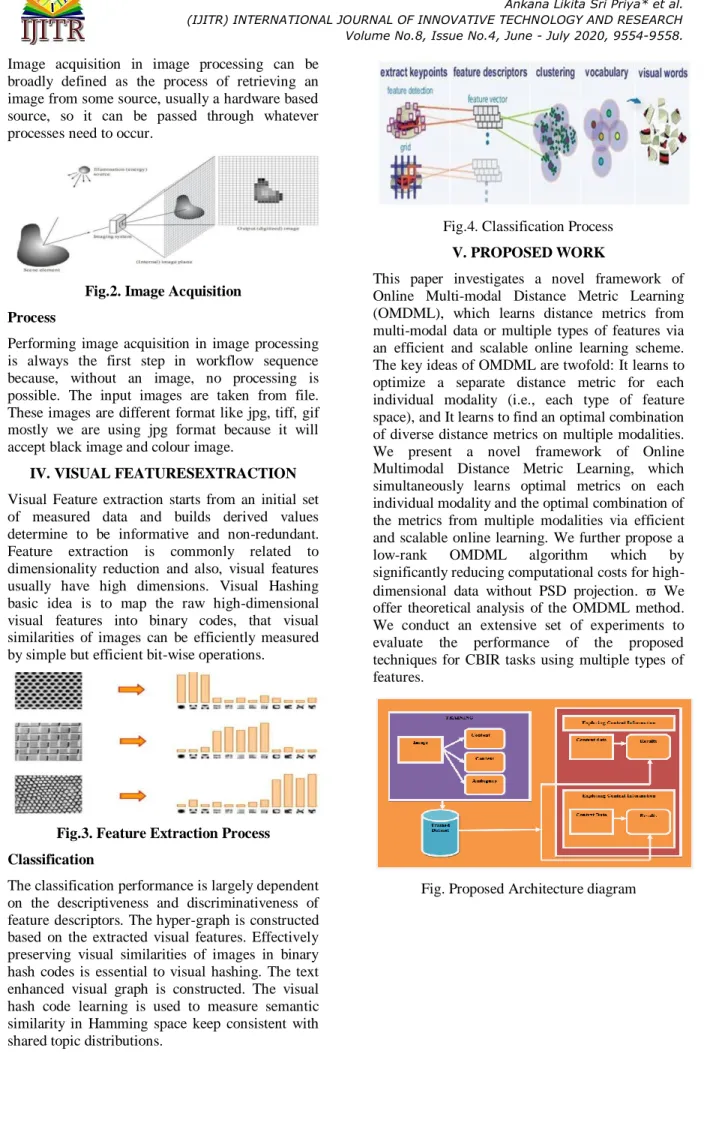
The classification performance is largely dependent on the descriptiveness and discriminativeness of feature descriptors. The hyper-graph is constructed based on the extracted visual features. Effectively preserving visual similarities of images in binary hash codes is essential to visual hashing. The text enhanced visual graph is constructed. The visual hash code learning is used to measure semantic similarity in Hamming space keep consistent with shared topic distributions.
Fig.4. Classification Process V. PROPOSED WORK
This paper investigates a novel framework of Online Multi-modal Distance Metric Learning (OMDML), which learns distance metrics from multi-modal data or multiple types of features via an efficient and scalable online learning scheme. The key ideas of OMDML are twofold: It learns to optimize a separate distance metric for each individual modality (i.e., each type of feature space), and It learns to find an optimal combination of diverse distance metrics on multiple modalities. We present a novel framework of Online Multimodal Distance Metric Learning, which simultaneously learns optimal metrics on each individual modality and the optimal combination of the metrics from multiple modalities via efficient and scalable online learning. We further propose a low-rank OMDML algorithm which by significantly reducing computational costs for high-dimensional data without PSD projection. We offer theoretical analysis of the OMDML method. We conduct an extensive set of experiments to evaluate the performance of the proposed techniques for CBIR tasks using multiple types of features.
VI. RESULTS AND DISCUSSIONS
A. Dataset
The input image needed for this system is COREL image data set, which is a subset of COREL image database consisting of 10000images. COREL is widely used in many CBIR works. All of the images are from different categories, with 100 images per category. Such as Corel image, roses, butterfly, buildings and so on. That is to say, images from the same category are judged relevant and otherwise irrelevant.
B. Performance evaluation
To evaluate the performance of the image retrieval algorithm we use the two most well-known parameters; precision and recall.
PRECISION
It is the ratio of the number of relevant images retrieved to the total number of irrelevant and relevant images retrieved. It is usually expressed as a percentage.
No of relevant images retrieved
*100% No of relevant images retrieved
+
No of irrelevant images are not retrieved.
RECALL
It is the ratio of the number of relevant images retrieved to the total number of relevant images in the database. It is usually expressed as a percentage.
No of irrelevant images retrieved
*100% No of relevant images are retrieved
+
No of relevant images are not retrieved. VII. CONCLUSION
In this work we implemented a new system to make enhancement on the available existing online multi-modal distance metric learning (OMDML) with a new feature of extension to solve the Image ambiguity issue using Conditional Random Field (CRF) Algorithm. The implementation results show that the proposed model is very efficient in providing the solution for the problem of ambiguity in the Content based Image Retrieval System. CRF model works well than the available existing model and results proved it too.
REFERENCES
[1] Bin Xu, Jiajun Bu, Chun Chen, Can Wang, Deng CAI, And Xiaofei He― EMR : A Scalable Graph-Based Ranking Model For Content-Based Image Retrieval‖ Ieee Transactions On Knowledge And Data Engineering, Vol. 27, No. 1, January 2015. [2] Pengcheng Wu, Steven C. H. Hoi, Peilin
Zhao, Chunyan Miao, And Zhi-Yong Liu ―Online Multi-Modal Distance Metric Learning With Application To Image Retrieval‖ Ieee Transactions On Knowledge And Data Engineering, Vol. 28, No. 2, February 2016
[3] Bin Xu, Jiajun Bu, Chun Chen, Deng Cai, Xiaofei He, Wei Liu, JieboLuo ―Efficient Manifold Ranking For Image Retrieval‖ SIGIR’11 July 24–28, 2011, Beijing, China 2011.
[4] Reshma Chaudhari1, A. M. Patil2 ―Content Based Image Retrieval Using ColourAnd Shape Features‖. International Journal Of Advanced Research In Electrical, Electronics And Instrumentation Engineering Vol. 1, Issue 5, November 2012.
[5] Reshma Chaudhari1, A. M. Patil2 ―Content Based Image Retrieval Using ColourAnd Shape Features‖. International
Engineering Vol. 1, Issue 5, November 2012.
[6] W. Liu, J. He, And S. Chang. ―Large Graph Construction For Scalable Semi-Supervised Learning‖. In Proceedings of the 27th International Conference On Machine Learning, Pages 679–686, 2010.
[7] Ji Wan, Dayong Wang, Steven C.H. Hoi, PengchengWu,Jianke Zhu, Yongdong Zhang, Jintao Li‖ Deep Learning For Content-Based Image Retrieval: A Comprehensive Study‖ MM’14, , Orlando, Florida, USA November 3–7, 2014. [8] S. C. Hoi, W. Liu, And S.-F. Chang,
―Semi-Supervised Distance Metric Learning For Collaborative Image Retrieval,‖ In ProcIeee Conf. Comput. Vis. Pattern Recog., Jun. 2008.
[9] Burr Settles Mark Craven, Soumya Ray B. Settles, M. Craven And S. Ray. ―Multiple-Instance Active Learning‖. In NIPS’08, 2008.Ye Xu, Wei
[10] Ping,Andrew T. Campbell ―Multi-Instance Metric Learning‖ 11th IEEE International Conference On Data Mining ,2011.