University of Wisconsin Milwaukee
UWM Digital Commons
Theses and DissertationsAugust 2017
Unsupervised Biomedical Named Entity
Recognition
Omid Ghiasvand
University of Wisconsin-Milwaukee
Follow this and additional works at:https://dc.uwm.edu/etd
Part of theBioinformatics Commons, and theComputer Sciences Commons
This Dissertation is brought to you for free and open access by UWM Digital Commons. It has been accepted for inclusion in Theses and Dissertations by an authorized administrator of UWM Digital Commons. For more information, please [email protected].
Recommended Citation
Ghiasvand, Omid, "Unsupervised Biomedical Named Entity Recognition" (2017).Theses and Dissertations. 1621. https://dc.uwm.edu/etd/1621
UNSUPERVISED BIOMEDICAL NAMED
ENTITY RECOGNITION
by
Omid Ghiasvand
A Dissertation Submitted in Partial Fulfillment of the Requirements for the Degree of
Doctor of Philosophy
in Biomedical and Health Informatics
at
The University of Wisconsin-Milwaukee August 2017
ii
ABSTRACT
UNSUPERVISED BIOMEDICAL NAMED ENTITY RECOGNITION by
Omid Ghiasvand
The University of Wisconsin-Milwaukee, 2017 Under the Supervision of Dr. Rohit J. Kate
Named entity recognition (NER) from text is an important task for several applications,
including in the biomedical domain. Supervised machine learning based systems have been the most successful on NER task, however, they require correct annotations in large quantities for training. Annotating text manually is very labor intensive and also needs domain expertise. The purpose of this research is to reduce human annotation effort and to decrease cost of annotation for building NER systems in the biomedical domain. The method developed in this work is based on leveraging the availability of resources like UMLS (Unified Medical Language System), that contain a list of biomedical entities and a large unannotated corpus to build an unsupervised NER system that does not require any manual annotations.
The method that we developed in this research has two phases. In the first phase, a biomedical corpus is automatically annotated with some named entities using UMLS through unambiguous exact matching which we call weakly-labeled data. In this data, positive examples are the entities in the text that exactly match in UMLS and have only one semantic type which belongs to the desired entity class to be extracted (for example, diseases and disorders). Negative examples are the entities in the text that exactly match in UMLS but are of semantic types other than those that belong to the desired entity class. These examples are then used to train a machine learning classifier using features that represent the contexts in which they appeared in the text. The
iii
trained classifier is applied back to the text to gather more examples iteratively through the process of self-training. The trained classifier is then capable of classifying mentions in an unseen text as of the desired entity class or not from the contexts in which they appear. Although the trained named entity detector is good at detecting the presence of entities of the desired class in text, it cannot determine their correct boundaries. In the second phase of our method, called “Boundary Expansion”, the correct boundaries of the entities are determined. This method is based on a novel idea that utilizes machine learning and UMLS. Training examples for boundary expansion are gathered directly from UMLS and do not require any manual annotations. We also developed a new WordNet based approach for boundary expansion. Our developed method was evaluated on three datasets - SemEval 2014 Task 7 dataset that has diseases and disorders as the desired entity class, GENIA dataset that has proteins, DNAs, RNAs, cell types, and cell lines as the desired entity classes, and i2b2 dataset that has problems, tests, and treatments as the desired entity classes. Our method performed well and obtained performance close to supervised methods on the SemEval dataset. On the other datasets, it outperformed an existing unsupervised method on most entity classes. Availability of a list of entity names with their semantic types and a large unannotated corpus are the only requirements of our method to work well. Given these, our method generalizes across different types of entities and different types of biomedical text. Being unsupervised, the method can be easily applied to new NER tasks without needing costly annotations.
iv
To my beloved parents,
v
TABLE OF CONTENTS
LIST OF FIGURES ... vii
LIST OF TABLES ... viii
1 Introduction ... 1
1.1 Problem Statement and Motivation ... 2
1.2 Research Objectives and Questions ... 4
1.3 Research Approach ... 5
2 Background ... 7
2.1 Named Entity Extraction ... 8
2.2 Unified Medical Language System ... 9
2.3 Related Work ... 10
2.3.1 Supervised Named Entity Recognition ... 11
2.3.2 Unsupervised Named Entity Recognition ... 14
2.4 Our Previous Work ... 20
3 Methods... 26
3.1 Overview ... 27
3.2 Entity Detection ... 29
3.2.1 Creating Weakly-Labeled Training Examples ... 29
3.2.2 Training a machine learning tool ... 32
3.2.3 Self-training ... 36
3.2.4 Testing the System ... 37
3.3 Boundary Expansion ... 37
3.3.1 WordNet Based Method for Boundary Expansion ... 38
3.3.2 Machine Learning Based Boundary Expansion ... 43
3.4 Extracting Discontinuous Entities ... 46
4 Results and Discussion ... 48
4.1 Data Sets ... 49
4.2 Evaluation Measures ... 51
4.3 Baseline for Comparison ... 53
vi
4.5 Named Entity Detection Results ... 55
4.6 Boundary Expansion Results ... 58
4.7 Result Comparisons ... 60 4.8 Discussion ... 64 5 Future Work ... 68 6 Conclusion ... 70 7 References ... 72 Curriculum Vitae ... 85
vii
LIST OF FIGURES
Figure 1 An illustration of named entity recognition (NER) ... 2
Figure 2 Example of tagging a paragraph in our system ... 23
Figure 3 Overall approach for training named entity detector ... 28
Figure 4 Overall approach for training boundary expander ... 28
Figure 5 Overall approach for testing the unsupervised NER system ... 29
Figure 6 Exact Matching Method ... 30
Figure 7 Precision-Recall curve on SemEval corpus ... 56
Figure 8 Precision-Recall curve on i2b2 corpus, Problem class ... 57
Figure 9 Precision-Recall curve on i2b2 corpus, Test class ... 57
Figure 10 Precision-Recall curve on i2b2 corpus, Treatment class ... 58
Figure 11 Precision-Recall curve on GENIA corpus, Protein class ... 58
Figure 12 Comparison, SemEval 2014 corpus, Strict ... 60
Figure 13 Comparison, SemEval 2014 corpus, Relaxed ... 61
Figure 14 F-score comparison of different method on i2b2 corpus, Test class ... 62
Figure 15 F-score comparison of different method on i2b2 corpus, Problem class ... 63
Figure 16 F-score comparison of different method on i2b2 corpus, Treatment class ... 63
viii
LIST OF TABLES
Table 1 Semantic types of disease/disorders accepted by SemEval ... 20
Table 2 Distribution of reports in training data set ... 21
Table 3 Features used for training CRF ... 23
Table 4 Results of a supervised model... 24
Table 5 SemEval 2014, Task 7 results of teams ... 25
Table 6 List of features used in classifier ... 35
Table 7 All variations of mention “left atrial dilation” to be saved in Elasticsearch index ... 40
Table 8 Threshold of WordNet based algorithm... 43
Table 9 List of features used for training Boundary Expansion tool ... 45
Table 10 Distribution of reports in SemEval 2014 training data set ... 49
Table 11 Data presented in i2b2 and GENIA corpora ... 51
Table 12 Values for weighted true positive ... 52
Table 13 Exact Matching results on SemEval corpus ... 53
Table 14 Exact Matching results on i2b2 corpus ... 53
Table 15 Exact Matching results on GENIA corpus ... 53
Table 16 Unambiguous Exact Matching results on SemEval corpus ... 54
Table 17 Unambiguous Exact Matching results on i2b2 corpus ... 54
Table 18 Unambiguous Exact Matching results on GENIA corpus ... 54
Table 19 Results of the CRF based NER system trained with weakly-labeled data ... 54
Table 20 Best results of Named Entity Detection on SemEval corpus ... 55
Table 21 Best results of Named Entity Detection on i2b2 corpus ... 55
Table 22 Best results of Named Entity Detection on GENIA corpus ... 55
ix
Table 24 Improvement of Boundary detection methods on SemEval corpus ... 59
Table 25 Improvement of Boundary detection methods on i2b2 corpus ... 59
Table 26 Improvement of Boundary detection methods on GENIA corpus ... 59
Table 27 Performance of different methods on SemEval 2014 dataset ... 60
Table 28 Comparison of different methods on i2b2 corpus ... 61
Table 29 Comparison of different methods on GENIA corpus ... 62
1
2 1.1 Problem Statement and Motivation
Named entity recognition (NER) is a task of automatically identifying entities of certain types from text documents [1]; for example, identifying all gene names from biomedical literature [2], or identifying all person and organization names from news stories [3], or identifying all biomedical names from clinical text [4]. Figure 1 shows an example of the last task. NER has several important applications. It can help in identifying and highlighting passages of text that may be relevant for a particular information need [5]. It is used to index documents according to entity types in order to help in retrieving documents as needed, for example, to retrieve all documents from a collection that talk about a specific gene [6]. It is also used as the first step in automatically identifying relations between entities mentioned in text, a task also known as relation extraction [7]. For example, in order to automatically identify gene-gene interactions mentioned in text [8], a system first needs to automatically identify all the genes mentioned in the text. NER and relation extraction tasks are also referred to as information extraction [9-10] and have important applications in automatically populating databases [11]. Thus, NER is also useful in transforming unstructured representation of text into a structured knowledge representation of databases.
Figure 1 An illustration of named entity recognition (NER) task of identifying disease and disorder entities from clinical text. The figure shows an example of clinical sentence from which a disorder entity has been recognized
NER is not as simple as matching known entity names in the text documents. There are two major reasons for this. The first reason is variability, i.e. entities may be mentioned in the text in
3
various forms which are different from their standard names. For example, in Figure 1 the disorder name is “left ventricular hypertrophy” but it is mentioned in the sentence as “left ventricle hypertrophic” hence a match would have failed. The second reason is ambiguity, i.e. a term may have different meanings depending upon the context in which it is used. For example, “stroke” is a disorder name and that word is also present in the sentence shown in Figure 1, however, it does not mean the disorder in that sentence and hence it should not be recognized as a disorder. For these two reasons, successful NER systems recognize entities based on the contexts in which they are present in sentences and not simply by matching known entity names. In addition, for some NER tasks, like identifying gene names, a list of entity names is also never complete because new genes are being continuously discovered and given new names.
In [12] four different approaches of developing NER systems have been listed. These approaches are dictionary based, rule based, machine learning based classification model, and machine learning based sequential model. For developing the last two approaches that are classified as supervised learning methods, there is a training process that needs training data.
Some early NER systems used handcrafted rules [13-14]. For example, a rule could be “a noun phrase that follows ‘the patient has’ will be a disorder name”. However, there are numerous ways in which disorders can be mentioned in a sentence and hence it is not possible to handcraft every such rule. Moreover, such rules are not always accurate. They also require significant amount of human effort to create. For all these reasons, handcrafted rule-based approaches for NER have been largely supplanted by machine learning based approaches [15-17]. In machine learning approaches, first a training dataset is manually created by annotating several text documents with the named entities of the desired type (Figure 1 is an example of an annotated sentence). Next, a suitable machine learning method is employed that automatically learns and
4
generalizes from this data the contexts and other characteristics based on which named entities can be accurately recognized. The trained system can then be applied to previously unseen text to recognize named entities. Such a machine learning approach is called supervised because it is provided manual supervision in the form of training data from which it learns. Supervised machine learning has now become the standard way of building NER systems. However, the biggest disadvantage of this approach is that it requires significant amount of manual work to annotate text in order to build the training data. For specialized text, like clinical text or biomedical literature, the annotators also need to have expertise in the subject area. Thus, supervised machine learning approach is also expensive requiring expert human labor.
On the other hand, unsupervised NER does not need any training data. These kinds of NER systems may only utilize dictionary and machine learning tools using weakly labeled-data. Thus, the implementation of these systems is less expensive than supervised systems, they need less effort to build, and they can be applied to every kind of domain including biomedical and social networks. Moreover, these kinds of NER systems can be used in different languages. These are the advantages of unsupervised NER systems, however they might not be as accurate as supervised systems.
1.2 Research Objectives and Questions
The research questions that we investigated in our research are:
• How accurately can we extract names of entities from biomedical text without requiring manual annotations?
• How does the unsupervised method to extract biomedical named entities generalize across different types of entities and different types of biomedical texts?
5
These are the main questions that we addressed in our research. To address the first question, we developed an unsupervised method for extracting named entities, and to address the second question we evaluated it on different types of biomedical texts and named entities.
The objectives of the research can be summarized as follows:
• Developing a novel unsupervised method for extracting biomedical named entities,
• Evaluating the developed unsupervised system with different entity classes such as biological terms (genes and proteins) and medical terms (diseases and treatments),
• Creating a tool for people to extract named entities from text of their desired domain without needing manual annotations and make it publicly available.
1.3 Research Approach
The approach presented in this dissertation leverages two large resources in order to eliminate the need for manually creating annotated training data. The first resource is Unified Medical Language System (UMLS) [18] which has more than one million clinical entity names. The second resource is a large corpus of biomedical text. If the task is to build an NER system for extracting diseases and disorders from clinical notes, our method first automatically annotates large number of clinical notes with disease and disorder entity names which are known to be unambiguous in UMLS (i.e. they do not mean anything else other than disease or disorder, say unlike “stroke” in the example of Figure 1). These form positive examples to train a machine learning method to recognize named entities. Although this process misses annotating several entities because of the variability problem pointed out earlier, however, because this is done on a very large amount of clinical text, we are able to gather sufficient number of positive examples
6
for training. Machine learning methods also need negative examples to learn their distinction from positive examples. For this, the same process is repeated for clinical entities of other
semantic types in UMLS (e.g., substances, anatomical structures, etc.) which form negative examples. Negative examples are selected from mentions that may belong to any semantic group other than the desired named entity class. The method works analogously if the NER task requires extracting entities of a different class.
To evaluate our method, we used three datasets representing different genres of biomedical text. The first data set used in this research, is SemEval 2014 data that includes clinical notes of four types: discharge summaries, radiology, echocardiogram, and electrocardiograph reports. Among these notes, names of diseases and disorders were to be detected. Genia and i2b2 NLP corpus are two other datasets used for testing our developed method on different types of biomedical text and named entities. GENIA corpus is a collection of Medline abstracts which is intended to represent the literature of molecular biology. It contains names of proteins, cell types, cell lines, DNAs, and RNAs. The other dataset is i2b2 NLP corpus including discharge summaries from different medical institutes in which three different classes of entities including problems (diseases), treatments, and tests are to be detected. The results presented in chapter 4 show the higher performance of our system in comparison with other unsupervised system developed in [51]. Chapter 3 describes our methods in details.
7
8 2.1 Named Entity Extraction
According to [19], text annotation is, the practice and the result of adding a note or gloss to a text which may include highlight or underline, comments, footnotes, tags, and links.” In some scientific fields annotation is similar to meta-data, because they provide information about the text or part of a text document. In [20], the authors identified four primary applications of text annotation: facilitating reading and later writing tasks, eavesdropping on the insights of other readers, providing feedback to writers or promoting communication with collaborators, and calling attention to topics and important passages.
In recent years, the use of natural language based systems such as question-answering, summarization, and translation has grown up fast. The main concentration of these kinds of systems is analysis of natural language. Moreover, processing huge amounts of text is another requirement for them. Automatic natural language annotation is often used in these systems and to handle huge amount of data. In natural language processing, automatic annotation is a process of extracting information from text documents by machines. Named Entity Recognition (NER) [21], is a task of information extraction and is being extensively used to annotate texts. NER seeks to locate and classify elements such as names of persons, organizations, etc. among text documents. Application of NER in extracting information from biomedical text is crucial, and it prepares that information for further analysis; such as, relation extraction between biological entities. For example, by detecting names of genes and proteins we are able to study the association of gene clusters with the biological content provided by corresponding literature. The approaches presented in our study are based on a dictionary. The dictionary that we used to extract named entities is Unified Medical Language System (UMLS). Its meta-thesaurus contains
9
1 million biomedical concepts and 5 million concept names. After the description of UMLS, next in this chapter, we present related work on named entity extraction.
2.2 Unified Medical Language System
The Unified Medical Language System (UMLS) is a collection of many controlled vocabularies in the biomedical sciences. UMLS provides facilities for natural language processing and a mapping structure among these vocabularies; thus, allowing one to translate among the various terminology systems. The UMLS was designed and is maintained by the US National Library of Medicine. It is updated quarterly and freely available [18].
UMLS consists of Knowledge Sources (databases) and a set of software tools including:
• Metathesaurus: Terms and codes from many vocabularies, including CPT, ICD-10-CM, LOINC, MeSH, RxNorm, and SNOMED CT
• Semantic Network: Broad categories (semantic types) and their relationships (semantic relations)
• SPECIALIST Lexicon and Lexical Tools: Natural language processing tools
Semantic Network and Lexical Tools has been used to produce the Metathesaurus. Metathesaurus production involves [22]:
• Processing the terms and codes using the Lexical Tools
• Grouping synonymous terms into concepts
• Categorizing concepts by semantic types from the Semantic Network
• Incorporating relationships and attributes provided by vocabularies
10
Mentions in the UMLS have been separated in 15 semantic groups. These groups are as follows: 1. Activities and Behaviors
2. Anatomy
3. Chemicals and Drugs 4. Concepts and Ideas 5. Devices
6. Disorders
7. Genes and Molecular Sequences 8. Geographic Areas 9. Living Beings 10.Objects 11.Occupations 12.Organizations 13.Phenomena 14.Physiology 15.Procedures
In the current research, we concentrated on names of biomedical entities.
2.3 Related Work
In this section, we first review past work in supervised methods in extracting biomedical named entities. Supervised methods need manually annotated training data. Next, unsupervised named entity recognition systems and specifically unsupervised biomedical NER from past work are reviewed. Unsupervised methods do not need any manually annotated training data.
11
2.3.1 Supervised Named Entity Recognition
Supervised named entity recognition methods use manually labeled training data for training machine learning systems for extracting named entities. These methods need very accurate labeled data. Supervised NER methods have been developed based on two common techniques: sequence labeling based and classification based. Conditional random fields (CRFs) [23] and Hidden Markov Models (HMMs) [24] are sequence labeling based machine learning methods that have been extensively used in NER systems. These kinds of methods work by labeling the entire sequence of words in a sentence whether they are part of named entities or not. Machine learning classifiers such as support vector machines (SVMs) [25], decision trees, etc. have been used in classification based NER systems. These types of methods work by classifying a word or a phrase in a sentence whether it is a named entity or not.
2.3.1.1 Supervised Biomedical Named Entity Recognition
In Biomedical Named Entity Recognition (BM-NER), there are two main concentrations: extracting names of genes, proteins, and relevant biological terms, and also identifying names of diseases, drugs, and other medical terms. In [51], these two NER systems have been denoted as biological NER and medical NER respectively. The NER system that were developed early were rule based or lexicon based [26-33]. One of the NER systems in this area is MedLEE [26], that is a general natural language processing based system for analysis of clinical text, and encoding and mapping terms to a controlled vocabulary. With some modification from MedLEE, Friedman et al [32] developed GENIES to extract molecular pathways from journal articles. EDGAR is another natural language processor that detects information about drugs and genes related to cancer from biomedical literature [30]. The next NER system which has been very successful is AbGene [27]. This system extracts names of genes and proteins. Another common
12
tool for BM-NER is developed by National Library of Medicine (NLM), known as MetaMap [33]. This tool extracts mentions based on UMLS Metathesaurus. Many of these systems highly depend on lexical knowledge resources such as UMLS [34] and GO [35]. Newly concept detection and term normalization to UMLS in clinical text are provided by cTAKES [36].
However, the rule-based NER systems lack portability and robustness. Creating and maintaining rules also requires a significant amount of human time and effort and is thus also expensive. Rules need to be modified or new rules need to be created every time the data changes. Rule-based methods are often domain and language specific and cannot be adapted well to new domains [37]. Thus, supervised methods have been developed to solve these problems.
In recent years, many data driven based approaches have been developed in BM-NER with having access to annotated data. GENIA corpus [38] has accelerated related research in biological NER using different kinds of supervised learning models, such as Support Vector Machines (SVMs) [39-41], Hidden Markov Models (HMMs) [42], and Conditional Random Fields [43-48]. GENIA was used as a dataset in the shared task of Bio-NLP/NLPBA 2004 [38], and nine teams participated in that competition. Another task that participants were supposed to extract gene mentions [49] was in BioCreAtIvE challenge [50]. These kinds of tasks are being held every year with new challenges, advancing the field with relevant information extraction tasks, such as gene normalization [52] and bio-event identification [53]. Most of developed models in these challenges are supervised based on SVM and CRF.
Another domain in BM-NER is medical domain, in which publicly available corpus NER evaluation was created in the i2b2 challenge 2010 [54]. In this event, 22 teams submitted their developed models including supervised and semi-supervised ones [53]. Before the availability of
13
i2b2 corpus, latest research was focused on evaluating, extending, and comparison with MetaMap and its predecessor MMTx [55]. Abacha and Zweigenbaum did some modifications on MetaMap and compared it with statistical based methods like CRF and SVM [56-57]. A fuzzy matcher was implemented by Patrick et al. for mapping terms to UMLS concepts [58]. Before creating i2b2, a dataset of clinical progress notes with 11 concept categories were annotated by Wang, and it was used for evaluating CRF [59]. They also provided a cascading system that combines an SVM, a Maximum Entropy, and a CRF model to reclassify extracted entities to improve accuracy of classification [60]. Most recent advances in clinical entity recognition follow the trend of supervised learning, combined with ensemble system [61], and large scale feature engineering [62-63].
Another shared task for medical NER was SemEval 2014 Task 7 in which teams were supposed to identify names of diseases and disorders. In SemEval 2014 Task 7, a total of 21 teams participated including our team. They used various approaches for tackling the tasks, ranging from purely rule-based, unsupervised [64-65], to a hybrid of rules and machine learning classifiers that acquired high accuracy using SVM and CRF [66-67]. Complete results of SemEval 2014 are presented in Chapter 3.
The main problem with supervised methods is providing training data. These kinds of data are manually annotated text used to train machine learning tools. These data must be precisely annotated by experts for training an accurate system. This process is labor intensive and increases the cost of developing such system. In contrast, unsupervised NER systems are an attractive alternative which do not require any manual annotations and can hence be developed with very little cost and manual effort.
14
2.3.2 Unsupervised Named Entity Recognition
In this subsection, we describe some unsupervised NER systems developed for the general domain. In the next subsection, we describe unsupervised NER systems for the biomedical domain.
Several researchers have developed unsupervised NER systems. In [68] and [69], authors developed NER methods based on heuristic rules and lexical resources like WordNet [70]. Rau [68] implemented an algorithm that extracts company names automatically from financial news. The author implemented a good algorithm by combining heuristics, exception lists, and extensive corpus analysis. In her research, she addressed two common problems which are extracting company names from text and recognizing subsequent references to a company. The algorithm generates the most likely variations that those names may go by, for use in subsequent retrieval. The implemented algorithm was tested over one million words of financial news, and extracted names of companies with 95% precision. It succeeded in extracting 25% more companies than were indexed by a human. Coates-Stephen proposed an approach that used an internal structure of names and the descriptive information that regularly accompanies them to produce lexical and knowledge base entries for unknown proper names. [68] and [69] are early works in this area. In more recent works, the authors proposed a procedure to automatically extend ontology with domain specific knowledge [71]. Alfonesca and Manandhar stated that the main benefit of their approach is its ability to be applied to any language. They implemented an algorithm based on word-sense disambiguation procedure. The method used in their approach is Aggire’s method [72]. Aggire’s method consists of the following steps:
15
• Submit the query to Internet search engine and collecting results
• Download documents and calculate frequencies of words
• Store list of words and frequencies
The reason that they used Aggire’s method is that WordNet does not have topic headers, and they used it to create them. After collecting headers, they weighted each word to provide contextual support, and finally to extract named entities.
Nadeau et al [73] proposed an unsupervised NER system that was made of two modules. The first one is used to create large gazetteers of entities, such as a list of cities. The second module used simple heuristics to identify and classify entities in the context of a given document (i.e., entity disambiguation). Generating gazetteers is a task of automatically generating lists of entities that has been investigated by several researchers. After running module one or generating gazetteers, resolving ambiguity was performed in module two. The list lookup strategy is the method of performing NER by scanning through a given input document, looking for terms that match a list entry. Their system was evaluated on two corpuses, the MUC-7 Enamex and Car Brands. They believed that the good performance of gazetteer generation, combined with ambiguity resolution, on an entirely new domain emphasizes their domain-independent character and shows the strength of the unsupervised approach.
Sakine and Nobata [74] developed a named entity tagger using dictionary and pattern based rules for 200 categories of named entities. The dictionaries that they used were created by accumulating 130,000 instances of each category from the Web, newspapers, and other sources, and a dictionary with 50,000 common noun phrases as well. The rules were used to identify
16
entities which could not be matched by dictionary. The rules used patterns including four components:
• literal string
• word class
• part of speech
• current tagged NE label
The results showed that their proposed approached achieved 80% in precision and 72% in recall. Shinyama and Sekine believed that distribution of words in news articles is a way to obtain rare named entities [75]. Based on Zipf’s law [76], they found that most name entities, which are a large portion of vocabulary, are rarely used. Therefore, it is not easy for NER system developers to continue with a contemporary set of words, however a large number of documents are provided for learning. In this study, they proposed a method to strengthen the lexical knowledge for NER by using synchronicity of names. The documents used in their study that were comparable are less restricted than parallel documents, and also they are more available. A significant characteristic that named entities tend to have in comparable documents is that they were preserved across documents because it is hard to paraphrase them. Thus, in two sets of comparable documents the distribution of some specific names in one set looks like another document set. Based on this characteristic, authors concentrated on time series of distribution of words, and they hypothesized a time series of a certain word must be same as time series of the same word in another document. Then, they calculated similarity of time series of distributions among documents. Finally, the highly-ranked words were taken as NE, which was obtained by
17
measuring similarity between time series of a certain word in different documents. They successfully achieved rare named entities with 90% accuracy.
The other category of methods, which are more recent, are in fact weakly supervised instead of unsupervised. These methods used a bootstrapping-like manner to strengthen the models. The first important study in this category was done by Collins and Singer [77]. In their study, they used seven simple seed rules for training a classifier instead of a large number of rules. The only supervision in this study is in the form of seven rules that are:
• full-string = New York -> Location
• full-string = California -> Location
• full-string = US. -> Location
• contains (Mr.) -> Person
• contains (Incorporated) -> Organization
• full-string = Microsoft -> Organization
• full-string = I.B.M. -> Organization
They used this approach to gain leverage from natural redundancy in the data: for many named-entity instances, both the spelling of the name and the context in which it appears are sufficient to determine its type. The classification approach that was used in their study was based on “Rote Learning” method [78].
A multi-level bootstrapping method was introduced by Riloff and Jones [79]. In this study, they generated semantic lexicon and extraction patterns simultaneously which usually are two requirements of dictionaries. A mutual bootstrapping technique was developed to alternately
18
select the best extraction pattern for the category and bootstrap its extraction into the semantic lexicon, which is the basis for selecting the next extraction pattern. This method was evaluated on a collection of corporate web pages and a corpus of news articles that generated high quality dictionaries for several semantic categories. After that, several methods were developed to improve bootstrapping methods [80-82]. It must be mentioned that most of the works in this category focus only on entity classification, which assume that named entities have been identified correctly.
It is impressive that in many ways, previous studies were the beginning of unsupervised NER using word sense disambiguation, especially in classification of detected mentions. For instance, the method of bootstrapping proposed in [75] was used at first by Yarowsky [83] for word sense disambiguation. Yarovsky proposed an unsupervised learning for sense disambiguation, that when trained on un-annotated English text, competes with the performance of supervised methods that need manually annotated data. Then again, the idea of entity classification based on their context signatures [71] is similar to distributional techniques in word sense disambiguation [84], in which context of NE were used to detect word senses.
2.3.2.1 Unsupervised Biomedical Named Entity Recognition
The NER systems that were used are typically rule based or lexicon based [68, 38-43]. The only work that we are aware of in the biomedical domain is by Shaodian Zhang and Noemi Elhadad [51], who proposed a new unsupervised approach to extract mentions of diseases from clinical notes. The authors proposed a step-wise approach that does not rely on hand-built rules or examples of annotated entities, so it can be adapted to different semantic categories and text genres easily. Leveraging entity recognition terminologies, shallow syntactic knowledge, and
19
corpus statistics were used instead of supervision. Results of applying this method on i2b2 and GENIA corpora data sets show their proposed method achieved F-scores 24.1% and 15.2% in i2b2 and GENIA test datasets respectively. Their proposed algorithm includes three steps: Seed Term Collection, Boundary Detection, and Entity Classification.
In this approach, the first step is to collect seed terms according to representation of entity classes. The seed term sets were collected from external terminologies, and were defined by user choice of semantic type/group of UMLS or specific concepts that describe the semantic domains of the classes. The second step, Boundary Detection, involves collecting candidates for entity classification. In the solution authors hypothesized entities should be noun phrases, and to remove those that are not real noun phrases, Inverse Frequent Diversity (IDF) was employed. Entity Classification is the third step of this approach. It was based on the intuition that entities of the same class tend to have similar vocabulary and context, and based on that, classification was done [51]. In [85], Elhadad used the same approach in [51], and developed a method to generate a lexicon representative of the language of members in given community with respect to specific semantic types.
In [86], another method was developed to identify semantic terms from PubMed. However, their goal was to extend existing terminologies, a task which is different from NER. The first step in their method is to obtain headwords uniquely corresponding to concepts. The concept of a phrase is mostly determined by the headword. Thus, the procedure guarantees that the same concept phrases are investigated. Extracting candidate terms is the next step, which is done by using linguistic patterns. This process also removes the headword, or it tries to find neighboring terms which are semantically linked to the headword. However, the terms extracted from the linguistic
20
patterns may be noisy; thus, an SVM classifier is applied to eliminate irrelevant terms in the last step [86].
The advantage of our method over these methods in biomedical named entity extraction is that we used a machine learning based tool, in which we generated weakly-labeled data for the training the machine learning tool. This allowed us to develop more accurate systems than those that were developed before. The results shown in chapter 4, compared the performance of these systems.
2.4 Our Previous Work
In our previous work, we developed a supervised NER system that utilized the machine learning method of CRFs. We developed a BM-NER for participating in SemEval 2014 Task 7 [4], Natural Language Processing competition. In that competition, we were supposed to extract names of diseases and disorder from clinical notes.
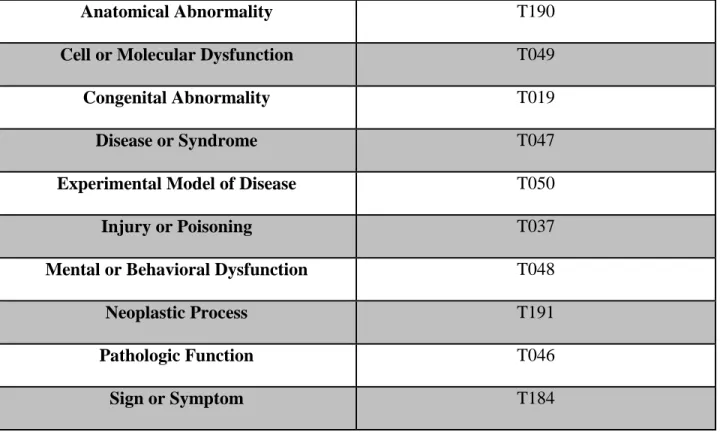
In that study, we used data sets provided by SemEval 2014 organizers. SemEval is an ongoing series of evaluations of computational semantic analysis systems. In the competition, we participated [46] in Task 7 “Analysis of Clinical Text” [87] in which participants were supposed to extract names of disease and disorders by developing supervised, un-supervised, or semi-supervised models. Based on SemEval rules diseases and disorders are scattered among 12 semantic types in “Disorder” semantic group shown in Table 1.
Table 1 Semantic types of disease/disorders accepted by SemEval
Semantic Type Code
21
Anatomical Abnormality T190
Cell or Molecular Dysfunction T049
Congenital Abnormality T019
Disease or Syndrome T047
Experimental Model of Disease T050
Injury or Poisoning T037
Mental or Behavioral Dysfunction T048
Neoplastic Process T191
Pathologic Function T046
Sign or Symptom T184
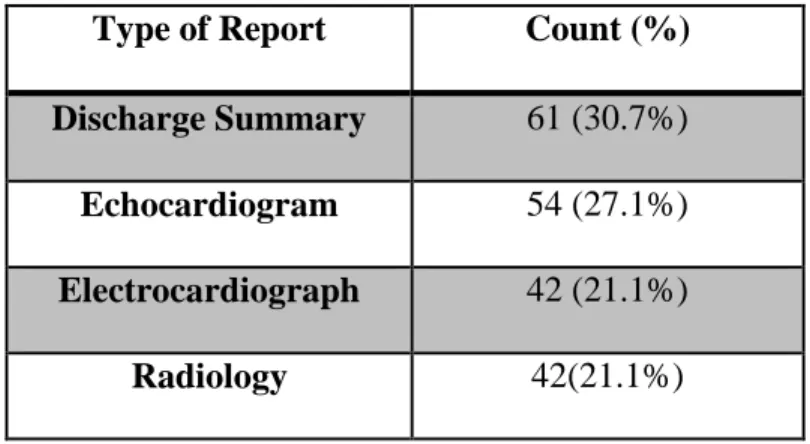
The data provided by SemEval includes two sets. The first one is training data set that contains 199 clinical reports. The other data set is test set that have 133 clinical reports. Training data consists clinical reports of four types: discharge summaries, echocardiogram, electrocardiogram, and radiology reports, while test data set contains only discharge summaries. The distribution of reports in training data set is shown in Table 2. These datasets were manually annotated with diseases and disorders. In the current work, we used these gold-standard annotations only for evaluation and not for training.
Table 2 Distribution of reports in training data set
Type of Report Count (%)
Discharge Summary 61 (30.7%)
22
Electrocardiograph 42 (21.1%)
Radiology 42(21.1%)
CRFs are kinds of undirected probabilistic graphical models. A CRF is a form of undirected graphical model that defines a single log-linear distribution over label sequences given a particular observation sequence. The main advantage of CRFs against HMMs is their conditional natures that result in relaxation of the independence assumptions required by HMMs in order to ensure tractable inference [88]. They can be used to model relationships between observations and make a robust model to recognize the sequence relationships. Most of the times CRFs have been used to predict labels or to parse sequence of data points. One of the most important applications of CRFs is in natural language processing, gene prediction, and image processing. In natural language processing CRFs usage is growing fast, and they have been used for shallow parsing and named entity recognition [88]. They can incorporate a large set of arbitrary and non-independent features while still having efficient procedures for non-greedy finite-state inference and training. CRFs have been indicated robust and reliable in different sequence modeling tasks including named entity recognition [89].
Also in our research, we used BIO approach to label words through sentences. The goal is to predict labels (B= beginning, I= inside, or O= outside) of each word in text. In Figure 2, a paragraph from a discharge summary has been tagged with related BIO labels. Words tagged as
Bs and Is are desired named entities. A desired named entity starts with tag B and continues with tag I, for mentions with more than one word. Single word named entities tagged with B, and other words that are not part of desired mentions tagged with O.
23
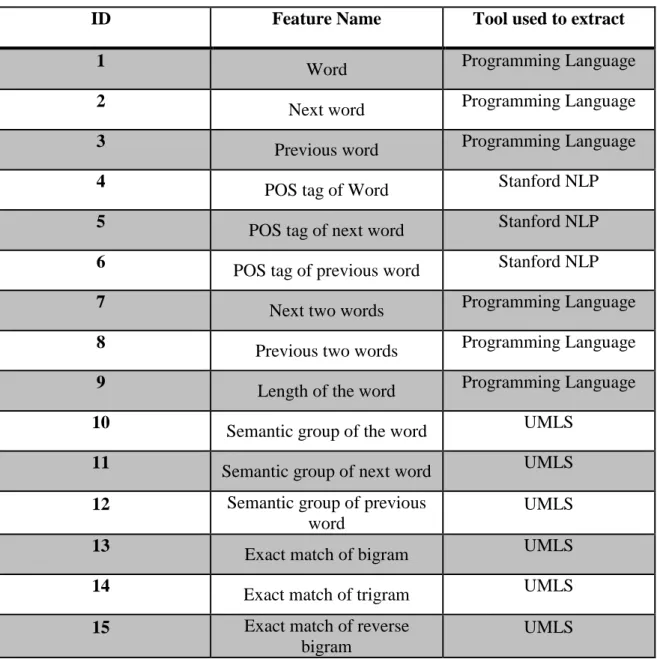
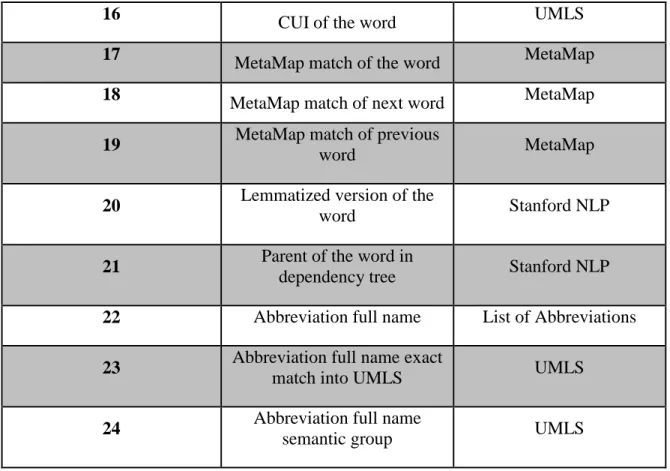
To train the CRF, we used a set of features listed in Table 3.
Table 3 Features used for training CRF
ID Feature Name Tool used to extract
1
Word Programming Language
2
Next word Programming Language
3
Previous word Programming Language
4 POS tag of Word Stanford NLP
5
POS tag of next word Stanford NLP
6
POS tag of previous word Stanford NLP
7
Next two words Programming Language
8 Previous two words Programming Language
9 Length of the word Programming Language
10 Semantic group of the word UMLS
11
Semantic group of next word UMLS
12 Semantic group of previous word
UMLS
13
Exact match of bigram UMLS
14
Exact match of trigram UMLS
15 Exact match of reverse bigram
UMLS
The/O patient/O is/O a/O 40-year-old/O female/O with/O complaints/O of/O headache/B and/O dizziness/B ./O In/O 2015-01-14/O , /O the/O patient/O had/O headache/B with/O neck/B stiffness/I and/O was/O unable/B to/I walk/I
for/O 45/O minutes/O ./O The/O patient/O also/O had/O a/O similar/O episode/O a/O year/O and/O a/O half/O ago/O where/O she/O had/O
inability/O to/O walk/O without/O pain/B ./O
24
16 CUI of the word UMLS
17
MetaMap match of the word MetaMap
18
MetaMap match of next word MetaMap
19 MetaMap match of previous
word MetaMap
20 Lemmatized version of the
word Stanford NLP
21 Parent of the word in
dependency tree Stanford NLP
22 Abbreviation full name List of Abbreviations
23 Abbreviation full name exact
match into UMLS UMLS
24 Abbreviation full name
semantic group UMLS
To evaluate our developed method, we used SemEval 2014 evaluation tool, which is thoroughly explained in Section 4.2.
Our developed model [46] had achieved F-score 75.5% (precision=78.7%, recall= 72.6%). The results are shown in details in Table 4.
Table 4 Results of a supervised model
Precision Recall F-score
Strict 0.787 0.726 0.755
Relaxed 0.911 0.856 0.883
At the end of the competition, our developed method came third among 24 teams around the world. Table 5 shows the results and ranking of participated teams in SemEval 2014 competition
25
(Our team was UWM that is highlighted). The best team, UTH_CCB, from University of Texas, Health Science Center, used more resources of annotated text to reach the best system. The method that they developed, also utilized a CRF based model for extracting names of diseases and disorders.
Table 5 SemEval 2014, Task 7 results of teams
Team Name Run Precision Recall F-Score
UTH_CCB 0 0.843 0.786 0.813 UTU 1 0.765 0.767 0.766 UWM 0 0.787 0.726 0.755 IxaMed 1 0.681 0.786 0.73 RelAgent 0 0.741 0.701 0.72 ezDI 1 0.761 0.681 0.719 ULisboa 0 0.753 0.663 0.705 BioinformaticsUA 0 0.813 0.605 0.694 ThinkMiners 0 0.734 0.65 0.689 ECNU 0 0.754 0.611 0.675 UniPI 2 0.712 0.601 0.652 UNT 0 0.647 0.628 0.638 CogComp 1 0.639 0.529 0.579 TMU 0 0.524 0.576 0.549 MindLab-UNAL 2 0.561 0.534 0.547 IITP 0 0.5 0.479 0.489 SZTE-NLP 1 0.547 0.252 0.345 QUT_AEHRC 0 0.387 0.298 0.337 KUL 0 0.655 0.178 0.28 UG 0 0.114 0.234 0.153
26
27 3.1 Overview
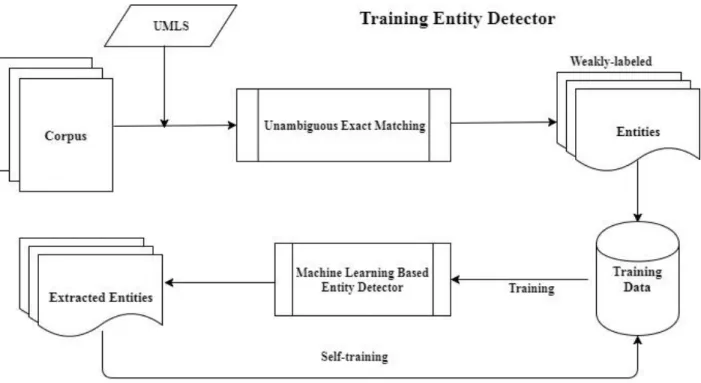
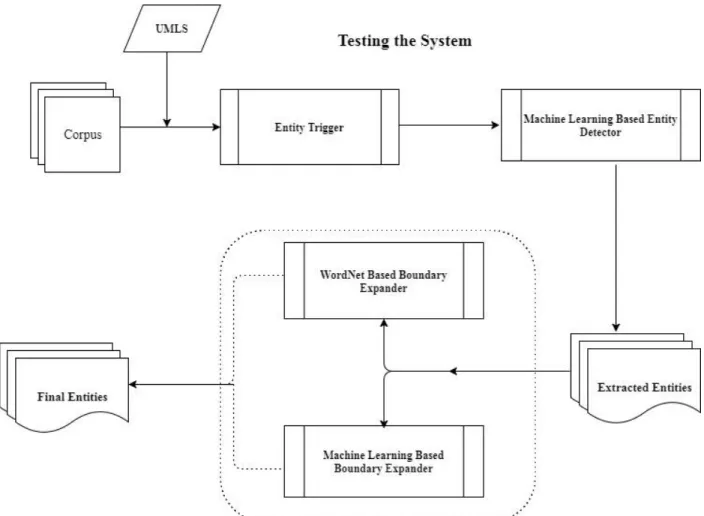
As mentioned before, the purpose of this research is to reduce human effort of annotation for building entity extraction systems for biomedical domains. Our previous work showed a supervised model that reached considerably high accuracy in comparison with other developed methods by teams participated in SemEval 2014 NLP competition. In this chapter, we present our proposed methods for detecting named entities without any training data that is manually annotated. Figure 3 shows the overall approach to our proposed method for unsupervised biomedical named entity recognition. In our approach, the first step is to extract entities, which is “entity detector”. We create weakly-labeled data using “Unambiguous exact matching” algorithm based on UMLS. Then we trained a machine learning tool using weakly-labeled data. After this step, “Entity trigger” algorithm used to send terms from corpus to the classifier to determine whether they belong to the desired entity class or not. Next, new entities are added to the weakly-labeled data and the machine learning tool is further trained iteratively. Extracted entities, outcomes of “Entity Detection”, are sent to the “Boundary Expansion” to find correct boundaries of each extracted mention.
We developed two types of boundary expansion methods: WordNet based and Machine learning based methods. In the first one, we used an algorithm to find right boundaries of mentions using WordNet and UMLS, while in the latter we used a machine learning tool to correct boundaries. This machine learning tool was trained using UMLS terms. These approaches are described in detail in the next sections. Figures 3-5 illustrate our developed approach.
28
Figure 3 Overall approach for training named entity detector
29
Figure 5 Overall approach for testing the unsupervised NER system
3.2 Entity Detection
In this section, we describe our machine learning based tools for entity detection. The first step is to generate some training data with high precision. Next is to use that data for training the tools, and finally we developed methods for detecting correct boundaries of mentions.
3.2.1 Creating Weakly-Labeled Training Examples
Firstly, we used a dictionary based method to generate weakly-labeled annotated clinical notes. The dictionary used in our research is Unified Medical Language System or UMLS. The next section describes the algorithm of generating weakly-labeled training examples.
30
3.2.1.1 Unambiguous Exact Matching
The algorithm of generating weakly-labeled training examples is called “Unambiguous Exact Matching”. Here “unambiguous” refers to those mentions in dictionary which belong to only and only one semantic group such as “Disorders”. This concept is discussed later in this section. Our suggested method basically is a procedure of mapping all words (or unigrams) and terms (or n-grams, n>1) found in the text to a dictionary. This process begins with determining a window on text and moving it through all sentences in the documents. A window is a series of words that begins with word at position 1 and ends with word at positions n based on n-gram size. Maximum size of window is n that determines number of words of terms to be mapped to UMLS meta-thesaurus. After locating window, the algorithm maps all words inside the window to UMLS. If there is no match for that term, size of window is subtracted by one. Now the number of words inside the window is n-1. This process goes on until the size of window becomes one. In other words, the process stops when there is only one word left. To find matches of single words only nouns, detected by their part of speech (POS) tags were considered to be mapped to the UMLS, because we hypothesized desired mentions are nouns. If the algorithm could not find any matched term in the dictionary for the window, then the starting point of window increases by one, and the process repeats for the new window. If there is any matched term, the new window begins with the word right after the matched term. In the following example, exact matching procedure has been shown.
Sentence 1: 18 year old female with complaint of headache and dizziness. Sentence 2: She suffered from coronary artery disease while she was pregnant.
Figure 6 Exact Matching Method D A B
31
In Figure 6, sentence 1, the series of words in the window starts at point A. At first there are n=5
words in the window. The process starts with mapping that and ends when window size is one and there is no match for that single word. Then it moves the cursor to the next position that is point B. In the second sentence algorithm finds a match for the n-gram inside the window. After finding a match the cursor moves to the next point right after the matched mention that is point
D. By using this method through all text documents, we were able to generate weakly-labeled clinical notes.
Another important thing that must be mentioned is that we put a restriction on matched terms. In the UMLS terms might have more than one semantic type. That means a mention can belong to more than one semantic groups. For example, “distress” is a “disease” and a “physiological process”. Because of that, we restrict matched terms to be of only one semantic type. Thus if “distress” word is found in the text, it will not be matched to any UMLS term in our method, because it is known to be ambiguous, so the algorithm is called “unambiguous exact matching”. Because of this restriction, we can be sure that all the matched terms are of the desired semantic type only and do not mean something else in the text. This is a distinct feature of our method, in the previous work [51] had simply included all the mentions, including ambiguous ones, which leads to incorrect training examples. In our method, we generated positive examples from those mentions that belong to only and only one semantic group. On the other hand, negative examples are those mentions that belong to all other semantic types except the desired one that named entities belong to.
32
3.2.2 Training a machine learning tool
After running the exact matching algorithm, we have training data that we call weakly-labeled that can be used to train a machine learning tool for detecting mentions Using a machine learning tool for entity detection can be done by using classification based models or sequence labeling based models. In this framework, we used classification based model, because many positive examples may be missed. The developed methods are presented in the next sections.
3.2.2.1 Sequence Labeling Method vs. Classification
The first step after generating weakly-labeled training data, is to develop a machine learning tool for detecting mentions that were missed by the exact matching algorithm.
The most important observation is that because we considered mentions with only one semantic type, the system missed many mentions that are terms to be extracted. Sequence labeling methods expect every word of a sentence to have a correct label in the training data. Thus, the words which are not labeled as named entities will be considered as negative examples. Given that our process of automatically creating training data misses some entities, the missed entities will then go in with incorrect labels if a sequence labeling method is used to train, thus adversely affecting the training process. Hence in the proposed project, instead of using a sequence labeling method such as CRF, we used a classification method such as Decision Tree and Support Vector Machine (SVM) [90] [i]. In a classification method, the missed entities do not automatically become negative examples.
Furthermore, many of detected mentions by exact matching are those that have one or more missing parts. These mentions may be partially matched to vocabulary. For example, there is no exact match for “gas discomfort” in UMLS, in “disease/disorder” entity class, but there is one for
33
“gas”. In that case the exact matching fails to detect “gas discomfort” as a disease although it could have detected “gas” as a disease.
By analyzing results of exact matching and weakly-labeled models, we realized that there were many typos and different derivatives of words for related diseases, and moreover, around 10% of mentions were discontinuous. For instance, “left atrium is moderately dilated” contains disease name that its preferred term in the UMLS is “left atrial dilation”. In this case, not only a new method is needed to detect “dilated” as “dilation”, but also an algorithm is required to handle discontinuous mentions such as “left atrium dilated” in “left atrium is moderately dilated”.
3.2.2.2 Learning Classification Methods
To avoid distracting machine learning tool by imperfect training examples (weakly-labeled), we developed a novel method based on learning classification tools for entity detection, which is the most significant part of our research, and an algorithm to handle discontinuous mentions. The proposed approach constitutes three components: a learning classification tool, border detection, and detecting discontinuous mentions. These methods are described in the next sub sections. Classification learning methods require examples to be represented in terms of features from which they can learn statistical regularities and patterns to distinguish between positive and negative examples. We used Decision Tree as our main classification method, because we found out that by experimenting different classifiers such as SVM and decision trees and got better results. We used the Weka software [91] [ii] to implement “Random-Subspace” decision tree which is publicly available for free. The decision tree classifier trained using the positive and negative examples generated in “Unambiguous Exact Matching” were then applied to classify each term in new text whether it is a named entity of the desired type or not. Hence, positive
34
examples are those detected mentions corresponding to only one semantic group in the UMLS. In UMLS, there are numerous mentions that are linked to multiple semantic groups. We applied the classifier to only noun phrases because named entities are almost always noun phrases. Detecting mentions of the desired named entity type which in the dictionary are ambiguous (terms belong to multiple semantic groups) is the main purpose of this classifier (unambiguous terms can be detected easily as in our previous step). Terms with unique semantic types, generated by Exact Matching, and such ambiguous terms will be found in text in similar contexts. The machine learning method will learn these contexts from the weakly-labeled training data of unambiguous terms and then will be able to detect terms which are known to be ambiguous. The contexts are provided to the machine learning method in terms of features.
After some experiments, we found out that SVM based classifiers work better with large number of features. These kinds of cases could be found in classifying sentences that may contain words and other n-grams among all documents as features. Also after doing some trials on data and checking different classifiers, such as Bayesian methods, the most accurate results were acquired by Decision Tree based methods. These kinds of classifiers use decision trees to go from observations about an item (represented in the branches) to conclusions about the item's target value (represented in the leaves). It is one of the predictive modelling approaches used in statistics, data mining and machine learning. Tree models where the target variable can take a finite set of values are called classification trees; in these tree structures, leaves represent class labels and branches represent conjunctions of features that lead to those class labels. Decision trees where the target variable can take continuous values (typically real numbers) are called regression trees [92].
35
The type of decision tree that was used as classifier in our research is “Random-Subspace.” In machine learning the random subspace method, also called attribute bagging or feature bagging, is an ensemble learning method that attempts to reduce the correlation between estimators in an ensemble by training them on random samples of features instead of the entire feature set. In ensemble learning one tries to combine the models produced by several learners into an ensemble that performs better than the original learners. One way of combining learners is bootstrap aggregating or bagging, which shows each learner a randomly sampled subset of the training points so that the learners will produce different models that can be sensibly averaged. In bagging, one samples training points with replacement from the full training set [93]. The random subspace method is similar to bagging except that the features ("attributes", "predictors", "independent variables") are randomly sampled, with replacement, for each learner. Informally, this causes individual learners to not over-focus on features that appear highly predictive/descriptive in the training set, but fail to be as predictive for points outside that set. The random subspace method has been used for decision trees; when combined with "ordinary" bagging of decision trees, the resulting models are called random forests [93-94].
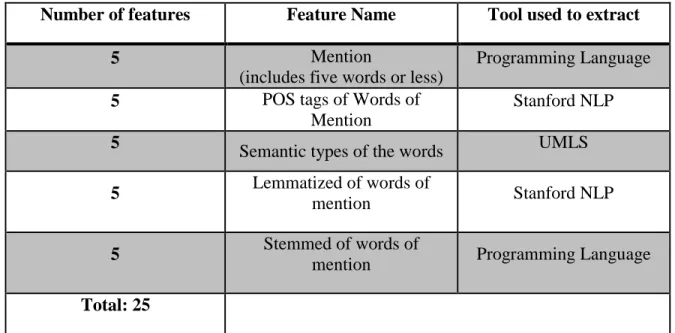
We used 55 features in this research which include surrounding words, words of the mentions, part of speech tags, lemmatized and stemming forms, and sematic types of words. All features used for training the classifier are listed in Table 6. By using the classifier, we could reach a significant improvement in the results that are shown in the next chapter.
Table 6 List of features used in classifier
Number of features Feature Name Tool used to extract
5 Mention
(includes five words or less)
36
3 Next three words Programming Language
3
Previous three words Programming Language
5 POS tags of Words of Mention
Stanford NLP
3
POS tag of next words Stanford NLP
3
POS tag of previous words Stanford NLP
5
Semantic types of the words UMLS
3 Semantic types of next words UMLS
3 Semantic types of previous words
UMLS
5 Lemmatized of words of
mention Stanford NLP
3 Lemmatized of next three
words Stanford NLP
3 Lemmatized of previous
three words Stanford NLP
5 Stemmed of words of
mention Programming Language
3 Stemmed of next three words Stanford NLP
3 Stemmed of previous three
words Stanford NLP
Total: 55
3.2.3 Self-training
In order to further improve the performance of our system, we applied the trained classifier on the training corpus itself to gather more positive and negative examples which are in turn used to train the classifier again. This way of training is also known as self-training and has been shown to be helpful in improving performance. The process starts firstly by training the classifier with
37
the weakly-labeled training data. After training and applying it to clinical notes, we were able to detect ambiguous mentions and to check whether they are named entities of the desired type or not. Then newly extracted terms (from ambiguous mentions) were added to the old training data set. By using the new training data set and repeating the same procedure, new mentions were extracted, and the performance was improved. The iterative process is repeated a few times until no new examples are gathered.
3.2.4 Testing the System
To apply our system, potential entities are first collected by an “Entity Trigger”. The terms in the text that match terms of the required semantic types in UMLS, including partially, are triggered as possible entities. These are then sent to the trained classifier for entity detection (described in the last section). The classifier generates a number between 0 and 1. If the term could pass the threshold, then it can be categorized as a desired mention. The threshold for each entity class was determined by experimenting different numbers to get the best performance.
3.3 Boundary Expansion
Many named entities detected by the entity detector may have missing parts or incorrect boundaries. Since, many named entities may have missing parts or incorrect boundaries. For example, “effusion” was detected by classifier as a named entity in diseases class, but the mention that has correct boundaries is “pericardial effusion”. To solve this problem, we developed two methods for detecting correct boundaries of detected mentions. The first method utilized WordNet and Elasticsearch, and the second one used a classifier to detect correct boundaries of mentions trained by examples generated from UMLS mentions. The next sections describe the two methods.
38
3.3.1 WordNet Based Method for Boundary Expansion
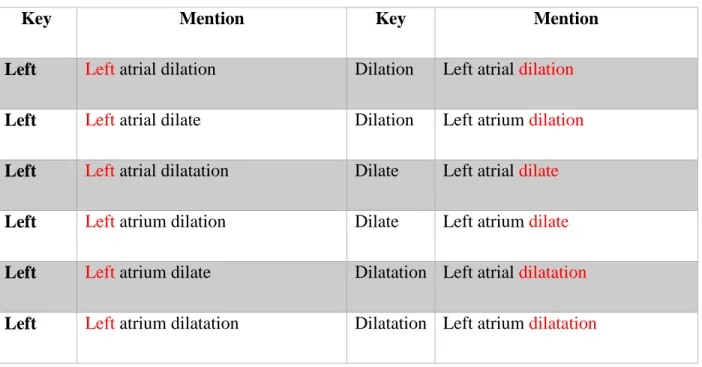
For developing our boundary expansion method, firstly we utilized WordNet [70] database to find derivatives of words. WordNet is a lexical database for the English language. It groups English words into sets of synonyms called synsets, provides short definitions and usage examples, and records a number of relations among these synsets or their members [95]. Words derivatives vary in sentences based upon their part of speech tags and positions, hence mentions might be different from their relevant term in UMLS. For example, in “Living beings” semantic group in UMLS, “mice” does not exist but there is “mouse” instead, or “dilated left atrium” is in UMLS as “left atrial dilation”. By using WordNet, lemmatization, and stemming techniques we extracted all possible derivatives of words and their combinations of UMLS mentions. Example 1 shows how WordNet was used to obtain all derivatives of words and their combinations in a mention.
Using WordNet to extract derivatives of words: left, atrial, and dilation.
• WordNet derivatives of each word:
o Left -> Left
o Atrial -> Atrial, Atrium
o Dilation -> Dilation, Dilate, Dilatation All Combinations:
• Left atrial dilation
• Left atrial dilate
• Left atrial dilatation
• Left atrium dilation
• Left atrium dilate
• Left atrium dilatation
39
In this research, we used Elasticsearch [96] to get access to mentions as fast as possible, and WordNet was used for extracting different forms of mention. The method was not only used for correcting boundaries, but also it was used to find discontinuous mentions that are around 10% of all terms (described in Section 3.4). Our method starts with indexing mention in some Elasticseach indexes. Then it uses some similarity functions to map mentions to UMLS terms. Before mapping mentions to UMLS, we used Elasticsearch to store and to access them quickly.
Elasticsearch is a search engine based on Lucene. It provides a distributed, multitenant-capable full-text search engine with an HTTP web interface and schema-free JSON documents. Elasticsearch is developed in Java and is released as open source under the terms of the Apache License. The main purpose of using Elasticsearch is to store tremendous amount of data and to access them as quick as possible. It can save millions of documents (mentions) and can access them very quickly [97].
In order to access stored data in Elasticsearch, for each record a “key” must be defined. A key plays an important role in our approach, because selecting an appropriate key may lead us to get more proper outcomes. Choosing inappropriate keys distracts the whole process and may result in redundant outcomes, consequently significanttime consumption of process.
To select a proper key for each mention in UMLS, we relied on facts of results generated by Exact Matching and the classifier. Results contain two types of scores: Relaxed and Strict. Exact scores indicate accuracy of boundaries of mentions from both left and right sides while inexact scores include all mentions correctly detected not only from both sides but also from the left or right. Based on that fact, we decided to use the most-left and the most-right words in mentions to be keys in Elasticsearch indexes (at least one side, left or right, is correct). Therefore, each