A new method for Quantitative Trait Loci Detection
Charles-Elie Rabier, C´
eline Delmas
To cite this version:
Charles-Elie Rabier, C´
eline Delmas. A new method for Quantitative Trait Loci Detection.
2010.
<
hal-00610615
>
HAL Id: hal-00610615
https://hal.archives-ouvertes.fr/hal-00610615
Submitted on 23 Jul 2011
HAL
is a multi-disciplinary open access
archive for the deposit and dissemination of
sci-entific research documents, whether they are
pub-lished or not.
The documents may come from
teaching and research institutions in France or
abroad, or from public or private research centers.
L’archive ouverte pluridisciplinaire
HAL
, est
destin´
ee au d´
epˆ
ot et `
a la diffusion de documents
scientifiques de niveau recherche, publi´
es ou non,
´
emanant des ´
etablissements d’enseignement et de
recherche fran¸
cais ou ´
etrangers, des laboratoires
publics ou priv´
es.
A new method for Quantitative Trait Loci detection
Charles-Elie Rabier
Institut de Mathématiques de Toulouse, Toulouse, France.
INRA UR631, Auzeville, France.
Céline Delmas
INRA UR631, Auzeville, France.
Summary. We consider the likelihood ratio test (LRT) process related to the test of the
ab-sence of QTL on the interval
[0
, T
]
representing a chromosome (a QTL denotes a quantitative
trait locus, i.e. a gene with quantitative effect on a trait). We give the asymptotic distribution
of this LRT process under the general alternative that there exist
m
QTL on
[0
, T
]
. This
theo-retical result allows us to propose to estimate the number of QTL and their positions using the
LASSO. Our method does not require the choice of cofactors contrary to Composite Interval
Mapping (CIM). Besides, our method is not affected by interactions.
Keywords:
Gaussian process, Likelihood Ratio Test, Mixture models, Nuisance parameters
present only under the alternative, QTL detection,
χ
2
process.
1.
Introduction
Westudyabakrosspopulation:
A
×
(
A
×
B
)
,whereA
andB
arepurelyhomozygouslines andweaddresstheproblemofdetetingQuantitativeTraitLoi,so-alledQTL(genesinu-eningaquantitativetraitwhihisabletobemeasured)onagivenhromosome. Thetrait
isobservedon
n
individuals(progenies)andwedenotebyY
j
, j
= 1
, ..., n
,theobservations, whih wewill assumetobeindependentandidentially distributed (iid). Themehanismofgenetis,ormorepreiselyofmeiosis,impliesthat amongthetwohromosomesofeah
individual,oneispurely inheritedfrom
A
whiletheother(thereombined"one),onsists ofpartsoriginatedfromA
andpartsoriginatedfromB
,duetorossing-overs.TheHaldane (1919)modelling assumesthat rossoversourasa Poisson proess. Using the Haldane(1919)distane and modelling, eah hromosome will berepresented bya segment
[0
, T
]
. Thedistane on[0
, T
]
isalledthegenetidistane(whihismeasuredinMorgans). Inafamous artile,Landerand Botstein(1989)proposed,withthehelp of genetimark-ers,to santhe hromosome,performingalikelihood ratiotest (LRT)of theabsene ofa
QTL at every loation
t
∈
[0
, T
]
. It leadsto alikelihood ratiotest proess"Λ
n
(
.
)
, and thenanaturalstatistiisthesupremumof suhaproess. This methodisalledintervalmapping". There have been many papers related to the supremum of the LRT proess.
Forexample,weanmentionFeingoldandal.(1993),ChurhillandDoerge(1994),Rebaï
andal.(1994), Rebaïand al.(1995), Ciero(1998), Piepho(2001),Chang and al.(2009),
Rabier(2010).
Theproblem is that onsideringthe supremumof theproessasatest statisti is
appro-priatewhenthereisonlyoneQTLonthehromosomebutitbeomesinappropriatewhen
a more general approah has to be onsidered. When multiple QTL our on the same
hromosome,theyaetsimultanouslytheLRTproess. Forinstane,whentwoQTLare
loatedintwodierentmarkerintervallosebutnotadjaent,apeakisoftenfoundbetween
thesetwomarkerinterval: itisaghostQTL(MartinezandCurnow(1992)). Jansen(1993)
andZeng(1994)proposedindependentlytheCompositeIntervalMapping",whihonsists
inombiningintervalmappingontwoankingmarkersandmultipleregressionanalysison
othermarkers(Wuand al.(2007)). This way,theQTLnotloatedin themarkerinterval
testeddo notaet anymorethe LRTproess. Their eetsare removeddue to multiple
regressionanalysis. Howewer, thehoie of markersasofator isveryompliated. It is
stillanopenquestiontoday. Untilnow,therehasbeennomathematialproofwhihould
helpusonhowtohoosethesetofmarkersrigorously. Inthisontext,theaimofourpaper
istoproposeanalternativetoCompositeIntervalMapping",thatistosayanewmethod
whihdoesnotrequirethehoieofofators.
Asmentionedbefore,inRabier(2010),theauthorssupposethatthereisnomorethanone
QTLonthehromosome(itis loatedat
t
⋆
∈
[0
, T
]
). Theyshowthat theLRTproess is
asymptotiallythesquareofanonlinearinterpolatedproess"entered under
H
0
(ie. no QTLonthehromosome)andunentered ofameanfuntion under thealternative. ThismeanfuntiondependsontheQTLeet anditsloation
t
⋆
. Inthispaper,wegeneralize
theseresultstothegeneralalternativethat thereexist
m
QTLon[0
, T
]
att
⋆
1
,
· · ·
, t
⋆
m
with additiveeetsq
1
,
· · ·
, q
m
.Themain dierenesbetweenthealternativeofonlyoneQTLandthegeneralalternative,
isinthedistributionofthetrait
Y
. WhenthereisonlyoneQTLatt
⋆
∈
[0
, T
]
,thetrait
Y
, onditionallytoinformationbroughtbygenetimarkersloatedonthehromosome,obeystoamixture modelwithknownweights:
p
(
t
⋆
)
f
(
µ
+
q,σ
)(
.
) +
{
1
−
p
(
t
⋆
)
}
f
(
µ
−
q,σ
)(
.
)
(1)where
f
(
µ,σ
)(
.
)
denotesaGaussiandensitywithmeanµ
andvarianeσ
2
.
(
µ, q, σ
)
arethe unknownparameters.When there are
m
QTL segregating, the distribution of the traitY
, is a mixture of2
m
omponentsoftheform:
2
m
X
α
=1
w
α
f
(
M
α
,σ
)(
.
)
wherethe
w
α
sandtheM
α
sare knownfuntions oftheunknownparametersµ
,m
,t
⋆
1
, ...,t
⋆
m
,q
1
,...,q
m
.Inthisontext,weshowthatunderthegeneralalternative,theLRTproessisstill
asymp-totially the square of anon linear interpolated proess". Howewer, the mean funtion
depends this time onthe numberof QTL,their positions andtheir eets. This
theoret-ialresult allowsus to propose a newmethod to estimate the number of QTL and their
positions using theLASSO.Note that in this paper,asin Broman andSpeed(2002), the
fous is mainly onthe estimation of thenumberof QTL andtheir positions, rather than
ontheestimation oftheQTLeets. Nevertheless,theeetsanbeobtainedeasilywith
themethodthatwepropose.
Theoriginalityofourpaperistwofold. First,withourasymptoti studyofthe LRT
betweentwotrueQTL.Seondly,theoriginalityisinthefatthatweproposeanewmethod
tondQTL.Ourmethodisveryeasytoimplementanddoesnotrequirethehoieof
mark-ersas ofators whih is amajor drawbak of Composite Interval Mapping. Besides, we
provethat our method is not aeted by interations. With the help of simulateddata,
weshowthat ourmethod performs better thantheCompositeIntervalMappingwhihis
largelyused in thegeneti ommunity. Werefer to thebook ofVan derVaart (1998)for
elementofasymptotistatistisusedin proofs.
2.
Model and Notations
Thehromosomeisthesegment
[0
, T
]
.K
genetimarkersareloatedonthehromosome, oneat eah extremity.t
1
= 0
< t
2
< ... < t
K
=
T
are theloations ofthemarkers. The genomeinformation"att
willbedenotedX
(
t
)
. TheHaldane(1919)model,whihassumes that rossoversouras aPoissonproess, anbewrittenmathematially : letN
(
t
)
bea standardPoisson proess,thelawofX
(
t
)
is1
2
(
δ
1
+
δ
−
1)
andX
(
t
) = (
−
1)
N
(
t
)
X
(
t
1)
. The Haldane(1919)funtionr
: [0
, T
]
2
7−→
0
,
1
2
issuh as:r
(
t, t
′
) =
P
(
X
(
t
)
X
(
t
′
) =
−
1) =
P
(
|
N
(
t
)
−
N
(
t
′
)
|
odd) =
1
2
(1
−
e
−
2
|
t
−
t
′
|
)
¯
r
(
t, t
′
)
willbethefuntion equalto
1
−
r
(
t, t
′
)
.
r
(
t, t
′
)
denotestheprobabilityof reombinationbetweentwoloi(ie. positions)loatedat
t
andt
′
.
r
¯
(
t, t
′
)
denotestheabseneofreombination. Notethatareombinationoursif
thereisanoddnumberofrossoversbetweenthetwoloi.
Weareinterestedinaquantitativetrait
Y
whihisaetedbyseveralQTLloatedonthe hromosome.m
willrefertothenumberofQTLandq
s
totheQTLeetofthesthQTL. Itsposition will bealledt
⋆
s
. Weimpose0
< t
⋆
1
< ... < t
⋆
m
< T
and wewillsupposethat theQTL eets areadditives and there is no interation betweenthem. In this ontext,thequantitativetrait
Y
veries:Y
=
µ
+
m
X
s
=1
X
(
t
⋆
s
)
q
s
+
σε
where
ε
isaGaussian whitenoise.Besides, the genome information"is available only at loations of geneti markers, that
is to say at
t
1
, t
2
, ..., t
K
. We denote byX
j
(
t
)
the value of the variableX
(
t
)
for the jth observation. So, in fat, our observation on eah individual is(
Y
j
, X
j
(
t
1)
, ..., X
j
(
t
K
))
. Theseobservationsaresupposed tobeiid.3.
LRT process under the alternative of only one QTL located on
[0
, T
]
(Rabier
(2010))
Before etablishing the general result of this paper, we rst should fous on the work of
Rabier (2010), that is to say the ase where there is only one QTL lying on
[0
, T
]
(ie.m
= 1
). It will be agood wayto introdue the LRT proess and will make thereading of our paper easier. In order to sum up this previous work, we will onsider the samehromosome, performing a likelihood ratio test (LRT) of the absene of a QTLat every
loation
t
∈
[0
, T
]
.Weonsider values ofthe parameter
t
that are distint ofthe markerspositions, and the resultwillbeprolongedbyontinuityat themarkerspositions. Fort
∈
[
t
1
, t
K
]
\
T
K
whereT
K
=
{
t
1
, ..., t
K
}
,wedenet
ℓ
andt
r
as:t
ℓ
=
sup
{
t
k
∈
T
k
:
t
k
< t
}
, t
r
=
inf
{
t
k
∈
T
k
:
t < t
k
}
Inotherwords,
t
belongsto theMarkerinterval"(
t
ℓ
, t
r
)
. Wedene
p
(
t
)
theweightsuh asp
(
t
) =
P
X
(
t
) = 1
X
(
t
ℓ
)
, X
(
t
r
)
. BytheBayesrule,p
(
t
) =
Q
1
t
,
1
1
X
(
t
ℓ
)=11
X
(
t
r
)=1
+
Q
1
t
,
−
1
1
X
(
t
ℓ
)=11
X
(
t
r
)=
−
1
+
Q
−
t
1
,
1
1
X
(
t
ℓ
)=
−
11
X
(
t
r
)=1
+
Q
t
−
1
,
−
1
1
X
(
t
ℓ
)=
−
11
X
(
t
r
)=
−
1
(2) where:Q
1
t
,
1
=
¯
r
(
t
ℓ
, t
) ¯
r
(
t, t
r
)
¯
r
(
t
ℓ
, t
r
)
,
Q
1
,
−
1
t
=
¯
r
(
t
ℓ
, t
)
r
(
t, t
r
)
r
(
t
ℓ
, t
r
)
Q
−
t
1
,
−
1
= 1
−
Q
1
,
1
t
andQ
−
1
,
1
t
= 1
−
Q
1
,
−
1
t
Let
θ
= (
q, µ, σ
)
betheparameterofthemodelatt
xedandθ
0
= (0
, µ, σ
)
thetruevalue of the parameterunderH
0
. The likelihood of the tripletY, X
(
t
ℓ
)
, X
(
t
r
)
with respet
tothemeasure
λ
⊗
N
⊗
N
,λ
beingtheLebesguemeasure,N
theountymeasureonN
, is∀
t
∈
[
t
ℓ
, t
r
]
:L
(
θ, t
) =
p
(
t
)
f
(
µ
+
q,σ
)(
y
) +
{
1
−
p
(
t
)
}
f
(
µ
−
q,σ
)(
y
)
g
(
t
)
(3)where
g
(
t
)
isafuntion independentofθ
.Thelikelihood
L
n
(
θ, t
)
forn
observationsisobtainedbytheprodutofn
termsasabove.ˆ
θ
= (ˆ
q,
µ,
ˆ
σ
ˆ
)
willbethemaximumlikelihoodestimator(MLE)ofθ
.Under
H
0
,there is noQTLlyingon theinterval[0
, T
]
. Besides,underH
1
, it issupposed thatthere isonlyoneloationwhere theQTLlies(ie.m
= 1
). Inorder todealwiththis alternative, theloation ofthe QTL,t
⋆
(
t
⋆
∈
[0
, T
]
),has to beadded in thedenition of
H
1
. So,thealternativehypothesis anbewritten :H
at
⋆
:
theQTLisloatedatthepositiont
⋆
witheetq
=
a/
√
n
wherea
∈
R
⋆
"In this ontext, the authors show that the LRT proess,
Λ
n
(
.
)
, onvergesweakly to the square of a non linear interpolated proess". It means that the LRT statistis at eahpointaneasilybededuedfromtheWaldorsorestatistisalulatedatmarkerspositions.
Besides, this non linear interpolated proess" is entered under
H
0
and unentered of a meanfuntionm
t
⋆
(
t
)
underH
at
⋆
. ThismeanfuntiondependsontheloationoftheQTLt
⋆
,thepositiontested
t
andtheparametera
linkedtotheQTLeet. Itisalsoanonlinear interpolatedfontion" (sameinterpolation astheproess). Then,sinethey supposethatthereisonlyoneQTLon
[0
, T
]
,theauthorshavealoseformula(duetotheinterpolation) toomputethesupremumofΛ
n
(
.
)
.4.
LRT process under the general alternative of
m
QTL on
[0
, T
]
Inthe previousSetion, it has been supposed that there wasonly one QTLlying on the
interval
[0
, T
]
. As aonsequene,thetest statistiused wasanaturalstatisti, that isto say the supremum of the proess. The interest is now on studying the same proess aspreviously,
Λ
n
(
.
)
,butunderthepreseneofseveralQTLontheinterval[0
, T
]
. Inthisase, thegoalisnotto performatestanymore,buttobeabletorunamodelseletioninordertoestimatethenumberofQTLandtheirloations.
Letdenote
~t
⋆
thequantityreferingto theloationsof theQTL.
H
a~
t
⋆
willbethefollowing assumption:H
a~
t
⋆
: there arem
QTLloatedrespetivelyatt
⋆
1
,...,t
⋆
m
andwitheetq
1
=
√
a
1
n
,...,q
m
=
a
m
√
n
where(
a
1
, ..., a
m
)
∈
R
m⋆
"WeremindthatwesupposethattheQTLeetsareadditivesandthatthereisno
intera-tionbetweenthem. Wewillonsidervalues
t
,t
⋆
1
,...,t
⋆
m
oftheparametersthat aredistint of the markers positions, and the result will be prolonged by ontinuity at the markerspositions.
4.1.
Results
TheoremWith the previousdenednotations,
S
n
(
.
)
⇒
Z
⋆
(
.
)
,
Λ
n
(
.
)
F.d.
→ {
Z
⋆
(
.
)
}
2
asn tendstoinnity,under
H
0
andH
a~
t
⋆
where:•
S
n
(
.
)
is thesoreproessforn
observations• ⇒
isthe weak onvergeneandF.d.
→
isthe onvergeneofnite-dimensional distribu-tions•
Z
⋆
(
.
)
isaGaussian proesswith unitvariane.
•
Z
⋆
(
.
)
isthe ontinuousandthe non linear interpolatedproess"suhas:
Z
⋆
(
t
) =
α
(
t
)
Z
⋆
(
t
ℓ
) +
β
(
t
)
Z
⋆
(
t
r
)
/
r
E
h
{
2
p
(
t
)
−
1
}
2
i
The meanfuntion of
Z
⋆
(
.
)
:•
underH
0
,m
(
t
) = 0
•
underH
a~
t
⋆
,m
~
t
⋆
(
t
) =
α
(
t
)
m
~
t
⋆
(
t
ℓ
) +
β
(
t
)
m
~
t
⋆
(
t
r
)
/
r
E
h
{
2
p
(
t
)
−
1
}
2
i
Thedierent quantitiesare:
α
(
t
) =
Q
1
t
,
1
+
Q
1
t
,
−
1
−
1
, β
(
t
) =
Q
1
t
,
1
−
Q
1
t
,
−
1
,
CovZ
(
t
ℓ
)
, Z
(
t
r
)
=
e
−
2(
t
r
−
t
ℓ
)
m
~
t
⋆
(
t
ℓ
) =
m
X
s
=1
a
s
e
−
2
|
t
⋆
s
−
t
ℓ
|
/ σ , m
~
t
⋆
(
t
r
) =
m
X
s
=1
a
s
e
−
2
|
t
r
−
t
⋆
s
|
/ σ ,
andE
h
{
2
p
(
t
)
−
1
}
2
i
=
{
α
(
t
)
}
2
+
{
β
(
t
)
}
2
+ 2
α
(
t
)
β
(
t
)
e
−
2(
t
r
−
t
ℓ
)
.
TheproofisgiveninSetion 7.1.
4.2.
Illustration of the theorem and of the Ghost QTL phenomenon
0
20
40
60
80
100
−1.8
−1.6
−1.4
−1.2
−1
−0.8
−0.6
−0.4
−0.2
0
t(cM)
Z*(t)
0
20
40
60
80
100
0
0.5
1
1.5
2
2.5
3
t(cM)
( Z*(t) )
2
ProessZ
⋆
(
.
)
Proess{
Z
⋆
(
.
)
}
2
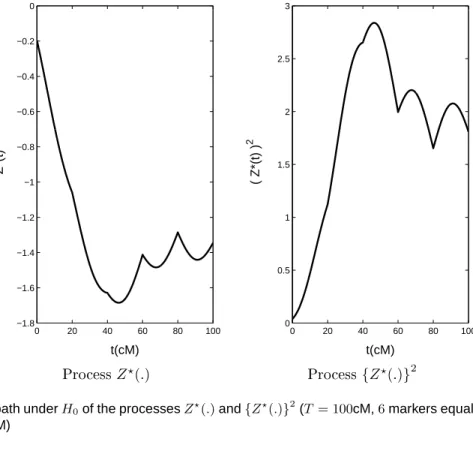
Fig. 1. A path under
H
0
of the processes
Z
⋆
(
.
)
and
{
Z
⋆
(
.
)
}
2
(
T
= 100
cM,
6
markers equally spaced
every
20
cM)
0
20 30 40
60 70 80
100
0.5
1
1.5
2
2.5
3
3.5
4
4.5
5
5.5
t(cM)
t*
1
=70cM and a
1
=4
t*
1
=30cM and a
1
=4
t*
1
=70cM and a
1
=6
0
20 30 40 50 60 70 80
100
3
3.5
4
4.5
5
5.5
6
6.5
7
7.5
8
t(cM)
a
2
=4
a
2
=6
m
= 1
m
= 2
,t
⋆
1
= 30
M,t
⋆
2
= 70
M,a
1
= 4
Fig. 2. Mean function
m
~
t
⋆
(
t
)
as a function of the number
m
of QTL, their positions
t
⋆
s
, and the
0
20
40
60
80
100
1.5
2
2.5
3
3.5
4
4.5
5
5.5
6
t(cM)
Z*(t)
a
2
=4
a
2
=6
0
20
40
60
80
100
0
5
10
15
20
25
30
35
t(cM)
( Z*(t) )
2
a
2
=4
a
2
=6
ProessZ
⋆
(
.
)
Proess{
Z
⋆
(
.
)
}
2
Fig. 3. Same path of
Z
⋆
(
.
)
and
{
Z
⋆
(
.
)
}
2
as under
H
0
but under
H
a~
t
⋆
(
m
= 2
,
t
⋆
1
= 30
cM,
t
⋆
2
= 70
cM,
In order to illustrate the theorem, we will onsider a geneti map whih onsists of
a hromosome of size
T
= 100
M with6
markers equally spaed every20
M. Figure 1 refersto theabsene of QTLon thehromosome. On theleft-side, a pathof theproessZ
⋆
(
.
)
is represented under
H
0
. As there is not any QTL, it orresponds only to noise. Besides, we an observe the interpolation obtained between geneti markers. The samepathorrespondingtotheproess
{
Z
⋆
(
.
)
}
2
hasbeenaddedontheright-side: in genetis,
we all this path "a likelihood prole". It is usually this path that we obtain when we
analyzedata. Note that manyauthors, insteadof omputing theproess
Λ
n
(
.
)
, fous on theLOD proess,LOD
n
(
.
)
whereLOD
n
(
.
) = Λ
n
(
.
)
/
{
2 log(10)
}
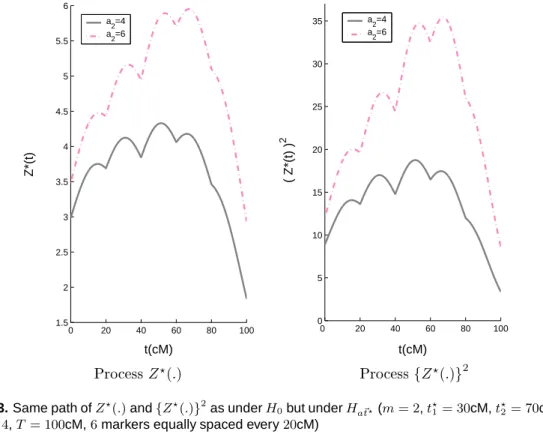
.Figure 2 represents the signal. On the left-side, we present some mean funtions
m
~
t
⋆
(
t
)
whenonly oneQTL(
m
= 1
)is loated onthehromosome. As expeted, the supremum ofthese interpolatedfuntions is obtainedatthe loationofthe QTL.Besides, thelargertheQTLeetis,thestrongerthesignalis. Ontheright-side,thefousison
m
~
t
⋆
(
t
)
whenm
= 2
. Aording to the theorem,m
~
t
⋆
(
t
)
is obtained by summing the mean funtions orrespondingto the asem
= 1
. As aonsequene,thefuntionsm
~
t
⋆
(
t
)
of the graphof theright-sideareeasilyobtainedfromthoseofthegraphoftheleft-side. Let'sfousontheurveinsolidline. ThetwoQTLareloatedrespetivelyat
t
⋆
1
= 30
Mandt
⋆
2
= 70
M.So, themarkerinterval(40
M,60
M) isadjaenttothe twomarkerintervalswhere theQTL areloated. Asaresult,wean observeonthegraphthat thebiggestpeakis obtainedintheinterval(
40
M,60
M)andthatthesupremumisobtainedin themiddleof thismarker interval, at50
M. Note that it is obtainedexatlyat50
M sine we onsider exatlythe same eet (a
1
=
a
2
= 4
) and that there is symmetry due to the loation of the QTL andthelength ofthehromosome. Ifnowweonsider alargereet fortheseond QTL(
a
2
= 6
)loatedatt
⋆
2
= 70
M(dashedline),weanobservealmostthesametwopeaksin theintervals(40
M,60
M)and(80
M,100
M).Besides,thesupremumofthemeanfuntion is obtainedat52
M. It is like abaryenter : someweights are aeted to the QTL asa funtionoftheireets,sothesignalandtheloationofthesupremumisaetedbytheseweights.
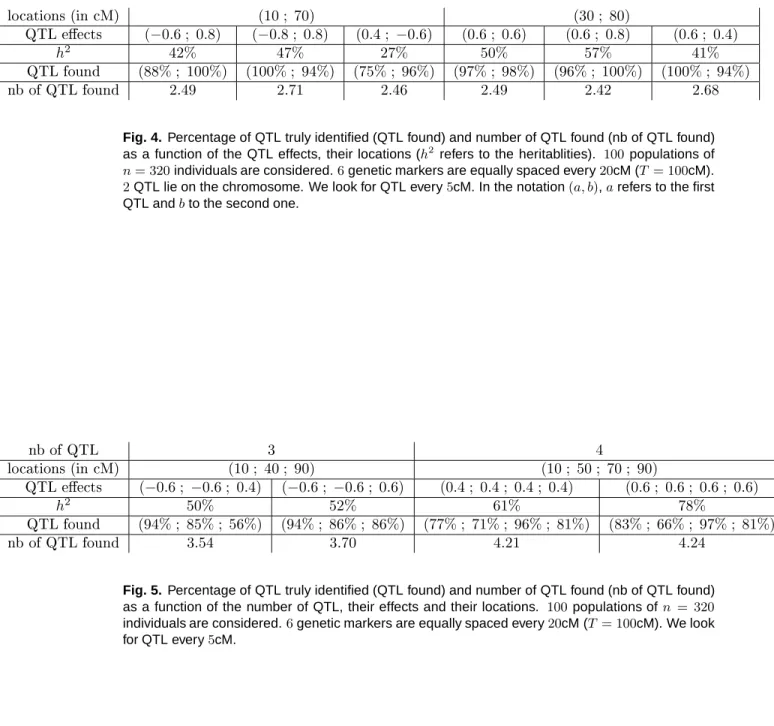
Figure3istheanalogousofFigure1under thealternativeof
2
QTLloatedatt
⋆
1
= 30
M andt
⋆
2
= 70
M. As in Figure 1, the path of theproessZ
⋆
(
.
)
is on the left-side whereas
theoneorrespondingto
{
Z
⋆
(
.
)
}
2
isontheright-side. Aordingto thetheorem, inorder
to obtainthe path of
Z
⋆
(
.
)
under
H
a~
t
⋆
, wehave to sum thepath ofZ
⋆
(
.
)
under
H
0
(ie. the noise), and the mean funtionm
~
t
⋆
(
t
)
(ie. the signal). In other words, the path ofZ
⋆
(
.
)
under
H
a~
t
⋆
hasbeenobtainedbyaddingthepathofZ
⋆
(
.
)
presentedinFigure1and
themean funtion of the graphof theright-sideof Figure 2. Note that on theright-side
of Figure 3, the likelihood prole (ie. the path of
{
Z
⋆
(
.
)
}
2
) haseasily been obtained by
omputationof thesquare of
Z
⋆
(
.
)
. We anobservein Figure3that, whenthe eetsof
thetwoQTLarethesame(ie. thesolidlines),thebiggestpeakisobtainedbetween
40
M and60
MwhihisamarkerintervalwherethereisnoQTL:suhapeakisalledaghost QTL(MartinezandCurnow(1992)). Itwasexpetedsinethesupremumofthesignalwasobtainedat
50
M.Notethat whenweinreasetheeetoftheseondQTL(ie. thedashedlines),thebiggest
peakis obtainedin themarkerinterval(
60
M,80
M)whihistheintervalwhihontains theseond QTL.Itis dueto thenoisesinethesignalisalmost thesameinthe intervals(
40
M,60
M) and (60
M,80
M) whereas the values ofZ
⋆
(
.
)
are larger under
H
0
in the markerinterval(60
M,80
M)thanintheinterval(40
M,60
M).detetion, are the results of two omponents : the noise and the signal whih ontains
informationson thenumberof QTL, theireets and positions. Besides, when twoQTL
areloatedin twodierentmarkersintervalslosebut notadjaent,aghost QTLisoften
foundbetweenthese twomarkersintervals: itisdue tothesignal(f. Figure2). Wean
onlysayoften" beauseofthenoisewhihaetsalsothelikelihoodproles.
5.
A new method for QTL detection
Inthissetion,thegoalistoproposeamethodtoestimatethenumberofQTL,theireets
andtheirpositionsombiningresultsofthetheorem andapenalizedlikelihoodmethod.
5.1.
Introducing our method
Aordingtothetheorem, ifwedisretizethe soreproess atmarkerspositions, wehave
when
n
islarge:~
S
n
=
m
~
~
t
⋆
+
~ε
whereS
~
n
= (
S
n
(
t
1)
, S
n
(
t
2)
, ... , S
n
(
t
K
))
′
,m
~
~
t
⋆
= (
m
~
t
⋆(
t
1)
, m
~
t
⋆
(
t
2)
, ... , m
~
t
⋆
(
t
K
))
′
and~ε
∼
N
(0
,
Σ)
withΣ
kk
′
=
e
−
2
|
t
k
−
t
k
′
|
.It willbeuseful to deorrelatetheomponentsof
S
~
n
forrunningthe penalizedlikelihood method. That'swhy,weproposetokeeponlypointsoftheproesstakenatmarkerpositions: wean perform aCholesky deomposition of
Σ
(weremind thatS
n
is an interpolated proess"). However,wewill lookforQTLnotonlyonmarkerspostions.Letonsider theCholeskydeomposition
Σ =
AA
′
. Itomes:A
−
1
S
~
n
=
A
−
1
B
a
1
σ
, ... ,
a
m
σ
′
+
A
−
1
~
ε
where
B
isamatrixofsizeK
×
m
suhasB
ks
=
e
−
2
|
t
k
−
t
⋆
s
|
.
Theproblemis that thenumber
m
ofQTLand theirpositionst
⋆
1
,...,t
⋆
m
are unknown. So, weonsideranewdisretizationof[0
, T
]
orrespondingtoalltheloationswherewethink theQTLan beloated :0
6
˜
t
1
<
˜
t
2
< ... <
˜
t
L
6
T
.˜
a
1
, ...,
˜
a
L
will bethe orresponding eetsdividedbyσ
. As aonsequene,weanrewritethemodel:A
−
1
S
~
n
=
A
−
1
B
˜
(˜
a
1
, ... ,
a
˜
L
)
′
+
A
−
1
~ε
(4)where
B
˜
isamatrixofsizeK
×
L
suhasB
˜
kl
=
e
−
2
|
t
k
−
˜
t
l
|
.
Atthis time, wewould liketo know whih of the oeients
˜
a
1
, ...,
˜
a
L
are exatly0
: it willtellus wheretheQTLareloated. Asaonsequene,anaturalapproahistousetheLASSOTibshirani(1996):
argmin
(˜
a
1
,...,
a
˜
L)
′
A
−
1
S
~
n
−
A
−
1
B
˜
(˜
a
1
, ... ,
˜
a
L
)
′
2
providedthat|
a
˜
1
|
+
...
+
|
a
˜
L
|
6
ζ
ζ
is a tuning parameter. It will ontrol the amount of shrinkage that is applied to the estimatesTibshirani(1996). A large(resp. small)ζ
will leadtothe estimationof alarge (resp. small)numberofQTLm
. Wewillestimateζ
usingrossvalidationasdesribedin5.2.
Computing the score and the Wald processes
Inorder to run ourmethod, weneed to alulate the soreproess disretized at marker
loations. Weremindthat
t
k
referstotheloationofmarkerk
. AordingtoRabier(2010), thesorestatistionmarkerk
veries:S
n
(
t
k
) =
n
X
j
=1
(
y
j
−
µ
)
2 1
X
j(
t
k)=1
−
1
σ
√
n
(5)AordingtoProhorovandbyontiguity(f. Setion 7.1),thesoretest anbeobtained,
replaing
µ
byy
¯
:=
P
n
j
=1
y
j
/n
andσ
byn
1
n
−
1
P
n
j
=1
(
y
j
−
y
¯
)
2
o
1
/
2
.Besides, let
W
n
(
.
)
the Wald proess forn
observations. As the model is regular and by ontiguity, we have∀
t
∈
[0
, T
]
,S
n
(
t
) =
W
n
(
t
) +
o
P
(1)
whereo
P
(1)
is asequene whih onvergesto0
in probabilityunderH
0
andH
a~
t
⋆
.As a onsequene, ourmethod for QTL detetion is also suitable with the Wald proess
W
n
(
.
)
(justreplaeS
n
byW
n
in Setion5.1). Inthisase,aordingto Rabier(2010):W
n
(
t
k
) =
n
q/
ˆ
n
X
j
=1
(
y
j
−
y
¯
)
2
1
/
2
where
q
ˆ
isthemaximumlikelihoodestimatorofq
.5.3.
How to improve our method
Ourmethodis basedontheasymptotiresultofthetheorem. Asaonsequene,wehave
to onsideranumberof observations
n
largeenoughto run themethod. Weremindthat wehaven
observations sineweonsidern
individuals. On theother hand,in themodel (4),wehavethistimeonlyK
observationswhihorrespondtothesorestatisti(obtained fromthen
individuals)onmarkersand deorrelated. Besides,there areL
parameters˜
a
1
, ...,˜
a
L
toestimate(ifweexeptζ
). Weremindthat˜
t
1
,... ,˜
t
L
denotetheloationwhere we aregoingto lookforQTL.Inmostofases,aswedon'thaveanyideawheretheQTLarelying,wewilllookforQTLonmarkersandbetweenmarkers. Ifweonsider
d
positionsin eah markerinterval, thenL
=
K
(
d
+ 1)
−
d
. ItomesL >> K
. Insuh asituation,the LASSOissuitable. Howewer,inordertoimprovetheperformaneoftheLASSO,itwouldbenieifweoulddealwithalargenumberofobservations
K
. TheproblemisthatK
refers tothenumberofgenetimarkerwhih isonstant. So,wehaveto ndanalternative. Inanasymptotistudy,thequestionisalwaysthesame: howmanyindividuals
n
areneeded to reah theasymptoti ? We haveto keep in mind that even ifn
is verylarge, wewill onlydealwithK
observations(ie. thenumberof markers) in model (4). As aresult, we proposetosplit theindividuals intogroupsandto analyzethese groupsseparately,thatisto sayomputing thesore(or Wald)proess foreahgroup. Obviously,wehaveto deal
withanumberofindividualslargeenoughineahgroupin ordertoreahtheasymptoti.
Weonsidergroupsofsamesizesandweall
I
thenumberofgroups:n/I
isthenumberof individualsin eah group.S
i
I
(
.
)
denotesthesoreproessfor thei
thgroup. Aordingto thetheorem,S
i
I
(
.
)
isasymptotiallythesquareofanonlinearinterpolatedproess"with ameanfuntionm
~
~
t
⋆
,I
(
.
)
underthealternative,verifyingm
~
t
⋆
,I
(
t
) =
n
α
(
t
)
m
~
t
⋆
,I
(
t
ℓ
) +
β
(
t
)
m
~
t
⋆
,I
(
t
r
)
o
/
r
E
h
{
2
p
(
t
)
−
1
}
2
i
where
m
~
t
⋆
,I
(
t
ℓ
) =
L
X
s
=1
a
s
e
−
2
|
t
⋆
s
−
t
ℓ
|
/
(
σ
√
I
)
,
m
~
t
⋆
,I
(
t
r
) =
L
X
s
=1
a
s
e
−
2
|
t
r
−
t
⋆
s
|
/
(
σ
√
I
)
Note that√
I
at the denominator omes from the fat that the QTL eets have been denedasafuntion ofthetotalnumberofindividualsn
.So,sinethe groupsare independent,weaneasilyadapt ourmethod of Setion5.1. We
havenow:
~
S
1
I
, ... , ~
S
I
I
′
=
m
~
~
t
⋆
,I
, ... , ~
m
~
t
⋆
,I
′
+ (
~ε
1
, ... , ~ε
I
)
′
wherem
~
~
t
⋆
,I
=
m
~
t
⋆
,I
(
t
1)
, m
~
t
⋆
,I
(
t
2)
, ... , m
~
t
⋆
,I
(
t
K
)
,S
~
i
I
=
S
I
i
(
t
1)
, S
I
i
(
t
2)
, ... , S
I
i
(
t
K
)
and
~ε
i
iidofsize1
×
K
suhaseah~ε
i
∼
N
(0
,
Σ)
withΣ
kk
′
=
e
−
2
|
t
k
−
t
k
′
|
.Inthesamewayaspreviously(f. Setion 5.1)providedthat this time
a
˜
1
, ...,˜
a
L
are the eetsdividedbyσ
√
I
:Γ
S
~
1
I
, ... , ~
S
I
I
′
= Ξ (˜
a
1
, ... ,
˜
a
L
)
′
+ Γ
~ε
(6)Γ
isasquarematrixofsizeKI
suhasΓ =
Diag
A
−
1
, ... , A
−
1
.
Ξ
isaolumn vetorofomponentsA
−
1
B
˜
repliated
I
times. Toonlude,weproposetousetheLASSOTibshirani (1996):argmin
(˜
a
1
,...,
˜
a
L)
′
Γ
~
S
I
1
, ... , ~
S
I
I
′
−
Ξ (˜
a
1
, ... ,
˜
a
L
)
′
2
providedthat|
˜
a
1
|
+
...
+
|
a
˜
L
|
6
ζ
6.
Simulations
Inthis Setion, weperformour methodusing Wald proesses(f. Setion 5.2) and5fold
rossvalidationfortheLASSO.Weonsider
100
populationsofsizen
= 320
. Weusemainly MATLABtoperformourmethod. WeusedRtoperformTheLASSOwithpakageLARSofHastieandEfron. CompositeIntervalMappingwasperformedusing(R/qtlBromanand
al.(2003)).
6.1.
How does our method perform?
In order to illustrate the performanes of our method, we onsider a sparse map whih
onsists of
6
genetimarkersequallyspaed every20
M on ahromosomeof lengthT
=
100
M. Welook fora QTL every5
M. Inorder to make groups,wehave to nd agood ompromisebetweenhavingenoughindividualsineahgrouptoreahtheasymptoti,andhavingalargenumberofgroupstoinreasetheperformanesoftheLASSO.Wesplithere
our
320
individuals into8
groups of40
individuals in order to improve the method (f. Setion 5.3). Indeed, it is reasonable to onsider the asymptoti to be reahed with40
individuals(Rabier(2010)).Asaonsequene,wehavenowL
= 21
parameterstoestimate with6
×
8 = 48
observations(6
markersand8
groups).Westudyseveralsituationswith
2
,3
and4
QTL.WewillsaythataQTListrulyidentied iftheQTLis ndinaneighbourhood of5
M ofthetrueposition (iean intervaloflength10
Menteredonthetrueloation). Besides,inordertoountthenumberofQTLfound, wehavehoosen notto penalizeifseveralQTLwerefoundin the10
Mintervalsentered onthetrueloations,whereaswehavehoosentopenalizealotforanyQTLfoundoutsideoftheintervals. Asaonsequene,weountonlyoneQTLif
2
or3
QTLarefoundin the10
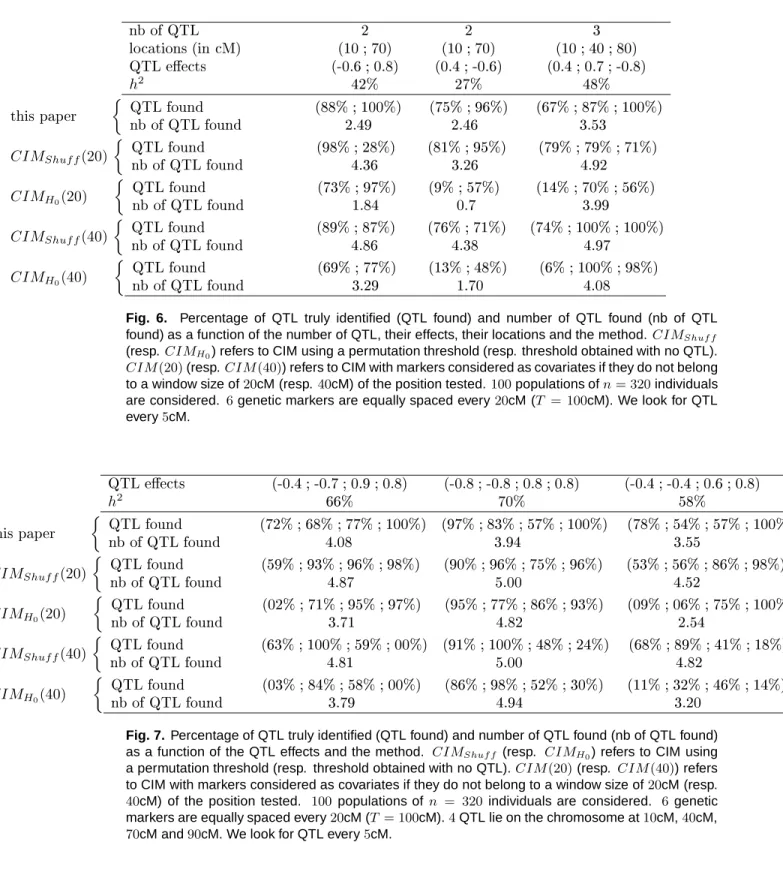
MintervalsenteredonthetrueloationsandweountoneQTLforeveryQTLfound outsidetheseintervals.In Figure 4, we study a situation with
2
QTL loated on the hromosome. First, two QTLlinked in repulsion (iewith opposite signs)areloatedat positions10
M and70
M onthehromosome. Wehaveto keepin mind that asourmethod isbasedonontiguity,theQTLeets haveto belose to
0
. However,weansee in Figure4, that themethod givesgoodresultsevenwhentheeets arenotsoloseto0
. Note thattheheritabilityis indiatedjust forinformationbut itis notlinkedto theperformanesofourmethod sinethebiggertheeetsarethebiggertheheritabilityis. ThenumberofQTLfoundisslightly
greaterthan
2
,but itisreasonablesinewepenalizealotwhenweareoutsideoftheQTL intervals. We obtain thesame onlusions forthe two QTL linked in oupling (ie. withsamesigns)presentedontherightsideofFigure4. Goodperformanesofthemethodsare
alsoillustratedin Figure5when
3
and4
QTLareloatedonthehromosome.6.2.
Comparison with the Composite Interval Mapping
Weproposehereto ompare ourmethod with theComposite IntervalMapping(CIM) of
Jansen (1993) and Zeng (1994), largelyused in the geneti ommunity. Weremind that
CIMonsistsin ombiningintervalmappingontwoankingmarkersandmultiple
regres-sionanalysisonotherseletedmarkers(Wuandal.(2007)). Thisway,theQTLnotloated
inthemarkerintervaltesteddon'taettheteststatistisanymore. Asaonsequene,itis
possibletoperformseparatelyintervalmappingineahmarkerintervaltotestthepresene
ofaQTLintheinterval. However,thehoieofthemarkersasofatorsisveryempirial
: wedon'tknowhowtohoiethesetofmarkersin amathematialpointofview.
FortheomparisonbetweenourmethodandCIM,weusethesameongurationasin
Se-tion6.1. Westudyseveralsituationswith
2
,3
and4
QTLonthehromosome(seeFigures 6and7). Weompute4
kindsofCIM.First,weonsidertwowaysofhoosingtheofators :CIM
(20)
(resp.CIM
(40)
) referstoCIM with markersonsidered asovariatesif they donotbelongto awindowsize of20
M(resp.40
M)ofthepositiontested. Seondly, we onsidertwowaysofomputingthethresholds: oneobtainedusing1000
permutationsand alledShuf f
here(Churhilland Doerge(1994)),andanotherwhihisobtained theoreti-allyunderH
0
(6
.
76
aordingtoRabier(2010)).InordertoountthenumberofQTLforCIM,foreahmarkerinterval,weountoneQTL
ifthe supremumof theproess is abovethethreshold (itorresponds to thedenition of
CIM).Besides, forCIM,wewillsaythat aQTListruly identiediftheQTL isndin a
neighbourhoodof
5
Mofthetrueposition. Forinstane,ifaQTLisloatedat10
M, the supremuminthemarkerinterval(0
M;20
M)hastobeobtainedbetween5
Mand15
M. Howewer,ifweonsideraQTLloatedat40
M(ieonthethirdmarker),wewillonsider thatthisQTListrulyidentiedifthesupremuminthemarkerinterval(20
M;40
M)is ob-tainedbetween35
Mand40
M,orifitisobtainedbetween40
Mand45
Minthemarker interval(40
M;60
M).AordingtoFigure 6,ifweonsider
2
QTLat10
M and70
M witheets−
0
.
6
and0
.
8
, weansee thatCIM
H
trueQTLarelargelyfound. However,ifweonsiderthesame
2
QTLbutwith eets0
.
4
and−
0
.
6
,CIM
H
0
(20)
performs badly.CIM
Shuf f
(20)
seemsto the best way to perform CIM : thetrue QTL arelargely found but wend3
.
26
QTL.If weonsider3
QTL, the best wayto perform CIMisCIM
Shuf f
(40)
but we nd4
.
97
QTL.As aonsequene,the hoieoftheofatorsandthehoieofthethresholdshighlydependsoftheonguration: CIMisveryempirial. Ifnowwehavealookonourmethodin Figure6,weobtainnie
results: theQTL are largelyfound and thenumber ofQTL found is good whateverthe
ongurationstudied. Sameonlusions holdwith
4
QTL(seeFigure7).6.3.
Our method is not affected by epistasis
Until now, wehavesupposed that theQTLeets wereadditivesand that there were no
interation betweenthem (f. Setion 2). However,there are many interations between
loi in the genome (ie. epistasis). That's why wepropose here to integrate interations
in themodelonsidered. Weremindthat
m
referto the number ofadditiveQTL andq
s
to theQTL eet ofthe sth additive QTL.Its position ist
⋆
s
. We will allm
˜
thenumber of interations andq
˜
s
the eet of the sthinteration. Theloi orresponding to thesth interationwillbealled˜
t
2
s
−
1
andt
˜
2
s
. Inthisontext,thequantitativetraitY
veries:Y
=
µ
+
m
X
s
=1
X
(
t
⋆
s
)
q
s
+
˜
m
X
s
=1
X
(˜
t
2
s
−
1)
X
(˜
t
2
s
) ˜
q
s
+
σε
where
ε
isaGaussian whitenoise. Weintroduetwonewhypothesis:H
a~
t
⋆
, b
t
˜
: therearem
additiveQTLloatedrespetivelyatt
⋆
1
,...,t
⋆
m
and witheetq
1
=
√
a
1
n
,...,q
m
=
a
m
√
n
where(
a
1
, ..., a
m
)
∈
R
m⋆
andthereare
m
˜
interations: betweenloi˜
t
1
and˜
t
2
,...,betweenloi˜
t
2 ˜
m
−
1
and˜
t
2 ˜
m
,with eetsrespetivelyq
˜
1
=
b
1
√
n
,...,q
˜
m
˜
=
b
m
˜
√
n
where(
b
1
, ..., b
m
˜
)
∈
R
˜
m⋆
".H
0
, b
˜
t
: thereisnotanyadditiveQTLon[0
, T
]
andthereare
m
˜
interations: betweenloi˜
t
1
and˜
t
2
,...,betweenloi˜
t
2 ˜
m
−
1
and˜
t
2 ˜
m
,with eetsrespetivelyq
˜
1
=
b
1
√
n
,...,q
˜
m
˜
=
b
m
˜
√
n
where(
b
1
, ..., b
m
˜
)
∈
R
˜
m⋆
". PropositionUnderH
0
, b
t
˜
andunderH
a~
t
⋆
, b
˜
t
∀
k S
n
(
t
k
) =
Z
⋆
(
t
k
) +
o
P
(1)
andΛ
n
(
t
k
) =
{
Z
⋆
(
t
k
)
}
2
+
o
P
(1)
whereZ
⋆
(
.
)
istheGaussianproessofthetheorem(f. Setion4.1)suhas
Z
⋆
(
.
)
isentered
under
H
0
, b
˜
t
andwith the meanfuntionm
~
t
⋆
(
.
)
ofthe theorem underH
a~
t
⋆
, b
˜
t
.TheproofisgiveninSetion 7.2. Aordingtotheproposition,ourmethodwhihisbased
onlyonpointsoftheproesstakenatmarkerpositions,isnotaetedbyepistasis. Indeed,
under
H
a~
t
⋆
, b
˜
t
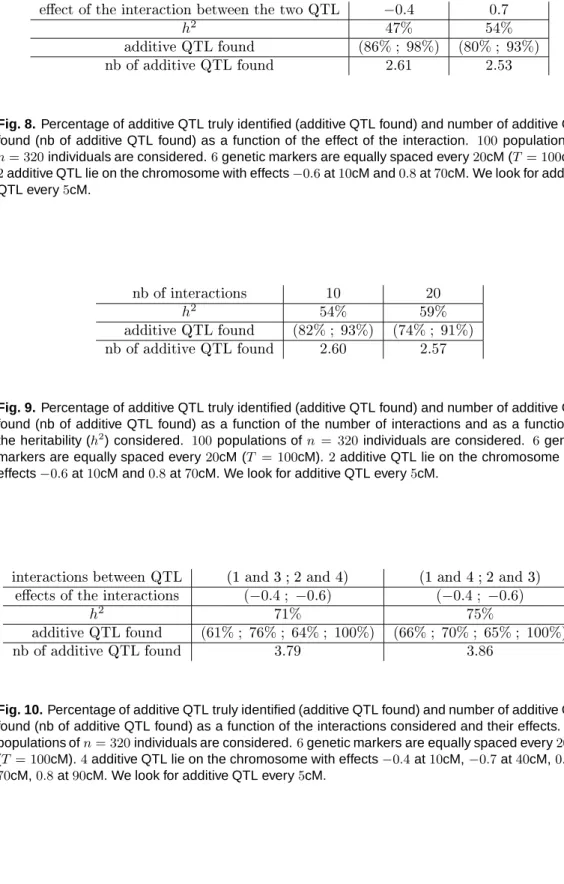
,themeanfuntionat markerpositionisthesameaspreviously.Figures 8 to 11 illustrate this phenomenon. The same map aspreviously is onsidered.
In Figures 8 and 9, weonsider twoadditive QTL on thehromosome : one with eet
−
0
.
6
at10
Mandtheotherwitheet0
.
8
at70
M.Tobegin,inFigure8,weonsiderone interation: wehavehoosentostudyaninterationbetweenthetwoQTL.WeonsidertwofoundandthenumberofadditiveQTLfound isgood. Then, inFigure9,weonsiderthis
time
10
and20
interations(keepingtheinterationbetweentheQTLwitheet−
0
.
4
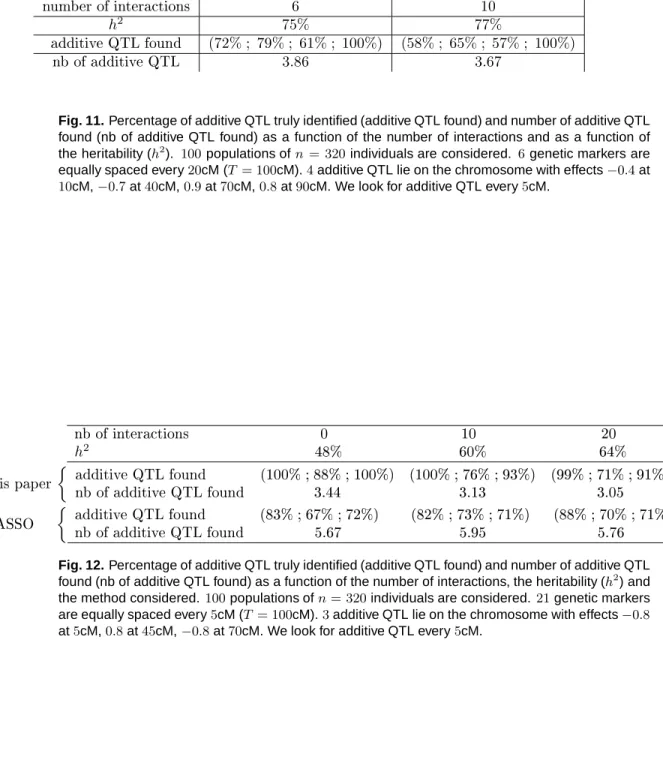
). The resultsarestillnie: theperformanesofourmethodarenotaetedbytheinterations(asexpeted withtheProposition). Same onlusionshold with
4
additiveQTL(seeFigures 10and11). Note thatforFigure11,wekeptthesameinterationbetweenQTLasontheleftsideofFigure10,andweaddedotherinterations.
6.4.
Our method is suitable for dense map
Toonlude,wewould liketo mentionthat ourmethod isalsosuitable fordensemap (ie
alargenumberof genetimarkersloseto eah other). Inthisase, wewill perform only
testsongenetimarkers. InFigure12,weonsider,aspreviously,ahromosomeoflength
T
= 100
M, butgenetimarkersarenowloatedevery5
M.WelookforQTLevery5
M. We ompare here our method and a lassial LASSO method whih onsists of a linearmodel where thetrait
Y
is thevariableto explain andthe regressorsarethe markers. In ordertoperformthelassialLASSO,weused0
.
1
asatuningparameterinsteadof5
fold ross-validation. It wasa good ompromise (betweenthe QTL found and their number)sine the results of the ross-validation were not good at all. Aording to the Figure
(usingthesamerulestollthetableasin Setion6.1), weansee thatourmethod gives
largelybetterresultsthanthelassialLASSO.Notethatourmethodisstilltheoretially
unaetedbyanyinterations.
7.
Proofs
7.1.
Proof of the theorem
We will onsider valuest
,t
⋆
1
, ...,t
⋆
m
of the parameters that are distint of the markers positions, andtheresultwillbeprolongedbyontinuityatthemarkerspositions.Study under
H
0
:ThereisnoQTLonthehromosome. TheproofisfullygiveninRabier(2010).
Nevertheless, weremindthat thesoreteststatistifor
n
observations veriesat positiont
:S
n
(
t
) =
n
X
j
=1
(
y
j
−
µ
) (2
p
j
(
t
)
−
1)
σ
√
n
r
E
h
{
2
p
(
t
)
−
1
}
2
i
(7) whereE
h
{
2
p
(
t
)
−
1
}
2
i
=
{
α
(
t
)
}
2
+
{
β
(
t
)
}
2
+ 2
α
(
t
)
β
(
t
)
e
−
2(
t
r
−
t
ℓ
)
.Itwillbeusefulforthestudyofthegeneralalternative.
Study under
H
a~
t
⋆
:Thereare severalQTLloated onthehromosome. Wesuppose that theQTLeetsare
additivesandthatthere isnointerationbetweenthem.
Inthis ontext,thequantitativetrait
Y
veries:Y
j
=
µ
+
m
X
s
=1
X
j
(
t
⋆
s
)
q
s
+
σε
j
(8)•
ξ
: numberof Markerintervals"whihontaintheQTL.γ
= 1
, ..., ξ
willrefertothedierentintervals.•
m
γ
: numberofQTLintheintervalγ
.τ
= 1
, ..., m
γ
referstotheτ
thQTLintheintervalγ
.•
thes
thQTLon[0
, T
]
,anberewritten,s
= (
τ, γ
) =
n
P
γ
−
1
i
=1
m
i
o
+
τ
Letθ
a~
t
⋆
= (
q
1
, ..., q
m
, µ, σ
)
andθ
0
~
t
⋆
= (0
, ...,
0
, µ, σ
)
. Aftersomealulations,thelikelihoodofY, X
n
t
⋆ℓ
(1
,
1)
o
, X
n
t
⋆r
(1
,
1)
o
, ..., X
n
t
⋆ℓ
(1
,ξ
)
o
, X
n
t
⋆r
(1
,ξ
)
o
withrespettothemeasure
λ
⊗
N
⊗
...
⊗
N
,λ
beingtheLebesguemeasure,N
theounty measureonN
, veries:L
⋆
(
θ
a~
t
⋆
) =
X
(
u
1
,...,u
m)
∈{−
1
,
1
}
m
f
(
µ
+
u
1
q
1
+
...
+
u
m
q
m
,σ
)(
y
)
×
(
ξ
Y
γ
=1
A
n
t
⋆ℓ
(
τ,γ
)
, t
⋆
(
τ,γ
)
o
"
m
γ
−
1
Y
τ
=1
R
n
t
⋆
(
τ,γ
)
, t
⋆
(
τ
+1
,γ
)
o
#
A
n
t
⋆r
(
m
γ
,γ
)
, t
⋆
(
m
γ
,γ
)
o
!
g
⋆
(
~t
⋆
)
)
whereu
s
=
u
(
τ,γ
)
A
n
t , t
⋆
(
τ,γ
)
o
=
r
n
t , t
⋆
(
τ,γ
)
o
1
X
(
t
)
u
(
τ,γ
)=
−
1
+ ¯
r
n
t , t
⋆
(
τ,γ
)
o
1
X
(
t
)
u
(
τ,γ
)=1
R
n
t
⋆
(
τ,γ
)
, t
⋆
(
τ
+1
,γ
)
o
= ¯
r
n
t
⋆
(
τ,γ
)
, t
⋆
(
τ
+1
,γ
)
o
1
u
(
τ,γ
)
u
(
τ
+1
,γ
)=1
+
r
n
t
⋆
(
τ,γ
)
, t
⋆
(
τ
+1
,γ
)
o
1
u
(
τ,γ
)
u
(
τ
+1
,γ
)=
−
1
g
⋆
(
~t
⋆
) =
1
2
ξ
−
1
Y
γ
=1
D
n
t
⋆r
(
m
γ
,γ
)
, t
⋆ℓ
(1
,γ
+1)
o
D
(
t, t
′
) = ¯
r
(
t, t
′
) 1
X
(
t
)
X
(
t
′
)=1
+
r
(
t, t
′
) 1
X
(
t
)
X
(
t
′
)=
−
1
ThelikelihoodL
⋆
n
(
θ
a~
t
⋆
)
forn
observationsisobtainedbytheprodutofn
termsasabove. LetQ
n
andP
n
twosequenesofprobabilitymeasuresdenedonthesamespae(Ω
n
,
A
n
)
.Q
n
(respetivelyP
n
)isthelaworrespondingto thedensityL
⋆
n
(
θ
a~
t
⋆
)
(respL
⋆
n
(
θ
0
~
t
⋆
)
). We willalltheloglikelihoodratiolog
dQ
n
dP
n
. Itveries:log
dQ
n
dP
n
= log
n
L
⋆
n
(
θ
a~
t⋆
)
L
⋆
n
(
θ
0
~
t⋆
)
o
.Asthemodelisdierentiablein quadratimeanat
θ
a~
t
⋆
and aordingtotheentral limit theorem:log
dQ
n
dP
n
H
0
→
N
(
−
1
2
ϑ
2
, ϑ
2
)
withϑ
2
∈
R
+
⋆
Bytheiii)ofLeCam'srstlemma,wehave
Q
n
⊳ P
n
. Leto
P
θ
0
(1)
beshortforasequeneofrandomvetorsthatonvergestozerosinprobability
under
H
0
(i.e. noQTLonthewholeintervalstudied). Besides,aordingto Rabier(2010):where
S
n
(
t
)
isgivenin formula(7). Leto
P
θ
0
~
t⋆
(1)
beasequeneofrandomvetorsthatonvergestozerosifthereisnoQTLatt
⋆
1
,...,t
⋆
m
. Then,itislearthat :Λ
n
(
t
) =
{
S
n
(
t
)
}
2
+
o
P
θ
0
~
t⋆
(1)
Let
o
P
θ
a~
t⋆
(1)
beasequeneofrandomvetorsthat onvergestozerosifthereare
m
QTL att
⋆
1
,...,t
⋆
m
. AsQ
n
⊳ P
n
, aordingtoiv)ofLeCam'srstlemma :Λ
n
(
t
) =
{
S
n
(
t
)
}
2
+
o
P
θ
a~
t⋆
(1)
So,alulationsanbedonewiththesoreteststatisti.
Aordingto Rabier(2010), the sore test statisti at
t
anbe obtainedby a non linear interpolation:S
n
(
t
) =
α
(
t
)
S
n
(
t
ℓ
) +
β
(
t
)
S
n
(
t
r
)
r
E
h
{
2
p
(
t
)
−
1
}
2
i
whereα
(
t
) =
Q
1
,
1
t
+
Q
1
,
−
1
t
−
1
andβ
(
t
) =
Q
1
,
1
t
−
Q
1
,
−
1
t
. Letm
~
t
⋆
(
.
)
betheasymptotimeanfuntionofthesoreproessS
n
(
.
)
. Itomes :m
~
t
⋆
(
t
) =
α
(
t
)
m
~
t
⋆
(
t
ℓ
) +
β
(
t
)
m
~
t
⋆
(
t
r
)
r
E
h
{
2
p
(
t
)
−
1
}
2
i
Letalulate thequantities
m
~
t
⋆
(
t
ℓ
)
andm
~
t
⋆(
t
r
)
.Weremindthat
t
k
referstotheloationofmarkerk
. AordingtoRabier(2010),thesore statistionmarkerk
veries:S
n
(
t
k
) =
n
X
j
=1
(
y
j
−
µ
)
2 1
X
j(
t
k)=1
−
1
σ
√
n
Aordingto formula(8):S
n
(
t
k
) =
1
√
n
n
X
j
=1
ε
j
2 1
X
j(
t
k)=1
−
1
+
1
σn
n
X
j
=1
(
m
X
s
=1
X
j
(
t
⋆
s
)
a
s
)
2 1
X
j
(
t
k)=1
−
1
=
S
0
n
(
t
k
) +
1
σn
n
X
j
=1
(
m
X
s
=1
X
j
(
t
⋆
s
)
a
s
)
2 1
X
j
(
t
k)=1
−
1
(9) whereS
0
n
(
t
k
)
isthesoreobtainedunderH
0
atloationt
k
. Bythelawoflargenumber:1
n
n
X
j
=1
(
m
X
s
=1
X
j
(
t
⋆
s
)
a
s
)
2 1
X
j
(
t
k)=1
−
1
→
E
"(
m
X
s
=1
X
(
t
⋆
s
)
a
s
)
2 1
X
(
t
k)=1
−
1
#
Aordingto Rabier(2010),wehave:
E
"(
m
X
s
=1
X
(
t
⋆
s
)
a
s
)
2 1
X
(
t
k
)=1
−
1
#
=
m
X
s
=1
a
s
e
−
2
|
t
⋆
s
−
t
k
|
Itomes:m
~
t
⋆
(
t
k
) =
1
σ
m
X
s
=1
a
s
e
−
2
|
t
⋆
s
−
t
k
|
Asaonsequene:m
~
t
⋆
(
t
ℓ
) =
1
σ
m
X
s
=1
a
s
e
−
2
|
t
⋆
s
−
t
ℓ
|
,
m
~
t
⋆
(
t
r
) =
1
σ
m
X
s
=1
a
s
e
−
2
|
t
⋆
s
−
t
r
|
Weak onvergeneof the soreproess:
Theproofis exatlythesameasin Rabier(2010).
7.2.
Proof of the proposition
˜
m
is the number of interations andq
˜
s
the eet of the sth interation. The loi orre-sponding tothesthinterationaret
˜
2
s
andt
˜
2
s
−
1
. Inthisontext,thequantitativetraitY
veries:Y
=
µ
+
m
X
s
=1
X
(
t
⋆
s
)
q
s
+
˜
m
X
s
=1
X
(˜
t
2
s
−
1)
X
(˜
t
2
s
) ˜
q
s
+
σε
(10)where
ε
isaGaussian whitenoise.Wewill onsider valuesof
˜
t
1
, ...,t
˜
2 ˜
m
andt
⋆
1
, ...,t
⋆
m
distintof markerpositions, and the resultwill beprolongedbyontinuity.Let
o
P
θ
0
~
t⋆ ,
0˜
t
(1)
beasequeneofrandomvetorsthatonvergestozerosifthereisnoadditive
QTLat
t
⋆
1
, ...,t
⋆
m
and nointerationsbetweenloi˜
t
1
and˜
t
2
, ....,nointerations between loi˜
t
2 ˜
m
−
1
and˜
t
2 ˜
m
. Inthesamewayasintheproofofthetheorem,itislearthat:Λ
n
(
t
k
) =
{
S
n
(
t
k
)
}
2
+
o
P
θ
0
~
t⋆ ,
0˜
t
(1)
where
S
n
(
t
k
)
isgiveninformula(5)ofSetion5.2.Inordertoadapttheproofofthetheorem,wejusthavetoonsiderthelikelihoodof
Y
and theankingmarkersof theadditiveQTL(as previously)butwehaveto add theankingmarkersof
t
˜
1
,...,˜
t
2 ˜
m
. Themodelisstilldierentiableinquadratimean. Leto
P
θ
a~
t⋆ ,b
˜
t
(1)
be a sequene of random vetors that onverges to zeros if there are
m
additiveQTL att
⋆
1
, ...,t
⋆
m
andm
˜
interations : loi˜
t
1
and˜
t
2
, ...., loi˜
t
2 ˜
m
−
1
and˜
t
2 ˜
m
. Then,aordingto iv)ofLeCam'srstlemma:Λ
n
(
t
k
) =
{
S
n
(
t
k
)
}
2
+
o
P
θ
a~
t⋆ ,b
t
˜
(1)
Aordingto formula(10),wehave:
S
n
(
t
k
) =
1
√
n
n
X
j
=1
ε
j
2 1
X
j(
t
k)=1
−
1
+
1
σn
n
X
j
=1
(
m
X
s
=1
X
j
(
t
⋆
s
)
a
s
)
2 1
X
j
(
t
k)=1
−
1
+
1
σn
n
X
j
=1
(
m
˜
X
s
=1
X
j
(˜
t
2
s
−
1)
X
j
(˜
t
2
s
)
b
s
)
2 1
X
j
(
t
k)=1
−
1
=
S
0
n
(
t
k
) +
1
σn
n
X
j
=1
(
m
X
s
=1
X
j
(
t
⋆
s
)
a
s
)
2 1
X
j
(
t
k)=1
−
1
+
1
σn
n
X
j
=1
(
m
˜
X
s
=1
X
j
(˜
t
2
s
−
1)
X
j
(˜
t
2
s
)
b
s
)
2 1
X
j
(
t
k)=1
−
1
(11) whereS
0
n
(
t
k
)
isthesoreobtainedunderthenullhypothesisthatthereisnoadditiveQTL andnointerationson[0
, T
]
(sameS
0
n
asinformula(9) oftheproofof thetheorem). A-ordingtotheproofof thetheorem, wehave1
σn
P
n
j
=1
{
P
m
s
=1
X
j
(
t
⋆
s
)
a
s
}
2 1
X
j
(
t
k)=1
−
1
whihtendstom
~
t
⋆
(
t
k
)
. Besides,1
σn
n
X
j
=1
(
m
˜
X
s
=1
X
j
(˜
t
2
s
−
1)
X
j
(˜
t
2
s
)
b
s
)
2 1
X
j(
t
k)=1
−
1
→
E
"(
m
˜
X
s
=1
X
(˜
t
2
s
−
1)
X
j
(˜
t
2
s
)
b
s
)
2 1
X
(
t
k)=1
−
1
#
Wehave:E
X
(˜
t
2
s
−
1)
X
(˜
t
2
s
)
2 1
X
(
t
k)=1
−
1
= 2
E
X
(˜
t
2
s
−
1)
X
(˜
t
2
s
)1
X
(
t
k)=1
−
e
−
2
|
˜
t
2
s
−
˜
t
2
s
−
1
|
Ift
k
<
t
˜
2
s
−
1
<
˜
t
2
s
,then:E
X
(˜
t
2
s
−
1)
X
(˜
t
2
s
)
2 1
X
(
t
k)=1
−
1
= 0
If˜
t
2
s
−
1
< t
k
<
˜
t
2
s
,then:E
X
(˜
t
2
s
−
1)
X
(˜
t
2
s
)
2 1
X
(
t
k
)=1
−
1
= 0
Asaonsequene:E
X
(˜
t
2
s
−
1)
X
(˜
t
2
s
)
2 1
X
(
t
k)=1
−
1
= 0
Itonludestheproofforunder
H
a~
t
⋆
, b
˜
t
. InordertoobtaintheresultunderH
0
, b
˜
t
,wejust havetodealwithontiguity,onsidering thelikelihoodofY
andonlytheankingmarkers of˜
t
1
, ...,t
˜
2 ˜
m
(ie the loi for the interations). Then, we do the same alulations as in formula(11)but thistimethereis notanymoretheadditiveterm(ietheseond term). ItonludestheproofoftheProposition.
8.
Acknowledgements
The authors thank Jean-Mihel Elsen for having proposed this subjet of researh and
fruitfuldisussions. This work hasbeensupported bytheAnimalGeneti Departmentof
loations(inM)
(10 ; 70)
(30 ; 80)
QTLeets
(
−
0
.
6 ; 0
.
8)
(
−
0
.
8 ; 0
.
8)
(0
.
4 ;
−
0
.
6)
(0
.
6 ; 0
.
6)
(0
.
6 ; 0
.
8)
(0
.
6 ; 0
.
4)
h
2
42%
47%
27%
50%
57%
41%
QTLfound
(88% ; 100%)
(100% ; 94%)
(75% ; 96%)
(97% ; 98%)
(96% ; 100%)
(100% ; 94%)
nbofQTLfound
2
.
49
2
.
71
2
.
46<