Transforming Dependencies into Phrase Structures
Lingpeng Kong School of Computer Science
Carnegie Mellon University Pittsburgh, PA, USA [email protected]
Alexander M. Rush Facebook AI Research
New York, NY, USA [email protected]
Noah A. Smith School of Computer Science
Carnegie Mellon University Pittsburgh, PA, USA [email protected]
Abstract
We present a new algorithm for transforming dependency parse trees into phrase-structure parse trees. We cast the problem as struc-tured prediction and learn a statistical model. Our algorithm is faster than traditional phrase-structure parsing and achieves 90.4% English parsing accuracy and 82.4% Chinese parsing accuracy, near to the state of the art on both benchmarks.
1 Introduction
Natural language parsers typically produce phrase-structure (constituent) trees or dependency trees. These representations capture some of the same syn-tactic phenomena, and the two can be produced jointly (Klein and Manning, 2002; Hall and Nivre, 2008; Carreras et al., 2008; Rush et al., 2010). Yet it appears to be completely unpredictable which will be preferred by a particular subcommunity or used in a particular application. Both continue to receive the attention of parsing researchers.
Further, it appears to be a historical accident that phrase-structure syntax was used in annotating the Penn Treebank, and that English dependency annotations are largely derived through mechani-cal, rule-based transformations (reviewed in Sec-tion 2). Indeed, despite extensive work on direct-to-dependency parsing algorithms (which we call d-parsing), the most accurate dependency parsers for English still involve phrase-structure parsing (which we callc-parsing) followed by rule-based extraction of dependencies (Kong and Smith, 2014).
What if dependency annotations had come first? Because d-parsers are generally much faster than
c-parsers, we consider an alternate pipeline (Sec-tion 3): d-parse first, then transform the depen-dency representation into a phrase-structure tree constrained to be consistent with the dependency parse. This idea was explored by Xia and Palmer (2001) and Xia et al. (2009) using hand-written rules. Instead, we present a data-driven algorithm using the structured prediction framework (Sec-tion 4). The approach can be understood as a specially-trained coarse-to-fine decoding algorithm where a d-parser provides “coarse” structure and the second stage refines it (Charniak and Johnson, 2005; Petrov and Klein, 2007).
Our lexicalized phrase-structure parser, PAD, is asymptotically faster than parsing with a lexical-ized context-free grammar: O(n2) plus d-parsing, vs. O(n5) worst case runtime in sentence length
n, with the same grammar constant. Experiments show that our approach achieves linear observable runtime, and accuracy similar to state-of-the-art phrase-structure parsers without reranking or semi-supervised training (Section 7).
2 Background
We begin with the conventional development by first introducing c-parsing and then defining d-parses through a mechanical conversion using head rules. In the next section, we consider the reverse transfor-mation.
2.1 CFG Parsing
The phrase-structure trees annotated in the Penn Treebank are derivation trees from a context-free grammar. Define a binary1 context-free grammar 1For notational simplicity, we defer discussion of non-binary rules to Section 3.3.
(CFG) as a 4-tuple (N,G,T, r) where N is a set of nonterminal symbols (e.g. NP, VP), T is a set of terminal symbols, consisting of the words in the language, G is a set of binary rules of the form
A→ β1β2, andr ∈ N is a distinguished root non-terminal symbol.
Given an input sentence x1, . . . , xn of terminal symbols from T, define the set of c-parses for the sentence asY(x). This set consists of all binary or-dered trees with fringex1, . . . , xn, internal nodes la-beled fromN, all tree productionsA→ β1β2 con-sisting of members ofG, and root labelr.
For a c-parse y ∈ Y(x), we further associate a span hv⇐, v⇒i with each vertex in the tree. This specifies the subsequence {xv⇐, . . . , xv⇒} of the
sentence covered by this vertex.
2.2 Dependency Parsing
Dependency parses provide an alternative, and in some sense simpler, representation of sentence structure. These d-parses can be derived through mechanical transformation from context-free trees. There are several popular transformations in wide use; each provides a different representation of a sentence’s structure (Collins, 2003; De Marneffe and Manning, 2008; Yamada and Matsumoto, 2003; Johansson and Nugues, 2007).
We consider the class of transformations that are defined through localhead rules. For a binary CFG, define a collection of head rules as a mapping from each CFG rule to a head preference for its left or right child. We use the notation A → β∗
1 β2 and
A → β1 β2∗ to indicate a left- or right-headed rule, respectively.
The head rules can be used to map a c-parse to a dependency tree (d-parse). In a d-parse, each word in the sentence is assigned as a dependent to a head word,h ∈ {0, . . . , n}, where0is a special symbol indicating the pseudo-root of the sentence. For each
hwe defineL(h)⊂ {1, . . . , h−1}as the set of left dependencies ofh, andR(h) ⊂ {h+ 1, . . . , n} as the set of right dependencies.
A d-parse can be constructed recursively from a c-parse and the head rules. For each c-parse vertex
vwith potential childrenvLandvRin bottom-up or-der, we apply the following procedure to both assign heads to the c-parse and construct the d-parse:
S(3)
. . .
VP(3)
VBD∗(3)
sold3 NP(2)
NN∗(2)
automaker2 DT(1)
The1
The1 automaker2 sold3 . . .
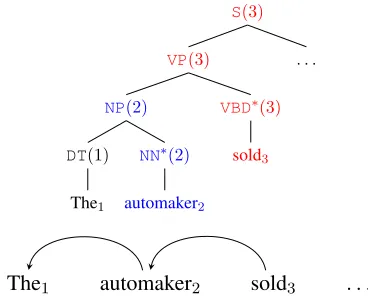
Figure 1: Illustration of c-parse to d-parse conversion with head rules{VP→NP VBD∗,NP→DT NN∗, . . .}. The c-parse is an
ordered tree with fringex1, . . . , xn. Each vertex is annotated with a terminal or nonterminal symbol and a derived head index. The blue and red vertices have the wordsautomaker2 and
sold3 as heads respectively. The vertexVP(3)implies that
automaker2is a left-dependent ofsold3, and that2∈ L(3) in the d-parse.
1. If the vertex is leafxm, thenhead(v) =m.
2. If the next rule isA → β∗
1 β2 thenhead(v) =
head(vL) and head(vR) ∈ R(head(v)), i.e. the head of the right-child is a dependent of the head word.
3. If the next rule isA → β1 β2∗ thenhead(v) =
head(vR) and head(vL) ∈ L(head(v)), i.e. the head of the left-child is a dependent of the head word.
Figure 1 shows an example conversion of a c-parse to d-parse using this procedure.
By construction, these dependencies form a di-rected tree with arcs(h, m) for allh ∈ {0, . . . , n}
and m ∈ L(h) ∪ R(h). While this tree differs from the original c-parse, we can relate the two trees through their spans. Define the dependency tree spanhh⇐, h⇒ias the contiguous sequence of words reachable from word h in this tree.2 This span is equivalent to the maximal spanhv⇐, v⇒iof any c-parse vertex withhead(v) = h. This property will be important for the parsing algorithm presented in the next section.
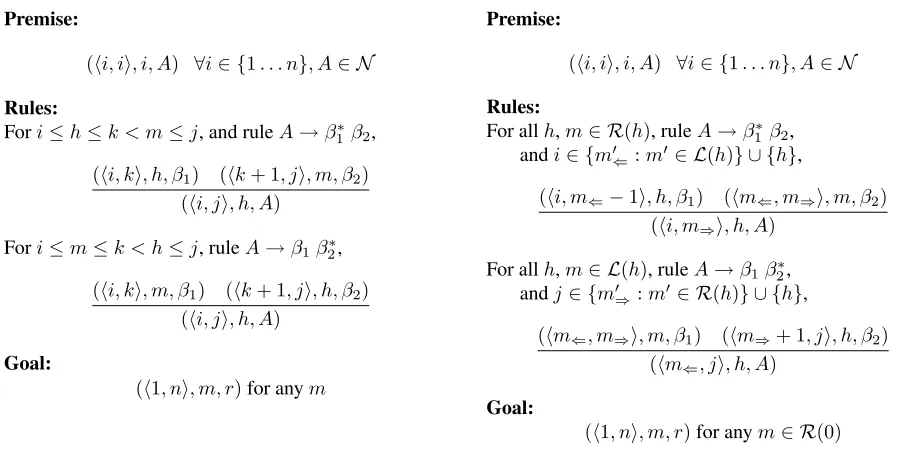
Premise:
(hi, ii, i, A) ∀i∈ {1. . . n}, A∈ N
Rules:
Fori≤h≤k < m≤j, and ruleA→β∗ 1β2,
(hi, ki, h, β1) (hk+ 1, ji, m, β2) (hi, ji, h, A)
Fori≤m≤k < h≤j, ruleA→β1β∗ 2,
(hi, ki, m, β1) (hk+ 1, ji, h, β2) (hi, ji, h, A)
Goal:
(h1, ni, m, r)for anym
Premise:
(hi, ii, i, A) ∀i∈ {1. . . n}, A∈ N
Rules:
For allh,m∈ R(h), ruleA→β∗ 1 β2,
andi∈ {m0
⇐:m0 ∈ L(h)} ∪ {h},
(hi, m⇐−1i, h, β1) (hm⇐, m⇒i, m, β2)
(hi, m⇒i, h, A)
For allh,m∈ L(h), ruleA→β1β∗ 2,
andj∈ {m0
⇒:m0 ∈ R(h)} ∪ {h},
(hm⇐, m⇒i, m, β1) (hm⇒+ 1, ji, h, β2)
(hm⇐, ji, h, A)
Goal:
(h1, ni, m, r)for anym∈ R(0)
Figure 3: The two algorithms written as deductive parsers. Starting from thepremise, any valid application ofrulesthat leads to a goalis a valid parse. Left: lexicalized CKY algorithm for CFG parsing with head rules. For this algorithm there areO(n5|G|)rules wherenis the length of the sentence. Right: the constrained CKY parsing algorithm forY(x, d). The algorithm is nearly identical except that many of the free indices are now fixed given the dependency parse. Finding the optimal c-parse with the new algorithm now requiresO (P
h|L(h)||R(h)|)|G|
time whereL(h)andR(h)are the left and right dependents of wordh.
a valid dependency span. For example, if for a word
h there are|L(h)| = 3left dependents, then when taking the next right-dependent there can only be4
valid left boundary indices.
The runtime of the final algorithm reduces to
O(Ph|L(h)||R(h)||G|). While the terms |L(h)|
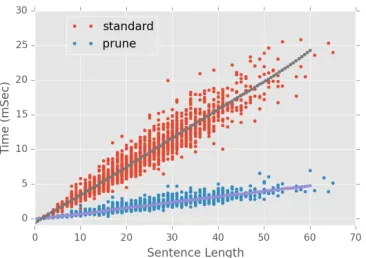
and |R(h)| could in theory make the runtime quadratic, in practice the number of dependents is almost always constant in the length of the sentence. This leads to linear observed runtime in practice as we will show in Section 7.
3.2 Pruning
In addition to constraining the number of c-parses, the d-parse also provides valuable information about the labeling and structure of the c-parse. We can use this information to further prune the search space. We employ two pruning methods:
Method 1 uses the part-of-speech tag of xh,
tag(h), to limit the possible rule productions at a given span. We build tablesGtag(h) and restrict the search to rules seen in training for a particular part-of-speech tag.
Method 2 prunes based on the order in which de-pendent words are added. By the constraints of the
algorithm, a head wordxhmust combine with each of its left and right dependents. However, the or-der of combination can lead to different tree struc-tures (as illustrated in Figure 2). In total there are
|L(h)| × |R(h)|possible orderings of dependents. In practice, though, it is often easy to predict which side, left or right, will come next. We do this by estimating the distribution,
p(side|tag(h),tag(m),tag(m0)),
wherem∈ L(h)is the next left dependent andm0 ∈
R(h)is the next right dependent. If the conditional probability ofleftorrightis greater than a threshold parameter γ, we make a hard decision to combine with that side next. This pruning further reduces the impact of outliers with multiple dependents on both sides.
Model Complexity Sent./s. Ora.F1
LEXCKY∗ n5|G| 0.25 100.0
DEPCKY P
h|L(h)||R(h)||G| 71.2 92.6 PRUNE1 P
h|L(h)||R(h)||GT| 336.0 92.5
PRUNE2 – 96.6 92.5
PRUNE1+2 – 425.1 92.5
Table 1: Comparison of three parsing setups: LEX CKY∗
is the complete lexicalized c-parser onY(x), but limited to only sentences less than 20 words for tractability, DEP CKY
is the constrained c-parser onY(x, d), PRUNE1, PRUNE2, and PRUNE1+2 are combinations of the pruning methods described
in Section 3.2. The oracle is the best labeledF1achievable on the development data (§22, see Section 7).
pruning contributes even greater speed-ups. The or-acle experiments show that the d-parse constraints do contribute a large drop in oracle accuracy, while pruning contributes a relatively small one. Still, this upper-bound on accuracy is high enough to make it possible to still recover c-parses at least as accurate as state-of-the-art c-parsers. We will return to this discussion in Section 7.
3.3 Binarization and Unary Rules
We have to this point developed the algorithm for a strictly binary-branching grammar; however, we need to produce trees have rules with varying size. In order to apply the algorithm, we binarize the grammar and add productions to handle unary rules. Consider a non-binarized rule of the form A →
β1. . . βm with head childβ∗k. Relative to the head childβk the rule has left-sideβ1. . . βk−1 and right-side βk+1. . . βm. We replace this rule with new binary rules and non-terminal symbols to produce each side independently as a simple chain, left-side first. The transformation introduces the following new rules:5 A → β1 A¯∗, A¯ → βi A¯∗ for i ∈
{2, . . . , k}, andA¯→A¯∗βifori∈ {k, . . . , m}. As an example consider the transformation of a rule with four children:
S
NP NP VP∗
NP
⇒ S
¯S∗
NP
¯S∗
NP VP∗
NP
These rules can then be reversed deterministically to produce a non-binary tree.
5These rules are slightly modified whenk= 1.
We also explored binarization using horizontal and vertical markovization to include additional context of the tree, as found useful in unlexicalized approaches (Klein and Manning, 2003). Preliminary experiments showed that this increased the size of the grammar, and the runtime of the algorithm, with-out leading to improvements in accuracy.
Phrase-structure trees also include unary rules of the formA→β∗
1. To handle unary rules we modify the parsing algorithms in Figure 3 to include a unary completion rule,
(hi, ji, h, β1)
(hi, ji, h, A)
for all indices i ≤ h ≤ j that are consistent with the dependency parse. In order to avoid unary re-cursion, we limit the number of applications of this rule at each span (preserving the runtime of the algo-rithm). Preliminary experiments looked at collaps-ing the unary rules into the nonterminal symbols, but we found that this hurt performance compared to explicit unary rules.
4 Structured Prediction
We learn the d-parse to c-parse conversion us-ing a standard structured prediction setup. Define the linear scoring function s for a conversion as
s(y;x, d, θ) = θ>f(x, d, y) whereθis a parameter vector andf(x, d, y)is a feature function that maps parse productions to sparse feature vectors. While the parser only requires a d-parse at prediction time, the parameters of this scoring function are learned directly from a treebank of c-parses and a set of head rules. The structured prediction model, in effect, learns to invert the head rule transformation.
4.1 Features
The scoring function requires specifying a set of parse featuresf which, in theory, could be directly adapted from existing lexicalized c-parsers. How-ever, the structure of the dependency parse greatly limits the number of decisions that need to be made, and allows for a smaller set of features.
For a production
(hi, ki, m, β1) (hk+ 1, ji, h, β2) (hi, ji, h, A)
Nonterm Features (A,β1) (A, β1,tag(m)) (A,β2) (A, β2,tag(h))
Span Features (rule, xi) (rule, xi−1)
(rule, xj) (rule, xj+1) (rule, xk) (rule, xk+1) (rule,bin(j−i))
Rule Features (rule)
(rule, xh,tag(m)) (rule,tag(h), xm) (rule,tag(h),tag(m)) (rule, xh)
(rule,tag(h)) (rule, xm) (rule,tag(m))
Figure 4: The feature templates used in the functionf(x, d, y). For the span features, the symbolruleis expanded into both
A →B Cand backoff symbolA. The functionbin(i) parti-tions a span length into one of 10 bins.
modifier word and part-of-speech, and head word and part-of-speech.
The second set of features is modeled after the span features described in the X-bar-style parser of Hall et al. (2014). These include conjunctions of the rule with: first and last word of current span, pre-ceding and following word of current span, adjacent words at split of current span, and binned length of the span.
The full feature set is shown in Figure 4. After training, there are a total of around 2 million non-zero features. For efficiency, we use lossy feature hashing. We found this had no impact on parsing accuracy but made the parsing significantly faster.
4.2 Training
The parameters θ are estimated using a struc-tural support vector machine (Taskar et al., 2004). Given a set of gold-annotated c-parse examples,
(x1, y1), . . . ,(xD, yD), and d-parses d1. . . dD in-duced from the head rules, we estimate the parame-ters to minimize the regularized empirical risk
min
θ D
X
i=1
`(xi, di, yi, θ) +λ||θ|| 1
where we define ` as `(x, d, y, θ) = −s(y) + maxy0∈Y(x,d)(s(y0) + ∆(y, y0)) and where ∆ is a
problem specific cost-function. In experiments, we use a Hamming loss∆(y, y0) =|y−y0|whereyis an indicator for production rules firing over pairs of adjacent spans (i.e.,i, j, k).
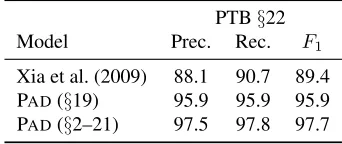
PTB§22 Model Prec. Rec. F1
Xia et al. (2009) 88.1 90.7 89.4 PAD(§19) 95.9 95.9 95.9
PAD(§2–21) 97.5 97.8 97.7
Table 2: Comparison with the rule-based system of Xia et al. (2009). Results are shown using gold-standard tags and depen-dencies. Xia et al. report results consulting only§19 in devel-opment and note that additional data had little effect. We show our system’s results using§19 and the full training set.
The objective is optimized using AdaGrad (Duchi et al., 2011). The gradient calculation requires com-puting a loss-augmented max-scoring c-parse for each training example which is done using the al-gorithm of Figure 3 (right).
5 Related Work
The problem of converting dependency to phrase-structured trees has been studied previously from the perspective of building multi-representational tree-banks. Xia and Palmer (2001) and Xia et al. (2009) develop a rule-based system for the conversion of human-annotated dependency parses. This work fo-cuses on modeling the conversion decisions made and capturing how researchers annotate specific phe-nomena. Our work focuses on a different problem of learning a data-driven structured prediction model that is also able to handle automatically predicted dependency parses as input. While the aim is dif-ferent, Table 2 does give a direct comparison of our system to that of Xia et al. (2009) on gold d-parse data.
An important line of previous work also uses de-pendency parsers to produce phrase-structure trees. In particular Hall et al. (2007) and Hall and Nivre (2008) develop a specialized dependency label set to encode phrase-structure information in the d-parse. After predicting a d-parse this label information can be used to assemble a predicted c-parse. Our work differs in that it does not make any assumptions on the labeling of the dependency tree used and it uses structured prediction to produce the final c-parse.
a new intermediate representation called “head-ordered dependency trees”, which encode head or-dering information in dependeny labels. Their al-gorithm is based on a reduction of the constituent parsing to dependency parsing of such trees.
There has been successful work combining de-pendency and phrase-structure information to build accurate c-parsers. Klein and Manning (2002) con-struct a factored generative model that scores both context-free syntactic productions and semantic de-pendencies. Carreras et al. (2008) construct a state-of-the-art parser that uses a dependency parsing model both for pruning and within a richer lexical-ized parser. Similarly, Rush et al. (2010) use dual decomposition to combine a powerful dependency parser with a lexicalized phrase-structure model. This work differs in that we treat the dependency parse as a hard constraint, hence largely reduce the runtime of a fully lexicalized phrase structure pars-ing model while maintainpars-ing the ability, at least in principle, to generate highly accurate phrase-structure parses.
Finally there have also been several papers that use ideas from dependency parsing to simplify and speed up phrase-structure prediction. Zhu et al. (2013) build a high-accuracy phrase-structure parser using a transition-based system. Hall et al. (2014) use a stripped down parser based on a simple X-bar grammar and a small set of lexicalized features.
6 Methods
We ran a series of experiments to assess the accu-racy, efficiency, and applicability of our parser, PAD, to several tasks. These experiments use the follow-ing setup.
For English experiments we use the standard Penn Treebank (PTB) experimental setup (Marcus et al., 1993). Training is done on§2–21, development on
§22, and testing on§23. We use the development set to tune the regularization parameter,λ= 1e−8, and the pruning threshold,γ = 0.95.
For Chinese experiments, we use version 5.1 of the Penn Chinese Treebank 5.1 (CTB) (Xue et al., 2005). We followed previous work and used articles 001–270 and 440–1151 for training, 301–325 for de-velopment, and 271–300 for test. We also use the development set to tune the regularization
parame-ter,λ= 1e−3.
Part-of-speech tagging is performed for all mod-els using TurboTagger (Martins et al., 2013). Prior to training the d-parser, the training sections are automatically processed using 10-fold jackknifing (Collins and Koo, 2005) for both dependency and phrase structure trees. Zhu et al. (2013) found this simple technique gives an improvement to depen-dency accuracy of 0.4% on English and 2.0% on Chinese in their system.
During training, we use the d-parses induced by the head rules from the gold c-parses as constraints. There is a slight mismatch here with test, since these d-parses are guaranteed to be consistent with the tar-get c-parse. We also experimented with using 10-fold jacknifing of the d-parser during training to pro-duce more realistic parses; however, we found that this hurt performance of the parser.
Unless otherwise noted, in English the test d-parsing is done using the RedShift implementation6 of the parser of Zhang and Nivre (2011), trained to follow the conventions of Collins head rules (Collins, 2003). This parser is a transition-based beam search parser, and the size of the beamk con-trols a speed/accuracy trade-off. By default we use a beam of k = 16. We found that dependency la-bels have a significant impact on the performance of the RedShift parser, but not on English dependency conversion. We therefore train a labeled parser, but discard the labels.
For Chinese, we use the head rules compiled by Ding and Palmer (2005)7. For this data-set we trained the d-parser using the YaraParser implemen-tation8of the parser of Zhang and Nivre (2011), be-cause it has a better Chinese implementation. We use a beam of k = 64. In experiments, we found that Chinese labels were quite helpful, and added four additional features templates conjoining the la-bel with the non-terminals of a rule.
Evaluation for phrase-structure parses is per-formed using the evalb9 script with the standard setup. We report labeledF1 scores as well as recall and precision. For dependency parsing, we report
6https://github.com/syllog1sm/redshift 7http://stp.lingfil.uu.se/˜nivre/
research/chn_headrules.txt
8https://github.com/yahoo/YaraParser 9http://nlp.cs.nyu.edu/evalb
PTB§23
Model F1 Sent./s.
Charniak (2000) 89.5 – Stanford PCFG (2003) 85.5 5.3 Petrov (2007) 90.1 8.6 Zhu (2013) 90.3 39.0 Carreras (2008) 91.1 – CJ Reranking (2005) 91.5 4.3 Stanford RNN (2013) 90.0 2.8
PAD 90.4 34.3
PAD(Pruned) 90.3 58.6
CTB
Model F1
Charniak (2000) 80.8 Bikel (2004) 80.6 Petrov (2007) 83.3
Zhu (2013) 83.2
PAD 82.4
Table 3: Accuracy and speed on PTB §23 and CTB 5.1 test split. Comparisons are to state-of-the-art non-reranking super-vised phrase-structure parsers (Charniak, 2000; Klein and Man-ning, 2003; Petrov and Klein, 2007; Carreras et al., 2008; Zhu et al., 2013; Bikel, 2004), and semi-supervised and reranking parsers (Charniak and Johnson, 2005; Socher et al., 2013).
unlabeled accuracy score (UAS).
We implemented the grammar binarization, head rules, and pruning tables in Python, and the parser, features, and training in C++. Experiments are per-formed on a Lenovo ThinkCentre desktop computer with 32GB of memory and Core i7-3770 3.4GHz 8M cache CPU.
7 Experiments
We ran experiments to assess the accuracy of the method, its runtime efficiency, the effect of depen-dency parsing accuracy, and the effect of the amount of annotated phrase-structure data.
Parsing Accuracy Table 3 compares the accuracy and speed of the phrase-structure trees produced by the parser. For these experiments we treat our sys-tem and the Zhang-Nivre parser as an independently trained, but complete end-to-end c-parser. Runtime for these experiments includes both the time for d-parsing and conversion. Despite the fixed
depen-Model UAS F1 Sent./s. Oracle
MALTPARSER 89.7 85.5 240.7 87.8
RS-K1 90.1 86.6 233.9 87.6 RS-K4 92.5 90.1 151.3 91.5 RS-K16 93.1 90.6 58.6 92.5 YARA-K1 89.7 85.3 1265.8 86.7
YARA-K16 92.9 89.8 157.5 91.7
YARA-K32 93.1 90.4 48.3 92.0
YARA-K64 93.1 90.5 47.3 92.2
TP-BASIC 92.8 88.9 132.8 90.8
TP-STANDARD 93.3 90.9 27.2 92.6
TP-FULL 93.5 90.8 13.2 92.9
Table 4: The effect of d-parsing accuracy (PTB§22) on PAD
and an oracle converter. Runtime includes d-parsing and c-parsing. Inputs include MaltParser (Nivre et al., 2006), the RedShift and the Yara implementations of the parser of Zhang and Nivre (2011) with various beam size, and three versions of TurboParser trained with projective constraints (Martins et al., 2013).
dency constraints, the English results show that the parser is comparable in accuracy to many widely-used systems, and is significantly faster. The parser most competitive in both speed and accuracy is that of Zhu et al. (2013), a fast shift-reduce phrase-structure parser.
Furthermore, the Chinese results suggest that, even without making language-specific changes in the feature system we can still achieve competitive parsing accuracy.
Effect of Dependencies Table 4 shows experi-ments comparing the effect of different input d-parses. For these experiments we used the same ver-sion of PAD with 11 different d-parsers of varying quality and speed. We measure for each parser: its UAS, speed, and labeled F1 when used with PAD and with an oracle converter.10 The paired figure 10For a gold parseyand predicted dependenciesdˆ, define the oracle parse asy0= arg min
Figure 5: Empirical runtime of the parser on sentences of vary-ing length, with and without prunvary-ing. Despite a worst-case quadratic complexity, observed runtime is linear.
shows that there is a direct correlation between the UAS of the inputs and labeledF1.
Runtime In Section 3 we considered the theoret-ical complexity of the parsing model and presented the main speed results in Table 1. Despite having a quadratic theoretical complexity, the practical run-time was quite fast. Here we consider the empiri-cal complexity of the model by measuring the time spent on individual sentences. Figure 5 shows parser speed for sentences of varying length for both the full algorithm and with pruning. In both cases the observed runtime is linear.
Recovering Phrase-Structure Treebanks Anno-tating phrase-structure trees is often more expensive and slower than annotating unlabeled dependency trees (Schneider et al., 2013). For low-resource lan-guages, an alternative approach to developing fully annotated phrase-structure treebanks might be to la-bel a small amount of c-parses and a large amount of cheaper d-parses. Assuming this setup, we ask how many c-parses would be necessary to obtain reason-able performance?
For this experiment, we train PAD on only 5% of the PTB training set and apply it to predicted d-parses from a fully-trained model. Even with this small amount of data, we obtain a parser with de-velopment score ofF1 = 89.1%, which is compa-rable to Charniak (2000) and Stanford PCFG (Klein and Manning, 2003) trained on the complete c-parse training set. Additionally, if the gold dependencies are available, PAD with 5% training achievesF1 =
95.8%on development, demonstrating a strong
abil-Class Results
Dep. Span Split Count Acc.
(h, m) hi, ji k A
+ + + 32853 97.9
– + + 381 69.3
+ + – 802 83.3
– + – 496 85.9
+ – – 1717 0.0
– – – 1794 0.0
Table 5: Error analysis of binary CFG rules. Rules used are split into classes based on correct (+) identification of dependency (h, m), spanhi, ji, and splitk. “Count” is the size of each class. “Acc.” is the accuracy of span nonterminal identification.
ity to recover the phrase-structure trees from depen-dency annotations.
Analysis Finally we consider an internal error analysis of the parser. For this analysis, we group each binary rule production selected by the parser by three properties: Is its dependency (h, m) cor-rect? Is its spanhi, jicorrect? Is its splitkcorrect? The first property is fully determined by the input d-parse, the others are partially determined by PAD itself.
Table 5 shows the breakdown. The conversion is almost always accurate (∼98%) when the parser has correct span and dependency information. As expected, the difficult cases come when the depen-dency was fully incorrect, or there is a propagated span mistake. As dependency parsers improve, the performance of PADshould improve as well.
8 Conclusion
With recent advances in statistical dependency pars-ing, we find that fast, high-quality phrase-structure parsing is achievable using dependency parsing first, followed by a statistical conversion algorithm to fill in phrase-structure trees. Our implementation is available as open-source software athttps:// github.com/ikekonglp/PAD.
Acknowledgments The authors thank the anony-mous reviewers and Andr´e Martins, Chris Dyer, and Slav Petrov for helpful feedback. This research was supported in part by NSF grant IIS-1352440 and computing resources provided by Google and the Pittsburgh Supercomputing Center.
Nathan Schneider, Brendan O’Connor, Naomi Saphra, David Bamman, Manaal Faruqui, Noah A Smith, Chris Dyer, and Jason Baldridge. 2013. A framework for (under) specifying dependency syn-tax without overloading annotators. arXiv preprint arXiv:1306.2091.
Richard Socher, John Bauer, Christopher D Manning, and Andrew Y Ng. 2013. Parsing with compositional vec-tor grammars. In In Proceedings of the ACL confer-ence.
Ben Taskar, Carlos Guestrin, and Daphne Koller. 2004. Max-margin Markov networks. InAdvances in Neural Information Processing Systems 16.
Fei Xia and Martha Palmer. 2001. Converting depen-dency structures to phrase structures. InProceedings of the first international conference on Human lan-guage technology research, pages 1–5. Association for Computational Linguistics.
Fei Xia, Owen Rambow, Rajesh Bhatt, Martha Palmer, and Dipti Misra Sharma. 2009. Towards a multi-representational treebank. In The 7th International Workshop on Treebanks and Linguistic Theories. Groningen, Netherlands.
Naiwen Xue, Fei Xia, Fu-Dong Chiou, and Martha Palmer. 2005. The penn chinese treebank: Phrase structure annotation of a large corpus. Natural lan-guage engineering, 11(02):207–238.
Hiroyasu Yamada and Yuji Matsumoto. 2003. Statistical dependency analysis with support vector machines. In
Proceedings of IWPT, volume 3.
Yue Zhang and Joakim Nivre. 2011. Transition-based dependency parsing with rich non-local features. In
Proceedings of the 49th Annual Meeting of the Asso-ciation for Computational Linguistics: Human Lan-guage Technologies: short papers-Volume 2, pages 188–193. Association for Computational Linguistics. Muhua Zhu, Yue Zhang, Wenliang Chen, Min Zhang, and
Jingbo Zhu. 2013. Fast and accurate shift-reduce con-stituent parsing. InACL (1), pages 434–443.
![Figure 2:[Adapted from (Collins et al., 1999).] A d-parse(left) and several c-parses consistent with it (right)](https://thumb-us.123doks.com/thumbv2/123dok_us/1058434.1132160/3.612.77.294.43.171/figure-adapted-collins-parse-left-parses-consistent-right.webp)