©2008Institute of Mathematics and Informatics, Vilnius
An Efficient and Sensitive Decision Tree Approach
to Mining Concept-Drifting Data Streams
Cheng-Jung TSAI
Department of Computer Science, National Chiao Tung University 1001, Ta Hsueh Rd., Hsinchu 300, Taiwan, Republic of China e-mail: [email protected]
Chien-I LEE
Department of Information and Learning Technology, National University of Tainan 33, Sec. 2, Shu-Lin St. Tainan 700, Taiwan, Republic of China
e-mail: [email protected]
Wei-Pang YANG
Department of Information Management, National Dong Hwa University No.1, Sec. 2, Da Hsueh Rd., Shoufeng, Hualien 97401, Taiwan, Republic of China e-mail: [email protected]
Received: November 2006
Abstract.Data stream mining has become a novel research topic of growing interest in knowl-edge discovery. Most proposed algorithms for data stream mining assume that each data block is basically a random sample from a stationary distribution, but many databases available violate this assumption. That is, the class of an instance may change over time, known as concept drift. In this paper, we propose a Sensitive Concept Drift Probing Decision Tree algorithm (SCRIPT), which is based on the statisticalX2 test, to handle the concept drift problem on data streams. Compared
with the proposed methods, the advantages of SCRIPT include: a) it can avoid unnecessary system cost for stable data streams; b) it can immediately and efficiently corrects original classifier while data streams are instable; c) it is more suitable to the applications in which a sensitive detection of concept drift is required.
Key words:data mining, data streams, incremental learning, decision tree, concept drift.
1. Introduction
Data mining, an important technique used in searching for knowledge in databases, has attracted many researchers’ attention in recent years. Among several functionalities of data mining, classification is crucially important and has been applied successfully to several areas (Jegeleviˇciuset al., 2002; Remeikiset al., 2004). The popular techniques developed for classification includes Bayesian classification, Neural Networks, Genetic Algorithms, and Decision Trees (Gehrke et al., 2000; Han and Kamber, 2001; Mehta et al., 1996; Miseviˇcius, 2006; Quinlan, 1993; Rastogi and Shim, 1998; Shaferet al.,
1996). However, in addition to displaying comparable classification accuracy to other techniques, decision tree is more efficient and easily interpreted by human (Rastogi and Shim, 1998). In the research domain of decision tree, several important issues, includ-ing scalability (Gehrkeet al., 2000), imbalanced dataset (Japkowicz and Stephen, 2002), ensemble classifier (Chawlaet al., 2002), incremental learning (Schlimmer and Fisher, 1986; Utgoff, 1989) etc., also have been widely studied. Since the real-world data nowa-days might come in the form of consecutive data blocks (Domingos and Hulten, 2000), researchers have put more and more attention on data streams mining. The related ap-plications include e-mail sorting (Cohen, 1996), calendar scheduling (Blum, 1997), and computer intrusion detection (Maloof and Michalski, 2000) etc. Nevertheless, most pro-posed approaches of data stream mining assumed data blocks come understationary distribution. Such an assumption is unreasonable since the concept(also called target class) of an instance might change as time goes by. That is, an instance with concept “yes” in current data block may be with concept “no” in the next one. Such a change of concept is known asconcept drift(Harrieset al., 1998; Kiferet al., 2004; Schlimmer and Fisher, 1986; Wanget al., 2003),changing concepts(Klinkenberg and Renz, 1998), or time-varying concepts(Kuhet al., 1991).
Window-based approaches (Hultenet al., 2001; Klinkenberg and Renz, 1998; Maloof, 2003; Widmer and Kubat, 1996) are the common solutions for the concept drift problem on data stream. They use a fixed or sliding window (Jin and Agrawa, 2003) to select ap-propriate training data for different time points. Weighting-based (Koychev, 2000; Kolter and Maloof, 2003) and ensemble classifier (Fan, 2004; Street and Kim, 2001) were also introduced to handle the concept drift problem. However, while the concept is stationary, the methods mentioned above spend a lot unnecessary system cost, including compu-tational cost to rebuild the decision tree or storage cost to record similar data blocks. Moreover, they generally are not sensitive enough to the concept drift problem. For some real-time applications such as fraudulent credit card transactions or computer virus de-tection, a sensitive approach to detect drifting concepts would be very important since serious damage can be therefore reduced. Finally, it is interesting to note that drifting instances should gather in some specific areas in the dimensional space of attributes, oth-erwise they can be regarded as noise instances. These foregoing observations motivate us to propose a more efficient and sensitive approach to mine drifting concepts on data streams.
In this paper, we propose aSensitive Concept Drift Probing Decision Tree algorithm (SCRIPT). The main contributions of SCRIPT are: a) it can avoid unnecessary system cost for stable data streams; b) it can efficiently rebuild classifier while data streams are instable; c) it is more suitable for the applications in which a sensitive detection of con-cept drift is required. We evaluated SCRIPT on UCI Database (Agrawalet al., 1992) to demonstrate its accuracy, efficiency, and sensitivity on the detection of concept drift. The remainder of this paper is organized as follows. Section 2 introduces the concept drift problem and some traditional data stream mining algorithms. In Section 3, we propose our Sensitive Concept Drift Probing Decision Tree algorithm. The experimental evalua-tion is presented in Secevalua-tion 4. Finally, we concludes this paper.
2. The Problem of Concept Drift on Data Stream Mining
VFDT (Very Fast Decision Tree Learner) (Domingos and Hulten, 2000) have been pro-posed to solve the scalable problem when learning from very large data stream. It starts with a single leaf and starts collecting training examples from a data stream. When VFDT gets enough data to know, with high confidence that it knows which attribute is the best to partition the data with, it turns the leaf into an internal node and goes on splitting it. However, as most incremental learning methods, it assumes that the data is a random sample drawn from a stationary distribution and is inappropriate for the concept drift mining such as credit card approval and fraud detection. CVFDT (Hultenet al., 2001) (Concept-adapting Very Fast Decision Tree Learner), which is formerly VFDT, is a rep-resentative window-based approach for mining concept drift on data stream. It solves the concept drift problem by maintaining only fixed amount of data within the window. CVFDT keeps its learned tree up-to-date with this window by monitoring the quality of its old decisions as data moves into and out of the window. In particular, whenever a new instance is read it is added to the statistics at all the nodes in the tree that it passes through, the last example in the window is forgotten from every node where it had previously had an effect, and the validity of all statistical tests are checked. If CVFDT detects a change, it starts growing an alternate tree in parallel which is rooted at the newly-invalidated node. When the alternate is more accurate on new data than the original, the original will be replaced by the alternate tree.
WAH (Window-Adjustment-Heuristic) (Widmer and Kubat, 1996) and DNW (Klin-kenberg and Renz, 1998) are also window-based algorithms, however, they use sliding window. WAH take the actual condition of decision tree into account to dynamically adjust the window size. After new data stream join, the doubt for concept drift will re-duce the size of windows by 20%. Contrarily, when data are stable, a unit of window is deleted to avoid maintaining too many unused data. When the concept seems to be sta-ble, the original window size is maintained. If none of the conditions mentioned above are valid, it means that more information will be needed to build classifiers. As a result, old data will not be left out of the window and new data will also be added in it. Al-though WAH can solve the problem of concept drift according to actual conditions, but it is suitable only for small databases. DNW deals with the learning of training data by way of data block, which is suitable for data stream environment. DNW has a similar way of learning to WAH; however, they are different in condition and way of assessment. DNW builds a classifier for each block, and compares the three parameters: accuracy, recall, and precision for classifiers on the current blocks with the ones for the previous classifiers. Weighting-based (Koychev, 2000; Kolter and Maloof, 2003) and ensemble classifier (Fan, 2004; Street and Kim, 2001) were also introduced to handle the concept drift problem on data stream. Weighting-based approach provides each example with a weight according to their age and utility for the classification task. Ensemble classifier built separate sub-classifiers and then combines the prediction of each sub-classifier to classify the unseen data. The main disadvantage of an ensemble classifier is the huge system cost caused by the building and maintenance of all sub-classifiers.
While the concept is stable, the methods mentioned above would spend unnecessary system cost, including computational cost to build or rebuild a decision tree or storage cost to record similar data streams. Moreover, when concept is drifting, they generally are not sensitive enough to the concept drift problem. That is, if the proportion of drifting instances to all instances in a data block is small, the proposed solutions can detect the changes until the number of drifting instances reaches a threshold to cause obvious dif-ference in accuracy or information gain. For some applications such as fraudulent credit card transactions, the sensitivity to detect drifting concepts would be very important. In an ensemble classifier, the fraudulent transactions might be ignored due to the predictions of old sub-classifiers. For weighting-based approaches, even giving a high weight to the transactions in the new data block, they might also make a wrong prediction since the influence of old transactions. Fixed window-based approaches have a similar problem to that in weighting-based approaches, and sliding window-based approaches would also disregard such changes since these drifting transactions would not cause obvious variance of accuracy or information gain.
3. Sensitive Concept Drift Probing Decision Tree Algorithm
In this section, we first give some discussions of the concept problem in Section 3.1. We then define the CDAV which is used to probe the drifting concept in Section 3.2. In Section 3.3, we present the correct mechanism to efficiently handle concept drift problem. Section 3.4 is our Sensitive Concept Drift Probing Decision Tree algorithm (SCRIPT) Algorithm. Finally, we compare the system cost among SCRIPT, DNW, and CVFDT in Section 3.5.
3.1. Concept Stable, Concept Drift, and Concept Shift
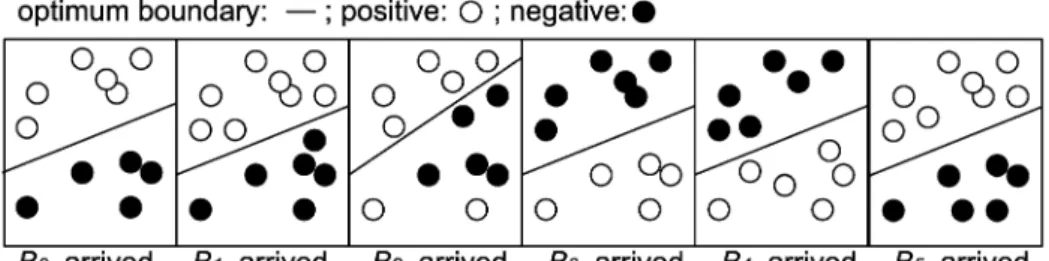
To make readers easily understand the problem we will address later, in this paper we di-vide the concept drift into concept stable, concept drift, and concept shift (Hsieh, 2004). We refer to the examples in (Wanget al., 2003) and modify the figures to illustrate the problem in Fig. 1. Fig. 1 represents a two-dimensional data stream and is divided into six continuous data blocks according to the arriving time of data. Instances arriving between
tiandti+1form blockBi, and the separating line in each block stands for the optimum classification boundary in this block. During timet0tot1, data blocksB0 andB1have
similar data distribution. That is, data stream during this period is stable. Thereafter inB2,
some instances shows concept drift and the optimum boundary changes. This is defined as “concept drift”. Finally, data blocksB4andB5have opposite sample distribution and
this is defined as “concept shift”. Obviously, since the sample distributions of the first two blocksB0andB1are quite close, we can use decision treeDT0built byB0as the
clas-sifier forB1to save the computational and recording cost. Meanwhile,B2shows slight
differences when compared with the sample distribution ofB1and an efficient approach
Fig. 1. A data stream with the occurrence of concept drift.
Besides, in Section 2, we have showed that the proposed solutions are not sensible enough to the drifting concepts. That is, the proposed solutions can detect the changes until the number of drifting instances reaches a threshold to cause obvious difference in accuracy or information gain. Here we describe another concept drift problem which would enforce some proposed solutions such as CVFDT and DNW make a wrong pre-diction. In order to introduce this problem, we subdivide concept drift intoone-way drift andtwo-way drift(Hsieh, 2004). Take Fig. 1 as the example again, we can find that some negative data inB2drift to be positive data inB3, known as one-way drift. However, the
positive data inB4drift to be negative inB5, and vice versa, known as two-way drift. We
can regard two-way drift as a kind of “local” concept shift if it occurs in the internal or leaf node of a decision tree. If the variation of information gain or gini index is used as the criterion to judge the occurrence of concept drift, e.g., the difference of information gain adopted in CVFDT, we can detect only one-way drift since the information gain ob-tained fromB4would the same asB5. It is worth to note that for the real data, two-way
drift might happen. For example, a hacker in turn uses two computers with IP address
xandyto send attack packages. When an internal node, which is learned from the first data block, splits the packages formxas safe and that fromyas attack, there might be a contrary result learned from another data block. A similar condition might be found in trash mail protection, image comparison and so on.
3.2. Class Distribution on Attribute Values
Since the proposed solutions to mine concept-drifting data stream check the occurrence of concept drift on the level of instance or attribute, they generally are not sensitive enough. Besides, they are also unable to detect the two-way drift illustrated in Fig. 1. To solve these problems, SCRIPT probe the changes at a more detailed level, which is calledCDAV (Class Distribution on Attribute Values) and defined as follows.
DEFINITION1. Assuming that a data block containsmtarget classesck(k= 1, . . . , m),
nattributesai (i = 1, . . . , n), and each attributeai havingv attribute valuesaij (j =
1, . . . , v), then the distribution of target classckon the attribute valueaijis defined as a
With Definition 1, we can use theX2test to check if there are concept drift between two data blocks.X2is a statistical measure used to test the hypothesis that two discrete
attributes are statistically independent. Applied to the concept problem, it tests the hy-pothesis that the class distribution on an attribute value of two data blocks is identical. The formula to computing theX2value is
X2= (f
ijk−fijk)2
fijk
, (1)
wherefijkrepresents the number of instances having attribute valueaij and classckin
Dandfijk is that inD. With Formula (1), we can then define the variance of aCDAVij in the two data blocks as follows.
DEFINITION2. For a given significant levelα, the varianceCDAVD→D(i, j)of the a
CDAVijbetween two data blocksDandDin a data stream is defined as
CDAVD→D(i, j) = m k=1 (fijk −fijk)2 fijk . (2)
PROPOSITION. For the two data blocksDandD, if allCDAVD→D(i, j)< ε, then the concept distribution on all attribute valueaij in the two data blocks show no significant difference, and neither do the accuracy of decision tree built according to D andD, respectively.
Proof. Since CDAVD→D(i, j) < ε, we can obtainfijk ∼= fijk for target classesck (k= 1, . . . , m), attributesai(i= 1, . . . , n) and attribute valueaij.
For attributeai, the Entropy before the splitting is
I(ai) =− m k=1
PiklogPik,
wherePik =fi+k/N,fi+kdenotes the total number of instances belonging to classck as shown in Table 1, andNdenotes the total number of instances in the data block.
Sincefijk∼=fijk andN=Nwe can obtain
Pik=fi+k/N= v j=1 fijk/N∼=− v j=1 fijk /N=fi+k/N=Pik .
Continually, we can obtain that
− m k=1 PiklogPik∼=− m k=1 Pik logPik and I(ai)∼=I(ai). (3)
Suppose we splitting all instancesN into v subset by attribute ai, the Entropy of attributeaiafter splitting is
E(ai) = v j=1 fij+ N × − m k=1
PijklogPijk
, (4)
wherePijk = fijk/fij+,fij+ denotes the total number of instances having attribute
valueaijas shown in Table 1.
Sincefijk ∼=fijk we can infer that for the attribute valueaij
fij+∼=fij+. (5)
As a result, we can also obtain that
Pijk ∼=Pijk and − m k=1
PijklogPijk=∼=− m k=1
Pijk logPijk . (6)
From (4), (5) and (6), we can get that
E(ai)∼=E(ai). (7)
From (3) and (7), we can get that
Gain(ai) =I(ai)−E(ai)∼=I(ai)−E(ai) =Gain(ai).
That is, theInformation gainof attributeaiin data blocksDandDis similar.
As a result, the two decision trees which are respectively built by using blocksDand
Dwill be similar.
By this Proposition and Formula 2, we can detect any kind of concept drift between two data blocks and then build an accurate decision tree. The significance level can be set to be smaller or larger according to the needs of applications. With a given significance level, we can obtain the εby checking the X2 table in a statistical book. The degree
Table 1
The class distribution on an attributeai
Class\value ai1 ai2 . . . aiv Summation c1 fi11 fi21 fiv1 fi+1 c2 fi12 fi22 fiv2 fi+2 . . . . . . . . . . . . . . . . . . cm fi1m fi21 fivm fi+m Summation fi1+ fi2+ fiv+ N
of freedom will be 1 less than the number of classes. Suppose that we set the level of significanceα= 5%and there are three classes, if allCDAVD→D(i, j)are less thanε=
5.991, that means the class distribution on all attributes shows no significant difference betweenDandDwith 95% confidence. As a result, the information gain obtained from any attribute will show no significant difference and the decision tree need not to be rebuilt. Note that the purpose of our Proposition is to claim that a rebuild tree will have very similar accuracy to that of original one, rather than to guarantee the rebuild tree will be a copy of the original one.
For clearly understand our idea, a case with two datasetsD andD is presented in Table 2. Each of the two sets has two attributesA1andA2, and each attribute has three
attribute values (a11, a12, a13;a21, a22, a23). There are total 500 instances and two classes
arec1andc2in each dataset. Assuming that the level of significanceα= 5%(degree of
freedom= 1andε= 3.841), we can infer the following by Formula 2:
CDAVD→D(1,1) = 0.6723< ε; CDAVD→D(1,2) = 0.5948< ε;
CDAVD→D(1,3) = 0.5326< ε; CDAVD→D(2,1) = 2.7763< ε;
CDAVD→D(2,2) = 1.7223< ε; CDAVD→D(2,3) = 1.5948< ε.
Since allCDAVs have no significant difference, by our Proposition mentioned above, the decision trees built respectively withDandDwould be very similar. To verify this, we build the two decision trees and show the corresponding rules. The rules obtained from data setDare:
(1)A1=“a12”→c2; (2)A1= “a13”→c2;
(3)A1= “a11”∩A2= “a21”→c2; (4)A1= “a11”∩A2= “a22”→c1;
(5)A1= “a11”∩A2= “a23”→c2.
And the rules obtained from data setDare:
(1)A1= “a12”→c2; (2)A1= “a13”→c2;
(3)A1= “a11”∩A2= “a21”→c2; (4)A1= “a11”∩A2= “a22”→c1;
(5)A1= “a11”∩A2= “a23”→c2.
We can find that the two decision tree have identical rules. This result corresponds to our Proposition.
Table 2
Two data setsDandDwithout occurrence of concept drift
Dataset D D
attribute A1 A2 A1 A2
Attribute value a11 a12 a13 a21 a22 a23 a11 a12 a13 a21 a22 a23
class c1 192 41 13 18 216 12 198 42 12 25 211 15
COROLLARY. By above Proposition, we can infer that if the variance of CDAV for the two data blocks D and D is greater than or equivalent to a threshold ε, (i.e.,
CDAVD→D(i, j) ε), then concept drift may occur betweenDandD. As a result, the original decision tree needs to be corrected.
Here, we use the two datasets in Table 3 modified from Table 2 to illustrate this Corol-lary. Again assuming that the level of significantα = 5% (degree of freedom= 1and
ε= 3.841), we can infer the following by Formula 2:
CDAVD→D(1,1) = 3.0848< ε; CDAVD→D(1,2) = 1.5402< ε;
CDAVD→D(1,3) = 5.9085> ε; CDAVD→D(2,1) = 1.8754< ε; CDAVD→D(2,2) = 0.4274< ε; CDAVD→D(2,3) = 2.7299< ε. SinceCDAV13 achieves significant difference, by above Corollary, we can claim that
concept drift occurs and the decision trees built respectively withD andD would be different. To verify this, we again show the corresponding rules for two trees as follows. The rules obtained from data setDare:
(1)A1= “a12”→c2; (2)A1= “a11”∩A2= “a21”→c2;
(3)A1= “a11”∩A2= “a22”→c1; (4)A1= “a11”∩A2= “a23”→c2;
(5)A1=“a13”→c2.
And the rules obtained from data setDare:
(1)A1= “a12”→c2; (2)A1= “a11”∩A2= “a21”→c2;
(3)A1= “a11”∩A2= “a22”→c1; (4)A1= “a11”∩A2= “a23”→c2;
(5)A1=“a13”∩A2=“a21”→c2; (6)A1=“a13”∩A2=“a22”→c1; (7)A1=“a13”∩A2=“a23”→c2.
By comparison, we can find that the ruleA1 = a13 → c2in datasetD have some
changes in data setD; the results correspond to our Corollary. 3.3. Correcting Mechanism in SCRIPT
As described in Introduction, drifting instances should gather in some specific areas in the dimensional space of attributes, otherwise they can be regarded as noise instances.
Table 3
Two data setsDandDwith occurrence of concept drift
Dataset D D
attribute A1 A2 A1 A2
Attribute value a11 a12 a13 a21 a22 a23 a11 a12 a13 a21 a22 a23
class c1 192 41 13 18 216 12 203 34 20 23 208 16
Accordingly, another advantage ofCDAV is that it can reveal which attribute values cause concept drift before building the decision tree by aggregating the driftingCDAVs. This will enable SCRIPT to efficiently and immediately amend the original decision tree. In the example in Table 3, we can recognize the concept drift is caused by attribute value
a13. Therefore, we can only correct the subtree rooted at a13 to efficiently correct the
decision model.
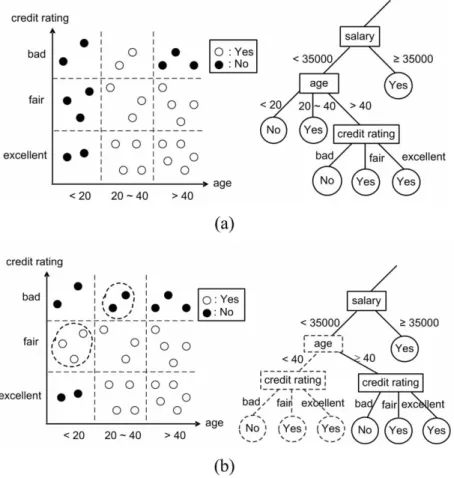
We use Fig. 2 to further illustrate the idea of correcting mechanism in SCRIPT. Fig. 2(a) is a decision tree trained from old customer’s data to predict if a customer will apply for credit cards. For better understanding, only the subtree rooted at attribute “salary” is shown. A similar decision tree, except that it is trained from new customer’s data stream, is shown in Fig. 2(b). By comparison with the CDAVs in Fig. 2(a) and Fig. 2(b), we can find that some concept in new data block is significantly different from that in old one. More importantly, we can find that these changes gather up in the branch of “age < 20 and 20age < 40”. Accordingly, the aggregated drifting CDAVs
Fig. 2. Two data blocks with the occurrence of concept drift: (a) original data block and the corresponding sub-tree; (b) new data block and the corresponding sub-tree.
is 0age < 40 and it means that a people younger than 40 have changed his concepts in this example. To efficiently provide a decision tree suitable for new customers’ data block, we can only correct the subtree rooted at 0age < 40 as in Fig. 2(b).
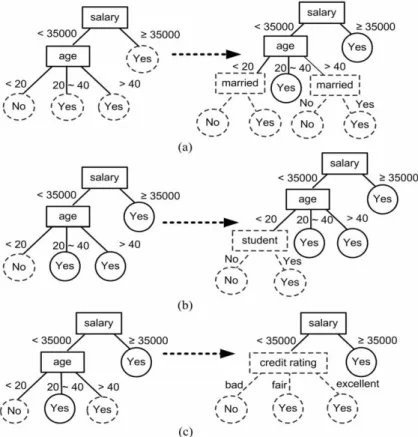
Now, we detail the correcting mechanism in SCRIPT. In the processing of data stream, when the difference of CDAV between new data blockBtand original data blockBt−i (t i 1) is greater than the given threshold (the level of significance is set 0.05 as the default), the correct methods in SCRIPT can be divided into the following cases. The corresponding illustration of each case is shown in Fig. 3. In each case of Fig. 3, the dotted node in the left tree (original tree) denoted the occurring of concept drift and the dotted subtree in the right tree (new tree) is an alternate tree built by SCRIPT.
For each aggregated drifting CDAV in attributeaiwith value(s)aij
a. If attribute ai was not a split attribute of a node in the original decision tree; SCRIPT will use this attribute to split all leaf nodes by using data blockBt. Such a variation of CDAV indicates that an attribute with originally little information changes into an optimal split attribute due to concept drift. We illustrate this con-dition in Fig. 3(a).
b. If attributeai was a split attribute of a node in the original decision tree and all
CDAVs group in an interval aij, SCRIPT will remove the subtree rooted at the attribute valueaij from the original tree and use data blockBtto build the alter-native tree. Such a variation means concept drift is caused by a fixed rangeaijof the attributeai. Take Fig. 3(b) for example, for the attribute age, those under 20 were originally inclined not to apply for credit cards; however, with the growing consuming ability of students, more and more are applying.
c. If attributeai was a split attribute of a node in the original decision tree but all CDAVs are scattered in several interval, SCRIPT will removes the subtree rooted at this attributeaifrom the original tree and use data blockBtto build the alterna-tive tree. Such a variation represents concept drift is caused by the attributeaibut within multiple ranges of the attribute. For instance, for the attribute of age, people younger than 20 and older than 40 were originally both inclined not to apply for credit cards; however, with the change of payment types, more and more are apply-ing. In this case, “age”, no longer the optimal split attribute, is replaced by “credit rating”, according to a test result. This case is illustrated in Fig. 3(c).
Note that all aggregated drifting CDAVs might distribute among several attributes and SCRIPT will check if they are in the same path in the original tree before the correctness. If two aggregated CDAVs are in the same path, the one locates in the highest level will be reserved and the other will be deleted.
3.4. SCRIPT Algorithm
Combine Section 3.1 to 3.3, we summary our Sensitive Concept Drift Probing Decision Tree (SCRIPT) algorithm in this section. Based on the variation of CDAV (Class Dis-tribution on the Attribute Value), SCRIPT aims to apply to large scale and high speed applications which also require the sensitiveness to handle the drifting concepts. SCRIPT cuts the data stream into sequential data blocks. When the test threshold is set asα, each training data in the block should be read no more than once and processed in minimal constant time while concepts are stable. While concepts are instable, SCRIPT would de-tect concept drift, and then build the alternate tree to correct previously built tree. The pseudo code of SCRIPT is shown in Fig. 4. Giving the size of data blockN(1000as the default) and the significance levelα(0.05as the default), SCRIPT calculates the CDAVs in data blockB0in Line 4 as the initial reference. Note that,Ncan be set larger in a high
speed environment or smaller for the real time application; however,fijkmust be larger than 5 which is a basic requirement inX2statistics test. Similarly,αcan be set smaller if the detection of concept drift is very important and larger otherwise. The default signifi-cant levelαin SCRIPT is set as 0.05 since this value is widely used as the default in the statistic. It is not hard to imagine that SCRIPT will be more sensitive to the concept drift but may require more computational cost if we use a larger significant levelα; on the contrary, SCRIPT will be more tolerant to the noise data with a smallerα. The CDAV of new coming blockBt+1is calculated in Line 6 to 10. The CDAVs of two data blocksBt andBt+1are compared in Line 11 to 14. All drifting CDAVs are then aggregated in Line
16 for the purpose of efficiently correcting the decision model in Line 22 to 31. Finally, the recorded information is updated in Line 32.
Inputs:N: the size of the block (1000 as the default); Bt: the data block in time stept;
α: the level of significance (0.05 as the default);
Procedure SCRIPT(N, α, Bt) /* Initialization */
1. t= 0;
2. Build the original decision treeDT0byB0;
3. Record the set of split attributes ofDT0inSplitatt[]; 4. Count theCDAVs inB0and record them inRCDAV[ ];
/* Detect the concept drift and correct the original decision tree */
5. t=t+ 1
6. For the new coming data blockBtin time stept
7. For each instance (ai, ck)inBtinS
8. For each valueaijof each attributeai∈A
9. For each classck
10. CountCDAVkjkinRCDAV[ ];
11. For eachCDVijin the new data block
12. If |CDAVt−1→t(i, j)|> ε
13. Record thisCDAV inDCDAV[ ];
14. End if
15. IfDCDAV[ ]is not empty
16. Aggregate the recorded CDAVs;
17. For all aggregated CDAVs
18. If two aggregated CDAVs are in the same path in the original decision tree
19. Reserve the one locates in the highest level inACDAV[ ];
20. End if
21. Update ;
22. For all aggregated CDAVs belonged to attributeaiinACDAV[ ] 23. If attributeaiis not inSplitatt[]
24. Build an alternative tree rooted at this node by usingBt;
25. Elseif attributeaiis inSplitatt[] and all aggregated CDAVs inaigroup in an intervalaij
26. Remove the subtree rooted at this attribute valueaijfromDTt−1; 27. Use the new data blockBtto build the alternative tree rooted ataij; 28. Else
29. Remove the subtree rooted at this attributeaifromDTt−1; 30. Use the new data blockBtto build the alternative tree rooted ataj; 31. End if
32. UpdateSplitatt[] ,RCDAV[ ], and the recorded decision tree;
33. End If
34. Return.
Fig. 4. The pseudo code of SCRIPT algorithm.
3.5. The Comparison of System Cost Among SCRIPT, DNW, and CVFDT
In this section, we compare the system cost of SCRIPT to that of two state-of-the-art window-based approaches: DNW and CVFDT. Assumed a data block has iattributes,
CDAVs, it has a small memory costO(ijk). SCRIPT also needs to record a decision tree and the split attributes in this tree, however, the memory cost isO(n)and can be ignored, wherenis the number of nodes of the recorded decision tree. For CVFDT, since it has to record the counting in each node of the recorded decision tree, the memory cost needed will beO(nijk). DNW, which is a sliding window approach, might have a worst record cost since it record instances instead counting and new data blocks might have to be mixed into old ones. If the maintained data iswtimes as much as that of a new data block, then the needed memory cost will beO(wN i), whereNis the number of instances in the block .
In the aspect of computational cost, while the concept is stable, SCRIPT only needs to carry outi×jtimes of comparisons to see if there are any drifting CDAVs. There-fore, the required computational cost ofO(ij). If we use CVFDT, we have to check the information gain for each attribute in each node of decision tree when a new data block is given. If the tree hasnnodes, the computational cost needed would beO(nijk) (Klin-kenberg and Renz, 1998). For DNW, the computational cost would beO(nwN i)since the tree is rebuilt from scratch. When the concept drifts, DNW and CVFDT have a sim-ilar computational cost to that in stable stream. Since SCRIPT directly correcting some sub-trees by checking the drifting CDAVs, the computational cost of the rebuilding is
O(ij) +O(nijk), wheren nandO(ij)is responsible for the comparison of CDAVs andO(nijk)is the computational cost for the rebuilding of sub-trees. Comparisons of system cost among SCRIPT, DNW, and CVFDT in stable and drifting data stream are summarized in Table 4. In summary, SCRIPT has the smallest memory requirement and computational cost when concept is stable. When concept drifts, SCRIPT still requires the smallest memory cost and a better or comparable computational cost.
4. Empirical Analysis
In this section, two the-state-of-art data stream mining algorithms, DNW and CVFDT, are implemented to compare with our SCRIPT. We run all experiments on a PC equipped with Windows XP professional operating system, Pentium III 1GHz CPU and 512mb Sdram memory. For the preset of parameters in DNW, we refer to (Klinkenberg and Renz, 1998) and setα= 5.0, β= 0.25, andγ= 0.50.
Table 4
The Comparisons of system cost among SCRIPT, DNW, and CVFDT
Concept Stable Concept Drift
Algorithm
Memory Cost Computational Cost Memory Cost Computational Cost DNW O(wN i) O(nwN i) O(wN i) O(nwN i) CVFDT O(nijk) O(nijk) O(nijk) O(nijk) SCRIPT O(ijk) O(ij) O(ijk) O(nijk)
4.1. Experimental Datasets
We select three datasets from UCI databases in which the number of instances is larger than 4000 as our experimental datasets. UCI database (UCI Repository of Machining Learning Database) is a repository of several kinds of datasets and these datasets are widely used by the machine learning community for the empirical analysis. The summary of the four real datasets is shown in Table 5. To simulate a data stream, for each UCI dataset we first divide it into three data blocksB0, B1, andB2to simulate a stable data
stream. Then, we code a program to generate consecutively data blocks contain drifting concepts by modifyingB2. As described in Introduction and Section 2, one purpose of
SCRIPT is to detect the drifting concepts more sensitively to make it suitable for the applications in which a small part of drifting concepts would cause large damage. To evaluate the sensitiveness about the detection of concept drift, we set the drifting ratio as 1%; that is, there areN×(t−2)% drifting instances in the data blockBtin time stept (t2), whereNis the number of instances inB0. This program works as follows. First,
it randomly picks up one instanceSin data blockBtand randomly selects attributesam (1m10) for reference. The target classes of instances, which have the same values to that of S in all attributesam, are then changed. We limit the number of referable attributes less than 10 since drifting concepts should be caused by some but not a lot attribute values. For example, age and salary may influence the application of credit cards but weight and height will not; IP address and the number of sending packages may be the main basis to find a PC which sends virus package; fraudulent credit card transactions can be detected by the payment amount and location. If the number of drifting instances is less than the requirement, the program goes on next loop to get more drifting instances. On the contrary, if there are more instances satisfy the requirement,N%instances are randomly picked up as drifting ones. Consequently, for each UCI dataset, we generate 13 data blocks (B0∼B13)and each data block is divided into 10 parts of which nine parts
are used as training dataset to calculate the execution time and the remaining one as the testing dataset to count the accuracy. Each generated data stream would correspond to our assumption described in Introduction and Section 3.3 that drifting instances should gather in some specific areas in the dimensional space of attributes, otherwise they can be regarded as noise. Finally, to get an objective result, all experiments were repeated 100 times to obtain the average.
Table 5
The summary of three experimental UCI datasets
Dataset Number of instances Number of attributes Number of classes
satimage 6435 36 6
thy 7200 21 3
4.2. The Comparison of Accuracy
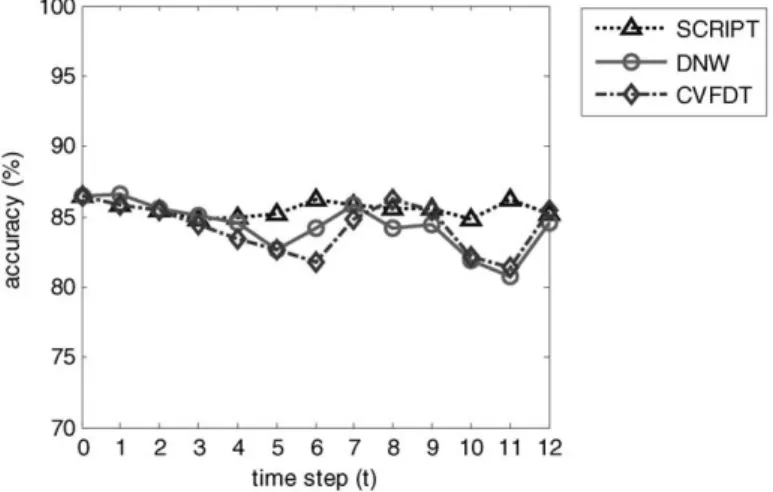
Figs. 5–7 illustrates the comparison of accuracy among DNW, CVFDT, and SCRIPT ont. In Figs. 5–7, we can find that SCRIPT has a similar accuracy to that of DNW and CVFDT in stable data blocksB0toB2. It follows the Proposition mentioned in Section 3.2 that
when concept is stable, the accuracy of the SCRIPT is similar to that of classifier which is rebuilt. When there are drifting concepts from data blocksB3 toB12, we can find
SCRIPT is much more sensitive than DNW and CVFDT. That is, SCRIPT always keeps a high accuracy but DNW and CVFDT can detect the changes until the number of drifting instances reaches a threshold to cause obvious difference in accuracy or information gain. Take the satimage dataset in Fig. 5 for example, DNW averagely recognizes the drifting concepts in blocksB6, B7andB12and therefore reduce the window size to build an
up-Fig. 5. The comparison of accuracy on satimage.
Fig. 7. The comparison of accuracy on spambase.
to-date decision tree; CVFDT averagely uses the alternate subtree to correct the original classification model to raise the accuracy in time step 7, 8 and 12. Similar conditions occur in thy and spambase dataset: in thy, DNW usually discovers the changes in time step 7, 8, and 12, and in time step 8 and 9 in spambase; CVFDT averagely recognizes the drifting concepts in time step 6, 7, and 11in thy and spambase dataset.
4.3. The Comparison of Execution Time
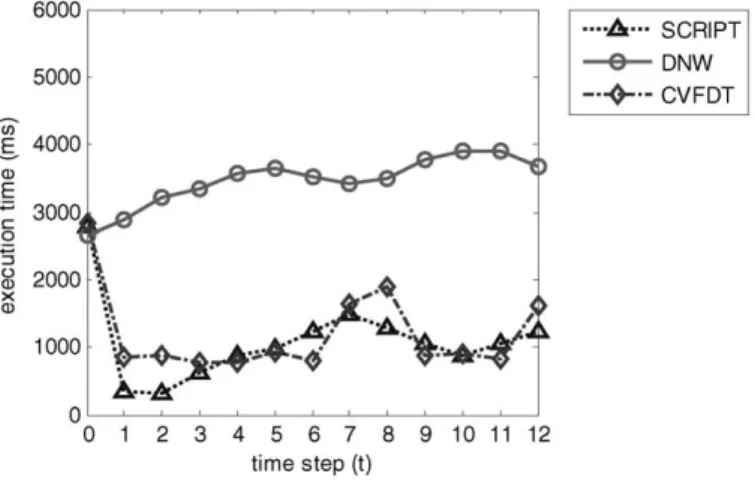
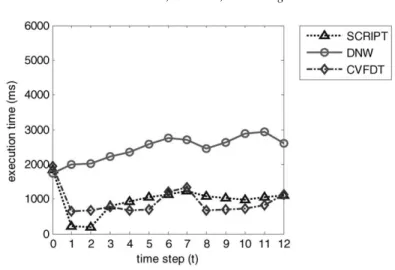
In the aspect of comparison of execution time in Figs. 8–10, SCRIPT, DNW, and CVFDT have a similar execution time for the building of the first decision tree in data blockB0.
However, SCRIPT and CVFDT requires a little more execution time in the initial step since SCRIPT needs to calculate the CDAVs and CVFDT must record the counts in each node. After the beginning step, SCRIPT is much more efficient than DNW and CVFDT
Fig. 9. The comparison of execution time on thy.
Fig. 10. The comparison of execution time on spambase.
when concept is stable in time step 1 and 2. When concept drifts, the execution time of SCRIPT is worse than that of CVFDT in most cases. However, this is caused by the fact that SCRIPT recognizes the drifting concepts and therefore needs more execution time to correct the original decision tree in these time steps. It is worth to note that when both SCRIPT and CVFDT detect the drifting instances and correct the decision tree, e.g., in time step 7, 8 and 12 in Fig. 8, SCRIPT is more efficient than CVFDT. The reason is SCRIPT can immediately know which sub-trees should be amended by checking the drifting CDAVs but CVFDT have to check the variation of information gain node by node from the root. Similar condition can be found in time step 6 and 7 in thy and spambase dataset. DNW, which builds a new classifier in each time step, always has the worst computational cost. The computational is much worse as time goes by since DNW does not recognize the concept drift and therefore mixes the new data block into the old one.
4.4. The Analysis of Significance Levelα
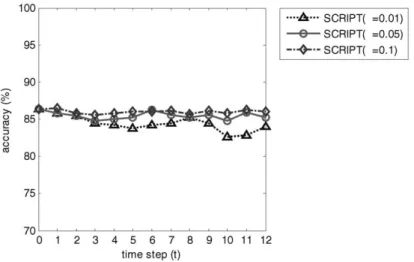
Finally, in this section, we use the three drifting datasets generated in Section 4.1 to evaluate our SCRIPT on different levels of significance. Due to the content limit and the similar results on three datasets, we only illustrate the result of satimage in Fig. 11 and 12. As inferred in Section 3.4, SCRIPT will be more sensitive to the concept drift but should require more computational cost if we use a larger significant levelα;on the contrary, SCRIPT will be more tolerant to the noise data with a smallerα. The experi-mental results in the three datasets correspond to our inference. In Fig. 11, SCRIPT with a higher significance level (0.1 in this example) can on average reach a higher accuracy. The reason is that the hypothesis which assumes the class distribution in two data block
Fig. 11. The comparison of accuracy of SCRIPT with different levels of significance on satimage.
is identical will be rejected more easily when the significance level is larger. Therefore, a small number of drifting instances will make SCRIPT to correct the original decision tree. Relatively, as illustrated in Fig. 12, SCRIPT with a higher significance level aver-agely needs more execution time to implement the correct mechanism. It is also worth to note that in the stable data blocksB1andB2, SCRIPT with significant level 0.01 still
correct the decision tree constructed byB0. This is occurred by the fact that we randomly
split the original dataset into three subsets to simulate a stable data stream and the three data blocks might contain some inconsistency caused by the random sampling.
5. Conclusions
Mining drifting concepts on data stream has become a novel research topic of growing interest in knowledge discovery. However, while the concept is stationary, the proposed methods spend a lot unnecessary system cost, including computational cost to rebuild the decision tree or storage cost to record similar data blocks. Moreover, they generally are not sensitive enough to the concept drift problem. In this paper, we propose a Sensitive Concept Drift Probing Decision Tree algorithm, called SCRIPT, to handle this problem. The Proposition in Section 3.2 verifies the validity for SCRIPT to determine if concept drift exists between two data blocks. The experiments in Section 4 also show that SCRIPT can sensitively, accurately, and efficiently handle the drifting concepts on data stream. Acknowledgments
This research was partially supported by the National Science Council of Republic of China under Grant No. NSC 96-2520-S-024-002.
References
Agrawal, R., S. Ghosh, T. Imielinski, B. Iyer and A. Swami (1992). An interval classifier for database mining applications. InProceedings of the 18th International Conference on Very Large Databases. pp. 560–573. Blum, A. (1997). Empirical support for winnow and weighted-majority algorithms: results on a calendar
scheduling domain.Machine Learning,26, 5–23.
Cohen, W. (1996). Learning rules that classify e-mail. InProceedings of the AAAI Spring Symposium on Ma-chine Learning in Information Access. Menlo Park, CA. AAAI Press, Technical Report SS96-05. pp. 18–25. Chawla, N.V., L.O. Hall, K.W. Bowyer, T.E. Moore and W.P. Kegelmeyer (2002). Distributed pasting of small
Votes. InMultiple Classifier Systems. pp. 52–61.
Domingos, P., and G. Hulten (2000). Mining high-speed data streams. InProceedings of the Sixth International Conference on Knowledge Discovery and Data Mining. Boston, MA. ACM Press. pp. 71–80.
Fan, W. (2004). Systematic data selection to mine concept-drifting data streams. InProceedings of the10th ACM SIGKDD International Conference on Knowledge Discovery and Data Mining. pp. 128–137. Gehrke, J., R. Ramakrishnan and V. Ganti (2000). RainForest: a framework for fast decision tree construction
of large datasets.Data Mining and Knowledge Discovery,4(2/3), 127–162.
Han, J., and M. Kamber (2001).Data Mining:Concepts and Techniques. Morgan Kaufmann Publisher. Harries, M.B., C. Sammut and K. Horn (1998). Extracting hidden context.Machine Learning,32(2), 101–126. Hsieh, C.H. (2004).An Efficient Approach for Mining Concept-Drifting Data Streams. Master thesis. Institute
of Information Education, National University of Tainan, Taiwan, R.O.C.
Hulten, G.., L. Spencer and P. Ddmingos (2001). Mining time-changing data streams. InProceedings of the 7th ACM SIGKDD International Conference on Knowledge Discovery and Data Mining. San Francisco. pp. 97–106.
Jegeleviˇcius, D., A. Lukoševiˇcius, A. Paunksnis and V. Barzdziukas (2002). Application of data mining tech-nique for diagnosis of posterior uveal melanoma.Informatica,13(4), 455–464.
Jin, R., and G. Agrawa (2003). Efficient decision tree construction on streaming data. InProceedings of the 9th ACM SIGKDD International Conference on Knowledge Discovery and Data Mining. Washington, DC. pp. 571–576.
Japkowicz, N., and S. Stephen (2002). The class imbalance problem: a systematic study.Intelligent Data Anal-ysis,6(5), 429–450.
Koychev, I. (2000). Gradual forgetting for adaptation to concept drift. InProceedings of ECAI 2000 Workshop in Spatio-Temporal Reasoning. Berlin, Germany.
Kifer, D., S. Ben-David and J. Gehrke (2004). Detecting change in data streams. InProceedings of the 30th International Conference on Very Large Databases. Toronto, Canada. pp. 180–191.
Kolter, J.Z., and M.A. Maloof (2003). Dynamic weighted majority: a new ensemble method for tracking concept drift. InProceedings of the 3rd International IEEE Conference on Data Mining. Melbourne, FL. pp. 123– 130.
Kuh, A., T. Petsche and R. L. Rivest (1991). Learning time-varying concepts. InIn Advances in Neural Infor-mation Processing Systems 3, vol. 3. Morgan Kaufmann, San Francisco, CA. pp. 183–189.
Klinkenberg, R., and I. Renz (1998). Adaptive information filtering: learning in the presence of concept drifts. InProceedings of International Conference on Machine Learning. Menlo Park, California. pp. 33–40. Maloof, M.A., and R.S. Michalski (2000). Selecting examples for partial memory learning.Machine Learning,
41(1), 27–52.
Maloof, M. (2003). Incremental rule learning with partial instance memory for changing concepts. In Proceed-ings of the International Joint Conference on Neural Networks. IEEE Press, Los Alamitos, CA.
Mehta, M., R. Agrawal and J. Rissanen (1996). SLIQ: a fast scalable classifier for data mining. InProceedings of the 5th International Conference on Extending Database Technology.Lecture Notes in Computer Science. Springer-Verlag. pp. 18–32.
Misevicius, A. (2006). Experiments with hybrid genetic algorithm for the grey pattern problem.Informatica, 17(2), 237–258.
Quinlan, J.R. (1993).C4.5:Program for Machine Learning. Morgen Kaufmann Publisher, San Mateo, CA. Rastogi, R., and K. Shim (1998). PUBLIC: a decision tree classifier that integrates building and pruning. In
Proceedings of the 24th International Conference on Very Large Databases. pp. 404–415.
emeikis, N., I. Skuˇcas, V. Melninkait˙e (2004).Text categorization using neural networks initialized with decision trees.Informatica,15(4), 551–564.
Shafer, J.C., R. Agrawal and M. Mehta (1996). SPRINT: a scalable parallel classifier for data mining. In Pro-ceedings of the 22th International Conference on Very Large Databases. pp. 544–555.
Schlimmer, J.C., and D.H. Fisher (1986). A case study of incremental concept induction. InProceedings of the 5th International Conference on Artificial Intelligence. Philadelphia, PA. pp. 496–501.
Schlimmer, J., and R. Granger (1986). Beyond incremental processing: tracking concept drift. InProceedings of 5th National Conference on Artificial Intelligence. Philadelphia, PA. pp. 502–507.
Street, W., and Y. Kim (2001). A streaming ensemble algorithm (sea) for large-scale classification. In Proceed-ings of 7th International Conference on Knowledge Discovery and Data Mining. New York. pp. 377–382. Utgoff, P.E. (1989). Incremental induction of decision trees.Machine Learning,4(2), 161–186.
Wang, H., W. Fan, P.S. Yu and J. Han (2003). Mining concept-drifting data streams using ensemble classifiers. InProceedings of 9th ACM SIGKDD International Conference on Knowledge Discovery and Data Mining. Washington, DC. pp. 226–235.
Widmer, G., and M. Kubat (1996). Learning in the presence of concept drift and hidden contexts.Machine Learning,23(1), 69–101.
C.-J. Tsaiwas born in Tainan, Taiwan, Republic of China, 1973. He received the BS degree in mathematics and science education from National Ping Tung University of Ed-ucation in 1995 and M.S. degrees in information edEd-ucation from National University of Tainan in 2000. Currently, he is a PhD student in the Department of Computer Science in National Chiao Tung University, Hsinchu, Taiwan, Republic of China. His current research interests include data mining, database theory and application, information re-trieval, e-learning, and information system.
C.-I Leewas born in Taipei, Taiwan, Republic of China, 1965. He received the BS degree in computer science from Feng Chia University in 1987 and MS degree in applied math-ematic from National Sun Yat-Sen University in 1993. He received the PhD degree in computer science from National Chiao Tung University in June 1997 and then joined the Graduate Institute of Computer Science and Information Education, National University of Tainan, Tainan, Taiwan, Republic of China. He is currently an associate professor and his research interests include data mining, e-learning, multimedia databases and informa-tion retrieval.
W.-P. Yanwas born on May 17, 1950 in Hualien, Taiwan, Republic of China. He received the BS degree in mathematics from National Taiwan Normal University in 1974, and the MS and PhD degrees from the National Chiao Tung University in 1979 and 1984, respec-tively, both in computer engineering. Since August 1979, he has been on the faculty of the Department of Computer Science and Information Engineering at National Chiao Tung University, Hsinchu, Taiwan. In the academic year 1985–1986, he was awarded the Na-tional Postdoctoral Research Fellowship and was a visiting scholar at Harvard University. From 1986 to 1987, he was the director of the Computer Center of National Chiao Tung University. In August 1988, he joined the Department of Computer and Information Sci-ence at National Chiao Tung University, and acted as the head of the Department for one year. Then he went to IBM Almaden Research Center in San Jose, California for another one year as visiting scientist. From 1990 to 1992, he was the head of the Department of Computer and Information Science again. He was the visiting scholar of the University of Washington in Seattle for one year in 1996–97. He was the director of University Li-brary from 1988–2004. Since 2004 he has transferred to National Dong Hwa University at Hualien and acted as the head of the Department of Information Management. Now he is the dean of School of Management. His research interests include database theory and application, information retrieval, data miming, digital library, and digital museum. Dr. Yang is also a senior member of IEEE, and a member of ACM.
Efektyvus ir patikimas sprendim
u medžio metodas kintamos koncep-
cijos duomen
u gavybai
Cheng-Jung TSAI, Chien-I LEE, Wei-Pang YANG
Duomenu sraut u duomen u gavyba yra žini u technologija, kuriai pastaruoju metu skiriama ne- mažai d˙emesio. Dauguma duomenu sraut u tyrimo algoritm u remiasi prielaida, kad analizuojami informacijos blokai yra atsitiktiniai, o ju skirstiniai stacionar¯us. Taˇciau daugelio duomen u bazi u atveju ši prielaida nepasitvirtina. Tai, kad laikui b˙egant kai kuriu klasi uiraš u turinys gali kisti, yra apib¯udinama koncepcijos kitimo savoka. Šiame darbe mes si¯ulome patikim a koncepcijos kitimo zondavimo sprendimu medžio (Sensitive Concept Drift Probing Decision Tree (SCRIPT)) algo- ritma, pagr ist a statistinio X2 testo taikymu koncepcijos kitimui nagrin˙eti. Palyginus su žinomais metodais SCRIPT pasižymi tokiais privalumais: a) padeda išvengti kaštu, susijusi u su stacionariais duomenu srautais; b) padeda greitai ir efektyviai koreguoti pradinius klasifikatorius, kai duomen u srautai yra nestabil¯us; c) yra ypaˇc efektyvi tais atvejais, kai reikalinga patikimaiivertinti koncepci- jos pokyˇcius.