
An Efficient Data Aggregation Scheme for
Privacy-Friendly Dynamic Pricing-based Billing and
Demand-Response Management in Smart Grids
Prosanta Gope and Biplab Sikdar,
Senior Member, IEEE
Abstract—Smart grids take advantage of information and com-munication technologies to achieve energy efficiency, automation and reliability. These systems allow two-way communications and power flow between the grid and consumers. However, these bidi-rectional communications introduce several security and privacy threats to consumers. One of the open challenges in this context is user privacy when smart meters are used to capture fine-grained energy usage information. Although considerable research has been carried out in this direction, most of the existing solutions invariably introduce computational complexity and overhead, which makes them infeasible for resource constrained smart meters. In this paper, we propose a privacy-friendly and efficient data aggregation scheme (EDAS) for dynamic pricing based billing and demand-response management in smart grids. To the best of our knowledge, this is thefirst paperto address privacy in the context of billing under dynamic electricity pricing. Security and performance analyses show that the proposed scheme offers better privacy protection for electric meter reading aggregation and computational efficiency, as compared to existing schemes.
Index Terms—Privacy, data aggregation, smart grids
I. INTRODUCTION
Smart-grids represent the next generation of power grids which use extensive monitoring and measurements to manage the operation of the grid, and achieve greater efficiency and cost reduction. The combined volatility of both power supply (e.g. with renewables) and power demand creates a growing problem that needs to be resolved by smart grids. To enable the envisioned energy management in smart grids, information on current power consumption and the availability of power needs to be exchanged between power consumers and power suppliers. Hence, smart grids need a framework of intercon-nected smart monitoring and measurement devices. Besides, with the recent development in smart grids, many endeavours have started to introduce the Internet of Things (IoT) as an enabling technology for smart grids since each device in the grid can be considered as a connected object [1]. In this regard, devices in the smart grid such as smart meters act as IoT devices that autonomously report their data to the grid infras-tructure by using information and communication technology (ICT). However, this interconnection of grid technology with information and communication technologies leads to various
P. Gope, is with Department of Computer Science, National Univer-sity of Singapore, 21 Lower Kent Ridge Rd, Singapore 119077. (E-mail: [email protected]/[email protected])
B. Sikdar is with Department of Electrical and Computer Engineering, National University of Singapore, 21 Lower Kent Ridge Rd, Singapore 119077. (Email: [email protected])
Corresponding author: P. Gope
security challenges in a power grid [2]. A key challenge and major obstacle in the widespread deployment of smart grids is privacy, which is a primary concern from the customer’s point of view.
In general, for pricing and feedback purposes, a smart grid relies heavily on the usage of a smart metering infrastructure. For instance, smart meter data is useful for load forecasting, demand-response management, and dynamic pricing. How-ever, the recording and transmission of power consumption profiles may cause serious privacy issues. For example, fine-grained power consumption data of a smart meter can be ex-ploited for revealing a consumer’s private information related to their daily routines or the appliances in the house. This can lead to personalized advertisements or be used extract information on when a house is empty. In [2], it is shown that complex usage patterns can be extracted from the high-resolution consumption information using simple off-the-shelf statistical tools, and the extracted information can be used to profile and monitor users for various purposes. Thus, energy usage data must be protected for privacy in a smart grid. Furthermore, the computational resources at the consumer’s side are usually very limited. Solutions for preserving user privacy should thus be computationally inexpensive.
A. Related Work
In order to address the privacy issues, several privacy-preserving data aggregation protocols have been proposed in recent years. Lu et al. designed a privacy-preserving data aggregation protocol [3] by using the Paillier homomorphic crypto-system [4], which results in a high computation over-head on the entities like smart meters. Liang et al. proposed a usage-based dynamic pricing scheme for smart grids [5] by using the fully homomorphic technique devised by Naehring et al. [6]. As fully homomorphic techniques are difficult to plement with current computing resources, this scheme is im-practical. Chia-Mu et al. [7] introduced a ring signature based scheme to protect usage profiles. However, its computational cost increases with the size of the ring. In [8], a mesh-network-based privacy-preserving data aggregation scheme has been proposed using elliptic curve cryptography (ECC). However, this scheme requires higher setup and computation cost. Zhang et al. have proposed a self-certified signature scheme [9] and Sui et al. have designed an incentive-based anonymous authentication scheme [10]. These are constructed with the assumption of an anonymity network, where the sources of © © 2018 IEEE. Personal use of this material is permitted. Permission from IEEE must be obtained for all other uses, in any current or future media, including reprinting/republishing this material for advertising or promotional purposes, creating new collective works, for resale or redistribution to servers or lists, or reuse of any copyrighted component of this work in other works.
usage reports are anonymous. Therefore, it is hard to identify any smart meter or communication failure. Li et al. introduced a different technique for data aggregation in smart grids in a hop-by-hop way [11], [12]. But it is still unclear how to construct the aggregation tree, and how to ensure aggregation in case of failure. Besides, the public key signatures used in these schemes result in higher computational cost. Apart from the schemes above, there are few more data aggregation protocols that have been introduced in recent years [13], [14], [15], [16]. In [13] a discrete logarithm problem (DLP)-based data aggregation scheme is introduced, in which the authors allows a substation to access private data using a shared key. Hence, this scheme cannot ensure strong privacy. In [14], Kursawe et al. suggested a set of masking-based schemes for privacy in smart grids. In their schemes, the authors utilized the concept of Decisional Diffie-Hellman (DDH) group and Bilinear mapping for checking the correctness of the shared masking value, which are computationally expensive and ill-suited for resource constrained smart meters. Knirsch et al. have also proposed a masking-based approach for data aggre-gation [15]. Their scheme utilizes the concept of homomorphic hashing for checking the correctness of the shared secrets. However, this construction has a couple of issues. First, it is complicated to implement and computationally expensive to execute. Second, it cannot ensure security of the hashed data, and an attacker can compute the original message block by taking the logarithm of the hash for that block. In [16] a Paillier homomorphic encryption based data aggregation protocol is proposed. However, in the proposed scheme, the usage reports transmitted by each smart meterSMireveals it’s
identityIDSMi, which is fixed for all transactions. Therefore,
an adversary can easily understand that the usage data is from the same consumer’s end and can easily link the IDSMi to an
actual user. Thus, the scheme presented in [16] cannot ensure anonymity of a consumer. Mohammed et al. have proposed a multi-hop based data aggregation scheme [17]. However, in their scheme the usage report is transmitted without any integrity protection. Besides, during data aggregation, a smart meter is not authenticated. Consequently, a dishonest or fake smart meter may falsify the data, which will cause an in-accurate aggregated result. Apart from [3-17], recently two more interesting data aggregation schemes have been pro-posed [25-26]. However, these schemes are designed upon the computationally inefficient operations (such as EC-ElGamal cryptosystem and complex parabolic function). Hence, they would be infeasible for the resource constrained smart meters. B. Problem Statement and Motivation
The collection of fine-grained energy consumption data is necessary for a number of smart-grid features and applications. For example, implementing dynamic electricity pricing based on time-of-day schedules, demand-side management through financial incentives, and energy demand-response management requires the collection of meter readings multiple times a day. Also, consumers may wish to know their energy usage information on a given day or period in order to adjust their energy consumption. Therefore, the utility or its designated
data aggregator needs the ability to collect smart meter readings at arbitrary intervals or periods. Although several existing techniques have been proposed for privacy-preserving data aggregation for billing or demand-response management of energy in smart grids, most of the existing schemes are based on computationally expensive operations such as Paillier crypto system, lattice-based encryption, ElGamal encryption etc. On the other hand, in the existing masking-based schemes, for verifying the correctness of the masking secrets, they also use the computationally expensive operations such as DDH group and Bilinear mapping, or homomorphic hashing, which are not suitable for the resource-limited smart meters. For example, a smart meter from Atmel’s family with ARM Cortex-M4 processor can provide a maximum CPU speed of 720 MHz [20]. As such, this smart meter may not be suitable to perform any computationally expensive operations. Also, since smart grid systems are mostly operated in a large scale, computationally expensive operations may impair the efficiency of the system. Furthermore, existing billing solutions in the literature consider a constant tariff price rate throughout the day (even for the whole month), which is not suitable for thedynamic electricity pricing-based billing model used in many counties (such as Finland, Estonia, Norway, etc.) [22]. For instance, in Portugal, tariff price rate varies four times in a day based on peak (3 hours/day), half-peak (14 hours/day), normal peak (3 hours/day) and super off-peak (4 hours/day). For that, we need a dynamic pricing-based billing model.
This paper seeks to address all these issues by proposing an efficient data aggregation scheme (EDAS) for privacy-aware secure billing systems and facilitating applications such as balancing the power production and demand in smart grids. Our proposed scheme is based on symmetric key cryptographic primitives such as hash functions, which cause very limited computational overhead and data aggregation time and hence is suitable for the resource constrained devices in smart grids. The key contributions of this paper can be summarized as:
• An efficientauthentication and key establishment scheme is developed for data aggregation for dynamic pricing-based billing.
• A computationally efficient, lightweightdata aggregation scheme, EDAS, is proposed for dynamic pricing-based billing systems that ensures the privacy of the consumer’s identity as well as the usage data. To the best of our knowledge, this is the first paper to address privacy in the context of billing under dynamic electricity pricing.
• A novel data aggregation scheme for a group of
con-sumers (e.g. from a region/locality) is proposed that does not compromise the privacy of any individual customer.
• The proposed scheme provides a higher degree of
effi-ciency. Specifically, the proposed scheme does not need to perform any asymmetric cryptographic operations. The rest of the paper is organized as follows. In Section II, we present the underlying smart grid model, adversary model, and security goals that are relevant to this paper. Section III presents the proposed EDAS scheme and its security is analyzed in Section IV. A discussion on the performance of
TABLE I
NOTATIONS ANDCRYPTOGRAPHICFUNCTIONS
Symbol Definition
SP Service provider HAN Home area network
HG Home gateway
SM Smart meter
TPA Third-party aggregator
SIDi Shadow identity of theHGi
T IDi Temporary Identity of theHGi
ki Secret key of theHGi
Kas Shared secret key between TPA and SP
khi Shared integrity key betweenHGi and TPA
ENCk[x] Plaintextxencrypted using keyk
Mij Meter reading of the smart meterSMi at time intervalTj
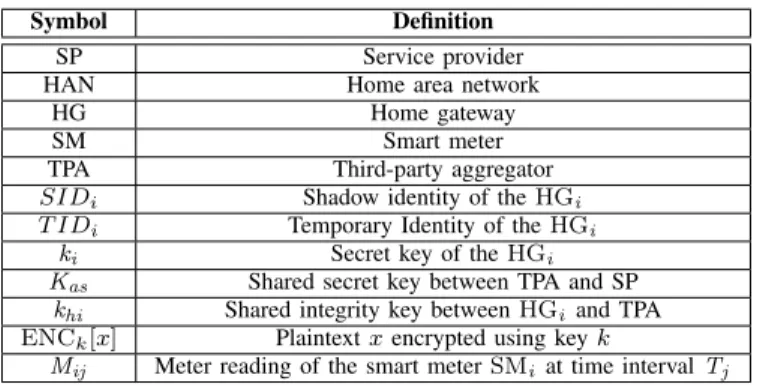
the proposed scheme is presented in Section V and Section VI concludes the paper. The symbols and cryptographic functions used in this paper are defined in Table I.
II. SYSTEM ANDADVERSARYMODEL,ANDSECURITY
GOALS
In this section, we first describe the network architecture of the proposed privacy-preserving data aggregation mechanism and present the underlying adversary model. Subsequently, we define the security goals of our proposed scheme.
A. System Model
Figure 1 shows our system model for the smart metering infrastructure which is used to develop the proposed scheme. Our system model consists of five major entities: a service provider (SP), a third-party aggregator (TPA) employed by the service provider, a set of smart meters (SMs), a set of home gateways (HGs), and numerous home area networks (HANs). In our system model, the SP is responsible for procuring elec-tricity from the producers, supplying elecelec-tricity to consumers, and sending billing notification to each HAN. The TPA is responsible for accumulating the power consumption data of each HAN. At the end of each day or any specific period, the TPA sends the aggregated data to the SP for billing purposes. In this way, the TPA assists the SP to implement dynamic pricing-based billing and also reduces the overhead of the SP. Next, each HAN is composed of a SM, a HG, and a set of home appliances (HAs). Each SM is connected with its HG through a trusted link. A HG periodically collects reading from the SM and sends it to the TPA. The communication between a SM and its HG is through WiFi. Each HG communicates with the TPA through a Long-Term-Evolution-Advanced (LTE-A) network. Note that while the network model is provided for completeness, the proposed EDAS scheme does not rely on any specific underlying networking technology.
B. Adversary Model
In our system model, the SP handles the billing process. Therefore, the SP has to know relevant information about the consumer such as the consumer’s name and the mailing address etc. Hence, in our adversary model we consider the SP as a trusted organization (e.g. owned by the government,
Fig. 1. System model for smart metering infrastructure.
such as Singapore Power in Singapore and National Grid in United Kingdom). On the other hand, the TPA is owned by a private company whose main responsibility is to assist the SP. Therefore, in our system model we consider the TPA as a honest-but-curious entity, who may want to know the con-sumption data of each HAN and subsequently may try to sell the usage information to another company, e.g. for marketing materials for home appliances. Various elements inside the communication network may also act as adversaries and be interested in private details of the power consumption of each HAN. A compromised network and its various elements (like router or switch) can alter or fabricate the meters’ consumption data. Hence, any communication through the network may not be secure. Usually, the TPA and the communication network (like LTE-A) are owned and operated by two different orga-nizations, and therefore we assume that they do not collude with each other. Also, any HG may act as an adversary and be interested to know the consumption data of another HG from a different HAN. An outside attacker may try to impersonate as a legitimate entity that can be a HG, or the TPA, to send data under its name. For instance, a dishonest or fake HG could falsify the data for causing inaccurate aggregation result. In addition, the outside attacker may eavesdrop on the network transmission media for obtaining the power consumption data and also may try to alter or retransmit them.
C. Security Goals
• Authentication: Before aggregating any data, the TPA needs to authenticate each HG in order to prevent in-accurate aggregation results. On the other hand, before obtaining the aggregated data from the TPA through the insecure public communication channel, the SP needs to authenticate the TPA.
• Usage Data Confidentiality: The secrecy of the end-to-end communication is vital and the electricity consump-tion data should be kept secret from any third party for protecting the privacy of the customer. In this regard, if
Fig. 2. Authenticated initialization and refilling process.
an outsider or an inside adversary like other HGs from different HANs or the TPA obtains the messages with electricity consumption information, then he/she should not be able to comprehend the encrypted message.
• Usage Data Integrity:The TPA should be able to verify
the integrity of the data received from each HG of a HAN. Similarly, the SP needs to check the integrity of the aggregated data received from the TPA.
• Consumer Privacy:The TPA should not be able to ex-tract any private information (e.g, name, address, contact number, etc.) of a HAN user. Only the SP should have the ability to know a consumer’s real identity, and their electricity usage. This is necessary for determining the actual electricity consumption and proper billing services. In addition, after eavesdropping the usage data, an outside adversary should not be able to comprehend that the data is from a particular consumer’s end.
• Forward Secrecy: Forward secrecy is extremely
impor-tant since cryptographic computations, e.g., encryption, and authentication, are often carried out during data aggregation. In a scheme with forward secrecy, secret keys are evolved at regular time periods. Exposure of a secret key corresponding to a given time period does not enable an adversary to break the scheme for any prior time period. In other words, forward secrecy ensures that the messages of prior time periods are confidential even if the current time period’s key has been compromised.
To improve the security level of smart meters, forward secrecy should be considered. Now, to ensure forward secrecy in our proposed scheme, it is important that the exposure of shared secret keys of HGi, TPA, and SP
should not enable the adversary to obtain the aggregated meter reading and billing information of each user in the previous time periods.
III. PROPOSEDENERGY-EFFICIENTDATAAGGREGATION
SCHEME- EDAS
In this section we present our EDAS which consists of three phases:authenticated initialization and refilling,data aggrega-tion for dynamic pricing-based billing, and data aggregation for demand-response management. In the authenticated ini-tialization and refilling phase, a home gateway HGi and the
aggregator TPA mutually authenticate each other with the help of the SP and subsequently establish an integrity keykhi, a set
of random integers, and temporary identities between them. In addition, through this phase, both the HGi and the TPA can
update their integrity key and establish a new set of temporary identities. In the data aggregation for dynamic pricing-based billing phase, the TPA anonymously accumulates the usage data and eventually sends it to the SP for billing. In the final phase of EDAS, the TPA anonymously accumulates and aggregates the usage data of a group of HANs in order to assists the SP with demand-response management.
Fig. 3. Proposed computationally efficient and lightweight data aggregation scheme for secure dynamic pricing-based billing process in smart grids.
A. Authenticated Initialization and Refilling
Assume that there are n HANs in a locality which obtain power supply from the SP. During meter installation of a home HANi, the SP randomly generates a shadow identitySIDiand
a secret key ki and assigns them to the HG of HANi. This
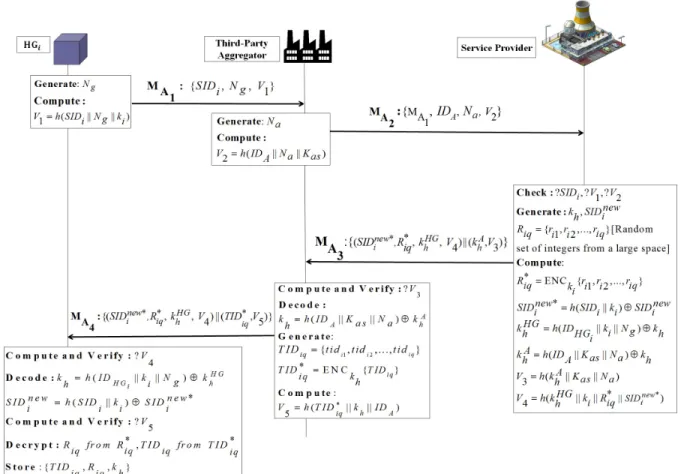
phase of the proposed scheme consists of the following steps: Step 1: HGi generates a nonce Ng and computes V1 =
h(SIDi||Ng||ki). Then, HGi composes a request message
MA1 : {SIDi,Ng,V1} and sends it to the TPA. Since, a
particular shadow identity SIDi cannot be used twice, the
request messageMA1cannot be replayed. Moreover to address
the loss of synchronization issue or denial of service (DoS) attack [19], both HGi and the SP can maintain a set of
pseudo identitiesPIDi ={pid1,pid2,· · ·,pidn}, where each
identity can be used only once and after that it must be deleted by both sides.
Step 2: Upon receiving the request message MA1, the
TPA generates a random number Na and computes V2 =
h(IDA||Na||Kas). Subsequently, the TPA creates a message
MA2 :{MA1,IDA,Na,V2} and sends it to the SP.
Step 3: After receiving the message MA2, the SP first
tries to identify SIDi and then checks V1 and V2. If these
parameters are valid, then the SP randomly generates an integrity key kh, a new shadow identity SIDinew, and picks
a set of q random integers Riq = {ri1,ri2,· · · ,riq} drawn
uniformly from [a, b], wherea andb are chosen to be orders of magnitude larger than the typical meter value. For instance, in the USA the average power consumption of a house is about 15 kWh each day. In this scenario, a and b may be chosen as106 and108, respectively. To ensure better privacy,
the choice ofa andb should be changed regularly. Now, the SP computes R∗iq = ENCki{ri1,ri2,· · · ,riq}, SID
new∗
i =
h(SIDi||ki) ⊕ SIDinew, khHG = h(IDHGi||ki||Ng) ⊕ kh,
kA
h = h(IDA||Kas||Na)⊕kh, V3 = h(khA||Kas||Na), and
V4=h(khHG||ki||R∗iq||SIDinew∗). It then composes a message
MA3 : {(SID new∗ i ,R∗iq,k HG h ,V4)||(k A h ,V3)} and sends it to
the TPA. Here, ENC denotes symmetric-key-based encryption using the Advanced Encryption Standard (AES).
Step 4: On receiving MA3, the TPA first validates V3.
If the validation is successful, then the TPA decodes kh =
h(IDA||Kas||Na) ⊕ khA and generates a set of q unique
temporary identities TIDiq ={tidi1,tidi2,· · · ,tidiq}. Next,
the TPA derives TIDiq∗ = ENCkh(TIDiq),V5 = h(TIDiq∗||
kh||IDA)and creates a messageMA4 :{(SID
new∗ i , Riq∗,k
HG h ,
V4)||(TIDiq∗||V5)} and sends it to HGi.
Step 5: Upon receiving the message MA4, HGi first
computes and verifies V4 and then decodes kh =
h(IDHGi||ki||Ng) ⊕ khHG and SID new
i = h(SIDi||ki) ⊕
SIDinew∗. Hereafter, HGi verifies the parameter V5. If all the validations are successful, HGi decrypts Riq from R∗iq,
andTIDiq fromTIDiq∗, and stores{TIDiq,Riq,kh} for data
aggregation. Details of this phase are also depicted in Fig. 2. B. Data Aggregation for Dynamic Pricing-based Billing
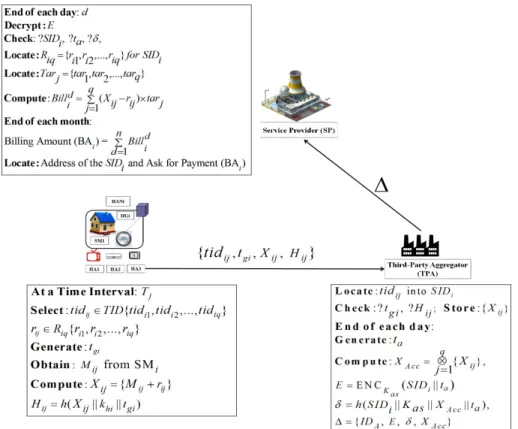
In this subsection, we present our privacy-friendly and efficient data aggregation scheme for dynamic pricing-based billing, where we consider the variations in tariff prices throughout the day according to the time-of-day period sched-ules. After a pre-defined schedule of the time interval Tj,
Fig. 4. Proposed computationally efficient and lightweight data aggregation scheme for demand-response management in smart grids.
unused masking value rij ∈ Riq, and calculates the blinded
measurement Xij = {Mij + rij}, where it is assumed
that rij ≫ Mij. Then, HGi selects an unused temporary
identity tidij ∈ T ID{tidi1,tidi2,· · ·,tidiq}, generates a
timestamp tgi, and computes Hij = h(Xij||kh||tgi). Finally,
HGi composes a message {tidij,tgi,Xij,Hij} and sends it
to the TPA. Then, HGi deletes the pair of used (rij,tidij)
from the respective lists. Note that once all the masking values Riq = {ri1,ri2,· · · ,riq} and temporary identities
tidij ∈T ID{tidi1,tidi2,· · ·,tidiq} are used up, HGi needs
to execute Phase 1 again.
Now, upon receiving the usage data, the TPA first lo-cates and validates the temporary identity tidij, along with
the timestamp tgi and key-hash integrity output Hij. If the
validation is successful, the TPA stores Xij in its database.
Otherwise, the TPA terminates the accumulation process and asks HGi to send the reading again. At the end of the
day (or any desired interval), the TPA generates a times-tamp ta and then computes XACC = Njq=1{Xij}, E =
ENCKas(SIDi||ta), andδ=h(SIDi||Kas||XACC||ta). Here, N
denotes the accumulation of the blinded measurements, i.e.,
{Xi1||Xi2|| · · · ||Xiq}. Finally, the TPA composes a message
∆ ={IDA,E, δ,XACC} and sends it to the SP. After
receiv-ing the power consumption information ∆, the SP first de-cryptsE and then validates the timestampta, andδ. If the
val-idation is successful, the SP locatesRiq={ri1,ri2,· · ·,riq}
and the list of tariff pricesTar[q] ={tar1,tar2,· · ·,tarq}for
each interval and subsequently computes the bill amount for the day d, i.e., Billd
i =
Pq
j=1(Xij −rij)Tar[j] and stores
Billd
i in its database. Thus, the consumer can see his/her
energy usage for each day. At the end of the month, the SP calculates the billing amount BAi = Pn
d=1Bill
d i . After
calculatingBAi, the SP locates the consumer information and sends the bill to the owner ofHANi. Details of this phase are
depicted in Fig. 3.
Note that for the correctness of the proposed scheme, both the SP and HGi should sequentially use the masking values
fromRiq ={ri1,ri2,· · ·,riq}. For instance, if it is assumed
that there are five different tariff prices throughout the day, then HGi needs to send the usage information of HANi
five times(T1, T2,· · · , T5)in a day. Now, we further assume that after the execution of each authenticated initialization and refilling phase, HGi receives five masking values, i.e., Ri5 = {ri1, ri2,· · ·, ri5}. Therefore, both the SP and HGi
are required to useRi5 in the following way:{ri1(atT1),ri2 (atT2),· · ·, ri5 ( atT5)}. However, for better performance of the proposed scheme, we assume that after execution of each authenticated initialization and refilling phase,HGi receives
the masking values for two to three days.
C. Data Aggregation for Demand-Response Management For maintaining balance between power production and demand, the SP needs to know the electricity usage of its users or any sub-group of its users (e.g. from a specific geographic region) on a regular basis (say, every one or two hours). Consider a group ofnusers for aggregation. In this regard, the SP maintains an×q matrix (P) of random integers, whose
i-th row comprises of the vectorRiq ={ri1,ri2,· · · ,riq}that
was generated for and shared withHGi during the execution
are synchronized with respect to their vectorRiq and for any
time period Tj specified by the SP or the TPA, each HAN
uses the j-th element of its vector of random variables (i.e., rij for HGi). Our data aggregation process then consists of
the following steps:
Step AG1: At a particular time intervalTj, the SP selects
the corresponding column of M and calculates ColjSum =
Pn
i=1P[i][j]. It then generates a time stamptsp and computes
∆SP = ENCKas(ColjSum||Kas), HSP = h(∆SP||Kas||tsp),
and subsequently sends {∆SP,HSP,tsp} to the TPA.
Step AG2: Upon receiving{∆SP,HSP,tsp}, the TPA first
checks whether the time stamp tsp andHSP are valid or not.
If they are valid, the TPA decrypts and obtainsColjSum from
∆SP. Then the TPA asks the HGs to return their reading for
that interval.
Step AG3: Next, each gateway HGi picks an unused
temporary identity tidij ∈ TID and selects the predefined
random integer rij from its array, which was assigned for
that particular interval. The HGi then collects the meter
reading Mi for that interval from SMi and generates a
time stamptgi.HGi then calculates its blinded measurement
Xi =Mi+rij, computes Hi =h(X1||khi||tgi), composes a
message{tidij,tgi,Xi,Hi}, and sends it to the TPA.
Step AG4: After receiving the meter reading from each home gateway HGi, the TPA first checks tgi and Hi, and
then maps tidij into SIDi. It then computes the sum of the
blinded measurement SumBM = P n
i=1Xi, and obtains the
aggregated result of the actual measurement by SumAM =
SumBM −ColjSum. Thus the TPA obtains the aggregated
power consumption data of the HANs, which may be used as an input for demand-response management.
Note that in our system if any of the checks in the steps above fails, this phase of the proposed scheme is aborted. Besides, to expedite the performance of the above data ag-gregation scheme, the SP can pre-compute∆SP andHSP for
several sessions and send them to the TPA. Finally, in order to ensure forward secrecy in the proposed scheme, at the end of each interaction, all the three entities (HGi, the TPA, and
the SP) need to update their shared secret keys. For example, after sending/receiving the aggregated data of each day, both HGi and the TPA need to update the hash-integrity key with
khi∗ =h(khi||tgi). In case of loss of synchronization or denial
of service (DoS) attack [19], both HGi and the TPA need to
execute the authenticated initialization and refilling phase of the proposed scheme. Details of this phase are depicted in Fig. 4.
IV. SECURITYANALYSIS
In this section, we demonstrate that the proposed scheme can achieve all the security goals listed in Section II.
1) Accomplishment of Authentication: In theauthenticated initialization and refillingphase of EDAS, the SP authenticates HGi by verifying the shadow identitySIDi andV1in the
re-quest messageMA2, where only a legitimateHGican generate
the valid key-hash output V1. Besides, the SP authenticates the TPA by using the request parameter V2, which must be equal toh(IDA||Na||Kas). On the other hand, bothHGi and
the TPA authenticate the SP by using the response parameters V3 and V4, respectively. Now, in the data aggregation for billing phaseof EDAS, before accumulating any usage data, the TPA authenticates HGi by using the time-stamp tgi and
the response Hij. Moreover, in this phase of EDAS, the SP
authenticates the TPA by using the hash-response parameter
δ. On the other hand, in the data aggregation for balancing demand-response phaseof EDAS, the TPA authenticatesHGi
by using the time-stamp tgi and the response Hi. Finally, in
EDAS, if an adversary tries to perform any replay attempt, the receiving end can easily comprehend such attacks by using the timestamps {tgi,ta}. Therefore, the proposed scheme is also
secure against replay attacks.
2) Accomplishment of Usage Data Confidentiality: The amount of electricity usage in HANi is blinded with the
random integerrij. Hence, the TPA can only see the blinded
measurement of a HAN or the summation of the usage data of a group of HANs. As each element of Riq is unique and random, even if two consecutive readings from a HAN or the readings from two HANs are the same, an adversary (even the TPA) cannot comprehend that from the blinded measurements. Thus, the pattern of the electricity consumption is protected from detection by any eavesdropper.
3) Accomplishment of Usage Data Integrity: In the data aggregation for billing phase, we ensure two levels of data integrity. In the first level, the TPA checks whether it has received the same data as that was sent by HGi. For that,
the TPA computes H∗
ij and checks whether Hij∗ is equal to
Hij or not. Similarly, in the second level, the SP invokes the
key-hash oracle and computesδ∗ to check the integrity of the aggregated electricity consumption by comparing δ∗ with δ. This approach facilitates the detection of any manipulation of the aggregated usage data during communication. On the other hand, in thedata aggregation for balancing demand-response phase of EDAS, the TPA checks the integrity of the usage data by using the parameter Hi, which helps to prevent the
generation of an inaccurate aggregated result.
4) Accomplishment of Consumer Privacy : In EDAS, ex-cept for the SP, no one can gain knowledge of any private information of a HAN user. The TPA only knows the shadow identity SIDi and uses that to accumulate the readings for
each HAN. Besides, while sending the usage data, HGi is
not allowed use the same temporary identity tidij twice. No
one except the TPA can recognize the mapping betweentidij
and SIDi. Therefore, an outsider cannot guess whether the
usage data for two consecutive days are from the same HAN user. This approach of the proposed scheme is quite useful for achieving privacy against eavesdropper (PAE) [21].
5) Accomplishment of Forward Secrecy : EDAS uses a regular update of the shared keyskhi andKas. For instance,
after sending/receiving the usage data of each day, bothHGi
and the TPA need to update the hash-integrity key kh with
kh∗. Now, even if the integrity key kh∗ is revealed, an attacker cannot obtainkh fromkh∗ since the hash functionh(·)is
one-way. In this way, EDAS can prevent an attacker from obtaining any previous aggregated usage data and billing information.
TABLE II
PERFORMANCEBENCHMARKINGBASED ONSECURITYPROPERTIES
(NOTATION: A: AUTHENTICATION; DC: DATACONFIDENTIALITY; DI: DATAINTEGRITY; CP: CONSUMERPRIVACY; FS: FORWARDSECRECY).
Scheme A DC DI CP FS
Li et al. [12] No Yes Yes No Yes Fouda et al. [13] Yes No Yes No Yes Kursawe et al. [14] No Yes Yes No No Knirsch et al. [15] No Yes Yes No Yes Jo et al. [16] Yes Yes Yes No Yes Mohammed et al. [17] No Yes No Yes Yes EDAS Yes Yes Yes Yes Yes
TABLE III
PERFORMANCEBENCHMARKINGBASED ONCOMPUTATION AND
COMMUNICATIONCOST(NOTATION: H: HASHOPERATION; ASE/D: ASYMMETRICENCRYPTION/DECRYPTION; SE/SD: SYMMETRIC
ENCRYPTION/DECRYPTION; MEO: MODULAREXPONENTIATION
OPERATION).
Performance Matrices Fouda et al. [13] EDAS
Key-establishment Cost 2ASE+2ASD 2SE+2SD +4MEO+2H +15H Computation Cost at HG 1SE+1H 1H Computation Cost at TPA 1SD+1H 1SE+1H
Computation Cost at SP - 1SD+1H Communication Cost (HG-TPA) 56 bytes 72 bytes Communication Cost (TPA-SP) - 80 bytes
V. PERFORMANCEANALYSIS ANDCOMPARISONS
The objective of EDAS is not only to fulfill several security requirements in smart grids, but also to ensure that the com-putational and communication overhead is reasonable during the data aggregation process. To manifest the advantages of EDAS, we compare EDAS with recently proposed data aggregation schemes for smart grids: [12], [13], [14], [15], [16], and [17]. We also demonstrate that EDAS is well suited for resource limited smart grid devices (like smart meters and home gateways). In order to analyze the performance of EDAS, particularly on the security front, our scheme has been compared with five state-of-the-art protocols [12], [13], [14], [15], [16], and [17] (shown in Table II), by considering all the security goals listed in Section II. From Table II we see that EDAS can ensure all the security goals listed in Section II, in contrast to the protocols presented in [12], [13], [14], [15], [16], and [17] that only guarantee a subset of the requirements. For instance, in [12], [14], [15], and [17], while data aggregation the identity and the legitimacy of the smart meters are not verified. Consequently, a dishonest or fake smart meter may falsify the data, which will cause an inaccurate aggregated result. On the other hand, in [12], [13], [14], [15], [16], and [17], the smart meters reveal their fixed identity while transmitting the usage data. As a consequence, an adversary can easily comprehend that the usage data is from the same HAN. Therefore, [12], [13], [14], [15], [16], and [17] cannot ensure consumer privacy.
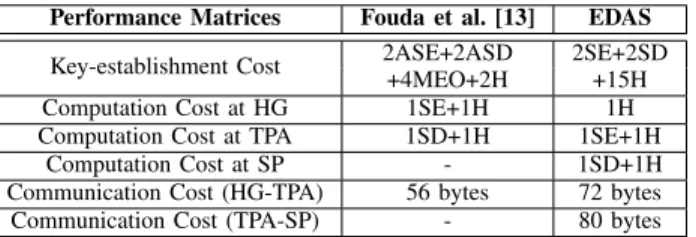
Next, we consider the computation and communication costs for analyzing the performance of the data aggregation for billing phase in EDAS with respect to other existing schemes. To ensure fairness, we compare EDAS with the scheme in [13] because both of these schemes use
symmetric-key crypto systems to ensure privacy and integrity of the usage data for billing process. Before data aggregation, both the schemes require the establishment of a shared secret key between the HG and the TPA through an authenticated key-exchange protocol. However, it should be noted that unlike [13], for maintaining forward security EDAS does not need to execute the authenticated key-establishment protocol for each transaction. Instead, once all the random integersRiqare used up, EDAS executes the key-establishment protocol of the authenticated initialization and refilling phase for obtaining the new set of random integers (the results presented here use sets of 10 random integers). On the other hand, the key establishment protocol in [13] is based on the computationally expensive Diffie-Hellman key exchange scheme. In contrast, EDAS is based on the lightweight cryptographic primitives like one-way hash function, exclusive-OR, etc. (shown in Table III).
Next we present experimental results to analyze the per-formance of the proposed scheme more comprehensively. Table IV presents the experiential specifications, including the hardware, computational, and communication specifications. For measuring the computation time of different cryptographic operations used in [13] and/or EDAS, we conducted simula-tions of their cryptographic operasimula-tions on an Intel Core i5-2500 processor with CPU speed 3.3 GHz (operating as the SP), an AMD E450 processor with 1.65 GHz CPU speed (operating as the TPA), and a HTC One X with ARM Cortex-A9 MPCore processor with 890 MHz CPU speed (operating as a HG). Moreover, the scheme presented in [13] uses asymmetric encryption during its key-establishment process and both EDAS and [13] use symmetric key encryption and hash operations during data aggregation. Hence, we emulate the Advance Encryption Standard with Cipher Block Chaining (AES-CBC) mode, the Elliptic Curve Integrated Encryption Scheme (ECIES), and SHA-256, as the symmetric encryption, asymmetric encryption, and hash operation, respectively. The simulation uses Java Cryptography Extension (JCE) [25] to evaluate the execution time of different cryptographic opera-tions.
Based on our experimental results, the key-establishment process in [13] takes 147.48 ms on an average. Besides, for securely transferring 56 bytes of usage data, the protocol incurs 5.32 ms of communication cost. In our experiments, we consider the size of the usage data for each transactions to be 8 bytes, and the size of the identity of a HG and the hash integrity outputs to be 128 bits and 256 bits, respectively. Ensuring privacy and integrity of the usage data in [13] incurs 0.0075 ms of computation cost. Overall, the average computation and communication cost for data aggregation and billing process in [13] for an entire month is N×152.9 ms, where N denotes the number of times the aggregated usage data is sent from a HG to the TPA in a month. One the other hand, the key-establishment process in EDAS takes 57.03 ms. In addition, transferring 72 bytes of data (including usage data of 8 bytes) between a HG and the TPA takes 6.49 ms. At the end, for transferring billing information to the SP, EDAS takes 9.63 ms. Overall, the entire computation and communication costs for the data aggregation and billing process for each
TABLE IV
EXPERIMENTALSPECIFICATIONS
Specification HG TPA SP
Hardware Specification HTC One X with ARM Cortex-A9 MPCore processor AMD E450 processor Intel Core i5-2500 processor
Computation Cost of the Cryptographic Operations Used in [13] and EDAS
Computational Specification HG TPA SP
SHA-256 0.00067 ms 0.00042 ms 0.00037 ms
AES-CBC-256 Encryption 0.0027 ms 0.0012 ms 0.00097 ms
AES-CBC-256 Decryption 0.0043 ms 0.0031 ms 0.0019 ms
Modular Exponentiation Operation 13.56 ms 8.93 ms
-Elliptic Curve Integrated Encryption (ECIE) 17.37 ms 11.54 ms
-Communication Cost
Communication Specification HG-TPA TPA-SP
Link Type One-hop Wireless (802.11) Wired (Internet) Average Transmission Time for 896-bits 12.32 ms 16.19 ms
month in EDAS is x×57.03 +N ×6.49 +d×9.63 ms, where x is the number of executions of the authenticated initialization and refilling phase in a month and d is the number of days in a month. Fig. 5 shows the total cost with respect to the number of HG data transmissions in a month. From Fig. 5, we see that if a HG sends it’s meter reading twice in every day to the TPA (i.e. N = 60), d = 30 and
x= 15 (i.e., one execution of theauthenticated initialization and refilling phaseevery two days), then the scheme presented in [13] takes 9174 ms, whereas EDAS takes only 1533.3 ms. Finally, we consider the performance of thedemand-response management phase in EDAS with the existing schemes. For this, we conducted simulations of the cryptographic operations used by the existing data aggregation schemes and by the proposed scheme on an AMD E450 processor with 1.65 GHz CPU speed (operating as the TPA or SP), and a HTC One X with ARM Cortex-A9 MPCore processor with 890 MHz CPU speed (operating as a HG). The simulations used the JPBC library Pbc-0.5.14 [23], JCE [25], and the Pailler library libpaillier-0.8 [24] to evaluate the execution time of different cryptographic operations. Table V shows the variation in the aggregation time for different numbers of SMs in the proposed scheme, and others. It can be seen from Table V that the aggregation time for the Pailler encryption based Li et al.’s scheme is higher than others. On the other hand, the data aggregation time for the proposed scheme is significantly lower as compared to the others. Hence, the proposed scheme is better suited for efficient data aggregation in smart-grids.
VI. CONCLUSION
In this paper, we proposed an efficient data aggrega-tion scheme (EDAS) for secure and privacy-aware dynamic pricing-based billing, and demand-response management in smart-grids. It is designed using lightweight symmetric-key-based cryptographic primitives. We analyzed the security of the proposed scheme and it was shown that EDAS can ensure several security properties like authentication, data privacy, data integrity, etc., which are highly important for smart grid security. Moreover, it was shown that EDAS has significantly lower computation and communication cost as compared to other data aggregation schemes. Hence, we argue that EDAS is efficient, practical, and more suitable for applications with
Fig. 5. Performance comparison between Fouda et al.’s scheme [13] and EDAS-based Billing Approach in terms of total data aggregation time.
TABLE V
VARIATION OFAGGREGATIONTIME FORVARIOUSNUMBER OFSMS
Schemes No of Smart Meters Aggregation Time
Li et al. [12] 200 3216 ms 400 5829 ms 500 7210 ms Fouda et al. [13] 200 1.87 ms 400 3.73 ms 500 4.65 ms Kursawe et al. [14] 200 2364 ms 400 4698 ms 500 5880 ms Knirsch et al. [15] 200 89.6 ms 400 123.45 ms 500 165.97 ms Jo et al. [16] 200 1247 ms 400 2189 ms 500 2685 ms Mohammed et al. [17] 200 875 ms 400 1546 ms 500 2317 ms EDAS 200 0.185 ms 400 0.37 ms 500 0.56 ms
real time requirements than other similar approaches for smart grid security.
ACKNOWLEDGMENT
This research was supported by the National Research Foundation, Prime Minister’s Office, Singapore under its Cor-porate Laboratory@University Scheme, National University of Singapore, and Singapore Telecommunications Ltd.
REFERENCES
[1] Y. Li, X. Cheng,Y.Cao, “Smart Choice for the Smart Grid:Narrowband Internet of Things (NB-IoT),”IEEE Internet of Things Journal, DOI: 10.1109/JIOT.2017.2781251,2017.
[2] R. Anderson and S. Fuloria,“Who controls the off switch?” in Proc. IEEE SmartGridComm, pp. 96-101, 2010.
[3] R. Lu, X. Liang, X.L Li, and X. Shen, “Eppa: an efficient and privacy-preserving aggregation scheme for secure smart grid communications,” IEEE Trans. Parallel Distributed System, vol. 23(9), pp. 1621–1631, 2012.
[4] P. Paillier, “Public-key cryptosystems based on composite degree resid-uosity classes,” In: Stern, J. (ed.)EUROCRYPT1999. LNCS, vol. 1592, pp. 223–228. Springer, Heidelberg 1999.
[5] X. Liang, X. Li, R. Lu, X. Lin and X. Shen, “UDP: usage based dynamic pricing with privacy preservation for smart grid,”IEEE Transactions on Smart Grid, vol. 4(1),pp. 141–150, 2013.
[6] M. Naehrig, K. Lauter and V. Vaikuntanathan, “Can homomorphic encryption be practical?,” In Proc. the 3rd ACM Cloud Computing Security Workshop, pp. 113–124, 2011.
[7] Y. Chia-Mu, C.-Y. Chen, S.-Y. Kuo, H.-C. Chao, “Privacy-preserving power request in smart grid networks,”IEEE Syst. J. vol. 8(2), pp. 441–449, 2014.
[8] S. Tonyali, O. Cakmak, K. akkaya, M. Mahmoud, and I. Guvenc, “Secure Data Obfuscation Scheme to Enable Privacy-Preserving State Estimation in Smart Grid AMI Networks,”IEEE Internet of Things Journal, vol. 3(5), OCTOBER 2016.
[9] J. Zhang, L. Liu, Y. Cui, Z. Chen, “SP 2 DAS:self-certified PKC-based privacy-preserving data aggregation scheme in smart grid,” Int. J. Distrib. Sens. Netw, DOI: https://doi.org/10.1155/2013/457325, 1–11, 2013.
[10] Z. Sui, A. Alyousef, H. de Meer, “IAA: incentive-based anonymous authentication scheme in smart grids,” Internet Sciencevol. 9089, pp. 133–144. Springer, Heidelberg (2015)
[11] F. Li, B. Luo, “Preserving data integrity for smart grid data aggregation,” in Proc. IEEE SmartGridComm, pp. 366-371, Tainan, Taiwan, November 2012.
[12] F. Li, B. Luo, P. Liu, “Secure information aggregation for smart grids using homomorphic encryption,”in Proc. IEEE SmartGridComm, pp. 327-332, Gaithersburg, USA, November 2010.
[13] M. M. Fouda, Z. M. Fadlullah, N. Kato, R. Lu, and X. Shen, “A lightweight message authentication scheme for smart grid communica-tions,”IEEE Transactions on Smart Grid,vol. 2(4), pp. 675–685, Dec. 2014.
[14] K. Kursawe, G. Danezis, and M. Kohlweiss, “Privacy-friendly ag-gregation for the smart grid,”in Proc. Privacy Enhanced Technology Symposium, pp. 175–191, 2011.
[15] F. Knirsch et al. “Error-resilient Masking Approaches for Privacy Preserving Data Aggregation,”IEEE Transactions on Smart Grid,DOI: 10.1109/TSG.2016.2630803, 2016.
[16] H. J. Jo, I. S. Kim and D. H. Lee, "Efficient and Privacy-Preserving Metering Protocols for Smart Grid Systems," in IEEE Transactions on Smart Grid, vol. 7, no. 3, pp. 1732-1742, DOI: 10.1109/TSG.2015.2449278, May 2016.
[17] H. Mohammed, S. Tonyali, K. Rabieh, M. Mahmoud, and K. Akkaya, ""Efficient Privacy-Preserving Data Collection Scheme for Smart Grid AMI Networks"," in IEEE Globecom 2016,, Washington DC, USA, December 2016.
[18] Oracle Technology Network. Java Cryptography Architecture (JCA). [Online]. Available: http://docs.oracle.com/javase/6/docs/technotes/ guides/crypto/CrypoSpec.html, accessed Apr. 20, 2017.
[19] P. Gope, J. Lee, and T~Q. S. Quek, “Resilience of DoS attack in designing anonymous user authentication protocol for wireless sensor networks,” IEEE Sensors Journal, vol. 17, no. 2, pp. 498–503, Jan. 2017.
[20] Atmel’s family of smart power meters. http://www.atmel.com/products/smart-energy/power-metering/ (accessed on 28 May 2017).
[21] P. Gope, J. Lee, and T~Q. S. Quek, “Lightweight and Practical Anonymous Authentication Protocol for RFID Systems Using Physically Unclonable Functions,”IEEE Transactions on Information Forensics and Security,DOI:10.1109/TIFS.2018.2832849, 2018.
[22] Dynamic pricing in electricity supply. http://www.eurelectric.org/media/309103/dynamic_pricing_in_electricity _supply-2017-2520-0003-01-e.pdf (accessed on 28 August 2017). [23] libpaillier-0.8. Tech. rep. http://hms.isi.jhu.edu/acsc/libpaillier/ (accessed
on 16 April 2017).
[24] Pbc library. Tech. rep. http://crypto.standford.edu/pbc/, (accessed on 16 April 2017).
[25] Y. Liu, W. Guo, C. Fan, L. Chang, and C. Cheng, “A Practical Privacy-Preserving Data Aggregation (3PDA) Scheme for Smart Grid,” IEEE Transactions on Industrial Informatics, DOI: 10.1109/TII2018.2809672, 2018.
[26] T. Jiang, Y. Cao, L. Yu, and Z. Wang, “Load Shaping Strategy Based on Energy Storage and Dynamic Pricing in Smart Grid,”IEEE Transactions on Smart Grid, vol.5(6), pp.2868-2876, 2014.
Prosanta Gope received the M.Tech. degree in computer science and engineering from the National Institute of Technology (NIT), Durgapur, India, in 2009, and the PhD degree in computer science and information engineering from National Cheng Kung University (NCKU), Tainan, Taiwan, in 2015. He is currently working as a Research Fellow in the department of computer science at National Univer-sity of Singapore (NUS). Prior to this, Dr. Gope served over one year as a Postdoctoral Research Fellow at Singapore University of Technology and Design (SUTD) established in collaboration with Massachusetts Institute of Technology (MIT). His research interests include lightweight authentication, authenticated encryption, access control system, and security in mobile communication and hardware security of the IoT devices. He has authored over 40 peer-reviewed articles in several reputable international journals and conferences, and has three filed patents. He received the Distinguish Ph.D. Scholar Award in 2014 given by National Cheng Kung University, Tainan, Taiwan.
Biplab Sikdar (S’98-M’02-SM’09) received the B.Tech. degree in electronics and communication en-gineering from North Eastern Hill University, Shil-long, India, in 1996, the M.Tech. degree in electrical engineering from the Indian Institute of Technology, Kanpur, India, in 1998, and the Ph.D. degree in electrical engineering from the Rensselaer Polytech-nic Institute, Troy, NY, USA, in 2001. He was on the faculty of Rensselaer Polytechnic Institute from 2001 to 2013, first as an Assistant and then as an Associate Professor. He is currently an Associate Professor with the Department of Electrical and Computer Engineering, National University of Singapore, Singapore. His research interests include computer networks, and security for IoT and cyber physical systems. Dr. Sikdar is a member of Eta Kappa Nu and Tau Beta Pi. He served as an Associate Editor for the IEEE Transactions on Communications from 2007 to 2012. He currently serves as an Associate Editor for the IEEE Transactions on Mobile Computing.

![Fig. 5. Performance comparison between Fouda et al.’s scheme [13] and EDAS-based Billing Approach in terms of total data aggregation time.](https://thumb-us.123doks.com/thumbv2/123dok_us/9447060.2819006/9.918.82.883.112.321/performance-comparison-fouda-scheme-edas-billing-approach-aggregation.webp)
