Theoretical Computer Science 89 (1991) 33-62 Elsevier
33
Decidable boundedness
problems
for sets of graphs generated by
hyperedge-replacement
Annegret
Habel, Hans-J&-g Kreowski
Universitiit Bremen, Fachbereich Mathematik und Znformatik, Postfach 330440, W-2800 Bremen 33, Germany
Walter Vogler
Technische Universitiit Miinchen, Znstitut fiir Znformatik, Postfach 202420, W-8000 Miinchen 2, Germany
Abstract
Habel, A., H.-J. Kreowski and W. Vogler, Decidable boundedness problems for sets of graphs generated by hyperedge-replacement, Theoretical Computer Science 89 (1991) 33-62.
Consider a class GZ of hyperedge-replacement graph grammars and a numeric function on graphs like the number of edges, the degree (i.e., the maximum of the degrees of all nodes of a graph), the number of simple paths, the size of a maximum set of independent nodes, etc. Each such function induces a boundedness problem for the class V: Given a grammar HRG in %‘, are the function values of all graphs in the language L( HRG), generated by HRG, bounded by an integer or not? We show that the boundedness problem is decidable if the corresponding function is compatible with the derivation process of the grammars in V and if it is composed of maxima, sums, and products in a certain way. This decidability result applies particularly to the examples listed above.
Various significant sets of graphs such as the set of series-parallel graphs, the set of (maximum) outerplanar graphs, the set of k-trees, and the set of graphs of cyclic bandwidth G k can be generated by hyperedge-replacement graph grammars. Hence, the study in this paper is not only attributed to the area of graph grammars but may also interest those who investigate graph-theoretic properties of particular sets of graphs.
1. Introduction
Context-free graph grammars (like edge- and hyperedge-replacement grammars as investigated, e.g., by Bauderon and Courcelle [2] or in [8, lo] or like boundary NLC grammars as introduced by Rozenberg and Welzl [17]) have been studied intensively for some time now because of-at least-two reasons.
(1) Although their generative power is intentionally restricted, they cover many graph languages interesting from the point of view of applications as well as of graph theory (for example, certain types of flow diagrams, PASCAL syntax diagrams,
34 A. Hahel et al.
certain types of Petri nets, graph representations of functional expressions, series- parallel graphs, outerplanar graphs, k-trees, graphs with cyclic bandwidth ck).
(2) Of all classes of graph grammars discussed in the literature, they seem to render the most attractive theory with a variety of results on structure, decidability and complexity (see, e.g., Arnborg, Lagergren and Seese [ 11, Bauderon and Courcelle [2,3], Della Vigna and Ghezzi [4], Lautemann [15], Lengauer and Wanke [16], Rozenberg and Welzl [17, 181, Slisenko [19], and [14, 7, 8, 10, 11, 5, 61).
In particular, Courcelle [3], Arnborg et al. [l], Lengauer and Wanke [16], and [ 111 present syntactic and semantic conditions such that, for a graph property P satisfying the conditions, the following hold for all context-free graph grammars of the types considered in the respective papers:
(1) It is decidable whether (or not) some graph with property P is generated. (2) It is decidable whether (or not) all generated graphs have property P. (3) It is decidable in linear time whether (or not) a generated graph represented by a derivation (or something equivalent) has property P.
The results apply to properties such as connectivity, planarity, k-colorability, existence of Hamiltonian and Eulerian paths and cycles.
Based on the framework of hyperedge-replacement graph grammars, we continue this line of consideration in this paper. We are going to investigate the decidability of a different type of problems concerning functions on graphs and above all numeric quantities like the numbers of nodes, edges and paths, the node degree, maximum and minimum lengths of paths and cycles, etc. The kind of question we ask for a class of grammars may be called boundedness problem. It is as follows:
(4) Is it decidable whether (or not), concerning a particular quantity, the values of all graphs generated by a grammar are bounded?
For example, we want to know whether the node degree or the number of paths grow beyond any bound within a graph language. In the main result, we show that such a boundedness problem is decidable for a class of hyperedge-replacement grammars if the corresponding quantity function is built up by maxima, sums and products and if the function is compatible with the derivation process of the given grammars. Examples of this kind are the bounded-node-degree problem, the bounded-maximum-path-length problem, the bounded-maximum-number-of-paths problem and others. It should be mentioned here that the only result of the same nature occurring in the literature is the decidability of the bounded-degree problem for NLC grammars (see [13]).
Various significant sets of graphs such as the set of series-parallel graphs, the set of (maximum) outerplanar graphs, the set of k-trees, and the set of graphs of cyclic bandwidth s k can be generated by hyperedge-replacement graph grammars. Hence, the study in this paper is not only attributed to the area of graph grammars but may also interest those who investigate graph-theoretic properties of particular sets of graphs.
The paper is organized in the following way. Sections 2 and 3 comprise the preliminaries on (hyper)graphs and hyperedge-replacement grammars as needed.
Decidable boundedness problems for hyperedge-replacement graphs 35
In Section 4, we discuss several examples of numeric functions which are compatible with the derivation process of our grammars in a certain way. In Section 5, we introduce the general notion of compatible functions and relate them with our earlier notion of compatible predicates [ 111. Finally, we show in the main result in Section 6 that the boundedness problem corresponding to a numeric function is decidable if the function is pointwise defined as the maximum of sums and products and if it is compatible.
While the general results work for arbitrary classes of hyperedge-replacement grammars, we have to admit that most of our examples are formulated for the class of edge-replacement grammars. But we are confident that all of them can be adapted to more general classes of hyperedge-replacement grammars.
A short version of this paper without proofs is given in [12].
2. Preliminaries
This section provides the basic notions on graphs and hypergraphs as far as needed in the paper. The key construction is the replacement of some hyperedges of a hypergraph by hypergraphs yielding an expanded hypergraph. In our approach, a hyperedge is an atomic item with an ordered set of incoming tentacles and an ordered set of outgoing tentacles where, intuitively, each tentacle grips at a node through the source and target functions. Correspondingly, a hypergraph is equipped with two sequences of distinguished nodes so that it is enabled to replace a hyperedge. General assumption 2.1. Throughout the paper, let C be an arbitrary, but fixed alphabet, called a set of labels (or colors).
Definition 2.2 (hypergraphs). (1) A hypergruph over C is a system ( V, E, s, f, I) where V is a finite set of nodes (or vertices), E is a finite set of hyperedges, s : E + V” and t:E+ V”’ are two mappings assigning a sequence of sources s(e) and a sequence of targets t(e) to each eE E, and I: E + C is a mapping labeling each hyperedge.
(2) A hyperedge e E E of a hypergraph (V, E, s, t, I) is called an (m, n)-edge for some m, HEN if Is(e)l=m and It(e n2 The pair (m, n) is the type of e, denoted by type(e). e is said to be well-formed if its sources and targets are pairwise distinct. (3) A multi-pointed hypergraph over C is a system H = (V, E, s, t, 1, begin, end) where the first five components define a hypergraph over C and begin, end E V*. Components of H are denoted by V,, EH, sH, tH, lH, begin,, end,, respectively. The set of all multi-pointed hypergraphs over C is denoted by Xc.
(4) HE Xc is said to be an (m, n)-hypergruph for some m, n EN if Ibegin,] = m and lend, I = n. The pair (m, n) is the type of H, denoted by type(H). H is said to
’ For a set A, A* denotes the set of all words over A, including the empty word A. ’ For a word w t A*, IwI denotes its length.
36 A. Habel et al.
be well-formed if all hyperedges are well-formed and the begin-nodes and end-nodes of H are pairwise distinct.
(5) Let H E FJ&, begin, = begin,. . . begin,,, and end, = end,. . . end,, with begin,, endjE V, for i=l,..., m and j=l,..., n. Then EXT,={beginili=l ,..., m}u {endi) j = 1,. . . , n} denotes the set of external nodes of H. Moreover, INTn =
V, - EXT, denotes the set of internal nodes of H.
Remarks. (1) There is a l-l-correspondence between hypergraphs and (O,O)-hyper- graphs so that hypergraphs may be seen as special cases of multi-pointed hypergraphs.
(2) An (m, n)-hypergraph over C with (1, 1)-edges only is said to be an (m, n)- graph. The set of all (1, 1)-graphs over C is denoted by SC.
Definition 2.3 (special hypergraphs). (1) A multi-pointed hypergraph H is said to be a singleton if IEH I= 1 and 1 V, - EXTnI = 0. e(H) refers to the only hyperedge of H and l(H) refers to its label.
(2) A singleton H is said to be a handle if sH( e) = begin, and tH( e) = end,. If lr, (e) = A and type(e) = (m, n) for some m, n E I+J, then H is called an (m, n)-handle induced by A.
Remark. Given HE Y&., each hyperedge e E EH induces a handle e’ by restricting the mappings sH, tH, and lH to the set {e}, restricting the set of nodes to those ones occurring in sH( e) and tH (e), and choosing begin,. = sn (e) and end,. = tH (e).
Definition 2.4 (subhypergraphs and isomorphic hypergraphs). (1) Let H, H’E 2,. Then H is called a (weak) subhypergraph of H’, denoted by H c H’, if V, c Vn., EH E En,, and s”(e) = s,(e), t,(e) = tJe), In(e) = l,(e) for all e E E”. (Note that nothing is assumed on the relation of the distinguished nodes.)
(2) Let H, H’E %‘c and iv : V, + Vn., iE : En + Er,, be bijective mappings. Then i = (iv, ie) : H + H’ is called an isomorphism from H to H’ if i$( sn (e)) = s& iE (e)), i*v(tH(e)) = MiE(e)), l,(e)) = MiE(e)) f or all e E En as well as i*,(begin,) = begin,,, i$(end,) = end,,.3 H and H’ are said to be isomorphic, denoted by H G H’, if there is an isomorphism from H to H’.
Now we are ready to introduce how hypergraphs may substitute hyperedges. An (m, n)-edge can be replaced by an (m, n)-hypergraph in two steps.
(1) Remove the hyperedge.
(2) Add the hypergraph except the external nodes and hand over each tentacle of a hyperedge (of the replacing hypergraph) which grips to an external node to the corresponding source or target node of the replaced hyperedge.
3 For a mapping f: A+ B, the free symbolwise extension f*: A* + B* is defined by f*(a, . ak) = f(a,)...f(a,)forallkENanda,EA(i=l,..., k).
Decidable boundedness problems for hyperedge-replacement graphs 31 Moreover, an arbitrary number of hyperedges can be replaced simultaneously in this way.
Definition 2.5 (hyperedge replacement). Let H E SY, be a multi-pointed hypergraph,
B G EH, and rep1 : B + & a mapping with rype( rep/( b)) = type( 6) for all b E B. Then the replacement of B in H through rep1 yields the multi-pointed hypergraph X given by
l v, = VH +ChGB( K,,,,, - EX&,(b,),4 l & = (EH - B)+C,,, Erep/~,j,
l each hyperedge of EH -B keeps its sources and targets,
l each hyperedge of Erepl(bj (for all b E B) keeps its internal sources and targets and the external ones are handed over to the corresponding sources and targets of b, i.e., sx(e) = h*(s,,,,,,(e)) and lx(e) = h*(tr,,cb,(e)) for all b E B and e E
E reps where h : V,,,WI + VX is defined by h(u) = ~1 for v E Vrepl(bl - EXT+(,,), h(bi)=si (i=l,..., m) for begin,,,(b,=b,...b, and SH(b)=S1...S,, h(e,)=t, (j=l,..., n) for endre,,l(bj=el...en and tH(b)=tl...t,.
l each hyperedge keeps its label, l begin, = begin, and end, = endH.
The resulting multi-pointed hypergraph X is denoted by REPLACE (H, repl). Remark. The construction above is meaningful and determines (up to isomorphism) a unique hypergraph X if h is a mapping. This is automatically fulfilled whenever the begin-nodes and end-nodes of each replacing hypergraph are pairwise distinct. If one wants to avoid such a restriction, one has to require that the following application condition is satisfied for each b E B: If begin,,,(,,, = x1. . .x, and
endrep,~b~=xm+l...~m+n as well as SH(b)=yl...ym and tH(b)=ym+ ,... y,+,,, then, for i,j=l,..., m + n, xi = xj implies yi = yj.
3. Hyperedge-replacement grammars and languages
In this section we give a short summary of the basic notions on hyperedge- replacement grammars generalizing edge-replacement grammars as investigated e.g. in [7,8] and context-free string grammars. Details and examples can be found in r9,101.
Based on hyperedge replacement, one can derive multi-pointed hypergraphs from multi-pointed hypergraphs by applying productions of a simple form.
Definition 3.1 (productions and derivations). (1) Let N E C. A production (over N) is an ordered pair p = (A, R) with A E N and R E %Y,. A is called the left-hand side
4 The sum symbols + and 1 denote the disjoint union of sets; the symbol - denotes the set-theoretic difference.
38 A. Habel et al
of p and is denoted by lhs(p), R is called the right-hand side and is denoted by
rhs(p). The type of p, denoted by type(p), is given by the type of R.
(2) Let HE Xc., B z EH, and P be a set of productions. A mapping prod : B+ P
is called a production base in H if 1, (b) = Ihs( prod(b)) and type( 6) =
type(rhs(prod(b))) for all bE B.
(3) Let H, H’ E Xc and prod : B + P be a production base in H. Then H directly
derives H’ through prod if H’ is isomorphic to REPLACE(H, repl) where repl: B+
Xc-. is given by repl(b) = rhs( prod(b)) for all b E B. We write H 2 H’ or H =3 H’ in this case.
(4) A sequence of direct derivations HO T H, 7 . * . 7 Hk is called a derivation from HO to Hk (of length k). Additionally, in the case H = H’, we speak of a
derivation from H to H’ of length 0. A derivation from H to H’ is shortly denoted by H 9 H’ or H 3 H’. If the length of the derivation should be stressed, we write
H+H’or H&H’.
(5) A direct derivation through prod : (4 + P is called a dummy.’ A derivation is said to be valid if at least one of its steps is not a dummy.
Remarks. (1) The application of a production p = (A, R) of type (m, n) to a multi- pointed hypergraph H requires the following two steps only:
(a) Choose a hyperedge e of type (m, n) with label A. (b) Replace the hyperedge e in H by R.
(2) Some significant properties of direct derivations are the following: On the one hand, the definition of a direct derivation includes the case that no hyperedge is replaced. This dummy step derives a hypergraph isomorphic to the initial one. On the other hand, it includes the case that all hyperedges are replaced in one step. Moreover, whenever some hyperedges can be replaced in parallel, they can be replaced one after the other leading to the same derived hypergraph.
Using the introduced concepts of productions and derivations hyperedge-replace- ment grammars and languages can be introduced in a straightforward way. Definition 3.2 (hyperedge-replacement grammars and languages). (1) A hyperedge-
replacement grammar is a system HRG = (N, T, P, 2) where N % C is a set of
nonterminals, T c C is a set of terminals, P is a finite set of productions over N, and Z E X, is the axiom. The class of all hyperedge-replacement grammars is denoted by X!X%?.
(2) HRG is said to be typed if there is a mapping hype : N u T+ kJ x N such that, for each production (A, R) E P, hype(A) = fype( R) and hype(l,(e)) = type(e) for all e E ER and hype(l,(e)) = type(e) for all e E Ez. HRG is said to be be well-formed
’ A production base prod : B + P in H may be empty, i.e., B = 6 In this case H + H’ through prod
Decidable boundedness problems for h~peredge-replacement graphs 39
if the right-hand sides of the productions are well-formed and all hyperedges in Z are well-formed.
(3) The hypergraph language L(HRG) generated by HRG consists of all hyper- graphs which can be derived from Z applying productions of P and which are terminally labeled,
L(HRG)={H&Yt?~IZ $H}.
Remarks. (1) Even if one wants to generate graph languages rather than hypergraph languages, one may use nonterminal hyperedges because the generative power of hyperedge-replacement grammars increases with the maximum number of tentacles of a hyperedge involved in the replacement (see [lo]).
(2) Without effecting the generative power, we will assume in the following that N and T are finite, N n T = @, and Z is a singleton with l(Z) E N. Furthermore, we will assume that the hyperedge-replacement grammars considered in this paper are typed and well-formed.
The results presented in the following sections are mainly based on some funda- mental aspects of hyperedge-replacement derivations. Roughly speaking, hyperedge- replacement derivations cannot interfere with each other as long as they handle different hyperedges. On the one hand, a collection of derivations of the form e’ 3 H(e) for e E ER can be simultaneously embedded into R leading to a single derivation R 3 H. On the other hand, restricting a derivation R 3 H to the handle e’ induced by the hyperedge e E ER one obtains a so-called “restricted” derivation e’ 3 H(e) where H(e) G H. Finally, restricting a derivation to the handles induced by the hyperedges, and subsequently embedding them again returns the original derivation. In other words, hyperedge-replacement derivations can be distributed to the handles of the hyperedges without losing information. We state and use this result in the following recursive version concerning terminal hypergraphs which are derivable from handles.
Theorem 3.3. Let HRG = (N, T, P, Z) be a typed and well-formed hyperedge-replace- ment grammar, A E N u T, and H E 2,. Then there is a derivation A’ + R &J H for some ka06 if and only if A’ =+ R and, for each e E E,, there is a derivation IR(e)’ % H(e) with H(e) E H such that H ^- REPLACE(R, repl) with repl(e) = H(e) for e E ER.
Remarks. (1) The derivation l,(e)’ $ H( ) e may be valid or not. In the first case, it has the same form as the original derivation, but it is shorter as the original one. In the latter case, H(e) is isomorphic to e’ (resp. lR (e)*) and hence a terminal handle.
’ For a symbol AE N u T with /type(A) = (m, n), A’ denotes an (m, n)-handle induced by A. (Note that (m, n)-handles induced by a symbol A are isomorphic).
40 A. Habel et al.
(2) Given a derivation R % H, the derivation I,(e)’ 5 H(e) for each e E ER is called the fibre of e and-the other way round-the given derivation is the joint embedding of its fibres.
(3) Theorem 3.3 is a direct consequence of the Context-Freeness Lemma for hyperedge replacement presented in [6, Theorem 11.2.41. The proof of the theorem is given in [6, V.1.11.
4. Some graph-theoretic functions compatible with derivations
A hyperedge-replacement grammar as a generating device specifies a (hyper)graph language. Unfortunately, in a finite amount of time, the generating process only produces a finite section of the language explicitly (and even this may consume much time). Hence one may wonder what the hyperedge-replacement grammar can tell us about the generated language. As a matter of fact, by Theorem 3.3, we have the following nice situation. Given a hyperedge-replacement grammar and an arbitrary terminal (hyper)graph H with derivation A’ =3 R 3 H, we get a decompo- sition of H into “smaller” components which are derivable from the handles of the hyperedges in R. If one is interested in values of graph-theoretic functions of derived (hyper)graphs, one may ask how a certain value of a derived (hyper)graph depends on values of the components. A function is said to be “compatible” with the derivation process of hyperedge-replacement grammars if it can be computed for each derived (hyper)graph H by computing the values (or related values) for the components and composing the values to the value of H.
In this section, we pick up several graph-theoretic functions and show that they are “compatible” with the replacement process of hyperedges. A formal definition of compatibility is given in the next section. We discuss the number of nodes and hyperedges, the number of paths and cycles, the length of a shortest path, the length of a longest simple path, the minimum and maximum degree, and the number of components.
Number of nodes and hyperedges
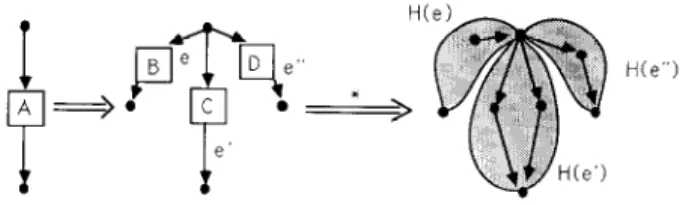
To illustrate our kind of investigation, we first consider the computation of the number of nodes and hyperedges in a hypergraph. In the following, let 1 V, 1 denote the number of nodes, IINT,I the number of internal nodes, and lEHl the number of hyperedges in a hypergraph H. Let A’ + R 3 H be a derivation of H, and, for e E ER, &(e)’ 3 H(e) be the fibre of R 3 H induced by e. Then the node set of H consists of the nodes of R and the internal nodes of the components H(e). Hence, the number of nodes in H can be computed from the number of nodes in R and the number of internal nodes in the H(e) by summing up the numbers. For example, the hypergraph H in Fig. 1 has 8 nodes; 4 nodes are already in R, H(e) and H(e”) possess one internal node each, H( e’) has 2 internal nodes. Even simpler, the number of hyperedges in H can be determined by the number of hyperedges
Decidable boundedness problems for hyperedge-replacement graphs 41
H(
H(e")
Fig. 1. A derivation of the form A.3 R 5 H,
in H(e) by summing up the numbers of the H(e). In our example, H(e), H(e’) and H(e”) possess one, four and two hyperedges, respectively; therefore, the whole hypergraph H has seven hyperedges.
Theorem 4.1. Let HE %,, A’ =3 R 5 H be a derivation of H, and, for e E ER, lR (e)’ 3 H(e) the$bre of R 3 H induced by e. Then
IVMV4+~~ I~~TFfwI,
,~NGf = lDG+ c IDTY,e,I,
etER
l&l = .ic, l%d
R
Proof. Without loss of generality, we can assume H = REPLACE( R, repl) with repZ(e) = H(e) for e E E, (cf. Theorem 3.3). By definition of replacement, V, = VR+CeEER INTH(,), EH =CeSER EHcel, and EXT, = EXT,. Hence, we have INT, = V, - EXT, = V, - EXTR+CetEx INT,,.,= INTR+CetER INT,,.,. Now the cardinality statements with respect to the number of nodes and the number of hyperedges follow directly from the set-theoretic statements. q
Remarks. (1) Similarly, the composed function size given by size(H) = 1 V, I + I EH I can be handled. It uses the auxiliary function intsize given by intsize(H) = IkNT,I+IE,I.
size(H) = IV,l+ 1 intsize(H(e)), ecE,
intsize(H) = IINT,I+ 1 intsize(H(e)). etE,
(2) The density function dens given by dens(H) = IE, l/l V,l if I V,l > 0 (and dens(H) = 0 ’ otherwise) can also be expressed in the following way:
’ Dens, minipath, and maxpath are defined to be functions with values in No =N+{O}, the set of all nonnegative integers plus a special symbol 0. We use this special symbol 0, if the considered function has no sensible integer value. We calculate with 0 as follows: Vi E I Vn, EN+ {O},
l Lr n, = 0 and n,,, n, = 0 if and only if n, = 0 for some j E I,
l min,,, n, = min,,,. n, and max ,tl n, = max,,,, n, for I’={i~l/n,fo}, and min,,,n,=o and max,,,n,=o for I=@.
42 A. Habel et al,
The expression for computing dens(H) makes use of the possibility to compute the number of internal nodes as well as the number of hyperedges of the H(e)‘s. It does not make use of the density of some of the H(e)‘s.
For simplifying the technicalities, we restrict our following consideration to the class Z%?9? of edge-replacement grammars in the sense of [7,8]. To be more explicit, a (typed and well-formed) hyperedge-replacement grammar ERG is in Z%YZ9 if and only if the right-hand sides of the productions as well as the axiom are (1, 1)-graphs. Note that, in this case, each GE L(ERG) is a (1, 1)-graph, i.e., a graph with two distinguished nodes beginc and end,.
General assumption 4.2. For the rest of this section, let ERG be an edge-replacement grammar, G be a graph with distinguished nodes begin, and end,, A’ + R 2 G
be a derivation of G in ERG, and, for e E ER, l,(e)’ 3 G(e) be the fibre of R 3 G induced by e.
Simples path: number, minimum and maximum length
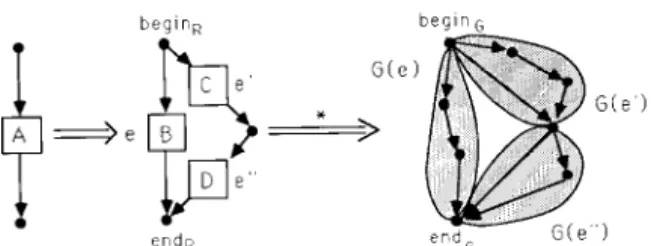
We are going to discuss how the number of simple paths of a graph G can be computed from the number of simple paths of the graphs G(e). Considering for example the graph G in Fig. 2, one may observe that G contains five simple paths connecting begin, and end,; one path is created by the edge e and lies completely in G(e), the other four ones are created by the edges e’ and e” (forming a simple path connecting beginR and end,) and are composed by a simple path of G(e’) joining begincc,,, and end,(,,, and a simple path of G( e”) joining endcc,,, = begincc.-,
and endcc,,,). The product of the number of simple paths of G(e’) (joining begin,(,,,
and end,(,,,) and the number of simple paths of G(e”) (joining begin,(.-, and en&(es,j ) decribes the number of simple paths created by the simple path in R built from e’ and e”. The sum of all numbers of simple paths created by a simple path in R connecting begin, and end, describes the number of all simple paths in G connecting begin, and end,.
Although G(e) contains a path connecting begin, and end,, this path is not a shortest one in G. G( e’) contains a path of length one connecting beginc = begin,(,,, and end,(,., and G(e”) contains a path of length one connecting end,,,,, = begino,-, and endcce-) = endc. Hence, the path in R connecting begin, and end, built from
beglnR
G(e)
x
--,
Decidable boundedness problems for h~peredge-replacement graphs 43 e’ and e” creates a path of length two. The sum of the minimum path length of G(e’) (joining beg&(,,, and en&,,, ) and the minimum path length of G( e”) (joining
begin,,,,,, and end,,,.,, ) describes the minimum length of paths created by the path in R built from e’ and e”. The minimum of all the minimum path lengths created by paths in R connecting begin, and end, describes the minimum length of paths in G connecting beginc and endc. Analogously, the maximum of all the maximum simple-path lengths created by simple paths in R connecting begin, and end, describes the maximum length of simple paths in G connecting begin, and endc.
We will use the following notions: Given a graph G, a path joining ZI,, and u, is a sequence p = vO, e,, v,, e,, . . . , e,, v, of alternating nodes and edges such that for 1 c is n, vi_, and v, are the nodes incident with ei. If uO= v, then p is said to be a cycle. In this case, we do not distinguish p either from the cycle vi, e,+, , . . . , e,, %, e,,..., ei, u, or from the cycle v,, e,, . . . , e, , uO, e,, . . . , e,,, , vi. If in a path each node appears once, then the sequence is called a simple path. If each node appears once except that vO= v,, and n 23 then p is a simple cycle. The length of a path or a cycle p, denoted length(p), is the number of edges it contains. “e on p” denotes the fact that e occurs in p.
Theorem 4.3. For a (1, l)-graph G, let PATH, denote the set of simple paths joining begin, and endc and numpath(G) the number of these paths in G. Moreover, let minpath( G) and maxpath( G) denote the minimum resp. maximum simple-path length, if any (and minpath( G) = maxpath( G) = 0 otherwise, see footnote 7). Then
numpath( G) = 1 U numpath(G(e)), pr PATH, eon,,
minpath (G) = min 1 minpath(G(e)), PE “Am, eon,,
maxpath( G) = max C maxpath(G(e)).
P= “Aru~ e<,,,,,
Proof. Let G be a (1, 1)-graph and p^ be a simple path joining begin, and endc;. Without loss of generality, we can assume G = REPLACE (R, rep/) with repl(e) =
G(e) for each e E E, (cf. Theorem 3.3). Particularly, V, c V,. Starting from begin, and running through i, nodes of R are visited in a certain sequence vO,. . . , 0,. Cutting p^ in these nodes, one gets a sequence of simple paths p, , . . . , p,, (where pi
connects v,_, and v, for i = 1, . . . , n). For i = 1, . . . , n, there exists e; E ER such that
p, belongs to G(ei). Otherwise, if pi would be covered by more components, it would visit at least three nodes of R. By the same reason, e, connects v,_, and v, (for i=l,..., n). Thus, p = v,~, e,, . . . , e,, u, forms a simple path joining begin,
and end, and for i = 1, . . . , n, pi is a simple path joining begin,,,, and end,,,,,.
Conversely, if p = vO, e,, . . . , e,, v, is a simple path joining begin, and end, and, for i=l,..., n, p, is a simple path joining begin,,,,, and end,,,,, then the replace- ment of the edges e, , . . . , e, by the corresponding paths p,, . . . , pn yields a simple
44 A. Habel et al. path joining begino and end,. Therefore,
PATHG = IJ {replace(p, path) Ipath E PATHo,,,), PE PATHn
where replace(p, path) denotes the path obtained from p by replacing all edges e on p by the corresponding paths path(e).
The statements on the number of simple paths as well as the minimum and maximum simple-path length follow immediately from the following set-theoretical statement: Since, for a simple path p E PATHR, repluce(p, path) f repluce( p, path’) if and only if puth( e) # path’(e) for some e on p, the number of simple paths induced by P is Konp numputh(G(e)). Since different paths in R yield different paths in G, the number of simple paths in G is the sum of the numbers of simple paths induced by some simple path in R.
Since, for a simple path p E PATHR,
length( repluce( p, path)) = 1 length( puth( e)), eonp
,,$pHG
length(~) = pe~j~HR C mineonp Wh(ekPATH,(,, length(puth(e)).
Replacing min by max wherever it occurs, we obtain the statement for maxpePATH, length(p). Using the definition of minputh and maxpath, we can derive the claimed minimum- and maximum-statements. 0
Simple cycles: number, minimum and maximum length
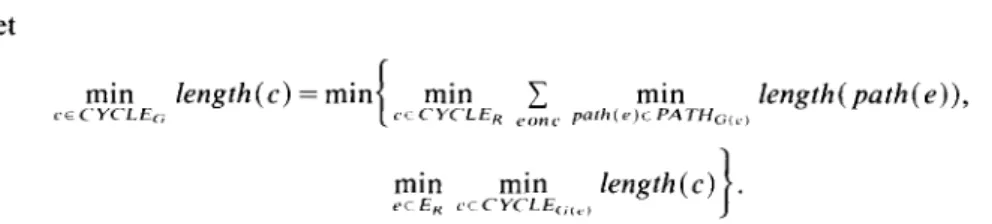
The number of simple cycles, the minimum cycle length, and the maximum simple-cycle length of a graph can be determined using the computation of the number of simple paths, the minimum path length, and the maximum simple-path length, respectively. Considering for example the graph G in Fig. 2, G contains six simple cycles, one completely lying in G(e’), one completely lying in G(e”), and four ones running through G(e), G(e’), and G(e”). The latter are composed by simple paths of G(e), G( e’), and G( e”). The product of the number of simple paths of G(e), G(e’), and G(e”) describes the number of simple cycles created by the simple cycle in R built from e, e’, and err. The sum of all numbers of simple cycles created by simple cycles in R describes the number of all composed simple cycles in G. Adding the numbers of simple cycles in the G(e) (e E ER), we obtain the number of all simple cycles in G. The minimum resp. maximum simple-cycle length can be handled in a similar way.
Theorem 4.4. For a (1, l)-graph G, let CYCLE, denote the set of simple cycles and
numcycle(G) the number of these cycles in G. Moreover, let mincycle(G) and max- cycle(G) denote the minimum resp. maximum simple-cycle length, if any; otherwise, let mincycle( G) = 0 = maxcycle( G). Then
numcycle( G) = 1 n numputh( G( e)) + C numcycle( G( e)),
Decidable boundedness problems for hyperedge-replacement graphs 45
mincycle( G) = min CE pYnnE 1 minpath( G( e)), ok mincycle( G( e)) , R eonc
maxcycle( G) = max ccCYCLE, JI= maxpath(G(e)), max ~%x maxcycle(G(e)) . R
Proof. Let G be a (1, 1)-graph and c^ be a simple cycle. Without loss of generality, we can assume G = REPLACE(R, repl) with repl( e) = G(e) for each e E ER
(cf. Theorem 3.3). Particularly, V, c V,. Starting somewhere on c^ and running through t, two cases may occur.
Case 1: The cycle c^ belongs to a single component, say G(e).
Case 2: The cycle c^ does not belong to a single component. Then we consider the sequence vO, . . . , v, of visited nodes of R. Cutting c^ in these nodes, one gets a sequence of simple paths pl,. . . , p,,+, (where pi connects vi-, and vi for i = 1, . . . , n
and p,,+, connects v, and v,,). For i = 1,. . . , n + 1, there exists ei E ER such that pi
belongs to G(ei). Otherwise, if pi would be covered by more components, it would visit at least three nodes of R. By the same reason, ei connects vi-r and vi (for i=l,..., n+l). Thus, c= v,,, e,, . . . , e,,,, II,+, forms a simple cycle in R and for
i=l,..., n + 1, pi is a simple path joining begin,(,) and endGce,).
Conversely, if c = vO, e,, . . . , e,,,, v,+r is a simple cycle in R and, for i = 1 ,..., n + 1, pi is a simple path joining begin,(,) and end,<,,, then the replacement of the edges e,, . . . , e,,, by the paths pl,. . . ,P,,+~ yields a simple cycle in G. Moreover, if e E ER and c is a simple cycle in G(e), then c is a cycle in G, too. Therefore,
CYCLEG = ceCkLE {replace(c, path) Ipath E PATH,& R
u
U
{clc~
CYCLE,,,,1
etER
where replace( c, path) denotes the cycle obtained from c by replacing all edges e on c by the corresponding simple paths path(e).
The statements on the number of simple cycles as well as the minimum and maximum simple-cycle length are immediate consequences of the following set- theoretical statement: Since, for a simple cycle c in R, replace(c,path) #
repluce(c, path’) if and only if path(e) #path’(e) for some e on c, the number of simple cycles induced by c is fl,,,, numpath(G(e)). Different simple cycles in R yield different cycles in G. Finally, cycles belonging to different components are different. Therefore, we obtain the claimed cardinality statement from the set- theoretic statement.
Since, for a simple cycle c E CYCLE,,
length(replace(c, path)) = 1 length( path(e)), eDnC
46 A. Habel et al.
we get
min Zength( c) = min min 1 min
CE c’YC‘l_E<; L’i CYCLE, cO,,C parh(e)cPATHc;(,, Zength(path(e)),
min min
eiER ~FCYCLE,,,,,
A corresponding statement for maxpt c‘ YC‘LE, length(c) can be obtained. Using the definition of mincycle and maxcycle, we can derive the claimed minimum- and maximum-statements. 0
Minimum and maximum degree
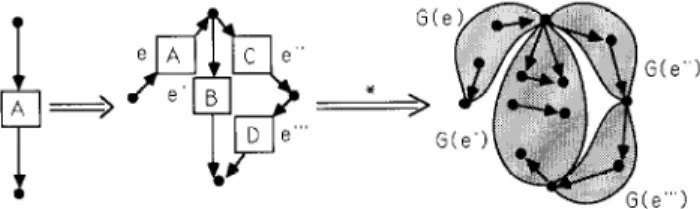
We continue in discussing how the minimum (resp. maximum) degree of a graph G can be computed from the minimum (resp. maximum) degree of the G(e). With respect to the determination of the minimum (maximum) degree of a graph G it is useful to know the minimum (maximum) degree of the internal nodes of G(e) as well as the degrees of begin,(,, and endcC,). As illustrated in Fig. 3, the degree DG( u) of a node u in V, c V, can be determined by summing up the degrees of the nodes begin,(,,, begin,,,,,, begincC,,,, (e, e’, and e” are the outgoing edges from v), and endcc,,.,, (e”’ is the only incoming edge in 0). Building the minimum (maximum) of the DG( v) (u E V,), we obtain the minimum (maximum) degree of the nodes u E V,. Moreover, the degrees of the internal nodes of the G(e) have to be taken into account.
Fig. 3. A derivation of the form A’+ R 4 G.
Theorem 4.5. For a graph G, let mindegree(G) and maxdegree( G) denote the minimum resp. maximum degree among the nodes of G. Moreover, let minintdegree(G) denote the minimum degree among the internal nodes of G and bdegree(G) and edegree( G) the degree of begin, resp. endG. Then
mindegree( G) = min mg D,(v), mg minintdegree( G(e)) ,
1 I
minintdegree(G) = min .,nrT
H &(v), ,mF R minintdegree(G(e))
maxdegree( G) = max 2%~ DG( v), EZIE maxdegree( G( e))
1 I ,
Decidable boundedness problems for hyperedge-replacement graphs 41
where, for v E V,, DG‘(v)= C
KY,‘(,) bdegree(G(e))+ etr,‘(c) C edegree(G(e)).
Proof. Let G be a (1, l)-graph and u be a node in G. Without loss of generality, we can assume G = REPLACE( R, repl) with repZ(e) = G(e) for each e E E, (cf. Theorem 3.3). Particularly, V, s V,. Thus, the degree of v in G, C&(V), can be determined as follows:
d,(u) = 1
DG(v) if vE V,,
dcc,,( v) if v E INT,,,, for some e E ER,
where
k(u) = C &,,,(kin,,,J + C
.FSH’(U) ett,‘(u) k&en&,,,). Using the notations introduced above, we get
DG(v)= 1
PL.‘R’CU) bdegree(G(e))+ ecr,‘(u) C edegree(G(e)).
By definition of the minimum degree of G and the minimum degree of G among the internal nodes,
mindegree( G) = me, d,(v)
= min ,mr~ DG(v), min
1 R et E, r;~lNi-~~., min &q,,(u)
21 DG( u), mp minintdegree( G(e)) ,
R R I
minintdegree( G) = JII~_ d,(v) <I
= min
i “,nEr R DG(v), rn$ minintdegree( G(e)) R
Let maxintdegree(G) denote the maximum degree among the internal nodes of G. Then we have analogously
maxdegree( G) = z;x dG( v) (i
max DG( v), max
UC v, ccl.?, UE max INTG,,) k,, (u)}
5:x DG(v), z”;” maxintdegree( G( e))
48 A. Habel et al.
Since maxdegree( G( e)) = max{ maxintdegree( G(e)), d,(,,(begin,(,,), d,,,,( end,(,))}
and
the last expression can be simplified to max
1
zavx DG(u), max maxdegree( G(e) .
R tYEER I
Finally, by the definition of bdegree and edegree, we get bdegree( G) = DG( beginG)
and edegree(G) = DG(endG). This completes the proof. 0
Number of components
Finally, we will show how the the number of components of a graph G can be computed provided that a derivation A’ =3 R 3 G of G with fibres Z,(e)’ 3 G(e) is given. We count the number of components of the graph R’ obtained from R by removing all edges e for which numpath( G(e)) is zero (nodes which are in the same component of R’ are in the same component of G) and look for “new” components obtained by the replacement of e by G(e) neither containing s,(e) nor t,(e). In our example in Fig. 4, numputh(G(e)) as well as numputh( G( e’)) are zero, thus R’
consists of two components. e creates no new component, its created nodes belong to the component containing the source resp. the target of e; e’ creates one new component with two nodes, all other ‘nodes belong to the component containing the source resp. the target of e’; e” and e”’ do not create new components. Therefore, G consists of three components.
G(e’ )
Fig. 4. A derivation of the form A’ =3 R 3 G.
Theorem 4.6. For a (1, l)-graph G, let camp(G) denote the number of connected components in G and newcomp( G) d enote the number of connected components neither containing begin, nor end,. Then
comp( G) = comp( R’) + C newcomp( G( e)),
t-GER
newcomp( G) = newcomp( R’) + 1 newcomp( G(e))
eSE,
Decidable boundedness problems for hyperedge-replacement graphs 49 Remark. newcomp(G) can be expressed directly by
newcomp( G) = camp(G)-1 ifnumparh(G)~l, comp( G) - 2 otherwise.
Proof of Theorem 4.6. Let COMP be a connected component in G. Without loss of generality, we can assume G = REPLACE( R, repl) with repZ(e) = G(e) for each e E ER (cf. Theorem 3.3). Particularly, V, & V,. Now two cases may occur.
Case 1: V,,,p n V, = 0. Then Vc,,p & INT,,,, for some e E ER, i.e., COMP is a “new” component created by e neither containing begin,(,) nor end,(,).
Case 2: V,,,p n V, # 0. Then the subgraph COMP’ c R with node set V,,,,. = V COMP n V, and edge set ECOMPs = {e E ER 1 begin,(,), end,(,) E V,-,Mp and num-
path( G(e)) 2 1) forms a connected component of R’ (since COMP is connected, COMP’ is connected, too). Suppose now that there is a node v E V,, - V,-o,ps which is joined with a node v’ E V,0,p8 by an edge e in R’. Then numpath( G( e)) 2 1 which means that v is joined with v’by a path in G. Since COMP is a connected component containing u’, v is in v,oMp n v, = VC.oMp’, a contradiction. Consequently,
comp(G)~comp(R’)+ 1 newcomp(G(e)). es,?,
Analogously,
newcomp( G) s newcomp( R’) + C newcomp( G(e)).
etE,
Conversely, let COMP’ be a component in R’. Then, for each pair of nodes v, uf E VCOMP~ , v and v’ are connected in G (they are connected in R’ and, for e E ERt, numpath( G(e)) 3 1). Consider now an arbitrary edge e E ER - ERs. Two cases may occur. (a) The source and target node of e are in the same component of R’. Then all nodes of G(e) which are connected with beginc(,, or end,(,) are in the same component as sR( e) and tR(e). (b) The source and the target node are in different components of R’. In any case, the nodes of G(e) which are connected with begin,(,) are in the same component as sR( e) and all nodes of G(e) which are connected with endcc,, are in the same component as tR(e). Different components in R’ yield different components in G. Moreover, for an edge e E ER, the components in G(e) which neither contain beginc(,) nor end,(,) yield additional components. Thus, we have comp(R’)+C.sER newcomp( G( e)) G comp( G) and newcomp( R’) + c etER newcomp( G(e)) s newcomp(G). I7
5. Compatible functions
In this section we introduce the notion of compatible functions in such a way that all functions considered in the previous section are special cases. Roughly speaking, a function fO on hypergraphs is said to be compatible with the derivation process of hyperedge-replacement grammars if, for each hypergraph H and each derivation of it, the value of H, f,(H), can be computed from the values of some specific subhypergraphs H(e) determined by the fibres of the derivation. As the
50 A. Hahel et al.
examples will show, this view is oversimplified for most applications. To compute the value of H, it might be necessary to compute the values of some other related functions for the H(e)‘s. Therefore, we use families of functions indexed by some finite set I and we need a mapping assign which determines the values for the H(e)‘s with respect to the different value functions.
The notion of compatible functions generalizes obviously our earlier notion of compatible predicates (see [ll]). More interestingly, a certain type of compatible functions that are composed of minima, maxima, sums, and products induce compat- ible predicates of the form: the function value of a graph exceeds a given fixed integer, or the function value does not exceed a fixed integer. Consequently, we get the decidability of the problems (l), (2), and (3) in the introduction for these predicates as a corollary.
Definition 5.1 (compatible functions). (1) Let Ce be a class of hyperedge-replacement grammars, I a finite index set, VAL a set of values, f: X,. x I+ VAL a function*, and f’ a function defined on triples (R, assign, i) with R E XC, assign : ER x I + VAL, i E I, and values in VAL. Then
f
is called(%, f ‘)-compatible
if, for all HRG = (N, T, P, 2) E 5% and all derivations of the form A’ 3 R 3 H with A E N and H E X,, and for alli
E I,
f(H,
i)=f'(Rf(H(-),
-),
9."
(2) A function
fo:
Xc +
VAL is called %-compatible if functionsf
and f and an index iO exist such thatfo=f(-,
io)
andf
is (Z, f’)-compatible.Remarks. (1) Intuitively, a function is compatible if it can be computed for a large hypergraph derived by a fibre by computing some values for the smaller components of the corresponding shorter fibres. Such a function must be closed under isomorph- ism because the derivability of hypergraphs is independent of the representation of nodes and hyperedges.
(2) %-compatibility is concerned with the productions of the grammars in (e and not with their axioms. Therefore, we may assume that, for each HRG = (N, T, P, 2) E
%2 and each Z/E %$, HRG’ = (N, T, P, 2’) belongs to the class %, too.
Examples 5.2. (a) Let % = X9???, I = {all, int}, VAL = N, and
f
andf'
be given by f(H, all) = 1 V,I (the number of all nodes in H),f(H, int) = IINT,I (the number of all internal nodes in H) f’( R, assign, all) = I v,I + 1 assign( e, int),
rtEH
f’(R, assign, int) = IINT,~+ C assign(e, in?).
* We assume that all considered functions are closed under isomorphism, i.e., for a functionf; if H = H’ for some H, H’t Xc, then f( H, i) =f( H’, i) (resp. f( H, assign, i) =f( H’, assign, i)) for all i t I.
9 f(H(-),-) denotes the function defined byf(H(-),-)(e, j)=f(H(e), j) for .CE E,, je I. For ie I, f(-, i) denotes the wary function defined by f(-, i)(H) =f( H, i) for all H E Xc.
Decidable boundedness problems for hyperedge-replacement graphs 51
By Theorem 4.1, we get the following nice relationship:
= IVRi+,,C, .f(ff(e), in?) =f’(R f(ff(-1, -1, all). H
Analogously, we obtainf( H, int) =f’(R, f( El-), -), int). Therefore,f is (%%!9, f’)- compatible and f0 =f(-, all), concerning
(1) the number of nodes, is X+2$?-compatible.
(b) By Theorem 4.1, the following functions on hypergraphs are %%RC!?-compatible: (2) the number of hyperedges,
(3) the size, and
(4) the density of a hypergraph.
(c) Let % = ZZ’S%, I = { np}, VAL = No, and f and f’ be given by f( G, np) = numpath( G) (the number of simple paths in G),
f’(R, assign, np) = C n assign( v) ,,t PATH, ronp
By Theorem 4.3, we get the following relationship: f( G, np) =
numpath
(G)=
c
n
numpath( G( e))pr PATHR eonp
=,,p~TH, J, f(G(eL HP) =f’(R, f(W),
-1,
v).
Therefore f is (E%!F?, f’)-compatible and f0 =f(-, np), concerning
(5) the number of simple paths connecting the external nodes, is %!@YI- compatible.
(d) By Theorems 4.3-4.6, the following functions on graphs are ‘EX%compatible: (6) the minimum-path length (of paths connecting the external nodes), (7) the maximum-simple-path length (of paths connecting the external nodes), (8) the number of simple cycles,
(9) the minimum-cycle length, (10) the maximum-simple-cycle length, (11) the minimum degree,
(12) the maximum degree, and
(13) the number of components of a graph.
We recall now the notion of compatible predicates and relate it with a special type of compatible functions.
52 A. Habel et al.
Definition 5.3 (compatible predicates). (1) Let %’ be a class of hyperedge-replacement grammars, I a finite index set, PROP a decidable predicate” defined on pairs (H, i) with H E XC and i E I, and PROP’ a decidable predicate on triples (R, assign, i) with R E XC, a mapping assign : ER + I, and i E I. Then PROP is called (‘S’, PROP’)- compatible if, for all HRG = (N, T, P, 2) E % and all derivations A’ + R 3 H with A E N and HE SYT, and for all ig I, PROP(H, i) holds if and only if there is a mapping assign : ER + I such that PROP’(R, assign, i) holds and furthermore PROP( H(e), assign(e)) holds for each e E ER.
(2) A predicate PROP, on XC is called V-compatible if predicates PROP and PROP’ and an index i. exist such that PROP,= PROP(-, io)” and PROP is ( %, PROP’) -compatible.
Remarks. (1) Intuitively, a property is compatible if it can be tested for a large hypergraph with a long fibre by checking the smaller components of the correspond- ing shorter fibres.
(2) Examples of compatible properties are: connectivity, planarity, existence of Hamiltonian and Eulerian paths and cycles, k-colorability for each k 5 0 (see [ 11,5]).
(3) In [ 1 l] it is shown, that, for all %-compatible properties PROP,, it is decidable whether, given any hyperedge-replacement grammar HRGE %, PROP, holds for some HE L(HRG) and PROP, holds for all HE L(HRG).
Definition 5.4 (special types of compatible functions). Recall No = N + (0). (1) A functionf: XC x I + No is said to be (%, min, max, +, .)-compatible if there exists an f’ such that for each right-hand side R of some production in % and each i E I, f’( R, -, i) corresponds to an expression formed with variables assign( e,j) (e E ER, j E I) and constants from N by addition, multiplication, minimum, and maximum, and f is ( Vi?, f’) -compatible. The function is (‘S’, max, +, . )-compatible if the operation min does not occur.
(2)
A
functionf,: XC + No is (%, min, max, +, *)-compatible (resp. (%?, max, +, .)- compatible) if a function f and an index i. exist such that fo=f(-, io) and f is (%Y, min, max, +, .)-compatible (resp. (%‘, max, +, .)-compatible).Theorem 5.5. Let PROP, be a %-compatible predicate. Then the function f. : Xc + No given by
f,(H)={ 1 if PROP,(H) holds, 0 otherwise,
is (%‘, max, +, * )-compatible.
” We assume that all considered predicates are closed under isomorphism, i.e., if a predicate @ holds for HE %f, and H-H’, then @ holds for H’, too.
” For i E I, PROP(-, i) denotes the wary predicate defined by PROP(-, i)(H) = PROP(H, i) for all HEX,.
Decidable boundedness problems for hyperedge-replacement graphs 53 Proof. Let PROP, be a %-compatible predicate, PROP, PROP’ the corresponding predicates, I the corresponding index set, and i0 the index such that PROP,= PROP(-, iO). Then we define functions f; f’ as follows:
f(H, i) = 1
1 if PROP(H, i) holds, 0 otherwise,
(
1 if PROP’( R, assign, i) holds for some assign : ER + I f’( R, assign’, i) = with assign’(e, assign(e)) = 1 for all e E ER,
0 otherwise.
Obviously, fO( H) =f( H, i,). Hence it remains to show that f is (%, f’)-compatible. Let H E XT, A’ j R 3 H a derivation of H in HRG, and, for e E En, Zn (e)’ 3 H(e)
be the fibre of R 5 H inducted by e.
If f( H, i) = 1, then PROP( H, i) is satisfied. By the (%, PROP’)-compatibility of PROP, there is a mapping assign : E, + I such that PROP’( R, assign, i) and
PROP(H(e),assign(e))foreEE, hold.Thus,f(H(e),assign(e))=lforalleEE,.
Using the definition of f’, we obtain f’( R, f( H(-), -), i) = 1. Conversely, if
f’(R, f(H(-), -), i) = 1, then there exists a mapping assign : ER + Z with f( H( e), assign(e)) = 1 for e E ER such that PROP’( R, assign, i) holds. Moreover,
PROP( H( e), assign(e)) holds for e E En because f( H( e), assign(e)) = 1 for e E ER.
Now the (‘32, PROP’)-compatibility of PROP implies that PROP( H, i) holds and the definition off implies that f( H, i) = 1. Now f( H, i) =f’( R, f( H(-), -), i) for all
i E I, i.e., f is (%, f’)-compatible. Moreover, f’(R, assign’, i) can be expressed as max 0, max n assign’( e, us(e))
astAs USE,
where AS = {assign : En + 11 PROP’( R, assign, i)}. Hence, f is (%, max, +, . )- compatible. 0
Conversely, ( %‘, min, max, +, . )-compatible functions induce certain ‘S-compat- ible predicates.
Theorem 5.6. Let fO: Xc + No be a ( %T, min, max, +, . )-compatible function for some class % of hyperedge-replacement grammars. Moreover, let n E No. Then the predicates
given by “f,(H) < n”, “fO( H) s n”, “fO( H) = n”, “fO( H) 2 n”, and “fO( H) > n” are
%‘-compatible.‘2
Proof. Let fO: Xc + No be a (92, min, max, +, . )-compatible function, f and f’ the corresponding functions, I the corresponding index set and i, the index such that
fO=f(-,io). Let J={O, l,..., n}+ (0, big} for n EN and J = (0, big} for n = 0. Moreover, let [-] : No + J be the mapping with [m] = big for m > n and [m] = m
otherwise. Now we define a new index set i and predicates PROP, PROP’ as follows: l i is the set of all mappings from I to J, denoted by i = [ 1+ J].