Rasha Kadry Abdelatti Mohamed Soliman
Submitted in accordance with the requirements for the degree of PhD in Arabic Linguistics
The University of Leeds Linguistics and Phonetics
School of Modern Languages and Cultures
The candidate confirms that the work submitted is her own and that appropriate credit has been given where reference has been made to the work of others.
This copy has been supplied on the understanding that it is copyright material and that no quotation from the thesis may be published without proper
acknowledgement.
The right of Rasha Kadry Abdelatti Mohamed Soliman to be identified as Author of this work has been asserted by her in accordance with the Copyright, Designs and Patents Act 1988.
Dedication
To my parents
Acknowledgements
"In the name of Allah, the most gracious, the most merciful. All praise to Allah by whose grace good deeds are achieved"
I wish to express sincere gratitude and deep thanks to my supervisor, Dr. Melinda Whong for her advice, patience and encouragement. I owe her much for her intellectual guidance and moral support throughout every stage of my study and for all the invaluable skills she taught me which I know I will continue to grow and utilise.
From the School of Modern Languages and Cultures at the University of Leeds, I would like to thank Ms. Karen Priestley for her excellent and prompt administrative support and Dr. Diane Nelson as my postgraduate tutor for encouraging me as well as many postgraduate students to participate in the organised annual PG
conferences in which I received insightful feedback.
I am indebted to all the Arabic speaking individuals who agreed to take part in this study, giving their time and effort and allowing me to record their conversations. Their participation is greatly appreciated. Special thanks to all those who helped me to record high quality dialectal sentences to use in my case study; Mr. Aimen Ghummed and Mr. Abdurraof Shitaw for their input in the Libyan dialect, Ms. Arwa Gandeel for her input in the Hijazi dialect and to my dear sister-in-law Asmaa Soliman for her input in the Levantine dialects. I am also very grateful to Professor. Dilworth Parkinson at Brigham Young University for allowing me to join the online Arabic-L mailing list through which I reached many Arabic linguists who provided me with support and references in analysing the urban dialects I used in my study. I am grateful to the Arabic students at the University of Manchester who
wholeheartedly participated in the case-study of my research and to all those who gave me insight into their Arabic language learning needs.
I am heavily indebted to my beloved husband, Najeeb, for his support of my Ph.D. endeavour and for always being there for me throughout the exciting times of my study as well as the stressful ones.
My love and thanks to my sweet children, Yusuf, Ismail and Haroon for innocently allowing me to take some of our time together to spend on my research and for always bringing smiles on my face when needed. My appreciation also goes to my sisters, brothers and friends for all their love, prayers and good wishes.
Last but not least, I will always be grateful to my parents who always had
confidence in me. I am grateful for the opportunities they opened up encouraging me to get into the field of Arabic language teaching and linguistics, for their trust and support in sending me to do my M.A. far away from them and for encouraging me to pursue my Ph.D. study. My deepest appreciation and heartfelt thanks go to them for their patience, their prayers, their sacrifice, their endurance, and for their love and endless support of my education.
Thanks to all of you. Without your support this work would have never been possible.
Abstract
This research is divided into two interlinked parts. The first part reviews literature on the diglossia and variability of the Arabic language and investigates how mutual intelligibility is achieved in informal conversations between speakers of different Arabic dialects. 11 conversations were recorded between speakers of 12 Arabic dialects. Instances of borrowing from Modern Standard Arabic were observed and analysed. The participants were also interviewed after the recorded conversations in order to get more insight into the listening comprehension strategies that they applied to achieve intelligibility. The results show that the native speakers tend to rely mostly on their native dialect in cross-dialectal interaction with a much smaller number of borrowings from Modern Standard Arabic in comparison with previous studies. A number of listening strategies were observed to be used in order to aid intelligibility. These strategies included making use of the context, ignoring non-content words and making use of their linguistic knowledge and the root and pattern system in Arabic as a frame of reference in comprehending unfamiliar cognates. The analysis also showed that dialect familiarity has a major role in aiding comprehension between the native speakers of different Arabic dialects. The second part, first, examines the needs of learning Arabic as a second language in Higher Education, then presents a case study that tests the advanced Arabic learners’ level of cognate recognition in unfamiliar dialects and whether explicit strategy teaching and lexical training can improve their dialectal lexical
comprehension. Five final year university students of Arabic with an advanced level in MSA and exposure to a dialect participated in this study. Pre and post-tests of dialectal listening comprehension were administered. The results of a higher score in the post-test confirmed that the explicit strategy training helped the Arabic students to achieve better comprehension of cognates in unfamiliar dialects.
Table of Contents
Dedication ... iii
Acknowledgements ... iv
Abstract ... vi
Table of Contents ...vii
List of Tables ... xi
List of Figures ... xiii
List of Abbreviations ... xiv
Transliteration Scheme ... xv
Chapter 1: Introduction: The Arabic language and its diglossic nature ... 1
1.1 What is Diglossia? ... 2
1.1.1 Views on diglossia ... 5
1.1.2 Diglossia versus standardisation ... 7
1.1.3 Diglossia versus bilingualism ... 8
1.1.4 Diglossia versus code-switching and code-mixing ... 9
1.1.5 Diglossia versus register ... 10
1.1.6 Diglossia and dialects ... 11
1.2 Arabic Diglossia ... 12
1.2.1 Brief history of Arabic diglossia and its emergence ... 12
1.2.2 The standardisation of Arabic ... 13
1.2.3 The languages of the occupied lands ... 14
1.2.4 The current Arabic varieties ... 15
1.2.4.1 Classical Arabic (CA) ... 15
1.2.4.2 Modern Standard Arabic (MSA) ... 16
1.2.4.3 The Arabic dialects ... 17
1.2.4.4 Educated Spoken Arabic (ESA) ... 19
1.3 Overview of this research project ... 21
Chapter 2: Cross-dialectal conversations: Literature Review ... 24
2.1 Cross-dialectal conversations and mutual intelligibility ... 24
2.2 Arabic cross-dialectal conversations ... 26
2.2.1 Blanc’s study (1960) ... 28
2.2.3 Abu-Melhim’s study (1992) ... 31
2.2.4 Abu-Haidar’s study (1994) ... 33
2.2.5 Shiri’s study (2002) ... 34
2.2.6 Limitations in the studies on Arabic cross-dialectal communication ... 35
2.3 Language variability in TASL ... 39
2.4 Conclusions ... 43
Part I Cross-dialectal conversations in Arabic: language choice and comprehension strategies ... 45
Chapter 3: Investigating native Arabic cross-dialectal conversations: Methodology ... 46
3.1 The research questions ... 47
3.2 Methodology ... 48
3.2.1 The participants ... 49
3.2.2 The settings and instructions given to the participants ... 51
3.2.3 The data collection and analysis ... 53
Chapter 4: The language of cross-dialectal conversations: Results and Discussion ... 58
4.1 Results ... 58
4.1.1 Borrowings from MSA by participant and by conversation ... 59
4.1.2 Cognate borrowings ... 61
4.1.3 Non-cognate borrowings ... 64
4.1.4 Variables influencing MSA borrowings ... 70
4.2 Discussion ... 73
4.2.1 Research question 1: Which linguistic elements are borrowed from MSA in informal cross-dialectal communication? ... 73
4.2.2 Research question 2: Are there any linguistic or non-linguistic variables that may influence MSA borrowings? ... 76
Chapter 5: Native listening comprehension strategies in Arabic cross-dialectal conversations: Results and Discussion ... 79
5.1 Results ... 80
5.1.1 Successful comprehension ... 80
5.1.1.1 Strategies applied by the speaker ... 81
5.1.1.2 Strategies applied by the listener ... 83
5.1.2 Comprehension failure ... 92
5.2.1 Research question 3: What are the strategies that the NSs apply and the factors that influence comprehensibility in
cross-dialectal communication? ... 97
Chapter 6: Arabic cross-dialectal conversations: Conclusions ... 101
6.1 Findings ... 102
6.2 Implications for TASL ... 108
6.3 Limitations and areas for further research ... 109
Part II Implications for the Teaching of Arabic as a Second Language ... 113
Chapter 7: Arabic as a Second language: Learners’ needs in Higher Education ... 114
7.1 Previous studies on the learning needs of Arabic language students ... 114
7.2 The learning needs of students of Arabic at the University of Manchester: A pilot study ... 120
7.2.1 A description of the questionnaire and its administration ... 120
7.2.2 The Results ... 124
7.2.3 Discussion of the results of the questionnaire ... 132
7.3 Conclusions ... 138
7.4 Points to consider if administering the questionnaire in the future ... 139
Chapter 8: A multi-case study on L2 listening comprehension of cross-dialectal Arabic: Methodology ... 141
8.1 The study design ... 142
8.2 The participants... 143
8.3 The setting ... 146
8.4 The test instrument ... 146
8.5 Procedure and ethical considerations ... 154
8.6 The dialectal training intervention and the group discussions ... 154
8.7 Procedures for the data analysis ... 156
Chapter 9: A multi-case study on the L2 listening comprehension of cross-dialectal Arabic: Results and Discussion ... 160
9.1 Results ... 161
9.1.1 Correct pre-test responses by dialect ... 161
9.1.2 Correct pre-test responses by type of morpheme ... 162
9.1.3 The effects of the training on their recognition of cognates in unfamiliar dialects ... 165
9.1.4 The effects of the training on their recognition of root and functional morphemes ... 167
9.1.5.1 The importance of learning about the pronunciation rules and the corresponding sounds in the Arabic
varieties ... 168
9.1.5.2 Combining morphemes in the dialects ... 169
9.1.5.3 Linking between the unfamiliar and the familiar varieties ... 169
9.1.5.4 The effectiveness of the strategy training ... 171
9.2 Discussion of the results ... 171
9.2.1 Research question 4: To what extent can the advanced university Arabic students achieve successful dialectal comprehension? ... 172
9.2.2 Research question 5: Can explicit instruction of the NSs’ listening strategies affect the level of L2 dialectal lexical comprehension? ... 175
Chapter 10: Conclusions ... 179
10.1 Findings: L2 comprehension of lexis in unfamiliar dialects ... 180
10.2 Limitations of the case-study ... 182
10.3 Conclusions of both parts of this study project ... 183
10.4 Questions for further research ... 185
List of References ... 188
Appendix A: Consent form for recording the NSs cross-dialectal conversations ... 195
Appendix B: Resources used to verify the MSA borrowings into the dialects of the participants ... 196
Appendix C: Needs Analysis Questionnaire ... 198
Appendix D: Consent Form for the needs analysis questionnaire ... 203
Appendix E: The tested words in the case study ... 204
Appendix E.1: The tested words in the pre-test of the case-study and their cognates in MSA ... 204
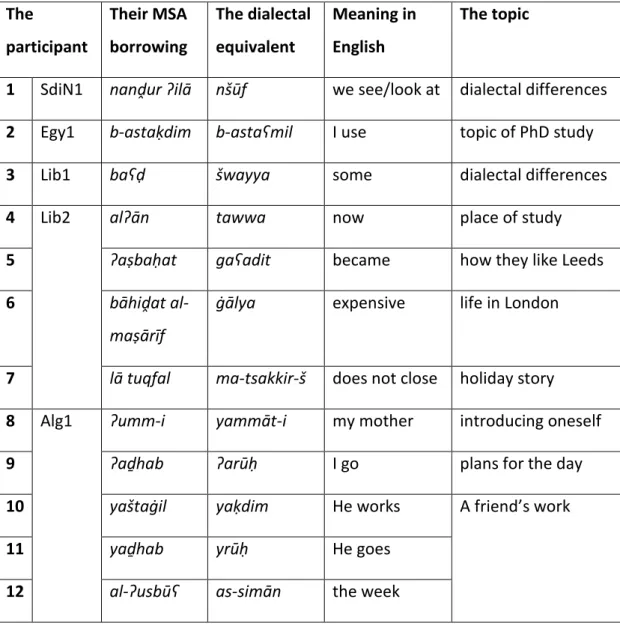
Appendix E.2: The tested words in the post-test of the case-study and their cognates in MSA ... 205
Appendix F: The sentences used in the case-study test ... 207
Appendix F.1: The sentences used in the pre-test ... 207
Appendix F.2: The sentences used in the post-test ... 209
Appendix G: The consent form and answer sheet for the dialectal L2 recognition case-study ... 211
List of Tables
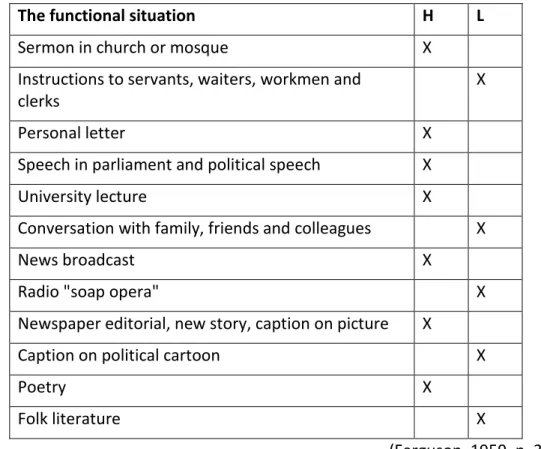
Table 1.1: The functional situations for H and L in diglossic languages according to
Ferguson’s definition ... 4
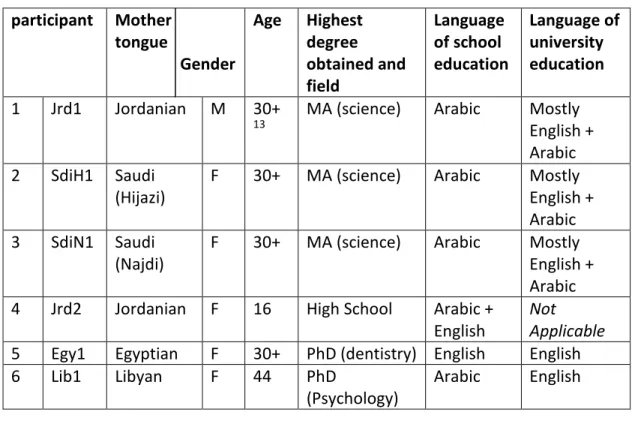
Table 3.1: The participants ... 50
Table 3.2: The conversations ... 52
Table 4.1: The number of MSA borrowings by participant and by conversation ... 59
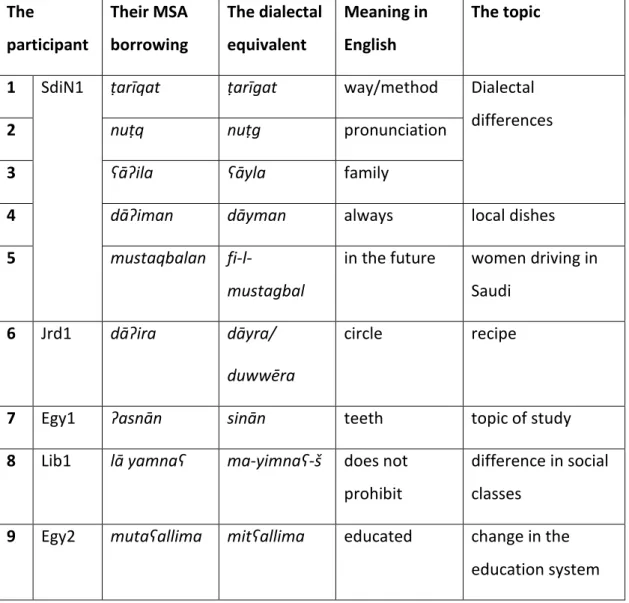
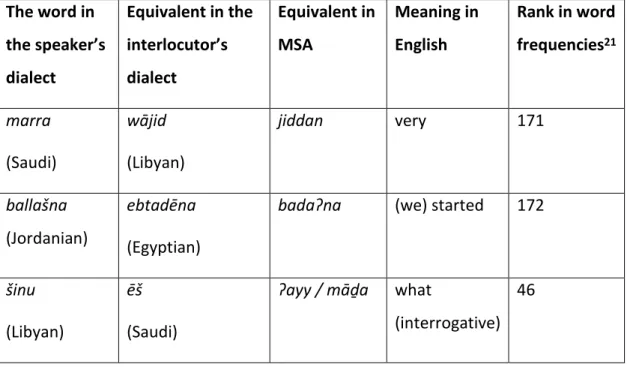
Table 4.2: The borrowed MSA cognates, their dialectal equivalents and the topics in which they occurred... 61
Table 4.3: The borrowed MSA non-cognates, their dialectal equivalents and the topics in which they occurred ... 65
Table 4.4: The linguistic features of the cognates and non-cognates borrowed from MSA ... 69
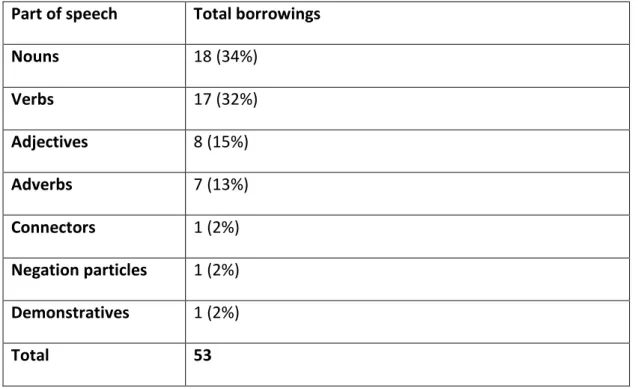
Table 4.5: The number of borrowed MSA elements by part of speech ... 70
Table 4.6: The number of borrowed MSA elements by gender ... 71
Table 5.1: Familiar dialectal non-cognates and their frequency of use ... 85
Table 5.2: The words that broke comprehension and their frequency of use ... 94
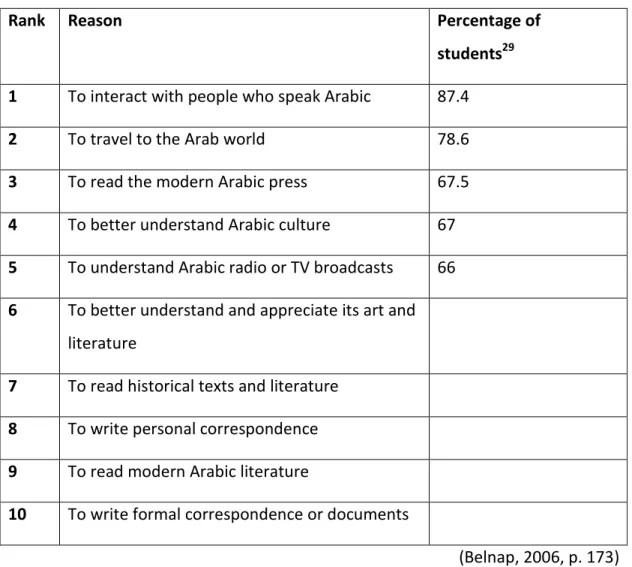
Table 7.1: Learners’ top ten reasons for choosing Arabic in Belnap’s first survey (1986) ... 116
Table 7.2: Learners’ top ten reasons for choosing Arabic in Belnap’s second survey (2006) ... 117
Table 7.3: The number of participants at different years of study ... 125
Table 7.4: The top ten learning needs with the highest agreement responses ... 126
Table 7.5: “Agree” responses to Academic purposes ranked according to priority ... 128
Table 7.6: “Agree” responses to religious purposes ranked according to priority . 129 Table 7.7: Responses to personal and social purposes ranked according to priority ... 130
Table 7.8: “Agree” responses to the Media and cultural understanding purposes131 Table 7.9: Students responses towards learning the Arabic dialects ... 132
Table 8.1: The demographics of the participants ... 145
Table 8.2: Morpho-phonological differences between the cognates in the tests . 148 Table 8.3: The functional morphemes in both tests ... 158
Table 8.4: The tested elements in each dialect in both tests ... 158
Table 9.1: Correct pre-test responses by dialect ... 162
Table 9.3: The total number and percentages of the linguistic elements that were correctly translated in both tests ... 164 Table 9.4: Correct post-test responses by dialect... 166 Table 9.5: Correct post-test responses by type of morpheme ... 167
List of Figures
Figure 5.1: Observations of the actions taken by the speakers and the listeners in cross-dialectal interaction ………..……… 100 Figure 7.1: Percentage of agreement responses to the career options …………127 Figure 9.1: The percentage of correct elements in both tests …………..………….165 Figure 9.2: Averages of correct responses by dialects in both tests ………166 Figure 9.3: Averages of correct responses by type of morpheme in both
List of Abbreviations
TASL Teaching Arabic as a Second Language
L1 First Language
L2 Second Language
NS Native Speaker
NNS Non-Native Speaker
H High form in diglossia
L Low form in diglossia
HE Higher Education
MSA Modern Standard Arabic
CA Classical Arabic
ESA Educated Spoken Arabic
Transliteration Scheme
The transliteration system used throughout this thesis is mainly the DIN31635 ("Intellibe - Intellaren,") which is presented in the following table showing the Arabic letters, their equivalents in the DIN31635 system and the nearest
equivalents in the IPA system. For some Arabic sounds, the IPA system is used as presented in the tables below. Some Arabic letters have different pronunciation in the dialects included in this study; these are also presented in the tables below and indicated to be dialectal. In reference to individual sounds, the IPA system is used. Consonants
Transliteration symbols
Arabic IPA Transliteration
symbols Arabic IPA ʔ ء ʔ ḍ ض ɮˤ b ب b ṭ ط tˤ t ت t ḓ ظ ðˤ ṯ ث θ ẓ (dialectal) ظ zˤ s (dialectal) ث s ʕ ع ʕ dj / j ج dʒ / ʒ ġ غ ɣ g (dialectal) ج g f ف f y (dialectal) ج j q ق q ḥ ح ħ ʔ (dialectal) ق ʔ ḳ خ x g (dialectal) ق g d د d k ك k ḏ ذ ð ch (dialectal) ك tʃ z (dialectal) ذ z l ل l r ر r m م m z ز z n ن n s س s h ه h š ش ʃ w و w ṣ ص sˤ y ي j
Vowels Transliteration symbols Arabic long vowels IPA Transliteration symbols Arabic short vowels IPA ā
ا
ɑː / aː aَ ـ
a / ɑ āا
æː (dialectal) aَ ـ
æ īي
iː iَ ـ
iē (dialectal)
ي
eː e (dialectal)َ ـ
eū
و
uː uَ ـ
uChapter 1: Introduction: The Arabic language and its diglossic nature
A language can be briefly defined as a tool for communication (Fromkin et al., 1999). Humans need to interact with each other and language facilitates this interaction, whether it is spoken, written or signed. The interaction does not have to be only between two or more people, but also with oneself as in thinking aloud or in writing shopping lists and reminders or with other entities as in praying to God for example. The functions of a language are innumerable; we advise, inform, encourage, tell off, correspond with letters, educate, ask, enliven or even offend each other with language. Language can also be used as a type of art or forentertainment as in singing, calligraphy and poetry. Each of these functions can be achieved using different choices of words and different syntactic structures of utterances depending on the context while still considered being within one language. For example, a German recipe book would have specific words and collocations which would be considerably different from the language of the German press. This variation in the use of language is referred to as "register" (Yule, 1996). Language use can change also in achieving the same task – in the same context – but in a different social situation. For instance, the language used for asking for directions could differ in some cultures depending on the formality of the situation i.e. the age and the gender of the addressee. The latter type of language variation is referred to in sociolinguistics as a variation in the "style" (Stockwell, 2002).
When the difference in the pronunciation, vocabulary use and the grammatical structures of the varieties of the same language becomes significant in achieving different functions,this phenomenon is not referred to as a variation of register or style, but rather as "Diglossia". Although the phenomenon of diglossia has always existed in some parts of the world, the term “diglossie” itself was first used in French to describe the Arabic linguistic situation in 1930 by William Marçais. The English equivalent “diglossia” was not used until the late fifties when Charles Ferguson employed it in his famous article “Diglossia” in the journal Word (Ferguson, 1959; Kaye, 2001). One of the diglossic languages that has received a
lot of focus since Ferguson's article is Arabic. This could be due to the fact that its long history, the large number of its native speakers (NSs) and the size of the lands where it is spoken has resulted in a multi-diglossic situation with many Arabic dialectal varieties. Such variation has been stated to be problematic in Teaching Arabic as a Second Language (TASL) (Ferguson, 1963). This is because it requires the teachers and the TASL program coordinators to make decisions regarding which variety to teach and if more than one variety is to be taught, then how many of them and in what order they should be introduced to the second language (L2) learners.
The motivation behind the present research study originates from the researcher’s commitment to and experience in TASL and seeks to better understand the
diglossia of the Arabic language, how certain diglossic aspects are dealt with among the NSs of different Arabic dialects and how it can be efficiently
incorporated into TASL. This research aims to contribute to the field of TASL by investigating pertinent language skills which take Arabic diglossia and variability into account and support learners to acquire some of the goals that they aim for. Prior to presenting the aims and the methodologies of the present study project and its research questions, it is important to review literature on diglossia in general and on Arabic diglossia in particular in order to have an understanding of its nature and its implications for communication between the Arabic NSs and TASL. Therefore, the rest of this chapter will review literature on the definition of diglossia and how it is distinguished from other sociolinguistic phenomena such as bilingualism, register and style. The chapter will also discuss Arabic diglossia, the history of its emergence and the different Arabic varieties, and will conclude with an overview of this research project.
1.1 What is Diglossia?
Diglossia is a linguistic phenomenon that exists when two different forms of the same language are used to achieve different functions within the same speech community. Diglossia has always existed in various communities but did not receive much attention from academics until 1957 when a study was undertaken
on the problem of linguistic duality in the Iraqi speaking community by Al-Toma (Ferguson, 1959, p. 326). Following this study, Ferguson investigated the phenomenon and proposed further research questions to be answered. Ferguson's coinage "diglossia" was modelled on the French word “diglossie”. Ferguson defined diglossia as:
… one particular kind of standardization where two varieties of a language exist side by side throughout the community, with each having a definite role to play
(Ferguson, 1959, p. 325)
He refers to these two varieties as the High form (H) and the Low form (L). H is considered by its NSs to be the prestigious standard language while L is the day-to-day spoken language which does not have the same prestige but is rather
considered a corrupted form of H by some of its NSs. L is acquired at home and never taught in schools while H is analysed in terms of its syntax and lexicon and taught in primary and high schools. Ferguson also described H as the language of education, conference presentations, media, religious speeches and ceremonies and the language which has usually been chosen to be taught as a second language. On the other hand, L is not as prestigious; its syntax is not analysed in order to be taught in schools and usually not chosen by teachers to be taught as a second language either. Ferguson proposed three conditions in which diglossia naturally arises:
1. The availability of a sizable body of literature in a language similar to the spoken variety of a certain community and which carries fundamental values and beliefs for that community.
2. When literacy is limited to a small elite in that community
3. A long period of time having passed between the first two conditions.
In his article, Ferguson's chose four examples to describe diglossia; Arabic, Swiss German, Modern Greek and Haitian Creole and he referred to these languages to
compare the two forms in terms of: function, prestige, literary heritage, acquisition, standardization, stability, grammar, lexicon and phonology. He indicated that the most important feature of diglossia is the specialization of function for H and L. Table 1.1 below illustrates a sample listing of possible situations stated by Ferguson indicating the variety normally used for each of them1:
Table 1.1: The functional situations for H and L in diglossic languages according to Ferguson’s definition
The functional situation H L
Sermon in church or mosque X
Instructions to servants, waiters, workmen and clerks
X
Personal letter X
Speech in parliament and political speech X
University lecture X
Conversation with family, friends and colleagues X
News broadcast X
Radio "soap opera" X
Newspaper editorial, new story, caption on picture X
Caption on political cartoon X
Poetry X
Folk literature X
(Ferguson, 1959, p. 329)
In describing diglossia, Ferguson relied on his own suppositions on how a diglossic language comes into being, how it is acquired and into what direction it develops. Many papers and articles were produced afterwards analysing the phenomenon
1 The table above is only an example of the different niches of each variety. However it is to be noted that these niches can change with time and geography and can be different from a diglossic language to another. In a more recent field study carried out in Cairo, Wilmsen (2006) observed the language use in political speeches and university lectures and concluded that Egyptian Colloquial Arabic – which would be referred to as (L)
more comprehensively, supporting as well as criticising Ferguson's article. The following section will illustrate briefly other descriptions and definitions of diglossia.
1.1.1 Views on diglossia
After Ferguson's seminal article, there were many attempts to analyse diglossia further and to try to search for other sociolinguistic situations that would provide a more detailed description of the phenomenon. In 1993, Fernandez produced a comprehensive bibliographical book which included almost 3000 entries of papers and articles related to diglossia between 1960 and 1990; they covered about 173 language varieties, out of these, 287 articles were on diglossia in Arabic
(Fernandez, 1993). Ferguson's description of diglossia was predominant in the literature until 1967 when an extended definition of diglossia was proposed by Fishman. Fishman (1967) introduced the idea that diglossia could be extended to bilingual situations found in societies where two unrelated varieties - or at least historically distant languages - occupy the H and L roles as in the example of Latin in medieval Europe which was used for religious, educational, literacy and other such prestigious domains, while another language (in the case of medieval Europe, the vernacular languages of that era) is rarely used for such purposes, being only employed for more informal, primarily spoken domains (Fishman, 1967). Another more contemporary example that Fishman gave for a bilingual diglossic situation was in Paraguay, where Guarani and Spanish – two very distinct languages; an indigenous American language and an Indo-European language – serve different social functions. Guarani serves the L functions as assigned by Ferguson while Spanish is the formal language that serves H functions. Fishman's notion was the next step of defining diglossia after Ferguson’s and his definition is recognized as "Fishman's extended diglossia" (Fasold, 1984).
The two definitions of Ferguson and Fishman were analysed more in the seventies and eighties and more questions were raised regarding the limitations of language usage in a diglossic situation. An alternative to Fishman's view started to emerge in Fasold's review of diglossia (Fasold, 1984). He pointed out the lack of
meant. It could be presumed from Ferguson's description and the four language examples he presented that it is a community that lives within certain political borders. This lack of specification of a speech community is what led Fasold to invent the term "diglossic community" rather than "a speech community" to make it less correlated to political boundaries. By a diglossic community he meant the community that uses two different varieties to represent Ferguson's H and L's niches regardless of the geographical locations of the two varieties. In scrutinizing the three views on diglossia, it can be confirmed that all of them emphasized the functional specification in language use to be the main feature of diglossia. Ferguson proposed that the two varieties are related such as Classical Arabic and an Arabic dialect and confirming that Classical Arabic is not used for informal situations. Fishman proposed the un-relatedness of the two varieties as the example mentioned above in Paraguay of the use of Spanish and Guarani where Spanish is not used for informal situations in Paraguay, even though, it is used informally in Spain. Fasold's broad diglossia emphasized the insignificance of language relatedness and proposed the notion that diglossia can include any two different codes such as registers or sub-dialects as long as one of them is not used informally by anyone in a specified diglossic community.
The previous proposed definitions were then studied by Hudson (1994) who agreed with Fasold on the important role which formality plays in defining a diglossic language; however he pointed out that after examining the features of grammar, lexicon and phonology in Ferguson's preliminary discussion, one has to be cautious not to mix between the concepts of formality and diglossia. He points out two issues to distinguish between formality in diglossic and non-diglossic situation; these are the extent of linguistic differences between the two varieties and the level of resistance of the formal variety to influence against the informal one (Hudson, 1994). The literature on the definitions of diglossia is huge and still ongoing studies are trying to analyse the phenomenon. The details discussed in the literature are not presented in this paper as they would be outside the scope of this study; however, a detailed description of Arabic diglossia is presented later in this chapter. In the next section, and before focusing on the Arabic language, it is important to look at some sociolinguistic terms - such as standardisation,
bilingualism, code-switching, code-mixing, register and dialect - and compare them briefly with diglossia in order to provide an adequate comprehensive description of Arabic diglossia and to distinguish it from the other sociolinguistic phenomena that exist in some Arabic speaking communities and to further clarify what a diglossia is, by saying what it is not. In describing diglossia here, Ferguson's abbreviations for the two varieties – H and L – will be used regardless of the languages they refer to.
1.1.2 Diglossia versus standardisation
Diglossia can easily be confused with standardization. In most of the literature in sociolinguistics, the definition of a standard language appears identical to the H in the diglossic situation. For example, a definition of standard English was given in (Yule, 1996, p. 227) as:
The variety which forms the basis of printed English in newspapers and books, which is used in the mass media and which is taught in schools. It is the variety we normally try to teach to those who want to learn English as a second language.
This definition can be completely applied to H in diglossia; however the main characteristic which differentiates diglossia from standardization is that H and L have limited and specified functions and neither of them can be used solely to achieve all the required communicative functions in the speech community. H is never used for day-to-day conversations by anyone in the community and if this is attempted, it is considered artificial or even unacceptable (Ferguson, 1959). On the other hand, the standard variety in a non-diglossic language is usually used fully and naturally to achieve all the communicative functions of a certain group of people within a certain speech community. Standardization can exist within the diglossic situation. There can be two standard languages for the same community; the standard written language and the standard spoken language. In Egypt, for instance, the Cairene dialect is mostly considered by its NSs to be the standard spoken variety and not the Alexandrian nor the Upper-Egyptian. Versteegh has
pointed out that there is a tendency towards the dialect of the capital city of a country to be the standard spoken variety in diglossia (Versteegh, 1997). This distinction between standardization and diglossia is important to be recognized in teaching second languages. As it was stated above in Yule's
definition of Standard English, the standard variety is usually the one chosen to be taught as a second language. This choice could mean that the learner might not be exposed to the other dialects or accents of English and could encounter difficulties in understanding them; however the Standard English learnt would enable him/her to communicate fully with the NSs. The only disadvantage in that case would be associating that learner with the group who speaks the standard language as a first language (L1). In diglossia, the situation is very different. When the H variety is the only variety taught as a second language, it will enable the learner to achieve its functions in the community, such as writing formal letters, understanding the language of newspapers and reading Arabic books. However, the learner will still need to learn an L variety in order to achieve other functions like; greeting people, booking a ticket or asking for directions.
1.1.3 Diglossia versus bilingualism
Both bilingualism and diglossia mean the existence of two fluent varieties as first languages within the same community. However, there are certain characteristics that differentiate the two phenomena. A simple differentiation is that in
bilingualism, an individual is capable of using the two varieties fully to achieve all communicative functions required and the choice of which variety to use depends mainly on the addressee2. In diglossia, the level of proficiency in the two varieties is not equal in terms of the language skills; an individual can have a native fluency in speaking L but not in speaking H. The choice of which variety to use in diglossia does not only depend on the addressee but also on other sociolinguistic factors such as the formality of the situation or the type of the language function.
Bilingualism can be collective and can be isolated (Francescato, 1986); this means that a whole society can be bilingual such as in Canada, where English and French
2Although a bilingual person can be considered a NS of two varieties, usually one of them
are both official languages. Isolated bilingualism refers to an individual being brought up using two different languages. Yule (1996) gives the example of a native English and French speaker, who becomes a bilingual as a result of having two parents speak the two different languages. Diglossia is not an isolated
phenomenon but always a collective one that characterises a whole community. In collective bilingualism, the two varieties can be recognised as official languages of that community. In diglossia, H is recognised as the official language of the community while L does not have the same status and can even be perceived as a spoken medium in a corrupted form of H. Nevertheless, Ferguson anticipated a slow change in the stability of diglossia and suggested that different L forms can be recognised as official spoken Languages – specifically in the case of Arabic with several low forms being used in different regions. For example, MSA would be the official written language in Egypt while the Cairene dialect would be recognised as the official and standard spoken language (Ferguson, 1959). Observations of the recent linguistic situation in Egypt prove Ferguson's anticipation. Despite the fact that so far there have not been yet any national actions in the Arabic speaking countries to declare a spoken variety as an official language, the use of Cairene Arabic has gained more acceptance in recent years in use in formal situations (Wilmsen, 2006). Diglossia and bilingualism can also exist simultaneously in the same community. An example Tunisia, where the majority of literate people are NSs of Arabic and French and their Arabic is diglossic; MSA is an official language of the country while the people speak Tunisian Arabic dialect in everyday situations (Daoud, 2011).
1.1.4 Diglossia versus code-switching and code-mixing
Code-switching is defined as the shifting from one variety to another by a single speaker. It refers to a linguistic action that is recurrent in bilingualism and in diglossia. In the case of individual bilingualism, switching from one language to another depends on the addressee. For example Arabic-English bilinguals from parents who speak the two languages, would choose to speak Arabic with their Arabic speaking relatives, and would switch to English when speaking with the relatives from the other parent's side. In collective bilingualism, the switching is controlled by social rules and is referred to as situational
code-switching such as in the example given by Hudson (1996) of a village in north Italy where the community speaks German within their families and switches to standard Italian at work, school and churches (Hudson, 1996). According to Hudson's description of situational code switching, it can be argued that this is exactly what happens in diglossia when an individual switches from H to L
depending on the situation e.g. an Imam who gives the religious ceremony in MSA would switch to his Arabic dialect when greeting people after the end of the ceremony.
This difference in the level of awareness of one's switching between varieties is clearer when comparing between “code-switching” and "code-mixing". In code mixing, the choice to use a specific variety is not necessarily based on the
addressee or on the situation, but it is a phenomenon of mixing the two varieties in the same situation. This mixing is not only of the lexicon of the two varieties but can also include applying the syntactic rules of one variety to another (Hudson, 1996). The factors that cause code-mixing to occur are yet to be researched (Wardhaugh, 2006). Code-mixing can be seen in Arabic diglossia in the variety called “Educated Spoken Arabic” in which the L form is used with linguistic features borrowed from H on the phonological, lexical and syntactical levels (Agius and Shivtiel, 1992). According to Bassiouney (2009), some linguists make a distinction between code-switching and code-mixing, differentiating them by the labels “inter-sentential” and “intra-sentential” while others may regard this distinction as creating confusion.3
1.1.5 Diglossia versus register
The term “register” refers to a language associated with specific subject matter within the same variety (Fromkin et al., 1999). There are three dimensions that control the use of register; "the field" which means the purpose or the subject matter of the communication e.g. the language of legal documents. The second dimension is "the mode"; meaning whether the language of communication is spoken, signed or written and the last dimension is "the tenor" and this means the
3 For more detailed discussion on the distinctions between code-switching and code-mixing see Bassiouney (2006), Myers-Scotton (1993) and Mazraani (1997).
relationship between the participants i.e. formal or informal (Hudson, 1994). A change in register does not mean a change in the language variety – as in bilingualism or diglossia - but rather in the choice of words and the grammatical features within the same variety. There is one quality that register and diglossia have in common. This is the community's awareness of the change of register or the change of forms. A register that is associated with a specific social situation is unlikely to be used in another social situation. Yule (1996) gives the example of a religious register such as in "You shall be blessed by Him in times of tribulation" as not to be found in any other non-religious situations. The same type of
sociolinguistic association can be applied to diglossia. It can be unacceptable in the community to use H for situations of when L is supposed to be used.
1.1.6 Diglossia and dialects
The term "dialect" has gained a lot of focus from sociolinguists when trying to distinguish it from the term "language". The difference between language and dialect has been ambiguous. The two terms are widely and freely used by ordinary people and for most of them a dialect is a non-prestigious variety of a language (Haugen, 1966, cited in Wardhaugh, 2006 p. 28). Although it can be assumed that there is more intelligibility between dialects than between languages, there can be political and geographical factors that challenges such an assumption. Gumperz (1982) gives the example of Hindi and Urdu, which are considered "different languages" by their speakers. However, the two varieties share many linguistic features and they are mutually intelligible (Gumperz, 1982a, cited in Wardhaugh, 2006 p. 29). Hudson (1996) proposed two factors that determine whether a variety is considered a language or a dialect. These are the size; a dialect is perceived to be derived from a language and not the other way round. The other factor is the prestige that is linked with the language and not the dialect (Hudson, 1996). In diglossia, the L form refers only to the dialects of a certain language, while H refers to the standard language and not to any of the dialects.
1.2 Arabic Diglossia
Arabic is a well-known diglossic language in the field of sociolinguistics which could be due to its large number of native and second language speakers as well as its history. The popularity of the topic of "Arabic diglossia" is evident in Fernandez's bibliography book in which the diglossia of Arabic was discussed in more
references than any of the other 173 diglossic languages in his book (Fernandez, 1993). One of the references which focused on the Arabic diglossia was Badawi’s renowned description of the language situation in Egypt not having only two forms – H and L - but five levels of language use in a continuum starting from ʕāmmiyyat al-ʔummiyyīn “the dialect of the illiterate” up to fuṣḥā at-turāṯ “the Classical Arabic of literary texts” (Badawi, 1973). This new concept of Arabic diglossia having a range of forms that are used in an entwined way led to more research work trying to linguistically describe each of these forms and referring to Arabic sometimes as a “multiglossic” instead of a diglossic language (Hary, 1996)4. In this section, a brief history of Arabic diglossia and its emergence will be presented, followed by a description of the main Arabic varieties which encompass the diglossic situation of the language and which will be referred to frequently in the rest of this study .
1.2.1 Brief history of Arabic diglossia and its emergence
According to Versteegh (1997), the oldest text found to be almost identical to what is called now Classical Arabic was discovered south east of Damascus and dated 328 AD. However, the word "Arabs" – i.e. speakers of Arabic – dates back to as early as 853 BC (Versteegh, 1997). In pre-Islamic times, many varieties of Arabic existed in the Arabian Peninsula and according to Versteegh (1997), the variety of the middle of the peninsula "Najd" was regarded a poetic language, its prestige being due to the social and political power of the tribes who lived in that area. This sociolinguistic situation is very similar to the contemporary concept of "standard versus dialects" with the variety of Najd being the standard at that time. The linguistic situation then though cannot be described as diglossic because all these Arabic varieties were used by different communities in the peninsula under formal
and informal conditions, unlike contemporary Arabic diglossia where one variety is not spoken informally by anyone. Some linguists such as Blau (1977) support the opinion that Arabic diglossia did not start until the Arab conquests of other lands with the language of the Quran being preserved while the spoken varieties were allowed to change naturally like all language varieties (Kaye, 2001). According to Versteegh (1997) also, Arabic diglossia may have started during the Islamic conquests and with the standardisation of Arabic in the occupied lands. The next section will briefly review the process of the standardisation of Arabic. I will then look at the current Arabic varieties and their usages.
1.2.2 The standardisation of Arabic
The beginning of the Islamic period shaped the Classical Arabic language as it is known at the present time and many efforts were made to make sure the language is preserved due to its religious significance and its old social prestige. There have been two original sources of literary Arabic; the Quran and pre-Islamic poems. Based on these two sources, the standardisation of Arabic began. The main reasons for standardisation according to Versteegh (1997) were:
• The divergence between the language of the Bedouin and the other varieties in the empire became a threat to communication.
• To achieve some measure of uniformity.
• To have more control on different areas of the empire.
(Versteegh, 1997, p. 53)
The first step of standardisation was to develop and standardise the Arabic script. This included important decisions which shaped the look of Arabic script until now such as the addition of the diacritic dots around 665AC to distinguish between many letters and the invention of the short vowel signs by the grammarian Abu l-Aswad Addu'ali in 688AC. These changes insured a more correct writing and pronunciation of Arabic by non-Arabs. The second step of standardisation included a detailed description of grammar and lexicon. It was Abu l-Aswad also who
started writing a description of Arabic grammar based on the language of the Quran and pre-Islamic poetry and also based on liaising with trustworthy Bedouin
at that time; however, the first proper book that described and explained the grammar of Classical Arabic was written by Sibawayh in the late 700s (Bateson, 2003). He produced a detailed description of Arabic pronunciation, lexical
structures and syntactic rules relying on the best sources of Classical Arabic at his time. Sibawayh's work played another important role in standardising and developing Arabic; this was through the lexical and morphological structures that he defined which helped in coining new terms from other languages and cultures. One more addition to Arabic was the loanwords from the occupied lands,
particularly medical terminology and names of food and objects which the Arab Bedouin did not know before the conquests.
1.2.3 The languages of the occupied lands
Standardisation played a major role in establishing Arabic in a big region and in the gradual loss of the original languages in the occupied lands such as Aramaic, Coptic and Greek. The stages in which these languages disappeared are not fully known. However, it is found from research that a period of bilingualism existed in these lands, e.g. Coptic and Arabic were spoken in Egypt and Syriac and Arabic in the Levant (Versteegh, 1997). Chejne (1969, p. 60) lists the following to be some of the factors that are believed to have contributed to ending bilingualism in the area and in the domination of Arabic5:
The strong relations and the marriages that occurred between the Arabs and the original people of the conquered lands.
The continuous and costly wars that these lands had before the Arab
conquests which brought moral, cultural and economic dislocation. This made the people welcome the new conqueror along with their language.
The Arabs had a very strong pride in their language which gradually influenced the people of the conquered lands to aspire to speak the prestigious language of the conqueror.
5 It is to be noted here that the issue of the different factors that contributed to the death of the original languages in the occupied lands is considerably debated. For more details on the different scholarly opinions, see Blau (1977), Chejne (1969), Ferrando (2007) and Owens (2013).
1.2.4 The current Arabic varieties
Different Arabic varieties have always existed in the Arabian Peninsula (Versteegh, 1997). However with the Islamic conquests, the language of the Quran became the dominant variety in terms of its high status and it was considered in the Islamic empire as the correct form of Arabic or al-fuṣḥa. With the growth of the empire and at an early stage of its formation, different varieties started to take shape and were acknowledged by the linguists and the historians at the time. These new varieties functioned similarly to the Arabic dialects as they are referred to nowadays. While the description of fuṣḥa at-turāṯ - or classical Arabic - received significant attention for centuries, the documentation of how the dialects are used did not receive the same focus and until the time of the present study, there are many spoken Arabic dialects that are yet to be linguistically analysed and described (Versteegh, 1997). This section will describe briefly the contemporary varieties of Arabic, their common linguistic features and the elements and functions that distinguish between them. These varieties will be referred to frequently throughout this thesis as it will explore how the NSs deal with their morpho-phonological and lexical differences and how the L2 learners can cope with such variation.
1.2.4.1 Classical Arabic (CA)
This is the variety which is found in old Arabic texts, such as in the Quran, Hadith (the Prophet Muhammad's narrations), the Arabic translated Bible and classical poetry and literature. It is debatable whether CA was actually a spoken variety at any point for achieving the functions of the day-to-day conversations or whether it was mainly a poetic variety (Bateson, 2003). CA was the standard and became the language of administration in all central Islamic states except Iran and Turkey where it was replaced later by Persian and Turkish. Currently, CA is not the
language of administration anywhere but rather this more poetic form of Arabic is limited to literature and religious texts and settings (Bateson, 2003). A detailed linguistic description of CA has been preserved since Sibawayh's ‘Book’ in 700AC. This includes a detailed description of the syntax, morphology and the articulation of the Arabic sounds. The latter was and still is referred to – in religious contexts -
as "tajwīd rules"- meaning "the perfection of pronunciation". The skill of tajwīd is of great significance to Muslims as it is compulsory for them to learn and apply it when reciting the Quran. The rules of tajwīd have been described in detail in books as well as being orally imitated and handed down from one generation to the next in order to avoid discrepancies in pronunciation (Boullata, 2013; Nelson, 2001).
1.2.4.2 Modern Standard Arabic (MSA)
This is the variety of Arabic that is considered nowadays to be the standard language across the Arab world. It is the language of formal situations such as conferences, education, speeches and the news. The more formal a situation gets, the more MSA is to be found. MSA is the main variety of written language in the Arab world; as in school and university textbooks, manuals, instructions, street signs, books and modern novels. Both MSA and CA are varieties that were referred to as the High forms by Ferguson. MSA is not acquired by the NS but rather taught to children when they start their education and it is the main variety chosen in Arabic as a Second Language programs (Ferguson, 1959; Versteegh, 1997).
According to Versteegh (1997), MSA emerged in its current form in the nineteenth century due to two factors. The first was the start of exposure to European
cultures through occupation and through the increasing number of Arabic students in Europe. The other factor was the fall of the Ottoman Empire which used Turkish as the administrative language in some of its provinces. These two factors
stimulated the rise of Arab nationalism and entailed a need for reviving and revitalising CA in order to incorporate new political and scientific concepts (Versteegh, 1997). Through the nineteenth century, there were debates among linguists and politicians regarding the idea of replacing CA with MSA, which led to the current co-existence of the two varieties with MSA being the standard formal language while CA is the religious literary language (Chejne, 1969).
The linguistic differences between CA and MSA are mainly lexical with few syntactic differences. New modern terms were coined and became part of MSA while some of the words and structures of CA are seldom used in MSA. They share the same script and most aspects of pronunciation as described in Sibawayh's
Book. Yet, the pronunciation of MSA is frequently influenced by the speaker's dialect. For example, when listening to an Egyptian news presenter speaking in MSA, the CA sound / dʒ / is usually replaced by /g/ as used in the Cairene dialect. Although many Arabic NSs perceive MSA to be standardised across the Arab world, linguistic variations have been observed when comparing the MSA used in the media in different – and especially in distant – Arab countries (Van Mol, 2003). MSA as well as CA are mainly written languages, even when MSA is used in presenting the news for example in a spoken form; it is usually read aloud from previously written documents. When MSA is attempted to be spoken
spontaneously in a formal situation, usually an influence of the speakers’ dialect is observable; however, even with this dialectal influence, many NSs may still
consider it MSA and in some cases it is referred to as “the middle language”. In written MSA, stricter grammatical rules tend to be applied and flexibility is seen as language error.
1.2.4.3 The Arabic dialects
The dialects are the varieties which are spoken – and infrequently written – around different parts of the Arab world. They serve the functions of the L form as
referred to by Ferguson, such as day-to-day conversations at home, with family, in the streets and with friends. They are acquired as a first language and not formally taught in schools. Throughout the history of the Arab world, they did not receive much attention from the linguists as they were - and still can be - considered by their NSs as corrupted forms of Arabic. In his description of the L forms, Ferguson (1959) made an imprecise statement about their lack of prestige however in examining the Arabic dialects in sociolinguistic contexts, there are variable views regarding their prestige. According to Abd El-Jawad (1987), there are levels of prestige given to the Arabic dialects by their NSs depending on the power and the modernity of their speech communities. He also states that the Arabs have contradicting views on their varieties; they believe that CA and MSA are the only prestigious varieties, while unconsciously they would give a level of prestige to a specific dialect variety within their community for some formal situations (Abd-El-Jawad, 1987). This could be noticed in the preference given to the dialect of Nablus in Palestine over other Palestinian dialects and to Cairene over the Upper
Egyptian dialect. The usage of the dialects based on Ferguson’s initial description indicates only informal situations; however it has been observed that speaking an Arabic dialect in formal and religious situations is gaining more acceptance, though this is variable depending on the Arab region. Wilmsen (2006) observed the normality of using Cairene in conferences, educational settings and religious preaching in Egypt.
Versteegh (1997) mentions that the Arabic dialects existed at a very early stage of the Islamic conquests. Although, most of the original languages of the occupied lands gradually died out, they had a phonological and a lexical influence on the spoken Arabic that has remained present in current Arabic dialects. He presented a classification of these dialects based on geographical factors as well as the stages of Arabic standardisation that took place in each region. His classification included five groups of dialects with a distinctive linguistic affinity between the dialects of each group:
1. The dialects of the Arabian peninsula 2. Mesopotamian dialects
3. Syro-Lebanese dialects 4. Egyptian dialects 5. Maghreb dialects
(Versteegh, 1997, p. 145)
There are two important points to be mentioned here. The first is that even though the classification above seems geographical, there are various Bedouin tribes who live around different areas in the Arab world and who speak distinct dialects from the urban ones. Most of these Bedouin dialects share more linguistic elements with each other and with some of the dialects of the Arabian Peninsula than with the urban dialects of their countries. The second point is that the five groups above do not cover other minority dialects spoken outside the Arab world such as Maltese, Uzbek, Afghani and other African Arabic varieties. Versteegh (1997) lists the main linguistic features that distinguish the dialects from MSA and CA which include mostly phonological, morphological and lexical features. Some of these features are for example the glottal stop sound – hamza - in MSA which disappears in most dialects or is replaced by a glide /j/ sound, the qāf sound that is
replaced in some dialects by either a /g/, /k/ or a glottal stop /ʔ/, occasional different word order and the omitting of ʔiʕrāb ‘the case endings’6. According to some linguists, most of the linguistic features that distinguish between Arabic varieties are lexical and morpho-phonological, with syntactic features having more inter-dialectal similarities (Ezzat, 1974; Rosenhouse, 2007).
1.2.4.4 Educated Spoken Arabic (ESA)
In a further examination of Arabic diglossia, Badawi (1973) stated that it is not always easy to distinguish whether certain utterances belong to a specific form of Arabic and not the other – referring to the dialects versus MSA or CA. This is due to the mixing that occurs frequently – especially among educated Arabic speakers - between what is considered by their speech community as a dialect and what is considered as MSA (Badawi, 1973). In the introduction to their pioneering dictionary of Egyptian Arabic, Hinds and Badawi (1986) refer to the challenges faced in order to decide whether a certain word belongs to the Egyptian dialect or to a higher form such as MSA. Their response was to highlight in the dictionary whether a particular word is restricted to use by illiterate Egyptians or whether it is restricted to the use of the highly educated (Hinds and Badawi, 1986). This variety of mixed elements from MSA and the dialects is what Badawi (1973) referred to as ʕāmmiyyat al-muṯaqqafīn “the colloquial of the cultured/educated”. It is also referred to in the literature as Educated Spoken Arabic (ESA) or Formal Spoken Arabic (FSA).
ESA has received a lot of attention from linguists regarding its linguistic features and the sociolinguistic situations where it is used. Some linguists devoted time in supporting its use, studying it and proposing it as an option in TASL (Agius, 1990; Agius and Shivtiel, 1992; El-Hassan, 1997; Harrell et al., 1960; Mitchell, 1978, 1986; Ryding and Mehall, 2005). However, an agreement on a linguistic description of ESA has been difficult to reach as it can vary considerably with many sociolinguistic factors such as geography, age, level of education and the situation in which it is
6For a more comprehensive list of the features that distinguish the dialects from MSA and
used. Some linguists even perceive ESA as a way of legitimising the NSs’ failure in speaking MSA correctly (Versteegh, 1997; Wilmsen, 2006).
In defining ESA, Mitchel (1978) referred to two different concepts of language use. The first was the pan-Arab variety which the Arabs from different regions use for spoken communication. They mix elements from their dialects and from MSA in order to reach a mutually intelligible variety. The second concept defines ESA as the variety of Arabic which is used mainly by educated speakers only in formal situations in which they attempt to speak MSA to elevate their language to correspond to the situation. However, as MSA is rarely used in the spoken form, the speakers tend to mix elements of their dialects and MSA (Mitchell, 1978). Most of the studies that tried to investigate the linguistic structure of ESA relied on the second concept given by Mitchell (1978) which refers to formal intra-dialectal situations – such as in radio and TV interviews or in political speeches - in which the educated speaker tries to elevate his/her language by borrowing elements from MSA (Albirini, 2011; Bassiouney, 2006; El-Hassan, 1997; Holes, 1993, 2004; Mazraani, 1997; Mejdell, 2006; Saeed, 1997). Most of these studies had a sociolinguistic perspective in which they aimed to investigate social and cultural factors that prompt the use of ESA while a few tried to observe the type of
linguistic modifications made in ESA. The limited linguistic analysis of ESA revealed a variable level of lexical borrowing from MSA as well as some classicising instances of replacing a dialectal phoneme with its MSA equivalent. A morpho-syntactic feature observed by Holes (1993) was the occasional hybridisation of verbs in which the speaker uses an MSA verb while keeping the dialectal affixes. Yet the outcome of all these studies show an immense variability in how the speakers choose to apply these modifications with some relying mostly on their dialect even in very formal situations (Wilmsen, 2006) while others opting to approximate a pure MSA (Wilmsen, 2009).
On the other hand, the second concept of ESA by Mitchel as the pan-Arab variety used in cross-dialectal communication has received less attention from researchers with fewer studies that tried to investigate how the Arabs from different regions speak and understand each other (Abu-Haidar, 1994; Abu-Melhim, 1992; Blanc, 1960; Ezzat, 1974; Shiri, 2002). These studies aimed to observe the modifications
made by the NSs in cross-dialectal situations and some of them aimed to prove the existence of intelligibility between certain dialects; however, there has been a lack in specifying and quantifying the MSA linguistic elements that aid intelligibility. There is also a lack of research that tried to link the NSs cross-dialectal
communication and the field of Arabic L2 learning and teaching. Related to this discussion, Ferguson says in his paper on the problems of teaching languages with diglossia:
One question… is the need for facilitating the students’ adaptation to a local dialect when he goes to a part of the Arab world where the people do not speak the kind of Arabic he has studied. This problem exists, of course, for native speakers of Arabic, but for them it is much less serious because of the far greater language resources at their command. It would seem that any responsible course of Arabic instruction at the college or university level should offer sufficient information on the nature and range of dialect variation, in particular lexical differences, to enable the student to make an adequate adjustment to a new dialect area within a matter of weeks, assuming he has a solid basis in one particular variety of L.
(Ferguson, 1963, pp. 76-77)
1.3 Overview of this research project
The existence of various Arabic dialects as well as the diglossia of the language which entails the use of CA and MSA to serve certain functions raise questions regarding how the NSs use these varieties and cope with each other’s dialectal differences, what strategies and language modifications are used by speakers of different varieties in order to reach intelligibility and how the L2 learners can cope with such variation. One of the descriptions of ESA above regarding the
phenomenon of borrowing elements from MSA into the dialects in order to achieve intelligibility in cross-dialectal communication inspired the research questions of the present study. The study initially had a focus only on the NSs’ diglossic use of MSA in their dialects in order to understand each other in cross-dialectal
conversations and not on the comprehension aspect of these conversations and the strategies applied by the listeners. It aimed to identify and list the lexical and
morpho-phonological elements of MSA that contribute to successful
comprehension and explore whether certain MSA elements are also used by L2 learners of Arabic in cross-dialectal interaction. Therefore the initial research questions aimed to explore: 1. The types of MSA borrowings made by the NSs in cross-dialectal situations and 2. The types of MSA borrowings made by L2 learners in order to aid their communication with a range of different dialect speakers. However, as the study progressed, it showed that the listening strategies that the NSs apply in cross-dialectal interaction have a substantial role in aiding
understanding and therefore a slight change to the focus of the study took place to include the following research questions: 1. Which linguistic elements are
borrowed from MSA in informal cross-dialectal communication? 2. Are there any linguistic or non-linguistic variables that may influence MSA borrowings? 3. What strategies do the NSs apply in cross-dialectal communication in order to achieve comprehensibility? 4. To what extent can the advanced university Arabic students achieve successful dialectal lexical comprehension? 5. Can explicit instruction in the NSs’ listening strategies affect the level of L2 dialectal lexical comprehension? Chapter 2 will briefly review the literature on intelligibility in communication between closely related language varieties and on intelligibility in Arabic cross-dialectal conversations. It will appraise the related studies, their conclusions and their limitations. It will also review what the literature has stated about the role of variability in TASL. Due to the nature of this study focusing on both Arabic NSs and the L2 learners, the study has two interrelated parts. The first part’s aim is to examine the NS’s cross-dialectal communication and observe their language modification and the strategies they apply in order to achieve intelligibility, while the second part explores the possibility of training the Arabic learners to cope with the dialectal lexical variability by applying the same NS’s strategies in order to strengthen their level of comprehension of a range of Arabic varieties.
Chapters 3, 4, 5 and 6 will comprise the first part of this study. Chapter 3 will list the research questions of the current study and present the methodology used in order to investigate the language modifications and the comprehension strategies applied by the NSs in cross-dialectal situations. The methodology will include how
the data was gathered and how it was analysed. The results of the analysis are presented and discussed in chapters 4 and 5; with chapter 4 being concerned with the type of language and modifications that were observed to be made by the NSs, while chapter 5 presents and discusses the results regarding the linguistic factors and strategies that aided cross-dialectal comprehension. Chapter 6 will end the first part of the study with conclusions that will lay the foundations for the second part which explores implications for TASL and whether the NS’s cross-dialectal skills can be introduced to Arabic learners to enhance their ability to cope with the dialectal lexical variability.
The second part of the study will start with chapter 7 which gives an overview of the Arabic learners’ needs through a brief review of previous needs analysis studies and a pilot study of the learning needs of 54 Arabic learners at the University of Manchester. The results of the needs analysis pilot-study confirms that the
learners’ goal is to reach a near-native level of language skills and to be able to use Arabic appropriately regardless of the settings in which it is used. In chapter 8, the methodology of a case-study is presented in which four advanced Arabic L2
learners were assessed and trained to apply the NS’s cross-dialectal comprehension strategies in order to achieve a better level of lexical
understanding of unfamiliar Arabic dialects. The results of the case-study are presented and discussed in chapter 9. Chapter 10 summarises the findings in the two parts of this study project. It also presents its limitations and suggests further questions for future research.
Chapter 2: Cross-dialectal conversations: Literature Review
Chapter one presented definitions of diglossia and how it is distinguished from other linguistic phenomena such as bilingualism. It also discussed the diglossia of the Arabic language and how it contributed to the presence of the contemporary Arabic varieties with each of them serving certain functions. One of the Arabic varieties that received attention from linguists in the seventies was the ESA. As presented earlier, ESA was given a definition by Mitchel (1978) which referred to the variety used by the educated speakers and which involves mixed elements from MSA and dialects but in two distinct settings; one is intra-dialectal in formal situations in which the use of MSA elevates the language to match the formality of the situation; while the other setting is cross-dialectal in which the use of MSA serves the function of facilitating comprehension.The present study is concerned with how MSA is used in cross-dialectal
communication and aims to investigate the specific borrowed MSA elements and the NS’s listening strategies that contribute to successful comprehension between speakers of different dialects. The introduction of these elements and strategies to L2 learners of Arabic can subsequently be explored to examine whether this would aid their communication with speakers of unfamiliar dialects. In order to decide on the methodology and the steps to follow in conducting the present study,
literature on cross-dialectal interaction in general and on Arabic in particular is first reviewed in this chapter. The chapter will also review literature on the role of Arabic language variation in TASL and will discuss the limitations and the gaps in literature which instigated the research questions of the present study.
2.1 Cross-dialectal conversations and mutual intelligibility
Mutual intelligibility is defined as the degree of understanding between speakers of different varieties; the more successful comprehension they achieve, the more intelligible their varieties are to each other (Ottenheimer, 2013). Mutual