Classroom Action Research Journal 1 (2) (2017) 73-81
Classroom Action Research
Journal
http://journal2.um.ac.id/index.php/carjo
The Implementation of Role Playing Learning Model to Increase
Student Learning Activities and Outcomes
Putra Hilmi Prayitno
DOI: 10.17977/um013v1i22017p73
Faculty of Economics, Universitas Negeri Malang
History Article Abstract Received 13 April 2017
Approved 14 May 2017 Published 7 June 2017
This present research was conducted in the SMA Laboratorium Universitas Negeri Malang. 45 students from XI class of Social Science 1 were recruited as the subject of this research. This research includes classroom action research consisting of two cycles and each cycle consists of two meetings. The data for student learning activities are collected by using observation sheets, meanwhile, the data for student learning activities to learning outcomes are collected by observing the score progress in the test cycle I and cycle II. The objective of this study are; 1) To describe and analyze the use of role-playing learning model in improving students activity of XI class SMA Laboratorium Universitas Negeri Malang in economic subjects, and 2) To observe the student’s activity and poor students' in economic subjects after implementing the Role Playing learning model. In this research, student learning activities increased from 46.67% in the first cycle to 73.33% in the second cycle. Meanwhile, the learning outcomes increased from 73.3% to 77.8% in cycle II. It can be concluded that role-playing learning model increased the learning activity and outcome of the XI social science class 1 of SMA Laboratorium Universitas Negeri Malang.
How to Cite Keywords
role-playing learning models, student learning activities, learning outcomes
Prayitno, P. H. (2017). The Implementation of Role Playing Learning Model to Increase Student Learning Activities and Outcomes. Classroom Action Research Journal, 1(2), 73-81.
Correspondent email: e-ISSN 2598-4195
INTRODUCTION
In essence, education is a human conscious effort aimed at developing and improving the quality of human beings. In the process, education cannot be separated from development. This is due to the development directed towards developing educational facilities as well as qualified human resources that are expected to achieve the goal of national education (Depatemen Pendidikan Nasional, 2004). Economics is a part of education, particularly formal education to contribute to building the highly qualified human resource.
Economics subject constitutes the study of human behavior and action to meet their various needs, vary and evolve with existing resources through the choices of production, consumption, and/or distribution activities. The function of economic subjects at the level of high school is to develop the student’s economic skill, by understanding realities and economic phenomena, comprehending the concept and theory as well as practicing to solve economic problems that occurred in the community.
In the learning process, teachers and learners are often faced with various problems, both with regard to the subjects and social intercourse. There are various ways to solve learning problems, such as class discussion/question and answer between teachers and learners, discovery and inquiry. The creative teacher must constantly seek new approaches to solve learning problems, avoid continuously using monotonous way, and choose other variations such as trying to apply cooperative learning.
In applying cooperative learning which can increase the student’s activity, teachers need to arrange the most appropriate and effective problem-solving steps to resolve it. One of the ways is to find a method of learning arouse students attention and involve the student activity equally. Thus, student’s activities in learning economics can be increased, so that their learning outcomes also improved significantly. One of the alternatives to achieve the goal is to implement cooperative learning methods with the type of Role Playing (play a role).
The role-playing learning model involves many students to be active in the learning process and provide an exciting ambiance to make students happy, not boring and enthusiastic to participate in the lesson. Thus, the students will be more impressed by the subjects, which may lead to improving student learning outcomes (Silberman, 2001). Play a role in learning is an attempt to solve the problem through demonstration, as well as steps of problem identification, analysis, characterization, and discussion. For this purpose, a number of students acted as an actor and the other as an observer. An actor must be able to live up to the role. Through role-playing, learners interact with others who also acted a certain role in accordance with the chosen theme.
Initial observations and informal interviews are conducted on August 5, 2010, by Economics teacher of class XI Social Science Class 1 in Laboratory High School, State University of Malang. The observation revealed that most of the learning process was dominated by teachers and students was still passive, while the KTSP curriculum demands that the students are more active while the teacher only as a facilitator. In addition, classroom conditions are crowded because it comprised nearly 50 students which caused the messy situation, joking, and less attention to the explanation of the teacher in the classroom. Even based on informal interviews conducted to students in class XI Social Science Class 1
on their views on subjects of the economy, many students said that the Economics subject is difficult and tedious because there are many theories and notions to memorize.
In accordance with the above background, the objectives of this study are as follows: (1) To describe the implementation of cooperative learning Role Playing to increase the students activity and outcomes of XI social science class in SMA Laboratorium Universitas Negeri Malang in economics subject ; (2) to determine the students activity and outcomes of XI social science class in SMA Laboratorium Universitas Negeri Malang in economic subjects after implementation of cooperative learning Role Playing.
According to Sanjaya (2006), he claimed that "learning is a constant process that never stops and is not ended inside the classroom." Most experts believe that learning is a process of change derived from experiences. Along with the development of information technology, learning is not only interpreted as an act separated from human life. According to the constructivist learning theory which developed by Piaget (Sanjaya, 2006) described the notion of learning is more than just remembering. Students who understand and are able to apply the knowledge they have learned, they should be able to solve problems, find something for himself, and to dwell on a variety of ideas.
Based on these definitions, it can be concluded that learning is not just accumulating knowledge. Learning is a mental process that occurs in a person, leading to the emergence of behavioral changes and be done anywhere and lifelong. Learning and teaching are two things that if both are applied simultaneously, it will be more focused and systematic. Learners will study optimally to achieve their goals through the learning process. According to the concept of communication, learning is a process of communication or interaction between teachers and students and students with other students.
Some instructional learning theories are as follows; 1) The exertion of teachers to form the intended behavior by providing an environment to make the relationship stimulus (environment) with the behavior of learners (Behavioristic); 2) how teachers provide opportunities for learners to think in order to understand what is learned (Cognitive); 3) provide freedom for learners to choose the materials and how to study them according to interests and abilities (Humanistic). Learning by the role-playing model is a way of mastering learning materials by developing their imagination and sense. Development of student’s imagination and sense can be done by acting as a living character or inanimate. This method is widely involved students and made them enjoy the learning. Moreover, this method has additional credit; (a) to ensure the participation of all students and give equal opportunity to demonstrate their ability to work together to succeed, and (b) the game is an enjoyable experience for students (Prasetyo, 2001).
Learning by role-playing comprises several stages: (1) warm the ambience and motivate learners to draw a problem; (2) the selection of roles; (3) arrange the stages of role play; (4) prepare an observer; (5) the stage of characterization; (6) discussion and evaluation; (7) the characterization; (8) discussion and evaluation of phase two; (9) as well as to share experiences and draw conclusions. These stages are the conclusion from various references in determining the stage in the role play (Role Playing).
According to Djamarah and Zain (2002) Role Play has some advantages and disadvantages. The advantages of this method are; 1) Students are trained himself to understand and remember the content of the material to be played; 2) The students will be trained to take the initiative, and be creative; 3) the student's talent can be nurtured in order to emerge from school for performing arts; 4) cooperation between players can be grown and nurtured with the best; 5) the students acquire the habit to accept and share responsibility with others; 6) oral language students can be developed into a better language to make it easier to understand other people; 7) the game is a fun learning experience for students.
While the disadvantages of this Role Playing model are some students who do not play the role of being less active, time-consuming, requires a quite extensive and often other class was disturbed by the sound of the players and applause/observer. According to Wijaya (1988) stated that "the nature of student activity is intellectual and emotional engagement (mental involvement) of students in learning activities rather than just physical activity ". While Alipandie (1984) argued his point that there are two activities that are valued in the learning; physical activity (physical) and mental activity (spiritual). Physical activity (physical) is a variety of student activities such as doing research, experiment, construct models and so on, whereas mental activity (spiritual) is a variety of activities that include elements of psychological students in teaching shown by perseverance to follow the lesson, carefully observing, memorizing, thinking to solve problems and drawing conclusions.
Hamalik (2008) stated that the various activities of the students are as follows: Visual activities, Oral activities, Listening activities, Writing activities, Drawing activities, motor activities, Mental activities, and Emotional activities.
Dimyati and Mudjiono (1994) claimed that the learning outcome is a learning result in the form of teaching effect that useful for teachers and students. Students learn to improve cognitive abilities, affective, and psychomotor. By increasing these expected skills, willingness or attention to the surrounding environment will be enhanced.
Assessment of learning outcomes is an activity aimed to determine the extent to which the process of teaching and learning was effective. The effectiveness of study looked at the ability of students achieve the learning objectives that have been set. In terms of teachers, assessment of learning outcomes will provide an overview of the effectiveness of teaching, whether approaches and media that is used to help students achieve the learning objectives. Achievement test conducted by each teacher can provide the information to which we master and capabilities already achieved by students in achieving the learning objectives. The results of the economic study are the results achieved after doing business students (learning) that can be seen in terms of capabilities (score), attitudes, and skills of students after learning economic subjects.
METHOD
This study used a qualitative descriptive approach, because the data in the form of events or incidents, so it will be described to further analyze. This type of research is the Classroom Action Research (CAR). Before implementing the action, the lesson plan was prepared in advance. The lessons will be conducted based on the developed lesson plans for 2-hour lesson (2x45 min).
In this study, researcher act as executor of activity, action planning, data collection, data analysts and as a reporting research results. This research was conducted at the Laboratory School, State University of Malang. The subject study is XI social science class 1 of Laboratory High School, State University of Malang. The research was conducted in odd semester of 2010/2011 academic year with the material Regional Government Budget (APBD) and National Government Budget (APBN)
The research data consists of the student’s initial capability, student learning activity, and the data of economics student learning outcomes. The data are collected using observation sheet that is obtained from the teacher and the observer, and the test results that comes from students. The study consisted of two cycles; in which each cycle consists of several stages, action planning, action, observation, reflection, and treatment or assistance. Data collection techniques in this study used the method of observation using observation sheet student learning activities, and tests conducted at every beginning and end of each cycle.
RESULT AND DISCUSSION
Description of Data Implementation Cycle I
Planning for the implementation of the first cycle based on the result of reflection at the time prior to the study. The planning of the first cycle is as follows. 1) Establishing the subject; 2) making the design selected by a heterogeneous group based on academic ability of students and sex in which the list of groups can be found in appendix; 3) write lesson plans (RPP) Role Playing
model for the first cycle; 4) create a scenario to play a role; 5) compiling Student Activity Sheet (LKS) for the first cycle; 6) preparing observation sheets of student activity in the learning model of role playing and field notes; 7) creating a sequence number of students to be fitted chest of students, the goal is to ease in observing student’s activity because the observer is not only subject teachers.
The first meeting was conducted on Friday, October 15, 2010, at the hour to 1-2 or at 07.15-08.45 a.m. with the subject of the concept of state and local budgets, and a second meeting was held on Thursday, October 21, 2010, at 7:15 o'clock hour 1-2 or -08.45 a.m. in a room of XI social science class 1 of SMA Laboratorium Universitas Negeri Malang on the subject of revenue sources of central and local governments. During the implementation, the researchers assisted by four observers consisting of three peers and one teacher of the Economics class.
The findings from the observation are as follows, 1) the student was still much crowded and less controlled; 2) the teacher instructions were less clear and less loud volume; 3) formation of a group was too much time consuming because the students were less responsive; 4) observer only paid attention but less responsive; 5) not all of the students participated actively in group discussions; 6) students still looked hesitant and afraid to express opinions or discussion results; 7) students who played the role was still highly dependent on the scenario text.
The reflection results from the implementation of the cycle 1 are; 1) The study conducted has reflected learning of Role Playing model because generally the learning process run according to lesson plan; 2) The class was messy when the teacher made a group distribution because a lot of students who were
protesting against the formation of such groups because they were not in group with her closest friends and did not want to gather with their group; 3) students tend to be passive in the group discussions; 4) student activity has begun to increase in the second meeting, students have started to pay attention and did worksheets more seriously; 5) The learning hours was not in line with the planned time before; 6) the student was still dependent on the scenario text; 7) the learning activities of students still did not meet the criteria for success.
Treatments done by the researcher are, 1) in the implementation of the second cycle, the division of the group members was same as in the first cycle; 2) The teacher was no longer making a detailed scenario but just making the flow of action play; 3) the teacher should frequently visit the group at this stage of the discussion to help students in doing student worksheet and to avoid crowded that would make less active in discussions; 4) time management was more efficient especially at the stage of evaluation and conclusion; 5) teachers should constantly encourage students to be active, so that the active ones are not only the certain students.
Data Description of Implementation Cycle II
Based on the reflection of first cycle treatment, then the planning done in the second cycle, are 1) writing lesson plan (RPP) of Role Playing model for the first cycle and precisely in determining the time allocation; 2) creating a groove action role-playing; 3) compiling Student Activity Sheet (LKS) for the second cycle; 3) preparing observation sheets student activity in the learning of role-playing model and field notes; 4) setting up the serial number of the students.
Implementation of the second cycle was divided into two (2) meetings in which respectively carried out 2 x 45 minutes on 28 October on the subject of government policy in the areas of fiscal and 4 November 2010 with the subject of the types of central government expenditures and government area. Both were held on for 1-2 hours or at 7:15 to 08:45 a.m. in room XI social science class 1 of SMA Laboratorium Universitas Negeri Malang
From the learning activities in the second cycle results obtained findings as follows: 1) The teacher was able to control the class well; 2) each group has been quite enthusiastic in answering questions from the teacher; 3) overall learning has been going smoothly, fairly good classroom management, but students who were active are less prevalent; 4) students who play a role was still a lot to read the text and the lack of appreciation; 5) scenario run well and students were enthusiastic to follow the lesson.
Based on the observations in both teachers and students as well as field records obtained results of the second cycle of reflection learning model application of Role Playing as follows: 1) Study conducted in conformity with the lesson plan; 2) learning already reflect the Role Playing model; 3) The teacher has motivated students so that the students began to come forward and speak; 4) The student activity increased compared to the cycle I.
Thus we can conclude that the activity of students of class XI social science class 1 of SMA Laboratorium Universitas Negeri Malang on state and local budgets material has been reached so that the study is completed.
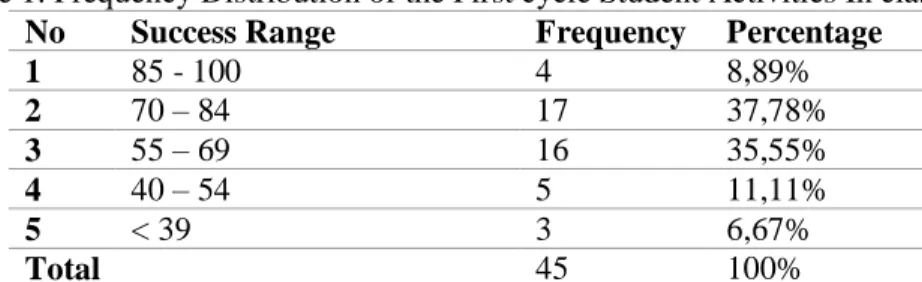
Student learning activities are gathered based on the observations during the learning process in every cycle I and II. Classically, student learning activities in class XI social science class 1 of SMA Laboratorium Universitas Negeri Malang for the application of learning model role-playing can be observed in Table below.
Table 1. Frequency Distribution of the First cycle Student Activities In classical
No Success Range Frequency Percentage
1 85 - 100 4 8,89% 2 70 – 84 17 37,78% 3 55 – 69 16 35,55% 4 40 – 54 5 11,11% 5 < 39 3 6,67% Total 45 100%
Source: Student’s activity outcomes in Cycle 1
Based on table 1 above, it shows that the students who are categorized succeed (range above 70) in the first cycle are 21 (4+17) students or by 46.67% (8.89% + 37.78%). Average students who have not succeeded in the first cycle of action are 24 students or as much as 53.33%.
Student Activities in Cycle II
Table 2. Frequency Distribution of the Second Cycle Student Activities In classical
No Success Range Frequency Percentage
1 85 - 100 13 28,89% 2 70 – 84 20 44,44% 3 55 – 69 7 15,56% 4 40 – 54 - 0% 5 < 39 5 11,11% Total 45 100%
Source: Student’s activity outcomes in Cycle II
Based on Table above, it is known that students who are categorized succeeded in the second cycle are 33 (13+20) students or by 73.33% (28.89 % + 44.44%). A number of students who have increased their learning activity from the first cycle to the second cycle are 12 students or 26.67%. Average students who have not succeeded are 12 students or 24.44%.
Data Description of Student Learning Outcomes
Data collection aims to determine whether there is an increase in student learning outcomes in class XI social science 1 by the treatment of cooperative
role-playing methods. Data from the first learning cycle are further put in the category of value results are as follows.
Table 3. Value Category Analysis of Learning Outcomes Cycle I
Category Pre Test Post Test
Excellent - 2
Pretty Good 5 19
Less 38 12
Source: Economic Learning Students after the provision of cycle I
From the table above it can be concluded that in the pre-tests none of the students gaining the excellent category and only 7 students who achieve the level of mastery (good and pretty good). After being given the action then given a post-test with material problems are not much different from the pre-post-test there are two students who gained the excellent category and the number of students who achieve mastery level increased to 32 students. The percentages of Students Mastery of Economic Learning Outcomes in the first cycle are shown in the following table.
Table 4. Percentage of Students Mastery of Economic Learning Outcomes in Cycle I
Prior Actions (pre-test) After Action (Post Tests)
Completed Not Completed Completed Not Completed
7 38 33 12
15.6% 84.4% 73.3% 26.7%
Source: Economics student Learning Outcomes after the implementation of the first cycle
From the table above, it shows that students who completed only 15.6% in the pre-test and 84.4% of them are failed. The average value of pre-test is 52.5 (see appendix 36). After giving the actions, the students who completed increased to 73.3%, and the ones who are failed are 26.7% with an average value of 72.5. So, the percentage of economic mastery learning outcomes of students increased 57.7% from 15.6% to 73.3%.
After implementing cycle I then the researcher implemented the second cycle. The data categories of students economics score in the second cycle are shown in the following table.
Table 5. Analysis Category Value of Learning Outcomes Cycle II
Category Pre Test Post Test
Excellent 1 5
Good 2 16
Pretty Good 5 14
Less 32 11
Source: Economic Learning Students after the administration of the second cycle
From the table above it shows that after the implementation of the action, the number of students who completed increased to 35 students with 5 students in the excellent category, and the rest of students come into the category of good and quite good. This shows a significant improvement from pre-test to post-test in cycle II.
While the percentages of students completeness learning outcomes in the second cycle are shown in the following table.
Table 6. Percentage of Students Mastery Learning Outcomes Economic Cycle II
Before Action (Pre Test) After Action (Post Tests)
Completed Not Completed Completed Not Completed
17.8% 82.2% 77.8% 22.2%
Source: Student Economics learning outcomes after the implementation of the second cycle
In accordance with the table 4:10 above, the percentages of students completeness learning outcomes in the second cycle increase by 60% from 17.8% to 77.8%. CONCLUSION
Based on the data and discussion, it can be concluded as follows: 1) Implementation of lesson study based model debate combined with the model Numbered Heads Together (NHT) on economic subjects XI Social science 3 class State Senior High School 1 of Tumpang in academic year 2015/2016 could run well in accordance with the learning objectives have been determined. This is proven by the increase in the percentage of teachers of activity during teaching and learning activities that applied models lesson study based model debate combined with the model Numbered Heads Together (NHT) from 75% to 77.27% and 2) implementation of lesson study based model debate combined with the model Numbered Heads Together (NHT) on economic subjects can enhance the activity of XI Social science 3 class State Senior High School 1 of Tumpang in academic year 2015/2016 because the implementation of lesson study based model debate combined with the model Numbered Heads Together (NHT), all students are required to attend, order, and participate in the debate argue. This can be proven by the results of the student activity showed an increase of 69.63% to 77.78%.
REFERENCES
Alipandie, I. (1984). Didaktik Metodik Pendidikan Umum. Surabaya: Penerbit Usaha Nasional.
Depatemen Pendidikan Nasional, Dirjen Pendidikan Dasar dan Menengah, Direktorat Pendidikan Lajutan Pertama (2004). Pendekatan Konstekstual (Contextual Teaching and Learning (CTL)).
Dimyati & Mudjiono. (1999). Belajar dan Pembelajaran. Jakarta: PT. Rineka Cipta.
Djamarah, S.B dan Zain. (2002). Strategi Belajar Mengajar. Jakarta: Rhineka Cipta.
Hamalik, O. (2008). Proses Belajar Mengajar. Jakarta: PT. Bumi Aksara.
Prasetyo, A. (2001). Metode Role Playing untuk Meningkatkan Hasil Belajar Biologi siswa kelas II SLTP N I Driyono Gresik. Buletin Pelangi Pendidikan. Edisi IV Tahun II
Sanjaya, W. (2006). Strategi Pembe-lajaran Berorientasi Standar Proses Pendidikan. Jakarta: Kencana.
Silberman, M. (2001). Active Learning (101 Strategi Pembelajaran Aktif).
Jakarta: Pustaka Insan Madani.
Wijaya. (1988). Upaya Pembaharuan dalam Pendidikan Pengajaran. Bandung: Remaja Karya.