NATIONAL OPEN UNIVERSITY OF NIGERIA
SCHOOL OF SCIENCE AND TECHNOLOGY
COURSE CODE: CIT 703
Course Code
Course Title Information Technology and Software Development
Course Developer/Writer Eze, Festus Chux
Department of Computer Science Ebonyi State University
Abakaliki Course Editor
Programme Leader
Introduction
Information Technology and Software Development is a three credit load course for all the students
offering Post Graduate Diploma (PGD) in Computer Science, Information Technology and other allied
courses.
Software Development is a major branch in computing and information Technology. A software
development professional oversees the processes of software development, the management of
software development project, the maintenance of the installed software in an organisation. For
sometime the field has been dominated with what is the definitive process of software
development. Furthermore there has been the running battle between professionals and managers
on who should control a software development project. There is an attempt to classify it as any
other project that an organisation handles hence anybody could manage it. Whereas others see it as
a highly professional issue that requires high precision in design, management and implementation.
However, software development is all involving. It involves the user (client) whose interest is
paramount. The developing organisation and her professionals ( team)are of great importance.
Therefore a successful exercise can only take place when all these variegated interests are
harmonised.
What
You
will
Learn
in
this
Course
This course consists of units and a course guide. This guide gives you a brief insight into what the course is all about, the necessary course materials and how you can work with them. In addition it advocates some general guidelines for the amount of time you are likely to spend on each unit of the course in order to complete it successfully.
It gives you guidance in respect of your Tutor Marked Assignment which will be made available in the assignment file. There will be regular tutorial classes that are related to the course. It is advisable for you to attend these tutorial sessions. The course will equip with the wherewithal needed to manage a software development project.
Aim
of
the
Course
The course is designed to provide you with the understanding of managing a software development design and development project. Also it makes you to understand how to take the client into full consideration in the course of the project.
Course
Objectives
To achieve the aims set out, the course has a set of objectives. Each unit has specific objectives which are included at the beginning of each unit. You should read these objectives before you study the unit. It is also advisable that you refer to them as you progress in your study of the unit to ascertain your progress. Also you should also look at the objectives after completion of each unit. By so doing, you would have followed the instructions in the unit.
Below are the comprehensive objectives of the course as a whole. By meeting these
objectives, you should have achieved the aims of aims of the course as whole. In addition to the aims above, this course sets to achieve some objectives. Thus after going through the course, you should be able to:
Explain the concept of software development life cycle Identify the different software development models Identify the software development processes Explain how to handle software project planning Explain the software development modelling languages Explain the concept and application of Data Flow Diagrams Explain the process of software validation, verification and testing Explain the issues of state transitions and state chart
Explain the process of requirement engineering, datamodel and dbms
Working through this Course
To complete this course you are required to read each study unit, read the textbooks and read other materials which may be provided by the National Open University of Nigeria.
Each unit contains self‐assessment exercises and at certain points in the course you will be required to submit assignments for assessment purposes. At the end of the course there is final examination. Below you will find listed all the components of the course, what you have to do and how you should allocate your time to each unit in order to complete the course on time and successfully.
This course demands that you spend a lot of time to study. My advice is that you optimise the opportunity provided by the tutorial sessions where you have the opportunity of comparing your knowledge with that of your colleagues.
The
Course
Materials
The man components of the course are:
1. The Course Guide 2. Study Units
3. References/Further Readings 4. Assignments
Study Unit
The study units in this course are as follows: Module 1
Unit 1 Software Development Life Cycle
Unit 2 Software Engineering Process Models Unit 3 Software Development Processes Module 2
Unit 1 Universal Modelling Language (UML) Unit 2 Data Modelling
Unit 3 Database Management System
Module 3
Unit 1 Entity Relationship
Unit 2 Data Flow Diagrams (DFDs) Unit 3 Extreme Programming (XP) Unit 4 Requirement Engineering Module 4
Unit 1 State Charts, State Transition Networks and Finite State Machines
Unit 2 Software Project Planning
Unit 3 Software Validation, Verification and Testing
Note each unit consists of one or two weeks’ work and includes introduction, objectives, reading materials, exercises, conclusions and summary, Tutor Marked Assignment (TMAs), references and other resources. The unit directs you to work on these exercises related to required reading. In general these exercises test you on the materials thereby assisting you to evaluate your progress and to reinforce your comprehension of the material. Together with the TMA these exercises will help you in achieving the stated learning objectives of the individual units and of the course as a whole.
Presentation Schedule
Your course materials have important dates for early and timely completion and submission of your TMAs and attending tutorials. You should remember that you are required to submit
all your assignments by the stipulated time and date. You should guard against falling behind in your work.
Assessment
There are three aspects to the assessment of the course. First is made up of self‐assessment exercises, second consists of the TMA and third is the written examination/end of course examination.
You are advised to do the exercises. In tackling the assignments, you are expected to apply information, knowledge and techniques you gathered during the course. The assignments must be submitted to your facilitator for formal assessment in accordance with the
deadlines stated in the presentation schedule and the assignment file. The work you submit to your tutor for assessment accounts for 30% of your total course work. At the end of the course you will need to sit for a final examination or end of course examination of about three hour duration. This examination will count for 70% of the total course mark.
Tutor‐Marked Assignment
This the continuous assessment component of your course. It accounts for 30% of the total score. You will be given four TMAs (4) to answer. Three of these must be answered before you are allowed to sit for the end of the course examination. The assignment questions for the units in the course are contained in the assignment file. You will be able to complete them through your reading the information contained in the reading materials, references and the study units. You are advised to research deeper into topics so as have a broader view of the discussions.
Endeavour to get the assignments to the facilitator on or before the deadline. If for any reason you cannot complete the work on time , contact your facilitator before the assignment is due to discuss the possibility of an extension. Extension will not be granted after the due date has passed unless on exceptional circumstances.
Final Examination and Grading
The end of course examination for Information Technology and Software Development will be for about 3 hours and it has a value of 70% of the total course work. The examination will reflect the type of self‐testing, practice exercise and tutor marked assignment problems you have previously encountered. All these areas of the course will be assessed.
Use the time between finishing the last unit and sitting for the examination to revise the whole course. It might be useful to review your self tests, TMAs and the comments on them before the course examination. The end of course examination covers information from all parts of the course.
Course Marking Sceme
Assignment Marks
Assignments 1‐4 Four assignments,best three marks of the four count at 10% each – 30% of course marks
End of course examination 70% of overall course marks
Total 100% of course materials
Facilitators/Tutors and Tutorials
There are 21 hours of tutorials provided in support of this course. You will be notified of the dates, times and venues of these tutorials as well as the name and phone numbers of the facilitator, as soon as you are allocated to a tutorial group.
Your facilitator will mark and comment on your assignments, keep a close watch on your progress and any difficulties you might face and provide assistance to you during the course. You are expected to mail TMA to your facilitator at least two working days before the schedule date. The TMA s will be marked by your tutor returned back to you as soon as possible.
Do not delay to contact your facilitator by telephone or email if you need assistance. The following might lead to your needing your facilitator’s assistance:
You do not understand any part of the study or assigned reading You have difficulty with the self test
You have a question or a problem with an assignment or with the grading of an assignment
Endeavour to attend tutorials. It affords you the opportunity of face to face contact with the facilitator and to ask questions which are answered instantly. You also raise problems encountered in the course of study.
Summary
Information Technology and Software Development is a course designed to equip you with what it takes to handle large software project. Further more you learn how to manage software systems in the house. Also you get to understand how you can design your software t o meet the clients needs avoid errors which are very expensive in software development.
Furthermore by the time you are through with this course you can function effectively as a system analyst, software developer, software evaluator etc
Contents 1.0 Introduction 2 2.0 Objective 2
3.0 Software Development Lifecycle Processes 2
3.1 Software User Company Wishing To Procure New Software. 2
Activity A/ Self Assessment Exercise 3
3.2 Software Acquisition 3 3.3 Software Supply 3 3.4 Software Development 4 3.5 Software Coding 4 3.6 Software Testing 4
Activity B/ Self Assessment Exercise 4
3.6.1 Execute Module test 5
3.6.2 Execute Integration test 5
3.6.3 Execute System test 5
3.6.4 Software Maintenance 5
3.7 Software Development Activities 6
3.7.1
Planning 6
3.7.2 Design
6
3.7.3 Specification 6
3.7.4 Architecture 6
3.7.5 Implementation, testing and documenting
7
3.7.6 Deployment and maintenance
7
Tutor Marked assignment 8
4.0 Summary and Conclusion 8
1.0 INTRODUCTION
As in any other engineering discipline, software engineering also has some structured models for software development. This unit will provide you with a generic overview about different software development methodologies adopted by contemporary software firms. Like any other set of engineering products, software products are also oriented towards the
customer. It is either market driven or it drives the market. Customer Satisfaction was the
buzzword of the 80's. Customer Delight in the 90’s and Customer Ecstasy in the new
millennium. Products that are not customer or user friendly have no place in the market
even though they are engineered using the best technology. The interface of the product is as important as the internal technology of the product.
ISO 12207 is an ISO standard for software lifecycle processes. It aims to be the standard that
defines all the tasks required for developing and maintaining software.
The ISO 12207 standard establishes a process of lifecycle for software, including processes and activities applied during the acquisition and configuration of the services of the system. Each Process has a set of outcomes associated with it. There are 23 Processes, 95 Activities, 325 Tasks and 224 Outcomes. These ISO details are not for this work.
The standard has the main objective of supplying a common structure so that the buyers, suppliers, developers, maintainers, operators, managers and technicians involved with the software development use a common language. This common language is established in the form of well defined processes. The structure of the standard was intended to be conceived in a flexible, modular way so as to be adaptable to the necessities of whoever uses it. The standard is based on two basic principles: modularity and responsibility. Modularity means processes with minimum coupling and maximum cohesion. Responsibility means to establish a responsibility for each process, facilitating the application of the standard in projects where many people can be legally involved.
The set of processes, activities and tasks can be adapted according to the software project. These processes are classified in three types: basic, support and organizational. The support and organizational processes must exist independently of the organization and the project being executed. The basic processes are instantiated according to the situation.
2.0 OBJECTIVE
By the end of this unit the student is expected to be conversant with:
i. Generic software development methodologies
ii. Software development life cycle process
iii. Activities involved in initiating a software development project
iv. Software supply and development
3.0 SOFTWARE DEVELOPMENT LIFECYCLE PROCESSES
Software development lifecycle processes contain the core processes involved in creating a software product. We are going to consider software development lifecycle on two
perspectives.
1. A software user company wishing to procure new software. 2. A software development company wishing produce new software.
A software user would of a necessity diligently follow five processes to procure a standard software. They are as follows:
i. Acquisition ii. Supply iii. Development iv. Operation v. Maintenance
Because the lifecycle processes cover a very large area a scope was defined. We will explain all the processes briefly but Acquisition and Development more extensively. Each phase within the lifecycle processes can be divided into different activities. This unit explains the different activities for each lifecycle process.
Activity A/ Self Assessment Exercise
1. Explain the implication of ISO 12207 in software development
2. Explain what you mean by software development life cycle
3. Describe the two approaches to software development life cycle
3.2 ACQUISITION
Acquisition covers the activities involved in initiating a project. The acquisition phase can be divided into different activities and deliverables that are completed chronologically.
Initiation: during this activity the following tasks are completed.
i. Define System requirements and obtain approval if applicable;
ii. Define the general requirements of the software
iii. Evaluate other options such as a purchase of an off-the-shelf product or
enhancement of an existing product;
iv. If an off-the-shelf product is purchased, the software requirements of this product
need to be analyzed.
v. Develop an acquisition plan, which can also be used during the acquisition phase
vi. Define acceptance criteria.
vii. Prepare Request for proposal: during this activity the following tasks are
completed:
a. Acquisition requirements, like System requirements and technical constraints such as target environment, are defined.
b. Contract milestones for reviewing and supplier's progress audits are defined.
viii. Prepare Contract: during this activity the following tasks are completed a. Selection procedure for suppliers are developed;
b. Suppliers, based on the developed selection procedure, are selected; c. The tailor-made ISO/IEC 12207 standard must be included in the contract;
ix. Negotiate changes: Negotiations are held with the selected suppliers;
x. Update contract: Contract is updated with the result from the negotiations in the
previous activity.
xi. Supplier monitoring: during this activity the following tasks are completed
a. Activities of the suppliers according to the agreements made are monitored;
b. Work together with suppliers to guarantee timely delivery if needed.
xii. Acceptance and completion: during this activity the following tasks are completed
a. Acceptance tests and procedures are developed; b. Acceptance and testing on the product is conducted;
3.3 Supply
During the supply phase a project management plan is developed. This plan contains information about the project such as different milestones that need to be reached. This project management plan is needed during the next phase which is the development phase.
3.4
Development
During the development phase the software product is designed, created and tested and will result in a software product ready to be sold to the customer. Throughout time many people have developed means of developing a software application. The choice of developing method often depends on the present situation. The development method which is used in many projects is the V-model. Techniques that can be used during the development are UML for designing and TMap for testing. The following are the most important steps of the V- model.
i. Define software requirements: Gather the software requirements, or demands, for
the product that is to be created.
ii. Create High level design: In this phase, the software development process, the
software's overall structure and its nuances are defined. In terms of the
client/server technology, the number of tiers needed for the package architecture, the database design, the data structure design etc. are all defined in this phase. A software development model is thus created.
iii. Analysis and Design are very crucial in the whole development cycle. Any
glitch in the design phase could be very expensive to solve in the later stage of
the software development. Much care is taken during this phase. The logical system of the product is developed in this phase.
A basic layout of the product is created. This means the setup of different modules and how they communicate with each other. This design does not contain very much detail about the modules.
The different modules present in the High level design are designed separately. The modules are designed in as much detail as possible.
3.5 CODING
The code is created according to the high level design and the module design.
The design must be translated into a machine-readable form. The code generation step performs this task. If the design is performed in a detailed manner, code generation can be
accomplished without much complication. Programming tools like compilers, interpreters,
debuggers etc... are used to generate the code. Different high level programming languages
like C, C++, Pascal, Java are used for coding. With respect to the type of application, the
right programming language is chosen. 3.6 TESTING
Once the code is generated, the software program testing begins. Different testing methodologies are available to unravel the bugs that were committed during the previous phases. Different testing tools and methodologies are already available. Some companies build their own testing tools that are tailor made for their own development operations. Activity B/self Assessment Exercise
1. Describe the following concepts with regards to a software user intending to procure a software:
i. software maintenance
ii. software acquisition
iii. software operation
2. What are the steps a software development company would take in producing a software solution for a client?
3.6.1 Execute Module test
The different modules are tested for correct functioning. If this is the case the project can move to the next activity, else the project returns to the module design phase to correct any errors.
3.6.2 Execute Integration test
The communication between modules is tested for correct functioning. If this is the case the project can move to the next activity, else the project falls back to the high level design to correct any errors.
3.6.3 Execute System test
This test checks whether all software requirements are present in the product. If this is the case the product is completed and the product is ready to be transferred to the customer. Else the project falls back to the software requirements activity and the software requirements have to be adjusted.
3.6.4 Maintenance
The software will definitely undergo change once it is delivered to the customer. There can be many reasons for this change to occur. Change could happen because of some unexpected input values into the system. In addition, the changes in the system could directly affect the software operations. The software should be developed to accommodate changes that could happen during the post implementation period.
3.7 Software Development Activities
The activities of the software development process represented in the waterfall model. There are several other models to represent this process.
Software Development Activities from wikipaedia
3.7.1 Planning
The important task in creating a software product is extracting the requirements or
requirements analysis. Customers typically have an abstract idea of what they want as an end result, but not what software should do. Incomplete, ambiguous, or even contradictory requirements are recognized by skilled and experienced software engineers at this point. Frequently demonstrating live code may help reduce the risk that the requirements are incorrect.
Once the general requirements are gleaned from the client, an analysis of the scope of the development should be determined and clearly stated. This is often called a scope document. Certain functionality may be out of scope of the project as a function of cost or as a result of unclear requirements at the start of development. If the development is done externally, this document can be considered a legal document so that if there are ever disputes, any
ambiguity of what was promised to the client can be clarified.
3.7.2 Design
Domain Analysis is often the first step in attempting to design a new piece of software, whether it be an addition to an existing software, a new application, a new subsystem or a whole new system. Assuming that the developers (including the analysts) are not sufficiently knowledgeable in the subject area of the new software, the first task is to investigate the so- called "domain" of the software. The more knowledgeable they are about the domain already, the less work required. Another objective of this work is to make the analysts, who will later try to elicit and gather the requirements from the area experts, speak with them in the domain's own terminology, facilitating a better understanding of what is being said by these experts. If the analyst does not use the proper terminology it is likely that they will not be
taken seriously, thus this phase is an important prelude to extracting and gathering the requirements. If an analyst hasn't done the appropriate work confusion may ensue.
3.7.3 Specification
Specification is the task of precisely describing the software to be written, possibly in a rigorous way. In practice, most successful specifications are written to understand and fine- tune applications that were already well-developed, although safety-critical software systems
are often carefully specified prior to application development. Specifications are most
important for external interfaces that must remain stable. A good way to determine whether the specifications are sufficiently precise is to have a third party review the documents making sure that the requirements and Use Cases are logically sound.
3.7.4 Architecture
The architecture of a software system or software architecture refers to an abstract
representation of that system. Architecture is concerned with making sure the software
system will meet the requirements of the product, as well as ensuring that future requirements can be addressed. The architecture step also addresses interfaces between the software system and other software products, as well as the underlying hardware or the host operating system.
3.7.5 Implementation, testing and documenting
Implementation is the part of the process where software engineers actually program the code for the project.
Software testing is an integral and important part of the software development process. This part of the process ensures that bugs are recognized as early as possible.
Documenting the internal design of software for the purpose of future maintenance and enhancement is done throughout development. This may also include the authoring of an API, be it external or internal.
3.7.6 Deployment and maintenance
Deployment starts after the code is appropriately tested, is approved for release and sold or otherwise distributed into a production environment.
Software Training and Support is important because a large percentage of software projects fail because the developers fail to realize that it doesn't matter how much time and planning a development team puts into creating software if nobody in an organization ends up using it. People are often resistant to change and avoid venturing into an unfamiliar area, so as a part of the deployment phase, it is very important to have training classes for new clients of your software.
Maintenance and enhancing software to cope with newly discovered problems or new requirements can take far more time than the initial development of the software. It may be necessary to add code that does not fit the original design to correct an unforeseen problem or it may be that a customer is requesting more functionality and code can be added to
accommodate their requests. It is during this phase that customer calls come in and you see whether your testing was extensive enough to uncover the problems before customers do. If the labor cost of the maintenance phase exceeds 25% of the prior-phases' labor cost, then it is likely that the overall quality, of at least one prior phase, is poor. In that case, management should consider the option of rebuilding the system (or portions) before maintenance cost is out of control.
Bug Tracking System tools are often deployed at this stage of the process to allow
development teams to interface with customer/field teams testing the software to identify any real or perceived issues. These software tools, both open source and commercially licensed, provide a customizable process to acquire, review, acknowledge, and respond to reported issues.
Tutor Marked assignment
1. Differentiate between executive module test and executive integration test 2. Explain what you understand by software deployment
3. Describe in details what you mean by bugs 4.0 Summary and Conclusion
Like any other set of engineering products, software products are also oriented towards the customer. It is either market driven or it drives the market. A software project has an entry and exit point. It is paramount to note that the software products has to be maintained and updated to keep abreast with the corporate expansion.
5.0 References and Further Reading
1. Roger S. Pressman, Software Engineering (A practitioner's approach), 5th edition, 2000, Mc Graw-Hill Education
2. Government Accountability Report (January 2003). Report GAO-03-343, National Airspace System: Better Cost Data Could Improve FAA’s Management of the Standard Terminal Automation Replacement System. Retrieved from http://www.gao.gov/cgi-bin/getrpt?GAO-03-343
3. Gerhard Fischer, "The Software Technology of the 21st Century: From Software
Reuse to Collaborative Software Design", 2001
4. Lydia Ash: The Web Testing Companion: The Insider's Guide to Efficient and
Effective Tests, Wiley, May 2, 2003.
5. www.SaaSSDLC.com - Software as a Service Systems Development Life Cycle
Project
6. Software development life cycle (SDLC) [visual image], software development life
cycle
7. Iterative Development and The Leaning Tower of Pisa - From The Trench 8. Selecting an SDLC", 2009
Contents
1.0 Introduction 2
2.0 Objectives 2
3.0 History 2
3.1 What is a software life cycle model? 3
3.2 What is a software process model? 4
3.3 Traditional Software Life Cycle Models 5
3.4 Classic Software Life Cycle 6
Activity A/Self Assessment Exercise 7
3.4.1 Stepwise Refinement 7
3.4.2 Incremental Development and Release 7
3.4.3 Industrial and Military Standards, and Capability Models 7
3.5 Alternatives to the Traditional Software Life Cycle Models 10
3.5.1 Software Product Development Models 10
3.5.2 Rapid Prototyping and Joint Application Development 10
3.5.3 Joint Application Development (JAD) 11
3.5.4 Assembling Reusable Components 11
3.5.5 Application Generation 12
3.5.6 Software Documentation Support Environments 12
3.5.7Rapid Iteration, Incremental Evolution, and Evolutionary Delivery 13
3.6 Program Evolution Models 13
Activity B/Self Assessment Exercise 14
3.7 Software Production Process Models 14
3.7.1 Non-Operational Process Models 14
3.7.1.1The Spiral Model. 14
3.8 Operational Process Models 16
3.8.1 Operational specifications for rapid prototyping. 16
3.8.2 Software automation. 17
3.8.3 Software process automation and programming. 17
3.9 Emerging Trends and New Directions 18
Tutor Marked Assignment 18
4.0 Summary and Conclusions 19
5.0 References and Further 19
1.0 Introduction
Software systems come and go through a series of passages that account for their inception, initial development, productive operation, upkeep, and retirement from one generation to
another. This unit categorizes and examines a number of methods for describing or modeling how software systems are developed. It begins with background and definitions of traditional software life cycle models that dominate most current software development practices. This is followed by a more comprehensive review of the alternative models of software evolution that are of current use as the basis for organizing software engineering projects and
technologies. 2.0 objectives
By the end of this unit the student is expected to understand: i. what software development life cycle is
ii. how to differentiate between the different software development models iii. what software production model is
iv. how to apply these models in software development 3.0 History
Explicit models of software evolution date back to the earliest projects developing large software
systems in the 1950's and 1960's. Overall, the apparent purpose of these early software life cycle models was to provide a conceptual scheme for rationally managing the development of software systems. Such a scheme could therefore serve as a basis for planning, organizing, staffing, coordinating, budgeting, and directing software development activities.
Since the 1960's, many descriptions of the classic software life cycle have appeared. Royce in 1970 originated the formulation of the software life cycle using the now familiar "waterfall" chart, displayed in Figure 1. The chart summarizes in a single display how developing large software systems are difficult because it involves complex engineering tasks that may require iteration and rework before completion. These charts are often employed during introductory presentations, for people (e.g., customers of custom software) who may be unfamiliar with the various technical problems and strategies that must be addressed when constructing large software systems. These classic software life cycle models usually include some version or subset of the following activities:
i. system Initiation/Planning: where do systems come from? In most situations, new feasible systems replace or supplement existing information processing
mechanisms whether they were previously automated, manual, or informal. ii. Requirement Analysis and Specification: identifies the problems a new software
system is suppose to solve, its operational capabilities, its desired performance characteristics, and the resource infrastructure needed to support system operation and maintenance.
iii. Functional Specification or Prototyping: identifies and potentially formalizes the objects of computation, their attributes and relationships, the operations that transform these objects, the constraints that restrict system behaviour, and so forth.
iv. Partition and Selection (Build vs. Buy vs. Reuse): given requirements and functional specifications, divide the system into manageable pieces that denote logical subsystems, then determine whether new, existing, or reusable software systems correspond to the needed pieces.
v. Architectural Design and Configuration Specification: defines the interconnection and resource interfaces between system subsystems, components, and modules in ways suitable for their detailed design and overall configuration management.
vi. Detailed Component Design Specification: defines the procedural methods through which the data resources within the modules of a component are transformed from required inputs into provided outputs.
vii. Component Implementation and Debugging: codifies the preceding specifications into operational source code implementations and validates their basic operation. viii. Software Integration and Testing: affirms and sustains the overall integrity of the software system architectural configuration through verifying the consistency and completeness of implemented modules, verifying the resource interfaces and interconnections against their specifications, and validating the performance of the system and subsystems against their requirements.
ix. Documentation Revision and System Delivery: packaging and rationalizing recorded system development descriptions into systematic documents and user guides, all in a form suitable for dissemination and system support.
x. Deployment and Installation: providing directions for installing the delivered software into the local computing environment, configuring operating systems parameters and user access privileges, and running diagnostic test cases to assure the viability of basic system operation.
xi. Training and Use: providing system users with instructional aids and guidance for understanding the system's capabilities and limits in order to effectively use the system.
xii. Software Maintenance: sustaining the useful operation of a system in its
host/target environment by providing requested functional enhancements, repairs, performance improvements, and conversions.
3.1 What is a software life cycle model?
A software life cycle model is either a descriptive or prescriptive characterization of how software is or should be developed. A descriptive model describes the history of how a particular
software system was developed. Descriptive models may be used as the basis for understanding
and improving software development processes, or for building empirically grounded prescriptive models. A prescriptive model prescribes how a new software system should be developed. Prescriptive models are used as guidelines or frameworks to organize and structure how software development activities should be performed, and in what order. Typically, it is easier and more common to articulate a prescriptive life cycle model for how software systems should be developed. This is possible since most such models are intuitive or well reasoned. This means that many idiosyncratic details that describe how a software system is built in practice can be ignored, generalized, or deferred for later consideration. This, of course, should raise concern for the relative validity and robustness of such life cycle models when developing different kinds of application systems, in different kinds of
development settings, using different programming languages, with differentially skilled staff, etc. However, prescriptive models are also used to package the development tasks and
techniques for using a given set of software engineering tools or environment during a development project.
Descriptive life cycle models, on the other hand, characterize how particular software systems
are actually developed in specific settings. As such, they are less common and more difficult to
articulate for an obvious reason: one must observe or collect data throughout the life cycle of a
software system, a period of elapsed time often measured in years. Also, descriptive models are
specific to the systems observed and only generalizable through systematic comparative analysis.
Therefore, this suggests the prescriptive software life cycle models will dominate attention until
a sufficient base of observational data is available to articulate empirically grounded descriptive
life cycle models.
These two characterizations suggest that there are a variety of purposes for articulating software
life cycle models. These characterizations serve as a
i. Guideline to organize, plan, staff, budget, schedule and manage software project
work over organizational time, space, and computing environments.
ii. Prescriptive outline for what documents to produce for delivery to client.
iii. Basis for determining what software engineering tools and methodologies will be
most appropriate to support different life cycle activities.
iv. Framework for analyzing or estimating patterns of resource allocation and
consumption during the software life cycle
v. Basis for conducting empirical studies to determine what affects software
productivity, cost, and overall quality. 3.2 What is a software process model?
In contrast to software life cycle models, software process models often represent a
networked sequence of activities, objects, transformations, and events that embody strategies for accomplishing software evolution. Such models can be used to develop more precise and formalized descriptions of software life cycle activities. Their power emerges from their utilization of a sufficiently rich notation, syntax, or semantics, often suitable for
computational processing.
Software process networks can be viewed as representing multiple interconnected task chains Task chains represent a non-linear sequence of actions that structure and transform available computational objects (resources) into intermediate or finished products. Non-linearity implies that the sequence of actions may be non-deterministic, iterative, accommodate
multiple/parallel alternatives, as well as partially ordered to account for incremental progress. Task actions in turn can be viewed a non-linear sequences of primitive actions which denote atomic units of computing work, such as a user's selection of a command or menu entry using a mouse or keyboard. These units of cooperative work between people and computers are referred to as structured discourses of work, while task chains have become popularized under the name of workflow.
Task chains can be employed to characterize either prescriptive or descriptive action sequences.
Prescriptive task chains are idealized plans of what actions should be accomplished, and in what
order. For example, a task chain for the activity of object-oriented software design might include
the following task actions:
i. Develop an informal narrative specification of the system.
ii. Identify the objects and their attributes.
iii. Identify the operations on the objects.
iv. Identify the interfaces between objects, attributes, or operations.
v. Implement the operations.
Clearly, this sequence of actions could entail multiple iterations and non-procedural primitive action invocations in the course of incrementally progressing toward an object-oriented software design.
Task chains join or split into other task chains resulting in an overall production network or web. The production web represents the organizational production system that transforms raw computational, cognitive, and other organizational resources into assembled, integrated and usable software systems. The production lattice therefore structures how a software system is developed, used, and maintained. However, prescriptive task chains and actions cannot be formally guaranteed to anticipate all possible circumstances or idiosyncratic foul-ups that can emerge in the real world of software development. Thus, any software production web will in some way realize only an approximate or incomplete description of software development. Articulation work is a kind of unanticipated task that is performed when a planned task chain is
inadequate or breaks down. It is work that represents an open-ended non-deterministic sequence
of actions taken to restore progress on the disarticulated task chain, or else to shift the flow of productive work onto some other task chain. Thus, descriptive task chains are employed to characterize the observed course of events and situations that emerge when people try to follow a planned task sequence.
Articulation work in the context of software evolution includes actions people take that entail either their accommodation to the contingent or anomalous behaviour of a software system, or
negotiation with others who may be able to affect a system modification or otherwise alter current circumstances.
This notion of articulation work has also been referred to as software process dynamism.
3.3 Traditional Software Life Cycle Models
Traditional models of software evolution have been with us since the earliest days of software engineering. In this section, we identify four. The classic software life cycle (or "waterfall chart")
and stepwise refinement models are widely instantiated in just about all books on modern programming practices and software engineering. The incremental release model is closely related to industrial practices where it most often occurs. Military standards based models have
also certain forms of the classic life cycle model into required practice for government contractors. Each of these four models uses coarse-grain or macroscopic characterizations when
describing software evolution. The progressive steps of software evolution are often described as
stages, such as requirements specification, preliminary design, and implementation; these usually
have little or no further characterization other than a list of attributes that the product of such a
stage should possess. Further, these models are independent of any organizational development
setting, choice of programming language, software application domain, etc. In short, the traditional models are context-free rather than context-sensitive. But as all of these life cycle models have been in use for some time, we refer to them as the traditional models, and characterize each in turn.
3.4 Classic Software Life Cycle
The classic software life cycle is often represented as a simple prescriptive waterfall software phase model, where software evolution proceeds through an orderly sequence of transitions from
one phase to the next in order. Such models resemble finite state machine descriptions of software evolution. However, these models have been perhaps most useful in helping to structure, staff, and manage large software development projects in complex organizational settings, which was one of the primary purposes.
Alternatively, these classic models have been widely characterized as both poor descriptive and
prescriptive models of how software development "in-the-small" or "in-the-large" can or should
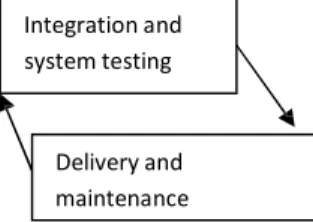
occur. Figure 1 provides a common view of the waterfall model for software development attributed to Royce. Feasibility Study
Requirement analysis and specification Design and specification
Coding and Module testing
Integration and system testing
Delivery and maintenance
Figure 1. The Waterfall Model of Software Development (Royce 1970)
Activity A/Self Assessment Exercise
1. What are the steps involved in classic software development 2. Explain the following terms:
i. Software life cycle model
ii. Prescriptive model
iii. Descriptive model
3. What is software process model 3.4.1 Stepwise Refinement
In this approach, software systems are developed through the progressive refinement and enhancement of high-level system specifications into source code components. However, the choice and order of which steps to choose and which refinements to apply remain unstated. Instead, formalization is expected to emerge within the heuristics and skills that are acquired and applied through increasingly competent practice. This model has been most effective and widely applied in helping to teach individual programmers how to organize their software development work. Many interpretations of the classic software life cycle thus subsume this approach within their design and implementations.
3.4.2 Incremental Development and Release
Developing systems through incremental release requires first providing essential operating functions, then providing system users with improved and more capable versions of a system at
regular intervals. This model combines the classic software life cycle with iterative
enhancement at the level of system development organization. It also supports a strategy to periodically distribute software maintenance updates and services to dispersed user
communities.
This in turn accommodates the provision of standard software maintenance contracts. It is therefore a popular model of software evolution used by many commercial software firms and
system vendors. This approach has also been extended through the use of software prototyping
tools and techniques, which more directly provide support for incremental development and iterative release for early and ongoing user feedback and evaluation.
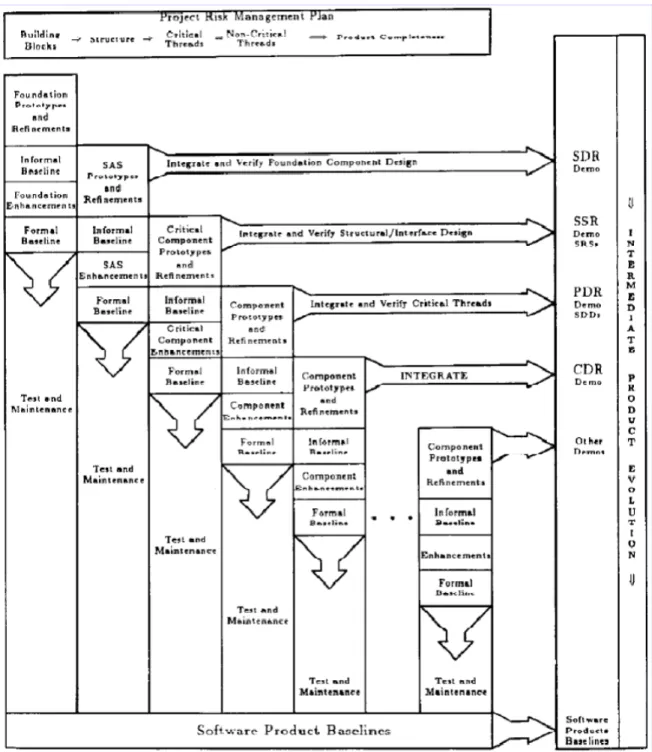
Figure 2 provides an example view of an incremental development, build, and release model for engineering large Ada-based software systems, developed by Royce in 1990 at TRW. Elsewhere, the Cleanroom software development method at use in IBM and NASA laboratories
stepwise refinement) to separate in-house quality assurance teams that apply statistical measures
and analyses as the basis for certifying high-quality software systems.
3.4.3 Industrial and Military Standards, and Capability Models
Industrial firms often adopt some variation of the classic model as the basis for standardizing their software development practice. Such standardization is often motivated by needs to simplify or eliminate complications that emerge during large software development or project management.
From the 1970's through the present, many government contractors organized their software development activities according to succession of military software standards such as MIL- STD-
2167A, MIL-STD 498, and IEEE-STD-016. ISO12207 is now the standard that most such contractors now follow. These standards are an outgrowth of the classic life cycle activities, together with the documents required by clients who procure either software systems or complex platforms with embedded software systems. Military software system are often constrained in ways not found in industrial or academic practice, including:
(1) Required use of military standard computing equipment (which is often technologically dated and possesses limited processing capabilities);
(2) Are embedded in larger systems (e.g., airplanes, submarines, missiles, command and control systems) which are mission-critical (i.e., those whose untimely failure could result in military disadvantage and/or life-threatening risks);
(3) Are developed under contract to private firms through cumbersome procurement and acquisition procedures that can be subject to public scrutiny and legislative intervention; (4) Many embedded software systems for the military are among the largest and most complex systems in the world.
Finally, the development of custom software systems using commercial off-the-shelf (COTS) components or products is a recent direction for government contractors, and thus represents new challenges for how to incorporate a component-based development into the overall software life cycle. Accordingly, new software life cycle models that exploit COTS components will continue to appear in the next few years.
Figure 2. An Incremental Development, Build, and Release Model (Royce 1990)
In industrial settings, standard software development models represent often provide explicit detailed guidelines for how to deploy, install, customize or tune a new software system release in
its operating application environment. In addition, these standards are intended to be compatible
with provision of software quality assurance, configuration management, and independent verification and validation services in a multi-contractor development project.
These efforts in turn help pave the way for what many software development organizations now practice, or have been certified to practice, software process capability assessments, following the Capability Maturity Model developed by the Software Engineering Institute . 3.5 Alternatives to the Traditional Software Life Cycle Models
There are at least three alternative sets of models of software development. These models are alternatives to the traditional software life cycle models. These three sets focus attention to either the products, production processes, or production settings associated with software development. Collectively, these alternative models are finer-grained, often detailed to the point
of computational formalization, more often empirically grounded, and in some cases address the
role of new automated technologies in facilitating software development. We examine each set of models in the following sections.
3.5.1 Software Product Development Models
Software products represent the information-intensive artifacts that are incrementally constructed
and iteratively revised through a software development effort. Such efforts can be modeled using
software product life cycle models. These product development models represent an evolutionary
revision to the traditional software life cycle models. The revisions arose due to the availability of new software development technologies such as software prototyping languages and environments, reusable software, application generators, and documentation support environments. Each of these technologies seeks to enable the creation of executable software implementations either earlier in the software development effort or more rapidly. Therefore in this regard, the models of software development may be implicit in the use of the
technology, rather than explicitly articulated. This is possible because such models become increasingly intuitive to those developers whose favourable experiences with these
technologies
substantiate their use. Thus, detailed examination of these models is most appropriate when such
technologies are available for use or experimentation.
3.5.2 Rapid Prototyping and Joint Application Development
Prototyping is a technique for providing a reduced functionality or a limited performance version
of a software system early in its development. In contrast to the classic system life cycle, prototyping is an approach whereby more emphasis, activity, and processing are directed to the early stages of software development (requirements analysis and functional specification). In turn, prototyping can more directly accommodate early 10 user participation in
determining, shaping, or evaluating emerging system functionality.
Therefore, these up-front concentrations of effort, together with the use of prototyping technologies, seeks to trade-off or otherwise reduce downstream software design activities and
iterations, as well as simplify the software implementation effort.
demonstration systems, quick-and-dirty prototypes, and incremental evolutionary prototypes. Increasing functionality and subsequent evolvability is what distinguishes the prototype forms on this list.
Prototyping technologies usually take some form of software functional specifications as their
starting point or input, which in turn is simulated, analyzed, or directly executed. These technologies can allow developers to rapidly construct early or primitive versions of software systems that users can evaluate. User evaluations can then be incorporated as feedback to refine
the emerging system specifications and designs. Further, depending on the prototyping technology, the complete working system can be developed through a continual revising/refining
the input specifications. This has the advantage of always providing a working version of the emerging system, while redefining software design and testing activities to input specification refinement and execution. Alternatively, other prototyping approaches are best suited for developing throwaway or demonstration systems, or for building prototypes by reusing part/all
of some existing software systems. Subsequently, it becomes clear why modern models of software development like the Spiral Model and the ISO 12207 expect that prototyping will be a common activity that facilitates the capture and refinement of software requirements, as well as overall software development.
3.5.3 Joint Application Development (JAD)
This is a technique for engaging a group or team of software developers, testers, customers,
and prospective end-users in a collaborative requirements elicitation and prototyping effort. JAD is quintessentially a technique for facilitating group interaction and collaboration. Consultants often employ JAD or external software system vendors who have been engaged to build a custom software system for use in a particular organizational setting. The JAD process is based on four ideas:
1.People who actually work at a job have the best understanding of that job.
2.People who are trained in software development have the best understanding of the possibilities of that technology.
3. Software-based information systems and business processes rarely exist in isolation -- they transcend the confines of any single system or office and effect work in related departments.
People working in these related areas have valuable insight on the role of a system within a larger community.
4.The best information systems are designed when all of these groups work together on a project as equal partners.
Following these ideas, it should be possible for JAD to cover the complete development life cycle of a system. The JAD is usually a 3 to 6 month well-defined project, when systems can be
constructed from commercially available software products that do not require extensive coding
or complex systems integration. For large-scale projects, it is recommended that the project be organized as an incremental development effort, and that separate JAD's be used for each increment. Given this formulation, it is possible to view open source software development projects that rely on group email discussions among globally distributed users and
developers, together with Internet-based synchronized version updates as an informal variant of JAD.
3.5.4 Assembling Reusable Components
The basic approach of reusability is to configure and specialize pre-existing software
components into viable application systems. Such source code components might already have associated specifications and designs associated with their implementations, as well as have been tested and certified. However, it is also clear that software domain models, system specifications, designs, test case suites, and other software abstractions may themselves be treated as reusable software development components. These components may have a greater potential for favourable impact on reuse and semi-automated system generation or
composition. Therefore,
assembling reusable software components is a strategy for decreasing software development effort in ways that are compatible with the traditional life cycle models.
The basic dilemmas encountered with reusable software componentry include: (a) acquiring,analyzing and modeling a software application domain,
(b) how to define an appropriate software part naming or classification scheme, (c) collecting or building reusable software components,
(d) configuring or composing components into a viable application, (e) maintaining and searching a components library.
In turn, each of these dilemmas is mitigated or resolved in practice through the selection of software component granularity. The granularity of the components (i.e., size, complexity, and functional capability) varies greatly across different approaches. Most approaches attempt to utilize components similar to common data structures with algorithms for their manipulation: small-grain components. However, the use/reuse of small-grain components in and of itself does not constitute a distinct approach to software development.
Other approaches attempt to utilize components resembling functionally complete systems or subsystems (e.g., user interface management system): large-grain components. The use/reuse of large-grain components guided by an application domain analysis and subsequent mapping of attributed domain objects and operations onto interrelated components does appear to be an alternative approach to developing software systems.
There are many ways to utilize reusable software components in evolving software systems such as during architectural or component design specification as a way to speed
implementation. They might also be used for prototyping purposes if a suitable software prototyping technology is available.
3.5.5 Application Generation
Application generation is an approach to software development similar to reuse of
parameterized, large-grain software source code components. Such components are configured and specialized to an application domain via a formalized specification language used as input to the application generator. Common examples provide standardized interfaces to database management system applications, and include generators for reports, graphics, user interfaces, and application-specific editors.
Application generators give rise to a model of software development whereby traditional software design activities are either all but eliminated, or reduced to a data base design problem.
embodies or provides a generic software design that should be compatible with the application
domain. However, users of application generators are usually expected to provide input specifications and application maintenance services. These capabilities are possible since the generators can usually only produce software systems specific to a small number of similar application domains, and usually those that depend on a data base management system. 3.5.6 Software Documentation Support Environments
Much of the focus on developing software products draws attention to the tangible software artifacts that result. Most often, these products take the form of documents: commented source code listings, structured design diagrams, unit development folders, etc. These documents characterize what the developed system is suppose to do, how it does it, how it was developed, how it was put together and validated, and how to install, use, and maintain it. Thus, a collection of software documents records the passage of a developed software system through a set of life
cycle stages. It seems reasonable that there will be models of software development that focus attention to the systematic production, organization, and management of the software development documents.
Further, as documents are tangible products, it is common practice when software systems are
developed under contract to a private firm, that the delivery of these documents is a contractual
stipulation, as well as the basis for receiving payment for development work already performed.
Thus, the need to support and validate conformance of these documents to software development
and quality assurance standards emerges. However, software development documents are often a
primary medium for communication between developers, users, and maintainers that spans organizational space and time. Thus, each of these groups can benefit from automated mechanisms that allow them to browse, query, retrieve, and selectively print documents. As such, we should not be surprise to see construction and deployment of software environments that provide ever increasing automated support for engineering the software documentation life cycle, or how these capabilities have since become part of the commonly available
computeraided software engineering (CASE) tools suites like Rational Rose, and others based on the use of the Unified Modeling Language (UML).
3.5.7Rapid Iteration, Incremental Evolution, and Evolutionary Delivery
There are a growing number of technological, social and economic trends that are shaping how a
new generation of software systems are being developed that exploit the Internet and World Wide Web. These include the synchronize and stabilize techniques popularized by Microsoft and
Netscape at the height of the fiercely competitive efforts to dominate the Web browser market of
the mid 1990's. They also include the development of open source software systems that rely on a decentralized community of volunteer software developers to collectively develop and test software systems that are incrementally enhanced, released, experienced, and debugged in an overall iterative and cyclic manner. The elapsed time of these incremental development life cycles on some projects may be measured in weeks, days, or hours! The centralized
planning, management authority and coordination imposed by the traditional system life cycle model has been discarded in these efforts, replaced instead by a more organic, participatory, reputation-based, and community oriented engineering practice.
Software engineering in the style of rapid iteration and incremental evolution is one that focuses on and celebrates the inevitability of constantly shifting system requirements, unanticipated situations of use and functional enhancement, and the need for developers to collaborate with one another, even when they have never met.
3.6 Program Evolution Models
In contrast to the preceding four prescriptive product development models, Lehman and Belady
sought to develop a descriptive model of software product evolution at IBM.
Based on their investigations, they identify five properties that characterize the evolution of large software systems. These are:
1. Continuing change: a large software system undergoes continuing change or becomes progressively less useful
2. Increasing complexity: as a software system evolves, its complexity increases unless work is done to maintain or reduce it
3. Fundamental law of program evolution: program evolution, the programming process, and global measures of project and system attributes are statistically self-regulating with
determinable trends and invariances
4. Invariant work rate: the rate of global activity in a large software project is statistically invariant
5. Incremental growth limit: during the active life of a large program, the volume of modifications made to successive releases is statistically invariant.
However, note that these are global properties of large software systems and not causal mechanisms of software development.
Activity B/Self Assessment Exercise
1. Describe the stepwise refinement approach
2. List the features that differentiates military software from industrial software 3. Describe the following concepts
i. Rapid prototyping
ii. Joint application development
3.7 Software Production Process Models
There are two kinds of software production process models: non-operational and operational. Both are software process models. The difference between the two primarily stems from the fact
that the operational models can be viewed as computational scripts or programs: programs that
implement a particular regimen of software engineering and development. Non-operational models on the other hand denote conceptual approaches that have not yet been sufficiently articulated in a form suitable for codification or automated processing.
3.7.1 Non-Operational Process Models
There are two classes of non-operational software process models of interest. These are the spiral model and the continuous transformation models. There is also a wide selection of
other non-operational models, which for brevity we label as miscellaneous models. Each is examined in turn.
3.7.1.1The Spiral Model.
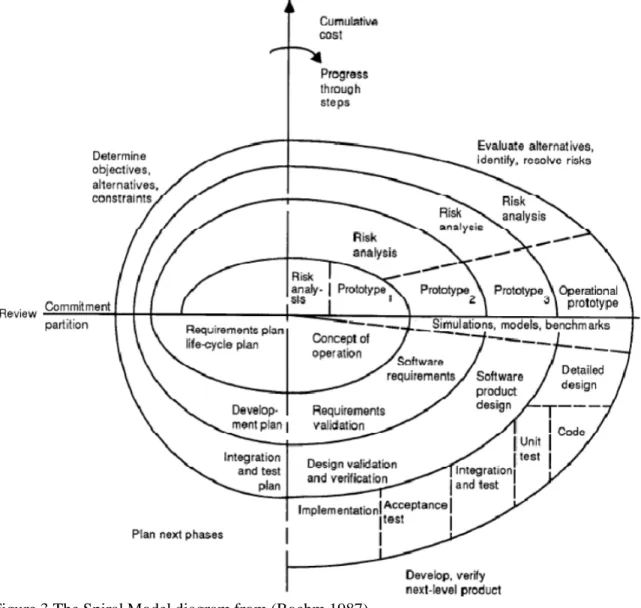
The spiral model of software development and evolution represents a risk driven approach to software process analysis and structuring. This approach, developed by Barry Boehm, incorporates elements of specification-driven, prototype-driven process methods, together with the classic software life cycle. It does so by representing iterative development cycles as an expanding spiral, with inner cycles denoting early system analysis and prototyping, and outer cycles denoting the classic software life cycle.
The radial dimension denotes cumulative development costs, and the angular dimension denotes
progress made in accomplishing each development spiral. See Figure 3.
Risk analysis, which seeks to identify situations that might cause a development effort to fail or
go over budget/schedule, occurs during each spiral cycle. In each cycle, it represents roughly the
same amount of angular displacement, while the displaced sweep volume denotes increasing levels of effort required for risk analysis. System development in this model therefore spirals out
only so far as needed according to the risk that must be managed. Alternatively, the spiral model
indicates that the classic software life cycle model need only be followed when risks are greatest,
and after early system prototyping as a way of reducing these risks, albeit at increased cost. The
insights that the Spiral Model offered has in turn influenced the standard software life cycle process models, such as ISO12207 noted earlier. Finally, efforts are now in progress to integrate
computer-based support for stakeholder negotiations and capture of trade-off rationales into an
operational form of the WinWin Spiral Model 3.7.1.2 Miscellaneous Process Models.
Many variations of the non-operational life cycle and process models are available. These include fully interconnected life cycle models that accommodate transitions between any two phases subject to satisfaction of their pre- and post-conditions, as well as compound variations on the traditional life cycle and continuous transformation models. However, reports indicate that in general most software process models are exploratory, though there is now a growing base of experimental or industrial experience with these models.
Figure 3.The Spiral Model diagram from (Boehm 1987) 3.8 Operational Process Models
In contrast to the preceding non-operational process models, many models are now beginning to
appear which codify software engineering processes in computational terms--as programs or executable models. Three classes of operational software process models can be identified and
examined. Following this, we can also identify a number of emerging trends that exploit and extend the use of operational process models for software engineering.
3.8.1 Operational specifications for rapid prototyping.
The operational approach to software development assumes the existence of a formal specification language and processing environment that supports the evolutionary development of specifications into an prototype implementation. Specifications in the
language are coded, and when computationally evaluated, constitute a functional prototype of the specified system. When such specifications can be developed and processed incrementally, the resulting system prototypes can be refined and evolved into functionally more complete systems. However, the emerging software systems are always operational in some form during their development.