Introduction
Madhusudan Bhattarai and P.K. Viswanathan
The Mahatma Gandhi National Rural Employment Guarantee Act (MGNREGA) is the single most innovative programme from India and a lesson to the whole world
Joseph Stiglitz (Nobel Laureate), July 2016
1.1
Introduction
The initiation of National Rural Employment Guarantee Act of 2005 (NREGA in short), later renamed as the Mahatma Gandhi National Rural Employment Guarantee Act (MGNREGA) in 2009, is indeed a landmark rural development programme in the history of Independent India. This is both in terms of the process and spread of activities carried out, and level of participation by rural poor in the development activities. In fact, the popularity and importance of India’s signature social welfare programme—NREGA—is also being discussed worldwide, espe-cially in the developing countries, for its adaptability and replication. No doubt, after initiation of this programme in February 2006, it has also brought about several structural and functional changes in implementing rural development pro-gramme in India.
M. Bhattarai (&)
Jalsrot Vikas Sanstha (JVS), 20694, Kathmandu, Nepal e-mail: [email protected]
M. Bhattarai
ICRISAT, Hyderabad, India P.K. Viswanathan
Amrita School of Business, Amrita Vishwa Vidyapeetham (Deemed to be University), Kochi, Kerala, India
e-mail: [email protected]
©Springer Nature Singapore Pte Ltd. 2018
M. Bhattarai et al. (eds.),Employment Guarantee Programme and Dynamics of Rural Transformation in India, India Studies in Business and Economics, https://doi.org/10.1007/978-981-10-6262-9_1
Unlike other Rural Development programmes so far implemented in India, NREGA1is a right based employment guarantee programme, which has given a right to all rural poor and vulnerable households to demand for minimum of 100 days of employment per annum. Given the nature of monsoon dependent agriculture and erratic rainfall pattern of monsoon, the 100 days of employment during the slack period of farm operation is a very critical livelihood support to millions of rural poor and vulnerable population living below poverty line in the country.
In fact, India has a long history of‘public spending for rural development and poverty reduction programmes ever since its Independence and MGNREGA may be considered as the largest and the widely appreciatedflagship programme in view of its outreach and impacts on the rural economy and society. In what follows, we provide a brief account of the historical evolution of MGNREGA in India.
1.2
Poverty Reduction Through Employment Generation
in India: A Historical Perspective
Provision of social safety net (SSN) to the poor and vulnerable sections of popu-lation through public work programmes has a long history in the Indian sub-continent. Even in Kautilya’s Artha Sasthra (an economic programme of states and duties of government to its citizen written about 2400 years ago by famous ancient eastern philosopher Chanakya), emphasis was given to the provision of adequate social safety net measures to the poor and vulnerable sections of popu-lation in a country to ensure happiness to king and kingdom. For instance, as Chanakya then writes in the Kautilya Artha Sasthra“In the happiness of his subjects lies his happiness; in their welfare his welfare; whatever pleases himself he shall not consider as good, but whatever pleases his subjects he shall consider as good.” (Chanakya quotes, 350–283 BCE).
Subsequently in medieval times, the kings and temple institutions in Indian sub-continent have built several public works—water ponds, irrigation canals, road, temples, and related community level work programmes to provide employment and welfare to the needed section of population, when other forms of employment were not available in the society. In colonial period, public workfares were organised in India by the government largely to distribute food and other relief measures at the famine struck communities.
Since independence in 1947, various welfare oriented rural development pro-grammes have been initiated by the central and state governments of India to provide employment security and livelihood benefits to the poor and vulnerable
1In this study, Mahatma Gandhi National Rural Employment Guarantee Act (MGNREGA), or the term“Mahatma Gandhi National Rural Employment Guarantee Scheme”(MGNREGS) has been used interchangeably. Before, 2009, the same MGNREGA programme was called as NREGA (or NREGS) in India. The same programme was renamed from NREGA to MGNREGA by the Government of India in 20.
sections. These schemes were grouped under rural development programme, or rural employment creation and/or poverty alleviation programmes. Considering the scale of population living in rural India now, and the magnitude of poverty and vulnerability situations, it may not be feasible to provide full employment to all the needy, but the various schemes implemented from time to time, have provided some relief to the poor. In terms of its scale and coverage across various parts of India, MGNREGS is one of the prominent welfare enhancement and social safety net programmes in rural India in recent times.
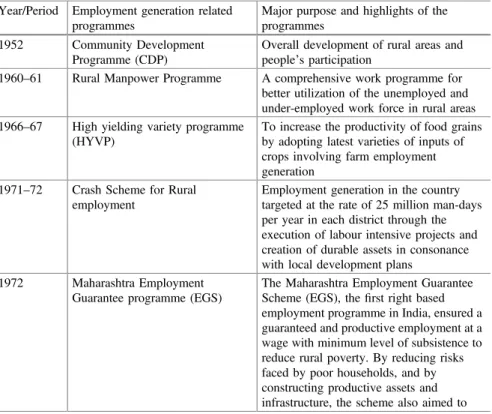
Evolution of various employment generated related social welfare programmes, or schemes that are linked with employment generation purposes (or EGS related areas) and implemented at various periods of time are summarized in Table1.1. At present, not all of these schemes are in operation with the exception of a few. Over time, many of the programmes with narrow scope have been either abandoned or merged with other schemes and implemented at large areas/regions of the country. The Community Development Programme that was initiated in 1952 was thefirst large scale social welfare programme with employment support and asset creation in the rural areas.
Table 1.1 Evolution of employment generation related programmes in India Year/Period Employment generation related
programmes
Major purpose and highlights of the programmes
1952 Community Development Programme (CDP)
Overall development of rural areas and people’s participation
1960–61 Rural Manpower Programme A comprehensive work programme for better utilization of the unemployed and under-employed work force in rural areas 1966–67 High yielding variety programme
(HYVP)
To increase the productivity of food grains by adopting latest varieties of inputs of crops involving farm employment generation
1971–72 Crash Scheme for Rural employment
Employment generation in the country targeted at the rate of 25 million man-days per year in each district through the execution of labour intensive projects and creation of durable assets in consonance with local development plans
1972 Maharashtra Employment Guarantee programme (EGS)
The Maharashtra Employment Guarantee Scheme (EGS), thefirst right based employment programme in India, ensured a guaranteed and productive employment at a wage with minimum level of subsistence to reduce rural poverty. By reducing risks faced by poor households, and by constructing productive assets and infrastructure, the scheme also aimed to
Table 1.1 (continued)
Year/Period Employment generation related programmes
Major purpose and highlights of the programmes
have a longer-term developmental role. This is considered as a precursor of MGNREGA
1971–72 Rural work Programme (Drought Prone Area Programme)
Protection from drought by achieving environmental balance and by developing ground water
1972 Employment Guarantee Scheme of Maharashtra
To assist the economically weaker sections of the rural society
1972 Crash Scheme for Rural Employment (CSRE)
For rural employment 1977 Wage Employment Programme or
Food for Work Programme
This programme was further strengthened in the 1980s
1979 Training Rural Youth for Self-Employment (TRYSEM)
Programme for Training rural youth for self-employment
1980 Integrated Rural Development Programme (IRDP)
All-round development of the rural poor through a programme of asset endowment for self-employment
1980 National Rural Employment Programme (NREP)
To provide profitable employment opportunities to the rural poor 1983 Rural Landless Employment
Guarantee Programme (RLEGP)
For providing employment to landless farmers and laborers
1983 Self-employment to the Educated Unemployed Youth (SEEUY)
To providefinancial and technical assistance for self-employment 1986 Self-Employment programme for
Urban Poor (SEPUP)
To provide self-employment to urban poor through provision of subsidy and bank credit
1989 Jawahar Rozgar Yojana For providing employment to rural unemployed
1990 Scheme of Urban Wage Employment (SUWE)
To provide wages employment after arranging the basic facilities for poor people in the urban areas where population is less than one lakh
1993 Employment Assurance Scheme (EAS)
To provide employment of at least 100 days in a year in village 1997 Swarna Jayanti Shahari Rozgar
Yojana (SJSRY)
To provide gainful employment to urban unemployed and under employed poor through self-employment or wage employment
1999 Swarna Jayanti Gram Swarozgar Yojana (SYGSY)
For eliminating rural poverty and unemployment and promoting self-employment
2001 Sampoorna Grameen Rozgar Yojana
To provide wage employment and food security in rural areas and also to create durable economic and social assets
“Food for the work programme”initiated in India in 1960s were earlier form of employment guarantee scheme. Under this, food and basic support for survival needs were provided to the famine or food insured communities through targeting the population who were willing to participate in the unskilled manual work of the public works programme. The need to participate for manual work programme is a critical factor for low cost targeting the population that are vulnerable and urgently in need of the social safety net supports from rest of the population. At many times, they are also source of confusion and controversial debates on the subject matter as well.
After a series of severe drought and famine like situations, the Maharashtra state government introduced a drought relief programme in 1972 with the objective of providing employment to rural poor, called as Maharashtra Employment Guarantee Scheme (MEGS). There were several changes in the programme, but in 1977 this became an act, and institutionalized in the state of Maharashtra by taking the fund from payroll tax, and passing an act in the Maharashtra state assembly in 1977. The 1977 MEGS Act stated as“An Act to make effective provision for security of right to work by guaranteeing employment to all adult persons who volunteered to do unskilled manual work in rural areas in the state of Maharashtra.”The MEGS act was conceptually the same as that of the unemployment insurance scheme widely practiced in some of the developed countries,financing it from payroll tax systems. In 1970s and 1980s, this MEGS was very popular Rural Development scheme, and provided short run benefits and relief to the vulnerable communities as well as the farming communities through asset creation and building basic rural infrastructure, or improvement of agricultural productivity.
In reality, MEGS has become a model (basis for) scheme for the employment programmes in India. In view of increasing unemployment and labour force in the country, learning from success (and shortcoming) of MEGS, National Rural Employment Guarantee Act (NREGA) was notified by the Government of India on
Table 1.1 (continued)
Year/Period Employment generation related programmes
Major purpose and highlights of the programmes
2004 National Food for Work Programme
To give food through wage employment in the drought affected areas in eight states. Wages are paid by state government partly in cash and partly in food grains
2002–03 Jai Prakash Narayan Rojgar Guarantee Yojana (JPNRGY)
Employment guarantee in most poor districts
2005 Mahatma Gandhi National Rural Employment Guarantee Act (MGNREGA)
To create a right based framework for wage employment programmes and make the government legally bound to provide employment to those who seek it 2008 Prime Minister’s Employment
Generation Programme (PMEGP)
To generate employment opportunities in rural as well as urban areas through setting up of new self-employment ventures/ projects/micro enterprises
7th September 2005 and passed by the parliament. The MGNREGA guarantees 100 days of employment to every rural household during afinancial year, whose adult members volunteer to do unskilled manual work. The act came into force on 02 February 2006 and it was implemented in a phased manner. It was notified in 200 most backward districts in itsfirst phase of implementation. In Financial Year 2007–08, it was extended to cover another 130 districts in phase two. The remaining districts were notified under NREGA with effect from 1st April 2008. As a result, since early 2008, NREGA has covered the entire country with the exception of districts that have a hundred percent urban population. The NREGA was renamed as the Mahatma Gandhi National Rural Employment Guarantee Act (MGNREGA) by the then Prime Minister Man Mohan Singh, while addressing a meeting held to celebrate the golden jubilee of the Panchayat raj institutions in India on 02 October 2009.
1.3
MGNREGA and Its Salient Features
Since 2009, not only the name and contents of the programme have been changed, but also the funding for the programme was almost doubled, and it turned an integral part of the rural development and social safety net measures in rural India covering nearly 50 million households annually, who voluntarily participate in the programme by providing un-skilled manual labor. In 2012/13, with USD 8 billion per annum of government expenditure for the MGNREGS related activities, this is also one of the largest employment generation related social safety net measures in the world.
The total budgetary expenditure for MGNREGA2 indeed also varies year to year. In monetary terms it has increased in the recent past, though in real terms, it gives a different picture altogether. The total expenditure for MGNREGA accounted for 0.36% of annual GDP of India in 2013, which got reduced to 0.26% of GDP in 2016/17 (details are in Chap.2and in subsequent chapters). In the recent years, larger chunk of the rural people are directly engaged in any of the MGNREGS related activities for about 50 days of manual work activities provided by the local governments (see Appendix Table1.2 for a detailed overview of physical andfinancial performance of MGNREGA since its inception).
In due course, the scope of the MGNREGA activities has been widened with active participation from most of the states, though with differences in the intensity of implementation. Given the federal structure of the Indian constitution with
2MGNREGA is the act that was passed by the parliament in 2005. For the ease of reading, in this volume, we have used the term MGNREGS, MGNREGA, or NREGS interchangeably.
Table 1.2 Physical and fi nancial performance of MGNREGA since its implementation Coverage: employment, expenditure and social groups Phase I Phase II Phase III 2006 – 07 2007 – 08 2008 – 09 2009 – 10 2010 – 11 2011 – 12 2012 – 13 2013 – 14 2014 – 15 2015 – 16 a 1. Number of districts under NREGA 200 330 615 615 615 615 632 632 632 659 2. Number of households covered by the programme (2.1) Households with job cards (million) 38 65 100 113 119 123 130.1 128.1 128.0 128.4 (2.2) Households provided employment (million) 2.1 3.4 4.5 5.3 54 50 49.9 47.9 41.4 34.0 (2.3) Total households (million) 900 1,440 2,160 2,840 2,570 2,110 2,302.9 2,202.8 1,662.3 1,202.9 (2.4) Average no of days employed per household 43 42 48 54 47 42 46.15 45.99 40.15 35.37 3. Share of marginalised groups in NREGA employment (%) (3.1) Women 40 42 49 49 48 48 47.04 47.97 50.23 52.72 (3.2) Scheduled Tribes (ST) 36 29 25 21 21 18 17.93 17.88 18.44 18.09 (3.3) Scheduled Caste (SC) 26 27 29 30 31 22 22.79 22.93 22.23 23.36 4. Expenditure on NREGA (4.1) Total expenditure (Rs. million) 8,813 120,570 272,510 379,050 397,720 376,370 397,782.70 385,526.20 360,245.60 266,485.10 (4.2) Average expenditure per district (Rs. million) 44 48 44 62 640 610 (continued)
Table 1.2 (continued) Coverage: employment, expenditure and social groups Phase I Phase II Phase III 2006 – 07 2007 – 08 2008 – 09 2009 – 10 2010 – 11 2011 – 12 2012 – 13 2013 – 14 2014 – 15 2015 – 16 a (4.3) Average expenditure per person day (Rs.) 98 110 126 134 153 178 172.73 175.02 216.72 221.54 (4.4) Average wage per person day (Rs.) 65 75 84 90 100 117 117.91 120.26 145.56 159.89 (4.5) Share of wages in total expenditure (%) 66 68 67 68 68 70 68.26 68.71 67.17 72.18 Note a Performance until 8th December 2015
agriculture and rural development issues being the subjects of interest to both the centre and states, different states have implemented the programme with localizing it and with appropriate changes. This is also one of the reasons for variation in performance and effectiveness of the programme across states and regions in India. MGNREG programme has been designed to meet dual purpose of social needs of poor section of rural population as well as needs of overall sections of the society. That is, while providing social safety net to the poor and vulnerable rural house-holds, utmost care was also given to linking the activities and interventions with the process of growth and asset creation activities. This‘dual purpose’feature of the programme is also one of the reasons for controversies in its implementation and not being able to satisfy the programme objectives across states on a uniform basis.
The MGNREGA also has some of the unique features like bottom-up planning and implementation, demand-driven structure for work activities, and in-built framework of social audits and empowerment in lowest tier of panchayat and at hamlet level settlements.
Salient Features of the MGNREGA are summarized below:
• The scheme and targeted population are self-selecting. That is, those who are interested to do manual unskilled work, have to demand for work at their Gram Panchayat. Each household is entitled to 100 days of employment in eachfiscal year. Forest Right Act (FRA) beneficiaries are entitled to 150 days of employment. In states like Rajasthan, communities like theSahriyashave been given an entitlement of 200 days.
• After the compilation of the work demanded, Panchayat has to provide employment within the 15 days. If employment is not provided within the 15 days, there is a provision of paying unemployment allowances to the job seekers.
• Public work under MGNRGA should be provided within the 5 km radius of the village, beyond the 5 km, 10% of extra wages to be payable to meet the transportation and living expense of workers.
• The wages under the scheme has to be paid weekly, and not beyond a fortnight.
• After 2009, wage rate has been paid in piece-rate basis in most cases, after measurement of work done by a group of labor force. This has providedfl ex-ibility of timing of work as per the local agro-climatic condition, and agricultural seasonality of work demand.
• Panchayat Raj Institutions should organize Gram Sabhas to plan and take decision about the nature and choice of works to be undertaken in each of the financial year.
• Every district has to prepare a shelf of projects to be undertaken under MGNREGA, the exact type of work to be done vary by states and several factors. Some of the major categories of permissible works are as follows: – Renovation of traditional water bodies including desilting of tanks. – Development of lands of the SC/ST/BPL/IAY and land reform beneficiaries.
– Rural connectivity. – Drought proofing.
– Central government notified work in consultation with state governments.
• The wage and material expenditure should be in 60:40 ratio at block level of work distribution.
• Social Audit has to be conducted at least once in every six months.
• The minimum facilities should be provided at worksite such as creche, drinking water, and shade (For further details on work procedures and guidelines of MGNREGA, see MoRD2012).
Within a village, the Panchayat office needs to plan for detailed implementation of modalities and integrity of MGNREGA work in the village.
(a) Implementation Status of the programme
The NREGS scheme was introduced across states in India in a phased manner as discussed above. In April 2008, the NREGS was expanded to entire rural area of the country covering 34 States and Union Territories, 614 Districts, 6,096 Blocks and 2.65 lakhs Gram Panchayat. By the end of 2015/16, the scheme was functioning in 648 Districts of India, which includes ongoing work in 6,849 Blocks and 250,441 Gram Panchayats in India (NREGA website).
(b) Major activities covered under MGNREGA
Majority of the MGNREG activities are related to agricultural and allied activities, water conservation, irrigation ditch cleaning, rural road connectivity, etc. Permissible activities are clearly stipulated in Paragraph 1 of Schedule-I of Mahatma Gandhi NREGA, under Ministry of Rural Development. The variety of activities permitted and allowed to be undertaken by MGNREGA are discussed in Reddy (2014), MoRD (2012), Desai et al. (2015). Recently, the works have also been selected to facilitate rural sanitation projects in a major way. Overall, the works funded by MGNREGA have been divided into 10 broad categories; they include: Watershed, Irrigation and Flood management works, Agricultural and Livestock related works, Fisheries and works in coastal areas and the Rural Drinking water and Sanitation related works. The actual nature and types of work done in a year greatly vary by states.
In the MGNREGA 2.0 (after the second generation reforms for the rural job scheme), the priority of the works are decided by the Gram Panchayat in the meetings of the Gram Sabhas and the Ward Sabhas. The second-generation pro-gramme of MGNREGS has added 30 new works in the Schedule 1 and now it also supports rural sanitation projects such as toilet building, soak pits construction, and solid and liquid waste management. Though the overall 60:40 ratio of labour and material component are maintained at the Block level (Thaluka/Mandal), some flexibilities are there in maintaining this ratio even at district level for certain works based on the local context (MoRD2013).
In fact, recently, Construction of Angan Wadi Centre (AWC) building has also been included as an approved activity under the MGNREG Act. This created direct linkage with nutrition and health sectors in the rural economy, and provide child-care support to the labor force, especially women family members. A‘Guidelines for construction of Anganwadi Centres’ under MGNREGS, have been issued jointly by the Secretary, Women and Child Development (WCD) and Secretary, Ministry of Rural Development, on 13th August, 2015. Under MGNREGS, expenditure up to Rs. 5 lakh (Rs. 0.5 million) per AWC building for construction will be allowed. Expenditure beyond Rs. 5 lakh per AWC including finishing, flooring, painting, plumbing, electrification, wood work, etc. will be met from the related component of ICDS funds. The construction of toilet and Anganwadi Centers under MGNREGA programme not only provide a direct support to the efficient running of ICDS and Anganwadi Center across the parts of rural India, but it may also enable several million of rural women to participate in paid employment and income generation activities in their village. These activities include both farming as well as non-farm sector activities. Thus, strengthening rural sanitation and ICDS programme through MGNREGA activities will help the EGS programme to directly contribute in improving the nutrition, education, and sanitation status in rural India, with short run as well as long run public goods benefits.
1.4
Performance of NREGA
Performance of MGNREGA is often one of the most debated issues in public policy and news media in India. Any discussion on“performance of MGNREGA”is also one of the politically charged policy issues in recent times. The public opinion as well as the academia working on the subject seems to be divided into different camps. A Report of Government of India (MoRD 2015) suggest that, despite maximum of 100 days of employment cap for an individual in afiscal year, the average person days employment generated per household in 2015–16 was only 49 days, which was the highest level of employment provided by the programme in the last eight years.
There is still huge demand for works under MGNREGA, specially in slack season of agriculture, however, number of days of employment provided by MGNREGA has not been improved due to several loopholes in the administrative andfinancial management systems that exist. Recently, the central government has emphasized more on improvement in timely payment of wages to laborers, linking the programme with livelihood programmes and other sanitation (national sanita-tion complain, ICDF, etc.) so that more numbers of working days are added, and timely payment of wages ensured with the use of ICT and other relevant technologies.
A recent report from the MoRD3suggest that total of about 2.35 billion person days’ of work were generated in 2015/2016. Then, about 55% of the total bene-ficiaries were women, a large number of whom belonging to scheduled caste, scheduled tribes and other vulnerable sections. On an average, about 49 days of work was created in the 2015/16, which was the highest in the past 8–10 years. In 2015/16, the MGNREGA budget was set as Rs. 37,000 corer (Rs. 370,000 mil-lion), while the actual expenditure incurred was at Rs. 43,000 crore, by providing additional Rs. 6,000 crore in the year than actually planned earlier. In fact, the MGNREGA had created 2.35 billion person days of employment in thefiscal year 2014–15, which was itself afive-years’record in its performance. This suggests still a growing demand for the MGNREGA across India, despite the rise in agricultural labor wage rate in the local markets.
The performance of MGNREGA in terms of its implementation greatly varies across states of India, as also reported by various studies on the topic. State level local institutions have greater role in setting up the implementation institutions, laying out administrative and financial outlays, planning and designing of the programme, and selection of expenditure modalities. Depending upon the institu-tional capability of the state level local institutions and government machinery, the programme performance is also expected to vary across states. Viewed from this angle, it may be observed that three northeastern states (Tripura, Mizoram and Sikkim) were relatively on top in providing number of jobs per person than rest of the country. For example, in Tripura, under MGNREGA, an astounding 94.5 person days per household jobs were created during 2015–16, against the national average of 48.5 days in the same year. Mizoram and Sikkim states held second and third places respectively, by providing 69 and 67 days of jobs per person during the same period. Whereas, in terms of total expenditure incurred, Tamil Nadu, Andhra Pradesh, West Bengal, and Rajasthan were much ahead than rest of the states. This was due to the large numbers of labor force participated in the programme in these states. Since the total number of work days provided was lower in these states, it reflected on the lower number of average workdays per household compared to the three NE states.
The MGNREGA implementation performance report published by the central government for the year 2015/16 revealed that over 257,847 grama panchayats spread over 6,858 blocks and 661 districts across the country have been served by the programme. However, as per the report, about 40,000 panchayats (about 16%) did not provide any job to any worker during the period. Most of these 40,000 panchayats fall in the states of Chhattisgarh, Gujarat, Haryana, Maharashtra, Punjab, Utharakhand and Uttar Pradesh. The average days of employment provided per household in 2014–15 were only 40.17, significantly lower than 46 days as reported in 2013–14. Thus, with an average of 40.17 days of employment, 2014–15
3These updated recent data on MGNREGA are data are taken from MoRD publication on ‘Performance, Initiatives and Strategies FY 2015–16 and FY 2016–17’.
was the worst performance year in the last 10 years, whereas 2009–10 was the best performance year with an average of 54 days of employment provision in a year (http://www.financialexpress.com).
1.5
MGNREGA Achievements, Relevance,
and Growing Concerns
Several empirical studies have demonstrated that the MGNREGA have helped greatly in providing supplementary household income to rural poor of about 10% of the annual income, and this programme has contributed largely in checking distress migration of entire household/family from rural to urban, while women workers obtained employment from this scheme locally as well. However, some members who can earn more still move out of village to urban centers seeking better work and income opportunities, whereas, other members continue to stay back and work under MGNREGA or take up other available works in the village itself (Desai et al. 2015).
MGNREGA schemes have also indirectly helped in reducing dropouts and increasing the retention of children in schools. This is because, school going childrens’mothers have now stayed back in the village for the sake of their chil-dren’s education rather than migrating out with their spouse in search of better wage and longer employment (authors field observations in ICRISAT rural villages in SAT regions in 2013–14). Likewise, a study using difference—in difference method of impact assessment in a dry region of India has shown that debt burden of participant households declined sharply over non-participants after the implemen-tation of MGNREGA in their villages (Bhattarai et al.2014). Similarly, the recent UNDP Global Human Development Report refers to the MGNREGA as one of the milestones in social protection measures in the world, in comparison to schemes in other countries, such as: (a) the Rural Employment for Public Assets in Bangladesh; (b) Jefes De Hogar in Argentina; and (c) the Karnali employment programme in Nepal. However, the programmes in Bangladesh and Nepal are limited in scope in terms of their inclusion criteria of beneficiaries (Chakraborty 2016).
As reported in many studies, the MGNREGA scheme have helped the poor and vulnerable sections of the population in rural India. The fact that workers belonging to marginalized and vulnerable social groups have benefited from the MGNREGS at the national level makes it a unique programme. Almost half of the workforce comprised of women and the proportion of scheduled caste workers was around 22% and scheduled tribe around 18%. This suggests that the scheme has been able to influence the lives of rural poor especially the marginalized and vulnerable social categories and groups. A study by IFPRI (Liu and Barrett2013) has reported that
the MGNREGA might have contributed for a decline in underweight children (less thanfive years) and for improving their status. For instance, there were only about 30% underweight children in 2014 vis-à-vis 43.7% in 2005. Likewise, Desai et al. (2015) reported that the MGNREGA provided benefits to both poor and non-poor households, of which, the poor are more likely to be attracted by the programme, and hence, it is a good self-targeting social safety net programme.
Using a rigorous impact assessment procedure based on difference-in-difference evaluation method, Desai et al. (2015) also reported that MGNREGA participation across India has been dominated by poor and socially vulnerable (agricultural wage laborers, schedule tribes (adivasi), and schedule caste (dalits) and other backward classes, and landless, marginal and small farmers); and MGNREGA was instru-mental in reducing poverty among these groups. The NCEAR study reports that MGNREGA reduced poverty overall by up to 32% and prevented 154 million people from falling into poverty; and it made greater impact in less developed area and among the socially vulnerable groups (Desai et al.2015).
However, over last few years, there was also a marked decline in the delivery, budget expenditure in real terms, and implementation of the total schemes faced a setback in many places, though the trend varies from state to state. Though the nominal figures on total allocation of funds for the MGNREGA activities have increased over the years, its value in real terms had declined. For example, the share of totalfiscal expenditure for MGNREGA works in 2008/09 was close to 1% of the national GDP, which declined to 0.36% of in 2012/13, and 0.26% in 2016/17. Over the last two years, there were also concerns as regards the changing labor to material ratio of the programme expenditure from 60:40 to 51:49.
On the other hand, some amount of disillusionment and disappointment against the programme has also set in the minds of the labor force in recent years. This is largely due to administrative delays in the disbursement of wages to workers for more than 2–3 months, and uncertainty of work availability in the next season so that the labor force can decide whether to migrate out of the village or remain locally for seasonal jobs Basu and Sen (2015). Recently, questions have been also raised on MGNREGA implementation, its planning process at local level, poor awareness and capacity building among the local panchayat level workers, intro-duction of complex ICT and new software without adequate training to local staffs working in rural areas, and growing level of corruption and mishandling offinancial resources allocated for MGNREGA work.
Even after a decade of implementation of NREGA, the rural workers are facing acute shortage of work, long-delays in receiving wage payments, lack of trans-parency in work allocation, wage payment, and uncertainty in continuation of work next season or next year. This situation has been primarily due to the result of various moves by successive governments to undermine NREGA across the
country. For example, the budgetary allocations for the programme were drastically reduced from almost 1% of the GDP in 2008–09 to about 0.3% in 2013–14. Likewise, in 2011, NREGA wages were delinked from minimum wage rate; as a result, the MGNREGA wage rates have stagnated in real terms for the past several years.
In addition, changes are being done in the working procedures of MGNREGS, year after year, which has also exerted additional pressures on villages and local level institutions to cope up with the MGNREGA work activities. At many places, local administrations are unable to cope with the constant changes in the work schedules and guidelines of MGNREGA by the Ministry of Rural Development, and the excessive reliance on technology for the implementation of the programme (Agrawal 2017), but without proper training to the local staff in using the technology.
Of late, discussions were also taking place at the policy and governance circles as regards restricting the scope of MGNREGA to the 200 backward districts where the programme was originally launched in 2006. The logic for this argument is that a broad-based employment guarantee programme is not required in other parts of the country where market wage rate is already higher than the minimum wage rate prescribed in MGNREGA. However, this change of rolling back the policy, may severely twist the spirit of the right based employment guarantee principle of the MGNREGA Act. This would also potentially impact labor market in rest of the country greatly, altering the employment security and bargaining power of unskilled labor in large parts of India.
The fact remains that the poor and vulnerable section of households are not restricted to only those 200 districts where the programme was launched in 2006, but instead, are scattered all over. Even in the states of Kerala, and Punjab, where the wage rates are already nearly double than the NREGA wage rates, the poor households and labor in these two states are still demanding for MGNREGA wage work during the slack season of farming, when adequate employment are not available. On the other hand, implementing MGNREGA to all over India has financial implications, as non-targeted households are also getting benefits.
Over the 10 years period of its implementation, the MoRD and the implementing agencies have also learnt from the country-wide experiences leading to several reforms in implementing the scheme. Over the lastfive years, nearly 2/3rd of total expenditure was made in agriculture and allied activities, and 57% of all workers were women, well above the statutory requirement of 33%, and nearly 20–23% of the total workers belonged to scheduled caste and scheduled tribe categories. During thefiscal year 2015–16, actual expenditure under MGNREGA was INR 413 billion (USD 6.35 billion in 2015 exchange rate), which was the highest expenditure in nominal terms since its inception. Out of this, about 73% was for wage payment, with women accounting for 55 and 95% of the payments made through electronic fund management system (NREGA web site atwww.nrega.org.in).
Thus, the MoRD has also introduced an electronic fund management system, and coordinated with banks and post offices, besides monitoring of dues clearance time and process. This was intended to ensure the timely release of funds to states
and the block and panchayat level agencies to provide work on demand. The government has also increased number of work to up to 150 days in drought-affected districts. Likewise, the Central government was also planning to issue a Master Circular, which will consolidate all key instructions from the gov-ernment on the implementation of the MGNREGA across the states and regions. Similarly, the MoRD has also planned to train and place 10,000 barefoot techni-cians from worker households to efficiently managing the process at local sites.
Besides, the Ministry of Rural Development has been trying to bring about major reforms in implementation of the MGNREGA programme and to meet the demand for work in drought affected areas, as well as to create durable and income generating assets mostly linked to augmentation of irrigation potential and thus addressing the agrarian distress permanently. In the year 2015–16, MoRD allowed state governments to provide employment under MGNREGA wherever needed, particularly more in drought-affected areas, through earmarking additional resour-ces available from the central government. The central government has expanded the job entitlement from 100 to 150 days of MGNREGA work in a year to addi-tional 2.05 million households in 2015/16 in drought-affected regions of ten states. All of these efforts benefited 4.4 million of households at all India level who have completed 100 days of employment under MGNREGA scheme in that year.
Of late, the government of India has started several new programmes on sani-tation, nutrition, and health sectors in the rural areas as convergence schemes. The government ministries were planning to construct 3.3 million of Individual House Hold Latrines (IHHL) in rural India, as part of Swachh Bharat Mission, and 63,000 Anganwadi centers were constructed to strengthen rural infrastructure (MoRD 2016). The central governmental agencies were trying to establish a close linkage between MGNREGA work and labor use on these new schemes initiated, such as Sanitation campaign, Pradhan Mantri Krishi Sinchai Yojana (PMKSY), ICDF, and other related programmes. It is expected that, convergence of these programmes in rural areas will address both short-run as well as long run needs of the society. More importantly, a proper convergence of MGNREGA work with these national level programmes will provide continuity of the employment guarantee programme in the long run with sustained funding from state and central governments.
More recently, the Ministry of Rural Development (MoRD) was also planning to link MGNREGS job cards with AADHAR numbers and bank account numbers at the household level. Use of electronic Fund Management System has also ensured timely payment of the labor wage. The quality of implementation of the scheme greatly varies across the states. In many states, it has been reported that people usually do not come forward for MGNREGA works in their village, because there are other works with higher payments available in the village itself. This is also perfectly all right, as MGNREGA is a last resort for employment, as a social safety net to the society, when the alternate jobs and livelihood opportunities are not available in the local areas.
1.6
Impacts of MGNREGA: Burgeoning Empirical
Literature
Ever since its inception, the MGNREGA has evinced lot of interest among scholars who have undertaken research on various aspects of the programme in terms of its effectiveness, performance in meeting the targets, usefulness in serving livelihood needs, providing services to rural poor and its effect in creating assets and infras-tructure in the rural communities. However, there is paucity of empirical studies addressing several unexplored issues, such as: (a) whether MGNREGA has led to an increase in rural wage rate in India? and (b) whether, MGNREGA has enabled reducing the debt burden and food insecurity and vulnerability of poor and low-income rural households. After 10 years of experience of its implementation and the impacts on different sectors of the rural and urban economies, it is felt by many that the MGNREGA programme should be analyzed within a broader per-spective of rural development and its effectiveness in serving the immediate needs and requirements of the rural poor and vulnerable sections of the communities.
Contradicting several studies on the performances of MGNREGA, one study by NCEAR, using panel household analysis across large geographical setting, has reported very positive impact of the MGNREGA programme on reduction of poverty, food insecurity, and debt burden among the rural poor and vulnerable households (Desai et al.2015). The findings of this study are quite revealing with respect to the performance and evaluation of the programme as also reported by government agencies and several other empirical investigations on the performance of the programme (see, MoRD2012).
Due to large number of people involved in the programme and getting benefited out of it, the successive national and local governments have been compelled not to change the major course of the programme implementation. In 2014 and 2015, the national government alsofloated an idea to have a major change on the course of action and priority of the MGNREGA programme and its implementation strate-gies. However, due to changing governments in several states of India, the actual implementation of the new reforms in the programme has not been much effective. Instead, the national and state governments have slightly increased the budgetary provisions for the MGNREGS during thefiscal years of 2014/15 and 2015/16 than the provisions made in the preceding years.
Whether and why NREGA activities are needed in India now when the economy is growing at almost two-digit level for the last one and half decades? This is one of the hotly debated policy issues in India now. In fact, there are other issues like changing dynamics of public policy related to MGNREGA and other flagship programmes, especially after mid 2014, following a change in the government at the centre. The question on the rationale of MGNREGA programme has also been widely contested in academic and policy circles since its implementation in 2006. On the one hand, one section argues that while the universal access and right based approach of the programme must be continued in the present format covering the
entire country, the implementation part needs to befine-tuned to make it relevant for the current context.
On the other hand, another section of scholars are of the view that the pro-gramme must be downsized and implemented only in those areas of less developed and marginal communities, where it is needed the most. They also argued that the nature of work undertaken in MGNREGA should include more non-farm activities keeping in view the growing size of the rural non-farm sector. No doubt, each of the two alternate strategies discussed in the literature here signify different implications of the MGNREGA on the rural poor.
More recently, several of the rural development sector think tanks and public policy experts in the central and state governments have been greatly concerned with ‘whether to implement the MGNREGA programme as it has been imple-mented so far, or to adapt and transform it to new ways to address the short-run as well as long-run problems of employment creation and livelihood improvement in rural India’. Within the Ministry of Rural Development, there was a debate as to ‘whether to merge MGNREGS work activities with the farm operations, as in the case of EGS implementation in Maharashtra—which has been in operation in Maharashtra state since 1972, or to make the MGNREGS programme and its implementation agencies stand alone and separated from the other rural develop-ment agencies (Aruna2013).
To sum up, the overall performance of the programme has been satisfactory. Of course, there are also several issues and challenges and the entire dynamics of the programme and its implementation across states and regions within need a deeper understanding in terms of reflections of the realities from the grassroots level.
1.7
About the Present Volume and Its Relevance
In this regard, the present volume takes a critical look at the status and imple-mentation of the MGNREGA across states in India and the emerging dynamics in the rural context, especially, its interface with the rural labour market. The volume is an effort to consolidate some of the illustrative state level experiences of suc-cesses and failures in the implementation of MGNREGA by taking cases across over 15 states of India, and by different authors. It also attempts to explore some of the future courses of action that may help evolve a sustainable strategy for implementation of MGNREGA and for achieving inclusive growth with secured employment in India. The studies presented in the volume are unique in terms of the use of empirical analysis across states using inter-disciplinary research methods, and relying on both quantitative and qualitative techniques.
The idea of this volume came up at a workshop jointly organized by the Gujarat Institute of Development Research (GIDR) and International Crops Research Institute for the Semi-Arid Tropics (ICRISAT) held at GIDR Ahmadabad, during 10–11 December 2013. The workshop was attended by over 25 eminent scholars and partners who have been working on MGNREGA across the states. At the
workshop, a multi-disciplinary team of policy analysts and scholars had presented papers on various aspects of MGNREGA implementation across states: the per-formance, and the future direction of the programme. After the workshop, it was thought to develop a volume by compiling the selected papers on various topics of implementation of MGNREGS, covering several themes and contemporary issues of the programme with a pan India coverage, i.e., from Tripura in northeast to Kerala in South India. Later on, a few papers were solicited from other scholars working on MGNREGS. Again, in view of the change in the government at the national level in May 2014, it was felt to specifically look at the changes in the policy discourses on MGNREGA. Hence, a few more papers were invited covering the most contemporary scenarios of implementation of the programme. Thus, we have a carefully scrutinised collection of empirical papers from eminent scholars in India and abroad who have been engaged in research on MGNREGA and its implications on the ground across states.
The volume covers issues that are expected to throw light on redesigning and reframing MGNREGS activities so that the programme create significant impacts on inclusive growth in rural areas. The scope and coverage of most of the literature and books available on MGNREGS at present is somewhat limited, as it largely focuses on a particular state, or at the most, one or few states. Likewise, there are several studies which rely heavily on the standard macro level data on MGNREGA while examining the performance of the programme across the states, such as number of Labor days of employment provided, and wage payment per day, etc. Such analyses are limited by the fact that they do not provide a critical view of the impacts of the programme at the micro contexts. The present volume addresses this limitation by providing more focused analysis in the empirical contexts of a district or a village or even a particular case study context.
Many of the chapters in this volume have been prepared with series of con-sultation with the programme beneficiaries, by undertaking proper statistical sam-pling and analytical procedures. These chapters have compiled the stakeholders’ perceptions towards the programme implementation in their villages, and the extent of participation, engagement in the same and the benefits out of the programme.
The volume of employment generated since the inception of the programme (from 2006–07 up to 2015–16) of MGNREGA has been around 19 billion person days that averages around 2 billion person days every year. Set in this background, the main objective of the Chap.2 by Parmod Kumar is to analyse the impact of MGNREGA on the rural livelihoods through generation of additional employment especially among the deprived sections of the society including the Scheduled Castes (SC), Scheduled Tribes (ST), Other Backward Communities (OBC) and women. The Chapter throws some light on the issue of migration of labour from rural to urban areas due to lack of employment opportunities in the villages and examines how MGNREGA has been able to make any dent on labour migration.
D. Narasimha Reddy et al. in Chap.3 examines the interesting aspect of the impact of MGNREGA on rural wages as well as the dynamic interface between MGNREGA and the rural labour markets. The Chapter presents a comprehensive view of the changes happening in the rural labour markets in the context of the
wider uptake of the MGNREGA works in the villages. Based on evidences as emerge from several studies, the Chapter engages with some of the important concerns arising from the wide-scale implementation of MGNREGA, such as: the burgeoning labour shortage, increasing farm wages and rising farming costs, farm mechanization, peak-season labour adjustments, labour migration, etc.
The paper observes that the eventuality of farm labour shortage may not be strictly ascribed to increased rural worker participation in MGNREGA. The fact remains that labor scarcity has emerged as one of the major constraints to increase agricultural production in India. The study suggests for some policy interventions based on macro and micro levels analysis of the trends in implementation of MGNREGA, which mainly include: (a) development of labor saving technologies and machines to overcome labor scarcity; (b) an inclusive farm mechanization programme for women and youth, strengthening rural-urban connectivity; (c) social protection for migrant labor and capacity building programmes for skill augmentation; and (d) development of MGNREGA calendar depicting the schedule of time-period representing the lean-season during which the work will be implemented.
While a large number of studies have looked into the nature and progress of employment creation under the scheme, there have been very few studies looking into the equally important issue of asset creation under the same. In this regard, Chap.4by Verma and Shah reviews and synthesizes the evidences of asset creation under the MGNREGA based onfield case studies of more than 140 best-performing MGNREGA water assets. In retrospect, when it was launched, the MGNREGA was expected to create useful, productive and durable assets, both public and private. To understand the impacts of MGNREGA on creation of durable assets, the IWMI had undertaken surveys in 2009–10 and 2010–11. The surveys indicated that where implemented well, the MGNREGA made significant and positive income effects through rural asset creation. The programme witnessed a significant turnaround in respect of water security programmes, investing some US$3 billion annually, by way of construction, repair and renovation of rural water assets.
The reviews of case studies of best-performing MGNREGA water assets indi-cated that, on average, the best-performing assets are able to generate gross returns equal to their investment in a little over a year. The chapter offers eight practical suggestions for maximizing MGNREGA’s net positive impact. Broadly, the propositions reflect four principles:prioritization,capacities,incentivesandexit(by ‘exit’it implies a gradual decline in demand for work under MGNREGA).
The Chapter argues that focusing on non-wage benefits of MGNREGA can elevate its performance; and, in the process, build stakes for rural communities. Doing this will require significant capacity-building investments in local institutions (PRIs, block and district administration) and creative, context-specific arrangements for ensuring sustainability of assets. There is also an urgent need to build capacities and enhance opportunities in the non-farm sector. MGNREGA work should not and cannot be a permanent occupation for poor households. Over years, the dependence of poor households on MGNREGA and the willingness of people to work at government-prescribed minimum wages must decline. This would be a robust indicator of MGNREGA’s success. This can be done by building high-performing
assets that help uplift the village economy to a level of prosperity which crowds out the need for minimum-wage work.
Chapter5 by Narayanamoorthy et al. explores the argument that‘whether the NREGS had increased the farm wage rate substantially resulting in a sharp reduction in farm profitability’? It uses the cost of cultivation survey data published by the Commission for Agricultural Costs and Prices. Based on data for the period 2000–01 to 2010–11 from few states, viz., Andhra Pradesh, Odisha, Punjab, Karnataka, Maharashtra, Madhya Pradesh and Rajasthan, the study examinedfive different foodgrain crops, namely, paddy, wheat, jowar, gram (channa) and tur (red gram) for the analysis. The study refutes the argument that the profitability of foodgrain crops had declined after the introduction of MGNREGS. This is not only true with high area with high productivity (HAHP) states but also with high area with low productivity (HALP) states.
However, it also shows that the real cost of human labour input had increased considerably in all five crops in both HAHP and HALP states following the implementation of NREGS (2006–07 to 2010–11). The profitability calculated in relation to all paid out costs (C2) had either increased or the losses incurred reduced in allfive crops in both the HAHP and HALP states. The number of years of profit realized by the farmers has also increased in most crops during the post-NREGS period as compared to pre-NREGS period (2000–01 to 2005–06). Increased pro-ductivity in most crops seems to have helped to increase the profitability by negating the increase in human labour cost. The analysis also indicates that the labour scarcity accentuated due to NREGS may have increased the cost of human labour at a faster pace. Hence, arrangements may be made to link up NREGS with agricultural operations to reduce the labour scarcity and also to improve the prof-itability in crops cultivation.
Maharashtra was the pioneer state to provide guarantee of employment to rural poor during the drought years of early 1970s. After the implementation of MGNREGS in 2006, both the schemes were being implemented in Maharashtra simultaneously. In this context, the Chap.6 by Kajale and Shroff examines the employment profile and the assets created under the state run EGS and centrally sponsored MGNREGS in Maharashtra.
It analyses phase wise performance of the MGNREGS, extent of employment generated, assets created and expenditure incurred on the works carried out during 2008–09 and 2012–13. Various factors responsible for the poor performance of the scheme till 2010–11 were also examined. The chapter also discusses limitations and potentials of the scheme as well as policy implications. The analysis shows that EGS as well as MGNREGS have been successful as employment guarantee pro-grammes as they have provided employment whenever and wherever the need arose. However, it is felt that this has not led to creation of durable and good quality assets that would enhance overall productivity of the agricultural sector.
The Chap. 7 by Mishra and Mishra assumes relevance in the context of the announcement of new guidelines/framework towards planning for MGNREGA works in convergence with other government programmes. Accordingly, the new guidelines have made it mandatory for the states to ensure that at least 60% of
works undertaken in a district in terms of costs is spent for creation of productive assets that are directly linked to agriculture and allied activities. This is very important considering that creation of productive assets is necessary not only for making ecological regeneration but also for ensuring sustainable growth of agri-culture sector and creation of livelihood opportunities in a village economy.
The Chapter also discusses the experience of initiatives towards convergence of the MGNREGA with other developmental schemes in the states of Odisha and West Bengal. It is expected that such convergence initiatives would lead to not only optimum utilization of public investments in conservation and management of natural resources, but also in creating assets that would help in mitigating adverse effects of climate change and create conditions for sustainable development of the rural economy.
The Chapter also discusses some pertinent issues: What are the different types of convergence models that have been initiated in Odisha and West Bengal? How have the joint efforts of various line departments contributed to conservation and management of natural resources? Are assets created under convergence initiatives sustainable in the long-run? How have these assets contributed to agriculture sector, particularly to enhance production and yield, changes in cropping pattern, crop diversification, and multiple cropping? Can the existing institutions contribute to management and utilization of the assets created under convergence? If not, what institutional supports are necessary in this regard?
The Chap.8by Vinoj Abraham is an attempt to understand the process of asset creation under the MGNREGS covering four south Indian states, viz., Kerala, erstwhile Andhra Pradesh, Tamilnadu and Karnataka. The Chapter presents an interesting analysis of how the different states have behaved in respect of setting the local governance institutions for the effective implementation of the state sponsored flagship programmes, especially, the MGNREGS. The interface between the MGNREGS and the local settings has been presented as highly varying across the states. The Chapter endeavor to argue the case that the type of asset creation, methods of asset creation and maintenance, and benefits accrued by the local people across the four states is largely influenced by the local polity, local governance structure and democratic practices at the local level.
Theflagship programme MGNREGA is in practice in all the states since the last 10 years, with dual objectives of creation of jobs and productive assets in rural India. The small north eastern state of Tripura has successfully implemented the pro-gramme and marked notable success. In this regard, the Chap.9by Bhowmik et al. is an effort to look into the impacts of the scheme on the participating households in the Dhalai district. The study reveals that MGNREGS has impacted on livelihood of the participating households, though most of the households survive on daily wages. Increase in asset base also portray that income assurance has been evident. The study alsofinds more job opportunities for the unreserved categories in the scheme as it witnessed a decreasing trend in allotment ratios for the STs in the study area.
However, with the recent changes in the operational framework, the participants became apprehensive about the future of the scheme.
Chapter10 by Vani and Srikantha Murthy explores the multiplier effects of NREGS employment in a village economy context using the Social Accounting Matrix (SAM) framework. A good number of research studies have been conducted on efficacy of the scheme in achieving targets set under the Act. However, most of the studies had considered only direct employment creation through this pro-gramme and there were only a few studies undertaken to assess the impact of MGNREGS on the village economy as a whole. One such research was conducted by Indira Hirway, M.R. Saluja and Bhupesh Yadav in Nana Kotda village in Gujarat in January 2008. The Chapter suggests that making the programme more demand driven, taking more labor intensive work activities under MGNREGA would also ensure more circulation of MGNREGA expenditures within the local economy, which would produce more employment and income locally due to increased feedback and inter-sectoral linkage (or multiplier) effects.
Nagaraj et al. (Chap.11) make an assessment of the impacts of MGNREGA, on some of the indicators, such as households’ labor market participation, income, employment and productive assets creation based on macro level studies of six states, viz, Karnataka, Rajasthan, undivided Andhra Pradesh, Gujarat, Madhya Pradesh, Maharashtra and micro level insights from Karnataka villages. It also analyzed other critical issues such as whether MGNREGA programme has been successful in providing 100 days of employment per annum to rural families demanding employment and to what extent the MGNREGA has offered social protection to the rural poor?
The study indicate that at macro level the performance of MGNREGA is not even across states even after a decade of its implementation. Only 7–12% of the households could receive 100 days of employment from MGNREGA in the study states. The trend of absorbing higher proportion of youth population under MGNREGA work pose serious implications in terms of labor scarcity in farming. It was observed that the benefits obtained are largely at community level through asset creation that included desiltation of irrigation tanks and construction of check dams benefiting bore wells through groundwater recharge, and assured source of drinking water for livestock even during summer months. Likewise, the other sets of infrastructural benefits were improvement in rural connectivity due to road works, construction of school buildings and thus helping village children by reducing the drudgery of travelling to far away schools and so on.
However, though MGNREGA works were able to assure sustainable develop-ment through improved Natural Resource Managedevelop-ment in some regions, it fails in providing social protection where the leadership of implementing agencies is weak and leaders lack dynamism. Stringent rules and regulations resulted in inordinate delays in executing works and late payment to workers.
Chapter12by Ravindra and Chaudhary makes a strong case for enhancing the scope of Employment Guarantee scheme for inclusive and resilient growth in rainfed areas under the new ‘inter-sectoral convergence’ guidelines set by the Ministry of Rural Development in the implementation offlagship programmes. It
notes that unfortunately, the perception of‘durable assets’in MGNREGS is limited to physically measurable constructions (digging, filling of earth and brick and mortar). The same analogy can be extended to other qualitative aspects of public goods that can potentially provide environmental services in rainfed areas. In fact, theAgro-ecological restorationneeds to be considered as a‘durable asset’creation under MGNREGS, even if it does not involve brick, mortar or earth work.
With the fast spread of Non-Pesticidal Management (NPM) and organic agri-culture, the scope for local inputs to substitute for external chemical inputs which are often subsidised, has increased; such demand is also universal across the rainfed areas. Conversion of this potential demand into local enterprises needs considerable skilling, innovations and effective demand generation. MGNREGS can be an effective platform in incubating such local labour intensive enterprises. Provision of labour subsidy for such enterprises for a defined incubation period can be an effective instrument for their promotion.
The Chapter then argues that MGNREGS is uniquely positioned to make a substantial contribution to drive sustainability, resilience and growth in rainfed agriculture, livestock andfish production systems. Its strength lies in its universal presence, focus on labor, well laid out systems of payments, social audit and intensive coverage of rainfed geography. All that is needed is providing interpre-tativeflexibility on the concept of‘creation of durable assets’in natural resources development and drought proofing. The Chapter also lays out some boundary conditions for not compromising the constitutional mandate of MGNREGA. Such expansion of scope of the Scheme without compromising its own objectives can potentially have multiplier effects of its investments in achieving resilience and growth of rainfed agriculture.
Chapter13by Shah et al. provides a narrative of the journey of MGNREGA by highlighting the important challenges along with the changing approaches in its implementation in the recent years. It observes that though MGNREGA in its present form had significantly contributed towards improving the status of the rural households, continuity of the programme in future will be beset with many chal-lenges. While the very nature and content of the programme had undergone sig-nificant modifications and adaptations over the past one decade of its existence, its future scope and potential appears to be rather bleak in view of the changing facets of the rural economies as well as the socio-economic and demographic character-istics of the households. The Chapter observes that from a future perspective, employment guarantee programme, ideally, should take into consideration of the multifunctional nature of the impact that the assets, related mainly to natural resources, are expected to generate, especially, if initiated through a developmental mode. The various facets of the impact may thus, include not only income and employment, but also larger developmental objectives such as environmental sus-tainability, intra-village equity, and building of institutional capacities through democratic decentralization.
1.8
MGNREGS: A Future Perspective
With increasing efforts at the national level to implement the MGNREGS in con-vergence with several of the otherflagship programmes supported by the national and state governments, it seems that the programme would continue to stay ben-efiting the rural households in most parts of the country. The concept of‘
conver-gence planning’of MGNREGA is being undertaken by MoRD since 2009, with the
line state and local government agencies working in tandem to implement various rural development programmes at the panchayats. The main logic behind this innovative convergence planning is to have inter-sectoral convergence of devel-opment programmes to realize optimum utilization of public funds, as also to obtain maximum returns out of the public investments in terms of more number of employment and wages earnings out of limited public funding [For details, see in this volume: Mishra and Mishra (Chap.7, this volume), and Adusumilli and Chaudhary (Chap.12, this volume)]. Given the potential of spreading the multiplier impacts of the programme in convergence with other state support programmes, it is quite likely that the programme would still continue to influence the public policy making and governance in India in the years to come. More importantly, in a vibrant democratic system, as in India, the nature and scale of the existing social safety net programmes (including MGNREGS) can also create its own check and balance on the democratic governance process, as a large segment of the rural population has already become a major stakeholder and beneficiary of the pro-gramme. This signifies that a democratically elected political party (or political leader), which has to face election in each four tofive years of time, would less likely to scrap out the MGNREGA from India now, unless other forms of alternate livelihoods with significant impacts and welfare outcomes are created in the rural economy.
One of the positive impacts of the MGNREGS has been the rise in rural wages in many states of India after introduction of MGNREGS (see also Chap.5 by Narayanamoorthy et al., this volume), especially, in Kerala, Punjab, Andhra Pradesh, Haryana, Karnataka, Bihar, Rajasthan, West Bengal, Jharkhand and Uttarakhand. However, it is important to consider that the MGNREGA notified wages in these states are still lower than the mandated minimum wages set for unskilled agricultural laborers. In many of these states, adult population often prefer migrating out from the villages to urban areas in search of higher wage rates, and MGNREGA is not yet an attractive option for these rural youth. Besides, the profiles of the existing work activities assigned under MGREGS are such that they neither warrant using technical skills nor provide avenues for learning new skills or technical expertise. Thus, it is a real challenge before the policy makers to reinvent the programme with more and more work programmes that provide greater scope for skill development and thereby a progressive shift in the profile of the rural labour force. This makes a serious case for giving a facelift for the rural workforce by way of skilling and training in new employment opportunities with immense
potential for increased wage levels and earnings in tandem with the rising costs and living standards.
In fact, MGNREGA interventions assume greater significance in the heightened context of the distress induced by persistent drought in rural areas. This raises an important issue as to‘whether MGNREGA should also continue as a drought-relief measure in the drought hit areas’. By virtue of the notification by the Ministry of Rural Development (MoRD), the drought-hit areas are entitled to get 50 additional days of employment per year from the existing 100-day per year mark. But, increasing number of days of work in these villages from MGNREGA is a real challenge, as currently only 4% of the employed households are able to get 100 days of employment (during 2014–15). This is due to either rationing of work or lack of availability of work. Even when the programme was at its peak of success in 2008–09, only 14% of the rural households participated in the programme had 100 days of employment in a year, which had declined to 10% and remained at that level until 2013–14. This calls for revisiting the programme and the implementation strategies to make them much more sensitive to the drought affected regions as a measure of livelihood security and distress mitigation. These are also serious challenges, since the vibrancy and sustainability of the programme invariably depends on thefinancial strength of the implementing agencies (national and state governments).
Focusing on the links between right-to-work (MGNREGA), ecology, and health, it appears that these three aspects of overall human development, especially amongst the poor, have to get integrated in the next phase of development of MGNREGS. The specific question that needs immediate understanding is to know the macro-micro level interactions in rural India in relation to MGNREGS inter-ventions. In the absence of this, it may lead to‘double-discrimination’of the rural poor who are still waiting to become an important part of the development process. Furthermore, in the absence of alternative employment growth paths, the MGNREGS activities may be continued in the future, though with minimal eco-nomic gain in the short run.
From a future perspective, employment guarantee programme, ideally, may also need to take into consideration of the multifunctional nature of the impacts that the assets, related mainly to natural resources, are expected to generate further employment, especially, if initiated with a broader developmental perspective in mind. The various facets of the impact may thus, include not only income and employment, but also larger developmental objectives such as environmental sus-tainability, intra-village equity, and building of institutional capacities through democratic decentralization.