A framework for relating,
implementing and verifying
argumentation models and
their translations
Bas van Gijzel
Supervisor: Henrik Nilsson
Thesis submitted to The University of Nottingham
for the degree of Doctor of Philosophy
Abstract
Computational argumentation theory deals with the formalisation of argu-ment structure, conflict between arguargu-ments and domain-specific constructs, such as proof standards, epistemic probabilities or argument schemes. How-ever, despite these practical components, there is a lack of implementations and implementation methods available for most structured models of argu-mentation and translations between them.
This thesis addresses this problem, by constructing a general framework for relating, implementing and formally verifying argumentation models and translations between them, drawing from dependent type theory and the Curry-Howard correspondence. The framework provides mathematical tools and programming methodologies to implement argumentation models, al-lowing programmers and argumentation theorists to construct implementa-tions that are closely related to the mathematical definiimplementa-tions. It furthermore provides tools that, without much effort on the programmer’s side, can au-tomatically construct counter-examples to desired properties, while finally providing methodologies that can prove formal correctness of the implemen-tation in a theorem prover.
The thesis consists of various use cases that demonstrate the general approach of the framework. The Carneades argumentation model, Dung’s abstract argumentation frameworks and a translation between them, are im-plemented in the functional programming language Haskell. Implementations of formal properties of the translation are provided together with a formali-sation of AFs in the theorem prover, Agda. The result is a verified pipeline, from the structured model Carneades into existing efficient SAT-based im-plementations of Dung’s AFs. Finally, the ASPIC+model for argumentation is generalised to incorporate content orderings, weight propagation and ar-gument accrual. The framework is applied to provide a translation from this new model into Dung’s AFs, together with a complete implementation.
Acknowledgements
I would like to thank my supervisor Henrik Nilsson, for giving me the freedom to decide what research I could do during the PhD. I enjoyed the relaxed atmosphere at the Functional Programming Lab and I will miss the drinks at the Johnson Arms with Graham, Henrik, Thorsten, Venanzio, Laurence, and the other PhD students from the FP lab. Also, I would like to thank all the students from Nottingham that I was lucky enough to teach in the past few years. (I won’t miss marking your course work.)
I would like to thank Tom Gordon for his general interest in my work, the fruitful discussions about type theory and Carneades, and the extensive comments on my papers. I am grateful to the people from both the argumen-tation and functional programming research communities for always making me feel welcome. Also, I would like to thank Jan Kuper, Henry Prakken and Andres L¨oh in particular, for sparking my interest in both research fields. I would like to thank Henry Prakken, Sjoerd Timmer, Bas Testerink and colleagues for the productive and “gezellige” time in Utrecht.
I am very happy with all my friends, both old and new, for not complain-ing too much, but complaincomplain-ing enough, that I was so busy in the past four years. It will be good to see you all again!
I would like to thank my family for supporting me throughout the years, whether it was with the PhD or life in general. Thank you for visiting me in the UK many times, I know I can always count on you.
Finally, all the love for Hardeep, for supporting me and always being able to make me relax.
Contents
List of Figures xv
1 Introduction 1
1.1 Contributions . . . 8
1.2 Structure of the thesis . . . 11
1.3 Relation to previous work . . . 12
1.4 Roadmap . . . 13
I
Background
15
2 Functional programming background 17 2.1 Functional programming: Haskell . . . 172.1.1 Purely functional programming . . . 18
2.1.2 Functions and types . . . 19
2.1.3 Data types and pattern matching . . . 21
2.1.4 Recursive functions . . . 23
2.1.5 Typeclasses . . . 25
2.1.6 QuickCheck . . . 27
2.1.7 References . . . 28
2.2 Dependently typed functional programming: Agda . . . 28
2.2.1 Functions and types . . . 29
2.2.2 Dependent types and functions . . . 32
2.2.3 Proving in Agda . . . 34
2.2.4 References . . . 39
3 Argumentation background 41 3.1 Argumentation process . . . 41
3.2 Dung’s abstract argumentation frameworks . . . 42
3.2.1 Standard definitions . . . 43
3.2.2 Properties and further definitions . . . 48 ix
3.2.3 Semi-stable extensions . . . 49 3.2.4 Argument labellings . . . 50 3.2.5 References . . . 54 3.3 ASPIC+ (2010) . . . . 54 3.3.1 Basic definitions . . . 55 3.3.2 Arguments . . . 57
3.3.3 Attack and defeat . . . 60
3.3.4 Properties of argumentation theories . . . 63
3.3.5 References . . . 64
3.4 Carneades (2009) . . . 64
3.4.1 Stage-specific Carneades . . . 65
3.4.2 Dialogical notions . . . 70
3.4.3 References . . . 73
3.5 ASPIC+ with proof standards/burdens . . . . 73
3.5.1 Basic definitions . . . 73
3.5.2 Burden of persuasion and standards of proof . . . 75
3.6 Rationality postulates . . . 76
3.7 Literature review of further models of argumentation . . . 77
3.7.1 Logic of Argumentation . . . 77
3.7.2 Preference based argumentation frameworks . . . 78
3.7.3 Value-based argumentation frameworks . . . 79
3.7.4 Defeasible logic programming . . . 80
3.7.5 Bipolar argumentation frameworks . . . 81
3.7.6 Abstract dialectical frameworks . . . 81
3.7.7 Weighted argument systems . . . 82
3.7.8 Pollock’s approach to degrees of justification . . . 83
3.7.9 Besnard and Hunter’s classical logic approach to argu-mentation . . . 83
3.7.10 Hunter’s probabilistic approach . . . 84
3.7.11 Further work . . . 85
II
General framework and use cases
87
4 A reference implementation of Dung’s argumentation frame-works in Haskell 89 4.1 Basic definitions . . . 904.1.1 Standard semantics . . . 92
4.2 Labelling . . . 96
4.2.1 Basic labelling definitions . . . 96
4.2.3 Complete, preferred and stable labellings . . . 99
4.2.4 Caminada’s labelling algorithm . . . 105
4.3 Dungell: a command-line interface and API for the AFs in Haskell implementation . . . 109
4.3.1 ICCMA competition . . . 109
4.3.2 Input and output . . . 110
4.3.3 Command-line interface . . . 110
4.3.4 API and documentation on Hackage . . . 113
4.4 Related work . . . 116
4.5 Conclusions . . . 116
5 Haskell gets argumentative 117 5.1 Introduction . . . 118
5.2 Background: the Carneades argumentation model . . . 119
5.3 Towards a DSL for Carneades in Haskell . . . 122
5.3.1 Arguments . . . 122
5.3.2 Carneades Argument Evaluation Structure . . . 124
5.3.3 Evaluation . . . 126
5.3.4 Proof standards . . . 127
5.3.5 Convenience functions . . . 128
5.3.6 Implementing a CAES . . . 129
5.4 The DSL as a Haskell library . . . 132
5.4.1 Parsing . . . 132
5.4.2 Examples . . . 136
5.5 Related work . . . 137
5.6 Conclusions and future work . . . 139
6 Relating Carneades with abstract argumentation via the ASPIC+ framework for structured argumentation 143 6.1 Introduction . . . 143
6.2 Relation between Carneades and Dung’s AFs . . . 145
6.2.1 Translation of stage-specific Carneades . . . 145
6.2.2 Translation properties . . . 151
6.2.3 Generalisation of the translation . . . 161
6.3 Related work . . . 162
6.4 Conclusions and future work . . . 163
7 Towards a framework for the implementation and verification of translations between argumentation models 167 7.1 An algorithm and implementation for translation of Carneades into Dung . . . 168
7.1.1 A practical algorithm for the translation of Carneades
into Dung . . . 168
7.1.2 Step by step translation of an example . . . 169
7.1.3 Our implementation of the algorithm . . . 173
7.2 Verification of formal properties of implementations . . . 179
7.2.1 Quick testing of properties . . . 179
7.2.2 Complete formalisation in a theorem prover . . . 181
7.3 Related work . . . 188
7.4 Conclusions and future work . . . 189
8 A general argumentation framework supporting weights and argument aggregation 191 8.1 An instantiation of ASPIC+ (2013) . . . 192
8.2 Content orderings . . . 195
8.2.1 Content orderings based on sets . . . 196
8.2.2 Content orderings based on multi-sets . . . 199
8.2.3 Content orderings based on sequences . . . 200
8.3 Weight assignment, weight propagation and proof standards . 200 8.3.1 Confidence measures . . . 200
8.3.2 Attack and defeat . . . 204
8.4 Argument aggregation . . . 204
8.4.1 Generalised content orderings . . . 205
8.4.2 Probabilistic confidence measures . . . 208
8.5 Implementation of content orderings, weight propagation and argument aggregation . . . 211
8.5.1 Arguments . . . 211
8.5.2 Argumentation system and argumentation theory . . . 213
8.5.3 General and concrete content (based) orderings . . . . 214
8.5.4 Aggregation and the probabilistic confidence measure . 214 8.5.5 Example . . . 215
8.6 Related work . . . 217
8.7 Conclusions and future work . . . 218
9 Conclusion 219 9.1 Summary . . . 219
9.2 Future work . . . 220
9.2.1 Incorporate ASPIC+and efficient argument generation into a general framework . . . 220
9.2.2 Extending the formalisation of Dung’s AFs in Agda . . 221
9.2.3 Formalising Carneades and the translation from Carneades into Dung in a theorem prover . . . 221
9.2.4 Rationality postulates and rules of aggregation for
Chap-ter 8 . . . 221
9.2.5 Extending categorical interpretation of argumentation to include negation . . . 221
A Tools for the implementation of argumentation models 223 A.1 Programming methodology . . . 223
A.1.1 Functional programming . . . 223
A.1.2 Formalisation in a theorem prover . . . 224
A.2 Tools . . . 225
A.2.1 Literate programming . . . 225
A.2.2 Open source software and public repositories . . . 226
B Minor technical contributions to existing argumentation
mod-els and algorithms 227
List of Figures
1.1 Overview of completed and future research . . . 10
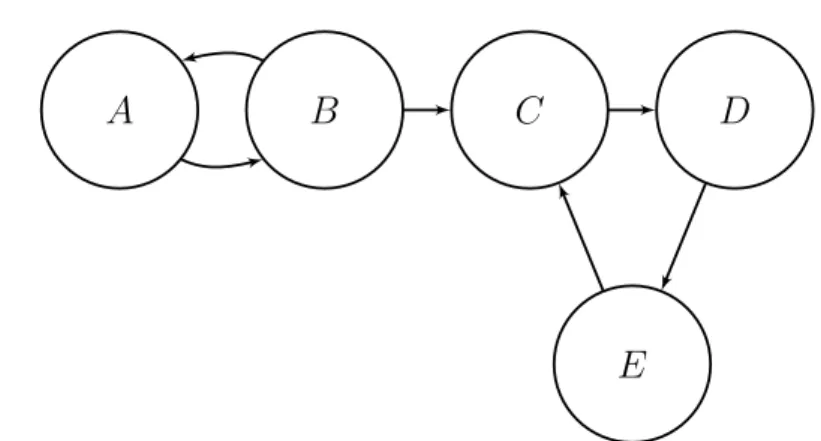
3.1 An (abstract) argumentation framework . . . 44
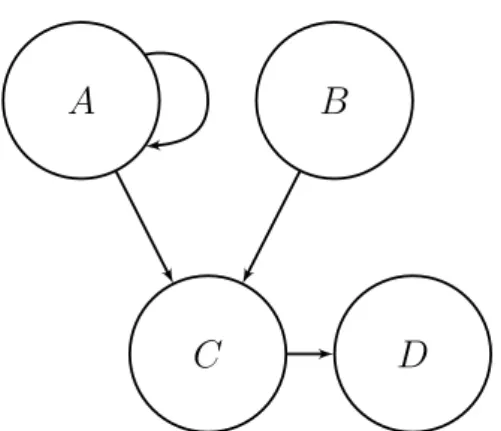
3.2 A more complex argumentation framework . . . 47
3.3 An argumentation framework with no stable extensions . . . . 50
3.4 An argumentation framework with a stable extension . . . 53
3.5 An argument for t using an issue premise . . . 58
3.6 Another argument for t . . . 58
3.7 Corresponding argumentation framework . . . 62
3.8 Arguments in Carneades . . . 70
4.1 An (abstract) argumentation framework . . . 90
4.2 A more complex argumentation framework . . . 95
4.3 An argumentation framework with a stable extension . . . 102
4.4 An argumentation framework with no stable extension . . . . 108
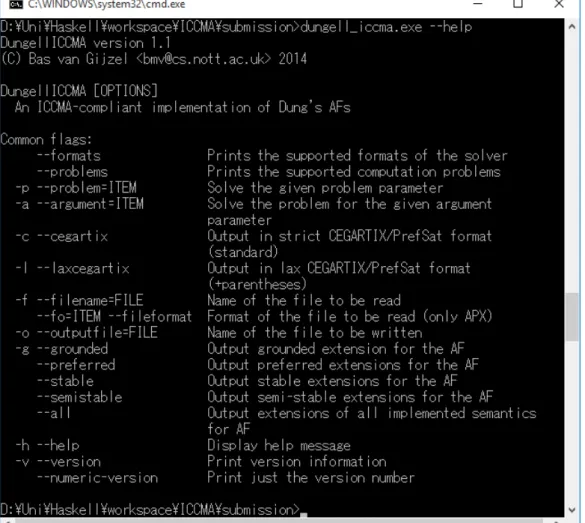
4.5 The Dungell ICCMA command line interface . . . 111
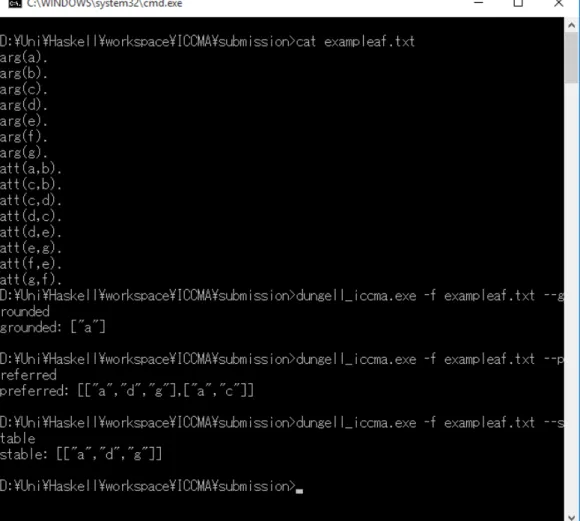
4.6 The Dungell ICCMA evaluated on an example AF . . . 112
4.7 A screenshot of part of the documentation of the Dung package on Hackage . . . 114
4.8 The Dung package API . . . 115
5.1 Carneades argument for murder . . . 120
5.2 Arguments pro and conintent . . . 121
5.3 Carneades argument for murder, and arguments pro and con intent . . . 130
5.4 A file containing the definition of the CAES from Section 5.3.6 133 5.5 An EBNF grammar for the CAES input language . . . 134
6.1 Structured arguments corresponding to Example 3.59 . . . 150
6.2 Ambiguity-blocking in Carneades . . . 159
6.3 Greece versus Italy argument trees . . . 162
6.4 Greece versus Italy argumentation framework . . . 162 xv
7.1 Three arguments in a murder case in Carneades . . . 170 7.2 The dependency graph corresponding to the three arguments
of Figure 7.1 . . . 171 7.3 The Dung AF corresponding to the translation of the three
arguments of Figure 7.1 . . . 172 8.1 An aggregated argument for f . . . 207
Chapter 1
Introduction
Argumentation theory is an interdisciplinary field studying how conclusions can be reached through logical reasoning. Argumentation should here be understood in a general sense, including for example political debates along with more rigorous settings such as a legal or a scientific argument. A cen-tral aspect is that there is usually not going to be any clear-cut truth, but rather arguments and counter-arguments, possibly carrying different weights, and possibly relative to the understanding of a specific audience and what is known at a specific point in time. The question, then, is what it means to sys-tematically evaluate such a set of arguments to reach a rational conclusion. Fields that intersect with argumentation theory thus include philosophy (no-tably epistemology and the philosophy of science and mathematics), logic, rhetoric, and psychology.
Computational argumentation theory is studied in the context of artificial intelligence. Computational argumentation models deal with the formalisa-tion of argument structure as well as conflict and domain-specific constructs such as proof standards. Most argumentation models can apply one or more types of inferencing mechanisms on a problem has been already been for-malised, e.g. a specific court case, to derive a set of conclusions and/or ap-plicable arguments.
There are two main approaches to defining computational argumentation models: the abstract approach and the structured approach. The abstract approach makes no specific assumptions about the form of arguments. Thus this approach is generally applicable across domains. In contrast, the struc-tured approach assumes an argument structure, more or less specific to do-mains such as legal or scientific argumentation1. Irrespective of the approach,
computational argumentation theory is concerned with the mathematical
1The ASPIC+ is slightly more general in that it assumes only a basic structure of
arguments, but leaves the logical language abstract.
analysis and specification of translations between models of argumentation. This thesis puts forward a new, principled approach to the design, im-plementation and formalisation of computational argumentation models and translations between them drawing from dependent type theory [115, 116, 167] and the Curry-Howard correspondence [43, 44, 93, 167, 188]. This ap-proach has a number of advantages:
• It intuitively captures existing abstract and structured argumentation models, providing implementations that also define a mathematical specification (see Chapter 4 and 5).
• Correctness of implementations is shown by implementing desirable properties, such as correspondence properties (see Chapter 7).
• It allows the specification and the proofs of an argumentation model or translation to be unified with its implementation by formalising it in a dependently typed theorem prover such as Agda (see Chapter 7). Some of these ideas have previously been explored by Krause et al. [103], but their work has so far not had any major impact on the field of argu-mentation with respect to how arguargu-mentation models are implemented and formalised. This thesis develops these ideas much further in a contemporary argumentation setting.
Implementations of argumentation models and their translations
Dung’s argumentation frameworks [48] are one of the most influential ab-stract models of argumentation. They capture the essence of argumentation, defining arguments as an abstract set together with a notion of conflict repre-sented by a relation on this set. Dung’s model sets the standard for various other abstract approaches to argumentation, including abstract dialectical frameworks [23] (see Section 3.2 and in particular Section 3.2.5).
Dung’s argumentation frameworks (AFs) have an established relation-ship [48] to logic programming [112]. It is therefore not surprising that AFs have seen significant developments in the area of efficient implementation and elegant implementation methods [35, 36], particularly through implementa-tions written in logic programming and answer set programming [56, 55] or through implementations based on SAT-solvers [34, 56]. Several other abstract models, are either direct extensions of AFs or are closely related. These models can thus also be implemented with relative ease through en-coding into answer set programming clauses [57, 37], translation into other
mathematical formalisms [19], or by direct implementation into a logic pro-gramming language such as Prolog [68]. See Section 4.4 for further related work on implementations of abstract argumentation models.
There has been a resurgence of interest in structured argumentation mod-els, with new developments in both general frameworks [145, 3, 17, 14, 130] and more domain-specific approaches [86, 83, 180]. However, the state of implementations for these structured models is markedly different from the abstract models:
• As abstract argumentation is closely related to logic programming it facilitates developing intuitive implementations, closely aligned with the logical specification, that are also efficient [35, 36]. In contrast, no mainstream, general-purpose language or paradigm provides an equally close fit for structured argumentation. Java has been used in a few implementation efforts [164]. However, because Java fundamentally is an imperative language, those implementations tend to be quite far removed from the logical specification. This makes it difficult to verify whether they actually are correct.
• Most implementations of structured argumentation models are not pub-licly available. Simari [164] gives an overview of some structured argu-mentation models, but most impleargu-mentations of those are now unavail-able or closed source, meaning that details of these specific implemen-tation techniques effectively have been lost. New implementers thus have to start from scratch.
Two notable exceptions are the Carneades implementation [80]2 and
the Tweety project [174]3. See Section 5.5 for further related work on
implementations of structured argumentation models.
• There are existing translations from structured into abstract argumen-tation frameworks (via structured argumenargumen-tation models) [145, 77, 76, 19, 122], which in principle should allow abstract argumentation im-plementations to be leveraged. Examples include the translation of Carneades into ASPIC+ (which generates AFs) [77, 76] and the trans-lation of abstract dialectical frameworks into Dung [19]. Both proofs are substantial and very technical, and thus hard to verify even for experts in the field. The complexity of these translations is a probable cause of the lack of implementations of translations. See Section 7.3
2See
https://carneades.github.com.
3See
for further discussion of implementations of translations between argu-mentation models.
To address these problems, my research takes a principled approach to the relating, implementing and generalising of argumentation models based on functional programming and the Curry-Howard correspondence. Functional programming and the Curry-Howard correspondence are applied to obtain, respectively, intuitive implementations and mechanical formalisations that are both very close to the mathematical specifications.
Functional programming
My thesis attempts to address the lack of implementations of structural ar-gumentation frameworks and translation between models by exploiting func-tional programming. We will see that verification of structured argumenta-tion frameworks and their translaargumenta-tions is facilitated by a declarative imple-mentation where the code is close to the actual mathematics. Functional programming languages thus provide a good basic fit. An additional ad-vantage is their proven track record as hosts for Embedded Domain-Specific Languages (EDSL) [95, 94], allowing tailoring to specific requirements which is exactly what is needed to support particular structured argumentation frameworks.
The choice of functional programming language is Haskell [100, 114, 99]. The use of Haskell in the thesis is motivated by previous work [72], in which the Carneades argumentation model was implemented in a way that is easily understandable to argumentation theorists with no prior Haskell knowledge. Further, two of the Cabal packages4discussed in previous papers [72, 73] (see
also Section 4 and 5), the Dung and CarneadesDSL package, have been used in AI for programming (e.g. a closed source natural language processor) and teaching5.
Haskell has several advantages for the implementation of structured and abstract argumentation models and their translations:
• Programs are statically and strongly typed, i.e. code can be checked on compile-time for its type and the compiler can catch a significant amount of programming errors before running a program.
• Haskell supportspurely functional programming. A pure function does not have side-effects, making it closer to how functions are specified in mathematics.
4For a discussion of Cabal packages, see Appendix A.
5School of Informatics, University of Edinburgh, AILP 2012–2013, 2013–2014, 2014–
• Haskell has very flexible syntax and furthermore has facilities for defin-ing (embedded) domain specific languages. Together with pure func-tional programming, it is possible to develop an implementation that serves as a mathematical specification in its own right.
• Haskell allows for automatic random testing of the state space by using the QuickCheck [40] library. Programmers can thus quickly check cor-rectness of their programs by specifying intuitive properties and letting QuickCheck search for possible counter-examples6.
• Although Haskell itself is not a theorem prover, code programmed in Haskell can be relatively easily lifted to a theorem prover such as Agda, allowing formal verification of an implementation.
See Section 2.1 for an in depth discussion of the technical programming language terminology. For a further discussion of the motivations for using functional programming, see [105, 8, 96].
Curry-Howard correspondence
While tools like QuickCheck [40] can help finding problems automatically, firm correctness guarantees can only be obtained through formal proofs. Given that we are working in a pure, functional, strongly typed setting, theo-rem provers based on the Curry-Howard correspondence [43, 44, 93, 167, 188] offer a particularly attractive approach. The Curry-Howard correspondence is a connection between logic and computation that directly relates types with propositions and programs with proofs. Thus, to write down a proof for a theorem is the same as implementing a function for the corresponding type.
The Logic of Argumentation by Krause et al. [103] is an argumentation model that directly exploits this connection by generalising the link between typed lambda calculus and intuitionistic type theory [115, 116], by defining a notion of argument as proof terms with weights corresponding to lambda terms with free variables, given a context (see Section 3.7.1 for further de-tails). The approach in the thesis is partly based on the insight gained from this connection, i.e., arguments and inferencing are closely related to func-tional programming and evaluation.
Agda [128] is a theorem prover based on dependent type theory [115, 116, 167] with syntax that is very close to that of Haskell, making the step from
6QuickCheck generates a specified number of test cases before it gives up finding a
from a Haskell implementation to an Agda formalisation relatively small. Agda checks that all functions are terminating. Thus, if we successfully implement an algorithm in Agda, we immediately know that our algorithm is terminating on all (finite) inputs.
Furthermore, translations between argumentation models can be noto-riously complex (various proofs including [145, 77, 76, 19] have later been amended or said to be very hard to understand even by authors of the re-spective models). Given the complexity of proofs of correctness, and the difficulty even for experts of the field to check this work, I believe that me-chanical formalisation of translations and their correctness proofs also have significant benefits.
The general framework
The thesis develops a principled approach to the implementation and for-malisation of argumentation models and their translations. In particular, a methodology is provided for implementing argumentation models, translating between different argumentation models, testing correctness of implementa-tions and finally proving correctness of implementaimplementa-tions.
1. Implementation of abstract and structured argumentation
mod-els:
• Various abstractions and implementation methods of existing ar-gumentation concepts are provided, e.g., a general implementation of Dung’s AFs allowing different instantations and providing var-ious high level algorithm implementations is given in Chapter 4. The various algorithms and definitions implemented in Chapter 4, 5 and 7 are deliberately implemented as close to the mathemat-ics as possible, using high-level programming, to make it easy to verify that the implementations are indeed correct. The imple-mentations in the various chapters are therefore also meant as reference implementations.
• Argumentation theorists that intend to implement a different ab-stract argumentation model, can apply the implementation meth-ods of Chapter 4 to develop their own implementation, or alterna-tively, use the implementation of Chapter 4 as a translation target (see also point 2.).
• Domain specific languages can be built from an argumentation model implementation using the methodology outlined in Chap-ter 5.
• All programming code and programming methodology is fully doc-umented, open source and available making the work reproducible and suitable as teaching material (see Chapter 4 and 5)7.
2. Implementation of translations between argumentation
mod-els:
• Chapter 4 is a general and complete implementation of Dung’s AFs that is intended to be used as a translation target from other argumentation models. Chapter 7 and Chapter 8 provide use cases for this approach, providing high-level implementation of a trans-lation from Carneades/generalised ASPIC+into Dung’s AFs. The
implementation methods of Chapter 7 are intended to be comple-mented with testing or formal verification (see point 3. and 4.).
• Argumentation theorists that intend to provide an efficient im-plementation of their argumentation model can also rely on the implementation of Chapter 4, by implementing a translation to this implementation. Although the implementation of Dung’s AFs in Chapter 4 in itself is not optimised, the implementation does provide various output formats that are readily usable by various efficient SAT-based implementations in the field (see Chapter 7).
3. Verification/testing of implementations of argumentation
mod-els and their translations:
• Argumentation models can be verified by implementing expected properties directly into Haskell and applying the testing methods used in Chapter 7 to do a limited search of the state space, possibly finding counter-examples when these properties are violated (see point 4. for formal verification).
• Translations can be verified by implementing both the original model and the translation and again applying the testing methods used in Chapter 7 to verify that the original model implementation and the result in the translated Dung AF correspond.
4. Formal verification of implementations of argumentation
mod-els and their translations through formalisation in a theorem prover:
7
• Chapter 7 provides a reference implementation of Dung’s AFs in the theorem prover Agda, documenting how to formalise defini-tions up to grounded semantics.
• The implementation of Chapter 7 is intended as a translation tar-get for mechanical formalisations of translations from argumenta-tion models.
• Again, all proofs and programming methodologies are fully docu-mented, open source and available making the work reproducible and suitable as teaching material8.
The ultimate goal here is that the functional programming approach taken is as suitable for implementing and formalising structured argumentation frameworks and their translations as logic programming is for implementing abstract argumentation models. See also Section 1.1 and Figure 1.1, for details on how the thesis contributions apply to each of these points.
1.1
Contributions
The specific contributions of the thesis are the following:
• An implementation in Haskell of Dung’s abstract argumentation frame-works [48], its standard semantics and the more recent semi-stable se-mantics [28]. The code is very close to the mathematical definitions, allowing the work to simultaneously serve as documentation and imple-mentation and showing how functional programming is indeed suitable for implementing abstract argumentation models.
• An implementation and domain specific language for the Carneades argumentation model [86, 83], providing one of the first functional pro-gramming implementations of a structured argumentation model. The implementation has been shown to be intuitive to read and use by argumentation theorists, and is now used as the basis of a university module.
• A deeper treatment of the previous work translating Carneades into ASPIC+ [69, 76]. Further theorems about the correspondence of the
translation are proved and a derivative translation from Carneades into Dung is constructed. Further algorithms and properties are given for the derived translation.
8
• An implementation of the translation from Carneades into Dung is given, providing one of the first implementations of a translation be-tween argumentation models. The implementation techniques are fully documented and all work is made publicly available and reusable. The desired properties of such a translation are discussed, together with their implementation in Haskell. In addition, a sketch is provided how such properties might be formalised in a theorem prover.
• A formalisation of the implementation of Dung’s AFs in a theorem, Agda, is given, thereby providing the first fully machine-checkable for-malisation of an argumentation model, and showcasing the benefits of using a functional programming language as an initial implementation.
• The above implementations and formalisation are combined, to provide a verified pipeline, starting from an input file reading a Carneades argument structure, resulting in a file containing a Dung AF, readable by one of the fastest current implementations [56].
• A generalisation of the ASPIC+ model is developed, extending the
model with content orderings, weight propagation and argument ac-crual. The framework constructed in this thesis is then applied to pro-vide an implementation of extended ASPIC+, by translating it directly
into Dung’s AFs.
• Finally, all work has been made open source, publicly available and are immediately installable, either as a Hackage package or as a literate programming file. All the implementations and formalisations are also extensively documented and contain various examples of their usage. These contributions and the relationship between them are summarised in a schematic overview in Figure 1.1. The top half of the figure (using cloudy outlines) denote mathematical specifications and implementations of argumentation models and their translations, while the bottom half denotes completely mechanised formal specifications (in a theorem prover). Dashed lines indicate that part of the implementation is left to future work, while solid lines indicate the project has been completely finished.
Carneades Formalised Carneades
Dung’s
AFs
Generalised ASPIC+
F
ormalised Dung’s AFs
formalisation translation translation formalisation v erified translation formalisation Figure 1.1: Ov erview of completed and future researc h
There are also various small technical contributions to existing argumen-tation models and translations in the thesis, see Appendix B.
1.2
Structure of the thesis
This section gives an overview of the research I have done, by discussing how each section contributes to the overall thesis. The thesis is organised into two parts:
1. The first part discusses the relevant background needed to read the main part of the thesis.
2. The second part presents my framework for relating, implementing and verifying argumentation models and their translations. Various use cases of this framework are provided.
Part I is organised as follows.
Chapter 2 discusses the necessary functional programming
preliminar-ies. Section 2.1 discusses functional programming in general and furthermore provides an overview of the Haskell language, including various examples. Section 2.2 gives an introduction to the Curry-Howard correspondence, de-pendent type theory and the Agda programming language.
InChapter 3the necessary argumentation background is discussed.
Sec-tion 3.1 starts with an introducSec-tion to process of argumentaSec-tion, covering the relationship between abstract and structured argumentation. Section 3.2 introduces the abstract argumentation frameworks by Dung. Section 3.3 dis-cusses the 2010 version of the ASPIC+ model. Section 3.4 gives a different
treatment of the 2009 version of the Carneades model, explicitly splitting the model in a stage-specific and dialogical part. Section 3.5 discusses ASPIC+ with proof standards/burdens. Section 3.6 gives a treatment of rationality postulates, constraints that can be imposed on the evaluation of argumenta-tion models with structure. Finally, Secargumenta-tion 3.7 provides a literature review of other related computational argumentation models.
Part II is organised as follows.
Chapter 4 presents an implementation in Haskell of Dung’s
argumen-tation frameworks, its standard semantics and the more recent semi-stable semantics. Furthermore, the labelling algorithm for calculating preferred, stable and semi-stable semantics and all the definitions discussed in Cami-nada [28] are presented and faithfully implemented. Finally, a library and command-line interface for these implementations are included and discussed.
Chapter 5 presents a case study for implementing a structured argu-mentation model, Carneades, into Haskell, while simultaneously defining an embedded domain specific language. This implementation is then lifted to a Haskell library.
Chapter 6relates the Carneades argumentation model with the ASPIC+
framework, by presenting a translation that allows arbitrary Carneades ar-gument evaluation structures to be faithfully represented in ASPIC+. In
particular, it is proved that important correspondence results and rational-ity postulates hold for the translation. Finally, the translation is applied to generalise the Carneades model to allow for evaluation on cycle-containing structures.
Chapter 7 builds on the use cases presented in the previous chapters,
providing a general methodology for developing abstract and structured ar-gumentation models, and translations between them. The chapter discusses an implementation in Haskell of a translation from Carneades into Dung, derived from the translation of Carneades into ASPIC+. Properties of the implementation are implemented and tested using the QuickCheck library. Finally, a mechanical formalisation of Dung’s AFs up to grounded semantics is presented in Agda.
Chapter 8presents a use case of the framework constructed in my thesis.
A new structured argumentation model is defined by extending ASPIC+ with content orderings, propagation of weights and argument accrual. This model is then, with relative ease, implemented in Haskell by building on the implementations of the previous chapters.
Chapter 9concludes this thesis, providing an overview of the work done
and giving suggestions for future work. The appendices are structured as follows.
Appendix A gives an overview of the techniques and technologies used
in the thesis.
Appendix B elaborates the minor technical contributions to existing
argumentation models and translations.
1.3
Relation to previous work
Parts of this thesis were previously published in my MSc. thesis or in scientific articles. All the publications mentioned in this section were written as a lead or only author.
Part of the background material in Chapter 3, in particular the basic definitions and four standard semantics of Dung and the majority of the Carneades and ASPIC+ sections, are based on previous work as produced in
my MSc thesis [69], the article with Henry Prakken [77] and the articles with Henrik Nilsson [72, 73, 75, 74].
Chapter 4 contains earlier work from [73, 75, 74]. The implementation
has been significantly extended to include implementations for the preferred, stable and semi-stable labelling algorithms [28], along with all the accompa-nying definitions. The Dungell application is based on the work published at ICCMA [71].
Chapter 5is based on the article published at Trends in Functional
Pro-gramming [72]. The work has been updated to incorporate changes required to support the translation from Carneades into Dung in [75, 74] and has furthermore been extended to incorporate a parser, an output module and a significantly extended related work section.
Chapter 6is largely based on the article published in Argument & Com-putation [77], building on the work of [76, 69].
Chapter 7 is the final product of multiple iterations [72, 73, 75, 74] of developing a framework for the implementation and formalisation of abstract models, structured models and translations between them. The chapter has been extended to include the complete Agda formalisation of Dung’s AFs, it describes in more detail how the translation between Carneades and Dung is implemented and it also covers an in depth discussion of related work.
Chapter 8has not been published before. Part of the research was done
with guidance of Henry Prakken, when visiting Utrecht University.
Appendix A is an extended and rewritten version of a previously
pub-lished article [70].
1.4
Roadmap
This thesis is interdisciplinary, containing technical contributions in both argumentation theory and functional programming. I have attempted to accommodate argumentation theorists, functional programmers and general computer scientists by making the thesis largely self-contained. This section provides three suggested paths for reading the thesis, matching to the three intended audiences.
There is deliberate overlap between chapters, in particular between the background and the functional programming implementations of argumenta-tion models. It is intended that the reader can use the background secargumenta-tion as a central reference point for all the mathematical definitions. The functional programming chapters give a self-contained introduction to argumentation models, repeating or rephrasing mathematical definitions to be more suited
for a functional programming audience, while providing corresponding im-plementations.
The following order of progressing through the thesis is advised:
• If the reader is a functional programmer, an introduction to argumen-tation theory through functional programming in Chapter 4 and Chap-ter 5 is advised.
Section order: 3.1 ⇒ A ⇒4 ⇒ 5⇒ 7 ⇒8 ⇒ 9, referring back to the models in Chapter 3 and the translation in Chapter 6 when needed. A book length introduction to argumentation theory and some of the here discussed models is given in Besnard and Hunter [14].
• An argumentation theorist can linearly progress through the thesis, skipping the argumentation background Chapter 3, only referring to it when needed as a refresher or as an introduction to a specific model. Argumentation theorists with no background in (functional) program-ming, might want to consult a standard introduction to functional pro-gramming [99, 111] in addition to the functional propro-gramming back-ground Chapter 2, before tackling Chapter 4.
• A reader with neither a background in argumentation theory nor in functional programming could either progress linearly through the re-port while consulting literature on argumentation [14, 157] or alterna-tively follow the route of the functional programmer while reading an introduction to functional programming [99, 111].
Part I
Background
Chapter 2
Functional programming
background
This chapter gives an introduction to functional programming, discussing the necessary concepts and providing concrete examples to help the reader un-derstand the approach taken in the thesis. For a more in depth introduction the reader should consult Section 2.1.7 and 2.2.4, which discuss introductory texts on (dependently typed) functional programming and other relevant lit-erature9.
Section 2.1 introduces the functional programming paradigm and in spe-cific, the purely functional programming language Haskell. In particular, it will be made clear what it means for a programming language to be purely functional and what it entails to have strong static typing, lazy evaluation and referential transparency. The reader will also be introduced to con-crete Haskell syntax w.r.t. its types and functions, algebraic data types and typeclasses. Finally, the Haskell library QuickCheck will be discussed and references to further reading material will be given.
Section 2.2 introduces the dependently typed functional programming language Agda, a programming language and an interactive system for writ-ing and checkwrit-ing proofs.
2.1
Functional programming: Haskell
This section discusses the paradigm of functional programming and in spe-cific, the programming language Haskell [100, 114, 99]. For a further moti-vation of the use of functional programming in this thesis, see Chapter 1 and
9Further technical and practical concepts used in this thesis, such as literate
program-ming and Haskell packages, are discussed in Appendix A.
further references in Section 2.1.7 and 2.2.4.
2.1.1
Purely functional programming
Purely functional programming takes a quite different approach to program-ming than that of imperative and object oriented programprogram-ming languages such as Java [87], C++ [169] and Pascal [190]. Java, C++ and Pascal all rely on the assignment statement, a command that changes the state of a vari-able to a new value, thereby overwriting the previous value. Assignment statements, and other commands that induce side effects, make it harder to perform reasoning about programs, including proving correctness and termi-nation of programs. This is particularly true in the context of parallelism and shared data structures [170]. To prove correctness of programs that have shared state requires advanced reasoning tools such as separation logic [162]. In contrast, purely functional programming deliberately does not allow side effects and shared state, and instead depends on pure functions, i.e. functions that do not change the global state and are therefore side effect free. Haskell is a purely functional programming language [100, 114]10, allowing us
to more easily prove properties of our Haskell programs by using equational reasoning (see Section 2.1.6 and Hutton [99]) and it also shortens the gap between our programs and a fully mechanically formalised specification in a theorem prover, such as Agda (see Section 2.2). Even Haskell’s unpure code, including mutable state and concurrency, can be reasoned about purely using equational reasoning [172].
Consider the following Java code fragment:
public s t a t i c i n t f i b o n a c c i (i n t n ) { . . .
}
We can see that the above function takes an int as argument and returns an int as result. However, despite that intuitively the Fibonacci function should only work on calculating the correct corresponding Fibonacci number, we are not barred from writing to the file system, printing out a document or firing a nuclear missile. A pure function does not allow for such side effects. In Haskell we have a type declaration that is very similar to the Java type of
fibonacci:11
fibonacci ::Int →Int fibonacci n =. . .
10Strictly speaking, Haskell does allow for one side effect: non-termination.
11We use slightly idealised syntax for Haskell, as generated by the tool lhs2tex. See
The same type declaration in Haskell provides more guarantees about the behaviour of the function than the Java specification. By disallowing side effects, we are guaranteed that a function call applied to the same argument will always give the same result, making Haskell functions closer to functions as used in mathematics12. Results of computations are then computed
deter-ministically, allowing us to substitute a function application in Haskell by its result, an important property of Haskell calledreferential transparency [99].
2.1.2
Functions and types
A program in a functional programming language consists of a number of defined functions. Functions in Haskell are defined by giving it a name, giving a name to its possible arguments (juxtaposed) and defining a body (after the equals sign) that specifies how the calculation depends on the argument(s).
double x =x +x
Heredouble is a function taking numbers and doubling them. Computation then occurs by applying functions to appropriate arguments (where argu-ments can again be functions). Function application in Haskell is denoted by juxtaposition, e.g. f 3 True will apply f to arguments 3 and True. So
double 4 will give the expected 8.
Defining double as a function can also be seen as defining an equation, relating left and right hand sides of the equals sign. Haskell’s referential transparency allows us to substitute equals for equals, combining this with the idea of functions defining equations, we can doequational reasoning. For example, if we encounter the expression double x in another function, we can without problem replace this by its right hand side x +x. For further examples of equational reasoning, see Chapter 13 of Hutton [99].
Haskell is a statically, strongly typed language [100, 114]. Static typing implies that the Haskell compiler knows on compile time for each piece of code, what type it has. Haskell is alsostrongly typed, i.e. supplying incorrectly typed arguments or making incorrect type combinations will throw a compiler error. This combination of strong and static typing means that many of the programming errors can be caught at compile time. For an in depth discussion of static type checking and its use in programming languages, see Pierce’s book on type systems [135].
12By specifying a function as pure, we disallow the implementer of this function to do
Compilers for the Haskell language also provide type inference. For in-stance, the previously defined function double will get a type that is auto-matically inferred by the compiler (or the compiler would throw an error in case it was impossible to infer a valid one). A programmer can always opt to supply the type signature, together with its definition, explicitly.
double::Int →Int double x =x +x
A type expression e::T can be read as: expression e has type T.
Type
Haskell provides a mechanism for defining type synonyms, either as a short-hand for a complex type or to clarify the usage of a type. For instance, in Section 4.1 the simplest instance of an abstract argument is defined to be a String, but we might want the users of the code to still think of these arguments as abstract arguments, in contrast to how they are actually im-plemented.
typeAbsArg =String
Note that the above definition only defines a synonym and the compiler therefore does not handle AbsArg and String differently. If a programmer does want to make a distinction on names, for instance for types that should be handled differently but are not structurally different, she can usenewtypes
defined in Section 2.1.3.
Polymorphic types
Int,Bool and type synonyms likeAbsArg are all concrete types. Haskell also provides polymorphic types, that is a type variable that can be instantiated by any concrete type allowing users to write functions that work for every type, i.e. parametric polymorphism [78, 160, 117, 135]13. Haskell has tuples, meaning that the programmer can define tuples ofInts, i.e. (Int,Int), or any other combination such as (String,(Int,Bool)). A generic tuple is polymor-phic and has type (a,b), witha and b being type variables.
A function that takes the first element of a tuple should not need to depend on the concrete instantiation of a and b and this indeed the case in Haskell:
13In Section 2.1.5 we will see how we can restrict a type variable to a certain class of
types by using typeclasses, where each typeclass can give a a possibly different behaviour, giving rise toad-hoc polymorphism.
fst :: (a,b)→a fst (x,y) =x
The type offst can be read as a universally quantified statement: for all types
a and b, given a tuple (a,b) return an a. If we ignore infinitely looping and partial definitions, then by parametricity [161, 187], the correct definition is also the only possible implementation of this function. Parametricity will be discussed in more detail in Section 2.2.3.
2.1.3
Data types and pattern matching
We have seen that all Haskell expressions (values) have types. For example:
False::Bool True ::Bool
¬ ::Bool →Bool
Programmers who want to define new types, such as the Bool type, can do so by using data declarations. For example, Bool is defined in the Haskell standard library as following:
dataBool =True |False
On the left hand side is thedatakeyword followed by the name of the type. After the equal signs we get one or more value constructors, separated by the bar symbol which can be read as “or”.
Type parameters
Value constructors in a data definition can have one or more arguments, which can either be concrete types, or variables thereby resulting in a poly-morphic type. A good example of the power of Haskell’s algebraic data types is the Maybe type.
dataMaybe a =Nothing |Just a
The Maybe data type is a data type respresenting exception. Maybe has two constructors,Just a in the case of a successful computation, andNothing in case an exception occurs. For example, division on integers has an excep-tional case when dividing by zero:
safeDiv ::Double →Double →Maybe Double safeDiv m 0 =Nothing
Double is a data type for floating point numbers. TheDouble data type can intuitively be seen as a very big data type definition having a case for every floating number it is able to represent. The functionsafeDiv above is defined by pattern matching on theDouble data type, splitting the function into two lines. The first line matches on the 0 constructor, returning Nothing as the result. In the case a number other than 0 is encountered, the result of the division is wrapped in the Just constructor. Here $ is shorthand for lowest priority application, meaning Just $m /n is equal to Just (m /n). If we would then want to use the result of such a division we can pattern match on theMaybe data type, we can use the result of aJust Double and for Nothing
we can either propagate the Nothing type or possibly give an error message.
Lists
Haskell has very strong syntactical support for lists, allowing for easier pat-tern matching and list comprehensions. For example, the following function takes the first element of a list:
head :: [a]→a head (x :xs) = x
Here [a] is a polymorphic list, (x :xs) pattern matches on the list, splitting it into its first element and thetail of the list, returning thehead. Note that we do not have a case for the empty list, which will therefore throw an error when taking the head of the empty list, [ ]. We can however define a safe version of this using the previously discussedMaybe datatype.
safeHead:: [a]→Maybe a safeHead [ ] =Nothing safeHead (x : ) =Just x
The underscore represents a wild card, matching any remaining patterns. Finally, list comprehensions are a Haskell syntactical construct that al-lows us to specify lists close to mathematical set builder notation. Given that we defined isEven, the following function takes the even numbers of a list of numbers:
evenList :: [Int]→[Int]
evenList ns = [n |n ←ns,isEven n]
This is similar to the mathematical {n|n ←ns,n is even}, and indeed the Haskell list comprehension is interpreted in a similar manner. The bar can be read as “such that” and then ←ns is called agenerator and can be read
as n is drawn from ns. The other allowed statement beside a generator is a guard statement, i.e. a logical expression resulting in a Bool. Only those elements for which the result of the Boolean expression isTrue will be added to the list. Finally, note that all this syntax can be desugared into standard Haskell syntax.
Newtype
While type synonyms are useful for giving types a different name and in-tuition, we sometimes would like to make two equivalent types explicitly different by using anewtypedeclaration14. We can do this to prevent users
from mixing up a file name and with another type of String or to define functions with different behaviours depending on which newtype is used.
newtypeFeet =Feet Double
newtypeCM =CM Double
HereFeet andCM are twonewtypedeclarations that both use aDouble as its only argument. Despite that the two are equivalent, a user cannot call a function usingFeet with aCM type and vice versa, thereby preventing some programming errors on the type level.
Finally, newtypes can be used to define different type class (see Sec-tion 2.1.5) for what is essentially the same type.
2.1.4
Recursive functions
Haskell’s basic mechanism for looping isrecursion[46], a function is recursive if it is defined “in terms of itself”. Standard recursive function have at least one base case (to allow for termination) and one or more recursive cases. For example, the Fibonacci function from Section 2.1.1 can be defined as following:
fibonacci ::Int →Int fibonacci 0 = 0
fibonacci 1 = 1
fibonacci n =fibonacci (n−1) +fibonacci (n −2)
The multi line definition can be seen as defining three equations, when the argument is 0, 1 or something else. A calculation of fibonacci 3 would go as following:
14newtypedeclarations are also used to declare cyclic type definitions, which are
fibonacci 3 =fibonacci 2 +fibonacci 1 (applyingfibonacci n) = (fibonacci 1 +fibonacci 0) +fibonacci 1
(applyingfibonacci n) = (1 +fibonacci 0) +fibonacci 1 (applying fibonacci 1) = (1 + 0) +fibonacci 1 (applying fibonacci 0)
= 1 +fibonacci 1 (1 + 0 = 1)
= 1 + 1 (applying fibonacci 1)
= 2 (1 + 1 = 2)
An important thing to note is that having a base case for a recursive func-tion in Haskell (or most other programming languages), does not guarantee termination. The Agda programming language discussed in Section 2.2 does guarantee this property.
Partial application
In the previous subsection we saw the functionsafeDiv:
safeDiv ::Double →Double →Maybe Double
The type of safeDiv gives the impression that the function takes two argu-ments. However, the arrow notation hides the fact that the arrows in types of Haskell functions associate to the right.
safeDiv ::Double →(Double →Maybe Double)
safeDiv is thus a function that takes one argument, a Double, and returns a function Double → Maybe Double. Using this idea, we can do a partial application as following:
plus::Int →Int →Int plus x y =x +y plusThree::Int →Int plusThree =plus 3 Then, we have that:
>plusThree 5 8
Anonymous functions
In the previous sections, functions were defined by defining an equation, e.g.
double x = x +x, where double defines the name. Functions can also be defined anonymously when understood as a lambda expression:
λx →x +x
2.1.5
Typeclasses
Section 2.1.2 discussed polymorphic functions, i.e. functions that work gener-ically for any instantiation of types. Haskell has its own version of ad-hoc polymorphism (function overloading) [31] by the use of typeclasses [187, 92]. A typeclass declaration is similar to a Java interface, defining a general type of behaviour for all instances of that particular typeclass.
A Haskell programmer can syntactically define the type of functions that work for type variables in a specific typeclass by using aclass constraint C a, whereC is the name of the typeclass anda is the type variable. For example, the definition of + in the Prelude (the Haskell standard library) uses a class constraint ofNum, the class of numeric types:
(+) ::Num a ⇒a →a →a
The type of + can be read as, given thatais an instance of the typeclassNum, + has type a → a → a. Any data or newtype declaration can be turned into an instance of a typeclass, provided that we give an implementation for the methods that typeclass specifies.
Eq
Eq is the class of types that are able to be compared for equality and in-equality.
classEq a where
(≡) ::a →a →Bool
(6≡) ::a →a →Bool
The Eq typeclass specifies two methods, ≡ to compare two elements for equality and6≡to compare two elements for inequality. The default definition in the Haskell Prelude implements both methods using the other definition, which means that to successfully define an instance for Eq T for type T we only need to define ≡or 6≡.
instanceEq CM where
(CM d1)≡(CM d2) = d1 ≡d2
Here we define an instance of Eq for the CM newtype, using the already defined≡ onDoubles.
Ord
TheOrd typeclass contains those types that first of all are an instance of the
Eq typeclass and furthermore can be totally ordered.
classEq a ⇒Ord a where
compare ::a →a →Ordering (<) ::a →a →Bool (>) ::a →a →Bool (>) ::a →a →Bool (6) ::a →a →Bool max ::a →a →a min ::a →a →a
The functions<, >, >, 6 implement an ordering in the expected way; max
and min respectively return the maximum and minimum of two elements of
a;compare takes two elements ofa and determines whether the first element is smaller than (LT), equal to (EQ) or greater than (GT) the second element, with dataOrdering =LT |EQ |GT.
Show
Finally, members of the Show typeclass are types that can be presented as
Strings.
classShow a where
showsPrec::Int →a →ShowS show ::a →String
showList :: [a]→ShowS
Show defines three methods: show takes any element of a and returns a
String that represents that a; showList and showsPrec are defined for effi-ciency reasons and will not be discussed.
2.1.6
QuickCheck
QuickCheck [40]15is a lightweight tool that aids programmers in formulating and automatically testing properties of their Haskell code. Properties are defined as Haskell functions. QuickCheck can, dependent on the type of data used as input for the property, automatically generate data that will test satisfaction of the property.
Properties
Instead of writing unit tests, QuickCheck allows users to state general prop-erties that are required of a function. For example, sensible propprop-erties for thereverse function from the Haskell standard library would be the following (with ++ defining list concatenation):
reverse [x] = [x]
reverse (xs ++ys) =reverse ys ++reverse xs reverse (reverse xs) =xs
QuickCheck provides a DSL that provides tools to specify such properties:
propRevSingleton::Int →Bool
propRevSingleton x =reverse [x]≡[x]
propRevApp:: [Int]→[Int]→Bool
propRevApp xs ys =reverse (xs ++ys)≡reverse ys ++reverse xs propRevRev :: [Int]→Bool
propRevRev xs =reverse (reverse xs)≡xs
Note that the type of the properties has to be defined specific to a type (monomorphically), otherwise QuickCheck will not be able to generate arbi-trary data for testing the properties.
Using QuickCheck to check properties
QuickCheck provides a basic function quickCheck and further customisable variants that can automatically test a property, given that QuickCheck knows how to generate arbitrary test cases. For example, running quickCheck on one of the properties defined before, would look as following:
>quickCheck propRevRev OK :passed 100tests.
15See:
Alternatively, in the case of a buggy implementation or an ill-defined prop-erty, we could have the following:
propRevWrong :: [Int]→Bool propRevWrong xs =xs ≡rev xs
>quickCheck propRevWrong Falsifiable,after 2tests : [2,3]
Here QuickCheck correctly extracts a counter-example for the parameter xs, which violates the property.
QuickCheck has various pre-defined instances for generating Ints, lists and various other standard Haskell data types. If an instance is not available or suited for the specific use case, then the user can define their ownArbitrary
type class instance.
For example, the instance for your own type of Ints that only returns small positive values, might look as following:
newtypeMyInt =M Int
instanceArbitrary MyInt where
arbitrary =M (choose (1,100))
Here choose is a predefined combinator generating a value between two given ranges.
2.1.7
References
This section gave a quick introduction to various functional programming features and Haskell in specific. There are various resources that give a more in depth introduction to functional programming in Haskell, including the books by Hutton [99], Lipova˜ca [111], O’Sullivan et al. [131] and oth-ers [177, 16]. The Haskell language reports [100, 114] are also a good source of information for the Haskell language and libraries.
For a further discussion of the motivations for using functional program-ming in general, see [105, 8, 96].
2.2
Dependently typed functional
program-ming: Agda
This section discusses the dependently typed (functional) programming lan-guage, Agda [128, 127, 129]. Agda, like Haskell, is a pure functional program-ming language, requiring functions to not have side-effects or shared state.
The type system of Agda forms a consistent logical system, called a type theory. The type theory is an extension of Martin-L¨of type theory [116, 115], with features such asdependent types, indexed families,totality and the abil-ity to write proofs for theorems that are simultaneously (well-typed) terms implementing a type.
2.2.1
Functions and types
Similar to Haskell, Agda programmers can define new data types by using
datadeclarations.
dataBool :Set where
true :Set false :Set
dataN:Set zero:N
suc :N→N
Since Agda has kinds [135], i.e. the type of a type constructor, we need to make it explicit that Bool and N are base types by declaring their types to be Set. Data type definitions can also take type parameters.
Below we define Agda’s equivalents of Maybe, Either and lists.
dataMaybe (A:Set) :Set where
just :A→Maybe A nothing :Maybe A
data + (A B :Set) :Set where
inl :A→A+B inr :B →A+B
dataList (A:Set) :Set where
[ ] :List A
:: :A→List A→List A
Agda does not have all of Haskell’s syntactical conveniences, making the declarations of lists more explicit. Agda does allow numerals to be used as a syntactic short hand for naturals.
natList :List N
natList =zero:: (suc zero) :: (suc (suc zero)) :: [ ] -- or equivalently
natList2 :List N
Pattern matching
Given our inductive type for natural numbers we can define the + function on naturals by pattern matching on the two types of the constructor.
+ :N→N→N
Zero + m =m
Succ n + m =Succ (n + m)
To ensure consistency of Agda as a theorem prover, functions need to be total and terminating. To enforce this, Agda has a coverage checker and a termination checker. The coverage checker ensures that functions, such as + , are defined on all cases of a data type. The termination checker will determine whether a function is obviously terminating, by checking whether it is structurally recursive (see Norell’s thesis [127] and the latest Agda re-lease [129] for details on the exact algorithm used). Termination and coverage checking are undecidable in general. Agda, thus instead places the burden on the programmer to define their functions such that the type checker can automatically detect whether it is terminating and fully covered.
For example, thesafeHeadfunction, as defined in Section 2, can be defined in Agda as follows:
safeHead:List A→Maybe A safeHead [ ] =nothing safeHead (x ::xs) =just x
Both cases of the list data type are covered, and there are no recursive calls. Agda will therefore accept this definition. However, Agda equivalent to Haskell’shead function is not fully covered ([ ]) and will therefore be rejected.
-- Not accepted by the type checker:
head :List A→A head (x ::xs) =x
Similarly, we can try to cheat the type checker by writing a case for [ ], but Agda will mark the head0 function (and the specific offending case) as possibly non-terminating.
-- Also not accepted:
head0 :List A→A head0 (x ::xs) = x head0 [ ] =head0 [ ]
The append functionapp, appending two lists together, is a polymorphic function taking a type argument A. It is defined by structural recursion on the list’s structure and accepted as total by the Agda type checker.
app:: (A:Set)→List A →List A →List A app A[ ] ys =ys
app A(x ::xs)ys =x :: (app A xs ys)
The append function can then be specialised to natural numbers, by explicitly supplying a type argument.
appNat::List N→List N→List N appNat =app N
Agda is a dependently typed programming language, allowing functions to not only depend on type (as is the case for app) but also on values. In the case the function does not depend on a value, Agda provides the convenient option to define the parameter as implicit, making it not required to supply the parameter as long as it can be inferred by the type checker (otherwise it will still have to explicitly passed).
Implicit arguments
The append function can be redefined to instead have an implicit argument for the type A by writing it between curly braces. The Agda compiler will then normally be able to be infer the argument through its use.
++ ::{A:Set} →List A→List A→List A
[ ] ++ys =ys
(x ::xs) ++ys =x :: (xs ++ys)
The underscores denote the position(s) in which arguments are supplied around the operator, making it possible to define our own infix but also mixfix operators. If needed, arguments can always be provided explicitly by providing them within curly braces:
natList3 :N
natList3 =natList1 ++ natList2 natList4 :N
natList4 = ++ {N}natList1 natList2
-- a mixfix operator
if then else :{A:Set} →Bool →A→A→A if true then lb else =lb
2.2.2
Dependent types and functions
Agda generalises data types and the function space to types and functions
dependent on values. Lists of a defined length, calledvectors, can be defined similarly to lists, providing an additional natural number index. The Vec
data type has two constructors. The empty vector [ ] (for a typeA) is a vector with length zero. The :: constructor takes an implicit natural number, an element of type A, a vector of typeA with lengthn and constructs a vector of typeA with total length n+ 1.
dataVec (A:Set) :N→Set where
[ ] :Vec A zero
:: :{n:N} →A→Vec A n →Vec A(suc n)
The data type declaration for vector has a type parameter A left of the colon. Right of the colon is an index, giving rise to an indexed family of data types, i.e., for each natural number n, Vec A n defines a type. Note that the :: also defines a dependent function, taking a natural number and returning a vector type depending on thevalue. Finally, Agda does not require that functions or data type constructors use different names, making it possible to use the :: constructor for both lists and vectors. The compiler will try to infer the appropriate type given the context.
Given theVec data type, we can now define ahead function that is total:
head :{A:Set} {n:N} →Vec A(suc n)→A head (x ::xs) =x
The coverage checker will accept the above definition, despite the lack of a case for the [ ] constructor. The Agda compiler (correctly) detects that it is impossible to supply the empty vector to the function while satisfying the type signature of the function (requiring ann+ 1 element vector).
Absurd patterns
The Agda compiler is not always able to tell directly whether a term or type is satisfiable. If this is the case, then the programmer can provide more information about the data type and explicitly tell the Agda compiler that the pattern is absurd, by supplying the impossible pattern (). It is then not required to provide a definition for that pattern. For example, we can make the absurd pattern explicit in the definition of head for a vector by instead matching on the implicit natural: