vii
TABLE OF CONTENTS
CHAPTER TITLE PAGE
DECLARATION ii DEDICATION iii ACKNOWLEDGEMENTS iv
ABSTRACT v
ABSTRAK vi
TABLE OF CONTENTS vii LIST OF TABLES xi LIST OF FIGURES xii LIST OF ABBREVIATIONS xiv LIST OF APPENDICES xv
1 INTRODUCTION
1.1 Introduction 1 1.2 Problem Background 3 1.3 Problem Statement 4 1.4 Objectives of the Projects 5 1.5 Scopes of the Projects 5 1.6 Importance of the Study 6
2 LITERATURE REVIEW
2.1 Introduction 8
2.2 Breast cancer 9
2.2.1 What is Breast Cancer 9 2.2.2 Types of Breast Cancer 9
2.2.2.1 Non-invasive Breast Cancer 10 2.2.2.2 Invasive Breast Cancer 11
2.2.3 Screening for Breast Cancer 12 2.2.4 Diagnosis of Breast Cancer 13
2.2.4.1 Biopsy 14
2.3 Microarray Technology 15
2.3.1 Definition 15
2.3.2 Applications of Microarray 15 2.3.2.1 Gene Expression Profiling 17 2.3.2.2 Data Analysis 19 2.4 Feature Selection 20
2.4.1 Relief 24
2.4.2 Information Gain 25
2.4.3 Chi-Square 26
2.5 Radial Basis Function 27 2.5.1 Types of Radial Basis Function, RBF 27 2.5.2 Radial Basis Function, RBF, network 30
2.6 Classification 34
2.6.1 Comparison with others Classifiers 35 2.7 Receiver Operating Characteristic, ROC 37
2.8 Summary 38 3 METHODOLOGY 3.1 Introduction 39 3.2 Research Framework 40 3.3 Software Requirement 41 3.4 Data Source 41 3.5 HykGene 41
ix 3.5.1 Gene Ranking 43 3.5.1.1 ReliefF Algorithm 44 3.5.1.2 Information Gain 47 3.5.1.3 χ2-statistic 47 3.5.2 Classification 50 3.5.2.1 k-nearest neigbor 50
3.5.2.2 Support vector machine 51 3.5.2.3 C4.5 decision tree 51 3.5.2.4 Naive Bayes 52 3.6 Classification using Radial Basis Function
Network 52 3.7 Evaluation of the Classifier 54
3.8 Summary 56
4 DESIGN AND IMPLEMENTATION
4.1 Introduction 57 4.2 Data Acquisition 58 4.2.1 Data format 61 4.3 Experiments 63 4.3.1 Genes Ranked 63 4.3.1.1 Experimental Settings 63 4.3.2 Classifications of top-ranked genes 64 4.3.2.1 Experimental Settings 64 4.3.3 Evaluation of Classifiers Performances 65 4.3.3.1 Experimental Settings 65
4.4 Summary 67
5 EXPERIMENTAL RESULTS ANALYSIS
5.1 Introduction 68
5.2 Results Discussion 69 5.2.1 Analysis Results of Features Selection
Techniques 69 5.2.2 Analysis Results of Classifications 72
5.2.3 Analysis Results of Classifier Performances 74
5.3 Summary 77
6 DISCUSSIONS AND CONCLUSION
6.1 Introduction 79
6.2 Overview 79
6.3 Achievements and Contributions 81 6.4 Research Problem 82 6.5 Suggestion to Enhance the Research 82 6.6 Conclusion 83
REFERENCES 85
APPENDIX A 95
xi
LIST OF TABLES
TABLE NO TITLE PAGE
2.1 Previous researches using microarray technology
16 2.2 A taxonomy of feature selection techniques 22 2.3 Previous researches on classification using RBF
network 35 4.1 5.1 5.2 5.3 5.4 5.5 5.6
EST-contigs, GenBank accession number and oligonucleotide probe sequence
Results on breast cancer dataset using Relief-F Results on breast cancer using Information Gain Results on breast cancer using χ2-statistic Results on classification using different classifiers
TPR and FPR of classifiers ROC Area of Classifiers
59 69 69 70 72 75 77
LIST OF FIGURES
FIGURE NO TITLE PAGE
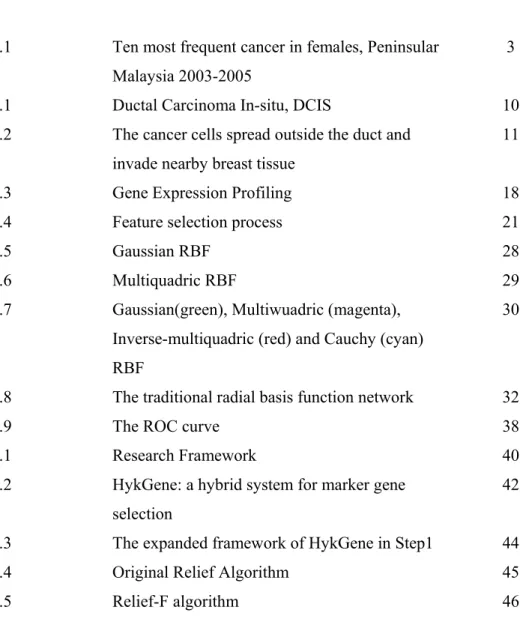
1.1 Ten most frequent cancer in females, Peninsular Malaysia 2003-2005
3 2.1 Ductal Carcinoma In-situ, DCIS 10 2.2 The cancer cells spread outside the duct and
invade nearby breast tissue
11 2.3 Gene Expression Profiling 18 2.4 Feature selection process 21
2.5 Gaussian RBF 28
2.6 Multiquadric RBF 29
2.7 Gaussian(green), Multiwuadric (magenta), Inverse-multiquadric (red) and Cauchy (cyan) RBF
30
2.8 The traditional radial basis function network 32
2.9 The ROC curve 38
3.1 Research Framework 40
3.2 HykGene: a hybrid system for marker gene selection
42 3.3 The expanded framework of HykGene in Step1 44 3.4
3.5
Original Relief Algorithm Relief-F algorithm
45 46
xiii 3.6 3.7 3.8 3.9 χ²-statistic algorithm
The expanded framework of HykGene in Step 4 Radial Basis Function Network architecture AUC algorithm
49 50 53 55
4.1 The data matrix 58
4.2 4.3
Fifteenth of the instances of breast cancer microarray dataset Microarray Image 60 61 4.4 4.5
Header of the ARFF file Data of the ARFF file
62 62 4.6 ROC Space 66 4.7 5.1 5.2 5.3 5.4 5.5 5.6 5.7 5.8
Framework to plotting multiple ROC curve using Weka
Graph on cross validation classification accuracy using 50-top ranked genes Graph on cross validation classification accuracy using 100-top ranked genes Percentage of Correctly Classified Instances using 50 top-ranked genes
Percentage of Correctly Classified Instances using 100 top-ranked genes
ROC Space of 50 top-ranked genes ROC Space of 100 top-ranked genes ROC Curve of 50 top-ranked genes ROC Curve of 100 top-ranked genes
67 70 71 73 73 75 75 76 76
LIST OF ABBREVIATIONS
AUC - Area Under Curve
ARFF - Artificial Relation File Format
cDNA - Complementary Deoxyribonucleic Acid cRNA - Complementary Ribonucleic Acid
DNA EST FPR k-NN MLP - - - - - Deoxyribonucleic Acid Expressed Sequence Tag False Positive Rate
k-nearest neighbor Multilayer Perceptron mRNA NB - -
Messenger Ribonucleic Acid Naive Bayes
RBF - Radial Basis Function
RNA - Ribonucleic Acid
ROC - Receiver Operating Characteristics SOM - Self Organising Maps
SVM TPR
- -
Support Vector Machine True Positive Rate
xv
LIST OF APPENDICES
APPENDIX TITLE PAGE
A B
Project 1 Gantt Chart Project 2 Gantt Chart
95 99