Enhancing Surveying Education
through e-Learning
INTERNATIONAL FEDERATION
A publication of FIG Commission 2 – Professional Education
FIG PUbLIcATIONNO 46
Enhancing Surveying Education
through e-Learning
A publication of FIG Commission 2 –
Professional Education
Published in English Copenhagen, Denmark ISBN 978-87-90907-76-1 Published by
The International Federation of Surveyors (FIG) Kalvebod Brygge 31–33, DK-1780 Copenhagen V DENMARK Tel. +45 38 86 10 81 Fax +45 38 86 02 52 E-mail: [email protected] www.fig.net January 2010 ACKNOWLEDGEMENTS
Editors: Liza Groenendijk and Bela Markus
Cover photos: © Gerard Kuster, 2006 (middle); BOKU, 2009 (left), ITC, 2008 (right)
Pictures on pages 7, 9, 16, 19, 37, 43 (upper) and back cover: Courtesy of ITC (www.itc.nl) Pictures on pages 42 and 43 (lower): Courtesy of BEV (www.bev.gv.at)
Design and layout: International Federation of Surveyors, FIG Printer: Oriveden Kirjapaino, Finland
Contents
Foreword ... 5
IntroduCtIon ... 6
1 the ConCept oF e-learnIng ... 8
1.1 E-learning defined ... 8
1.2 Policy considerations ... 8
1.3 Continuing professional development ... 8
1.4 Knowledge management ...10
1.5 Learning at workplace ...10
1.6 Organizational learning...10
2 the nature oF e-learnIng ...11
2.1 Trend from technology to pedagogy ...11
2.2 Reusability ...11
2.3 Metadata ...12
2.4 Learning Content Management System ...12
2.5 Web 2.0 ...13
2.6 Standards ...14
3 e-learnIng teChnology and InFrastruCture ...15
3.1 Internet ...15
3.2 Learning management systems ...15
3.3 (Multi-media) software for course development ...16
3.4 Virtual libraries ...17
3.5 E-learning infrastructure ...18
3.6 End-to-end model for e-learning...18
4 eFFeCtIve e-learnIng ...19
4.1 Networking, organizational issues ...19
4.2 Business models ...20
5 role oF e-learnIng In surveyIng ...22
5.1 Awareness building ...22
5.2 Platform for collaboration ...24
5.3 Sharing good practice ...25
5.4 Creating a learning community ...26
5.5 The growing importance of life-long-learning ...26
6 FIg polICy on e-learnIng ...27
reFerenCes ...28
Case oF good praCtICe 1: unIgIs ...32
Overview ...32
Clearly defined professional qualifications ...33
Curriculum development ...34
Distance learning ...34
Quality assurance ...35
References ...35
Case oF good praCtICe 2: esrI – the vIrtual Campus ...37
A history of successes ...37
Challenges and shortcomings ...39
The way ahead ...40
Foreword
Surveying is one of the oldest professions. Traditionally land surveyors are profession-als who determine or establish points, lines, polygons of the selected real word objects, who collect their attribute data, who register the rights on those and visualize the re-sults. To fulfil the needs of the society usually surveying schools were one of the first higher educational institutions in the field of engineering in every country. On the one hand, to process raw measurements a very high level of mathematical background was needed. That is why so many mathematicians are in close contacts with surveying. On the other hand data processing needed special devices like the abacus, the logarithmic table, the mechanical calculator etc.
At the middle of the last century a new device was introduced: the computer. It changed dramatically first our computational habits in sixties, and afterwards the mapping de-vices and the data processing practice as a whole new way of thinking. In the seventies the remote sensing satellites and in the eighties the Global Positioning System (GPS) generated more basic changes. The introduction of Internet and the rapid changes of Information and Communication Technologies (ICT) caused yet another fundamental transformation of surveying. Nowadays the computers are used only for a very little percentage for computing. They are totally integrated into our workflow, serving us within data acquisition, database developments, data processing, data analysis and visualization. Through the computer networks our profession serves the e-Society. In the last fifty years computers have changed the work of surveyors totally. As usual the way of thinking is always a little bit behind the possibilities. The aim of this publica-tion is to summarize the results of FIG Commission 2 on the field of computer uses in surveying education, to help academy and surveying industry to more quickly make the transformation from traditional teaching and learning to e-learning.
This publication aims to support FIG community with basic knowledge on e-learning and declares the FIG policy in this field. The content is a summary of lessons learned in e-learning during the last FIG events, basically at the workshop in Enschede, June 2008. We would like to thank for all the contributors of this publication, but pre-em-inently Prof. Steven Frank, Dr. Reinfried Mansberger, Dr. Adrijana Car, Dr. James Petch and Nicholas Frunzi.
January 2010
Bela markus liza groenendijk
Chair, FIG Commission 2 Chair, FIG Working Group 2.2
stig enemark
IntroduCtIon
Developments in ICT had a huge effect on the surveying profession (Markus, 2008). New technologies and new opportunities have enabled surveyors to broaden their skills and competencies. The number of competencies in which surveyors might claim to be proficient now number over 200 (Mahoney et al, 2007). The rapid changes in the profession have created a growing need for continuous changes in education and an increasing demand for continuing professional development (Markus, 2008).
ICT and the impact on the surveying profession and professional education.
Enemark (2007) summarizes the major key international trends in the surveying educa-tion as follows:
– management skills, versus specialist skills
– project organized education, versus subject based education – virtual academy, versus classroom lecture courses
– lifelong learning, versus vocational training.
Fairly (2009), advocating a clear, concise surveying profile for the future, distinguished two major changes taking place across Australia and the EU: internationalization and interoperability. Surveyors of today work in an increasingly global market and the pro-fession has grown rapidly beyond cadastral surveying, with increasing application of surveying and mapping technologies in other sectors.
Lifelong learning has become a buzz-word and a well established concept for continu-ous professional development of staff engaged in surveying institutions and other land professionals (Osskó, 2008). E-learning methods and tools have been introduced and are now playing an increasing role in professional education.
E-learning is one of the main themes in FIG Commission 2 – Professional Education (Markus, 2008). Several FIG events in the past years were dedicated to e-learning or re-lated topics such as curriculum design, knowledge management, and management of education. This technical report summarizes the outcomes of the Commission’s work-shops, symposia and working groups. The report aims to bring together the experi-ences and viewpoints within FIG on the role of e-learning in surveying education. The intention of the report is to support FIG members and their affiliates and the surveying public in general in their efforts to further develop e-learning initiatives within their organisations.
The steps for taking a data model through its conceptual, logical, and physical phases, including modelling the user’s view, defining objects and relationships, selecting
graphic representations, matching database elements, and organizing the geo-database structure are used as guidelines for building the structure of this publica-tion.
The report will start in chapter 1 with a general explanation of the concept of e-learn-ing; this is followed by a more in-depth description on the nature of e-learning in chap-ter 2. In chapchap-ter 3, e-learning technology and infrastructure, the more practical aspects of e-learning are covered, with in chapter 4 a discussion on effective e-learning. Chap-ter 5 is dedicated to role of e-learning in surveying and in chapChap-ter 6 the FIG policy on e-learning is presented. Many issues presented in these chapters come back in the two examples of best practices in e-learning in surveying at the end of the publication: Case of Best Practice 1, UNIGIS, and Case of Best Practice 2, ESRI.
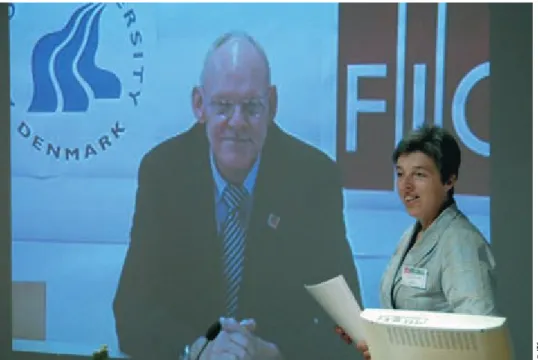
FIG President Stig Enemark delivering his opening speech from a distance by using Video Conferencing (FIG Workshop Sharing Good Practices, Enschede, the Netherlands, June 2008). In the front Liza Groenendijk, editor of this publication.
© IT
1 the ConCept oF e-learnIng
1.1 E-learning defined
Markus (2008) defines e-learning as follows: “– – e-learning is a learning process created by interaction with digitally delivered content, network-based services and tutoring support. This definition focuses on the revolutionary impact of network-enabled tech-nology. Adding more details on methodology: e-learning is any technologically medi-ated learning using computers whether from a distance or in face to face classroom setting (computer assisted learning), it is a shift from traditional education or training to ICT-based personalized, flexible, individual, self-organized, collaborative learning based on a community of learners, teachers, facilitators, experts – –.”
Central in this definition are two aspects of e-learning: – e-learning as computer assisted learning, and
– e-learning as pedagogy for student-centred and collaborative learning.
These aspects in fact summarise the development of e-learning in time. Early devel-opments in e-learning focussed on computer assisted learning, where part or all of the learning content is delivered digitally. More recently the pedagogical dimension of e-learning has become prominent.
1.2 Policy considerations
E-learning has become popular because of its potential for providing more flexible ac-cess to content and instruction at any time, from any place (Means et al, 2009). Frequently, the focus entails:
a) increasing the availability of learning experiences for learners who cannot or choose not to attend traditional face-to-face offerings,
b) assembling and disseminating instructional content more cost-efficiently, or c) enabling instructors to handle more students while maintaining learning
out-come quality that is equivalent to that of comparable face-to-face instruction. If student outcomes are the same whether a course is taken online or face-to-face, then online instruction can be used cost-effectively in settings where too few students are situated in a particular geographic locale to warrant an on-site instructor (e.g., rural students, students in specialized courses).
1.3 Continuing professional development
The potential role of e-learning in Continuing Professional Development was already mentioned in the FIG Policy Statement on CPD published in 1996. And the experiences within Commission 2 has shown that this was not just a nice policy idea at that time, but that e-learning has proven to fit perfectly with the concepts of life-long-learning or continuing development. It has proven to be a flexible mode of learning for profession-als. Due to the high flexibility in time-, site- and learning aspects, e-learning is a proper tool and an essential driving force for the realisation of life-long learning.
E-learning in surveying: anywhere, any time and any one. Student Working on an assign-ment for his distance course at 300 km/hr in a bullet train in Japan (top) and students in
Ghana participating in an online course with local facilitation (bottom).
© Verplank e © B alla tor e
1.4 Knowledge management
In the dynamically changing world of business, the competitiveness of companies (and/ or universities) depends heavily on the possibility to find, for a given problem, the right knowledge in the right moment. By using a Knowledge Management System (KMS), organisations increase returns, save time and money, are more adaptable, and have a far better understanding of partners, processes, customers, competitors and their business. To benefit from every customer or partner interaction, corporations must give employees the opportunities to record what was learned. Efficient knowledge man-agement needs not only document knowledge but must provide tools for collabora-tion among all contributors to the knowledge pool. Then, other employees must have access to the data and the means to understand it in context. Knowledge manage-ment helps an organisation gain insight and understanding from its own experiences. When employees use KMS, best practices are stored throughout the organization, and each employee accessing the system has similar power to the best employee (Markus, 2002).
1.5 Learning at workplace
Daily tasks are evolving faster than universities can produce qualified graduates. Many employers apply constant, on-the-job training to remain competitive. E-learning pro-grams help staff members to obtain new skills and critical improvements quickly and efficiently.
Companies integrate e-learning into the mainstream. They can easily amalgamate learning modules into staff communications, and can add similar tools to web-based systems.
E-learning opens the world. Likewise, small businesses can access the same level of knowledge and insight that was earlier only available to large companies.
Mobile technology helps e-learning initiatives. Wireless technology allows educators to reach learners in their working environment.
The ESRI Case (see the appendix) gives an excellent insight in the role and development of e-learning to support workplace learning.
1.6 Organizational learning
Organizational Learning (OL) is a powerful tool to improve the performance of an or-ganization. In general there are two different processes of organizational change that are associated with organisational learning:
– adaptive learning, where changes are made in reaction to changed conditions and
– pro-active learning, i.e. organizational changes that have been made on a more intentional basis.
Adaptive learning is seen as a process of incremental changes, more automatic and less cognitively induced than proactive learning. Proactive learning which goes beyond the simple reacting to environmental changes.
2 the nature oF e-learnIng
2.1 Trend from technology to pedagogy
Early developments in e-learning focussed on computer assisted learning, where part or all of the learning content is delivered digitally. These type of e-learning activities can be classified according to its objective – whether the activity serves as a replace-ment for face-to-face instruction (e.g., a virtual course) or as an enhancereplace-ment of the face-to-face learning experience (i.e., online learning activities that are part of a course given face-to-face) (US Department of Education, 2009; Verkroost, 2009).
More recently the pedagogical dimension of e-learning has become prominent. Learn-ing experiences can be classified in terms of the amount of control that the student has over the content and nature of the learning activity. In traditional or expository learning experiences, content is transmitted to the student by a lecture, written mate-rial, or other mechanisms. Such conventional instruction is often contrasted with active learning in which the student has control of what and how he or she learns. Another category of learning experiences stresses collaborative or interactive learning activity in which the nature of the learning content is emergent as learners interact with one another and with a teacher or other knowledge sources.
Typically, in expository instruction, the technology delivers the content. In active learning, the technology allows students to control digital artefacts to explore infor-mation or address problems. In interactive learning or collaborative learning, tech-nology mediates human interaction either synchronously or asynchronously; learn-ing emerges through interactions with other students and the technology (US De-partment of Education, 2009). Both active and interactive learning approaches are student-centred and make use of online learning models supported by Web 2.0 tech-nologies.
Blended learning combines e-learning with face-to-face learning and other learn-ing mechanisms. It can include the use of audio, video, documents, software, and “hands-on” experiences. Blended learning recognizes that some learning experiences are not appropriate to e-learning and need be taught in other fashion. For example, learning how to measure angles with a theodolite is greatly enhanced by physically operating the theodolite in practice – setting the instrument precisely over a point and precisely pointing the instrument at various objects to be measured. (Lam 2008).
2.2 Reusability
One of the great advantages of digital medium is the ease of storage and reusabil-ity of teaching materials or “learning objects.” Keeping learning objects on file is done with a push of a button. Upgrading and redeveloping materials is simple and easy. To be reusable, e-learning objects should be easily disassembled and reassembled. Users should be able to easily mix materials from multiple sources without dependence on proprietary systems (Hodgins and Conner 2000).
Chiappe (2007) defined Learning Objects as: “A digital self-contained and reusable en-tity, with a clear educational purpose, with at least three internal and editable compo-nents: content, learning activities and elements of context. The learning objects must
have an external structure of information to facilitate their identification, storage and retrieval: the metadata. “
Beck (http://en.wikipedia.org/wiki/Learning_object) suggests that learning objects have the following key characteristics:
– Learning objects are a new way of thinking about learning content. Traditionally, content comes in a several hour chunk. Learning objects are much smaller units of learning, typically ranging from 2 minutes to 15 minutes.
– Are self-contained – each learning object can be taken independently.
– Are reusable – a single learning object may be used in multiple contexts for mul-tiple purposes.
– Can be aggregated – learning objects can be grouped into larger collections of content, including traditional course structures.
– Are tagged with metadata – every learning object has descriptive information allowing it to be easily found by a search.
There is general trend from long to short in building learning objects. Nano learning (n-learning) is the latest term in the natural progression: from learning, distance learn-ing (d-learnlearn-ing), flexible learnlearn-ing (f-learnlearn-ing), electronic learnlearn-ing (e-learnlearn-ing), blended learning (b-learning), and the recent addition, (mobile) m-learning.
2.3 Metadata
Metadata is data about data and the time of production. It describes the content of data, the data producer, and the purpose(s) for which the data was produced. Typical e-learning metadata allows the potential user (instructor or student) to assess the qual-ity and suitabilqual-ity of e-learning materials. Metadata would describe the creator, the in-tended purpose or possible uses of the material, the date the material was created and other relevant factors. The purpose of metadata is to allow potential users to quickly and easily find and evaluate e-learning objects.
Metadata can be used to improve the search process, to build user-specific, guided paths, and to maintain relationships among disparate educational resources. Several metadata projects are under development to target and standardize the instructional qualities that are most useful in describing educational resources. The efforts of these projects will provide a metadata foundation that can be leveraged by future instruc-tional applications. It is obvious that the continued success of the Internet is contingent upon automated tools that efficiently guide the information gatherer toward relevant and appropriate material (Markus, 2000).
2.4 Learning Content Management System
The knowledge base for surveying is vast and not completely defined. The materials used to form an e-learning experience come from a wide variety of sources. In some cases, they are merely text copied from published textbooks and/or manuals. In other cases they may be presentations such as PowerPoint slides or handouts, live or record-ed digital audio, or live or recordrecord-ed digital video. The knowlrecord-edge base can be in
modu-lar or course form with modumodu-lar form (e.g. learning objects) being the recommended format. The knowledge can be built by the instructor, borrowed from a virtual library, or purchased from a vendor. In a Learning Content Management System all the materials can be organised and easily accessed.
2.5 Web 2.0
In the past few years a new wave of internet technology, Web 2.0, has emerged with the potential to further enhance teaching and learning environment in higher education (Ajjan & Hartshorne, 2008). With the use of Web 2.0 students no longer access the web only for course information and content; they can do much more. Students access the web, collect different pieces of information and create new information that could be shared with others. Web 2.0 applications replace the traditional passive modes of con-tent delivery, such as posting lecture notes and videos, with the knowledge generated by the group. Examples of Web 2.0 technologies include wikis, blogs, instant messag-ing, internet telephony, social networking sites, podcasting and online media sharing (Groenendijk, 2009).
Blogs (abbreviated from weblogs) are web-based publications consisting primarily of periodic articles (normally in reverse chronological order) containing text, images and links to web content, such as websites or other blogs. Blogs have a variety of formats and might include the user expressing their opinion about a topic or documenting activities. Blogs are often used as online diaries. Blogs are interactive in the sense that other users could provide comments on the information posted by the blog author. Educational applications of blogs include researching, tracking, interpreting, and eval-uating blogs for political commentary, cultural events, business, or other news and for examining changes over time. Blogging is now being used as a tool for students to keep records of their learning. They also allow feedback from instructors and other students. Blogs can be used by single students or by groups of students to share ideas, progress on projects, or to pose questions (Ajjan & Hartshorne, 2008; Kottyan, 2008).
Wikis (What I Know Is) refer to collaborative websites that allow users to interact by adding, removing, or editing site content. The most well-known wiki implementation is Wikipedia (http://wikipedia.org/). A wiki is a type of website that allows anyone visit-ing the site to add, to remove, or otherwise to edit all content, very quickly and easily, sometimes without the need for registration. This ease of interaction and operation makes a wiki an effective tool for collaborative learning and collaborative writing. Wiki is popular software that can be used for student collaboration on projects. Wiki allows multiple users to work on the same document(s) from several locations, offering a plat-form for online group work with students from all over the world in distance education courses (Molendijk, 2008). Wiki’s allow students to work on documents or presentation media collectively, with a history of changes always available (Cepek and Pytel, 2006). Instant messaging (IM) is a collection of technologies that create the possibility of real-time text-based communication between two or more participants over the internet or some form of internal network/intranet. – Chat happens in real-time. IM allows ef-fective and efficient communication, featuring immediate receipt of acknowledgment or reply. In certain cases Instant Messaging might involves additional features, which make it even more popular, i.e. to see the other party, e.g. webcams, or to talk directly for free over the internet (Yahoo! Messenger, Windows Life Messenger, Skype).
Social networks allow users to create personal profiles and establish a variety of net-works that connect him/her with family, friends, and other colleagues. Users of Hyves, Facebook, or LinkIn, for example, utilize these sites to stay in touch with friends, make plans, and find new friends, to find old schoolmates or to maintain and extend their professional network. A recent newcomer in social networking is Twitter: a free social networking and micro-blogging service that enables its users to send and read mes-sages known as tweets (http://wikipedia.org/, accessed 31.08.09).
Podcasting and webcasting, created either by instructors or by students, are another new phase in e-learning. While the term comes from a blend of the terms iPod and broadcasting any computer capable of viewing multi-media electronic files are used as the instruction medium. Students can produce presentations that can be shared with other students. Students download the podcasts, which can be either audio or video or both, to view inside or outside the classroom (Frank, 2009). Podcasts are developed by lecturers for guiding students during practical work in the field.
Media sharing websites such as YouTube allow students to find informative videos or to create short videos films that can be shared with the world. Teachers use YouTube to publish educational videos or refer to videos with interesting content, demonstra-tions or complete courses1. Online applications, such as Google Earth and other Virtual
Globes, offer excellent opportunities for e-learning in surveying and geospatial infor-mation education (Groenendijk, 2009).
2.6 Standards
A learning object could be a text file, a videotaped lecture or a computer exercise. The Learning Object Standard addresses the accessibility, reusability and interoperability of learning objects. Accessibility refers to the use of metadata so that learning objects can be identified and evaluated. Reusability allows a learning object to be used in different instructional contexts.
Interoperability requires that the learning object be independent of both the delivery system and the knowledge management system (Polsani, 2003). The premise is that educational components could be built that would be reusable in many contexts. Users would be able to combine learning objects to create a new educational experience such as a course, seminar, etc. (Wiley, 2000).
The Sharable Content Object Reference Model (SCORM) defines, packages and manag-es learning objects. Sharable Content Objects are another term for e-learning objects. The standards addresses how these objects can be created to be reusable across a va-riety of learning systems. Included in the standards are methods of packaging data for multiple uses, compressing (zipping) data for transfer, and sequencing data for student acquisition (SCORM, 2004).
1 Follow the next links for the recordings of the opening speech by video conference by FIG President Stig Enemark at the FIG Workshop in Enschede, the Netherlands, June 2008: http://www.youtube.com/ watch?v=eDqXKgSktXY and http://www.youtube.com/watch?v=RYEU-SJbyiw&feature=related
3 e-learnIng teChnology and InFrastruCture
As mentioned in earlier chapters, the basis of e-learning is digital technology – com-puters and computer networks. The Internet allows one to reach out across town or across continents to deliver e-learning courses. Broadband computer networks allow vast quantities of data to be moved quickly and efficiently from computer to computer. Advances in computer software and hardware allow new and innovative approaches to teaching and learning. This can present problems as some parts of the globe do not have broadband Internet access and/or do not have dependable sources of electricity to run their computers (Olaniyi, 2006).
3.1 Internet
When discussing e-learning technology, the Internet easily comes to mind. There is a trend among the Internet community to redesign the whole Internet system be one gigantic e-learning system. In most cases, the Internet offers the most efficient and cost effective method of conducting e-learning. Beyond having the ability to interconnect computers is the need to have the interconnection in such a way that e-learning can be effectively and efficiently managed. This happens in some part through the standards discussed in Chapter 2 and in other parts by use of vendor or open platform software specifically developed for e-learning purposes. Special software for organizing e-learn-ing (called platforms) can be used to manage e-learne-learn-ing.
E-learning is, for the most part, dependent on the Internet. Broadband Internet ac-cess is neac-cessary to use most e-learning objects other than text documents. This can still be a problem in some parts of the world. E-learning is made simpler by the use of Learning Management Systems (LMS) which can create portals on the Internet through which students can easily find and access learning objects. These systems, often called e-learning platforms, are placed at the portals to allow instructors and administrators to organize and deliver educational courses.
3.2 Learning management systems
E-learning platforms are software that organize and automate many of the activities associated with e-learning. These platforms can be organized in a variety of ways. E-learning platforms offer users a structure that can be easily adapted to multiple uses from augmentation of “brick and mortar” education to stand-alone training exercises. They allow easy organization of e-learning materials with relatively easy user interac-tion (Milenov and Kay, 2008). Students may use them to work on group projects, take online quizzes and examinations, and turn in assignments (Markus, 2006). They can al-low students to register for classes, pay for classes, and take classes all online. They can allow educators to present learning materials, monitor student activity and assess stu-dent learning (Australian Flexible Learning Community 2002). The platforms are com-mercially available (like WebCT, Blackboard) or Open Source (Moodle, etc.).
Initially learning management systems were dominated by content, but over the last four to five years Web 2.0 features were added to facilitate communication and col-laborative learning. Internet discussion boards and forums, chats, wikis and blogs are common collaborative learning tools integrated in the learning management systems.
Discussion boards can be used both formally and informally in e-learning. Students are able to discuss their understanding of topics with other students and with instructors outside of the virtual classroom.
An example of the use of Web 2.0 tools in distance education is Virtual GEO, an educa-tional portal of the University of West Hungary. The portal is based on the open Learn-ing Management System Moodle and makes use of blogs and wikis (Kottyan, 2006, Kottyan, 2008). The Institute of Surveying, Remote sensing and Land Information at the University of Natural resources and Applied Life Sciences, Vienna, also make use of Moodle. An evaluation their e-learning experiences with communication tools in Moodle is presented by Mansberger et all (2008).
Skype, and different kinds of messengers, allows audio/visual group communication. Similar to a conference call with telephones, Skype conference calls allow cheap, real-time communication. A simple webcam can be added at the instructor’s computer to give visual capabilities so that students can see demonstrations and lecture. Additional cameras at students’ computers allow face-to-face interchange between the instructor and students (Todorovski 2008; Wahlstrom 2008).
3.3 (Multi-media) software for course development
There are literally thousands of software applications available for building and manag-ing e-learnmanag-ing courses. Most of the conventional software applications used for learnmanag-ing and business, such as word processors, slide presentation software, video software and others can and have been adapted to create material for e-learning courses. A plethora
Personal homepages of online students available to all in the Learning Management System.
© B
of new software applications aimed directly at creating e-learning courses and materi-als have materi-also emerged. Companies like Adobe, Articulate, imc AG, Lectora, RapideL and SoftChalk, to name a few, make software specifically aimed at developing e-learning applications. Most of the software appear to support the standards discussed in chap-ter 2.6.
The trend is towards open source and web-based learning. Online applications, such as Google Earth, that focus on geospatial information, are being designed for e-learning and are being incorporated into e-learning exercises.
3.4 Virtual libraries
Repositories of digital information (virtual libraries) can be accessed to assist e-learning. Originally developed by converting brick and mortar library records to electronic form, they have expanded to include a vast array of digital information and data. Specialized virtual libraries contain electronic records specific to one or more related topics. FIG maintains a virtual library of papers presented at FIG workshops, annual working weeks and conferences.
Virtual libraries are indexed databases of electronic educational materials. They are places where instructors, researchers and students go to find electronic publications on research, theory, history and other important aspects of a particular theme. In cases where the learning material is not in electronic form users may search and order or re-serve copies of the materials. Most academic and national libraries have developed vir-tual capabilities where electronic copies library resources may be downloaded. Virvir-tual libraries can contain digital copies of textbooks, audio, video, software, datasets and other resources that can be quickly accessed by people all over the world. Language will always be a barrier to some but virtual libraries are being developed in most of the World’s major languages.
In addition to traditional libraries being put online in electronic format, new virtual libraries are being developed as repositories of learning and other materials. In the United States, as in many other countries, a national geospatial data clearing house has been established with links to various local, state and national geospatial data includ-ing survey, mappinclud-ing, and GIS data. The sites are maintained primarily by government agencies and provide a wealth of geospatial information. These materials are being incorporated into many e-learning courses.
Other new virtual libraries are being developed that are repositories of e-learning mate-rials. Structure on the IEEE Learning Object model, they allow access to learning objects and learning object metadata. These libraries consist of e-learning objects that can be accessed and reassembled to modify existing courses or to develop new courses. Access to virtual libraries may be free to all, free to subscribers or at some cost to sub-scribers. Subscribers may pay either a set periodic access fee or pay individually for each item they download. Good practices require that virtual libraries contain meta-data of the learning materials available so that students and instructors can evaluate the usefulness of those materials for a particular need. The accessing the data need to know not only the content of the information and/or data but also any special data formatting or other characteristics that will allow them to evaluate whether they have the necessary software to take full advantage of the information and data.
The role of the virtual library can not be underestimated in e-learning in academic set-tings. Students can access the virtual library where and whenever they like; this is an advantage in traditional, blended and complete online courses. In particular e-learning courses focussing on participants from developing countries, access to online library resources is of vital importance and contributes highly to the success of these courses.
3.5 E-learning infrastructure
The learning infrastructure encompasses the culture, processes, tools and other essences of learning. It is about creating learning environments that can develop tools and processes to improve teaching, lower costs, and provide greater access to learn-ing. To fully realize the potential for e-learning, students, educators and administrators must re-think the concepts of education. Students must become more self-reliant and self-motivated. Educators and administrators must become more innovative and flex-ible.
As the Internet easily reaches across international boundaries, so does e-learning. E-learning has the ability to build capacity for developing nations with agreements with institutions in developed countries. Students in developing countries will be able to receive at least a part of their education while working or going to school within their home country.
Alliances formed among e-learning software developers have the advantage of extend-ing software use within the learnextend-ing community. Few developers or vendors can offer more than a few of the components needed to build a complex e-learning platform. Alliances allow vendors and developers to incorporate more and more capabilities into these systems (Barron, 2002).
3.6 End-to-end model for e-learning
The end-to-end principle states that operations should occur at the end points of a sys-tem or as close to the end points as possible. In e-learning this concept would apply when knowledge is transferred from the instructor to the student. The standards dis-cussed in Chapter 2 along with the learning platforms describe earlier in this chapter provide that end-to-end model. Students can access learning objects through a soft-ware platform that is located at a server site at the host university, agency or company. The nature of the end-to-end model for e-learning is such that the instructor and stu-dent are seeing the same material, organization of material and sequencing of material regardless of the distance between the two or the computers that they are using. To achieve and end-to-end business process, e-learning must be scalable, adaptable, agile and must establish a brand. A service-oriented, business driven approach is need-ed. The focus should be on user needs. Educational organizations must learn to build ever more complex and flexible applications and products over time. (Petch, 2006).
4 eFFeCtIve e-learnIng
To be successful, e-learning must be easily accessible and cost effective. New technol-ogy has been and is continuing to be developed that allow us to more easily structure and share e-learning. Beyond technology and learning materials, social and economic structures must be built and maintained that support e-learning.Investment in tech-nology alone does not guarantee success (Bjorke, 2008). Learning institutions must rethink how learning is best provided to meet the legitimate needs of students and potential students.
4.1 Networking, organizational issues
The requirements for e-learning differ quite a lot from traditional training courses: the technology (computers, software), staff equipped to develop and facilitate the e-learn-ing courses or learne-learn-ing objects, technical and secretarial staff to support the smooth development and implementation of online courses or blended courses. Development of new courseware for online training programmes is more time consuming than giv-ing a series of lectures and practical sessions, and involves advanced expertise, both technical and pedagogical.
The technical requirements for e-learning, is another aspect that might lead to frustra-tions if not taken care of properly. Issues like bandwidth, proper software, internet ac-cess, technical support in case of troubles, need to be in place.
Communication with secretariat and lecturing staff has to be well organised. It is an important aspect to create and maintain a good relation and stay motivated for the course. Students in online courses depend completely on the online communication. Instructors and teaching staff must be up to date and aware of the technologies used in e-learning. They will often find that students are ahead of them in technological aware-ness and can learn from both formalized training and interaction with students. The preparation of e-learning materials is time consuming but can be rewarding with qual-ity materials being produced and motivated students getting involved. The interaction among students and between students and faculty lead to continued faculty learning and awareness about e-learning.
As with most successful undertakings, there must be an institutional “buy in” to e-learn-ing, whether it is produced by academia, government or private business. There must be a commitment to invest in the technology – computers, Internet, etc. – needed to make e-learning effective and successful.
4.2 Business models
Hoppe and Breitner (2003) define three types of business models for e-learning. The “market” model defines the players and the market structure. The “activity” model focuses on the activities of a business. The “asset” model looks at costs and revenue. Market based e-learning is based on supply and demand. Used by educational institu-tions, it uses e-learning integrated into traditional course offerings as well as for contin-uous learning for professional qualification. However, e-learning is used in business as much or more as in academia. With this model the student typically pays for education, or it is provided through the state, through the normal fee structures of learning. Activity based e-learning is related to customer needs. The learning is often based upon one or more specific business products, usually software. The learning may be provided directly from the business or through a service provider. Depending on the complexity of the material, the demand for the training and the willingness of students to pay for the learning, students may or may not pay for the education. ESRI e-learning fits this model.
Asset based e-learning is used by academic institutions and by private businesses. Again, academic institutions may have all or a part of the costs of providing the educa-tion subsidized by the state. Students pay directly for the e-learning content independ-ent of other educational costs. Academic institutions may themselves be the users of the content, either for in-house use or to pass on to students. Payment may be by the course or by periodic membership fees.
Business factors driving the business models are various. Along with traditional uni-versity degree programs, there are continuing education demands that are being met through e-learning. Learning organizations, including universities, are offering non-degree certifications on topic areas that enhance employment qualifications. They pro-vide coursework required by regulations on continuing professional development. And they provide ongoing training on new equipment and software (Barron, 2002). Business models for academic programs can vary widely. An e-learning consortium model is used by several universities in Europe. Each university contributes one or
more e-learning courses to a pool of courses. For each course contributed, the univer-sity gains access to a certain number of courses from other universities. Each e-learning course is developed from existing courses at the university. The university delivers the full course to other universities including instructor time (Blok, 2008; Markus, 2006).
4.3 Benefits
Perhaps the greatest benefit of e-learning is shown in the recent U.S. Department of Education publication „Evaluation of Evidence-Based Practices in Online Learning: A Meta-Analysis and Review of Online Learning Studies” (Means et al, 2009). This study looked at various empirical studies done on e-learning between 1996 and 2008 and concluded that students using e-learning performed better than students who did not use e-learning. The students who performed best were those who received blended learning. The studies were primarily performed in higher learning environments such as professional education.
Other benefits fall into academic, economic, and social realms. Academic benefits include increased access to knowledge through online resources, ease of revision of course materials, ability of students to connect with experts around the world, a more active role for learners in setting the pace of their learning, more flexibility for both instructors and students, and scalability of courses from small to large numbers of stu-dents simultaneously (Lam 2008, Mansberger et al, 2006, 2008; Markus, 2006).
Economic benefits can include the ability to expand student enrolment, reduction of student travel, ease of revision of course materials and reduction of teaching facilities (Mansberger et al, 2006; Olaniyi, 2006).
Social benefits are mixed. While it can be more difficult to motivate students when us-ing e-learnus-ing (Bjorke, 2008), students who can self-motivate have a more direct con-trol over their individual learning (Olaniyi, 2006).
5 role oF e-learnIng In surveyIng
5.1 Awareness building
Within the last decades the introduction of computers has changed rapidly the society, science and technology around the surveying profession (Markus, 2008). Changes took place in the field of data collection, data storage, data processing and visualisation. New technologies appeared, which – 20 years ago – were not known by most of the surveyors and other professionals involved in spatial data capture, like GNSS (Global Navigation Satellite Systems), GIS (Geographic Information Systems), Laser Scanning, Digital Photogrammetry or Web Technologies. These new technologies require addi-tional technical knowledge.
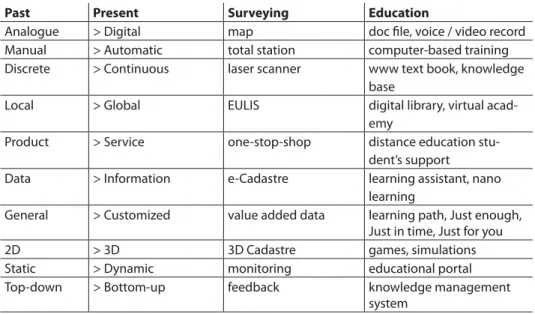
past present surveying education
Analogue > Digital map doc file, voice / video record Manual > Automatic total station computer-based training Discrete > Continuous laser scanner www text book, knowledge
base
Local > Global EULIS digital library, virtual acad-emy
Product > Service one-stop-shop distance education stu-dent’s support
Data > Information e-Cadastre learning assistant, nano learning
General > Customized value added data learning path, Just enough, Just in time, Just for you 2D > 3D 3D Cadastre games, simulations Static > Dynamic monitoring educational portal Top-down > Bottom-up feedback knowledge management
system
In a global perspective the role of surveyors is also shifting: Enemark (2009) entitles the change as the big swing “From Measurement to Management” in the sense that surveyors have extended their technical knowledge by social, legal, economic and en-vironmental understanding.
The new professional fields require a change in the professional education and training. A new kind of knowledge is needed. Enterprises and professional institutions expect
Employability from the alumni of academic studies: that means subject specific basic knowledge, professional technical and methodological competence as well as generic competences and skills, like the ability to communicate, the capacity for teamwork, the learning aptitude and the capability for analysis.
Besides the new requirements from a professional point of view the academic survey-ing education nowadays is affected by additional determinsurvey-ing factors: Globalisation,
demographic development, and new public management:
Table 1: Technological trends and changes in surveying and education due to introduction of computers.
– Globalisation will force academic institutions to cooperate, to exchange staff members and students, but also to sharpen their individual profiles to prove in the national and international competition.
– In the next 40 years worldwide the population will increase approximately by 30 percent. But the detailed figures show a sharp contrast in the democratic develop-ment between countries. In some regions (especially in Europe) the population is decreasing (UN, 2008). Both developments are a challenge for educational aspects.
– Within the last years at many (especially European) universities new public man-agement was implemented. The benefit of an increased flexibility of financial re-sources and of the self-reliance in human resource management is accompanied by additional administrative duties and tasks for staff members (Mansberger et al., 2006).
Educational institutions in general and academic surveying organisations in particular have to meet the outlined changes, frame conditions new challenges. A paradigm shift in academic education is required:
– From teaching to learning:
Education has to focus on students, to learning processes and to learning out-comes. Traditional, subject-orientated teaching has to be substituted by indi-vidual project-orientated and self-organised learning. Teachers have to change their role from presenters and instructors to facilitators, mentors, tutors, coach-es, and consulters (Wildt, 2008).
– From timed and on-site lectures to time and site independent education:
Modern educational methods enable self-paced and self-directed learning with a high flexibility on time and site. So learning materials and most of the support has to be available 24 hours / 7 days (Markus, 2006).
– From self-contained studies to life-long-learning:
The increase of worldwide knowledge is estimated to be doubled within four years. Therefore the existing concept of self-contained study courses has to be replaced by the concept of continuing professional development.
E-learning is a proper facilitator to manage this paradigm shift in academic education as shown in a (modified) list of the most important features of e-learning outlined by Markus (2006):
– E-learning services designed using learner-centred approaches.
– E-learning gives learners a chance to speed up or slow down as needed.
– E-learning can happen when needed. It enables a high flexibility on time and site for teachers and students.
– E-learning does not require physical presence.
– E-learning promotes greater student interaction and advances collaboration. – E-learning uses interactive technology to develop fun, engaging, effective
simu-lations.
But nevertheless all proponents of this modern teaching and learning technologies have to be aware that
– E-learning is just a tool and Learning is the objective. Powerpoints and scripts to download on the internet are not e-learning. Pedagogy must take the lead, while technology responds to the pedagogical training (Bjørke, 2008).
– E-learning does not save time for the teachers – but it improves the knowledge transfer.
– Virtual communication cannot completely substitute personal communication (Mansberger et al., 2008).
The introduction of e-learning requires accompanying measures. Teachers have to ac-quire new competences: Information and Communication Technologies (ICT) as well as e-pedagogy are needed ingredients for operating e-learning. In this point surveyors are favoured as they are very familiar and skilled in working with ICT.
Institutions dealing with surveying education also have to redesign the curricula: Sub-jects, contents and learning methods have to be adapted to e-learning to meet the demands of employability.
And finally, high priority must be given to the introduction of a quality assurance sys-tem to guarantee the high level of academic surveying education. The urgency of this requirement is enhanced by the increased time-independency as well as site-inde-pendency of students and lecturers due to international mobility programs and the availability of new electronic teaching tools (Mansberger et al., 2006).
5.2 Platform for collaboration
In the early days of e-learning discussions were dominated by content. The content still remains a constant factor in e-learning, but with the introduction of Web 2.0 technolo-gies to the higher education the focus shifted towards online communication and col-laboration (O’Reilly, 2006).
The modern forms of ICT – also called social software – are appropriate facilitators for implementing the metamorphosis from “teaching” to “learning”. Communication tools in e-learning are platforms for collaboration for all actors involved in professional edu-cational (e.g. teachers, learners, experts, facilitators, mentors, supervisors, coaches) and they enable mutual learning in different appearances:
– between peers or between persons with different educational status – between practice and academic
– bidirectional or in groups – synchronous or asynchronous – cross-functional or cross-sectional – in a local or global level
5.3 Sharing good practice
Workshops and conferences organised by FIG Commission 2 (Professions Education) have identified a large evidence of e-learning projects and a high level of acquired ex-perience within the academic surveying community. The topics for Lessons Learnt in the field of e-learning are manifold and cover educational, didactical, pedagogical issues, but also technical and economical aspects. Experiences of experts in surveying educa-tion with e-learning and developments of practical e-learning materials are published in the proceedings of above mentioned conferences (FIG, 2006; FIG, 2007; FIG, 2008; FIG, 2009).
It is the order of the day to share this knowledge within the professional community to enable an improvement of academic surveying education on a global level. Demand-orientated education outlined by modern and up-to-date learning technologies is the best promotion for the surveying profession and a conditio sine qua non for the recruit-ment of students.
Table 2: Overview of major online distance programs offered in the field of surveying, geo-information science and remote sensing.
program description e-learning specifications
CCRS Tutorials Remote Sensing training offered by Canadian Centre of Remote Sensing
Interactive training modules eduGI Geoinformatic online courses on various
subjects. Various European Universities sharing e-courses
Educational Platform (Blackboard); e-lectures, self tests; virtual class-room sessions
ESRI Instructor-led and self-paced web cours-es and seminars in a broad field of GIS related topics.
Virtual classroom and Virtual Cam-pus; instructional podcasts; online training resources
E-tutor GIS for Local level development planning, Indian Institute of Technology/UNDP
Multi-media based tutor
EuroSDR-Euro-Serv
Advanced GI Sciences courses, European Spatial Data Research Organisation
Short courses on advanced topics; including 2 days workshop at start; various places in Europe
Gimolus GIS and modeling courses offered by University of Stuttgart.
Virtual landscape using WebGIS GIS
Self Learning Tool
Introductory and advanced topics in GIS; University of Melbourne
A number of internet based inter-active multimedia modules GITTA GIS(T) modules, Swiss Virtual Campus:
Consortium of Swiss teaching institu-tions
Virtual Campus, multilingual; ECLASS-pedagogical approach ICRSEdu Online resources in Remote Sensing,
International Center for Remote Sensing Education, USA
Web-based structured core curricu-lum for remote sensing
LEAP GIS, GPS, cartography, surveying Curtin University of Science, Australia
Virtual online learning; virtual field trip; various modules; distance and open learning.
UNIGIS A worldwide network of educational institutions offering distance learning degree courses in GIS.
Website; virtual classroom; virtual office; wiki; web conferences glo-bal; virtual and multilingual
5.4 Creating a learning community
E-learning is an important driving force for the implementation of up-to-date learning activities. Technology-enhanced learning also opens global classrooms: e-learning is a catalyser for collaboration across national and international boundaries as well as a facilitator for worldwide networks of academic learning communities. These net-works facilitate the development of high quality courses and study programmes ensur-ing currency, relevance and a broad curriculum catalogue (Bjørke, 2008).
Working together, sharing of experiences and resources, is considered of great impor-tance for the success and further development of e-learning in the field of surveying, geo-information science and land administration (Groenendijk, 2008). New national and international partnerships between academics and professionals have to be es-tablished with the objective to share knowledge in the development of staff, in the development of learning contents, in the development of pedagogic concepts, and in the development of business models.
But all the activities and efforts of creating international learning communities have to take into consideration the regional requirements of learning outcomes, the cultural differences in learning style and content, and the language barriers. From a technical point of view the limiting factors of e-learning are the access to computers and the internet penetration within a region or a country.
5.5 The growing importance of life-long-learning
The current increase and improvement of technologies and methods and the new needs of employability in the field of surveying profession necessitates a continuous knowledge gain surveying experts. University graduation is no longer a ticket for pro-fessional career. Learning for life has to be shifted to life-long learning (Enemark, 2009) to meet the challenges of this accelerated change of requirements for profession. Ad-ditionally, the need for more flexible learning paths will keep growing in the future to react to the ever-faster changing needs of the labour markets, to the demographic developments and to the more mobile workforce (Bacher, 2009).
Academic surveying institutions have to provide life-long-learning. University studies and traditional professional education have to be adapted, have to be extended by (part-time) training programmes and have to be integrated to a system of Continuous Professional Development (CPD).
6 FIg polICy on e-learnIng
It is amongst the objectives of FIG Commission 2 (Professional Education)
– to support academic institutions and industry with new methods of knowledge management, helping surveyors continuously to update their academic and professional profiles
– to promote content development experiences, facilitating international re-searches in surveying education and training and to initiate joint projects on this field (curriculum development, educational material development, joint courses, quality assurance etc.)
– to strengthen knowledge transfer between FIG Commissions, inspiring activities on knowledge networks and
– to improving dissemination of information on educational theory and practice to the members across the world.
FIG has recognised e-learning as a proper tool to realise the above outlined objectives. Therefore appropriate strategies were discussed within FIG-Commission 2 to promote the use of e-learning in the surveying community and to encourage academic, profes-sional and governmental institutions to use this cutting edge learning technology. This can be achieved by the following activities:
– FIG will stimulate e-learningby raising the awareness about the paradigm shift
in education from teaching to learning, by communicating employability and life-long-learning as the new requirements for an up-to-date academic profes-sional education, and by incentivising teaching staff (e.g. FIG award for e-learn-ing).
– FIG will distribute information on the topic of e-learning to the surveying com-munity, e.g. by publishing conference papers, by this booklet on e-learning, by compiling a reference book about e-learning or by a register of “good practice”.
– FIG will bring experts together to share their knowledge on the topic of e-learn-ing. This can be done physically during conferences or workshops or virtually in form of electronic discussion forums.
– FIG promotes e-learning networks starting with FIG Commission 2 as a seed.
But FIG will also increase cooperation on the topic of e-learning with other or-ganisations in the field of geosciences, like ISPRS and ICA.
– FIG will encourage their members to develop and share e-learning contents
within surveying education.This can be achieved by the establishment of a
da-tabase with specific learning materials, such as literature, scripts, interactive learning tools, test questions, etc; and through development of a quality assess-ment guide for e-learning courses. .
– FIG will influence and encourage governmental and administrative bodies to
support the introduction of e-learning and life-long-learning as well as to pro-vide the political frame conditions to enhance these activities.
reFerenCes
Ajjan, H. and R. Hartshorne (2008). Investigating faculty decisions to adopt Web 2.0 technologies: Theory and empirical tests. Internet and Higher Education 11, 71–80. Australian Flexible Learning Community (2002). Retrieved June 5,2009, from: http:// community.flexiblelearning.net.au/TechnologiesforLearning/content/article_442.htm. Bacher, G. (2009). The European Higher Education Area: Goals Achieve & Outlook to-wards 2010 and Beyond. FIG Workshop on Navigation the Future of Surveying Educa-tion, Vienna, Austria.
Barron, T. (2002). Evolving Business Models in eLearning. Summary white paper: Learn-ing on Demand. Retreived June 30, 2009, from http://www.sric-bi.com/LoD/ summaries/ EvolvBizModelsSum.pdf.
Beck, R. J. (2007) What are learning objects? Retrieved December 25, 2009, from: http:// www4.uwm.edu/cie/learning_objects.cfm?gid=56.
Bjorke, S. A. (2008). Challenges and training needs of E-supporters. Sharing Good Prac-tices: E-learning in Surveying, geo-information Sciences and Land Administration. FIG International Workshop, Enschede, Netherlands, 11–13 June, 2008.
Blok, C. A. (2008). Sharing e-courses in GI science with partners: business model, ex-periences, and lessons learnt. Sharing Good Practices: E-learning in Surveying, geo-information Sciences and Land Administration. FIG International Workshop, Enschede, Netherlands, 11–13 June, 2008.
Cepek, A. and J. Pytel (2006). Collaborative Academy. FIG Workshop on eGovernance, Knowledge Management and e-learning. Budapest, Hungary, 2006.
Chiappe, A. et al., 2007: “Toward an instructional design model based on learning ob-jects”, in Educational Technology Research and Development, Springer, Boston, pp. 671–681.
Enemark, S. (2007). Promoting the interaction between education, research and pro-fessional practice. Proceedings FIG Commission 2 – Symposium, Scientia est Potentia – Knowledge is Power, 7–9 June 2007, Czech Technical University, Prague, Czech Re-public.
Enemark, S., 2009: Surveying Education: Facing the Challenges of the Future, FIG Work-shop on Navigation the Future of Surveying Education, Vienna, Austria.
Fairlie, K. (2009). Navigating the global consciousness: a young surveyor’s future. Pro-ceedings FIG Working Week, Surveyors key role in accelerated development, 3–8 May 2009, Eilat, Israel.
FIG (1996). FIG Publication no. 15. CPD – Continuing Professional Development and its future promotion within.
FIG (2006) Workshop on eGovernance, Knowledge Management and e-learning; Pro-ceedings. Editor: Bela Markus. Published by College of Geoinformation. University of Hungary. April 2006. Budapest. Hungary.
FIG (2007). Scientia Est Potentia; Jubilee Proceedings. Editor: Aleš Čepek. Published by the Czech Technical University in Prague. June 2007. Prague. Czech Republic.
FIG (2008). FIG International Workshop. Sharing Good Practices: E-learning in Survey-ing, Geo-Information Sciences and Land Administration. Proceedings. Editors: Liza Groenendijk, Christian Lemmen. Published by International Institute for Geo-Informa-tion Science and Earth ObservaGeo-Informa-tion (ITC). June 2008. Enschede, the Netherlands. FIG (2009). FIG Workshop on Navigation the Future of Surveying Education. Proceedings. Editor: Austrian Society of Surveying and Geoinformation. Österreichische Zeitschrift für Vermessung und Geoinformation (vgi). 97.Jahrgang, Heft 1/2009. Vienna, Austria. Groenendijk, E. M. C. (2009). “Experience-based learning and e-learning: a perfect com-bination.” International Archives of Photogrammetry, Remote Sensing and Spatial In-formation Sciences 38(6/W7).
Groenendijk, E.M.C. (2009). Experience-based learning in the geo-information sciences: 15 years of nuts game. Proceedings FIG International workshop, Navigating the future of surveying education, 26–28 February 2009, Vienna, Austria.
Groenendijk, E.M.C. (2008) Sharing Good Practices in E-Leaning: outcome of a work-shop. FIG International Workshop Sharing Good Practices: E-learning in Surveying, Geoinformation Sciences and Land Administration. Enschede, Netherlands.
Hodgins, W. and M. Connor (2000). Everything you wanted to know about learning standards but were afraid to ask. Line Zine, Fall 2000. Online version. Retrieved June 5, 2009, from http://www.learnativity.com/standards.html.
Hoppe, G. and M. H. Breitner (2003). Business Models for E-learning. University of Hannover, Discussion paper 287. Retrived from June 1, 2009, from: http://www.wiwi. uni-hannover.de/Forschung/Diskussionspapiere/dp-287.pdf.
Kottyan, L. (2006). Open systems in e-learning. In: Proceedings FIG Workshop eGovern-ance, Knowledge Management and eLearning, 27–29 April 2006, Budapest, Hungary. Kottyan, L. (2008). Sharing student knowledge in exchange programs. In: Proceedings FIG International Workshop. Sharing Good Practices: E-learning in Surveying, Geo-information Sciences and Land Administration, 11–13 June 2008, ITC, Enschede, the Netherlands.
Lam, S. Y. W. (2008). Blended e-learning Model for Geomatics Curriculum: Design, Imple-mentation and Evaluation. Proceedings of FIG Commission 2 Workshop, Sharing Good Practices: E-learning in Surveying, Geo-information Sciences and Land Administration, 11–13 June, 2008, Enschede, Netherlands.
Lam, S. Y. W. (2008). Blended e-learning Model for Geomatics Curriculum: Design, Imple-mentation and Evaluation. Proceedings of FIG Commission 2 Workshop, Sharing Good Practices: E-learning in Surveying, Geo-information Sciences and Land Administration, 11–13 June, 2008, Enschede, Netherlands.
Learning organization (2009). Retreived 8 Aug 2009, from: http://en.wikipedia.org/wiki/ Learning_organization.
Macromedia (ND). E-learning Standards. Online document. Retrieved June 5, 2009, from http://www.adobe.com/resources/elearning/standards.html.
Mahoney R., F. Plimmer, J. Hannah and J. Kavanagh (2007). Where are we heading? The crisis in surveying education and a changing profession. Proceedings FIG Working Week 2007, Strategic Integration of Surveying Services, 13–17 May 2007, Hong Kong, China,
Mansberger, R., C. R. Michalek, and T. Bauer (2008). Communication Tools in E-learning: Experiences in Academic Geomatics Education, Sharing Good Practices: E-learning in Surveying, Geo-information Sciences and Land Administration, FIG International Work-shop, Enschede, the Netherlands, 11–13 June 2008.
Mansberger, R., H. Schuh, G. Steinkellner (2006). Impacts of the Bologna Process and of New Public Management on the Academic Surveying Education in Austria. XXIII Inter-national FIG Congress, InterInter-national Federation of Surveyors.
Mansberger, R., T. Bauer and E. Heine (2006). Flop or Top – Experiences with E-learning in Academic Education. FIG Workshop on eGovernance, Knowledge Management and eLearning, Budapest, Hungary, 2006.
Markus B. (2000): Educational metadata, FIG Working Week, Prague, Czech Republic. Markus B. (2002). (Global) spatial knowledge management, GSDI 6 Conference – From global to local, Budapest, Hungary.
Markus, B. (2006). Experiences in and Around e-learning. Proceedings XXIII FIG Con-gress, Shaping the Change, 8–13 October, 2006, Munich, Germany.
Markus, B. (2008). Thinking about e-learning. Proceedings FIG International Workshop. Sharing Good Practices: E-learning in Surveying, Geo-information Sciences and Land Administration, 11–13 June 2008, ITC, Enschede, the Netherlands.
Means, B., Y. Toyama, R. Murphy, M. Bakia and K. Jones (2009). Evaluation of Evidence-Based Practices in Online Learning: A Meta-Analysis and Review of Online Learning Studies. U.S. Department of Education, Center for Technology in Learning, May 2009. Milenov, P. and S. Kay (2008). Provision of technical support and regulatory reference information on the control of agricultural subsidies in EU through use of Wiki-based Knowledge Management. Sharing Good Practices: E-learning in Surveying, geo-infor-mation Sciences and Land Administration. FIG International Workshop, Enschede, the Netherlands, 11–13 June, 2008.
Molendijk, A. M., H.J. Scholten & J. Kaandorp (2008). Geographical Information for all: Breaking the Barriers for GI Distance Learning. In: Proceedings FIG International Work-shop. Sharing Good Practices: E-learning in Surveying, Geo-information Sciences and Land Administration, 11–13 June 2008, ITC, Enschede, the Netherlands.
O’Hear, S. (2006). How E-learning 2.0 – How Web technologies are shaping education. ReadWriteWeb. Retrieved June 1, 2009, from: http://www.readwriteweb.com/archives/ e-learning_20.php.
Olaniyi, S. S. (2006). E_learning Technology: The Nigeria Experience. Shaping the Change: XXIII FIG Congress, Munich, Germany, October 8–13, 2006.
O’Reilly, T., 2006: http://radar.oreilly.com/archives/2006/12/web-20-compact- definition-tryi.html, last visited: 12 April 2008.
Osskó, A. (2008). The importance of changes in land surveyors’ education. Proceedings FIG International Workshop. Sharing Good Practices: E-learning in Surveying, Geo-information Sciences and Land Administration, 11–13 June 2008, ITC, Enschede, the Netherlands. Pasternack, P., R. Bloch, C. Gellert, M. Hölscher, R. Kreckel, D. Lewin, I. Lischka, A. Schild-berg (2009). Die Trends der Hochschulbildung und ihre Konsequenzen. HoF WittenSchild-berg