Jennings, Peter (2013) PBL but not as we know it: an
ethnography of the practice and facilitation of
'problem-based learning' within a hybrid graduate-entry medical
programme in England. PhD thesis, University of
Nottingham.
Access from the University of Nottingham repository: http://eprints.nottingham.ac.uk/14438/1/602367.pdf
Copyright and reuse:
The Nottingham ePrints service makes this work by researchers of the University of Nottingham available open access under the following conditions.
· Copyright and all moral rights to the version of the paper presented here belong to
the individual author(s) and/or other copyright owners.
· To the extent reasonable and practicable the material made available in Nottingham
ePrints has been checked for eligibility before being made available.
· Copies of full items can be used for personal research or study, educational, or
not-for-profit purposes without prior permission or charge provided that the authors, title and full bibliographic details are credited, a hyperlink and/or URL is given for the original metadata page and the content is not changed in any way.
· Quotations or similar reproductions must be sufficiently acknowledged.
Please see our full end user licence at:
http://eprints.nottingham.ac.uk/end_user_agreement.pdf
A note on versions:
The version presented here may differ from the published version or from the version of record. If you wish to cite this item you are advised to consult the publisher’s version. Please see the repository url above for details on accessing the published version and note that access may require a subscription.
PBL BUT NOT AS WE KNOW IT:
AN ETHNOGRAPHY OF THE PRACTICEAND FACILITATION OF 'PROBLEM-BASED LEARNING' WITHIN A
HYBRID GRADUATE-ENTRY MEDICAL PROGRAMME IN ENGLAND
PETERJENNINGS, BA, BSc
Thesis submitted to the University of Nottingham for the degree of Doctor of Philosophy
Dedication
I dedicate this thesis to Katie Cowley, my amazing wife, who continually listened to me and supported me throughout this long journey; to my children, Owen and Sophia, whose smiles fuelled my perseverance; and, to Mom and Dad - Thank you for everything you have given me.
Abstract
This thesis lifts the lid' on the educational practices within a medical
education programme, which is based upon a Problem-Based learning
(PBl) approach. It is an ethnographic case study that sets out to
understand the practice and facilitation of PBl situated within a hybrid
curriculum at a graduate-entry medical programme in England. Data was
collected by audio-visual recording of PBl sessions, audio recording and
observing facilitator meetings and through the author's experiences as a
participant observer working as a facilitator within the research setting.
The study exposes a variety of PBl practices within a single curriculum
setting that have not previously been examined in detail within medical
education, in particular through use of direct observational methods. The
findings pose a challenge to a core educational objective, upon which the
'PBl' programme was founded, that being to develop students' skills as
self-directed learners. While this is highlighted within the literature as a
central component to the PBl process, the findings raise questions about
how these assumptions are reflected in the practice of PBL.
Keywords: medical education, problem-based learning, facilitation, and ethnography
Acknowledgments
"!can't!" Moses exclaimed.
"Yes, you can," God told him,
"Because / will be there with you."
Exodus Chapter 31
As I conducted and completed this research, God worked through a number of people to support me.
I am extremely grateful to my supervisors at the University of Nottingham: Professor Roger Murphy of the School of Education and Professor Joe Kai of the School of Community Health Sciences. Thank you for your extreme patience and the on-going support you gave to me throughout my journey.
I would like to thank the Centre for Social Research in Health and Health Care for supporting my development as a researcher and for funding this research study.
I'm grateful to the whole team at GEM for their support and encouragement especially to Shake, Paul, Jenny and all of the facilitators and the students who took part in this research.
Thank you to all those with and working toward PhD's who listened, offered advice and proofread my work: Gillian, Kim, Munir, Fiona, Jacqui &
laura.
Thank you to my Mom and Dad and my family in U.S.A. and England along with my friends for their prayers, love, encouragement and knowing when to ask 'How's your research going?" and when not to mention it.
Finally and most of all, I want to thank my wife, Katie, and our two children, Owen and Sophia. Thank you for all of your love, support and sacrifices.
Thank you to all of these people and to many others, who repeatedly told me, 'Yes, you can.' Your encouragement helped me to believe that I could.
1Reference: Batchelor, M and Boshoff, P. (2006) My first bedtime bible.
Contents
Chapter 3:Methodology 3.1lntroduction
3.2 Research Aims and Objectives
3.3 Choosing a Qualitative Research Strategy 3.4 Research Design Decisions
3.5 Sampling 3.6 Data Collection
3.7 My Approach to Analyzing Data 3.8 My Pilot Study
3.9 Reflexivity
3.10 Ethical Reflections 3.11 Conclusion
Chapter 4:lifting the Lid on PSl at GEM 4.1lntroduction
4.2 Establishing GEM
4.3 The PBL Curriculum at GEM 4.4 The Structure of PBL at GEM 4.5 The People at GEM
4.6 The PBL Environment at GEM 4.7 Initiation 2 3 4 5 7 8 9 10 10 16 16 21 29 31 31 32 44 51 62 78 87 88 88 88 90 99 102 116 125 126 129 131 135 136 136 137 138 143 154 162 166 Dedication Abstract Acknowledgments Contents List of Abbreviations List of Figures List of Tables Chapter 1: Introduction 1.1 A Peek into PBL ... 1.2 Invitation
1.3 Drawn to Education and Facilitation 1.4 The Contextual Backdrop to my Research 1.5 Overview of my Research
CHAPTER2:Reviewing the Literature 2.1lntroduction
2.2 Origins, Theories and Characteristics of PBL 2.3 The Literature in Relation to Small Group Work 2.4 Facilitating Groups
2.5. Research Exploring Facilitation 2.6. Debating the Evidence for PBL 2.7 Conclusion
4.8 Conclusion 186 Chapter 5: Exploring Self-Directed Learning within PBL 187
S.llntroduction 187
5.2. Establishing Learning Issues 188 5.3 A Hybrid PBLCurriculum's Influence on Self-Directed Learning 211 5.4 Allocating and Feeding Back Learning Issues 223 S.SImpact of Assessment on Self-Directed Learning within PBL 240
5.6 Conclusion 244
Chapter 6: Facilitating Problem-Based Learning 245
6.1lntroduction 245
6.2 Facilitators' Professional Identities 246 6.3 Knowledge Sharing Matrix: How Facilitators Utilise Varying Levelsof Content Expertise within Groups 251 6.4 Supporting Facilitators Learning via CBM 270 6.5 The Personal Dimension of Facilitation 290
6.6 Conclusion 301
Chapter 7: Reflecting on the Findings 303
7.1lntroduction 303
7.2 Summary of Research 303
7.3 Exploring the Implications ofthe Findings 309 7.5 Strengths of My Research 318 7.6 Limitations of My Research 324 7.7 Ideas for Further Research 324 7.8 Becoming an Ethnographer 325
7.9 Concluding Comment 326
Appendices 327
Appendix 1.Healthy Volunteer's Information Sheet 327 Appendix 2. Healthy Volunteer's Consent Form 329 Appendix 3. Confirmation of Ethical Approval 330 Appendix 4. GEM Weekly Timetable 332
BMI CBM DAFNE DoH GEM GMC HEFCE MWSAC NHS PBl UK
List of Abbreviations
Body Mass Index
Case Briefing Meeting
Dose Adjustment for Normal Eating
Department of Health
University of Nottingham Graduate Entry Medicine Programme
General Medical Council
Higher Education Funding Council for England
Medical Workforce Standing Advisory Committee
National Health Service
Problem-Based learning
List of Figures
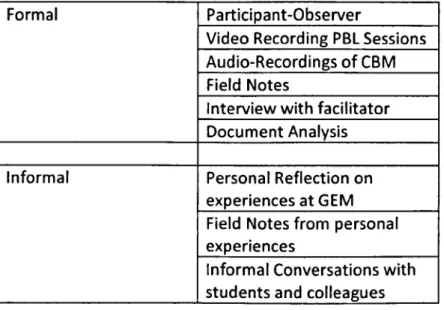
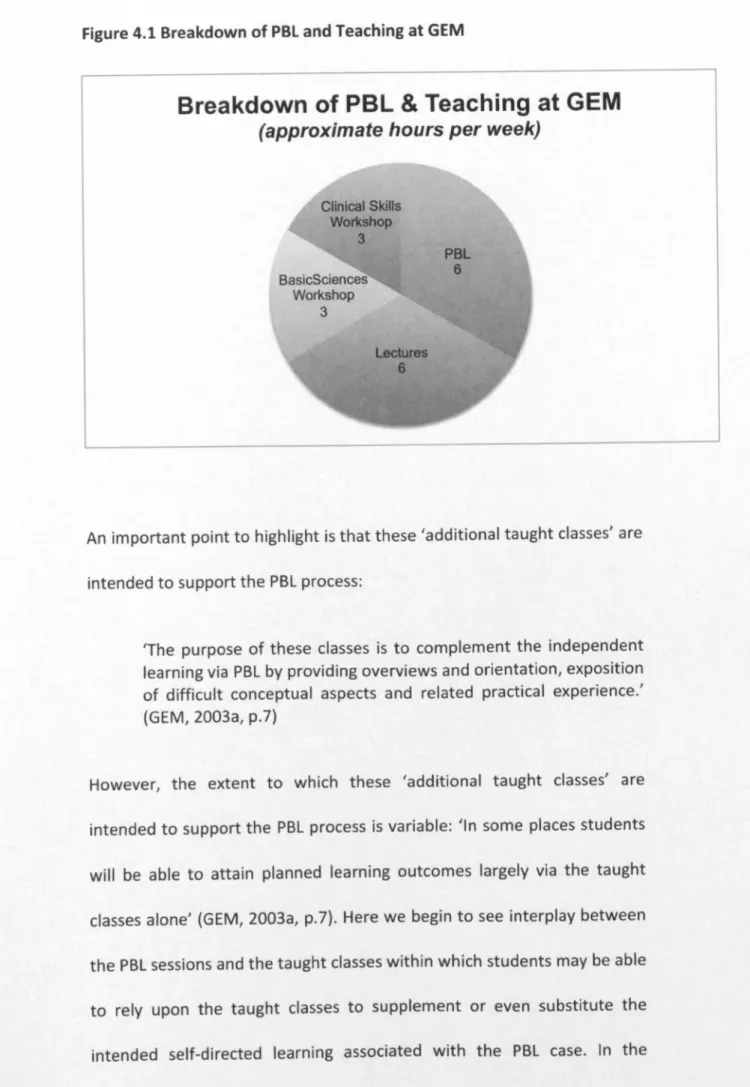
Figure 2.1 An Interpretation of Kolb's Experiential Learning Cycle 47 Figure 3.1 Student Recruitment Email 113 Figure 3.2 Labelling of Video Data 121 Figure 3.3 Referencing Video Data 122 Figure 3.4 Labelling and Referencing Audio-Recordings 124 Figure 4.1 Breakdown of PBL and Teaching at GEM 140
Figure 4.2 Trigger Text 145
Figure 4.3 Formal PBL Structure at GEM during Year 1. 153
Figure 4.4 Email 169
Figure 4.5 Introductory Exercise for Session 1, Year 1 at GEM 171 Figure 5.1 GEM Library Resource Sheet 215 Figure 6.1 Knowledge Sharing Matrix 251
List of Tables
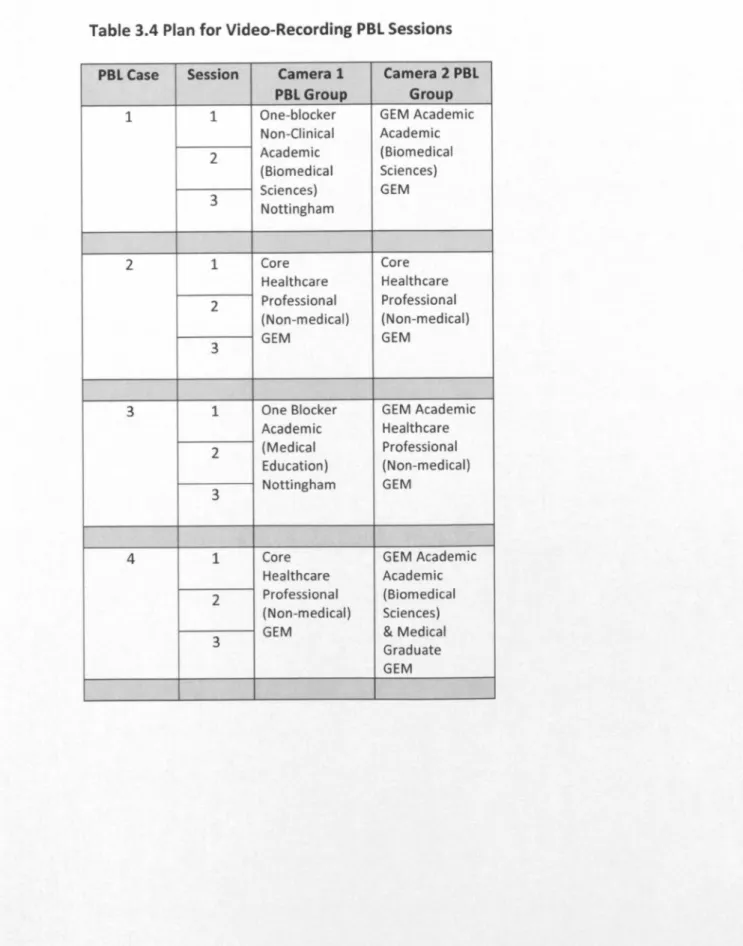
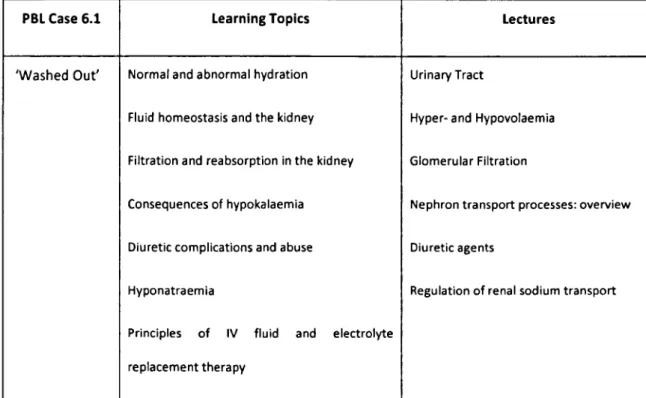
Table 2.1 Benefits Gained from Small Group Work 48 Table 2.2 Components of the Small Group Process SO Table 2.3 Learner's Characteristics 53 Table 2.4 Responsibilities of Facilitators 60 Table 3.1 Formal and Informal Data Collection 102 Table 3.2 Plan for Video-Recording PBl Sessions 110 Table 3.3 Details of PBl Facilitators 111 Table 3.4 Plan for Video-Recording PBL Sessions 115 Table 4.1 Outcomes from Tomorrow's Doctors 142 Table 4.2 Examples of Learning Topics 148 Table 4.3 learning Topics and lectures Assigned to PBL Case 150 Table 4.4 Purposes of Ground Rules 174 Table 6.1 Characteristics of Facilitators Observed in PBl and CBM 249
Chapter 1: Introduction
1.1 A Peek into PBl ...
We join this PBl group a few minutes before they start a new case. The time is nearly 11:00 a.m. on a Friday morning. The day started at 9:00 am. The group has already completed one session of PBl. Three men and two women all aged in their mid-twenties are having a break in the PBl room. One of the female students is sitting and typing on one of the two computer terminals situated on opposite sides of the room. The four other students are standing and leaning against chairs. One of the students is describing the upheaval caused when his housemate fell in love and unexpectedly decided to quit his work and move out of town. He was a monk not a medical student. The other students are laughing and probing for more details. The students are nearing the end of their first year in medical school.
The door opens and a male student enters carrying a packet of biscuits in his hand. He opens the packet and offers biscuits to the other students. At the far end of the room stands a circular table around which sit six blue chairs. The table is scattered with books, notepads, mugs and water bottles.
Four large whiteboards hang on the walls on either side of the room. They are covered with writing and diagrams written in green, blue, black and red coloured marker. The wall at the far end of the room is glass from floor to ceiling. A board rubber is propping the window open. leftover Christmas decorations, two strands of yellow and red tinsel, are draped across the top of the window. Outside the windows, the sun is shining onto green leafy trees. It is June.
Moments later, another male student enters the room and turns on the kettle. A female student moves around the room wiping the whiteboards clean, but she leaves some diagrams untouched. Another student asks, 'Who wants a drink?' Orders are taken for coffee and tea. 'I'll have a decaf,' someone replies. The kettle boils and clicks. Steam temporarily fogs the lens of the video camera that is positioned above the kettle and is
recording these activities.
As drinks are being made, the door opens, and the facilitator along with another female student enter the room. The facilitator is complimenting the student on her new hair colour. The facilitator puts a folder on the table and sits down with her back to the camera.
She looks around the room at the whiteboards and then asks, 'Did anyone find out about (unclear speech), I forgot to go through them.'
The students reply, 'Yeah, they were covered in lecture.'
The facilitator then asks, 'Have you seen, has Pete been in?'
The students respond, 'He has. Yeah, the camera is on.'
The facilitator replies, 'Is it on? Is it on?'
A student jokingly warns her, 'Be careful what you say, Alison!'
Another laughs and says, 'He's been filming me making tea.'
Two other students are huddled around the computer screen,
'Yeah.'
Music blasts from the computer, not a song but an upbeat guitar-picking tune.
'I'll bet Pete will be glad he is recording all this.'
'He'll be loving it!' the other student replies.
The students find another website that plays musical scales and scales are played and repeated.
One of the male students leaning on a desk across the room asks, 'Is this week's case up yet?'
The students laugh.
And then, a brief conversation takes place between one of the students and the facilitator.
A student looking up from the computer: 'Oh, is Alison2 back as well?'
The facilitator replies, 'Yeah, sorry.'
The student apologises, 'Sorry, Alison. I hadn't noticed.'
The facilitator facetiously remarks, 'Sorry to interrupt' to the student who responds, 'I just got over excited.'
2I used pseudonyms to replace staff members' and students' names throughout my
thesis. However, I used my own name when students referred to me in my role as a researcher.
During this exchange, the other students begin migrating toward the table. The room becomes quiet. Five students and the facilitator sit around the table. One of the students has pushed his seat away from the table and is leaning against the wall nearly outside the video's capture area.
Another student laughs and suggests, 'We should reposition Pete's camera. Aim it at the wall.'
At about the same time, the sixth student who has been sitting at the computer, looking at the screen and typing, turns on his chair toward the group. Clapping his hands together, he exclaims, 'Okay, we're in luck the case is working! Whooo!'
Another student asks, 'That's the first time this term, isn't it'?'
The student responds, 'Yeah, should we play the trigger text through?'
The room becomes quiet and he clicks the mouse. A moment later a pre-recorded voice resonates from the computer's speakers:
'Mr Graham Brown is a 66-year-old widowed pensioner who has
been brought to the local hospital after being found at home by his
daughter lying on the bathroom floor.
His daughter says that he was confused and unable to coherently
explain what had happened, but she was able to find out that her
father had tripped and fallen heavily against the bath, about 48
hours previously. He said he felt an immediate pain in his right hip
and was unable to move. His daughter called a doctor straight
away, who arrived within 30 minutes, commenced an infusion of
intravenous saline and arranged for an ambulance to take Mr
Brown to the hospital.
On admission he was intermittently confused and complained of pain and swelling in his right leg. His blood pressure was found to be low, and on catheterisation of his bladder, very little urine was drained.'
The recording ends. A student then immediately attempts to guess which faculty member read the text by asking, 'Was that Tom?'
The students then make a few jokes and laugh before remembering that they are being filmed. The facilitator sits quietly at the table with her back to the camera.
After this brief discussion, another student suggests, 'Should we play it again?
One student describes the image that accompanies the trigger text by reading the following description displayed on the computer screen:
'A man in his sixties with two days' growth of beard, connected to an intravenous drip as he lies in a hospital bed, his daughter next to him.'
As the student finishes reading, three other students stand up and move towards the computer screen to take a closer look. The trigger text is replayed.
When the voice finishes a second time, the students begin asking questions and offering tentative explanations about Mr Brown's problems. One of the female students in the group begins writing factual details on a whiteboard.
The other students initially call out information, 'Mr Graham Brown', 'Sixty-six year old pensioner', 'Confused, on admission he's still intermittently confused', 'fell two days previously.'
The student seated at the computer reads sections of the trigger text aloud. Another student writes this information on the whiteboard in the form of a spider diagram.
After the students finish discussing details about the trigger text, a female student who has been writing on the whiteboard tosses her pen to a male student seated across the table. He looks at her and asks, 'What?'
She mentions something about recording symptoms. He gets up and walks around the table and begins recording information and questions as other students call out. Another male student boasts, 'We're a well-oiled machine.'
1.2 Invitation
This extract provides a taste of PBLas practiced within an undergraduate
medical programme in England. Even though PBL has been more widely
adopted within Higher Education, these real-life accounts from PBL are
relatively rare. Throughout the past decade, I have been immersed in PBL
both as a researcher and as a facilitator. When I began my research, one
of my aims was to record and to describe the PBL process based upon
observations of PBLin practice within a newly established graduate-entry
medical programme in England. I felt that this research would provide
valuable insight to better inform understanding of the process of PBLand
facilitation.
1.3 Drawn to Education and Facilitation
1.3.1 My Educational Experiences
Throughout my life I have been interested in educating others. My first
formal educational role started in primary school working as a peer
educator on public health themed programmes such as 'Say No to Sex'
and 'Say No to Drugs'. I became very interested in 'alternative' forms of
education when I attended a summer camp. This was run by the High
Scope Institute and was aligned with an active learning approach. This
continued in university where I volunteered as a public health peer
After graduating from the University of Michigan with a Bachelor of Arts
degree in Psychology and a Bachelor of Science in Nursing, I decided to
work as a primary school teacher in Colombia. There I taught English to
reception students whose English was limited. Communicating with the
students was challenging as I spoke very little Spanish. Returning to live in
the United States, I worked as a nurse in intensive care and also part-time
as a diabetes educator. I was on track to train in anaesthesia when an
opportunity arose to travel to Brisbane, Australia; where I spent a year
working in hospitals.
When I moved to England in 1999, I spent some time considering my
career. I worked through a book entitled 'What Colour is your Parachute?'
(Bolles, 1998) This helped me to identify my interests. Through this
exercise I decided to begin educating health care professionals in England
about insulin pump therapy. I used a pump to manage my Type 1 diabetes
and was surprised how little information was available on insulin pumps in
England. I contacted a company and initially began working throughout
England educating people about insulin pumps. This role expanded to
include Europe, Russiaand South Africa. I found this role very satisfying. I
was able to share my knowledge and experience of insulin pumps and
glucose sensing with others, helping them to become competent in using
these tools. I worked in this area for four years. While I enjoyed training
healthcare professionals and patients about insulin pump therapy and
I then made a move to work in the NHS as a diabetes specialist nurse. This
enabled me to continue working in insulin pumps and glucose sensing
education, but this time I worked directly with patients. I began running
intensive one-week programmes aimed at teaching small groups of adults
with Type 1 diabetes how to self-manage their diabetes. The educational
approach on the programme was aligned with principles of adult
education (DAFNE Study Group, 2002) and aimed to educate not simply
through lecturing the participants but through various activities and
scenarios. I also worked as a research nurse supporting clinical trials in
diabetes. The variety that working in research and clinical practice offered
was very satisfying.
While working in this role, the University of Nottingham established a new
Graduate Entry Medical programme (GEM) within the local hospital trust.
This programme was recruiting health care professionals to be tutors for a
Problem-Based learning (PBl) programme. This opportunity interested
me, as I was attracted to the idea of working in academia. This stemmed
from my experiences as a university student rather than from direct
experience gained by working in this area. The role appeared to
complement my role as a diabetes educator and involved working with
small groups of students, which I enjoyed. I saw the role of facilitating PBl
1.3.2 Culture Shock of Facilitating PBl
I soon realised that facilitating was different from any educational role I
had experienced. In all my previous roles, I was educating others. It didn't
matter whether I spoke their language; I knew what I wanted to teach and
could draw on my knowledge of the areas to educate my students. Using
the knowledge I gained at High Scope, I tried to incorporate activities that
would engage learners in an activity rather than rely solely instructing
them. This approach resembled what I understood the PBL method to be.
The PBL process, however, was very different. Rather than being in charge
and leading the group, the role of the facilitator was less defined. During
my training, I heard phrases repeated such as 'Go with the group' and
'Trust the process.' These became mantras at GEM that I repeated but did
not fully understand.
As I began working as a PBL facilitator, I found this educational role very
different from those I had previously done in schools, healthcare, business
or the NHS. For example, in my previous role as an insulin pump educator,
I had specialist knowledge and clinical experience that I drew upon when
educating other healthcare professionals be they nurses or professors
Working as a facilitator at GEM, I found that I was not knowledgeable
about many of the subject areas I facilitated. I still had expertise but not in
many of the areas that cases would be covering. This put me in a very
different position to those I had previously held. I also felt intimidated
working with medical students. This was partly because I did not
understand the material to the same degree as I had previously in my
experiences as an educator. But this was also because I was not sure what
would be happening during the sessions. I had worked within traditional
and structured educational programmes that consisted of first identifying
the aims and objectives of the session and then, based on these, adopting
a mixture of teaching and activities that complemented them. Adapting to
PBL and its distinctive educational approach within GEM proved to be
challenging. I realized this once I began working as a facilitator.
1.3.3 Deciding to Read for a PhD
Shortly after starting my new post as a facilitator and while also working
part-time in diabetes education, another part-time opportunity arose to
read for a PhD in Education funded by the Centre for Social Research in
Health and Healthcare. This studentship would enable me to undertake
further study in education, which was something I had been
contemplating for some time. I also felt the qualification would enable
me to develop a career in academia and complement the research I was
More importantly, though, I saw this as an opportunity to research PBL
and facilitation. I felt that I was well positioned to undertake the study
while working at GEM. In adjusting to my role as a facilitator, I looked to
the literature on PBLfacilitation and found that, on the whole, it didn't
seem to fit with my experience. Also, little attention had been paid to
studying the practices of PBLand facilitation. This changing approach to
education was not unique to the context where I conducted my research.
Rather it resulted from the changing nature of medical education.
1.4 The Contextual Backdrop to
my
ResearchWithin this section I will explore the national contexts within which I
conducted my research. First, I will discuss how the 'prevailing political
climate' (Brookfield, 1986, p.vii) has impacted upon medical education in
England. An examination of how recent changes in medical education
driven by government policy and General Medical Council policy have
significantly altered medical education within England will follow.
Changes have occurred in medical education relating to where students
are trained, which students are trained, how students are trained, and by
whom. These changes have resulted in part from the recent expansion of
undergraduate medical schools and programmes within England
1.4.1 Expanding Medical Education within England
In 1997, the Medical Workforce Standing Advisory Committee's (MWSAC)
issued a report calling for approximately 1000 student places to be
created within undergraduate medical education in England to meet the
future service demands of the NHS (MWSAC, 2001) A joint
implementation group that included representatives from the Higher
Education Funding Council for England (HEFCE), the Department of Health
(DoH) and the General Medical Council (GMC) was formed to oversee the
allocation of these places.
In 2000, the DoH published the NHS Plan. This policy called for an increase
of an additional 1000 places for undergraduate medical students (DoH,
2000). Following four allocation exercises by the joint implementation
group, the annual number of undergraduate medical students in England
rose from 3614 in 1998 to 5894 in 2001. The additional 2280 students
were absorbed by increasing the placements within existing medical
schools, by acceptance into new programmes affiliated with existing
medical schools or by admittance into one of the four newly established
1.4.2 Graduate-Entry Medicine
Within their report, MWSAC also recommended establishing
graduate-entry medical programmes in England (2001). While graduates previously
had access to existing undergraduate medical programmes, fast-track
programmes open only to graduates were new to medical education in
England.
Adopting graduate entry follows the longstanding tradition set by medical
schools in North America (Flexner, 1910) and more recently in Australia
(Prideaux et al., 2000). During the past ten years, fourteen universities
within the United Kingdom (UK) have established graduate entry medicine
courses (Bligh, 2004). GEM is one of these courses and where I conducted
my research study.
Other graduate entry medical programmes claim to offer shorter and less
expensive training opportunities and to embrace more diverse student
populations than traditional undergraduate courses (Prideaux et al.,
2000). However, these claims have begun to be questioned (Powis et al.,
2004; Searle, 2004). Nevertheless, increasing the number of medical
student places and establishing graduate entry medicine within England
have significantly impacted who would be selected for medical school and
where they would be trained.
How these medical students would be taught also underwent radical
student numbers was occurring, a survey identified a shortage of staff
within academic medicine (Smith and Sime, 2001). The report estimated
that 'between 10% and 15% of professorial and senior lecturer posts, and
some 20% of lecturer posts are vacant. The percentage of posts that are
vacant is a cause for concern, particularly in the context of the rapid
expansion of medical education.' (Smith and Sime, 2001, p.9). Alongside
the increasing student numbers and academic staff shortages, substantial
changes to the teaching and learning methods used within undergraduate
medical education were also occurring (Bligh, 2004).
1.4.3 Tomorrow's Doctors
The GMC is the regulatory body for physicians within the UK. Its policies
aim to protect patient welfare and to guide doctors. The Education
Committee of the GMC is responsible for 'promoting high standards of
medical education and coordinating all stages of medical education'
(GMC, 1993, p.4). The Education Committee has influenced medical
training within the UK through its publication of Tomorrow's Doctors:
Recommendations on undergraduate medical education (GMC, 1993;
GMC, 2003; GMC, 2009). Of note, the Joint Implementation Group
assessed applications for additional medical students, new medical
programmes and schools according to criteria within Tomorrow's Doctors
Initially, the need for Tomorrow's Doctors stemmed from 'external
factors' like the rapidly changing technological developments within
medical science, the shift of care from hospitals to community settings
and the blurring of roles among doctors and other health care
professionals (GMC, 1993, p.4). The rising number of medical students
and staff shortages within academic medicine increased the need for new
methods of training doctors (Bligh, 2004).
Tomorrow's Doctors calls for radical reforms of undergraduate medical
education curricula. The emphasis of education extends beyond
knowledge acquisition (GMC, 2003, p.2). The concept that learning is an
end product of the curriculum has altered (Biggs, 2003; Ramsden, 2003);
so that greater emphasis is placed upon 'a learning process that includes
the ability to evaluate data as well as to develop skills to interact with
patients and colleagues' (GMC, 2003, p.2). This shift from learning being
defined as a product to learning defined as a process has had significant
impact upon the provision of undergraduate medical education in
England.
Tomorrow's Doctors outlines 14 general recommendations followed by
nearly 100 detailed curricular outcomes (GMC, 2003). One of the general
recommendations is aimed at addressing the long-standing problem of
'The scarcely tolerable burden of information that is imposed taxes the memory but not the intellect. The emphasis is on the passive acquisition of knowledge, much of it to become out-dated or forgotten rather than on its discovery through curiosity and experiment. The result is a regrettable tendency to under-provide those components of the course that are truly educational, that pertain to the proper function of a university and that are the hallmark of scholarship. Attitudes to learning that are based on enquiry and the explorations of knowledge are dulled by an excessive information load and by a system of examinations.'
(GMC, 1993, p.S)
These issues are not new. The GMC recognised the 'overloading of the
curriculum of education ... followed by results injurious to the student' in
1863 and in 1869 suggested that 'some limit must be assigned to the
amount of knowledge that can be fitly exacted' (1993, p.5). More recent
guidelines from Tomorrow's Doctors continue to call for similar action,
'factual information must be kept to the essential minimum that students
need at this stage of medical education' (GMC, 2003, p.3). The latest
guidance highlights the need for graduates to be skilled in 'applying their
knowledge' (GMC, 2009, p.14).
Other recommendations include ensuring that,
'Teaching and learning systems take account of modern educational theory and research learning opportunities must help students explore knowledge, and evaluate and integrate ... evidence critically. The curriculum must motivate students and help them develop the skills for self-directed learning.'
1.4.4 Questioning the Evidence Underlying Tomorrow's Doctors
Tomorrow's Doctors lacks any references to supporting evidence for its
policy recommendations; therefore, it is unclear how research has
impacted the development of the policy recommendations. This leaves
the policy open to criticism. One critique by Williams, the dean of the
faculty of Medicine and Dentistry at the University of Bristol and Lau, a
fourth year medical student has criticized the reform to the core
curriculum of undergraduate medical training as harmful 'ideology'
resulting in
'educational reform ... driven by enthusiasm for change rather than by rational responses to the shortcomings of traditional curriculums ... Reformers always have a duty to prove that their proposals are necessary, sound, and practicable and that they will genuinely improve on whatever went before.' (2004, p.94)
Their criticisms seem appropriate, as one would expect the field of
medicine, which relies so heavily upon evidence to influence its practice,
would also seek strong evidence to support training and education
approaches. Williams and lau's criticisms of Tomorrow's Doctors
Tomorrow's Doctors illustrates the demand by those responsible for
implementing policy (e.g. Deans of Medical Schools) and those effected by
policy (e.g. undergraduate medical students) for robust evidence that
While evidence was not explicitly referenced within Tomorrow's Doctors,
other authors have since provided clear definitions of 'modern education
theory' that are supported by educational theory and research. Maudsley
and Strivens (2000) relate the concept of 'modern education theory' to
specific educational theories: situated learning (GMC, 1993; Lave and
Wenger, 1991), reflective practice (Schon, 1987), and experiential learning
(Kolb, 1984), critical thinking (Brookfield, 1987) and problem solving skills
(Barrows, 1988).
Many new medical schools and graduate entry programmes have
followed the recommendations of the GMC to move away from factual
recall and to develop curricula that incorporate modern educational
theory and opportunities for self-directed learning (Howe et al., 2004).
Collaborative teaching and learning methods within small student groups
utilising case studies to guide the students' self-directed learning have
been widely adopted (Howe et al., 2004). This approach is commonly
referred to as Problem-Based Learning (Barrows, 2000).
This section has examined broader contextual factors that have
contributed to the changing environment of undergraduate medical
education within England and shaped the local context within my research
1.S Overview of
my
ResearchThis thesis is organized within seven chapters. Chapter one introduces the
motivations for undertaking a study into PBL and facilitation. It also
explores recent changes in undergraduate medical education in England
that have impacted where students are trained, which students are
trained, how students are trained and who trains students. In Chapter two,
I review the literature on PBL,small group work and facilitation. Chapter
three discussesthe factors that influenced the design and methods of my
research. My philosophical framework aligns with interpretivism, although
I originally came from a positivist stance. My evolving research strategy
has been based on qualitative methodology to allow an in-depth and
open-minded exploration of the research setting and allow inductive
development of my research questions and the subsequent emerging
findings. I chose a combination of ethnography and case study because
there is a lack of research exploring the culture and practices of PBLwithin
the literature. I collected data using participant-observation, audio-visual
recording, field notes, documents and personal reflections. These have
been chosen for a range of theoretical and practical reasons that are
outlined in detail within the chapter. In Chapters four, five, and six, I
present the findings in two main ways. Firstly, I provide an overarching
description of GEM and contextual factors of PBL. This mainly derives
from my observations as a participant-observer and from official
documents describing the formal view of PBLat GEM. Secondly, I focus on
observations: student's engagement with self-directed learning and how
facilitators make sense of PBL at GEM.
My findings reveal variability in what occurs during the times allocated to
PBl. Certain features are consistent with previously defined PBL and PBL
described for GEM in the course manual and provide illustrations of PBL
working well. However, I also found examples of when the students were
not engaging in the process and the facilitators were caught between the
aims of PBL and influences of the broader faculty-generated curriculum. I
reveal the tensions between the stated aims of PBL at GEM, the aims of
the students and the aims of the facilitators. I also show examples of
self-directed learning stimulated by the case that shows students
demonstrating creativity, spontaneity and variety. I also highlight ways in
which the students become distracted from PBL and are seemingly
motivated, not by the process of learning for learning's sake, but by the
pressures of assessment and the perceived need to acquire knowledge
rather than to develop effective lifelong learning skills. This message is
reinforced by teaching practices the students encounter within the hybrid
curriculum. My study provides unique data about students' experiences of
learning within a hybrid PBL curriculum and the distinctive role that
CHAPTER 2: Reviewing the Literature
2.1lntroduction
This chapter explores the literature covering three broad areas of
Problem-Based learning (PBl): the origins, theory, and characteristics of
PBl; various forms and practices of PBl across different educational
contexts; and the debates surrounding research into PBl. Section 2.2
addresses the following questions: Where and how did the idea of PBl
arise? What were the original defining characteristics of PBl? What
educational theories inform/underpin this approach? Section 2.3 explores
literature around small group work. It explores definitions and
classifications of groups before then examining issues around the
effectiveness pertaining to issues around membership and group process.
Section 2.4 focuses on facilitating groups. Initially, this explores the
general literature on small group work and then focuses on facilitating PBl
within medical education. Section 2.5 builds upon this by examining the
research on facilitation. This explores a framework of facilitator authority
proposed by Heron (1999). Finally, Section 2.6 examines the challenges
that researchers face in trying to understand the effectiveness and diverse
PBl practices of these inherently variable approaches across different
educational contexts. It includes an overview of different research
approaches that have been applied to provide a context for my chosen
2.2 Origins, Theories and Characteristics of PBl
2.2.1 Origins of PBl
As described by Barrows, PBl is an educational method within which small
groups of learners are first presented with problems that act as a stimulus
for learning (1986). These reflect real-life issues that students will
encounter in their professional practice and are intended to increase
students' motivations for learning (Barrows, 1986). They establish,
integrate and develop their understanding of the concepts underpinning
the problem. Guided by a facilitator, they learn together through a
process of engaging with problems.
The idea of PBl originated in part from Barrows' experiences at the
University of Southern California where he trained third-year medical
students on clinical placements in neurology (Barrows and Abrahamson,
1964; Barrows and Tamblyn, 1980). He noticed that his clinical students
did not seem to be able to apply previous teaching from the pre-clinical
phase to the clinical cases encountered on their placements. The
approach was developed further while Barrows, who was on sabbatical,
worked within a team to redesign the undergraduate medical curriculum
at McMasters University (Barrows and Tamblyn, 1980). McMasters
University in Canada pioneered the use of PBl as an educational approach
in medical education (Barrows, 2000). As Taylor and Miflin (2008)
conceived within a specific educational context. This distinction is
important, as I shall later outline since PBl has since evolved in many
forms.
2.2.2 Theories and Characteristics Underpinning PBl
In the following description PBl is described in line with Barrows' model of
'Authentic PBl' (2000, p.37). Barrows' original idea was that clinical based
problems posed to pre-clinical students would stimulate students to
activate prior knowledge. The benefits of using problems to stimulate
learning are based in constructivist learning theory (Bruner, 1966;
Hmelo-Silver, 2004; Norman and Schmidt, 1992a; Schmidt, 1993). Constructivist
learning theory derives from constructivism in psychology and is the idea
that humans construct knowledge and meaning from their experiences.
learning is viewed as a process where newly acquired knowledge is
organized around a framework of existing knowledge. This association of
new with existing knowledge aids recall and the application of the newly
acquired knowledge. The broad aims of PBl are to i) fill knowledge gaps;
ii) integrate knowledge and iii) develop students' problem-solving skills
(Barrows and Tamblyn, 1980; Hmelo-Silver, 2004). Hung and loyens argue
that although PBl has had its detractors, the increasing interest amongst
educators in constructivist learning theory during the 1990s has allowed
educators to see the potential benefits of PBl (2012). Of more importance
is the need for "cultivating students to become independent problem
support for the utility of PBLcomes from Schmidt, van der Molen et al.
(2009). In looking at a single medical school, they found better
interpersonal skills, practical medical skills, higher rating of the curriculum
by students, fewer drop-outs, and small but positive differences with
respect to clinical reasoning and medical knowledge (2009). There are
limitations in drawing conclusions from a study of a single medical school.
The authors limited their study due to the recognized differences between
different PBLcurricula across different institutions and thus the difficulty
of analyzing cross-curricular data (Schmidt et al., 2009).
Savery and Duffy describe how PBL is consistent with the principles of
constructivist learning theory. Again their argument rests on the
description of a particular type of PBLwhere "all of the learning arises out
of consideration of the problem" (1995, p.38). Learning objectives and
additional resources are not provided alongside the case. The content
domain is not emphasized as it might be in other case or problem-based
approaches where the problem is presented in addition to other learning
around the topic. They describe PBL as a "cognitive apprenticeship
focusing on both the knowledge domain and the problem solving
associated with that knowledge domain or profession" (1995, p.38) Their
description of what might be called pure PBL is important to note since
later I will discuss the tensions inherent in a hybrid curriculum like GEM
where PBL is one component of several other learning settings such as
Barrows' model of PBl is detailed as follows:
Students acquire an essential body of knowledge that is retrievable and useable in all domains that are required to effectively address clinical problems.
Students develop the ability to use this knowledge effectively in the evaluation and care of patients' health problems; that is, they develop the cognitive skills appropriate to professional clinical reasoning.
Students develop the ability to extend and improve knowledge to keep up to date and cope with new problems that may arise in their professional lives {self-directed learning skills}.
{In Taylor and Miflin, 2008, p.744}
Students do this by first engaging with problems. While exploring the
problem, students work together in small groups and are encouraged to
share their existing knowledge and theories. Vygotsky describes the Zone
of Proximal Development as the level of understanding attainable by a
learner when learning with a more expert peer or in collaboration with
more capable peers {1978}. In PBl this could be others with different prior
knowledge and with a facilitator with more expertise (whether from prior
content expertise or that gained from training and peer group
discussions). Within GEM the expertise and capability of peers comes
from the mixture of students having a variety of educational and social
backgrounds. They bring mixed expertise from science and arts
backgrounds and different ranges of experiences as graduates prior to
commencing medicine. I shall discuss facilitator expertise in more depth
PBl group sizes vary across curricula. Barrows recommends groups of
between 5 to 7 students (Barrows, 2000, p.38). Small group work
incorporates a social component within the learning process that differs
from didactic approaches commonly used within a lecture theatre. lave
and Wenger (1991) argue that learning arises from the social context.
They propose the model of situated learning. With PBl the pre-clinical
training process can be more similar to clinical situations and the social
participation that students will encounter as clinicians. PBl sessions can
be a training ground for future "communities of practice" (lave and
Wenger 1991). However, it should be noted that although PBl is trying to
simulate a clinical social context, this is achieved through a group of peers
working together on a paper case in a non-clinical environment. Hence, I
would suggest that the PBl community of practice is a precursor to the
later clinical community of practice the students will encounter as
profeSSionals. This pre-clinical PBl phase contrasts with the types of
apprenticeships described by lave and Wenger (Yucatec midwives, native
tailors and meat cutters) where students learn in real-life situations.
However, later clinical training is more closely aligned with lave and
Wenger's descriptions of situated learning and communities of practice.
Pre-clinical learners start on the periphery of the community and through
'legitimate peripheral participation' can develop expertise through
engaging with social interaction that is aligned with the context (lave and
Wenger, 1991, p.29). The PBl group can act as a precursor community and
encounter as clinicians.
Perhaps one of the difficulties of whole-heartedly (or generally) aligning
PBl learning environments with reflections of situated learning theory is
the variability of whether a clinical expert is facilitating the group.
Theoretically the acquisition of expertise for PBl students comes from
their relational interactions with peers and facilitator rather than the
apprenticeships with experts discussed by lave and Wenger (1991). This
raises an interesting question about the role of the facilitator within the
PBl community of practice that links with the debates around content and
non-content expertise of facilitators covered later. In relation to
facilitators, Spronken-Smith and Harland explored how a newly
established community of practice could support teachers making the
transition to becoming facilitators within a PBl curriculum (2009). Within
GEM weekly case briefing meetings (CBM) can be likened to a community
of practice. PBl facilitators meet to discussthe following week's case and
reflect on progress of their PBl groups to date. A more experienced peer
with either content expertise or process expertise or both facilitate CBM.
Newer facilitators are integrated into these meetings, which provide
ongoing support.
Returning to Barrows' description of the PBl process, as the problem is
discussedgaps or limits in the group's collective knowledge are identified.
identify resources and use them to answer their questions. Within the
original model of PBl, students are expected to develop skills in
self-directed learning and metacognition (Barrows, 2000; Barrows and
Tamblyn, 1980).
Metacognition is knowing about knowing (Gijselaers, 1996; Hmelo-Silver,
2004). Flavell states 'Metacognition refers to one's knowledge concerning
one's own cognitive processes and products' (1976, p.232). It
encompasses both one's knowledge about one's own cognition and also
the regulation of one's cognition. Poor metacognition leads to an inability
to assessone's level of skill or understanding in a particular area; students
can have poor insight into the inadequacy of their understanding of a
topic. The metacognitive process involves students identifying what they
need to know, determining how they will fill their learning needs and
evaluating reasons for either achieving or not achieving their learning
goals. This approach is intended to mirror approaches to problem solving
used by professionals (Barrows, 2000). Increasing research into how to
reduce errors in clinical decision making and diagnostic reasoning
(Croskerry, 2000; Graber, 2003) has highlighted the importance of
2.2.2.1 Understanding the Principles of Basic Medical Science
Barrows relates his model of PBl to core principles of medical education
(2000). Barrows' first principle addresses the need for physicians to be
'effective', 'efficient' and 'humane practitioners' (Barrows, 2000, p.5). This
principle contains the need for doctors to have a sound understanding of
principles of basic medical science in order that this knowledge can be
applied to addressing the patients' complaint. Related to this is the need
for students to adopt a clinical reasoning process when addressing
complex problems. This process involves generating a range of possible
hypotheses, gathering data through history and examination, analysing
and synthesising the data in order to decide upon a diagnosis and
treatment plan (Barrows, 2000). Throughout this process, students
develop metacognitive skills as they question and reflect upon their
decisions. Barrows argues that this clinical reasoning process needs to be
adopted as students learn the basic medical sciencesin order to establish
links between this knowledge and medical practice (2000). Knowledge,
clinical reasoning and metacognition are central tenets of PBl (Barrows,
1986; Barrows, 2000). Thus PBl in practice needs to be found to promote
these skills.
2.2.2.2 Self-Directed Learning
Barrows identifies a second core principle of medical education that
relates to the need for the practice of learning to continue after students
to the changing nature of medical science, patient care, and health care
systems (2000). The need to be self-directed learners underlies this
principle. An aim of PBL is allowing students to develop self-directed
learning skills to identify what they need to learn from the problems they
encounter (2000). Rather than being taught information by the faculty,
students engage with a problem or case. This is intended to allow them to
guide their own learning. Zimmerman and Lebeau summarise aspects of
students' self-directed learning via PBL: through discussions within a
group, the students discern what they already know from what they need
to learn (2000). Students have time allocated for self-directed learning
during which they can research these learning issues and seek to answer
their questions. The students return to the group to share what they have
found and evaluate their learning (Zimmerman and Lebeau, 2000).
Students are guided through the process by facilitators (Barrows, 1986;
Schmidt, 1983; Walton and Matthews, 1989; Wood, 2003).
Barrows describes self-directed learning in terms of the following skills:
self-monitoring, self-assessment, defining learning needs, determining the
appropriate learning resources, using resources effectively, evaluating the
accuracy and value of the information in the resource, recording or filing
the information of future reference and applying what has been learned
to the present patient problem and future problems (2000, pp.30-32). His
argument aligns with the General Medical Council's recommendations on
'learning opportunities must help students explore knowledge, and evaluate and integrate (bring together) evidence critically. The curriculum must motivate students and help them develop the skills for self-directed learning.' (2002, p.3)
Of note, motivation is mentioned here. Motivation in learners has been
categorized in educational psychology as intrinsic and extrinsic (Ryan and
Deci, 2000). Intrinsic motivation refers to the drive to learn due to the
inherent interest in a subject in an effort to improve knowledge and skill,
for enjoyment and for self-fulfilment (Ryan and Decl, 2000). Extrinsic
motivation is driven by the need to accomplish a certain outcome, for
example pass an exam or assessment to proceed on a course of study
(such as summative assessmentsat GEM to enable students to continue
onto the next year of the course) (Simmons et al., 2004). When students
take a genuine interest in their work they are intrinsically motivated. If
students learn purely to pass exams this is extrinsic. I would argue that in
the hybrid curriculum at GEM, although there are opportunities to
cultivate intrinsic motivation, the emphasis placed on passing summative
assessmentscan detract from opportunities to engage in learning for
self-fulfilment and enjoyment.
Norman and Schmidt argue that 'there is no evidence that PBl curricula
result in improvement in general content-free problem-solving skills'
however 'it enhances intrinsic interest in the subject matter' and 'appears
maintained (1992b, p.557). Pedersenfound evidence of more intrinsically
motivated behaviour during PBl compared with regular class learning
activities (2003).
Thus the reported benefits of PBl are that students construct knowledge
that can be applied to future problems, develop metacognition, reasoning
and self-directed learning skills, become skilled in group work and
motivated to learn independently (Barrows, 2000; Biggs,2003; Gijselaers,
1996; Wood, 2003). These benefits are aligned with the GMC Educational
Committee's recommendations outlined in Tomorrow's Doctors (1993;
2003).
2.2.3 Contrasting PBL and Didactic Teaching
The PBl approach contrasts with traditional lecture-based courses where
the emphasis is primarily on an individual expert (Le. teacher) passing on
knowledge to a large group of students in a didactic manner with the
students as passive recipients (Biggs,2003). PBl as an educational method
is argued to provide greater opportunities to develop these core skills
than does a lecture-based approach (Barrows, 2000; Biggs,2003). PBl can
encourage a deep learning style where students can critically analyse new
ideas, linking them to prior knowledge and developing understanding to
be applied in new contexts over the long term (Biggs, 2003). This is
desirable learning for medical students who will apply their learning in
Deep learning exists where students try to understand the meaning of
what is being studied (Ramsden, 2003; Wood, 2003). It contrasts with
surface learning approaches where students learn by rote to be able to
recall information without necessarily understanding it (Newble and
Entwistle, 1986; Ramsden, 2003). Interestingly in a study by McParland et
al. where PBL was used with psychiatry students, PBL did not seem to
promote more effective learning styles although students did perform
better in examinations (2004).
While PBL sounds impressive in theory, according to Barrows,
implementing it fully is both 'difficult and expensive' (1986, p.48S). At
GEM the building has been designed around PBL with multiple small base
rooms to accommodate the PBL groups. This is integrated with space for
lecture theatres and labs for practical sessions. The design of the building
reflects the hybrid nature of the PBL curriculum at GEM. GEM also
provides facilitators for each PBL group, thus requiring more staff than a
2.3 The Literature in Relation to Small Group Work
A key feature of PBLis that the learners are organized into groups in order
to engage in the learning process. They learn with peers and a facilitator
potentially enhancing the level of understanding obtained by each
individual due to the Zone of Proximal Development described by
Vygotsky(1978).
2.3.1 Defining Groups
Groups have been defined in a number of ways. Elwyn et al. provide a
simple definition of a group as '... small number of people who have a
shared identity, a shared frame of reference, and shared objectives'
(2001, p.4). This definition stresses the need for each component to be
shared among the group members. It raises the following question: could
a collection of individuals with different objectives accurately be described
as a group? While this point may sound pedantic, it uses a straightforward
benchmark of sharing to distinguish between a collection of individuals
and a group. When setting out to study learning in small groups as I have
done, it is necessary to make this basic distinction as drawing conclusions
about group work based on observations of a collection of individuals
Jaques developed a unique and more complex definition of groups by
drawing together a combination of essential characteristics (2000). These
characteristics define groups according to their 'needs', 'collective
perception', 'shared aims', 'interdependence', 'social organisation',
'interaction', 'cohesiveness' and 'membership' (Jaques, 2000, pp.1-2).
These resonate with the characteristics described in communities of
practice by Lave and Wenger (1991). While these characteristics describe
the group as a whole unit, it is important to recognise that a group is still a
collection of individuals. The individuals who take part in the groups or
who compose these groups can bring a range of influences to the group
process. At GEM the students come from diverse educational backgrounds
from a range of science and arts subjects. There is a wide range of ages
from early 20's to over 40 years old. Some have had careers prior to
commencing the course and some have come straight from
undergraduate courses.
2.3.2 Classifying Groups
Groups can be classified as formal or informal (Elwyn et ai, 2001). Formal
groups are 'created as mechanisms within a wider organisation ... Their
functions tend to be clearly specified, their membership restricted and
their control over resources limited' (Elwyn et al., 2001, p.4). Informal
groups can be described as 'grass roots' (ibid.). These groups grow from
the needs of its members. Understanding how groups are defined and
work in Higher Education.
2.3.3 Small Group Work as an Effective Means of Study
The evidence to support group work as an effective means of study is
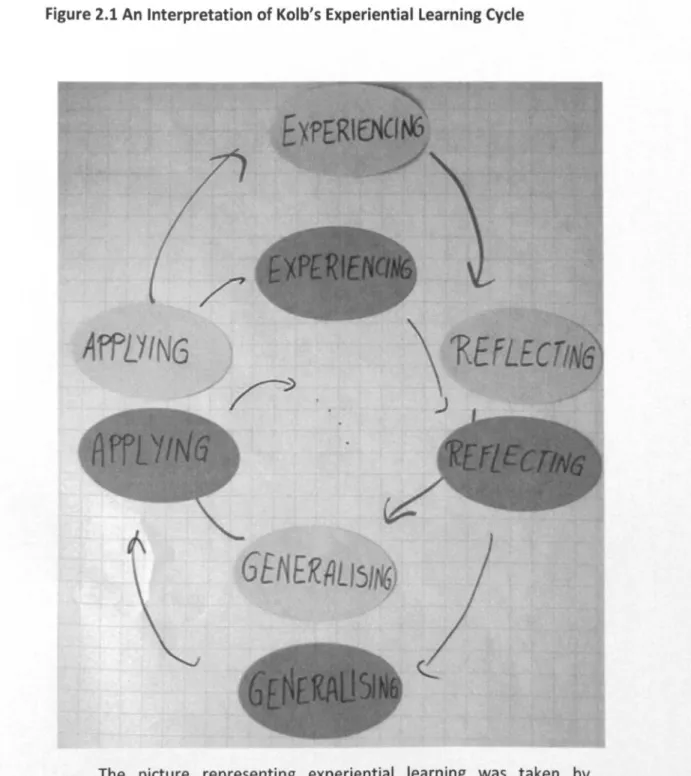
closely linked to various adult learning theories, for example Kolb's
experiential learning cycle (1993). Kolb's cycle involves the following steps
Figure 2.1 An Interpretation of Kolb's Experiential Learning Cycle
AffLYI
G
GE
ER~
151
The picture representing experiential learning was taken by devilarts and is copyrighted. It is reproduced here under a Creative Commons licence (Attribution-Non-Commercial-Share Alike 2.0 Generic) http://www.flickr.com/photos/devilarts/2458317215/.
Elwyn et al. recommend adding a step to Lewin and Kolb's experiential
learning cycle that involves 'critical discourse with others' (2001, p.177).
This highlights the 'importance [of] social discourse as a means of
illustrates the epistemology associated with adult learning theory that
knowledge evolves and continually changes based upon experiences.
Within a group learners share their individual experiences and grow a
shared experience as they learn together. At GEM students draw upon
previous educational and life experiences during group discussions to help
address the problem. They share new learning with each other and evolve
a shared experience of learning as they tackle each problem. Elwyn et al.
{2001} identify a number of benefits gained from small group work {Table
2.1}.
Table 2.1 Benefits Gained from Small Group Work
• Encourages learners to control and direct their learning
• Enable learners to identify gaps in their understanding and make connections between concepts
• Activates previously acquired understanding
• Promotes questioning and discussion
• Promotes higher-level activities conducive to deep learning
• Allows application and development of ideas
• Promotes change in individual attitudes and motivation
• Improves confidence and self-esteem
How might the classification of groups as formal or informal relate to
effectiveness of the group (Le. the readiness of groups to engage in the
experiential learning cycle)? It seems like a mismatch could occur by
formalising group work within curricula in the hope of achieving outcomes
linked with adult learning theory or deep learning. Would outcomes linked
with adult learning theory or deep learning be more likely to be achieved
via informal groups? In informal groups the agenda and work is intended
to arise from the members' motivations. From observations and
experience of facilitating PBl groups (Le. formal groups), I note that
students may feel pressured to take part not due to their motivation (or
other reasons linked to adult learning theory) but rather to satisfy the
requirements of the curriculum. This raises important questions about
whether effective adult learning is more likely to occur within formal
groups. I will share observations relating to this in my findings.
2.3.4 Group Content and Process
Through reading the literature about small group work, I began to
understand group work in terms of
content
(e.g. the task),process
(e.g.the group dynamics) and
structure
(organisation of activities) (Jaques,2000, p.v). The content relates to what the group does. Elwyn et al.
identify the variety of tasks groups encounter (2001). Content relates to
the rationale behind forming the group, the job that will be addressed and
the formal or informal nature of the group (Elwyn et al., 2001). Group
The importance of it is highlighted by Jaques, 'Process ... though rarely
attended to, is usually what determines whether a group works effectively
or not' (2000, p.v). Within GEM facilitators are encouraged to nurture the
group process and dedicate time to practices like 'starting a group' (See
Chapter 4).
Elwyn et al. define process according to three components: Active
Participation, Specific Task, and Reflection (2001, pp.5-7). These highlight
the importance of involving each member, focusing the group's attention
and learning from the group's experiences (2001). The authors outlined
the components of the small group process (2001). These are included in
Table 2.2.
Table 2.2 Components of the Small Group Process
•
EnvironmentFacilitation
Methods used in group work
Forming
•
•
•
• Storming and Norming
•
PerformingEvaluating the group process
•
• When groups go wrong
This table illustrates important factors that influence how a small group
functions. Facilitation is one of the components of the small group
process.
2.4 Facilitating Groups
2.4.1 Established Ideas about Facilitation
The facilitation of learning ... is a highly complex psychosocial drama in which the personalities of the individuals involved, the contextual setting for the educational transaction, and the prevailing political climate crucially affect the nature and form of learning. Yet among theorists and practitioners of adult learning this complexity is frequently ignored. (Brookfield, 1986, p.vii)
Facilitation is a key component of PBl. Facilitation has been widely
explored outside PBl by Heron (1999) and Brookfield (1986) and within
PBl literatures by Barrows (2000), Dolmans et al. (2010) and Maudsley
(1999a, 1999b). Established ideas about facilitation are mainly situated
within the literature relating to small group work. Jacquesdiscussespoints
to consider during three stages of facilitation: planning, preparation and
doing (2000). Elwyn et al. offer another three-stage model that includes:
'preparatory work', 'group work' and 'follow-up' (2001, p.51). Heron
presents a model of facilitation based upon different dimensions and
modes (1999).
and discuss how similar models could be applied to exploring the
facilitation of PBL. This would help to broaden the view of facilitation
beyond what currently exists within the medical education literature (Le.
a view of facilitation primarily focused on what happens during PBL
sessions).
2.4.1.1 Planning
Planning can occur before, during or after PBL group learning sessions.
The planning stage is important because it broadly relates to issues about
content and process expertise of facilitators. There have been many
debates within the literature about the required level of content expertise
and process expertise (Rothman and Page, 2001; Schmidt, 1993).
However, there has been little mention about how this expertise is
developed or descriptions relating to the application or sharing of this
expertise among facilitators. I explore issues relating to these issues
within my findings.
2.4.1.2 Preparation
The preparation stage generally relates to contextual issues such as the
group size, membership and environmental factors. It is also necessary to
recognise that context can refer to external factors that influence the
group process (Elwyn et al., 2001). Elwyn et al. raised the following
•
'Why and how have individuals come together?''What personal or professional 'baggage' have these individuals brought to the group?'
'What is the culture of the organisation in which the group is required to operate?'
'What is the nature of the task or tasks that the group is required to address?'
'What external pressures does the group face?'
•
•
•
•
(2001, pp.21-31)
Looking at one of these questions in greater detail uncovers many factors
that can impact the process of facilitation within groups. It is interesting to
consider the individual characteristics that each learner can bring to the
group. Elwyn suggests numerous factors (2001) (See Table 2.3).
Table 2.3 learner's Characteristics
• Prior knowledge and skills (science background vs. non-science)
• Attitudes, beliefs and values
• Personality
• Previous experience of group work (both positive and negative)
• Cultural or religious factors (think broadly to include armed forces)
• Relationships between group members outside the group
• Economic factors
• Life events (recent or forthcoming)