Procedia Computer Science 96 ( 2016 ) 33 – 42
1877-0509 © 2016 Published by Elsevier B.V. This is an open access article under the CC BY-NC-ND license (http://creativecommons.org/licenses/by-nc-nd/4.0/).
Peer-review under responsibility of KES International doi: 10.1016/j.procs.2016.08.091
ScienceDirect
20th International Conference on Knowledge Based and Intelligent Information and Engineering
Systems
Randomization-based Privacy-preserving Frameworks for
Collaborative Filtering
Zeynep Batmaz
a, Huseyin Polat
a,∗aComputer Engineering Department, Anadolu University, 26470 Eskisehir, Turkey {zozdemir, [email protected]}
Abstract
Randomization-based privacy protection methods are widely used in collaborative filtering systems to achieve individual privacy. The basic idea behind randomization utilized in collaborative filtering schemes is to add randomness to original data in such a way so that required levels of accuracy and privacy can be achieved. Although there are various studies on privacy-preserving collaborative filtering using randomization, there are no well-defined privacy-preserving frameworks for collaborative filtering algorithms based on randomization. In this paper, we present eight randomization-based privacy-preserving frameworks for privacy protection in collaborative filtering schemes. We first group privacy-preserving methods into two broad categories. We then classify them based on private data. Final grouping is done while considering varying privacy concerns of individual users. The frameworks can be chosen according to individual users’ expectations and be utilized for privacy protection. The well-defined privacy-preserving frameworks form a basis for privacy protection based on randomized perturbation and randomized response techniques in collaborative filtering studies.
c
2016 The Authors. Published by Elsevier B.V. Peer-review under responsibility of KES International.
Keywords: Framework, privacy, randomization, collaborative filtering, data masking
1. Introduction
E-commerce helps online vendors collect user preferences about various products traded over the Internet. Such preferences are considered valuable and private asset because they can be used for recommendation purposes and help online vendors increase their sales/profits. Moreover, revealing such data might cause various privacy risks. To transform such data into knowledge, e-commerce sites employ recommender systems. Collaborative filtering (CF) is one of the most common recommender systems. CF schemes employ other people’s data for generating predictions for single items and top-Nrecommendation lists. A traditional CF algorithm consists of three steps such as similarity computation, neighbor selection, and recommendation estimation1.
Users provide their preferences about products they bought or showed interest to online vendors. An n× m user-item matrix is created to store such data, wherenandm represent number of users and items, respectively.
∗Corresponding author. Tel.:+90-222-321-3550 ; fax:+90-222-323-9501.
E-mail address:[email protected]
© 2016 Published by Elsevier B.V. This is an open access article under the CC BY-NC-ND license (http://creativecommons.org/licenses/by-nc-nd/4.0/).
Without privacy protection, user might not feel comfortable to share their preferences with e-commerce sites. They either refuse to give data at all or tend to provide false data. High quality results can be derived from high quality data. To collect high quality enough data for recommendation purposes, privacy-preserving collaborative filtering (PPCF) schemes are used2,3. Users’ preferences represented by numeric or binary ratings can be considered private.
Furthermore, it might be more damaging for revealing whether a user bought an item or not. Hence, rated/unrated items can also be considered private data. Privacy protection methods aim to mask such private data (ratings and rated/unrated items). To achieve privacy, different privacy protection methods are used in PPCF systems2. The most
common method is known as randomization in general. Randomization adds some randomness to original data. Since CF algorithms usually depend on aggregate data, it is still possible to estimate accurate recommendations from perturbed data. Level of randomness should be chosen in such a way so that accurate predictions can be estimated while preserving privacy. However, accuracy and privacy are conflicting goals. Moreover, users’ privacy concerns might be different. Likewise, user preferences can be represented using numeric or binary ratings. These constraints require different privacy protection measures.
As presented in2,3, there are numerous PPCF studies based on randomization. Different researchers propose to
use randomization-based privacy-preserving techniques for privacy in CF systems. The methods can be grouped as randomized perturbation techniques (RPTs) and randomized response techniques (RRTs) for numeric and binary ratings-based PPCF schemes, respectively. There are also different privacy control parameters. Their values should be carefully chosen. Varying users’ privacy concerns should be considered as well. The studies on randomization presented in2,3 do not use steady preserving measures. It is more appropriate to employ common
privacy-preserving frameworks for fair comparisons in CF schemes. Well-defined and structured privacy-privacy-preserving frame-works should be presented for CF systems.
Following the above-mentioned motivation, we design eight privacy-preserving frameworks for CF. The frame-works are structured for numeric and binary ratings-based schemes because they use RPTs and RRTs, respectively. Some users might consider true ratings only as confidential while some might consider true ratings and rated/unrated items as private data. Hence, different frameworks should be designed for two different confidential data consider-ations. Finally, due to varying privacy concerns, users might perturb their confidential data variable; or they might decide to use invariable data masking. Thus, two different approaches are proposed for variable and invariable data perturbation. Considering these cases, we design eight frameworks. These frameworks will form a common base for researchers in the CF research field.
2. Related Work
Agrawal and Srikant4propose to use value distortion on randomization as a privacy-preserving method. The true valuexiis masked with a random valueri; andxi+riis shared. Note thatriis drawn from a distribution with zero
mean. The authors also discuss privacy levels provided by randomization based on uniform and Gaussian random number distributions. Polat and Du5,6,7propose RPTs in order to achieve confidentiality in CF systems. The authors
consider invariable data disguising. In addition to invariable data perturbation, variable data disguising-based RPT are used in PPCF schemes8,9. Due to varying privacy concerns, users tend to disguise their private data in such a
way so that required levels of privacy is achieved. This results inconsistent data masking. Compared to invariable data perturbation, variable data disguising provides higher privacy level. Users randomly decide random number distribution and the related standard deviation. Uniform or Gaussian random number distribution can be used to generate random noise. To disguise rated/unrated items, the authors propose to fill in some randomly chosen unrated item cells. Number of the filled cells can be selected uniformly over a range. Similarly, standard deviations of the random number distributions can be uniformly randomly selected over a specified range. Gong10utilizes RPTs to
achieve privacy in both centralized and decentralized PPCF schemes. Basu et al.11also use RPTs to protect individual
user ratings in Slope One predictors for CF. The authors focus on masking real ratings only. They also propose to disguise deviations computed by subtracting the related ratings off-line. Zhu et al.12utilize data perturbation to hide
the true ratings of the neighbors.
Numeric and binary ratings hold different properties. RPTs are suitable to perturb numeric ratings while RRTs are appropriate for masking binary ratings. Warner13proposes a surveying technique that forms the basis of RRTs.
questions directly, two related questions are asked. The respondents use a randomized device to decide which question to answer. Polat and Du14propose a data masking method based on RRTs. They consider using group-based schemes
for disguising binary ratings. The authors aim to hide both true ratings and rated/unrated items. Data in each group is masked independently. A random number is chosen and it is compared with a predefined value to decide whether to use true data or reversed data (1s are reversed to 0s and 0s are reversed to 1s). Kaleli and Polat15mask binary
ratings using RRTs and show how to estimate na¨ıve Bayesian classifier-based recommendations. They scrutinize how accuracy changes with varying number of groups. As expected, increasing number of groups makes accuracy worse due augmented randomness. Kikuchi and Mochizuki16perform a perturbation in a randomized response scheme.
3. Classification of Privacy-Preserving Frameworks
In this section, we explain the privacy-preserving frameworks and present their pseudo-codes. The frameworks are designed in such a way so that the appropriate one can be chosen based on the user requirements. The frameworks are structured based on the following three dimensions:
1. Randomization type:User preferences can be represented using numeric or binary ratings. In numeric ratings-based CF schemes, data is masked using RPTs. On the other hand, data is perturbed using RRTs in binary ratings-based CF systems. Thus, the frameworks can be grouped into two classes according to the randomization type as follows:
(a) RPTs (b) RRTs
2. Confidential data: Users concern about their private data. Public data can be shared with e-commerce sites. However, users do not want to provide their private data in plain form to online vendors. Generally speaking, confidential data can be grouped into two broad categories as follows:
(a) Ratings: Users usually do not want other to learn their true ratings about the products they bought or showed interest. Such ratings can be exploited for profiling, unsolicited marketing, price discrimination, government surveillance, and so on17. Due to these privacy risks, users mask their ratings and send perturbed ratings to
the CF system.
(b) Rating and rated/unrated items: In addition to ratings, it might be more damaging to reveal rated/unrated items. Rated items disclose information about users’ tendencies and interests. Nobody wants others to learn that she bought specific magazines or products. Likewise, unrated items mean that users have not bought them yet; and thus, such products are prospective items to be purchased and the users are potential customers. This might lead to unsolicited marketing and price discrimination. Due to these reasons, users mask their ratings and rated/unrated items.
3. Privacy concerns: Privacy concerns differ from one user to another. Varying privacy concerns cause variable data masking. On the other hand, users can perturb their confidential data in the same way, known as invariable data masking. The frameworks can be grouped into two classes based privacy concerns dimension as follows:
(a) Invariable: In this case, all users disguise their private data consistently. The CF system forces each user to mask their private data following the same procedure. Invariable data disguising is less complex and provides smaller privacy level.
(b) Variable: Some users are privacy fundamentalist while some are marginally concerned about their privacy. The majority of the users are less concerned about their privacy than the fundamentals. Due to varying privacy concerns and expectations, users might decide to mask their data inconsistently.
As presented above, there are three major dimensions for classifying the privacy-preserving frameworks. Each dimension consists of two classes; and thus, that leads to eight privacy-preserving frameworks as follows:
1. Framework-1: Masking ratings only invariably using RPTs-RPTRI 2. Framework-2: Masking ratings only variably using RPTs-RPTRV
3. Framework-3: Masking ratings and rated/unrated items invariably using RPTs-RPTR2I
4. Framework-4: Masking ratings and rated/unrated items variably using RPTs-RPTR2V
5. Framework-5: Masking ratings only invariably using RRTs-RRTRI 6. Framework-6: Masking ratings only variably using RRTs-RRTRV
7. Framework-7: Masking ratings and rated/unrated items invariably using RRTs-RRTR2I
8. Framework-8: Masking ratings and rated/unrated items variably using RRTs-RRTR2V
4. Privacy-Preserving Frameworks
Our frameworks are based on RPTs and RRTs. We first basically describe these methods. RPTs select a random number distribution with zero mean and a standard deviation. Uniform or Gaussian random number distributions can be employed to generate random noise. Using the distribution with the chosen parameter values, required number of random numbers are generated. These random values are finally added to the private data items that are supposed to be disguised. In order to mask rated/unrated items, randomly selected some of the unrated item cells are filled in with random numbers, too. All users can use the same random number distribution with the fixed values of privacy control parameters. For variable disguising, each user can randomly select random number distribution and the values of the parameters over a specified range.
RRTs first determine number of groups and a threshold. If the ratings are grouped into a single group, this scheme is known as one-group method. If the number of groups two or more, then the corresponding method is called multi-group scheme. To mask true binary ratings, the ratings are multi-grouped according to the number of multi-groups. Data in each group is then independently masked. A random number is chosen for each group and the random numbers are compared with the chosen threshold. If the random number is larger than the threshold, binary ratings are reversed (1s are transformed into 0s and 0s are transformed into 1s) and sent to the CF system. Otherwise, the true ratings are sent. To perturb rated/unrated items, randomly selected some of the unrated item cells are filled in with binary ratings. For both of RRTs and RPTs, number of randomly selected unrated item cells depends on the amount of the unrated item cells. However, number of unrated cells to be filled in should be carefully determined. Filling too many unrated item cells might significantly affect originality of the collected true data. Hence, it is reasonable to determine the number of unrated item cells to be filled in based on the density of the user ratings vector. Note that users must divide their ratings vectors into the same number of groups for estimating recommendations with decent accuracy in RRTs.
4.1. Framework-1: Masking ratings only invariably using RPTs-RPTRI
The framework’s pseudo-code is given in Algorithm 1. It uses RPTs and masks ratings only. All users perturb their data in the same way.
Algorithm 1Masking ratings only invariably using RPTs-RPTRI
1: CF System:
2: decides the random number distribution uniform or Gaussian
3: chooses the random number distribution’s standard deviation determineσ
4: lets users know them publish random number distribution andσ
5: Each useru:
6: computes number of her ratings findmu
7: ifthe random number distribution is uniformthen
8: computesα=31/2σ random numbers are chosen over the range [-α,+α]
9: end if
10: generates random numbersru jforj=1, 2,. . .,mu murandom numbers are needed to maskmuratings
4.2. Framework-2: Masking ratings only variably using RPTs-RPTRV
The framework’s pseudo-code is given in Algorithm 2. Unlike the first framework, users inconsistently perturb their ratings only. Each user determines the random number distribution from given choices independently. Furthermore, each user chooses the standard deviation of the random number distribution over the given range. Note that the range and the set of the random number distributions are determined by CF system.
Algorithm 2Masking ratings only variably using RPTs-RPTRV
1: CF System:
2: decides the set of random number distributions the set includes uniform and Gaussian distributions
3: decides the upper bound of standard deviations of the random number distribution setσmax
4: lets users know them publish random number distributions set andσmax
5: Each useru:
6: computes number of her ratings findmu
7: uniformly randomly selects random number distribution choose either uniform or Gaussian using flip coin
8: uniformly randomly chooses standard deviation of the distribution from the range (0,σmax] σu∈(0, σmax]
9: ifthe random number distribution is uniformthen
10: computesαu=31/2σu random numbers are chosen over the range [-αu,+αu]
11: end if
12: generates random numbersru jforj=1, 2,. . .,mu murandom numbers are needed to maskmuratings
13: adds random numbers to the corresponding ratings ratings are masked with random noise 4.3. Framework-3: Masking ratings and rated/unrated items invariably using RPTs-RPTR2I
The framework’s pseudo-code is given in Algorithm 3. Since confidential data includes ratings and rated/unrated items, users invariably disguise both their true ratings and rated/unrated items using RPTs. Due to invariable data perturbation, all users disguise their private data in the same way. The CF system forces each user to mask their private using the given choices.
Algorithm 3Masking ratings and rated/unrated items invariably using RPTs-RPTR2I 1: CF System:
2: decides the random number distribution uniform or Gaussian
3: chooses the random number distribution’s standard deviation determineσ
4: decides the value of filling parameter chooseβ
5: lets users know them publish random number distribution,σ, andβ 6: Each useru:
7: computes number of her ratings findmu
8: computes number of her unrated items cells mun=m−mu
9: ifthe random number distribution is uniformthen
10: computesα=31/2σ random numbers are chosen over the range [-α,+α] 11: end if
12: computes number of the unrated items cells to be filled in calculatemu f
13: mu f =β×mu/100 value ofβdepends on how many unrated items cells to be filled in
14: generates random numbersru jforj=1, 2,. . .,mu+mu f mu+mu f random numbers are needed for masking
15: uniformly randomly selectsmu f number of themununrated items cellsmu funrated items cells to be filled in
16: adds random numbers to the corresponding ratings and the chosen unrated cells ratings and rated/unrated items are masked with noise data
4.4. Framework-4: Masking ratings and rated/unrated items variably using RPTs-RPTR2V
The framework’s pseudo-code is given in Algorithm 4. Inconsistent data disguising is performed by each user using RPTs. All users perturb their ratings and the rated/unrated items.
Algorithm 4Masking ratings and rated/unrated items variably using RPTs-RPTR2V 1: CF System:
2: decides the set of random number distributions the set includes uniform and Gaussian distributions
3: decides the upper bound of standard deviations of the random number distribution setσmax
4: decides the upper bound of filling parameter setβmax
5: lets users know them publish random number distribution,σmax, andβmax
6: Each useru:
7: computes number of her ratings findmu
8: computes number of her unrated items cells mun=m−mu
9: uniformly randomly selects random number distribution choose either uniform or Gaussian using flip coin
10: uniformly randomly chooses standard deviation of the distribution from the range (0,σmax] σu∈(0, σmax]
11: ifthe random number distribution is uniformthen
12: computesαu=31/2σu random numbers are chosen over the range [-αu,+αu]
13: end if
14: uniformly randomly chooses value of filling parameter from the range (0,βmax] βu∈(0, βmax] andβmax
depends on density of user ratings vector (du)
15: computes number of the unrated item cells to be filled in calculatemu f
16: mu f =βu×mu/100 βupercent of the unrated items cells are computed
17: generates random numbersru jforj=1, 2,. . .,mu+mu f mu+mu f random numbers are needed for masking
18: uniformly randomly selectsmu f number of themununrated items cells mu funrated item cells to be filled in
19: adds random numbers to the corresponding ratings and the chosen unrated cells ratings and rated/unrated items are masked with noise data
4.5. Framework-5: Masking ratings only invariably using RRTs-RRTRI
The framework’s pseudo-code is given in Algorithm 5. In binary ratings-based filtering schemes, RRTs can be used for data masking. All users perturb their ratings only in the same way.
Algorithm 5Masking ratings only invariably using RRTs-RRTRI
1: CF System:
2: decides the number of groups determineM,Mis a small positive integer
3: decides the threshold chooseθ
4: lets users know them publishMandθ
5: Each useru:
6: groups her ratings intoMgroups divide the ratings vector intoMsub-vectors
7: uniformly randomly creates random numbersru jover the range [0, 1] forj=1, 2,. . .,M Mrandom
numbers are needed forMgroups
8: comparesru jandθforj=1, 2,. . .,M to decide wether to reverse the ratings or not in the jthgroup
9: ifru j< θthen
10: keeps true ratings in the jthgroup do not reverse any ratings
11: else
12: reverses her ratings in the jthgroup transform 1s into 0s and 0s into 1s
13: end if
4.6. Framework-6: Masking ratings only variably using RRTs-RRTRV
The framework’s pseudo-code is given in Algorithm 6. Users might decide to inconsistently mask their ratings only using RRTs.
Algorithm 6Masking ratings only variably using RRTs-RRTRV
1: CF System:
2: decides the number of groups determineM
3: decides the upper bound of the threshold chooseθmax
4: lets users know them publishMandθmax
5: Each useru:
6: groups her ratings intoMgroups divide the ratings vector intoMsub-vectors
7: uniformly randomly createsθu jover the range (0,θmax] forj=1, 2,. . .,M θu j∈(0, θmax]
8: uniformly randomly creates random numbersru jover the range [0, 1] forj=1, 2,. . .,M Mrandom
numbers are needed forMgroups
9: comparesru jandθu jforj=1, 2,. . .,M to decide wether to reverse the ratings or not in the jthgroup
10: ififru j< θu jthen
11: keeps true ratings in the jthgroup do not reverse any ratings
12: else
13: reverses her ratings reverses her ratings in thejthgroup transform 1s into 0s and 0s into 1s
14: end if
15: sends perturbed data send disguised ratings vector
4.7. Framework-7: Masking ratings and rated/unrated items invariably using RRTs-RRTR2I
The framework’s pseudo-code is given in Algorithm 7, where ratings and rated/unrated items are masked. Algorithm 7Masking ratings and rated/unrated items invariably using RRTs-RRTR2I
1: CF System:
2: decides the number of groups determineM
3: decides the threshold chooseθ
4: decides the value of filling parameter selectβ
5: lets users know them publishM,θ, andβ
6: Each useru:
7: computes number of her ratings findmu
8: computes number of her unrated items cells mun=m−mu
9: computes number of the unrated items cells to be filled in calculatemu f
10: mu f =β×mu/100 value ofβdepends on how many unrated items cells to be filled in
11: uniformly randomly selectsmu fnumber of themununrated items cellsmu f unrated items cells to be filled in
12: randomly fills in the chosen unrated item cells with binary ratings fill in them with 1s or 0s
13: groups her filled ratings vector intoMgroups divide the filled ratings vector intoMsub-vectors
14: creates random numbersru jover [0, 1] forj=1, 2,. . .,M Mrandom numbers are needed forMgroups
15: comparesru jandθforj=1, 2,. . .,M to decide wether to reverse the ratings or not in the jthgroup
16: ifru j< θthen
17: keeps the same ratings in the jthgroup including the filled ones do not reverse any ratings
18: else
19: reverses ratings in thejthgroup including the filled ones transform 1s into 0s and 0s into 1s
20: end if
4.8. Framework-8: Masking ratings and rated/unrated items variably using RRTs-RRTR2V
The framework’s pseudo-code is given in Algorithm 8. In binary ratings-based PPCF schemes, users inconsistently perturb their ratings and the rated/unrated items using RRTs in order to achieve required levels of privacy.
Algorithm 8Masking ratings and rated/unrated items variably using RRTs-RRTR2V 1: CF System:
2: decides the number of groups determineM
3: decides the upper bound of threshold chooseθmax
4: decides the upper bound of filling parameter setβmax
5: lets users know them publishM,θmax, andβmax
6: Each useru:
7: computes number of her ratings findmu
8: computes number of her unrated item cells mun=m−mu
9: uniformly randomly chooses value of filling parameter from the range (0,βmax] βu∈(0, βmax] andβmax
depends on density of user ratings vector (du)
10: computes number of the unrated item cells to be filled in calculatemu f
11: mu f =βu×mu/100 βupercent of the unrated items cells are computed
12: uniformly randomly selectsmu f number of themununrated items cellsmu f unrated items cells to be filled in
13: randomly fills the chosen unrated item cells with binary ratings fill in them with 1s or 0s
14: groups her filled ratings vector intoMgroups divide the filled ratings vector intoMsub-vectors
15: uniformly randomly createsθu jover the range (0,θmax] forj=1, 2,. . .,M θu j∈(0, θmax]
16: uniformly randomly creates random numbersru jover the range [0, 1] forj=1, 2,. . .,M Mrandom
numbers are needed forMgroups
17: comparesru jandθu j to decide wether to reverse the ratings or not in the jthgroup
18: ifru j< θu jthen
19: keeps the same ratings in the jthgroup including the filled ones do not reverse any ratings
20: else
21: reverses ratings in thejthgroup including the filled ones transform 1s into 0s and 0s into 1s
22: end if
23: sends perturbed data send disguised ratings vector
5. Discussion and An Example
We have presented eight privacy-preserving frameworks for CF schemes on numeric and binary ratings to achieve privacy. Since privacy and accuracy are conflicting goals, privacy-preserving frameworks should be designed cor-respondingly. An additional criterion, called online performance, should also be considered. For both uniform and Gaussian random number distributions, largerσvalues provide larger randomness; and thus, privacy level increases. However, accuracy becomes worse due to augmented randomness5,7. Disguising private data using variable privacy
frameworks improves privacy level because values of privacy control parameters need to be first guessed. Generally speaking, the probability of guessingβu is 1 out ofβmax. Also note that the value ofβmaxdepends on the density
of the users’ ratings vectors, which are not known by the server. After estimating trueβuvalues, the probability of
guessing true rating vector is 1 out of (βmax×Cxy), wherexandyrepresent the number of ratings in disguised and true
rating vectors, respectively18,19. Note thatCb
ais the number ofa-combinations given a set ofb. Privacy level of RRTs
improves with increasing group numbers andθvalues close to 0.514,15. Conversely, smaller number of groups orθ
values close to 1 or 0 make privacy worse while making accuracy better. In case of both unrated items and ratings are masked, the probability of guessing the number of filled unrated itemsmu f is 1 out ofm/2, wheremrepresents the
items filled as 1s and 0s can be guessed as 1 out ofCm1
mu f/2and 1 out ofC m0
mu f/2, respectively. Therefore, the probability
of estimating the fake ratings is 1 out of (m/2×Cm1 mu f/2C
m0 mu f/2)
14,15.
Considering privacy, accuracy, and online performance, appropriate privacy-preserving framework for achieving privacy in CF systems can be chosen as follows: (i) If higher accuracy and lower computational costs are more important than privacy, then Framework 1 and Framework 5 can be used for numeric and binary ratings-oriented CF systems, respectively. (ii) For numeric ratings-oriented CF systems, if providing higher privacy level with admissible accuracy and computational costs by letting each user to determine their own parameter values is more important, then Framework 2 should be used. Correspondingly, Framework 6 should be preferred for binary ratings-oriented CF systems. (iii) When providing higher privacy level by masking ratings and rated/unrated items with admissible accuracy and computational costs is more important, Framework 3 and Framework 7 should be utilized for numeric and binary ratings-oriented CF systems, respectively. (iv) If providing full privacy is more important then accuracy and lower computational costs, then Framework 4 and Framework 8 should be preferred for numeric and binary ratings-oriented CF systems, respectively.
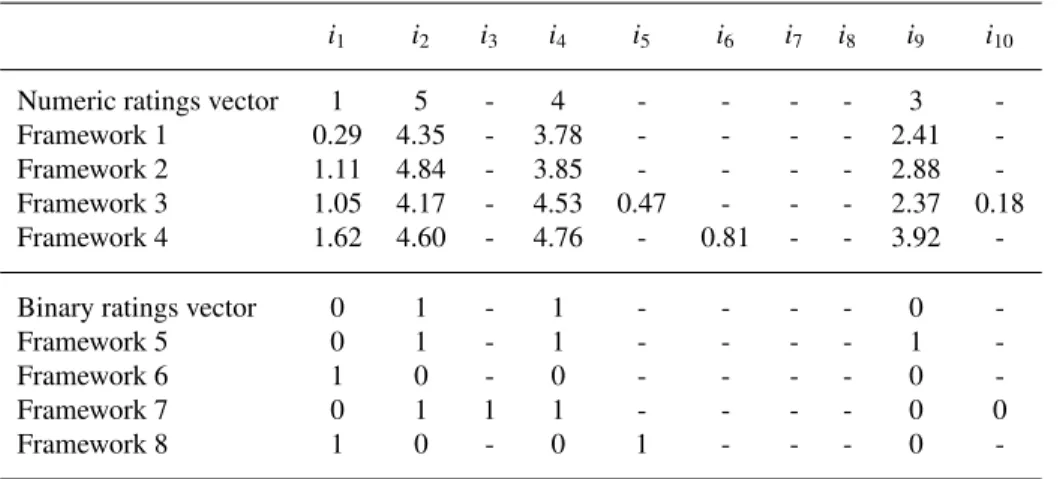
To show how the proposed eight frameworks can be used to mask data, we use a simple example. We generate two user ratings vectors. One of them includes numeric ratings while the other consists of binary ratings, as shown in Table 1. The vectors include four ratings and six unrated items, where “-” shows unrated items. Thus, there are 10 items likei1,i2,. . .,i10. For Framework 1, we choose Gaussian distribution and setσto 1. Then, we generate
four random numbers like [-0.71, 1.35, -0.22, -0.59]. We add these random numbers to the true ratings and obtain the masked vector, as shown in Table 1 for Framework 1. For Framework 2, we choose 1 asσmax andσuis uniformly
randomly selected over the range (0, 1] as 0.0965. We use Gaussian distribution and generate four random numbers like [0.11, -0.16, -0.15, -0.12]. We add them to the real ratings and obtain the perturbed vector for Framework 2. We select Gaussian distribution for Framework 3, whereσandβare set to 1 and 50, respectively. It means that two unrated items cells are supposed to be filled in random data. Hence, we generate six random numbers like [0.05, -0.83, 0.53, 0.47, -0.63, 0.18]. Suppose that the fifth and the tenth items are selected to be filled in. The perturbed vector is shown in Table 1 for Framework 3. For Framework 4, we choose Gaussian distribution. We setσmaxand βmax to 1 and 50, respectively. Then,σu andβuare uniformly randomly selected over the range (0, 1] and (0, 50]
as 0.74 and 28, respectively. Thus, one unrated item cell will be filled in. Assume that the sixth item is filled. We generate five random numbers like [0.62, -0.40, 0.76, 0.81, 0.92], mask the vector, and obtain the perturbed one for Framework 4. For Frameworks 5-8, we setMto 2. Suppose thatθ is set to 0.8; and 0.25 and 0.85 are uniformly randomly chosen two random numbers for two groups for Framework 5. Similarly,θmaxis set to 0.8 andθuis selected
as 0.29 for Framework 6. Also, 0.42 and 0.04 are chosen as random numbers for two groups. For Framework 7,θand βare selected as 0.8 and 50, respectively. Thus, two unrated items cells will be filled in. Assume that the third and the tenth items are selected and filled in 1 and 0, respectively. The two random numbers for the two groups are 0.44 and 0.10. Finally, for Framework 8, we chooseθmaxas 0.8 andθuis uniformly randomly selected as 0.24. We setβmax
to 50 andβuis randomly selected as 33. Hence, one unrated item will be filled in. Assume that the fifth item is filled
with 0. The two random numbers are 0.45 and 0.08 for two groups. The disguised vectors are shown in Table 1.
6. Conclusions and Future Work
Protecting users’ confidential data is extremely important for improving quality of a recommender system. Used data set in recommender systems may be binary or numeric. Hence, randomization type must be determined consid-ering the data set’s structure. Besides protecting ratings of users from third parties due to various privacy risks, users also want to keep their number of ratings and their rated items private in order to avoid from disclosing their tenden-cies and interests. Also, since privacy concerns may differ from one user to another, users may want to disguise their confidential data differently. We have presented eight privacy frameworks for randomization-based privacy protection collaborative filtering systems. Our frameworks help researchers select appropriate privacy preserving method. They also form a basis for fair comparison of different privacy-preserving collaborative filtering schemes on randomization. Our future research direction includes providing evaluation frameworks for privacy-preserving collaborative filter-ing schemes. Also, frameworks should be designed by considerfilter-ing privacy, accuracy, performance, and robustness.
Table 1. Ratings vectors and their disguised versions using the proposed frameworks
i1 i2 i3 i4 i5 i6 i7 i8 i9 i10
Numeric ratings vector 1 5 - 4 - - - - 3
-Framework 1 0.29 4.35 - 3.78 - - - - 2.41
-Framework 2 1.11 4.84 - 3.85 - - - - 2.88
-Framework 3 1.05 4.17 - 4.53 0.47 - - - 2.37 0.18
Framework 4 1.62 4.60 - 4.76 - 0.81 - - 3.92
-Binary ratings vector 0 1 - 1 - - - - 0
-Framework 5 0 1 - 1 - - - - 1
-Framework 6 1 0 - 0 - - - - 0
-Framework 7 0 1 1 1 - - - - 0 0
Framework 8 1 0 - 0 1 - - - 0
-Acknowledgements
This study is supported by the Grant 114E571 from TUBITAK. References
1. Bobadilla J, Ortega F, Hernando A, Guti´errez A. Recommender systems survey.Knowledge-Based Systems2013;46:109-132.
2. Bilge A, Kaleli C, Yakut I, Gunes I, Polat H. A survey of privacy-preserving collaborative filtering schemes.International Journal of Software Engineering and Knowledge Engineering2013;23(8):1085-1108.
3. Ozturk A, Polat H. From existing trends to future trends in privacy-preserving collaborative filtering.Wiley Interdisciplinary Reviews: Data Mining and Knowledge Discovery2015;5(6):276-291.
4. Agrawal R, Srikant R. Privacy-preserving data mining.ACM SIGMOD Record2000;29(2):439-450.
5. Polat H, Du W. Privacy-preserving collaborative filtering using randomized perturbation techniques.Proceedings of the 3rd IEEE International Conference on Data Mining2003; Melbourne, FL, USA, pp. 625-628.
6. Polat H, Du W. SVD-based collaborative filtering with privacy.Proceedings of the ACM Symposium on Applied Computing2007; Santa Fe, NM, USA, pp. 791-795.
7. Polat H, Du W. Privacy-preserving collaborative filtering.International Journal of Electronic Commerce2005;9(4):9-35.
8. Polat H, Du W. Effects of inconsistently masked data using RPT on CF with privacy.Proceedings of the ACM Symposium on Applied Computing
2007; Seoul, Korea, pp. 649-653.
9. Yakut I, Polat H. Achieving private SVD-based recommendations on inconsistently masked data.Proceedings of the 1st International Confer-ence on Security of Information and Networks2007; Gazimagusa, Cyprus, pp. 172-176.
10. Gong S. Privacy-preserving collaborative filtering based on randomized perturbation techniques and secure multiparty computation. Interna-tional Journal of Advancements in Computing Technology2011;3(4):89-99.
11. Basu A, Vaidya J, Kikuchi H. Perturbation-based privacy-preserving Slope One predictors for collaborative filtering.IFIP Advances in Infor-mation and Communication Technology2012;374:17-35.
12. Zhu T, Ren Y, Zhou W, Rong J, Xiong P. An effective privacy preserving algorithm for neighborhood-based collaborative filtering.Future Generation Computer Systems2014;36:142-155.
13. Warner SL. Randomized response: A survey technique for eliminating evasive answer bias.Journal of the American Statistical Association
1965;60(309):63-69.
14. Polat H, Du W. Achieving private recommendations using randomized response techniques.Lecture Notes in Computer Science2006;
3918:637-646.
15. Kaleli C, Polat H. Providing private recommendations using na¨ıve Bayesian classifier.Advances in Soft Computing2007;43:168-173. 16. Kikuchi H, Mochizuki A. Privacy-preserving collaborative filtering using randomized response.Journal of Information Processing2013;
21(4):617-623.
17. Cranor, LF. “I didn’t buy it for myself” privacy and e-commerce personalization.Proceedings of the ACM Workshop on Privacy in Electronic Society2003; Washington, DC, USA, pp. 111-117.
18. Bilge A, Polat H. A comparison of clustering-based privacy-preserving collaborative filtering schemes.Applied Soft Computing2013;
13(5):2478-2489.
19. Bilge A, Polat H. A scalable privacy-preserving recommendation scheme via bisectingk-means clustering.Information Processing& Man-agement2013;49(4):912-927.