Optimisation of In-network Caching
for Information-Centric Future
Internet
Submitted by Haozhe Wang to the University of Exeter
as a thesis for the degree of
Doctor of Philosophy in Computer Science
In January 2017
This thesis is available for Library use on the understanding that it is copyright material and that no quotation from the thesis may be published without proper
acknowledgement.
I certify that all material in this thesis which is not my own work has been identified and that no material has previously been submitted and approved for the award of a
degree by this or any other University.
The rapid development in wireless technologies and multimedia services has radically shifted the major function of the current Internet from host-centric communication to service-oriented content dissemination, resulting a mismatch between the pro-tocol design and the current usage patterns. Motivated by this significant change, Information-Centric Networking (ICN), which has been attracting ever-increasing attention from the communication networks research community, has emerged as a new clean-slate networking paradigm for future Internet. Through identifying and routing data by unified names, ICN aims at providing natural support for efficient information retrieval over the Internet. As a crucial characteristic of ICN, in-network caching enables users to efficiently access popular contents from on-path routers equipped with ubiquitous caches, leading to the enhancement of the service quality and reduction of network loads.
Performance analysis and optimisation has been and continues to be key research interests of ICN. This thesis focuses on the development of efficient and accurate analytical models for the performance evaluation of ICN caching and the design of optimal caching management schemes under practical network configurations. This research starts with the proposition of a new analytical model for caching performance under the bursty multimedia traffic. The bursty characteristic is captured and the closed formulas for cache hit ratio are derived. To investigate the impact of topology and heterogeneous caching parameters on the performance, a comprehensive analytical model is developed to gain valuable insight into the caching performance with heterogeneous cache sizes, service intensity and content distribution under arbitrary topology. The accuracy of the proposed models is validated by comparing the analytical results with those obtained from extensive
simulation experiments. The analytical models are then used as cost-efficient tools to investigate the key network and content parameters on the performance of caching in ICN.
Bursty traffic and heterogeneous caching features have significant influence on the performance of ICN. Therefore, in order to obtain optimal performance results, a caching resource allocation scheme, which leverages the proposed model and targets at minimising the total traffic within the network and improving hit probability at the nodes, is proposed. The performance results reveal that the caching allocation scheme can achieve better caching performance and network resource utilisation than the default homogeneous and random caching allocation strategy. To attain a thorough understanding of the trade-off between the economic aspect and service quality, a cost-aware Quality-of-Service (QoS) optimisation caching mechanism is further designed aiming for cost-efficiency and QoS guarantee in ICN. A cost model is proposed to take into account installation and operation cost of ICN under a realistic ISP network scenario, and a QoS model is presented to formulate the service delay and delay jitter in the presence of heterogeneous service requirements and general probabilistic caching strategy. Numerical results show the effectiveness of the proposed mechanism in achieving better service quality and lower network cost.
In this thesis, the proposed analytical models are used to efficiently and accurately evaluate the performance of ICN and investigate the key performance metrics. Leveraging the insights discovered by the analytical models, the proposed caching management schemes are able to optimise and enhance the performance of ICN. To widen the outcomes achieved in the thesis, several interesting yet challenging research directions are pointed out.
First and foremost, I would like to express my sincere gratitude towards my supervisor Prof. Geyong Min for the inspiration and continuous support of my PhD study. I have gained immensely from his wisdom, his critical thinking, his integral view on research, and most importantly, from his hard working attitude. He taught me to work with enthusiasm and curiosity, two fundamental qualities for a researcher. Without his guidance, constant feedback and financial support, this PhD would not have been achievable. Apart from his tremendous academic support, he has given me so many wonderful opportunities and always been there for me and allowed me to grow both personally and professionally. I am really glad to be associated with a great person like Prof. Geyong Min in my life.
My sincere thanks also goes to my second supervisor and friend Dr. Jia Hu for his dedicated help to my research, especially for sharing his insightful comments and encouragement, and also for widening my research from various perspectives. All the discussion and brainstorming sessions have been invaluable help and motivation for me at various stages of writing my thesis.
I thank my fellow research colleagues and labmates, Dr. Yulei Wu, Wang Miao, Noushin Najjari, Chengqiang Huang, Yuan Zuo, Xiangle Cheng, Yujia Zhu, Zhengxin Yu, Dr. Yang Liu, Dr. Lejun Chen, Fangming Zhong, for always standing by my side and sharing a great relationship as compassionate friends. All of you have enriched my life and been a great strength to me all throughout my PhD pursuit.
Last buy not the least, I would like to thank my family, my mother and father, from the bottom of my heart for all their love and encouragement and the sacrifices that they have made on my behalf. They have the kindness and the patience to tolerate my absence from the many responsibilities to complete my PhD study.
List of Figures xi
List of Tables xv
List of Abbreviations xvii
List of Publications xix
1 Introduction 1
1.1 Motivations and Challenges . . . 2
1.2 Research Aims and Contributions . . . 5
1.3 Outline of the Thesis . . . 6
2 Background and Literature Review 9 2.1 Information-Centric Networking (ICN) . . . 10
2.1.1 Features of ICN . . . 10
2.1.2 ICN Architectures . . . 12
2.2 Content-Centric Networking . . . 14
2.3 In-network Caching . . . 17
2.3.1 Cache decision policies . . . 18
2.3.2 Cache replacement policy . . . 19
2.3.3 Content characteristics . . . 21
2.4 Literature Review . . . 22
2.4.1 Caching Performance Modelling of ICN . . . 22
2.4.2 Caching Management and Allocation Optimisation . . . 24
2.5 Summary . . . 26
3 Performance Analysis of ICN Caching for Multimedia Services 29 3.1 Introduction . . . 29
3.2 Analytical Model . . . 30
3.2.1 System parameters . . . 31
3.2.2 Modelling of Bursty Content Requests . . . 32
3.2.3 Modelling of Caching Performance under Bursty Content requests 34 3.2.4 Modelling of Caching Performance with Tree Topology . . . . 39
3.3 Model Validation and Performance Evaluation . . . 42
3.3.1 Single Cache Performance under Bursty Content Requests . . 42
3.3.2 Network of Caches with Tree Topology under Bursty Content Requests . . . 43
3.3.3 Performance Evaluation . . . 45
3.4 Summary . . . 46
4 Performance Analysis and Optimisation of Heterogeneous Caching under Arbitrary Topology 49 4.1 Introduction . . . 49
4.2 Analytical Model . . . 51
4.2.1 System parameters . . . 51
4.2.2 Modelling the Performance of Arbitrary ICN . . . 52
4.3 Model Validation and Performance Analysis . . . 60
4.4 Model-based Optimal Cache Allocation . . . 68
4.5 Summary . . . 74
5 Cost-Aware QoS Optimisation for Caching of ICN for Multi-Services 77 5.1 Introduction . . . 77
5.2 System Model . . . 79
5.2.1 System Parameters . . . 80
5.2.2 Cost Model . . . 81
5.2.4 Cache Performance Analysis . . . 88
5.3 Cost-Aware Caching Allocation Scheme . . . 91
5.3.1 Multi-objective Optimisation Goals . . . 91
5.3.2 Design of a Cost-aware Caching Mechanism . . . 93
5.3.3 Computational Complexity Analysis . . . 95
5.4 Numerical Evaluation . . . 96
5.4.1 Experiment Setup . . . 96
5.4.2 Performance Evaluation . . . 98
5.5 Summary . . . 104
6 Conclusions and Future Work 105 6.1 Conclusions . . . 105
6.2 Future Work . . . 107
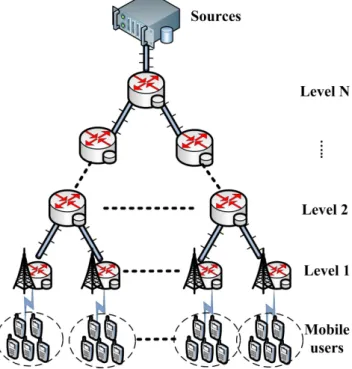
2.1 CCN packet types. (Source: [17]) . . . 15 2.2 The key components of CCN. (Source: [17]) . . . 16 2.3 The working flow of CCN. . . 17 3.1 The binary tree network topology to be investigated for caching
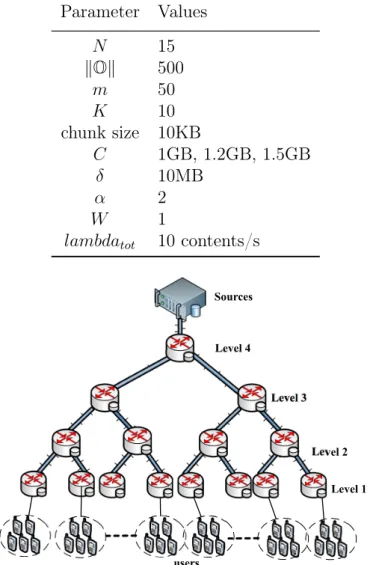
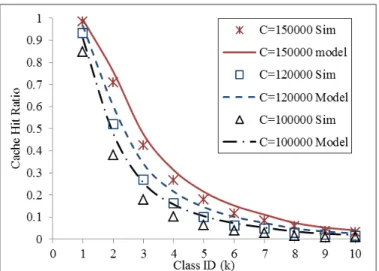
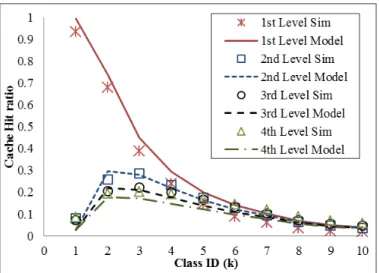
performance. . . 39 3.2 4-level binary tree network used for the validation . . . 43 3.3 Single cache hit ratio predicted by the model against those obtained
through simulation under bursty traffic vs. contents of different classes with the different cache size C= 100000,1200000,150000 chunks. . . 44
3.4 Cache hit ratio predicted by the model against those obtained via simulation under bursty traffic for different level of routers, withN = 4
level binary tree, cache size C= 150000chunks, and the Zipf exponent
α = 2. . . 45
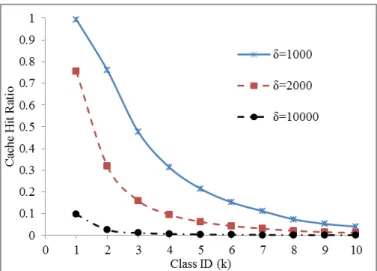
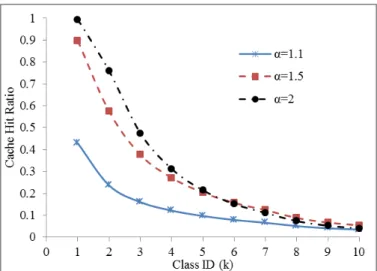
3.5 Cache hit ratio predicted by the model for different content sizes. . . 46 3.6 Cache hit ratio predicted by the model for different Zipf exponentα
vs. content of different classes. . . 47 3.7 Global cache hit ratio predicted by the model vs. different Zipf
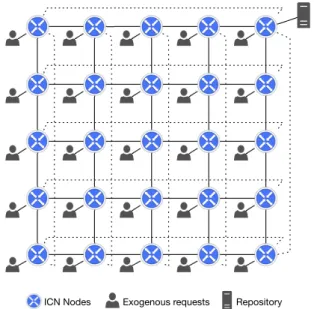
exponent α. . . 47 4.1 Network topology: 5×5 two-dimensional torus network with one
4.2 Mean cache hit ratioHk,di predicted by the model against those
ob-tained through simulation under bursty traffic vs. content of different service types with various cache sizes Cvn. . . 64
4.3 Mean cache hit ratio predicted by the model for different content sizes with cache sizeCvn = 120000. . . 66
4.4 Global cache hit ratioHdi predicted by the model vs. different Zipf
exponent α with cache size Cvn = 120000. . . 67
4.5 CCN router state transition diagram . . . 67 4.6 Average round trip time of different types of services under the torus
topology with link delay equals 2ms and Cvn = 120000. . . 69
4.7 The topology of Abilene network with three different network configu-ration . . . 70 4.8 The optimal results of proposed allocation mechanism under three
different scenarios. . . 73 4.9 The optimal cache size allocation of the proposed strategy under three
different network scenario . . . 73 5.1 Network topology of Abilene with different content requesting rate
and content popularity distribution. . . 96 5.2 The diversity of node cost based on location shown on the topology.
Higher CAPEX nodes are darker in colour and higher OPEX nodes are larger in size. . . 97 5.3 Pareto optimal set under the goals (cost of network vs QoS) comparing
with homogeneous and random cache allocation methods with cache budget Ctot ={1.0e6,1.2e6,1.5e6}. . . 100
5.4 Comparing of network cost among three cache allocation methods under caching budget Ctot ={1.0e6,1.2e6,1.5e6}. . . 101
5.5 Comparing of service quality among three cache allocation methods under caching budget Ctot ={1.0e6,1.2e6,1.5e6}. . . 101
5.6 Cache allocation for each node for the median of Pareto optimal set under Ctot ={1.0e6,1.2e6,1.5e6}. . . 102
5.7 Impact of Zipf parameter α on the cost and QoS with qn = 0.5 and
homogeneous content request rate. . . 103 5.8 Impact of caching probabilityqn on the cost and QoS with
3.1 Summary of system parameters . . . 32
3.2 Parameters set for the validation . . . 43
4.1 Summary of main notations . . . 53
4.2 Parameters set for the validation . . . 62
5.1 Summary of notations . . . 82
Acronyms / Abbreviations ARTT Average Round Trip Time BS Base Station
C-RAN Cloud Radio Access Network CCN Content-Centric Networking CDN Content Delivery Networks CS Content Store
DHT Distribute Hash Table
DONA Data-Oriented Network Architecture FIB Forwarding Information Base
FIFO First-In-First-Out
ICN Information-Centric Networking IoT Internet of Things
IP Internet Protocol
IPTV Internet Protocol Television IRM Independence Request Model ISP Internet Service Provider
LCE Leave Copy Everywhere LFU Least Frequently Used LRU Least Recently Used
MMPP Markov-modulated Poisson process MRU Most Recently Used
NDN Named Data Networking NetInf Network of Information
NFV Network Functions Virtualisation OTT Over-the-Top
P2P Peer-to-Peer
PARC Palo Alto Research Centre PIT Pending Interest Table
PSIRP Publish-Subscribe Internet Routing Paradigm QoE Quality of Experience
QoS Quality of Service SBS Small Base Station SLA Service Level Agreement TCP Transmission Control Protocol TLS Transport Layer Security URI Uniform Resource Identifier VoD Video on Demand
[1] Haozhe Wang, Geyong Min, Jia Hu, Wang Miao, and Nektarios Georgalas. Perfor-mance Evaluation of Information-Centric Networking for Multimedia Services. In
2016 IEEE Symposium on Service-Oriented System Engineering (SOSE), pages
146–151. IEEE, mar 2016. (Best Paper Award)
[2] Haozhe Wang, Geyong Min, Jia Hu, Hao Yin, and Wang Miao. Caching of Content-Centric Networking under Bursty Content Requests. In 2014 IEEE
Wireless Communications and Networking Conference (WCNC), pages 2522–2527.
IEEE, apr 2014.
[3] Huijie Yang, Jia Hu, Haozhe Wang, and Hao Wu. A Content Caching Strategy Based on Demand Estimate Function in Small Cell Networks. Accepted by IEEE
GreenCom 2017, IEEE, jun 2017.
[4] Haozhe Wang, Jia Hu, Geyong Min, Wang Miao, and Nektarios Georgalas. Cost-Aware QoS Optimisation for Caching in Information-Centric Networking.
Submitted to IEEE GLOBECOM 2017.
[5] Haozhe Wang, Jia Hu, Geyong Min, Wang Miao, and Nektarios Georgalas. Cost-Aware QoS Optimisation for Caching in Information-Centric Networking for Multi-services. to be submitted to IEEE Transactions on Communications.
[6] Haozhe Wang, Geyong Min, Jia Hu, Wang Miao, Nektarios Georgalas, and Yang Liu. Performance Analysis and Optimisation of Information-Centric Networking for Multimedia Services. to be submitted to for IEEE/ACM Transactions on
[7] Wang Miao, Geyong Min, Yulei Wu, Haozhe Wang, and Jia Hu. Performance Modelling and Analysis of Software-Defined Networking under Bursty Multimedia Traffic. ACM Transactions on Multimedia Computing, Communications, and
Applications, 12(5s):1–19, sep 2016.
[8] Wang Miao, Geyong Min, Yulei Wu, and Haozhe Wang. Performance Modelling of Preemption-Based Packet Scheduling for Data Plane in Soft-ware Defined Networks. In 2015 IEEE International Conference on Smart
City/SocialCom/SustainCom (SmartCity), pages 60–65. IEEE, dec 2015. (Best
Introduction
The major principles and architecture of current Internet were designed back in 1970s. From the beginning, the Internet runs on top of TCP/IP (Transmission Control Protocol and Internet Protocol) suite of protocols, which is the fundamental building block for the Internet’s architecture. The Internet paradigm is a host-to-host based model, aiming at resource sharing and interconnection between hosts. All the Internet information exchanges are realised by packet switching which forwards packets using the destination address contained in the packet itself. This host-centric Internet has perfectly matched the early Internet usage, because the Internet applications or protocols at that time were all end-to-end communications such as the instance massage exchange, e-mail service and FTP file download.
The advent of the World Wide Web has radically changed Internet usage from host-to-host to service access and data retrieval. Multimedia services like Video on Demand (VoD), over-the-top (OTT) video, IPTV, on-line gaming and social networking represent the predominant usage of today’s Internet. These services focus on the requested contents rather than host location, since the users tend to pay less attention to where the content is obtained, and are more interested in how fast and reliable the requested content can be accessed [1]. Therefore, the usage of Internet is switching from the host-centric to a content-oriented model. In order to follow these evolutions, more and more patches or overlay are added to the current Internet protocol stack, such as Peer-to-peer (P2P), Proxy, Content-Delivery Networks (CDNs), multi-homing, multicast, Mobile IP, etc., which made the Internet
become more and more complex. Even if the Internet has been able to address the challenges raised by new applications, the host-centric Internet is becoming too heavy to offer the best performance to the end-users. Due to the mismatch between the architecture and its current usage, the Internet is inadequate to deal with the problems of scalable content distribution, Quality-of-Experience (QoE), mobility, security, etc.
Facing these shortcomings, research communities are motivated to design Future Internet architectures. Information Centric Networking (ICN) paradigm was proposed to address the above-mentioned architectural problems. ICN treats content objects as the first class entity of the network architecture instead of physical location by identifying and routing contents by unified names. ICN is a receiver-driven networking model, where end-users only express their interests for a given content, then the entire network is in charge of routing the requests based on the content names only. The requests are forwarded towards the best content containers and delivering the contents through the reverse paths to the end-users. It decouples content from location to achieve a naturally content-centric architecture [2].
The rest of this chapter is organised as follows: Section 1.1 is devoted to the mo-tivations and challenges of this research. The research aims and major contributions of this thesis are shown in Section 1.2. Finally, the outline of this thesis is presented in Section 1.3.
1.1
Motivations and Challenges
A notable advantage of ICN is to provide native support for scalable and highly efficient information retrieval. This is achieved through transparent and ubiquitous in-network caching. ICN routers are equipped with cache memory and enabled to cache frequently requested contents passing them. By means of caching, it is possible for ICN routers to serve requests of cached contents rather than forwarding the requests to the original server. In-network caching is considered as an integral part of ICN [3] to efficiently obtain content, alleviate congestion, reduce network load, and enhance Quality-of-Experience (QoE) perceived by users. However, in-network
caching differs from Web caching in which cache is transparent to applications and cached content is finer grained. This poses new challenging issues to be addressed, such as cache management and cache placement/replacement strategies, to efficiently utilise the limited cache resources. For example,
(i) ICN is still in its early age, thus it is necessary to have clear understanding of the factors that affect its potential performance before ICN can be widely adopted in commercial systems. A majority of the existing works on ICN caching were carried out via simulations. However, analytical model of ICN cache networks is indispensable for the understanding of the intrinsic behaviours and important metrics of caching performance. Due to the new receiver-driven transmission model and finer grained caching object, it becomes a challenge to analytically characterise the performance of ICN. Even when a single ICN node employing basic cache strategy (such as Least Recently Used) is considered, it is still difficult to model the data transferring process and quantify the caching performance. The modelling issue become even harder when a network of cache nodes are taken into account [4]. Therefore, it is imperative to develop a unified and accurate analytical model based on appropriate assumption under realistic scenarios.
(ii) As the dominant services of the Internet, various multimedia applications generate a substantial amount of traffic [5]. Due to the diversity of multimedia applications, data streams generated by these applications have various impacts on the performance of ICN. The data traffic generated by multimedia services are known to exhibit a bursty nature [6]. Because the data transmission in ICN is a receiver-driven process, the content request process of multimedia services also exhibits the bursty characteristics. The constant arrival rate or Poisson process used by most of the existing ICN cache studies [7–10] are inadequate for capturing traffic burstiness of multimedia services. Therefore, traffic pattern becomes a crucial factor, and a new analytical model is needed to capture the the bursty nature of content requests when we evaluate the performance of caching.
(iii) Although ICN caching has received considerable research attention, the existing works on ICN caching are mainly focused on a single cache node or special cache network topologies, such as cascade topology or tree topology. These special network topologies simplify the interoperability between cache nodes, therefore simplify the development and analysis of cache network models. But in ICN caches are ubiquitous and transmission paths are no longer fixed, the realistic topology of cache networks should be represented by arbitrary graphs [11] rather than the fixed parent-child relationships. Consequently, it is necessary to develop a comprehensive and accurate analytical model for understanding the performance of ICN caching under arbitrary network topology.
(iv) Various services differ considerably in their request rate, content size and popularity, this heterogeneity requires ICN to efficiently share and allocate cache resources among different services. This poses new challenges to be addressed for in-network cache management and optimal caching resource allocation. Therefore, an efficient caching management scheme which optimally allocates caching resources to each node for reducing the traffic load of services and improving the service quality is in demand.
(v) In-network caching can benefit both Internet Service Providers (ISPs) and end users. It reduces the traffic load of services for ISPs and alleviate network congestions. In the mean time, it improves the Quality of Service (QoS) for end users and reduces service latency. However, the economic aspect of ICN has received marginal consideration so far [12]. But It is vital to understand the potential cost-effectiveness of ICN before its wide deployment in ISP’s network. As a result, it is timely to take the economic aspect into account in order to achieve both cost-efficiency and QoS guarantee in ICN caching.
1.2
Research Aims and Contributions
The research work reported in this thesis is focused on the analysis and optimisation of the performance of ICN serving multimedia services under realistic network environments. The main objectives of the research are:
(i) To develop cost effective and versatile analytical models for the performance evaluation of ICN with bursty multimedia traffic under arbitrary network topology.
(ii) To exploit the analytical models to investigate the impact of key performance metrics of ICN and develop an optimal cache allocation scheme under practical network configurations.
(iii) To investigate the association between the cost of ICN and QoS and find the optimal trade-off between them with a novel cost-aware caching mechanism in the presence of realistic caching strategy and heterogeneous network.
To achieve these objectives, the research develops new analytical models to investigate the performance of ICN in the presence of heterogeneous bursty traffic under arbitrary network topology. The accuracy of the proposed models is validated through the extensive comparison of the analytical performance results with those obtained from ICN simulation experiments. Novel caching schemes that leverage the analytical modes are proposed to improve the performance of ICN. The major contributions of this research are summarised as follows:
(i) A new analytical model is developed to evaluate the caching performance of ICN under bursty multimedia content requests. To capture the bursty characteristics of multimedia services, the developed model adopts the Markov-modulated Poisson process (MMPP) to represent the time-varying content requesting process. A thorough analysis has been conducted to evaluate the caching performance of a tree network under Zipf-like content distribution and Least Recently Used (LRU) caching strategy.
(ii) A comprehensive analytical model for gaining the insights of caching per-formance under arbitrary network topology with heterogeneous cache sizes, content distributions and request intensity is developed. The model derives the cache hit ratio at any node for various services as the key performance metric. The model is used to explore the impact of the cache size, content popularity distribution and content length on the performance of ICN caching.
(iii) A caching allocation scheme is proposed by leveraging the developed analytical model to achieve optimal caching resource allocations under heterogeneous bursty content requests and content distributions in realistic network config-urations. The scheme obtains a way for deploying a limited budge of caches to the nodes targeting at minimising the total traffic within the network and improving the network performance. The performance results reveal that the proposed caching allocation scheme can achieve better caching performance and network resource utilisation than the default homogeneous and random caching allocation strategy.
(iv) A cost-aware QoS optimisation caching mechanism is proposed aiming for cost-efficiency and QoS guarantee in ICN. Two new models are designed to investigate the inner association between the economic aspect of network and service level agreement (SLA). The cost model takes into account installation and operation cost of ICN under a realistic ISP network scenario. The QoS model formulates the service delay and delay jitter in the presence of multiple services and general probabilistic caching strategy. The proposed mechanism jointly considers the two models and adopts a multi-objective optimisation method to find the optimal caching resource allocation. The performance results show that the cost-aware caching mechanism can attain an economical ICN and also guarantee the service performance.
1.3
Outline of the Thesis
Chapter 2 introduces the background of ICN including the key features, archi-tectures and caching strategies. A detailed literature review on the performance modelling and optimisation is then presented.
Chapter 3 presents analytical models for evaluating the ICN performance under bursty multimedia content requests. Particularly, the first model analyses the edge ICN nodes with LRU and Leave Copy Everywhere (LCE) caching strategies and Zipf popularity distribution; the second one considers the caching performance in a tree network. The models are used to explore the key network and content parameters of ICN caching.
Chapter 4 proposes a comprehensive analytical model for arbitrary ICN with heterogeneous bursty requests, content sizes and popularity distribution. Then a model-based caching allocation strategy is proposed to improve the ICN performance and achieve the optimal caching resource allocation.
Chapter 5 develops a cost-aware QoS optimisation caching mechanism to study the trade-off between Quality-of-Service (QoS) and cost of ICN. A cost model and a QoS model are designed to investigate the inner association between them.
Background and Literature Review
For more than a decade, the inherent drawbacks of the current Internet have been calling for its revolutionary designs. The host-oriented communication model, which was designed for special data transmission in the early age of Internet, is causing troubles everywhere in nowadays content based various multimedia services. Con-sequently, Information Centric Network (ICN) is proposed to solve these problems. As the most permanent clean-slate approach for next generation Internet, ICN has attracted much attention from network researchers in the passed few years. Although ICN enters now into the main stream of networking research, it is still in its early stage. Many projects have been carried on in order to propose a concrete ICN solution to deploy it in reality. This chapter gives a general background knowledge and presents an in-depth review of the related research on caching performance modelling and enchantment of ICN.The rest of this chapter is organized as follows. The background knowledge including the ICN architectures with important features is presented in Section 2.1. One of the most promising ICN architecture, Content-Centric Networking (CCN) is introduced in Section 2.2. In-network caching as one of the most important feature of ICN is detailed in Section 2.3. A detailed literature review on modelling of ICN performance as well as the caching allocation and optimisation is then presented in Section 2.4.
2.1
Information-Centric Networking (ICN)
The ICN paradigm focusing on redesigning the Future Internet architecture, placing named data rather than content locations (IP addresses) in the centre of the network design. The primary goal of ICN is to shift the current host-centric communication model of the Internet to a content-oriented model, in order to overcome the mismatch between the current usage patterns and the original design. In this section, the fundamental features of ICN common to most proposed designs are investigated, followed by the design principles of three ICN approaches.
2.1.1
Features of ICN
Many ICN architectures have been proposed by different research groups. Although the proposed architectures of ICN differ with respect to the details, they share several objectives and common components, including location-independent naming, in-network caching, name-based routing and content security.
Naming
The fundamental concept of the ICN is to evolve the host-based Internet architecture to a named-based one. ICN requires globally unique and location independent names [13, 14]. The content name is the only identifier of each content object, a globally unique name should be used for routing at a global level. Unlike the IP address which is relevant to the geography location, the naming of content should be location independent to route to the best content sources, such as the origin publisher or the on-path caches. Various kinds of naming schemes have been proposed, in order to achieve persistent naming and provide an efficient and scalable look-up for names of billions of contents. Among all those schemes, two categories of naming structures have been largely received: the hierarchical and the flat namespaces. Each naming scheme has the advantages and disadvantages in terms of security and scalability, thus, naming remains an open research issue. The hierarchical scheme adopts the similar ideas as the IP addresses [15] and the Uniform Resource Identifier (URI) [16], which can be aggregated into the prefixes and perform the longest match or shortest
match. Furthermore, it improves the scalability of the routing system. In some architecture, such as CCN [17], the hierarchical names are unique for routing but also human-readable. The flat naming scheme consists of identifying data with a flat label which is not suitable for aggregation. However, it can perform the Distribute Hash Table (DHT) based look-ups to improve the efficiency [18].
In-network Caching
One of the most remarkable features that differs ICN from the current Internet is introduction of the in-network caching capability. Every network element of the ICN can temporarily hold a copy of the data packets that traverse it. In virtue of the unique names, ICN is aware of the names content they are delivering, therefore requests for contents can be satisfied by any node holding a copy in its cache within the network, which reduces the response delay. In this way, ICN architectures naturally offer a reliable, scalable and application-independent network-level content delivery system, instead of leveraging any external storage resource such as Content Delivery Networks (CDN) and Peer-to-Peer (P2P) systems, commonly adopted in the current Internet architecture [11]. This ubiquitous in-network caching significantly improves the content retrieving efficiency and alleviates the traffic congestion. Routing and Delivery
There are two phases in content retrieving in ICN, the request routing phase and the content delivery phase, respectively [13]. The request routing phase is realised in two manners: the naming resolution based routing and the direct name based routing. The naming resolution requires one or several centralised servers. These servers collect the content publication information and build a global view of the contents in the network. When an ICN router forwards a request, they resolve the content name in order to find the closest copy and deliver it to the receiver. Contrarily, the name based routing is directly performed in the ICN routers. Each router has a local routing table-liked forwarding information base which is filled by the content publication messages. In this case, the router addresses the request and routes the request to one or multiple potential data sources followed its own forwarding
strategies. The request routing methods heavily depends on how contents are named and published. During the content delivery phase, the providers do not send contents directly to the end-users, and the delivery is completely a receiver-driven process. The receiver sends requests to the network, and the provider can only response to the requests. After the source has received the request message, the data is routed back to the requester.
Security
Security in today’s host-centric Internet is based on the protection of the end-to-end communication channel. For example, Transport Layer Security (TLS) is used to established end-to-end connectivity, and authenticated server is used in synchronous three-way authentication. Contrarily, ICN requires location independent and self-certifying security mechanism to enable ubiquitous in-network caching system [19]. Since requests can be satisfied by any network element, the architecture must secure the content itself rather than the communication path. Security is strictly related to naming, and the name should embed the information of data integrity and signature verification.
2.1.2
ICN Architectures
In the past few years many projects have been carried on in order to propose a concrete ICN solution to deploy it in reality. For example, key projects in the United States (CCN/NDN [17]/[20], and previously DONA [21]) and Europe (NetInf from the project 4WARD [22]/SAIL [23], PSIRP/PURSUIT [24][25] and COMET [26]) have worked on redesigning core network primitives to realise ICN architectures. Since its proposal, ICN has attracted significant interest in both academia and industry. This section introduces three projects related to ICN approaches at a high level with the purpose of providing a general understanding of them before going into a detailed discussion in the next section.
Data-Oriented Network Architecture (DONA): In DONA, contents are published into the network by the sources. Nodes that are authorized to serve
data, register to the resolution infrastructure consisting of resolution handlers (RHs). Requests (FIND packets) are routed by name toward the appropriate RH. Data is sent back in response, either through the reverse RH path, enabling caching, or over a more direct route. Content providers can perform a wildcard registration of their principal in the RH, so that queries can be directed to them without needing to register specific objects. It is also possible to register contents names before the content is created and made available. Register commands have expiry times. When the expiry time is reached, the registration needs to be renewed. The RH resolution infrastructure routes requests by name in a hierarchical fashion and tries to find a copy of the content closest to the client. DONA’s anycast name resolution process allows clean support for network-imposed middleboxes (e.g., firewalls, proxies).
Publish-Subscribe Internet Routing Paradigm (PSIRP): In PSIRP, con-tents are also published into the network by the content sources. The publication belongs to a particular named scope. Receivers can subscribe to contents. The publi-cations and subscriptions are matched by a rendezvous system. The subscription request specifies the scope identifier (SI) and the rendezvous identifier (RI) that together name the desired content. The identifiers are input to a matching procedure resulting in a forwarding identifier (FI), which is sent to the content source so that it can start forwarding data. The FI consists of a Bloom filter that routers use for selecting the interfaces on which to forward an content. This means that routers do not need to keep forwarding state. The use of Bloom filters results in a certain number of false positives; in this case this means forwarding on some interfaces where there are no receivers.
Network of Information (NetInf ): In NetInf, there are two models for retrieving contents, via name resolution and via name-based routing, thereby allowing adaptation to different network environments. In NetInf, depending on the model used in the local network, sources publish contents by registering a name/locator binding with a name resolution service (NRS), or announcing routing information in a routing protocol. A NetInf node holding a copy of a content (including in-network caches and user terminals) can optionally register its copy with an NRS, thereby
adding a new name/locator binding. If an NRS is available, a receiver can first resolve a content name into a set of available locators and can subsequently retrieve a copy of the data from the “best” available source(s). Alternatively, the receiver can directly send out a GET request with the content name, which will be forwarded toward an available content copy using name-based routing. As soon as a copy is reached, the data will be returned to the receiver. The two models are merged in a hybrid resolution/routing approach where a global resolution system provides mappings in the form of routing hints that enable aggregation of routing information.
2.2
Content-Centric Networking
Content-Centric Networking (CCN) [17], one of the most well-known ICN paradigm designed by the Palo Alto Research Centre (PARC), elaborates some ideas and principles previously introduced by other ICN proposals. CCN proposes a clean-slate Internet architecture including naming and forwarding functionalities, taking care of security, content dissemination and mobility issues. The mainly design of CCN focuses on the network layer and transport layer of the ISO Internet model, maintaining the simplicity of IP in order to become the thin waist of the future Internet Architecture. Recently, projects focused on CCN called Named Data Networking (NDN) [20] has been funded by the NSF’s Future Internet Architecture Program.
The research work described in this thesis is mainly focused on the architecture proposed in CCN, but the results can broadly apply in the context of general ICN architectures and other caching-related work. In this section, the CCN architecture is described.
CCN is driven by two types of packets: Interest and Data defined in [17], shown
in Fig. 2.1. Interest packets are sent by users to ask for the named contents. Each
Interest packet contains a content name based on a hierarchical structure, similar to
a URI, with the prefix illustrating the global and organizational routing information, and a suffix providing the details of version and segmentation. Data packet, each of
which contains a unit of data of the request content, is transmitted in response to the matchingInterest and consumes thatInterest.
Interest Packet
Data Packet
Fig. 2.1 CCN packet types. (Source: [17])
In CCN, the traditional IP routing table that is identified by IP addresses is no longer suitable and should be adapted to forward data, resolving the content names instead of the IP addresses. This adapted routing table is named as the Forwarding Information Base (FIB) in CCN and maps the names of content to the output interface(s) that should be used to forward Interest towards appropriated
router(s). This router may have the rightData or knowledge about how to propagate
the Interest to potential data sources.
The Content Store (CS), which serves as a local cache for contents, is checked to see whether the requested Data packet is already available. If this is the case,
the CCN router will deliver that content from the CS and consume the Interest
packet. The CS caches theData passed through the router, so the subsequent content
requests can be satisfied from it.
The Pending Interest Table (PIT) is a new structure in the CCN. It tracks the incoming interface(s) from which the pendingInterests have arrived. The architecture
of CCN router is illustrated in Fig. 2.2.
When one CCN router receives an Interest packet and the CS has no entry for
the requested data, the PIT will be checked. If an Interest has no match in either
the CS or PIT, a new PIT entry is created and the Interest is forwarded through
one or more interfaces according to the FIB. When this CCN router receives the responseData packet, it looks up the PIT for the incoming interfaces and forwards
the Data towards all the matching interfaces. After that, the entry for this content
Fig. 2.2 The key components of CCN. (Source: [17])
the CCN router will only forward the first Interest once, and keeps track of all the
interfaces from which theInterest packets are received. When the router receives the
corresponding Data packet, it will forward that packet to all the interfaces tracked
in the PIT. By so doing, the CCN network then naturally offers a native request aggregation and multicast function.
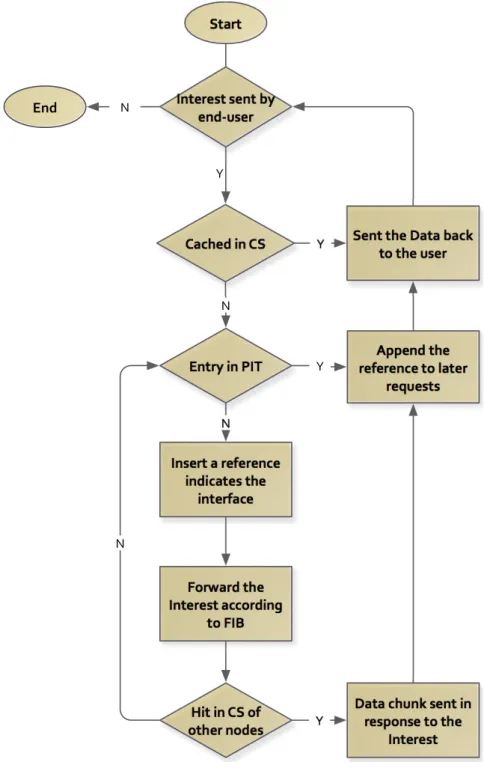
The working flow of CCN is illustrated in Fig. 2.3. In the content retrieving process, end-users request content by sendingInterest packets for named data chunks
to the CCN access edge router. If the requestedData is already stored in the CS, it
is immediately sent back in reply to the userInterest. Otherwise, the CCN router
inserts a reference to the interface from where the Interest came from in the PIT
and forwards the Interest packet to certain interfaces according to the FIB and
the forwarding strategy. In case multiple requests for the same content hit a CCN router that has already created a PIT entry, however which has not received the content yet, the PIT is appended with references to the latter requests. In this way, CCN naturally performs request aggregation, reducing redundant network loads. In the worst case, the requested Data of Interest packet is not cached at any CS of
intermediate CCN routers, then theInterest packet will be forwarded to the original
back according to PIT information, and PIT references are removed once interests are satisfied by sendingData on the corresponding interfaces.
!"#$%$&#'&$"#'()' $"*+,&$% -$"#'#.$'/0#0'(012' #3'#.$',&$% 401.$*'5"'4-677$"*'#.$' %$8$%$"1$'#3'90#$%' %$:,$&#& ;"#%)'5"'<!= !"&$%#'0'%$8$%$"1$' 5"*510#$&'#.$' 5"#$%801$' >3%?0%*'#.$' !"#$%$&#'0113%*5"@' #3'>!A B5#'5"'4-'38' 3#.$%'"3*$& /0#0'1.,"2'&$"#'5"' %$&73"&$'#3'#.$' !"#$%$&# ! ! " " " ! -#0%# ;"* " !
Fig. 2.3 The working flow of CCN.
2.3
In-network Caching
ICN architecture considers in-network caching as an integral part of the network. Caching plays a vital role in order to efficiently obtain the popular content, alleviate congestion, reduce redundant network load, and enhance the Quality-of-Experience
(QoE). Therefore, in-network caching of ICN has received considerable research attention in recent years [2, 3, 7, 8, 10, 11, 27–56]. Caching management that includes the cache decision and replacement polices has been in the centre of caching research. Before the surveys of related ICN caching work, the techniques and mechanism for caching performance are introduced in this section.
2.3.1
Cache decision policies
Cache decision policy determines which contents are to be stored at which cache nodes. Most of the ICNs use implicit cache placement policies, which means there is no global coordination proxy that is often used in Content delivery network (CDN).
In the existing cache of web proxies or CDN, it may be feasible to find the optimal content placement based on a priori knowledge of the number of caching nodes, network topology, routing distances, and traffic demand [57, 58]. However in ICN, caches are operated at networking layer (layer 3) and transparent to applications, so the cache solution of traditional web caches are no longer fit due to the lack of high level and aggregated vision. ICN is a flattening network, and the nodes need to exchange information as little as possible. Therefore, each cache node should be able to determine whether to cache the content by itself.
Moreover, cache nodes are arranged in an arbitrary topology and cache opera-tion needs to obey the line-rate requirement. These factors have made tradiopera-tional explicit cache decisions unsuitable for ICN, since they introduce more complexity and communication overheads. ICN needs simple yet effective cache decision policies. The simple Leave copy everywhere (LCE) [11, 17], which is the first caching policy proposed in ICN, copies the content on every node on a delivery path. There are other topology-based caching such as Leave Copy Down (LCD) [59] and Move Copy Down (MCD)[60]. When a cache hit happens, LCE caches the content on a delivery path towards to the edge of the network. Each cache node pushes the content one hop closer to the end-users, so after several requests, popular contents will be cached at the edge network. Similar to LCD, MCD also tends to cache the popular content to the edge network. The difference is that when a content cached on the current
node generates a hit, the node will delete the copy and a copy of the content will be moved to the downstream node. LCD and MCD aim to reduce the redundancy of caching.
Leave Copy Probabilistically (LCP) [31] also called cache with probability, is a classic probabilistic caching policy. A fixed probabilityp is given as a priori. Caching decision is individually made by each node, and the requested content is copied with probabilityp. LCP cannot distinguish the types of contents and treat all contents the same. Some modifications [61, 62] have been made for LCP with dynamic probability, i.e., each node has various probability pto decide whether to copy the content or not. Whenp= 1, LCP becomes to LCE. LCE is the default cache decision policy
for some ICN architectures (such as CCN and NDN) [17] due to its simplicity and operating at line speed, and has been used as a benchmark for the performance evaluation of other caching policies.
2.3.2
Cache replacement policy
Limited cache sizes require the application of cache replacement policies which determine the content to be evicted from the cache when it is full. One of the fundamental operations is to determine the object to be removed from the cache when it is full. Cache replacement policies have received extensive research in the web cache literature [63]. However, the demand for low overhead operations is highlighted in ICN, which means cache replacement should perform as fast as possible, so complex replacement algorithms are not suitable for this purpose.
The replacement policies can be classified into two main categories, recency-based and frequency-recency-based policies. The recency-recency-based policies use recency as the main factor. The most widely analysed recency-based replacement policy is Least-Recently Used (LRU), which removes the content from the cache that has not been referenced for the longest period of time. In [64] authors provide an analytical characterisation of the miss probability of LRU under Poisson assumptions of content request arrivals. Other recency-based policies are more or less extensions of the LRU strategy. LRU policy has been successfully adopted in buffer management
and computer memory. One advantage of recency-based replacement polices is the temporal locality of reference which provides the ability to adapt to content popularity changes. Furthermore, LRU-like policies have low complexity and can be implemented at line speed. The LRU policy has been investigated in ICN caching in [9, 10, 32, 65].
Frequency-based policies use frequency as a main factor. Like the status of LRU in recency-based policies, Least-Frequently Used (LFU) is the most famous frequency-based policy. LFU is based on the fact that the popularities of different contents can be represented by the access frequency. The LFU applied in real-world is not perfect LFU that counts the global number of requests to a content. Instead, in-cache LFU that counts the request in the local cache only is more widely adopted. So in the LFU policy, a count statistics for the number of past requests to each content is recorded, and the least frequently requested content is evicted when the cache is full. The advantage of frequency-based strategies is that they can achieve an optimal cache hit for independent requests and avoid fluctuating contents storing and removing from the cache, if the popularity is monotonous to time. However, LFU is too complex to practically implement in ICN, due to the unlimited count statistics. It is worth noting that the research results in [27, 65] have shown that the performance of LRU policy is indistinguishable from some complex polices such as Most Recently Used (MRU) and Most Frequently Used (MFU), and LRU performance is sometimes as good as that of LFU.
In practical implementation, cache replacement policies and decision policies interwork with each other. In [66], a content replacement policy named Least-Value First (LVF) is proposed based on a utility function that takes into account two aspects, the popularity of content and the delay for retrieving that content, respectively. Authors of [67] argued that the caching policies should be chosen according to the location of a cache node in the network. For the edging cache nodes which are near or connect to the users, a replacement decision should be based on the number of hops to retrieve the content. For the caches within the network which connect to other cache nodes, a replacement decision should further consider the
number of router interfaces where a request for this content has arrived, in addition to the number of hops to retrieve the content.
2.3.3
Content characteristics
The key characteristics that are significant for caching performance of ICN are discussed.
Types of content. The Cisco Visual Networking Index published in 2016 classifies Internet traffic and forecasts global demand for the period 2015-2020 [5]. Some 82% of traffic is content retrieval, classified as web, email and data, file sharing, gaming and Internet video. Moreover, Internet video streaming and downloads are beginning to take a larger share of bandwidth and will grow to more than 69 percent of all consumer Internet traffic in 2017. Internet video can be further divided into short-form Internet video (for example, YouTube, video on Facebook and Twitter), long-form Internet video (for example, Hulu), live Internet video, Over-the-top video (for example, Netflix, HBO, Amazon Video), online video purchases and rentals, webcam viewing, and web-based video monitoring (excludes P2P video file downloads).
Catalog and content size The term catalog size describes the number of individual contents in a network. The total number of indexed web pages in the world is at least 4.55 billion [68]. ICN identifies contents by global unified name at chunk granularity, therefore the number of names objects with respect to ICN is estimated at 1023 orders of magnitude [69]. Deployability and scalability concerns
may affect the performance and efficiency of caching policies [70].
User Generated Content (UGC) is dominated by YouTube. A recent study by Zhou et al. estimated that there are currently 5×10⁸ YouTube videos of mean size
10 MB [71]. VoD catalogues, on the other hand, are much smaller. Inspection of various sites yields populations measured in thousands of movies, TV shows and trailers. The mean VoD object size is estimated around 100 MB.
Popularity distributionCaching performance depends crucially on the content popularity distributions. As usually assumed in the literature and pointed out in
[72] for Youtube, the content popularity can be characterised by Zipf or Zipf-like laws: the request rateq(n)for the nth most popular page is proportional to 1/nα for
some α. The exponent parameter α of the Zipf distribution in the ICN literature varies between 1 and 2.5. Many caching strategies are based on content popularity distribution, such as LRU, LFU and more sophisticated variants derived from them.
2.4
Literature Review
Despite there has been a large amount of literature on web caching, e.g. [63], novel aspects of ICN technology (e.g., splitting content into chunks, arbitrary network topologies, line speed requirement, etc.) rekindle the research interest of in-network caching. Furthermore, the requests in ICN are highly correlated comparing to traditional caching, since a new request for a content will further triggers a series of requests for data chunks. In this section, the prior work related to performance modelling of ICN caching, cache resource management and performance optimisation, and economic implications of caching are reviewed. Furthermore, we also highlight that how this research can fill some of the most important gaps left in the existing work.
2.4.1
Caching Performance Modelling of ICN
A majority of the existing works on ICN caching were carried out via simulations [8, 27, 30, 32, 33, 44, 48, 73]. However, analytical modelling of ICN cache networks is indispensable for the understanding of the intrinsic behaviours and features of in-network caching. A unified and accurate analytical is in demand as a cost-effective tool to analyse the behaviour of ICN caching and further guide the design and optimisation of ICN.
Mechanisms for caching have been widely studied at the application level, mostly in the context of web applications. Research on current traffic patterns could shed additional light on the popularity characteristics of information today and thus to the possible benefits from widespread caching. For instance, a recent study has shown that web information popularity has changed during the past few years, affecting
application level caching performance [74]. Another issue is that when caching takes place inside the network, cache space management therefore becomes crucial for the network, and recent works, albeit based on simplified traffic models, have indicated that intelligent schemes can substantially improve performance [31, 75, 76]. However, in today’s service-oriented network, different types of multimedia traffic will compete for the same caching space, therefore the simplified traffic models such as Poisson cannot be used to accurately quantify the characteristics of content requests in ICN. Most of the existing in-network cache studies consider the simplified traffic models such as constant arrival rate and Poisson process [7–10], which fail to capture the bursty nature of content requests in ICN.
Moreover, most of the ICN caching studies did not consider a realistic topology, thus ignored the correlations among ICN nodes. In [9, 10, 31, 77], the performance of in-network caching is evaluated in simple topologies such as simple cascade topology, diamond topology or tree topologies. In contrast to the aforementioned network topologies, the realistic ICN topology of cache networks should be represented by arbitrary graphs [11] or scale-free topologies [78–80] due to the mobility and on-path caching features of ICN. [81] proposes an approximate model to investigate general cache networks under Poisson content request process. The impact of topology on the performance of caching has been investigated in [75] and proposed a caching strategy exploiting the concept of betweenness centrality to select the nodes having the highest probability of getting a cache hit along the content delivery path.
The arbitrary topology also brings new constrain for performance modelling. Existing caching works [10, 82, 83] have adopted the assumption of independent content requests, following the Independent Reference Model (IRM). However, content requests in ICN may correspond to the retrieval of multiple chunks of a content, which leads to the requests being correlated to each other. Furthermore, due to the arbitrary topology, a node may receive the missing content requests forwarded from its neighbours, thus the assumption of IRM arrivals may not be justified. Authors of [84] have questioned the validity of the IRM with regard to object naming granularity. Therefore, an analytical model that can capture the bursty nature of content requests
and in the mean time can evaluate the performance of ICN caching under arbitrary network topology is in demand.
In this work, instead of the simple traffic assumption, we take into account the bursty traffic arisen by multimedia services and heterogeneous content popularity distribution to investigate the cache performance under arbitrary topology through developing a comprehensive analytical model. Furthermore, the developed analytical model is used to explore the key factors that have impact on the caching performance.
2.4.2
Caching Management and Allocation Optimisation
A good caching strategy can reduce the traffic load of services and improve the service quality. Caching strategies have been widely studied in [3, 28–30, 32, 33, 36, 37, 40, 44, 46, 47, 49, 75, 85–95] for the improvement of caching performance. Recently, cache allocation optimisation has received much attention.
Cache allocation problem has been studied in [57, 96–99] for applications of CDN. This off-path caching optimal placement problem has been solved through optimisation methods [100, 101]. However, one fundamental challenge in ICN is that under a fixed total caching resource limit, how to allocate the caching resource to on-path nodes with heterogeneous traffic and content distribution, so that the cache performance of the whole system can be optimised. This is indeed a network dimensioning problem under a given budget. Cache space allocation needs to take account of network topology and traffic demands. The results in [44] show that the cache size determined based on centrality can only have marginal effect on performance improvement, and this marginal improvement can even be achieved with a much simpler allocation scheme—degree based allocation, i.e., the cache capacity allocated to a node is proportional to its node degree. In [31], it was shown that allocating more storage resource to edge routers rather than core routers is beneficial for performance improvement. These studies together show that when network topology is considered, a resource allocation scheme should not simply be based on the node’s static topological centrality, but should be based on the distance from the caching node and users as well as its serviced user population. Meanwhile,
since simple cache space allocation alone cannot achieve considerable performance improvement, it is necessary to integrate the cache space allocation with object placement and object query policies. A heuristic algorithm was proposed in [85] to find a near-optimal cache allocation. Extensive simulations are conducted to observe the key factors for caching performance. A heterogeneous cache allocation was proposed in [44] based on degree centrality which allocates caches proportionally to the number of links, and results show that only limited performance gain is achieved under heterogeneously sized caches. Because caching mechanism based on graph-related centrality properties fails to take the traffic patterns into account, a cache size optimisation scheme is presented in [49] to overcome the problem. The proposed algorithm determines the cache size based on the importance of a router by using manifold learning to analyse traffic distribution and user behaviours. [86] presented a probabilistic approach that allocates resources along the path according to the content flow, aiming at reducing the caching redundancy and improve fairness for different contents.
In this research, a cache allocation scheme, which leverages the knowledge dis-covered by the comprehensive analytical model, is proposed to achieve the global optimal allocation for a realistic ICN configuration with heterogeneous bursty content requests and content popularity distribution.
2.4.3
Economic Impact on Caching
The previous optimising work mainly focus on enhancing caching efficiency [8, 49, 86, 87, 102]. Despite the potential technical benefits investigated in the previous sections, ICN has so far remained in the research community, unlike CDNs or web caches that have seen a large deployment. The reason behind this is that the economic incentives are not clear enough to persuade leading ISPs to transform their network architectures. Nevertheless, the economic aspect of ICN has received marginal consideration so far [91]. Therefore, it is crucial to investigate the monetary impact on the cache deployment in ICN.
The economic issues have been studied in the caching mechanism under peer-to-peer (P2P) and web caches [12, 53, 103–105]. However in the context of ICN, caches are formed as an arbitrary network, and performance are influenced by multiple services due to caches are shared by and transparent to the applications. Therefore, the cost of cache network differs from caching of the Internet.
To address this problem, game theory is widely adopted in many works. A game-based pricing model that provides economic incentives for caching and sharing content in ICN has been proposed in [106]. A model has been developed in [12] for the assessment of the economic incentives of different network players to widely deploy storage for ICN caching. The economic feasibility of ICN has been evaluated in [107] by using the the two-sided markets analysis, and compared with client-server, peer-to-peer and CDN models. Kocak et al. [37] used game theory to study a price-convex demand-response pricing model. These works focus on the interaction between different players in the network and does not consider the cache design and performance. Therefore, the cost and performance are treated as orthogonal problems. Araldo et al. [92] show that considering the traffic costs of a network operator leads to cache allocations that are suboptimal in terms of hit rate. In [91], two models were proposed to investigate the impact of content retrieval cost on the caching design, but the authors make strong assumptions for the models such as unrealistic content requests and simplified topology.
In order to foster the practical deployment of ICN in next-generation network by service providers, it becomes crucial to understand the performance and cost bounds of ICN. To this end, this research investigates the inner association between the performance and cost of ICN. The results are useful for network operators to select the most appropriate settings for different services requirements.
2.5
Summary
In this chapter, the background knowledge of ICN, including the key features and existing architectures have been investigated. Furthermore, a survey of the in-networking caching research has been presented. More specifically, a description
of the existing caching strategies and key characteristics of caching performance has been provided. At last, a comprehensive literature review of state-of-the-art cache performance modelling and optimisation has been presented, indicating the new challenges in ICN caching and showing how this research can address these challenges.
Performance Analysis of ICN
Caching for Multimedia Services
3.1
Introduction
The rapid development in multimedia services has given rise to new requirements for the Internet, such as supporting billions of devices and transmitting huge amount of multimedia contents in real-time. Due to the diversity of multimedia applications, traffic generated by these applications have various impacts on the performance of ICN. Therefore, traffic pattern becomes a crucial factor when conducting performance evaluation of caching. As the dominant type of network traffic nowadays, the data streams generated by multimedia services are known to exhibit the bursty nature [6]. Because the data transmission in ICN is a receiver-driven process (i.e., the communication is driven by receivers sending requests), the content request process of multimedia services also exhibits the bursty characteristics, which needs to be taken into account when evaluating the performance of ICN. However, most of the existing ICN cache studies consider the simplified content request models such as constant arrival rate and Poisson process [7–10], which fail to capture the bursty nature of content requests in ICN. This arises an gap as how to characterise the bursty nature of ICN traffic.
In-network caching is considered as an integral part of ICN [3] to efficiently obtain content, alleviate congestion, reduce network load, and enhance users’
Quality-of-Experience (QoE). However, in-network caching differs from Web caching in which cache is transparent to applications and content to be cached is finer grained. This poses new challenging issues to be addressed, such as cache management and cache placement/replacement strategies, to efficiently utilise the limited cache.
A unified and accurate analytical model of caching can be used to evaluate the performance of ICN and to further guide the design of optimised ICN protocols. The weakness of the existing caching studies of ICN reflect in the assumption of traffic pattern. Most of the existing studies consider the simplified traffic models such as constant arrival rate and Poisson process [7–10], which fail to capture the bursty nature of content requests in ICN. To fill in this gap, this chapter aims to investigate the performance issues of caching in ICN routers under the bursty content requests. To this end, a new analytical model is developed as a cost-effective performance tool to investigate the caching of ICN, especially thecache hit ratio of routers. The
analytical model contains two main parts, namely the model for the single router and the model for tree network. The developed analytical model adopts the Markov-modulated Poisson process (MMPP) to capture the bursty nature of the content requests. The Least-Recently-Used (LRU) replacement policy is taken into account because it has been applied successfully in many caching systems [63]. The accuracy of the analytical model is validated through extensive simulation experiments. Finally, the analytical model is used to evaluate the impact of key metrics, such as the cache size, content size and content popularity on the performance of caching in ICN.
The remainder of this chapter is organized as follows. Section 3.2 presents the system parameters and the model of bursty content requests, and then derives the analytical model for caching of ICN. Section 3.3 validates the analytical model and carries out the performance analysis. Section 3.4 concludes the chapter
3.2
Analytical Model
This section presents the system model and methodology used to develop the analyt-ical models for caching performance of ICN under bursty multimedia traffic. Firstly, system parameters and assumptions are introduced. Secondly, MMPP is leveraged
to model the bursty content requests of multimedia services. Then, an analytical model is developed to investigate the caching performance of ICN routers in the presence of bursty content requests.
3.2.1
System parameters
The system parameters are introduced in this subsection. Table 3.1 provides a summary of the notations used in the derivation of the model, and the notations are explained in details below:
(i) A total of O= {content1, . . . , contentO} different contents are considered in
the model. Contents are formed into K sets, with each set representing one type of services, and each set contains m =O/K different contents. Within each service type, k, the m contents have the same popularity.
(ii) The popularity of contents belonged to different services follows the Zipf distribution, which is widely used for characterising the content popularity [8, 9, 32, 108], because it has been pointed out in [72] that the popularity of real web content accesses was observed following the Zipf distribution. As a result, contents in service k (i.e., the k-th most popular content) are requested with the probability qk=f(α, k) = 1/k
α
PK
i=11/iα
= kDα, k ≥1, whereα ≥1 is the
value of the exponent characterising the Zipf distribution, 1/D =PK
i=11/i
α.
(iii) Content with file size F is segmented into chunks. The content size, F, follows a geometrical distribution with δ chunks on average, i.e. P(F =s) =
1
δ(1−
1
δ)
s−1, s= 1,2,3, . . .
(iv) Since caching operation needs to be line-rate and services running on caches are diverse, complex cache coordination policy are not suitable due to the high complexity and communication overhead [11]. The model considers Lease Recently Used (LRU) policy cache replacing policy on each node, which has low complexity and can be implemented at line speed. The LRU policy has been used in [9, 10, 32, 65].
Table 3.1 Summary of system parameters Parameter Meaning
O Total number of different content items
m Number of different contents in each class K Number of class
C Content Store (Cache) size in number of chunks δ Average content size in number of chunks
F File size in number of chunks (geometrically distributed) hk, hk(i) Cache hit ratio for contents in class k at the 1st, ith level
H Global cache hit ratio
qk, qk(i) Probability of requests for contents in classk at the 1st,ith level
α Zipf exponent characterizing the distribution
λtot, λtot(i) Total content request rate at the1st, ith level of cache
λk, λk(i) Mean request rate for contents in class k at the 1st, ith level of cache
λsk Initial content arrival rate of users
Qk Infinitesimal generator of requests for contents in classk
Λk Request rate matrix of contents in class k
λ λ
λ Arrival rate vector for all classes. Diagonal values of Λ
N Number of ICN routers in the network
τk Time interval between two requests for the same chunk that generate a miss
Li Link delay between the1st level and the ith level of routers
3.2.2
Modelling of Bursty Content Requests
Content requests of multimedia applications in ICN exist a bursty nature which can be represented by MMPP. The MMPP is a doubly stochastic process with the arrival rate varying according to an irreducible continuous-time Markov chain [109]. It is capable of modeling the bursty content requests because it can capture the time-varying arrival rate of different services. The arrival process of each type of multimedia services is modeled by a special case of MMPP called Interrupted Poisson Process (IPP).I
![Fig. 2.1 CCN packet types. (Source: [17])](https://thumb-us.123doks.com/thumbv2/123dok_us/510548.2560220/35.892.175.719.84.314/fig-ccn-packet-types-source.webp)
![Fig. 2.2 The key components of CCN. (Source: [17])](https://thumb-us.123doks.com/thumbv2/123dok_us/510548.2560220/36.892.187.714.92.419/fig-key-components-ccn-source.webp)