Duquesne University Duquesne University
Duquesne Scholarship Collection
Duquesne Scholarship Collection
Electronic Theses and DissertationsSpring 5-8-2020
The Effects of Teacher Professional Development and
The Effects of Teacher Professional Development and
Self-Efficacy on Classroom Uses of Information and Computer
Efficacy on Classroom Uses of Information and Computer
Technologies
Technologies
Elif N. Gokbel
DUQUESNE UNIVERSITY
Follow this and additional works at: https://dsc.duq.edu/etd
Part of the Educational Technology Commons, Science and Mathematics Education Commons, and the Teacher Education and Professional Development Commons
Recommended Citation Recommended Citation
Gokbel, E. N. (2020). The Effects of Teacher Professional Development and Self-Efficacy on Classroom Uses of Information and Computer Technologies (Doctoral dissertation, Duquesne University). Retrieved from https://dsc.duq.edu/etd/1881
THE EFFECTS OF TEACHER PROFESSIONAL DEVELOPMENT AND SELF-EFFICACY ON CLASSROOM USES OF INFORMATION AND COMPUTER TECHNOLOGIES
A Dissertation
Submitted to the School of Education
Duquesne University
In partial fulfillment of the requirements for the degree of Doctor of Education
By
Elif Nagihan Gokbel
Copyright by Elif Nagihan Gokbel
THE EFFECTS OF TEACHER PROFESSIONAL DEVELOPMENT AND SELF-EFFICACY ON CLASSROOM USES OF INFORMATION AND COMPUTER TECHNOLOGIES
By
Elif Nagihan Gokbel Approved December 11, 2019 ______________________ Rachel Ayieko, Ph.D. Assistant Professor in Mathematics Education (Committee Chair) _______________________ Melissa Boston, Ed.D. Professor of Instruction and Leadership in Education (Committee Member)
____________________ Gibbs Kanyongo, Ph.D.
Professor of Educational Statistics (Committee Member)
___________________ Cindy Walker, Ph.D. Dean and Professor School of Education
_____________________ Sandra Quinones, Ph.D. Director, Doctoral Program in Educational Technology
ABSTRACT
THE EFFECTS OF TEACHER PROFESSIONAL DEVELOPMENT AND SELF-EFFICACY ON CLASSROOM USES OF INFORMATION AND COMPUTER TECHNOLOGIES
By
Elif Nagihan Gokbel May 2020
Dissertation supervised by Dr. Rachel Ayieko
The uses of new technologies during mathematics instruction are essential for
maintaining opportunities for students to gain better understanding of the content and become digital learners in the information age. Although scholars found technology integration is helpful in improving students’ mathematics achievement, the role of teachers’ preparedness for
technology integration remains critical.
Technology professional development and self-efficacy are two major factors impacting teachers’ successful integration of instructional technologies. The purpose of this study was to provide a more in-depth look into (i) mathematics teachers technology uses during direct instruction, dialogic instruction, and assessment; (ii) the relationship between various types of professional development activities (online collaboration, face to face collaboration and
course-based) and classroom technology use; and finally (iii) the mediator role of self-efficacy between professional development and classroom technology use.
The findings demonstrate that eighth grade mathematics teachers tend to integrate technology more often through direct instruction than dialogic instruction and assessment. Teacher self-efficacy, collaboration, and online collaboration for professional development had a significant relationship with technology use through direct instruction. Next, the results indicated that self-efficacy, collaboration, and course-based professional development were three
significant factors for technology use in dialogic instruction. These three factors also
significantly contributed to increasing technology use through assessment. Third, when self-efficacy mediated the hypothesized relationship, only face to face collaboration among teachers had a significantly positive association with teachers’ technology use through any type of instruction. Based on the findings, this study concludes that face-to-face collaboration among teachers were more effective than online professional interactions to make a change in teacher practices. Online learning communities should be encouraged for teachers who seek further guidance and resources sharing after joining a face-to-face training. Recommendations for future research and implications for practice are discussed.
DEDICATION
I dedicate this dissertation to my beloved husband, Veysel Gokbel, who managed my stress, fear, excitement and absence with patience, kindness, and love far beyond my
expectations. You were always my biggest fan and supporter. You have encouraged me to always be better, and you challenge me to be my best self. I could not have done this without all the support you have given me. Thank you for your love, friendship and support throughout this difficult process.
To my son, Emirhan, who came into my life as I began this project. You are the sunshine of my life. I hope this accomplishment inspires you and teaches you that you can be anything you want to be if you try hard enough. Thank you Emirhan for being patient when mommy was busy and absent sometimes. It is done now.
ACKNOWLEDGEMENT
This dissertation is the product of a long journey that I am fortunate not to have made alone. There are many people that I would like to acknowledge and sincerely thank for all of the help and support in the completion of this dissertation. I would not have been able to make this a reality without every one of them. One person in particular comes to my mind -- she is my committee chair, advisor, mentor, instructor, co-author and trusted friend. Thank you, Dr. Rachel Ayieko, for helping me every step of the way in this process. I fully believe that with your
support, warmth and wisdom, I was able to achieve this milestone. I will forever carry your personal and professional influence.
Dr. Boston, having you my advisor and instructor during my master’s program at
Duquesne was a great pleasure for me. Your caring feedback, guidance and wealth of knowledge helped me not only with my research, but with every step of the process. Thank you.
Dr. Kanyongo, your statistical expertise and personal tenacity got me through this dissertation. You are truly brilliant at what you do. Thank you for your support and feedback.
I would also like to thank all the professors at Duquesne University that I had the honor to learn from. Each and every one of you are in a part of this paper in some way. You helped me create, think in new ways, develop my writing, and so much more.
My deepest gratitude belongs with my family, near and far. My family’s unconditional love helped me to keep this journey in perspective. My parents, Zeliha and Mehmet, and my siblings never questioned my goals but instead provided steadfast support and encouragement. Dad, I appreciate your hard work, vision and leadership, which I always look up to. Mom, you
inspired me and encouraged me to continue my doctoral journey. I wouldn’t be where I am today if it wasn’t for all of your support in my educational endeavors throughout the years. I know that you both are proud of me. I hope you will always know how much I love you.
Thank you, my sisters, Havvabetul and Hayrunnisa, and my brothers, Muhammed Emin and Ilyas Taha, for believing in me. I know I have been away from home for so many years, but I hope this inspires you to do anything you want anywhere in the world. I love you very much.
TABLE OF CONTENTS
ABSTRACT ... iv
DEDICATION ... vi
ACKNOWLEDGEMENT ...vii
LIST OF TABLES... xiii
LIST OF FIGURES ...xiv
CHAPTER I: INTRODUCTION ... 1
Statement of the Problem ... 3
Mathematics Teachers’ Technology Integration ... 4
Teacher Technology Professional Development and Self-Efficacy ... 5
Purpose of the Study ... 5
Research Questions... 6
Significance of the Study ... 6
Organization of the Document ... 8
Definitions of Terms... 9
Key to Abbreviations ... 11
CHAPTER II: LITERATURE REVIEW ... 12
Theoretical Framework ... 12
A Framework for Studying the Effects of Professional Development on Teachers ... 13
Active learning. ... 14
Coherence ... 14
Duration ... 15
Collective participation ... 15
Zone of Proximal Development Theory ... 16
Self-efficacy Theory ... 18
The Theoretical Model ... 20
Previous Research Studies ... 21
Teachers’ Technology Use ... 21
Technology use in mathematics classrooms ... 23
Technology use supporting dialogic instruction ... 25
Technology use supporting direct instruction ... 26
Technology use through assessment ... 27
Teacher Professional Development... 27
Course- and training-based model ... 30
Collaboration for ICT-related information... 30
ICT mediated collaboration for learning ... 31
Professional Development and Technology Use ... 32
Self-Efficacy and Technology Use ... 34
Relationships between PD and Self-efficacy, and Teachers’ ICT Implementation ... 35
Country Background... 36
Conclusion... 39
CHAPTER III: RESEARCH DESIGN AND METHODS ... 41
Data ... 41
Target Population and Sample Design ... 42
Weights ... 44
Variables in the Study ... 44
Dependent Variable ... 44
Technology use during mathematics instruction ... 44
Independent Variables ... 46
Types of professional development ... 46
Course-based ICT learning ... 46
ICT-mediated collaboration for learning ... 47
Collaboration for ICT-related information ... 47
Teachers’ ICT self-efficacy... 48
Data Analysis Approaches ... 50
CHAPTER IV: RESULTS ... 52
Participant Demographics ... 53
Handling Missing Values and Outliers ... 54
Testing Assumptions ... 55
Descriptive Information of the Subscales and Reliability Measures... 57
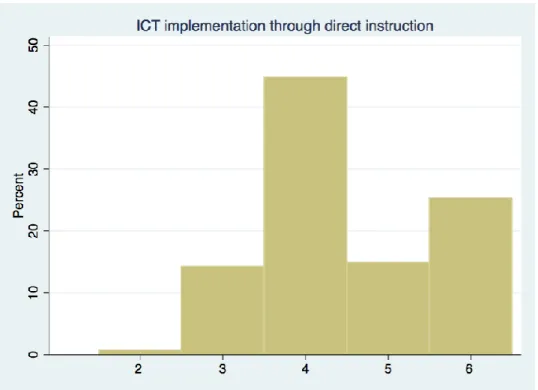
ICT implementation through direct instruction ... 59
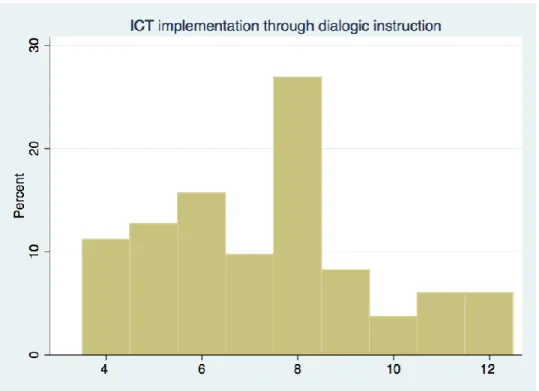
ICT implementation through dialogic instruction ... 60
ICT implementation for assessment ... 61
The Relationship between PD, Self-efficacy, and ICT Implementation ... 62
CHAPTER V: SUMMARY, DISCUSSION, AND RECOMMENDATIONS ... 69
Introduction ... 69
Summary of Findings ... 69
Teachers’ ICT Implementation during Mathematics Instruction ... 69
The association of PD and Self-Efficacy with ICT Implementation during Mathematics Instruction ... 70
Face-to-face vs. online PD ... 72
Self-Efficacy as a Mediator in the Relationship between PD and ICT Implementation during Mathematics Instruction... 75
Recommendations for Future Research ... 76
Limitations ... 78
Implications for Practice and Conclusion ... 80
REFERENCES ... 83
Appendix A: Testing Assumptions... 100
LIST OF TABLES
Table 1. Characteristics of the Study Sample ... 43
Table 2. A Description of Dependent Variables ... 46
Table 3. A Description of Independent Variables ... 49
Table 4. Respondents’ Demographics ... 54
Table 5. Direct Effects of Professional Development and Self-efficacy on Technology Use ... 65
Table 6. Mediator Effects of Self-efficacy in the Relationship between Professional Development and Technology Use ... 66
LIST OF FIGURES
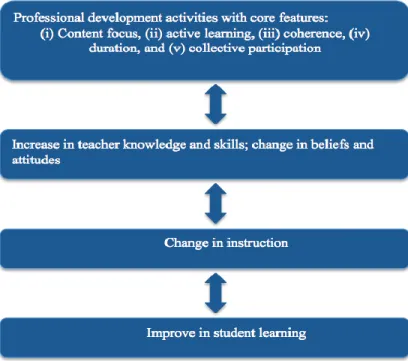
Figure 1. Desimone’s (2009) conceptual framework ... 13
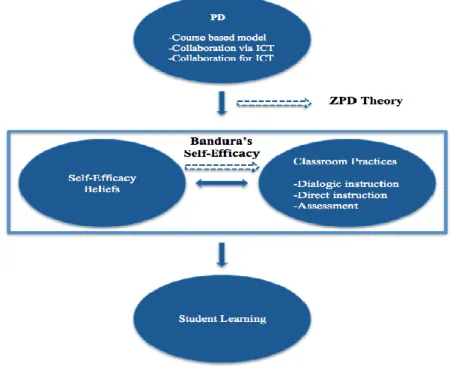
Figure 2. Theoretical model ... 20
Figure 3. ICT implementation through direct instruction ... 60
Figure 4. ICT implementation through dialogic instruction ... 61
CHAPTER I: INTRODUCTION
In today’s world, technology is easily accessible and readily available in everyday life. It is especially powerful in sustaining educational reforms (Toh, 2016). The potential of the use of digital technologies in teaching and learning is increasing dramatically, as technology becomes rapidly integrated in education. Classrooms today have many forms of technology, including computers, mobile devices, digital cameras, social media platforms and networks, software applications, the Internet, etc.
The uses of new technologies during instruction are essential for maintaining
opportunities for students to become digital learners in the information age (Greenhow, Robelia, & Hughes, 2009). Specifically, scholars found that technology is effective in improving student learning and achievement in mathematics (Barrow, Markman, & Rouse, 2008; Demirbilek & Tamer, 2010; Eyyam & Yaratan, 2014; House & Telese, 2012) and science (Delen & Bulut, 2011). Although technology integration is helpful in improving students’ mathematics
achievement, the role of teachers and their preparedness to use technology effectively in their classrooms remains critical and should be examined (Polly, Mims, Shepherd, & Inan, 2010). The massive portion of research related to the use of educational technologies has been conducted within developed countries (most of them in Europe, North America and East Asia) and informed by the needs of education systems in these same countries. However, this existing paradigm has been changing in this decade, as there are increase in research studies in
developing countries along with investments in education technology. Turkey is one of the developing countries who substantially invested in educational technology in the last two decades (Gumus, 2013).
Besides to the recent investments, many international and national studies agree that the effective integration of technology into classroom instruction has yet to be realized in Turkey.
For instance, in their report from the Trends in International Mathematics and Science Study (TIMSS) 2011 study, Mullis and his colleagues (2012) indicated that, in Turkey, 24% of eighth grade mathematics teachers allowed their students to explore mathematics principles and concepts on the computer at least monthly; 26% of math teachers had them look up ideas and information on computer; 22% of teachers had students process and analyze data at least
monthly; while only 21% of mathematics teachers had them use computers to practice skills and procedures. In the following study, TIMSS 2015, these percentages were as follows: 13% for exploring mathematics principles and concepts; 11% for look up ideas and information on computer; 15% for process and analyze data; 12% for use computers to practice skills and procedures (Mullis, Martin, Foy, & Hooper, 2016).
These low figures might be the result of many factors, especially, lack of knowledge and skills of mathematics teachers to teach with technology (Wachira and Keengwe, 2011). It is believed that to integrate technology in the classroom successfully, the teacher must be
competent in technology, must understand how to engage the student in learning, must have an in-depth knowledge of their subject matter, and must integrate all the components into the teaching (Koehler, Mishra, Kereluik, Shin, & Graham, 2014). Hagerman, Keller and Spicer (2013) found that most teachers would like to use technology in their classrooms but did not have the knowledge to effectively use the technology (Hagerman, Keller, & Spicer, 2013). Therefore, integrating technology into the classroom instruction requires that teachers must not only know the content, but also be pedagogically proficient in technology and be able to integrate it into their content area.
Previous studies point out the need for mathematics teachers to take quality technology education in order to facilitate technology integration into teaching. According to the Teaching and Learning International Survey (TALIS) 2013, the top two professional development needs of teachers were: (i) Learning to teach information and computer technology (ICT) skills
(mentioned by 19% of teachers); (ii) using new technologies in the workplace (18% of teachers) (OECD, 2014). In another study in Turkey, only 27% of eighth grade mathematics teachers reported that they had participated in a professional development activity focused on using technology in mathematic instruction in the past two years (Mullis et al., 2016). The recent investments and initiatives (e.g., the FATIH Project ‒ in Turkish, Fırsatları Artırma ve Teknolojiyi İyileştirme Hareketi) aims to increase the opportunities for teacher training on technology (Pouezevara, Dincer, Kipp, & Sariisik, 2003). As there are more training support for Turkish teachers than ever before, there is need to gain a better understanding about the influence of ICT related professional development on the growth of teachers’ ICT competences in Turkey (Aslan & Zhu, 2017; Aydin, Gurol, & Vanderlinde, 2016; Yuksel, 2012).
Statement of the Problem
Turkey is one of the developing countries who increasingly invested in educational technology in the last two decades (Gumus, 2013). Besides to those investments, findings from international assessments such as TIMSS and Program for International Student Assessment (PISA) indicated that Turkey’s academic achievement is far below the international average in mathematics (Gurria, 2013; Mullis et al., 2016). The International Computer and Information Literacy Study (ICILS) 2013 study also revealed that computer and information literacy scores of students in Turkey were noticeably lower than those of other participating countries. The findings show that students in Turkey need support not only for fostering mathematics
knowledge and literacy but also for training in computer literacy. To make learners more literate in both ICT skills and the content of mathematics, meaningful technology exposure should be offered to them and to their teachers. This can be done through; i) teachers’ technology integration into mathematics classrooms; and ii) teacher professional development to use technology. Focusing on a developing country for this study would finally contribute to the policies and practices in other developing countries as well.
Mathematics Teachers’ Technology Integration
Technology is an inevitable part of students’ lives and should be promoted in learning so that students experience the richness and flexibility it offers in learning and exploring
phenomena. The praise for technology implementation in teaching and learning mathematics is reflected in recommendations from a number of organizations such as the International Society for Technology in Education (ISTE, 2014), the National Council of Teachers of Mathematics (NCTM, 2000, 2014), and the National Council for the Accreditation of Teacher Education (NCATE, 2008). As stated in NCTM’s Principles to Actions (2014), “technology in mathematics classrooms influences not only how teachers teach but also what they are able to teach” (p.84).
The significance of technology implementation in improving student understanding of mathematics cannot be undervalued (Barrow, Markman, & Rouse, 2008). The studies found that technology integration into classrooms has a positive influence on students’ mathematics
learning (Barrow et al., 2008; Demirbilek & Tamer, 2010; Eyyam & Yaratan, 2014). Thus, the presence of technology in mathematics classrooms makes learning different as it mediates learning (Heid, 2005).
Teacher Technology Professional Development and Self-Efficacy
In-service teachers’ professional development (PD) and self-efficacy are keys to successful integration of instructional technologies (Beas & Salanova, 2006; Pan & Franklin, 2011; Serin, 2015; Uslu & Bumen, 2012). There is a need to understand what makes professional development effective for teachers to foster their expertise and skills about technology (Garet, Porter, Desimone, Birman, & Yoon, 2001; Kang, Cha, & Ha, 2013). Also, these studies do not highlight particular features of PD that are important for mathematics teachers’ use of
technology as well as the role of ICT self-efficacy for technology use in mathematics
classrooms. What is documented in the literature include 1) the role of collaboration, and 2) the role of technology as subject matter or mediator in PD.
In sum, when teachers are exposed to quality in-service education, they are more likely to have high confidence to use technology and provide quality instruction for students (Desimone, 2009; Yuksel, 2012). The improvement of mathematics teacher quality through useful
professional development activities and ICT self-efficacy is essential for promoting
instructionally innovative ways of teaching in mathematics instruction. Also, such a change in classroom practices can lead to an increase in students’ mathematics learning and more proficiency in a fundamental 21st century skill.
Purpose of the Study
This study uses nationally representative data of Turkey from the ICILS 2013 dataset, which is the latest version. This data was collected by country representatives in collaboration with the International Association for the Evaluation of Educational Achievement (IEA). The aim of the study is to a) describe eighth grade mathematics teachers’ uses of information and computer technologies in classroom instruction; b) examine the relationship between the
participation in technology related PD (Professional Development) and ICT self-efficacy, and ICT use; and c) the role of ICT self-efficacy as a mediator in the relationship between PD and technology use.
This study builds on the conversation about the relationships between eighth grade mathematics teachers’ PD activities and ICT self-efficacy and the degree to which they have implemented technology in Turkish classrooms. More importantly, this study is essential in adding to the literature by recognizing the mediating role of teachers’ ICT self-efficacy between professional development and teaching practice, which was also recommended for future
research in a study of Kang and his colleagues (2013). Research Questions The questions guiding this study as follows:
1.How does eighth grade mathematics teacher ICT implementation occur through (i) dialogic instruction, (ii) direct instruction, and (iii) assessment?
2. Is there any significant impact of ICT professional development and ICT self-efficacy on eighth grade mathematics teachers’ classroom ICT implementation?
3. To what extent does ICT self-efficacy mediate the relationship between ICT
professional development and eighth grade mathematics teachers’ classroom ICT implementation?
Significance of the Study
Recent studies investigating barriers to teachers’ integration of technology into their classrooms underline the lack of professional development opportunities and lack of support for teachers (Brun & Hinostroza, 2014; Inan & Lowther, 2010; Valcke, Rots, Verbeke, & Van Braak, 2007). Many of the studies conclude that there is a need to provide appropriate
professional development to increase teacher skills and competence (Guskey, 2002; Serin, 2015; Uslu & Bumen, 2012).
In considering Turkey’s recent attempts to support the integration of ICT into education and teacher training on ICT, it is important to determine the extent to which teachers and
students benefit from these efforts and investments. This study aims to evaluate the influence of various types of PD activities on mathematics teachers’ integration of ICT in their classrooms. In light of this intention, this study will inform policymakers and educational leaders on the types of PDs that matter for training teachers.
Significance of this study is various. First, the ICILS 2013 is a valuable dataset that is the largest and most recent technology survey in which Turkish teachers participated. Using this dataset validates the current study since the results are generalizable and reflect on the recent changes in Turkish education. Second, the study will focus on teachers of mathematics. Different from other content areas, technology is fundamental in effective mathematics teaching and has the potential to change traditional ways of doing mathematics. Finally, the importance of studies related to technology-supported mathematics education is growing in Turkey, considering the increasing awareness and support for technology integration in schools. Although the number of such studies has increased during the last decade, there is still research need for those
investigating the influence of ICT- related PD programs and ICT self-efficacy on ICT use for teaching (Aslan & Zhu, 2017; Aydin et al., 2016; Uslu & Bumen, 2012; Yuksel, 2012). Thus, this study would contribute meaningfully to the policies and practices and build on the literature by including the context from a developing country.
Organization of the Document
This document has five major segments: Introduction, Literature Review, Methodology, Results, and Discussion. Chapter I describes the introduction, problem statement, purpose of the study, research questions, significance of the study, limitations, and key definitions. In the next chapter, the literature on technology professional development, ICT self-efficacy, and
mathematics teachers’ integration of instructional technology during classroom instruction are discussed in relation to the research questions. Categorizations for the teacher technology professional development and instructional technology usage are discussed in detail in Chapter II. Chapter III describes the dataset used in this study, the research methods used to answer the research questions, and how variables are operationalized. Chapter IV will present results of data analysis while Chapter V will discuss the results, implications of this study, and
Definitions of Terms
The following key terms corresponding definitions are described below, and these terms are used throughout this dissertation.
Information and Computer Technologies (ICT): ICT is a term that includes any information gathering technologies and computers. It is a tool for accessing resources, communicating, analyzing or conducting simulations.
Self-Efficacy: According to Bandura (1982), “Self-efficacy is concerned with judgments of how well one can execute courses of action required to deal with prospective situations” (p. 122). ICT Self-Efficacy: ICT self-efficacy refers to beliefs in teachers’ ability to accomplish tasks on computer technologies.
Teacher Professional Development: Professional development is a set of activities teachers participates to earn or maintain knowledge and skills in a specific content and/or pedagogy such as conferences, courses, trainings, workshops, study groups, mentoring, and other online and face-to-face collaborative activities.
ICT Use: ICT use refers to the types of teachers’ information and computer technologies implementation in the classrooms through (i) dialogic instruction, (ii) direct instruction, and (iii) assessment.
Direct Instruction: The direct instruction model refers to instructional approaches that are structured, sequenced, and led by teachers and the presentation of content to students by teachers, such as in a lecture or demonstration.
Dialogic Instruction: Dialogic instruction means using talk and collaboration effectively for carrying out teaching and learning. In this model, students take active roles in their learning
whereas teachers facilitate student-led learning experiences including mathematical discussions, explorations of ideas (Lewis, 2014).
Zone of Proximal Development: Vygotsky (1978) defined ZPD as “the distance between the actual development level as determined by independent problem solving and the level of potential development as determined through problem solving under adult guidance or in collaboration with more capable peers” (p. 86).
Key to Abbreviations
The following abbreviations have been used in the document: ICT: Information and Computer Technologies
PD: Professional Development ZPD: Zone of Proximal Development
ISTE: International Society for Technology in Education ICILS: International Computer and Information Literacy Study
IEA: International Association for the Evaluation of Educational Achievement NCTM: National Council of Mathematics Teachers
TALIS: Teaching and Learning International Survey
OECD: Organization for Economic Co-operation and Development TIMSS: Trends in International Mathematics and Science Study
FATIH: Movement to Increase Opportunities and Improve Technology, in Turkish,
CHAPTER II: LITERATURE REVIEW
Many research studies have revealed the benefits of technology in improving student achievement. However, the role of teachers, and whether they are prepared to use technology effectively in their classrooms, should be examined (Polly et al., 2010). The following studies address critical and key ideas that guide the framework of this dissertation. The first section provides an overview of the theories and their relationship to teacher education, specifically in terms of a general description of Desimone’s (2009) framework and its application to the current study to interpret the relationship between teachers’ PD and self-efficacy with ICT integration in classrooms. ZPD (Zone of Proximal Development) theory and Bandura’s self-efficacy theory have been utilized to support Desimone’s argument. ZPD is applicable to research on technology integration and can explain the association between PD and mathematics teachers’ use of ICT tools while Bandura’s self-efficacy framework explains the influence of teachers’ self-efficacy in technology integration. The second section discusses previous research studies with a purpose of explaining the connection of teachers’ ICT professional development and ICT self-efficacy with teachers’ technology implementation into the classroom. The final section describes the
educational background in Turkey and the function of technology in Turkish education. Theoretical Framework
Technology integration is helpful in teaching and learning mathematics (NCTM, 2000). Teachers’ knowledge, beliefs, and how they implement technology in their classrooms are fundamental factors that impact this integration effectively and meaningfully (Wachira &
Keengwe, 2011). This section provides an overview of the theories and how they were utilized to develop the framework of this dissertation. There are three essential concepts that guide the theoretical approach of this dissertation. First, Desimone’s (2009) framework and its application
to the current study are discussed. Desimone’s (2009) conceptual structure addresses the influence of teacher professional development and self-efficacy on classroom practices. As Vygotsky’s ZPD explains the idea of professional development generating teacher change in practice, it is utilized to support Desimone’s argument in terms of the association between PD and mathematics teachers’ use of ICT tools. Third, the study gives an outline of Bandura’s self-efficacy to justify the effect of teachers’ self-self-efficacy in technology integration.
A Framework for Studying the Effects of Professional Development on Teachers Desimone’s (2009) conceptual framework has been introduced as a useful and comprehensive framework suggested by literature and empirical research to evaluate the influence of professional development and beliefs on teachers’ classroom practices. This comprehensive framework explains three facets: 1) the definition of effective professional
development, 2) the path showing how this effective professional development impacts teachers’ practices, and 3) the contextual factors influencing professional development (Kang et al., 2013).
Desimone (2009) proposed five core features of effective professional development that are critical to improving teacher knowledge and skills, improving their classroom practices, and finally increasing student achievement: (i) content focus, (ii) active learning, (iii) coherence, (iv) duration, and (v) collective participation.
The content focus. Content focus is the most effective feature of professional development (Desimone, 2009). Content indicates what teachers learn through professional development (Garet et al., 2001). Specifically, Kennedy (1998) defined two main types of
content in professional development: knowledge of the subject matter, and the knowledge of how students learn that content. Desimone (2009) pointed that focus on subject matter content is linked to increases in teacher acquisition, practices, and student learning of that content.
Active learning. Active learning occurs when the professional development maintains opportunities for teachers to engage in the evaluation of teaching and learning (Garet et al., 2001). And, it includes observations of expert teachers or being observed, allowing for constant feedback, and interactive discussions while reviewing student work, etc. Previous research studies have suggested a variety of ways to support active learning, such as observations of expert teachers or being observed, classroom visits, developing and presenting lessons, leading discussions, peer coaching, mentoring, and interacting with teachers to discuss steps for
improving teaching practice both face to face and virtually (Corcoran, 2007; Desimone, 2009; Harris, 2008b, Ryymin et al., 2008).
Coherence. Coherence is another feature that emphasizes the consistency of the content and underlying perspectives of professional development activities with the realities of teachers’ day-to-day work (Kang et al., 2013). Professional development is most effective when school
and state reforms and policies are aligned with what teachers are learning in professional development.
Duration. Time span is also an important feature to increase the quality of professional development. Hochberg and Desimone (2010) defined duration as “both the number of contact hours of a professional development activity, and the length of time over which engagement in the activity spans” (p. 96). For meaningful change in teacher beliefs and practices to occur, a professional development activity should be offered over a semester or intense summer program with at least 20 hours.
Collective participation. Collective participation is proposed as another feature that requires teachers from same school, grade, and/or content area to participate in the professional development programs collectively. A correlational analysis found that collective participation has a significant relationship with teacher changes in technology integration practices (Penuel, Fishman, Yamaguchi & Gallagher, 2007). Therefore, teachers have more change in classroom practices when they join the professional activities with other teachers from the same
department, grade groupings, school, or set of schools.
In addition to the core features, Desimone (2009) proposed a conceptual framework for studying the effects of professional development on teachers and students (See Figure 1). This model allows researchers to study the change that professional development generates in
teachers’ beliefs, knowledge, or practice. Also, this model can be utilized to understand how the change in instruction might influence students learning outcomes.
A previous study that used Desimone’s framework analyzed the effectiveness of an instructional-technology professional development program in a multiphase evaluation (Martin et al., 2010). The authors first examined the program, and then determined the impact of various
features in program implementation on teacher outcomes and student achievement. Martin and his colleagues (2010) found that greater PD participation was linked to higher-quality teacher products and higher student achievement. Those teacher products involved instruction modeling, technology integration, and inquiry-based learning. Another previous study utilized Desimone’s framework to examine the effect of PD on only student outcomes. Campbell (2011) conducted a 3-year randomized control study and found that over time mathematics coaches who highly engaged in PD courses including mathematics content, and pedagogy were positively effective in student achievement in grades 3, 4, and 5.
This current study intends to investigate the influence of eighth grade mathematics teachers’ technology professional development and technology self-efficacy on teacher changes in classroom technology integration practices. Also, it aims to picture the mediating role of technology self-efficacy between teacher professional development and classroom practices. Therefore, the framework for this study draws from Desimone’s (2009) conceptual framework to examine the contribution of several types of professional development activities and ICT-self efficacy on the effectiveness of ICT implementation in mathematics classrooms.
Zone of Proximal Development Theory
The Zone of Proximal Development (ZPD) is one of the major themes in Vygotsky's sociocultural theory. Vygotsky (1978) defined ZPD as “the distance between the actual development level as determined by independent problem solving and the level of potential development as determined through problem solving under adult guidance or in collaboration with more capable peers” (p. 86). That is, the ZPD addresses the gap between an individual’s ability to perform a task and the higher level of performance that can be promoted by others with
more experience (Vygotsky, 1962). The ZPD involves a variety of tasks that individuals can accomplish with the help of others but cannot yet perform independently.
Originally, this concept was intended to explain child development. However, researchers in the literature noted that the Zone Theory could be practiced in the context of teacher education (Blanton, Westbrook, & Carter, 2005; Fani & Ghaemi, 2011; Hussain, Monaghan, & Threlfall, 2013; Kuusisaari, 2014). Zone theories were employed in teacher education research in various subject areas such as language, science, and mathematics. In their study, Shabani, Khatib, and Ebadi (2010) examined the instructional implications of Vygotsky's concept of Zone of Proximal Development and its applications to the notion of language teacher professional development. Kuusisaari (2014) utilized ZPD theory to explore the benefits of in-service teacher collaboration in teacher development. In that study, the author concluded that teachers can foster their
knowledge with collaboration when they raise questions and revise collaboratively developed ideas (Kuusisaari, 2014).
Goos (2005) first applied Vygotsky’s ZPD to analyze how collaboration might influence the integration of pre-service and novice secondary mathematics teachers’ technology (e.g. computers and graphics calculators) into classroom practice. Then the concept was utilized in a series of studies investigating factors (beliefs, knowledge, professional development activities, teacher collaboration, etc.) influencing secondary mathematics teachers’ application of digital technologies in classroom instruction (Bennison & Goos, 2010; Goos, 2012; Goos & Bennison, 2008).
Regarding the theoretical framework discussed above, teachers’ professional development experiences and collaboration efforts can be explained as complementary components of a teacher’s Zone of Proximal Development. By applying the theory of ZPD,
professional development programs as “capable others” could promote teachers’ competencies and skills, as learning shifts from individual to collaborative settings (Wu, 2004). Therefore, it is appropriate to extend the theory in order to understand the influence of teachers’ collaborative development activities on classroom use of technology by placing teachers in the learner position.
Self-efficacy Theory
All teachers hold various educational beliefs about work, students, subject matter, and their roles and responsibilities (Pajares, 1992). Although the construct of educational beliefs is itself wide-ranging and “too difficult to operationalize” (p. 316), Pajares has identified several types of educational beliefs: teacher efficacy, epistemological beliefs, perceptions of self-worth (self-esteem), beliefs about a particular subject, and the self-efficacy of performing specific tasks. As Pan and Franklin (2011, p. 29) asserted, “due to the fact that what people do and believe may not always be consistent, people’s behaviors are usually guided by their perceptions of self- efficacy instead of their actual capabilities.” Since its introduction in the literature, the construct of self-efficacy has been identified as a significant variable for predicting an
individual’s behavior (Joo, Lim, & Kim, 2013; Pajares & Miller, 1994).
Bandura (1986) defined self-efficacy as “People’s judgment of their capabilities to organize and execute courses of action required to attain designated types of performances” (p. 391); it is categorized as either high or low. If people have a high self-efficacy, they have a high level of belief in their ability to perform an action and finally achieve a goal. Task
accomplishment provides the basis for further improvement in self-efficacy (Hale, 2013). The lower self-efficacy is, the less the level of belief in one’s ability to perform a particular task.
Bandura (1977) identified four main sources of self-efficacy: experiences of mastery, vicarious experiences, social persuasion, and emotional states. Experiences of mastery are one of the most prominent sources of self-efficacy, including prior successful experiences leading to the development of personal efficacy (Bandura, 1982). Vicarious experiences originate from the observation of peers or “others.” If the observed others perform a task successfully, this
observation may increase the observer’s self-efficacy (Fanni, Rega, & Cantoni, 2013). But seeing them fail may negatively influence efficacy level of the observer. Third source of
self-efficacy is social persuasion. It explains that one’s self-efficacy may be positively affected if others’ encouragement occurs. As Bandura (1982, p. 127) states, “Although social persuasion alone may be limited in its power to create enduring increases in self-efficacy, it can contribute to successful performance if the heightened appraisal is within realistic bounds.” According to Bandura, emotional states symbolize the final piece of self-efficacy. Individuals with a high level of self-efficacy may employ even negative psychological factors such as stress or tension to foster their performance, while those with a lower self-efficacy take these emotional states as a barrier to performing well (Fanni et al., 2013).
Teachers’ perceived ICT competency is an influential factor in their integration of technology in instruction (Beas & Salanova, 2006). High correlations were often found between teachers perceived self-efficacy and technology implementation (Pan & Franklin, 2011; Sang, Valcke, Braak, & Tondeur, 2010), although a few studies found technology self-efficacy was not significantly correlated to teachers’ efficient use of technology (e.g., Fanni et al., 2013). This study will utilize Bandura’s concept of efficacy to investigate how teachers’ ICT self-efficacy might influence their actual implementation of ICT in classrooms.
The Theoretical Model
Figure 2 below represents the theoretical model of this study. This study investigates the influence of ICT related professional development and self-efficacy on mathematics teachers’ technology implementation in the classroom and also examines how ICT self-efficacy mediates the relationship between PD and technology implementation. The three types of professional development considered in this study are listed in the left-hand boxes of Figure 2: Course-based ICT learning, supported collaboration for learning, and collaboration for seeking ICT-related knowledge. These three types of teacher PD have several components, drawn from the literature reviewed in this chapter. Teachers’ ICT self-efficacy represents a scale to measure teachers’ ability to perform a series of tasks on a computer by themselves. Furthermore, this study focuses on three types of ICT usage in mathematics classrooms. These are ICT use supporting dialogic instruction, ICT use supporting direct instruction, and ICT use through assessment.
Previous Research Studies Teachers’ Technology Use
Teachers have always been considered as the key to student success. As their role is changing, the International Society for Technology in Education (ISTE) has proposed new technology standards for teachers. In the latest available standards instituted in 2008, the ISTE outlined the novel skills and pedagogical visions teachers need to teach, work, and learn in the digital age. The ISTE technology standards for teachers are as follows (ISTE, 2014, pp. 1-2): (i) Facilitate and inspire student learning and creativity; (ii) Design and develop digital-age learning experiences and assessments; (iii) Model digital age work and learning; (iv) Promote and model digital citizenship and responsibility; and (v) Engage in professional growth and leadership.
Rubin (1996) emphasized that inquiry-based learning has usually occurred without technology; indeed, technology is not always needed. But, the author added, “Technology can play a special role in supporting inquiry-based learning and in transforming classroom practice” (p. 36). For a better understanding of how technology can support effective learning, Rubin (1996) noted two important distinctions: (i) technology being used as the subject of instruction or as a tool for teaching, and (ii) technology being used as amplifiers and transformers. Using technology as amplifiers can change the classroom practice in a more efficient way, while using technology as transformers can change the learning process and the way the instruction is carried out (Rubin, 1996).
Ainley, Banks, and Fleming (2002) investigated the ways in which ICT influence teaching and learning in technology-rich elementary and secondary classrooms. Based on case studies, they classified instructional computer use in four categories: computers as information resource tools, computers as authoring tools, computers as knowledge construction tools, and
computers as learning reinforcement tools (Ainley et al., 2002). Baylor and Ritchie (2002) believed that, in the classroom, technology could be used either as the subject matter for study or as an instructional tool for teaching and learning. In addition, they included the following types of educational technology in their classification: the use of computers for collaboration,
constructivist use of technology, and the use of computers for higher-order skills (Baylor & Ritchie, 2002).
Similar to Rubin’s (1996) categorization, Hughes (2005) classified technology-supported teaching practices into three phases: Replacement, amplification, and transformation. In the
replacement phase, teachers tend to implement technology as a tool that does not change instructional goals and learning processes. The amplification phase requires technology to be more effective than replacement, but again the tasks remain the same. Transformational use of technology is the most effective, as it may change the instruction from teacher-centered to student-centered and also foster student development (Hughes, 2005). Moreover, in a previous study, Tondeur, Van Braak, and Valcke (2007) identified three reliable factors for primary school teachers’ ICT competencies as follows: “Technical ICT skills, ICT competencies focusing on the learning process, and social and ethical ICT competencies” (p. 967). Finally, using a nationally representative dataset of 1653 Norwegian eighth-grade teachers, Scherer, Siddiq, and Teo (2015) classified some constructs to contribute to the literature on typologies of ICT usage. Their classification divides instructional ICT use into three categories: assessment and feedback, collaboration among students, and fostering the development of students’ skills.
Snoeyink and Ertmer (2001) attempted to identify factors impacting technology integration by teachers by classifying them into two categories: first-order (external) barriers, including resource-related issues such as lack of equipment and lack of support, and
second-order (internal) barriers, including organizational culture as well as teachers’ beliefs and attitudes about teaching and technology. Similarly, Wachira and Keengwe (2011) also identified a range of factors influencing mathematics teachers’ interest in and implementation of technology. These included availability and reliability, time, anxiety and confidence, access to appropriate teaching materials, access to technical support, the level of technology leadership, knowledge of
technology integration into mathematics teaching, and beliefs about technology in learning (Wachira & Keengwe, 2011). This study specifically focused on teachers’ access to appropriate professional development activities and self-confidence in using ICT, both widely acknowledged to be critical factors that affect teachers’ classroom technology usage.
Technology use in mathematics classrooms. For effective learning of mathematics, technology must be fundamental part of the classroom instruction (NCTM, 2014). In the 21st century, instructional technologies in mathematics classrooms can be found in several formats, such as graphing calculators, web-based sources, instructional software, tablet PCs, desktop-based devices, Interactive White Boards, mobile devices, etc. From these forms of technologies, it can be seen that the technology in the mathematics classroom is changing from calculators to information and computer-based technologies. National Council of Teachers of Mathematics’
Principles and Standards for School Mathematics (2000) addressed technology in six crucial issues in mathematics education in addition to equity, teaching, learning, curriculum, and assessment. Because mathematics education is articulated across all six principles (Sherman, 2012), the role of technology in mathematics education has been intriguing.
According to NCTM’s Principles and Standards for School Mathematics (2000),
“Technology is essential in teaching and learning mathematics; it influences the mathematics that is taught and enhances student learning” (p.24). While technology is influential as a teaching and
learning tool in mathematics classrooms, it is not technology itself that causes the difference in teaching and learning. In particular, how technologies are used and by whom are critical factors making that difference (Heid, 2005). Therefore, technology-supported mathematics teaching approaches receives a special attention.
There are several studies in the literature that focus on patterns of technology’s role in mathematics teaching and learning. For example, Goos, Galbraith, Renshaw, and Geiger (2003) proposed four roles for technology in math classrooms in terms of teaching interactions: Master, servant, partner, and extension of self. Technology as master refers to using technology as an instructional tool in the case that teachers have a limited expertise with technology. In this model, students are usually encouraged to use technology to present ideas (e.g., projector, white board) to fill the lack of teachers’ technical competence (Goos et al., 2003). Technology as servant means that technology is utilized as a replacement for basic mathematical procedures such as calculations and visual representations and the tasks remain same (Hughes, 2005). This use of technology supports teaching but does not involve any creativity to change the nature of activities (Goos et al., 2003). Technology’s role as a partnergenerates new ways for students and teachers to facilitate learning. This model requires that the technology mediates mathematical discussion and student interactions to promote understanding (Baylor & Ritchie, 2002). The last type, technology as extension of self, is the most advanced that has teachers and students as technological experts who are integrating technology inherently into teaching and learning (Goos et al., 2003). This naturally changes the instruction from teacher-centered to student-centered (Hughes, 2005).
In a recent study, Munter, Stein, and Smith (2015) described two distinct models of mathematics instruction in terms of pedagogy. Those included dialogic and direct instruction.
Although dialogic and direct instruction models have similarities, they especially differ in terms of students’ roles in learning, mathematical creativity, group work, and role of representations (Munter et al., 2015). For instance, dialogic instruction provides more opportunities for students to engage in small group and whole-class discussions to talk about their ideas, questions, and disagreements (Lewis, 2014). Through dialogic instruction, students take an active, dominant role in their learning whereas teachers facilitate student-led learning experiences including mathematical discussions, explorations of ideas (Lewis, 2014).
As the present study focuses on teachers’ technology implementation in mathematics classrooms, three important types of mathematics teachers’ instructional technology use were determined based on the existing literature (e.g., Munter et al., 2015) to form the focus of this study.
Technology use supporting dialogic instruction. Dialogic instruction is an effective teaching method of mathematics. It refers to student-centered and active learning process in which students build on prior knowledge with new experiences in socially constructed ways (Munter et al., 2015; NCTM, 2014). The Standards for Mathematical Practice (SMP) in the Common Core State Standards recommend that students should work collaboratively in developing and discussing ideas and concepts to enhance understanding (CCSSI 2010, SMP 2 and 3, p. 6). Also, students should use technology appropriately and communicate precisely to others in a mathematical discussion (SMP 5 and 6, p. 7).
Effective uses of ICT tools in centered mathematics instruction enable student-led discussions, proper communication, and collaboration among students. McCoy (2014) investigated the effect of information technology on attitudes toward mathematics in a middle graders’ algebra class. The study revealed that group collaboration generated more better
learning and understanding of mathematics. Therefore, McCoy (2014) suggested that technology was effective for students’ modeling, collaboration, and communication with understanding.
Furthermore, Mullins, Rummel, and Spada (2011) examined how collaboration might affect students learning of mathematics in a computer-supported classroom. It was found that collaborative student-centered activities generate a significant change in students’ mathematics learning outcomes in a technology-integrated classroom. However, teacher-centered and procedural instruction resulted in no effect on the development of mathematics understanding (Mullins et al., 2011).
Technology use supporting direct instruction. According to Munter et al. (2015), the direct instruction model represents lessons that include the followings: (a) The teacher’s descriptions of an objective and connections to previous topics; (b) presentation of necessary concepts; (c) demonstration of how to complete the target problem type; and (d) scaffolded phases of guided and independent practice, accompanied by immediate corrective feedback (p.6). Differing from dialogic instruction, this model does not require any communication or
collaboration among students.
Direct instruction model does not only depress students’ role but also technology’s role in learning. In teacher-centered instruction, ICT tools can be used to present information through direct class instruction and reinforce learning of skills through repetition of examples. This type of technology uses only functions as a replacement and does not change any instructional practice, processes of student learning, or lesson goal (Hughes, 2005). When teachers assign passive roles to students and technology during classroom instruction, students’ mathematics understanding does not increase (Mullins et al., 2011).
Technology use through assessment. Assessment is a fundamental part of instruction. In effective mathematics instruction, assessment should help students identify the difficulties and strengths of past performance and that foster their learning (NCTM, 2014). Assessment should have four different functions in mathematics teaching and learning: (i) Tracing students’ progress to foster learning; (ii) making instructional decisions to adjust teaching; (iii) evaluating students’ achievement to report understanding of students; (iv) evaluating programs for decision-making about instructional programs (NCTM, 2014, p.89).
Assessment has two common types: Formative and summative. Summative often occurs at the end of a particular course, degree, or year whereas formative assessment primarily aims to inform teachers about students’ learning progress. There are also two common forms of
formative assessment including oral and written assessments. Currently, a novel form emerged, assessment via ICT (Van den Heuvel-Panhuizen, Kolovou, & Peltenburg, 2011). ICT-based assessment generates better assessment in three ways: (i) Tasks can demand high mathematical procedures; (ii) tasks become more accessible; (iii) it exposes student-thinking process (Van den Heuvel-Panhuizen et al., 2011). The research underlines that ICT use in combination with formative feedback and assessment improves mathematics development of students (Genlott & Gronlund, 2016).
Teacher Professional Development
Professional development activities aim to generate a change in behavior. Guskey (2002) identified three primary goals of such programs as a change in the classroom traditions of
teachers, a change in their views and beliefs, and a change in the learning outcomes of students. According to Guskey’s Model of Teacher Change, the sequence of such changes occurs as follows: “Teacher professional development -> changes in the classroom practices of teachers ->
change in the learning outcomes of students -> change in teachers’ attitudes and beliefs”
(Guskey, 2002, p. 383). Therefore, efficient technology professional development programs first influence teachers and students to use technology in the classroom. As this use leads to better learning outcomes, teachers develop more positive attitudes and beliefs about technology.
In professional development literature, various criteria have been used to classify the types of effective professional development that foster teacher competencies and expertise. In an earlier study, Lauro and Dennis (1995) proposed five approaches to effective professional development for teachers: (1) A comprehensive learning approach that brings experts into a district or school to facilitate staff development sessions; (2) a one-shot deal that occurs before the academic year starts and brings in a presenter for staff members to focus on a particular topic; (3) conferences in only one location and in a specified time period that provide significant amounts of information on different practices and theories; (4) in-house training offered by experts for ongoing development; and (5) video-based learning where teachers utilize online resources and videos as a source of inspiration and long-term change for themselves. Each
training approach can be useful in different cases according to learners’ needs and learning types. Lauro and Dennis (1995) described the comprehensive option as the most efficient, while the one-shot deal was defined as the type usually chosen for teacher development. Similar to the above classification, Corcoran (1995) also attempted to fit professional development into three categories: Traditional in-service programs (designed by state education departments,
universities, etc.), in-house district activities, and school-based staff development. Furthermore, Harris (2008b) divided 20 educational technology PD models into five types: (a) Instructor-organized sessions (demonstrations, hands-on workshops, large-group and small-group
exploration, unassisted or assisted exploration, individual learning plans, prescribed and managed instruction); (c) collaborative learning (classroom visits, mentoring, peer coaching, sharing best practices both face-to-face and virtually, lesson study); (d) data-based inquiry (independent, collaborative, or externally assisted action research); and (e) development of materials (collaborative and individual). In the same year, Ryymin, Palonen & Hakkarainen (2008) analyzed the collaboration structure of teachers concerning their use of ICT. Four patterns of collaborative learning were introduced: The Counselor, the Weakly Social, the Collaborator, and the Inquirer. The Counselor actively provides guidance and advice without seeking
information from colleagues. The Weakly Social favors media rather than face-to-face interactions in his/her information seeking. The Collaborator uses several kinds of media for web-based learning, while the Inquirer is an active seeker of ICT- related information and engages in face-to-face connections in the school (Ryymin et al., 2008).
In their study, Garet et al. (2001) used a nationally representative sample of mathematics and science teachers to show the effects of various types of PD on teachers’ skills. They
proposed several structural and core features of effective professional development activities in order to make positive changes in teachers’ knowledge, skills, and classroom practices.
Structural features refer to the form of activity, its duration, and the collective participation of teachers from the same school, while core features focus on content knowledge, opportunities for active learning, and coherence with other learning activities (Garet et al., 2001, p. 920). They also identified two broad categories of PD activities that are distinct in form, namely: Traditional vs. reform. Non-reform types of PD include workshops, conferences, courses, training, etc. Reform types of PD include study groups and network that support for collaborative learning. There are three types of professional development as the focus of this study: (i) Course- and
training-based model (Corcoran, 1995; Garet et al., 2001); (ii) ICT mediated collaboration for learning (Bates, Phalen, & Moran, 2016; Duncan-Howell, 2010; Tinker, 2001; Ryymin et al., 2008); (iii) collaboration for ICT-related information (Borko, 2004; Carlson & Gadio, 2002; Ryymin et al., 2008).
Course- and training-based model. Course-based and training-based professional development activities have often been defined as non-reform types of professional development (e.g. Corcoran, 1995; Garet et al., 2001). These types of PD usually occur outside the teacher’s school or classroom and are delivered by experts in the various fields (Garet et al., 2001). Although non-reform PD programs are extensively used for teacher development, they are often criticized as not being useful in aiding teachers to incorporate technology successfully into their teaching and to feel confident using it (Carlson & Gadio, 2002). As a result, a new paradigm in professional development has emerged, involving study groups, mentorship, and coaching (Carlson & Gadio, 2002).
Collaboration for ICT-related information. Ryymin and his colleagues (2008) define this type of teacher collaboration use as active seeking of ICT- related information and engaging in face-to-face connections in the school. This type of learning usually occurs during the school day, particularly during classroom instruction supporting collaboration among teachers and experts. Harris (2008a) points out, “Collaborative learning is a promising model of professional development for teachers that has a growing research base demonstrating its effectiveness. It is the most desired—but unfortunately, also one of the least frequently practiced” (p. 24). Putnam and Borko (2000) suggested that teachers learn best in their own classrooms. As the teachers’ learning is situated directly in classroom practices, teacher change becomes powerful (Putnam & Borko, 2000). Therefore, teacher collaboration during school hours might effectively create a
significant change in teachers’ technology learning and implementation. Finally, collaborative teacher learning might occur not only face–to-face but also virtually (Harris, 2008a).
ICT mediated collaboration for learning. ICT mediated collaboration is defined as a networking structure in which teachers use several kinds of media for web-based learning including discussion boards, forums, and blogs, etc. Bates, Phalen, and Moran (2016) have broadly defined online PD as synchronous, asynchronous, and hybrid. Synchronous PD activities happen in real time and provide in-person PD in a virtual setting. Asynchronous PD happens at different times and includes self-paced interaction. Teacher social networks, discussion boards, and resource-sharing websites are the most common types of asynchronous platforms for
teachers’ PD. Hybrid model of collaboration includes online learning activities take place as part of a larger in-person learning opportunity. For example, in-person trainings or courses that require virtual collaboration or other online tasks between sessions. These hybrid opportunities may use synchronous or asynchronous online tools based on the tasks (Bates et al., 2016).
A well-designed PD needs to enhance teachers’ abilities to use technology in
collaboration and communication with colleagues in both local and global platforms (NCTM, 2014). Teachers need to actively seek out ways of using technology to support mathematics learning of students. As technology lets teachers collaborate with others, they bring more innovative ways into classrooms for students to use technology to describe mathematical thinking and generate mathematical discussions (NCTM, 2014).
Online spaces for PD can be an ideal choice “when teachers need access to colleagues with similar interests, but these collaborators are not available at their home schools” (Bates et al., 2016, p. 72). Supporting this, the previous studies state that online learning communities can become more effective when it is designed as a follow-up support platform for those who seek
further guidance and resources sharing after joining a face-to-face PD (McConnell, Parker, Eberhardt, Koehler, & Lundeberg, 2013; Sentence & Humphreys, 2015). These studies also highlight the fact that teachers mostly prefer face-to-face trainings and meetings for professional learning.
Professional Development and Technology Use
Researchers see a correlation between the style of professional development and its effectiveness in teachers’ technology integration. Uslu and Bumen (2012) conducted a study to analyze the impact of a six-week PD program on teachers’ technology integration and attitudes towards ICT. The results showed that the PD program significantly increased technology integration of teachers as confirmed by pre- and post-tests, while no difference was detected on the teachers’ attitudes towards ICT.
Lavonen and his colleagues investigated the effect of a PD program on science teachers’ ICT competence and integration (Lavonen, Juuti, Aksela, & Meisalo, 2006). They observed a substantial increase in science teachers’ ICT use and skill during the PD program. They also proposed some suggestions to improve the effectiveness of ICT-related PD programs on technology integration. For example, the programs should encourage collaboration (sharing ideas, group work, etc.) and should be pedagogy focused (Lavonen et al., 2006). Similarly, Serin (2015) conducted a quantitative study to investigate the relationship between science teachers’ perceived needs in ICT-related PD and their ICT-related classroom practices. He found that science teachers who reported no need for any PD already showed significantly higher use of technology during classroom instruction (Serin, 2015).
In addition, Cristo (2005) investigated the effect of a training designed to guide
implementation. The study focused on the ICT tools of Geometer’s sketchpad and Excel. In conclusion, Cristo (2005) suggested that familiarity with an ICT application and knowledge of how to use them was influential factors for the teachers to be able to integrate them in
mathematics classrooms. Supporting Cristo’s (2005) findings, Goos and Bennison (2008) found professional development as a significant predictor for the frequency of mathematics teachers’ technology implementation in teaching. Eventually, Loong (2003) carried out a small-scale survey study on 63 secondary mathematics teachers in Australia. The survey asked about
frequency of Internet use, ways in which teachers used the Internet for mathematics learning, and their professional development experiences. No statistically significant relationships were found between use and competency, and professional development (Loong, 2003).
Different than the studies cited above, there were previous research focused on the effect of online PD on teacher outcomes. Dalgarno and Colgan (2007) investigated the benefits of an online community on improving elementary mathematics teachers’ knowledge gain in terms of technology, pedagogy, and content. It has been emphasized that mathematics teachers are active seekers of technology mediated professional development experiences and opportunities for sharing and communicating, and access to quality resources (Dalgarno & Colgan, 2007).
Therefore, as mathematics teachers can have access to knowledge through technology-facilitated learning, their technology integrated classroom practices might change. In their study, Fishman and his colleagues (2013) examined differences in science teacher and student learning from professional development (PD) in two modalities: Online and face-to-face. They found that teachers and students exhibited significant gains in both conditions, and that there was no significant difference between conditions. Therefore, science teachers’ knowledge, beliefs, and classroom practices significantly increased after both face to face and online PD. Although these