White Rose Research Online URL for this paper:
http://eprints.whiterose.ac.uk/153402/
Version: Accepted Version
Article:
Michelot, T., Blackwell, P.G. orcid.org/0000-0002-3141-4914, Chamaillé Jammes, S. et al.
‐
(1 more author) (2019) Inference in MCMC step selection models. Biometrics. ISSN
0006-341X
https://doi.org/10.1111/biom.13170
This is the peer reviewed version of the following article: Michelot, T. , Blackwell, P. G.,
Chamaillé Jammes, S. and Matthiopoulos, J. (2019), Inference in MCMC step selection
‐
models. Biometrics, which has been published in final form at
https://doi.org/10.1111/biom.13170. This article may be used for non-commercial purposes
in accordance with Wiley Terms and Conditions for Use of Self-Archived Versions.
[email protected] https://eprints.whiterose.ac.uk/
Reuse
Items deposited in White Rose Research Online are protected by copyright, with all rights reserved unless indicated otherwise. They may be downloaded and/or printed for private study, or other acts as permitted by national copyright laws. The publisher or other rights holders may allow further reproduction and re-use of the full text version. This is indicated by the licence information on the White Rose Research Online record for the item.
Takedown
If you consider content in White Rose Research Online to be in breach of UK law, please notify us by
Inference in MCMC step selection models
Th´eo Michelot∗
Centre for Research into Ecological and Environmental Modelling, University of St Andrews, Buchanan Gardens, St Andrews KY169LZ, U.K.
*email:[email protected]
and
Paul G. Blackwell
School of Mathematics and Statistics,
University of Sheffield, Hounsfield Road, Sheffield S37RH, U.K.
and
Simon Chamaill´e-Jammes
CEFE, CNRS, Universit´e de Montpellier,
Universit´e Paul Val´ery Montpellier, EPHE, IRD, Montpellier, France
and
Jason Matthiopoulos
Institute of Biodiversity, Animal Health and Comparative Medicine, Graham Kerr Building, College of Medical, Veterinary and Life Sciences,
University of Glasgow, Glasgow G128QQ, U.K.
Summary: Habitat selection models are used in ecology to link the spatial distribution of animals to environmental covariates, and identify preferred habitats. The most widely used models of this type, resource selection functions, aim to capture the steady-state distribution of space use of the animal, but they assume independence between the observed locations of an animal. This is unrealistic when location data display temporal autocorrelation. The alternative approach of step selection functions embed habitat selection in a model of animal movement, to account for the autocorrelation. However, inferences from step selection functions depend on the underlying movement model, and they do not readily predict steady-state space use. We suggest an analogy between parameter updates and target distributions in Markov chain Monte Carlo (MCMC) algorithms, and step selection and steady-state distributions
000 0000
in movement ecology, leading to a step selection model with an explicit steady-state distribution. In this framework, we explain how maximum likelihood estimation can be used for simultaneous inference about movement and habitat selection. We describe the local Gibbs sampler, a novel rejection-free MCMC scheme, use it as the basis of a flexible class of animal movement models, and derive its likelihood function for several important special cases. In a simulation study, we verify that maximum likelihood estimation can recover all model parameters. We illustrate the application of the method with data from a zebra.
Key words: animal movement, local Gibbs sampler, Markov chain Monte Carlo, MCMC step selection, resource
1. Introduction
Location data are routinely collected on animals, e.g. with GPS tags, resulting in bivariate
time series of coordinates. Statistical methods have been developed to combine location data
with environmental data, to understand how an animal’s use of space relates to the
distribu-tions of spatial covariates (e.g. vegetation type or resource density; see Manly et al., 2002).
A common focus of such analyses is habitat selection, i.e. deviations from proportionality
between habitat availability and habitat use by the animal (Northrup et al., 2013). Habitat
availability is derived from maps of the covariates, and habitat use from the location data. If
the time that the animal spends in different habitats is not proportional to their prevalence
in the study region, this suggests that it selects certain habitats over others, which is of great
interest for conservation.
In habitat selection studies, the goal is to estimate a habitat selection function
w
(c(x)),
which measures the strength of the selection for a habitat unit defined by the vector of
covariates
c(x) = (
c
1(x)
, . . . , c
J(x)) at spatial location
x. Habitat selection functions usually
take the form
w
{
c(x)
}
= exp
{
β
′c(x)
}
,
(1)
where
β
′= (
β
1, . . . , β
J) is a vector of unknown parameters. Each parameter
β
jreflects the
effect of the covariate
c
jon the animal’s use of space (i.e. apparent selection or avoidance).
Most commonly, the function
w
is called the “resource selection function” (RSF), and it is
interpreted as the long-term habitat selection by the animal (Boyce and McDonald, 1999).
The RSF is used to model the stationary distribution
π
(x) of the animal’s location in space,
termed the utilization distribution,
π
(x) =
R
w
{
c(x)
}
Ωw
{
c(y)
}
d
y
(2)
where Ω denotes the study region. For example, if we consider a categorical habitat variable,
the utilization distribution
π
takes a different value over each habitat type. The utilization
distribution can be viewed as a heatmap of the animal’s usage of space, or as the probability
density for its location at an arbitrary time.
The coefficients
β
jof the RSF link the utilization distribution to the distributions of
covariates. They can be estimated from location data, e.g. using a logistic regression for
use-availability data (Aarts et al., 2012). RSF models assume that the observed locations
are an independent sample from the utilization distribution, and they often ignore the
autocorrelation inherent in animal movement data (Fieberg et al., 2010). To define habitat
availability, RSF analyses typically assume that any location within the study area (e.g.
home range, population range) is equally accessible to the individual at each time step
(Matthiopoulos, 2003). However, ignoring the effect of movement can lead to
misinterpreta-tions, and the definition of the region of availability can have an impact on the estimated
selection parameters and utilization distribution (Beyer et al., 2010).
Alternatively, to address these limitations of RSFs, habitat selection can be defined through
a step selection function (SSF; Rhodes et al., 2005; Fortin et al., 2005), which measures
habitat selection at the time-scale of the individual observed movement steps. In an SSF
model, the likelihood of an animal moving from a location
x
to a location
y
is
p
(y
|
x) =
R
φ
(y
|
x)
w
{
c(y)
}
Ωφ
(z
|
x)
w
{
c(z)
}
d
z
,
(3)
where
φ
(y
|
x) is the likelihood of a step from
x
to
y
in the absence of covariate effects,
which describes the underlying movement model. Matched conditional logistic regression is
typically used to estimate the parameters
β
jof a SSF from telemetry data (Forester et al.,
2009). The autocorrelation of the data is explicitly accounted for, with this joint model of
animal movement and habitat selection. Habitat availability is specified by the movement
model, which describes which spatial units are accessible to the animal within one time step,
given its current location.
the regression coefficients
β
jdo not represent quite the same things in the two cases,
and the methods described do not lead to the same estimates of the coefficients, or of
the function
w
and the implied steady-state distribution. In an RSF, the coefficients are
directly linked to the global distribution
π
(x) of space use through Equation 2. However,
the coefficients of an SSF measure local habitat preference: their interpretation is tied to
the choice of the movement kernel
φ
. Unlike the RSF, the SSF therefore does not capture
the long-term utilization distribution. This discrepancy between the approaches has been
demonstrated analytically (Barnett and Moorcroft, 2008), and empirically (Signer et al.,
2017). The utilization distribution
π
is often of interest, and there have been efforts to derive
it from the SSF. In particular, for a generalization of the SSF model given in Equation 3, Potts
et al. (2014) described the evolution of the distribution of the animal’s location between times
t
and
t
+ 1. They iterated this calculation to evaluate the limiting utilization distribution
π
.
Alternatively, Signer et al. (2017) suggested using simulations from a fitted SSF to estimate
its stationary distribution. Although their approaches offer a way to numerically evaluate the
steady-state distribution of an SSF model, that distribution cannot be written as a simple
function of the spatial covariates (as in Equation 1).
Michelot et al. (2019) introduced a new model of step selection, in which both the
short-term movement rules and the long-short-term utilization distribution
π
arise from the same habitat
selection process. Here, we extend that approach to a much wider class of movement models.
We show how likelihood-based inference can be used to simultaneously estimate habitat
preference and movement characteristics from movement data, and present a simulation
study to investigate the performance of the method (in the online supplementary material).
Finally, we illustrate the application of our approach with the analysis of a movement track
of plains zebra (
Equus quagga
), and we discuss model selection and model checking in this
framework.
2. Animal movement models based on MCMC
2.1
MCMC step selection model
First, we briefly summarize the approach of Michelot et al. (2019). By construction, a Markov
chain Monte Carlo (MCMC) algorithm describes step selection rules, determined by the
transition kernel
p
(x
t+1|x
t), such that the long-term distribution of
{
x
1,
x
2, . . .
}
is a given
distribution, termed the target distribution (Gilks et al., 1995). As such, it can be considered
as the basis for a model of animal movement: the transition kernel defines the movement rules
of the animal, and the target distribution is the utilization distribution
π
(i.e. the long-term
distribution of the animal’s space use). To link the animal’s movement to the distribution of
the covariates of interest, we model the utilization distribution with a (normalized) RSF, as
given in Equation 2. The resulting model describes an animal’s movement in response to its
environment, similarly to SSF models, but it explicitly delivers the utilization distribution
π
. We call it an “MCMC step selection model”.
The MCMC step selection model has two sets of parameters. The parameters of the
tran-sition kernel
p
(x
t+1|x
t), i.e. the tuning parameters of the MCMC algorithm, are movement
parameters. The parameters of the target distribution
π
, i.e. the
β
jin Equation 1, are
habitat selection parameters. Our goal is to estimate those parameters jointly from movement
and habitat data. Our approach provides a framework for joint inference about short-term
movement, habitat selection, and long-term space use by animals.
In this framework, the choice of the MCMC sampler determines the choice of a movement
model. Some MCMC algorithms may not provide a realistic description of animal movement,
if the transition kernel is a poor representation of the animal’s step selection rules. In the
following section, we extend the algorithm introduced by Michelot et al. (2019) to a much
more flexible family of movement models. The sampler that they described is a special case
of the algorithm presented here, but we keep the “local Gibbs” name that they coined.
2.2
The local Gibbs sampler
In the context of the approach proposed in Section 2.1, our aim is to define a flexible MCMC
algorithm, with transition rules that resemble the step selection process of an animal.
Fol-lowing this idea, the local Gibbs sampler uses local information about the target distribution
to take steps in its parameter space, similarly to an animal using local information about its
environment to choose where to move.
The local Gibbs algorithm for the target distribution
π
is defined as follows on the domain
Ω. We choose
φ
: Ω
→
R
the density function of a symmetric distribution, i.e. such that
∀
x
,
y
∈
Ω
, φ
(y
|
x) =
φ
(x
|
y). We start from
x
1∈
Ω; then, for
t
= 1
,
2
, . . .
,
(1) Generate a point
µ
from
φ
(
·|
x
t).
(2) Define the distribution ˜
π
on the domain Ω by
˜
π
(x) =
R
φ
(x
|
µ)
π
(x)
z∈Ωφ
(z
|
µ)
π
(z)
d
z
.
(3) Sample the next point
x
t+1from ˜
π
.
At each iteration, ˜
π
represents the local information about the target distribution
π
over a
neighborhood of
x
tdefined by
φ
. The sampled points
{
x
1,
x
2, . . .
}
have
π
as their stationary
distribution. This is verified in Web Appendix A. The local Gibbs sampler is thus a valid
MCMC algorithm for any symmetric density
φ
, with target distribution
π
. Note that it is
a rejection-free sampler, as it does not need an acceptance-rejection step to preserve the
correct stationary distribution.
In the framework described in Section 2.1, the target distribution
π
can be written as a
normalized RSF, with parameters
β, and the local Gibbs sampler defines a model of animal
movement and habitat selection. The choice of the density
φ
determines the shape of the
movement kernel. In the following, we consider the case where
φ
is a parametric function,
and we explicitly denote it
φ
(
·|
x
,
θ), where
θ
is a vector of movement parameters. We discuss
two useful special cases of
φ
, the normal kernel model and the availability radius model, in
Section 2.3. The intermediate point
µ
sampled in step 1 of the local Gibbs algorithm does
not have a biological interpretation; it is a stepping stone in the construction of a valid
transition kernel.
In the general case, the step density of the model from
x
tto
x
t+1is given by the transition
kernel of the algorithm,
p
(x
t+1|
x
t,
β
,
θ) =
π
(x
t+1)
Z
µ∈Ωφ
(x
t+1|µ
,
θ)
φ
(µ
|
x
t,
θ)
R
z∈Ωπ
(z)
φ
(z
|
µ
,
θ)
d
z
d
µ
.
(4)
The steps of the derivation are similar to the proof of the detailed balance condition, given
in Web Appendix A. Note that, although the algorithm is rejection-free, the step density
p
(x
t+1|x
t,
β
,
θ) is typically positive at the point
x
t+1=
x
t, and this model therefore does
not preclude movement steps of length zero. (See also the zero-inflated case below.)
In the absence of covariate effects (i.e. if
∀
x
∈
Ω
, π
(x) =
k
), each step is the sum of two
φ
-distributed increments, and we therefore call
φ
the half-step density of the model. The
habitat-independent movement kernel of the local Gibbs model is given by the convolution
p
0(x
t+1|x
t,
θ) =
R
µ∈Ω
φ
(x
t+1|µ
,
θ)
φ
(µ
|
x
t,
θ)
d
µ.
In step 2 of the algorithm given above, the integral
R
z∈Ω
φ
(z
|
µ)
π
(z)
d
z
cannot generally be
evaluated analytically, unless the covariates follow a tractable parametric form. In practice,
we can use Monte Carlo integration to sample from the transition density, as follows. At
each iteration, a large number of points
{
z
1,
z
2, . . . ,
z
K}
is sampled from
φ
(
·|
µ), and
x
t+1is
selected from the
z
k, with probabilities given by
π
(z
k)
/
P
jπ
(z
j). With this procedure, we
can simulate movement tracks on a given utilization distribution; see Web Appendix E for an
example. The local Gibbs algorithm would usually not be an interesting choice for the general
purpose of sampling from a probability distribution (e.g. in Bayesian inference). Indeed,
although there are no rejections, the numerical integration requires many evaluations of the
target distribution for each iteration, which renders the procedure more computationally
intensive than, say, standard Metropolis-Hastings sampling. In the following, we consider
the local Gibbs algorithm only for the purpose of modeling animal movement.
We discuss the links between the local Gibbs algorithm and conventional Gibbs sampling
in Web Appendix C. We explore relevant special cases of the local Gibbs model in Section
2.3, and present extensions in Section 2.4.
2.3
Special cases of the local Gibbs model
An interesting special case of the local Gibbs model is obtained when the half-step density
φ
is taken to be a bivariate (circular) normal density centered on the origin
x
t. We will
call this formulation the normal kernel model. In the absence of covariate effects, if
φ
is a
normal distribution with variance
σ
2I, where
I
is the 2
×
2 identity matrix, then the
habitat-independent movement kernel is also a normal distribution, with variance 2
σ
2I
. In this case,
the distance between
x
tand
x
t+1(the “step length”) follows a Rayleigh distribution with
scale parameter
√
2
σ
. The parameter
σ
of this model can thus be linked to the speed of
movement of the animal. It also determines the extent of the region over which the animal
can perceive its habitat.
The model described by Michelot et al. (2019) is another special case of the local Gibbs
model. In their approach, the half-step density
φ
is uniform over a disc of radius
r
centered
on the origin. At each iteration, the point
µ
is sampled from a uniform distribution over
D
r(x
t), where
D
r(x) denotes the disc of radius
r
and center
x. Then, the endpoint
x
t+1is
sampled from
π
truncated to
D
r(µ). We will refer to
r
as the “availability radius”, drawing
a parallel with the availability radius model of Rhodes et al. (2005). Figures 1(A) and (B)
show the shapes of the habitat-independent transition densities of the local Gibbs model
when the half-step density
φ
is normal, and when it is uniform on a disc, respectively. These
two examples illustrate the flexibility of the underlying movement model.
The local Gibbs model can also be extended to include a discrete component in the half-step
distribution. In particular, it would be possible to define a zero-inflated version of
φ
as the
combination of a continuous symmetric distribution and some probability mass at the origin.
This model would allow for steps of length zero with positive probability, corresponding to
time steps over which the animal does not move.
2.4
Mixture of local Gibbs steps
A mixture of MCMC algorithms, all with stationary distribution
π
, defines a valid MCMC
algorithm for
π
. Tierney (1994) calls these mixtures “hybrid” algorithms. In our application,
an MCMC movement model can be defined by a combination of several transition kernels.
We consider three hybrid algorithms, to extend the local Gibbs movement model.
2.4.1
Local Gibbs with random parameters.
An extension of the local Gibbs algorithm can
be obtained by considering that the parameters
θ
of the half-step density
φ
are themselves
random, and are drawn independently at each iteration from a probability distribution
p
(θ
|
ω). This results in a hierarchical model, formulated in terms of the hyperparameters
ω. In this case, the step density is obtained by integrating over
θ, and Equation 4 becomes
p
(x
t+1|x
t,
β
,
ω) =
π
(x
t+1)
Z
θp
(θ
|
ω)
Z
µ∈Ωφ
(x
t+1|
µ
,
θ)
φ
(µ
|
x
t,
θ)
R
z∈Ωπ
(z)
φ
(z
|
µ
,
θ)
d
z
d
µ
d
θ
.
(5)
This extension is convenient to define more general movement models. For example, the
radius parameter
r
of the availability radius model of Michelot et al. (2019) could be
treated as random rather than fixed, to capture the variations in the scale of perception
and movement of an animal through time. The radius parameter takes positive values, and
could be modelled with a gamma distribution with shape parameter
α
and rate parameter
ρ
. In this example,
θ
=
r
,
ω
= (
α, ρ
), and
p
(θ
|
ω) is the gamma pdf. Figure 1(C) shows the
habitat-independent step density of this random availability radius model.
2.4.2
State-switching local Gibbs model.
The local Gibbs model has two sets of
param-eters: the parameters
β
of the utilization distribution
π
, and the movement parameters
θ
of the half-step density
φ
. For example, the movement parameters are the variance
σ
2in
the normal kernel model, and the availability radius
r
in the availability radius model. This
framework can be extended by considering that the animal switches between
N
discrete
states through time, each associated with a set of movement parameters
{
θ
(1), . . . ,
θ
(N)}
. We
can model the switching behavior with a latent process (
S
t) defined on
{
1
, . . . , N
}
, which
indicates which state is active at each time step
t
(e.g. a Markov chain). Multistate models
like this one are very popular in movement ecology, to describe animal movement as the
consequence of behavior. The states are usually treated as proxies for behavioral states of
the animal, such as “foraging” or “exploring” (Blackwell, 1997, 2003; Morales et al., 2004).
The target distribution of the local Gibbs sampler does not depend on the movement
parameters
θ. It only depends on the habitat selection parameters
β. In this multistate
formulation, the movement process switches between
N
local Gibbs models, all with the
same parameters
β
and utilization distribution
π
. The utilization distribution of the
state-switching model is therefore also
π
. The underlying MCMC algorithm can be seen as a hybrid
algorithm, based on
N
transition kernels.
Roever et al. (2014) showed that ignoring animal behavior in habitat selection studies could
lead to incorrect conclusions. They argued for a two-stage modeling approach, in which tracks
would first be classified into behavioral states using a state-switching correlated random
walk model (Morales et al., 2004), and a separate set of habitat selection parameters would
then be estimated for each behavioral state. The state-switching local Gibbs model that we
suggest here is different, because it estimates only one set of habitat selection parameters
for all states. This is a limitation of our approach, because the habitat selection cannot
be estimated separately in the different states, and the estimated parameters may capture
the averaged effects of habitat selection over all behavioral states. However, the scale of
perception and movement can differ among the states, if they are characterized by different
parameters
θ
(j). Then, the state-switching local Gibbs model does account for the behavioral
heterogeneity in the scale of habitat selection.
2.4.3
Local Gibbs over irregular intervals.
A movement model based on an MCMC
algo-rithm is generally formulated in discrete time, where a time step of the model corresponds
to an iteration of the algorithm. This is in particular true of the local Gibbs sampler: the
parameters of the half-step density are tied to a particular time scale. We can relax this
constraint, by making an assumption on the relationship between the time interval and the
scale of the half-step density. In this section, we consider irregular time points (
t
1, . . . , t
n),
and the corresponding locations
x
j=
x
tj,
j
= 1
, . . . , n
.
There is no general scaling property for the parameters of the half-step density, but we can
use the assumptions of Brownian motion to express this time dependence in the special case
of the normal kernel model. The variance of the transition density of the Brownian motion
is proportional to the length of the time interval (Einstein, 1905). Based on this assumption,
we consider the local Gibbs model with half-step density
φ
(
·|
x
j) =
ϕ
(
·|
x
j,
∆
jσ
2I
), where
ϕ
is the normal pdf, ∆
j=
t
j+1−
t
jis the length of the time interval, and
I
is the identity
matrix. The step density of this model can thus be written
p
(x
j+1|
x
j) =
π
(x
j+1)
Z
µ∈Ωϕ
(x
j+1|
µ
,
∆
jσ
2I
)
ϕ
(µ
|
x
j,
∆
jσ
2I)
R
z∈Ωπ
(z)
ϕ
(z
|
µ
,
∆
jσ
2I)
d
z
d
µ
.
(6)
In the absence of covariate effects, the step density between
t
jand
t
j+1is
p
0(x
j+1|x
j) =
ϕ
(x
j+1|x
j,
2∆
jσ
2I
), the transition density of the Brownian motion with diffusion rate 2
σ
2.
This can be viewed as a hybrid algorithm, with the transition kernel changing as a function
of the time interval. This formulation can be used to model movement data collected at
irregular time intervals, because the scale parameter
σ
2is not tied to a particular discrete
time step.
3. Inference
The parameters of an MCMC step selection model can be estimated, to carry out inference
about the effects of environmental covariates on the animal’s movement and space use.
3.1
The local Gibbs likelihood
In the local Gibbs model, our aim is to estimate the habitat selection parameters
β
(pa-rameters of the utilization distribution
π
), and the movement parameters
θ
(parameters
of the half-step density
φ
), from observed animal movement and habitat data. In the
fol-lowing, we consider
T
locations
x
1, . . . ,
x
T, observed without measurement error. The
like-lihood of a step from
x
tto
x
t+1, under the local Gibbs model, is given by the
transi-tion kernel
p
(x
t+1|x
t,
β
,
θ) of the algorithm (Equation 4) and, for
T
observed locations,
the full likelihood is obtained as the product over observed steps,
L
(β
,
θ
|
x
1, . . . ,
x
T) =
Q
T−1t=1
p
(x
t+1|x
t,
β
,
θ). Estimates of the model parameters can be obtained by maximizing
the likelihood with respect to
β
and
θ, as here, or by using it in a Bayesian framework.
The likelihood of a step under the normal kernel and the availability radius models,
presented in Section 2.3, can be derived by substituting the corresponding expressions of
the half-step density
φ
in the transition kernel of Equation 4. Similarly, for the local Gibbs
model with random parameters and the local Gibbs model with irregular intervals, the
likelihood is given by the step densities derived in Sections 2.4.1 and 2.4.3, respectively. In
Web Appendix B, we present the derivation of the likelihood for the models considered in
the simulation studies and analyses of the next sections.
In this framework, it is straightforward to account for missing location data in the
like-lihood: missing steps (i.e. with missing start point or end point) have no contribution. If
several independent movement tracks are collected, possibly on several different animals,
their joint likelihood may be calculated as the product of the likelihoods of the individual
tracks, to obtain pooled parameter estimates.
Likelihood-based model selection criteria, such as the AIC and BIC, can be derived to
com-pare competing MCMC movement model formulations. In Section 4, we suggest predictive
checks to assess goodness-of-fit for the local Gibbs model.
3.2
State-switching local Gibbs model
In the state-switching model presented in Section 2.4.2, the parameters of the half-step
density
φ
can take
N
values
{
θ
(1), . . . ,
θ
(N)}
. An underlying state process (
S
t
) determines
which of the
N
densities is active at each time step
t
. If (
S
t) is chosen to be a Markov chain,
this defines a hidden Markov model, and the associated inferential machinery can be used:
the likelihood can be calculated with the forward algorithm, which provides an efficient way
to sum over all possible state sequences (Zucchini et al., 2016). In the present context, it
can be written
L
(β
,
{
θ
(j)}|
x
1
, . . . ,
x
T) =
δ
(1)P
(x
1,
x
2)
Γ
P
(x
2,
x
3)
· · ·
Γ
P
(x
T−1,
x
T)
1
, where
δ
(1)is the initial distribution of the Markov chain,
Γ
= (
γ
ij)
Ni,j=1is its transition probability
matrix,
P
(x
t,
x
t+1) is the
N
×
N
diagonal matrix with elements
{
p
(x
t+1|
x
t,
β
,
θ
(j))
}
Nj=1,
and
1
is a
N
-vector of ones. Maximum likelihood can be used to obtain estimates of all
model parameters, including habitat selection parameters (β), movement parameters (θ
(j)),
and transition probabilities (
Γ
). The Viterbi algorithm can be implemented to derive the
most likely sequence of underlying states, given the data and a fitted model (Zucchini et al.,
2016). This approach is used in animal movement analyses to classify observed locations into
behavioral phases, described by different movement characteristics (Michelot et al., 2016).
3.3
Monte Carlo approximation of the likelihood
The integrals in the likelihood expression given in Equation 4 cannot generally be evaluated
analytically. Monte Carlo sampling can be used as follows to approximate the likelihood of
a step from
x
tto
x
t+1.
For
i
∈ {
1
, . . . , n
µ}
, sample
µ
ifrom
φ
(
·|
x
t,
θ) and for
j
∈ {
1
, . . . , n
z}
sample
z
ijfrom
approximated by
ˆ
p
(x
t+1|
x
t,
β
,
θ) =
π
(x
t+1)
n
zn
µ nµX
i=1φ
(x
t+1|
µ
i,
θ)
P
nz j=1π
(z
ij)
.
(7)
In the case where
θ
is random, the likelihood is written with one additional integral
(Equation 5), which must also be approximated. As an example, the approximate likelihood
of the random availability radius model is given in Web Appendix D.
The approximation in Equation 7 can be made arbitrarily accurate by choosing large sizes
of Monte Carlo samples (
n
µand
n
z). Latin hypercube sampling can be used to reduce the
number of samples needed in the approximation of the likelihood (McKay et al., 1979). In
Web Appendix D, we describe the practical implementation of the local Gibbs approximate
likelihood for the normal kernel model and the random availability radius model.
In Web Appendix E, we investigate the performance of the method to estimate the RSF
and the movement parameters from simulated movement data. The simulations confirm
that all model parameters can be recovered, by numerical optimization of the approximate
likelihood.
4. Application: zebra case study
We consider a track of GPS locations of one plains zebra, acquired every 30 minutes from
January to May 2014 in Hwange National Park (Zimbabwe). The track consists of 7246
locations, regularly spaced in time, with 125 missing observations. The habitat layer used to
estimate the habitat selection process is a vegetation map, with four categories: grassland,
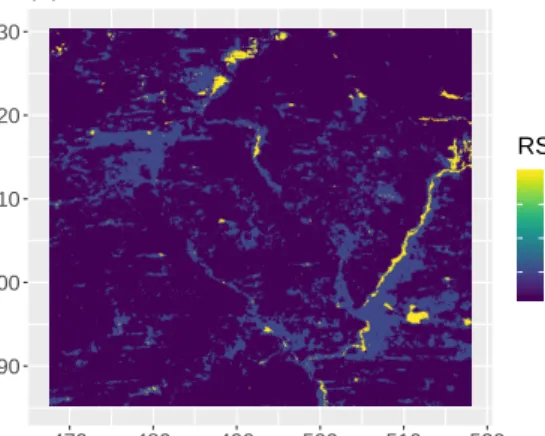
bushed grassland, bushland, and woodland. A map of the habitat and of the track is shown
in Figure 2(A). The code and data used in the case study are provided in the supplementary
material.
4.1
Normal kernel model
We fitted the local Gibbs model with normal half-step density to the track, using the function
optim
in R to numerically optimize the (approximate) log-likelihood function. We chose
n
µ=
n
z= 50 for the Monte Carlo samples in the approximation of the likelihood function
(Equation 7), which was sufficient in the simulation study of Web Appendix E.
A numerical optimizer is susceptible to becoming stuck in a local maximum of the likelihood
function, and failing to find its global maximum. To circumvent this problem, we fitted the
model 50 times, starting from randomly-chosen initial parameter values, and we selected the
parameter estimates leading to the best (largest) maximum likelihood. Each model fit took
about 8 minutes on a 2GHz i5 CPU. For the best fitting model, we numerically evaluated
the Hessian matrix of the log-likelihood function at the maximum likelihood estimate, and
we derived standard errors for the estimated parameters.
The estimates of the habitat selection parameters and the Hessian-based (Wald) 95%
confidence intervals are given in Table 1 (under “Model 1”), and a map of the fitted RSF is
shown in Figure 2(B). The estimated habitat selection parameters indicate that this zebra
selects open habitats more strongly than wooded areas, which is consistent with the natural
history of the species. Zebras prefer more open areas that provide more forage and greater
visibility. This result is also consistent with an analysis based on a standard RSF, conducted
by Courbin et al. (2016) on many individuals in the same area, albeit with a different
vegetation map.
[Table 1 about here.]
[Figure 2 about here.]
The standard deviation of the half-step density was estimated to ˆ
σ
= 0
.
20. Under this
model, in the absence of covariate effects (e.g. in a large patch of uniform habitat), the step
lengths of the animal follow a Rayleigh distribution with scale parameter
λ
=
√
2
σ
. The
estimate of the scale parameter is ˆ
λ
= 0
.
28, and the mean of the (habitat-independent) step
length distribution can be derived as
p
π/
2ˆ
λ
= 0
.
35km. This gives an estimate of the scale
of movement and perception of the zebra over 30 min time intervals.
To assess this movement model, we simulated 10
4locations from the fitted model, on the
same habitat map as the observations. We compared the distribution of step lengths observed
in the zebra data set to the distribution of simulated step lengths (Figure 3). There is a clear
discrepancy between the two distributions: the model fails to capture very short and very
long step lengths, and overestimates the density of intermediate step lengths. The empirical
distribution of step lengths has a mode at zero, and a long tail, which cannot be appropriately
modelled by this formulation. We then considered the random availability radius model for
more flexibility.
4.2
Random availability radius model
We fitted the local Gibbs model with random availability radius, described in Section 2.4.1,
to the same track. We modelled the availability radius with a gamma distribution, and
estimated its shape and rate parameters. We used Monte Carlo samples of sizes
n
r= 20 and
n
µ=
n
z= 40, following the simulation study of Web Appendix E. As in Section 4.1, we
ran the numerical optimization 50 times with random initial parameter values, and kept the
model fit with the largest likelihood, to avoid numerical convergence issues. Each model fit
took about 1.5 hour on a 2GHz i5 CPU. We evaluated the Hessian matrix of the log-likelihood
at the maximum likelihood estimates, and derived standard errors for the parameters.
The estimates of the habitat selection parameters, and the 95% confidence intervals, are
given in Table 1 (under “Model 2”), and a map of the RSF is shown in Web Appendix I.
The parameter values are quite similar to those obtained with the normal kernel model, and
the results confirm that the selection is stronger for open habitats (i.e. grassland and bushed
grassland). The estimated shape of the gamma distribution of the availability radius was
ˆ
α
= 0
.
78, and the rate was ˆ
ρ
= 3
.
57. The estimated gamma distribution of the availability
radius therefore had mean ˆ
E
(
r
t) = ˆ
α/
ρ
ˆ
= 0
.
22km, and 95th percentile ˆ
P
0.95= 0
.
72km, for
30 min intervals.
To assess the random availability radius model, we simulated a track of length 10
4from
the fitted model, on the same habitat map. We compared the distributions of observed and
simulated step lengths (Figure 3). The distribution of the simulated steps resembles that of
the observed steps much more closely than with the normal kernel model. This indicates that
the model was able to capture the speed of the zebra’s movement. This is remarkable, as the
step lengths or the speeds are never directly modelled: instead, we estimated the distribution
of the unobserved radius of the relocation region.
[Figure 3 about here.]
There is a trade-off between realism of the movement model and computational speed: the
random availability radius model was 15-20 times slower than the normal kernel model in
this analysis, due to the additional nested integral in its likelihood (Equation 5). Here, the
habitat selection estimates ˆ
β
jwere very similar using both models. This suggests that the
simpler one (normal kernel model) is sufficient to capture the RSF, even if the movement
component is not flexible enough to capture the zebra’s step lengths. However, we could not
have known this before fitting the random availability radius model and, generally, model
checking methods should be used to verify that features of the movement are appropriately
captured by the model. In this analysis, the AIC for the normal kernel model was
−
141, and
the AIC for the random availability radius model was
−
8906. This criterion thus strongly
favored the latter, more complex, model.
In the local Gibbs algorithm, the half-step density
φ
is required to be symmetric, to
satisfy the detailed balance condition (Section 2.2). As a consequence, the local Gibbs model
does not include directional persistence. This can be a problem to analyse high-resolution
movement data, which typically feature strong persistence. To investigate the effect of this
misspecification on the estimates of the habitat selection parameters, we fitted the normal
kernel model to data simulated from a step selection model with directional persistence. The
simulations are presented in Web Appendix H. We found that, for moderately persistent
movement (similar to the zebra’s), the local Gibbs model could still accurately recover the
utilization distribution. However, for simulated data with strongly autocorrelated directions,
the estimates of habitat preference were biased. This suggests that the local Gibbs model may
not be appropriate to analyse very persistent movement, e.g. collected at a high temporal
resolution.
5. Discussion
We showed how a new class of step selection models, based on the same underlying concept
as MCMC algorithms, can be used to estimate an animal’s habitat selection and movement
characteristics. In this framework, short-term step selection gives rise to the long-term
utilization distribution. This approach connects standard RSF and SSF models, because
the equilibrium distribution of the movement model is guaranteed to be proportional to the
underlying RSF. We described maximum likelihood estimation for the local Gibbs sampler,
a flexible family of MCMC algorithms which can be used to model animal movement.
Parameters of movement and habitat selection can be estimated jointly.
In the case study of Section 4, we compared two local Gibbs models with different half-step
densities, and we found a trade-off between the flexibility of the movement model and the
computational cost of inference. Our framework is not limited to the special cases described
here, however, and it may be possible to find a local Gibbs formulation that combines the
computational speed of the normal kernel model and the flexibility of the random availability
radius model. For example, we could define the half-step density
φ
as the combination of
a uniform distribution of turning angles and a given distribution for the distance to the
origin. The uniform angles ensure that the half-step density is symmetric, and the shape of
the distance distribution determines the habitat-independent movement model. It may be
possible to achieve a distribution of step lengths with a mode close to zero, as in the zebra
data set, with an exponential or Weibull distribution of distances.
An important feature of the local Gibbs model is that the size of the region of availability
does not need to be defined a priori. In habitat selection analyses based on use-availability
designs, the choice of the spatial extent of the availability region is challenging, and can lead
to biased selection estimates (Beyer et al., 2010). Instead of choosing it, we estimate it from
the observed tracking data, with a movement model based on a symmetric half-step density.
The scale of availability is for example measured by the variance of the normal kernel model,
and by the radius in the availability radius model. One limitation of this method is that the
scale of availability jointly captures the accessibility and the local information that the animal
has about the habitat (e.g. through perception, memory, shared information). The half-step
density of the algorithm therefore describes both the distance that the animal is likely to
cover over one time interval, and the size of the region over which it knows the habitat. This
is a strong assumption, that is made in most step selection models (Forester et al., 2009),
in which habitat selection is considered to take place at the scale of the movement kernel.
Recently, Avgar et al. (2015) and Bastille-Rousseau et al. (2018) have proposed models to
estimate the movement process and the perception on separate scales. Additional work is
required to allow this flexibility within the framework presented in this paper.
Acknowledgements
We are grateful to Jonathan Potts and Otso Ovaskainen for discussions about this work,
and to the associate editor and two reviewers, for their helpful suggestions. TM was funded
by the Leverhulme Trust, award number DS-2014-081. SCJ was supported by the grant
ANR-16-CE02-0001-01 of the French
Agence Nationale de la Recherche
.
References
Aarts, G., Fieberg, J., and Matthiopoulos, J. (2012). Comparative interpretation of count,
presence–absence and point methods for species distribution models.
Methods in Ecology
and Evolution
3,
177–187.
Avgar, T., Baker, J. A., Brown, G. S., Hagens, J. S., Kittle, A. M., Mallon, E. E., McGreer,
M. T., Mosser, A., Newmaster, S. G., Patterson, B. R., et al. (2015). Space-use behaviour
of woodland caribou based on a cognitive movement model.
Journal of Animal Ecology
84,
1059–1070.
Barnett, A. H. and Moorcroft, P. R. (2008). Analytic steady-state space use patterns and
rapid computations in mechanistic home range analysis.
Journal of mathematical biology
57,
139–159.
Bastille-Rousseau, G., Murray, D. L., Schaefer, J. A., Lewis, M. A., Mahoney, S. P., and Potts,
J. R. (2018). Spatial scales of habitat selection decisions: implications for telemetry-based
movement modelling.
Ecography
41,
437–443.
Beyer, H. L., Haydon, D. T., Morales, J. M., Frair, J. L., Hebblewhite, M., Mitchell, M.,
and Matthiopoulos, J. (2010). The interpretation of habitat preference metrics under
use–availability designs.
Philosophical Transactions of the Royal Society of London B:
Biological Sciences
365,
2245–2254.
Blackwell, P. (1997). Random diffusion models for animal movement.
Ecological Modelling
100,
87–102.
Blackwell, P. G. (2003). Bayesian inference for Markov processes with diffusion and discrete
components.
Biometrika
90,
613–627.
Boyce, M. S. and McDonald, L. L. (1999). Relating populations to habitats using resource
selection functions.
Trends in Ecology & Evolution
14,
268–272.
Chamaill´e-Jammes, S. (2016). Reactive responses of zebras to lion encounters shape
their predator–prey space game at large scale.
Oikos
125,
829–838.
Einstein, A. (1905). ¨
Uber die von der molekularkinetischen Theorie der W¨arme geforderte
Bewegung von in ruhenden Fl¨
ussigkeiten suspendierten Teilchen.
Annalen der Physik
322,
549–560.
Fieberg, J., Matthiopoulos, J., Hebblewhite, M., Boyce, M. S., and Frair, J. L. (2010).
Correlation and studies of habitat selection: problem, red herring or opportunity?
Philosophical Transactions of the Royal Society of London B: Biological Sciences
365,
2233–2244.
Forester, J. D., Im, H. K., and Rathouz, P. J. (2009). Accounting for animal movement
in estimation of resource selection functions: sampling and data analysis.
Ecology
90,
3554–3565.
Fortin, D., Beyer, H. L., Boyce, M. S., Smith, D. W., Duchesne, T., and Mao, J. S.
(2005). Wolves influence elk movements: behavior shapes a trophic cascade in yellowstone
national park.
Ecology
86,
1320–1330.
Gilks, W. R., Richardson, S., and Spiegelhalter, D. (1995).
Markov chain Monte Carlo in
practice
. CRC press.
Manly, B., McDonald, L., Thomas, D., McDonald, T. L., and Erickson, W. P. (2002).
Resource selection by animals: statistical design and analysis for field studies, Second
Edition
. Kluwer Academic Publishers, Dordrecht.
Matthiopoulos, J. (2003). The use of space by animals as a function of accessibility and
preference.
Ecological Modelling
159,
239–268.
McKay, M. D., Beckman, R. J., and Conover, W. J. (1979). Comparison of three methods
for selecting values of input variables in the analysis of output from a computer code.
Technometrics
21,
239–245.
Michelot, T., Blackwell, P. G., and Matthiopoulos, J. (2019). Linking resource selection and
step selection models for habitat preferences in animals.
Ecology
100,
e02452.
Michelot, T., Langrock, R., and Patterson, T. A. (2016). moveHMM: An R package for the
statistical modelling of animal movement data using hidden Markov models.
Methods in
Ecology and Evolution
7,
1308–1315.
Morales, J. M., Haydon, D. T., Frair, J., Holsinger, K. E., and Fryxell, J. M. (2004).
Extracting more out of relocation data: building movement models as mixtures of random
walks.
Ecology
85,
2436–2445.
Northrup, J. M., Hooten, M. B., Anderson, C. R., and Wittemyer, G. (2013). Practical
guidance on characterizing availability in resource selection functions under a use–
availability design.
Ecology
94,
1456–1463.
Potts, J. R., Bastille-Rousseau, G., Murray, D. L., Schaefer, J. A., and Lewis, M. A. (2014).
Predicting local and non-local effects of resources on animal space use using a mechanistic
step selection model.
Methods in Ecology and Evolution
5,
253–262.
Rhodes, J. R., McAlpine, C. A., Lunney, D., and Possingham, H. P. (2005). A spatially
explicit habitat selection model incorporating home range behavior.
Ecology
86,
1199–
1205.
Roever, C. L., Beyer, H., Chase, M., and Van Aarde, R. J. (2014). The pitfalls of ignoring
behaviour when quantifying habitat selection.
Diversity and Distributions
20,
322–333.
Signer, J., Fieberg, J., and Avgar, T. (2017). Estimating utilization distributions from fitted
step-selection functions.
Ecosphere
8,
.
Tierney, L. (1994). Markov chains for exploring posterior distributions.
The Annals of
Statistics
22,
1701–1728.
Zucchini, W., MacDonald, I. L., and Langrock, R. (2016).
Hidden Markov models for time
series: an introduction using R, Second Edition
. Chapman and Hall/CRC.
Supporting information
Web Appendices referenced in Sections 2, 3 and 4 are available with this paper at the
Biometrics website on Wiley Online Library. The code and data used in the simulation
studies and the case study are available in the online supplementary material.
(A) x coordinate 0 Step density (B) x coordinate −2r 0 2r Step density (C) x coordinate 0 Step density
Figure 1.
Slices through the two-dimensional habitat-independent step densities in three
different MCMC movement models. (The step densities are symmetric around the origin.)
(A) Normal kernel model. (B) Availability radius model. (C) Availability radius model,
with time-varying radius
r
tdrawn from a gamma distribution. Analytical formulas can be
● ●●●●●●●●●●● ●●●●●●●●●●●●●●●●●● ●●●●●● ●●●●●●●●●●●●● ●●●● ●●●●●●●●● ●●●●●● ● ● ● ●●●●● ● ● ●●●●●● ●●● ● ●●●●●●●●●●●●●●●●●●●●●●●●●●●●● ●● ●●●●●●●●● ●● ● ●●● ● ●● ● ●● ●●●●●● ●●● ●●● ●●●●●● ●● ● ●●●●●● ●● ●●●●●●● ●●●●●●●●●● ●●●●●● ●●●●●●●●●●●●● ● ●●●● ● ●●●●●●●●●●● ●●●●● ● ●●● ●●●●●●●●●●●● ● ● ●●●● ● ● ● ● ●●●● ● ● ● ● ● ● ● ●● ● ●● ●●● ● ● ● ● ● ●●●●●●●● ● ● ●●●●●●●●●●●●●●●●●●●●●●●●●●●●● ●●●●● ●● ●●●● ● ● ●● ●●●● ●● ● ● ●●●●●● ●● ● ●●●●●●●●●●●●●●●●●● ● ●●● ●●●●● ● ●●● ●●●●●●●●●●●●●●●● ● ●●● ●●●●●● ●●●●●●●●●●●●●●●●●●●●●●●●●●●●●●●●●●●●●●●●●●●●●●●●●●●●●●● ●●● ● ● ●●●●●●●●●●●●●●●●●● ●●●●● ● ● ● ●●●●●● ●●●●●●●●●●● ●●●●●●●● ●● ● ● ●●●● ●●●●●●●●●●●●●● ● ● ●●●●●●●●●●●●●●●●●●● ● ● ● ●●● ● ● ● ● ● ● ● ● ●●● ●●●●● ●●●●● ●● ● ●●●●● ● ●●●●● ● ●●●●●●●●● ● ● ● ●●●●●● ●●●●●●●●●●●●●●● ●●● ●●●●●●●●●●●●●●● ●●●●●●●●●● ●●●●●●●●●● ●●●●●●●●●●●●●●●● ●●●●●●●●● ● ●●●●●●●● ●●●●●●●●● ●●●●●●● ●●●● ●●●●●●●●●●●●●●●●● ● ●●●●●●● ● ●●●●●● ●●●●●●●●●●●●●●●●● ●●●● ●●● ●●● ● ●●●●●●● ●●●●●● ●●●●●●●●●●●●●●●●●●●●●●●●●●●●●●●●●●●●●●●●●●●● ●●●●●●●●●●●●●●●●● ● ● ● ● ● ● ● ● ● ● ● ● ● ● ●●●●● ●●●●● ● ● ● ●●●●●●●●●●●●●● ●●●●●●●● ●● ● ● ● ● ● ● ● ● ● ● ● ● ●●●●●● ●●●●●● ● ● ● ● ● ●● ●● ● ●●● ●● ●● ● ● ●● ●● ●●●●●●● ●●●●●●●●●●●●●●●●●●●● ● ●● ●● ● ● ●●●●●●●●●●●●●●●●●●●●●●● ● ●●●●●●● ● ●●●●● ●●●● ●●●●● ●● ●● ● ● ●● ●●●●●●●●●●●● ●●●●● ●● ●●●●● ● ●● ●●● ● ● ● ● ● ●●● ● ● ● ●●●●● ●●●●●●●●● ●●●●●●●● ●●●●●●●●●●●●●●●●●●●●●● ●● ● ● ●●●●●●●●●●●●●●● ●●●●●● ●●●●●●● ●●● ● ●● ● ●●●● ● ● ●● ●●● ● ●●●●●●● ● ●●●●●● ●●● ● ●●●● ● ●● ●●●●●●●●● ● ●●●●● ● ●●●● ● ●●●●●●●●●●●●●●●●●●●●●●●●●●● ● ● ●● ●●●●●●●●●●●●●●●●●●●●●●●●●●●●●●●●●●●●●●●●●●●●●●●●●●●●●●●●●●●●●●●●●●●●●●●●●●●●●●●●●●●●●●●●●●●●●●●●●●●●●●●●●●●●●●●●● ● ● ●●●● ●●● ● ● ● ●●● ●●●●● ●● ● ●●●●● ●●●●●●●●●●●●●●●●●●●●●●●●●● ●● ●● ●●●●●●● ● ● ● ●● ● ● ● ● ● ●● ●●● ●●●●● ●● ● ● ● ●●●●●● ● ●●●●●●●●●●●● ●●●●● ●● ●● ●● ●●●●●●●●● ● ●●●●●●●●●●●●●●●●●●●●●●●●●● ● ● ● ● ●●●●● ●●●●●●● ●● ●●●●●● ● ●●●●●● ●●●● ●● ●●●●●●●●●● ●●●●●●● ●●●●●●●●●●● ●●●●●●●●●●●●●●●●●●●●●●●●●●●●●● ●● ● ●●● ● ●●●●●●●●●●●●●●●●●● ●●●●●●●●●●●●●●●●●●●●●●●●● ●●●●●●●●●●●●● ●●●●● ●●●●●●● ●●●●● ●●●● ●●●●●●●●●●●●●●●●●●● ●●● ●●● ● ●●● ● ●●●● ● ● ● ● ● ●●●●●●● ●●●●●●●● ●●●●●●●●● ● ●●●●●●●●● ●●●●●●● ●●● ● ● ● ●●● ●●●●● ● ●●●●● ● ●●●●●●●● ● ● ●●● ● ●●●●●●●●●●●●● ●●●● ● ●●●●● ●● ●● ●● ●●●●● ●●●●●●●●●● ●●●●●● ● ● ●●●●●●● ● ●●●● ● ●● ● ●●● ●● ●● ● ●●●●●●●●●●●●●●●● ● ●●●● ● ●●●●●●● ● ●● ● ●● ● ● ● ● ● ●●●●● ●●●●●●●●●●●●● ●●●● ●●●●●●●●●●●●●● ●●● ● ● ● ● ● ●●●● ● ●● ● ● ● ●●● ● ● ● ●● ● ●●● ● ● ●●●●●●●●●●●●●● ●●●●● ●● ● ●●●●●●●●● ●● ● ● ● ●● ●● ●●●●●●● ●●●●● ● ●● ●●●●●●●●●●●●●●● ●● ● ● ● ●●●● ● ●●●●●●●●●●● ●●● ● ●●● ●●●●●●●●● ● ● ●● ●● ●●● ● ●●●●●●●●●●●●●●●●●●●●●● ● ●●●●●●●●●●●●● ●●● ●●●●●●● ●● ●●●●●●●● ●●●●● ●●●● ●●●●●●●●● ●●●●●●●●●●●●●●●●●●●●● ●●●●●●●●● ●●●●●●●●●●●●●●●●● ●●●● ●●● ● ● ● ● ● ●● ● ● ● ● ● ● ● ● ● ●●●●●●●●●● ●●●●●●●●●●●● ●● ●●● ● ●●●●●●● ●●●●●●●●●● ●● ● ● ● ●●● ● ●● ●● ●● ●●●● ●●●● ●●●●●●● ● ● ● ●●●●●●●●●●● ●● ● ●●● ●● ●●●●● ●●●●●●●●●● ●●●●●●●●●●●●●●●●●●●●●●●●●● ●●●●● ● ●● ●●●●●●●●●●●●●●●●●●●●●●●●●●● ●● ● ● ● ● ● ● ● ● ● ●●●●●●●● ● ● ●●●●●●●●●●●●●● ●●●●●●●●●●●● ● ● ● ●● ● ●● ● ● ●● ●● ● ● ●● ● ● ● ● ●● ● ●● ●●●●●●●●●●●●●●●● ● ● ●●● ●●●●● ● ● ●●●●● ● ● ●● ●●● ●● ●●●●● ●●●●● ●●●●● ●●●●●●●●● ●●●●●●●●●●●●●●●●●●●●● ●●● ●●●●●●●●●●●●● ● ●●●●● ● ● ● ●● ● ● ● ●● ● ● ● ●●●●●●●●● ● ●●●● ●●●●●●●●●●●●●●●●●●●●●●●●●●●●●●●●●●●●●● ●●● ●● ●●●●●● ● ● ●●●●●●● ●●●●●●●●●●●●●●●●●●●●● ● ●●●●●●●●●●● ● ●●●●●●●●●●●●●●●●●●●●●●●●●●●●●●●●●●●●●● ●●●●●●●●●●●●●●● ● ●●● ●●●● ●●●●●● ●●●●●●●●●●●●●●●●●●●●●●●●● ●●●●●●●●●●●●●●●●●●● ● ● ● ●●●●● ● ●●●●●●●●●● ● ● ●●●●●●●●●● ●●● ● ● ● ●●●●●●●●●●●●●●●●●●●●●●●●●●●● ●●●●●● ●●●●●● ●● ●● ●●● ● ● ●●●●●●●●●●●●●●●●●●●●● ●●●●●●●●●●●● ● ● ● ● ●●●●●●●● ●●●●●●●●●●●●●●●●●●●●●●●●●●●●●●● ●●●●●●●●●●●●●●●● ●●●●●●●●●●●●●●●●● ● ● ● ● ●● ●●●● ● ● ● ● ● ●●● ●●●●●●● ●● ●●● ● ● ●● ● ● ● ● ● ●●●●●●●●●●●●●●●●●●●●● ● ● ● ● ● ●● ●●●● ● ●●●●●●●●●● ●●●●●●●● ●●●●● ● ● ●●●● ●●●●●●●●●●●● ●●●● ●●● ● ●●●●●●●●● ● ●●●●●●●● ●●●●●●●●●●●●●● ●●●●● ●●●● ●●● ●●●●●●●●●●●●● ● ●●●●●●●●●●●●●●●● ●●●●●●●●●●●●●●●●●●●●●●●●●●● ●●●● ● ● ● ● ●●●●● ●●●●●●● ●●●●●● ●●●● ● ● ● ● ●●●●●●●●●●●●●●●●●● ● ●●● ●●● ●●●●●●● ●●●●●●●●● ●● ●●●● ●●●●●●●● ●●●●●●● ●●●●●●●●●●●●●●●● ●●●●●● ●●●●●●●●●●●●● ●● ●●●●●●●●●●●●●● ●●●●● ● ●●●●●●●●●● ●●●●●●●●●● ● ●● ●● ●●●●●●●●●●●●●●●● ●●●●●●●●●●●●● ● ●●●●●● ●●●●●●●●●●●●●● ● ●● ●● ●●●●● ●●●●●●● ●●●●●● ● ●●●●●●●●●●●●●●●●●●●●●●●●●●●●●●●●●●●●●●●●● ● ● ●●● ● ●●● ● ● ● ●● ●● ● ●●● ● ● ●●●●●●●●●●●●●●●●●● ● ●● ● ● ●● ● ●●●●● ●●●●●●●●●●●●●●●●●●●●●●●●● ●●●●●●●● ● ● ● ●●●●● ●● ●●●● ●●●●●●●● ●●●●●●●●●●● ●● ●●●●● ●● ●● ● ● ● ● ●●●●●●●●● ●●●●●●●●● ● ●●●●● ● ● ●●●●●●●● ● ●●●●●●●●●●●●●●●●●●●● ●●●●●●●●●●●● ●●●●●●●●●●●● ●●●●●●●●● ●●●● ●● ●● ●●● ●●●●●●●●●●● ● ●● ● ●●●●● ● ● ●●●●●●●●●●●●●●●●●●●●●●●●●● ● ●●● ●●● ● ● ● ●●● ●●●●●●●●●●●●●●●●●● ● ● ● ●● ● ● ● ● ●● ● ●● ●●●●●●●●●●●●●●●●●●●●● ●●● ●●● ●●● ●● ●●● ●●●● ● ● ● ● ● ● ● ● ●●●●● ●●● ●●●● ●●● ● ●●●● ●● ● ● ●●● ● ● ● ● ●● ● ● ●● ●●●● ● ●●●●●●●● ● ● ● ● ● ● ● ● ● ● ●● ● ● ● ● ● ● ● ● ● ●●●●●●● ●● ● ●●● ● ● ●●● ● ●● ●● ● ● ● ●●●●●●●●●● ●●● ● ●●● ● ● ●● ● ●● ●●●●●●●●●●●●●●● ● ●●● ● ● ●●●●●●●● ● ● ● ● ●●●●●●● ●●●●●●● ●●●● ●●●●●●●●●●●● ●●●●●●●●● ●●●●●●●●●●●● ●●● ●●●●● ●●● ● ● ●●● ●●●● ●●●●●●●●●●●● ●● ● ●●●● ●●● ●● ●●●● ●● ● ● ●●●●●●●● ● ●●●●●●●●●● ●●●● ●●●●●● ● ●● ● ● ●●●● ●●● ●●● ●●●●● ●● ●●●●●●●●● ● ●●● ●●●●●●● ●● ●●●●● ● ● ● ●● ● ● ● ●●● ●●●●●●●●●● ● ● ● ● ● ● ● ● ● ● ● ●●●●●●● ●●●● ●● ●●●●● ● ●● ● ● ● ●●●●●●●●●● ● ● ●●●● ●●●●●●●●● ●●●● ●● ● ●●●●●●●●● ●●●●●●●●●●●●●●●●●●●● ●●●●●●●●●●●●●●●●●●● ●●●●●●●●●●●●●●●●●●●●●●●●● ●● ●●●●●●●●●●● ●●●●● ● ● ●●●●●●●●●●●●●●●●●● ●●●●●●●●●●●●●●●● ●● ● ●● ●●●●●●●●●●●●●●●●●●●●●● ●●●●●●●●●●●●●●●● ●● ● ●●●●●● ●●●●●●●●●●●●●●●●●●●●●●●●●●●●● ●●●● ●●● ● ●●● ● ●●●●●●●●●● ●●●●●●●●●●●●●● ● ●●●● ●●●●●●●●●●●●●●●●●●●●●●●●●●●●●●●●●●●● ●●●●●● ●●●●● ●● ●●●●● ●●●●● ●●●●●●● ●●●●●●●●●●●●●●●●●●●●●●●●●●●●●●●●●●●●●●●●●●●●●●●●●●● ●●●●● ● ●●●●●● ●●● ●●● ●●●●●●●●●●●● ● ● ● ●● ●●●●●●●●●●●●●● ●●●●●●●●●●● ●●●●● ●●●●●●●●●●● ●●● ● ● ●●●●● ● ● ●● ●● ● ●●●● ●●●●●●●●●● ● ●●●●●●● ● ● ● ● ● ● ● ● ●●●●●●●●●●●● ●●●●●●●●●●●●●●●●●●●●●●●●●●●● ●●●●●●●●●●●●●●●●●●●●●●●●●●●●●●●●●●●●●●●●● ● ● ● ●● ●●●● ●●●●● ●●●● ●●●●●●●●●●●●●●● ● ●●●●● ● ●●●●●●●●●●●●●●●●●●●●●●●●●●● ●●●●●●● ●●●●● ●● ● ● ●●●●●●●●●●●●●●●●●●●●● ●●●●●●●●●●● ●●●●●●●●●●●●●●●●●●●●●●●●●●●●●●●●●●●●●●●●●●●●●●●●●●●●●●●●●●●●●● ●●●●●●● ●●●●●●●●●● ●● ● ●● ● ● ●● ●●●● ● ●●●●●● ●●●●●●●●●●●●●●●●●●●●●●●●●●●●●●●●●●●●●●●●●●● ●●●●●●●●●●●●●●●●●●●●●●●●●●●●● ● ●●●●●●● ●●●● ● ● ●● ●● ●●●● ●●● ●●●●● ●●●●●● ●●●●●●●● ●●●● ●●● ●● ●●●●●●●●●●●● ●● ●●●●●●●●●●●● ●●●●●●●●●●●●●●●●●●●● ● ● ●●●●●●●● ●●●●●● ●●● ●●●●●●●● ●●●● ●●●●●●●●●●●●●●●● ●● ●● ●● ●● ●●●●●●●● ●●●●● ●●●● ●●●●●●●●●●● ● ●●●●●●●●● ●●●● ●●●●●●●●●●●●●●●●●●●● ●● ● ● ●●●●●●●●●●● ● ●●●●●●●●● ●●●● ●●●● ● ● ●●●●●● ● ●●●●●●●●●●●●●●●●●●●●●●●●●●●●●●● ●●●●●●●●●●●●●●●●●●●●●●● ● ●●●●●●●●●●●●●●●●●●●●●●●●●●●●●●●●●●●●●●●●●●●●●●●●●●●● ●●●●●● ●●●●●●●● ●●●●●● ●●●●●● ●●●●●●●●●●●●●●●●● ● ●●●●● ●● ● ●●●●●●●●●●●● ●● ●●●●● ●●●●●● ●●●●●●●●●●●●● ● ●●●●● ●●●●●●●●●●●●●●●●●●●●●●●●● ● ●●●●●●●●●●● ●●●●● ● ● ● ●●●●●●● ●●● ● ●● ●●●●●●●●● ●●● ●●●●●●●● ●● ●● ●●●●● ●● ● ● ●●●●●●●●●●●●●●●●●●●●●●●●●●●●●●●●●●●●●●●●●●●●●● ●●●●●●●●●●●●●●●●●●●●●●●●●●●●●●●●●●●●●●●●●●●●●●●● ●