Available at:
http://hdl.handle.net/2078.1/152527 [Downloaded 2019/04/19 at 09:56:14 ]
"Copula-Based Regression Estimation and Inference"
Noh, Hohsuk ; El Ghouch, Anouar ; Bouezmarni, TaoufikAbstract
We investigate a new approach to estimating a regression function based on copulas. The main idea behind this approach is to write the regression function in terms of a copula and marginal distributions. Once the copula and the marginal distributions are estimated, we use the plug-in method to construct our new estimator. Because various methods are available in the literature for estimating both a copula and a distribution, this idea provides a rich and flexible family of regression estimators. We provide some asymptotic results related to this copula-based regression modeling when the copula is estimated via profile likelihood and the marginals are estimated nonparametrically. We also study the finite sample performance of the estimator and illustrate its usefulness by analyzing data from air pollution studies.
Document type : Article de périodique (Journal article)
Référence bibliographique
Noh, Hohsuk ; El Ghouch, Anouar ; Bouezmarni, Taoufik. Copula-Based Regression Estimation and Inference. In: Journal of the American Statistical Association, Vol. 108, no. 502, p. 676-688 (2013)On: 25 November 2014, At: 01:18 Publisher: Taylor & Francis
Informa Ltd Registered in England and Wales Registered Number: 1072954 Registered office: Mortimer House, 37-41 Mortimer Street, London W1T 3JH, UK
Journal of the American Statistical Association
Publication details, including instructions for authors and subscription information:http://www.tandfonline.com/loi/uasa20
Copula-Based Regression Estimation and Inference
Hohsuk Noh a , Anouar El Ghouch a & Taoufik Bouezmarni ba
Institut de Statistique, Biostatistique et Sciences Actuarielles , Université Catholique de Louvain , Louvain la Neuve , 1348 , Beligum
b
Departement de Mathematiques , Université de Sherbrooke , Sherbrooke , Quebec , J1K 2R1 , Canada
Accepted author version posted online: 29 Mar 2013.Published online: 01 Jul 2013.
To cite this article: Hohsuk Noh , Anouar El Ghouch & Taoufik Bouezmarni (2013) Copula-Based Regression Estimation and
Inference, Journal of the American Statistical Association, 108:502, 676-688, DOI: 10.1080/01621459.2013.783842
To link to this article: http://dx.doi.org/10.1080/01621459.2013.783842
PLEASE SCROLL DOWN FOR ARTICLE
Taylor & Francis makes every effort to ensure the accuracy of all the information (the “Content”) contained in the publications on our platform. However, Taylor & Francis, our agents, and our licensors make no
representations or warranties whatsoever as to the accuracy, completeness, or suitability for any purpose of the Content. Any opinions and views expressed in this publication are the opinions and views of the authors, and are not the views of or endorsed by Taylor & Francis. The accuracy of the Content should not be relied upon and should be independently verified with primary sources of information. Taylor and Francis shall not be liable for any losses, actions, claims, proceedings, demands, costs, expenses, damages, and other liabilities whatsoever or howsoever caused arising directly or indirectly in connection with, in relation to or arising out of the use of the Content.
This article may be used for research, teaching, and private study purposes. Any substantial or systematic reproduction, redistribution, reselling, loan, sub-licensing, systematic supply, or distribution in any
form to anyone is expressly forbidden. Terms & Conditions of access and use can be found at http:// www.tandfonline.com/page/terms-and-conditions
Copula-Based Regression Estimation and Inference
Hohsuk NOH, Anouar El GHOUCH, and Taoufik BOUEZMARNI
We investigate a new approach to estimating a regression function based on copulas. The main idea behind this approach is to write the regression function in terms of a copula and marginal distributions. Once the copula and the marginal distributions are estimated, we use the plug-in method to construct our new estimator. Because various methods are available in the literature for estimating both a copula and a distribution, this idea provides a rich and flexible family of regression estimators. We provide some asymptotic results related to this copula-based regression modeling when the copula is estimated via profile likelihood and the marginals are estimated nonparametrically. We also study the finite sample performance of the estimator and illustrate its usefulness by analyzing data from air pollution studies. KEY WORDS: Dependence modeling; Profile likelihood; Semiparametric regression; Vine copula.
1. INTRODUCTION
Let X =(X1, . . . , Xd) be a random vector of dimension
d ≥1 and Y be a random variable with continuous
cumula-tive distribution functions (cdf’s) F1, . . . , Fd and F0,
respec-tively. Y is our response variable and X is our set of
co-variates. We denote the density of Xj by fj and that of Y
by f0. For a givenx =(x1, . . . , xd), we will use F(x) as a
shortcut for (F1(x1), . . . , Fd(xd)). From the inspiring work of
Sklar (1959), the cdf of (Y,X) evaluated at (y,x) can be
ex-pressed asC(F0(y),F(x)),whereCis the copula distribution
of (Y,X), which is the function from [0,1]d+1 to [0,1]
de-fined by C(u0, u1, . . . , ud)=P(U0≤u0, U1≤u1, . . . , Ud ≤
ud), whereU0=F0(Y) andUj =Fj(Xj), j =1, . . . , d.This
is nothing but a joint distribution function with margins that
are uniform over the unit interval [0,1]. Copulas enable us to
model the dependence between variables separately from their marginal distributions and by specifying a copula we
summa-rize all the dependencies between margins. See Nelsen (2006)
for more about this subject. From the definition of a copula
function, the conditional density ofYgivenX =xis given by
f0(y)c(F0(y),F(x))
cX(F(x))
,
where c(u0,u)≡c(u0, u1, . . . , ud)=∂d+1C(u0, u1, . . . , ud)/
∂u0∂u1. . . ∂ud is the copula density corresponding to C and
cX(u)≡cX(u1, . . . , ud)=∂dC(1, u1, . . . , ud)/∂u1. . . ∂ud is
the copula density ofX. Obviously, the conditional mean,m(x),
Hohsuk Noh is postdoctoral researcher, Institut de Statistique, Biostatis-tique et Sciences Actuarielles, Universit´e Catholique de Louvain, Louvain la Neuve 1348, Beligum (E-mail:[email protected]). Anouar El Ghouch is Professor, Institut de Statistique, Biostatistique et Sciences Actuarielles, Universit´e Catholique de Louvain, Louvain la Neuve 1348, Beligum (E-mail:[email protected]). Taoufik Bouezmarni is Assistant Pro-fessor, Departement de Mathematiques, Universit´e de Sherbrooke, Sherbrooke, Quebec J1K 2R1, Canada (E-mail: [email protected]). H. Noh’s research is supported by IAP research network P6/03 of the Belgian Government (Belgian Science Policy) and the European Re-search Council under the European Community’s Seventh Framework Programme (FP7/2007-2013)/ERC Grant agreement no. 203650. A. El Ghouch’s research is supported by IAP research network P6/03 of the Belgian Government (Belgian Science Policy), and the contract “Projet d’Actions de Recherche Concert´ees” (ARC) 11/16-039 of the “Communaut´e Franc¸aise de Belgique,” granted by the “Acad´emie Universitaire Louvain.” The authors thank two anonymous referees, the associate editor, and the coeditor for their valuable suggestions that have significantly improved the article.
ofYgivenX=xcan be written as
m(x)=E(Y w(F0(Y),F(x)))=
e(F(x))
cX(F(x))
, (1)
wherew(u0,u)=c(u0,u)/cX(u) and
e(u)=E(Y c(F0(Y),u))=
1
0
F0−1(u0)c(u0,u)du0. (2)
The equality (1) shows that, given the marginals, one can
ob-tain the mean regression function relating Y to X directly
from the copula density, or equivalently the copula
distribu-tion of (Y,X). It also implies that the conditional mean
is just a weighted mean with weights induced by the
un-known “conditional” copula function w defined above. This
relation is not new and has already been applied in
Sun-gur (2005), Leong and Valdez (2005), and Crane and Van
Der Hoek (2008) to compute the mean regression function
corresponding to several well-known copula families
(Gaus-sian, t, Farlie–Gumbel–Morgenstern (FGM), Iterated FGM,
Archimedean, etc.) with single (d =1) and multiple
covari-ate(s). To illustrate the idea, we briefly cite two examples:
• If the copula density of (Y, X1) belongs to the FGM family
with a parameterθ, that is,c(u0, u1)=1+θ(1−2u0)(1−
2u1), then we have
m(x1)=E(Y)+θ(2F1(x1)−1)
F0(y)(1−F0(y))dy. (3) A similar formula holds for the multiple covariate case; see
Leong and Valdez (2005) .
• If the copula of (Y,X) is Gaussian with correlation
matrix Y,X = 1 ρ ρ X , then we have m(x)=EF0−1(u−X1ρ+ 1−ρ−X1ρZ) , (4) where u=(−1(F1(x1)), . . . , −1(Fd(xd))), Z∼N
(0,1), andis the cdf of a standard normal distribution.
© 2013American Statistical Association Journal of the American Statistical Association
June 2013, Vol. 108, No. 502, Theory and Methods DOI:10.1080/01621459.2013.783842
676
Note that in the single covariate case, we have cX(u)≡
cX1(u1)=1 for all u1∈[0,1]. In such a case, the weight
function w coincides with the copula density c and (1)
re-duces to m(x1)=e(F1(x1))=E(Y c(F0(Y), F1(x1))). Also, if
the covariates are mutually independent, then cX(u)=1 and
m(x) coincides withe(F(x)). In other words,e(F(x)), the
nu-merator ofm(x) in (1), is the mean regression function ofY
given X assuming independence between the covariates or,
equivalently, assuming that the conditional density ofY|X is
f0(y)c(F0(y),F(x)). Thus, in term of copulas, the mean regres-sion function is the ratio of a numerator that only captures the
mean dependence between Y and X and a denominator that
captures the dependence withinX.
The equality (1) can also be used as an estimating equation.
In fact, if ˆw, ˆF0, and ˆFj are any given estimators forw,F0, and
Fj, respectively, thenmcan obviously be estimated by
ˆ
m(x)=
∞
−∞
ywˆ( ˆF0(y),F(xˆ ))dFˆ0(y), (5)
where ˆF(x)=( ˆF1(x1), . . . ,Fˆd(xd)). To the best of our
knowl-edge, such an approach has never been proposed or investigated in the literature, neither in the single nor in the multiple
covari-ate case. To estimcovari-atew, one needs an estimator for the copula
densitiescandcX. The copula densitycXcan be obtained from
cby integration. In fact, cX(u)= ∞ −∞ f0(y)c(F0(y),u))dy= 1 0 c(u0,u)du0. (6)
Therefore, given an estimator ˆcforc, one can easily estimate
cX using the plug-in method and then estimatemby (5).
Since, in the literature, there are many different methods
avail-able for estimating a copula and a cdf, ˆm(x) defines a large new
class of interesting estimators. Depending on the method of
es-timating the components in (5), ˆm(x) can be a nonparametric or
a semiparametric or a fully parametric estimator. For example,
using nonparametric estimators forc,F0, andFj,j =1, . . . , d,
leads to a fully nonparametric estimator. Nonparametric
meth-ods for estimating c include kernel-smoothing estimators
(Gijbels and Mielniczuk 1990; Charpentier, Fermanian, and
Scaillet 2006; Chen and Huang 2007; Omelka, Gijbels, and
Veraverbeke 2009), Bernstein estimator (Bouezmarni,
Rom-bouts, and Taamouti2010), and spline estimator (Kauermann
et al.in press) to name a few. In spite of the great flexibility,
nonparametric methods are typically affected by the curse of di-mensionality and come with the difficult problem of selecting a good smoothing parameter. On the other hand, imposing a para-metric structure on both the copula and marginal distributions can lead to severely biased and inconsistent (fully parametric) estimators in case of misspecification. For these reasons and to avoid such problems as much as possible, we consider here a semiparametric approach where the copula is modeled para-metrically but the marginal distributions are modeled nonpara-metrically. As will be shown in the next sections, the proposed method has many interesting properties both from a theoreti-cal and a practitheoreti-cal point of view. In particular, the asymptotic properties are easy to obtain, the numerical calculations can be done directly using existing software packages and, unlike many semiparametric methods, no iteration procedure is needed
to guarantee consistency. Also, the asymptotic variance can be estimated without any extra complications.
The plan of the article is as follows. Section2 presents the
general theoretical framework of the method with the necessary
notations and assumptions. In Section3, we identify the
asymp-totic representation of the proposed estimator in the single and multiple covariate cases. From this representation, we establish the asymptotic distribution of the estimator. Further, we propose
and study an estimator of its asymptotic variance. In Section4,
we investigate theoretical properties of the estimator under
mis-specification. In Section5, we present some numerical
simula-tions designed to confirm the theoretical results and to compare the performance of our estimators with that of some
competi-tors. Finally, in Section6, we analyze data from air pollution
studies to illustrate the usefulness of the proposed estimator. All the proofs appear in the Appendix.
2. THEORETICAL BACKGROUND
LetXi=(X1,i, . . . , Xd,i)and let (Yi,Xi), i=1, . . . , n,be
an independent and identically distributed (iid) sample of n
observations generated from the distribution of (Y,X). Clearly,
the shape and the performance of our estimator ˆmin (5) will
depend heavily on the methods of estimation forc,F0, andFj.
In this work,F0is estimated by a rescaled empirical distribution
function: ˆ F0,n(y)= 1 n+1 n i=1 I(Yi ≤y).
Estimating the other cdf’sFj,j =1, . . . , d, can also be done
in the same way via ˆFj,n. However, this results in a nonsmooth
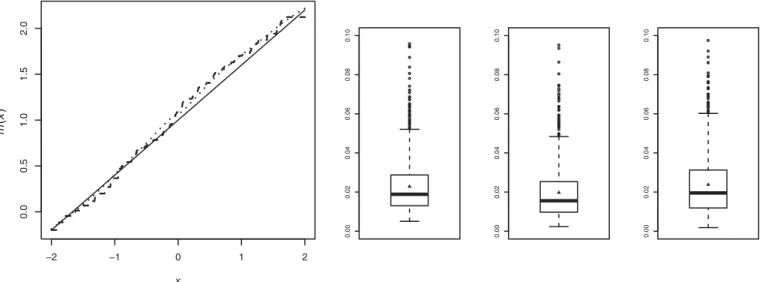
estimate ˆm(x) as is illustrated in Figure 1, where we show
the resulting estimator using ˆF1,n in the univariate case. To
get a more visually attractive regression curve or surface, one
should smooth the empirical cdf’s ˆF1,n, . . . ,Fˆd,n. The simple
way to do that is to use a kernel-smoothing method. Letk(·) be
a function, which is a symmetric probability density function
and h≡hn→0 be a bandwidth parameter. Then, a
kernel-smoothing estimator ofFj is given by
˜ Fj,n(x)= 1 n n i=1 K x−Xj,i h ,
where K(x)=−∞x k(t)dt. The methods of estimating the
marginalsF1, . . . , Fddo not bring out any difference in
asymp-totic behavior of the estimator ˆm(x) as long as they satisfy the
following assumption:
Assumption A. For a given point of interestx ∈Rd, ˜ Fj,n(xj)=n−1 n i=1 I(Xj,i≤xj)+op(n−1/2), j =1, . . . , d.
Note that the kernel-smoothing estimator ˜Fj,nsatisfies
Assump-tion A ifnh4→0. Evidently, this assumption also holds true
for the rescaled empirical cdf ˆFj,n.
We examined the effect of the methods of estimating the marginal distributions on the regression fit in an extensive sim-ulation study and came to the conclusion that both estimators
( ˆFj,n and ˜Fj,n) show more or less similar performance. Here,
678 Journal of the American Statistical Association, June 2013
Figure 1. Estimated regression functions using ˆF1,n(dashed line) and ˜F1opt,n(dotted line); the black line is the true regression function. Boxplots
of the empirical integrated squared errors of ˆmwith ˆF1,n, ˜F
opt 1,n, and ˜F
cv
1,n, respectively (from left to right).
we present one example to illustrate this. We generate (Y, X1)
using a Gaussian copula according to DGP S.a described in
Section5. To assess the effect of each method, we consider the
empirical integrated mean squared error (IMSE), the empiri-cal integrated squared bias (IBIAS), and the empiriempiri-cal integrate variance (IVAR), which are given by
IMSE = 1 N N l=1 ISE( ˆm(l))≡ 1 N N l=1 1 I I i=1 ˆ m(l)(xi)−m(xi)2 = 1 I I i=1 m(xi)−m¯ˆ(xi)2 +1 I I i=1 1 N N l=1 ( ˆm(l)(xi)−m¯ˆ(xi))2 (7) ≡IBIAS+IVAR,
where {xi,i=1, . . . , I}is a fixed evaluation set, which
cor-responds to a random sample of size I =500 generated from
the distribution of X, ˆm(l)(·) is the estimated regression
func-tion from thelth data sample and ¯ˆm(xi)=N−1N
l=1mˆ( l)(xi).
Table 1shows the IMSE together with the IBIAS and the IVAR
of ˆm based on N =1000 random samples of size n=100.
We compute ˆmusing ˆF1,n, the rescaled empirical cdf, ˜F1opt,n, the
kernel-smoothing estimate with the mean square optimal band-width, that is,
hopt(x1)= 2f1(x1) t k(t)K(t)dt (t2k(t)dt)2{f 1(x1)}2 1/3 n−1/3,
and ˜F1cv,n, the kernel-smoothing estimate with a bandwidth
cho-sen via the cross-validation (CV) method. Compared with the
Table 1. IBIAS, IVAR, and IMSE (×100) of ˆmdepending on the method of estimatingF1 ˆ F1,n F˜ opt 1,n F˜ cv 1,n
IBIAS IVAR IMSE IBIAS IVAR IMSE IBIAS IVAR IMSE 0.773 1.511 2.282 0.661 1.311 1.971 1.014 1.364 2.377
rescaled empirical cdf, we see in Table 1 that the
kernel-smoothing estimate gives better results if the optimal bandwidth is used. However, when the bandwidth is chosen by the data, its
performance is similar to that of the nonsmooth estimator ˆF1,n.
Figure 1, which shows the boxplots of the empirical integrated squared errors (ISEs), also supports this observation. Based on
that, in all our numerical simulations (see Section5), we use the
rescaled empirical cdf for its simplicity.
As mentioned in the introduction, in this work we adopt a semiparametric approach. For the theoretical analysis, we
as-sume that the true copula densitycbelongs to a certain
para-metric family, which is known. However, in our simulations we consider situations where such a copula family is unknown and should be chosen adaptively using the data. We denote the
cop-ula family to whichcbelongs byC= {c(.;θ), θ∈}, where
is a compact subset ofRp. Defineθ
0to be the true (but
un-known) copula parameter, which lies in the interior ofso that
c(.) coincides withc(.;θ0). We will restrict our interest to an
estimator ˆθnofθ0, which satisfies the following assumption.
Assumption B. ˆ θn−θ0=n−1 n i=1 ηi+op(n−1/2), (8)
where ηi =η(U0,i,Ui;θ0) is a p-dimensional random vector
such thatEη=0andEηη<∞andUi =(U1,i, . . . , Ud,i).
Many existing estimators forθ0 in the literature satisfy this
assumption. One promising estimator among them is the
(semi-parametric) maximum pseudo-likelihood (PL) estimator ˆθPLn ,
which is defined as the maximizer of
L(θ)= n
i=1
logc( ˆF0,n(Yi),Fn(Xiˆ );θ),
where ˆFn(Xi)=( ˆF1,n(X1,i), . . . ,Fˆd,n(Xd,i)). ˆθ
PL
n was
stud-ied by Genest, Ghoudi, and Rivest (1995), Silvapulle, Kim, and
Silvapulle (2004), Tsukahara (2005), and Kojadinovic and Yan
(2011). Kojadinovic and Yan (2011) compared ˆθPLn with two
method-of-moment estimators and found that the PL estimator
performs best overall in terms of mean squared error. A sim-ilar conclusion was drawn in Silvapulle, Kim, and Silvapulle
(2004) regarding the comparison of ˆθPLn with two other
estima-tors based on the maximum likelihood. Assumption B holds for ˆ
θPLn whenever the score function of the density csatisfies the
conditions (A.1)–(A.5) given in Tsukahara (2005). For the PL
estimator, the functionηis given by
η(U0,U;θ)=J−1(θ)×K(U0,U;θ), (9) where J(θ)= [0,1]d+1 ∂2 ∂θ∂θlogc(u0,u;θ0) dC(u0,u;θ)
andK(U0,U;θ) is ap-dimensional vector whosekth element
is ∂ ∂θk logc(U0,U;θ)+ d j=0 [0,1]d+1 (I(Uj ≤vj)−vj) × ∂2 ∂θk∂vj logc(v0,v;θ) dC(v0,v;θ).
Remark 1. Tsukahara (2005) stated the conditions under
which the asymptotic normality of ˆθnholds and does not give
explicitly the iid representation in (8). However, to prove the
asymptotic normality, Tsukahara (2005) made use of the
gen-eral theory of Z-estimators, see, for example, sec. A.10 of Bickel
et al. (1993) and chap. 3.3 of van der Vaart and Wellner (1996).
He reduced the problem to the asymptotic normality of a multi-variate rank statistic, the proof of which is a direct consequence of asymptotic linearity and the classical central limit theorem as
given in Ruymgaart (1973, chap. 2).
Before continuing, we need to introduce the following nota-tions:
• ∂jc= ∂u∂cj forj =0, . . . , d, and∂jcX =∂c∂uX
j and∂je=
∂e ∂uj
forj =1, . . . , d, wheree(u;θ)=E(Y c(F0(Y),u;θ)).
• c˙=(∂θ1∂c, . . . ,∂θ∂c p) , c˙ X =(∂c∂θ1X, . . . ,∂c∂θXp), and e˙= (∂θ1∂e, . . . ,∂θ∂e p) .
Finally, to facilitate the asymptotic analysis, we need the fol-lowing assumptions:
Assumption C. Letg denote either c˙ or ∂jc, j =0, . . . , d
andx∈Rd be a given point of interest, which satisfiesF(x)∈
(0,1)d.
(C1) (u,θ)→gu0(u,θ)≡g(u0,u;θ) is continuous at (F(x),
θ0) uniformly inu0∈[0,1].
(C2)u0→g(u0,F(x);θ0) is continuous in [0,1].
3. MAIN RESULTS
Now we are ready to present the main results. We will show the asymptotic iid representation of the proposed estimator, which implies that the estimator follows a normal distribution asymptotically.
3.1 Single Covariate Case (d=1)
First, consider the simpler case where there is only one
co-variateX1. In this case,
m(x1)=e(F1(x1);θ0)=E[Y c(F0(Y), F1(x1);θ0)], can be estimated by ˆ m(x1)=eˆ( ˜F1,n(x1); ˆθn)≡n−1 n i=1 Yic( ˆF0,n(Yi),F˜1,n(x1); ˆθn).
The following theorem gives an asymptotic iid representation of this estimator. Its proof is given in the Appendix.
Theorem 1. Assume that ˜F1,n(·), ˆθn, andc(·) satisfy
Assump-tions A, B, and C, respectively. IfEY2 <∞, then we have
√ n( ˆm(x1)−m(x1)) =√1 n n i=1 I(X1,i≤x1)−F1(x1) ∂1e(F1(x1);θ0) − I(Yi ≤y)−F0(y) c(F0(y), F1(x1);θ0)dy +η i e(˙F1(x1);θ0) +op(1).
Theorem 1 implies that√n( ˆm(x1)−m(x1)) follows
asymp-totically a normal distribution with mean 0 and varianceσ2=
var(Ei(θ0)), withEi(θ0) being the term within the bracket in
Theorem 1. By the plug-in principle, a natural estimator ofσ2is
given by ˆσ2=n−1n i=1( ˆEi( ˆθn)−n−1 n i=1Eˆi( ˆθn))2, where ˆ Ei(θ)=I(X1,i ≤x1)−Fˆ1,n(x1) ∂1e( ˆF1,n(x1); ˆθn) − (I(Yi ≤y)−Fˆ0,n(y))c( ˆF0,n(y),Fˆ1,n(x1);θ)dy +ηˆi (θ)ˆ˙e( ˆF1,n(x1); ˆθn), with ηˆi(θ)=η( ˆF0,n(Yi),Fˆ1,n(X1,i);θ), ˆ˙e(u1;θ)=n−1 n i=1 Yic( ˆ˙F0,n(Yi), u1;θ), and∂1e(u1;θ)=n−1 n i=1Yi∂1c( ˆF0,n(Yi),
u1;θ). The sketch of the proof for the consistency of ˆσ2with the
necessary assumptions is given in the Appendix. Additionally,
we check the consistency empirically in Section5 by
investi-gating the validity of the confidence interval for ˆm(x1) based
on ˆσ2.
3.2 Multiple Covariate Case (d≥2)
In the general case (d ≥2), the regression function is given
by
m(x)= e(F(x);θ0)
cX(F(x);θ0)
. (10)
Estimating the numerator of m(x) can be done, as in
the single covariate case, by eˆ( ˜Fn(x); ˆθn)≡n−1n
i=1
Yic( ˆF0,n(Yi),Fn(x˜ ); ˆθn), where Fn(x)˜ =( ˜F1,n(x1), . . . ,
˜
Fd,n(xd)). Following the proof of Theorem 1, one can easily
check that under Assumptions A, B, and C, we have ˆ e( ˜Fn(x); ˆθn)−e(F(x);θ0)=n−1 n i=1 Ei(x;θ0)+op(n−1/2), (11)
680 Journal of the American Statistical Association, June 2013
Table 2. IBIAS, IVAR, and IMSE (×1000) of ˆmand ˜m
IBIAS IVAR IMSE IBIAS IVAR IMSE ˆ m 0.172 1.567 1.737 1.178 1.963 3.139 m˜ where Ei(x;θ0)= d j=1 I(Xj,i≤xj)−Fj(xj) ∂je(F(x);θ0) − {I(Yi ≤y)−F0(y)}c(F0(y),F(x);θ0)dy +η i e(F˙ (x);θ0).
From the Equation (6), we consider two estimators for the
de-nominator of (10), which are
˜ cX( ˜Fn(x); ˆθn)= 1 0 c(u0,Fn(x); ˆ˜ θn)du0and ˆ cX( ˜Fn(x); ˆθn)=n−1 n i=1 c( ˆF0,n(Yi),Fn(x); ˆ˜ θn).
These two estimators lead to two different estimators form(x),
˜
m(x), and ˆm(x), respectively. However, the difference between
˜
m(x) and ˆm(x) is negligible asymptotically (see the remark
be-low). In our simulation studies, we have found that in many cases
the estimator ˆm(x) is preferable to ˜m(x) in terms of finite sample
performance. To illustrate this remark, we briefly present one small Monte Carlo study designed to compare these two
esti-mators. UsingN =1000 random samples generated from DGP
M.a (d =2) described in Section5, we compute the empirical
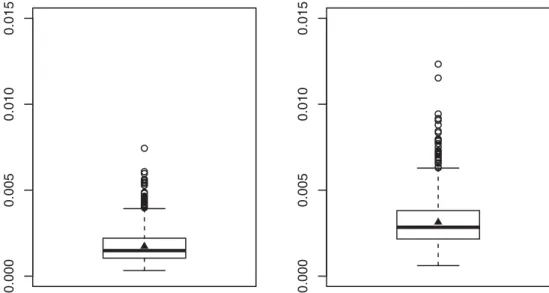
IMSE, IBIAS, and IVAR for ˜mand ˆm. FromTable 2, we see
that the latter clearly performs better than the former, both in terms of bias and variance. This observation is also confirmed byFigure 2, which shows the boxplots of the empirical ISEs of the two estimators. From this observation, we only consider
ˆ
m(x) hereafter.
To state the main result about ˆm(x), first note that the
asymp-totic representation of ˆcX( ˜Fn(x); ˆθn) follows by using similar
arguments as in the proof of Theorem 1. In fact, under
Assump-tions A, B, and C, one can easily check that we have ˆ cX( ˜Fn(x); ˆθn)−cX(F(x);θ0)=n−1 n i=1 Di(x;θ0)+op(n−1/2), (12) where Di(x;θ0)= d j=1{I(Xj,i ≤xj)−Fj(xj)}∂jcX(F(x); θ0)+ηi ˙cX(F(x);θ0).
Remark 2. This representation implies that up to
op(n−1/2), ˆcX( ˜Fn(x); ˆθn) is asymptotically equivalent to
1
0 c(u0,Fn(x); ˆ˜ θn)du0. This also means that the difference
be-tween ˜m(x) and ˆm(x) is negligible up to the first-order
approx-imation.
Finally, combining (11) with (12) leads to our main result.
Theorem 2. Assume that every component of ˜Fn satisfies
Assumption A, ˆθn andc(·) satisfy Assumptions B and C,
re-spectively. IfE[Y2]<∞, then we have
√ n( ˆm(x)−m(x))= √1 n n i=1 1 cX(F(x);θ0) × [Ei(x;θ0)−m(x)Di(x;θ0)]+op(1). As in the univariate case, the asymptotic normality of
√
n( ˆm(x)−m(x)) can be deduced from Theorem 2. The
asymp-totic variance of√n( ˆm(x)−m(x)), which is given by
var 1 cX(F(x);θ0) [E1(x;θ0)−m(x)D1(x;θ0)] ,
can be estimated using the plug-in method. As a consequence,
one can easily construct pointwise confidence intervals form.
The validity of this approach is investigated in Section5.
4. CONSIDERATION OF MISSPECIFICATION
If the true copula family is known, the proposed estimator performs well as will be shown in the simulation study. However, in practice such information is not available and the copula shape needs to be selected using the data. In any selection procedure,
0.000 0.005 0.010 0.015 0.000 0.005 0.010 0.015
Figure 2. Boxplots of the empirical ISE’s of ˆm(left) and ˜m(right). The triangular dots indicate the average of the ISE.
there is the possibility that the wrong copula family will be selected and using a misspecified copula model for our method
will lead to an inconsistent estimator ofm(x). In this section,
we are interested in the following question: what is the effect (cost) of using a misspecified copula model on the resulting
regression estimator? To answer this question, assume thatC=
{c(.;θ), θ∈}is a parametric family of copula densities under
consideration. In the previous sections, we assumed that the copula family is well-specified, that is, there exists the true
parameterθ0 such thatc(.;θ0) coincides with the true copula
density,c(·), of (Y,X). Under a misspecified model, suchθ0
may not exist. However, even in such a situation, we can define
the pseudo-true parameterθ∗to be the unique minimum within
the setof I(θ)= [0,1]d+1 ln c(u0,u) c(u0,u;θ) dC(u0,u).
Here,I(θ) is the classical Kullback–Leibler information
crite-rion expressed in terms of copula densities instead of the tradi-tional densities. Following the lines of the proof for Theorem
2 with θ∗ instead of θ0, we are able to describe the
asymp-totic behavior of ˆm(x) under misspecification in the following
theorem.
Theorem 3. Assume that every component of ˜Fn satisfies
Assumption A and ˆθn andc(·) satisfy Assumptions B and C,
respectively, withθ∗instead ofθ0. IfE[Y2]<∞, then we have
√ n( ˆm(x)−m(x;θ∗))= √1 n n i=1 1 cX(F(x);θ∗) Ei(F(x);θ∗) − m(x;θ∗)Di(F(x);θ∗) +op(1),
where m(x,θ∗) is the mean regression function under
the assumption that the joint distribution of (Y,X) is
C(F0(Y),F(X);θ∗). Remark 3. Let ˆ θn=arg min θ n i=1 logcFˆ0,n(Yi),Fn(Xi);ˆ θ
be the maximum PL estimator. By the classical maximum
like-lihood theory under misspecification, see White (1982), and
following the proof of Theorem 1 in Tsukahara (2005), we have
verified that ˆθnsatisfies Assumption B with ηas given by (9)
but withθ∗instead ofθ0.
Clearly, this theorem reduces to Theorem 2 when the cop-ula family is well specified. Additionally, the result implies that
under the misspecification, the estimator ˆm(x) is still
asymp-totically normal but is biased. More specifically, a misspecified
copula brings out a bias in the estimation of m(x), which is
(asymptotically) nothing but the difference betweenm(x), the
true regression function, andm(x;θ∗) its best approximation
(in terms of likelihood) among the regression function family
{m(x;θ)≡E(Y c(F0(Y),F(x);θ))/cX(F(x);θ), θ∈}. As a
result, it is important to choose a rich and flexible copula family
to make the differencem(x)−m(x;θ∗) small. More discussion
about this will be given in the next section.
5. SIMULATIONS
The objective of this section is first to check whether the
asymptotic theory for ˆm(x) works both when the copula is well
specified (Theorem 2) and when the copula is misspecified (The-orem 3). The second objective is to compare our semiparametric estimator with some competitors both when the true copula fam-ily is known and when the copula famfam-ily and its parameters are adaptively selected using the data. To this end, we consider the following data generating procedures (DGPs):
• DGP S.a(F0(Y), F1(X1))∼Gaussian copula with
param-eterρ1;Y ∼N(μY, σY2).
(i) The resulting regression function is m(x1)=μY+
σYρ1−1(F1(x1)),where is the cdf of a standard
normal distribution.
(ii) X1is generated fromN(μX1, σ
2 X1).
• DGP S.b(F0(Y), F1(X1))∼FGM copula with parameter
θ;Y ∼N(μY, σY2).
(i) The resulting regression function is m(x1)=μY−
θ
√πσY+2√θπσYF1(x1).
(ii) X1 is generated from the cdf FX1(x1)=1−
exp(−exp(x1)).
• DGP S.c (F0(Y), F1(X1))∼Student’st copula with
pa-rametersρanddf;Y ∼N(μY, σY2).
(i) The resulting regression function is
m(x1)=μY+E
σY−1(df(ρa
+Tdf(1−ρ2)(1+a2/df)/(df+1))),
wherea =−df1(FX1(x1)).df is the cdf of a
univari-ate Student’st-distribution with degrees of freedomdf
andTis a univariate Student’strandom variable with
degrees of freedomdf+1.
(ii) X1is generated fromN(μX1, σ
2 X1) .
• DGP S.d(F0(Y), F1(X1))∼Clayton copula with
parame-tersδ;Y ∼N(μY, σY2).
(i) The resulting regression function is
m(x1)=μY+E σY−1(T−1/δ) , where T ∼fT(t)=(1/δ+1)(1+ξ)(1/δ+1)/(t+ ξ)(1/δ+2)fort >1 andξ =F X1(x1)−δ−1.
(ii) X1is generated fromN(μX1, σ
2 X1).
• DGP M.a(F0(Y), F1(X1), . . . , Fd(Xd))∼Gaussian
cop-ula with correlation matrix=[ρ1 ρ
X], whereρis a
d-dimensional vector;Y ∼U(0,1).
(i) The resulting regression function is
m(x)= ⎛ ⎝d j=1 aj 2−ρa −1(F j(xj)) ⎞ ⎠, wherea=(a1, . . . , ad)≡−X1ρ.
(ii) Xj is generated fromN(μXj, σ
2
Xj), j=1, . . . , d.
682 Journal of the American Statistical Association, June 2013
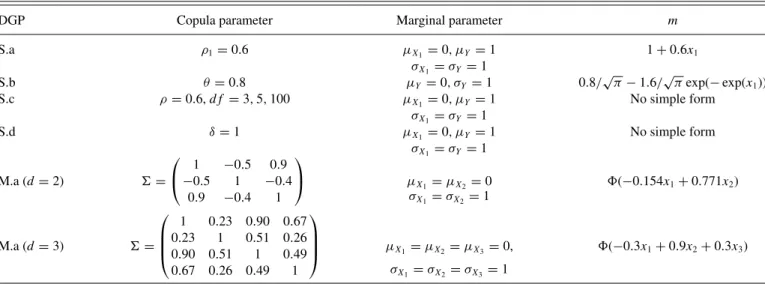
Table 3. Parameters of the copula and of the marginal distributions for each DGP
DGP Copula parameter Marginal parameter m
S.a ρ1=0.6 μX1=0, μY =1 1+0.6x1 σX1=σY =1 S.b θ=0.8 μY =0, σY =1 0.8/ √ π−1.6/√πexp(−exp(x1)) S.c ρ=0.6,df =3,5,100 μX1=0, μY =1 No simple form σX1=σY =1 S.d δ=1 μX1=0, μY =1 No simple form σX1=σY =1 M.a (d=2) = ⎛ ⎝−01.5 −01.5 −00.9.4 0.9 −0.4 1 ⎞ ⎠ μX1=μX2=0 (−0.154x1+0.771x2) σX1=σX2=1 M.a (d=3) = ⎛ ⎜ ⎜ ⎝ 1 0.23 0.90 0.67 0.23 1 0.51 0.26 0.90 0.51 1 0.49 0.67 0.26 0.49 1 ⎞ ⎟ ⎟ ⎠ μX1=μX2=μX3=0, (−0.3x1+0.9x2+0.3x3) σX1=σX2=σX3=1 The parameters of the copula and of the marginal distributions
that we use for each DGP are given inTable 3. All computations
are done with R (R Development Core Team2010).
5.1 Verifying the Asymptotic Results
To verify the established asymptotic results, we draw
Quantile-Quantile (Q-Q) plots of ˆm(x) and calculate empirical
coverage probabilities (ECPs) of the (1−α)-confidence
inter-vals of m(x) calculated according to Theorem 2. ECP means
the proportion of confidence intervals that contain the true value
of the regression functionm(x). By seeing whether the ECPs
are close to the nominal level (1−α), we can check that the
proposed estimator ˆm(x) is asymptotically normal. Also, we
can validate the asymptotic iid representation for ˆm(x) and the
appropriateness of the proposed variance estimator of ˆm(x). We
calculate the estimator ˆm(x) fromN =1000 random samples of
sizen=50,100,200,and 400. This is done for different values
of significance levelα and points of interestx. Only selected
and representative results are shown to save space.
5.1.1 When the Copula is Well Specified. Table 4presents
the ECP of the 95% confidence intervals for m(x) with data
generated from DGP S.a, DGP S.b, and DGP M.a (d=2). We
calculate the ECP, when x is an interior point (x=μX, the
mean of the distribution of X) and a boundary point (a point
that satisfiesP(X−μX>x−μX)=0.1, where · is
the Euclidean norm). As seen inTable 4, even for a small sample
size, the ECPs are generally quite close to their nominal confi-dence level. This demonstrates the validity of our iid represen-tation and the consistency of our asymptotic variance estimator.
Figure 3, which shows the Q-Q plots for our estimator with DGP
S.b whenn=50, also confirms this finding. These plots clearly
indicate the accuracy of the normal approximation to the
asymp-totic distribution of ˆm(x). To estimate the copula parameter, we
make use of the R packagecopula(see Yan2007).
5.1.2 When the Copula is Misspecified. To verify the asymptotic behavior of our estimator under misspecification,
we generate data from Student’stcopula and Clayton copula
according to DGP S.c and DGP S.d, respectively, but in our estimation procedure we use a Gaussian copula. To see how the degree of misspecification influences our estimator, we vary the
degrees of freedom (df) of the Student’s copula in{3,5,100}.
Since the difference between the best approximationm(x1, ρ∗)
and the true valuem(x1) depends on the distance between the
given copula familyC= {c(.;θ), θ∈}and the true copula
c(·), we expect to see the estimator ˆm(x1) concentrating more
aroundm(x1) as thedf of the truet-copula increases based on
our established theory. The “pseudo”-true regression function
ism(x1, ρ∗)=1+ρ∗x1withρ∗=0.583,0.590,0.596 for the
t-copulas (df=3,5,100), respectively, andρ∗=0.503 for the Clayton copula.
Figure 4shows the boxplots of the estimators ˆm(x1) obtained from 1000 random samples of size 200. As stated in Theorem 3, we see that the observed values are symmetrically distributed
around the pseudo-true parameter m(x1, ρ∗) instead of true
parameter ˆm(x1). The difference between these two quantities
corresponds exactly to the asymptotic bias. This bias decreases as the “distance” between the true and the used copula decreases.
In case of the t-copula, our estimator becomes consistent as
thedfincreases. Clearly, the selection of an appropriate copula
family is important for guaranteeing good performance of our methodology considering the case of the Clayton copula.
Table 4. Coverage probabilities of the proposed confidence interval form(x),α=0.05
DGP x n=50 n=100 n=200 n=400 Interior S.a 0.00 0.943 0.938 0.939 0.953 S.b −0.58 0.953 0.952 0.951 0.949 M.a (d=2) (0.00,0.00) 0.946 0.943 0.937 0.943 Boundary S.a −1.64 0.907 0.933 0.956 0.950 S.b −2.49 0.968 0.957 0.962 0.955 M.a (d=2) (1.53,1.53) 0.946 0.945 0.946 0.962
−3 −2 −1 0 1 2 3 −0.4 −0.2 0.0 0.2 0.4 Theoretical Quantiles m^
(
x)
m^(
x)
−3 −2 −1 0 1 2 3 −0. 8 −0.4 0.0 0.2 Theoretical QuantilesFigure 3. Q-Q plots of ˆm(x) at an interior point (left) and at a boundary point (right).n=50, DGP S.b.
5.2 Robustness and Comparison With Other Methods
In this section, we compare our semiparametric estimator both with semiparametric and nonparametric competitors. We consider four estimators for comparison.
• mˆtc: our estimator when the true copula family is used.
• mˆuc: our estimator when the copula density family is
adap-tively selected using the data (see the explanation below).
• mˆll: local linear estimator with the bandwidth selected by
CV using the R packagenp(see Hayfield and Racine2008).
• mˆsi: single index regression estimator based on a two-stage
estimation method; the single index coefficients are first
estimated by the R packagedr using the slice inverse
re-gression method (see Li1991) and then the link function
is estimated in the same way as for ˆmll.
When no information is available about the true copula den-sity, we should choose an appropriate copula family for our
estimator ˆmuc. This step may be difficult especially when the
number of covariates is large. The reason is that the set of
high-dimensional copulas available in the literature is limited to very special and restrictive copula families such as elliptical copu-las and Archimedean copucopu-las. For this reason, the strategy that we advocate and adopt here is to make use of the recent avail-able work about the simplified pair-copula decomposition. The main idea is to decompose a multivariate copula to a cascade of bivariate copulas so that we can take advantage of the rela-tive simplicity of bivariate copula selection and estimation. To be more specific, we briefly describe such an approach for the
case of a three-variate vectorX =(X1, X2, X3). By applying
Sklar’s theorem recursively, one can write, for example,
c(F0(y), F1(x1), F2(x2), F3(x3))
= cX(F1(x1), F2(x2), F3(x3))c01(F0(y), F1(x1))
×c02|1(F0|1(y|x1), F2|1(x2|x1)|x1)
×c03|12(F0|12(y|x1, x2), F3|12(x3|x1, x2)|x1, x2), (13)
wherec01,c02|1andc03|12are the copula densities associated with
the distributions of (Y, X1), (Y, X2)|X1, and (Y, X3)|(X1, X2),
0.2 0.3 0.4 0.5 0.6 0.7 0. 8 Clayton 0.2 0.3 0.4 0.5 0.6 0.7 0. 8 t(df=3) 0.2 0.3 0.4 0.5 0.6 0.7 0. 8 t(df=5) 0.2 0.3 0.4 0.5 0.6 0.7 0. 8 t(df=100)
Figure 4. Boxplots of ˆm(x1) atx1=F1−1(0.2)= −0.8416 for different degree of freedom. The horizontal solid line representsm(x1, ρ∗) and
the dotted line representsm(x1).
684 Journal of the American Statistical Association, June 2013
respectively. Similarly,cXcan be, for example, decomposed as
cX(F1(x1), F2(x2), F3(x3))
=c12(F1(x1), F2(x2))c23(F2(x2), F3(x3))c13|2(F1|2(x1|x2),
×F3|2(x3|x2)|x2).
If we assume that all the conditional copulas depend on the conditioning variables only through the conditional
distributions, for example, c02|1(F0|1(y|x1), F2|1(x2|x1)|x1)=
c02|1(F0|1(y|x1), F2|1(x2|x1)), then it leads to the so-called
sim-plified pair-copula decomposition. Because any bivariate copula density can be used as a building block for this decomposition, the simplified pair-copula decomposition provides high flexibil-ity and the abilflexibil-ity to cover a wide range of complex
dependen-cies. Hobæk Haff, Aas, and Frigessi (2010) and Stoeber, Joe,
and Czado (2012) discussed the conditions under which such a
simplification is possible and found that this is not a severe re-striction in many situations. For more about this decomposition,
see the recent book by Kurowicka and Joe (2010).
In our simulation, for our estimator ˆmuc, we choose one
decomposition (R-vine structure) for the data and then choose the pair-copulas independently among 10 candidate copulas:
two are elliptical (Gaussian and Student’s t) and eight are
Archimedean (Clayton, Gumbel, Frank, Joe, Clayton–Gumbel, Joe–Gumbel, Joe–Clayton, and Joe–Frank) using the R package VineCopula; see Dißmann et al. (2011). As a selection criterion for bivariate copula, we use the Akaike information criterion (AIC).
Remark 4. As noted by the referees, instead of using the classical AIC, which lacks theoretical justification in the context of pseudo-maximum likelihood, it is possible to use the copula
information criterion (CIC); see Grønneberg and Hjort (2011)
and Grønneberg (2011). However, the CIC does not exist for
some popular copula families such as Gumbel and Joe copulas and is complicated to compute even when it exists. Compared with the CIC, the AIC is easy to compute and has been shown to perform well for copula selection in R-vine framework; see
Brechmann (2010, chap. 5).
5.2.1 When the Simplified Pair-Copula Assumption Holds. To generate data that satisfy our copula assumptions, we
con-sider DGP M.a (d =2) and M.a (d =3). As a reference case,
we consider the nonlinear least-square estimator ˆmls with the
true link function. We use the R packagenlrwrto calculate ˆmls.
For details, we refer to Ritz and Streibig (2008).Table 5shows
the IMSE of each estimator. As expected, the least-square
esti-mator ˆmlsgives the best performance. The difference in IMSE
Table 5. 100×IMSE for ˆmls(least square), ˆmtc(true copula), ˆmuc
(unknown copula), and ˆmll(local linear)
DGP n mlsˆ mtcˆ mucˆ msiˆ mllˆ M.a (d=2) 50 0.067 0.177 0.205 0.332 0.637 100 0.029 0.079 0.097 0.196 0.197 200 0.015 0.038 0.047 0.059 0.098 M.a (d=3) 50 0.030 0.195 0.229 0.404 0.547 100 0.014 0.092 0.107 0.283 0.159 200 0.007 0.045 0.052 0.048 0.076
Table 6. Specification of DGP M.b, DGP M.c, and DGP M.d.is the cdf of the standard Cauchy distribution
DGP m(X) σ
M.b (−0.3X1+0.9X2+0.3X3) 0.1
M.c √|2X1−X2+0.5| +(−0.5X3+1)(0.1X3
4) 2
M.d ((−2X1+X2−4X3+3X4+X5+2X6)/√35)3 0.5
between ˆmlsand our copula estimators decreases as the sample
size increases. Since additional variability comes into the esti-mation from the selection of copula family for each bivariate
copula, ˆmuchas larger IMSE than ˆmtcbut the difference is
rel-atively moderate. The reason for the modest difference is that the Gaussian copula admits R-vine decompositions with
Gaus-sian pair-copulas (see Hobæk Haff, Aas, and Frigessi2010) and
the AIC works reasonably well. We observe that the estimator ˆ
mucdoes better than the local linear estimator on the whole and
especially at boundary regions (the details are not shown here). The same remarks remain valid in three-covariate case. In this
case, it is important to note that the difference between ˆmtcand
ˆ
mucbecomes bigger than in two-covariate case especially when
the sample size is small. This is because the number of bivariate copula to be selected and estimated by the data in the decompo-sition increases with the number of the covariates (six instead of
three in our case). However, whend =3, ˆmucstill remains
sig-nificantly better than the local linear estimator, which is known to suffer from the curse of dimensionality. Finally, it is notable
that our estimator ˆmucis even better than the single index
esti-mator ˆmsioverall. The reason for it may be that the uncertainty
stemming from the copula choice is relatively smaller than that coming from the estimation of the single index coefficients when the dimension of the covariates is relatively small.
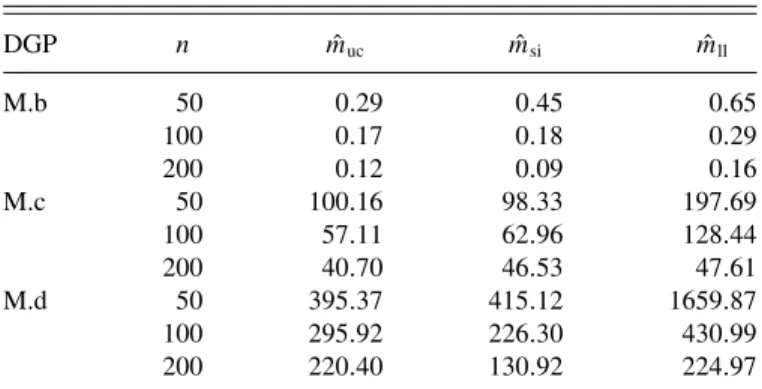
5.2.2 When the Simplified Pair-Copula Assumption Does not Hold. In this section, we investigate how our estimator performs when the true copula does not belong to the class of R-vines under consideration. For such purpose, we generate the data from DGP M.b, DGP M.c, and DGP M.d, which are
based on the regression model Y =m(X)+σ , where X is
multivariate normal with mean 0 and cov(Xi, Xj)=0.5|i−j|
and∼N(0,1) independent ofX. Specification of each DGP
is given inTable 6.
In these cases, to our knowledge, the true copula densities cannot fit into any simplified pair-copula decomposition with
Table 7. 100×IMSE for ˆmuc(unknown copula), ˆmsi(single index), and ˆmll(local linear)
DGP n mˆuc mˆsi mˆll M.b 50 0.29 0.45 0.65 100 0.17 0.18 0.29 200 0.12 0.09 0.16 M.c 50 100.16 98.33 197.69 100 57.11 62.96 128.44 200 40.70 46.53 47.61 M.d 50 395.37 415.12 1659.87 100 295.92 226.30 430.99 200 220.40 130.92 224.97
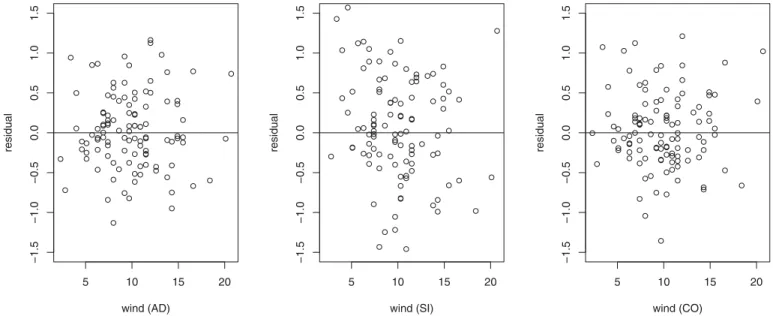
5 10 15 20 −1.5 −1.0 −0.5 0.0 0.5 1.0 1.5 wind (AD) resid u al 5 10 15 20 −1.5 −1.0 −0.5 0.0 0.5 1.0 1.5 wind (SI) resid u al 5 10 15 20 −1.5 −1.0 −0.5 0.0 0.5 1.0 1.5 wind (CO) resid u al
Figure 5. Residual plots for (AD), (SI), and (CO).
the bivariate copulas in our candidate list. Consequently, the
performance of ˆmucis affected by the misspecification caused
by assuming the pair-copula decomposition and arising in the
bivariate copula selection.Table 7shows that on the whole our
estimator ˆmuc has better performance than the nonparametric
estimator ˆmllespecially when the sample size is small and the
number of covariates is large. In the cases of DGP M.b and M.d, where the true model is a single-index model, our
esti-mator ˆmucperforms similarly to the estimator ˆmsibut with ˆmsi
having a slight advantage. This is natural because the estimator ˆ
msi directly exploits the information about the true regression
structure. However, under DGP M.c where the single index
as-sumption is not correct, our estimator ˆmucseems to work better
than the other estimators ˆmsiand ˆmll.
6. REAL DATA ANALYSIS
To illustrate our method, we analyze data from air pollution studies. The data consist of measurements of daily ozone
con-centration (Y =log(ozone)), solar radiation (X1=rad), daily
maximum temperature (X2 =temp), and wind speed (X3=
wind) onn=111 days from May to September 1973 in New
York. To estimatem(X1, X2, X3)=E(Y|X1, X2, X3), we
con-sider the following:
(LL) Local linear estimator with the bandwidth selected by CV.
(LS) Least-square estimator ˆβ0+βˆ1rad+βˆ2temp+βˆ3wind+
ˆ
β4wind2.
(AD) Additive model estimator ˆg1(rad)+gˆ2(temp)+gˆ3(wind).
(SI) Single index model estimator gˆ( ˆβ1rad+βˆ2temp+
ˆ
β3wind).
Table 8. Cross-validation error of each estimator for ozone data (LS) (AD) (SI) (CO) (LL) CV1 0.3183 0.2917 0.4465 0.2768 0.2815
CV2 0.2174 0.2203 0.3446 0.2065 0.1701
(CO) Our copula-based estimator with the copula selected by the data using pair-copula decomposition.
Model (LS) was considered by Crawley (2005), who found
that the quadratic model fitted the data well. (AD), (SI), and (CO) are semiparametric models. We use a smoothing spline to
fit the AD using R packagegamand a local linear estimator to
fit the SI. Finally, as an evaluation measure of each estimator, we compute the following two versions of CV error:
CV1( ˆm)=median1≤i≤n|Yi−mˆ−i(Xi)| and
CV2( ˆm)=
n
i=1
(Yi−mˆ−i(Xi))2, (14)
where ˆm−i(Xi) is the estimate of m(Xi) from the dataset
{(Yj,Xj);j =i, j =1, . . . , n}. CV1is a robustified version of
the standard CV error CV2.
Table 8 suggests that all the estimators except (SI) show more or less similar performances with our method having a slight advantage. Clearly, the single index structure is not ap-propriate for this data and the additive structure seems to be more adequate. In terms of the CV criteria, our estimator shows
very good performance. The residual plots betweenX3,i(wind)
andYi−mˆ−i(Xi) for (AD), (SI), and (CO), seeFigure 5, also
support these remarks. We observe that the residuals from (SI)
show a decreasing trend asX3(wind) increases while the
resid-uals from (AD) and (CO) show a random pattern. This example clearly shows the flexibility of our estimator and its ability to adapt to the underlying regression structure of the data.
7. CONCLUSION AND FUTURE WORKS
We proposed a new semiparametric estimator of a regression function based on copulas. The estimator is obtained by model-ing the joint distribution of the response and its covariates via a parametric copula family and the marginals via nonparametric methods. This method is flexible, easy to implement and seems to be less influenced by the curse of dimensionality. However, this advantage is attained at the price of a model risk in the
686 Journal of the American Statistical Association, June 2013 copula modeling. Here, we empirically checked that such a
model risk was small but some theoretical analysis about the ad-ditional risk stemming from the model selection step is needed. Additionally, since copula has some advantages in modeling tail dependence, it would be interesting to see whether our cop-ula regression framework benefits from those advantages in the estimation when the data have a specific tail dependence.
APPENDIX: TECHNICAL DETAILS
Lemma 1. Assume thatcsatisfies Assumption C. If (i)E|Y|<∞, (ii) ˜F1,n(x1)−F1(x1)=Op(n−1/2), and (iii) ˆθn−θ0=Op(n−1/2), then
we have ˆ m(x1)=n−1 n i=1 Yic(F0(Yi), F1(x1);θ0)+n−1 n i=1 Yi( ˆF0,n(Yi) −F0(Yi))∂0c(F0(Yi), F1(x1);θ0)+( ˜F1,n(x1) −F1(x1))∂1e(F1(x1);θ0)+( ˆθn−θ0)e˙(F1(x1);θ0) +op(n−1/2).
Proof. Using the first-order Taylor expansion, we have ˆ m(x1)=n−1 n i=1 Yic(F0(Yi), F1(x1);θ0)+V1,n+V2,n+V3,n, (A.1) where V1,n=n−1 n i=1 Yi( ˆF0,n(Yi)−F0(Yi))∂0c( ˜U0,i,U1˜ ,i; ˜θi,n), V2,n=n−1 n i=1 Yi( ˜F1,n(x1)−F1(x1))∂1c( ˜U0,i,U˜1,i; ˜θi,n), V3,n=n−1 n i=1 Yi( ˆθn−θ0)˙c( ˜U0,i,U1˜ ,i; ˜θi,n),
with ˜U0,i=F0(Yi)+ti,n( ˆF0,n(Yi)−F0(Yi)), ˜U1,i=F1(x1)+ti,n( ˜F1,n
(x1)−F1(x1)), and ˜θi,n=θ0+ti,n( ˆθn−θ0) for some random quantity ti,n∈[0,1]. By adding and subtracting ∂0c(F0(Yi), F1(x1);θ0) in the
sum, decompose further the termV1,nas
V1,n=n−1 n i=1 Yi( ˆF0,n(Yi)−F0(Yi))∂0c(F0(Yi), F1(x1);θ0)+Rn, where Rn=n−1 n i=1 Yi( ˆF0,n(Yi)−F0(Yi))[∂0c( ˜U0,i,U1˜ ,i; ˜θi,n) −∂0c(F0(Yi), F1(x1);θ0)].
To show Rn=op(n−1/2), first note that n−1
n
i=1|Yi| =Op(1) and
supy|F0ˆ,n(y)−F0(y)| =Op(n−1/2) by Donsker’s Theorem. Moreover,
by Assumption C and the continuous mapping theorem, we have max 1≤i≤n∂0c( ˜U0,i, ˜ U1,i; ˜θi,n)−∂0c( ˜U0,i, F1(x1);θ0)=op(1); sup |u˜0−u0|<n |∂0c( ˜u0, F1(x1);θ0)−∂0c(u0, F1(x1);θ0)| =op(1) whenevern=op(1).
Consequently, by the triangle inequality, we have max
1≤i≤n∂0c( ˜U0,i,
˜
U1,i; ˜θi,n)−∂0c(F0(Yi), F1(x1);θ0)=op(1),
which leads toRn=op(n−1/2). Thus, we know that
V1,n=n−1 n i=1 Yi( ˆF0,n(Yi)−F0(Yi))∂0c(F0(Yi), F1(x1);θ0)+op(n−1/2). (A.2) Now, we turn to the second termV2,n. Following the same arguments
as forV1,nwith Assumption (ii), we have
V2,n=( ˜F1,n(x1)−F1(x1))n−1 n i=1 Yi∂1c(F0(Yi), F1(x1);θ0)+op(n−1/2) =( ˜F1,n(x1)−F1(x1))∂1e(F1(x1);θ0)+op(n−1/2). (A.3)
In the last equality, we use the fact that n−1n
i=1Yi∂1c(F0(Yi),
F1(x1);θ0) converges in probability toE(Y ∂1c(F0(Y), F1(x1);θ0))= ∂1e(F1(x1);θ0).Similarly, using Assumption (iii), the last term V3,n
can be expressed as V3,n=( ˆθn−θ0)n−1 n i=1 Yi˙c(F0(Yi), F1(x1);θ0)+op(n−1/2) =( ˆθn−θ0)e˙(F1(x1);θ0)+op(n−1/2). (A.4)
Recollecting the elements (A.2), (A.3), (A.4), and (A.1) gives the claimed result.
Proof of Theorem 1
Put V˜1,n=n−1
n
i=1Yi( ˆF0,n(Yi)−F0(Yi))∂0c(F0(Yi), F1(x1);θ0).
This is aV-statistic with the kernel
h(Yi, Yj)= 1 2 Yi(I(Yj≤Yi)−F0(Yi))∂0c(F0(Yi), F1(x1);θ0) +Yj(I(Yi≤Yj)−F0(Yj))∂0c(F0(Yj), F1(x1);θ0) .
By Assumption C and (i), we haveE[h2(Y
i, Yj)]<∞. Therefore, using
Lemma 5.7.3 and Theorem 5.3.2 in Serfling (1980) and the fact that
Eh(Yi, Yj)=0, we get that ˜ V1,n=n−1 n i=1 λ(Yi, F1(x1);θ0)+op(n−1/2), (A.5) where λ(u0, u1;θ)= y{I(u0≤y)−F0(y)}∂0c(F0(y), u1;θ)f0(y)dy.
Using integration by part and the fact thatE|Y|<∞, it is easy to check that λ(u0, u1;θ)= yc(F0(y), u1;θ0)f0(y)dy−u0c(F0(u0), u1;θ0) − (I(u0≤y)−F0(y))c(F0(y), u1;θ0)dy.
This result together with Lemma 1, Assumptions A, and B concludes the proof.
Sketch of the Proof for the Consistency of ˆσ2
Here, we sketch the proof for the single parameter (p=1) and single covariate (d=1) case . The proof for the general case can be done in a similar way. To prove the consistency, we mainly need to prove that
n−1 n i=1 ˆ E2 i( ˆθn)=n−1 n i=1 ˆ E2 i(θ0)+op(1) (A.6) =n−1 n i=1 Ei2(θ0)+op(1). (A.7)