The Impact of Job Satisfaction on Employees’ Loyalty and
Commitment: A Comparative Study Among Some Selected
Sectors in Ghana
Lady Nadia Frempong1 Wonder Agbenyo1* Peter Adjei Darko2
1.College of Economics and Management, Sichuan Agricultural University, Chengdu 611130, China 2.School of Economics and Management, University of Electronics Science and Technology, Chengdu, China
Abstract
Job satisfaction is one of the vital needs of a most employees in any well-structured organization and vital to all corporate management. It is believed that the prospect business will depend on the level of employees’ satisfactions. The drive of the study is to find whether job satisfaction has impact on the employees’ loyalty and commitment. The study utilized descriptive and exploratory research design. The study population was the entire employees in the selected sectors in Ghana. A total of (150) employee from the mining, financial and manufacturing industries were sampled. Multiple regression analysis was used to predict the unknown value of a variable from the known value of variable also called predictors. According to findings of this study, the model shows a significant and positive relationship, individual factor contribute to the satisfaction but does not have a strong impact on job satisfaction in all sectors. The study again portrayed that, there was at least a positively significant relation between the human resources practices’, job satisfaction and loyalty/commitment in various sectors. The study concluded that job satisfaction showed a significant impact on loyalty and commitment in the manufacturing and mining sector and there was at least significant relationship between the human resource practices, job satisfaction and loyalty/commitment in various sectors which validates the various theories and studies. The study also recommends that, stakeholders of the sectors should pay more attention to employees’ loyalty and commitment as this will enhance the improvement and help survive the current competition within these sectors.
Keywords: Ghana,Job satisfaction, Employee’s Loyalty, Commitment.
1. Introduction
Job Satisfaction is a major factor to enhance and maintain the overall yield of organization and job loyalty by efficient service and better performance. Job satisfaction has been defined as a pleasurable emotional state resulting from the appraisal of one’s job; an affective reaction to one’s job; and an attitude towards one’s job (Kumari & Pandey, 2011). This definition recommends that form attitudes towards our job in considering state of mind, principles and manners. Job satisfaction and motivation are often use interchangeably, although they are clearly related. According to Newstrom (2007), job satisfaction on the other hand is a particular view of the work with which employees views their job and this view is affected by favorable and unfavorable feelings and attachments of one’s work. In other words, it is how employees see their job and how ones job influences their behavior on that particular job. For all industries, employees are indispensable resources and they represent the vital speculation, on the off chance if they are satisfied and loyal or committed to their job for the sustainability of the industry competitive advantage. The key organizational objective is Job satisfaction and is essential for higher competitive level and organizational success (Garcia-Bernal et al, 2005). Defining the “Satisfaction” is, “final state of a psychological process” (Garcia-Bernal et al, 2005). Most studies have the notion that organizational practices have influences on employee’s behavior. Employee loyalty and commitment is the cornerstone to any organization’s success. Without employee loyalty, commitment, and the continuous work they do, which is essential to business’s infrastructure, organization and companies are indistinguishable might not have the capacity to accomplish its mission, vision, or objectives.
As employees satisfaction is one of the needs of a well-structured organization and vital to all corporate management. It is believed that the prospect business will depend on the level of employees’ satisfactions. A particular organization or business can be affected if their employees are not satisfied. Human Resource Management (HRM) practices provide a number of important sources of enhanced company performance (Pfeffer & Veiga, 1999). Employee’s happiness in his/ her career or willingness to stay or leave in the workplace depends on the level of satisfaction acquired in the organization. In order to avoid qualified, committed and skillful employees leaving, employers need to consistently engaged employees to know the factors that will make them satisfied with their job. Whether it is good, bad, positive or negative each factor that either aids in or helps diminish employee job satisfactions can greatly impact one’s loyalty and commitment. Every organization want to achieve it mission and vision so they consider some of the HRM practices like training and skill development. Hence, there is the need to emerge all the practices like fair reward/recognition, employee participation decision making, workplace environment, empowerment of employees, career development, etc. to facilitate job satisfaction towards employees’ commitment and loyalty.
This study is carried out among some selected sectors in Ghana to find out the job satisfaction impacts on the employees’ loyalty and commitment and factors (Human Resources Management practices) affecting them in order to make efficient and effective management system. It is undisputable that every individual has his or her own way to be motivated. When money may be the motivating factor for an employee, promotion might also be the motivating factor for the other employee. This variety of what actually motivates an employee has left this question an answered among most researchers. Thus, how do employers motivate their employees to increase work performance? Hence, the study will also identify the most effective factors of job satisfaction on employee loyalty and commitment, find out the impact of the factors of job satisfaction on employees’ loyalty and commitment and then suggest some measures in order to enhance the factors of job satisfactions and its influence on employees’ loyalty and commitment in Ghanaian sectors.
2. Literature review 2.1 Job Satisfaction
Job satisfaction plays a major role in employees’ job performance in an organization. Employees are particular with the job satisfaction for the enhancement of their lives in terms of security and fulfillment which leads to employees’ commitment, loyalty, and punctuality and then reduce labor turnover at the long-run. To the employer, employees’ satisfaction guarantees worker’s commitment, stable workforce and labor productivity to reduce the cost of hiring and training and to improve organizational performance. Job satisfaction refers to how pleasurable an individual is with his or her job; whether he or she likes the job. According to Locke, (1976), job satisfaction has been the most commonly definitions as “pleasurable or positive emotional state resulting from the appraisal of one’s job and job experiences”. Hulin and Judge (2003) are also of the view that job satisfaction includes multidimensional psychological responses to an individual’s job, and that these personal responses have cognitive, affective and behavioral components. Job satisfaction varies in the extent of the emotional feelings (affective) about the job or the evaluative (cognitive) of the job by an individual. Achievement of targets determines the performance of institutions and strengthens their commitments with their employees in terms of fringe benefits.
2.2 Employees’ Loyalty and Commitment
As employee loyalty and commitment are the presumed outcome whether or not an employee is satisfied are defined in many ways by numerous researchers. Loyalty as defined by Logan (1984) is the strong relationship that ties an employee to his or her particular organization even when it may not be monetary considerably to stay there”. Elegido (2013) also defines employee’s loyalty as a deliberate commitment to promote the best interests of one’s employer, even when doing so may call for losing some characteristic of one’s self-interest beyond what would be required by one’s legal and other moral obligations. Commitment, according to Anderson and Weitz (1992) and Morgan and Hunt (1994) contends that commitment “is a long-term relational perspective that encourages parties to resist the short-term benefits offered by other companies in favor of the benefits associated with remaining in a relationship” (as cited in Dagger, David, & Ng, 2011). Employee’s commitment has three levels. Employees that are classified within affective commitment level are been found with and are passionately attached to their organization so much that they stay with the same company because they desire to stay (Pepe, 2010). Employee with continuance commitment level, remains with the same employer for number of years because of the cost involve with leaving are known, so they decide to remain not because they want to but they need to (Pepe, 2010). Meyer& Allen (1991), as cited in Pepe (2010) that employees who exhibit normative commitment are opt to stay with an organization, not because they want to, or because they have to but it’s alternatively because they feel ought to
2.3 Factors of Job Satisfaction
There are numerous factors that affect or have impact on job satisfaction that have been developed by several authors. In this study, four main factors that the researchers think is very vital when it comes to job satisfaction in relation to employee loyalty and commitment in human resource practice are discussed.
2.3.1 Satisfaction and Reward and Recognition
Among the several factors of job satisfaction, reward and recognition are the influential factors that motivate employees. As stated in the two- factor- theory by Hertzberg (1974), one of the factors is motivator /satisfier which inspires employees to exhibit attitudes to the performance of work to achieve results. Benefits received by workers doing their jobs are included as reward (Kalleberg, 1977; Mottaz, 1988). Maurer (2001) emphasized on the relationship between the organizational successes as the consequences of employees job satisfactions. Bowen (2000) defined reward as something given or received against for a service and also recognition as the appreciation of one’s contribution to the organization in the eyes of public. Jun et al. (2006), also identified reward and recognition as the attested key factors which influence the employee job satisfaction.
2.3.2 Satisfaction and Employee Participation in Decision Making
to have a positive association with positive work attitudes and employee’s commitment (Cassar, 1999). Boon et al. (2006) in their study find a positive association between employee’s participation and affective commitment, note the positive effects of participation on job satisfaction, changing certain personality characteristics of employees. According to Luthans (2005), decision making can be formal or informal and entails intellectual and emotional as well as physical involvement.
2.3.3 Satisfaction and Work Place Environment
The environment in which one found oneself also plays a major role in employee’s job satisfactions. This factor is example under the Herzberg (1966) two- factor- theory as the hygiene which may cause dissatisfaction when they are inadequate. The work place environment in this content is generally termed as the “working environment conditions”. Herzberg (1966) stated these working conditions as ventilation, lighting, tools, space, and other related environmental features, the amount of work and the facilities of the institution. Some other studies also analyzed the lighting effect, air quality and other parameters on physical health like fatigues, headache, pain, eye and nose, throat, skin irritation. Donald and Siu (2001) created the relationship between workplace environment, mental and physical well-being of employee and job satisfaction.
2.3.4 Satisfaction and Empowerment of Employees
Due to the high level of multinational competition, employers are concentrating more towards employee’s empowerment. Also as job satisfaction has been the everyday study by both employee and employer, different researchers has described the concept of empowerment from different angles. Hales and Klidas (1998) explained it as the relationship and belonging aspects as a means to give knowledge, facts and authority to the colleagues. All the business and research related persons believe that persons who are employees are the competitive advantage for the organization (Etzioni, 1961; Siegall & Gardner, 2000). Empowerment includes giving employees freedom of actions to make decision how they go about their daily activities (Carless, 2004; Haas, 2010).
2.4 Theories and Models of Job Satisfactions
2.4.1 Dispositional Theory
This theory is based on personality traits of happy people and how these factors are carried over into the workplace. In other words, job satisfaction is to some extent an individual trait. This approach becomes effective when job satisfaction tends to be stable over time. Heller (2002) connected some three theories in aid to the dispositional theorybut will consider only one, that is, positive and negative affectivity. Positive affectivity is the personality features defined as high energy, passionate and pleasurable commitment while negative affectivity is a personality type described as distressed, pleasurable commitment and nerviness. This theory proposes people with positive attitudes possess more energy and face work task with enthusiasm. Employees with these traits are motivated to work even with or without supervision. In contrast, negative attitudes results in employees who find little or no satisfaction from work.
2.4.2 Two-Factor Theory
According to Hertzberg (1974) two- factor theory of job satisfaction use the attributes found in the dispositional theory which point out two factors that could satisfy and dissatisfy an employee in his job. An employee’s motivation to work is continually related to the job satisfaction of a subordinate. The factors are as follow:
1. Motivational / Satisfying factors are features that would inspire an employee to have better work performance and as a result to attain satisfaction. These factors can comprise of job promotions, bonuses and public recognition.
2. Hygiene / Dissatisfying factors are not necessarily motivating, but would cause dissatisfaction if they are insufficient. Examples are salaries, non-financial employees’ benefits, company’s policies and the overall workplace environment.
2.5 Theoretical Framework and Hypothesis
2.5.1 Reward and Recognition
Reward refers to something given or received against a service (Bowen, 2000). In simple terms reward is giving physical kind of payment to someone or something good that has been done. It can be in any form, a car or monetary value. Bowen (2000) refers to recognition as the acknowledgement of one’s role to the organization in the eyes of the public. Reward and recognition is seen as the main influential factor of job satisfaction. Lack or simple reward and recognition system have negative impact on job satisfaction. Waqa et.al (2014) emphasized that, reward and recognition has positive relation to job satisfaction in a study conducted in the financial sector. In essence, findings by different researchers call for management to improve reward and recognition in order to have greater impact on employee satisfaction. Based on the results reviewed the following hypothesis is developed: Hypothesis 1: Reward and Recognition has significant and positive impact on employee’s job satisfaction. 2.5.2 Employee’s Participation in Decision Making
Employee’s participation in decision making in simple term is the process whereby an individual’s new ideas and opinions are valued, information about the organization are communicated to employees as well as been involved
in the decision making. Employee participation as taking part in the common decision making has shown a positive link with positive task attitude and employee commitment, (Cassar, 1999). Employee absenteeism is reduced, organizational commitment turns greater, enhanced performance, and low turnover and higher employee job satisfaction are assured when employees are involved in the decision making, (Luthans, 2005). Participation can affect employee’s job satisfaction directly or indirectly. Although participation approach have positive link on employee’s job satisfaction which can increase performance, it does not always serves as a guarantee to success. According to Hackman & Oldham (1976), job characteristics theory is whereby an employee identifies the importance and feel powered to contribute it skills and ideas in decision making will have greater influence on job satisfaction. The hypothesis emanated from the discussion is:
Hypothesis 2: There is a positive and a significant relationship of Employee’s participation in decision making and Employee job satisfaction.
2.5.3 Work Place Environment
The work place environment also plays a major role in employee’s satisfaction. The environment should be conducive to accommodate an employee to accomplish his task. According to Herzberg (1996) working conditions comprise of the space, tools and other related environmental features, the kind of work, company’s policies that facilitates the organization. One of the two factor theory known as hygiene does not necessarily motivate but may cause dissatisfaction when they are not taken into consideration. The working atmosphere gives people pleasure to do their best to maximize performance. Also in the same study of Waqas et.al (2014) emphasized that work place environment was also important factor to job satisfaction in financial sector. Employers need to improve working environment.
Hypothesis 3: Working Place Environment has a significant impact on Job Satisfaction. 2.5.4 Empowerment of Employees
Empowerment simple means to give official authority or legal power to a person to act in his or someone’s behalf. Empowerment promotes self-actualization. Carless (2004) and Hass (2010) in their theoretical definition also states that empowerment is how employers allow and give employees knowledge of actions to make their own decisions that will affect their work. Job characteristics theory also emphasizes on empowerment in terms of the core feature of autonomy. In general life when a person is more independent, it is believed that, he or she works effectively towards the ideas generated by him. This also happens in the work environment , employees are ready and willing to work effectively under less supervision as well as task performed are been evaluated and feedback are been received from management. A research also shows that an instance in which an employee authority is increased has a reflection in his intrinsic motivation which leads to the level of employee job satisfaction. Bordin et.al (2007) also found out in their study that employee empowerment has impact on employee job satisfaction. Hypothesis 4: There is a significant relationship between Employee’s empowerment and Employee’s job satisfaction
2.5.5 Job Satisfaction and Employee’s Loyalty and Commitment
Employee’s loyalty is a strong feeling of being with an employer even if it demands to do something out of his personal interest. Elegido (2013) defines employee’s loyalty as deliberate commitment to further the best interests of one’s employer, even when doing so may demand sacrificing some aspect of one’s self-interest beyond what would be required by one’s legal and other moral duties. Employee’s commitment in a dictionary definition makes us believe that is a synonym to loyalty as defined by Elegido (2013) but in terms of job it has different meaning. Employee’s commitment according to Anderson and Weitz (1992), Morgan and Hunt (1994), “is a long-term relational perspective that encourages parties to resist the short-term benefits offered by other companies in favor of the benefits associated with remaining in a relationship” (Dagger et al, 2011). Although individual perception of his/ her work happiness is usually subjective, there can be measures to foster job satisfaction among workers. Hulin and Judge (2013) stated that job satisfaction includes multidimensional psychological responses to an individual’s job, and that these personal responses have cognitive, affective and behavioral components. In the study by Smith (2015), participant focus was not on the good benefits and pay but was the relationships built and interactions between employees, co-workers, managers, supervisors, members, clients. Participant’s primary reason why they chose to stay with one employer for multiple years was the fact that they truly love the work they do. On this basis of definitions and research there is relation between job satisfaction and employee loyalty and commitment.
Hypothesis 5: Job satisfaction has a positive influence on Employee’s loyalty and commitment.
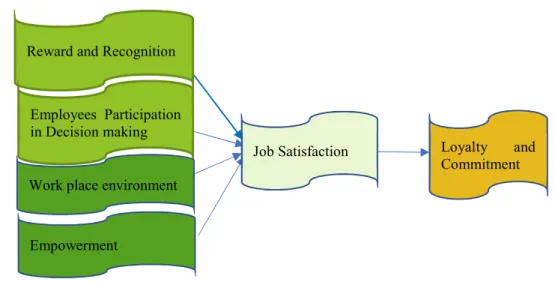
2.6 Conceptual Framework
Based on the above theories and definitions review, the following framework has been formulated to depict the relationship between the dependent and independent variables.
Figure 3-1 Theoretical Model Source: Researcher’s Construct, 2017
3. Research Methodology
3.1 Purpose of the Research Study
The purpose of the study is to find whether the job satisfaction impacts on the employees’ loyalty and commitment and factors (Human Resources Management practices) affecting them in order to make efficient and effective management system.
3.2 Research Design and Sampling Technique
Purposive sampling was used since the purpose is to get an insight in the factors of job satisfaction that have influence on employee’s loyalty and commitment. Purposive sampling was used to select the sectors under study which was mining, financial and manufacturing companies. This is because these institutions have a huge number of employees especially in the mining and manufacturing companies in which employee’s turnover is low as compared to financial companies. Based on the background of the study some companies under the three (3) selected sectors were randomly sampled on the basis of life span, performance, reputation and it contribution toward the economic growth of Ghana. A questionnaire was administered to capture information or data from employees in the selected sectors on issues relating to job satisfaction, loyalty and commitment. The questionnaire consisted of 33 items in four sections. Section A was the demographic information on the type of sector, age, gender, job position and years of work with that sector. Section B dealt with the factors that influence job satisfaction in terms of reward and recognition, employee’s participation, work place environment and empowerment. Section C was on employees responses on how loyal and committed they are to their sector. Section D was also on the items that sector can do differently to enhance job satisfaction. The responses were measured on the 5 point Likert scale ranging from 1-5.
3.2.1 Validity of the Questionnaire
Table 3-1 KMO and Bartlett’s Test of Sphericity
Kaiser-Meyer-Olkin Measure of Sampling Adequacy 0.692 Bartlett’s Test of Sphericity
Approx. Chi-Square 89.578
Df 17
Sig 0.000
Source: Field Survey, 2017
Factor analysis is a useful tool for investigating variable relationships for complex concepts. It helps to investigates concepts that are not easily measured by reducing large to small number of variables to provide the construct validity proof. KMO and Bartletts Test of Sphericity is a test pertaining to business in most researches for measuring the sampling adequacy in order to check the variable ratio for different analysis to be conducted. From the table, it can be seen that the coefficient for Kaiser-Meyer-Olkin Measure of Sampling Adequacy is greater than 0.6, and it is 0.692 also Bartlett’s Test of Sphericity showed sig value less than 0.05 at 5% level of significance.
Reward and Recognition
Employees Participation in Decision making
Work place environment
Empowerment
Job Satisfaction Loyalty and Commitment
3.2.2 Reliability of the Questionnaire
Table 3-2 Reliability of Questionnaire
Variables Cronbach’s Alpha
Reward/recognitions 0.719
Employees’ participation in decision making 0.787
Workplace environment 0.810
Employees’ empowerment 0.745
Job satisfactions 0.862
Employees’ loyalty/commitment 0.792
Source: Field Survey, 2017
The coefficient of Cronbach’s alpha reliability normally ranges between 0 and 1. However, there is no lower limit to the coefficient. The nearer the Cronbach’s alpha coefficient is to 1.0 the greater the internal consistency of the items in the scale.
3.3 Data Analysis Method
The data was analyzed using Statistical Package for Social Sciences (SPSS version 23.0. Quantitative data was used to generate simple descriptive statistic (frequency tables, percentages and graphs), which are useful in evaluating and making comparisons between the different variables of the study and these were presented in tables and histograms. Also, a statistical test like multiple regression analysis was used to predict the unknown value of a variable from the known value of variable also called predictors, cronbach’s alpha for testing reliability of questionnaire as well as factor analysis tools like KMO and Bartlett’s Test of Sphericity for checking the validity of questionnaires.
The following mathematical models were formulated:
Model 1: JS = β0+ β1 (RR) + β2 (PDM) +β3 (WPE) +β4 (EE) + β5(C) + ε Where: JS = Job satisfaction,
β0 = Constant co-efficient,
β1, β2, β3, β4, β5= Predictors co-efficient, RR = Reward & Recognition,
PDM = Participation in Decision Making, WPE = Work Place Environment, EE = Emplyoee Empowerment. C= Control variables
ε = error term
Model 2: LC = β0+ β1 (JS) + β2(C) + ε Where: LC = Loyalty and Commitment, JS = Job satisfaction,
β0 = Constant co-efficient, β1, β2 = Predictor co-efficient. ε = error term
4. Research Findings
4.1 Regression Model for the Manufacturing Sector
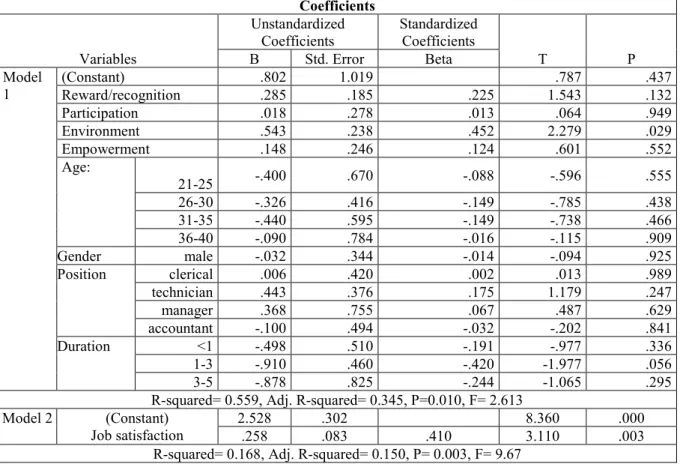
Table 4.1 below shows the regression analysis for manufacturing sector. Considering the variability in dependent (job satisfaction) and independent variables (motivational factors), the R2 in the model 1 derived 0.559 which indicates that, 55.9% of the variability in dependent variable is predicted by the independent variable. Adjusted R2 also show 0.345 which indicates 34.5% of the changes in job satisfaction can be explained by the model. However the 65.5% of the variability cannot be explained by this model, meaning they may be other factors affecting job satisfaction. The model also gives the coefficient of the constant variables. The overall model was reasonably fit and there was a significant relationship (p<0.050), however, it can be seen that all the motivational factors were not significant predictors of job satisfaction except workplace environment with the positive relationship of 0.543 (54.3%) and a significant predictor to job satisfaction of (β=0.452, t (150) = 2.279, p<0.050). With regards to the control variables in the model, all age categories showed a negative relationship Age: 21-25 0.400), 26-30 (-0.326), 31-35 (-0.440), 36-40 (-0.090) with job satisfaction. None of the age categories had a significant impact on job satisfaction (p>0.050). Gender and duration with negative relationships whiles position had a positive relationship except accountant did not also have impact on job satisfaction. The R2 in the model 2 where job satisfaction is the independent and loyalty and commitment is dependent variable is seen to be 0.168 which shows that, 16.8% of the changeability in dependent variable is not strongly predicted by the independent variable. The
adjusted R2 indicates 0.150 representing 15.0%. The model coefficient of the predictors shows that, job satisfaction is a significant predictor to loyalty and commitment (β=0.410, t (150) = 3.110, p<0.050).
Table 4.1 Multiple Regression with Control Variables for Manufacturing Sector
Coefficients Variables Unstandardized Coefficients Standardized Coefficients T P B Std. Error Beta Model 1 (Constant) .802 1.019 .787 .437 Reward/recognition .285 .185 .225 1.543 .132 Participation .018 .278 .013 .064 .949 Environment .543 .238 .452 2.279 .029 Empowerment .148 .246 .124 .601 .552 Age: 21-25 -.400 .670 -.088 -.596 .555 26-30 -.326 .416 -.149 -.785 .438 31-35 -.440 .595 -.149 -.738 .466 36-40 -.090 .784 -.016 -.115 .909 Gender male -.032 .344 -.014 -.094 .925 Position clerical .006 .420 .002 .013 .989 technician .443 .376 .175 1.179 .247 manager .368 .755 .067 .487 .629 accountant -.100 .494 -.032 -.202 .841 Duration <1 -.498 .510 -.191 -.977 .336 1-3 -.910 .460 -.420 -1.977 .056 3-5 -.878 .825 -.244 -1.065 .295
R-squared= 0.559, Adj. R-squared= 0.345, P=0.010, F= 2.613 Model 2 (Constant)
Job satisfaction
2.528 .302 8.360 .000
.258 .083 .410 3.110 .003
R-squared= 0.168, Adj. R-squared= 0.150, P= 0.003, F= 9.67 Source: Field Survey, 2017
4.1.2 Regression Model for the Financial Sector
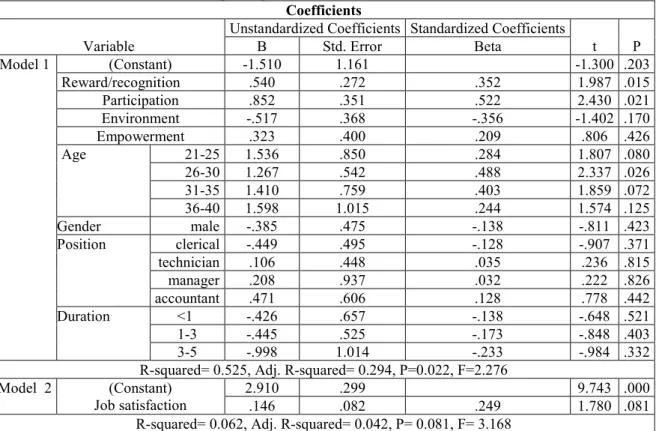
Table 4.2 below also presents the regression analysis result of financial sector. The R2 in the model1 showed 0.525 representing 52.5% variation of the dependent variable (job satisfaction) can be explained by the independent variable. The table indicates adjusted R2 was 0.294 showing 29.4% change in job satisfaction can be seen in the model. The remaining 70.6% of the variability means that they may be other factors that need to be considered other than the ones selected in the study. It can be identified that both reward/ recognition and participation significantly predict job satisfaction (β=0.352, t(150)=1.987, p<0.050), (β=0.552, t(150)=2.430, p<0.050) respectively. The overall model was reasonably fit and there was a significantly relationship of (p<0.050). Gender, position and duration showed a negative relationship whiles age showed a positive relationship with job satisfaction. Though all age category showed a positive relationship, only age 26-30 seen as a predictor to job satisfaction with (β=-0.488, t(150)=-2.337, p<0.050). Gender and duration with negative relationships whiles position had a positive relationship, except clerical did not have impact on job satisfaction. The R2 in the model 2 where job satisfaction is the independent and loyalty and commitment is dependent variable derived 0.062 which is 0.62% can be explained that the variability in dependent variable is low predicted by the independent variable. The adjusted R2 point out a co-efficient of 0.042 whiles the 0.958 variability may be identified by other motivational factors. There was no strong significant impact between them (β=0.0.249, t (150) =1.780, p>0.050).
Table 4.2 Multiple Regression with Control Variables for Financial Sector
Coefficients
Variable
Unstandardized Coefficients Standardized Coefficients
t P B Std. Error Beta Model 1 (Constant) -1.510 1.161 -1.300 .203 Reward/recognition .540 .272 .352 1.987 .015 Participation .852 .351 .522 2.430 .021 Environment -.517 .368 -.356 -1.402 .170 Empowerment .323 .400 .209 .806 .426 Age 21-25 1.536 .850 .284 1.807 .080 26-30 1.267 .542 .488 2.337 .026 31-35 1.410 .759 .403 1.859 .072 36-40 1.598 1.015 .244 1.574 .125 Gender male -.385 .475 -.138 -.811 .423 Position clerical -.449 .495 -.128 -.907 .371 technician .106 .448 .035 .236 .815 manager .208 .937 .032 .222 .826 accountant .471 .606 .128 .778 .442 Duration <1 -.426 .657 -.138 -.648 .521 1-3 -.445 .525 -.173 -.848 .403 3-5 -.998 1.014 -.233 -.984 .332
R-squared= 0.525, Adj. R-squared= 0.294, P=0.022, F=2.276 Model 2 (Constant)
Job satisfaction
2.910 .299 9.743 .000
.146 .082 .249 1.780 .081
R-squared= 0.062, Adj. R-squared= 0.042, P= 0.081, F= 3.168 Source: Field Survey, 2017
4.1.3 Regression Model for the Mining Sector
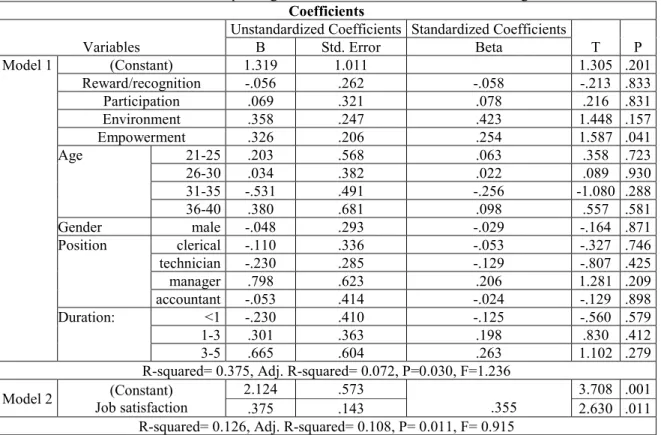
Table 4.3 shows the regression analysis for mining sector. Considering the variability in dependent (job satisfaction) and independent variables (motivational factors), the R2 in the model 1 derived 0.375 which indicate that, 37.5% of the variability in dependent variable is predicted by independent variable. Adjusted R2 also show 0.072 which indicates 7.2% of the changes in job satisfaction can be explained by the model. However the 92.8% of the variability cannot be explained by this model, meaning they are may be other factors affecting job satisfaction. The model also gives the coefficient of the constant variables. The overall model was reasonably fit and there was a significantly relationship of (p<0.050), however, it can be seen that all the motivational factors were not significant predictors of job satisfaction except employee empowerment with (β=0.254, t (150) = 1.587, p<0.050). Only position had a positive relationship but none of the control variables had a significant impact on job satisfaction. The R2 in the model 2 where job satisfaction is the independent and loyalty and commitment is dependent variable is seen to be 0.126 which shows that, 12.6% of the changeability in dependent variable is not strongly predicted by the independent variable. The adjusted R2 indicates 0.108 representing 10.8%. The model coefficient of the independent variables shows that, job satisfaction was significant predictor to loyalty and commitment (β=0.355, t (150) = 2.630, p<0.050).
Table 4.3 Multiple Regression with Control Variables for Mining Sector
Coefficients
Variables
Unstandardized Coefficients Standardized Coefficients
T P B Std. Error Beta Model 1 (Constant) 1.319 1.011 1.305 .201 Reward/recognition -.056 .262 -.058 -.213 .833 Participation .069 .321 .078 .216 .831 Environment .358 .247 .423 1.448 .157 Empowerment .326 .206 .254 1.587 .041 Age 21-25 .203 .568 .063 .358 .723 26-30 .034 .382 .022 .089 .930 31-35 -.531 .491 -.256 -1.080 .288 36-40 .380 .681 .098 .557 .581 Gender male -.048 .293 -.029 -.164 .871 Position clerical -.110 .336 -.053 -.327 .746 technician -.230 .285 -.129 -.807 .425 manager .798 .623 .206 1.281 .209 accountant -.053 .414 -.024 -.129 .898 Duration: <1 -.230 .410 -.125 -.560 .579 1-3 .301 .363 .198 .830 .412 3-5 .665 .604 .263 1.102 .279
R-squared= 0.375, Adj. R-squared= 0.072, P=0.030, F=1.236 Model 2 (Constant) Job satisfaction 2.124 .375 .573 .143 .355 3.708 2.630 .001 .011 R-squared= 0.126, Adj. R-squared= 0.108, P= 0.011, F= 0.915
Source: Field Survey, 2017
5. Discussion
With regards to the manufacturing sector, the analysis portrayed that though the model shows a significant relationship between factors and job satisfaction with (p<0.050), the individual factors have no significant impact on job satisfaction except workplace environment with the positive relationship of 0.543 (54.3%) and a significant predictor to job satisfaction of (β=0.452, t(150) = 2.279, p<0.050). It therefore implies that, employees will be satisfied with their work if the environment within which they work makes them productive and efficient. This assertion contradict Waqas et.al (2014) in their study, which concluded that (reward/recognition, participation, environment and empowerment) were significant predictors of job satisfaction. It was revealed that job satisfaction contributed 25.8% to loyalty and commitment with (β=0.258) and (p<0.050) showing that there is a strong significance between them, this affirms the definitions given by (Logan., 1984; Elegido, 2013; Anderson & Weitz, 1992).
In the case of the financial sector, it was revealed that the model shows significant impact between the factors and job satisfaction (p<0.050), however only reward/ recognition and participation significantly predict job satisfaction with (β=0.352, t(150)=1.987, p=0.015<0.050), (β=0.522, t(150)=2.430, p=0.021<0.050) respectively. In the financial sector, giving reward/recognition as well as involving employees in decisions that affects the day to day operation of the institution is very important. The bedrock of every financial sector in Ghana is customer service. When employees are rewarded or given recognition by their employers for rendering quality services to their clients or customers, they gain a sense of satisfaction with their job and will work even more to uphold that recognition. This finding is in line with Asghar et.al (2014) study, in which they indicated that salary/fringe benefit (reward/recognition) and team work (participation) were positively associated with motivation.
With respect to the mining sector, it was observed that, employee’s empowerment has positive relationship and significant impact on the job satisfaction in with (β=0.254, t (150) =1.587, p<0.050). In Ghana, the mining sector is very popular not just for its lucrative aspect but for the opportunities it offers its employees. The mining sector does not only employ or find skilled and experienced employees but they also create employees with comprehensible knowledge by empowering them to take every opportunity to update and upgrade themselves in their field. By so doing they achieve more and also increase the productivity and efficiency of the organization. Such employees find satisfaction in their job and it becomes evident in their loyalty and commitment to the organization. This therefore makes employee’s empowerment a very strong tool to job satisfaction in the mining sector, especially in Ghana. This validates Bordin et.al(2006) in their study which concluded that employee empowerment has impact on employee job satisfaction. It has been identified in this result that, the ultimate effect of job satisfaction is loyalty and commitment as there is a strong positive significance between them (β=0.375)
and (p<0.050). It employs that job satisfaction contribute 37.5 % to loyalty and commitment this accepts the definition by (Meyer & Allen, 1991).
6. Conclusion
The fundamental objective of the study was to identify the factors of job satisfaction and its impact on job loyalty and commitment in manufacturing, financial and mining sector. Based on the analysis of the study, it can be concluded, that job satisfaction is not only influenced by the selected four factors (reward/recognition, participation, workplace environment and empowerment). Though the model shows a significant and positive relationship between the factors and job satisfaction, when the factors are considered individually, it is realized that they do not have strong impact on job satisfaction in the various sectors. The result obtained from the manufacturing sector; workplace environment showed a positive relationship and a significant impact on job satisfaction resonates the working atmosphere gives pleasure to employees to do their best to maximize performance, also employers need to improve working environment. The study further concluded that in the financial sector, reward/ recognition as well as employee participation both had a significant relationship with job satisfaction whilst in the mining sector; employee empowerment contributed more and had impact on job satisfaction. Meaning that the more employees are rewarded/recognized the more they exhibit good attitudes to the performance of work to achieve results, when employees are allowed to participate and express themselves in decision, who find a positive association between employee’s participation and affective commitment, note the positive effects of participation on job satisfaction. The study finally concluded that job satisfaction showed a significant impact on loyalty and commitment in the manufacturing and mining sector and there was at least significant relationship between the human resource practices, job satisfaction and loyalty/commitment in various sectors which validates the various theories and studies. The study recommends that, stakeholders of the sectors considered should pay more attention to employees’ loyalty and commitment as this will enhance the improvement and help survive the current competition within these sectors. The study further recommends that, management can also consider other factors of job satisfaction like job security, training and development since it is undisputable fact that what might be the motivating factor of an employee might not be to another.
References
Anderson, E., & Weitz, B. (1992). The use of pledges to build and sustain commitment in distribution channels. Journal of marketing research, 18-34.
Asghar. M., Ullah S., Ahmad. M. A.,et al. Determinants of employee ’ s motivation and commitment in financial sector of Pakistan [J].2014, 1(4):47–52.
Boon, O. K., Safa, M. S., & Arumugam, V. (2006). TQM practices and affective commitment: A case of Malaysian semiconductor packaging organizations.
Bordin, C., Bartram, T., & Casimir, G. (2006). The antecedents and consequences of psychological empowerment among Singaporean IT employees. Management Research News, 30(1), 34-46.
Bowen, R. B. (2000). Recognizing and rewarding employees.
Carless, S. A. (2004). Does psychological empowerment mediate the relationship between psychological climate and job satisfaction?. Journal of Business and Psychology, 18(4), 405-425.
Cassar, V. (1999). Can leader direction and employee participation co-exist? Investigating interaction effects between participation and favourable work-related attitudes among Maltese middle-managers. Journal of Managerial Psychology, 14(1), 57-68.
Dagger, T. S., David, M. E., & Ng, S. (2011). Do relationship benefits and maintenance drive commitment and loyalty?. Journal of Services Marketing, 25(4), 273-281.
Donald, I., & Siu, O. L. (2001). Moderating the stress impact of environmental conditions: The effect of organizational commitment in Hong Kong and China. Journal of Environmental Psychology, 21(4), 353-368. Elegido, J. M. (2013). Does it make sense to be a loyal employee?. Journal of business ethics, 116(3), 495-511. Etzioni, A. (1961). Complex organizations: On power, involvement, and their correlates.
García-Bernal, J., Gargallo-Castel, A., Marzo-Navarro, M., & Rivera-Torres, P. (2005). Job satisfaction: empirical evidence of gender differences. Women in Management Review, 20(4), 279-288.
Haas, M. R. (2010). The double-edged swords of autonomy and external knowledge: Analyzing team effectiveness in a multinational organization. Academy of Management Journal, 53(5), 989-1008.
Hackman, J. R., & Oldham, G. R. (1976). Motivation through the design of work: Test of a theory. Organizational behavior and human performance, 16(2), 250-279.
Hales, C., & Klidas, A. (1998). Empowerment in five-star hotels: choice, voice or rhetoric?. International journal of contemporary hospitality management, 10(3), 88-95.
Heller, D., Judge, T. A., & Watson, D. (2002). The confounding role of personality and trait affectivity in the relationship between job and life satisfaction. Journal of Organizational Behavior, 23(7), 815-835.
dynamics, 3(2), 18-29.
Herzberg, F. I. (1966). Work and the nature of man.
Hulin, C. L., & Judge, T. A. (2003). Job attitudes. Handbook of psychology.
Jun, M., Cai, S., & Shin, H. (2006). TQM practice in maquiladora: Antecedents of employee satisfaction and loyalty. Journal of operations management, 24(6), 791-812.
Kalleberg, A. L. (1977). Work values and job rewards: A theory of job satisfaction. American sociological review, 124-143.
Kumari, G., & Pandey, K. M. (2011). Job satisfaction in public sector and private sector: A comparison. International Journal of Innovation, Management and Technology, 2(3), 222.
Locke, E. (1976). The Nature and causes of job satisfaction. Handbook of industrial and organizational psychology, 1297-1349.
Logan, G. M. (1984). Loyalty and a Sense of Purpose. California Management Review, 27(1), 149-156.
Luthans, F., & Youssef, C. M. (2007). Emerging positive organizational behavior. Journal of management, 33(3), 321-349.
Meyer, J. P., & Allen, N. J. (1991). A three-component conceptualization of organizational commitment. Human resource management review, 1(1), 61-89.
Morgan, R. M., & Hunt, S. D. (1994). The commitment-trust theory of relationship marketing. The journal of marketing, 20-38.
Mottaz, C. J. (1988). Determinants of organizational commitment. Human relations, 41(6), 467-482.
Newstrom. J. W. (2007) Organizational behavior: human behavior at work [B]. Tata McGraw-Hill Publishing C. Ltd, 2007.
Pepe, M. (2010). The impact of extrinsic motivational dissatisfies on employee level of job satisfaction and commitment resulting in the intent to turnover. Journal of Business & Economics Research, 8(9), 99. Pfeffer, J., & Veiga, J. F. (1999). Putting people first for organizational success. The Academy of Management
Executive, 13(2), 37-48.
Siegall, M., & Gardner, S. (2000). Contextual factors of psychological empowerment. Personnel Review, 29(6), 703-722.
Smith, M. C. (2015). Motivation and its Impact on Employee Loyalty and Commitment: A Qualitative Analysis -Trinity Washington University.
Waqas, A., Bashir, U., Sattar, M. F., Abdullah, H. M., Hussain, I., Anjum, W., & Arshad, R. (2014). Factors influencing job satisfaction and its impact on job loyalty. International Journal of Learning and Development, 4(2), 141-161.