Understanding Spark System Performance for Image
Processing in a Heterogeneous Commodity Cluster
A Thesis Submitted to the
College of Graduate and Postdoctoral Studies
in Partial Fulfillment of the Requirements
for the degree of Master of Science
in the Department of Computer Science
University of Saskatchewan
Saskatoon
By
Owolabi Adekoya
c
Permission to Use
In presenting this thesis in partial fulfilment of the requirements for a Postgraduate degree from the University of Saskatchewan, I agree that the Libraries of this University may make it freely available for inspection. I further agree that permission for copying of this thesis in any manner, in whole or in part, for scholarly purposes may be granted by the professor or professors who supervised my thesis work or, in their absence, by the Head of the Department or the Dean of the College in which my thesis work was done. It is understood that any copying or publication or use of this thesis or parts thereof for financial gain shall not be allowed without my written permission. It is also understood that due recognition shall be given to me and to the University of Saskatchewan in any scholarly use which may be made of any material in my thesis. Requests for permission to copy or to make other use of material in this thesis in whole or part should be addressed to:
Dean
College of Graduate and Postdoctoral Studies University of Saskatchewan
116 Thorvaldson Building, 110 Science Place Saskatoon, Saskatchewan S7N 5C9
Canada
Head of the Department of Computer Science University of Saskatchewan
176 Thorvaldson Building, 110 Science Place Saskatoon, Saskatchewan S7N 5C9
Abstract
In recent years, Apache Spark has seen a widespread adoption in industries and institutions due to its cache mechanism for faster Big Data analytics. However, the speed advantage Spark provides, especially in a heterogeneous cluster environment, is not obtainable out-of-the-box; it requires the right combination of configuration parameters from the myriads of parameters provided by Spark developers. Recognizing this challenge, this thesis undertakes a study to provide insight on Spark performance particularly, regarding the impact of choice parameter settings. These are parameters that are critical to fast job completion and effective utilization of resources.
To this end, the study focuses on two specific example applications namely,flowerCounter and imageClus-tering, for processing still image datasets of Canola plants collected during the Summer of 2016 from selected plot fields using timelapse cameras in a heterogeneous Spark-clustered environments. These applications were of initial interest to the Plant Phenotyping and Imaging Research Centre (P2IRC) at the University of Saskatchewan. The P2IRC is responsible for developing systems that will aid fast analysis of large-scale seed breeding to ensure global food security. The flowerCounter application estimates the count of flowers from the images while the imageClustering application clusters images based on physical plant attributes. Two clusters are used for the experiments: a 12-node and 3-node cluster (including a master node), with Hadoop Distributed File System (HDFS) as the storage medium for the image datasets.
Experiments with the two case study applications demonstrate that increasing the number of tasks does not always speed-up job processing due to increased communication overheads. Findings from other experi-ments show that numerous tasks with one core per executor and small allocated memory limits parallelism within an executor and result in inefficient use of cluster resources. Executors with large CPU and memory, on the other hand, do not speed-up analytics due to processing delays and threads concurrency. Further experimental results indicate that application processing time depends on input data storage in conjunction with locality levels and executor run time is largely dominated by the disk I/O time especially, the read time cost. With respect to horizontal node scaling, Spark scales with increasing homogeneous computing nodes but the speed-up degrades with heterogeneous nodes. Finally, this study shows that the effectiveness of speculative tasks execution in mitigating the impact of slow nodes varies for the applications.
Acknowledgements
There are lot of persons that were instrumental to the success of this study. First, I would like to thank the Almighty God for the grace and wisdom given to me to start and complete this program successfully. I would also like to thank my family for their encouragement and support throughout this program. My profound gratitude goes to the graduate committee of the Department of Computer Science and the Graduate College at large for the financial assistantship given to me towards the completion of this work. Thank you for the privilege of exploring the frontiers of research at the University of Saskatchewan. My sincere appreciation also goes to my supervisors Dr Dwight Makaroff and Dr Derek Eager for their reception, mentorship, guidance, support (both professionally and financially), patience and understanding towards the completion of this study. I will be forever grateful for your kind gesture and assistance towards this research pursuit. I would also like to acknowledge my advisory committee members Dr Kevin Stanley and Dr Ian Stavness for their guidance and support towards this ideal. I would not forget to recognize the efforts of my instructors whose knowledge greatly contributed to my success namely Dr Nathaniel Osgood, Dr Ralph Deters, Dr Michael Horsch & Dr Kevin Stanley. I am also hugely indebted to some Departmental staff including Gwen Lacaster, Brittany Melnyk, Greg Oster, Cary Bernath, Raouf Ajami, Merlin Hansen, Seth Shacter & Jeff Long for their tremendous support all through this study. I also want to appreciate the efforts of Javier Garcia Gonzalez and Amit Mondal for providing the sequential version of the applications used in this study. I also acknowledge the support and encouragement of my research colleagues like Tunde Olabenjo, Habib Ado, Philip Dueck, Winchell Qian, Mohammed Rashid Chowdhury, Fadi Mobayed, Lin Pin & Faheem Abrar. I also appreciate the support of my Spiritual mentors Pastor & Mrs Titus Adedapo, Mr & Mrs Funso Oderinde, Brother Hugo Clarke, Mr Jamiu Sanni, Edward & Priscilla Bam, and especially my Spiritual father Pastor Kola Adebari. Lastly, I would like to thank my covenant brothers Tunde Onafeso and Elijah Ericmoore Jossou for being there in all ramifications during this research adventure and a lot of persons that I can not possibly remember. Thank you all for your support and encouragement. I am deeply grateful.
Contents
Permission to Use i
Abstract ii
Acknowledgements iii
Contents v
List of Tables vii
List of Figures viii
List of Abbreviations ix 1 Introduction 1 1.1 Thesis Motivation . . . 6 1.2 Thesis Statement . . . 6 1.3 Thesis Findings . . . 7 1.4 Thesis Organization . . . 8
2 Background and Related Work 9 2.1 Big Data Analytics Frameworks . . . 9
2.2 Spark Overview . . . 10
2.2.1 Spark Resource Managers . . . 13
2.2.2 Spark Storage Systems . . . 13
2.3 Spark Operations and Parameters . . . 13
2.4 Prior Performance Studies of Spark . . . 20
2.5 Chapter Summary . . . 22
3 Experimental Methodology and Design 24 3.1 Experimental Methodology . . . 24
3.1.1 Applications Benchmark Characteristics . . . 24
3.1.2 Input Datasets . . . 27
3.1.3 Cluster Setup . . . 28
3.1.4 Performance Characteristics of the Cluster Nodes . . . 31
3.1.5 Measurement Tools and Metrics . . . 32
3.2 Experimental Design . . . 36
3.2.1 Experiments to investigate the influence ofspark.files.maxPartitionByteson application performance . . . 36
3.2.2 Experiments to understand the influence ofspark.executor.cores on application perfor-mance . . . 36
3.2.3 Experiments to investigate the influence of spark.executor.memory parameter on ap-plication performance . . . 39
3.2.4 Experiments to study the scalability of the Spark system with increasing number of computing nodes . . . 39
3.2.5 Experiments to investigate the influence of spark.speculation configuration parameter on straggling tasks . . . 40
4 Performance Analysis and Evaluation 42 4.1 Effect of Partition Size . . . 42
4.2 JVM Executor Scaling . . . 58
4.3 Impact of Caching . . . 71
4.4 Compute Node Scaling . . . 76
4.5 Speculative Task Execution . . . 79
4.6 Chapter Summary . . . 83
5 Conclusion and Future Work 85 5.1 Summary . . . 85
5.2 Contributions . . . 87
5.3 Future Work . . . 88
List of Tables
2.1 Spark Configuration Parameters . . . 19
3.1 Applications Characteristics . . . 27
3.2 Dataset Description . . . 28
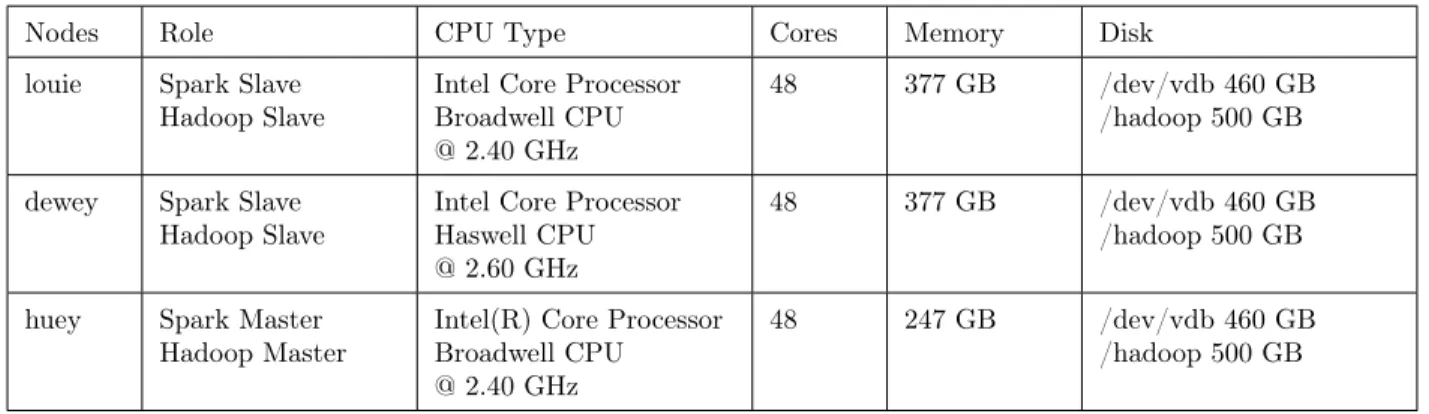
3.3 Specification of Each Node of the Larger Cluster . . . 29
3.4 Specification of Each Node of the Smaller Cluster . . . 30
3.5 Specification of the Benchmark Machine (Onomi) . . . 30
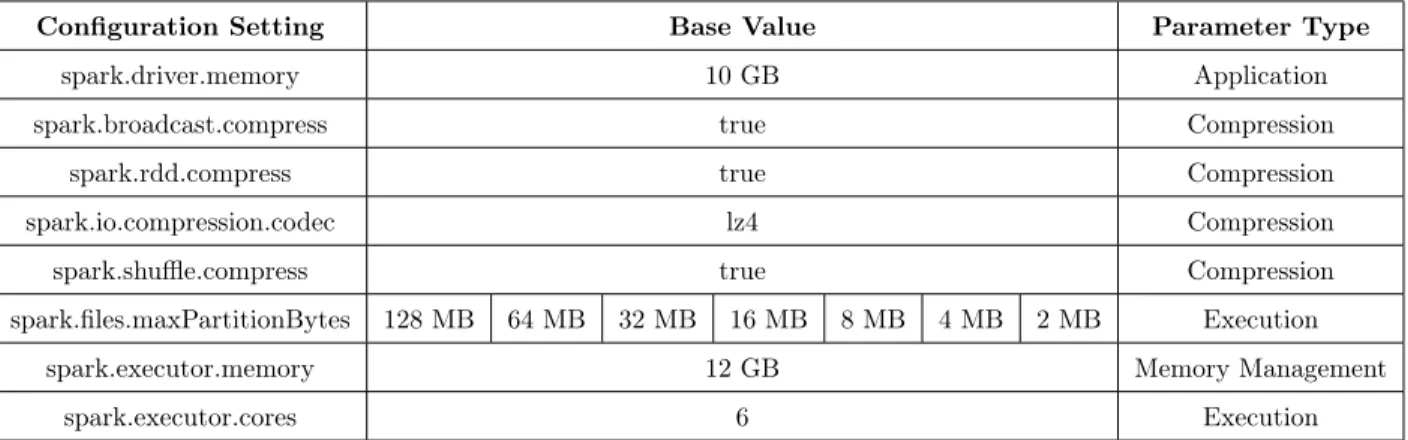
3.6 Spark Configuration Parameters for Experimental Design . . . 30
3.7 Performance Characteristics of Nodes . . . 33
3.8 Configuration Settings for Experiments in §3.2.1 . . . 37
3.9 Configuration Settings for Experiments in §3.2.2 . . . 38
3.10 Configuration Settings for Experiments in §3.2.3 . . . 40
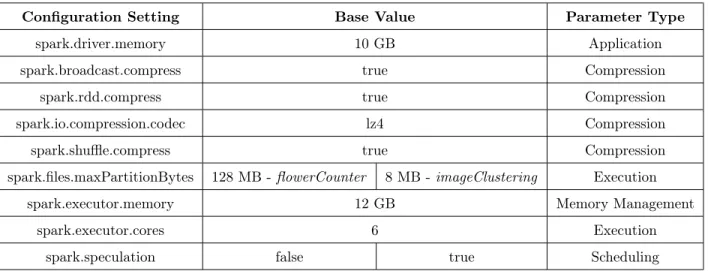
3.11 Configuration Settings for Experiments in §3.2.5 . . . 41
4.1 flowerCounter: Influence ofspark.files.maxPartitionBytes (July, 34.8 GB Dataset) . . . 44
4.2 flowerCounter: Influence ofspark.files.maxPartitionBytes (July, 34.8 GB Dataset) . . . 49
4.3 flowerCounter: Influence ofspark.executor.cores (August, 19.3 GB Dataset) . . . 59
4.4 Execution Time Summary of 9 JVM Executors forimageClustering (128 MB) . . . 63
4.5 Execution Time Summary of 18 JVM Executors forimageClustering (128 MB) . . . 63
4.6 Average Cluster Resource Usage Metrics forflowerCounter (64 MB) . . . 63
4.7 Average Cluster Resource Usage Metrics forimageClustering (128 MB) . . . 65
4.8 flowerCounter: Influence ofspark.executor.cores . . . 67
4.9 imageClustering: Influence of spark.executor.cores (July, 34.8 GB Dataset) . . . 67
4.10 flowerCounter: Influence of Caching (July, 34.8 GB Dataset) . . . 74
4.11 imageClustering: Influence of Caching (September, 5.7 GB Dataset) . . . 75
4.12 flowerCounter: Locality Level Summary (July, 34.8 GB Dataset) . . . 75
4.13 imageClustering: Locality Level Summary (September, 5.7 GB Dataset) . . . 75
4.14 flowerCounter: Tasks Execution Time Summary on all Nodes (July, 34.8 GB Dataset) . . . . 78
4.15 Runtime Comparison between the Sequential & SparkflowerCounter applications . . . 79 4.16 flowerCounter: Tasks Execution Time Summary with Speculation (July, 34.8 GB Dataset) . 82 4.17 imageClustering: Tasks Execution Time Summary without Speculation (July, 34.8 GB Dataset) 82 4.18 imageClustering: Tasks Execution Time Summary with Speculation (July, 34.8 GB Dataset) 83
List of Figures
2.1 The Berkeley Data Analytics Stack (BDAS) [3] . . . 11
2.2 Components of a Spark Application [49] . . . 12
2.3 The Spark workflow . . . 17
2.4 The Shuffle Phase . . . 18
4.1 Partition Size vs Runtime . . . 43
4.2 Stage Time Summary . . . 46
4.3 Task Progress Summary . . . 47
4.4 Task Progress Summary . . . 48
4.5 CPU Utilization . . . 50 4.6 CPU HeatMap . . . 52 4.7 RAM Usage . . . 53 4.8 Disk Throughput . . . 54 4.9 Network Throughput . . . 55 4.10 HDFS IO . . . 57
4.11 Tasks Completion Progress Summary . . . 60
4.12 Tasks Completion Progress Summary . . . 64
4.13 Task Completion Progress Summary . . . 65
4.14 Execution Time of Core Scaling . . . 69
4.15 Speedup of Core Scaling . . . 70
4.16 Influence ofspark.executor.memory Parameter . . . 71
4.17 Runtime vs Storage Level . . . 73
4.18 Effect of Node Scaling . . . 77
4.19 Influence of Slow Nodes . . . 78
List of Abbreviations
IoT Internet of Things
AMPlab Algorithms, Machines, & People Lab
TPC-DS Transaction Processing Performance Council Decision-Support P2IRC Plant Phenotyping and Imaging Research Centre
JVM Java Virtual Machine
UI User Interface
HDFS Hadoop Distributed File System RDD Resilient Distributed Dataset BDAS Berkeley Data Analytics Stack API Application Programming Interfaces DAG Directed Acyclic Graph
YARN Yet Another Resource Negotiator SSD Solid-State Drive
SciDB Scientific Database
HAT History-Based Auto-tuning PIL Python Image Processing Library MLlib Spark Machine Learning Library SIFT Scale Invariant Feature Transform KVM Kernel-based Virtual Machines
HT Hyper-Threading
FSB Front-Side Bus
QPI Quick Path Interconnect DMI Direct Media Interface TBT Turbo Boost Technology JSON JavaScript Object Notation
Chapter 1
Introduction
The MapReduce [17] programming paradigm has been effective for Big Data processing in a fast and scalable fashion. The execution model in MapReduce works by decomposing Big Data processing jobs into Map and Reduce sub tasks and then assigning those tasks to cluster computing nodes. Hadoop MapReduce was developed as an open-sourced alternative of the MapReduce programming paradigm. It is the parallel processing model of Hadoop [24] for processing and analyzing Big Data workloads. However, owing to the continued evolution of Big Data due to innovative exploits in computing domains such as mobile and social computing, Internet of Things (IoT) amongst other new domains, researchers and industry practitioners have found that MapReduce is no longer effective for some new emerging low latency and data-intensive applications such as iterative, data mining and graphical applications due to expensive I/O overheads and data serialization. This has led researchers and other concerned stakeholders to developing variant arrays of computing frameworks to meet these new emerging application scenarios. Apache Spark [62] is one of the new emerging in-memory analytics frameworks for Big Data processing designed ground up with the MapReduce programming paradigm. Spark, developed in 2009 at UC Berkeley AMPLab,1 open-sourced in 2010 became a top-level Apache project in 2014, is a data analytics engine designed to handle this new set of emerging applications.
Identifying performance bottlenecks in analytics frameworks such as Spark is difficult due to its in-memory and end-to-end design paradigm [40]. Substantial efforts have been directed towards understanding and identifying performance bottlenecks [8, 40, 51] in analytics frameworks as well as improving their per-formance [2, 4, 45]. However, most of these works involved using transactional and production traces such as the Transaction Processing Performance Council’s decision-support benchmark (TPC-DS) [15] and not real applications. Only recently did Zhang et al.[64] investigate Spark’s performance for real scientific data analysis in comparison with the traditional disk-based SciDB [9] software systems. Nonetheless, there has not been much work done in understanding Spark’s performance with respect to specific categories of scientifc applications with binary data such as image processing applications with real image datasets. Therefore, this work focuses on understanding the performance of Spark system for two image processing applications (flowerCounter andimageClustering developed using the python APIs of the Spark System - Pyspark2) in a
1https://amplab.cs.berkeley.edu/(Accessed: April 21, 2018)
heterogeneous commodity cluster. The larger cluster consists of 12 commodity personal computers with vary-ing configurations while the other smaller cluster consists of 3 larger servers with more computvary-ing resources respectively.
The two applications (flowerCounter and imageClustering) were selected because of their importance to the analytics pipeline of the global research project on food security currently being undertaken by the University of Saskatchewan Plant Phenotyping and Imaging Research Centre (P2IRC).3 The overarching goal of P2IRC is to developed systems that will provide information about plants traits for transforming large-scale seed breeding to support global food security.
TheflowerCounter application is one of the applications being developed by the Data Analysis for Rapid Plant Phenotyping4 project group under the Computational Informatics of Crop Phenotype Data research theme. Its purpose is to analyze the rate at which plant flowers are growing on plot fields using timelapse images collected from stationary cameras.
On the other hand, theimageClusteringapplication categorizes plant images based on observable physical attributes such as colour, brightness or size. The different categories can then be further analyzed for more insights. These applications are particularly selected to meet future scalability demands.
Processing the massive data with the sequential versions of these applications will be computationally expensive and last for several hours or days. Cluster operation with Spark will permit appropriate parallel processing. Furthermore, this provides opportunity to understand how Spark can be efficiently tuned in order to aid the processing of images. Thus, this thesis contributes to the investigation of distributed frameworks for image analysis applications within the context of P2IRC project, but can also be more generally applicable to configuration requirements for general Spark jobs.
These two sequential applications are selected not because of their inherent affinity to the Spark processing model but primarily for the purpose of investigating whether their performance can be improved by the sharing of cluster resources using the Spark programming model. The applications are not particularly suited to the Spark programming framework because they are based on the manipulation of large numpy arrays of binary data. The processing of large binary data by Spark is still an experimental feature and thus may not take advantage of Spark’s unique features. In particular, the Spark programming model favours applications that produce intermediate data output which can be persisted in memory for subsequent processing in the pipeline. This is the cache design paradigm inherent in the Spark processing engine for optimal performance. However, the flowerCounter application, for example, differs from this memory abstraction design as the application involves very little in-memory intermediate data results.
Moreover, the applications (flowerCounter andimageClustering) used in this study are particularly im-portant for subsequent image processing operation analyses as they will help to provide information about the growth of flowers on respective farm plots. The information obtained from the processing of the image
3http://p2irc.usask.ca/index.php(Accessed: February 5, 2018)
datasets with these applications can aid further analyses for example, to determine the cause(s) of the pat-terns observed which could be due to genetics, soil content and structure, environmental factors, weather conditions or any other cause(s) whatsoever. These applications may be particularly amenable to features of Spark and thus having a common processing paradigm could be useful for development and deployment.
To this end, this thesis investigates the effect(s) that the configurable engine parameters would have on the application processing time as well as how the underlying cluster computing resources are being utilized with the view of identifying performance bottlenecks in these applications. The sequential version of these applications is used as a baseline for resource consumption and processing time comparisons with the corresponding Spark versions.
A Spark application is expressed as a series of jobs depending on the inherent logic of the application. A
jobconsists of a series of stages which are defined by high level distributed operations (Spark transformations and actions) such as map, flatMap, filter, coalesce, reduceByKey, repartition, collect and saveAsTextFile. Some of these operations such ascoalesce,repartition, andreduceBykey involve the movement of data across the nodes in the cluster over the network. This transfer of data across the nodes is otherwise referred to as a shuffling operation. Astage is made up of parallel tasks that are executed by JVM executor processes running on the physical machines in the cluster. A task is essentially the unit of work corresponding to one data partition within a stage. The number of data partitions in a stage is determined by the size of the input data and the specified data block size. The default block size in Spark (a data partition size) is 128 MB.
Data skew has been identified as one of the causes of straggling tasks; its cause is mis-configured data partition sizes. Mis-configured partition sizes increase CPU computation time especially for shuffle operations and thus prolong job completion times [40, 51]. Spark calculates the number of tasks based on the data block size. Hence, if the number of tasks is smaller than the number of available CPU cores, CPU usage will be sub-optimal. Therefore, knowing the right partition size for Spark jobs (especially shuffle-heavy applications) will help to achieve optimal parallelism. However, determining the correct partition size for different workloads is not a trivial task; it involves using heuristic approaches to finding an optimal configurable size for different application scenarios [51, 64]. As a result, one aspect of this work investigates the effect of data partition size on the performance of the image processing applications.
Effective tuning of Java Virtual Machine (JVM) parameters is key to Spark application performance as the engine runs on the JVM. Badly configured Spark applications for JVM parameters such as the heap size and threads will degrade their performance due to increased garbage collection overhead, thread contention and context switching among other causes. Thus, the performance of Spark jobs is largely dependent on the right configuration of the JVM heap size as well as the number of JVM executors.
Chiba and Onodera [12] observed that using a single JVM executor is not an optimal solution. This might be due to the fact that Hadoop Distributed File System (HDFS) [47] client does not handle concurrent threads created by an executor with many cores well, thus leading to bad HDFS I/O throughput. This is because the number of concurrent operations that HDFS can handle is dependent on the number of data
blocks stored on the node.
As a result, performance might be improved by increasing the number of executors, as the data being processed is partitioned across many machines in the cluster, rather than having a single executor with many cores reading the same fraction of data on a single node [21]. On the other hand, running many small executors with a single core defeats the advantage of parallelism within an executor and subsequently degrade performance due to JVMs communication overhead [12, 13]. Also, having many tiny executors with fewer cores can lead to unnecessary duplication of data [21]. Evidently, this work also considers the effect of increasing JVM executor while keeping the total heap space constant on job performance.
Owing to the heterogeneous cluster nature, slow tasks are not unusual. Spark mitigates straggler tasks/n-odes byspeculative execution. This works by rescheduling tasks whose run time exceeds the median time of tasks that has already been completed to the scheduling queue. This might not be effective as tasks might still be resubmitted to the slow nodes as there is no way of identifying such nodes to prevent the task scheduler from submitting tasks to them [60]. Also, the effect of slow tasks on application performance could also be mitigated by increasing the number of cores allocated to a single task [44]. Similarly, this study investigates the effect of speculative task execution on the application processing time.
Identifying the key configuration settings for fast job execution (particularly for the applications being considered) as well as for optimal resource utilization is nontrivial because Spark provides a vast number of configuration settings regardingapplication properties, execution environments, resource utilization, tasks scheduling, memory management, compression and serialization, shuffle behaviour and Spark UI. The right combination of configuration parameters with respect to the different aspects of the programming framework varies depending on the different applications Spark supports. The operational modes represented in the
flowerCounter andimageClustering applications requre optimal use of cluster resources especially CPU and memory. This informs the choice of configuration parameters considered in the study.
Motivated by the objectives highlighted above and the work presented by Nguyen et al. [38], the key configuration settings investigated in this work are as follows:
• spark.files.maxPartitionBytes - This is a type of execution parameter that largely affects CPU usage. It is used to control the size of data in each partition and thus to increase/decrease the number of tasks (Equation 1.1) for effective parallelism and optimal CPU usage. The number of tasks is calculated based on the input data size and the block size provided by this parameter. The default block size of 128 MB is the same as the block size provided by the distributed data storage. The distributed file system used in this work is the Hadoop Distributed File System (HDFS).
Number_of_Tasks= Input_Size
Block_Size (1.1)
• spark.executor.cores- This is also an execution parameter type that controls the number of cores allocated to each executor and thus determines the number of executors in each of the cluster nodes.
The number of cores per executor (Equation 1.2) provided by this parameter is calculated by dividing the total number of cores on a cluster node minus one (as it is mandatory to reserve at least one core for the operating system) by the number of executors desired on the particular node.
Number_of_Cores_Per_Executor= T otal_N umber_of_Cores_on_Cluster_N ode−1
N umber_of_Executors_on_Cluster_N ode (1.2)
• spark.executor.memory- This is an application specific parameter which is used to control the size of heap allocated for Spark applications. The size (Equation 1.3) given to each executor is obtained by subtracting 1 GB (as it is mandatory to reserve at least 1 GB for the operating system) from each node’s memory and then divide by the number of executors desired on each cluster node. This parameter as well as the different storage levels (discussed in Chapter 2) helps to investigate the caching mechanism of the Spark engine.
Size_of_Memory_Per_Executor=T otal_M emory_Size_on_Cluster_N ode−1024
N umber_of_Executors_on_Cluster_N ode (1.3) • spark.speculation- This is a pervasive scheduling parameter type that impacts all cluster resources (CPU & Memory amongst others) [38]. This helps to mitigate the impact of slow tasks on application completion especially in a heterogeneous cluster such as the one used in this study.
In summary, this work provides answers to the following questions:
• How does Spark perform in comparison to the sequential versions of these applications?
• What is the effect of partition size on job completion determined by thespark.files.maxPartitionBytes
parameter?
• What is the impact of JVM executor scaling on job performance controlled by thespark.executor.cores
configuration setting?
• Does increasing memory allocated to Spark by adjusting thespark.executor.memoryparameter improve performance or what is the influence of using the different storage levels to cache the input data on application execution speed?
• How does Spark scale with increasing computing nodes in this context?
• What effect does speculative execution (triggered by thespark.speculationparameter) due to straggling nodes has on job completion time?
1.1
Thesis Motivation
The processing capability of cluster computing resources is an important and critical component for the processing of large scale data as well as the robustness and effectiveness of the distributed software systems that run on these cluster resources. The speed and efficiency of data processing computations is largely dependent on the processing power of the cluster resources both software and hardware alike. The demand for information and actionable insights from data by practitioners and other stakeholders make having a fast and robust data analytics framework necessary for continuous business growth, innovation and increased revenue to meet the escalating low-latency applications. This is the key premise upon which the motivations for this study solidly rested.
The first motivation for this work was the need to investigate the performance of scale-out analytics frameworks such as Spark for image processing applications as opposed to the single-node scale-up system currently being used for processing. In a scale-out systems, upgrades are done by adding more nodes to the cluster (horizontal scaling) while in a scale-up systems upgrades necessitate increasing computing resources (CPU, Memory, Disk & Network) in a single-node system (vertical scaling) [31, 18].
Apache Spark is a fast analytic engine designed to address some of the growing application use cases. However, the need to reduce the impact of computation bottlenecks for better processing time and data locality has led to a number of Spark improvements because that the CPU has been identified as the major impediment to faster analytics by the Spark engine compared to other factors [40]. The latest version of Spark5 (the Spark optimizer and the execution engine), has been claimed to have undergone effective performance improvement techniques for better utilization of the CPU and other resources to reduce computation time [16].
Evidently, the performance improvement implemented in Spark for fast analytics provided another im-petus for this work as image processing applications are computationally expensive and time-consuming to run sequentially. It is believed that this work would provide meaningful justification in terms of computa-tion cost/time and scalability concerns for processing images in a Spark cluster of commodity computing machines.
1.2
Thesis Statement
The default configuration settings of Spark do not always yield optimal performance for different workloads and determining the right combination of configuration parameters for workloads can be very confusing due to myriads of configuration parameters available [5]. For optimal workload performance, especially in a heterogeneous cluster environment, knowing the influence of each of the configuration parameters on job performance metrics is key in selecting the right combination of settings for fast job completion. Therefore,
the goal of this work was to be able to provide answers to the following questions:
• Would the use of a selection of configuration parameters permit the reduction of job execution time in a predictable manner?
• Would the inspection of low-level performance characteristics and job metrics help guide system ar-chitects in identifying bottlenecks as well as developing optimization strategies to improve resource utilization and job execution time?
• Would it be possible to mitigate stragglers effect(s) on job execution time?
In order to address the statements above, this work provides insight into the influence of some Spark config-uration parameters on the chosen applications.
The first contribution of this study is to determine the influence of data partition size on the completion speed of Spark jobs. Choosing the right data partition is important for fast execution in ensuring that tasks are evenly distributed across all the cluster nodes and thus helps to achieve efficient usage of resources as well as optimal parallelism. Apart from the contribution regarding data partition size, the impact of running tasks with the Java Virtual Machine (JVM) executor process on application speed was investigated. This is necessary as the Spark engine itself runs on the JVM and thus having too little or much executor processes could adversely affect job completion time. The third contribution of this study is to determine the importance of memory allocated for running Spark applications on job completion. Spark is built around memory abstraction, that is, the ability to take advantage of distributed memory and persist computation in it for subsequent processing. This work also studies the scale-out property of Spark with increasing number of computing nodes and compares performance with the sequential version of the application executed on a single machine of similar resource specification(s). The last contribution of this work helps to understand the effectiveness of Spark in mitigating the impact of slow tasks on application performance with speculative execution.
1.3
Thesis Findings
Based on the experiments conducted, here is a summary of the findings discovered:
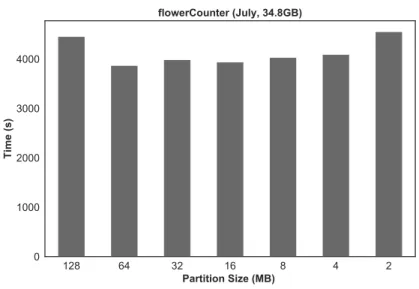
• Smaller data partition sizes (thus large number of tasks) less than 64 MB did not result in fast job completion time due to communication overheads. For all the data partition sizes considered, 64 MB data size yielded the fastest execution time.
• Numerous tiny tasks limits parallelism within an executor and thus result in inefficient use of cluster resources. On the other hand, tasks with large CPU and memory do not yield fast completion time due to processing delays and threads concurrency. Eleven JVM executors with 4 cores each exhibited better performance than using a single executor with large number of cores for theflowerCounter application.
Similarly, for the imageClustering application, two JVM executors with 16 cores each outperformed other configurations considered. Also, for both applications, using large number of JVM executors with one core each exhibited the worst performance due to delays caused by communication overhead.
• Spark scales with increasing homogeneous nodes but degrades with heterogeneous nodes for the flow-erCounter application only on the larger cluster. The scale-out property of spark showed a quasi-linear behaviour up to 9 cluster nodes with theflowerCounter application but decreased with 11 nodes, due to the addition of two nodes that have CPU frequency that is half of the other nodes.
• Increasing memory allocated for Spark applications (for example the imageClustering application) similarly increased job completion time. The impact of caching the input dataset using the different storage levels shows that the MEMORY_AND_DISK storage level has the fastest execution speed due to tasks with locality levels that made data and the processing code close enough to facilitate speedy execution.
• For the sequential vs Spark applications (flowerCounter), the Spark application executed on both the small & large clusters shows 4x and 3x the speed of the sequential application executed on the single machine with all datasets considered, despite similar or better processing and storage resources on the single machine.
• Finally, experiments show that speculative task execution mitigates the impact of slow nodes on job completion time for the flowerCounter application but slightly increases completion time for the im-ageClustering application.
1.4
Thesis Organization
The remainder of this thesis begins by describing the background information and related work in Chapter 2. This is followed with details of the experimental methodology used for this work as well as its design in Chapter 3. Next, the discussion of experimental results and their implications embodies Chapter 4. Finally, Chapter 5 concludes this thesis with a summary and a few recommendations for future research.
Chapter 2
Background and Related Work
This chapter contains a review of some existing works to provide a relatively comprehensive understanding of the Data Analytics Frameworks. The review begins with a brief discussion of Big Data Analytics Frame-works as well as an overview of Spark according to the layered Berkeley Data Analytics Stack (BDAS)1 architecture from the AMPLab in UC Berkeley. This is closely followed by a detailed description of Spark operations and key configuration parameters used in this study. This chapter concludes with a review of previous performance studies of Spark.
2.1
Big Data Analytics Frameworks
Big Data refers to data sets beyond the processing capacity of usual database software systems.2 Big Data is increasing in forms (consisting of raw, structured, semi-structured and even unstructured data), size (data is estimated to increase to Zettabytes (1021) in the nearby future), velocity (speed of the incoming data and its flows), variability, complexity and value [30]. Today, enterprises and institutions are exploring ways of discovering facts and actionable insights from the data to enhance critical business decisions for increased productivity and to provide the needed impetus for birthing innovations. There is a strong need for devel-oping systems that can handle the storing, processing and analysis of Big Data [28]. This has motivated domain experts to discover ways by which new and improved analytics frameworks can be developed to enhance the prevailing demands of deriving value from data. Notable examples of data analytics frameworks include Apache Spark [62], MapReduce [17], Dryad [27], Apache Flink [10] (an open source platform for distributed computation over streams of data), Apache Storm [50] (a distributed real-time directed acyclic graphs computation system), Apache Samza [39] (a stream processing engine that uses Apache Kafka [58] and Apache Hadoop YARN [53]) and DataFlow [1] among others. These frameworks allow the expression of parallel computations with a set of high-level operators without expensive data movement in a fault tolerant manner [63].
1https://amplab.cs.berkeley.edu/software/ (Accessed: April 21, 2018) 2https://en.wikipedia.org/wiki/Big_data (Accessed: April 21, 2018)
2.2
Spark Overview
Spark is a general unified analytics engine designed to be fast and easy to use. It leverages distributed memory abstraction to store intermediate data results for later reuse by employing a data abstraction model called Resilient Distributed Datasets (RDDs) [62, 63]. These are read-only data objects that are distributed, scalable and fault-tolerant. They are created through operations (either lazy transformations or actions) on data in persistent storage or from other RDDs. The ability of the Spark engine to persist intermediate computational results in memory makes it particularly apt for iterative applications such as machine learning and graph algorithms. These algorithms work on filtered data sets that can easily be incorporated into the memory of cluster commodity servers.
Most current data analytics frameworks like Hadoop MapReduce [17] have not performed well with these new classes of applications. This is because most of the frameworks were built using the acyclic data flow model and as such cannot handle applications such as iterative and graph processing well. They are designed specifically for handling applications such as batch processing; for them to be able to handle this new class of applications, job output has to be written to external systems causing expensive I/O overheads due to data replication and serialization ([63, 62]).
The Berkeley Data Analytics Stack (BDAS) provides the following characteristics for Big Data applica-tions:
• Low latency queries: Allows applications to run faster,
• Sophisticated analysis: Handles new classes of applications,
• Generalized analysis: Suited for all kinds of analysis including batch, iterative and interactive analysis, and
• Interoperability: Allows different analytics workloads to inter-operate.
BDAS is a layered analytics software framework consisting of different components built to seamlessly interact from the ground up to make sense of the emerging applications and the demanding use cases emanating from Big Data. The majority of the components within the stack emanated as autonomous projects intertwined by similar technologies to form a complete general solution stack to allow different frameworks to inter-operate [20]. The architecture is shown in Figure 2.1. The solution stack adapted for this study includes the in-built Spark standalone manager (resource manager), HDFS (storage medium), Spark core engine (processing engine) and the MLib (K-Means algorithm in the Machine Learning Library built on top of the Spark core). At the core of the BDAS framework is the Spark in-memory data analytics engine for faster data com-putation analysis and low latency applications. It is an in-memory general-purpose analytic engine that supports iterative machine learning algorithms, interactive data analysis as well as the conventional batch processing operations in a scalable and efficient manner. Spark is a fast cluster computing paradigm that
Figure 2.1: The Berkeley Data Analytics Stack (BDAS) [3]
exposes rich Scala and Python Application Pragramming Interfaces (APIs) for programming. These APIs facilitate programming at a much higher level of abstraction compared to traditional approaches. One of the main motivations for developing Spark was to allow distributed programming of Scala collections or sequences seamlessly. Spark supports a variety of data sources such as the HDFS [47], HBase [56], Casandra [32], Amazon S33 and other Hadoop-supported data sources.
A Spark application consists of five major components: a driver program, a cluster manager, workers, executors and tasks as shown in Figure 2.2. These components are briefly discussed as follows:
• Driver Program - A driver program (Spark application) is an application written using any of the supported Spark APIs - Scala, Python, Java or R. At a high level, a spark application consists of SparkContext (the main entry point to a Spark application) and the user code. RDDs are created by the interactions between the SparkContext and the user code which are then translated into a
Directed Acyclic Graph (DAG). The DAG of actions and transformations represents (the execution plan) the different RDD operations and the dependencies between them. There are two types of dependencies: narrow and wide dependencies. Innarrow dependencies (for example map, filter and union transformations) each parent RDD partition is needed by at most one child RDD while inwide
dependencies (for example join and groupByKey transformations) the parent RDD partition is needed by multiple child partitions. The RDDs translated into DAG are then submitted to theDAGScheduler. TheDAGSchedulersplits the DAG into stages of tasks and then submit the tasks to theTaskScheduler.
Figure 2.2: Components of a Spark Application [49]
TheDAGScheduler also determines the preferred location for tasks. Pipelined transformations (that is the transformations that do not require shuffling - narrow dependencies) are grouped into one stage. The boundary of each stage is a shuffle operation. TheTaskScheduleris responsible for sending tasks to the cluster, retry them if there are failures and also mitigate straggling tasks. The driver program also contains a scheduler backend mechanism that is an interface for plugging in different implementations of cluster managers such as Apache Mesos, Hadoop YARN, Spark standalone and Spark local.
• Cluster Manager - A Cluster manager is the resource Spark uses to acquire resources for executing the driver program jobs. The three cluster managers designed to work with Spark are the Mesos, YARN and the Spark standalone manager.
• Worker - A worker provides compute resources such as the CPU, memory and storage resources for executing a Spark application. Each worker node manages one or multiple ExecutorBackend process(es) and each ExecutorBackend process launches and manages executor instance.
• Executor - An executor is a Java Virtual Machine (JVM) process created by Spark on each worker node for an application. Each executor maintains a thread pool in which each task runs as a thread.
• Tasks - This is the smallest unit of work sent by the TaskScheduler to an executor which performs computations and returns results either to a driver program or divides its output for shuffle. Tasks in Spark include the Shuffle Map Task (Shuffle Write Operation), the Shuffle Reduce Task (Shuffle Read Operation) and the Result Task. The Shuffle Map Task writes its output in a shuffle file to disk (SPARK_LOCAL_DIRS). The Shuffle Reduce Task pulls shuffled data over the network and applies reduce logic. The Result task sends output to the driver.
2.2.1
Spark Resource Managers
This is the resource virtualization layer of the BDAS. A cluster resource management system is an important component in a cluster of computing servers for providing analytics frameworks efficient share of resources and scheduling their applications in a distributed fashion. Such a system generally consists of a master process on a node within the cluster that manages slave daemons on the other nodes and frameworks (such as Spark in this scenario) that run tasks on the slave nodes. A framework that runs on any cluster resource manager usually contains two key components: a scheduler to be offered resources by the master process and an executor that runs the framework’s tasks on the slave nodes ([22, 25]).
Spark is designed to work with two resource managers namely Mesos [25] and YARN [53], in addition to the built-in Standalone resource managers within the core engine. The Standalone resource manager is used in this study. This is to avoid unnecessary overhead that could be introduced by using resource managers that were not inherently built in the Spark engine.
2.2.2
Spark Storage Systems
Batch, iterative and interactive operations on Spark requires that data should be accessible to all the nodes within a cluster to ensure data locality based on the BDAS. The distributed nature of these operations require that data must be stored using systems that allow data sharing across a cluster of commodity servers without costly overheads due to data movement. Such systems are referred to as Distributed File Systems. They are designed to store and provide fast access to large datasets achieving scalability and fault tolerance by replicating data across cluster nodes to mitigate possible data loss [46].
Spark works with Distributed File Systems such as Hadoop Distributed File System (HDFS) [47], Cas-sandra [32], and Alluxio (Tachyon) [33]. This study uses only the HDFS as the distributed file storage system because additional database functionality is not needed.
2.3
Spark Operations and Parameters
To meet the challenges imposed by the new set of emerging applications, a new abstraction data called the Resilient Distributed Datasets (RDDs) was implemented in Spark to enable data persistence in memory [62, 63]. An RDD is a collection of immutable and fault-tolerant data objects which can be divided into multiple partitions for parallel operations on different machines within a cluster. RDDs are fault-tolerant parallel data structures that allow users persist data in memory. To achieve fault-tolerance, RDDs provide interface based on coarse-grained transformations which allow them to achieve tolerance by registering RDD transformations rather than the actual data such that RDD lost can be quickly recovered without data movement consequences [62, 63]. RDDs operations are of two types: RDD transformations and actions. The transformations, for example map, filter and flatmap operations, are lazy in that they do not return any value
when executed while the actions, such as count and collect operations, return a value to the driver program when called upon.
RDDs enable the fast processing of workloads by allowing users to persist RDDs for later reuse. RDDs are persisted in memory by default but can be spilled to disk if the available memory is insufficient. Priority levels can also be assigned to RDDs for specifying which RDD should be spilled to disk first. Spark provides different storage levels for persisting or caching RDDs. Storage levels are flags used for controlling how RDDs should be stored. RDDs can be stored in memory or on disk or in memory in serialized format.
Data locality [7] is crucial to application performance. It specifies the proximity of data to the processing code. RDDs also help to achieve effective data locality placement strategies by ensuring that data are placed close enough to where they will be processed with the interface preferredLocations(p) based on the number of partitions for better performance. Scheduling design in Spark is built on the notion that computations are usually faster if the data and the operating code are together as it is cheaper to transport serialized code than data chunks. The locality levels based on data location implemented in Spark are highlighted thus (from closest to farthest):
• PROCESS_LOCAL - This level places data in the same JVM process running the code. It’s the fastest locality level.
• NODE_LOCAL - This is the level when data is on the node as the processing code. For example, when the Spark node is also an HDFS datanode or when data is on another executor in the same node. It is slightly slower than the PROCESS_LOCAL level as it requires data movement between processes but faster than the other locality levels.
• NO_PREF - This level ensures that data is accessed equally at the same time without any preference to where the data is located. This level gives no preference to data location.
• RACK_LOCAL - This is the level for data that resides on a rack hosting several servers. Thus, it requires data transfer across network via a switch.
• ANY - This means that data is on the network but on a different rack.
Spark usually prefers to schedule tasks with the PROCESS_LOCAL level but when this can not be satisfied, it waits until a busy CPU is free for scheduling or schedules task at a more remote or distant location that requires data movement.
RDDs can be partitioned across cluster nodes to ensure working with reduced data set size. Data parti-tioning in the context of distributed systems is the dividing of large data sets into logical chunks for parallel processing over a cluster of computing machines. Partitioning is important for distributed data processing to reduce network I/O overhead of distributed operations as Spark achieves locality by placing data and serialized codes close enough to the worker nodes for processing.
Spark uses RDD partitions to store data read from distributed data storage such as HDFS [47] or Cas-sandra. The degree of parallelism in a Spark application is based on the RDDs partition number. The number of partitions is dependent on how the RDD was created. RDDs are created either over files read from distributed or local storage or through a parallel collection of data objects.
For RDDs created over files stored in HDFS for example, the number of partitions will be equal to the HDFS blocks (a block is 128 MB by default in HDFS). The number of partitions is equal to the number of tasks that will be computed by the worker machines. There are two key RDD operations as stated above - transformations (these create a new dataset from an existing one for example map, filter, mapPartitions, groupByKey and reduceByKey) and actions (these return the result of computed pipelined transformations such as collect, count, saveAsTextFile and takeSample). Here are some key terms in the physical execution model of a Spark application with respect to the RDD.
• Jobs - These are parallel computation of tasks that are materialized by Spark action RDD operations. For example, assuming a Spark’s application logic contains the following RDD operations:
1. Load a file from HDFS containing words into RDD1 (RDD1 created with partitions automatically based on the default HDFS block size)
2. Load another file from HDFS with words into RDD2 (RDD2 creation) 3. Join RDD1 and RDD2 to form RDD3 (a transformation operation) 4. Split up RDD3 into distinct words withflatMap to form RDD4
5. Transform each word in RDD4 and count unique occurrence with map and reduceByKey trans-formations to get each word frequency - RDD5.
6. Save RDD5 to a text file usingsaveAsTextFile transformation. 7. Split up RDD1 withflatMap to get RDD6
8. Count the number of words in RDD6 9. Split up RDD2 withflatMap to get RDD7
10. Transform RDD7 and count unique word occurrence with map and reduceByKey operations -RDD8
11. Collect RDD8 and print the result to stdout.
The entire set of steps form the operations represented in a Spark application. Saving the frequency of occurrence of each word to file in step 5 constitutes a job. The same is true for count and collect operations in steps 8 and 11 respectively.
• Stages - These are series of work within a job corresponding to one or more pipelined RDDs. As shown in the example above, steps 1 through 4 are stages containing pipelined RDDs (RDD1, RDD2, RDD3, RDD4) that must occur before thesaveAsTextFile Job can be materialized. Similarly, stages 1 and 7
are necessary for thecount job in step 8 to be materialized and also stages 2 and 9 are needed for the
collect job in step 11. They are primarily computations that produce intermediate results that can be persisted.
• Tasks - A task is the piece of data within a stage that corresponds to one RDD partition, computed on a given executor JVM.
• Worker Nodes - These are the physical machines that run the executors and the tasks.
• Executors - These are JVM processes that run on the worker nodes for the execution of the tasks.
• Shuffle - This is the transfer of data between stages. Joinoperations such as thejoin in step 3 of the example above,ByKeyoperations such asreduceByKey andgroupByKey andrepartitionoperations such asrepartition and coalesce can cause a shuffle and thus disrupt the locality of data resulting in more than one stages.
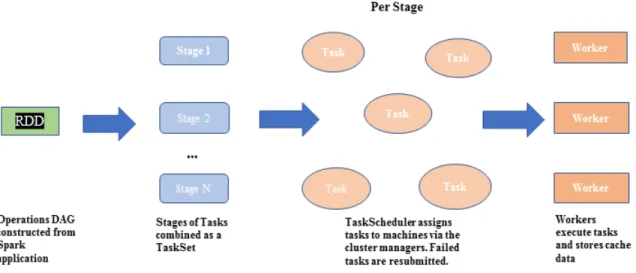
In other words, a Spark application defines a Directed Acyclic Graph (DAG) of RDDs which are operated upon to create new RDDs that refer back to their parents, thereby generating a lineage graph [62, 63]. Action operations force the translation of the lineage graph starting from the final action RDD and works backwards into stages which are further broken down to tasks. These tasks are submitted to the TaskScheduler for onward execution on the cluster machines by fetching input data either from a data storage or using an existing cached RDD. A typical execution flow of the Spark engine is as shown in Figure 2.3. An efficient Spark application requires setting an optimal number of partitions to achieve better parallelism and effective usage of cluster resources. Two key issues might arise when the number of tasks spawned by jobs is smaller than the number of CPU cores available [21]:
• Reduced benefit from entire cluster computing power, and
• Inconsistent data partition sizes resulting in memory pressure and increased garbage collection due to frequent pauses in computation, thus slowing down data processing.
Data within a partition would be spilled to disk often if its size exceeds memory capacity to avoid out-of-memory exceptions. Spilling data to disk results in expensive overheads due to data sorting and disk I/O, thus stalling job’s progress. Therefore, in order to get optimal benefit from cluster resources, the number of partitions should be at least equal to the number of CPUs available or greater by a multiple of 2 to 3 [21].
The number of partitions can be increased, for example if files are being read from HDFS, by the use of the repartition transformation which triggers shuffle, configuring HDFS InputFormat to create more splits or by writing files to HDFS with a smaller block size [13]. Partitions can also be increased by adjusting the Spark configuration parameterspark.files.maxPartitionBytes. The upper limit, however, is that tasks should take at least100 msto execute because having too many tasks can increase the overhead of scheduling tasks [55].
Figure 2.3: The Spark workflow
Data files are scattered in partitions across the cluster by the use of partitioners. In Spark, there are two types of partitioners implemented, namely the HashPartitioner (this is the default in Spark used for pair RDDs and used in this work) and the RangePartitioner (this partitioned sortable records equally by range). Data shuffling can be avoided if RDDs are partitioned appropriately [21]. Shuffling [6] of data is very expensive as it involves data sorting, repartitioning, serialization and deserialization, compression to reduce I/O bandwidth and disk I/O operations.
In Spark, unlike Hadoop, the reduce phase does not start until all map tasks have finished. Each map task writes its output in a shuffle file to disk as shown in Figure 2.4. This is the shuffle write operation. As there might be a lot of map tasks, the number of shuffle files can be substantially large. The effect of the files on computation can be reduced by enabling the Spark configuration parameter spark.shuffle.compress
for compression. The files written to disk are then read via the network in the reduce phase during the shuffle read operation [21].
Another importance of RDDs is that they help to mitigate the effect of slow nodes in clusters by running backup tasks. This benefit is achieved by a technique called speculative execution. The following steps show how the speculative algorithm works:
• First looks if the amount of finished tasks in a stage is greater than speculation quantile multiplied by the number of total tasks in the particular stage. If this is true, speculation execution will take place. Speculation quantile is the percentage of tasks which must be completed before speculation can be enabled in a particular stage.
• A scan of all successful tasks in the stage will be done to calculate the median time of tasks execution.
• A threshold for relaunching of slow tasks is then calculated by multiplying the speculation multiplier with the median time previously calculated. Speculation multiplier defines how many times slower a
Figure 2.4: The Shuffle Phase
task is, with respect to time, than the median time to be considered for speculation.
• Then relaunch tasks whose running times are greater than the threshold.
Spark speculative execution, rather than helping to reduce the effects of straggling tasks, might sometimes increase job execution time. This is because the speculative execution is based on the median time without taking into consideration that slow tasks might be resubmitted to the straggling worker nodes [60].
Spark provides a number of configuration parameters regarding application properties, execution envi-ronments and resource utilization among other parameters as exemplified in Chapter 1. These parameters are used in controlling application behaviours for optimal performance. The configuration parameters used in this study are shown in Table 2.1 together with a short explanation of each parameter alongside the cor-responding default values. The detailed description of the key parameters (including spark.executor.cores, spark.executor.memory, spark.files.maxPartitionBytes & spark.speculation) investigated is discussed in Chap-ter 3.
Table 2.1: Spark Configuration Parameters
Parameter Name Description Default
spark.driver.cores Number of cores to use for the driver pro-cess; cluster mode only
1
spark.driver.memory Amount of memory for the driver process 1 GB spark.executor.memory Amount of memory per executor process 1 GB spark.executor.cores Number of cores to use on each executor;
allows an application to run multiple ex-ecutors provided there are enough cores on that worker
1 in YARN mode and all available cores in stan-dalone and Mesos
spark.local.dir Directory on disk for storing map output files and RDDs
/tmp
spark.default.parallelism Default number of partitions to use for shuffle operations such as reduceByKey when not set by user
The value depends on the cluster manager
spark.rdd.compress Whether to compress serialized RDD par-titions
false
spark.shuffle.compress Whether to compress map output files true spark.shuffle.file.buffer Size of the in-memory buffer for each
shuf-fle output stream; reduces the number of disk seeks and system calls
32 KB
spark.io.compression.codec Codec used to compress internal data such as RDD partitions, broadcast variables and shuffle outputs
lz4
spark.broadcast.compress Whether to compress broadcast variables before sending them
true
spark.files.maxPartitionBytes The maximum number of bytes to pack into a single partition when reading files
134217728 (128 MB)
spark.eventLog.enabled Whether to log Spark events, useful for re-constructing Web UI after the application has finished
false
spark.eventLog.dir Directory for logging Spark events file:///tmp/spark-events
spark.speculation Specifies whether tasks should be
re-launched if they are running slow
2.4
Prior Performance Studies of Spark
A number of performance evaluation studies of iterative operations and other operations on data analytics frameworks have been done. Among these studies, Nguyen et al. [38] investigated the influence of con-figuration settings on application performance using different application workloads and thus developed a framework capable of identifying key configuration parameters that affect job performance.
Ousterhout et al. [42] argued that the architecture of existing analytics frameworks (such as Spark) makes reasoning about performance very challenging. This is due to the fine-grained pipelining paradigm inherent in such analytics frameworks. Pipelining ensures better performance by utilizing cluster resources for task execution but still requires efficient tuning for concurrent use of cluster resources and thus results in problems such as non-uniform resource usage by tasks, resource contention by concurrent tasks among others. To address these problems, the authors proposed a new architecture for analytics frameworks that makes performance bottlenecks easier to understand and identify and the resulting implications of the frameworks’ behaviours. The new architecture requires that jobs are partitioned into executable units called monotasks
with dedicated resource scheduler that ensures that each monotask uses a single cluster resource fully and thus helps to avoid contention by queuingmonotasks.
Due to the fast adoption and rapidly growing community of Spark enthusiasts, researchers and developers, big data analytics benchmarks have been developed to provide guidance and deployment strategies on how best to take advantage of the frameworks such as Spark. Notably among the benchmarks, specifically designed with the Spark programming paradigm, is SparkBench [34]. SparkBench is a suite of comprehensive workloads capable of evaluating (by providing configuration settings for optimal performance across different workload types as well as resource usage patterns) all the access and interfaces components built upon the Spark engine raging from iterative workloads to graphical applications as well as interactive and streaming workloads.
Veiga et al. [54] compared the performance of Hadoop, Spark and Flink using workload benchmarks including PageRank [19] and K-Means clustering among others and revealed that Spark outperformed Hadoop and Flink with respect to scalability in general across all the benchmarks considered especially for K-Means. The work also showed that HDFS block size (partition size) most suited for Spark workloads is 64 MB. The authors again revealed that one big executor/worker with 8 cores is the best configuration for Spark workloads except for PageRank. This might not be absolute because the maximum number of cores in the machine used for the study was 8. Therefore, more study is required to fully understand the influence of cores per executor on Spark applications. This finding that one big executor per node is the optimal configuration for Spark applications is also in resonance with the study done by Li et al. [34]. However, this finding contradicts Chiba et al. [12] as that suggests that workloads with two or four executors per node achieve the better performance.
Container technologies, such as Docker [37], are gaining traction nowadays, largely due to the adoption in large scale cloud computing. This increasing use in cloud computing is as a result of fast boot/start up
time and very low memory requirement that Docker containers provide. However, their performance vis-a-vis big data applications such as Spark still remains unclear. Ye and Ji [61] made effort to understand the performance of Spark applications in Docker containers and identified that the non-linearity performance behaviour exhibited by the applications is due two key problems: configuration parameters and resource contention between multiple containers. The authors thus created a performance prediction model for Spark applications in Docker containers with predictability of over 90%. A similar work provided a proof-of-concept architecture for scaled-up (the addition of more compute resources to a single-node system) Spark-based servers by dynamic partitioning of Docker-Spark-based containers into logical volumes to improve scalability performance of Spark applications [31].
Ousterhoutet al.[40] investigated the veracity of the belief that the major bottlenecks in data analytics frameworks are the network, the disk and stragglers (stragglers are slow nodes that substantially prolong job execution time) were the three notions investigated. The study was done using the Spark core analytics engine with a developed Blocked Time Analysis methodology that measures how long jobs spent blocked on cluster resources, with two benchmarks and industry workloads. Results obtained contradict the aforementioned claims about bottlenecks in data analytics frameworks. The results revealed that network improvements and disk I/O do not substantially impact performance in analytics frameworks but, rather most jobs are blocked in the CPU. According to the researchers, the study is relatively inconclusive as the work does not cover a wide range of workloads; the work showed that the widely held belief about performance in data analytics frameworks is absolutely untrue and thus requires that much work to be done before the global information community can claim to understand performance in data analytics frameworks holistically.
Hadoop and Spark were assessed using PageRank iterative workloads for memory utilization and speed using both real and synthetic datasets [23]. Experimental results show that for time-sensitive applications, Spark usually outperforms Hadoop as long as there is enough memory for the computation. This is because Spark is memory-intensive and as the number of iterations increases, intermediate results can quickly fill up the entire memory space which would eventually thwart the secure speed advantage of the Spark engine. This is challenging because it is difficult to ascertain the amount of memory that would be required for a particular iterative operation. The amount of memory that would be required is dependent on the particular iterative algorithm and the size of the input dataset. On the other hand, Hadoop is the preferred choice for less-memory-sensitive applications or when there is insufficient amount of memory for storing intermediate data results, provided there is enough disk space to take in the original dataset and the intermediate results [23].
A performance prediction model [59] was developed recently to evaluate Spark workloads with respect to the execution time, the memory utilization and the I/O cost using both iterative and non-iterative applications including the WordCount, Logistic Regression, K-Means clustering and the PageRank on a cluster of 13 nodes. The prediction accuracy from the model was found to be relatively high for the job execution time and the memory utilization but varied depending on the different applications for the I/O cost. According to the
paper, this might be due to the fact that the prediction performance model was simulated on a small scale. Work-load driven performance measurement [8] of the Spark engine implemented on a modern-scale up commodity cluster of servers showed that the work time inflation (extra time plus CPU time spent by job threads) and threads load imbalance (when one or few threads require more CPU time than other threads) are the major factors inhibiting workload scalability. At the micro-architecture level, the DRAM latency (memory bound latency) was the main cause of work time inflation. In particular, scalability analysis was done with increasing number of executor pool threads.
The effect of data partition size and executor core scaling to job completion time in data analytics frameworks have been investigated [51]. However, the characteristics of the applications considered in those works are different from the applications studied here. The impact of memory, caching, serialization, local file systems and SSDs forms the core of the study done in Zhang et al. [60] to understand the Spark’s system in comparison with SciDB for in-memory scientific data analysis. Generational garbage collection, multi-threading and executor scaling influence on TPC-H queries using the Spark engine have also been studied for their effects on job performance [12]. Straggler tasks effect in a heterogeneous environment has also been studied using improved version of the Spark’s speculative execution algorithm [60]. Speculative execution of Spark tasks was shown to be ineffective as it does not accurately determine straggling tasks due to slow nodes. HAT [11] is an optimized MapReduce Scheduler that mitigates the impact of slow tasks in heterogeneous environments by using historical information of already concluded tasks to detect slow tasks and then scheduled them accordingly on respective map and reduce slow nodes.
2.5
Chapter Summary
It is evident from the related works reviewed that more study is required for a comprehensive understanding of the influence of configuration parameters on Spark workloads. This is because most of these works provided conflicting results that are insufficient to be generally applicable for all Spark related workloads. It therefore implies that performance results from the applications considered in this study might not yield similar results as in the related studies reviewed.
However, these works are quite representative in that they provided insights on the influence of Spark configuration parameters as well as their effects on different application workloads. These studies provided guidance on the critical configuration parameters to investigate for their influence on applications process-ing and helped to reduce the time spent on designprocess-ing experimental methodologies. The findprocess-ings garnered from these studies also revealed the key performance metrics to monitor as well as their calculations for comprehensive understanding of Spark’s performance regarding the applications considered in this study.
Prior performance studies of Spark are crucial to this study because they provided useful insights about the performance of analytics jobs in frameworks such as Spark. The studies revealed insights on performance studies of processing different applications on analytics frameworks including Spark by identifying
perfor-mance bottlenecks and optimization strategies for mitigating their effects. The studies also offered ideas on areas where future works can be concentrated.
Chapter 3
Experimental Methodology and Design
3.1
Experimental Methodology
This section outlines the characteristics of the applications considered for this study with brief discussion on how each of the applications works. It then further describes the nature of the datasets used. A description of the experimental set up and the performance characteristics of the cluster nodes follow. Finally, the section discusses the metrics of interest together with the tools and techniques that were used for collecting them.
3.1.1
Applications Benchmark Characteristics
The two applications selected areflowerCounter andimageClustering. These applications are written with the Python APIs (Pyspark) implemented in Spark. They also use other external libraries including OpenCV [43], numpy [57], scikit-image [52], and Python Image Processing (PIL) [35] library. The flowerCounter
application, which estimates the number of flowers on images collected from plot fields, was selected to explore how it can be adapted to run faster in a scale-out Spark server cluster and then compare its performance with the sequential version of the application run on a single machine. Another reason for choosing the application is to study how it scales with increasing computing machines of varying capacity and datasets for future analyses. At a high level description, the imageClustering application clusters images using the k-Means clustering algorithm implemented in MLlib [36] library built on top of the Spark core engine based on features in the images with varying brightness or colour. Again, the choice of this application is to investigate the speed and scalability properties of the Spark engine for the clustering of the images relative to the performance of the sequential version of the same application processed on a single machine.
TheimageClustering application is more amenable to the Spark programmin
![Figure 2.1: The Berkeley Data Analytics Stack (BDAS) [3]](https://thumb-us.123doks.com/thumbv2/123dok_us/61018.2507188/21.918.179.744.105.489/figure-berkeley-data-analytics-stack-bdas.webp)
![Figure 2.2: Components of a Spark Application [49]](https://thumb-us.123doks.com/thumbv2/123dok_us/61018.2507188/22.918.203.725.107.391/figure-components-of-a-spark-application.webp)