Estudos e Documentos de Trabalho
Working Papers
20 | 2010
TAXATION AND GLOBALIZATION
Isabel Correia
October 2010
The analyses, opinions and fi ndings of these papers represent the views of the authors, they are not necessarily those of the Banco de Portugal or the Eurosystem.
Please address correspondence to
Isabel Correia
BANCO DE PORTUGAL
Edition
Economics and Research Department Av. Almirante Reis, 71-6th
1150-012 Lisboa www.bportugal.pt
Pre-press and Distribution Administrative Services Department Documentation, Editing and Museum Division Editing and Publishing Unit
Av. Almirante Reis, 71-2nd
1150-012 Lisboa
Printing
Administrative Services Department Logistics Division Lisbon, September 2010 Number of copies 170 ISBN 978-989-678-044-9 ISSN 0870-0117
Taxation and Globalization
Isabel Correia
Banco de Portugal, Universidade Catolica Portuguesa and CEPR
August 2010
Abstract
The decline of capital taxation is associated with e ciency gains. We show that, when agents are heterogeneous, equity concerns can change the policy recommendation driven by e ciency. Given the empirical evidence on the roots of heterogeneity inside each country, either in developing or developed economies, the elimination of capital taxation would lead always to a decline in inequality and to an increase of welfare of the poorest, in a small open economy acting unilaterally. On the contrary for a group of open economies following the same policy, the opposite occurs: with the elimination of capital taxation inequality worsens and it hurts the poorest of each country. Therefore globalization can be important to support a positive tax on capital.
Keywords: Capital taxation; Incidence; Globalization of capital markets; Policy coordination;
JEL: D63; E62; F42;
1
Introduction
That a decline of the tax rate on capital income in the steady state has a positive e ect in the e ciency of the economy is a well known result since the work of Chamley (1986) and Judd (1985). However that second best solution of not taxing capital has not been taken seriously by policy makers. One reason invoked, among others, is the regressive characteristic of the elimination of the tax on capital income, when accompanied by the increase of the tax rate on labor income, if the same pattern of government expenditures
has to be nanced. In short, either from a positive point of view, or from a normative without additional redistribution instruments, transforms the robust policy recommendation of eliminating the tax on capital into a weak on, if that change of policy is accompanied by a decline of the welfare of the poorest households in the economy. This assertion on the decrease of equity is usually based on a partial equilibrium reasoning: the reduction of the tax on capital and the increase of the tax on labor income increases the return on capital and declines the return on labor and therefore bene ts the upper income agents and worsens-o the situation of the lower income agents.
This article shows, using a general equilibrium framework, that the e ect on equity caused by the elimination of the tax on capital depends mainly on the joint distribution of characteristics that determine the society' hetero-geneity and on the degree of e ective international mobility of capital, for the economy under study. In the case of a small open economy, with perfect capital mobility, that decides unilaterally to change policy, the positive e ect on e ciency of the elimination of the tax on capital income is maximized and it is shown that the e ect on equity is always positive for the existing empiri-cal evidence on heterogeneity. However in an economy where the elimination of capital taxation leads to a transitional period, either because the economy is closed to capital movements, or because the change in policy has a small e ect on capital in ows, it is no longer in general guaranteed that the elimi-nation of the capital taxation is equity improving. On the contrary we show that here, for the empirical relevant heterogeneity, the decline in equity given the policy change is the rule. Besides, as claimed in Chari, Christiano and Kehoe (1994) in this case the increase in e ciency of applying the second best solution of capital taxation is mainly driven from the high tax rates in the initial periods. This implies that, the simple elimination of capital taxation has a smaller e ect on e ciency, and can even being negative for special parametrization. Both the low e ect on e ciency and the negative e ect on equity lead in this case to a loss to the poorest of the economy.
Therefore, if some equity concerns or political economy ingredients are included in the analysis, the desirability to decline or even to eliminate capital taxation depends crucially on the e ective mobility of capital, given the change of policy.
We consider an economy with in nitely lived households1. The
con-holds in our model economy di er in initial wealth and in labor e ciency. Since we assume those distributions to be exogenous, we can replicate ex-actly the particular moments of the wealth- and earnings-distributions that are crucial to assessing the e ects of the tax reform.2
The exogenous distributions of initial wealth and labor e ciency, as well as the conditions for Gorman aggregation, i.e. that there is a representa-tive agent, considerably simplify the computation of the aggregate general equilibrium e ects. These assumptions allow us to perform the exercise with-out a full characterization of the joint distribution of wealth and earnings. The exercise can be developed using only a subset of the moments of those distributions. To measure the e ects of the reform, we compare welfare dis-tributions before and after the reform. The method used is the one developed in Correia (1999) to analyze distributional e ects on models with heteroge-neous households, and applied in Correia (2010) to study the e ect on equity of the introduction of consumption taxation.
Our exercise is quite di erent from the one developed in Judd (1985). That work assumes the existence of idiosyncratic taxes. On the contrary in the present work we want exactly to analyze a world where the government does not have enough information to use those household speci c taxes. We do not determine the optimal plan but we limit our analysis to the e ect on equity of a policy measure that is e cient. There are two articles in the literature near ours. One is the well known result of Harberger (1995), where it is shown that wages decline due to an increase of the tax of capital in a general equilibrium model of a small open economy. This is a di erent exercise from ours since it assumes that the change in tax revenue distributed lump sum, and the tax on labor is maintained. The second article is the one by Garcia-Mila, Marcet and Ventura (2010). There a closed economy model of heterogeneous agents is developed, with preferences such that there is no representative agent. They nd that the poor agents are worse o after the
sequences of this tax reform, typical overlapping-generation models cannot replicate our results. For an explanation see, e.g., Ana Casta~neda, Javier Diaz-Gimenez, and Jose-Vitor Rios-Rull, (2003).
2In the model, households belong to the same group if they share the same
earn-ings/wealth ratio, and are thus a ected in a similar way by the tax reform. Other studies, such as Per Krusell and Jose-Vitor Rios-Rull (1996), use similar partitions of the popu-lation. Taxes are used to nance transfers, but transfers are endogenous, and part of a political equilibrium.
elimination of the tax on capital income, when total tax revenues are made constant by the increase the tax on labor income. The results in our paper clarify the apparent contradiction existent on the results of these two works. The paper proceeds as follows: In section 2 the model of the small open economy is presented. In section 3 the exercise is described and the results are derived for that economy. Section 4 extends the model to a closed economy and discusses the importance for the results of having a real interest rate endogenous to the change of policy. Section 5 contains the conclusions.
2
The model
The model represents a small open economy with perfect capital mobility. The technology is characterized by a neoclassical production function using as inputs capital,K;and labor measured in units of e ciency, EN;whereN represents hours of work and E is an index of labor e ciency: The
govern-ment spends a constant ow of per capita expenditures, G; and taxes labor
and capital income, at the origin, at the tax rates n and k; respectively.
The assumption that the system of taxing capital income is the territorial system implies that the income of external assets held by domestic house-holds, B ; is not subject to taxation. The real net return of these assets is the net international real interest rate,r : This constant rate is the one that characterizes the steady state of the rest of the world, which we assume to have fundamentals identical to the small economy. These assumptions im-ply that, with no costs of adjustment of capital, the economy will converge immediately to the new steady state, following the change of policy.
Agents are heterogeneous in labor e ciency and in non-human wealth. Each householdihas a labor e ciency level measured byEiand holds wealth
in physical capital, Ki; domestic bonds, Bi and external assets Bi: Agents
are identical in every other characteristic. To apply the method described in Correia (1999) we assume that preferences are such that Gorman aggregation is possible. Moreover, given cross section empirical evidence, we propose the type of preferences used in Greenwood, Hercowitz and Hu man (1988) (GHH), which are characterized by a zero wealth e ect on labor decisions. This characteristic implies that rich households do not work less than poor households, when having the same labor e ciency.
Then preferences of household ican be represented by3 Ui = 1 X t=0 t(Cit N ' it) 1 1 ; >0; ' >1 (1)
whereCit andNit represent the consumption and hours of work of agent iin
period t:
The intertemporal budget constraint of this household can be written as:
1 X t=0 Cit (1 +ro)(1 +r )t = 1 X t=0 wtEiNit (1 +ro)(1 +r )t +Ai0 (2)
where r0 is the net rate of return in period zero, wt is the net wage rate
at period t and Ai0; the initial wealth, is de ned as Ki0 +Bi0 +Bi0: It is
straightforward to verify that the optimal choice of hours is given by: Nit = (
Eiwt
' )
1
' 1 (3)
So it is clear that hours of work do not di er across agents when these have the same level of e ciency. When richer agents have a higher level of labor e ciency, they will work more than poor agents. Substituting this expression in the utility function (1) and in equation (2) allows to rede ne the optimal choice of consumption as:
M AX Ui = 1 X t=0 t Cit Cit 1 1 (4) subject to: 1 X t=0 Cit Cit (1 +r0)(1 +r )t = 1 X t=0 (Eiwt) ' ' 1 (1 +r0)(1 +r )t (1 '1) ( ')'11 +Ai0 (5) where Cit= " Eiwt ' # ' ' 1 (6)
Note that preferences are homogeneous inCbit Cit Cit:Given the isoelastic
preferences described in (4) and since the international real interest rate is at the steady state level, r = 1 1, then Cbit = Cbi; i.e., the transformed
consumption is constant over time. The intertemporal budget constraint, given by equation (5), allows for the determination of the optimal level of this variable for every household i as a function of the net wages path, the international real interest rate, the interest rate at time zero and its level of labor e ciency and of initial wealth.
We can write b Ci = r 1 +r 2 4X1 t=0 (Eiwt) ' ' 1 (1 +r )t (1 '1) ( ')'11 + (1 +r0)Ai0 3 5 (7)
The general equilibrium of this economy is characterized by equations (3) and (7) for the representative agent, i = r; non-Ponzi game conditions for the external debt, and the following equations:4,5
Yt=F(Kt; ErNrt) =Crt+G+Krt+1 (1 )Krt+Brt+1 (1 +r )Brt Ar0 =Kr0+Br0 1 M PM i=0Ki0+ M1 PMi=0Bi0 Er 1 1+r r G= n P1 t=0 (1+F2tNrrt)t + P1 t=0 kt (F1t )Krt (1+r )t r0 = (1 k0)(F10 ) r = (1 kt)(F1t ); t 1 wt = (1 n)F2t
The representative agent is the household with the weighted average
la-bor e ciency level of the economy6 and with the average stock of initial
4For simplicity we impose that the initial government debt is zero.
5We will represent the parcial derivative of functionF(:) in order to the ith argument
asFi:
non-human wealth. Given preferences and technology, as well as the initial average stock of physical capital and of external assets, and given policy in-struments (G; n and kt) the general equilibrium of this small open economy
can be computed. The e ciency of the economy is measured by the utility of the representative agent given equilibrium prices. The linear homogeneous utility of every agent can be easily computed substituting the equilibrium price vector and the idiosyncratic labor e ciency and initial wealth in (7).
3
Elimination of the capital income tax
The objective of this article is to compare the welfare distribution of agents in case 1, where the economy is characterized by a constant positive tax rate on capital, with the alternative situation, case 2, where the economy is characterized by that same tax in period zero but with a zero tax rate on capital afterwards. In Correia (1996) we prove that case 1 is the second best solution. Then, case 2 is always more e cient than case 1, i.e. the utility of the representative agent is higher in 2 than in 1
To avoid problems of cardinality when comparing utility across expe-riences and across agents we use the compensation consumption criteria, i.e. the percentage change in transformed consumption, C;b that each agent should experience to be as well o in both situations. This is equivalent to choose as utility indicator the de ned variable Cbi; that is the transformed
consumption of agent i:
The e ect on e ciency, or the e ect on utility of the representative agent,
i=r; can be measured by comparing
b Cr= r 1 +r 2 4X1 t=0 (wt) ' ' 1 (1 +r )t (1 '1) ( ')'11 + (1 +r0)Ar0 3 5 (8)
across policies. As we said e ciency is higher in case 2, or:
1 X t=0 (w2 t) ' ' 1 (1 +r )t (1 '1) ( ')'11 + (1 +r20)Ar0 > 1 X t=0 (w1 t) ' ' 1 (1 +r )t (1 '1) ( ')'11 + (1 +r10)Ar0 (9)
where x1and x2 represent respectively the equilibrium values of x in the
As the tax on capital income is constant in both experiments for t 1; the non-arbitrage condition and the neoclassical production function implies that Kr
N ; and therefore the marginal productivity of labor, is constant for t 1:The constant labor income tax rate then leads to a constant net wage
for t 1 in every experiment.
For t= 0 and using f.o. c.
w0 = (1 n)F20(KNr00) Nr0 = (w'0) 1 ' 1 we can write 'Nr'0 (1 )= (1 n)(1 )Kr0
As ' > 1; then ' (1 ) > 0; and since n2 > n1; then Nr20 < Nr10 and w2
0 < w10 : Kr0
Nr0 increases with the higher tax on labor. By assumption
1
k0 = k20: Therefore we obtain:
Result 1: The elimination of the tax rate on capital income implies that the net real interest rate in period 0 declines, i.e. r2
0 < r10.
Using (9) and result 1 we can say that:
Result 2: The elimination of the tax rate on capital income implies that:
1 X t=0 (w2 t) ' ' 1 (1 +r )t > 1 X t=0 (w1 t) ' ' 1 (1 +r )t (10)
These two results explain that, for the representative agent, utility in-creases not due to the return on capital, which declines, but due to the net present value of human capital, which increases although being taxed at a higher rate.
To understand the e ects on di erent agents, we order households by increasing transformed consumption, or utility. Ifi > j;agentiis richer, that
is it has a higher utility than agentj: Then to compare policy 1 with policy 2 in terms of equity we use the concept developed by Marshall and Olkin (1979): the relative di erential dominance. 7 This concept is equivalent to
an ordering of distributions of transformed consumption across households by the rst order stochastic dominance criteria.
De nition: Policy 2 is equity improving in relation to policy 1 i policy 2 dominates policy 1 in relative di erential, that is:
b C2 i b C2 j < Cb 1 i b C1 j ; for i > j (11)
To determine the e ect on equity of the elimination of the tax on capital income let us consider two extreme cases: One where agents have identical non-human wealth, i.e. Aio = Aro; and where the heterogeneity comes just
from di erent labor e ciency levels. On the other extreme agents have iden-tical labor e ciency levels, i.e. Ei =Er = 1; and are di erentiated only by
di erent initial levels of non-human wealth:
Note that, using the de nition of Cbi given in (7), in both extreme cases
the transformed consumption, and therefore utility, is the sum of two items: one that is homogeneous across agents and a second one that di erentiates agents.
Using (7), we check whether condition (11) is satis ed, after the results 1 and 2. When heterogeneity is in labor e ciency, condition (11) is equivalent to 1 +r2 0 P1 t=0 (w2 t) ' ' 1 (1+r )t > 1 +r 1 0 P1 t=0 (w1 t) ' ' 1 (1+r )t
On the other side when heterogeneity is caused by di erent initial nancial wealth, condition (11) implies the opposite condition, that is:
P1 t=0 (w2t) ' ' 1 (1+r )t 1 +r2 0 > P1 t=0 (wt1) ' ' 1 (1+r )t 1 +r1 0
7We show in Correia (1999) that this criteria of comparisons includes the Lorenz
crite-ria. It is equivalent to the Lorenz criteria, or to a rst-order stochastic dominance criteria, for any sub-groups of the population.
Therefore we can state that:
Result 3: The e ect on equity of the elimination of the tax on capital depends crucially on the roots of heterogeneity: is equity worsening when agents di er on labor e ciency and, on the contrary, is equity improving when agents di er by the initial stock of nancial wealth.
We can easily interpret result 3 in the following way: Individual welfare depends on two items: the present value of a function of net wages, which by result 2 increases with the elimination of capital taxation, and the initial wealth of every agent evaluated at (1 +r0);which by result 1 declines with
the change of policy. In the extreme cases described in result 3, depending on the characterization of households, either the rst or the second parcel is homogeneous across households. So, in the case where agents di er by
labor e ciency, the rst parcel is heterogeneous across households and the
second is homogeneous . The opposite occurs when agents are di erentiated exclusively by the initial stock of nancial wealth.
Because the e ect of the elimination of capital taxation on equity depends completely on the roots of households heterogeneity, the question proposed in this section is an empirical one. Cross section data tells us that both wealth and earnings are not equally distributed across households, and that either of the two extreme characterizations above are not plausible empirically. If both these two dimensions characterize the household, we can state that:
Proposition 18: Policy 1 dominates policy 2, if: a) P1 t=0 (w2t) ' ' 1 (1+r )t 1+r2 0 P1 t=0 (w1t) ' ' 1 (1+r )t 1+r1 0 and b) Ei ' ' 1 Ai0 Ej ' ' 1
Aj0 for all i and j such that
b
Cj <Cbi. Proof. We can rewrite relative utilities as:
b Ci b Cj = Ai0 Aj0 [ (p)= (p)]Ei ' ' 1 Ai0 + 1 [ (p)= (p)]Ej ' ' 1 Aj0 + 1 : (12)
where (p)= (p) = P1t=0 (wt) ' ' 1
(1+r )t=(1 +r0)
We can write the percentage change of Cbi
b Cj
when policy 1 is replaced by policy 2 as9 dCb i b Cj 2 1 ' (p)d= (p)21 (p 1) (p1)A i0Aj0 v1 ivj1 ! 0 @Ei ' ' 1 Ej ' ' 1 Ai0 Aj0 1 A: (13)
Since policy 2 dominates policy 1 if cCbi
b Cj
2 1
0, su cient conditions for this to happen are (p)d= (p)21 0 and Ai0
Aj0 Ei ' ' 1 Ej ' ' 1 for b Ci Cbj. .
Results 1 and 2 guarantee that a) is satis ed when capital taxation is eliminated. Empirical evidence have to be used to verify whether condition b) is satis ed.
From Budria et al. (2002) we use two di erent set of empirical obser-vations. First, their comparison of the top 1% with the bottom 40% of the distributions for wealth and earnings in the 1980's for the U.S.. And second, the partition of the sample in wealth quintiles from which we compute the average ratio of Ei
' ' 1
Ai0 for every quintile.
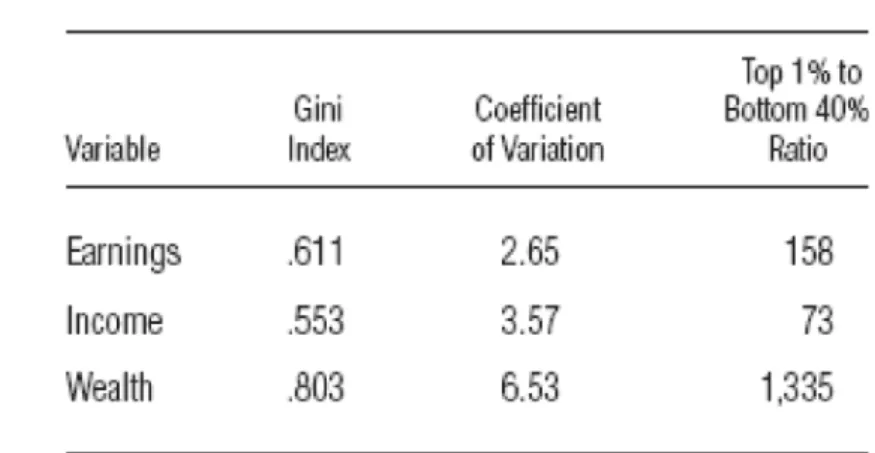
10 From Table 1 the ratio between
the top 1% and the bottom 40% for wealth can be computed. It is 1,335, and the ratio for earnings is 158, so that E40
' ' 1 E1 ' ' 1 A40;0
A1;0, where 1 and 40 are,
respectively, the top 1% and the bottom 40% groups of this two distributions. The positive correlation between wealth and earnings would be su cient for condition b) of proposition 1 to be satis ed for the two groups.
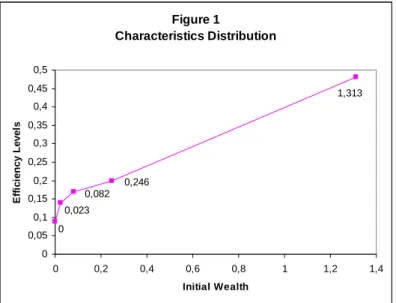
The information from the partition into quintiles is summarized in Figure 111where the average initial wealth level are displayed on the line (the rst
quintile has zero wealth) and e ciency levels are measured by Ei
'
' 1 since,
in the model, earnings across households are linear in Ei
'
' 1:It is immediate
to see that Ei ' ' 1
Ai0 declines with the increase in wealth, although the two
characteristics are positively correlated.
9WhereXb is the percentual change of X, that isXb2 1 = X
2
X1 X1 .
10See Tables 1 and 2 in Appendix.
Using those pieces of evidence and proposition 1, as well as the fact that the proposed policy measure increases e ciency, it is immediate to conclude that:
Result 4: Using empirical evidence every agent with a level of welfare below the one of the representative agent is better o with the elimination of capital taxation.
As the representative agent is better o and, for j < r, Cbj
b Cr
increases, the utility of household j increases more than the utility of the representative agent.
We prove that, using cross section data, the increase on human wealth and the decline on non-human initial wealth is still equity improving. As the representative agent increases welfare, then every agent with a level of wel-fare lower than the average increases welwel-fare with the elimination of capital taxation in the small open economy.
How robust is this result to di erent periods and economies? The de-scribed general characteristics of the U.S. distributions of earnings and wealth did not change during the 1990's, and they are common to a large set of Euro-pean economies, as shown in Budria and Diaz-Gimenez (2007). When trying to infer for developing countries like Latin America data is more scarce. Even if inequalities in education, earnings and income have been extensively stud-ied in Latin America, little is known about the distribution of wealth in this region. However the study of Torche and Spilerman (2008), which focus on the distribution of di erent assets types across some economic strata, allow us to infer that condition b) of proposition 1 is even more clear in that region. As claimed in that study: " In all countries for which wealth data is available, the Gini index for household wealth exceeds the Gini for household income". Using this evidence we can claim that this result is general for developed and developing countries.
4
The importance of the exogenous real
in-terest rate
The environment of the small open economy described in section 2 is a partic-ular one, in the sense that the real interest rate does not react to the change of policy that is under study. This assumption would no more be true either in the extreme case of a closed economy, or when the change of policy in one country is followed by a signi cative number of other countries, or in interme-diate cases where the country, although being the only one to implement the policy change and being open to capital trade, is not small in the sense that the elimination of capital taxation can a ect the equilibrium international real interest rate. We say that in those cases the e ective capital mobility is low because, given the change in policy, capital ows are much smaller when compared with the ones in the small open economy just described in section 2. In Garcia-Mila et al (2010), the elimination of capital taxation in a closed economy leads to a decline in welfare of the poorest households of the econ-omy. Their exercise is implemented in an environment which is not Gorman amenable, since preferences are not quasi-homothetic. Therefore it is not feasible the construction of a representative household and changes in the distribution a ect equilibrium prices. For the validity of the method applied in the present work it is important to understand whether the results ob-tained for a small open economy would be mainob-tained in a closed economy. If this was the case then the e ects on equilibrium driven by distribution would be rst order e ects, and the method a bad approximation.
This section develops the same exercise of section 2 but now in a closed economy. Here the change of policy will a ect also equilibrium real interest rates, implies a transitional path to the new steady state, and the change in equilibrium has to be computed numerically. When capital taxes are eliminated the economy converges from the steady state path associated with policy 1 to the one associated with policy 2. The equilibrium is characterized by the same set of equations, but the budget constraint is now given by
1 X t=0 Cit (1 +r0) t Y s=1 (1 +rs) = 1 X t=0 wtEiNit (1 +r0) t Y s=1 (1 +rs) +Ai0 (14)
more constant and reacts to the change in policy. The resources constraint is now given, for every t; by
Yt =F(Kt; ErNrt) = Crt+G+Krt+1 (1 )Krt
because Bit+1 = 0.
We use the calibration and part of the exercise performed in Correia (2010). That is, k = :512 and n = :23; which are consistent with N =:25
and G=Y = :19: Preferences are such the ' = 1:8; = 2:34; = 1:001 and =:96: The technology is Cobb Douglas, the share of capital is :4 and depreciation is :1:
The following table summarizes the information necessary for the exercise:
Table 1
vr( ) =
Benchmark
k=:5; n =:23
5:6(1) 3:7 Elimination of capital taxation
k = 0; n=:35
5:8(1:02) 2:9
wherevr( ) is the welfare value of the representative utility(consumption
equivalent in percentage of the benchmark) and = =P1t=0 (wt) ' ' 1 t Y s=1 (1+rs) =(1+ro):
It is immediate to see that, contrary to what happen in the small open economy, the value of = declines with the elimination of capital taxation13.
The transition to the new steady state is now characterized by an increasing capital/ labor ratio, therefore by an increasing path of wages and a decreas-ing path of interest rates. When compared with the case when there is no transition, wages are always lower and interest rates always higher during this transition path. Both contribute to a sign of = in the closed economy di erent from the one in the small open economy.
Taking into account the described empirical evidence on the joint
distri-bution of earnings and wealth and using proposition 1, the decline in =
leads to an increase in inequality.
Then the question is whether, given the increase in e ciency reported in the rst column of Table 1,the increase in inequality implies that the poorest households are worse o after the elimination of capital taxation.
Using the endowments of labor e ciency and initial capital for the repre-sentative household and for the households in the rst and second quintile, the values of utility for the representative agent as well as the values of = given in Table 1, we can use expression
b Cr b Cj = Ai0 Aj0 [ (p)= (p)]Ei ' ' 1 Ai0 + 1 [ (p)= (p)]Ej ' ' 1 Aj0 + 1 : (15)
13This decline is robust to di erent preferences, For example the same e ect is obtained
to con rm that welfare of the rst and second quintiles decline with the policy. This result establish that the di erent result in Garcia-Mila et al (2010) comes from the e ects of the change of policy on the real interest rates, that occur in the closed economy.14
5
Conclusions
We show in this article that the e ect on equity of the elimination of the tax rate on capital income depends in a crucial way on the globalization of capital markets. Whether the elimination of capital taxation leads to a change in the path of the real interest rate or to capital in ows into the country makes
the whole di erence for the result. The rst case can occur either because
the economy is closed or because, being capital markets open internationally, the change of policy was taken also by other countries. In the second case capital markets are open but the economy acts unilaterally, and is small to in uence the equilibrium real interest rate. Theoretically the e ect on equity would also depend on the roots of heterogeneity across households, but for the existing empirical evidence on the distribution of households characteristics the result would be well de ned, for a given path of the real interest rate.
Given the empirical evidence on the joint distribution of characteristics across households, which relevant moments are quite robust to most devel-oped and developing countries, the elimination of capital taxation in a closed economy, or for a group of small economies, worsens equity, while it improves it in a small open economy. Besides, the e ect on e ciency is positive in both cases, being stronger in the small open economy. Both e ects imply that the decision to implement that policy leads to a decline in the welfare of the poorest households in an economy where the change of policy does not lead
to e ective ows of capital across countries. E ective mobility of capital
turns this result round. In that case the elimination of capital taxation leads always to an improvement of the welfare of the poorest households, as is the case in the small open economy.
14Also, as said, important for the method used in the present article, the elimination of
the e ects on equilibrium of the changing distribution are really second order e ects and the hypothesis of a representative agent is a good one for the present exercise.
References
[1] Budria, Santiago and Javier Diaz-Gimenez, (2007), "Economic Inequal-ity in Spain: The European CommunInequal-ity Household Panel Dataset",
Spanish Economic Review 9: 1{38 .
[2] Budria, Santiago, Javier Diaz-Gimenez, Vicenzo Quadrini and Jose-Victor Rios-Rull, (2002), "Updated Facts on the Distributions of Earn-ings, Income and Wealth", Quarterly Review, 26 Federal Reserve Bank of Minneapolis.
[3] Casta~neda, Ana, Javier Diaz-Gimenez and Jose-Vitor Rios-Rull, (2003), \Accounting for earnings and wealth inequality" Journal of Political Economy 111: 818{857 .
[4] Chamley, C., (1986), "Optimal Taxation of Capital Income in General Equilibrium with In nite Lives", Econometrica, 54-6, 607-622.
[5] Chari, V.V., Larry Christiano and Patrick Kehoe, (1994), "Optimal Fiscal Policy in a Business Cycle Model", Journal of Political Economy,
102, 617-652.
[6] Correia, Isabel ,(1996), "Dynamic Optimal Taxation in Small Open Economies", Journal of Economic Dynamics and Control, 20, 691-708. [7] Correia, Isabel, (1999): "On the E ciency-Equity Trade-O ", Journal
of Monetary Economics, 44, 581-603.
[8] Correia, Isabel, (2010); "Consumption Taxes and Redistribution",
American Economic Review, 100 (4), 1695-1724 .
[9] Garcia-Mila Teresa, Albert Marcet and Eva Ventura, (2010), "Supply Side Interventions and Redistribution", Economic Journal, 120 (543), 105-130.
[10] Greenwood, Jeremy., Zvi Hercowitz and G. Hu man, (1988),
"Invest-ment, Capacity and the Real Business Cycles", American Economic
[11] Harberger, Arnold, (1995),\The ABCs of Corporation Tax Incidence: Insights Into the Open-Economy Case," inAmerican Council for Capital Formation, Tax Policy and Economic Growth, Washington: ACFF, pp. 47-76.
[12] Krusell, Per, Vincenzo Quadrini and Jose-V ctor R os-Rull, (1996), "Are
Consumption Taxes Really Better than Income Taxes?", Journal of
Monetary Economics, 37:3 .
[13] Krusell, Per and Jose-V ctor R os-Rull, (1999), "On the Size of Govern-ment: Political Economy in the Neoclassical Growth Model", American Economic Review, 89, 5, 1156-1181.
[14] Judd, Kennett, (1985): "Redistributive Taxation in a Simple Perfect Forsight Model", Journal of Public Economics,28, 59-83.
[15] Marshall, A. and I. Olkin, (1979), "Inequalities: Theory of Majorization and its Applications", Academic Press, New York.
[16] Torche, F. and S. Spilerman, (2008), "Household Wealth in Latin Amer-ica", in Personal Wealth from a Global Perspective, ed J. B. Davies, Oxford University Press.
Table1Budria et al.2002
Table 2Table7 in Budria et al2002 . . . And Ranked by Wealth
Characteristics of Sample Households in Each Wealth Group
Household Characteristics
Households in Wealth Quintiles
1st 2nd 3rd 4th 5th Total Sample
Average Earnings 16. 9 27. 7 35. 1 42. 2 90. 1 54. 8
Average Wealth −4. 1 19. 0 72. 6 175. 3 1, 177 288. 0
Figure 1 Characteristics Distribution 1,313 0,023 0 0,082 0,246 0 0,05 0,1 0,15 0,2 0,25 0,3 0,35 0,4 0,45 0,5 0 0,2 0,4 0,6 0,8 1 1,2 1,4 Initial Wealth E ff ici en cy L evel s
WORKING PAPERS 2008
1/08 THE DETERMINANTS OF PORTUGUESE BANKS’ CAPITAL BUFFERS — Miguel Boucinha
2/08 DO RESERVATION WAGES REALLY DECLINE? SOME INTERNATIONAL EVIDENCE ON THE DETERMINANTS OF RESERVATION WAGES
— John T. Addison, Mário Centeno, Pedro Portugal
3/08 UNEMPLOYMENT BENEFITS AND RESERVATION WAGES: KEY ELASTICITIES FROM A STRIPPED-DOWN JOB SEARCH APPROACH
— John T. Addison, Mário Centeno, Pedro Portugal
4/08 THE EFFECTS OF LOW-COST COUNTRIES ON PORTUGUESE MANUFACTURING IMPORT PRICES — Fátima Cardoso, Paulo Soares Esteves
5/08 WHAT IS BEHIND THE RECENT EVOLUTION OF PORTUGUESE TERMS OF TRADE? — Fátima Cardoso, Paulo Soares Esteves
6/08 EVALUATING JOB SEARCH PROGRAMS FOR OLD AND YOUNG INDIVIDUALS: HETEROGENEOUS IMPACT ON UNEMPLOYMENT DURATION
— Luis Centeno, Mário Centeno, Álvaro A. Novo
7/08 FORECASTING USING TARGETED DIFFUSION INDEXES — Francisco Dias, Maximiano Pinheiro, António Rua
8/08 STATISTICAL ARBITRAGE WITH DEFAULT AND COLLATERAL — José Fajardo, Ana Lacerda
9/08 DETERMINING THE NUMBER OF FACTORS IN APPROXIMATE FACTOR MODELS WITH GLOBAL AND GROUP-SPECIFIC FACTORS
— Francisco Dias, Maximiano Pinheiro, António Rua
10/08 VERTICAL SPECIALIZATION ACROSS THE WORLD: A RELATIVE MEASURE — João Amador, Sónia Cabral
11/08 INTERNATIONAL FRAGMENTATION OF PRODUCTION IN THE PORTUGUESE ECONOMY: WHAT DO DIFFERENT MEASURES TELL US?
— João Amador, Sónia Cabral
12/08 IMPACT OF THE RECENT REFORM OF THE PORTUGUESE PUBLIC EMPLOYEES’ PENSION SYSTEM — Maria Manuel Campos, Manuel Coutinho Pereira
13/08 EMPIRICAL EVIDENCE ON THE BEHAVIOR AND STABILIZING ROLE OF FISCAL AND MONETARY POLICIES IN THE US
— Manuel Coutinho Pereira
14/08 IMPACT ON WELFARE OF COUNTRY HETEROGENEITY IN A CURRENCY UNION — Carla Soares
15/08 WAGE AND PRICE DYNAMICS IN PORTUGAL — Carlos Robalo Marques
16/08 IMPROVING COMPETITION IN THE NON-TRADABLE GOODS AND LABOUR MARKETS: THE PORTUGUESE CASE — Vanda Almeida, Gabriela Castro, Ricardo Mourinho Félix
17/08 PRODUCT AND DESTINATION MIX IN EXPORT MARKETS — João Amador, Luca David Opromolla
18/08 FORECASTING INVESTMENT: A FISHING CONTEST USING SURVEY DATA — José Ramos Maria, Sara Serra
19/08 APPROXIMATING AND FORECASTING MACROECONOMIC SIGNALS IN REAL-TIME — João Valle e Azevedo
20/08 A THEORY OF ENTRY AND EXIT INTO EXPORTS MARKETS — Alfonso A. Irarrazabal, Luca David Opromolla
21/08 ON THE UNCERTAINTY AND RISKS OF MACROECONOMIC FORECASTS: COMBINING JUDGEMENTS WITH SAMPLE AND MODEL INFORMATION
— Maximiano Pinheiro, Paulo Soares Esteves
22/08 ANALYSIS OF THE PREDICTORS OF DEFAULT FOR PORTUGUESE FIRMS — Ana I. Lacerda, Russ A. Moro
23/08 INFLATION EXPECTATIONS IN THE EURO AREA: ARE CONSUMERS RATIONAL? — Francisco Dias, Cláudia Duarte, António Rua
2009
1/09 AN ASSESSMENT OF COMPETITION IN THE PORTUGUESE BANKING SYSTEM IN THE 1991-2004 PERIOD — Miguel Boucinha, Nuno Ribeiro
2/09 FINITE SAMPLE PERFORMANCE OF FREQUENCY AND TIME DOMAIN TESTS FOR SEASONAL FRACTIONAL INTEGRATION
— Paulo M. M. Rodrigues, Antonio Rubia, João Valle e Azevedo
3/09 THE MONETARY TRANSMISSION MECHANISM FOR A SMALL OPEN ECONOMY IN A MONETARY UNION — Bernardino Adão
4/09 INTERNATIONAL COMOVEMENT OF STOCK MARKET RETURNS: A WAVELET ANALYSIS — António Rua, Luís C. Nunes
5/09 THE INTEREST RATE PASS-THROUGH OF THE PORTUGUESE BANKING SYSTEM: CHARACTERIZATION AND DETERMINANTS
— Paula Antão
6/09 ELUSIVE COUNTER-CYCLICALITY AND DELIBERATE OPPORTUNISM? FISCAL POLICY FROM PLANS TO FINAL OUTCOMES
— Álvaro M. Pina
7/09 LOCAL IDENTIFICATION IN DSGE MODELS — Nikolay Iskrev
8/09 CREDIT RISK AND CAPITAL REQUIREMENTS FOR THE PORTUGUESE BANKING SYSTEM — Paula Antão, Ana Lacerda
9/09 A SIMPLE FEASIBLE ALTERNATIVE PROCEDURE TO ESTIMATE MODELS WITH HIGH-DIMENSIONAL FIXED EFFECTS
— Paulo Guimarães, Pedro Portugal
10/09 REAL WAGES AND THE BUSINESS CYCLE: ACCOUNTING FOR WORKER AND FIRM HETEROGENEITY — Anabela Carneiro, Paulo Guimarães, Pedro Portugal
11/09 DOUBLE COVERAGE AND DEMAND FOR HEALTH CARE: EVIDENCE FROM QUANTILE REGRESSION — Sara Moreira, Pedro Pita Barros
12/09 THE NUMBER OF BANK RELATIONSHIPS, BORROWING COSTS AND BANK COMPETITION — Diana Bonfi m, Qinglei Dai, Francesco Franco
13/09 DYNAMIC FACTOR MODELS WITH JAGGED EDGE PANEL DATA: TAKING ON BOARD THE DYNAMICS OF THE IDIOSYNCRATIC COMPONENTS
— Maximiano Pinheiro, António Rua, Francisco Dias
14/09 BAYESIAN ESTIMATION OF A DSGE MODEL FOR THE PORTUGUESE ECONOMY — Vanda Almeida
15/09 THE DYNAMIC EFFECTS OF SHOCKS TO WAGES AND PRICES IN THE UNITED STATES AND THE EURO AREA — Rita Duarte, Carlos Robalo Marques
16/09 MONEY IS AN EXPERIENCE GOOD: COMPETITION AND TRUST IN THE PRIVATE PROVISION OF MONEY — Ramon Marimon, Juan Pablo Nicolini, Pedro Teles
17/09 MONETARY POLICY AND THE FINANCING OF FIRMS — Fiorella De Fiore, Pedro Teles, Oreste Tristani
18/09 HOW ARE FIRMS’ WAGES AND PRICES LINKED: SURVEY EVIDENCE IN EUROPE
— Martine Druant, Silvia Fabiani, Gabor Kezdi, Ana Lamo, Fernando Martins, Roberto Sabbatini
19/09 THE FLEXIBLE FOURIER FORM AND LOCAL GLS DE-TRENDED UNIT ROOT TESTS — Paulo M. M. Rodrigues, A. M. Robert Taylor
20/09 ON LM-TYPE TESTS FOR SEASONAL UNIT ROOTS IN THE PRESENCE OF A BREAK IN TREND — Luis C. Nunes, Paulo M. M. Rodrigues
21/09 A NEW MEASURE OF FISCAL SHOCKS BASED ON BUDGET FORECASTS AND ITS IMPLICATIONS — Manuel Coutinho Pereira
22/09 AN ASSESSMENT OF PORTUGUESE BANKS’ COSTS AND EFFICIENCY — Miguel Boucinha, Nuno Ribeiro, Thomas Weyman-Jones
23/09 ADDING VALUE TO BANK BRANCH PERFORMANCE EVALUATION USING COGNITIVE MAPS AND MCDA: A CASE STUDY
— Fernando A. F. Ferreira, Sérgio P. Santos, Paulo M. M. Rodrigues
24/09 THE CROSS SECTIONAL DYNAMICS OF HETEROGENOUS TRADE MODELS — Alfonso Irarrazabal, Luca David Opromolla
25/09 ARE ATM/POS DATA RELEVANT WHEN NOWCASTING PRIVATE CONSUMPTION? — Paulo Soares Esteves
26/09 BACK TO BASICS: DATA REVISIONS — Fatima Cardoso, Claudia Duarte
27/09 EVIDENCE FROM SURVEYS OF PRICE-SETTING MANAGERS: POLICY LESSONS AND DIRECTIONS FOR ONGOING RESEARCH
— Vítor Gaspar , Andrew Levin, Fernando Martins, Frank Smets
2010
1/10 MEASURING COMOVEMENT IN THE TIME-FREQUENCY SPACE — António Rua
2/10 EXPORTS, IMPORTS AND WAGES: EVIDENCE FROM MATCHED FIRM-WORKER-PRODUCT PANELS — Pedro S. Martins, Luca David Opromolla
3/10 NONSTATIONARY EXTREMES AND THE US BUSINESS CYCLE — Miguel de Carvalho, K. Feridun Turkman, António Rua
4/10 EXPECTATIONS-DRIVEN CYCLES IN THE HOUSING MARKET — Luisa Lambertini, Caterina Mendicino, Maria Teresa Punzi
5/10 COUNTERFACTUAL ANALYSIS OF BANK MERGERS
— Pedro P. Barros, Diana Bonfi m, Moshe Kim, Nuno C. Martins
6/10 THE EAGLE. A MODEL FOR POLICY ANALYSIS OF MACROECONOMIC INTERDEPENDENCE IN THE EURO AREA — S. Gomes, P. Jacquinot, M. Pisani
7/10 A WAVELET APPROACH FOR FACTOR-AUGMENTED FORECASTING — António Rua
8/10 EXTREMAL DEPENDENCE IN INTERNATIONAL OUTPUT GROWTH: TALES FROM THE TAILS — Miguel de Carvalho, António Rua
9/10 TRACKING THE US BUSINESS CYCLE WITH A SINGULAR SPECTRUM ANALYSIS — Miguel de Carvalho, Paulo C. Rodrigues, António Rua
10/10 A MULTIPLE CRITERIA FRAMEWORK TO EVALUATE BANK BRANCH POTENTIAL ATTRACTIVENESS — Fernando A. F. Ferreira, Ronald W. Spahr, Sérgio P. Santos, Paulo M. M. Rodrigues
11/10 THE EFFECTS OF ADDITIVE OUTLIERS AND MEASUREMENT ERRORS WHEN TESTING FOR STRUCTURAL BREAKS IN VARIANCE
— Paulo M. M. Rodrigues, Antonio Rubia
12/10 CALENDAR EFFECTS IN DAILY ATM WITHDRAWALS — Paulo Soares Esteves, Paulo M. M. Rodrigues
13/10 MARGINAL DISTRIBUTIONS OF RANDOM VECTORS GENERATED BY AFFINE TRANSFORMATIONS OF INDEPENDENT TWO-PIECE NORMAL VARIABLES
— Maximiano Pinheiro
14/10 MONETARY POLICY EFFECTS: EVIDENCE FROM THE PORTUGUESE FLOW OF FUNDS — Isabel Marques Gameiro, João Sousa
15/10 SHORT AND LONG INTEREST RATE TARGETS — Bernardino Adão, Isabel Correia, Pedro Teles
16/10 FISCAL STIMULUS IN A SMALL EURO AREA ECONOMY
— Vanda Almeida, Gabriela Castro, Ricardo Mourinho Félix, José Francisco Maria
17/10 FISCAL INSTITUTIONS AND PUBLIC SPENDING VOLATILITY IN EUROPE — Bruno Albuquerque
18/10 GLOBAL POLICY AT THE ZERO LOWER BOUND IN A LARGE-SCALE DSGE MODEL — S. Gomes, P. Jacquinot, R. Mestre, J. Sousa
19/10 LABOR IMMOBILITY AND THE TRANSMISSION MECHANISM OF MONETARY POLICY IN A MONETARY UNION — Bernardino Adão, Isabel Correia
20/10 TAXATION AND GLOBALIZATION — Isabel Correia