Effect of processing parameters on recovery of hot process
virgin coconut oil and co-products utilization
M.R. Manikantan
*, M. Arivalagan, A.C. Mathew and K.B. Hebbar
Physiology, Biochemistry and Post Harvest Technology Division,
ICAR - Central Plantation Crops Research Institute, Kasaragod-671 124, Kerala, India (Manuscript Received:15-01-15, Revised:03-03-15, Accepted:03-06-15)
Abstract
Virgin coconut oil (VCO) is growing in popularity as functional food, cosmetic and pharmaceutical oil. The high cost of VCO is due to its low recovery. In order to improve the recovery, the effect of milk expelling methods (manual and mechanical) and pre-treatments (slicing, pulverizing and blanching) on coconut milk and hot process VCO recovery with respect to fresh coconut kernel weight was studied. The blanching and pulverizing yielded more milk and VCO recovery in both manual and mechanical expelling methods. The recovery of coconut milk and VCO ranged from 34.0 to 51.6 per cent and 14.2 to 22.4 per cent respectively. Among the different treatment combinations, pulverized, blanched and double screw pressed coconut kernel yielded the highest milk and VCO recovery. The per cent recovery of two important co-products namely coconut milk residue and VCO cake ranged from 38.5 to 55.6 and 6.3 to 8.8 respectively. An attempt was made to recover the oil from 8 per cent dried coconut milk residue and VCO cake in commercial oil expeller. The oil recovery from milk residue and VCO cake flour was 41.2±1.1 per cent and 25.8±1.0 per cent respectively. The dried coconut milk residue and VCO cake flour was utilized in the preparation of extrudates and sweet snacks along with the broken rice, maize grits and pearl millet grits.
Keywords: Coconut milk residue, extrudates, pre-treatments, recovery, VCO
*Corresponding Author: [email protected]
Introduction
Virgin coconut oil (VCO) is the oil resulting from the fresh and mature kernel of the coconut
(Cocos nucifera L.) through mechanical and natural
means, either with the use of heat or fermentation or centrifugation, provided that, it does not lead to alteration or transformation of the oil (APCC, 2003). VCO has many advantages, which include the health benefits from the retained vitamins and antioxidants, the antimicrobial and antiviral activity due to lauric acid components and through its easy digestibility.
Apart from the above, VCO and coconut oil have been traditionally used to enhance the beauty and promote the growth of tresses, refine and moisturizes skin conditions as well as in treatments for minor illnesses such as diarrhoea and skin inflammation. Nevin and Rajamohan (2010) found that wound healing rate was increased in skin of
rats treated with VCO. Lans (2007) reported that coconut was also used as an ‘ethnomedicine’ to treat gastrointestinal problems and minor cuts, injuries and swelling. The lauric acid, a medium chain fatty acid component in VCO, showed potential use in anti-obesity treatment (St-Onge and Jones, 2002; Assunção et al., 2009) as it increases energy expenditure, directly absorbed and burnt as energy in the liver, resulting in weight loss.
VCO can be extracted from the fresh and mature kernel of the coconut by several methods (Bawalan and Chapman, 2006). There are no specific processing prerequisites that were established according to Marina et al. (2009), however, several methods to produce VCO have been reported (Bawalan and Chapman, 2006; Nevin and Rajamohan, 2010; Raghavendra and Raghavarao, 2010). VCO could be produced by hot-processing method, natural fermentation method,
extraction from dried gratings (EDG) method and centrifuging method. The choice of the technology to be adopted depends to a great extent on the scale of operation, the degree of mechanization, the amount of investment available and the market demand.
Arumuganathan et al. (2011) concluded that the VCO produced by all the three methods, namely fermentation, hot processing and EDG, exhibited similar quality in terms of fatty acid composition. Senaviratne et al. (2009) found that the coconut oil extracted under hot conditions contained more phenolic substances and antioxidant potential than the coconut oil extracted under cold conditions. The fat content of fresh coconut kernel is reported as 30-35 per cent whereas the recovery of hot process VCO is reported in the range of 14-18 per cent (Madhavan et al., 2010). One of the reasons of low VCO recovery might be due to low coconut milk yield. Hence, there is a need to investigate the different type of pre-treatments such as size reduction and blanching in order to improve the recovery of coconut milk and VCO.
During VCO production, coconut milk residue and VCO cake are the two important co-products that are being used mainly in animal feed production at present. As a source of dietary fiber, these co-products provide a number of health benefits in relation to coronary heart diseases, colon cancer and diabetes (Trinidad et al., 2007). Previous studies revealed that consumption of high fibre coconut meal products increases faecal bulk and lowered the serum cholesterol (Gunathilake et al., 2009). Hence, there is a need to investigate the incorporation of these co-products in the production of broken rice, maize and pearl millet based extrudates and sweet snacks for human consumption.
The objectives of the study were to investigate the effect of milk expelling methods (manual and mechanical) and pre-treatments (slicing, pulverizing and blanching) on milk and hot process VCO recovery and the utilization of coconut milk residue and VCO cake in the production of extrudates and sweet snacks.
Materials and methods
Virgin coconut oil was produced from fully matured coconuts (11-12 months old) of WCT (West Coast Tall) variety by hot processing method as
described by Arumuganathan et al. (2011) using protocols and machineries developed at Agro Processing Complex of ICAR-Central Plantation Crops Research Institute, Kasaragod.
Normally, VCO production involves dehusking, deshelling, testa removing, slicing into 8 pieces, milk extraction, cooking of milk, oil separation and filtration. Blanching before slicing, pulverizing in place of slicing, manual and mechanical milk extraction were investigated to find the effect on milk and VCO recovery. Blanching of coconut kernels were done by soaking the kernels in water at 50 oC for 4 minutes. The pulverizing of
coconut kernels was undertaken by 50 kg h-1
capacity pulverizer (M/s. Pilotsmith, Thrissur, Kerala, India) using 0.63 mm mesh screen. The milk w a s e x t r a c t e d u s i n g m a n u a l l y o p e r a t e d milk extractor with hydraulic jack (30 kg h-1,
M/s. Pilotsmith, Thrissur, Kerala, India) and double screw milk expeller (300 kg h-1, M/s. Pilotsmith,
Thrissur, Kerala, India). The following treatments were selected in both manual (MA) and mechanical (ME) milk extraction during hot process VCO production: i) slicing (S), ii) slicing and blanching (SB), iii) pulverizing (P) and iv) pulverizing and blanching (PB). One hundred coconuts were used for one treatment experiment and at least three replications were conducted for each treatment.
The milk, VCO, coconut milk residue and VCO cake recovery was calculated by dividing the weight of the respective product with the weight of fresh coconut kernel. The coconut milk residue and VCO cake were dried to about 8 per cent in the commercial 4 KW electrical tray drier (Model: CCD-20, M/s Analab Instruments, Pathanamthitta, Kerala, India) of 50 kg per batch capacity. The milling of dried coconut milk residue and VCO cake was undertaken by 50 kg h-1 capacity pulverizer
using 0.63 mm mesh screen. The proximate composition, total dietary fibre, free fatty acid and peroxide value of both coconut milk residue and VCO cake were determined using the standard methods (AACC Standards, 2000). Particle-size distribution was measured using the ASABE S319.3 method (ASABE Standards, 2003) using a Rotap sieve shaker with set of sieves (RX-29, W.S.Tyler, Mentor, OH). The oil was expelled from coconut milk residue flour and VCO cake flour along with copra (10%) using 9 bolts single screw mechanical oil expeller of 100 kg h-1 capacity (M/s. Narain
Expeller Udyog, Ghaziabad, India). The coconut milk residue flour and VCO cake flour were incorporated with broken rice, maize and pearl millet at different proportions (0:100, 20:80 and 40:60) in the production of extrudates using co-rotating twin screw extruder (M/s. Basic Technology Private Limited, Kolkatta, India). The expansion index, crispiness work and sensory evaluation of the developed extrudates were determined using standard methods (Altan et al., 2008; Bouvier et al., 1997; Suknark et al., 1997). The sweet snacks was made by dipping the mixture of coconut milk residue (6.3%) and roasted broken rice powder (62.5%) in caramelized sugar syrup (31.3%) and manually moulded into round ball shape. The sensory evaluation of the developed sweet snacks was done using 9 point hedonic scale method. All the statistical analyses (ANOVA and DMRT) were done using SAS 9.3 (2011).
Results and discussion
Effect of pre-treatments on manually extracted milk, residue, VCO and cake recovery
The effect of slicing, pulverizing and blanching on the recovery of manually extracted milk, residue, VCO and VCO cake is shown in Fig. 1. The milk recovery varied significantly from 34.0 per cent to 41.5 per cent (Table 1). Highest milk yield was
obtained in pulverized blanched kernel followed by pulverized kernel, sliced blanched kernel and sliced kernel. From the analysis of DMRT, there was no significant difference between the milk yield of sliced blanched kernel and sliced kernel; pulverized blanched kernel and pulverized kernel. This indicates that the blanching did not influence in increasing the milk yield and pulverizing influenced the milk yield significantly.
The milk residue recovery was highest (55.6%) in slicing treatment and lowest (48.4%) in pulverizing and blanching treatment. Statistical analysis revealed that there was significant difference among the studied treatments (Table 1). But, DMRT analysis indicated that slicing treatment was significantly different from other treatments.
The per cent VCO recovery was 14.2, 15.1, 16.3 and 18.2 under slicing, slicing and blanching, pulverizing, pulverizing and blanching treatment, respectively. The significant difference among the treatments was observed as shown in both ANOVA and DMRT analysis. The increase of surface area in pulverizing treatment as compared to slicing treatment might have influenced in more milk and VCO recovery. The cell walls are more readily acted upon by heat and moisture if the kernel particles are small. Hence, size reduction is important for efficient recovery of oils. The blanching and heat
Fig. 1. Effect of pre-treatments on per cent recovery under manual extraction. Column with the same letter are not significantly different. SMA- Slicing and manual milk extraction; SBMA- Slicing, blanching and manual milk extraction; PMA- Pulverizing and manual milk extraction; PBMA- Pulverizing, blanching and manual milk extraction
process expands the kernel and coagulates the proteins present in the kernel causing coalescence of oil droplets and making the kernel permeable to the flow of oil (Shukla et al., 1992).
VCO cake recovery varied insignificantly from 6.3 per cent to 7.4 per cent. VCO cake recovery increased significantly due to blanching and pulverizing over other treatments as observed in DMRT analysis.
Effect of pre-treatments on mechanically extracted milk, residue, VCO and cake recovery
The recovery of mechanically extracted milk, VCO and cake was more than manual method of extraction by 26.3, 28.7 and 21.0 per cent, respectively. There was 18.1 per cent reduction in milk residue recovery due to mechanical milk extraction. There was an increase in recovery of mechanically extracted milk, VCO and cake due to slicing treatment by 28.2, 31.3 and 22.0 per cent, respectively over manual extraction. Mechanically extracted milk yielded 31.31, 32.5, 28 and 23.0 per cent more VCO than manually extracted milk from sliced, sliced+blanched, pulverized and pulverized+blanched kernels, respectively. The pressure experienced by kernel was more in mechanical extractor than manual extractor due to which more milk and VCO yield was observed.
Fig. 2 shows the effect of mechanical extraction and pre-treatments on recovery of milk, milk residue, VCO and cake. There was an increase in recovery of all the products except milk residue. Milk and milk residue recovery ranged from 43.6 to 51.6 per cent and 46.3 to 38.5 per cent respectively, among the studied treatments and significant difference among treatment was observed as per ANOVA and DMRT analysis.
Table 1. Statistical analysis and significance of pre-treatments on recovery
Variables F-value P-value
Manual extraction
Milk recovery 19.35** 0.001
Milk residue recovery 5.45* 0.025
VCO recovery 163.29** 1.63 E-07
VCO cake recovery 3.75NS 0.060 Mechanical extraction
Milk recovery 1.77NS 0.231
Milk residue recovery 1.78 NS 0.229
VCO recovery 49.94** 1.59E-05
VCO cake recovery 6.71** 0.014
* - Significant (P < 0.05); ** - Significant (P < 0.01); NS – non-significant
Fig. 2. Effect of pre-treatments on per cent recovery under mechanical extraction
Column with the same letter are not significantly different. SME- Slicing and mechanical milk extraction; SBME- Slicing, blanching and mechanical milk extraction; PME- Pulverizing and mechanical milk extraction; PBME- Pulverizing, blanching and mechanical milk extraction.
The per cent VCO yield was 18.6, 19.9, 20.9 and 22.4 for sliced, sliced + blanched, pulverized, pulverized + blanched kernels under mechanical mode of milk extraction. The effect of pre-treatments on VCO yield was significant. Similarly, cake yield also significantly increased due to pre-treatments.
In order to utilize the coconut milk residue and VCO cake in oil extraction and extrudate production, the biochemical constituents of dried powders of coconut milk residue and VCO cake were analyzed and presented in Table 2.
fibre and VCO cake flour contains fat and protein, the resultant extrudate was observed with less expansion index and crispiness. As observed by Bouvier et al. (1997), the crispness is related to cell structure demonstrating its fragility and “ease of breakdown”. The structure of the crispy products tends to collapse due to their fragile and weak structures. This structural property depends mainly of distribution, cells size and thickness of its walls. Structure breakdown generates small and numerous expanded peaks associated to the sound effects. In addition, the expansion ratio decreased as a result of increasing protein content because it has limited or non-puffing capacity compared with starch, hence by diluting starch content the expansion was reduced. The presence of fibre also contributed to
Table 2. Properties of coconut flour
Parameters Milk residue flour Cake flour
Mean±S.D. Mean±S.D. Crude protein (% N x 6.30) 5.29±0.065 20.12±0.081 Moisture (%) 2.86±0.186 3.12±0.096 Crude fat (%) 49.24±0.651 35.57±0.191 Crude fiber (%) 25.51±0.647 3.80±1.742 Ash (%) 0.93±0.012 6.08±0.084 Total dietary fiber (%) 46.50±0.353 12.75±0.309 Free fatty acids (%) 1.20±0.021 1.79±0.057 Peroxide value (mEq-1kg) 0.25±0.012 0.57±0.055
Particle size distribution (μm)524.77±10.680 594.56±5.640 S.D. - Standard deviation at α =0.05 level
An attempt was made to recover the oil from 8 per cent dried coconut milk residue and VCO cake in commercial oil expeller along with copra (10%). The oil yield from coconut milk residue and VCO cake was 41.2±1.1 per cent and 26.7±1.0 per cent, respectively.
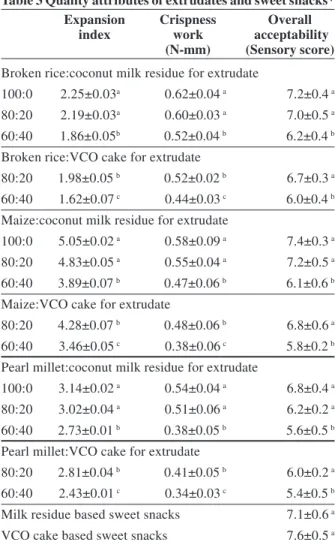
The extrudates and sweet snacks were made from the different combination of coconut milk residue/VCO cake and broken rice/maize/pearl millet and the quality attributes are presented in Table 3.
The expansion index, crispiness work and overall acceptability value were highest for the extrudates of 100:0 ratio of broken rice, maize and pearl millet grits (Table 3). The decreasing trend in the value of quality attributes was observed with the addition of coconut flours. According to Suknark
et al. (1997), increasing peanut flour in corn starch
resulted in an increase in fat and protein content which reduced the expansion of the extrudates. Since milk residue flour contains fat and dietary
Table 3 Quality attributes of extrudates and sweet snacks*
Expansion Crispness Overall
index work acceptability
(N-mm) (Sensory score)
Broken rice:coconut milk residue for extrudate
100:0 2.25±0.03a 0.62±0.04 a 7.2±0.4 a
80:20 2.19±0.03a 0.60±0.03 a 7.0±0.5 a
60:40 1.86±0.05b 0.52±0.04 b 6.2±0.4 b
Broken rice:VCO cake for extrudate
80:20 1.98±0.05 b 0.52±0.02 b 6.7±0.3 a
60:40 1.62±0.07 c 0.44±0.03 c 6.0±0.4 b
Maize:coconut milk residue for extrudate
100:0 5.05±0.02 a 0.58±0.09 a 7.4±0.3 a
80:20 4.83±0.05 a 0.55±0.04 a 7.2±0.5 a
60:40 3.89±0.07 b 0.47±0.06 b 6.1±0.6 b
Maize:VCO cake for extrudate
80:20 4.28±0.07 b 0.48±0.06 b 6.8±0.6 a
60:40 3.46±0.05 c 0.38±0.06 c 5.8±0.2 b
Pearl millet:coconut milk residue for extrudate
100:0 3.14±0.02 a 0.54±0.04 a 6.8±0.4 a
80:20 3.02±0.04 a 0.51±0.06 a 6.2±0.2 a
60:40 2.73±0.01 b 0.38±0.05 b 5.6±0.5 b
Pearl millet:VCO cake for extrudate
80:20 2.81±0.04 b 0.41±0.05 b 6.0±0.2 a
60:40 2.43±0.01 c 0.34±0.03 c 5.4±0.5 b
Milk residue based sweet snacks 7.1±0.6 a
VCO cake based sweet snacks 7.6±0.5 a
*The results are presented as mean ± standard deviation; Values with similar superscripts in the same rows for a given property are not significantly different and values followed by different superscripts are significant at α=0.05 level.
increase the product hardness due to reduction of cell size, probably causing premature rupture of gas cells, which reduced the overall expansion and resulted in less porous microstructure (Altan et al., 2008). Hence, it indicated that highest fibre content produced less crispy extrudate. The value of extruded products is based on higher expansion or puffiness and more crispiness and hence the overall acceptability score in sensory evaluation was reflected. In view of more protein and sweetness, VCO cake resulted in lesser extrusion attributes and more preferable sweet snacks than coconut milk residue flour.
Pulverizing and blanching treatment on coconut kernel yielded 41.5 per cent milk and 18.2 per cent VCO in manual method, whereas, in mechanical method, it was 51.6 per cent and 22.4 per cent. The present study revealed that coconut milk residue and VCO cake flour can be incorporated up to 20 per cent with broken rice, maize and pearl millet in producing extrudates with comparative extrusion characteristics and good acceptability.
Acknowledgements
The authors wish to acknowledge Director, ICAR-CPCRI, Kasaragod for his support and guidance in conducting this study. The authors wish to acknowledge AICRP on Post Harvest Technology CIPHET, Ludhiana for financial support to conduct this research. The authors sincerely thank Director, ICAR-CIPHET for facilities provided in conducting extrusion and further quality analysis studies. The authors also wish to acknowledge Dr. A.R.P. Kingsly, Assistant Professor, Kansas State University, Manhattan, USA for his help in conducting proximate composition analysis of coconut flour.
References
AACC (American Association of Cereal Chemists). 2000.
Approved Methods of the American Association of Cereal Chemists (10th and 11th ed.). St. Paul, MN, USA. Altan, A., McCarthy, K.L. and Maskan, M. 2008. Evaluation
of snack foods from barley – tomato pomace blends by extrusion processing. Journal of Food Engineering89: 231-242.
Arumuganathan, T., Madhavan, K., Mathew, A.C. and Sugada, P. 2011. Lipid profile of virgin coconut oil processed by different methods. Journal of Plantation Crops39(1): 247-251.
ASABE Standards S319.3. 2003. Method of determining and expressing fineness of feed materials by sieving. St. Joseph, MI, USA.
APCC (Asian and Pacific Coconut Community). 2003. Internet: Standard for Virgin Coconut Oil. Downloaded from http://www.apccsec.org/ standards.htm/ on 25/7/2013. Assunção, M.L., Ferreira, H.S., dos Santos, A.F., Cabral, C.R. and Florêncio, T.M.M.T. 2009. Effects of dietary coconut oil on the biochemical and anthropometric profiles of women presenting abdominal obesity. Lipids44: 593-601. Bawalan, D.D. and Chapman, K.R. 2006. Virgin Coconut Oil Production Manual for Micro- and Village-Scale Processing. FAO Regional Office for Asia and the Pacific, Bangkok, Thailand. 80 p.
Bouvier, J.M., Bonneville, R. and Goullieux, A. 1997. Instrumental methods for the measurement of extrudate crispness. Agro-Food Industry Hi-Technology8: 16–19. Gunathilake, K.D.P.P., Yalegana, C. and Kumara, A.A.N. 2009. Use of coconut flour as a source of protein and dietary fiber in wheat bread. Asian Journal of Food and Agro-Industry2(3): 382-391.
Lans, C. 2007. Comparison of plants used for skin and stomach problems in Trinidad and Tobago with Asian ethnomedicine. Journal of Ethnobiology and Ethnomedicine3: 3-14.
Madhavan, K., Arumuganathan, T. and Mathew, A.C. 2010. Virgin Coconut Oil. Technical Bulletin No. 61, Central Plantation Crops Research Institute, Kasaragod, India. 26 p. Marina, A.M., Che Man, Y.B. and Amin, I. 2009. Virgin
coconut oil: emerging functional food oil. Trends in Food Science and Technology20: 481-487.
Nevin, K.G. and Rajamohan, T. 2010. Effect of topical application of virgin coconut oil on skin components and antioxidant status during dermal wound healing in young rats. Skin Pharmacology and Physiology23: 290-297. Raghavendra, S.N. and Raghavarao, K.S.M.S. 2010. Effect
of different treatments for the destabilization of coconut milk emulsion. Journal of Food Engineering97: 341–347. Seneviratne, K.N., HapuarachchI, C.D. and Ekanayake, S. 2009. Comparison of the phenolic-dependent antioxidant properties of coconut oil extracted under cold and hot conditions. Food Chemistry114: 1444-1449.
Shukla, B.D., Srivastava, P.K. and Gupta, R.K. 1992. Oilseeds Processing Technology. CIAE, Bhopal, India. 268 p. St. Onge, M-P. and Jones, P.J.H. 2002. Physiological effects
of medium-chain triglycerides: Potential agents in the prevention of obesity. Journal of Nutrition132: 329–332. Suknark, K., Phillips, R.D. and Chinnan, M.S. 1997. Physical properties of directly expanded extrudates formulated from partially defatted peanut flour and different types of starch. Food Research International30: 515–583. Trinidad, T.P., Valdez, D.H., Loyola, A.S., Mallillin, A.C.,
Askali, F.C., Castillo, J.C. and Masa, D.B. 2007. Glycemic index of different coconut (Cocos nucifera) flour products in normal and diabetic subjects. British Journal of Nutrition90(3): 551-556.