AIS Electronic Library (AISeL)
AIS Electronic Library (AISeL)
ICIS 2019 Proceedings
Human Behavior and IS
Personalization & Trust-Enhancing Signals in E-Commerce
Personalization & Trust-Enhancing Signals in E-Commerce
Saskia Müller
Julius-Maximilians-Universität Würzburg, [email protected]
Frédéric Thiesse
University of Wuerzburg, [email protected]
Johannes Hewig
Julius-Maximilians-Universität Würzburg, [email protected]
Steven Schwehm
Julius-Maximilians-Universität Würzburg, [email protected]
Follow this and additional works at: https://aisel.aisnet.org/icis2019
Müller, Saskia; Thiesse, Frédéric; Hewig, Johannes; and Schwehm, Steven, "Personalization & Trust-Enhancing Signals in E-Commerce" (2019). ICIS 2019 Proceedings. 10.
https://aisel.aisnet.org/icis2019/behavior_is/behavior_is/10
This material is brought to you by the International Conference on Information Systems (ICIS) at AIS Electronic Library (AISeL). It has been accepted for inclusion in ICIS 2019 Proceedings by an authorized administrator of AIS Electronic Library (AISeL). For more information, please contact [email protected].
Personalization & Trust-Enhancing Signals
in E-Commerce
Short Paper
Saskia Müller
University of Würzburg
Würzburg, Germany
[email protected]
Johannes Hewig
University of Würzburg
Würzburg, Germany
[email protected]
Steven Schwehm
University of Würzburg
Würzburg, Germany
[email protected]
Frédéric Thiesse
University of Würzburg
Würzburg, Germany
[email protected]
Abstract
Despite worldwide growing revenue rates in e-Commerce, a lot of economic potential remains unused, which is manifesting in low conversion rates. Only a fraction of website visitors can be transformed to website buyers, which may be explained by a lack of trust in the retailer. In e-Commerce, trustworthiness can be signaled through special stimuli presented on the website as interaction platform between customer and retailer. By personalization of these signals, consumers can conveniently collect information needed to reduce their individual risk concerns. The objective of this study is to understand whether and how the personalization of trust-enhancing signals has an effect on trusting attitudes, buying intentions and buying behaviors. First promising preliminary results refer to the central importance of trust-enhancing signals for both a trustworthy impression and trust-related buying behavior. These insights will hold practical and managerial implications for web designers, online retailers and the integration of personalization into the business model.
Keywords: Personalization, big five, trust, e-Commerce, principal-agent theory
Introduction
A rapid expansion in applications, growth in technology and increasing consumer interest in online shopping led to a successful flourishing of the e-Commerce market in the last 20 years (Sreedhar 2018). The global e-Commerce revenue in the B2C context increased from US$286 billion in 2000 (Mahoney 2001) to US$ 1,785.7 billion in 2018 (Striapunina 2019). From the customer’s perspective, one of the main
reasons for this growing popularity may be seen in the availability of e-Commerce, which enables to flexibly control the time, place and extent of consumption (Ahrholdt 2011; Shapiro and Varian 1999).
Despite worldwide expanding revenue rates in e-Commerce, there is a lot of unexploited economic potential manifesting in low conversion rates (Ahrholdt 2011). The conversion rate (i.e. ratio of buyers to visitors of an online retailing website) is typically in the range from 2 to 3 percent (Monetate 2018). These numbers indicate that only a fraction of website visitors can be transformed to website buyers, which may be explained by a lack of trust in the online retailer (Ahrholdt 2011; Schlosser et al. 2006) . The online shopper can neither physically examine the product, nor communicate face to face with the retailer (Guenzi et al. 2009; Peck and Childers 2003). Given the automation and anonymity of online shopping, conventional
In the context of the first visit on a website (i.e. non-experiential, initial trust), trustworthiness can be signaled through stimuli presented on the website as interaction platform between customer and retailer (Ahrholdt 2011; McKnight et al. 2002; Schlosser et al. 2006). Starting with a comprehensive literature review over 187 studies as a basis for the current study, the authors identified 15 signals (i.e. website elements carrying surrogate information about products, seller and data protection) with the reliable capacity to positively influence trust-related attitudes. By personalization of these signals, consumers can conveniently collect the relevant information needed to reduce product-, seller-quality and data protection concerns and to quickly orient themselves on the website (Komiak and Benbasat 2006). The literature so far has focused on the effect of trust-enhancing signals on several attitudinal and behavioral components, but ignored their connection to the “big five” personality traits (McCrae and Costa 2003) and the effect of their personalization on trustworthiness-assessments, especially in a realistic web shop setting.
The primary objective of this study is to fill this research gap and to test a comprehensive model to forecast trust-related buying behavior in a non-experiential environment of initial trust (see Figure 1). This model is based on the theory of planned behavior (TPB) (Ajzen 1985) and transferred to the e-Commerce context (McKnight et al. 2002).
Figure 1. Research Model
Literature Review and Theory Development
The effect of trust-enhancing signals on several trust- and purchase-related attitudes has been addressed
in many research studies. The possibility to contact the retailer, a “frequently asked questions” section
(FAQ), social media presence, an “about us” section, SSL-encrypted network connection (SSL) and third-party assurances (quality seals) have been found to have a positive influence on customer satisfaction and trust (Collier and Bienstock 2006; Hajli 2014; Yoon 2002), buying intention (Song and Zahedi 2005) and online sales (Ranganathan and Grandon 2002). Free returns, the option to buy on invoice, warranties (money-back, product- and price guarantees) and shipping options have been found to reduce perceived transaction risks and to increase trust and buying intentions (Bart et al. 2005; Biswas and Biswas 2004; Collier and Bienstock 2006). Star ratings, customer testimonials or customer references have been shown to increase buying intention and customer satisfaction (Kim et al. 2002; Song and Zahedi 2005). The following literature review should give an overview over prior research in accordance with the various paths of the research model.
Personality & Signals
Online shopping is characterized by a difficulty to adequately predict the outcome of an online transaction. Transferring the principal-agent theory to the e-Commerce context, three sources of information asymmetry between buyer (principal) and seller (agent) give rise to this difficulty: Uncertainty about a
seller’s true characteristics and post-contractual opportunistic behavior (i.e. seller quality), about the
product’s characteristics and post-contractual performance (i.e. product quality) (Dimoka et al. 2012) as
well as about information privacy and security (i.e. data protection) (Pavlou et al. 2007). Based on the model of seller-, data protection- (Pavlou et al. 2007) and product-uncertainty mitigators (Dimoka et al. 2012), a classification of the 15 signals was undertaken by the authors. Considering the physical separation between seller and buyer in the e-Commerce context, seller quality can be extrapolated through signals informing
about seller’s characteristics (“about us” section), past transaction and feedback from other buyers (product
quality independent customer references), warranties and the buyer’s communication with the seller
(impersonal and personal contact, social media presence, FAQ) (Dimoka et al. 2012; Gefen 2002). Given the inability to physically inspect the product of interest pre-contractually, uncertainty about product
quality can be reduced through signals informing about the product’s characteristics (product quality
dependent customer testimonials, star-ratings), third-party assurances (quality seals), simplified withdrawal (payment on invoice, free returns) and mail-order transparency (shipping options) (Dimoka et al. 2012). The global and openly accessible structure of the internet involves the danger of private and monetary information misusage, giving rise to data protection uncertainties. The presence of a clarification concerning elevation, storage and usage of individual-related data (data privacy statement) and a specification of an encrypted data transfer (secure socket layer) can reduce data protection uncertainties (Pavlou et al. 2007). Extending the literature from signals to personality, we want to investigate personality-correlated preferences of trust-enhancing signals.
Personality traits describe a relatively stable pattern of cross-situational behavior and manifest in an
individual’s cognitions, emotions and behaviors (Hampson 2012). The personality profile exerts crucial
influence on how stimuli of the environment are selected, processed and responded to (Matthews 2008). The first visit on a website leaves the visitor with a paucity of information, which the individual strives to reduce (Gefen 2002; Pavlou et al. 2007). Personality and underlying motives are determining the kind of information the individual relies on to make a decision while ignoring others (Kazeminia et al. 2019; Matthews 2008). The “big five” model of personality encompasses five dimensions: extraversion, neuroticism, agreeableness, openness and conscientiousness (McCrae and Costa 2003).
Extraversion characterizes highly sociable individuals with a need for communication and stimulation (McCrae and Costa 2003) . It is reflected in low levels of risk aversion (Oehler et al. 2017) and high levels of trust towards strangers (Barnes et al. 2007). In the e-Commerce context, extraversion finds expression in a strong interest in social aspects of online shopping (Chen and Lee 2008; Riquelme and Román 2014), high trustworthiness ratings of online shops (Lumsden and MacKay 2006), low influence of security & privacy on trust (Riquelme and Román 2014), high willingness to disclose personal information (Brunet and Schmidt 2007) and responding to website contents like social presence, connectedness and reputation with an increase in trust-related attitudes (Chen and Lee 2008). Given that, the following hypotheses are postulated.
H1a: Due to the need to socialize and communicate with others, extraversion is positively related to the importance rating of trust-enhancing signals informing about seller quality (about us, personal and impersonal contact, customer references, social media presence, FAQ, warranties).
H1b: Due to low security- and privacy concerns, extraversion is negatively related to the importance rating of trust-enhancing signals informing about data protection (data privacy statement, secure socket layer). Neuroticism characterizes highly pessimistic, sensitive and anxious individuals with a proneness to experience negative emotions (McCrae and Costa 2003). It is reflected in a high level of risk aversion (Oehler et al. 2017), interpersonal skepticism, low trust towards strangers (Fahr and Irlenbusch 2008), the perception of being in an unfavorable position during transaction processes and having no control over outcomes (Walczuch and Lundgren 2004). In the e-Commerce context, neuroticism manifests in a low willingness to buy online (Bosnjak et al. 2007), low trustworthiness ratings of online shops (Lumsden and MacKay 2006), responding to website contents like argument- and product quality with positive attitudes (Chen and Lee 2008). Neuroticism has no impact on privacy perceptions (Junglas 2006). Given these findings, the following hypotheses are postulated.
H2a: Due to interpersonal skepticism and low levels of trust towards strangers, neuroticism is positively related to the importance rating of signals informing about seller quality (about us, personal and impersonal contact, customer references, social media presence, FAQ, warranties).
H2b: Due to the perception of having no control over outcomes of a transaction, neuroticism is positively related to the importance rating of signals informing about product quality (testimonials, star ratings, quality seals, payment on invoice, free return, shipping options).
Agreeableness characterizes highly trusting and cooperative individuals with positive beliefs towards the intention of others. It reflects in a high level of social interest in combination with strong empathy and compassion with others (McCrae and Costa 2003). In the e-Commerce context, agreeableness finds expression in a low willingness to buy online (Bosnjak et al. 2007), concerns of personal information being sold to third parties (Hin 2015) and a high importance of social presence in an online shop (Lumsden and MacKay 2006). Based on these findings, the following hypotheses are postulated.
H3a: Due to a high level of social interest and the significance of social presence, agreeableness is positively related to the importance rating of signals informing about seller quality (about us, personal and impersonal contact, customer references, social media presence, FAQ, warranties).
H3b: Due to concerns concerning personal information disclosure, agreeableness is positively related to the importance rating of signals informing about data protection (data privacy statement, secure socket layer). Openness to experience is characterized by open-mindedness, liberal decision making and intellectual curiosity manifesting in a high need for cognition (Chen and Lee 2008; McCrae and Costa 2003). In the e-Commerce context, it is expressed in a high willingness to buy online (Bosnjak et al. 2007), low concerns about privacy (Junglas 2006) and a high responding to website contents like seller reputation and social presence with an increase in trust (Chen and Lee 2008).
H4a: Due to the lower concerns of privacy and liberal decision making, openness to experience is negatively related to the importance rating of signals informing about data protection (data privacy statement, secure-socket layer).
H4b: Due to the high significance of seller reputation and social presence, openness to experience is positively related to the importance rating of signals informing about seller quality (about us, personal and impersonal contact, customer references, social media presence, FAQ, warranties).
Conscientiousness is characterized by cautious decision making, responsibility and perfectionism (McCrae and Costa 2003). It is manifested in a high level of risk aversion (Oehler et al. 2017) and a high need for cognition (Chen 2011). In the e-Commerce context, it is reflected in low trustworthiness ratings of online shops (Lumsden and MacKay 2006), online privacy concerns (Stieger et al. 2013) and responding to website-contents like product quality (Chen and Lee 2008). Given the results of the literature review, the following hypothesis is postulated.
H5: Due to the higher level of online privacy- and product quality concerns as well as low trustworthiness assessments of online shops, conscientiousness is positively related to the importance rating of signals informing about seller quality, product quality and data protection.
Personalization & Trusting Attitude
Personalization of information given on the website can be a strategy of matching presented information with the information seeking style in order to reduce the cognitive load of the individual decision making process (Kazeminia et al. 2019). In case the presented information on a website matches the (cognitive) shopping task, the user can search the information space more efficiently and better recall the product information (Hong et al. 2004). Personalization has been shown to positively increase trust (Koufaris and Hampton-Sosa 2004) and buying intentions (Song and Zahedi 2005).
The model of perceived trustworthiness formation (Mayer et al. 1995) has been transferred to the e-Commerce context and embedded in the TPB as part of the attitude component (McKnight et al. 2002). Three dominant trustee characteristics relevant for trustworthiness impression were identified: Ability as
the trustor’s (buyer’s) belief in a trustee’s (seller’s) competence to provide goods and services in a
convenient and competent way, benevolence as the buyer’s belief in the seller’s goodwill and non
-opportunistic motives and integrity as the buyer’s belief in moral-ethical correct principles guiding the
seller’s behavior (Mayer et al. 1995; McKnight et al. 2002). Personalization has an impact on trust, but so
H6: Personalization of trust-enhancing signals on a website differently influences the trust-related attitude components (ability, benevolence and integrity) of perceived trustworthiness.
Methodology
In order to test the hypotheses in an environment as realistic as possible, a web shop system comprising the aforementioned trust-enhancing signals was developed. For the purpose of encompassing a diverse product range each study participant can identify with, the three e-Commerce segments with the strongest revenue rates worldwide (2018) were selected: Fashion (US$524.9 billion, Categories: Shirts & Pullovers), Electronics & Media (US$329.6 billion, Categories: Bathroom, Living Room, Office Room, Kitchen) and Toys, Hobby & DIY (US$386.2 billion, Categories: Concerts, Musicals, Humor, Culture) (Striapunina 2019). Figure 2 illustrates the web shop setup, in this case for the product category ‘electronics & media’.
The setup was the same for each of the product categories: Cover page (left), product overview (middle), product detail view (right). Not shown here are the consumer basket and the order overview at the end of the ordering process. Trust-enhancing signals were presented on all pages.
Figure 2. Web shop system
Pilot Study
Experimental Design, Web Shop System and Manipulations
A first preliminary pilot study was conducted with the objective of testing whether an effect of trust-enhancing signals on perceived trustworthiness can be established. With the purpose of creating comparable conditions where the signal was presented and conditions where the signal was not presented, in each of the three rounds was randomized for every signal, whether it was presented or not.
Participants were given the instruction to imagine they were looking for new electronic articles, clothing and event tickets. Each participant should navigate through three different web shops, whose succession was randomized within subjects. To sensitize them for (perceptual) differences between the different web shops, they were instructed to explicitly pay attention to the different characteristics of the shops. During their web shop visit, all product interactions (click on product detail view, modification of product
characteristics: product color/ size, etc.) and the visitor’s final buying decision (buy/not buy) were recorded.
After the participants made their buying decision, they were instructed to evaluate every web shop in terms of their impression of trustworthiness on a scale from 0 (not trustworthy at all) to 100 (absolutely trustworthy). Due to the checkup of possible influences on trust, several control variables are recorded (age, gender, individual attitudes towards online shopping: product preferences, perceived risks and benefits and previous experiences in the online shopping context).
Subjects and Descriptive Statistics
Participants were recruited via Sona Systems, a recruitment system for psychological experiments of the Julius-Maximilians-University of Würzburg and received an incentive of 5€ for their participation. With
the objective of keeping the generalizability of results as high as possible, we recruited a random and representative sample of 96 internet users. Of the 96 participants, 69 were female and 27 male, the mean age was 29.39 years with an age range of 18-66. The majority of subjects indicated to use the internet 2-3 hours (31%) or 3-4 hours (29%) on average per day with the main purpose of information seeking (24%) or social networking (21%). 64% of subjects reported to shop online 1-2 times per month.
Preliminary Results
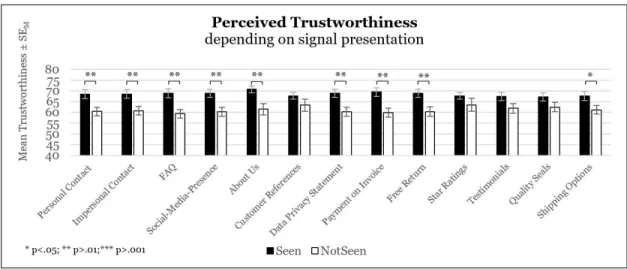
A repeated measurement ANOVA showed no significant differences in the perceived trustworthiness between the three product environments (F(2,190)=.23, p=.793; Fashion: M=63.47, SD=26.73; Electronics: M=64.77, SD=23.41; Events: M=65.87, SD=24.70). In order to investigate the effect of the trust-enhancing signal presentation, for each trust-enhancing signal an independent t-Test between conditions in which the signal was presented and conditions in which the signal was not presented was calculated. Figure 3 shows the results. Due to technical problems, SSL and warranties could not be recorded. Results revealed significantly higher ratings of trustworthiness when the signal was presented compared to when the signal was not presented for personal contact: t(286)=-2.79, p<.01, d=.33, impersonal contact: t(286)=-2.68, p<.01, d=.32, FAQ: t(286)=-3.33, p=.001, d=.40, social media presence: t(286)=-2.99, p<.01, d=.35, about us: t(286)=-3.04, p<.01, d=.38, data-privacy statement (t(286)=-3.02, p<.01, d=.35), payment on invoice (t(286)=-3.35, p=.001, d=.40) free returns (t(286)=-2.96, p<.01, d=.35) and shipping options (t(286)=-2.21, p<.05, d=.26). The number of presented trust-enhancing signals had a significant influence on the perceived trustworthiness (F(1,285)=9.91, p=.002, f2=.035). Furthermore, the perceived
trustworthiness could significantly predict the buying decision (W(1) = 41.24, p < .001, exp(B)=1.039, R2Cox&Snell= .191). The perceived trustworthiness had no effect on the number of product interactions (F(1,286)=.56, p=.456). Nevertheless, the number of product interactions could significantly predict the buying decision (W(1) = 6.403, p = .004, exp(B)=1.016).
Figure 3. Perceived trustworthiness depending on signal presentation
Main Study
In the planned main study, the focus should be augmented from the mere effect of trust-enhancing signals to the investigation of personalizing these trust-enhancing signals. To realize this, the main study has to be partitioned in two sub-studies.
As foundation for personalization, a connection between the big-five personality dimensions and the preference of the trust-enhancing signals has to be established. For the purpose of capturing the manifestation of the big five personality dimensions, a German version of the IPIP-NEO-120 (Johnson
2014) is administered. This questionnaire measures the five personality dimensions (extraversion, neuroticism, agreeableness, openness and conscientiousness) and their six facets with four items per facet (4 items x 6 facets x 5 dimensions = 120 items). Participants should indicate their approval on a unipolar
5-point scale ranging from “not accurate” to “accurate”. For the purpose of assessing the preference of the
trust-enhancing signals, importance judgments on all 15 trust-enhancing signals are raised on a unipolar
7-point scale ranging from “Absolutely not important” to “Absolutely important”. The planned sample size
includes at least 450 subjects in order to obtain reliable results. This first sub-study should be finished until end of August 2019.
A 2 (Signal Presentation: Randomized vs. Personalized) x 3 (Product-Environment: Fashion, Electronics & Events) within-subjects design is implemented in the web shop system to test the personalization effects by dynamically adjusting the web shop to the personality-associated preferences. To specifically measure the
three components of the trusting attitudes, the “trusting beliefs”-scale conveyed to the e-Commerce context
by Schlosser (2006) is applied. To assess the buying intention, a combination of implicit (product interactions, behavioral component) (Kwon and Kim 2012) and explicit methods (Bart et al. 2005) is used. Perceived risks and benefits of online shopping will be measured according to the “perceived benefits and risks of online shopping”-scale (Forsythe et al. 2006). Considering the anticipation of rather small effect sizes (Partial η² =.034) , the planned sample size for the second study includes at least 200 subjects. This second sub-study should be finished and analyzed until end of November 2019.
Discussion
The motivation behind our research is to develop a well elaborated, encompassing model to explain and predict attitude formation and the development of buying decisions in an e-Commerce context. With a first pilot study, the goal of testing whether the trust-enhancing signals have an distinguishable effect on trusting attitudes was pursued. The results showed that many trust-enhancing signals are of central importance for the accomplishment of a trustworthy perception of a website. Of particular importance for the customer’s
trusting attitude are the possibility to purchase on invoice and the presence of a FAQ-section. FAQ are a demonstration of the online retailer’s effort to collect and systematize problems or questions the customers are often confronted with. From the online retailer’s perspective, the provision of payment on invoice is
very risky. The traditional succession of financial transaction followed by the receipt of the article is reversed (Ahrholdt 2011). The willingness of the retailer to reverse the asynchrony of resource exchange and to
provide a framework of often encountered problems seem to hold special potential to reduce the customer’s
risk perception of online transactions. Furthermore, the number of trust-enhancing signals could predict the perceived trustworthiness: the more signals were presented, the higher the trustworthiness. Nevertheless, this result has to be interpreted with caution because the data showed a clear ceiling effect: starting by a number of 11 presented trust-enhancing signals, the addition of further signals had no enhancing effect on perceived trustworthiness anymore. A possible explanation for this finding could be that the individual processing capacity of trust-enhancing signals was exhausted with 11 signals. From this point, a saturation of the information seeking tendency concerning trust-enhancing signals possibly occurred. This point of saturation is certainly also dependent of individual factors and the combination of the kind of signals. Perceived trustworthiness of a website could predict the buying decision, but not the number of product interactions. This possibly could give a hint for a direct connection between trusting attitudes and trusting behaviors which is not unconditionally mediated by the trusting intentions. Again, this has to be interpreted with caution, because product interactions are possibly not a direct indicator of trusting intentions.
The main study should augment the so far focus from mere trust-enhancing signals to the personalization of these signals. Thereby, an important contribution should be made to understand how personality influences the signal preference and how and why personalization of trust-enhancing signals can affect a
customer’s attitudes, intentions and behaviors in the e-Commerce context.
Conclusion
To put it in a nutshell, the results of the pilot study are promising and point in the direction of understanding whether, how and why trust-enhancing signals can influence cognitive, affective and behavioral processes of a customer during a buying process. This understanding holds important implications for cognitively
facilitating the ordering process for a customer but also for increasing conversion rates of websites. Taken together, these insights will hold practical and managerial implications for web designers, online retailers and -companies and the integration of personalization into the business model.
References
Ahrholdt, D. C. 2011. “Empirical Identification of Success-Enhancing Web Site Signals in E-Tailing: An Analysis Based on known E-Tailers and the Theory of Reasoned Action,” Journal of Marketing Theory
and Practice (19:4), pp. 441–458.
Ajzen, I. 1985. “From Intentions to Actions: A Theory of Planned Behavior,” in Action control: From
cognition to behavior, J. Kuhl and J. Beckmann (eds.), Berlin: Springer, pp. 11–39.
Barnes, S. J., Bauer, H. H., Neumann, M. M., and Huber, F. 2007. “Segmenting cyberspace: A customer
typology for the internet,” European Journal of Marketing (41:1/2), pp. 71–93.
Bart, Y., Shankar, V., Sultan, F., and Urban, G. L. 2005. “Are the Drivers and Role of Online Trust the
Same for All Web Sites and Consumers? A Large-Scale Exploratory Empirical Study,” Journal of
Marketing (69:4), pp. 133–152.
Biswas, D., and Biswas, A. 2004. “The diagnostic role of signals in the context of perceived risks in online
shopping: Do signals matter more on the Web?,” Journal of Interactive Marketing (18:3), pp. 30–45.
Bosnjak, M., Galesic, M., and Tuten, T. 2007. “Personality determinants of online shopping: Explaining online purchase intentions using a hierarchical approach,” Journal of Business Research (60:6), pp.
597–605.
Brunet, P. M., and Schmidt, L. A. 2007. “Is shyness context specific? Relation between shyness and online
self-disclosure with and without a live webcam in young adults,” Journal of Research in Personality
(41:4), pp. 938–945.
Chen, S.-H., and Lee, K.-P. 2008. “The Role of Personality Traits and Perceived Values in Persuasion: An
Elaboration Likelihood Model Perspective on Online Shopping,” Social Behavior and Personality: an
international journal (36:10), pp. 1379–1399.
Chen, T. 2011. “Personality Traits Hierarchy of Online Shoppers,” International Journal of Marketing
Studies (3:4), pp. 23–39.
Collier, J. E., and Bienstock, C. C. 2006. “Measuring Service Quality in E-Retailing,” Journal of Service
Research (8:3), pp. 260–275.
Dimoka, A., Hong, Y., and Pavlou, P. 2012. “On Product Uncertainty in Online Markets: Theory and
Evidence,” MIS Quarterly (36:2), pp. 395–426.
Fahr, R., and Irlenbusch, B. 2008. “Identifying personality traits to enhance trust between organisations:
An experimental approach,” Managerial and Decision Economics (29:6), pp. 469–487.
Forsythe, S., Liu, C., Shannon, D., and Gardner, L. C. 2006. “Development of a scale to measure the
perceived benefits and risks of online shopping,” Journal of Interactive Marketing (20:2), pp. 55–75.
Gefen, D. 2002. “Reflections on the dimensions of trust and trustworthiness among online consumers,”
ACM SIGMIS Database (33:3), pp. 38–53.
Guenzi, P., Johnson, M. D., and Castaldo, S. 2009. “A comprehensive model of customer trust in two
retail stores,” Journal of Service Management (20:3), pp. 290–316.
Hajli, M. N. 2014. “A study of the impact of social media on consumers,” International Journal of Market
Research (56:3), pp. 387–404.
Hampson, S. E. 2012. “Personality processes: Mechanisms by which personality traits "get outside the
skin",” Annual review of psychology (63:1), pp. 315–339.
Hin, S. 2015. “Consumer Personality, Privacy Concerns and Usage of Location-Based Services (LBS),”
Journal of Economics, Business and Management (3:10), pp. 961–966.
Hong, W., Thong, J., and Tam, K. Y. 2004. “The Effects of Information Format and Shopping Task on
Consumers' Online Shopping Behavior: A Cognitive Fit Perspective,” Journal of Management
Information Systems (21:3), pp. 149–184.
Johnson, J. A. 2014. “Measuring thirty facets of the Five Factor Model with a 120-item public domain
inventory: Development of the IPIP-NEO-120,” Journal of Research in Personality (51:4), pp. 78–89.
Junglas, I. 2006. “Personality Traits and Privacy Perceptions: An Empirical Study in the Context of
Location-Based Services,” in Proceedings of the International Conference on Mobile Business, Copenhagen, Denmark. 26.06.2006 - 27.06.2006, IEEE, pp. 36–47.
Kazeminia, A., Kaedi, M., and Ganji, B. 2019. “Personality-Based Personalization of Online Store Features
Using Genetic Programming: Analysis and Experiment,” Journal of theoretical and applied electronic
commerce research (14:1), pp. 16–29.
Kim, J., Lee, J., Han, K., and Lee, M. 2002. “Businesses as Buildings: Metrics for the Architectural Quality
of Internet Businesses,” Information Systems Research (13:3), pp. 239–254.
Komiak, S., and Benbasat, I. 2006. “The Effects of Personalization and Familiarity on Trust and Adoption
of Recommendation Agents,” MIS Quarterly (30:4), pp. 941–960.
Koufaris, M., and Hampton-Sosa, W. 2004. “The development of initial trust in an online company by
new customers,” Information & Management (41:3), pp. 377–397.
Kwon, K., and Kim, C. 2012. “How to design personalization in a context of customer retention: Who
personalizes what and to what extent?” Electronic Commerce Research and Applications (11:2), pp.
101–116.
Lumsden, J., and MacKay, L. 2006. “How does personality affect trust in B2C e-commerce?” in
Proceedings of the 8th international conference on Electronic commerce, M. S. Fox and B. Spencer (eds.), Fredericton, New Brunswick, Canada. 13.08.2006 - 16.08.2006, New York: ACM Press, pp. 471–481.
Mahoney, M. 2001. Report: Global E-Commerce To Hit $550B in 2001. https://www.e-Commercetimes.com/story/8331.html. Accessed 25 April 2019.
Matthews, G. 2008. “Personality and Information Processing: A Cognitive-Adaptive Theory,” in The
SAGE Handbook of Personality Theory and Assessment: Personality Theories and Models, G. Boyle, G. Matthews and D. Saklofske (eds.), London: SAGE Publications Ltd, pp. 56–79.
Mayer, R. C., Davis, J. H., and Schoorman, F. D. 1995. “An Integrative Model of Organizational Trust,”
The Academy of Management Review (20:3), pp. 709–734.
McCrae, R. R., and Costa, P. T. 2003. Personality in Adulthood, Abingdon, UK: Taylor & Francis.
McKnight, D. H., Choudhury, V., and Kacmar, C. 2002. “Developing and Validating Trust Measures for e
-Commerce: An Integrative Typology,” Information Systems Research (13:3), pp. 334–359.
Monetate. 2018. “Monetate E-Commerce Quarterly Report for Q3 2018,” Pennsylvania.
Oehler, A., Wendt, S., Wedlich, F., and Horn, M. 2017. “Investors' Personality Influences Investment Decisions: Experimental Evidence on Extraversion and Neuroticism,” Journal of Behavioral Finance
(19:1), pp. 30–48.
Pavlou, P., Liang, H., and Xue, Y. 2007. “Understanding and Mitigating Uncertainty in Online Exchange
Relationships: A Principal-Agent Perspective,” MIS Quarterly (31:1), pp. 105–136.
Peck, J., and Childers, T. L. 2003. “Individual Differences in Haptic Information Processing: The “Need
for Touch” Scale,” Journal of Consumer Research (30:3), pp. 430–442.
Ranganathan, C., and Grandon, E. 2002. “An Exploratory Examination of Factors Affecting Online Sales,”
Journal of Computer Information Systems (42:3), pp. 87–93.
Riquelme, I., and Román, S. 2014. “Is the influence of privacy and security on online trust the same for all
type of consumers?” Electronic Markets (24:2), pp. 135–149.
Schlosser, A. E., White, T. B., and Lloyd, S. M. 2006. “Converting Web Site Visitors into Buyers: How Web
Site Investment Increases Consumer Trusting Beliefs and Online Purchase Intentions,” Journal of
Marketing (70:2), pp. 133–148.
Shapiro, C., and Varian, H. R. 1999. Information rules: A strategic guide to the network economy, Boston, Mass.: Harvard Business School Press.
Song, J., and Zahedi, F. “M.”. 2005. “A Theoretical Approach to Web Design in E-Commerce: A Belief
Reinforcement Model,” Management Science (51:8), pp. 1219–1235.
Sreedhar, G. 2018. Improving E-Commerce Web Applications Through Business Intelligence Techniques, Pennsylvania: IGI Global.
Stieger, S., Burger, C., Bohn, M., and Voracek, M. 2013. “Who commits virtual identity suicide?
Differences in privacy concerns, Internet addiction, and personality between Facebook users and
quitters,” Cyberpsychology, behavior and social networking (16:9), pp. 629–634.
Striapunina, K. 2019. “e-Commerce Report 2019,” Statista, Statista Digital Market Outlook - Market
Report (ed.), Hamburg.
Walczuch, R., and Lundgren, H. 2004. “Psychological antecedents of institution-based consumer trust in
e-retailing,” Information & Management (42:1), pp. 159–177.
Yoon, S.-J. 2002. “The antecedents and consequences of trust in online-purchase decisions,” Journal of