GUIDELINE for ANTITHROMOBIC REVERSAL
This document is intended as a guideline only and should not replace sound clinical judgment
Table 1: Reversal for ANTICOAGULANT therapy
ANTITHROMBOTIC REVERSAL AGENT COMMENTS
DIRECT THROMBIN INHIBITORS (DTIs) IV: ʹ Argatroban ʹ Bivalirudin (Angiomax®) Half-‐life 10-‐90 minutes PO: ʹ Dabigatran (Pradaxa®) Half-‐life 12-‐17 hours in normal renal function
The aPTT is currently the only readily available lab test to QUALITATIVELY measure dabigatran. Do not use PT/INR
Short half-‐life and discontinuation of DTI are primary means of attenuating bleed ʹ
support with crystalloid and blood products to facilitate rapid renal clearance
Off-‐label use of rFVIIa/PCC:
ʹ REQUIRES ATTENDING APPROVAL
ʹ Document attending
name in the order comments
Additional options:
ʹ If dabigatran ingested
within 2 hours, consider activated charcoal.
ʹ Mechanical methods,
such as dialysis, may be considered as a last resort
Recommend not giving rFVIIa and PCC together due to high risk of thrombosis unless clinical
situation warrants
rFVIIa
Dose*: 100 mcg/kg (dose cap at 100 kg to mitigate thrombotic risk)
- May repeat in 2 hours if continued bleeding
Administration: IV bolus over 3-‐5 minutes
- Use within 3 hours of reconstitution
Onset: <30 minutes Caution: thrombotic risk PCC
Dose*: 50 units/kg (dose cap at 100 kg to mitigate thrombotic risk)
- Give 2 units FFP for factor VIIa component
Administration: Place in empty IV bag and give slow IV push over 10 minutes
- Use within 3 hours of reconstitution
Onset: <30 minutes Caution: thrombotic risk
FACTOR XA INHIBITORS
- Fondaparinux
(Arixtra®) Half-‐life 17-‐21 hours in normal renal function
- Rivaroxaban
(Xarelto®) Half-‐life 5-‐9 hours (up to 13 hours in elderly) - Apixaban (Eliquis£) Half-‐life 8-‐15 hours
The PT is currently the only readily available lab test to QUALITATIVELY measure rivaroxaban and apixaban. Do not use INR. Also, do not use a standard anti-‐Factor Xa, as this assay must be calibrated to the specific anticoagulant
rFVIIa
Dose*: 100 mcg/kg (dose cap at 100 kg to mitigate thrombotic risk)
- May repeat in 2 hours if continued bleeding
Administration: IV bolus over 3-‐5 minutes
- Use within 3 hours of reconstitution
Onset: <30 minutes Caution: thrombotic risk
Off-‐label use of rFVIIa/PCC:
ʹ REQUIRES ATTENDING APPROVAL
ʹ Document attending
name in the order comments
Do not give rFVIIa and PCC together due to high risk of thrombosis
Additional option: If rivaroxaban or apixaban ingested within 2 hours, consider activated charcoal
Recommend not giving rFVIIa and PCC together due to high risk of thrombosis unless clinical situation warrants PCC
Dose*: 50 units/kg (dose cap at 100 kg to mitigate thrombotic risk)
- Give 2 units FFP for factor VIIa component
Administration: Place in empty IV bag and give slow IV push over 10 minutes
- Use within 3 hours of reconstitution
Onset: <30 minutes Caution: thrombotic risk
Reviewed and approved by: UNMH Anticoagulation Subcommittee, UNMH P&T Committee Page 2 Approved on:
Last updated: Feb 2013
HEPARIN
Half-‐life: 1-‐2 hours
Protamine
Dose: 1 mg reverses 100 units of UFH
Time since UFH Dose per 100units UFH over last 3h
<30 min 1 mg
30-‐120 min 0.5 mg
>120 min 0.25 mg
- Do not exceed 50mg in a single dose; high doses can have an undesirable
ANTIcoagulant effect
Administration: SIVP NTE 5mg/minute Onset: 5-‐15 minutes
Caution: Rapid administration can cause severe hypotension and anaphylaxis
Prophylactic SQ doses of UFH do not lead to increased risk of hemorrhage. Look for other causes of hemorrhage
In clinical practice, give 50 mg IV x1 over 10 minutes. May redose if bleeding continues. ANTITHROMBOTIC REVERSAL AGENT COMMENTS LMWHs (enoxaparin) Half-‐life: 2-‐8 hours
Protamine (Does not reverse LMWH as effectively as it does UFH)
Dose: 1 mg for each 1 mg of enoxaparin in last 8 hours
- If >12 hrs have elapsed since LMWH administration, protamine may not be needed
- Do not exceed 50mg in a single dose; high doses can have an undesirable
ANTIcoagulant effect
Administration: SIVP NTE 5mg/minute Onset: 5-‐15 minutes
Caution: Rapid administration can cause severe hypotension and anaphylaxis
If aPTT remains
prolonged, may give 2nd dose of 0.5mg protamine per 1 mg LMWH
Consider FFP and other blood product support.
In clinical practice, give 50 mg IV x1 over 10 minutes. May redose if bleeding continues.
WARFARIN Half-‐life 36 hours (5 days for INR normalization)
SUPRATHERAPEUTIC INR
INR 5-‐9:Omit 1-‐2 warfarin doses
± 1-‐2.5mg PO Vit K
INR > 9 (NO BLEED):
omit 1-‐2 warfarin
doses ± 2.5-‐5mg PO Vit K
ACTIVE BLEEDING AT ANY INR:
Hold warfarin & give Vit K 5-‐10mg IV
(may repeat q12h) +/-‐ FFP 10-‐30 mL/kg OR
PCC 25 units/kg if INR <5*
WϱϬƵŶŝƚƐͬŬŐŝĨ/EZшϱΎ
(dose cap at 100 kg to mitigate thrombotic risk)
SURGERY REVERSAL
INR > 1.5-‐2.5
Surgery <24 hours: 0.5-‐1mg IV Vit K x1
+/-‐ 5-‐8mL/kg FFP
Surgery 24-‐96 hours: 0.5-‐1mg PO Vit K x1
monitor INR q12-‐24h
INR >2.5-‐5
Surgery <24 hours:
1-‐2.5mg IV Vit K x1
+/-‐ 5-‐8mL/kg FFP
Surgery 24-‐96 hours: 1-‐2.5mg PO Vit K x1
monitor INR q12-‐24h
Phytonadione (Vitamin K) Dose: See box on left
Administration: IV-‐ dilute in 50 ml NS and give over 30 minutes
Onset: PO=24 hours; IV=12 hours Caution: IV -‐ may be associated with very small risk of anaphylaxis
Off-‐label use of rFVIIa/PCC:
ʹ REQUIRES ATTENDING APPROVAL
ʹ Document attending
name in the order comments
ROUND DOSE TO NEAREST WHOLE VIAL
See warfarin reversal guide and off label factor use algorithm if you have additional questions (both available on the pharmacy clinical resources
webpage)
REPEAT INR 30 MINUTES AFTER END OF PCC INFUSION.
Consider repeat PCC dose if INR target not acheived FFP
Dose: See box on left
Administration: At least 10 ml/min Onset: 2-‐6 hours
Caution: Carries risk of infection, must be thawed and a large volume is required (often > 1 liter) PCC
Dose: See box on left
- Give 2 units FFP for factor VIIa
component
Administration: Place in empty IV bag and give slow IV push over 10 minutes
- Use within 3 hours of
reconstitution Onset: <30 minutes Caution: thrombotic risk
UFH=unfractionated heparin, PCC = prothrombin complex concentrates (Bebulin), FFP = fresh frozen plasma, rVIIa = recombinant active factor VIIa (NovoSeven), DDAVP = desmopressin, SIVP = slow intravenous push, LMWH=low molecular weight heparin
*Denotes that doses are NOT based on high quality evidence
Consider the following agents for adjuvant therapy:
DDAVPMechanism: increases release of vWF and enhances platelet adhesion and aggregation Dose: 0.3 mcg/kg in 50 ml NS IV over 15 minutes
Caution: Serial doses associated with tachyphylaxis, hyponatremia, and seizures
Aminocaproic acid:
Mechanism: antifibrinolytic
Dose: 4-‐5 gm loading dose in 250 ml NS over 15 minutes followed by infusion of 1gm/hr infusion until bleeding subsides (max 30 gm/day) Caution: May require renal adjustment
Tranexamic acid:
Mechanism: antifibrinolytic
Dose: 1 gm loading dose in 50 ml NS IV over 10 minutes followed by 1 gm in 250 ml NS infused over the next 8 hours Caution: May require renal adjustment
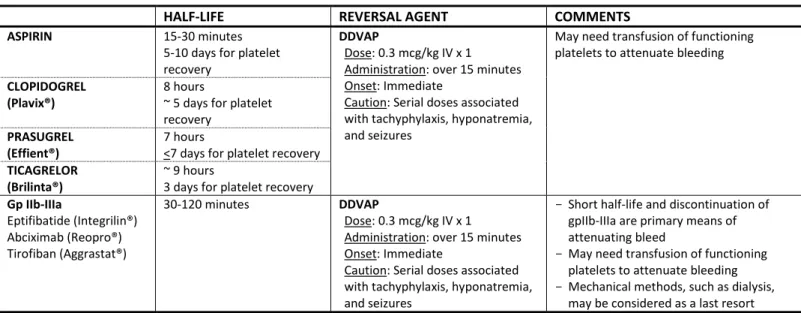
Table 2: Reversal for ANTIPLATELET therapy
HALF-‐LIFE REVERSAL AGENT COMMENTS
ASPIRIN 15-‐30 minutes
5-‐10 days for platelet
recovery
DDVAP
Dose: 0.3 mcg/kg IV x 1 Administration: over 15 minutes Onset: Immediate
Caution: Serial doses associated with tachyphylaxis, hyponatremia, and seizures
May need transfusion of functioning platelets to attenuate bleeding CLOPIDOGREL
(Plavix®)
8 hours
~ 5 days for platelet recovery
PRASUGREL (Effient®)
7 hours
<7 days for platelet recovery TICAGRELOR
(Brilinta®)
~ 9 hours
3 days for platelet recovery Gp IIb-‐IIIa Eptifibatide (Integrilin®) Abciximab (Reopro®) Tirofiban (Aggrastat®) 30-‐120 minutes DDVAP Dose: 0.3 mcg/kg IV x 1 Administration: over 15 minutes Onset: Immediate
Caution: Serial doses associated with tachyphylaxis, hyponatremia, and seizures
- Short half-‐life and discontinuation of
gpIIb-‐IIIa are primary means of attenuating bleed
- May need transfusion of functioning
platelets to attenuate bleeding
- Mechanical methods, such as dialysis,
may be considered as a last resort
UFH=unfractionated heparin, PCC = prothrombin complex concentrates (Bebulin), FFP = fresh frozen plasma, rVIIa = recombinant active factor VIIa (NovoSeven), DDAVP = desmopressin, SIVP = slow intravenous push, LMWH=low molecular weight heparin
*Denotes that doses are NOT based on high quality evidence
Reviewed and approved by: UNMH Anticoagulation Subcommittee, UNMH P&T Committee Page 4 Approved on:
Last updated: Feb 2013
OVERALL MANAGEMENT OF ANTICOAGULATED BLEEDING PATIENT
Bleeding Event Associated with Anticoagulation
Assess severity of bleed
Non-‐life threatening
(eg-‐ nosebleed lasting <1 hour; small amount of blood in stool; bleeding in oral cavity)
Life-‐threatening bleed
x Intracerebral x Gastrointestinal x Genitourinary x Intraperitoneal x Retroperitonealx Bleeding into extremity with risk of
compartment syndrome
Discontinue all anticoagulant therapy
Hold anticoagulation
Consider low dose IV vitamin K 1-‐2.5 mg
Monitor response to interventions and ongoing
coagulation parameters
Institute supportive
strategies as needed
Consider transfer to intensive
care unit
Intubation, fluid resuscitation,
transfusion as needed
Notify other services as needed
(eg-‐ endoscopy, radiology, surgery, OR) and have them on standby
Give antidote if one exists
x Vitamin K
x Protamine
x Platelets (for patients recently
on anti-‐platelet therapy)
Assessment and continual re-‐assessment
Vital signs
Coagulation parameters
Identify and address source
of bleed
Consider non-‐specific hemostatic therapies
FFP
PCCs
rFVIIa
DDAVP
Antifibrinolytics (aminocaproic acid, tranexamic acid)
Consider methods to remove anticoagulant
Dialysis
Hemoperfusion
REFERENCES:
1. Hirsh J, Bauer KA, Donati MB, Gould M, Samama MM, Weitz JI; American College of Chest Physicians. Parenteral
anticoagulants: American College of Chest Physicians Evidence-‐Based Clinical Practice Guidelines (8th Edition). Chest. 2008 Jun;133(6 Suppl):141S-‐159S.
2. Levi MM, Eerenberg E, Löwenberg E, Kamphuisen PW. Bleeding in patients using new anticoagulants or antiplatelet agents:
risk factors and management. Neth J Med. 2010 Feb;68(2):68-‐76.
3. Follis F, Filippone G, Montalbano G, Floriano M, Lobianco E, D'Ancona G, et al. Argatroban as a substitute of heparin during
cardiopulmonary bypass: a safe alternative? Interact Cardiovasc Thorac Surg. 2010 Apr;10(4):592-‐6.Epub 2010 Jan 8.
4. Martin ME, Kloecker GH, Laber DA. Argatroban for anticoagulation during cardiac surgery. Eur J Haematol. 2007
Feb;78(2):161-‐6.
5. O'Connell KA, Wood JJ, Wise RP, Lozier JN, Braun MM. Thromboembolic adverse events after use of recombinant human
coagulation factor VIIa. JAMA. 2006 Jan 18;295(3):293-‐8.
6. Huvers F, Slappendel R, Benraad B, van Hellemondt G, van Kraaij M. Treatment of postoperative bleeding after fondaparinux
with rFVIIa and tranexamic acid. Neth J Med. 2005 May;63(5):184-‐6.
7. Product Information: CYKLOKAPRON(R) injection, tranexamic acid injection. Pfizer & Upjohn Company, New York, NY, 2008.
8. Mathew P, Simon TL, Hunt KE, Crookston, KP. How we manage requests for recombinant factor VIIa (NovoSeven).
Transfusion 2007; 47:8-‐14.
9. Peter FW, Benkovic C, Muehlberger T, Vogt PM, Homann HH, Kuhnen C, et al. Effects of desmopressin on thrombogenesis in
aspirin-‐induced platelet dysfunction. Br J Haematol. 2002 Jun;117(3):658-‐63.
10. Patrono C. Aspirin as an antiplatelet drug. N Engl J Med. 1994 May 5;330(18):1287-‐94.
11. Crowther MA, Warkentin TE. Bleeding risk and the management of bleeding complications in patients undergoing
anticoagulant therapy: focus on new anticoagulant agents. Blood. 2008 May 15;111(10):4871-‐9. Epub 2008 Feb 28.
12. Parakh S, Naik N, Rohatgi N, Bhat U, Parakh K. Eptifibatide overdose. Int J Cardiol. 2009 Jan 24;131(3):430-‐2. Epub 2007 Nov
19.
13. Crowther MA, Berry LR, Monagle PT, Chan AK. Mechanisms responsible for the failure of protamine to inactivate low-‐
molecular-‐weight heparin. Br J Haematol 2002;116:178-‐86.
14. Leithäuser B, Zielske D, Seyfert UT, Jung F. Effects of desmopressin on platelet membrane glycoproteins and platelet
aggregation in volunteers on clopidogrel. Clin Hemorheol Microcirc. 2008;39(1-‐4):293-‐302.
15. Ranucci M, Nano G, Pazzaglia A, Bianchi P, Casana R, Tealdi DG. Platelet mapping and desmopressin reversal of platelet
inhibition during emergency carotid endarterectomy. J Cardiothorac Vasc Anesth.2007Dec;21(6):851-‐4.Epub2007 Jul 30.
16. Dobesh P. Pharmacokinetics and pharmacodynamics of prasugrel, a thienopyridine P2Y12 inhibitor. Pharmacotherapy.
2009Sep;29(9):1089-‐102.
17. van Ryn J, Stangier J, Haertter S, Liesenfeld KH, Wienen W, Feuring M, et al. Dabigatran etexilate-‐-‐a novel, reversible, oral
direct thrombin inhibitor: interpretation of coagulation assays and reversal of anticoagulant activity. Thromb Haemost. 2010 Jun;103(6):1116-‐27.Epub 2010 Mar 29
18. Mathew P, Simon TL, Hunt KE, Crookston, KP. How we manage requests for recombinant factor VIIa (NovoSeven).
Transfusion 2007; 47:8-‐14.
19. Nowakowski K, Rogers J, Nelson G, Gunalingam B. Abciximab-‐induced thrombocytopenia: management of bleeding in the
setting of recent coronary stents. J Interv Cardiol. 2008 Feb;21(1):100-‐5. Epub 2008 Jan 13.
20. Dobesh PP. Pharmacokinetics and pharmacodynamics of prasugrel, a thienopyridine P2Y12 inhibitor. Pharmacotherapy.