University of Massachusetts Amherst
ScholarWorks@UMass Amherst
Open Access Dissertations
9-2011
"Whether Writers Themselves Have Been
Changed": A Test of the Values Driving Writing
Center Work
Michelle Deal
University of Massachusetts Amherst, [email protected]
Follow this and additional works at:
https://scholarworks.umass.edu/open_access_dissertations
Part of the
English Language and Literature Commons
This Open Access Dissertation is brought to you for free and open access by ScholarWorks@UMass Amherst. It has been accepted for inclusion in Open Access Dissertations by an authorized administrator of ScholarWorks@UMass Amherst. For more information, please contact
Recommended Citation
Deal, Michelle, ""Whether Writers Themselves Have Been Changed": A Test of the Values Driving Writing Center Work" (2011).
Open Access Dissertations. 443.
“WHETHER WRITERS THEMSELVES HAVE BEEN CHANGED”: A TEST OF THE VALUES DRIVING WRITING CENTER WORK
A Dissertation Presented by
MICHELLE L. DEAL
Submitted to the Graduate School of the
University of Massachusetts Amherst in partial fulfillment of the requirements for the degree of
DOCTOR OF PHILOSOPHY
September 2011
© Copyright by Michelle L. Deal 2011
“WHETHER WRITERS THEMSELVES HAVE BEEN CHANGED”: A TEST OF THE VALUES DRIVING WRITING CENTER WORK
A Dissertation Presented by
MICHELLE L. DEAL
Approved as to style and content by:
_________________________________________________
Donna LeCourt, Chair
_________________________________________________
Anne Herrington, Member
_________________________________________________
Mathew Ouellett, Member
_______________________________________________
Joseph Bartolomeo, Department Head Department of English
iv
ACKNOWLEDGMENTS
I would like to thank my advisor, Donna LeCourt, for her many years of support. Her writing, teaching, and mentoring have helped make me a better writer, reader, thinker, and educator. I also extend my gratitude to the members of my committee, Anne Herrington and Mathew Ouellett, for their helpful comments, questions, and patience throughout this project. I equally thank the students who volunteered to participate in this study. I am especially grateful for their openness. Their writing, tutoring, and reflections have complicated my understanding of changed writers.
Many thanks go to the International Writing Centers Association for awarding me a dissertation research grant and to the staff at the University of Massachusetts Amherst Translation Center for their first-rate transcription services. Without grant funding, I would not have had the assistance of UMass transcriptionists, and without them, my data analyses would have taken significantly more time than I had to offer. Thanks also go to Neal Lerner for having read and responded to an early version of chapter 3, and to members of the NEWACC writers group who read and responded to a related conference paper/manuscript. I am also indebted to Patricia Zukowski, Haivan Hoang, and Lois Brown for having hired and mentored me as a tutor, administrator, and teacher. Their contributions to my professional development while researching and writing this dissertation have been invaluable.
This project may never have been completed without the support of family and friends who helped me to stay focused on this project and provided encouragement to persist: a special thank you to Adam Barcroft, Hannelore Deal, James Deal, Vicki Hamill, and Carla English.
v
ABSTRACT
“WHETHER WRITERS THEMSELVES HAVE BEEN CHANGED”: A TEST OF THE VALUES DRIVING WRITING CENTER WORK
SEPTEMBER 2011
MICHELLE L. DEAL, B.A., UNIVERSITY OF NORTH CAROLINA AT CHAPEL HILL M.A., UNIVERSITY OF VERMONT
PH.D., UNIVERSITY OF MASSACHUSETTS AMHERST
Directed by: Professor Donna LeCourt
This project questions a core value that writing center workers have long held about tutoring writing: that we change writers. Applying sociocognitive and Bakhtinian lenses, I was able to complicate theory-practice connections. Tutor-tutee negotiations during tutorials, tutees’ perceived learning outcomes, and their revisions were compared with their reasons for revising so that I could investigate what tutees potentially learn from their tutors, how, and why. Data indicated if tutors’ information/advice became, in Bakhtin’s terms, internally persuasive to tutees. When the authoritative discourses tutors represent or endorse converge with students’ internally persuasive discourses, they converge in students’ revision choices as tutor-tutee interdiscursivity. I proposed that such a convergence can lead to “changed” writers, writers who alter their understanding of themselves as writers and/or modify their thinking about a given paper, concept, or process.
vi
Even though students granted their tutors considerable authority, most tutees examined their tutors’ comments to see if they made sense and were worthy of
internalizing as generalized concepts to help them meet current writing goals. In short, tutors do indeed change writers, as I have defined change in the context of this study. Work with specific papers can impact students in terms of their larger process and development as writers; tutors’ strategies/concepts can become writers’
strategies/concepts to be applied again in new contexts. However, even when tutees were internally persuaded and appeared to have changed as writers, analyses into their
tutorials, revisions, perceived learning outcomes, and reasons for revising showed that some students took up their tutors’ information/advice in ways beyond their tutor’s control.
What some students internalize can be situation-specific and may not necessarily translate to other writing projects, can be significant yet limited understandings of rhetorical concepts, and may not appear in their revised drafts. Students can also be resistant to rhetorical concepts and revision strategies, especially those they perceive as antithetical to their ideological views about process, content, or structure. Given the variety of reasons students revise, the multiple contexts and influences affecting tutorials, and the ensuing challenges inherent in assessing tutorials, I recommend that tutors do not measure their success based on the Northian idea of a writing center. Though we do change writers, I recommend writing center workers think about successful tutorials in more complex ways than our Northian goal might imply. Tutors’ successes are not dependent on changes to writers but on their ability to collaboratively negotiate with writers. Instead of trying to prove the efficacy of writing center tutorials as direct cause and effect relationship, I recommend that writing center administrators try to
vii
demonstrate how tutorials foster several habits of mind that college students need to cultivate to become successful writers.
viii
TABLE OFCONTENTS
Page
ACKNOWLEDGMENTS ... iv
ABSTRACT ... v
LIST OF TABLES ... xii
CHAPTER 1. EFFICACY IN WRITING CENTER TUTORIALS: IN SEARCH OF BETTER WRITERS ...1
Writing Center Research: What We Know and What We Don’t Know ...3
Success with Tutoring Strategies ...6
Success with Tutorials ... 13
Success with Writing ... 19
Success with Writers ... 21
Chapter Outline ... 27
2. RESEARCH METHODS ... 29
Site ... 31
Participants ... 35
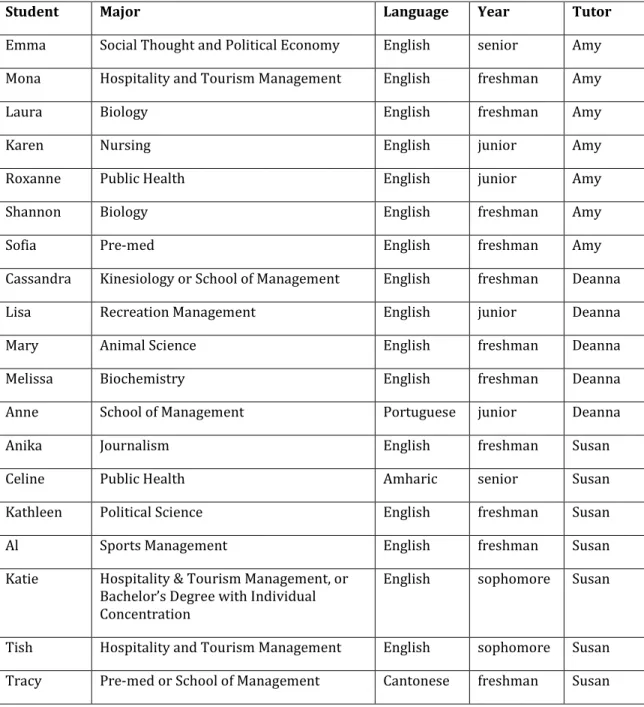
Student Writers ... 36
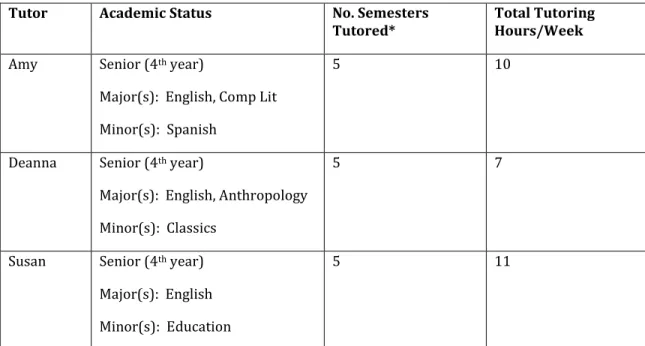
Writing Center Tutors ... 39
My Role as Researcher ... 45
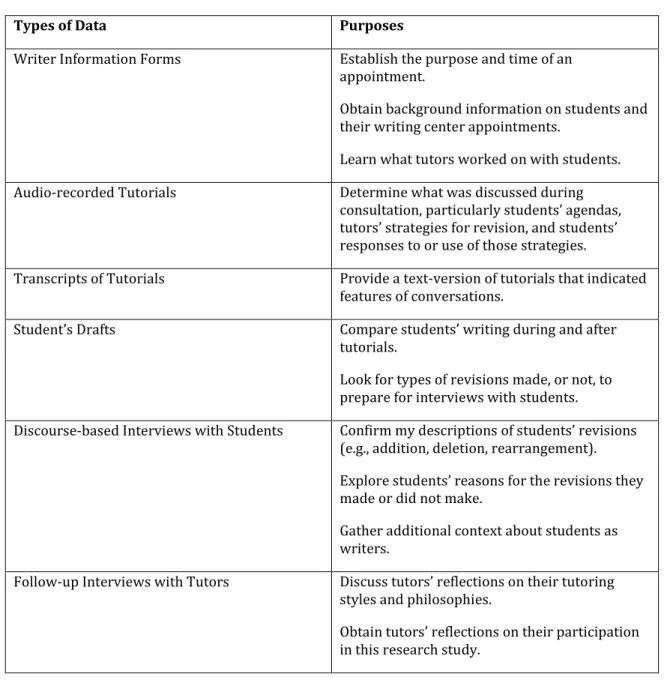
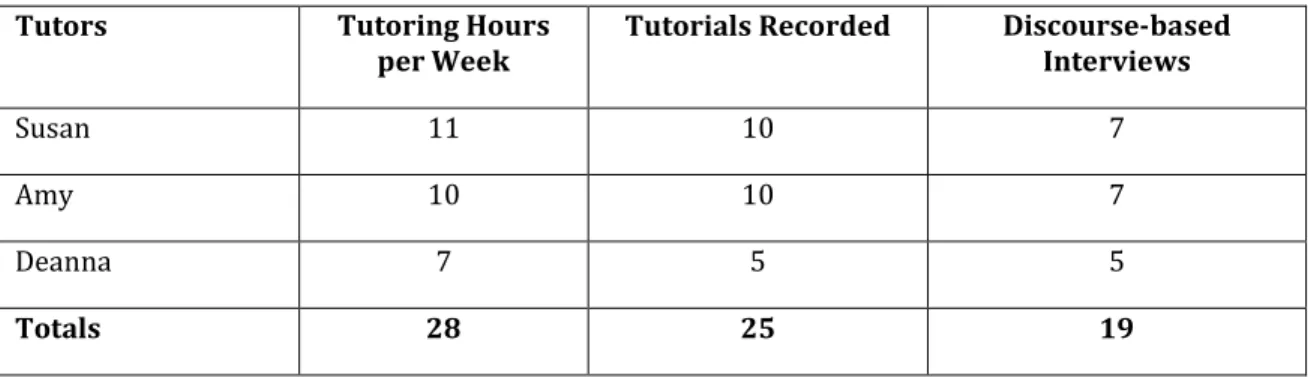
Data Collection ... 49
ix
Audio-recorded Tutorials ... 54
Transcripts of Tutorials ... 55
Students’ Drafts ... 59
Discourse-based Interviews with Tutees ... 60
Follow-up Interviews with Tutors ... 63
Data Analysis ... 63
Research Memos ... 64
Analyzing Student Writing ... 65
Analyzing Tutoring Approaches ... 66
Analyzing Tutoring Sessions and Discourse-based Interviews ... 67
Triangulating Tutorials, Texts, and Interviews ... 73
3. A COMPARISON OF TUTORIALS, REVISIONS, AND PERCEIVED LEARNING OUTCOMES ... 74 Tutorials ... 75 Information/Advice Requested ... 76 Rhetorical Situations ... 78 Information/Advice Received ... 80 Revisions... 82
Information/Advice Received and Used ... 83
Self-assurance, Motivation, Material Constraints, and Comprehension: No Additional Revisions Beyond Tutor’s Information/Advice... 86
Unnecessary Changes, Personal Preferences, Instructor Preferences, and Misunderstandings: Information/Advice Received and Not Used ... 88
Revisions as Extension of Tutorials ... 90
x
Discussion ... 93
Perceived Learning Outcomes ... 95
Comparing the Data ... 98
Expected Tutorial Outcomes ... 100
Unintended/Unexpected Tutorial Outcomes ... 102
Desirable By-products... 103
Conclusion ... 106
4. HOW AND WHY TUTEES REVISE: FROM METACOGNITION AND NEGOTIATION TO INTERNALLY PERSUASIVE DISCOURSES ... 110
Convergences of Authoritative and Internally Persuasive Discourses ... 111
Sofia: Applying and Extending Can Change Writers ... 114
Mona: Applying But Not Extending Can Change Writers ... 132
Al: Even Minimal Revisions Can Change Writers ... 149
Conclusion ... 169
5. WRITERS/WRITING: THE AFFECTS OF EXPERIMENTATION, REFLECTION, AND NEGOTIATION ... 171
Lisa: Situation-Specific Outcomes ... 172
Cassandra: Complicating Contexts ... 191
Emma: Writing with Power ... 207
Conclusion ... 234
6. CONCLUSION: THE VALUE OF WRITING CENTER WORK ... 237
Testing Assumptions ... 237
Redefining Success Theoretically ... 240
xi
Reconceptualizing Tutoring Practices... 247
Limitations and Future Research ... 249
APPENDICES ... 255
A. CONSENT AND LANGUAGE FORMS ... 256
B. TUTEE INTERVIEW QUESTIONS ... 263
C. TUTOR INTERVIEW QUESTIONS ... 270
D. TUTEES’ RHETORICAL SITUATIONS FOR REVISING ... 272
E. INFORMATION/ADVICE TUTEES RECEIVED AND USED ... 276
F. INFORMATION/ADVICE RECEIVED AND NOT USED, AND REVISIONS NOT DISCUSSED DURING TUTORIALS ... 282
G. TUTEES’ PERSPECTIVES ON THEIR REVISIONS ... 284
H. TUTEES’ PERSPECTIVES ON WHAT THEY LEARNED ... 286
I. SOFIA’S DRAFTS DURING AND AFTER TUTORIAL ... 290
J. MONA’S DRAFTS DURING AND AFTER TUTORIAL ... 316
K. AL’S DRAFTS DURING AND AFTER TUTORIAL ... 328
L. LISA’S DRAFTS DURING AND AFTER TUTORIAL ... 339
M. CASSANDRA’S DRAFTS DURING AND AFTER TUTORIAL ... 349
N. EMMA’S DRAFTS DURING AND AFTER TUTORIAL ... 364
xii
LIST OF TABLES Table Page 1. Tutee Participants ... 39 2. Tutor Participants ... 42 3. Data Collected ... 504. Data Collection Totals ... 52
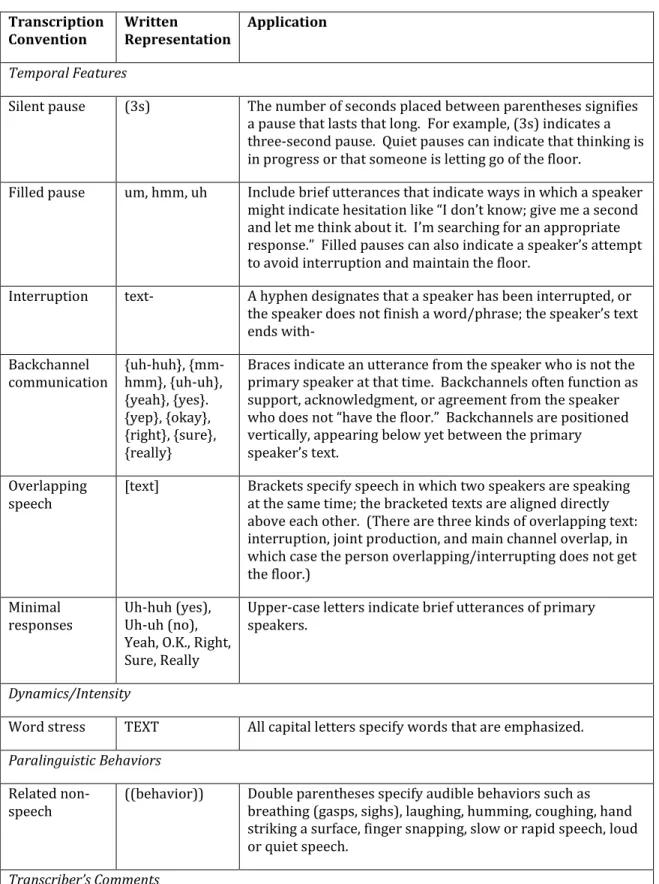
5. Close Vertical Transcription: Conventions and Classifications Used to Analyze Discourse Between Writing Tutors and Tutees ... 58
1
CHAPTER 1
EFFICACY IN WRITING CENTER TUTORIALS: IN SEARCH OF BETTER WRITERS A core belief among writing center workers, including myself, is that tutors improve students’ writing through improving students as writers. This position is central to writing center workers because it encourages tutors to help students cultivate writerly knowledge through a consultation about their tasks and goals. To only improve students’ writing means that tutors risk commandeering students’ projects to the degree students learn little to nothing that is meaningful to them. Writing center workers want students to base their revision choices on rhetorical, epistemological, aesthetic, and/or ethical
concepts and practices that lead to their own expanded writerly knowledge and capability. Despite this goal, writing center workers do not know if they are meeting it.
Research into the effects writing centers have on students’ writing and on students as writers is scarce and difficult to prove. Casey Jones published an assessment of the literature since 1970 on the relationship between writing centers and improvement in writing ability. He speculated that the overall scarcity of empirical studies into writing center efficacy resulted from methodological problems, such as: the difficulty in defining writing ability, “the complexity of the writing process itself,” the inability to control “the influence of confounding factors” on student writing, and the lack of generalized outcomes because “no two writing centers are alike” (5-6). Jones concluded that “evaluation of writing center efficacy is an elusive goal” because writing and writing centers do not “lend themselves very well to empirical study” (1, 17). Bearing these dilemmas in mind, writing centers workers have tried to assess the impact their centers have on students, largely due to increasing demands from deans and provosts to assess learning outcomes (Ianetta 39).
2
Tracing “the delicate line between measurable and intangible outcomes that researchers tread in this field,” Jones organized his findings into five categories of writing center efficacy (5): “direct” (quantitative) evidence of student writing ability, “indirect” (qualitative) evidence of student writing ability, evidence of tutors’ roles in writing center efficacy, the connection between faculty support and writing center efficacy, and the effects writing centers have on faculty and staff. Of most interest to me are studies Jones cited from the first two categories. Studies of improvement in students’ writing abilities have been correlated with higher grade point averages (Sutton and Arnold), better
freshman composition course grades and improved grades on proficiency exams (Sandlon, Naugie), increased error or grammar recognition (Wills), writing center instruction
(Roberts) improved attitudes toward writing (Van dam), and greater self-confidence (Matthews). These writing center assessments often equated success stories with student satisfaction and retention. Missing from previous research into students’ writing abilities are contextualized studies of what students learn about writing from writing center tutors—outcomes also valued by educational institutions. Even so, research into what students learn about writing from writing centers is not the focus of most of the recent published scholarship either.
In this dissertation study, I try to answer questions I see as central to writing center work. Tutors tutor writers and not just writing, so what about those writers? For what reasons do writers make writerly choices with regards to a writing center
consultation? What aspects of the tutorial were persuasive, not only satisfactory, to the writer and why? How did the student perform the tutor’s suggestions? Writing center workers need to know what students learn as writers because it is their goal, and this goal affects their role in educational institutions. My investigation into students’ writing
3
presents an analysis of what and if students learn as writers and, for that reason, tests the values driving writing center work and the value of writing center workers’ worth as educators distinct from others.
Writing Center Research: What We Know and What We Don’t Know Controlling for outside influences on students’ writing, collecting and measuring writing samples, defining improvement in writing, and generalizing from one student to another and one writing center to another pose significant challenges for research into assessing learning outcomes (Jones, Lerner “Writing”). Though methodological and practical concerns have arguably restricted writing center research, Beth Boquet and Neal Lerner contend the problematic reception of Stephen North’s essay “The Idea of a Writing Center” (published in 1984) has had a greater impact on the range and reach of writing center scholarship. Editors of the Writing Center Journal from 2002-2008, Boquet and Lerner write, “No article about writing centers has been invoked more frequently to identify, justify, and legitimize the work that writing centers do (or hope to do) in their institutions” (171). Having examined references to “Idea” published in the Writing Center Journal from 1985 through 2005, Boquet and Lerner claim North’s essay has been “‘lore-ified’” in writing center studies—“practice without critical reflection” (184). The articles Boquet and Lerner surveyed typically invoke North’s “Idea” “to confirm a commonly shared understanding” and not to assess his ideas (178). Due to this “epistemological trajectory,” writing center studies have rarely addressed “whether writers themselves have been changed by the instruction offered” (Boquet and Lerner 172, 184).
Most writing center workers hail North’s “Idea,” particularly North’s idea that tutors help “make better writers, not necessarily—or immediately—better texts” (441).
4
Likewise, tutors “must measure their success not in terms of the constantly changing model they create, but in terms of changes in the writer” (North 439). And by extension, “The essence of the writing center method, then, is [the] talking” between tutor and writer (443). North believed that
talk is everything. If the writing center is ever to prove its worth in other than quantitative terms—numbers of students seen, for example, or hours of tutorials provided—it will have to do so by describing this talk: what characterizes it, what effects it has, how it can be enhanced. (444)
Statements such as these have initiated 25 years of writing center lore without much questioning even though North wrote another essay the same year as “Idea” calling for research into “our assumptions” (see North “Writing”; Boquet and Lerner 183). Boquet and Lerner point out that while North asserted the goals and values of writing centers in “Idea,” he urged writing center workers to question them in “Writing Center Research.” No longer talking to English faculty but to tutors and administrators, North called for research into “the specific effects of writing center work” by asking, “‘What happens in tutorials?’” (Boquet and Lerner 183; North “Writing” 29 qtd in Boquet and Lerner 183). North proposed research possibilities such as “categorizing types of tutorials, identifying ‘effective’ tutoring, or comparing ‘tutorial content with written products’” (North
“Writing” 32 qtd in Boquet and Lerner 183). In short, North was asking writing center workers to become researchers in their own writing centers to assess theory and practice.
A decade later, due to the overwhelming “public idealization” of “Idea,” North published a response to writer center workers who “take [“Idea”] at anything like face value” (North “Revisiting” 9 qtd in Boquet and Lerner 179; “Revisiting” 12). He revised
5
and qualified three points concerning the relationship between tutor and writer, tutor and teacher, tutor and institution (“Revisiting” 10). Each shares a common concern: North’s clarification of tutors’ roles. Most important among them are tutors’ relationships with student writers. In “Idea,” North explained to his English faculty audience that writing center tutors are participant-observers of students’ education as writers; tutors enable writers to make sense of their composing processes because they are able to observe writers in process and intervene. In “Revisiting,” North explained to writing center workers that they were mistaken about his portrayal of tutors when or if they equated participant-observer solely with a minimalist, hands-off, unassuming tutor liberated from the social contexts circulating in writing center consultations (12). Overall, North’s response to writing center workers indicates a field entrenched in assumptions that he made and hoped would be tested. Ironically, North’s maxims have dominated writing center studies to the point at which “North’s aphorisms have become a kind of verbal shorthand, a special handshake for the initiated, an endpoint rather than an origin” (Boquet and Lerner 184, 171). Boquet and Lerner encourage their readers to self-reflect on “the ways in which one scholar—or, perhaps more to the point, one article or even one line—can come to define a field” (172).
Like Boquet and Lerner, I argue that writing centers studies has followed a trajectory that takes for granted what student writers potentially learn from tutors. My own assessment of this trajectory follows four categories for studying writing center tutorials: (a) theories and practices of tutoring that lead to (b) commendable tutorials and (c) skillful writing by (d) able writers. Perceptions of successful tutorials have focused on collaborative tutoring strategies. Those strategies have been most debated from two places, either directive and hierarchical, or nondirective (minimalist) and nonhierarchical
6
theories of collaboration. The majority of the research assumes that students filter their tutorials through the same lens as the researchers use to define instances of collaborative tutoring. Few studies have shown that success in tutoring depends on other factors than success with tutoring styles. Efficacy in writing center tutorials is more recently
connected to students’ perceptions of satisfaction. However, the question remains whether improved writing leads to improved writers as a measure of success. Writing center researchers are left with the considerable challenge to identify types of
improvement in writers. What would indicate that a writer has improved? In what ways is she better than before at writing? Is she more aware of something she does and/or doesn’t do?
The assumptions I am testing in this dissertation pertain to whether and how writing center workers help to create changed writers. My dissertation tries to identify the reasons for what students do and/or do not do with their writing during and after a tutorial as an indicator of what and whether students learn. This investigation into what happens during and after tutorials represents a step towards defining what we think of as success with students as writers, namely as a type of improvement that is relative to what students own in their writing.
Success with Tutoring Strategies
Student ownership is central to the belief and goal, the theory and practice, of creating better writers. A student needs to own his writing and his responsibilities as a writer in order to grow as one. Founding editor of the first writing center peer-reviewed publication, the Writing Lab Newsletter, Muriel Harris explained in 1995 to College English
7
characteristics of writing center tutorials that distinguish them from classroom
instruction. She described student ownership as a matter of “encouraging independence in collaborative talk” (“Talking” 30). The key to students’ independence comes from how they think differently in tutorials because of “exploratory talk,” a term Harris borrowed from Douglas Barnes (Barnes 50; Harris “Talking 31). Harris made a critical distinction between the types conversations that occur between tutors and writers and the
conversations between teachers and students. Exploratory talk, contrasted with presentational talk, helps students formulate their thinking without the pressure of performing. Without this pressure, “tutorial talk encourages knowing,” which is Harris’s second reason why writing center tutors matter (“Talking” 32). Tutors help writers acquire “strategic knowledge,” a term Harris borrowed from Linda Flower (Flower “Studying Cognition” 23 qtd in Harris “Talking” 32). In short, tutors teach writers the “how to’s” through exploratory talk about their writing, both of which are core
characteristics of writing center work that help students to make meaning. The logic runs as follows: If tutors’ tutoring strategies are collaborative strategies such as exploratory talk, students are more likely to own their writing, become more strategic, and learn as writers.
This is the reasoning that leads writing center workers to still agree with North and Harris even though they don’t know for sure how and if this works. Research into students and tutors’ conversations has not directly addressed development in writers as, for instance, writing strategies they have acquired and has instead attended to the nature of collaboration. Since 1984, writing center scholars have paid considerable attention to tutor and student talk as collaboration. After all, North and Harris made it clear that the talking that goes on during writing center tutorials is what sets them apart from
8
classroom pedagogy. Through the lens of collaboration theories and practices, some writing center workers have taken up student ownership through occasional but critical challenges to collaboration as particular tutoring strategies as talk that lead to students’ development as writers.
Writing center scholarship links the origins of collaboration as a writing center theory to Kenneth Bruffee’s collaborative learning model (e.g., Lerner and Boquet “From the Editors,” Kail “From the Guest Editor,” Hobson, Gillam). In a special issue of the
Writing Center Journal on Bruffee and the Brooklyn Plan, Peter Hawkes summarizes Bruffee’s model as a pedagogy of reacculturation and social change, terms Bruffee used himself (Bruffee “Social” 784, Hawkes 31). Bruffee argued that the conversations peer tutors and students have about writing mirror the recursive and social nature of acquiring knowledge within discourse communities and, therefore, has the potential to change students’ “relationship to the authority of knowledge” (Hawkes 30). As intermediaries between “the new language of the knowledge community [student writers] wish to join” and “the language they already know,” peer tutors provide writers with a “kind of critical consciousness” that has the potential for social change (Hawkes 30, 31). Specifically, students have the potential to enter new discourse communities and “question [their] values and perspectives,” which could lead to changing those communities in productive ways (Hawkes 31). In his landmark essay “Peer Tutoring and the ‘Conversation of
Mankind’,” Bruffee described writing center collaborations between tutors and writers as a conversation in which peers reach a consensus comparable to how knowledge is
contested between colleagues. On a practical level, Bruffee’s model is one that “offers students task-guided conversation and negotiation to reach a consensus on their own authority” (Hawkes 30, 31). Collaborative learning between peers, as Bruffee described it
9
and set it into motion across campuses around the country has been heralded as critical social action and as not entirely true.
Although student-tutors are usually considered peers with student-tutees, John Trimbur pointed out in 1987 how “peer tutoring” is not collaboration between equals because students seek the knowledge that tutors impart as members of larger institutional authorities. Four years later, wary of the collaboration “bandwagon,” Andrea Lunsford advised readers to reconsider collaboration from cultural and postcolonial stances: Collaboration, for all its libratory merits of harmony and peaceful solutions such as consensus, runs the risk of social elitism, of “erasing differences” (7). Anne DiPardo’s 1992 case study showed how class and ethnic differences, for instance, can undermine the ideal of “peer” tutoring and can lead to a naïve use of collaborative tutoring strategies. She observed, in one particular case, a tutor’s lack of training and supervision contributed to ethnocentric tutoring and an “inadvertent appropriation” of a student’s writing (365). Collaboration, as this tutor understood it, was reduced to a small set of tutoring strategies that should work for every student.
The editors of Intersections: Theory-Practice in Writing Centers, the first book to interrogate writing center theory-practice connections, addressed related concerns: “how various forces in collaborative relationships determine texts” and ways “to negotiate the thin lines between the conflicts which prevent true collaborations” (Mullen and Wallace vii, xiii). A significant conflict for all of the contributing authors was the use of social constructionist theories to only idealize and not critique collaboration in writing center tutorials. For instance, Christina Murphy warned readers that collaborative learning theory risks disregard for the “subjective experience” of the individual and status quo
10
practices of accommodation and consensus that suppress agency and diversity (28). Through a specific case example, Alice Gillam raised critical questions about “the explanatory power as well as the limitations” of current conceptions of collaboration when applied to practice (“Collaborative” 45). Gillam showed how “there is no such thing as a ‘typical’ session” (“Collaborative” 45). What is typical are tutorials’ “resistance to easy assessment” (“Collaborative” 45). In short, the contributors to Intersections are among the first to interrogate the “the gaps between what [writing center workers] theorize and what they practice” (Mullin “Introduction” ix, Hobson).
In addition to the theoretical challenges some scholars’ pose to “peer” tutoring and “consensus” building, collaboration in relation to tutoring practice is associated with two primary types of tutoring strategies, directive and nondirective. Nondirective tutoring has been considered (and probably still is for some) to be more collaborative, associated with sound ethics and teaching practices, whereas directive tutoring has connoted negative practices (Clark “Perspectives,” Jones). In The Allyn and Bacon Guide to Peer Tutoring
(2004), Neal Lerner and Paula Gillespie explain that nondirective strategies such as open-ended, content-clarifying, or leading questions do not have a “canned” answer for content- or process-related matters:
You may ask, ‘Why did you [the student writer] choose to put this section here?’ The writer is still going to hear this question as ‘This doesn’t belong here.’ She may ask, ‘Should I move it?’ You can then rephrase the question: ‘Is there a good reason why it belongs here?’ That allows her to assert that indeed it does but that maybe she needs to show the reader why. (37-38)
This type of nondirective tutor talk puts the student in the position of a writer owning her writing, making her own decisions about her writing, and puts the tutor in the position of
11
a reader responding to a text.In contrast, directive tutoring approaches do not typically position the writer as owner, per se, but as novice. Linda K. Shamoon and Deborah H. Burns showed how advanced beginners have benefited from directive tutoring in which rhetorical processes were modeled, imitated, and questioned. Another critique of nondirective tutoring comes from Paul Kei Matsuda: ESL students do not share the basic assumptions some native speakers of English have about academic writing conventions and therefore require more explicit instruction. Judith K. Powers discovered that tutors in her writing center had to explain to ESL students what an American writer’s audience expectations might be, to direct them in how to say something and the amount of evidence to provide as adequate support for an argument, and to locate errors that these students cannot hear editing by ear (42-43). All of these authors support a theory and practice of directive tutoring approaches that are legitimate, though arguably outside “processed-based, Socratic, private, a-disciplinary, and nonhierarchical or democratic” writing center theories of collaboration (Shamoon and Burns 177).
Collaboration has also been shown to have many variables aside from directive and nondirective tutoring strategies. Carol Severino published a short case study that categorizes several of the “situational and interpersonal dynamics” that impact tutorials and our evaluations of them as more collaborative or better than others, including age, gender, ethnicity, language, personality, experience, status, motivation, frequency and duration of tutorials, the written text in question, and topic knowledge. She referred to these forces as “features for rhetorically analyzing collaboration” that, as her study
12
a variety of features that help define successful collaborations. Building from Severino’s work, Blau, Hall, and Strauss conducted the first linguistic study of conversational features in writing center tutorials. They further analyzed two of Severino’s eighteen factors affecting tutorials: “‘Length of contributions to discussion (number of words of sentences each speaks)’ and ‘Rhetorical functions of contributions to discussion (leading questions, open-ended questions, complaints, appeals)’” (Severino qtd in Blau, Hall, and Strauss 21). The authors coded three recurring rhetorical strategies within conversation-based tutorials: “questions” (who asks, what type of question, and for what purpose is it asked), “echoing” (of non-content words/phrases, syntactic patterns, and play), and “qualifiers” (posing suggestions as questions and modifying comments) (23, 27, 32, 33). After analyzing their data, they believed “that in a number of cases that we examined, an undue—or misdirected—emphasis on the collaborative [nondirective] approach resulted in tutorials that seemed to waste time and lack clear direction” (38). From their point of view, reliance on primarily nondirective tutoring approaches did not constitute success of a writing center consultation.
Each of the researchers mentioned in this section have shown writing center workers that strategies other than nondirective strategies, plus a variety of rhetorical features, can affect “peer” tutoring, student ownership and revision, and the overall success of tutoring. Writing center researchers who complicate collaboration point toward the failings of writing centers’ “good intentions,” words Nancy Grimm uses to describe problematic assumptions underlying lorified theories and practices (Good Intentions). Empirical research into collaboration recommends writing center workers broaden their perceptions of how to create better writers considering a range of values not fully examined. Because writing center scholars have spent so much time defining
13
successful tutorials through a lens of nonhierarchical collaboration and tutoring strategies, they haven’t looked for success as change in writers evidenced through, for instance, their writing strategies or strategic knowledge. Even though authors such as those I cited above have made considerable contributions to the field by challenging conjecture, current writing center research continues to correlate writing center success with tutorials themselves, including tutoring strategies, as evidence of student satisfaction.
Success with Tutorials
The difference between early studies and more recent research into the effects of writing center tutorials on writers is a shift in perspective: Writing Center research since 2000 focuses on identifying characteristics of successful tutorials primarily from students’ and not researchers’ points of view. Types of tutoring strategies are not necessarily the focus, or only focus, of current writing center research; students’ overall perceptions of their tutorials are. Previously used measures such as improved student attitudes and confidence and the relationship between grades and tutorials continue to represent research categories for satisfaction. Writing center instruction, however broadly
conceived, is given more attention. The authors cited in this section cumulatively generate a sizeable list of tutoring outcomes related to students’ development as writers: tutors meeting student objectives (e.g., mutual agendas), tutors’ courtesy (e.g., rapport, care), tutors’ knowledge and ability (e.g., generalist/specialist tutors), students learning and applying information and believing writing improved (e.g., thesis construction and development), students procrastinating less (e.g., earlier drafts), students’ ownership of writing (e.g., agenda setting and tutor recommendations for the instructor’s input), and students’ comfort level (e.g., receiving positive feedback). Even though successful tutorials
14
are usually equated with different kinds of satisfaction from additional perspectives, success overall is still determined by who defines it—usually the researcher.
James Bell defined student satisfaction in two ways: satisfaction with the process (tutors/tutorials meeting objectives) and satisfaction with the product (learning and applying information) (“When” 19). Bell’s small-scale survey responses show that most students were satisfied with their tutoring sessions immediately after tutoring, two weeks later, and two months after tutorials (20-23). On the contrary, the results of Julie
Morrison and Jean-Paul Nadeau’s study indicates that students’ initial satisfaction ratings dropped once students received grades that were lower than students expected from their instructors (33). Morrison and Nadeau defined satisfaction for students using five scales: “overall conference satisfaction (Satisfied), satisfaction with the topics covered (Topics), ability to apply what was learned to school work (Apply), ability to use what was learned in the future (Future), and rating of consultant friendliness (Friendly)” (30). Student satisfaction for Peter Carino and Doug Enders’s survey is categorized as tutors’ courtesy, knowledge about writing, and ability to help students apply writing knowledge without “taking over” the session (97, 98). Students were satisfied if they experienced greater confidence as writers and believed that their writing improved as a result of their writing center consultations (96). Though most students reported satisfaction with tutors, Carino and Enders found no statistically significant correlation between frequency of students’ visits to writing centers and their satisfaction with tutors (96). However, frequency of visits significantly boosted students’ confidence and sense of improving their writing. The authors report that the results of their study are questionable but nonetheless challenged the authors’ assumptions that regular writing center users are more satisfied than one-time clients (85). These three studies suggest writing center instruction effects students’
15
perceptions of their writing and themselves as writers. Additional research further investigates the impact of writing center instruction.
Another form of student satisfaction and writing center success, reduced
procrastination, is described in Beth Rapp Young and Barbara A. Fritzshe’s research into students’ composing processes. They discovered a link between writing center users and fewer procrastination behaviors. High procrastinators only wrote their papers in advance of the deadline when they met with a writing center tutor. Young and Fritzshe report that the high correlation between writing center users and decreased procrastination
behaviors supports claims that writing centers help to create better writers (53). Though Young and Fritzshe’s study points toward an important aspect of what it means to be a writer, the authors note it’s not clear if the students participating recognized revision as a recursive process as well as a linear one. Writing center users may procrastinate less but nonetheless perceive composing as discrete steps. Still, it is clear that students recognized the value of writing drafts well before the eleventh hour and sharing them with tutors. In this case, better writers are those who procrastinate less because they use the writing center.
Students are also likely to be more satisfied with their writing center consultations if tutors address students’ agendas for revising and help them utilize this knowledge. Terese Thonus conducted a sociolinguistic and ethnographic analysis that broadens the scope of tutorial success to include tutors’ perspectives alongside students’ perceptions. She reports ten “interactional and pragmatic” features students and tutors attributed to the success of writing center consultations (“Tutor” 130). Key among these is tutor and students’ similar “understanding of the other’s intent,” or “parallel orientations to the
16
conversation,” as evidenced through linguistic and interactional features such as
volubility, overlaps, backchannels, laughter, and negotiation of directives (129, 124). Also, students and tutors believed that successful tutorials included thesis construction and development, student ownership of the writing, and tutor recommendations for additional support from instructors—a negation of absolute tutor authority (125). Thonus’s study further complicates collaboration from the perspective of those who experience writing center consultations. Successful interactions between students and tutors that are likely to contribute to changes in writers are not only contingent upon nonhierarchical tutoring practices but also on how tutor and student “negotiate” what the student can expect to learn and apply.
The relativity of success as a matter of expectations is also evident in Sarah Cushing Weigle and Gayle L. Nelson’s research into students’ and tutors’ perspectives. Their study of tutors’ identities as tutors shows “no direct connection between specific roles [that tutors play] and the perceived success of tutoring” for students whose primary language is not English (222). Success for their tutors meant having the knowledge required, communicating writerly knowledge, and boosting student confidence. However, “whether or not the tutor has a collaborative or directive stance towards the tutee, focuses on content or sentence level concerns, or talks less than the tutee appears to be less important in terms of [students’] perceptions of success” than tutors negotiating an agenda the writer anticipates, providing information the writer needs and can apply, and demonstrating an understanding of, or empathy for, the writer’s situation (“establishing rapport”) (Weigle and Nelson 221). For each of the three cases Weigle and Nelson analyzed, different tutoring roles did not affect tutees’ perceptions that they got “what
17
they wanted out of the tutoring sessions” (221).These results speak to another study by Terese Thonus in which faculty, tutees, and tutors radically differed in their expectations of tutors’ roles, from surrogate teacher to peer reader (“Triangulating”). She found that tutors’ roles are constantly changing within and across tutorials, suggesting students’ perceptions of success are likely to involve other aspects of writing center consultations. Likewise, Irene Clark’s study of student’s perceptions of directive and nondirective tutoring showed that students’ perceptions differed considerably from tutor’s perceptions (“Perspectives”). Students were more likely to perceive tutors as more directive than the tutors thought of
themselves and “seemed satisfied with the consultant’s degree of directiveness” (45). Her research suggests that no matter which of the two tutoring strategies tutors use, students will experience a writing center tutorial from their own perspectives and needs. Other aspects of the tutorial and the tutor’s tutoring strategies are driving student learning—at least their perception of it.
Most recently, Isabelle Thompson et al. deliberately examined similar mandates from writing center “lore,” namely, dialogic collaboration, tutor expertise, positive
feedback, and comfort level. Out of more than 4000 tutorials they surveyed, both students and tutors were most satisfied with their tutorials when tutors used directive strategies. However, it is not clear to me what those strategies are other than “answering students’ questions to improve writing quality” (96). Student and tutor satisfaction also
corresponded with “comfort” level, “receiving positive feedback,” and tutors’ “caring”—a result that supports some of Weigle and Nelson’s findings (Thompson et al. 80). The biggest predictors of student satisfaction were having their questions answered by tutors
18
they perceived to be advanced writers—experts of genre conventions and subject matter. Thompson et al.’s study supports the lore about attending to students’ comfort and
providing positive feedback. The lore about generalist tutors and dialogic collaboration is neither supported by this research nor other studies (see, for instance, Mackiewicz; Kiedaish and Dinitz; Davis et al., Wolcott; Clark “Perspectives,” “Maintaining,”
“Collaboration;” Flynn and King; Harris “Modeling;” Hubbuch; Thonus “Tutor”). Overall, results of the Thompson et al. study show a deconstructed form of collaboration,
“asymmetrical” (81). Asymmetrical collaboration means “both the tutor and the student have power” (81). The tutor is more experienced with writing and the student “has the power to initiate the collaboration and set the agenda” (81). This finding is critical because it further undermines the rigid binaries between directive and nondirective tutoring. However, their research advances another binary, generalist and specialist tutors—a binary that some writing center directors reject as false (personal
communication, Haivan Hoang). Still, Thompson et al. are among a handful of scholars to test our assumptions about writing center work through empirical research. Their work deepens our understanding of what successful tutorials look like depending on the students’ expectations and experiences.
Challenges to long-held assumptions about writing center work, particularly the idea that tutors are peers or “pure” tutors, are in greater supply today than twenty years ago. Writing center workers know a lot more about tutors’ and students’ perceptions of tutoring and the conversations they have with one another. Fortunately, many students’ expectations and experiences correspond with our foremost goal to foster writers. The most recent literature shows that successful tutorials are likely to be those in which students get what they came for: information or strategies for writing in an exploratory
19
and considerate yet expert setting. Even so, writing center research tends to focus on the tutorial as the central site for evaluating and assessing writing center effectiveness. The role students’ texts play in defining writing center success is seldom a benchmark.
Success with Writing
North’s axiom that tutors create better writers, not necessarily better texts, does not mean that tutors get to know writers more through their conversations with them than through students’ writing as a kind of conversation. Changes in the writing suggest if tutors have contributed to changes in the writers. If writing center workers want to know more about the effects of writing center tutors on writers, they need to investigate
students’ writing and compare this writing to their tutorials—a point North made in “Writing Center Research.” With the exception of Byron Stay’s study published in 1983, only three studies since 2000 analyze students’ writing as a measure of tutorial success, and none of them directly compare students’ writing to their tutorials.
Luke Niiler’s statistical analysis of writing center outcomes supports his earlier research into how much students’ essays were “impacted globally and locally by writing center intervention” (Niiler “Continued” 13). Using a multiple trait-based assessment, independent raters scored students’ tutored and non-tutored drafts. Niiler’s findings, in both studies, show raters favored tutored drafts, suggesting that writing center tutors have a significant impact on the improvements students make to their drafts. Likewise, Roberta Henson and Sharon Stephenson report in their study a statistically significant improvement in overall quality of tutored essays than non-tutored essays (4). James Bell also conducted research into students’ writing as measure of success; he set out to determine if they became better writers, better revisers: students who “have better
20
writing processes or more usable knowledge of conventions or both” (“Research” 5). He discovered that the peer tutors participating in his study performed as editors and that the professional tutor acted more as a teacher. The professional tutor initiated significantly more macrostructural changes (higher or first-order concerns) than the peer tutors, who initiated almost none and focused instead on surface changes. Bell was unable to
determine if students became better writers when working with peer tutors because most of the changes to a student’s text were made during the tutorial and not after.
Nevertheless, he doubts if students of tutor-centered sessions noticeably improved as writers because they were not active participants and had been presented with too many “rules” to remember, having gone through most of their papers in one tutorial. Taken together, these three studies reveal some of the difficulties assessing writing center instruction. Outside raters can speak to the improvement of students’ writing but not improved writers. To compare writing and writers, researchers must analyze students’ revisions along with their understanding of those revisions.
Valuable as they are, research into students’ writing still leave writing center workers wondering why students make changes (or not) to their texts. So far, we have only part of the story about the effectiveness of writing center work—the part that tells us how tutors affect change. But how do students affect change in their writing as a
consequence? What are some of the factors that contribute to their revisions? The purpose of my study is to examine students’ writing in response to writing center consultations, particularly students’ reasons for their revisions. To better understand ways writers themselves have changed, if they have, I investigate what students choose to adopt or discard from their writing center tutors. My analysis rests on a qualitative
21
approach that is interested in, as Deborah Brandt writes, sense making:
In other words, both ethnomethodologists and cognitive theorists in composition argue for approaching social actions as they are subjectively meaningful to the actors themselves, studying, that is, the acting, thinking, articulating perspectives of people in the process of doing something. The aim of both kinds of analyses, at one level at least, is to establish how actions make sense to those who make them. (323)
Success with Writers
Writing center workers need to look at the reasoning behind students’ choices because it is tied to how writers think. If students understand the choices they make regarding their revisions, they have mostly likely adopted some aspect of, for instance, rhetorical knowledge (e.g., audience, purpose) that helps them become better writers. For students to make choices about their revisions, they need to be convinced of their utility before they own them. According to some studies I mentioned earlier (e.g., Weigle and Nelson; Thonus “Tutoring”), students want to own their revision choices; they want to be strategic. Instead of studying the tutorial itself for success and satisfaction, I propose that writer center workers consider the effect of tutors on writers and their writing. While navigating new knowledge communities, what do writers take from writing center tutors and use (or not) in their writing? In a sense, writing center researchers need to look for convergences of tutor and tutee discourses.
Convergences of internally persuasive and authoritative discourses are Bakhtin’s words for the process of discerning social patterns of language that lead to new
relationships and knowledge (see “Discourse in the Novel”). In the context of writing center tutorials, students come to tutors with ways of making meaning that are internally
22
persuasive to them, or that they have internalized. Tutors present additional ways for students to make meaning, particularly within academic discourses, which are
authoritative discourses. That is, academic discourses have authority and power in knowledge making (Halasek 122-124, Grimm Good Intentions 113). When the
authoritative discourses tutors endorse or represent converge with students’ internally persuasive discourses, they converge in students’ revision choices. Such convergences represented for Bakhtin instances of enculturation: “the ideological becoming of a human being… the process of selectively assimilating the words of others” (41, emphasis mine). When an authoritative word becomes an internally persuasive word, it becomes part of an infinite struggle among “points of view, approaches, directions, and values,” yet this convergence is “not so much interpreted by us as it is further, that is, freely, developed, applied to new material, new conditions; it enters into interanimating relationships with new contexts” (Bakhtin 44). Writing center tutorials as sites of enculturation offer
students opportunities to try out new discourses/strategies and further their own writing agendas.
A published example of Bakhtin’s theory in practice comes from Paul Prior’s study of disciplinary enculturation. Prior analyzed revision-response rounds between a
graduate student and her academic advisor. What compelled Prior to question this student’s writing choices were her advisor’s directive comments. The advisor rewrote portions of the student’s text, raising the issue of ownership. Discourse analysis and discourse-based interviews showed a convergence of authoritative and internally persuasive discourses occurred (315, 320). In Prior’s case study, a graduate student entered and altered her academic discourse community while writing part of a
23
change within the study’s methodology. From a Bakhtinian perspective, the student was internally persuaded to use authoritative discourses she had been taught by her advisor to intervene in the authoritative discourse community of her discipline. This example of enculturation depended on the student’s process in learning metadiscourses that helped her critique both internally persuasive and authoritative discourses.
Likewise, in instances when a student chooses to follow a writing center tutor’s information/advice, it is possible that a tutor’s “discourse performs here no longer as information, directions, rules, models and so forth…; it performs here as authoritative discourse, and an internally persuasive discourse” (Bakhtin 41). In other words, during a writing center consultation, tutor concepts and strategies can become writer concepts and strategies as students revise. Granted, writing center tutors do not have the authority of graduate advisors, and students might not perceive peer tutors as representatives of authoritative discourses, per se, or their comments as authoritative. However, students generally perceive peers tutors as offering useful information or strategies for writing, as sharing knowledge acquired through practice and profession, and, therefore, as peer authorities whom are more advanced writers than they are themselves (e.g., Thompson et al.). I assume that authoritative discourses embodied in peer tutors interact regularly with internally persuasive discourses embodied in students, who are encouraged to appropriate parts of those discourses while negotiating their subjectivities. When a student’s thoughts shift from her tutor’s comments to her text, she thinks about changes she might make and ultimately acts on her known revision choices within several contexts (e.g., the tutorial itself, the assignment, personal/political goals). Convergences of
authoritative and internally persuasive discourses are indicators of tutor-tutee interdiscursivity that can lead to student ownership and writerly knowledge. This
24
dissertation is an attempt to locate such convergences as evidence of changed writers. Convergences of tutors’ authoritative discourses and students’ internally persuasive discourses are evident in ways students articulate reasons for their revision choices. As I mentioned earlier, writing center tutorials are collaborative learning environments in which students are engaged in exploratory talk. It is the tutor’s job to elicit the student’s understanding of what is inferred, implied, or implicit in his text: “Could you explain to me your thinking about this?” Students are asked to consider why they are doing what they are doing in their writing. This usually leads to students’ reconsiderations and revisions such as adding, deleting, rearranging, and substituting, or leaving things as they are. Because tutors enhance students’ metacognitive processes, I turn to metacognition studies as another frame for analyzing students’ revision choices.
Education, psychology, and linguistics scholars theorizing metacognition generally credit John Flavell for pioneering its research; he defined the term as “knowledge and cognition about cognitive phenomena” (“Metacognition and Cognitive Monitoring” 906; Brown; Griffith and Ruan; Hacker; Sitko). Researchers from a variety of academic disciplines studying the acquisition and application of knowledge rely on enduring features of metacognition (Flavell qtd. in Hacker 2). Those features contribute to relatively consistent beliefs that metacognition means knowledge and control of one’s thinking (Hacker, Dunlosky, and Graesser; Weinert and Kluwe; Israel, Block, Bauserman, and Kinnucan-Welsch; Metcalfe and Shimamura). Knowledge about one’s thinking “requires that learners step back and consider their own cognitive processes as objects of thought and reflection” (Brown 65). Control of one’s thinking “consists of the activities used to regulate and oversee learning” (Brown 68). In short, knowledge and control of
25
one’s thinking involves “self-regulation” or, to say it another way, “cognitive monitoring” (Griffith and Ruan 3).
Students’ thoughts and reflections about the writerly choices they make,
considering what they talked about with a writing center tutor, are examples of cognitive monitoring. Flavell’s model of cognitive monitoring categorizes how metacognition operates through reciprocal relations among four variables: a person’s metacognitive knowledge, a person’s metacognitive experiences, the goals to be achieved or tasks to be performed, and the strategies a person uses to reach those goals or execute tasks
(“Metacognition and Cognitive Monitoring”). In the context of writing centers, a student comes to a tutor with degrees and types of knowledge of her/himself as a writer (e.g., an expert or novice writer, a writer who…). This knowledge may or may not be articulated as “any coherent representation” and may or may not be accurate, resulting in a
“misunderstanding” of how well one knows oneself as writer in order to reach a particular writing goal (Flavell “Metacognition and Cognitive Monitoring” 907). Likewise, a writer comes to a tutor with interpretations about the goal or purpose of his/her assignment or writing task. A writer also comes with a sense of how challenging the writing project is/will be, given previous writing experiences. In most cases, a writer comes to the writing center because he/she needs a tutor’s guidance and impressions. During a consultation, a tutor tries to elicit the student’s thinking about his writing goals and revision choices as a way to engage the student in his own learning process. From asking questions to offering suggestions, tutors persuade students to act upon information and strategies for composing and revision. Tutors encourage students to strategize, to make deliberate choices, to acquire strategic knowledge—an argument already made by Muriel
26
Harris (“Talking”).Therefore, writing center consultations, by design, generate metacognitive experiences for writers, opportunities to articulate their thoughts about their thinking. Debra Myhill and Susan Jones, among several other authors they cite, argue that
metacognition in the writing process is “integral to the execution of effective revision” (326). Their claim suggests that writing centers are integral to the execution of effective writers. Writing center tutorials as metacognitive experiences surpass error detection and are a form of individualized yet collaborative instruction for which faculty may not have time and classroom peers do not have expertise (Harris “Collaboration”). Though many studies in the field of college composition focus on developing students’ revision skills, few studies investigate students’ metacognitive understandings of the revisions they make (Myhill and Jones 328). Within writing center scholarship, there are no published studies. The emphasis has been on the interactions between a student and tutor as a matter of satisfaction with process and product. Locating instances when students self-assess their own development of or advancement toward a writing goal or task should lead writing center workers to a better understanding of how students make sense of what their writing center tutors say and do, and if students’ revisions are meaningful to them—a theoretical convergence of discourses that leads in practice to changed writers.
Of course, changed, better, or more effective writers do not necessarily do everything their tutors suggest. Also, better writers are not experiencing more
convergences per tutorial than another. Furthermore, texts do not necessarily need to change in order for writers to change. I am as interested in what students choose to adopt from their tutors as I am curious about what they reject and extend. Students’ reasons for
27
not following their tutor’s suggestions or for coming up with their own ideas are also possible evidence of writerly knowledge and student ownership. I look for those occurrences, too. Nonetheless, results of this study show that convergences are more likely to occur than not to occur at all. Students come to writing center tutors for professional guidance, and most students apply what they think they learn during tutorials as a course of action toward improving their texts. After all, tutors’
recommendations, explicit or implied, are worth consideration, and students perceive their tutors as providing something worthwhile (i.e., information, concepts, strategies, support).
Chapter Outline
The following chapters elaborate my research into the effects tutors have on writers. In Chapter 2, I describe my role as researcher, the site and participants, and my methods for collecting and analyzing data, which include transcripts of tutorials, copies of students’ drafts before and after tutorials, and discourse-based interviews with students. Chapter 3 reviews the types of projects students were working on with their tutors, the kinds of changes students made to their texts during and after their tutoring sessions, and their perceived learning outcomes. After comparing tutorials, revisions, and students perceptions, I then delineate in Chapters 4 and 5 how writing center consultations are metacognitive experiences for writers, opportunities to articulate their thoughts about their thinking. I also explain how these experiences often lead to what Bakhtin described as convergences of authoritative and internally persuasive discourses, or what I am calling tutor-tutee interdiscursivity and acculturation of writers in writing centers. In other words, I describe how tutors elicit students’ tacit knowledge about their composing
28
processes and the rhetorical moves they make in their texts. I also show how, in response to tutors, students monitor their reasons for their revisions and think strategically about their choices. This kind of metacognitive experience opens up a space for tutors to recommend apt writing strategies and information and for students to articulate and practice their understanding of them as generalized concepts that suit their own writing goals. As students revise, tutors’ strategies and concepts can become writers’ strategies and concepts to be applied again in new contexts. For these analyses, I focus on tutees who best exemplify a continuum of changed writers. In Chapter 6, I close with a summary of the findings, implications for writing center assessment and tutor education, and possibilities for future research.
29
CHAPTER 2 RESEARCH METHODS
The idea for my dissertation project came in spring 2005, shortly after I started working at the University of Massachusetts Amherst Writing Center as a graduate student tutor and an Assistant Director. While I was facilitating an undergraduate tutoring practicum, I was also enrolled in a research methods graduate seminar. One of the essays assigned to us especially affected my thinking about collaborative theories and practices in writing centers. Paul Prior, whom I mentioned in Chapter 1, discovered that directive approaches to teaching were integral to a graduate student’s growth as an emerging member of her scientific discourse community. His interview with the student writer showed that she had become a better writer in her discourse community because of the direct instructions she received from her advisor. The connection Prior made between teaching strategy and student learning was, to me, worth exploring in the context of writing centers.
As a pilot study for my seminar, I investigated tutors’ perceptions of collaborative tutoring strategies and how they associated them with student learning. Using Carol Severino’s 18 rhetorical features for collaboration (e.g., age, gender, ethnicity, language, personality, experience, status, motivation, frequency and duration of tutorials, the
written text in question, and topic knowledge), I indentified the main rhetorical features of collaboration for 11 undergraduate writing center tutors and tried to map those features onto tutors’ descriptions of their tutoring approaches. What tutoring strategies did they believe most effective during tutorials? How do rhetorical features for collaboration affect their tutoring strategies? I learned that their education as tutors had an enormous impact
30
on their subjectivities. They equated nondirective tutoring strategies with the peer in “peer tutor.” Even though they had read and discussed a range of essays about tutoring (i.e., St. Martin’s Guide to Peer Tutoring, Allyn and Bacon Guide to Peer Tutoring), some of which questioned binaries such as nondirective/directive and peer/tutor, they believed that nondirective tutoring strategies were better, preferred, and maybe even trumped the other features for collaboration. Mired in collaborative learning theory, neither those tutors nor I asked as a matter of serious inquiry what writers thought they learned from us and how—assuming students learned something. We took it for granted. Through my pilot study, I found my dissertation topic: the relationship between writing center consultations and students’ development as writers.
That same year, I attended the International Writing Center Association Summer Institute and learned, among many useful things, that several higher-ed institutions required assessments of student learning outcomes in order for writing centers to remain in operation. Program leaders encouraged Institute participants to conduct writing center research that complemented the need to “count beans,” research that accompanied
statistics on students served or quantitative comparisons with standardized assessment scores and grade point averages (see Carino “Searching,” Lerner “Counting” and
“Searching”). I returned from the Institute with a more intimate sense of audience and a clearer purpose. I wanted to talk to student writers about their revision decisions so that I could understand what students learn as writers as a result of their writing center
consultations.
As I mentioned in Chapter 1, previous research into writing center assessment primarily focuses on students’ perceptions of satisfaction and success. Though students
31
are usually satisfied with their tutorials, writing centers workers still do not know what students learn from us—particularly if their perceptions correspond to their tutorials and revisions. Therefore, I decided to conduct a qualitative study in which I could achieve a thorough understanding, as much as possible, of what students do with the guidance they receive from tutors and why, hence providing an analysis of possible student learning outcomes from multiple sources of data. With this in mind, I composed the following research questions: (1) What kinds of information/advice do students seek or expect from writing center tutorials? (2) What kinds of information/advice are students
presented with during writing center tutorials? (3) What information/advice do students use to revise their papers? (4) Do students’ perceptions of what they learned correspond to their tutorials and/or revisions? (5) What metacognitive knowledge about writing are students enacting during and shortly after writing center tutorials?
In this chapter, I describe the site, participants, and methods for data collection and analysis. Participants consisted of nineteen undergraduates who had made writing center appointments with one of three undergraduate tutors during the spring semester 2008. I used qualitative analyses to examine data, which included transcripts of tutorials, copies of students’ drafts before and after tutorials, and discourse-based interviews with students about their revisions. The research I am conducting helps define what writing center and composition scholars think of as success with students as writers, namely as a type of improvement that is relative to what students own in their writing.
Site
The site I chose for my dissertation study is the University Writing Center at the University of Massachusetts Amherst (UMass Amherst). I selected this site over other