Enterprise Resource Planning Systems
Implementation and Upgrade
(A
Kenyan
Study)
Jim Odhiambo Otieno
School of Engineering and Information Sciences
Middlesex University
A thesis submitted to the School of Engineering and Information
Sciences,
Middlesex University in partial fulfilment for the degree of Doctor
of Philosophy
Dedication
“All things so bright and beautiful, the Lord God created them all”
This thesis is dedicated to my late supervisor, Prof. Colin Tully in recognition of his unerring support. I am indebted not only for his intellectual leadership, but also for his boundless enthusiasm and insightfulness, and his equally remarkable humanity.
Abstract
In recent years there has been an increase in using Enterprise Resource Planning (ERP) sys-tems in large companies and government corporations mainly in developed countries. While there is wide adoption of ERP systems in Western economies, developing countries lag far behind. However, due to recent economic growth, developing countries such as Kenya are increasingly becoming major targets of ERP vendors. There is an urgent need for under-standing ERP implementation issues in developing countries, as ERP systems are still in their early stages in these countries. They face additional challenges related to economic, cultural and basic infrastructure issues. This research investigates the organisational and national context within which ERP is adopted and used in Kenya, and how the context and ERP influence each other. In general, this research is based on the need to study organ-isations in their societal contexts and information systems in their organisational settings. The research contributes to the controversial debate on the conflict between standardisation imposed by ERP systems and localisation of business practices. This study provides some key insights into the implementation and use of ERP systems in the public and the private sectors in Kenya. Case study findings suggest that the company sector plays an important role in ERP implementations in several key dimensions. ERP systems with in-built business practices express the tendency toward standardisation. In addition, the study investigates the challenges faced by organisations implementing ERP systems in Kenya and factors influ-encing ERP upgrade decisions. Findings of this research suggest that ERP implementation and upgrade is influenced by, but not necessarily bound by, existing contextual factors – na-tional and organisana-tional. Two models, namely, the Empirical ERP Implementation Model (EEIM) and the Upgrade Decision Model (UDM), are developed to represent ERP imple-mentation and upgrade practices. The EEIM helps to identify why there will be particularly high variance in potential outcomes and further validates which organisational contexts and ERP implementation configurations create options during ERP implementation and usage. The UDM makes a novel contribution by showing how different forces interact to bring an aggregate of influences to a threshold level where an ERP system upgrade becomes necessary. The findings of this study also aid the management of organisations that are implementing ERP systems to gain a better understanding of the likely challenges they may face and to enable them to put in place appropriate measures to mitigate the risk of implementation failures. This study also proposes an IT strategy framework which can be used by organisa-tions planning to implement ERP to align their business and IT strategy. Finally, the study provides practical guidelines to practitioners on ERP implementation and upgrade based on the experience of the case study organisations and the ERP consultants interviewed.
Acknowledgements
Throughout the period of this PhD, my supervisors, Dr. Geetha Abeysinghe, the late Prof. Colin Tully, and Ms. Elli Georgeadou have demonstrated endless faith in my ability. The confidence I have gained through working with them is something that will remain with me for the rest of my career. First and foremost, my thanks to go them.
This opportunity to study for doctorate would not have become a reality were it not for Prof. Manny Lehman. A special heartfelt gratitude goes to him. Our meeting in a flight from Bangalore to Mumbai in India, is where this doctorate journey began.
The School of Engineering and Information Science at Middlesex University is a very rich intellectual environment in which to study. The opportunity to teach and share research with people were part of ‘the everyday’ and provided a source of constant inspiration to me. Particular thanks go to Dr. Geetha Abeysinghe for the support and guidance throughout the entire period of my study; Dr. Elke Duncker, who taught me invaluable lessons on research methods; Ms. Elli Georgeadou, my second supervisor, who kept a keen eye on my progress both academically and pastorally. Encouragement, insight and inspiration were three things I gained from my fellow PhD students at Middlesex –Amala, Lindsey, Dili, Hany, Enver, Yoney, and Michael Foster. Special thanks go to Emma Warne, Frida Attrams, and Pia Wallington for their friendship and support (which apparently goes by the label of ‘research office’). Very special thanks go to the technical support team particularly to Leonard Miraziz and Gerald Osei-Kofi.
This ‘training’ exerts a toll and I have a debt of gratitude to pay to my wife, Ruth Kengere, and my two little angels, Lincoln and Nicole, who refused to desert me, even though it appeared I had at times deserted them. Also, special thanks for their prayers and the endless encouragement and support.
I was encouraged by my department, and supported by the school, to attend a number of conferences and doctoral consortia. I was fortunate enough to spend time presenting and discussing research with a number of faculty and students whom I would like to thank. In particular, I would like to thank, Prof. Raymond Hackney and Prof Trevor Hopper at the UKAIS doctoral consortium in March 2005 whose feedback greatly informed my work; Dr. Gerald Grant, Dr. Nancy Johnson, and Dr. Evan Duggan at the IRMA doctoral consortium for the encouragement and valuable recommendations.
This thesis could not have been written without the tremendous support extended to me by Bidco Oil Refineries, Bamburi Cement Limited, Kenya Power and Lighting Company, Kenya Electricity Generating Company, and Agro-chemical and Food Company, my case
study organisations. I am especially indebted to Albert Mitamita, Joseph Ombongi, David Nzioka, and Betty Olweny.
Finally, I thank God for this opportunity to study for doctorate degree, the gift of life, and the wisdom and knowledge which enabled me to complete this thesis.
List of publications
Otieno, J. (2008) “ERP implementation challenges: A Kenyan case study”, Lecture Note in Business Information Systems, Springer, pp.399-409
Otieno, J. (2008) “ERP implementation challenges: Vendors perspective” in Proceedings of International Conference on Enterprise Information Systems (ICEIS), June 12 – 16 2008, Barcelona, Spain
Otieno, J. andAbeysinghe, G. (2006) “A framework for ERP implementation in Kenya: An empirical study” in, Proceedings of Information Resource Management Association (IRMA) International Conference, 21st May – 24th May 2006, Washington DC
Otieno, J. (2005) “A framework for ERP implementation in developing countries: Kenyan case study” inProceedings of Information Resource Management Association (IRMA) Inter-national Conference, 14th May – 18th May 2005, San Deigo, California USA
Leopoldo, E. and Otieno, J. (2005) “Critical Success Factors of ERP implementation”, En-cyclopedia of Information Science and Technology, pp. 628-633
Otieno, J. (2005) “A Model for ERP Adoption in Organisations in Developing Countries” in Proceedings of 10th United Kingdom Academy of Information Systems (UKAIS) Annual Conference, 21st – 22nd March 2005, Northumbria University, Newcastle, UK
Contents
1 Introduction 1
1.1 Research Background and Problem . . . 1
1.2 Aims, Objectives and Research Questions . . . 6
1.3 Research Rationale . . . 7
1.4 Scope and context of the study . . . 8
1.5 Expected Contribution to Knowledge . . . 10
1.6 Thesis Structure . . . 11
2 Literature Review 12 2.1 Introduction . . . 12
2.2 What is ERP? . . . 12
2.3 Drivers for ERP . . . 15
2.4 ERP as a change process–Business Process Re-engineering (BPR) . . . 17
2.5 ERP Implementation . . . 18
2.5.1 ERP Implementation Strategies . . . 19
2.5.2 ERP Implementation Models . . . 23
2.5.3 ERP systems upgrade . . . 26
2.5.4 What makes ERP implementation a nightmare? . . . 28
2.6 Critical Success Factors (CSFs) . . . 40
2.7 Current ERP trend . . . 41
2.8 Summary . . . 42
3 Research Methodology 44 3.1 Introduction . . . 44
3.2 Relevant Research Methods/Approaches . . . 44
3.3 Selected Research Method . . . 46
3.3.1 Case Study Research . . . 47
3.4 Research Design and Techniques . . . 49
3.4.1 Phase One: Pilot Study . . . 49
3.4.2 Phase Two: Qualitative Research . . . 50
3.4.3 Phase Three: Quantitative Research . . . 53
3.4.4 Phase Four: Model Development and Validation . . . 55
3.5 Summary . . . 55
4 Kenya and Case Study Organisations 57 4.1 Introduction . . . 57
4.1.1 Overall Background . . . 57
4.1.2 Economic environment . . . 58
4.1.3 Information and Communication Technology (ICT) in Kenya . . . 59
4.1.4 Policy and Regulatory Frameworks . . . 62
4.2 ERP Adoption in Kenya . . . 63
4.3 Introduction to Case Study Organisations . . . 64
4.3.1 Bidco Oil Refineries Company Background . . . 64
4.3.2 Bamburi Cement Limited (BCL) Background . . . 65
4.3.3 Agro-chemical and Food Company (ACFC) Background . . . 66
4.3.4 KPLC and KenGen Company . . . 66
4.4 Summary . . . 69
5 Qualitative Data Presentation and Analysis 70 5.1 Introduction . . . 70
5.2 Phase 1: Pilot Study . . . 70
5.2.1 Preliminary Literature Review . . . 71
5.2.2 Questionnaire Design . . . 71
5.2.3 Questionnaire Administation . . . 71
5.2.4 Pilot Study, Analysis, and Interpretation . . . 71
5.2.5 Revision of Data Collection Instrument . . . 76
5.3 Phase 2: Qualitative Research . . . 76
5.3.1 Further Literature Review and Conceptual Model Development . . . 76
5.3.2 Selection of Case Study Organisations . . . 77
5.3.3 Data Collection . . . 78
5.3.4 Data Analysis . . . 80
5.3.5 Within-Case Analysis and Interpretation of Findings . . . 85
5.3.6 Cross-Case Analysis and Interpretation of Findings . . . 86
6 Empirical Models 118
6.1 Introduction . . . 118
6.2 Empirical ERP Implementation Model (EEIM) . . . 118
6.2.1 ERP Implementation Outcome . . . 120
6.2.2 ERP Implementation Decisions . . . 121
6.2.3 Organisational context . . . 123
6.2.4 ERP Delivery Service . . . 124
6.2.5 External Environment . . . 125
6.2.6 ERP Implementation Challenges . . . 126
6.3 ERP Upgrade Decision Model (UDM) . . . 126
6.3.1 Upgrade Decisions: Motivating forces . . . 127
6.3.2 Contingency: Internal resource availability . . . 130
6.3.3 Interaction among motivating forces and resource availability . . . 131
6.4 Validation of the developed models . . . 132
6.4.1 Comparison With Similar and Conflicting Models . . . 133
6.4.2 Critical Group Discussion . . . 134
6.5 Summary . . . 135
7 Conclusion 136 7.1 Introduction . . . 136
7.2 Summary of the Research Findings . . . 136
7.2.1 ERP Implementation Practices in Kenya . . . 136
7.2.2 Organisational Context . . . 138
7.2.3 Project Management and Support . . . 144
7.2.4 External environmental factors . . . 146
7.2.5 ERP Implementation challenges . . . 147
7.3 Research Contribution . . . 150
7.3.1 Contribution to Knowledge . . . 150
7.3.2 Contribution to Practice . . . 152
7.4 Limitations and Future Work . . . 159
Appendices 178
A Within-Case Study Analyses and Interpretation 179 B Quantitative Data Presentation and Analysis 227 C Pilot Study Data Collection Collection Questionnaire 255
D Field Study One – Interview Protocol 259 E Survey Questionnaire – Field Study 2 262
F Critical Group Discussion Guide 271
List of Figures
2.1 ERP implementation phases and organisational choices . . . 20
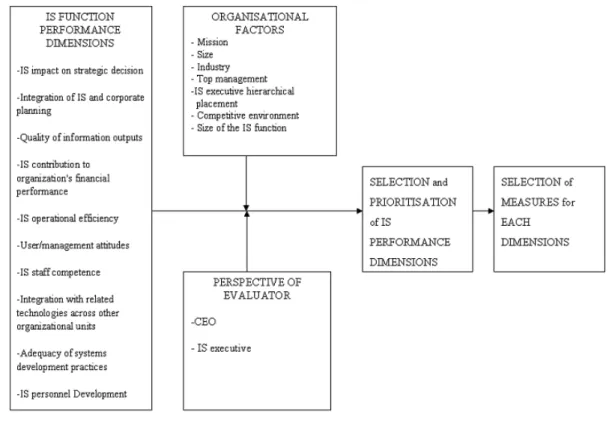
2.2 IS function performance evaluation model by Saunders & Jones (1992). . . . 25
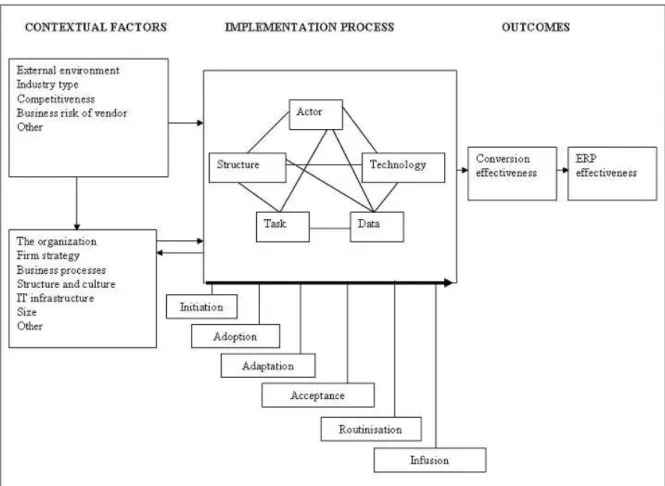
2.3 Somers et al. (2000) contextual framework . . . 27
4.1 Kenyan Map . . . 58
4.2 KenGen corporate objectives (KenGen Newsletter . . . 68
4.3 Power generation, transmission and distribution bodies in Kenya . . . 69
5.1 Preliminary ERP implementation conceptual model . . . 77
5.2 Sample Excerpt from Nvivo software . . . 81
5.3 KenGen Wide Area Network (Source: Project Document) . . . 107
5.4 ERP system availability and speed at KenGen . . . 108
6.1 Empirical ERP Implementation Model(EEIM) . . . 119
6.2 Model of the upgrade decision process . . . 127
B.1 The adapted measurement development paradigm . . . 231
B.2 Frequency distribution graph of ERP solutions implemented . . . 234
F.1 ERP Implementation Model . . . 271
F.2 Model of the upgrade decision process . . . 273
List of Tables
2.1 Drivers for Adopting ERP systems . . . 16
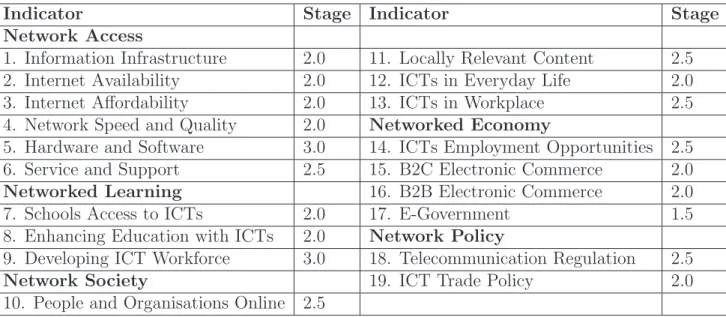
4.1 E-readiness Assessment in Kenya (Source: bridges.org) . . . 60
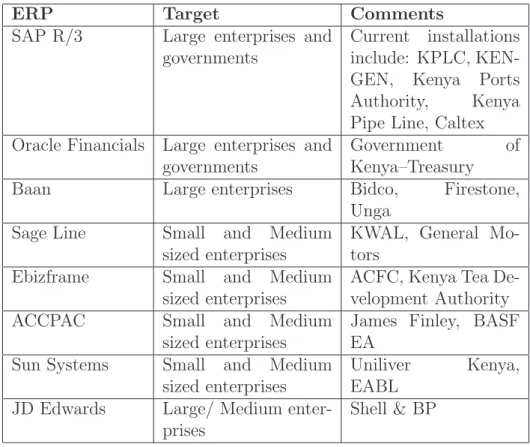
4.2 ERP Installations in the Kenyan Market (source: symphony consulting) . . . 64
5.1 Summary of Pilot Study Findings . . . 73
5.2 Summary of five case organisations . . . 78
5.3 Summary of data collection, techniques and sources from case studies . . . . 79
5.4 Sample identification of concepts . . . 82
5.5 Categories, properties and dimensions derived from data analysis . . . 83
5.6 Business factors influencing upgrade strategies and schedules . . . 113
5.7 Results of factor analysis . . . 117
B.1 Summary of response rate . . . 233
B.2 Summary responses for motivational factors . . . 235
B.3 Degree of customisation . . . 236
B.4 Module Customisation . . . 237
B.5 ERP Module Adoption Rates . . . 238
B.6 Summary responses for package adoption . . . 239
B.7 Summary of responses for package implementation . . . 239
B.8 Implementation strategies . . . 240
B.9 Summary responses for performance measures . . . 241
B.10 Summary responses for areas benefiting in percentage . . . 242
B.11 Results of factor analysis . . . 249
Chapter 1
Introduction
This chapter presents an overview of this research. The presentation will thereafter be followed by a problem discussion that will lead to the formulation of the statement of purpose, research questions, objectives, and rationale of the study. In summary, this chapter discusses the purpose, importance, timeliness, and relevance of this research study to information systems research, and in particular to ERP implementation in developing countries with Kenya as a case study.
1.1
Research Background and Problem
Lured by guarantees of improved business productivity, streamlined business operations, and increased cost savings (Tilley et al., 2007), organisations worldwide have launched initiatives to integrate ERP systems into their existing business environments. There has been a grow-ing increase in usgrow-ing Enterprise Resource Planngrow-ing (ERP) systems developed by, for example, SAP, Oracle, BaaN, PeopleSoft and JD Edwards as a business information system platform for large organisations and government corporations in developed countries such as USA, UK, Canada, and Australia (Davenport, 1998). Kumar & Hillegersberg (2000) state that:
ERP systems have now been adopted by the majority of the Fortune top 500 firms, and as the high end of the market becomes saturated, ERP systems are filtering down to medium-sized organizations, and to regions beyond those initially penetrated in Europe and North America.
While there is wide adoption of ERP systems in Europe and North America, developing countries lag far behind (Huang & Palvia, 2001; Huang et al., 2004). However, due to eco-nomic growth, developing countries such as Kenya are becoming major targets for ERP
vendors (O’Kane, 2002; Davison, 2002; Huang et al., 2004). In some developing countries, for example Kenya, a number of large and mid-sized organisations have implemented ERP solutions and more are expected to follow suit. The majority of adopting organisations that joined the ‘ERP bandwagon’ (Kraemers & Dissel, 2000) presumed that with relative ease they can benefit from the alleged ‘best business practices’ that are embedded within ERP systems.
However, the transfer of information systems like ERP – typically developed in developed countries – to developing countries is often marred by problems of mismatch with local, cul-tural, economic and regulatory requirements. For instance, (Huang & Palvia, 2001, page 276) state that:
Meanwhile, ERP is beginning to appear in many organisations of developing countries. Little research has been conducted to compare the implementation practices of ERP in developed vs developing countries. . . ERP technology faces additional challenges in developing countries related to economic, cultural, and basic infrastructure issues.
Gargeya & Brady (2005) state that studies, mostly conducted in developed countries, show that organisations often run into costly and sometimes fatal difficulties with implementation and subsequent maintenance of ERP systems. For example, Akkermans & van Helden (2002) and Monk & Wagner (2006) observe that a typical ERP implementation initiative takes anywhere between one and three years and typical budgets are in tens to hundreds of millions of dollars.
Popular press and trade journals have documented both successes (Johnston, 2002), and failures (Voordijik et al., 2005; Kimet al., 2005; Alshawi et al., 2004; Sia & Soh, 2002) but with very little explanation on the underlying causes. Poba-Nzaou et al. (2008) estimate the failure rate of ERP implementations in developed countries to be between 66% and 70%. Since the trade press is now replete with articles on ERP failures in Europe and North America where most these systems originate from, we agree with the Huang & Palvia (2001) argument that ERP implementation is likely to be more problematic in less developed countries like Kenya, given that “ERP technology faces additional challenges in developing countries related to economic, cultural, and basic infrastructure issues”.
In Kenya, the state-owned Uchumi supermarket chain closed down in June 2006 after ad-mitting it was insolvent — throwing more than 1,000 employees out of work and leaving debts of hundreds of millions of Kenyan shillings (Vardan, n.d.). The over-ambitious expan-sion strategy and the poor installation of the ERP system were cited by experts as some
of the reasons which contributed to insolvency, especially since they were financed out of working capital which resulted in tying up the much needed financial resources to pay off suppliers, employees and other trade creditors. Analysts further argued that the ERP system was poorly integrated and implemented, staff were poorly trained, and costs were unjusti-fiable. The Uchumi supermarket experience is an example that there is an urgent need for understanding ERP implementation practices in less developed countries, and in Kenya in particular, because these systems are still in their early stages in these countries and face economic, cultural and infrastructure challenges. The adoption and use of ERP in Kenya raises a unique question for less developed countries within Sub-Saharan Africa that has not been addressed in previous studies, i.e. the challenges faced by user and vendor organisations during ERP implementation and the contextual factors (national and organisational) that influence ERP adoption, implementation, and use. This research will, therefore, explore ERP implementation and upgrade practices among the private and public sector organisations in Kenya.
The difficulty in ERP implementation in developed countries may be exacerbated by the claim that ERP embodies established ways of doing business thereby requiring organisations adopting ERP systems to change their business processes to conform to business practices inbuilt in ERP packages. Vendors argue that the adoption of these best practices makes the configuring of the software less costly and brings about improvement in the organisation’s processes. Consequently, organisations and their members often experience pressure to adopt these practices (Gosain, 2004).
ERP systems are developed by vendors who draw on their existing sources of knowledge, resources and norms. These would include the developer organisation’s own business strat-egy and prevailing norms about what constitutes best practice. In general, the ‘spirit’ of ERP packages reflects beliefs about the value of having a single enterprise-wide system, and hence tend to have features that are aligned with cross-functional process integration and enterprise-wide data sharing (Markus & Tanis, 2000; Soh & Sia, 2004b).
Soh & Sia (2004b) further argue that developers, while modeling likely organisational re-quirements in order to design the system, usually draw on the network of organisations to which they have access. These ‘referent’ organisations are usually those from their home market and other markets in which they have a major presence. Such markets are likely to be defined by national and industry boundaries. The structures embedded in the resultant package will therefore reflect the context of the group of companies that the developers in-teracted with most closely during the design and development of the software. As a result, organisations adopting ERP systems may find the assumptions embodied by these systems
about the nature of organisations and the ways in which they operate run counter to their own existing structures and work practices. Soh et al. (2000), for instance, observed mis-alignments between ERP packages and organisational structures expressed in formal rules, procedures, and cultural norms in their study which was conducted in Singapore. They stated that:
Our findings suggest the “misfit” issue (gaps between the functionality offered by the package and that required by the adopting organisation) may be worse in Asia because the business models underlying most ERP packages reflect European or U.S. industry practices. Procedures in Asian organisations are likely to be different having evolved in a different cultural, economic and regulatory context. Given that Sub-Saharan Africa cultural contexts embody organisational practices different from those encountered in North America and Europe where most of ERP systems are developed, as discussed in Section 2.4.4.3, there can be significant problems associated with the reengineering of local practices and processes. Furthermore, ERP being capital intensive, is likely to be faced with constrained IT budgets (Heeks & Kenny, 2002) due to poor economic performance in this region. Cultural conflicts escalate implementation cost, and can lead to long implementation period as organisations spend more time and resources in resolving cultural conflicts. This becomes a two fold problem: companies lack the financial resources to gain access to tailored world-class ERP systems; and ERP companies are not prepared to deal effectively with the customisation processes that these markets require. In many cases, the basic infrastructure for supporting ERP may be lacking or insufficient to enable organisations to reap optimum benefits from ERP investments. ERP implementation and usage also require specialised skills which may not be sufficiently available in developing countries.
The arguments above suggest that there is often a gap between the system and specific con-texts, practices and requirements of particular user organisations. We can conclude that the underlying business models in-built in ERP have implicit contextual biases such as country (for example, European or American practices), sector (for example, private sector), indus-try (for example, manufacturing), and even biases in organisational practices (for example, process-oriented workflow). On this note, we argue that where contextual difference between the ERP package vendor and the adopting organisation exist, it is important to explicitly consider the difference and how it may influence the adoption and subsequently the use of the ERP package. Therefore, this research will seek evidence on how the organisational context influences ERP systems implementation and upgrade and how the organisational context is affected by the implementation and and use of ERP system using Kenya as a case study.
In spite of all the benefits, implementing ERP can be a risky undertaking (Poba-Nzaou et al., 2008). Ward et al.(2005) observe that due to the behaviourial and management related chal-lenges in the implementation process many ERP projects have been terminated. Arif et al. (2005) and Alshawiet al. (2004) assert it is imperative for organisations to be aware of the challenges and the experiences of others, and to learn from their challenges and practices, because of the complex and integrated nature of ERP, and the large investment involved. Identifying challenges relevant to local companies is one way to increase the chances of a suc-cessful local ERP implementation (Otieno, 2008; Leopoldo & Otieno, 2005). Therefore, this research will aim to identify challenges faced by Kenyan organisations during ERP systems implementation.
Only one study Ng (2001) details the difference between technical and functional upgrades. The absence of information about ERP upgrades is somewhat surprising given the general consent that upgrading is essential for companies to survive and compete (Fourney, 2007). As software vendors enhance their products to respond to anticipated business needs, they release upgrades with more features and better performance. Although performance im-provements are not necessarily anticipated in an upgrade, it is reasonable to expect or-ganisations to upgrade ERP systems for the purpose of achieving benefits such as greater efficiency and improved functionality that the current ERP system may be lacking (Paine, 2000; Beatty & Williams, 2006b). To the user of ERP systems, deciding whether and when to upgrade from the current version requires an ongoing process of evaluation.
One of the most neglected issues related to ERP systems is the decision to upgrade from one version to another. Although practical guidance to upgrade decisions have begun to appear in the literature (e.g. Beatty & Williams (2006a)), most studies of ERP have focused on initial adoption, and empirical research on ERP upgrade practices and decisions has been limited both in developed and developing countries. Ng (2001) found that maintenance and upgrades were adopted to realise increased business benefits and that cost was a major con-cern in those decisions. Although valuable, Ng’s study combined maintenance and upgrade decisions together making it difficult to understand the upgrade decision process indepen-dently. Therefore, this research will investigate ERP upgrade practices and decision-making process among Kenyan organisations.
Based on the suggestions of Friedland & Alford (1991) this research adheres to the need to study organisation as located in their societal contexts and information systems in their organisational setting. Therefore, in general this research investigates the organisational and national context within which ERP is adopted and used in Kenya, and how the context and ERP influence each other. ERP systems with in-built business practices express the
tendency toward standardisation. This research seek to contribute to the controversial issue on the conflict between standardization and localisation of business practices.
1.2
Aims, Objectives and Research Questions
Literature reviewed in Chapter 2 highlights issues that warrant further consideration with respect to the relevance of best practices embedded in ERP systems, their implementation and use in different organisational contexts. This research seeks to contribute to the debate on ERP implementation and upgrade in the context of a less developed country, Kenya. The research aims are stated as:
1. to explore ERP implementation and upgrade decision-making processes among private and public sector organisations in Kenya;
2. to identify challenges faced by Kenyan organisations during ERP implementation; 3. to propose suitable solutions within specific organisational and national contexts. Against the backdrop of these aims are the following main objectives of this study:
1. to identify contextual factors (organisational and national) that influence ERP systems implementation and upgrade decisions in Kenya;
2. to identify challenges faced by vendors and organisations implementing ERP systems in Kenya;
3. to establish whether there are differences in ERP implementation practices between public and private organisations in Kenya;
4. to propose suitable solutions (contextually) in order to maximise the likelihood of success of future ERP implementations and upgrades
In achieving these objectives the research attempts to answer the main research question: What organisational and national factors affect ERP implementation in Kenya? This research question can be refined thus:
2. Do organisations that have adopted ERP systems in Kenya encounter challenges in the process of implementing them?
3. What factors influence ERP systems upgrade decisions?
4. Is there a difference between ERP implementation practices among public and private organisations in Kenya?
1.3
Research Rationale
A number of arguments justify the importance of this study. First, despite the promises and the continued popularity of ERP Systems, evidence is accumulating to demonstrate that obtaining benefits from an ERP is not as straightforward as those selling and promoting such systems would like us to believe (Boersma & Kingma, 2005).
Second, although a number of challenges of ERP systems adoption and use have been iden-tified, they are mainly experiences of companies in the developed countries. There is very limited empirical research on ERP implementation focused on developed countries. We presume that the cultural problems in developed countries especially in Europe and North America seem to be marginal and managerial approaches tend to be largely similar, which makes adaptation of ERP software relatively easy. Despite these still many failures have been reported. There is no study, in researcher’s knowledge that has been carried out in Sub-Saharan Africa (SSA). Therefore, researchers in the field of Information Systems may be interested in reviewing the findings of this project given the lack of literature covering Sub-Saharan Africa and more so those based in Kenya.
Third, it is arguable that most ERP implementation frameworks and models reported in IS journals are based on ERP studies carried out in developed countries like United States of America, European countries, and Australia. The political, social, and economic unique-ness that SSA presents, Kenyan context being the case study in this thesis, could provide researchers with fertile ground for fresh extensions of existing theoretical paradigms and sometimes development of entirely new and different research frameworks.
Fourth, upgrade of ERP systems appear to be inevitable for several reasons. ERP software vendors typically establish ‘sunset dates’, after which vendors discontinue support for current versions. Thus, organisations that require vendor support are pressured to upgrade before the vendor’s sunset date. Although an organisation may choose to operate unsupported software, ERP products eventually become incompatible with other software or require new functionality. Unless organisations develop their own software or buy new software, their
only option becomes upgrading to a new, vendor-supported version. However, organisations do not need to upgrade to every new version of software because vendors typically support multiple versions at the same time. Thus, choices must be made which, make it important to study how organisations decide to migrate to the next version of ERP software and how the upgrade is carried out.
Lastly, there is a need to investigate the relevance of best practices in the context of devel-oping countries. Soh & Sia (2004b) state that ERP systems reflect Western ways of doing business. Based on the above discussion it can be argued that foreign developers of ERP systems usually make choices of what they personally consider relevant business practices. Their views are focused through their intentions and experiences. In other words, ERP de-velopers understand and model the environment as they perceive it through their personal culture-bound perspective which often do not coincide with the view of the local users.
1.4
Scope and context of the study
According to Creswell (2003) ‘delimitation’ is a parameter defining the “boundaries, excep-tions, reservations” in a research, and its inclusion and position in a research proposal or write up varies from one situation to another.The delimitation defines the limit or scope of the research. To research into the entire ERP topic, will not only mean researching into a wide range of issues and assumptions but also researching into every aspect of ERP imple-mentation, especially when viewed from the point of the existing large amount of literature. Therefore, this section is aimed limiting scope and context of this research to in order to make it manageable.
This dissertation is defined by the following boundaries and considerations:
• This study concentrates on both private and public organisations in Kenya. The rea-son for inclusion of private organisations is that adoption of ERP systems is more widespread in private organisations than in public sector organisations in Kenya. Ad-ditionally, the few studies available on ERP adoption in the literature were conducted in public sector organisations (Gable et al., 2003; Sedera & Gable, 2004). Thus by looking at private firms, the study will add to the body of knowledge in the area where it is still lacking. Public sector organisations on the other hand were included in order to allow comparison to be conducted on ERP implementation practices between pri-vate and public organisations. Moreover, the operational environments of the public and private sectors differ considerably (Mansour & Watson, 1980; Khandelwal, 2001) and findings from one may provide insights into the other.
• This study discusses ERP systems at a generic level by concentrating on its basic func-tionality rather than distinguishing between top brands and mid-market ERP products. Empirical evidence exists suggesting that, in some respects the benefits of ERP may be comparable even when systems types differ (Mabert et al., 2003; Laukkanenet al., 2005). ERP systems classified as top brands have been noted to differ to the extent that each might offer different capabilities (Shang & Seddon, 2002); the same is true for mid-market products (Fisher et al., 2004). The foregoing explains the choice of this research to include a variety of ERP systems rather than select only a specific type of ERP. Moreover, in some respect, the inclusion of wide-ranging ERP systems in a particular study may permit the generalisability of results from such a study, for the software.
• This study incorporates both large, medium and small size organisations.
• All the ERP implementation life-cycle phases are studied in this research. This is due to the fact that research area and ERP technology is subject to dynamic change. Or-ganisations after going live with ERP usually embark on actions aimed at achieving the full capabilities and benefits of ERP-enabled processes. The organisational context is also in a state of continuous change in a bid to adapt to the ever changing environ-mental context such as entry of new competitors, new government regulations, etc. A ‘snapshot’ view of these events could not capture the sweeping changes taking place and the influence they had on case study organisations hence the decision to study all the implementation life-cycle phases.
• Context as used in this dissertation is limited to the three aspects of an organisation’s context which previous studies by Tornatzky & Fleischer (1990) and Rogers (1983) re-port to influence the process by which organisations adopt, implement, and use techno-logical innovations: (a) Technotechno-logical context describes both the existing technologies in use and new technologies relevant to the firm, (b) Organisational context refers to descriptive measures about organisation such as scope, size, and the amount of slack resources available internally, (c) Environment context is the arena in which a firm conducts it business–its industry, competitors, and dealings with the government. The choice of the three contexts is consistent with the innovation diffusion theory which emphasises technological characteristics, and both the internal and external character-istics of an organisation, as drivers for technology diffusion.
1.5
Expected Contribution to Knowledge
The research aims to make contribution towards the promotion of contextually/culturally valid ERP implementation model. While investigating the limitation of current implemen-tation models with regard to contextual issues, this research aims to enhance effectiveness of these models. Through merging theory and empirical data from the field study organisa-tions, the research seeks to refine the existing models by proposing context sensitive model. The research also aims to make a novel contribution by developing an ERP upgrade decision model which will provide insight on why and when organisations choose to upgrade their ERP systems.
By reviewing literature on culture, and drawing insights into the core dimensions of culture and exploring the theoretical frameworks for understanding culture forms, the study con-tributes to ERP practice by identifying what organisational factors to look for when initiating ERP implementation and subsequent culture change – how individuals, ERP implementation and organisational change are linked. The findings of the study can help the management of corporations to better support the deployment of ERP in their organizations.
The findings of this research are expected to contribute towards ERP implementation prac-tice. The findings of this research are expected to be of importance to various stakeholders. For example, Vendors who contemplate entering foreign markets can use the proposed models to better understand global ERP markets and develop better strategy. ERP implementers can also recognise the environmental and internal requirements and prepare accordingly. Given the complexity and integrated nature of ERP and large investment involved it is im-perative for organisations to study the experiences of others, and learn from their practices and success factors (Umble et al., 2003; Leopoldo & Otieno, 2005). In this light, organisa-tions planning to implement ERP in Kenya can learn from the successes and failures of the case study organisations and therefore, avoid pitfalls which can lead to ERP project fail-ures. Based on the findings of this research, we intend to come up with a set of systematic steps (implementation guideline) and a methodology for helping managers, implementers and organisations adapt to the demands of the environment.
The research also presents avenues for continuing theoretical and empirical research investi-gations in the field of IS, in particular ERP. By identifying the impact of local context on IS, the research intends to create a better understanding of the limitation technologically deterministic approaches that little account of local conditions and high risks of strategies involved.
of ERP adoption, implementation and upgrade in diverse cultural and contextual setting, based on a Kenyan case study.
1.6
Thesis Structure
In this introductory chapter, the impetus to understand the background and motivations towards the undertaking was highlighted, presenting the reader with the research questions, study design and potential contributions from the study. By providing a background to the overall context of the study, the motivations and rationale for the study are put forth. Chapter 2 presents a review of the relevant background literature. We highlight the devel-opment of the research model (that guides the discourse) as well as present the research questions and hypotheses. The inter-relations between the subject areas, related studies and their implications for the study are discussed.
In Chapter 3, the research methodology is presented. The methodology used in the study’s context is the multi-paradigm approach, using a combination of techniques including survey, content analysis and multiple case study. Our research design recognises that understandings gained through interpretivist analysis might provide a basis for developing propositions. The Lee (1991) framework is used which integrates qualitative and quantitative research approaches.
In Chapter 4 of the national context where the case studies were drawn. The chapter also provides background information of the five case study organisations.
Chapter 5 presents the results of qualitative data analysis. The preliminary ERP implemen-tation model is presented and used as basis of coding.
Chapter 6 presents and discusses the Extended ERP Implementation Model (EEIM) and Upgrade Decision Model (UDM) derived from qualitative and quantitative data analyses. The models’ constructs and dimensions are defined followed by discussion of their interrela-tions. Finally, the models are verified to ascertain their validity. The chapter also presents the results of validation of the two the models.
In Chapter 7, the findings of the study are summarised. The detailed discussion reflecting on the main findings reported in Chapter 5 is presented. Finally, the chapter concludes the thesis by discussing the research’s contribution to the body of knowledge in research, practice and the methodological perspectives, its limitations and directions for future research. Other relevant details not included in the body of the thesis are kept in the appendices.
Chapter 2
Literature Review
2.1
Introduction
This chapter reviews the academic and practitioners literature published on Enterprise Re-source Planning (ERP) systems relevant to the focus of this research. Easterby-Smith et al. (1991) notes that it is important for researchers to familiarise themselves with existing re-search prior to collecting their own data . An appreciation of previous work relevant to this research served three further purposes. First, through providing direction in the construction of data collection instruments, it guarded against the risk of overload at the primary data collection stages of the project. Second, working the findings from extent literature into a formal review helped maintain throughout the study a sense of the topic’s perspective. Finally, this activity raised opportunities for articulating a critical analysis of the actual “meaning” of the data collected when the data analysis stages of the research were reached.
As discussed in Chapter 1, the focal point of this study is the influence of context on ERP implementation, spanning all the ERP life-cycle phases. This research broadly classifies current ERP literature in terms of its contribution to understanding the nature of ERP implementation project initiatives. This approach provides a base in which to situate this study. The chapter begins by defining ERP and elaborating how ‘best practices’ embedded in ERP systems lead to organisation restructuring and the likely consequences in the following sections.
2.2
What is ERP?
Klaus et al. (2000) and Al-Mashari et al. (2003) assert that ERP systems are not easy to define, more so if the stakeholders’ points of view are to be taken seriously. Their assertion
is supported by Boersma & Kingma (2005) who argue that there is no universally accepted definition of ERP. Different stakeholders of ERP will, depending on their position in the or-ganisation, have quite different views of and experiences with ERP (Markus & Tanis, 2000). Therefore, individuals or group definitions vary according to their “awareness context”. However, Deloitte Consulting ERP Second Wave report published in 1998 provides a useful starting point. According to Deloitte (1998), an ERP system is a packaged business software system that allows a company to:
• automate and integrate the majority of its business processes,
• share common data and practices across the entire enterprise, and
• produce and access information in a real-time environment
Davenport (1998) defines an ERP system as “a packaged software product that can be bought ‘off-the-shelf’ by an organisation in order to integrate and share its information and related business processes within and across functional areas”. His definition emphasises the integration, laid by ERP, between various organisational networks, in particular functional divisions within organisations like finance, marketing, procurement, inventory, sales and distribution, human resources planning and payroll while downplaying the implicit side of the ERP systems, for example business processes embedded in the ERP. Shehab et al.(2004) supports Davenport’s perspective that over-emphasises integration aspect of ERP systems by asserting that ERP is more than a software package that seeks to integrate functional departments within an organisation. This perspective is popular with most scholars and researchers who generally consider and define ERP on the basis of its capacity to integrate formerly segregated IT systems.
The second perspective which is fundamental for conceptualising ERP systems in this re-search, is related to best practices embedded in ERP systems. Umbleet al.(2003) articulated this less known or, if known, less talked about perspective of ERP systems by asserting that:
. . . buying an ERP package means much more than purchasing software, it means buying into the software vendor’s view of best practices for many of com-pany’s processes.
ERP systems embody best practices which are supposedly established ways of doing business (Soh et al., 2000; Soh & Sia, 2004a; Boersma & Kingma, 2005; Arif et al., 2005). These ‘best practices’ represent the underlying assumptions and beliefs embedded in the operation of ERP software by the vendors. Akrich (1992) in (Boersma & Kingma, 2005) purports that
best practices embedded in ERP, contain ‘script’ for users, informing them about what actions should be undertaken, when, where, and how. Therefore, it is arguable that ERP is not just a software package to be tailored to an organisation but an organisation business blue-print that affects how people work by “imposing its own logic on a company’s strategy, organisation, and culture” (Davenport, 1998; Lee & Lee, 2002).
An ERP system gives instructions at the workplace about how to organise activities vis-`a-vis co-workers, management and other elements in the business cycle. It may be perceived to operate in a similar to self-evident way as roads in the traffic system do, guiding drivers towards their destinations. Unlike custom-built software that must be programmed in tra-ditional ways to meet local needs, ERP software is ‘generic’, targeting multiple industries, and should be configured to predefined business practices before it can be used. Therefore, a company that implements ERP must, for the most part, accept the vendor’s assumptions about the company and change the existing processes and procedures to conform to them. This notion of best practices has been backed by management consultants and ERP vendors. Technology, in this case ERP, is considered as a driver to organisational change. The ’best practices’ embedded in these packages are seen as a summary of best practices and standards of operations, but pays no attention to how local context affects the process of implementa-tion, the actual operation and use of the systems, and whether a package is compatible with the organisations’ values and way of doing things.
While ERP vendors try to structure the systems to reflect best practices, it is the vendor not the client, who is defining what ‘best’ means. It implies that there is an objective function against which the ‘best’ can be evaluated. Studies such as (Kosalge, 2005) have proved that there is no single best way of doing business and the context plays a major role in the way business is carried out. For example, SAP AG being a German company following German best practices, international differences can be critical in the successful implementation of their software(Wei et al., 2005). On the premise of the views expressed above, we also argue that‘best’ is relative and what is best in one organisation, industry, region or country may not apply to others.
ERP is also referred to in the IS literature as enterprise systems (ES) and less frequently as enterprise-wide systems. Davenport (2000) calls for the replacement of these terms with a more generic classification of ERP as ‘business systems’. He argues that the technology has developed to such an extent that it now includes front and back office functionality making it inappropriate to assign an ERP label which is reminiscent of its material requirements planning (MRP) heritage. Whilst we take Davenport’s point, we choose to employ the term ERP throughout the thesis as a reminder of the lineage of the technology in the
manufac-turing context. In other words, the use of the phrase ERP in this study is purposeful and is meant to conjure images of technology that is informed by a traditionally hierarchical view of organising where business functions are clearly delineated (Kumar & Hillegersberg, 2000).
The working definition of ERP system in this study is based on the three major characteristics associated with ERP systems identified in the above literature discussion. Therefore, an ERP system:
1. is a set of packaged application software modules, within an integrated architecture, that can be used by organisations as their primary engine for integrating data, pro-cesses, and information technology, in real time, across internal and external value chains;
2. impounds deep knowledge of business practices that vendors have accumulated from implementations in a wide range of client organisations, that can exert considerable influence on the design of processes within new client organisations;
3. is a generic ‘semi-finished’ product with tables and parameters that clients or organisa-tions and their implementation partners must configure, customise, and integrate with other computer-based information systems to meet their business needs.
2.3
Drivers for ERP
As Walsham (2002) states, the 1990s was a decade where companies were turning away from decentralised computing systems in favour of enterprise-wide initiatives for organisational transformation. He argues that company managers began situating their organisations within a global context and in turn they developed a sense of worldwide business solutions. This awareness was supported by international management consultancies whose revenues increase as approaches become more widespread and standardised. Walsham (2002) and Koch (2001) argued that these consultancies were the “driving force” behind both ERP adoption and its precursor, Business Process Re-engineering (BPR) which forms an integral part of most ERP implementations.
In the mid- and late- 1990s, Y2K compliance was a major concern for many companies as well as the wish to replace existing and poor quality systems. Management consultants were touting the global ERP software solutions available from the several vendors as a panacea to the Y2K potential nightmare. Business executives seeking expert advice about operating
in the new millennium were encouraged by management consultants and ERP vendors to replace outdated, home-grown systems with a single integrated solution.
Other major reasons reported in the literature as drivers for ERP adoption relate to: improv-ing firms’ performance and decision makimprov-ing, reducimprov-ing labour costs, bureaucracy and errors. Other reasons are: pressure from the side of the competitors, business partner requirements for faster service, integration between functional units, organisational standardization across different locations and globalisation of businesses. Acquisitions and mergers between the units are forcing companies to change and function as a single system. However, for each company the drivers for implementing ERP are different as well as their priority order de-pends is likely to be influenced by the organisation’s context – internal and external.
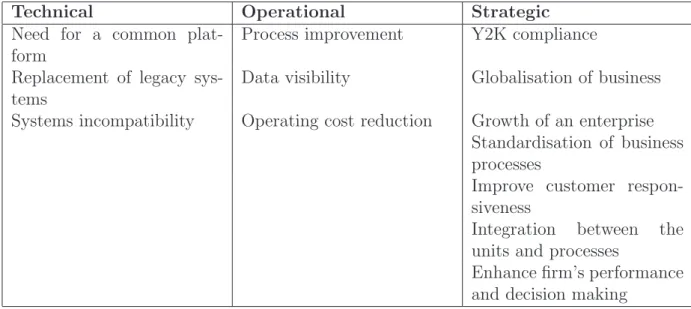
O’Leary (2004) grouped the ERP drivers into four categories: technology, business practices, strategy, and competitiveness. Holland et al.(1999) recognised three main dimensions: tech-nical, operational and strategic. Some studies such as Markus & Tanis (1999) narrow down the reasons even to broader groups: technological and business performance. Based on the literature review, the foremost reasons that have caused fast growth in the use of ERP systems are summarised in table 2.1.
Table 2.1: Drivers for Adopting ERP systems
Technical Operational Strategic
Need for a common plat-form
Process improvement Y2K compliance Replacement of legacy
sys-tems
Data visibility Globalisation of business Systems incompatibility Operating cost reduction Growth of an enterprise
Standardisation of business processes
Improve customer respon-siveness
Integration between the units and processes
Enhance firm’s performance and decision making
Olson (2004) summarises two studies, which have examined the motivations for ERP adop-tion. One study was carried out on U.S. manufacturing organisations and the other on Swedish firms. Organisations studied in both countries ranked the replacement of legacy systems, and the simplification and standardisation of their systems as their primary
rea-sons. Other reasons that received high ranking were the improvement of interactions with suppliers and customers, the gaining of strategic advantage, and the creation of supply-chain in order to link to global activities. Pressure to keep up with competitors, ease of upgrad-ing systems and restructurupgrad-ing organisation received low rankupgrad-ing from both of these studies. Given that there is increased ERP systems implementation in Kenya among large compa-nies and some mid-sized compacompa-nies are expected to follow suit. Hence, it is imperative to investigate the motivation towards the increased implementation trend.
2.4
ERP as a change process–Business Process
Re-engineering (BPR)
According to Revere (2004) and Light (2005a), a typical ERP implementation often involves some degree of business process re-engineering (BPR) and customisation. Arif et al. (2005) assert that if a company is not already conducting business in the manner assumed in the ERP software package they acquire, then the organisation must re-engineer its business processes and practices. Therefore, BPR can be considered as a key practice in ERP im-plementation. Keller & Teufel (1998) describe BPR as a pre-planning phase of ERP which can be done by either ERP software vendors and consultants or organisations’ own in-house team. ERP system analysts carefully examine the existing business procedures and practices in order to propose IS solutions that aimed at introducing radical changes to the business practices.
In BPR the goal is to replace the existing business processes with ones that are much more effective for both the customer and the organisation itself. Therefore, BPR can conceived as a technique for restructuring business operations to achieve improvements. However, the technique is not new. BPR has deep roots in, and was widely developed by, management consultancy companies in the 1990s. Improvement of business operations can also be achieved through TQM or process improvement, but with BPR the targeted improvements will be more significant and radical. Eardleyet al. (2008) state that the aim of TQM or process improvement approach is to streamline the process in the organisation’s value chain in order to add value incrementally.
Abdolvand et al. (2008) caution that inclusion of BPR in the implementation of ERP adds considerably to the risk of implementation failure and also expense of implementation. Prob-lems with BPR occur when the radical or “clean sheet” approach is adopted during ERP implementation. Problems with BPR is further supported by Attaran & Wood (1999) ar-gument that organisations may neither be willing to “obliterate” their present infrastructure
and to implement completely new one, nor be willing to interrupt their business while its core processes are re-engineered.
According to Eardley et al. (2008) introduction of ERP systems require organisations to re-think and redesign their processes to fit in with the ERP system. In this case, BPR is driven by IT and seeks to radically alter existing business practices. This IT-driven BPR view and other similar technocentric views of IT call for discarding existing practices and reconstitut-ing an organisation on the basis of completely fresh ideas. This view omits the role of human agents and the existing organisational and social contexts in the introduction of new tech-nologies (Sarker & Lee, 2002), assuming that organisations can be fully redesigned through new technology. There are two possible problems with this view. First, the redesigned pro-cess may be less than optimal in terms of propro-cess efficiency. Second, strategic misalignment may occur, as the new process may not contribute to the achievement of strategic business objectives. Reijers & Mansar (2005) argue that this in turn can lead to a full or partial “failure” of the BPR effort.
According to Abdolvand et al.(2008), better results can be realised if ERP is used as a BPR-enabler, and also as proactive tool for BPR. For organisations to use ERP as BPR-enabler the organisation IT strategy needs to be aligned with the business strategy so that there is no “technology gap”. ERP supported by the IT infrastructure then allows the business strategy to be enacted. In order to use ERP as proactive tool for BPR, the organisation IT strategy and business strategy need to be not only aligned but also interdependent. In the enabling role, the IT strategy supported the business strategy. In the proactive role, the IT strategy is a part of the business strategy. Therefore, it important for organisations implementing ERP to formulate clear vision of the type of organisation that needs to be built, then using ERP as an enabler of change to achieve that vision (Bjorn-Andersen et al., 1994).
2.5
ERP Implementation
ERP implementation is a complex and dynamic process, one that involves a mix of tech-nological and organisational interactions. According to Al-Mashari & Al-Mudimigh (2003) implementing ERP systems in many instances cause dramatic changes that need to be care-fully administered to reap the advantages of an ERP solution. In some well-documented cases, spectacular results have been achieved (Johnston, 2002). Failures, on the other hand, have been relatively high (Carlo, n.d.). Zhang et al. (2003) report that about 90% of ERP implementations are late or over budget while ERP systems success rate is only about 33%. Our deduction based on the literature review is that this trend has not changed significantly.
In addition, failures are much less extensively documented. As a result the pitfalls to be avoided tend to be less well known. It is aimed that the findings of this research will help in improving ERP implementation success in Kenya and other Sub-Saharan countries.
As Esteves & Pastor (2001) note, the implementation phase of the ERP lifecycle is currently the most widely researched in the IS discipline. They associate this focus with the difficul-ties of ERP implementations. Esteves & Pastor (2001) subdivide the ERP implementation literature into four topics relating to implementation: case studies, success, approaches, and other issues. Whilst the number of case studies on ERP might be higher than the other three topic areas, we argue that the focal point of these case studies varies.
We reclassify the ERP literature in terms of main project foci: implementation strategies; implementation models; ERP system upgrade, implementation challenges, critical success factors (CSFs); and trend and future of ERP systems. These are discussed in the following subsections.
2.5.1
ERP Implementation Strategies
The decisions taken during ERP implementation system are strategic in nature. These decisions relate to: the ERP system to be adopted, the scope of implementation, the imple-mentation strategy, the ‘go-live’ strategy, the training strategy, whether or not to upgrade and so on. The literature rarely consider this decisions to be strategic.
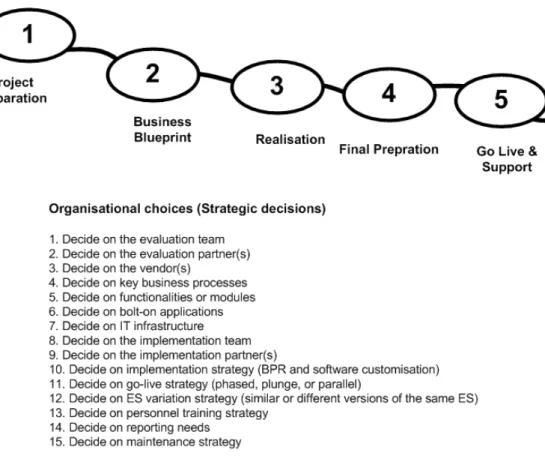
These decisions are strategic decisions in ERP because they: are normally adopted in organ-isations to support strategic objectives of organorgan-isations; commit a large amount of organisa-tional resources; have a long-term impact on shaping the ERP system and/or organisation processes; are complex because they spurn the entire organisation and involves different stakeholders (Lee & Myers, 2004). Figure 2.1 illustrates the ERP implementation phases and the organisational choices to be made by organisations implementing ERP systems. Project preparation phase of the implementation process consists of getting ready by plan-ning and organising people and tasks. It is a very important and critical stage of the ERP project since it constitutes the basis for the project. Among the decisions organisations have to make are decision on the ERP product, decision on functionalities or modules, decision on the implementation consultant etc. Blueprint phase comprises a detailed analysis that will allow the production of documentation on the business process requirements. In addition, blueprint phase consists of analysing the current business processes and investigating the chances for BPR or customisation. During blueprint phase, organisations need to decide on whether to customise the ERP system or re-enginer the existing business processes. Real-isation phase deals with the technical aspect and involves building up a system prototype
based on the processes and procedures investigated in the former stage. Final preparation phase is critical to the success of the implementation project and involves conducting a set of tuning and testing activities related to the configuration, integration, quality, interfaces and reports of the system. Moreover, this phase is concerned with the education and training of the users on the system processes, data discipline and modules. Therefore, organisations must make a decision on personnel training strategy. Lastly, go live and support phase deals with the maintenance and improvement issues to keep the implemented ERP system running and up to date. The Go Live phase includes also the monitoring of the implemented system in order to make sure to make the necessary changes and modifications if problems are to occur and that could affect the performance of the ERP. During this phase, organisations make decision on : go live strategy, maintenance strategy, and bolt-on applications. Figure 2.1 provides a pictorial representation of the ERP life-cycle phases and the implementation decisions organisations are required to make based on the researcher’s conception.
Figure 2.1: ERP implementation phases and organisational choices
The fundamental decisions regarding physical scope, BPR scope, technical scope, resource allocation and implementation strategy to be used to implement ERP system is based on such aspects as organisation size, complexity and structure, available resources, attitude towards change among many other organisational characteristics. Each implementation is unique
because different organisations will make different decisions based on their contextual factors. The decisions taken by the ERP implementation project teams significantly influence ERP implementation outcome. Therefore, organisations intending to implement ERP systems need to be aware of the trade-offs involved in making these important decisions in order to minimise the risk of failure and to optimise their ERP implementation. For illustration purpose, we discuss three main ERP strategies that can have profound influence on ERP implementation outcome: enterprise suite vs. best of breed, configuration vs. customisation, and Big-bang vs. phased approach.
Organisations implementing ERP system must decide whether to purchase all the ERP modules from a single vendor or to select ERP modules from different vendors based on their particular needs. These two strategies are referred to as enterprise suite and best of breed respectively. Light (2005a) states that both of these strategies are undoubtedly complex due to their scale, scope and BPR requirements. While highlighting Light (2005a), Mabert et al. (2001a) and Mabert et al. (2003) postulate that multi-vendor solution can provide the best functionality for each module, but implementing it becomes more complex because of the interfaces that need to be established. A single vendor solution on the other hand may not have all the functionality required, but will be easier to implement.
Similarly, organisations implementing ERP system must decide to either adopt business pro-cesses embedded in ERP or to customise the ERP system to make it fit with the existing business processes. The former is referred to as configuration while the later is referred to as customisation. According to Krumbholz & Maiden (2000),‘misfits’ resulting from differ-ences between system requirements and business requirements normally occurs during ERP implementation due to contextual differences between the package and the implementing organisation, requiring it to either configure or customise their system in order to resolve the ‘misfits’.
Grabski & Leech (2007) and Shehabet al. (2004) state that configuration known as ‘Vanilla approach’ can take the form of conscious redesigning of organisational processes and struc-tures to accommodate the functionality of the ERP system accompanied by substantial change management, to more piecemeal, evolutionary workarounds as individuals adapt to the package and their practices become part of the new organisational structure. This means deep changes in long-established ways of doing business (that may provide competitive ad-vantage) and a shake up of important peoples’ roles and responsibilities (Grant et al., 2006; Dewett & Jones, 2001; Koch, 2001). Based on this we argue that organisational setting can facilitate or hamper adaptation to the working principles of an ERP system.
the embedded structures in ERP represent best practice, and that customisation will make future upgrades more difficult. Management concerned about the cost and risks associated with customisation, may also support the adoption of package structures with minimal cus-tomisation. It tends to assume the persistence of current organisational structures within the organisation that have evolved over time (Grant et al., 2006; Soh & Sia, 2004a; Sheu et al., 2003). However, the researcher’s own experience and supported by Light (2005a),Light (2005b), and Wagneret al. (2006) indicate that a completely ‘Vanilla’ implementation is often not feasible.
Nicolaou (2004) describes customisation as the changing of the software to fit the already existing business processes in order to cater for organisation-specific and/or country-specific requirements. In the context of ERP implementation, package modification can range from customising the package code, to interfacing with custom developed modules of other ven-dors. Many researchers report that (Light, 2005a; Nicolaou, 2004; Nadhakumar et al., 2005; Koch et al., 1999) customisation slows down the project, introduces dangerous bugs into the system and makes upgrading the software to the ERP vendor’s next release excruciatingly difficult, because the customisations will need to be torn apart and rewritten to fit with the new version. Conversely, it implies less organisational changes, because it does not re-quire dramatical change in the organisation’s best practices (thereby retaining competitive advantage), and the way people work.
Whereas literature on ERP argue that ERP customisation is not rational, it is increas-ingly clear, as illustrated by authors such as (Arif et al., 2005; Sohet al., 2000; Soh & Sia, 2004a; Huang & Palvia, 2001; Hong & Kim, 2002) that successful implementation does not necessarily mean to adopt standard processes, but requires focusing on the improvements which give competitive advantage to the company. This point is emphasised by Soh & Sia (2004a) who found out that the reasons for customisation may concern the absence of a required functionality in the standard system and also lack of consistence of a standard pro-cess with organisational decision making. Therefore, a typical ERP implementation usually involves a mix of organisation and software customisations (Light, 2005a; Ward et al., 2005; Umble et al., 2003; Shehabet al., 2004; Al-Mashari & Al-Mudimigh, 2003).
Therefore, the decision an organisation may take in response to each ‘misfit’ is the result of a process of interaction and negotiation among various parties including management, users, IS personnel, and consultants. The nature of ‘misfit’ exerts a strong influence on whether the package structures would be more likely to prevail (i.e. the organisation would adapt the package), or the organisation structures would be more likely to prevail (i.e. the package would be customised via addition of supplementary modules or modification of package code).
Once installed, organisations are required to decide on big-bang or phased-in (modular) as a‘go-live’ strategy. The big-bang implementation approach refers to a scenario where the old system is discarded and all modules of the new system are introduced into each business unit over a weekend (Nicolaou, 2004; Motwani et al., 2002; Shehab et al., 2004). Although the big-bang approach presents a number of advantages, as it does not require parallel running of legacy and ERP software, it requires peak resource utilisation in a short period of time with lower resources available to address problems for particular modules, thus increasing the risk of total system failure (O’Leary, 2000).
The modular implementation approach on the other hand refers to a scenario where one module is implemented, and then it is run in parallel with the legacy system until the output results are satisfactory (i.e. reports and data). Although this approach presents a minimal risk of failure, it leads to increased costs of ERP. It is imperative that organisations planning to implement ERP need be aware of inherent trade-offs in different competing strategies so that they can make informed decisions and boost their implementation outcome.
2.5.2
ERP Implementation Models
Implementing an ERP system is generally an extensive challenge, with a typical ERP imple-mentation taking between one and five years (Poston & Grabski, 2001; Robey & Ross, 2002). In addition, the performance of the firm will get worse before it gets better and firms are expected to counter the staff resistance throughout the stages of ERP implementation (Ross, 1999). Several researchers have developed different models for ERP implementations. For instance, Ross (1999) proposed a five-stage model for ERP: implementation, stabilisation, continuous improvement and transformation.
Markus & Tanis (1999) suggested a model named enterprise system experience cycle, which has four phases: charter, project, shakedown and onward and upward. In 2000, Parr and Shanks developed a Process Phase Model (PPM) for ERP implementation, which is an extension of Ross (1999) and Markus & Tanis (1999) models, but integrating CSFs for each implementation stage. In the PPM, an ERP project is divided into three continuous phases: planning, project and enhancement (Shanks, 2000). In the project phase, it includes activities of set-up, re-engineering, design, configuration and testing, and installation.
The ERP implementation models mentioned above contain implicit assumptions with regard to the content, context, and nature of the change process. Like conventional IT implementa-tion models, they rely on linear, staged models which do not take into account the dynamic
interplay and reciprocal interaction between technology and the social process involving its use. Change is se