Learning Continuous Human-Robot
Interactions from Human-Human
Demonstrations
Von der Fakultät für Mathematik und Informatik
der Technischen Universität Bergakademie Freiberg
genehmigte
DISSERTATION
zur Erlangung des akademischen Grades
Doktor-Ingenieur
(Dr.-Ing.)
vorgelegt von
M.Sc. David Dominic Vogt
geboren am 10. August 1986 in Plauen
Gutachter: Prof. Dr.-Ing. habil. Bernhard Jung, Freiberg, Deutschland
Prof. Dr.-Ing. Heni Ben Amor, Tempe, USA
ii
Versicherung
Hiermit versichere ich, dass ich die vorliegende Arbeit ohne unzulässige Hilfe Dritter und ohne Benutzung anderer als der angegebenen Hilfsmittel angefertigt habe; die aus fremden Quellen direkt oder indirekt übernommenen Gedanken sind als solche kenntlich gemacht. Bei der Auswahl und Auswertung des Materials sowie bei der Herstellung des Manuskripts habe ich Unterstützungsleistungen von folgenden Personen erhalten:
Die Betreuer der vorliegenden Dissertation, Bernhard Jung und Heni Ben Amor, gaben Hinweise für die Überarbeitung früher Versionen des Manuskripts. Teile des dargestellten Materials entstanden im Rahmen von mir betreuter studentischer Quali-fizierungsarbeiten von Steve Grehl, Ben Lorenz und Simon Stepputtis.
Weitere Personen waren an der Abfassung der vorliegenden Arbeit nicht beteiligt. Die Hilfe eines Promotionsberaters habe ich nicht in Anspruch genommen. Keine Personen haben von mir geldwertige Leistungen für Arbeiten erhalten. Die Arbeit wurde bisher weder im Inland noch im Ausland in gleicher oder ähnlicher Form einer anderen Prüfungsbehörde vorgelegt.
iii
Acknowledgement
I would like to express my sincere gratitude to my advisers Prof. Jung and Prof. Ben Amor. Their extraordinary support, expert advice and continuous encouragement, guided me all the time and I could not have imaged having better mentors. In the end, their maddening attention to detail drove me to finally appreciate composition in graphics and appreciate color schemes.
I would also like to thank my colleagues and friends Erik Berger, Steve Grehl, Ben Lorenz and Simon Stepputtis for their wonderful collaboration. They supported me greatly and were always willing to try out new ideas in the lab. I am very thankful for all the stimulating discussions and our sleepless but productive nights before deadlines. Thanks to the financial support of the German Academic Exchange Service, I had the pleasure to work with colleagues and labmates from CIDSE at ASU. These times are very much appreciated.
This thesis would have been impossible without the support of my wonderful wife Doreen who had to renounce much for my research. Last but not least, I would like to thank my family: my parents, grand-parents, parents-in-law and kids for supporting me spiritually throughout writing this thesis and my life in general.
iv
Contents
Previous Publications vii
Nomenclature ix
Glossary of Terms xi
List of Figures xiii
List of Tables xv
1. Introduction to Interaction Learning 1
1.1. Robotic Co-Workers and Workplaces of the Future . . . 1
1.2. From Imitation Learning to Interaction Learning . . . 2
1.3. Interdependent, Concurrent and Cooperative Human-Robot Interaction 5 1.4. Problem Statement . . . 6
1.5. Contributions . . . 7
1.6. Overview Over the Main Chapters . . . 8
2. Related Work 10 2.1. Learning Human-Character Interactions . . . 10
2.1.1. Approaches based on Two-Person Demonstrations . . . 12
2.2. Learning Human-Robot Interactions . . . 13
2.2.1. Approaches based on Dynamic Movement Primitives (DMPs) . 13 2.2.2. Approaches based on Gaussian Mixture Models (GMMs) . . . . 14
2.2.3. Approaches based on Hidden Markov Models (HMMs) . . . 15
2.2.4. Approaches based on Interaction Meshes (IMs) . . . 17
2.2.5. Hybrid Approaches for Modeling Human-Robot Interaction . . . 18
2.2.6. Comparison of Methods . . . 20
2.3. Conclusion . . . 21
3. Mathematical Foundations 24 3.1. Motion Tracking and Representation of two-person Interactions . . . . 25
3.2. Dimensionality Reduction of Motion Capture Data . . . 26
3.2.1. Principal Component Analysis . . . 26
3.2.2. PCA and Motion Capture Data . . . 28
Contents v
3.3. Laplacian Mesh Editing and Interaction Meshes . . . 29
3.3.1. Laplacian Coordinates . . . 29
3.3.2. Laplacian Mesh Editing . . . 31
3.3.3. Interaction Meshes . . . 33
3.3.4. Further Reading . . . 36
3.4. Hidden Markov Models . . . 36
3.4.1. Introduction . . . 37
3.4.2. Three Problems Related to HMMs . . . 38
3.4.3. HMM Variants . . . 42
3.4.4. HMMs for Motion Capture Data . . . 43
3.4.5. Further Reading . . . 44
3.5. Conclusion . . . 44
4. Two-Person Interaction Models: From Human-Human Demonstration to Human-Robot Interaction 45 4.1. Introduction . . . 45
4.2. Methodology . . . 47
4.3. Learning Two-Person Interaction Models . . . 48
4.3.1. Data Acquisition: Human-Human Demonstration . . . 49
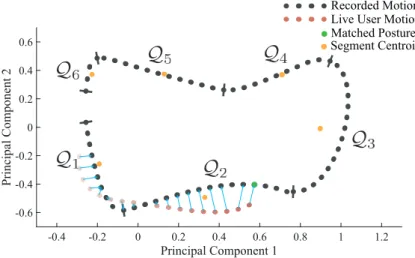
4.3.2. Global Posture Space . . . 51
4.3.3. Local Posture Spaces . . . 52
4.3.4. Context-based Interaction Meshes . . . 53
4.4. Computing Responses for the Controlled Agent . . . 55
4.4.1. Interaction Selection . . . 56
4.4.2. Temporal Alignment . . . 59
4.4.3. Spatial Adaptation . . . 60
4.5. Conclusion . . . 62
5. Behavior Generation for Interactive Virtual Humans 64 5.1. Introduction . . . 64
5.2. Learning an Interaction Model for Human-Character Interaction . . . . 65
5.2.1. Data Acquisition . . . 65
5.2.2. Posture Spaces Creation and their Segmentation . . . 66
5.2.3. Interaction Selection . . . 67
5.2.4. Interaction Mesh Creation . . . 67
5.3. Live Human-Agent Interactions . . . 68
5.4. Evaluation . . . 69
5.4.1. Experimental Setup . . . 69
5.4.2. Evaluating Interaction Selection . . . 71
5.4.3. Evaluation of Context-Dependent IMs . . . 76
5.4.4. Discussion . . . 78
Contents vi
6. Learning Continuous Human-Robot Interactions 82
6.1. Introduction . . . 82
6.2. Learning an Interaction Model for Continuous Human-Robot Interaction 83 6.3. Evaluation . . . 86 6.3.1. Experimental Setup . . . 87 6.3.2. Interaction Selection . . . 88 6.3.3. Spatial Generalization . . . 90 6.3.4. Temporal Generalization . . . 92 6.3.5. Computational Performance . . . 92 6.4. Discussion . . . 93 6.5. Conclusion . . . 94
7. Triadic Human-Robot Interactions 95 7.1. Introduction . . . 95
7.2. Related Work on Human-Robot Handover . . . 96
7.3. Interaction Models for Triadic Human-Robot Handovers . . . 97
7.3.1. Data Recording . . . 98
7.3.2. Triadic Interaction Meshes for Human-Robot Handovers . . . . 99
7.3.3. Data-Driven Triadic Constraint Extraction . . . 101
7.3.4. Local Posture Space Generation . . . 103
7.3.5. Generating Robot Responses . . . 103
7.4. Evaluation . . . 104 7.4.1. Methods . . . 104 7.4.2. Measures . . . 105 7.4.3. Procedure . . . 105 7.4.4. Results . . . 106 7.4.5. Interaction Times . . . 107 7.4.6. Spatial Generalization . . . 108
7.4.7. User Experience and Task Performance . . . 109
7.5. Discussion and Limitations . . . 110
7.6. Conclusion . . . 111
8. Conclusion 112 8.1. Summary and Main Contributions . . . 112
8.2. Discussion and Future Research Directions . . . 115
8.2.1. Application-oriented Research Directions . . . 115
8.2.2. Theory-driven Research Directions . . . 116
8.3. Concluding Remarks . . . 118
A. Appendix 119 A.1. Two-Person Motion Capture Data . . . 119
vii
Previous Publications
This thesis interpolates material from the authors own publications:
[1] David Vogt, Erik Berger, Heni Ben Amor, and Bernhard Jung. Learning Two-Person Interaction Models for Responsive Virtual Characters and Humanoid Robots. In Fach-gruppe Virtuelle und Augmentierte Realität der Gesellschaft für Informatik, 2012 [2] David Vogt, Erik Berger, Heni Ben Amor, and Bernhard Jung. A Task-Space Two-Person Interaction Model for Human-Robot Interaction. InFachgruppe Virtuelle und Augmentierte Realität der Gesellschaft für Informatik, 2013
[3] David Vogt, Heni Ben Amor, Erik Berger, and Bernhard Jung. Learning Two-Person Interaction Models for Responsive Synthetic Humanoids. Journal of Virtual Reality and Broadcasting, 11, 2014
[4] David Vogt, Steve Grehl, Erik Berger, Heni Ben Amor, and Bernhard Jung. A Data-Driven Method for Real-Time Character Animation in Human-Agent Interac-tion. In Timothy Bickmore, Stacy Marsella, and Candace Sidner, editors, Intelligent Virtual Agents SE - 57, volume 8637 of Lecture Notes in Computer Science, pages 463–476. Springer International Publishing, 2014
[5] David Vogt, Ben Lorenz, Steve Grehl, and Bernhard Jung. Behavior generation for interactive virtual humans using context-dependent interaction meshes and automated constraint extraction. Computer Animation and Virtual Worlds, 26(3-4):227–235, may 2015
[6] David Vogt, Simon Stepputtis, Richard Weinhold, Bernhard Jung, and Heni Ben Amor. Learning human-robot interactions from human-human demonstrations (with applications in Lego rocket assembly). In2016 IEEE-RAS 16th International Confer-ence on Humanoid Robots (Humanoids), pages 142–143. IEEE, nov 2016
[7] David Vogt, Simon Stepputtis, Steve Grehl, Bernhard Jung, and Ben Amor Heni. A System for Learning Continuous Human-Robot Interactions from Human-Human Demonstrations. InIEEE International Conference on Robotics and Automation (ICRA), pages 2882–2889, Singapore, 2017. IEEE
Contents viii
[8] David Vogt, Simon Stepputtis, Bernhard Jung, and Ben Amor Heni. One-Shot Learning of Human-Robot Handovers with Triadic Interaction Meshes. Springer Spe-cial Issue: Learning for Human-Robot Collaboration, 2018
At the core of this thesis, chapter 4 proposes a new imitation learning framework for collaborative robots. It is based on material from the authors own peer-reviewed articles [3, 5, 6]. Chapter 5 meanwhile rests on references [3] and [5]. The appli-cations presented in chapter 6 previously appeared in the following publiappli-cations of the author [6, 7]. At the time of writing, the results in chapter 7 are submitted for peer-review in [8].
ix
Nomenclature
Boldfacexrepresents a vector, the scalarxi is theith element ofx. Xdenotes a matrix
and Xi,j indicates ith row and the jth column. Capital calligraphic letters such as X and Y represent sets. Unbolded capital letters X are scalars.
(·)oa/ca/po denotes matrices, indices or scalars specific to the observed or controlled
agent and thepassive object respectively. poa,i for example means the i-th joint of the
observed agent. (·)i:j represents a range fromi to j of the elements in(·).
Contents x
Symbol Description
T Amount of motion capture frames
K Amount of segments
S Amount of previous poses for temporal alignment H Index to latest user pose
I Number of interactions/subtasks
M, N, U Number of joints of the observed, controlled agent and the object Z Dimensionality of the pose optimization formulation
R Number of kernels of the Gaussian Mixture Model
P Number of tetrahedrons in an Interaction Mesh
p Point/Posture/Set of motion capture markers p′ Posture in Laplacian coordinates, i.e. L(p)
ˆ
p Live posture Point/Posture/Set of motion capture markers R Cartesian space of the motion capture system
G Global posture space Lm mth local posture space
Qm mth segment, i.e. a set of points/poses pr:v), Q ∈ L dm Euclidean distance of a pose po to segment Qm
E Distance matrix of past user poses to segments
M Mesh Laplacian
C Hard constraint matrix C Index set of hard constraints F Soft constraint matrix
W Soft constraint weight matrix D Dynamic Time Warp cost matrix
Θ A Hidden Markov Model
S Set of internal states
Pi Start probabilities
Pi→j Transition probability matrix
xi
Acronyms
ANN Artificial Neural Net
c-HMM continuous Hidden Markov Model
DMP Dynamic Movement Primitive DOF Degree of Freedom
DR Dimensionality Reduction
DTW Dynamic Time Warp
EM Expectation Maximisation
g-HMM Gaussian Hidden Markov Model
GMM Gaussian Mixture Model
GMR Gaussian Mixture Regression
GPS Global Posture Space
HAI Human-Agent Interaction HMD Head Mounted Display HMM Hidden Markov Model
d-HMM discrete Hidden Markov Model
HRI Human-Robot Interaction IK Inverse Kinematics
IM Interaction Mesh
KDE Kernel Density Estimation
k-d tree k-dimensional tree
Acronyms xii
LPS Local Posture Space MDP Markov Decision Process
PC Principal Component
PCA Principal Component Analysis
pm-HMM Path Map Hidden Markov Model
PPCA Probabilistic Principal Component Analysis
sc-HMM semi-continuous Hidden Markov Model
SLE System of Linear Equations
TCP Tool Center Point TPN Time Petri Net
TRL Technology Readiness Level VR Virtual Reality
xiii
List of Figures
1.1. The envisioned robotic co-workers of this thesis . . . 1
1.2. Interaction structures . . . 5
1.3. Interaction learning overview . . . 6
1.4. Overview of the main chapter . . . 9
2.1. Path Map HMM and Probabilistic Principal Component Analysis (PPCA) 16 3.1. Overview of the mathematical concepts . . . 24
3.2. Principal Component Analysis (PCA) applied to motion capture data . 29 3.3. Laplacian Mesh Editing and isotropic transformations . . . 32
3.4. Interaction Mesh . . . 34
3.5. An exmaple of a discrete HMM . . . 38
3.6. Comparison of HMMs types . . . 42
4.1. Learning two-person interaction models . . . 47
4.2. Offline learning and online adaptation phases of an interaction model . 48 4.3. Spatiotemporal adaptation using interaction models . . . 49
4.4. Comparison of IM topologies . . . 53
4.5. State estimation and online motion adaptation . . . 55
4.6. Key pose estimation and HMM learning in posture spaces . . . 58
4.7. Online key pose estimation . . . 59
4.8. Temporal alignment in local posture spaces . . . 60
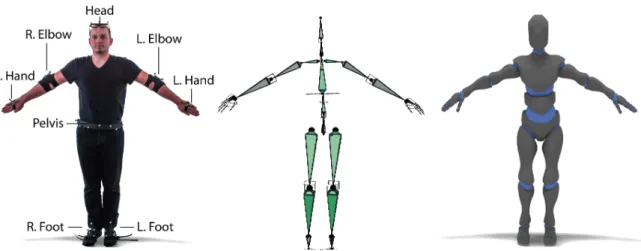
5.1. A virtual character’s motion is calculated based on an interaction model 64 5.2. Motion capture marker layout and kinematic chains of virtual characters 66 5.3. Context-dependent IMs for a punch motion . . . 67
5.4. Motion capture recordings of two-person interactions . . . 70
5.5. A 4-sided CAVE installation . . . 70
5.6. Character animation in immersive virtual worlds using HMDs . . . 71
5.7. The global and local posture spaces of a high five motion . . . 72
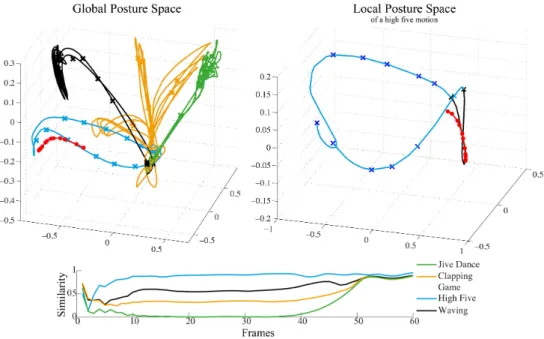
5.8. A high-five interaction with a user . . . 72
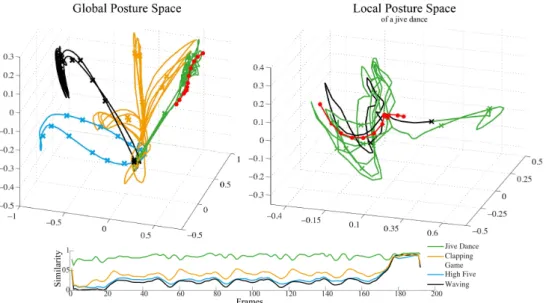
5.9. The global and local posture space of a Jive dance motion . . . 73
5.10. A virtual character reacts to human motion in a Jive dance setting . . 73
5.11. The gobal posture space and posture space of a clapping game . . . 74
5.12. A clapping game with a virtual character is shown . . . 74
5.13. Global and local posture spaces for a competitive fighting scenario . . . 75
List of Figures xiv
5.15. Global and local posture spaces for a kick motion . . . 75
5.16. Several stages of a kick motion are shown . . . 76
5.17. Comparision of IM toplogies and constraint variations for a clapping game 77 5.18. Comparision of IM topologies and constraint variations for a punch motion 78 5.19. Comparision of IM topologies and constraint variations for a kick motion 79 5.20. Variations of a kick interaction for different users . . . 79
6.1. A robot learns to jointly assembly objects with a human user . . . 82
6.2. Overview of the interaction model for HRI . . . 83
6.3. Motion capter marker layout for capturing the robot’s motion . . . 84
6.4. Context-dependent IMs for a box lifting interaction . . . 85
6.5. Key stages of two HRI scenarios . . . 86
6.6. Key stages of the tube assembly task . . . 86
6.7. Key stages of a Lego rocket assembly task . . . 87
6.8. Global and local posture spaces for a Lego rocket assembly task . . . . 88
6.9. Global posture space of the tube assembly task . . . 88
6.10. Global posture space and key pose estimates for two assembly tasks . . 89
6.11. Comparison of spatial generalization capabilities . . . 90
6.12. Spatial generalization capabilties of different IM methods . . . 91
6.13. The deformation energy before and after optimization for a box lifting and tube assembly task . . . 91
6.14. Pose error margins introduced by IK solvers . . . 92
6.15. Temporal generalization of interaction models for a Lego rocket assembly task . . . 93
7.1. A robotic assistant retrieves an object from a user in a triadic Human-Robot Interaction . . . 95
7.2. Triadic IMs are generated from human-human demonstrations for seam-less human-robot handovers . . . 98
7.3. Three stages of a typical handover . . . 99
7.4. Pairwise covariances of joints towards object vertices . . . 100
7.5. Segmentation of object and joint trajectory in low-dimensional space . 101 7.6. Motion capture of a human-human handover . . . 105
7.7. Rendering of the evaluation procedure . . . 106
7.8. Rendering of the experimental setup for triadic IMs . . . 106
7.9. Different users handover a green object to a robotic arm . . . 107
7.10. Comparison of interaction times . . . 108
7.11. Comparison of handover heights . . . 108
7.12. The amount of soft and hard constraints during human-robot handovers 109 7.13. Task performance and confidence levels . . . 110
7.14. Comparison of frustration levels . . . 110
7.15. Interaction models are bi-directional allowing for human-robot and robot-human handovers . . . 111
xv
List of Tables
2.1. A comparison of recent HRI approaches . . . 22
3.1. HMM variants and their computational complexity . . . 43
6.1. Confusion matrix of the proportion of correct guesses . . . 89
7.1. Comparison of successful handovers . . . 106
1
1. Introduction to Interaction
Learning
The trick to forgetting the big picture is to look at everything close up Palahniuk [9]
Fig. 1.1.:Robotic co-workers that work along-side humans are a great vision of robotics. Robots that are able to anticipate human motions could potentially change the environment we work in. They could for example release the physical load burdened on a human worker and in doing so increase their production efficiency. For that however human motions need to be constantly monitored and robot responses need to be seamlessly blended with that of the human co-worker. The figure shows typical interaction scenarios that are pursued in this thesis.
1.1. Robotic Co-Workers and Workplaces of the
Future
Manufacturing companies have long sought for robots to aid manual production pro-cesses and lower fabrication costs. Over the last decade a number of applications emerged where robots are embedded in assembly processes, successfully transforming traditional workplaces into robot-aided assembly lines. Most facilities, however, rely almost exclusively on human operators to trigger robot motions and collaborations be-tween humans and robots often proceed sequentially. As it stands, most human-robot collaborations are structured in a stop-and-go fashion, inducing delays, and following a rigid command-and-response pattern [10]. Despite notable benefits, there is a variety of
1. Introduction to Interaction Learning 2
tasks where these widely used turn-taking implementations are infeasible. Hand-overs, joint assemblies and product transports are prominent examples where it is insufficient to play back prerecorded robot motions. Instead, they require continuous adaptation of the robot’s motion to the human co-worker in order to be executed successfully.
Giving a robot this ability and allowing it to work side-by-side with humans would increase the number possible application scenarios and, more importantly, reduce the effort burdened on the human co-worker. In a joint transportation task for example, the physical load is typically shared among a group of workers and it could be significantly reduced by introducing a robotic assistant to carry most of the weight. Robots able to engage in such collaborations, have consequently the potential of improving workplace ergonomics and offer substantial reductions in injury and serious health hazards.
However, these seemingly simple and repetitive behaviors appear automatable at first, yet they are often done manually and robots are caged wherever people work among them. The reason for that results from the extensive set of skills, required to participate in interactions safely. Among others, human-aware responses and spa-tiotemporal awareness of the robot tend to be the most important aspects of a human-robot interaction. Traditionally, a skilled programmer is required to implement all possible interaction parameters with control routines. Unfortunately, this approach is intractable even for a small number of interactions as they are inherently hard to foresee beforehand. This disadvantage becomes considerably important in low-volume production processes. Often, assembly lines are altered and changed for new products in short intervals, requiring the robot to be re-configured to the new situation. As a result, interaction parameters need to be re-implemented regularly which clearly in-creases maintenance and production costs. Hence, efficient programming techniques are called for that allow fast and reliable skill acquisition, so that even untrained users are able to make efficient use of their new robotic co-worker.
Newly programmed robot behaviors need to be blended seamlessly with the user’s motion during a collaborative task while at the same time being demonstrably safe. This requires a high level of coordination of the robot, so that it is able to produce well-synchronized actions with human co-workers. The human-centered environment in which the robot operates further depends upon dynamic timing of behaviors and appropriate motion plans.
A work place of the future, where robots work jointly with humans displaying the kind of fluency that humans are accustomed to, is envisioned in this thesis (see Fig. 1.1). For this vision to become reality, however, an algorithmic foundation is needed that allows efficient training of robots by non-professionals while providing flexible and adaptive motion generation mechanisms.
1.2. From Imitation Learning to Interaction Learning
Leveraging human knowledge to train robots is a fundamental problem in robotics. Inspired by nature imitation learning has emerged as a valued tool for bootstrapping
1. Introduction to Interaction Learning 3
motor skills in various anthropomorphic structures [11]. It is generally referred to as the concept of learning the actions and postures required to do a task by observing a human teacher.
So far however, imitation learning is dominated by studies of individuals acting alone and it is mostly regarded as single agent approach. Yet, many day-to-day behaviors require the ability of two or more individuals to coordinate their motions concurrently to interactions such as in dances, collaborative transportations or hand-overs. These cooperative interactions are constantly influenced by contextual cues, e.g. postures of interaction partners or object positions. Still, humans are able to engage in them re-markably fluent. They tend to anticipate future actions of their interaction partners and adapt their behavior accordingly. In doing so they continuously reduce the dis-crepancy between the intended goal and the actual situation by changing temporal and positional courses [12]. In a high-five interaction for example, the individual movement of both interactants naturally changes in each repetition due to varying muscular acti-vations. However, the interaction can be easily carried out, retaining the intent of the joint behavior, i.e. to clap the other’s hand. The reason for that is the underlying mu-tual understanding of both partners, which often results in visible body synchrony and entrainment [13]. This leads to the hypothesis that the imitation of a single behavior by robot is not sufficient enough in order to engage in human-robot interactions. Instead, it stands to reason if imitation can be used toimitate the interaction by learning from two demonstrators instead of focusing on a single trainer.
Mimicking the behavior of one human during a two-person interaction is challenging problem for a robot. It requires continuous prediction of the other’s behavior and in-terdependent motion planning as each action influences the outcome of the respective other. Giving a robot this ability would change how it is able to interact with people, allowing a wide range of application scenarios. Imitation learning seems to be a promis-ing methodology to achieve that goal, as it offers a number of valuable properties that render it suitable for learning joint actions1
.
First, it allows the design of robot actions based on a trainers understanding of how the interaction should look like [14]. The underlying hypothesis is that humans would prefer to interact with robots the same way as they do with other people [15]. By imitating human motions in a human-robot interaction, no additional instructions would be required to train users as the robot’s behavior would appear intuitive and inherently natural.
Second, it enables robots to mimic human behavioral patterns during a joint task. Psychological studies suggest that for coordinated actions between robots and humans to emerge, human-like trajectories are essential [16]. By adopting the role of one of the demonstrators, the robot would able to imitate postures and temporal properties to coordinate its action with the user. This would benefit its acceptance, seeing that its actions appear not only functional but also predictable [17, 18].
1
In this context a joint action is considered a goal-directed action of two interactants that requires precise manipulation towards a Cartesian coordinate, such as hand-overs or collaborative trans-portations.
1. Introduction to Interaction Learning 4
From a demonstrator’s point of view, imitation learning provides a powerful know-ledge-transfer tool. In contrast to low-level control techniques, the concept of teaching someone by demonstrating a task is deeply rooted in the human learning process. The resulting efficiency with which knowledge is transferred is the main reason for its growth of popularity. Skills that can take weeks to master by oneself are often learned by observing a teacher, reducing the cumbersome trail-and-error process to a mere set of failed attempts.
From a computational point of view there is a general consensus that pre-imposing a programmer’s design to a robot’s control structure is counterproductive as researchers strive towards adaptive robots [19]. Within this context imitation is an intriguing concept as it can be seen as learning tool on a behavioral level. Instead of explic-itly defining motor commands abstract motion templates that allow for adaptation in unseen situations can be trained [11].
Recent advances in sensing technologies also encourage the use imitation learning for human-robot interactions. The latest developments of motion capture hardware has impacted professional systems that target film industries as well as consumer-grade devices. New capturing systems give users the ability of capturing gestures and movements with high quality and low latency. Some of the system even allow the recording of several people at the same time [20–22]. This offers additional insight into behavior patterns and correlation structures of several interactants. One key aspect of these parallel recordings is that they provide information about body synchrony and spatiotemporal relationships, features that are not available in single actor recordings. It is hypothesized that, instead of explicitly programming the robot for each foreseeable situation, these two-person recordings can be used to learn interactive behaviors.
Despite notable benefits, imitation also presents a number of difficulties that need to be addressed. Consider the reproduction of a single human movement on a robot for example. It can be easily assumed that the human’s skeletal structure and the robot’s kinematic chain differ from each other. As a result, motions cannot be transferred with-out further optimization, a problem that is generally referred to as thecorrespondence problem [23].
In addition to that, imitation by itself requires a significant amount of perceptual and cognitive abilities [19]. A skill that is to be imitated needs to be observed, rec-ognized and internally represented. The optimal implementation however is still an open research question and it is actively discussed in the community. Yet, one com-mon understanding it that it requires efficient integration of visual, memory and motor systems so that a robot is able to infer actions during runtime [24]. In a hand-over task for example, a robot needs to detect objects, anticipate hand-over locations and adapt the learned behavior to new positions. For that the skill of spatial reasoning about the user’s intent, i.e. the hand-over location, as well as the prediction of temporal prop-erties, i.e. when the hand-over will take place is required. In other words, the robot needs to generalize demonstrated behaviors spatially and temporally so that motions can be inferred for varying environmental conditions.
1. Introduction to Interaction Learning 5
Fig. 1.2.: Overview of interaction structures. Day-to-day tasks such as hand-overs and object trans-portations fall in the category of interdependent, concurrent, cooperative tasks. In contrast to turn-based interactions, interdependent behavior planning requires continuous adaptation of one’s body movement and its implementation in robotic assistants is the primary goal of this thesis. The figure is adapted from [28, p.2]
1.3. Interdependent, Concurrent and Cooperative
Human-Robot Interaction
Similar to imitation as being seen as an approach focused on a single agent, dyadic interactions among humans have also been examined mostly from a single perception point of view in neuroscience [25, 26]. Here, interactions are regarded as the individ-ual’s motion simultaneously or sequentially executed that affect the immediate and future outcomes of the other individuals involved in the situation [25]. In these, stand-alone roles dominate the field and surprisingly few physical human-human interaction analyses exist. More recently, however, a shift in perspective can be observed and neu-roscientists are also beginning to asses neuro-cognitive mechanisms, investigating what enables humans to coordinate actions. Instead of seeing interactions as individual mo-tions with interaction-relevant properties, joint acmo-tions are given priority, focusing on both behaviors at the same time. Interestingly, many properties of the joint action rest on the team members’ cognitive processes, such as motor-based simulation, prediction and behavior anticipation [27]. Resulting from this, it is argued that interactions should be differentiated into several distinguishable groups, moving towards a two-person neu-roscience [28]. Following this argument and thereby emphasizing the importance of the second-person, it is proposed that interactions between humans can be differentiated by three properties: (1) interaction structure, (2) goal structure and, (3) task structure. In this taxonomy each property assumes one of two values as illustrated in Fig. 1.2.
The interaction structure is divided into concurrent and turn-based interactions. Here, the agents’ motions are executed either simultaneously or as sequential actions that influence the immediate and current outcome of both individuals. In concurrent interactions both agents strive towards a common goal simultaneously, such as in races or martial arts whereas turn-based interactions follow a sequential order similar to a game of chess.
1. Introduction to Interaction Learning 6
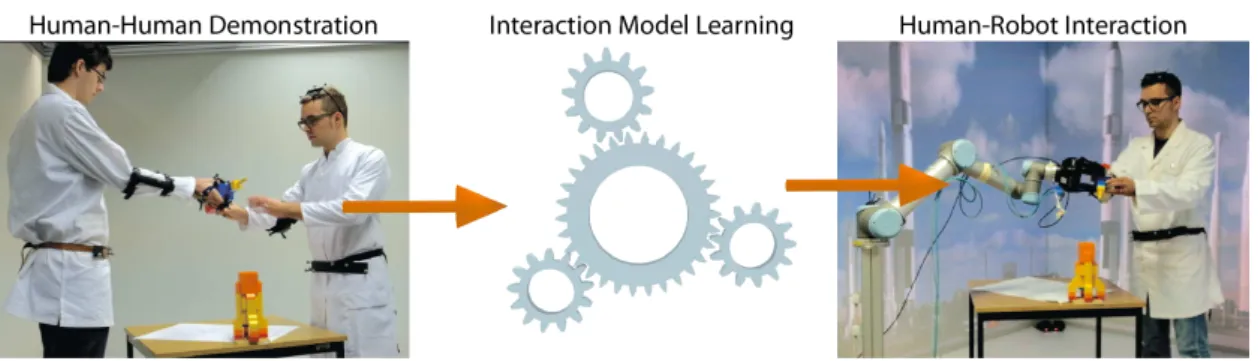
Fig. 1.3.:Overview of the interaction learning methodology. Based on human-human task demonstra-tions, an interaction model is learned that captures how the interactants moved during task demon-stration. The model allows a robot to continuously adapt its own motion during a human-robot interaction spatially as well as temporally to that of its huat of its human interaction partnerr.
Thegoal structure of a two-person interaction is separated intocooperative and com-petitivescenarios. Here, agents may expedite the goal achievement of others, resembling cooperation or impede it competitively.
The task structure of an interaction defines whether motions are independent or in-terdependent. The first denotes interactions where each individual’s behavior influences the task independently, such as in a race or a bowling game. Only the outcome of each behavior impacts the interactive task. Interdependent interactions on the other hand require adaptation of each individual’s behavior in order to affect the outcome of the task, such as in carrying an object, dancing or martial arts. The most visible property of interdependent interactions is body synchrony.
The interaction learning approach presented in this thesis directly addresses concur-rent interactions, that exhibit interdependent tasks structures and cooperative goals (see red highlight in Fig. 1.2). As outlined earlier, these tasks include but are not limited to hand-overs, collaborative transportations and assembly tasks, i.e. joint be-haviors that emerge often in day-to-day life. By their nature these tasks require, in contrast to turn-based actions, continuous spatiotemporal coordination of the individ-uals’ behavior and its outcome since both agents act simultaneously. On top of that both interactants operate on the same task, e.g. they carry an object jointly or hand-over items. This renders the task structure interdependent and each movement has to be planned with respect to the current situation.
For a robot to collaborate in these tasks with a human interaction partner, it is necessary to anticipate the human’s behavior and adapt motor commands continuously. At the same time, the amount of possible interaction scenarios should not be limited to single behavior but rather feature a broad repertoire.
1.4. Problem Statement
There is a clear need for interactive robots that are able to interact with humans seam-lessly and imitation learning might be the concept for achieving that goal. Despite its success, not much research has been conducted to extend it from single-actor imitation
1. Introduction to Interaction Learning 7
to two-person interactions. In this thesis, it is proposed that by building upon task demonstrations of two human users, interaction skills of robots can be bootstrapped. Within this context, the challenge is how interaction dynamics, such as spatial rela-tionships and body synchrony among the interactants should be gathered, represented internally and adapted during runtime.
The questions addressed in this thesis can further be formulated as follows:
• What steps are required to extend imitation learning to two-person interactions? • Using motion capture, what additional knowledge about a joint task can be gath-ered and used by a robot during runtime to optimize human-robot collaboration? • How can spatiotemporal generalization of demonstrated behaviors be achieved? To address the above research questions, a methodology is presented in this thesis that utilizes motion capture recordings of two users (see Fig. 1.4 ). Based on these two-person task demonstrations, interaction dynamics are represented in several low-dimensional spaces, efficiently compressing motions while preserving intrinsic details. Spatial relationships of both interactants are captured in a topological space that allows for efficient optimization of robot responses during runtime. A novel data structure is developed that utilizes data of two interaction partners in single unified interaction model. Using the model during runtime a robot’s response is inferred by aligning observed user motions spatially and temporally, before a robot’s response is adapted spatially at each frame. The robot’s motion is thereby seamlessly blended into the joint task with the human user and provides instant and safe responses. Using the proposed methodology a robot is able to participate and engage in interdependent cooperations, such as hand-overs or assembly tasks.
1.5. Contributions
In the following methodical and applicationr-related contributions made by this thesis are summarized.
Methodical Contributions
• An efficient approach for extracting human-robot interaction from human-human demonstration
• Data-driven fusion of methods for human behavior recognition and robot response generation
• Definition of a joint interaction model that generalizes the dynamics of trained behaviors spatially and temporally
• Introduction of triadic human-robot interactions based on intrinsic information in motion capture recordings
1. Introduction to Interaction Learning 8
Application-related Contributions
• General framework for robot and virtual character in human-agent interactions • Extensive behavior repertoire for interactive virtual characters
• Complex behaviors skills for collaborative robots in human-robot assembly tasks
1.6. Overview Over the Main Chapters
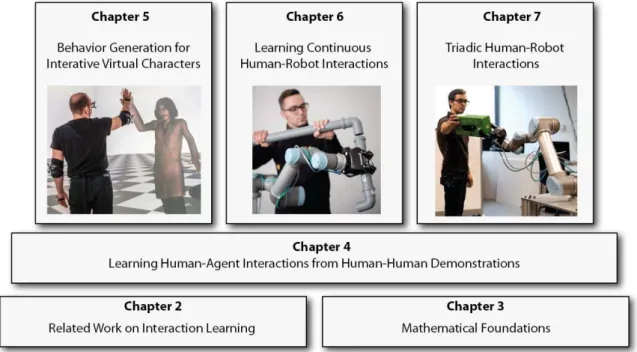
In chapter 2 current interaction learning approaches are reviewed. The survey starts by structuring and classifying each based on interaction types, real-time capabilities and action recognition features. In chapter 3 important mathematical concepts that are essential for the development of this thesis are introduced. Chapter 4 is the core of this thesis and presents a framework for learning human-robot interactions from human-human demonstrations (see Fig. 1.4). In subsequent chapters, the proposed methodology is evaluated in different scenarios. Beginning with chapter 5 interaction models are applied in a virtual agent setting to demonstrate how previously recorded motion capture templates are adapted to new situations. Then, the approach is utilized in a human-robot interaction setting in chapter 6. Here, a robotic arm learns to jointly assemble objects and coordinate its own motions with that of a human interaction partner. It will be demonstrated that, despite the different kinematic chains, a robot is still able to adapt human motion capture recordings to new situations. In chapter 7 the methodology is employed in a triadic human-robot handover setting. The triadic scenario allows, in addition to action recognition and body synchrony between both interactants, object rotations and positions to be represented during task demonstra-tion. As a result, the robot is able to account for variations of such during runtime which results in more natural and intuitive human-robot handovers. The performance of the approach is evaluated in a within-subject study and compared to state-of-the-art handover methodologies.
1. Introduction to Interaction Learning 9
Fig. 1.4.:Overview of the main chapters. Based on related work on imitation learning in chapter 2 and the mathematical concepts in chapter 3 a novel interaction learning framework is developed (see chapter 4). The methodology is evaluated with virtual characters in a controlled virtual environemnt in chapter 5. Chapter 6 adopts the approach in complex human-robot interactions that involve body synchrony and spatiotemporal adaptation. In chapter 7 the framework is employed in a triadic human-robot handover setting.
10
2. Related Work
The extensive body of research in the field of Human-Robot Interaction (HRI) started to evolve around turn-based scenarios featuring cooperative goals. More recently this focus shifted to continuously planning robots that collaborate with people and ap-proaches emerged that directly target concurrent behavior execution. The amount of open research questions and the increasing number of publications suggest that con-current and interdependent interactions are the most difficult ones to implement, as they require continuous situation monitoring and motion adaptation in realtime. A similar shift can be observed in Virtual Reality (VR) research even though it is ded-icated to character animation. Both fields seek control algorithms that enable agents to engage in seamless interactions with people and in doing so they focus on the same research topics such as motion recognition and response generation. Since the aim of this thesis is the development of an interaction learning methodology that is applicable in both areas, the following literature review introduces existing approaches from both fields. Their applicability to interaction learning, i.e. the learning from two-person task-demonstrations is discussed in detail and key benefits as well as limitations are highlighted.
2.1. Learning Human-Character Interactions
In the field of computer animation various methods have been proposed for animating virtual characters in interactions with users [29–33]. Despite these results most exist-ing techniques require a skilled animator to control the animation and they rely on conventional input devices such as mouse or keyboard to trigger pre-defined motions interactively. More recently however, the advent of cost-effective depth sensors such as the Microsoft Kinect camera, enabled researchers to capture live user motions. As a result motion capture became accessible to a broad audience. With the rise of these sys-tems traditional speech and gesture input paradigms gave way to adaptive animation techniques showing the growing interest in seamless human-agent interactions.
When developing such methods, however, one import necessity is the classification of human behavior during an ongoing interaction with the character. A successful classification allows an agent to react in a believable manner and, thus, provides a more intuitive and natural interaction experience to the user. At the same time the requirement for online motion adaption emerges. In order to react to human motions appropriately, the agent not only needs to classify the observed behavior but also adapt its own motion to best fit the current situation. Towards that end different
2. Related Work 11
example-based methods have been introduced. In [34] for example the authors propose a framework for online action recognition using histograms. Here, live user motions are mapped on motion capture samples using Dynamic Time Warp (DTW). Additional temporal properties are preserved using dynamic programming.
Also based on motion capture recordings, Camporesi and colleagues [35] describe a character animation framework for real-time motion blending. For that, several example motions are captured using a reduced marker set. During runtime agent motions are generated by blending example motions to new situations. The underlying minimization problem, i.e. motion blending, is efficiently solved which allows for real-time motion generation.
Xiao and colleagues on the other hand propose a human-agent interaction system that relies on trained user gestures [36]. During training motion capture in conjunction with a data glove is used to extract user poses. Then a k-dimensional tree (k-d tree) is constructed based on the resulting 32-dimensional feature vector. During runtime a nearest neighbor search is employed to classify live user postures which in turn trig-ger agent responses. Since the classification accuracy highly depends on the employed distance metric, the authors argue for a general Mahalanobis-metric [37] in contrast tra-ditional Eulclidean distances. In doing so higher classification accuracies are achieved for large data sets. However, as the method proposed by Camporesi [35] as well as Xiao [36] rely on exhaustive training data it is the user’s responsibility to forsee all possible interaction scenarios. At the same time Xiao et al. do not optimize agent responses which increases the amount of required training data further. These limita-tion render both approaches unfeasible in real-world settings, i.e. when the amount of interactions increases.
To study the influence of interaction on human perception Taubert and colleagues [38] present an approach based on a hierarchical probabilistic model. Each layer is com-posed of a Gaussian process latent variable model (GP-LVM) with a Gaussian process dynamical model (GPDM) on top. At first, each kinematic marker of both interac-tants is mapped onto a latent variable in a bottom layer. The interaction between both actors is then computed in the second layer, called interaction layer and a mapping between three latent variables and the bottom layer is constructed. In a final layer, nameddynamic layer, a GPDM encodes dynamic dependencies such as velocities and accelerations. During runtime interactive motions are inferred by back projecting the user’s current hand position into latent space, yielding an interaction variable in the interaction layer which is in turn projected down to extract joint angles for charac-ter animation. However, due to the computational expensive nature of the underly-ing probabilistic algorithm and the requirement for exhaustive trainunderly-ing data, model learning is a time consuming process. At same time only a single interaction can be synthesized during runtime limiting the system to one scenario.
2. Related Work 12
2.1.1. Approaches based on Two-Person Demonstrations
Towards the goal of motion recognition and response generation, Vogt et al. learn a continuous mapping function between user poses and agent responses [3]. In contrast to the above techniques, the authors use motion capture data of two interactants. After recoding two-person interactions, a low-dimensional space is computed for each interactants’ joint angle data using PCA. The problem of inferring an agent’s response during runtime is interpreted as a mapping problem. It is argued that for each point of user’s posture space a corresponding point the agent’s posture space can be extracted. The required mapping function is approximated with an Artificial Neural Net (ANN). Querying the net during runtime using the user’s motion as input, seamless agent responses are computed.
Due to the generalizing nature of the network, poses that are not part of the initial recording are still mapped to character responses. Also, the authors argue that by using a recurrent neural network instead of a traditional feedforward net, past user poses are incorporated allowing for various interactions to take place. One drawback is however that joint angle data is used for model learning which naturally yields a mapping function in joint angle space. The problem that arises is that a robot’s posture might be optimal with respect to joint angle values but suboptimal in task space, i.e. tool center point coordinates. The lack of goal-driven optimization in task space renders the approach impractical in scenarios where precise manipulation is required.
The need for distance preservation has also been recognized by the computer graphics community, which eventually lead to Interaction Meshes (IMs). First proposed in non-realtime environments, IMs [39] are an adoption of Laplacian Mesh Editing (LME) [40] to virtual character animation. For that a mesh is constructed between the joints of both interactants as well as points sampled on their surface. Using LME the net is deformed to fit the animators’ requirements, such as motion styles, character heights or varying skeleton proportions. It is thereby important to note that the net’s topology has a strong influence on its overall generalization capability. A thorough analysis of this is presented in chapter 5.
The method has later been adopted to human-agent interactions [41]. For that additional constraints such as foot contact constraints and velocity constraints have been included into the optimization procedure. However, in order to react to ongoing human motions an appropriate reference IM has to be selected at each time step. For this, Ho and colleagues use a k-d tree classification to store all postures of the active interactant, i.e. the user. Thek-d tree is queried during runtime with the user’s current posture as input, yielding a motion capture frame from the initial recording as well as the corresponding IM.
One problem that arises is that similar user postures should trigger different re-sponses of the virtual character depending on the current situation. The beginning of a high-five interaction for example might very well suggest a hand-shake interaction. However, using the k-d tree a character’s response alternates between the behaviors depending on the closest match of the user’s pose. This leads to visually unpleasing
2. Related Work 13
results. At the same time Ho et al. synthesize a character’s motion solely based on a single user posture and the last neighbor search result. This limits the temporal context of the response generation to two poses and long-range temporal dependencies are not considered. In order to distinguish between interactions that share similar segments, larger memories have to be taken into account to animate the character in a believable/contextual manner. Since the required contextual information is not incorporated, the method thus fails to compute reliable results for varying interactions. The above algorithms indicate an interest in adaptive motor control schemes that allow for seamless human-agent interactions. A common goal among researchers is an increase in user immersion which is achieved by generating agent responses tailored to the current situation. In doing so, motion capture is a key technology as it is used to track user motions in the real world while at the same time enhancing the user’s experience as no traditional input devices such as key boards are required [38]. An important insight is that by utilizing one’s own motion as the main way of interacting with the agent more intuitive and natural interactions emerge. Also, adaptive responses that take the specifics of the current situation in to account are in general perceived more natural in contrast to predefined animations. This increases the user’s experience further.
Focusing on the same naturalness and intuition, roboticists strive for similar goals in human-robot collaboration research. However, whereas virtual characters operate in simulated worlds, robots need to consider physical limitations and constraints of the real world. This increases the complexity of response generation algorithms by a magnitude. Nevertheless a number of approaches have been proposed and the following section presents an excerpt of them.
2.2. Learning Human-Robot Interactions
The previous section introduced character animation techniques that allow virtual agents to respond to human motions in a natural and intuitive way. A key aspect was that by using human motion capture data intuitive and adaptive agent responses can be triggered. Pursuing the same responsiveness in robots, roboticists proposed various control approaches which are reviewed in the following. The survey is struc-tured by the underlying learning algorithm and each method is discussed regarding its benefits and limitations in interdependent human-robot interactions.
2.2.1. Approaches based on DMPs
Generalizing robot motions from task demonstrations is a long sought goal of roboti-cists. With the advent of Dynamic Movement Primitive (DMP) a novel learning ap-proach has been proposed that allows movement planning under uncertainty and allows inference in unseen situations [42]. The concept follows the assumption that complex behavior skills are composed of several building blocks and DMPs are considered the
2. Related Work 14
mathematical representation of such. They are fundamentally based on dynamical sys-tems, i.e. point attractors. A combination such can be used to model movements over time. Several lines of work have spun from this approach.
In [43] for example, the concept of DMPs is used and extended to human-robot handovers. Here, Prada and colleagues update target positions of a attractor continu-ously during runtime to generalize to unseen positions. In a similar fashion, Ben Amor and colleagues propose a mixture of interaction primitives, a variation of DMPs for robot arm control in human-robot interactions [44, 45]. By maintaining a distribution over DMP parameters, inherent correlations of the joint task are encoded. In doing so, a robotic arm learns to react to human motions such that behaviors can be exe-cuted jointly. Unfortunately, interaction primitives require several past user poses as observations before reliable inferences about the robot’s motion can be generated [46]. This increases the delay and the risk of generating responses that are unsuitable in the current situation. So far, interaction primitives have only be generated based on kinesthetic teaching. This can be cumbersome and not very efficient for complex interactions.
2.2.2. Approaches based on GMMs
Other approaches for learning human-robot collaboration use force measurements to anticipate human intentions. Rozo and colleagues for example propose a time-dependent method to mimic forces and positions in the context of transportation tasks [47]. Here a robotic arm is kinesthetically trained to match a user’s hand while carrying an object. A GMM is computed to approximate task-specific parameters. The model is later em-ployed during runtime to infer velocities, positions and forces in ongoing interactions.
GMMs are also used in dressing scenarios [48] where a robot learns to assist a human to put on a jacket. In this context the GMM models user joints captured from several depth images. During runtime the learned model is employed to recognize user motions and adapt pre-defined robot gripper poses to new positions.
Tanaka et al. [49] estimate user positions in an assembly line setup and implement a control scheme so that a robot passes objects and tools to the user whenever they are needed. Using a laser scanner the area of interest, i.e. the region in which the user operates, is first sampled from task demonstrations and then discretized equidistantly. To obtain binned data for training a Markov chain the positions are approximated by a set of predefined Gaussian distributions yielding a GMM. During runtime the user’s position is captured by a laser scanner and the most likely distribution of the GMM is inferred. A robot trajectory is computed that specifically targets the mean position of the inferred Gaussian with an additional user-set offset. The underlying timing, i.e. when to pass the next object or tool, only depends on the previous state of the trained Markov chain. Whenever an object is picked up by the user, a timer is started and the next object is fetched and delivered.
While the approach shows interesting results in the considered assembly line setup, the static order of steps encoded in the Markov chain is restrictive in dynamic
envi-2. Related Work 15
ronments. Situations might arise in which the user approaches its work place from a different angle and, thus, a different distribution in the GMM is inferred. Since the robot’s motion and the corresponding timing are planned independently, the robot’s behavior might be unsuitable or even obstructive in a given context.
Another force based approach is proposed by Evrard and colleagues [50, 51]. They present a dyadic haptic collaboration scenario in which a bipedal humanoid robot carries an object with a human user. These transportation tasks typically require an action strategy on how to perform the task collaboratively, i.e. a plan where motion directions and operation roles (leader/follower) are negotiated. In order to create such a plan, Evrard et al. compute a GMM over correlations of joint velocities, positions and forces of both the human and the robot. Unfortunately, the robot is controlled remotely during training, which is unintuitive especially for high degree-of-freedom robots such as robotic arms.
During runtime the robot interprets forces as guidance for a one dimensional lifting motion by utilizing the learned GMM. Doing so, Gaussian Mixture Regression (GMR) is employed to analyze perceived joint forces to compute suitable motor commands that best fit the current situation. Interestingly, the robot is able to seamlessly switch between leader and follower roles. However, only a single scenario can be modeled, rendering the approach unfeasible for settings with varying interactions.
2.2.3. Approaches based on HMMs
Similar to [50], Kulvicius et al. [52] address physical transportation tasks. Instead of modeling the forces directly, both interactants are treated as two point particles coupled by a virtual spring. The forces applied by the interaction partner and, thus, to the particles, tell the robot how to adapt its own trajectory. In the early learning phase, the robot uses the measured force values to follow the human guidance during task execution. Perceived force and motion patterns are then used to incrementally learn a HMM that predicts the human’s next action. Over time the robot learns to take over a more active role in the interaction.
Instead of using forces to differentiate between phases of an interaction, HMMs are also used to classify tracking data. In [53] for example human motions are mapped to high-level actions. Each of them corresponds to an HMM that encodes the robot’s response. In order to generate a suitable robot behavior that take the current situa-tion into account, direct marker control is used. For that pre-recorded mositua-tion capture samples are adapted to the robot’s kinematic chain by attaching virtual springs to the robot’s extremities which in turn pull joints towards recorded marker positions. Dur-ing physical human-robot interaction an additional virtual sprDur-ing is placed between the leading hand of the user as well as the robot and in doing so the robot is able to spatially adapt its behavior. Due to the temporal features of HMMs, interactions such as high-five or waist-turns can be created seamlessly at every frame. However, based on the single connection between both interactants only a limited amount spatial gen-eralization is incorporated. This contrasts to the approach developed in the presented
2. Related Work 16
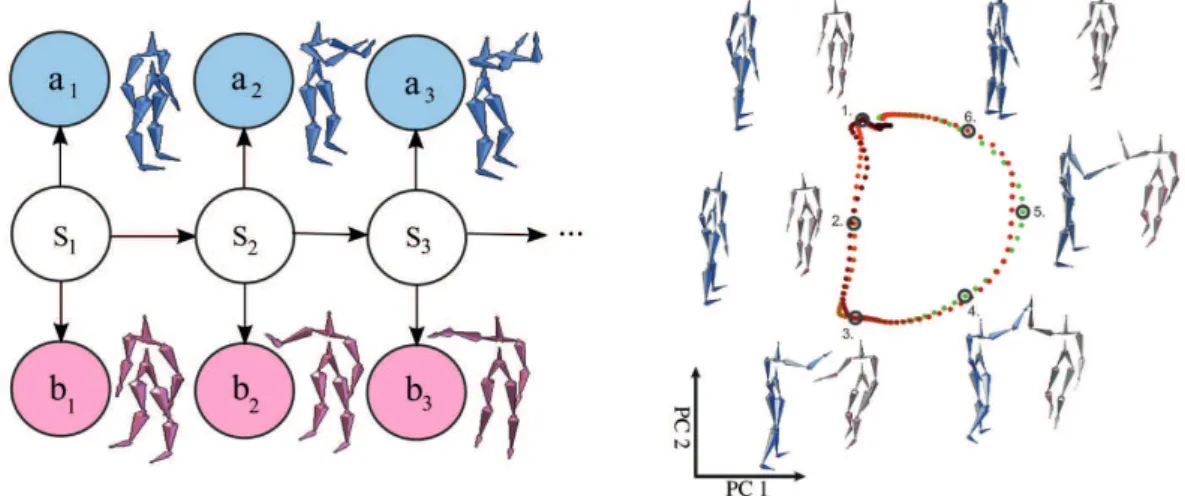
Fig. 2.1.:Left: A graphical model of a Path Map HMM. It relates time-series behavior of a cue-system, to an internal node system (depicted white). In contrast to traditional HMMs two observable nodes are connected (depicted red and blue). Here, joint angle data is observed from the human interaction partner (red) and mapped to corresponding joint angle data of the robot (blue). Right: A latent space of a high-five motion reduced in dimensionality using PPCA. Each point resembles a pair of poses reduced to 2 dimensions. Even if only one posture is observed during the interaction with a robot, response poses can still be inferred. The figures are adapted from [54, p. 3259]
thesis where additional relationships and, thus, more complex multi-joint interactions that involve body synchrony of both agents are trained.
To model the mutual dependency between two interactants Path Map Hidden Markov Models (pm-HMMs) are proposed by [54]. Typically, an HMM is defined in such a way that each hidden node is connected to one observable node only. In [54] however a different graph structure is assumed. Here, a path map relates the time-series behavior of a cue system to that of a target system. This is achieved by connecting each hidden node to two observables nodes: one observable for the cue system and one observable for the target system. A path map for the task of interaction modeling can be seen in Fig. 2.1.
As stated by Ben Amor et al. the HMM-based learning algorithm provides a rich set of tools for recognizing and estimating the current state of the interaction [54]. Yet, it comes at the price of high computational demands as well as limited generalization abilities. Using the HMM, no control over the robot’s response posture is provided and only the most similar pose from the recording is inferred. Given an optimal output of the HMM, further optimization might be required in order to adapt the response to the current situation. For example, a high-five motion might be optimal in joint angle space, given the inference of the HMM, but it might also be suboptimal in tool center coordinates. What this results to is that optimization and response inference should be carried out in task space rather then joint angle space. This is in generally not the case in [54] which renders the approach unsuitable for precise and goal directed motions.
Another HMM-based approach is proposed by Medina et al. [55]. In contrast to the above methods, the model is utilized in a hierarchically clustered fashion to incremen-tally learn form human-robot interactions. It utilizes several channels of communication to gain experience in a unsupervised manner. In the beginning, the robot passively
2. Related Work 17
follows user forces using a first order admittance controller while continuously storing forces in a database. If an input force occurs recurrently, the user is tasked to attribute that segment with a semantic description. This knowledge is used during runtime to ask about desired motion trajectories. Whenever a recognition is successful, either by querying it from the database or with additional certainty from human feedback, a response motion is generated by controlling gains of the admittance controller.
Targeting human-robot handovers, HMMs have also been used in [56]. Here, a two-stage process is implemented that, first handles the physical aspect of the hand-over tasks using the HMM, and, second, reasons about the user’s commitment to the given task using a higher-level cognitive layer. The latter evolves from the behaviour expected from the human user. In contrast to other methods the HMM learned in [56] models states of the robot on a higher-level, e.g. robot is picking up object and user grabs object. During a live interaction, the user’s overall commitment to the task is inferred by evaluating the current state of the HMM in addition to gaze directions and head orientations. In doing so, the robot is able to evaluate if the user is ready to receive the object and, if so, executes pre-defined motions accordingly.
However all actions of the robot follow the same motion providing no adaptations in joint angle space. For example, the pick-up location and the hand-over position of the object are assumed static, i.e. they remain unchanged throughout all interactions. Relying on the user’s ability to accommodate for that limitation, e.g. by moving towards the robot, can be counterintuitive. While the above approaches present valuable insight for effective motion recognition, they still lack adaptation of such to account for spatial variations. As a result, additional optimization techniques are called for that allow online alternation of robot motions so that the current user pose can be taken into account.
2.2.4. Approaches based on IMs
In order to adapt robot responses to new situations while preserving spatial relation-ships between the interactants, IMs have been proposed [39]. To compute optimal paths for a robotic arm in semi-dynamic environments Ivan et al. [57] propose a dy-namic variant of IMs. Here, proximities between the robot and its environment are modeled with IMs at frame level and their spatial relationships are maintained dur-ing motion execution so that the robot is able to adapt to changes in its surrounddur-ings. However, they are only incorporated offline, rendering the approach unsuitable for real-time human-robot interactions. At the same real-time, human motions are not taken into account and the interaction with them is not supported.
In a similar fashion, Ho and Shum [58] utilize IMs and create various net topologies between a humanoid robot and its constrained environment. In doing so they are able to compute a robot behavior that successfully avoids contact with obstacles while at the same time retaining the original shape of the motion. The control program, however, is computed offline and experiments are only shown in simulated worlds. This is due to the fact that the method requires vertices sampled on the robots surface and its
2. Related Work 18
surrounding environment, which is unfeasible in real-world settings.
In contrast to the above Yang et al. [59] present an HRI scenario, where a lightweight robotic arm is avoiding human contact while executing a behavior. During task execu-tion the robot’s moexecu-tion is encoded in IMs and net topologies are dynamically computed by evaluating distances between the robot’s joints, its motion targets and detected ob-stacles. By planning the motion incrementally the robot’s behavior is adapted during runtime and obstacles, such as users entering the workspace, are safely avoided. The task structure of the presented experiments can be considered independent and the robot essentially follows its own goal, i.e. continuing its motion. As a result the ap-plicability to interdependent human-robot interactions is limited since these dynamic scenarios do no provide long-term targets for the robot to reach for. Similar observa-tions hold true for the IM variants in [57] and [58].
The above approaches show the feasibility of IMs in the field of robotics. They do however lack user detection and state estimation which prohibits the robot to dif-ferentiate or react to user poses. This renders current IM methods inapplicable in interdependent HRI settings.
2.2.5. Hybrid Approaches for Modeling Human-Robot
Interaction
In [60] Donner et al. propose a force-based approach for cooperative swinging of ob-jects. Cooperative swinging is, in contrast to the applications scenarios pursued in this thesis, a repetitive and cyclic interaction. It features a very visible amount of body syn-chrony and requires precise timing as well as motion control to maintain certain energy levels, i.e. swinging heights. To manipulate this energy during an interaction with a human partner, the methodology shown in [60] continuously extracts pulse forces from a simplified pendulum model. This approach is, due to its low computational complex-ity and load during runtime, very suitable for cyclic time-dependent interactions. It scales, however, unfavorably to interaction structures that do not feature high degrees of periodicity. The application scenarios pursued in this thesis not only depend upon body synchrony but also task-space behavior coordination. This is not provided in the approach of Donner et al. which renders it unsuitable in the considered human-robot collaboration tasks.
From a more cognitive point of view Nikolaidis and Shah [61] show the advantages of cross-training for HRI. It is essentially a technique often used in human team training where all team members assume the others’ role in a joint task iteratively. They thus, experience the collaborative plan hands-on from different perspectives. The authors argue that this is beneficial for a robot as it is able to better understand its human interaction partner. In order to do so, however, a shared model of the joint task is required. As the computational teaming model of the robot and the mental model of the human interaction partner converge, it is expected that the same pattern of internal states are visited. The similarity of both models is computed by evaluating the overlap of executed actions and the more actions are taken by both interaction partners the
2. Related Work 19
better the computational model performs. In an extensive survey the authors highlight the increased interaction performance in terms of fluency. Here, a human user and a robot are tasked to drill a hole and insert a screw jointly . In the end an increase in concurrent motions by over 70 percent and a reduction of human idle times of 40 percent clearly shows the benefits of the shared model.
Addressing human-robot interaction timing, [62] present a robotic assistant scenario where a robot delivers parts and tools to a human worker. In contrast to the above approaches the robot’s behavior is planned independent from that of the human in-teraction partner and objects are handed over passively with a tray. In a survey the authors compare interaction times of human-robot with human-human trials. They conclude that human-robot interactions last significantly longer, compared to human standards, despite the robot being noticed much earlier during an interaction. This is arguably not due to the robot’s saliency, but rather the human’s comfort which affects its perception. It stands to reason if the observed degradation of fluency during the joint task can be decreased by planning the robot’s behavior interdependently from the human’s motion. The authors state that this could be achieved with imitation learning, limiting the effects of discomfort through intuitive and legible motions.
In an earlier work, Sakita et al. [63] also address timing and interruption during human-robot collaboration. The scenario is developed around three ways of engaging in a Lego assembly task: (1) executing the action simultaneously with a user, (2) disambiguating a situation or (3) taking over for the human. The robot’s action during runtime is inferred by estimating the user’s intent using gaze directions and fixation times. While the interaction relies on nonverbal communication symbols, the approach is still strictly turn-based and it does not offer anticipatory motor control for the robot. More recently, Awais and Henrich [64] propose an intention estimation approach based on finite state machines for more ambiguous situations in which a human’s behavior is not obvious. Instead of waiting for the situation to become clear, a proactive action is triggered and adapted to the most likely intention. Both methodologies, [63] and [64] do not include interdependent motor movement coordination or timing of the joint task.
Also focusing on fluency in human-robot collaboration, Cakmak et al. [65] directly address coordination timing in hand-over tasks. To suggest that a robot is ready to hand-over an object, several poses are defined. These are distinct from other things that the robot might be perceived to be doing when it has an object in its hand. This postural difference is called spatial contrast. In a similar vein the underlying timing during the hand-over is named temporal contrast. Cakmak and colleagues found that this positively effects the human’s perception of the task and improves the readability of the robot’s behavior. However, despite that finding, no elaboration on the robot’s motion is given, focusing on its final posture instead. It is reasonably save to assume that motion has a similar effect on the robot’s readability but further investigation is required to validate that hypothesis.
Timing in human-robot interactions has also been addressed in [66]. Here a Time Petri Net (TPN) is employed to model actions for a tower of Hanoi game, which is well
2. Related Work 20
known for its ability to structure knowledge from various input channels, such as in multi-modal communications. Within this context, interaction fluency is interpreted as the robot’s ability to shift from different actions and, thus, offering smooth recoveries after task interruptions.
In similar vein [67] and colleagues focus on timing in human-robot collaboration. They propose a probabilistic approach for user action recognition and time-sensitive planning of robot behaviors in an assembly task. Here, a robot is programmed to place and replace several boxes depending on the current progress of an assembly task. For that user actions as well as the state of the task have to be estimated to minimize the time spent on waiting for the next container. They propose a sensor model to heuristically infer the time when a robot has to switch boxes and they conclude that correctly estimating a sensors reliability is key to fluent human-robot collaboration.
Despite the results regarding motion and interaction timing the above approaches suffer from the lack of motion adaptation mechanisms. This limits the applicability of the methods but also indicates the need for optimizations techniques.
Similar to [59], Ceriani et al. [68] implicitly address timing in human-robot col-laboration by proposing a collision avoidance methodology based on automatic task constraint extraction and temporal adaptation at frame level. In their approach the authors harness joint redundancies of a robotic arm and optimize a given trajectory to avoid human contact using additional distance sensors attached to the robot. The un-derlying velocity constraints of each actuator belong to one of the following types: (1) hard constraints, i.e. instantaneous constraints that possibly over-constrain the system, (2) skill constraints, i.e. constraints that can be relaxed without causing the system to fail (such as temporary suspension) and (3) soft constraints, i.e. constraints concerning the position and velocity of redundant actuators. Using a state machine template and the extracted constraints, a safety strategy is then automatically generated. During runtime a collision avoidance trajectory is computed for the robot based on the in-teraction danger assessment and Cartesian control [69]. In contrast to [59] no active tra