An analysis of maintenance strategies and
development of a model for strategy formulation
– A case study
Master of Science Thesis in the Master Degree Programme, Production Engineering
GUSTAV FREDRIKSSON
HANNA LARSSON
Department of Product and Production Development Division of Production Systems
CHALMERS UNIVERSITY OF TECHNOLOGY Göteborg, Sweden, 2012
An analysis of maintenance strategies and
development of a model for strategy formulation
- A case study
GUSTAV FREDRIKSSON
HANNA LARSSON
Department of Product and Production Development
Division of Production Systems
CHALMERS UNIVERSITY OF TECHNOLOGY
Göteborg, Sweden, 2012
An analysis of maintenance strategies and
development of a model for strategy formulation
- A case study
GUSTAV FREDRIKSSON
HANNA LARSSON
© GUSTAV FREDRIKSSON, HANNA LARSSON, 2012
Examiner: Johan Stahre
Department of Product and Production Development
Chalmers University of Technology
SE-412 96 Göteborg
ABSTRACT
Maintenance has during a long period of time mostly been associated with costs and stoppages and has, of this reason, acquired a connotation of being something necessary evil. Nowadays, availability, reliability and safety in the production plants are more emphasized. An increasingly number of companies replaces the current reactive, fire-fighting, maintenance strategy with proactive strategies such as predictive and preventive maintenance and also with aggressive strategies such as Total Productive Maintenance (TPM) in order to achieve world-class performance.
This master thesis is aimed to address these issues for Volvo Trucks. Volvo is today working with maintenance in a reactive manner, where events and failures choose the direction. Although, there are at present ongoing changes in order to become more preventive and proactive in the work. This master thesis should serve as a basis for developing their strategy which will guide them towards a preventive and proactive maintenance environment.
A number of different methods have been used in this master thesis, i.e. a literature study; an internship with maintenance craftsmen on the shop-floor; a visit at the maintenance fair; an improvement meeting with a cross-functional group and interviews with maintenance craftsmen; benchmarking of Volvo Trucks Tuve and three other companies. A maintenance department analysis (MDA), which is a tool for benchmarking, has also been made. The MDA is a form with 45 questions, whose intent is to review and score the maintenance organization within a company. The thesis provides results showing that a highly reactive approach is used by the maintenance department. The average score from the MDA, with a value of 2.2, placed Volvo Trucks maintenance department last among the benchmarked companies. There is room for improvements in cooperation and communication between the maintenance department and production department, and this will contribute to a more preventive working environment. The maintenance department is often left out of projects and seen as a separate supporting function. The benchmarking has proven that successful companies have changed that approach and the communication between departments is integrated. These methods later formed the basis for the Customer Focused Model which has been developed, to guide Volvo Trucks in developing a maintenance strategy.
The Customer Focused Model has been developed primarily from the factors the authors found to obstruct the maintenance department from achieving the desired state and thus, it is a guidance to achieve the desired state. Together with Volvo's expertise and experience within the own organization and the area of maintenance it is hoped that the model will function as a bridge when developing and improving the organization to reach the vision.
Keywords: Maintenance strategy, reactive maintenance, preventive maintenance, proactive maintenance, reliability, life cycle costing, change management, human factors.
ACKNOWLEDGEMENT
As a final part of our Master's program, this work was performed during the spring semester of 2012 at the Volvo trucks in Gothenburg, Sweden. We would like to say a big thank you to Volvo and in particular the maintenance department for the opportunity to perform this work. A good attitude along with a large own arrangement and willing cooperation has facilitated and contributed enormous impact, both to the thesis work but also for our personal development. An extra mention, we dedicate our tutors Alexander Börjesson and Hans Wall for a big commitment and that you always have been present during the work.
We would also like to thank the organization Sustainability and Maintenance Global Center, SMGC, and Filip Adielsson for the contributions made via knowledge, experience and contacts provided which enabled the benchmarking studies we've performed. An organization whose future we hope to be successful, as they highlights a very important, but also interesting, area that we believe will be an important factor for companies from now on.
Finally, we want to spend the last word to thank our supervisor Torbjörn Ylipää, for his eternal commitment to our work. Torbjörn has provided us with his extensive knowledge and experience which have contributed a great support to this thesis, and we are eternally grateful for that. Göteborg, June 2012.
Gustav Fredriksson Hanna Larsson
Table of Contents
ABBREVIATIONS ... 1
1 INTRODUCTION ... 2
1.1 Background ... 2 1.2 Purpose ... 2 1.3 Research questions ... 3 1.4 Delimitations ... 32 METHOD ... 4
2.1 Literature study ... 52.2 Internship on the shop-floor ... 5
2.3 Visit at the maintenance fair ... 6
2.4 Benchmarking ... 6
2.5 Workshop at Volvo Trucks Tuve ... 8
2.6 Interviews with maintenance craftsmen ... 8
2.7 Maintenance Conference ... 9
2.8 Presentation at Volvo Trucks ... 10
2.9 Presentation at SKF – Validation ... 10
2.10 Reliability and validity ... 10
3 THEORETICAL FRAMEWORK ... 12
3.1 The development of Maintenance ... 12
3.2 Maintenance strategy ... 14
3.3 Maintenance Management ... 25
3.4 Maintenance concepts with fundamental ideas ... 38
3.5 Human factors and change management ... 70
4 RESULTS ... 75
4.1 Present state description ... 75
4.2 Maintenance fair, Gothenburg 2012 ... 80
4.3 Benchmarking Tools ... 82
4.4 The results of the benchmarking conducted ... 90
4.5 Improvement meeting – Maintenance ... 106
4.6 Presentation at Volvo Trucks ... 108
4.7 Presentation at SKF - Validation ... 109
5 DISCUSSION ... 110
5.1 Formulation of a maintenance strategy ... 110
5.2 Success factors for implementation of the maintenance strategy ... 123
5.3 Maintenance Department Analysis – MDA and Client Needs Analysis - CNA ... 124
5.4 Reliability and validity of methods and results ... 125
6 CONCLUSION ... 127
APPENDIX I – QUESTIONS SUPPORTING INTERVIEWS WITH MAINTENANCE
CRAFTSMEN ... I
APPENDIX II – PRESERVE SYSTEM FUNCTION ... II
APPENDIX III – MAINTENANCE DEPARTMENT ANALYSIS ... III
APPENDIX IV – JUSTIFICATION TO QUESTIONS – MDA... X
APPENDIX V – POLAR DIAGRAM FROM CLIENT NEEDS ANALYSIS ... XV
APPENDIX VI – PARETO CHART FROM CLIENT NEEDS ANALYSIS ... XVI
1
ABBREVIATIONS
BCM Business Centered Model CFM Customer Focused Model CM Corrective maintenance
CMMS Computerized maintenance management system CNA Client Needs Analysis
DoD Department of Defense EEM Early Equipment Management EWO Emergency Work Order
FMEA Failure Mode and Effects Analysis JIPM Japan institute of plant maintenance JMA Japan management association KPI Key Performance Indicator LCC Life Cycle Cost
LCP Life Cycle Profit LTA Logic tree analysis
MDA Maintenance department analysis MTBF Mean time between failures MTTF Mean time to failure
OEE Overall equipment efficiency PDCA Plan-Do-Check-Act
PdM Predictive maintenance PM Preventive maintenance RCA Root-cause analysis
RCM Reliability centered maintenance ROI Return on investment
SWOT Strengths-Weaknesses-Opportunities-Threats SMGC Sustainability and Maintenance Global Center TPM Total productive maintenance
2
1 INTRODUCTION
Below is the background, purpose, delimitations and research questions, with the intention to highlight the cause of this work. It is hoped that the reader is presented with the subject and in the end can connect with the conclusions of the work.
1.1 Background
Before World War II there was no maintenance as much. Parts were mostly menial and they would break so they were changed thus removed. An error, therefor, had little effect and was in many cases thus ignored. That changed during the war. Demand for production and production increased, but with a lack of manpower it led to more mechanized industry and more complex production (Alsyouf, 2007). Cost, longevity and availability were topics that aroused interest, and thus arose maintenance departments. The new found state had maintenance departments to develop periodic maintenance, planned maintenance and preventive maintenance (Kister and Hawking, 2006).
A production system consists of different types of equipment; all equipment must have a high availability and reliability in order to ensure a stable process. The maintenance department is responsible for keeping the equipment in the condition it initially was procured for and also to ensure that it can deliver according to the specification. This is an important role in a production system and if it is performed successfully it can facilitate the journey towards becoming sustainable through high asset utilization, thus providing to the overall profitability
Successful companies of today have often a distinct expressed business idea connected to a strategy that explains it and also, how to reach it.
It is widely known that the maintenance currently is viewed by management as a big expense. And it is not an unusual opinion since maintenance does not include any value adding activities. But this is about to change. It is increasingly common for enterprises to work with maintenance as a center point of profit. A greater knowledge of maintenance and its ability for long term profiting have increased the interest in the topic. It is all based on minimizing the downtime and the key to success is to ensure that proactive maintenance is properly being used. Hence, by leaving the firefighting perspective and striving to use proactive maintenance there is a lot to gain. Less failure, minimized downtime, lowered stress and higher quality, all working in the favor of profit.
1.2 Purpose
As Volvo trucks are trying to achieve a maintenance strategy where preventive maintenance accounts for as large part as possible, one has now developed a clear vision for where to be within a reasonable time. Furthermore, to achieve this vision one need to have a strategy which connects present time and the mission describing what to achieve, with the visions future state and where one wants to go. A commonly used metaphor describes it as a road which will take Volvo from the present state to the visions state. Recently Volvo trucks developed a vision of their maintenance; however, they have at this point no strategy for how to reach it. Hence, the purpose of this
3 master thesis is to develop a model for the formulation of a strategy which will support reaching this vision.
Besides the development of an model for the strategy, the thesis has been intended to benchmark other companies in order to get an understanding of how maintenance work are performed outside Volvo Trucks. Benchmarking is a robust method to distinguish if the work performed today lies within the frames of the means, thus, the benchmarking also where intended to highlight where the means are performing and where Volvo stands in comparison.
1.3 Research questions
To summarize the above mentioned purpose, this work should through several methods; including literature review, benchmarking and a status report on Volvo maintenance organization’s present state, develop a model that form the basis for the formulation of the maintenance department's future strategy. In order to develop the model, three research questions have been formulated. These three questions are aimed at grasping the key objectives of the thesis and also to function as guidance along the way of developing the model.
The three research questions are the following:
1. What is the present state of the maintenance department at Volvo Trucks, and what is the desired state?
2. Where do Volvo Trucks maintenance department stand in comparison with companies within similar industry segment, and what can Volvo Trucks learn from these companies? 3. What obstructs the maintenance department from achieving the desired state?
1.4 Delimitations
This master thesis is aimed to the maintenance department and will thus not focus or take into account the work or decision-making process related to production.
The master thesis will not include literature studies on the operational level of a maintenance organization; it will not include theory of how tools and techniques are used. The master thesis does not regard the time frames for executing the steps in the model.
4
2 METHOD
The methodology used in this project aims at gain knowledge about the area of maintenance from a strategic perspective, to understand the present state at Volvo Trucks maintenance department, as well as maintenance departments at other companies. This is, to finally present a model for the formulation of a maintenance strategy. This thesis is intended to generate a result and discussion useful for Volvo Trucks maintenance department. Therefore, the authors have continuously moved between performing literature studies of theoretical framework and documentation of their own observations, respectively collection of opinions from maintenance employees’ within the industry. That is, to gather a strong foundation of knowledge to present a broad and useful result and discussion.
The collection of information consisted mainly of interviews and observations, i.e. a qualitative methodology. An extensive literature study, internship at the shop-floor, benchmarking, a visit to the maintenance fair, a workshop and participation during a seminar, have also been performed in order to collect information and to create an understanding of the subject.
The problem in the thesis is characterized by factors such as human, culture, technology and economy. Therefore, in order to clarify and to understand the significance of the problem a qualitative methodology was used, which follows the interactive model of research design presented by Maxwell (2005). Qualitative approaches, compared to quantitative approach, emphasize words rather than numbers when data are collected and analyzed, and are intended to clarify the character or properties of a phenomena rather than determining quantities (Bryman and Bell, 2003; Widerberg, 2002). When performing qualitative research questions such as; “What does the phenomena mean?” and “What is it about?” are to be asked (Widerberg, 2002).
The interactive model of research design presented by Maxwell (2005) is intended to facilitate the understanding of the actual structure of the study, as well as to plan and perform the study. When to design a qualitative study, a logical strategy cannot, according to (Maxwell, 2005), be developed in advance and then faithfully be implemented. Thus, it is an ongoing process rather than a
process proceeding through a fixed sequence of steps. Hence, the design components interactions and interconnections with one another demands the design to be changed and adjusted so that the study accomplishes what it is intended to (Maxwell, 2005).
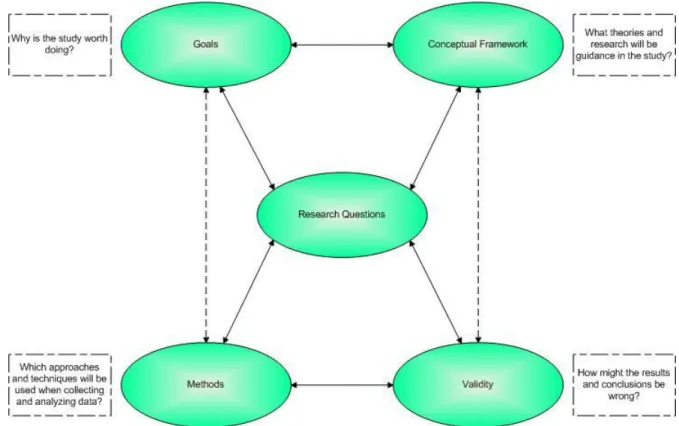
The interactive model of research design the different parts form an interacting and integrating whole, and each component is tied closely to several others. The most important connections among the five components (goals, conceptual framework, research questions, methods and validity) included in the model presented in (Maxwell, 2005) can be obtained from Figure 1 below.
5
2.1 Literature study
To gain knowledge about the role of a maintenance organization within an enterprise and the various maintenance concepts presented by researchers, the master thesis work began with an extensive literature study. Areas such as maintenance strategy, maintenance management and change management were studied in order to understand the strategic level of maintenance and the management’s role. The main goal of the literature study was to create a strong foundation of which the result is to be based upon.
A Maintenance Department Analysis (MDA) has been developed based on the literature study. The MDA consist of 45 questions within 13 areas concerning a maintenance organization. Each question is justified based on published literature. The MDA has been used as a benchmarking tool in order to perform an accurate comparison between companies, present the results clearly and visually, and also to truly gain the relevant information.
2.2 Internship on the shop-floor
In order to create a network within the maintenance department and to understand the maintenance function at Volvo Trucks Tuve, four days was spent on the shop-floor, working together with maintenance craftsmen. Three days was divided equally between three different
6 maintenance divisions at Volvo Trucks, where the maintenance craftsmen’s workday was observed, the fourth day was spent by observing maintenance technician’s workday. The first day was spent at the start of the production, the frame factory, the second at preassembly, then the third day at the final stage of the production and ending the week by working next to a technician related to the frame factory. The internship has also provided the thesis with data concerning human factors and change management. First, by understanding how a change may affect the role and perception of the organization, but also by the individual approach to their work, as this were able to be observed.
2.3 Visit at the maintenance fair
Visits to the maintenance fair were made to discuss maintenance with various companies. The focus was mainly on two well-known consultancy companies; Idhammar AB and Coor Service Management. The work performed during the maintenance fair was based on non-structured interviews.
2.4 Benchmarking
Benchmarking is a method and procedures to develop oneself by analyzing internal and / or external process counterparts (Berggren, 1992). Robert C. Camp (1989) defines it as: “an approach for establishing operating goals and productivity projects based on best-industry practices”. The aim is to obtain a better understanding of how others might do the same processing in a more efficient way, and thus increase the likelihood of improving their own productivity and competitiveness (Bergman and Klefsjö, 2010).
The outcome of a benchmark exercise depends on three fundamental aspects: Make sure to know your own operation, its strengths and weaknesses. Also, know the industry leader, and finally, make sure to incorporate best available methods (Camp, 1989).
Furthermore, benchmarking can be divided into four variants; internal, competitor, functional and generic. Internal benchmarking, when comparing different departments within the own company, can be advantages in the sense that data can easily be collected. Hidden factors are also easier to check (Wireman, 2010). Functional benchmarking aim to, in addition to comparison with competitors, compares organizations in similar fields. Generic benchmarking is when comparing to the best known to exist today (Bergman and Klefsjö, 2010), sometimes also called Best practices benchmarking (Wireman, 2010).
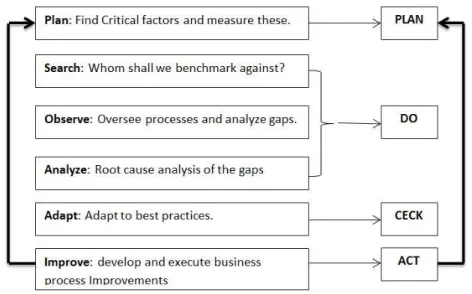
Various models for benchmarking has been developed. Xerox uses a ten-pace plan (Camp, 1993), while Bergman and Klefsjö (2010) presents a benchmarking process that linked the various steps to the PDCA, Plan-Do-Check-Act, cycle. They describe this model along what they refer to Watson presented in 1992. See below Figure 2.
7 Figure 2. The benchmarking process connected to the PDSA-cycle (Bergman et al., 2010).
Benchmarking has become a popular exercise and is used diligent of companies. However, it have also received portion of criticism. Wireman (2010) believes for example that there are some fundamental problems with the method. Wireman (2010) considers, among other things, that few parameters can really indicate what defines your position in the market. At the same time Wireman (2010) wonders whether a comparison with a company in another industry can really produce significant benefits. The failure to analyze companies and their processes in a more complete and better way, can lead to embracing methods which can be serious for one's own processes. In turn to competitor benchmarking, the issue of benchmarking is if it really represent their true values and solutions, because why would a competitor be willing to support its own competitor with solutions. Finally Wireman (2010) is critical to how to adapt to the benchmark values, if unlikely, the comparison succeeds obtain valuable comparisons. What instead is advocated is to embrace the best practices, where you learn how one works according to methods that really work. Most often, it may then even be enough to look to their own companies and the various departments. The problem is that many departments within the same company can be doubtful about solutions they haven’t come up with themselves (Wireman, 2010).
Results of the work consist, in part, of a benchmarking exercise which aimed to compare Volvo Trucks with companies in the same type of manufacturing. Since it is difficult to determine best in the business, and hence perform a generic benchmarking, a functional benchmarking has instead been performed. The work has developed a benchmarking form, maintenance department analysis, MDA, consisting of 45 questions in different areas of the maintenance organization. In addition, the thesis work has visited three companies and performed on-site analysis according to the MDA.
SKF has their own developed analysis tool named Client Needs Analysis (CNA), which through connection with the company was consigned to the authors. This tool was used on Volvo Trucks to
8 compare Volvo Trucks with its industry segment. The CNA was not performed as SKF performs it. When SKF performs a CNA analysis it’s done by an experienced maintenance specialist who based on the 40 questions performs the interview with personnel from maintenance and production. In these interviews the people from the customer site is interviewed together and the interviews take 3-4 hours. The result from the CNA analysis is during a second meeting presented to the customer together with a report with recommended actions. The CNA was in this thesis sent to Volvo Trucks maintenance department and the questions were answered under the responsibility of the maintenance manager.
2.5 Workshop at Volvo Trucks Tuve
Workshop is a term used for meetings with a purpose, and it is commonly viewed at as a meeting with a distinct structure and held by someone experienced within workshops techniques (Forsberg, 2012). By the use of the right tools and techniques during a meeting is the groups combined skills and experienced maximum utilized. A group can accomplish more together than the individuals can accomplish in their own directions (Forsberg, 2012). The increased rate of change demand meetings in order to debate and ventilate complex and difficult questions (Forsberg, 2012). It is important to consider the employees’ as well as the managers’ opinions and views in the master thesis, due to their experiences of the maintenance organization. Therefore, a cross-functional group was gathered to participate in a workshop focused on improvements by the use of a tool, a so called fishbone diagram. The problem highlighted was that the maintenance organization does not work proactively. To allure ideas and causes to the problem was a question asked: “What obstructs the organization to work proactively?” The authors handed out post-its on which the participants wrote plausible causes. When the causes were written down, the authors collected them and categorized them into main causes, i.e. “main bones” and placed them on the fishbone diagram which was drawn on a whiteboard. When the participants were finished with the writing was the fishbone complete and visual on the whiteboard, and a discussion concerning each cause was held. The execution of the workshop took 1.5 hours.
2.6 Interviews with maintenance craftsmen
Interview is a data collection method in which thoughts and opinions is gathered. It is a relatively simple procedure to obtain knowledge about a person's experience, experiences, values and opinions (Osvalder, A.L., 2008). Depending on the interview structure, it is possible to collect quantitative information but also qualitative. It is customary to divide the interview into three categories, namely; Unstructured, semi-structured and structured interview. Depending on what is sought through the interview is selected to which is believed to be most preferable. Structured interviews are best suited to quantitative studies, while unstructured is more suited to qualitative (Osvalder, A.L., 2008).
What distinguishes an unstructured interview is that interviewer asks open questions which are then discussed freely. The interviewed person may thus be controlled since every reference to the desired area can be controlled. The aim is that unstructured interview is preferable when the
9 interviewer in advance is unsure of the areas applied for, or has less knowledge about the subject (Osvalder, A.L., 2008). Unstructured interviews provide for this reason qualitative data. Additional advantages of an unstructured interview are deepening the ability of the issues that seem important to the respondent. The summary of the interview is complicated, however, rated value and the method is not suitable for larger scales.
In a structured interview, questionnaires where the respondent may, either independently or through the predefined response options, answer questions. To make a structured interview it requires good knowledge of the subject and a pre-desirable area to study. A structured interview is quantitative. Finally, in a semi-structured interview a priori structure of the areas that are sought in the interview has been made but the order is less operative and follow-up questions are also possible. Thus, the respondent is easier to be involved in the layout during the interview and answer in a more free way. A semi-structured interview provides both quantitative and qualitative responses (Osvalder, A.L., 2008).
As described, interviewing as a data collection method has both advantages and disadvantages. Advantages are usually mentioned to be that an interview is a subjective and flexible approach with the possibility of a deeper analysis of what the interviewed person really feels about a certain area. It's easy to ask the person to develop and explain their reasoning. This will also minimize the risk of misinterpretation. A further advantage which may also prove to be disadvantageous is that it is possible to influence the sample. The disadvantages are that the interviewee must be present throughout the operation. This may affect the interviewing person adversely. In addition, in an interview, allow the respondent to adjust their responses along what he thinks the interviewer are looking for, and thus influence the outcome. Interviews may also be seen as self-reporting data, that is, they do not give a far-reaching conclusion of what an audience likes but convey only what the respondent thinks (Osvalder, A.L., 2008).
The authors have formulated a number of questions concerning the maintenance organization which have been asked to maintenance craftsmen. This was performed to gain knowledge about the craftsmen’s opinions on their own work. This interview method is seen to be semi-structured. It was in advance known what topics that would be interesting and the respondent was seen to be allowed to answer each question freely. The data was collected via three respondents from each of the areas in the factory. They all had the same title and were considered to have similar skills. In addition, they have been employed for a long time. The questions which have been used can be found in Appendix I.
2.7 Maintenance Conference
A conference for the maintenance department was help, which the authors participated in. The conference was a starting point towards becoming more preventive in the work performed. It was on own initiative from the maintenance department and containing a present state review. An inspiring speech on the importance of maintenance and how the view of maintenance should be
10 changed for the better took place by the company cluster, SMGC, Sustainability and Maintenance Global Center. The financial manager went through the importance of effective maintenance with a focus on the company. Onwards, a interactive group assignment was conducted with emphasis on how the employees look at the vision stated by the maintenance department and what employees believe may become obstacles as well as success factors. In aspects for the thesis, the conference supported opinions, both by the financial manager as well as the feedback from the employees.
2.8 Presentation at Volvo Trucks
The work has halfway presented then results to validate that the problem found were justified and correct approach has been used. The aim was to early announce the direction and progress of the work and obtain feedback on the chosen path. In the final stage of the presentation is also given the opportunity to ask questions targeted to the listeners and embrace their approach in the subject. The questions asked were:
1. Which are the prerequisites to succeed change the organization?
2. Why were not the TPM implementation completed and what knowledge was gained? 3. Which are the critical success factors for the future implementation work?
2.9 Presentation at SKF – Validation
In a final stage, the thesis presented its approach and main results for the strategy group within SMGC. SMGC is a cluster of companies and was founded by the fact that it generally is a problem that businesses are reactive in their maintenance organizations. The strategy group within SMGC is a project that raises the question of maintenance strategies. Since Volvo also is a member of this company cluster, the thesis was offered the opportunity to present at one of their meetings, which appeared at SKF. The work therefore took advantage of the opportunity to obtain feedback from persons within the area of maintenance, and possesses considerable experience and knowledge. The presentation was aimed at highlighting the conclusions made on the subject of maintenance strategies. On the occasion developed model, to illustrate the establishment of a maintenance strategy, was presented and received useful feedback. Participants at the presentation were both researchers in the field of maintenance and simulation, maintenance managers, corporate CEO and strategy consultants. The feedback has been shown to be essential for the work, but have also shown that the work, at this stage, formed good results with a solid background to the topic.
2.10 Reliability and validity
Different methods has previously been discussed, both which is theoretically possible to perform in a similar study and also the methods practically carried out in this work. Onwards, it is logical to talk about the validity and reliability of the methods.
11
2.10.1 Reliability
Reliability in this context deals with the issue of consistency of measures performed (Bryman, A. and Bell, E. 2007). Furthermore Bryman, A. and Bell, E. (2007) believes that there are three areas explaining whether a measure is reliable, namely: Stability, Internal reliability and Inter-observer consistency.
o Stability is about the ability to obtain the same answer, and values through time. To be sure that the result does not fluctuate. Would thereof measurement or procedure is performed again, the result should prove to be the same. Would the correlation between the measurements deviate, it would imply that the respondents’ answers are unreliable (Bryman, A. and Bell, E. 2007). However, if it were to be a long time span between the measurements, the results of the respondents may very well be influenced by, for instance, living standards of the respondent.
o Internal reliability concerns, according to Bryman, A., and Bell, E. (2007), the issue of the procedure that the indicator for an answer even to affect the respondent's answer to another question. A multi- form is compiled into a final score, of which there are risks that the answer does not give a consistent picture (Bryman, A. and Bell, E. 2007).
o Inter-observed consistency deals with procedures were subjective judgment is involved in the categorization of responses or observations; it is thus possible that lack of consistency is present. Especially in the case where there is more than one observer who compiles the answers. This reflects most often in contexts in which issues, objects, answers, observations, to classify an individual's behavior (Bryman, A. and Bell, E. 2007).
2.10.2 Validity
Validity highlights the question whether an indicator actually measures what it is looking for. There are multiple approaches to pursue the validity of a concept and its data, below some, who Bryman and Bell (2007) highlights, briefly are clarified.
o Face validity – Here the validity are evaluated by looking to see how developed readings and reflections seems to be true. This may for example be done by experts in the field sharing their thoughts about the results and whether the measure reflects the concept concerned (Bryman, A. and Bell, E. 2007).
o Concurrent validity - In this case one seeks to validate whether the data measures the concurrent factors. It is then useful to use the criteria for their testimony and see the validity to this (Bryman, A. and Bell, E. 2007).
o Predictive validity - this validation differs for the concurrent in the means that predictive validity uses a future criterion measure for the concept (Bryman, A. and Bell, E. 2007).
o Construct validity - a means of determining the validity by deriving hypotheses from the theory that is relevant to the concept (Bryman, A. and Bell, E. 2007).
o Convergent validity - The validation is made possible by the data of the concept compared with other methods for the same concept (Bryman, A. and Bell, E. 2007).
12
3 THEORETICAL FRAMEWORK
The theoretical framework made is aimed to introduce maintenance and corresponding methodologies and philosophies within maintenance. It should also be used as a foundation of knowledge within the area of maintenance in order to develop a model for the formulation of a maintenance strategy.
3.1 The development of Maintenance
Definition maintenance
Maintenance is defined as: “Combination of all technical, administrative and managerial actions during the life cycle of an item intended to retain it in, or restore it to, a state in which it can perform a required function.” (prEN 13306, 1998)
History
The industry did not have a high mechanical level before the Second World War, that is, most of the equipment was over-designed and simple. The consequences of failure did not have a strong influence and the effect was neglected (Alsyouf, 2007). Due to this, the industrial equipment was running until failure occurred, and when it did it was either replaced or repaired. Thus the mentality was: “fix it when it breaks”. In the first approach of maintenance no actions were taken to detect the onset of failure neither to prevent failures, this approach can be described as reactive maintenance (Alsyouf, 2007).
The Second World War turned things around and everything changed dramatically during the war. This is due to shortage of manufacturing manpower and an increasing demand on production (Kister and Hawkins). As a result, the mechanization increased and the manufacturing facilities changed to be more complex (Alsyouf, 2007). To meet the growing demand for war materials, customer goods and to compensate to the manpower shortages, the technology within manufacturing was forced to develop more mechanization (Kister and Hawkins, 2006). Cost, longevity and availability were now regarded as important factors to achieve the business objectives and therefore, maintenance was considered as a technical manner and became a task of the maintenance department (Alsyouf, 2007). The equipment reliability was now important and production downtime became everybody’s concern. The newfound stature of maintenance allowed the maintenance organization to develop and implement periodic, planned and preventive programs (Kister and Hawkins, 2006).
The manufacturing facilities became even more automated and complex during the 1970s (Alsyouf, 2007). Reliability, availability and maintainability, as well as quality, safety, environment and multi-skilling were now considered very important. Condition monitoring, condition based maintenance and maintenance management information systems began to be used in the industry. Condition based monitoring became easier to use in industry due to automation and
13 development in information technology, and maintenance became more integrated and was no longer an isolated function (Alsyouf, 2007).
In the beginning of the 1980s had many systematic concepts been proposed, such as Total Productive Maintenance (TPM) and Reliability Centered Maintenance (RCM) (Alsyouf, 2007). The middle and corporate level management have until recently, ignored the impact of the maintenance operation on production costs, bottom-line profit and product quality. The general opinion has been that “nothing can be done to impact maintenance costs” or “maintenance is a necessary evil”. The developments of computer-based instrumentation or microprocessors have provided the means to manage the maintenance operation due to that it can be used to monitor the operating condition of plant equipment and systems. Unnecessary repairs can with this technique be reduced or even eliminated, catastrophic machine failures can be prevented and the negative impact of the maintenance operation on the profitability can be reduced (Mobley, 2004).
Today
It was not until recently that maintenance has gained recognition as potential profit generator. This is, despite the fact that in many industries maintenance amounts for a substantial sum and the maintenance personnel sometimes comprises a significant number of the total work force (Waeyenbergh and Pintelon, 2002).
The focus today is, due to globalization, to create internal and external partnership between maintenance and other elements in the supply chain, for example are maintenance involved when designing and improving the production process, and helping the purchasing department to select the original equipment manufacturer. Monitoring the deviations in both the quality of the product and the machine condition are now more emphasized (Alsyouf, 2007).
Maintenance becomes more and more part of the integrated business concept and there is a growing trend towards outsourcing, also a shift from failure-based to use-based maintenance and increasingly towards condition-based maintenance. Availability, reliability and safety in the production plants are now more emphasized (Waeyenbergh and Pintelon, 2002).
An increasingly number of companies replace the current reactive, “fire-fighting” maintenance strategy with proactive strategies such as predictive and preventive maintenance and also with aggressive strategies such as TPM in order to achieve world-class performance (Swanson, 2001). Companies undertake efforts to reduce costs and at the same time improve quality and productivity, a part of these efforts commonly includes an examination of the maintenance function. For many operations within a producing company are effective maintenance critical due to the fact that it extends equipment life, increase equipment availability and retains equipment in proper condition. Poorly maintained equipment may conversely lead to more frequent failures of the equipment, low utilization rate of the equipment and delayed production schedules. Equipment that is malfunctioning or misaligned may cause a higher scrap rate or produce products
14 with a questionable quality. In addition does the equipment need to be replaced more often due to shorter life-cycles, which also is a consequence of poor maintenance (Swanson, 2001). Maintenance has traditionally been considered as a necessary evil, but it is in fact rather a centre of profit than just unavoidable and unpredictable expense (Alsyouf, 2007). If effective maintenance policies are used, failures can be reduced to a minimum level which can result in great savings. Therefore, due to its role in the corporate long-term profitability, more and more significance is put on maintenance. The production and its operational aspects such as quality, costs, capacity, safety and environment are influenced by maintenance of the equipment. But, due to the fact that maintenance is considered to be a support process for production it is difficult to mark its impacts. The perceived maintenance performance level depends on the applied perspective (Alsyouf, 2007). Different departments within the organization have according to (Alsyouf, 2007) different views:
Accountants - The maintenance performed is considered in terms of costs
Top management - Only interested in budget performance
Engineers - Focus on techniques
Production - Sees the maintenance performance in terms of equipment availability and support
responsiveness.
Thus, there is a lack of common language (Alsyouf, 2007).
3.2 Maintenance strategy
Definition of Maintenance Strategy
Management method used in order to achieve the maintenance objectives (prEN 13306, 1998).
Definition of Maintenance Objectives
The targets assigned to or accepted by the management and maintenance department (prEN 13306, 1998). These targets may include availability, cost reduction, product quality, environment preservation, safety (prEN 13306, 1998).
A strategy is the idea of how to reach the objectives which means to take different steps or performing activities. The overall direction, a plan which describes the activities to be performed is described by the strategy (Campbell and Reyes-Picknell, 2006; Bergman and Klefsjö, 2010).
The content in the maintenance strategy is a mix of techniques and/or policies which depends on factors such as the nature of the plant, the maintenance goals or the equipment that will be maintained, the work environment and the work flow patterns (product focus, process focus) (Alsyouf, 2007).
In a competitive strategy are the firm’s goals and the means needed to reach the goals combined (Salonen, 2011).
15 A number of maintenance strategies and concepts have been suggested by intellectuals or implemented by practitioners. Researching, identification and execution of many inspect, repair and replace decisions (maintenance actions) are involved in the maintenance strategy, and the strategy describes which events (e.g. condition, passing of time, failure) that trigger which type of maintenance action. The concern is about formulating the facility’s optimal maintenance schedule, and also the best life plan for each unit of the facility, which should be done in co-ordination with production and other concerned functions (Alsyouf, 2007).
3.2.1 The importance of a maintenance strategy
Industry today is forced to increase production efficiency continuously in order to be competitive. The maintenance of production equipment is one important factor of this (Salonen, 2009).
A strategy (direction) is always followed, either consciously or unconsciously. When a strategy is not stated, only followed unconsciously, the result is often a reactive approach, which causes events and others to choose the direction. If a company does not work proactive to avoid failures or the consequences of failures, then the maintenance is operating on a run-to-failure strategy (Campbell and Reyes-Picknell, 2006).
If there is a well-developed and defined maintenance strategy which is known to everyone then new problems instead of old recurrence ones will be solved. If one is not, measurable time will be earned from develop and define a maintenance strategy, communicate it, and last focusing on the tactical choices for how to achieve it. Tactics are the actual activities needed to implement the strategy, which concerns the management of processes, people, and physical asset infrastructure (Campbell and Reyes-Picknell, 2006).
The strategy are developed to create a direction of how to meet the objectives of maximum availability/reliability and gaining thorough knowledge in the technical systems with an easy to use and structured approach (Waeyenbergh and Pintelon, 2002). The objectives may appear to be intuitive, but not until they are written down can the importance of a proactive maintenance and reliability organization of a company and its assets be highlighted. The effectiveness of a company will always be sub-optimized unless the reliability and maintenance organization works with a proactive list of objectives. Thus, reliability and maintenance is more than a “fix it when it breaks” function (Wireman, 2010). The objectives must be realized in accordance with safety and environmental regulations and also in a cost effective way. The integration of machines, men, methods and means into a well-designed strategy requires indispensable managerial capacity (Waeyenbergh and Pintelon, 2002).
16 1) The direct production personnel and the maintenance craftsmen and technicians need thorough knowledge of maintenance technology and competence to prevent disruptions early in the production process.
2) Management skills regarding maintenance planning and control tasks as well as human resources management are of major importance.
3) Flexibility to exploit trends and opportunities.
When developing a sound performance management system a fundamental step is to develop a comprehensive reliability and a maintenance organization (Wireman, 2010). Without the business defined it is not clear what the performance management system measure, therefore, proper resources need to be dedicated to ensure a well- defined and approved reliability and maintenance strategy. Until then, performance indicators for reliability and maintenance business should not be developed (Wireman, 2010).
Salonen (2009) performed a case study where the industry’s view on maintenance strategy was investigated. Six companies were included in the study and four of these companies had no maintenance strategy, nor did they use measures relevant for maintenance control. Salonen (2009) has presented another case study where stakeholder involvement in one company was tested. One important conclusion from this study was that stakeholder involvement may lead to a unanimous view on the maintenance department expected deliveries to the production department, which may contribute to higher cooperation between these departments. Thus the company’s productivity will in turn benefit from this (Salonen, 2009). Also (Bergman and Klefsjö, 2010) points out that both the internal and external customers, i.e. all stakeholders, need to be satisfied. In this case are maintenance technicians and craftsmen the internal customers which, as internal customers, according to (Bergman and Klefsjö, 2010) need to be satisfied in order for them to do a good work. There are several external customers, one of them is the production department, who is the customer which actually utilizes the service and thus, need to be satisfied with the service provided by the maintenance department. Other external customers pointed out by (Bergman and Klefsjö, 2010) are the people who live in the environment that is influenced by the organization and also the society at large. According to (Bergman and Klefsjö, 2010) does the customer who utilizes the service often play an active role in creating the service. It is argued that stakeholders of an organization have the following two characteristics (Salonen, 2009):
1. The ability of an organization to achieve its objectives is affected by them.
2. For helping the organization to achieve its objectives they require something in return.
3.2.2 Formulation of a maintenance strategy
In order to formulate a competitive strategy is it of important to consider the following key factors (Salonen, 2009):
1. The company’s strengths and weaknesses 2. The key implementers personal values 3. Opportunities and threats from the industry
17 4. Expectations from the society
Number one and two above are internal to company while number three and four are external (Salonen, 2009).
The strategy needs to be supported by tactical plans which must be executed, without tactical plans consisting activities won’t the idea of what to do or how to do it, be clear (Campbell and Reyes-Picknell, 2006). Industrial systems evolve rapidly, to keep up with the changing systems and environment the maintenance strategy therefore needs to be reviewed periodically (Waeyenbergh and Pintelon, 2002). This requires not only a structured but also a flexible maintenance strategy which allows feedback, improvement and responds to requirement changes (Waeyenbergh and Pintelon, 2002; Campbell and Reyes-Picknell, 2006). Furthermore, the strategy should be customized, which implies that it should consider all relevant factors of the situation on-hand. As such, the needs of the company will be tailored in the maintenance strategy. By that, the maintenance strategy will be unique for each company but the underlying structure needed to develop such strategy may be very comparable. The expectations of a structured framework for maintenance concept development are very comparable in almost every case (Waeyenbergh and Pintelon, 2002).
When to develop a strategy for maintenance it needs to be considered as a holistic (Waeyenbergh and Pintelon, 2002). A strategy can be built on many ways and if the company knows the current state, i.e. where the company is today, then an overall vision can be created and a good way to do this is by brainstorming for ideas after a seminar or workshop on successful practices (Campbell and Reyes-Picknell, 2006). The vision is the end result of what to achieve, an idealized picture of a future state which is desired for the organization. When the vision is formulated it is important to be innovative and encourage the employees to think new and big, and also that it is understandable to everyone (Campbell and Reyes-Picknell, 2006; Bergman and Klefsjö, 2010; Thomas, 2005). When the vision is created then the company states what to do to achieve it (Campbell and Reyes-Picknell, 2006). If the current state is not well known it is preferable to perform detailed analyses of this, a review of what is done and how it is done, before stating the vision and the strategy (Campbell and Reyes-Picknell, 2006).
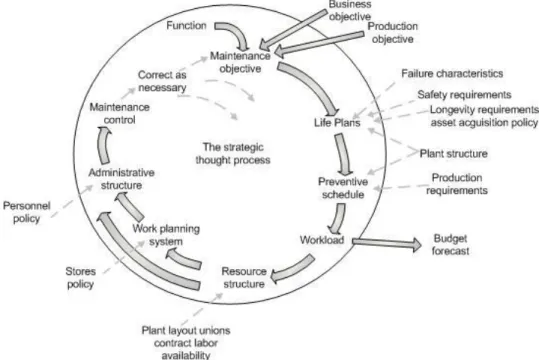
Kelly (2006) has presented a business-centered model (BCM) for the formulation of a maintenance strategy, see figure BCM below. The approach is called business-centered because it is derived from, and driven by, the business objectives identification, which then are translated into maintenance objectives and support the formulation of the maintenance strategy (Kelly, 2006). When to formulate a maintenance strategy it is important to understand how the plant operates, the relationship between the plant and its market and the maintenance function within this context (Kelly, 2006).
According to Kelly (2006) does the maintenance objectives need to be established in relation with the production and business objectives, and before this is done it need to be understood how the
18 maintenance function will be affected by its dynamic relation with the production function. When to set the objectives it need to be done in conjunction with the production department, this is, due to the fact that the production and maintenance objectives are inseparable (Kelly, 2006). The production and maintenance objectives also need to be compatible with the business objectives which can be obtained in Figure 3 below.
The large circle in Figure 3 above illustrates the strategic thought process of the maintenance manager which starts with the maintenance objective of the plant (Kelly, 2006).
McAllister (1999) has also presented a model for the formulation and review of a maintenance strategy. It is pointed out that maintenance should be considered as a partner within the business with the shared overall aim, that is, to produce and sell products at an acceptable margin of profit. In order for this to be achieved it must be understood that all functions within the business contributes to profitability. Thus, the maintenance function should align with the overall business goals. McAllister (1999) also points out that the before developing a maintenance strategy the need for change should be established. In the maintenance philosophy should change be embraced as a major expectation and constituent (McAllister, 1999). The maintenance strategy development process starts with stating the maintenance philosophy which is an expression of the maintenance function’s role within the company and the chosen approach for how to fulfill it. The next step is to consider the aims and objectives of the maintenance function. The aims can be at corporate, production and maintenance levels and the objectives must respond to the driving forces from production. The third step is to assess and evaluate the maintenance practices and issues. Figure 4 below represents the range of maintenance policy sectors and corresponding
Figure 3. A business-centered model (BCM) for the formulation of a maintenance strategy (Kelly, 2006)
19 practices to consider for this assessment which, after completion, may be used to develop a maintenance program. Then should tactics, for how to integrate existing practices with new ones, be developed. The last step is to determine the implementation plan (McAllister, 1999).
Factors that describe the general organizational structure, technically describe each system to maintain, as well as factors that describe interrelations between the different systems should be addressed. The maintenance concept will not reach its full potential if some of the required aspects are not included in the development of the strategy. A careless analysis, lost data or lack of knowledge might be reasons for an inadequate strategy. Due to the operational impact that maintenance may have on the equipment’s performance and the involvement of high direct as well as indirect cost, for both in-house and outsourcing maintenance, the development of the maintenance strategy should be done in a structured way (Waeyenbergh and Pintelon, 2002).
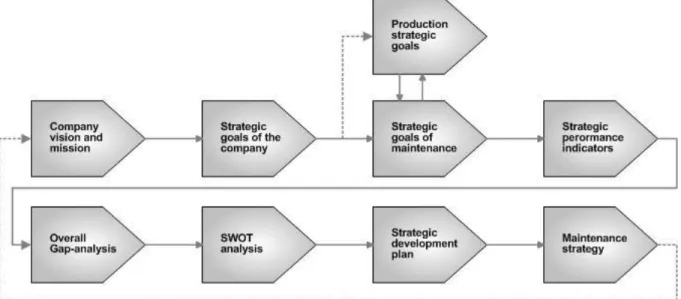
20 Concerning the formulation of a maintenance strategy a model proposed by Salonen (2009) will also be presented in this thesis. This model is a schematic view of the work-process when formulating a maintenance strategy and is presented in Figure 5 below.
Salonen (2011) describes the different parts within the model as follows:
1. Company vision and mission – The strategy should be based on the company vision and the mission.
2. Formulation of the strategic goals of the company – These goals should be supported by all functional strategies. Regarding the maintenance strategy it is essential to consider not only the overall strategic goals of the company, but also the goals of the production which is the customer to the maintenance organisation.
3. Define the strategic goals of maintenance – The strategic goals of both the production department and the company should be considered and the goals should reflect both effectiveness and efficiency. This is, in order to satisfy all stakeholders.
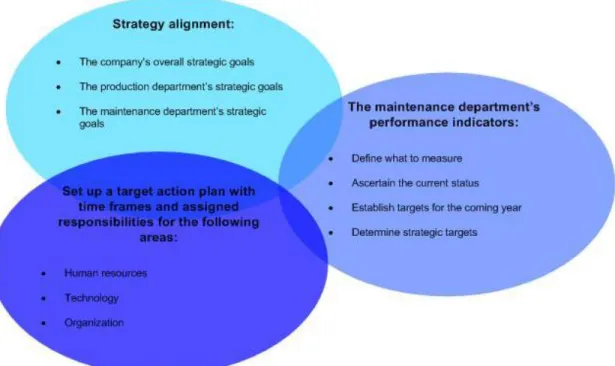
4. Tie the strategic goals to strategic performance indicators – The performance indicators are measured in order to evaluate the fulfillment of the strategic goals. All stakeholders, such as the production department and the owners, should preferrably be involved when choosing the performance indicators. The acceptance of the strategy among the stakeholders will with that approach increase. In order to avoid misinterpretations, the indicators need to be well-defined. Responsibilities, data collection methods and sources of data may also be defined in the strategy formulation.
5. Perform the overall GAP – analysis – Adress current or potential gaps in maintenance performance and when this is done, identify factors which potentially may influence the gap between current and desired levels.
6. Perform a SWOT (Strengths, Weaknesses, Opportunities, Threats) analysis – Adress the identified gaps in relation to factors considered strategic for the development of the Figure 5. A schematic view of the work-process when formulating a maintenance strategy (Salonen, 2009)
21 maintenance function. From the result of the SWOT analysis may a list of actions be identified.
7. Determine a strategic development plan – This plan can be set up by prioritizing the actions identified from the SWOT analysis.
8. Formulate the maintenance strategy – When the strategic development plan is in place may the maintenance strategy be formulated (Salonen, 2011).
In order to formulate a maintenance strategy and produce a maintenance plan, following questions need to be answered (Gupta, 2009):
What should be done?
Which are the most important items?
What are the legal requirements to be considered?
When can the work be performed in order to avoid loss of production?
In which frequency should surveys, inspections, works and tests be carried out? From where does the money come?
Salonen (2011) propose a structure to follow when to formulate the maintenance strategy, see Figure 6below.
A maintenance strategy should function as a road map which allows and includes alternatives, it is not meant to go in just one direction. The maintenance strategy must remain flexible in order for it to change with the company’s situation. The road map can be created based on results from benchmarking and from observations of the company’s own best plants as well as others already do. The vision is the description of desired excellence regardless from where the direction originates. The already existing practices need to be changed if they don’t match the vision, and
22 this is regardless if it is good or bad. The plans need to be more or less detailed dependent on how much change desired (Campbell and Reyes-Picknell, 2006).
3.2.3 Implementation of a maintenance strategy
There are many opinions on how the strategy should be implemented, but something that characterizes most is that there is no standard for how the implementation to take place. Rubenowitz believe that every organization has its own problems and will face its own problems. The conditions of which will vary greatly, which makes it difficult to use standards. Below are some approaches.
According to Campbell and Reynes-Picknell (2006) the implementation on the tactical level is based on the strategy and the following components are to be included, see Figure 7 below:
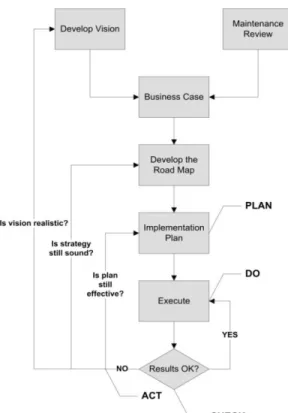
Supply chain, finance, accounting, training departments, operations, and plant management will all be affected by the maintenance strategy therefore, it should not only be the maintenance department’s responsible for putting the strategy together. Thus, it is a team effort. The details in the implementation plan do not need to be included in the document or statement of the strategy, those can be managed separately, the strategy should not be too complicated with excessive details – it should be simple. The detailed implementation plans should preferably start to be developed first when the strategy is stated, and move forward with the implementation details and execution of them step by step. Figure 8 below illustrates the development process of the maintenance strategy which is highly effective: Plan – Do – Check – Act (PDCA cycle).
23 The entire transition to the point where the vision is attained should be covered in the strategy. The implementation plan, a description of who will do what in specified time frames, is developed from the road map. From each part of the vision a work stream will be formed (Campbell and Reyes-Picknell, 2006). When developing an implementation plan the following should be considered:
The task and its key activities
Prioritize the initiatives. If there are several ongoing improvement projects, how much senior management time should be spent on each?
Estimate needed resources and level of effort
Appoint the “champion” which assignment is to ensure successful completion and the “sponsor” which tasks are to provide the resources
Establish start date, completion date, and milestones along the road
Define the goal to be achieved on successful completion, and the parameters to measure to determine if the project is on the right track
Define and evaluate the challenges along the way that can derail the efforts or cause a lose focus
The implementation of the plans is far more than a technical project. Human change is involved, which is the hard part. It is crucial not to ignore change management on every level within the organization (Campbell and Reyes-Picknell, 2006).
Figure 8. Strategy Development Process using the PDCA cycle (Campbell and Reyes-Picknell, 2006).
24 As described, Rubenowitz (2004) states that there are no standard solutions for implementing an organizational change since all companies suffer from issues specific for their company. However Rubenowitz (2004) also states that the most essential when implementing a change in an organization is the level of ambition. The most successful changes have been found in situation where the initial step is made in small areas. A change process is an ongoing project and should be performed in smaller processes which are then spread over the organization (Rubenowitz, 2004). Slack and Lewis (2008) views a implementation as all activities involved in making the strategy work as intended. It is advocated to uses, the five Ps, which are the following: Purpose, Point of entry, Process, Project management and participation. To a large extent Slack and Lewis (2008) focuses on operations, and hence the work will not go into detail on all steps, however, a few areas are highlighted below.
Purpose – in this context the purpose covers the strategic context. In which the connection the organizations resource capabilities is linked and fit to the requirements of its market. It also includes the perception of, understanding of, and cope with risk involved with change. These are all to be included in the implementation plan (Slack and Lewis, 2008). Important aspects here are how to manage risks. Slack and Lewis, describes prevention strategies, where the aim is to prevent a problem arises, mitigating strategies where the event causing the risk is isolated from causing negative consequences. Also, recovery strategies where the operation accepts the consequence from the event happening but actions are undertaken to minimize or compensate them.
Point of entry – This aspect highlights different organizational structures ability to change, it should be noted however, that each has its strengths and weaknesses and to propose an organizational structure is therefore difficult to do. Further, also it is important to heed the fact that an implementation process can be politically sensitive within the organization or company. For this reason, also support from the hierarchy is central to the success of the change (Slack and Lewis, 2008).
Process- This step covers the methodology of implementing formulation of the strategy. That is, the means and methods and the approach which are to be taken to formulate the strategy (Slack and Lewis, 2008). This focus area should also take into account the cost of implementation. A change may affect the process negatively in an initial stage, this influence may have economic effect, which Slack and Lewis (2008) categorizes the adjustment cost.
Project management - implementing a strategy is a big project and need to be treated as such. Slack and Lewis means that it is more of a program than a project. A project has a defined start and end point, a goal and defined resources. A program does not; rather it is an ongoing process. It should include documentation of stakeholders, resource and time planning, controls, communication and reviews. One area that in many cases may need a special focus is just stakeholders, which in some cases have the power to affect change, hence they should never be
25 ignored, and above all they should be kept informed (Slack and Lewis, 2008), see also Figure 9, showing the interest in stakeholders.
Figure 9. Stakeholder interest and how to include the stakeholder
Participation - Dedicated employees are obtained if those affected by the change also may be part of the process to develop the implementation stage. Bringing in too many staff may however have the effect that the change resemble today's situation too much as many may be limited by current experience.
3.3 Maintenance Management
Figure 10. An illustration of the management organization’s main tasks (Bergman and Klefsjö, 2010).
Maintenance management is a support organization, in a world-class organization the mission of maintenance is to achieve and sustain optimum availability of the business productive assets (plant, equipment, vehicles etc.). The product that maintenance delivers is uptime, i.e. availability (Mobley, 2004; Campbell and Reyes-Picknell, 2006). See also Figure 10, explaining the connection between mission – what to achieve, vision – where to go and the policies, goals and strategies – the how to do it.
26
Definition Maintenance Management
“All activities of the management that determines the maintenance objectives, strategies, and responsibilities and implement them by means such as maintenance planning, maintenance control and supervision, improvement of methods in the organization including economic aspects.” (prEN 13306, 1998)
Gupta (2009) defines Maintenance management as:
“A combination of different skills, including the experience and technical knowledge necessary to specify remedies and to identify the needs of maintenance.”
The elements to the management of any physical asset that are important from an engineering viewpoint is according to Moubray (1997) that the asset must be maintained and that it need to be modified from time to time.
Maintenance management generally consists of the following basic concepts (Gupta, 2009): 1. Setting aims and objectives
2. Providing the means of attaining those aims and objectives 3. Decision making
The maintenance function must integrate five major factors in order to achieve optimum costs for upkeep and repair, and those factors are (Gupta, 2009):
1. People 2. Policies 3. Equipment 4. Practices
5. Performance evaluation
3.3.1 The role of Maintenance Organization
Many maintenance organizations are pride of how fast they can react to production disturbances or catastrophic failure instead of their ability to prevent such events. Most plants continue to operate in this breakdown mode while few admit their continued adherence to this mentality. The role of the maintenance organization is in contrary to the popular belief; it is to maintain the equipment of the plant i.e. to be proactive and not to repair it after failure i.e. reactive. However, all catastrophic failures cannot be avoided and maintenance must therefore continue to react quickly to unexpected failures (Mobley, 2004). Optimum reliability is one part which determines the production capacity of the plant. Maintenance organization primary function is to ensure that all equipment and systems always are in good operating condition and on line, in other words to reduce disturbances (Mobley, 2004).
27 Production Disturbances
Production disturbances are a concept which is differently defined dependent on from which perspective the disturbances are regarded;
Maintenance perspective – Disturbances seen as technical errors or interruption. Production perspective – Disturbances seen from the aspect of efficiency.
Security perspective – Disturbances seen from the aspect of risks and consequences. Quality perspective – Variation in product quality is the focus.
The prerequisite of finding the best way to handle disturbances, are