(will be inserted by the editor)
Bayesian model comparison with un-normalised likelihoods
Richard G. Everitt · Adam M. Johansen · Ellen Rowing · MelinaEvdemon-Hogan
Received: date / Accepted: date
Abstract Models for which the likelihood function can be evaluated only up to a parameter-dependent un-known normalizing constant, such as Markov random field models, are used widely in computer science, stat-istical physics, spatial statistics, and network analysis. However, Bayesian analysis of these models using stand-ard Monte Carlo methods is not possible due to the in-tractability of their likelihood functions. Several meth-ods that permit exact, or close to exact, simulation from the posterior distribution have recently been developed. However, estimating the evidence and Bayes’ factors (BFs) for these models remains challenging in general. This paper describes new random weight importance sampling and sequential Monte Carlo methods for es-timating BFs that use simulation to circumvent the evaluation of the intractable likelihood, and compares them to existing methods. In some cases we observe an advantage in the use ofbiased weight estimates. An initial investigation into the theoretical and empirical properties of this class of methods is presented. Some support for the use of biased estimates is presented, but we advocate caution in the use of such estimates.
Keywords approximate Bayesian computation ·
Bayes’ factors · importance sampling · marginal likelihood· Markov random field·partition function·
sequential Monte Carlo
R. G. Everitt·E. Rowing·M. Evdemon-Hogan
Department of Mathematics and Statistics, University of Reading, UK.
E-mail: [email protected] A. M. Johansen
Department of Statistics, University of Warwick, Coventry, CV4 7AL, UK.
E-mail: [email protected]
1 Introduction
There has been much recent interest in performing Bayesian inference in models where the posterior is in-tractable and, in particular, we have the situation in which the posterior distribution π(θ|y) ∝ p(θ)f(y|θ), cannot be evaluated pointwise. This intractability typ-ically occurs occurs due to the intractability of the like-lihood, i.e. f(y|θ) cannot be evaluated pointwise. Ex-ample scenarios include:
1. the use of big data sets, where f(y|θ) consists of a product of a large number of terms;
2. the existence of a large number of latent variables x, with f(y|θ) known only as a high dimensional integral f(y|θ) =R
xf(y, x|θ)dx;
3. when f(y|θ) = Z1(θ)γ(y|θ), with Z(θ) being an in-tractable normalising constant (INC) for the tract-able termγ(y|θ) (e.g. whenf factorises as a Markov random field);
4. where it is possible to sample from f(·|θ), but not to evaluate it, such as when the distribution of the data given θ is modelled by a complex stochastic computer model.
Each of these (overlapping) situations has been con-sidered in some detail in previous work and each has inspired different methodologies.
In this paper we focus on the third case, in which the likelihood has an INC. This is an important prob-lem in its own right (Girolami et al (2013) refer to it as “one of the main challenges to methodology for compu-tational statistics currently”). There exist several com-peting methodologies for inference in this setting (see Everitt (2012)). In particular, the “exact” approaches of Møller et al (2006) and Murray et al (2006) exploit the decompositionf(y|θ) = 1
Z(θ)γ(y|θ), whereas
ulation based” methods such as approximate Bayesian computation (ABC) (Grelaud et al 2009) do not de-pend upon such a decomposition and can be applied more generally: to situation 1 in Picchini and Forman (2013); situations 2 and 3 (e.g. Everitt (2012)) and situ-ation 4 (e.g. Wilkinson (2013)).
This paper considers the problem of Bayesian model comparison in the presence of an INC. We explore both exact and simulation-based methods, and find that ele-ments of both approaches may also be more generally applicable. Specifically:
– For exact methods we find that approximations are required to allow practical implementation, and this leads us to investigate the use of approximate weights in importance sampling (IS) and sequential Monte Carlo (SMC). We examine the use of both exact-approximateapproaches (as in Fearnhead et al (2010)) and also “inexact-approximate” methods, in which complete flexibility is allowed in the approximation of weights, at the cost of losing the exactness of the method. This work is a natural counterpart to Alquier et al (2015), which examines ananalogous question (concerning the acceptance probability) for Markov chain Monte Carlo (MCMC) algorithms. These generally applicable methods, “noisy MCMC” (Alquier et al 2015) and “noisy SMC” (this paper) have some potential to address situations 1-3. – We provide some comparison of these inexact
ap-proximations with simulation-based methods, includ-ing the “synthetic likelihood” (SL) of Wood (2010). In the applications considered here we find this to be a viable alternative to ABC. Our results are suggest-ive that this, and related methods, may find success in scenarios in which ABC is more usually applied. In the remainder of this section we briefly outline the problem of, and methods for, parameter inference in the presence of an INC. We then detail the problem of Bayesian model comparison in this context, before discussing methods for addressing it in the following two sections.
1.1 Parameter inference
In this section we consider the problem of simulating fromπ(θ|y)∝p(θ)γ(y|θ)/Z(θ) using MCMC. This prob-lem has been well studied, and such models are termed doubly intractable because the acceptance probability in the Metropolis-Hastings (MH) algorithm
min 1,q(θ|θ ∗) q(θ∗|θ) p(θ∗) p(θ) γ(y|θ∗) γ(y|θ) Z(θ) Z(θ∗) , (1)
cannot be evaluated due to the presence of the INC. We first review exact methods for simulating from such a
target in sections 1.1.1-1.1.3, before looking at simulation-based methods in sections 1.1.4 and 1.1.5. The methods described here in the context of MCMC form the basis of the methods for evidence estimation developed in the remainder of the paper.
1.1.1 Single and multiple auxiliary variable methods
Møller et al (2006) avoid the evaluation of the INC by augmenting the target distribution with an extra variableuthat lies on the same space asy, and use an MH algorithm with target distribution
π(θ, u|y)∝qu(u|θ, y)f(y|θ)p(θ),
where qu is some (normalised) arbitrary distribution. As the MH proposal in (θ, u)-space they use
(θ∗, u∗)∼f(u∗|θ∗)q(θ∗|θ),
giving an acceptance probability of
min 1,q(θ|θ ∗) q(θ∗|θ) p(θ∗) p(θ) γ(y|θ∗) γ(y|θ) qu(u∗|θ∗, y) γ(u∗|θ∗) γ(u|θ) qu(u|θ, y) .
Note that, by viewing qu(u∗|θ∗, y)/γ(u∗|θ∗) as an unbiased IS estimator of 1/Z(θ∗), this algorithm can be seen as an instance of theexact approximations de-scribed in Beaumont (2003) and Andrieu and Roberts (2009), where it is established that if an unbiased es-timator of a target density is used appropriately in an MH algorithm, the θ-marginal of the invariant distri-bution of this chain is the target distridistri-bution of inter-est. This automatically suggests extensions to the sin-gle auxiliary variable (SAV) method described above, whereM >1 importance points are used, yielding:
d1 Z(θ) = 1 M M X m=1 qu(u(m)|θ, y) γ(u(m)|θ) . (2) Andrieu and Vihola (2012) show that the reduced vari-ance of this estimator leads to a reduced asymptotic variance of estimators from the resultant Markov chain. The variance of the IS estimator is strongly dependent on an appropriate choice of IS target qu(·|θ, y), which should have lighter tails thanf(·|θ). Møller et al (2006) suggest that a reasonable choice may be qu(·|θ, y) = f(·|bθ), where θb is the maximum likelihood estimator
of θ. However, in practice qu(·|θ, y) can be difficult to choose well, particularly wheny lies on a high dimen-sional space. Motivated by this, annealed importance sampling (AIS) (Neal 2001) can be used as an alter-native to IS, leading to the multiple auxiliary variable (MAV) method of Murray et al (2006). AIS makes use
of a sequence ofKtargets, which in Murray et al (2006) are chosen to be
fk(·|θ,θ, yb )∝γk(·|θ,bθ, y)
=γ(·|θ)(K+1−k)/(K+1)qu(·|θ, y)k/(K+1) (3) betweenf(·|θ) andqu(·|θ, y). After the initial drawuK+1∼ f(·|θ), the auxiliary point is taken through a sequence of K MCMC moves which successively have target fk(·|θ,θ, yb ) fork=K: 1. The resultant IS estimator is
given by d1 Z(θ) = 1 M M X m=1 K Y k=1 γk(u(km−)1|θ,θ, yb ) γk−1(u (m) k−1|θ,θ, yb ) . (4)
This estimator has a lower variance (although at a higher computational cost) than the corresponding IS estima-tor. We note that AIS can be viewed as a particular case of SMC without resampling and one might expect to obtain additional improvements at negligible cost by incorporating resampling steps within such algorithms (see Zhou et al (2015) for an illustration of the potential improvement and some discussion); we do not pursue this here as it is not the focus of this work.
1.1.2 Exchange algorithms
An alternative approach to avoiding the ratio of INCs in equation (1) is given by Murray et al (2006), in which it is suggested to use the acceptance probability min 1,q(θ|θ ∗) q(θ∗|θ) p(θ∗) p(θ) γ(y|θ∗) γ(y|θ) γ(u|θ) γ(u|θ∗) ,
whereu∼f(·|θ∗), motivated by the intuitive idea that γ(u|θ)/γ(u|θ∗) is a single point IS estimator of Z(θ)/Z(θ∗). This method is shown to have the correct invariant distribution, as is the extension in which AIS is used in place of IS. A potential extension might seem to be using multiple importance points {u(m)}M
m=1 ∼ f(·|θ∗) to obtain an estimator ofZ(θ)/Z(θ∗) that has a smaller variance, with the aim of improving the sta-tistical efficiency of estimators based on the resultant Markov chain. This scheme is shown to work well em-pirically in Alquier et al (2015). However, this chain does not have the desired target as its invariant dis-tribution. Instead it can be seen as part of a wider class of algorithms that use a noisy estimate of the acceptance probability: noisy Monte Carlo algorithms (also referred to as “inexact approximations” in Giro-lami et al (2013)). Alquier et al (2015) shows that under uniform ergodicity of the ideal chain, a bound on the expected difference between the noisy and true accep-tance probabilities can lead to bounds on the disaccep-tance between the desired target distribution and the iterated
noisy kernel. It also describes additional noisy MCMC algorithms for approximately simulating from the pos-terior, based on Langevin dynamics.
1.1.3 Russian Roulette and other approaches
Girolami et al (2013) use series-based approximations to intractable target distributions within the exact-approximation framework, where “Russian Roul-ette” methods from the physics literature are used to ensure the unbiasedness of truncations of infinite sums. These methods do not require exact simulation from f(·|θ∗), as do the SAV and exchange approaches de-scribed in the previous two sections. However, SAV and exchange are often implemented in practice by generat-ing the auxiliary variables by takgenerat-ing the final point of a long “internal” MCMC run in place of exact simulation (e.g Caimo and Friel (2011)). For finite runs of the in-ternal MCMC, this approach will not have exactly the desired invariant distribution, but Everitt (2012) shows that under regularity conditions the bias introduced by this approximation tends to zero as the run length of the internal MCMC increases: the same proof holds for the use of an MCMC chain for the simulation within an ABC-MCMC (i.e. MCMC applied to an ABC ap-proximation of the posterior, Marjoram et al (2003)) or SL-MCMC (i.e. MCMC applied to an SL approx-imation) algorithm, as described in sections 1.1.4 and 1.1.5. Although the approach of Girolami et al (2013) is exact, as they note it is significantly more computation-ally expensive than this approximate approach. For this reason, we do not pursue Russian Roulette approaches further in this paper.
When a rejection sampler is available for simulating fromf(·|θ∗), Rao et al (2013) introduce an alternative exact algorithm that has some favourable properties compared to the exchange algorithm. Since a rejection sampler is not available in many cases, we do not pursue this approach further.
1.1.4 Approximate Bayesian computation
Approximate Bayesian Computation (Tavar´e et al 1997) refers to methods that aim to approximate an intractable likelihoodf(y|θ) through the integral
e
f(S(y)|θ)∝ Z
π(S(y)|S(u))f(u|θ)du (5) where S(·) gives a vector of summary statistics and π(S(y)|S(u)) is the density of a symmetric kernel with bandwidth, centered at S(u) and evaluated at S(y). As→0, this distribution becomes more concentrated, so that in the case whereS(·) gives sufficient statistics
for estimating θ, as → 0 the approximate posterior becomes closer to the true posterior. This approxima-tion is used within standard Monte Carlo methods for simulating from the posterior. For example, it may be used within an MCMC algorithm, where using an exact-approximation argument it can be seen that it is suf-ficient in the calculation of the acceptance probability to use the Monte Carlo approximation
b f(S(y)|θ∗) = 1 M M X m=1 πS(y) S u(m) (6)
for the likelihood at θ∗ at each iteration, where
{u(m)}M
m=1 ∼ f(·|θ∗). Whilst the exact-approximation argument means that there is no additional bias due to this Monte Carlo approximation, the approximation introduced through using a tolerance > 0 or insuf-ficient summary statistics may be large. For this rea-son it might be considered a last resort to use ABC on likelihoods with an INC, but previous success on these models (e.g Grelaud et al (2009) and Everitt (2012)) lead us to consider them further in this paper.
1.1.5 Synthetic likelihood
ABC is essentially using, based on simulations fromf, a nonparameteric estimator of fS(S|θ), the distribu-tion of the summary statistics of the data given θ. In some situations, a parametric model might be more ap-propriate. For example, if the statistic is the sum of independent random variables, a Central Limit Theo-rem (CLT) might imply that it would be appropriate to assume thatfS(S|θ) is a multivariate Gaussian.
The SL approach (Wood 2010) proceeds by making exactly this Gaussian assumption and uses this approx-imate likelihood within an MCMC algorithm. The pa-rameters (the mean and variance) of this approximat-ing distribution for a givenθare estimated based on the summary statistics of simulations{u(m)}M
m=1∼f(·|θ). Concretely, the estimate of the likelihood is
b fSL (S(y)|θ) =NS(y);µθ,b Σθb , where b µθ= 1 M M X m=1 Su(m) Σθb = ssT M−1, (7) with s = (S(u1)−µbθ, ..., S(uM)−bµθ). Wood (2010)
applies this method in a setting where the summary statistics are regression coefficients, motivated by their distribution being approximately normal. One of the approximations inherent in this method, as in ABC, is the use of summary statistics rather than the whole
dataset. However, unlike ABC, there is no need to choose a bandwidth: this approximation is replaced with that arising from the discrepancy between the normal ap-proximation and the exact distribution of the chosen summary statistic. The SL method remains approxi-mate even if the summary statistic distribution is Gaus-sian asfbSL is not an unbiased estimate of the density
and so the exact-approximation results do not apply. Rather, this is a special case of noisy MCMC, and we do not expect the additional bias introduced by esti-mating the parameters offbSL to have large effects on
the results, even if the parameters are estimated via an internal MCMC chain targeting f(·|θ) as described in section 1.1.3.
SL is related to a number of other simulation based algorithms under the umbrella of Bayesian indirect in-ference (Drovandi et al 2015). This suggests a number of extensions to some of the methods presented in this paper that we do not explore here.
1.2 Bayesian model comparison
The main focus of this paper is estimating themarginal likelihood (also termed theevidence)
p(y) =
Z
p(θ)f(y|θ)dθ
andBayes’ factors: ratios of evidences for different mod-els (M1andM2, say), BF12=p(y|M1)/p(y|M2). These quantities cannot usually be estimated reliably from MCMC output, and commonly used methods for es-timating them requiref(y|θ) to be tractable inθ. This leads Friel (2013) to label their estimation as “triply intractable”whenf has an INC. To our knowledge the only published approach to estimating the evidence for such models is in Friel (2013), with this paper also giv-ing one of the only approaches to estimatgiv-ing BFs in this setting. For estimating BFs, ABC provides a vi-able alternative (Grelaud et al 2009), at least for models within the exponential family.
Friel (2013) starts from Chib’s approximation,
b
p(y) = f(y|eθ)p(θe)
b
π(eθ|y)
, (8)
where θe can be an arbitrary value of θ and πb is an
approximation to the posterior distribution. Such an approximation is intractable whenf has an INC. Friel (2013) devises a “population” version of the exchange algorithm that simulates pointsθ(p)from the posterior distribution, and which also gives an estimateZb(θ(p))
of the INC at each of these points. The pointsθ(p)can be used to find a kernel density approximationπb, and
estimates Zb(θ(p)) of the INC. These are then used in
a number of evaluations of (8) at points (generated by the population exchange algorithm) in a region of high posterior density, which are then averaged to find an estimate of the evidence. This method has a number of useful properties (including that it may be a more ef-ficient approach for parameter inference than the stan-dard exchange algorithm), but for evidence estimation it suffers the limitation of using a kernel density esti-mate which means that, as noted in the paper, its use is limited to low-dimensional parameter spaces.
In this paper we explore the alternative approach of methods based on IS, making use of the likelihood approximations described earlier in this section. These IS methods are outlined in section 2. In section 2 we note the good empirical performance of an inexact-approximate method and examine such approaches in more detail. As IS is itself not readily applicable to high dimensional parameter spaces, in section 3 we look at natural extensions to the IS methods based on SMC. Particular care is required when considering approxi-mations within iterative algorithms: we provide a pre-liminary study of approximation in this context demon-strating theoretically that the resulting error can be controlled uniformly in time, under very favorable as-sumptions. This, and the associated empirical study are intended to provide motivation and proof of con-cept; caution is still required if approximation is used within such methods in practice but the results pre-sented suggest that further investigation is warranted. The algorithms presented later in the paper are viable alternatives to the MCMC approaches to parameter es-timation described in this section, and may outperform the corresponding MCMC approach in some cases. In particular they all automatically make use of a pop-ulation of points, an idea previously explored in the MCMC context by Caimo and Friel (2011) and Friel (2013). In section 4 we draw conclusions.
2 Importance sampling approaches
In this section we investigate the use of IS for estimat-ing the evidence and BFs for models with INCs. We consider an “ideal” importance sampler that simulates P pointsθ(p) Pp=1 from a proposalq(·) and calculates their weight, in the presence of an INC, using
e
w(p)= p(θ
(p))γ(y|θ(p))
q(θ(p))Z(θ(p)) , (9) with an estimate of the evidence given by
b p(y) = 1 P P X p=1 e w(p). (10)
To estimate a BF we simply take the ratio of estimates of the evidence for the two models under considera-tion. However, the presence of the INC in the weight expression in (9) means that importance samplers can-not be directly implemented for these models. To cir-cumvent this problem we will investigate the use of the techniques described in section 1.1 in importance sampling. We begin by looking at exact-approximation based methods in section 2.1. We then examine the use to approximate likelihoods based on simulation, includ-ing ABC and SL in section 2.2, before lookinclud-ing at the performance of all of these methods on a toy example in section 2.3. Finally, in sections 2.4 and 2.6 we exam-ine applications to exponential random graph models (ERGMs) and Ising models, the latter of which leads us to consider the use of inexact-approximations in IS (first introduced in section 2.5).
2.1 Auxiliary variable IS
To avoid the evaluation of the INC in (9), we propose the use of the auxiliary variable method used in the MCMC context in section 1.1.1. Specifically, consider IS using the SAV target
p(θ, u|y)∝qu(u|θ, y)f(y|θ)p(θ),
noting that it has the same normalizing constant as p(θ|y)∝f(y|θ)p(θ), with proposal
q(θ, u) =f(u|θ)q(θ). This results in weights
e w(p)= qu(u|θ (p), y)γ(y|θ(p))p(θ(p)) γ(u|θ(p))q(θ(p)) Z(θ(p)) Z(θ(p)) = γ(y|θ (p))p(θ(p)) q(θ(p)) qu(u|θ(p), y) γ(u|θ(p)) , and the estimate (10) of the evidence.
In this method, which we will refer to as single
auxil-iary variable IS (SAVIS), we may view
qu(u|θ(p), y)/γ(u|θ(p)) as an unbiased importance sam-pling (IS) estimator of 1/Z(θ(p)). Although we are us-ing an unbiased estimator of the weights in place of the ideal weights, the result is still an exact importance sampler. SAVIS is an exact-approximate IS method, as seen previously in Fearnhead et al (2010), Chopin et al (2013) and Tran et al (2013). As in the MCMC setting, to ensure the variance of estimators produced by this scheme is not large we must ensure the variance of esti-mator of 1/Z(θ(p)) is small. Thus in practice we found extensions to this basic algorithm were useful: using multipleuimportance points for each proposedθ(p) as
in (2); and using AIS, rather than simple IS, for esti-mating 1/Z(θ(p)) as in (4) (giving an algorithm that we refer to as multiple auxiliary variable IS (MAVIS), in common with the terminology in Murray et al (2006)). Using qu(·|θ, y) = f(·|bθ), as described in section 1.1.1, andγk as in (3), we obtain d1 Z(θ) = 1 Z(θb) 1 M M X m=1 K Y k=1 γk(u(km−)1|θ∗, θ, y) γk−1(u(km−)1|θ∗, θ, y) . (11)
In this case the (A)IS methods are being used as unbi-ased estimators of the ratioZ(θb)/Z(θ) and again SMC
could be used in their place.
2.2 Simulation based methods
Didelot et al (2011) investigate the use of the ABC approximation when using IS for estimating marginal likelihoods. In this case the weight equation becomes
e w(p)=p(θ (p))1 R PR r=1π(S(y)|S(x (p) r )) q(θ(p)) , where nx(rp) oR r=1 ∼ f(·|θ
(p)), and using the notation from section 1.1.4. However, using these weights within (10) gives an estimate for p(S(y)) rather than, as de-sired, an estimate of the evidencep(y).
Fortunately, there are cases in which ABC may be used to estimate BFs. Didelot et al (2011) establish that, for the BF for two exponential family models: if S1(y) is sufficient for the parameters in model 1 and S2(y) is sufficient for the parameters in model 2, then usingS(y) = (S1(y), S2(y)) gives p(y|M1) p(y|M2) = p(S(y)|M1) p(S(y)|M2) .
Outside the exponential family, making an appropri-ate choice of summary statistics is harder (Robert et al 2011; Prangle et al 2014; Marin et al 2014).
Just as in the parameter estimation case, the use of a tolerance > 0 results in estimating an approxi-mation to the true BF. An alternative approxiapproxi-mation, not previously used in model comparison, is to use SL (as described in section 1.1.5). In this case the weight equation becomes e w(p)= p(θ(p))NS(y); b µθ(p),Σbθ(p) q(θ(p)) ,
where µθ,b Σθb are given by (7). As in parameter
esti-mation, this approximation is only appropriate if the normality assumption is reasonable. The choice of sum-mary statistics is as difficult as in the ABC case.
2.3 Toy example
In this section we have discussed three alternative meth-ods for estimating BFs: MAVIS, ABC and SL. To fur-ther understand their properties we now investigate the performance of each method on a toy example.
Consider i.i.d. observations y={yi}ni=1=100 of a dis-crete random variable that takes values inN. For such a dataset, we will find the BF for the models
1. y|θ∼Poisson(θ),θ=λ∼Exp(1) f1(y|θ) = n Y i=1 λyi yi!/exp(−nλ) 2. y|θ∼Geometric(θ),θ=p∼Unif(0,1) f2(y|θ) = n Y i=1 (1−p)yi/p−n.
In both cases we have rewritten the likelihoodsf1 and f2in the formγ(y|θ)/Z(θ) in order to use MAVIS. Due to the use of conjugate priors the BF for these two mod-els can be found analytically. As in Didelot et al (2011) we simulated (using an approximate rejection sampling scheme) 1000 datasets for which p(y|M1)
p(y|M1)+p(y|M2)roughly uniformly cover the interval [0.01,0.99], to ensure that testing is performed in a wide range of scenarios. For each algorithm we used the same computational effort, in terms of the number of simulations (100,000) from the likelihood (such simulations dominate the compu-tational cost of all of the algorithms considered).
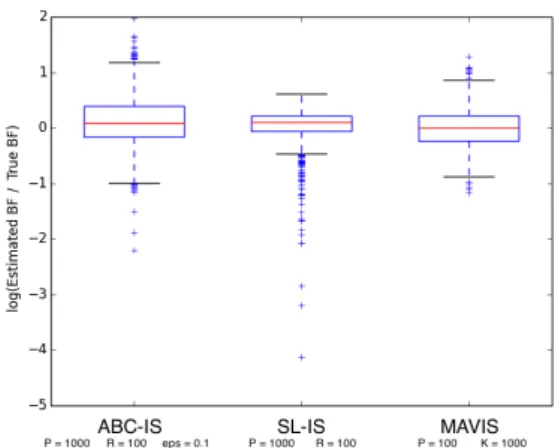
Our results are shown in figure 1, with the algorithm-specific parameters being given in figure 1a. We note that we achieved better results for MAVIS when: de-voting more computational effort to the estimation of 1/Z(θ) (thus we used only 100 importance points in θ-space, compared to 1000 for the other algorithms); and using more intermediate bridging distributions in the AIS, rather than multiple importance points (thus, in equation (11) we used K = 1000 and M = 1). In the ABC case we found that reducing much further than 0.1 resulted in many importance points with zero weight (note that here, and throughout the paper we use the uniform kernel for π). From the box plots in figure 1a, we might infer that overall SL has outper-formed the other methods, but be concerned about the number of outliers. Figures 1b to 1d shed more light on the situations in which each algorithm performs well.
In figure 1b we observe that the non-zeroresults in a bias in the BF estimates (represented by the shallower slope in the estimated BFs compared to the true val-ues). In this example we conclude that ABC has worked quite well, since the bias is only pronounced in situa-tions where the true BF favours one model strongly over
(a) A box plot of the log of the estimated BF divided by the true BF.
(b) The log of the BF estimated by ABC-IS against the log of the true BF.
(c) The log of the BF estimated by SL-IS against the log of the true BF.
(d) The log of the BF estimated by MAVIS against the log of the true BF.
Fig. 1: Bayes’ factors for the Poisson and geometric models.
the other, and this conclusion would not be affected by the bias. For this reason it might be more relevant in this example to consider the deviations from the shallow slope, which are likely due to the Monte Carlo variance in the estimator (which becomes more pronounced as is reduced). We see that the choice ofessentially gov-erns a bias-variance trade-off, and that the difficulty in using the approach more generally is that it is not easy to evaluate whether a choice of that ensures a low variance also ensures that the bias is not signifi-cant in terms of affecting the conclusions that might be drawn from the estimated BF (see section 2.4). Figure 1c suggests that SL has worked extremely well (in terms of having a low variance) for the most important situa-tions, where the BF is close to 1. However, we note that the large biases introduced due to the limitation of the Gaussian assumption when the BF is far from 1. Figure 1d indicates that there is little or no bias when using
MAVIS, but that there is appreciable variance (due to using IS on the relatively high-dimensionalu-space).
These results highlight that the three methods will be most effective in slightly different situations. The ap-proximations in ABC and SL introduce a bias, the effect of which might be difficult to assess. In ABC (assuming sufficient statistics) this bias can be reduced by an in-creased computational effort allowing a smaller, how-ever it is essentially impossible to assess when this bias is “small enough”. SL is the simplest method to imple-ment, and seems to work well in a wide variety of situa-tions, but the advice in Wood (2010) should be followed in checking that the assumption of normality is appro-priate. MAVIS is limited by the need to perform im-portance sampling on the high-dimensional (θ, u) space but consequently avoids specifying summary statistics, its bias is small, and this method is able to estimate the evidence of individual models.
ABC (= 0.1) ABC (= 0.05) SL MAVIS ˆ p(y|M1) ˆ p(y|M2) 4 20 40 41
Table 1: Model comparison results for Gamaneg data. Note that the ABC ( = 0.05) estimate was based upon just 5 sample points of non-zero weight. MAVIS also provides estimates of the individual evidence (log [pb(y|M1)] =−69.6, log [bp(y|M2)] =−73.3).
2.4 Application to social networks
In this section we use our methods to compare the evi-dence for two alternative ERGMs for the Gamaneg data previously analysed in Friel (2013) (who illustrate the data in their figure 3). An ERGM has the general form f(y|θ) = 1
Z(θ)exp θ TS(y)
,
where S(y) is a vector of statistics of a network y and θ is a parameter vector of the same length. We take S(y) = (# of edges ) in model 1 and S(y) = (# of edges, # of two stars) in model 2 . As in Friel (2013) we use the priorp(θ) =N(θ; 0,25I).
Using a computational budget of 105 simulations from the likelihood (each simulation consisting of an internal MCMC run of length 1000 as a proxy for an ex-act sampler, as described in section 1.1.3), Friel (2013) finds that the evidence for model 1 is ∼ 37×that for model 2. Using the same computational budget for our methods, consisting of 1000 importance points (with 100 simulations from the likelihood for each point), we obtained the results shown in Table 1.
This example highlights the issue with the bias-variance trade-off in ABC, with= 0.1 having too large a bias and= 0.05 having too large a variance. SL per-forms well — in this particular case the Gaussian as-sumption appears to be appropriate. One might expect this, since the statistics are sums of random variables. However, we note that this is not usually the case for ERGMs, particularly when modelling large networks, and that SL is a much more appropriate method for inference in the ERGMs with local dependence (Sch-weinberger and Handcock 2015). A more sophisticated ABC approach might exhibit improved performance, possibly outperforming SL. However, the appeal of SL is in its simplicity, and we find it to be a useful method for obtaining good results with minimal tuning.
2.5 IS with biased weights
The implementation of MAVIS in the previous section is not an exact-approximate method for two reasons:
1. An internal MCMC chain was used in place of an exact sampler;
2. The 1/Z(θb) term in (11) was estimated before
run-ning this algorithm (by using a standard SMC method, with initial distribution being the Bernoulli random graph (which can be simulated from exactly) and final distribution ∝ γ(·|bθ) to estimate Z(θb) (being
the normalising constant ofγ), and taking the recip-rocal) with this fixed estimate being used through-out.
However, in practice, we tend to find that such “inexact-approximations” do not introduce large errors into Bayes’ factor estimates, particularly when compared to standard implementations of ABC (as seen in the pre-vious section).
This example suggests that in practice it may some-times be advantageous to use biased rather than un-biased estimates of importance weights within a ran-dom weight IS algorithm: an observation that is some-what analogous to that made in Alquier et al (2015) in the context of MCMC. This section provides an initial theoretical exploration as to whether this might be a useful strategy in IS.
In order to analyse the behaviour of importance sampling with biased weights, we consider biased es-timates of the weights in equation (10). Let
w(θ) := p(θ)γ(y|θ) Z(θ)q(θ) .
We consider biased randomised weights that admit an additive decomposition,
`
w(θ) :=w(θ) +b(θ) + `Vθ,
in whichb(θ) =E[ `w(θ)|θ]−w(θ) is a deterministic func-tion describing the bias of the weights and `Vθ is a ran-dom variable (more precisely, there is an independent copy of such a random variable associated with every particle), which conditional uponθis of mean zero and variance `σ2
θ= Var( `w(θ)|θ). This decomposition will not generally be available in practice, but is flexible enough to allow the formal description of many settings of in-terest. For instance, one might consider the algorithms presented here by setting b(θ) to the (conditional) ex-pected value of the difference between the approximate and exact weights and `Vθto the difference between the approximate weights and their expected value.
We have immediately that the bias of such an es-timate is, using a subscript ofqto denote expectations and variances with respect toq(θ),Eq[b(θ)]. By a simple application of the law of total variance, its variance is
1 PVarq( `w(θ)) = 1 P Varq[w(θ) +b(θ)] +Eqσ`2θ
Consequently, the mean squared error of this estimate is: 1 P Varq[w(θ) +b(θ)] +Eq[`σ2θ] +Eq[b(θ)]2.
If we compare such a biased estimator with a second es-timator in which we use the same proposal distribution but instead use an unbiased random weight
´
w(θ) :=w(θ) + ´V(θ),
where ´V(θ) has conditional expectation zero and vari-ance ´σ2
θ, then it’s clear that the biased estimator has smaller mean squared error for small enough samples if it has sufficiently smaller variance, i.e., when (assum-ing Eq[b(θ)]2 > 0, otherwise one estimator dominates the other for all sample sizes):
1 P Varq[w(θ) +b(θ)] +Eq[`σθ2] +Eq[b(θ)]2 <1 P Varq[w(θ)] +Eq[´σ2θ] which holds whenP is inferior to
Eq[´σθ2−σ` 2
θ]−Varq[b(θ)]−2Covq[w(θ), b(θ)] Eq[b(θ)]2
.
In the artificially simple setting in whichb(θ) =b0 is constant, this would mean that the biased estim-ator would have smaller MSE for samples smaller than the ratio of the difference in variance to the square of that bias suggesting that qualitatively a biased es-timator might be better if the square of the average bias is small in comparison to the variance reduction that it provides. Given a family of increasingly expens-ive biased estimators with progressexpens-ively smaller bias, one could envisage using such an argument to manage the trade-off between less biased estimators and larger sample sizes. In practice a negative covariance between b(θ) and w(θ) might also lead to favourable perform-ance by biased estimators.
2.6 Applications to Ising models
In the current section we investigate this type of ap-proach further empirically, estimating Bayes’ factors from data simulated from Ising models. In particular we reanalyse the data from Friel (2013), which consists of 20 realisations from a first-order 10×10 Ising model and 20 realisations from a second-order 10×10 Ising model for which accurate estimates (via Friel and Rue (2007)) of the evidence serve as a ground truth for com-parison. We also analyse data from a 100×100 Ising model.
2.6.110×10Ising models
As in the toy example, we examine several different con-figurations of the IS and AIS estimators of theZ(bθ)/Z(θ)
term in the weight (9), using different values ofM,K and B, the burn in of the internal MCMC, that yield the same computational cost (in terms of the number of Gibbs sweeps used to simulate from the likelihood). Note that for small values of B these estimators are biased; a bias that decreases asB increases.
The empirical results in Friel (2013), use a total 2×10⁷ Gibbs sweeps to estimate one Bayes’ factor, to allow comparison of our results with those in that paper. Here, estimating a marginal likelihood is done in three stages: firstlybθis estimated; followed byZ(bθ),
then finally the marginal likelihood. We took θbto be
the posterior expectation, estimated from a run of the exchange algorithm of 10,000 iterations.Z(θb) was then
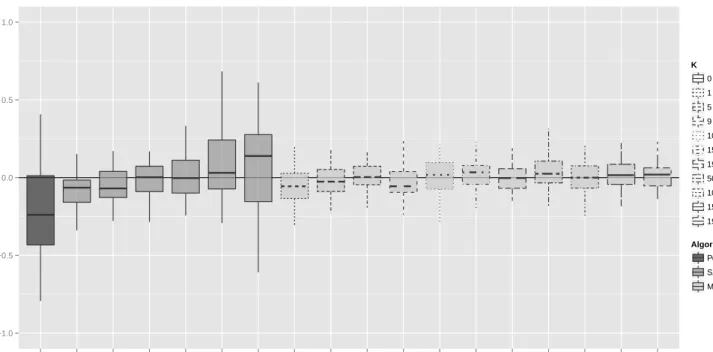
estimated using SMC with an MCMC move, with 200 particles and 100 targets, with the ith target being γi(·|θ) =γi(·|iθ/100), employing stratified resampling when the effective sample size (ESS; Kong et al (1994)) falls below 100. The total cost of these three stages is 5×10⁶Gibbs sweeps (1/4 of the cost of population ex-change) with the final IS stage costing 2×10⁴ sweeps (1/1000 of the cost of population exchange). We note that the cost of the first two stages has been chosen conservatively - less computational effort here can also yield good results. The importance proposal used in all cases was a multivariate normal distribution, with mean and variance taken to be the sample mean and variance from the initial run of the exchange algorithm. This proposal would clearly not be appropriate in high dimensions, but is reasonable for the low dimensional parameter spaces considered here. Figure 2 shows the results produced by these methods in comparison with those from Friel (2013).
We observe: improvements of the new methods over population exchange; an overall robustness of the new methods to different choices of parameters; and that there is a bias-variance tradeoff in the “internal” estim-ate ofZ(θb)/Z(θ) in terms of producing the best
beha-viour of the Bayes’ factor estimates. Recall that as B increases the bias of the internal estimate (the results of which can be observed in the results when usingB= 0) decreases, but for a fixed computational effort it is bene-ficial to use a lowerB and to instead increaseM, using more importance points to decrease the variance. As in Alquier et al (2015), we observe that it may be useful to move away from the exact-approximate approaches, and in this case, to simply use the best available es-timator of Z(bθ)/Z(θ) (taking into account its
−1.0 −0.5 0.0 0.5 1.0 Pop Exchg 200,1,0 100,2,0 20,10,0 10,20,0 2,100,0 1,200,0 100,1,1 20,5,5 10,15,5 20,1,9 10,10,10 10,5,15 10,1,19 1,150,50 1,100,100 1,50,150 1,1,199 M, B, K log(Estimated BF / T rue BF) K 0 1 5 9 10 15 19 50 100 150 199 Algorithm Population Exchange SAVIS MAVIS
Figure 2: Box plots of the results of population exchange, SAVIS, and MAVIS on the Ising data.
it is unbiased. In this example there is little observed difference in using our fixed computational budget on more AIS moves (K) in place of using more importance points (M). In general we might expect using more AIS moves to be more productive when the estimates of the Z(θb)/Z(θ) forθ far fromθbare required.
2.6.2100×100 Ising model
In this section we use SAVIS for estimating the mar-ginal likelihood for a first order Ising model on data of size 100×100 pixels simulated from an Ising model with parameter θ = 10. Again, estimating a marginal likelihood is done in three stages: firstlyθbis estimated;
followed by Z(θb), then finally the marginal likelihood.
The methods use for the first two stages are identical to those used in section 2.6.1, as is the choice of pro-posal distribution. The third stage is performed using SAVIS withM = 100 andB = 20. From 20 runs of this third stage, a five-number summary of the log evidence estimates was (5790.251, 5790.178, 5790.144, -5790.119, -5790.009), with the average ESS being 80.75. Note the low variance over these runs of the algorithm and the high ESS, which were also found for different configurations of the algorithm (including for more im-portance points and larger values of M and B). One might expect this example to be more difficult than the 10×10 grids considered in the previous section, due to
the need to find good estimates ofZ(θb)/Z(θ) that are
here normalising constants of distributions on a space of higher dimensions. However, since the posterior has lower variance in this case, only values of θ close toθb
are proposed, which makes estimatingZ(θb)/Z(θ) much
easier, yielding the good results in this section.
2.7 Discussion
In this section we have compared the use of ABC-IS, SL-IS, MAVIS (and alternatives) for estimating mar-ginal likelihoods and Bayes’ factors. The use of ABC for model comparison has received much attention, with much of the discussion centring around appropriate choices of summary statistics. We have avoided this in our examples by using exponential family models, but in general this remains an issue affecting both ABC and SL. It is the use of summary statistics that makes ABC and SL unable to provide evidence estimates. How-ever, it is the use of summary statistics, usually es-sential in these settings, that provides ABC and SL with an advantage over MAVIS, in which importance sampling must be performed over the high dimensional data-space. Despite this disadvantage, MAVIS avoids the approximations made in the simulation based meth-ods (illustrated in figures 1b to 1d, with the accuracy depending primarily on the quality of the estimate of
1/Z used). In section 2.6 we saw that there can be ad-vantages of using biased, but lower variance estimates in place of standard IS.
The main weakness of all of the methods described in this section is that they are all based on standard IS and are thus not practical for use whenθis high dimen-sional. In the next section we examine the use of SMC samplers as an extension to IS for use on triply intract-able problems, and in this framework discuss further the effect of inexact approximations.
3 Sequential Monte Carlo approaches
SMC samplers (Del Moral et al 2006) are a general-isation of IS, in which the problem of choosing an ap-propriate proposal distribution in IS is avoided by per-forming IS sequentially on a sequence of target distri-butions, starting at a target that is easy to simulate from, and ending at the target of interest. In standard IS the number of Monte Carlo points required in order to obtain a particular accuracy increases exponentially with the dimension of the space, but Beskos et al (2011) show (under appropriate regularity conditions) that the use of SMC circumvents this problem and can thus be practically useful in high dimensions.
In this section we introduce SMC algorithms for simulating from doubly intractable posteriors which have the by-product that, like IS, they also produce estim-ates of marginal likelihoods. We note that, although here we focus on estimating the evidence, the SMC sam-pler approaches based here are a natural alternative to the MCMC methods described in section 1.1. and inher-ently use a “population” of Monte Carlo points (shown to be beneficial on these models by Caimo and Friel (2011)). In section 3.1 we describe these algorithms, before examining an application to estimating the pre-cision matrix of a Gaussian distribution in high dimen-sions in section 3.2. In 3.4 we provide a preliminary in-vestigation of the consequences of using biased weight estimates in an SMC framework.
3.1 SMC samplers in the presence of an INC
This section introduces two alternative SMC samplers for use on doubly intractable target distributions. The first, marginal SMC, directly follows from the IS meth-ods in the previous section. The second, SMC-MCMC, requires a slightly different approach, but is more com-putationally efficient. Finally we briefly discuss simulation-based SMC samplers in section 3.1.2.
To begin, we introduce notation that is common to all algorithms that we discuss. SMC samplers perform
sequential IS usingP “particles”θ(p), each having (nor-malised) weightw(p), using a sequence of targetsπ
0 to πT, with πT being the distribution of interest, in our case π(θ|y) ∝ p(θ)f(y|θ). In this section we will take πt(θ|y)∝p(θ)ft(y|θ) =p(θ)γt(y|θ)/Zt(θ). At targett, a “forward” kernelKt(·|θ
(p)
t−1) is used to move particle θ(t−p)1 to θ(tp), with each particle then being reweighted to give unnormalised weight
e wt(p)= p(θt(p))γt(y|θ (p) t ) p(θ(t−p)1)γt−1(y|θt(p−)1) Zt−1(θ(t−p)1) Zt(θt(p)) Lt−1(θt(p), θ (p) t−1) Kt(θ(tp−)1, θt(p)) . Here,Lt−1represents a “backward” kernel that we chose differently in the alternative algorithms below. We note the presence of the INC, which means that this al-gorithm cannot be implemented in practice in its cur-rent form. The weights are then normalised to give
n
wt(p)o, and a resampling step is carried out. In the fol-lowing sections the focus is on the reweighting step: this is the main difference between the different algorithms. For more detail on these methods, see Del Moral et al (2007).
Zhou et al (2015) describe how BFs can be estim-ated directly by SMC samplers, simply by takingπ1 to be one model andπT to be the other (with theπtbeing intermediate distributions). This idea is also explored for Gibbs random fields in Friel (2013). However, the empirical results in Zhou et al (2015) suggest that in some cases this method does not necessarily perform better than estimating marginal likelihoods for the two models separately and taking the ratio of the estimates. Here we do not investigate these algorithms further, but note that they offer an alternative to estimating the marginal likelihood separately.
3.1.1 Random weight SMC Samplers
SMC with an MCMC kernel Suppose we were able to use a reversible MCMC kernel Kt with invariant dis-tribution πt(θ|y) ∝ p(θ)ft(y|θ), and choose the Lt−1 kernel to be the time reversal of Kt with respect to its invariant distribution, we obtain the following in-cremental weight: e wt(p)= γt(y|θ (p) t−1) γt−1(y|θ(t−p)1) Zt−1(θt(p−)1) Zt(θ(t−p)1) . (12)
Once again, we cannot evaluate this incremental weight due to the presence of a ratio of normalising constants. Also, such an MCMC kernel cannot generally be dir-ectly constructed — the MH update itself involves eval-uating the ratio of intractable normalising constants. However, appendix A shows that precisely the same weight update results when using either SAV or ex-change MCMC moves in place of a direct MCMC step.
In order that this approach may be implemented we might consider, in the spirit of the approximations suggested in section 2, using an estimate of the ratio termZt−1(θ
(p) t−1)/Zt(θ
(p)
t−1). For example, an unbiased IS estimate is given by \ Zt−1(θ (p) t−1) Zt(θ (p) t−1) = 1 M M X m=1 γt−1(u (m,p) t |θ (p) t−1) γt(u (m,p) t |θ (p) t−1) , (13) whereu(tm,p)∼ft(·|θ (p)
t−1). Although this estimate is un-biased, we note that the resultant algorithm does not have precisely the same extended space interpretation as the methods in Del Moral et al (2006). Appendix B gives an explicit construction for this case, which incor-porates a pseudomarginal-type construction (Andrieu and Roberts 2009).
Data point tempering For the SMC approach to be effi-cient we require that the sequence of distributions{πt} be chosen such thatπ0 is easy to simulate from,πT is the target of interest and the intermediate distributions provide a “route” between them. For the applications in this paper we found the data tempering approach of Chopin (2002) to be particularly useful. Suppose that the data y consists of N points, and that N is ex-actly divisible byT for ease of exposition. We then take π0(θ|y) =p(θ) and for t= 1, ...T πt(θ|y) =p(θ)ft(y|θ) with
ft(y|θ) =f y1:N t/T|θ
, (14)
i.e. essentially we incorporateN/Tadditional data points for each increment oft. On this sequence of targets we then propose to use the SMC sampler with an MCMC kernel as described in the previous section. The only slightly non-standard point is the estimation ofZt−1(θ
(p) t−1)/ Zt(θt(−p)1), since in this caseZt−1(θt(p−)1) andZt(θ
(p) t−1) are the normalising constants of distributions on different spaces. We use \ Zt−1(θ(tp−)1) Zt(θt(p−)1) = 1 M M X m=1 γt−1(vt(m,p)|θ (p) t−1)qw(w (m,p) t ) γt(u(tm,p)|θt(−p)1) (15) where u(tm,p) ∼ ft(·|θ (p) t−1) and v (m,p) t and w (m,p) t are
subvectors of u(tm,p). wt(m,p) is in the space of the ad-ditional variables added when moving from ft−1 to ft (providing the argument in an arbitrary auxiliary dis-tributionqw(·)) andv(tm,p)is in the space of the existing variables. Fort= 1 this becomes
\1 Z1(θ(0p)) = 1 M M X m=1 qw(u(1m,p)) γ1(u(1m,p)|θ0(p)) (16) withu(1m,p)∼ft(.|θ(0p)).
Analogous to the SAV method, a sensible choice for qw(w) might be to usef
w|bθ, wherewis on the same space as N/T data points. The normalising constant for this distribution needs to be known to calculate the importance weight in (19) so, as earlier, we advocate estimating this in advance of running the SMC sampler (aside from when the data points are added one at a time - in this case the normalising constant may usu-ally be found analyticusu-ally). Note that ify does not con-sist of i.i.d. points, it is useful to choose the order in which data points are added such that the same qw (each with the same normalising constant) can be used in every weight update. For example, in an Ising model, the requirement would be to add the same shape grid of variables at each target.
Marginal SMC An alternative method commonly used in ABC applications arises from the use of an approx-imation to the optimal backward kernel (Peters 2005; Klaas et al 2005). In this case the weight update is
e wt(p)= p(θ (p) t )γt(y|θ (p) t ) Zt(θ (p) t ) PP r=1w (r) t−1Kt(θ (p) t |θ (r) t−1) (17) for an arbitrary forward kernel Kt. This results in a computational complexity ofO(P2) compared toO(P) for a standard SMC method, but we include it here in order to note that the 1/Z(·) term in (17) could be dealt with in the same way as in the simple IS case. Considering the SAVM posterior, where in targett we use the distributionqufor the auxiliary variableut, and the SAVM proposal, whereu(tp) ∼ ft(·|θ
(p)
t ) we arrive at the weight update:
e wt(p)= qu(u (p) t |θ (p) t , y)p(θ (p) t )γt(y|θ (p) t ) γt(u(tp)|θ (p) t ) PP r=1w (r) t−1Kt(θ (p) t |θ (r) t−1) .
in which normalising constant appears in this weight update. We include this approach for completeness but do not investigate it further in this paper.
3.1.2 Simulation-based SMC samplers
Section 2.2 describes how the ABC and SL approxim-ations may be used within IS. The same approximate likelihoods may be used in SMC. In ABC (Sisson et al 2007), where the sequence of targets is chosen to be πt(θ)∝p(θ)fbt(y|θ) with a decreasing sequence t, this
idea provides a useful alternative to MCMC for explor-ing ABC posterior distributions, whilst also providexplor-ing estimates of Bayes’ factors (Didelot et al 2011). The use of SMC with SL does not appear to have been ex-plored previously. One might expect SMC to be use-ful in this context (using, for example, the sequence of targetsπt(θ) ∝p(θ)fb
(t/T)
SL (S(y)|θ)), particularly when
b
3.2 Application to precision matrices
In this section we examine the performance of the SMC sampler, with MCMC proposal and data-tempered tar-get distributions, for estimating the evidence in an ex-ample in whichθis of moderately high dimension. We consider the case in which θ = Σ−1 is an unknown precision matrix,f(y|θ) is thed-dimensional multivari-ate Gaussian distribution with zero mean and p(θ) is a Wishart distributionW(ν, V) with parametersν ≥d andV ∈Rd×d. Suppose we observeni.i.d. observations y ={yi}ni=1, whereyi ∈Rd. The true evidence can be calculated analytically, and is given by
p(y) = 1 πnd/2 Γd(ν+2n) Γd(ν2) V −1+Pn i=1yiy T i −1 ν+n 2 |V|ν2 , (18) where Γd denotes the d-dimensional gamma function. For ease of implementation, we parametrise the preci-sion using a Cholesky decomposition Σ−1=LL0 with
L a lower triangular matrix whose (i, j)’th element is denoted aij. As in section 2.3, we writef(y|θ) asγ(y|θ)/Z(θ) as follows f {yi} n i=1|Σ −1 =|2πΣ|−n/2exp −1 2 n X i=1 yi0Σ−1yi ! ,
where in some of the experiments that follow, Z(θ) =
|2πΣ|n/2 is treated as if it is an INC. In the Wishart prior, we takeν = 10 +dandV =Id.
Takingd= 10,n= 30 points were simulated using yi ∼ MVN(0d,0.1×Id). The parameter space is thus 55-dimensional, motivating the use of an SMC sampler in place of IS or the population exchange method, nei-ther of which are suited to this problem. In the SMC sampler, in which we used P = 10,000 particles, the sequence of targets is given by data point tempering. Specifically, the sequence of targets is to use p(Σ−1) whent= 0 andp(Σ−1)f{yi}t
i=1|Σ
−1fort= 1, ..., T (withT=n). The parameters are{aij |1≤j≤i≤d}. We use single component MH kernels to update each of the parameters, with one (deterministic) sweep consist-ing of an update of each in turn. For each aij we use a Gaussian random walk proposal, where at target t, the variance for the proposal used for aij is taken to be the sample variance of aij at target t−1. For up-dating the weights of each particle we used equation 15, where we chose qw(·) =f· |Σd−1
with Σd−1 the
maximum likelihood estimate of the precisionΣ−1, and choseM = 200 “internal” importance sampling points.
Systematic resampling was performed when the effec-tive sample size (ESS) fell belowP/2.
We estimated the evidence 10 times using the SMC sampler and compared the statistical properties of each algorithm using these estimates. For our simulated data, the log of the true evidence was −89.43. Over the 10 runs of the SMC sampler a five-number summary of the log evidence estimates was (−90.01, −89.51, −89.35,
−88.92,−88.37).
3.3 Application to Ising models
In this section we apply the random weight SMC sam-pler to the Ising model data considered in section 2.6.1. We use SMC to estimate the marginal likelihood of both the first and second order Ising models, then take the ratio of these estimates to estimate the Bayes’ factor. Note that in this case the size of the parameter space is much smaller than in the precision example, with the models having parameter spaces of sizes 1 and 2 respec-tively. The excellent results achieved by IS in section 2.6.1 might seem to imply that SMC samplers are not required for this problem, but recall that we required preliminary runs of the exchange algorithm in order to design an appropriate importance proposal, along with an SMC sampler in order to estimate the normalising constant Z(θb) of the distribution qu used for the
aux-iliary variablesu(m). An SMC sampler offers a cleaner approach that requires less user tuning.
We applied the random weight SMC sampler de-scribed in section 3.1.1, with 500 particles, data point tempering (adding one pixel at a time, takingqwto be Bern(0.5)), and using the estimate of the ratio of nor-malising constants in the weight update from equation (15) withM = 20 importance points. Each of these esti-mates requires simulating a single point fromγt(·|θ(t−p)1) using a Gibbs sampler, which had a burn in ofB= 10 iterations, yielding a total computational budget of 200 Gibbs sweeps for estimating the ratio of normalising constants. Note that, as considered in section 2.6.1, this use of a Gibbs sampler results in an inexact al-gorithm, but this level of burn in was found to be suffi-cient for this bias to be minimal in the random weight IS algorithms. The MCMC kernel of the exchange algo-rithm was used (with proposal taken to be the sample variance of the set of particles at each SMC iteration), using the approximate version where a Gibbs sampler with burn inB= 10 iterations is used to simulate from γt(·|θ(∗)). The total cost of this algorithm is comparable to the IS approaches in section 2.6.1, with a total cost of 5.25×10⁶Gibbs sweeps and hence around a quarter of that of the algorithm of Friel (2013). Figure 3 shows
Fig. 3: Box plots of the results of population exchange and random weight SMC.
the results produced by this method in comparison with those from Friel (2013).
We observe that the median of the random weight SMC estimates is more accurate than that of the popu-lation exchange estimates - the bias introduced through using an internal Gibbs sampler in place of an exact sampler does not appear to accumulate sufficiently to affect the results (this issue is explored further in the following section). However, it has slightly higher vari-ance than population exchange (much higher than SAVIS and MAVIS). This high variance can be attributed to two factors:
1. Since the SMC sampler begins with points sampled from the prior, larger changes in θ are considered than in the IS approaches, thus the estimates of the ratio of the normalising constants require more im-portance points to be accurate - the results suggest that the budget of 200 Gibbs sweeps is insufficient. This is the opposite situation to that encountered in section 2.6.2, where the changes in θ are small and the estimates of the ratio of the normalising constants are accurate with small numbers of im-portance points.
2. It’s been frequently observed (cf. Lee and Whiteley (2015)) that, as suggested by the asymptotic vari-ance expansion, in some instvari-ances the first few iter-ations of an SMC sampler contribute substantially to the ultimate error. This issue arises since the for-getting of the sampler doesn’t suppress the terms that the initial errors contribute to the asymptotic variance enough to compensate for the fact that they’re much larger than the final ones. This is due, when using data point tempering in the manner we
have here, to the much larger relative discrepancy between the first few distributions in the sequence than between later distributions.
We conclude that the random weight SMC method is a viable approach to estimating Bayes’ factors for these models, but that care should be taken in tuning the weight estimates and choosing the sequence of SMC distributions.
3.4 Biased Weights in SMC 3.4.1 Error bounds
We now examine the effect of using inexact weights on estimates produced by SMC samplers. By way of theo-retical motivation of such an approach, we demonstrate that under strong, but standard (cf. Del Moral (2004)), assumptions on the mixing of the sampler, if the ap-proximation error is sufficiently small, then this error can be controlled uniformly over the iterations of the algorithm and will not accumulate unboundedly over time (and that it can in principle be made arbitrarily small by making the relative bias small enough for the desired level of accuracy). We do not here consider the particle system itself, but rather the sequence of distri-butions which are being approximated by Monte Carlo in the approximate version of the algorithm and in the idealised algorithm being approximated. The Monte Carlo approximation of this sequence can then be un-derstood as a simple mean field approximation and its convergence has been well studied, see for example Del Moral (2004).
In order to do this, we make a number of identifi-cations in order to allow the consideration of the ap-proximation in an abstract manner. We allow Gte to
denote the incremental weight function at time t, and Gt to denote the exact weight function which it ap-proximates (any auxiliary random variables needed in order to obtain this approximation are simply added to the state space and their sampling distribution to the transition kernel). The transition kernel Mt com-bines the proposal distribution of the SMC algorithm together with the sampling distribution of any needed auxiliary variables. We allow xto denote the full col-lection of variables sampled during an iteration of the sampler, which is assumed to exist on the same space during each iteration of the sampler.
We employ the following assumptions (we assume an infinite sequence of algorithm steps and associated target distributions, proposals and importance weights; naturally, in practice only a finite number would be
em-ployed but this formalism allows for a straightforward statement of the result):
A1 (Bounded Relative Approximation Error) There ex-istsγ <∞such that:
sup t∈N sup x |Gt(x)−Gte (x)| e Gt(x) ≤γ.
A2 (Strong Mixing; slightly stronger than a global Doe-blin condition) There exists(M)>0 such that: sup t∈N inf x,y dMt(x,·) dMt(y,·) ≥(M).
A3 (Control of Potential) There exists (G) >0 such that: sup t∈N inf x,y Gt(x) Gt(y) ≥(G).
The first of these assumptions controls the error intro-duced by employing an inexact weighting function; the others ensure that the underlying dynamic system is sufficiently ergodic to forget it’s initial conditions and hence limit the accumulation of errors. We demonstrate below that the combination of these properties suffices to transfer that stability to the approximating system. We consider the behaviour of the distributions ηp and ˜ηp which correspond to the target distributions at iteration p of the exact and approximating algo-rithms, prior to reweighting, at iteration pin the fol-lowing proposition, the proof of which is provided in Appendix C, which demonstrates that if the approxi-mation error, γ, is sufficiently small then the accumu-lation of error over time is controlled:
Proposition 1 (Uniform Bound on Total-Variation Discrepancy). If A1, A2 and A3 hold then:
sup n∈N
kηn−ηne kTV≤4γ(1−(M))
3(M)(G) .
This result is not intended to do any more than demonstrate that, qualitatively, such forgetting can pre-vent the accumulation of error even in systems with “bi-ased” importance weighting potentials. In practice, one would wish to make use of more sophisticated ergod-icity results such as those of Whiteley (2013), within this framework to obtain results which are somewhat more broadly applicable: assumptions A2 and A3 are very strong, and are used only because they allow sta-bility to be established simply. Although this result is, in isolation, too weak to justify the use of the approx-imation schemes introduced here in practice, together with the empirical results presented below, it does sug-gest that further investigation of such approximations is warranted particularly in settings in which unbiased estimators are not available.
3.4.2 Empirical results
We use the precision example introduced in section 3.2 to investigate the effect of using biased weights in SMC samplers. Specifically we take d = 1 and use a sim-ulated dataset y where n = 5000 points were simu-lated usingyi ∼ N(0,0.1). In this case there is only a single parameter to estimate, a1, and we examine the bias of estimates of the evidence using four alternative SMC samplers, each of which use a data-tempered se-quence of targets (adding one data point at each tar-get). For this data we can calculate analytically the true value of the marginal likelihood after receiving each data point, thus we can estimate the bias of each sampler at each iteration. The first SMC sampler (the “exact weight” sampler) is the method where the true value ofZt−1(θ
(p) t−1)/Zt(θ
(p)
t−1) is used in the weight up-date. The second is the same “unbiased random weight” sampler used in section 3.2, which uses an unbiased IS weight estimate, here with M = 20 “internal” im-portance sampling points. The third, which we refer to as the “biased random weight” sampler, uses a biased bridge estimator instead, specifically we use in place of (15) \ Zt−1(θ (p) t−1) Zt(θ (p) t−1) = M/2 X m=1 " γt−1(v (m,p) t,1 |θ (p) t−1)qw(w (m,p) t,1 ) γt(u (m,p) t,1 |θ (p) t−1) #1/2 / M/2 X m=1 " γt(u(t,m,p2 )|θt(−p)1) γt−1(v(t,m,p2 )|θ (p) t−1)qw(w (m,p) t,2 ) #1/2 , (19) where v(t,m,p2 ) ∼ ft−1(.|θ (p) t−1), w (m,p) t,2 ∼ qw(.) so that ut,(m,p2 )=vt,(m,p2 ), wt,(m,p2 ), andu(t,m,p1 )∼ft(.|θt(p−)1) with vt,(m,p1 ) and w(t,m,p1 ) being the corresponding subvectors ofu(t,m,p1 ).
Motivated by the theoretical argument presented previously, we investigate the effect of improving the mixing of the kernel used within the SMC. In this model the exact posterior is available at each SMC target, so we may replace the use of an MCMC move to update the parameter with a direct simulation from the poste-rior. In this extreme case, there is no dependence be-tween each particle and its history; we refer to this, the fourth SMC sampler we consider, as “biased random weight with perfect mixing”. Each SMC sampler was run 20 times, using 50 particles.
Figures 4 and 5 show the estimated bias and mean square error of the log evidence estimates of each sam-pler at each iteration1. No bias is observed in the
al-1 We note that log of an unbiased estimate in fact produces
Fig. 4: The estimated bias in the log evidence estimates of the true (black solid), unbiased random weight (black dashed), biased random weight (grey solid) SMC algo-rithms using MCMC kernels, and the estimated bias when using the biased random weight algorithm with perfect mixing (grey dashed).
gorithm with true weights, and only a small bias is ob-served in the unbiased random weight sampler (this bias is likely to be due to the relatively small number of repli-cations). Bias does accumulate in the biased random weight sampler, but we note that the level of bias ap-pears to stabilise. This accumulation of bias means that one should exercise caution in the use of SMC samplers with biased weights. However, we observe that perfect mixing substantially decreases the bias in the evidence estimates from the algorithm. Also, in this case we ob-serve that the bias does not accumulate sufficiently to give poor estimates of the evidence. Here the standard deviation of the final log evidence estimate over the ran-dom weight SMC sampler runs is approximately 0.4, so the bias is not large by comparison.
3.5 Discussion
In section 2.6 we observed clearly that the use of biased weights in IS can be useful for estimating the evidence in doubly intractable models, but we have not observed the same for SMC with biased weights. When applied to the precision example in section 3.2, an inexact sam-pler (using the bridge estimator) did not outperform the exact sampler, despite the mean square error of the results for the exact algorithm indicate that the variance of the evidence estimates we use is sufficiently small that this effect is negligible.
Fig. 5: The estimated MSE in the log evidence estimates of the four SMC samplers (same key as figure 4).
biased bridge weight estimates being substantially im-proved compared to the unbiased IS estimate. Over 10 runs the mean square error in the log evidence was 0.34 for the inexact sampler, compared to 0.28 for the exact sampler. This experience suggests that samplers with biased weights should be used with caution: weight es-timates with low variance do not guarantee good per-formance due to the accumulation of bias in the SMC. However, the theoretical and empirical investigation in this section suggests that this idea is worth further investigation, possibly for situations involving some of the other intractable likelihoods listed in section 1. Our results suggest that improved mixing can help combat the accumulation of bias, which may imply that there may be situations where it is useful to perform many iterations of a kernel at a particular target, rather than the more standard approach of using many intermedi-ate targets at each of which a single iteration of a kernel is used. Other variations are also possible, such as the calculation of fast cheap biased weights at each target in order only to adaptively decide when to resample, with more accurate weight estimates (to ensure accu-rate resampling and accuaccu-rate estimates based on the particles) only calculated when the method chooses to resample.
4 Conclusions
This paper describes several IS and SMC approaches for estimating the evidence in models with INCs that out-perform previously described approaches. These meth-ods may also prove to be useful alternatives to MCMC