18‐904
“Optimal functional supervised classification with
separation condition"
Sébastien Gadat, Sébastien Gerchinovitz, and Clément Marteau
Optimal functional supervised classification with separation
condition
S´
ebastien Gadat, S´
ebastien Gerchinovitz, and Cl´
ement Marteau
January 8, 2018
Abstract
We consider the binary supervised classification problem with the Gaussian functional model intro-duced in [7]. Taking advantage of the Gaussian structure, we design a natural plug-in classifier and derive a family of upper bounds on its worst-case excess risk over Sobolev spaces. These bounds are parametrized by a separation distance quantifying the difficulty of the problem, and are proved to be optimal (up to logarithmic factors) through matching minimax lower bounds. Using the recent works of [9] and [14] we also derive a logarithmic lower bound showing that the populark-nearest neighbors classifier is far from optimality in this specific functional setting.
1
Introduction
The binary supervised classification problem is perhaps one of the most common tasks in statistics and machine learning. Even so, this problem still fosters new theoretical and applied questions because of the large variety of the data encountered so far. We refer the reader to [13] and [5] and to the references therein for a comprehensive introduction to binary supervised classification. This problem unfolds as follows. The learner has access tonindependent copies (X1, Y1), . . . ,(Xn, Yn) of a pair (X, Y), whereX
lies in a measurable space H and Y ∈ {0,1}. The goal of the learner is to predict the label Y after observing the new inputX, with the help of the sampleSn:= (Xi, Yi)16i6nto learn the unknown joint
distributionPX,Y of the pair (X, Y).
In some standard situations,Xlies in the simplest possible Hilbert space: H=Rd, which corresponds
to the finite-dimensional binary classification problem. This setting has been extensively studied so far. Popular classification procedures that are now theoretically well understood include the ERM method [27, 2], thek-nearest neighbors algorithm [16, 9, 3, 14], support vector machines [32], or random forests [4], just to name a few.
However there are situations where the inputsXiandX are better modelled as functions; the setH
is then infinite-dimensional. Practical examples can be found, e.g., in stochastic population dynamics [24], in signal processing [10], or in finance [23]. This binary supervised functional classification problem was tackled with nonparametric procedures such as kernel methods or the k-nearest neighbours algo-rithm. For example, [11] studied the nearest neighbour rule in any metric space, while [22] analyzed the performances of thek-nearest neighbours algorithm in terms of a metric covering measure. Such metric entropy arguments were also used in [8], or with kernel methods in [1].
Our functional model. In the present work, we focus on one of the most elementary diffusion classification model: we suppose that the inputX = (X(t))t∈[0,1]is a continuous trajectory, solution to
the stochastic differential equation
∀t∈[0,1], dX(t) =Y f(t)dt+ (1−Y)g(t)dt+dW(t), (1) where (W(t))06t61 is a standard Brownian motion, and whereY is a BernoulliB(1/2) random variable
independent from (W(t))06t61. In particular, in the sample Sn, trajectories Xi labeled with Yi = 1
The white noise model has played a key role in statistical theoretical developments; see, e.g., the sem-inal contributions of [17] in nonparametric estimation and of [26] in adaptive nonparametric estimation. In our supervised classification setting, the goal is not to estimatef andgbut to predict the value ofY
given an observed continuous trajectory (X(t))06t61. Of course, we assume that both functionsf and g are unknown so that the joint distribution PX,Y of the pair ((X(t))t∈[0,1], Y) is unknown. Without
any assumption on f and g, there is no hope to solve this problem in general. However, learning the functionsf and g(and thusPX,Y) from the sampleSnbecomes statistically feasible whenf andgare
smooth enough.
The functional model considered in this paper is very close to the one studied by [7]. Actually our setting is less general since [7] considered more general diffusions driven by state-dependent drift terms
t7−→f(t, X(t)) andt7−→g(t, X(t)). We focus on a simpler model, but derive refined risk bounds (with a different approach) that generalize the worst-case bounds of [7], as indicated below.
Some notation. We introduce some notation and definitions in order to present our contributions below. In our setting, aclassifier Φ is a measurable function, possibly depending on the sampleSn, that
maps each new input X = (X(t))t∈[0,1]to a label in {0,1}. Therisk associated with each classifier Φ
depends onf andgand is defined by:
Rf,g(Φ) :=P(Φ(X)6=Y),
where the expectation is taken with respect to all sources of randomness (i.e., both the sampleSnand
the pair (X, Y)). The goal of the learner is to construct a classifierΦ based on the sampleb Snthat mimics
theBayes classifier
Φ?= arg min
Φ
Rf,g(Φ), (2)
where the infimum is taken over all possible classifiers (the oracle Φ? is impractical sincef and gand
thusPX,Y are unknown). We measure the quality ofΦ through itsb worst-case excess risk
sup (f,g)∈E n Rf,g(Φ)−inf Φ Rf,g(Φ) o (3) over some set E of pairs of functions. In the sequel we focus on Sobolev classesHs(R) (see (21)) and
consider subsetsE ⊆ Hs(R)2 parametrized by a separation lower bound ∆ onkf−gk.
Main contributions and outline of the paper. In Section 2 we first state preliminary results about the margin behavior that will prove crucial in our analysis. We then make three types of contributions: • In Section 3 we design a classifierΦbdnbased on a thresholding rule. We derive an excess risk bound
that generalizes the worst-case results of [7] but also imply faster rates when the distancekf−gk is large. This acceleration is a consequence of the nice properties of the margin (see also, e.g., [2] and [14]).
Theorem (A). The classifier Φbdn defined in (16) with dn ≈ n
1
2s+1 has an excess risk roughly
bounded by (omitting logarithmic factors and constant factors depending only on s and R): for
n>NR,slarge enough, sup f,g∈Hs(R) kf−gk>∆ n Rf,g(Φbdn)−inf Φ Rf,g(Φ) o . n−2ss+1 if ∆.n−2ss+1 1 ∆n − 2s 2s+1 if ∆&n−2ss+1
• In Section 4.1 we derive a matching minimax lower bound (up to logarithmic factors) showing that the above worst-case bound cannot be improved by any classifier.
Theorem (B). For any numbern>NR,s of observations, any classifierΦb must satisfy (omitting
again logarithmic factors and constant factors depending only on sandR):
sup f,g∈Hs(R) kf−gk>∆ n Rf,g(Φ)b −inf Φ Rf,g(Φ) o & n−2ss+1 if ∆.n−2ss+1 1 ∆n − 2s 2s+1 if ∆&n− s 2s+1
• Finally, in Section 4.2, we show that the well-knownk-nearest neighbors rule tuned in a classical and optimal way (see, e.g., [31, 14]) is far from optimality in our specific functional setting. Theorem (D). For any threshold (dimension) db∈N∗based on a sample-splitting policy, and for
the optimal choicekoptn (db) =bn4/(4+
b
d)c, the
b
d-dimensionalkoptn (db)-nearest neighbors classifierΦNN
suffers a logarithmic excess risk in the worst case: sup f,g∈Hs(r) n Rf,g(ΦNN)−inf Φ Rf,g(Φ) o &log(n)−2s.
Most proofs are postponed to Appendix A (for the upper bounds) and to Appendix B (for the lower bounds).
Other useful notation. We denote the joint distribution of the pair ((X(t))t∈[0,1], Y) byPX,Y, and
write P⊗n =PX,Y⊗n for the joint distribution of the sample (Xi, Yi)16i6n. For notational convenience,
the measurePwill alternatively stand forP=PX,Y ×P⊗n (we integrate over both the sampleSnand
the pair (X, Y)) or for any other measure made clear by the context. The distribution of (X(t))t∈[0,1]
will be denoted byPX, while the distribution of (X(t))t∈[0,1]conditionally on the event {Y = 1}(resp.
{Y = 0}) will be written asPf (resp. Pg).
We write L2([0,1]) for the set of square Lebesgue-integrable functions f on [0,1], with L2-norm
kfk= R1 0 f
2
(t)dt1/2
and inner producthf, gi=R1
0 f(t)g(t)dt. With a slight abuse of notation, whenX
is a solution of (1) andϕ∈L2([0,1]), we sethϕ, Xi=R01ϕ(t)dX(t).
Finally we write Ber(p) or simplyB(p) for the Bernoulli distribution of parameterp∈[0,1], as well as B(n, p) for the binomial distribution with parametersn∈N∗andp∈[0,1]. We also setx∧y= min{x, y}
for allx, y∈R.
2
Preliminary results
2.1
Bayes classifier
We start by deriving an explicit expression for the optimal classifier Φ?introduced in (2). This optimal
classifier is known asthe Bayes classifier of the classification problem (see, e.g., [16, 13]).
LetP0 denote the Wiener measure on the set of continuous functions on [0,1]. It is easy to check that
the law ofX|Y is absolutely continuous with respect toP0 (see, e.g., [19]). Indeed, for any continuous
trajectoryX, the Girsanov formula implies that the density ofPf (i.e., ofX|{Y = 1}) with respect to
the reference measureP0 is given by qf(X) := dPf dP0 (X) = exp Z 1 0 f(s)dXs− 1 2kfk 2 . (4)
Similarly, the density ofPg (i.e., ofX|{Y = 0}) with respect toP0 is
qg(X) := dPg dP0 (X) = exp Z 1 0 g(s)dXs− 1 2kgk 2 . (5)
In the sequel we refer to qf andqg as the likelihood ratios of the modelsPf and Pg versus P0. Now,
using the Bayes formula, we can easily see that the regression functionηassociated with (1) is given by
η(X) := E[Y|X] =P(Y = 1|X) = dPf dP0(X) dPf dP0(X) + dPg dP0(X) = expR1 0(f(s)−g(s))dXs− 1 2kfk 2 +12kgk2 1 + expR1 0(f(s)−g(s))dXs− 1 2kfk 2+1 2kgk 2 . (6)
As an example, if we assume that we observedX(t) =f(t)dtwithX(0) = 0, thenη(X) = exp( 1 2kf−gk 2) 1+exp(1 2kf−gk2) , which is larger than or equal to 1/2 and gets closer to 1 when kf−gk increases. Roughly speaking, this means in that example that the distribution Pf is more likely than the distributionPg, which is
consistent with the definition of the model given by (1).
The Bayes classifier Φ?of the classification problem is then given by Φ?(X) :=1{η(X)>12}=1{R1
0(f(s)−g(s))dXs>12kfk2−1 2kgk2}
. (7)
It is well known that the Bayes classifier Φ? corresponds to the optimal classifier of the considered binary classification problem (see, e.g., [13]) in the sense that it satisfies (2). In particular, for any other classifier Φ, the excess risk of classification is given by
Rf,g(Φ)− Rf,g(Φ?) =E|2η(X)−1|1Φ(X)6=Φ?(X)
. (8)
In our statistical setting, the functionsfandgare unknown so that it is impossible to compute the oracle Bayes classifier (7). However, we can construct an approximation of it using the sample (Xi, Yi)16i6n.
In Section 3 we design a plug-in estimator combined with a projection step, and analyze its excess risk under a smoothness assumption onf andg. The next result on the margin will be a key ingredient of our analysis.
2.2
Control of the margin in the functional model
As was shown in earlier works on binary supervised classification (see, e.g., [27] or [2]), the probability mass of the region where the regression functionηis close to 1/2 plays an important role in the conver-gence rates. The behaviour of the functionηis classically described by a so-calledmargin assumption: there existα>0 andε0, C >0 such that, for all 0< ε6ε0,
PX η(X)−1 2 6 ε 6Cεα. (9)
We will show in Proposition 1 which parametersα, ε0, C >0 are associated with Model (1). The role
of (9) is easy to understand: classifying a trajectory X for whichη(X) is close to 1/2 is necessarily a challenging problem because the events{Y = 1}and{Y = 0}are almost equally likely. This not only makes the optimal (Bayes) classifier1η(X)>1/2 error-prone, but it also makes the task of mimicking the
Bayes classifier difficult. Indeed, any slightly bad approximation ofηwhen η(X)'1/2 can easily lead to a prediction different from1η(X)>1/2. A large value of the margin parameterαindicates that most
trajectoriesXare such thatη(X) is far from 1/2: this makes in a sense the classification problem easier. Our first contribution, detailed in Proposition 1 below, entails that the margin parameter associated with Model (1) crucially depends on the distance between the functionsf andgof interest. The proof is postponed to Appendix A.1.
Proposition 1. Let X be distributed according to Model (1), and set∆ := kf−gk. Then, for all 0< ε61/8, we have PX η(X)−1 2 6 ε 61∧ 10ε ∆ .
In particular, if the distancekf−gkis bounded from below by a positive constant, then (9) is satisfied with a margin parameterα= 1. If, instead,kf−gkis allowed to be arbitrarily small, then nothing can be guaranteed about the margin parameter (except the obvious valueα= 0 that always works).
3
Upper bounds on the excess risk
In this section we construct a classifier with nearly optimal excess risk. We detail its construction in Section 3.1 and analyze its approximation and estimation errors in Sections 3.2 and 3.3. Our main result, Theorem 1, is stated in Section 3.4. Nearly matching lower bounds will be provided in Section 4.
3.1
A classifier in a finite-dimensional setting
Our classifier—defined in Section 3.1.3 below—involves a projection step with coefficients θj and µj
introduced in Section 3.1.1 and estimated in Section 3.1.2.
3.1.1 L2 orthonormal basis (ϕj)j>1 and white noise model
Orthonormal basis. Let (ϕj)j∈N∗ be any orthonormal basis ofL 2
([0,1]), andd∈N∗be some dimension
that will be chosen as a function of the sizenof the sample (for projection purposes). In the sequel, the coefficients (cj(h))j>1 of any functionh∈L2([0,1]) w.r.t. the basis (ϕj)j>1 are defined by
cj(h) :=hϕj, hi=
Z 1 0
h(s)ϕj(s)ds , j>1,
and itsL2-projection onto Span (ϕj, 16j6d) is given by
Πd(h) = d
X
j=1
cj(h)ϕj. (10)
In particular, we will pay a specific attention to the coefficients off andginvolved in (1),
∀j>1, θj:=cj(f) and µj:=cj(g), (11)
and to theird-dimensional projectionsfd:= Πd(f) =Pdj=1θjϕjandgd:= Πd(g) =Pdj=1µjϕj.
White noise model. We now make a few comments on the white noise model considered in (1) (see also [17] for further details and its link with the infinite Gaussian sequence model). First note that, for all
ϕ∈L2([0,1]), almost surely, Z 1 0 ϕ(t)dX(t) =Y Z 1 0 f(t)ϕ(t)dt+ (1−Y) Z 1 0 g(t)ϕ(t)dt+ Z 1 0 ϕ(t)dW(t).
Recall that, with a slight abuse of notation, we write hϕ, Xi := R01ϕ(t)dX(t). The above almost sure equality implies that the conditional distribution of hϕ, Xi given Y is Gaussian with expectation hϕ, fi1Y=1+hϕ, gi1Y=0 and variance kϕk2. Therefore, the distribution of hϕ, Xiis a mixture of two
Gaussian distributions: 1 2N hϕ, fi,kϕk2+1 2N hϕ, gi,kϕk2.
An important feature of the white noise model is that the coefficients hϕj, Wi
j>1 associated with
different frequencies of the standard Brownian motion are independent. This is because they are jointly Gaussian, with a diagonal infinite covariance matrix:
∀j6=j0, E h hϕj, Wihϕj0, Wi i = Z 1 0 ϕj(t)ϕj0(t)dt= 0. The above remarks imply together with (11) that
∀j>1, L(hϕj, Xi|Y = 1) =N(θj,1) and L(hϕj, Xi|Y = 0) =N(µj,1), (12)
and that the coefficients hϕj, Xi
j>1 are conditionally independent givenY. 3.1.2 Estimation of (θj)16j6d and (µj)16j6d
In order to estimate theθjandµj, we split the sample (Xi, Yi)16i6ninto two subsamples corresponding
to either Yi = 0 orYi = 1. More formally, we define the two subsamples (Xi0)16i6N0 and (X
1 i)16i6N1
(one of which can be empty) by
( Xi0:=Xτ0 i , 16i6N0 X1 i :=Xτ1 i , 16i6N1
where N0:= n X i=1 1{Yi=0} and N1:= n X i=1 1{Yi=1}, (13)
and whereτik is the index t∈ {1, . . . , n}such that Yt =k for thei-th time, i.e., for allk∈ {0,1}and i∈ {1, . . . , Nk}, τik:= min ( t∈ {1, . . . , n}: t X t0=1 1{Yt0=k}>i ) .
The sizesN0andN1are random variables; they satisfyN0+N1 =nand both have a binomial distribution
B(n,1/2). In particular, both subsamples have (with high probability) approximately the same sizes.
Note from (1) that the two subsamples (Xi0)16i6N0 and (X
1
i)16i6N1 correspond to observations of the
functions gand f respectively. Following our comments from Section 3.1.1, it is natural to define the random coefficients (X0 i,j)16i6N0 16j6d and (X1 i,j)16i6N1 16j6d by X0 i,j:=hϕj, Xi0i=µj+ε0i,j, i= 1. . . N0, Xi,j1 :=hϕj, Xi1i=θj+ε1i,j, i= 1. . . N1, j∈ {1, . . . , d}, (14)
where the dimensiond∈N∗will be determined later (as a function ofn), and where
εki,j=
Z 1 0
ϕj(t)dWτk i(t).
By independence of the random variablesY1, W1, . . . , Yn, Wnused to generate the sample (Xi, Yi)16i6n
according to (1), and by the comments made in Section 3.1.1, we have the following conditional inde-pendence property for theεki,j.
Remark 1. Conditionally on (Y1, . . . , Yn), the nd random variables (or any (Y1, . . . , Yn)-measurable
permutation of them) ε01,1, . . . , ε01,d, ε 0 2,1, . . . , ε02,d, . . . , ε 0 N0,1, . . . , ε 0 N0,d, ε1 1,1, . . . , ε11,d, ε12,1, . . . , ε12,d, . . . , ε1N1,1, . . . , ε 1 N1,d
are i.i.d. N(0,1). As a consequence, on the event {N0 > 0} ∩ {N1 > 0}, the random variables Nk−1/2PNk
i=1ε k
i,j, 16j6d, k∈ {0,1}, are i.i.d.N(0,1) conditionally on(Y1, . . . , Yn).
For everyj∈ {1, . . . , d}, we use the coefficients defined in (14) to estimate the coefficientsµj andθj by
b µj=1{N0>0} 1 N0 N0 X i=1 Xi,j0 and θbj=1{N1>0} 1 N1 N1 X i=1 Xi,j1 . (15)
Note that we arbitrarily impose the value 0 forµbjwhenN0= 0 or forbθjwhenN1= 0. This convention
has a negligible impact, since with high probabilityN0 andN1 are both positive. 3.1.3 A simple classifier
We now build a simple classifier using the estimatorsµbj andθbj defined in (15). After observing a new
trajectoryX= (X(t))06t61, we construct the vectorXd∈Rddefined by
Xd:=
hϕ1, Xi, . . . ,hϕd, Xi
.
Then, we assign the label 1 to the trajectoryXifXdis closer tobθ:= (θb1, . . . ,θbd) than toµb:= (µb1, . . . ,bµd),
and the label 0 otherwise. More formally, our classifierΦbdis defined for all trajectoriesX by
b Φd(X) = ( 1 if kXd−bθkd6kXd−µbkd 0 if kXd−θbkd>kXd−µbkd , (16) where kxkd= q Pd j=1x 2
j denotes the Euclidean norm inR d
; we also writehx, yid =Pdj=1xjyj for the
Reinterpretation as a plug-in classifier We now explain whyΦbd can be reinterpreted as a
plug-in classifier plug-in a truncated space. Recall the expression (6) for the regression function η. It is thus natural to consider the ’truncated’ regression function ηd by replacing f and gwith their projections
Πd(f) =Pdj=1θjϕjand Πd(g) =Pdj=1µjϕj, i.e., ηd(X) := expR1 0(Πd(f)(s)−Πd(g)(s))dXs− 1 2kΠd(f)k 2+1 2kΠd(g)k 2 1 + exp R1 0(Πd(f)(s)−Πd(g)(s))dXs− 1 2kΠd(f)k2+ 1 2kΠd(g)k2 (17) = exp hθd−µd,Xdid− 1 2kθdk 2 d+ 1 2kµdk 2 d 1 + exp hθd−µd,Xdid−12kθdk2d+ 1 2kµdk2d ,
where θd := (θj)16j6d, andµd := (µj)16j6d. We also define the associated oracle classifier (that still
depends on the unknown functionsfandg): Φ?d(X) :=1{ηd(X)>12}=1{
R1
0(Πd(f)(s)−Πd(g)(s))dXs>12kΠd(f)k2−12kΠd(g)k2}. (18)
As shown in Remark 2 (see Section 3.3 below),ηdand Φ?dcorrespond to the regression function and the
Bayes classifier of the restricted classification problem where the learner has only access to the projected inputXd∈Rd, rather than the whole trajectoryX.
We are now ready to reinterpretΦbdas a plug-in classifier. Note that
kXd−θbkd6kXd−µbkd, ⇐⇒ exp12{kXd−µbk 2 d− kXd−θbk2d} 1 + exp12{kXd−µbk 2 d− kXd−θbk2d} > 1 2 , ⇐⇒ bηd(X)> 1 2 , where the estimated regression functionηbdis defined by
b ηd(X) := exphθb− b µ,Xdid−12kθbk2d+1 2kµbk 2 d 1 + exphbθ−µ,b Xdid−12kθbk2d+12kµbk2d . (19)
In other words, our classifierΦbdcan be rewritten asΦbd(X) =1{ηbd(X)>1/2}where bηdis an estimator of
the ’truncated’ regression functionηdintroduced in (17).
Proof strategy. In the next sections we upper bound the excess risk of Φbd. We use the following
classical decomposition (all quantities below are defined in Section 1, (16), and (18)): Rf,g(Φbd)− Rf,g(Φ?) =Rf,g(Φbd)− Rf,g(Φ?d) | {z } estimation error +Rf,g(Φ?d)− Rf,g(Φ?) | {z } approximation error .
The first term of the right-hand side (estimation error) measures how closeΦbdis to the oracle Φ?din the
trunctated space; we analyse it in Section 3.3 below. The second term (approximation error) quantifies the statistical loss induced by thed-dimensional projection; we study it in Section 3.2.
3.2
Approximation error
We first upper bound the approximation errorRf,g(Φ?d)− Rf,g(Φ?), where the two oracle classifiers Φ?d
and Φ? are defined by (18) and (7) respectively. Comparing the definitions ofηandηd in (6) and (17),
we can expect that, fordlarge enough, Πd(f)≈f and Πd(g)≈g, so thatηd(X)≈η(X) and therefore
Rf,g(Φ?d)≈ Rf,g(Φ?).
Lemma 1 below quantifies this approximation. The proof is postponed to Appendix A.2. We recall that, for notational convenience, we writefd= Πd(f) andgd= Πd(g).
Lemma 1. LetX be distributed according to Model (1), and recall that ∆ :=kf−gk. Let0< ε61/8 andd∈N?such that
max kf−fdk2,kg−gdk2
6 ε
2
512 ln(1/ε2). (20)
Then, the two oracle classifiers Φ?
dandΦ?defined by (18)and (7)satisfy
Rf,g(Φ?d)− Rf,g(Φ?)612ε2+ 2ε 1∧ 10ε ∆ .
We stress that the distance ∆ betweenf andghas a strong influence on the approximation error. In particular, if ∆ is bounded from below independently fromn, then the approximation error is at most of the order ofε2, while it can only be controlled byεif ∆.ε. This key role of ∆ is a consequence of the margin behavior analyzed in Proposition 1 (Section 2.2) and will also appear in the estimation error. A smoothness assumption. Whend∈N∗ is fixed, we can minimize the bound of Lemma 1 inε.
Unsurprisingly the resulting bound involves the distances kf −fdkand kg−gdk of f and g to their
projections fd and gd. In the sequel, we assume that the functionsf and g are smooth in that their
(Fourier) coefficients w.r.t. the basis (ϕj)j>1 decay sufficiently fast. More precisely, we assume that, for
some parameterss, R >0, the functionsf andgbelong to the set Hs(R) := ( h∈L2([0,1]) : +∞ X j=1 cj(h)2j2s6R2 ) . (21)
The set Hs(R) corresponds to a class of smooth functions with smoothness parameter s: whens= 0,
we simply obtain the L2([0,1])-ball of radiusR. For larger s, for example s= 1, we obtain a smaller
Sobolev space of functions such thatf0∈L2([0,1]) withkf0k26R.
Under the above assumption on the tail of the spectrum off andg, the loss of accuracy induced by the projection step is easy to quantify. Indeed, for allf∈ Hs(R) we have
kf−fdk2= +∞ X j=d+1 cj(f)26d −2s +∞ X j=d+1 cj(f)2j2s6R2d −2s ,
so that, omitting logarithmic factors,εcan be chosen of the order ofRd−sin the statement of Lemma 1.
3.3
Estimation error
We now upper bound the estimation errorRf,g(Φbd)− Rf,g(Φ?d) of our classifierΦbd. To that end, we first
reinterpret ηd and Φ?d; this will be useful to rewrite the estimation error as an excess risk (as in (8)) in
the truncated space. The next remark follows from direct calculations. Remark 2. Denote by Xd:= hϕj, Xi
16j6d, θd= (θj)16j6d, andµd= (µj)16j6d the versions ofX, θ, andµin the truncated space. Then,
ηd(X) = 1 2qfd(X) 1 2qfd(X) + 1 2qgd(X) and qfd(X) =e 1 2kXdk2e−21kXd−θdk2 .
Since the conditional distribution ofXdisN(θd, Id)givenY = 1andN(µd, Id)givenY = 0, this entails
that ηd(X) =P(Y = 1|Xd)almost surely.
In other words,ηdis the regression function of the restricted classification problem where the learner
has only access to the projected trajectory Xd ∈ Rd, instead of the whole trajectory X. The function
Φ∗d=1{ηd>1/2} is the associated Bayes classifier.
We are now ready to compare the risk of our classifier Φbd to that of thed-dimensional oracle Φ?d. The
proof of the next lemma is postponed to Appendix A.3. (The value of 4608 could most probably be improved.) We recall thatfd= Πd(f) andgd= Πd(g).
Lemma 2. We consider Model (1). Letd∈N∗and set∆d:=kfd−gdk. Let0< ε61/8andn>27 such that ∆d+ 2 r dlog(n) n ! r dlog(n) n 6 ε 48 . (22)
Then, the classifiers Φbd andΦ?ddefined by (16)and (18)satisfy
Rf,g(Φbd)− Rf,g(Φ?d)62ε 1∧10ε ∆d + 6 exp − nε 2 4608dlogn +13 n .
In the same vein as for the approximation error, the estimation error bound above strongly depends on the distance between the two functions fd and gd of interest. This is again a consequence of the
margin behavior analyzed in Proposition 1 (Section 2.2).
More precisely, whenεis chosen at least of the order ofpd/nlog(n) (in order to kill the exponential term), the estimation error bound above is roughly of the order of min
ε, ε2/∆
d . In particular, if ∆dis
bounded from below, then the estimation error is at most of the order ofε2 ≈dlog2(n)/n. On the other hand, if no lower bound is available for ∆d, then the only estimation error bound we get is a slower rate
of the order ofε≈p
d/nlog(n).
3.4
Convergence rate under a smoothness assumption
We now state the main result of this paper. We upper bound the excess riskRf,g(Φbd)− Rf,g(Φ?) of our
classifier when f andg belong to subsets of the Sobolev ballHs(R) defined in (21). These subsets are
parametrized by a separation distance ∆: a larger value of ∆ makes the classification problem easier, as reflected by the non-increasing bound below.
Theorem 1. There exist an absolute constantc >0and a constantNs,R>86depending only onsand Rsuch that the following holds true. For alls, R >0and alln>Ns,R, the classifierΦbdndefined by (16)
withdn=b(R2n) 1 2s+1csatisfies sup f,g∈Hs(R) kf−gk>∆ n Rf,g(Φbdn)−inf Φ Rf,g(Φ) o 6 c R2s1+1n− s 2s+1log(n) if∆< R 1 2s+1n− s 2s+1log(n) c ∆R 2 2s+1n−2s2+1s log2(n) if∆>R2s1+1n−2ss+1log(n)
The proof is postponed to Appendix A.4 and combines Lemmas 1 and 2 from the previous sections. A proof sketch is also provided below.
Note that the two bounds of the right-hand side coincide when ∆ = R1/(2s+1)n−s/(2s+1)log(n).
Therefore, there is a continuous transition from a slow rate (when ∆ is small) to a fast rate (when ∆ is large). This leads to the following remark.
Remark 3 (Novelty of the bound).
• Taking ∆ = 0, we recover the worst-case bound of [7, Corollary 4.4] (where u = 1/s) up to log-arithmic factors. As shown by Theorem 2 below, this slow rate is unimprovable for a small dis-tance kf−gk.
• However, we obtain a significantly faster rate when kf−gkis bounded from below. This improved rate is a consequence of the margin behavior (see, e.g., [2, 14]), but not of the choice ofdnthat is
oblivious to kf−gk.
• Continuous transitions from slow rates to faster rates were already derived in the past. For instance, for any supervised classification problem where the margin
2η(X)−1
>his almost surely bounded
from below, [29, Corollary 3] showed that the excess risk w.r.t. a class of VC-dimension V varies continuously fromp
V /ntoV /(nh)(omitting log factors) as a function of the margin parameterh. In a completely different setting, [30, Theorem 5] analyzed the minimax excess risk for nonparamet-ric regression with well-specified and misspecified models. They showed a continuous transition from slow to faster rates when the distance of the regression function to the statistical model decreases to zero.
We finally note that, though the choice of the parameter dndoes not depend on ∆, it still depends
on the (possibly unknown) smoothness parameters. Though designing an adaptive classifier is beyond the scope of this paper, it might be addressed via the Lepski method (see, e.g., [26]) after adapting it to the classification setting.
Sketch of the proof. We outline the main ingredients. For alld∈N∗and 0< ε1, ε2 61/8 satisfying the
assumptions of Lemmas 2 and 1,
Rf,g(Φbd)− Rf,g(Φ?) = Rf,g(Φbd)− Rf,g(Φ?d) +Rf,g(Φ?d)− Rf,g(Φ?) . ε1 1∧ ε1 kfd−gdk + exp − nε 2 1 4608dlogn +1 n +ε 2 2+ε2 1∧ ε2 kf−gk . min ε1+ε2, ε21+ε22 kf−gk + exp − nε 2 1 4608dlogn +1 n+ε 2 2 . min (r d nlog(n) +ε2, dlog2(n)/n+ε2 2 kf−gk ) +1 n+ε 2 2
for d large enough, and for the choice ofε1 ≈
p
d/nlog(n). Following the comments at the end of Section 3.2, we also choose ε2 ≈Rd−s (up to logarithmic factors). We obtain, omitting constant but
also logarithmic factors:
Rf,g(Φbd)− Rf,g(Φ?).min (r d n +d −s ,d/n+d −2s kf−gk ) .min ( n−2ss+1,n − 2s 2s+1 kf−gk ) ,
where the last inequality is obtained with the optimal value ofd≈n2s1+1. A detailed and more formal
proof (with, e.g., a rigorous treatment of the approximation kfd−gdk ≈ kf−gk) can be found in
Appendix A.4.
4
Lower bounds on the excess risk
In this section we derive two types of excess risk lower bounds.
The first one decays polynomially with nand applies toany classifier. This minimax lower bound indicates that, up to logarithmic factors, the excess risk of Theorem 1 cannot be improved in the worst case. This result is derived via standard nonparametric statistical tools (e.g., Fano’s inequality) and is stated in Section 4.1.
Our second lower bound is of a different nature: it decays logarithmically withn and only applies to the nonparametric k-nearest neighbors algorithm evaluated on projected trajectoriesXi,d ∈Rdand
Xd∈Rd. We allow dto be chosen adaptively via a sample-splitting strategy, and we considerk tuned
(optimally) as a function ofd. Our logarithmic lower bound indicates that this popular algorithm is not fit for our particular model; see Section 4.2 below.
4.1
A general minimax lower bound
We provide a lower bound showing that the excess risk bound of Theorem 1 is minimax optimal up to logarithmic factors. The proof is postponed to Appendix B.
Theorem 2. Consider the statistical model (1)and the setHs(R) defined in (21), wheres, R >0and
where (ϕj)j61 is any Hilbert basis ofL2([0,1]). Then, every classifier Φb satisfies, for any number n>
max
R1/s,(32 log(2)+2)2s+1/(3R2/4) of i.i.d. observations(Xi, Yi)16i6nfrom(1)and all∆∈(0, R/2],
sup f,g∈Hs(R) kf−gk>∆ n Rf,g(Φ)b −inf Φ Rf,g(Φ) o > ce−2R2/(2s+1)R1/(2s+1)n−s/(2s+1) if ∆< R1/(2s+1)n−s/(2s+1) ce−2∆2 ∆ R 2/(2s+1) n−2s/(2s+1) if ∆>R1/(2s+1)n−s/(2s+1)
We note two minor differences between the upper and lower bounds: Theorem 1 involves extra logarithmic factors, while Theorem 2 involves an extra term ofe−2∆2. Fortunately both terms have a minor influence (note that e−2∆2
>e−8R2 sincef, g∈ H
s(R)). We leave the question of identifying the
exact rate for future work. 1
If we omit logarithmic factors and constant factors depending only onsandR, Theorems 1 and 2 together imply that, forn>Ns,Rlarge enough:
• when ∆.R1/(2s+1)n−s/(2s+1), the optimal worst-case excess risk is of the order ofn−s/(2s+1);
• when ∆&R1/(2s+1)n−s/(2s+1), the optimal worst-case excess risk is of the order ofn−2s/(2s+1)/∆.
4.2
Lower bound for the
k
-NN classifier
In this section, we focus on the k-nearest neighbor (kNN) classifier. This classification rule has been intensively studied over the past fifty years. In particular, this method provides interesting theo-retical and practical properties. It is quite easy to handle and implement. Indeed, given a sample S ={(X1, Y1), . . . ,(Xn, Yn)}, a number of neighborsk, a normk.kand a new incoming observation, the
kNN classifier is defined as
Φn,k(X) =1{1
k
Pk
j=1Y(j)(X)>1/2}, (23)
where theY(j)correspond to the label of theX(j) re-arranged according to the ordering
kX(1)−Xk6...6kX(n)−Xk.
We refer the reader, e.g., to [16], [13] or [3] for more details.
We are interested below in the performances of the classifier Φn,kin this functionnal setting. For this
purpose, we will use the recent contribution of [9] that provides a lower bound of the misclassification rate of the kNN classifier in a very general framework. This lower bound is expressed as the measure of an uncertain set around η '1/2. We emphasize that we want to understand if a truncation strategy associated to a non parametric supervised classification approach is suitable for this kind of problem.
4.2.1 Finite-dimensional case
Smoothness parameter α We shall consider first a finite d-dimensional case for our Gaussian translation model. In that case, Remark 2 in Section 3.3 reveals that the truncation approach problem we are studying is, without loss of generality, equivalent to a supervised classification in Rd where
conditionally on the event {Y = 0} (resp. {Y = 1}), Xd is a standard Gaussian variable (resp. a
Gaussian random variable with meanmand variance 1). Ifγdrefers to the Gaussian density:
∀x∈Rd γd(x) := (2π)
−d/2
e−kxk2/2,
then in that case, the Bayes classifier inRdis:
Φ?d(x) =1{ηd(x)>1/2} with ηd(x) =
γd(x) γd(x) +γd(x−m)
∀x∈Rd,
In the following, to simplify the notations, we will drop the subscript din all these terms and will writeγ, ηinstead ofγd, ηd. Following [9], the rate of convergence of the kNN depends on a smoothness
parameterαinvolved in the next inequality:
∀x∈Rd |η(B(x, r))−η(x)|6Lµ(B(x, r))β (24)
where η(B(x, r)) refers to the mean value ofηonB(x, r) w.r.t. the distribution of the designX given by µ = 1
2γ(.) + 1
2γ(.−m). Therefore, our first task is to determine the value of β in our Gaussian
translation model. We begin with a simple proposition that entails that the value ofβcorresponding to our Gaussian translation model inRdis 2/d. The proof of Proposition 2 is postponed to Appendix C.1. 1Possible solutions include: slightly improving Proposition 1 via a tighter Gaussian concentration bound (to gain a factor of
Proposition 2. Assume thatkxk6R for someR∈R+. Then an explicit constantLRexists such that
∀r6 1
R |η(B(x, r))−η(x)|6LRµ(B(x, r)) 2/d
.
An important point given in the previous proposition is that when we are considering design points
xsuch thatkxk6R/2 andkmk6R/2, we then have
∀r61 ∀x∈B(0, R/2) |η(B(x, r))−η(x)|660πedR2eR2/dµ(B(x, r))2/d,
so that the constantLR involved in the statement of Proposition 2 can be chosen as: LR= 60πedR2eR
2/d
(25) According to inequality (24) and thanks to Proposition 2, the smoothness of the Gaussian translation model is given by:
βd= 2/d.
Now, we slightly modify the approach of [9] to obtain a lower bound on the excess risk that involves the margin of the classification problem. As pointed above, in the Gaussian translation model, when the two classes are well separated (meaning that the center of the two classes are separated with a distance independent onn), the margin parameter is equal to 1 (see Theorem 1).
Optimal calibration of the kNN Before giving our first result on the rate of convergence of the kNN classifier, we remind first some important facts regarding the choice of the number of neighbors
k for the kNN classifier. The ability of the kNN to produce a universally consistent classification rule highly depends on the choice of the bandwidth parameter kn. In particular, this bandwidth parameter
must satisfykn−→+∞andkn/n−→0 asn−→+∞to produce an asymptotically vanishing variance
and bias (see, e.g., [13] for details). However, to obtain an optimal rate of convergence, kn has to be
chosen to produce a nice trade-off between the bias and the variance of the excess risk. It is shown in [9] that, when the marginal law ofX is compactly supported, the optimal calibrationknoptis:
1 p knopt(d) =c kopt n (d) n βd ⇔ koptn (d)∼n 4 4+d (26)
where c refers to any non negative constant and βd = 2/drefers to the smoothness parameter of the
model involved in Inequality (24). On the other hand, whenβd= 1/d, it is shown in [14] that (almost)
optimal rates of convergence can be obtained in the non-compact case, choosing for instance
kn∼n
2 2+d+τ,
for some positiveτ. The following results provides a lower bound on the convergence rate with a number of neighborkcontained in a range of values .
Proposition 3. For anyd∈N, a constantC1 exists such that
Rf,g(Φk,n,d)− R(Φ?d)> C1 kn when k∈ Knwhere Kn= ( `∈Ns.t. √1 `>d ` n 2/d and `6n ) .
The proof of this result is given in Appendix C.2.
Remark 4. Proposition 3 is an important intermediary result to understand the behaviour of kNN with functional data. We briefly comment on this result below.
• The set Kn contains all the integers from 1 to an integer equivalent to n4/(4+d)d−2d/(4+d). In
particular, the “optimal” standard calibration of kn given by Equation (26)is included in the set
• Proposition 3 entails that tuning the kNN classifier in an “optimal way” cannot produce faster rates of convergence than n−4/(d+4), even with some additional informations on the considered model (here the Gaussian distribution of the conditional distributions):
Rf,g(Φkopt n (d),n,d)− R(Φ ? d)>C1n − 4 d+4.
These performances have to be compared to those obtained with our procedure that explicitly exploits the additional knowledge of Gaussian conditional distributions (see, e.g., Lemma 2).
• The last important point is that the lower bound in the statement of Proposition 3 appears to be seriously damaged whend increases. This is a classical feature of the curse of dimensionality. For us, it invalidates any approach that will jointly associate a truncation strategy with a kNN plug-in classifier: we will be led to choose dlarge withn to avoid too much loss of information but in the same time this will harms the statistical misclassification.
4.2.2 Lower bound of the misclassification rate with truncated strategies
As pointed by Proposition 3, the global behavior of the kNN classifier heavily depends on the choice of the dimensiond. In the same time, the size ofd is important to obtain a truncated Bayes classifier Φ?
d close to the Bayes classifier Φ?. To assess the performance of kNN, we consider a sample splitting
strategyS=S1∪ S2 where (S1,S2) is a partition ofS. Then,S1 is used to choose a dimensiondb, then
we apply an optimal kNN classifier method based on the samples of S2 on the truncated spaces with
Πdbwithk
opt
n (db) chosen as in Equation (26). It is important to note that the sample splitting strategy
produces a choicedbindependent on the samples inS2.
Theorem 3 below shows that any sample splitting strategy, every choice ofdbwill lead to bad
perfor-mances of classification on model (1). The proof is postponed to Appendix C.3. Theorem 3. In the functional Gaussian translation model, any kNN classifierΦkopt
n ,n,dbsatisfies inf b d∈N sup f,g∈Hs(r) Rf,g(Φkoptn (d),n,b db)−Rn(Φ ? )&log(n)−2s.
The main conclusion of this section and of Theorem 3 is that the kNN rule based on a truncation strategy does not lead to satisfying rates of convergence, regardless the choice of the dimension dbis.
We stress that this result is only valid for a specific choice of koptn (db). Although this choice appears
to be classic regarding the existing literature, obtaining a global lower bound (i.e., for any choice of k) remains an open (and difficult) problem. Even though we suspect that such a logarithmic lower bound also holds for some more general procedures (without sample splitting and with a more general possible choice ofkn), we do not have any proof of such a result. However, it should be kept in mind that the
misclassification of the classifierΦbdnproposed in Equation (16) attains a polynomial rate of convergence,
which is an important encouragement for its use instead of the use of a nonparametric classifier associated with a threshold rule.
A
Proof of the upper bounds
The goal of this section is to prove the polynomial upper bound of Theorem 1 together with the interme-diate results of Proposition 1 and Lemma 2. We will pay a specific attention to the acceleration (in terms of the numbernof samples) obtained when the functionsf andgappearing in (1) are well separated.
A.1
Proof of Proposition 1 (control of the margin)
We start by proving Proposition 1, i.e., we analyze the margin behavior in Model (1). This result is a key ingredient to derive our excess risk upper bounds.
Proof of Proposition 1. We use the Girsanov Equations (4) and (5) that define the likelihood ratioqf
andqg. We therefore deduce that PX η(X)−1 2 6 ε = PX |qf(X)−qg(X)| 2(qf(X) +qg(X)) 6 ε = PX |qf(X)−qg(X)| 2(qf(X) +qg(X))6 ε ∩ {qf(X)6qg(X)} +PX |qf(X)−qg(X)| 2(qf(X) +qg(X)) 6 ε ∩ {qf(X)> qg(X)} 6 PX | qf(X)−qg(X)| 4qg(X) 6 ε ∩ {qf(X)6qg(X)} +PX | qf(X)−qg(X)| 4qf(X) 6 ε ∩ {qf(X)> qg(X)} 6 PX qf(X) qg(X) −1 6 4ε +PX qg(X) qf(X) −1 6 4ε . (27)
The two terms of the last line are handled similarly, and we only deal with the first one. We note that
qf(X) qg(X) = exp Z 1 0 (f−g)(s)dXs− 1 2[kfk 2 − kgk2] .
Using the fact thatY ∼ B(1/2) and conditionning byY = 1 andY = 0, we can see that
PX qf(X) qg(X) −1 6 4ε = P e R1 0(f−g)(s)f(s)ds+ R1 0(f−g)(s)dWs−12[kfk2−kgk2]−1 64ε P(Y = 1) +P e R1 0(f−g)(s)g(s)ds+ R1 0(f−g)(s)dWs−12[kfk2−kgk2] −1 64ε P(Y = 0) =1 2P e 1 2kf−gk 2+R1 0(f−g)(s)dWs−1 64ε +1 2P e −1 2kf−gk 2+R1 0(f−g)(s)dWs−1 64ε =1 2P e 1 2∆2+∆ξ−1 64ε +1 2P e −1 2∆2+∆ξ−1 64ε , (28)
where ∆ :=kf−gkandξ∼ N(0,1) becauseR1
0[f(s)−g(s)]dWs∼ N(0,∆ 2
).
Using the inequalities ln(1 + 4ε)64εand ln(1−4ε)>−8εwhenε61/8, the above probability can be upper bounded as PX qf(X) qg(X) −1 6 4ε 6 1 2P −8ε ∆ − ∆ 2 6ξ6 4ε ∆− ∆ 2 +1 2P −8ε ∆+ ∆ 2 6ξ6 4ε ∆+ ∆ 2 , 6 5ε ∆,
where the last inequality follows fromP(a6ξ6b)6(b−a)/
√
2πand 12/√2π65. Inverting the roles off and g, we get by symmetry of the problem that the second term of (27) is also upper bounded by 5ε/∆. This concludes the proof.
Remark 5. Following the same proof strategy, it is easy to check that the same result hold in the truncated space, i.e., replacingηwithηdand∆with∆d:=kΠd(f−g)k. Namely, for alld∈N∗and all
0< ε61/8, PX ηd(X)− 1 2 6 ε 61∧ 10ε ∆d .
In particular, Equation (28)holds withqfd(X)/qgd(X)on the left-hand side and with ∆d on the
right-hand side because R1
0 Πd(f−g)(s)dWs∼ N(0,∆ 2 d).
A.2
Proof of Lemma 1 (control of the approximation error)
One key ingredient of the proof is to control the excess riskRf,g(Φ?d)− Rf,g(Φ?) in terms of the closeness
offdandgd tof andgrespectively. To do so, we set δd:=kf−fdk= p kfk2− kf dk2 and eδd:=kg−gdk= p kgk2− kg dk2.
Proof of Lemma 1. We start with the well-known formula on the excess risk of any classifier (see, e.g., [16]): Rf,g(Φ?d)− Rf,g(Φ?) =E h |2η(X)−1|1{Φ? d(X)6=Φ?(X)} i .
Then, following a classical control of the excess risk (see, e.g., [14]), Rf,g(Φ?d)− Rf,g(Φ?) = E h |2η(X)−1|1{Φ? d(X)6=Φ?(X)} 1{|η(X)−1/2|6ε}+1{|η(X)−1/2|>ε} i 6 2εP(|η(X)−1/2|6ε) | {z } :=T1 +P {Φ?d(X)6= Φ ? (X)} ∩ {|η(X)−1/2|> ε} | {z } :=T2 . (29)
Note that, up to the quantity 2ε, the termT1corresponds to the margin behavior discussed in Section 2.2
above. By Proposition 1 (note that 0< ε61/8), we have
T1:= 2εP |η(X)−1/2|6ε62ε 1∧10ε ∆ .
To control the second termT2, we note (classically) that Φ?(X) =1η(X)>1/2 and Φ?d(X) =1ηd(X)>1/2
together imply that
T2:=P {Φ?d(X)6= Φ ? (X)} ∩ {|η(X)−1/2|> ε} 6P |ηd(X)−η(X)|> ε .
UsingY ∼ B(1/2) and the conditional distribution of X|Y, we have
T26 1 2Pf |ηd(X)−η(X)|> ε | {z } :=T2,1 +1 2Pg |ηd(X)−η(X)|> ε | {z } :=T2,2 .
For the sake of brevity, we only study T2,1 (the second term T2,2 can be upper bounded similarly by
symmetry of the problem and by inverting the roles of f and g). To alleviate the notation, we set
fd:= Πd(f) andgd:= Πd(g). Recall from (4) thatqf denotes the likelihood ratio of the modelPf. Next
we decomposeη−ηd using the four (a.s. positive) likelihood ratiosqf,qg,qfd, andqgd:
η−ηd= qf qf +qg − qfd qfd+qgd = qf−qfd qf+qg +qfd 1 qf+qg − 1 qfd+qgd .
In order to upper boundT2,1, we use the triangle inequality three times in the decomposition above, we
note that 1 qf +qg − 1 qfd+qgd = qfd−qf+qgd−qg (qf+qg)(qfd+qgd) 6 |qfd−qf| qfqfd +|qgd−qg| qgqfd ,
and we use the inclusion {Z1+Z2+Z3 > ε} ⊆ {Z1 > ε/2} ∪ {Z2 > ε/4} ∪ {Z3 > ε/4}valid vor any
random variablesZ1, Z2, Z3. We get: T2,1 6 Pf |qfd(X)−qf(X)|> ε 2|qf(X) +qg(X)| +Pf qfd(X)|qf(X)−qfd(X)|> ε 4qf(X)qfd(X)| +Pf qfd(X)|qg(X)−qgd(X)|> ε 4qg(X)qfd(X)| 6 Pf |qfd(X)−qf(X)|> ε 2qf(X) +Pf |qfd(X)−qf(X)|> ε 4qf(X) +Pf |qgd(X)−qg(X)|> ε 4qg(X) 6 2Pf |qfd(X)−qf(X)|> ε 4qf(X) +Pf |qgd(X)−qg(X)|> ε 4qg(X)
Taking the logarithm, we can see that: Pf qfd(X) qf(X) −1 > ε 4 =Pf log qfd qf <log(1−ε/4) +Pf log qfd qf >log(1 +ε/4)
Using the inequalities log(1 +ε/4)>ε/8 and log(1−ε/4)6−ε/4 (that hold at least for all 0< ε61) we obtain: T2,162Pf logqfd(X) qf(X) > ε/8 | {z } :=S1 +2Pf logqfd(X) qf(X) <−ε 4 | {z } :=S2 +Pf logqgd(X) qg(X) > ε 8 | {z } :=S3 +Pf logqgd(X) qg(X) <−ε 4 | {z } :=S4 . (30) The Girsanov formula makes it possible to write logqqfd(X)
f(X) = R1 0(fd−f)(s)dXs− 1 2[kfdk 2− k fk2 ].We studyS1 and remark that underPf,dXs=f(s)ds+dWs for alls∈[0,1] so that
S1=Pf logqfd(X) qf(X) > ε 8 = P hfd−f, fi+ Z 1 0 (fd−f)(s)dWs− 1 2 kfdk2− kfk2 > ε 8 , = P Z 1 0 (fd−f)(s)dWs> 1 2 kfk2− k fdk2 +ε 8 6 P ξ > ε 8 ,
where ξ∼ N 0,kfd−fk2=N(0, δd2). But, by a classical (sub)Gaussian tail bound stated, e.g., in [6,
p.22], we get S16exp −(ε/8) 2 2δ2 d = exp − ε 2 128δ2 d . (31)
Combining the last inequality with the assumption
δd26 ε2 512 ln(1/ε2) 6 ε2 128 ln(1/ε2), we finally obtainS16ε2.
The second termS2 introduced in (30) can be dealt similarly, except that we can no longer neglect the
positive term kfk2− kf dk2
/2 =δ2
d/2: considering againξ∼ N(0, δ2d), we have
S2=Pf logqfd(X) qf(X) <−ε 4 =P ξ < δ 2 d 2 − ε 4 6P ξ <−ε 8 6ε2,
where the last inequality follows from the same Gaussian concentration argument as in (31), and where the inequality before last is becauseδd2/26ε/8. Indeed, by the assumptions of Lemma 1,
ε>p512 ln(82) max δd,δed >24 max δd2,eδ 2 d , (32)
where the second inequality follows from max{δd,eδd}6ε/2461 (as a result of the first inequality and ε61). Therefore,δ2d/26ε/486ε/8 as claimed above.
We now focus onS3: noting that log qgd(X) qg(X) = R1 0(gd−g)(s)dXs− 1 2[kgdk 2− kgk2],we get S3=Pf logqgd(X) qg(X) >ε 8 =P hgd−g, fi+ Z 1 0 (gd−g)(s)dWs− 1 2 kgdk2− kgk2 >ε 8 =P hgd−g, f−fdi+ Z 1 0 (gd−g)(s)dWs− 1 2 kgdk2− kgk2 >ε 8 ,
where we used the fact that gd−g and fd are orthogonal. Recall now that δd =kf−fdk and eδd =
kg−gdk=
p
kgk2− kg
dk2. Ifξe∼ N(0,δed2), the last equality entails
S36P ξ >e ε 8− e δd2 2 −eδdδd ! 6P ξ >e ε 8− e δ2d 2 − e δd2 2 − δd2 2 ! 6P e ξ > ε 16 6ε2,
where the second inequality follows from eδdδd 6 eδd+δd2
/2, where the third inequality is because max
δd2,eδd2 6ε/24 (by (32)), and where the last inequality follows from the same Gaussian tail bound
as the one used in (31) and from the assumptioneδ2d6ε2/ 512 ln(1/ε2)
.
A similar analysis shows that the last termS4introduced in (30) also satisfiesS46ε2. Putting everything
together, we finally get
T2,1 66ε2.
By symmetry of the problem and by inverting the roles of f and g, we can also see thatT2,2 6 6ε2.
Summing the bounds onT1,T2,1, andT2,2 concludes the proof.
A.3
Proof of Lemma 2 (control of the estimation error)
Though we now focus on the estimation error, most of the proof follows similar arguments as for Lemma 1 above: comparison of two regression functions, and Gaussian-type concentration inequalities.
Proof of Lemma 2. Recall from Remark 2 (Section 3.3) thatηd and Φ∗d =1{ηd>1/2} correspond to the
regression function and the Bayes classifier of the classification problem when the learner has only access to the projected input Xd:= (hϕj, Xi)16j6d. SinceΦbd(X) only depends onX throughXd, its excess
risk can be rewritten as
Rf,g(Φbd)− Rf,g(Φ ? d) =E h |2ηd(X)−1|1{Φbd(X)6=Φ?d(X)} i ,
where the expectation is with respect to both the sample (Xi, Yi)16i6nand the new inputX. Now, for
allε >0, Rf,g(Φbd)− Rf,g(Φ?d) = E h |2ηd(X)−1|1{Φbd(X)6=Φ?d(X)}1{|ηd(X)−1/2|6ε} i +E h |2ηd(X)−1|1{Φbd(X)6=Φ?d(X)}1{|ηd(X)−1/2|>ε} i 6 2εPX(|ηd(X)−1/2|6ε) +P(|ηbd(X)−ηd(X)|> ε),
where the last inequality follows from the inclusion b Φd(X)6= Φ?d(X) ∩ |ηd(X)−1/2|> ε ⊆ |ηbd(X)− ηd(X)|> ε (becauseΦbd(X) =1 b ηd(X)>1/2 and Φ ∗
d(X) =1ηd(X)>1/2). We can now apply the adaptation
of Proposition 1 to the truncated space (see Remark 5) to get Rf,g(Φbd)− Rf,g(Φ?d)62ε 1∧10ε ∆d +P(|ηbd(X)−ηd(X)|> ε). (33)
UsingY ∼ B(1/2) and the conditional distribution ofX givenY, we have:
P(|ηbd(X)−ηd(X)|> ε) = 1 2Pf(|bηd(X)−ηd(X)|> ε) | {z } :=T1 +1 2Pg(|bηd(X)−ηd(X)|> ε) | {z } :=T2 ,
where, with a slight abuse of notation, the first probability Pf(·) is with respect to both the sample
(Xi, Yi)16i6ndrawn i.i.d. from (1) and a new independent inputXdrawn fromPf; and similarly for the
second probabilityPg(·).
We now focus onT1until the end of the proof. (The control ofT2 is exactly similar, by symmetry of
the model and by inverting the roles offandg.) Denote byγd(x) = (2π)−d/2e−kxk
2/2
the density of the standard Gaussian distribution on Rd. By Remark 2 (Section 3.3), we have, settingθd := (θ1, . . . , θd)
andµd:= (µ1, . . . , µd),
ηd(X) =
Fd(X) Fd(X) +Gd(X)
, where Fd(x) =γd(x−θd) and Gd(x) =γd(x−µd).
Similarly, by (19), the estimated regression functionηbdcan be rewritten as
b ηd(X) = b Fd(X) b Fd(X) +Gbd(X) , where Fbd(x) =γd(x−θb) and Gbd(x) =γd(x−µb).
Using simple algebra, we get T1:=Pf(|ηbd(X)−ηd(X)|> ε) = Pf b Fd(X) b Fd(X) +Gbd(X) − Fd(X) Fd(X) +Gd(X) > ε ! 6 Pf b Fd(X)−Fd(X) Fd(X) +Gd(X) +Fbd(X) 1 b Fd(X) +Gbd(X) − 1 Fd(X) +Gd(X) ! > ε ! 6 Pf b Fd(X)−Fd(X) Fd(X) +Gd(X) >ε 3 ! +Pf b Fd(X) 1 b Fd(X) +Gbd(X) − 1 Fd(X) +Gd(X) ! > 2ε 3 ! =: P(A1) +P(A2). (34)
Control of P(A1). First note that P(A1) = Pf |Fbd(X)−Fd(X)|> ε 3(Fd(X) +Gd(X)) 6 Pf |Fbd(X)−Fd(X)|> ε 3Fd(X) (35) = Pf bFd(X)/Fd(X)−1 > ε 3 = Pf e hXd−(θ+b θd)/2,bθ−θdi−1 > ε 3 .
Since we have−log(1−u)>log(1 +u)>u/2 foru∈(0,1), some straightforward computations yield:
P(A1) 6 Pf * Xd− b θ+θd 2 ,bθ−θd + >log1 +ε 3 ! 6 Pf * Xd− b θ+θd 2 ,bθ−θd + >ε 6 ! = Pf * Xd−θd+ θd−θb 2 ,θb−θd + > ε 6 ! 6 Pf D Xd−θd,bθ−θd E > ε 6− kbθ−θdk2 2 ! .
Now, note from (12), (14)–(15), and Remark 1 that, under P⊗n⊗Pf and on the event{N1 >0}, the
random variablesξj:=Xd,j−θd,j=hϕj, Xi −θj, 16j6d, and
ζj:= √ N1 b θj−θd,j =√1 N1 N1 X i=1 ε1i,j, 16j6d ,
are i.i.d.N(0,1) conditionally onY1:n:= (Y1, . . . , Yn). (On the event{N1= 0}, we define theζjso as to
coincide with other independentN(0,1) random variablesζj0.) As a consequence, the random variables ξ1, . . . , ξd, ζ1, . . . , ζdare i.i.d.N(0,1) (unconditionally).
Note also from Hoeffding’s lemma (see, e.g., [6]) andn/2−p
nlog(n)/2>n/4 (because n>27) that
P N1< n 4 6P N1< n 2 − r nlogn 2 ! 6 1 n . (36)
Therefore, we deduce that P(A1) 6 Pf D Xd−θd,θb−θd E > ε 6− kθb−θdk2 2 , N1> n 4 ! +P N1< n 4 6 P d X j=1 ξjζj > √ N1ε 6 − kζk2 2√N1 , N1> n 4 ! +1 n 6 P d X j=1 ξjζj > √ nε 12 − kζk2 √ n ! +1 n 6 P d X j=1 ξjζj > √ nε 24 ! +P kζk2 > nε 24 + 1 n. (37)
We control the first deviation probability above. First, recalling that theξjandζj are i.i.d.N(0,1), and
conditioning by (ξ1, . . . , ξd), we get P d X j=1 ξjζj > √ nε 24 ! 6E " P d X j=1 ξjζj > √ nε 24 ξ1, . . . , ξd !# 62E " exp − nε 2 1152Pd j=1ξ2j !# ,
where the last inequality is because, conditionally on (ξ1, . . . , ξd), the random variableZ=Pdj=1ξjζjis
Gaussian with zero mean and varianceV =Pd j=1ξ
2
jand thus satisfiesP(|Z|> z|ξ1, . . . , ξd)62e−z
2/(2V)
for allz >0. But, distinguishing whetherPd j=1ξ
2
j is below or above 4dlogn, we obtain
P d X j=1 ξjζj > √ nε 24 ! 62 exp − nε 2 4608dlogn + 2P d X j=1 ξ2j>4dlogn ! 62 exp − nε 2 4608dlogn +2 n,
where we used the concentration inequality for theχ2 statistics of [25, Lemma 1]
∀x >0, P d X j=1 ξ2j> d+ 2 √ dx+ 2x ! 6e−x (38)
forx= log(n), and where we noted (since 2ab6a2+b2 and logn
>2 forn>27) that
d+ 2pdlogn+ 2 logn62d+ 3 logn64dlogn . (39) Plugging the above inequalities into (37), we finally obtain
P(A1)62 exp − nε 2 4608dlogn +P kζk2 >nε 24 +3 n. (40) Control of P(A2). We have: P(A2) := Pf b Fd(X) 1 b Fd(X) +Gbd(X) − 1 Fd(X) +Gd(X) ! > 2ε 3 ! = Pf b Fd(X) Fd(X)−Fbd(X) +Gd(X)−Gbd(X) (Fbd(X) +Gbd(X))(Fd(X) +Gd(X)) ! > 2ε 3 ! 6 Pf Fbd(X)(Fd(X)−Fbd(X)) > ε 3(Fd(X) +Gd(X))(Fbd(X) +Gbd(X)) +Pf Fbd(X)(Gd(X)−Gbd(X)) > ε 3(Fd(X) +Gd(X))(Fbd(X) +Gbd(X)) 6 Pf Fbd(X)(Fd(X)−Fbd(X)) > ε 3Fd(X)Fbd(X) +Pf Fbd(X)(Gd(X)−Gbd(X)) > ε 3Gd(X)Fbd(X) 6 Pf Fd(X)−Fbd(X) > ε 3Fd(X) +Pf Gd(X)−Gbd(X) > ε 3Gd(X) .
The first term has already been studied above (see (35) and the following inequalities) and thus satisfies the same upper bound asP(A1) in (40). As for the second term, following the same lines as those leading
to (37), we can see that
Pf Gd(X)−Gbd(X) > ε 3Gd(X) 6Pf Xd−b µ+µd 2 ,µb−µd >ε 6 6Pf Xd−θd,µb−µd > ε 6− θd−µd+ µd−µb 2 ,µb−µd 6Pf Xd−θd,bµ−µd > ε 6− kθd−µdk+ kµb−µdk 2 kbµ−µdk | {z } 64 ∆d+2 q dlog(n) n q dlog(n) n w.p.>1−2/n 6Pf Xd−θd,µb−µd > ε 12 +2 n,
where we used (36) and (38)–(39) again, and where the last inequality holds true whenever
∆d+ 2 r dlog(n) n ! r dlog(n) n 6 ε 48. (41)
Mimicking what we did to derive (37), we then get
Pf Gd(X)−Gbd(X) > ε 3Gd(X) 6P d X j=1 ξjζj > √ nε 24 ! + 1 n+ 2 n 62 exp − nε 2 4608dlogn +5 n.
Putting everything together, we can see that, provided (41) holds,
P(A2)64 exp − nε 2 4608dlogn +P kζk2 >nε 24 +8 n.
ConclusionCombining all results above, we get, under condition (41),
T1=P(A1) +P(A2)66 exp − nε 2 4608dlogn + 2P kζk2 >nε 24 +11 n
so that (the upper bound onT2 is identical by symmetry of the problem):
P(|ηbd(X)−ηd(X)|> ε)66 exp − nε 2 4608dlogn + 2P kζk2> nε 24 +11 n .
To conclude the proof, we note that, if (41) holds true, thennε/24>4dlogn>d+ 2√dlogn+ 2 logn
(by (39)), so thatP kζk2> nε/2461/nby (38).
A.4
Proof of Theorem 1 (excess risk of
Φ
b
dn)
In all the sequel we fixf, g∈ Hs(R) and show that
Rf,g(Φbdn)−inf Φ Rf,g(Φ)6 c R2s1+1n−2ss+1log(n) if ∆< R2s1+1n−2ss+1log(n) c ∆R 2 2s+1n− 2s 2s+1log2(n) if ∆>R 1 2s+1n− s 2s+1log(n) (42)
where ∆ :=kf−gk. This immediately entails the inequality of the theorem (i.e., the one involving the supremum) since the right-hand side of (42) is non-increasing in ∆.
Recall that Φ =1η>1/2 is the Bayes (optimal) classifier and that Φ?dn is the Bayes classifier in thedn
-dimensional truncated space (see Remark 2 in Section 3.3). We decompose the excess risk into estimation and approximation errors and use Lemmas 2 and 1: for some values ofε1 andε2to be determined later,
Rf,g(Φbdn)−inf Φ Rf,g(Φ) =Rf,g(Φbdn)− Rf,g(Φ?dn) +Rf,g(Φ ? dn)− Rf,g(Φ ? ) 62ε1 1∧10ε1 ∆dn + 6 exp − nε 2 1 4608dnlogn +13 n + 12ε 2 2+ 2ε2 1∧10ε2 ∆ 62ε1 1∧10ε1 ∆dn +19 n + 12ε 2 2+ 2ε2 1∧10ε2 ∆ , (43)
where ∆dn:=kfdn−gdnk, and where we assumed thatε
2
1>4608dnlog2(n)/n(to be checked below).
In all the sequel the value of the constantNs,Rmay change from line to line. Our first constraint onNs,R
is that Ns,R>1/R2, so thatdn:=b(R2n)
1
2s+1c>1 for alln>Ns,R. The choice ofdnalso guarantees
the bias–variance tradeoff Rd−ns ≈
p
dn/n ≈ R
1 2s+1n−
s
2s+1. More precisely, provided Ns,R is chosen
large enough, we get for alln>Ns,Rthat
r dn n 6R 1 2s+1n− s 2s+1 6Rd−s n 62R 1 2s+1n− s 2s+1. (44)
We now chooseε1 andε2 so as to minimize (43), while meeting the assumptions of Lemmas 2 and 1.
• We choose ε1:= 48 ∆dn+ 2 r dnlog(n) n + p 2 log(n) ! r dnlog(n) n .
This entails that 0 < ε1 6 1/8 for all n > Ns,R (provided Ns,R is chosen large enough), that
Assumption (22) of Lemma 2 holds true, and that the requirementε2
1>4608dnlog2(n)/nabove is met. • We choose ε2:= 32Rd−ns r log 1 32Rd−ns .
Choosing Ns,R large enough, we can guarantee for alln > Ns,R that 0 < ε2 6 1/8, as well as
log
1/(32Rd−s n )
>1 so thatε2>32Rdn−sand thereforeε2>32Rd−ns
p log(1/ε2), i.e., R2d−n2s6 ε22 512 log 1/ε2 2 .
Now, note thatkf−fdnk
2
6R2d−n2s for allf∈ Hs(R) because
kf−fdnk 2 = +∞ X k=dn+1 ck(f)26d−n2s +∞ X k=dn+1 ck(f)2k2s6R2d−n2s.
Combining the above inequalities implies that Assumption (20) of Lemma 1 is met. Before plugging the values ofε1 andε2 into (43), we compare ∆dnwith ∆:
∆dn:=kfdn−gdnk>kf−gk − kf−fdnk − kg−gdnk>∆−2Rd −s n > ∆ 10 (45) whenever ∆>(20/9)Rd−s
n . By (44) a sufficient condition is that ∆>(40/9)R
1 2s+1n−
s
2s+1 or even that
∆>R2s1+1n−2ss+1log(n) (providedN
s,R>e40/9≈85.2). This is the threshold value we use below, since
Case 1: ∆< R2s1+1n−
s
2s+1log(n).
We substitute the values ofε1 and ε2 into (43) and discard the (relatively large) terms 10ε1/∆dn and
10ε2/∆. We obtain, noting that 12ε22612ε2/862ε2:
Rf,g(Φbdn)−inf Φ Rf,g(Φ)62ε1+ 19 n + 12ε 2 2+ 2ε262ε1+ 4ε2+ 19 n 696 ∆dn+ 2 r dnlog(n) n + p 2 log(n) ! r dnlog(n) n + 128Rd −s n r log 1 32Rd−ns +19 n 6962R+ 2R2s1+1n−2ss+1plog(n) +p2 log(n) R2s1+1n−2ss+1plog(n) + 256R2s1+1n−2ss+1 s log n s 2s+1 32R2s1+1 +19 n 6c1R 1 2s+1n−2ss+1log(n), (46)
where the inequality before last follows from (44) and from ∆dn 6∆6kfk+kgk6 2R (sincef, g∈
Hs(R)), and where (46) holds for alln>Ns,Rprovided the absolute constant c1>0 and the constant Ns,R are chosen large enough.
Case 2: ∆>R2s1+1n−
s
2s+1log(n).
Following similar calculations, but using now the (relatively small) terms 10ε1/∆dnand 10ε2/∆, we can
see from (43) and then (45) that, for some absolute constantsc2, c3>0,
Rf,g(Φbdn)−inf Φ Rf,g(Φ)6 20ε21 ∆dn +19 n + 12ε 2 2+ 20ε22 ∆ 6 200ε21 ∆ + 20ε22 ∆ + 12ε 2 2+ 19 n 6c2R 2 2s+1n−2s2+1s log2(n) ∆ + log(n) ∆ + log(n) +19 n 6 c3R 2 2s+1n− 2s 2s+1log2(n) ∆ , (47)
where the last two inequalities hold true for all n > Ns,R provided Ns,R is chosen large enough (e.g.,
log2(n)/∆>log(n) whenn>e2R>e∆).
Conclusion: We derive (42) by combining (46) and (47) and by choosing c := max{c1, c3}. This
concludes the proof of Theorem 1.
B
Proof of the minimax lower bound (Theorem 2)
This section contains the proof of our minimax lower bound (Theorem 2). We will pay a specific attention to the influence of the separation distance ∆ =kf−gkon the misclassification rate. We directly start with the proof in Section B.1 below. We will use several key technical ingredients gathered in Section B.2.
B.1
Proof of Theorem 2
First case: ∆< R1/(2s+1)n−s/(2s+1). Note that
n (f, g)∈ Hs(R)× Hs(R) : kf−gk>∆ o ⊇n(f, g)∈ Hs(R)× Hs(R) : kf−gk>R1/(2s+1)n−s/(2s+1) o .
Therefore, taking the supremum over all such functions, we directly obtain a lower bound on the minimax excess risk by applying the lower bound ce−2∆2/∆
R2/(2s+1)n−2s/(2s+1) of the second case below with
Second case: ∆>R1/(2s+1)n−s/(2s+1). We proceed in three main steps.
Step 1: reduction to a finite-dimensional L1-estimation problem, and some notation.
Finite-dimensional construction. LetΦ be any classifier built from the sample (b Xi, Yi)16i6n. As is usual
when deriving nonparametric lower bounds, we restrict the supremum over all f, g∈ Hs(R) to a
well-chosen finite-dimensional subset. More precisely, in what follows, we restrict our attention to functions
f: [0,1]→Randg: [0,1]→Rof the form:
∀t∈R, f(t) =fθ(t) := d
X
j=1
θjϕj(t), θ∈Θ, and g(t) = 0,
for somed∈N∗and some parameter set Θ⊆θ∈Rd: θ1= ∆ and Pdj=2θ2jj2s6R2−∆2 to be made
more precise in Step 2 below. Note thathfθ, ϕji=θj, so that the notationθjis consistent with that of
Section 3.1.
Some notation. The notation we choose for this proof differs slightly from that of the rest of the paper. We write Pθ for the joint distribution of the training and test samples (Xi, Yi)16i6n,(X, Y)
when the true parameter is θ, and denote by Eθ the corresponding expectation. We also denote by Qθ the
distribution of the process (Zt)06t61 defined bydZt=fθ(t)dt+dW(t). We define theL1-norm ofhby
khkL1(Q 0):=
Z
|h(x)|dQ0(x) =E|h(W)|.
Finally, forX = (X(t))06t61 solution of (1), we set
e
Xj:=hϕj, Xi=
Z 1 0
ϕj(t)dX(t).
Note that when X is a standard Brownian motion on [0,1], then (Xej)j>1, are independent standard
Gaussian random variables (since (ϕj)j>1 is an orthonormal basis).
Reduction to an L1-estimation problem. Note thatg= 0∈ Hs(R) and{fθ :θ ∈Θ} ⊆ Hs(R) (see the
definition in (21)), and thatkfθ−0k=kθk>∆ for allθ∈Θ (we use the notationk.kboth inL2([0,1])
and inRd). Therefore, sup f,g∈Hs(R) kf−gk>∆ n Rf,g(Φ)b −inf Φ Rf,g(Φ) o >sup θ∈Θ n Rfθ,0(Φ)b −inf Φ Rfθ,0(Φ) o = sup θ∈ΘE θ h 2ηθ(X)−1 1 b Φ(X)6=Φθ(X) i , (48)
whereηθ(x) =Pθ(Y = 1|X =x) denotes the regression function corresponding to the statistical model (1)
withf=fθ andg= 0, and where Φθ(x) =1ηθ(x)>1/2 is the associated Bayes classifier.
But, for allθ∈Θ and anyδ∈(0,1/4) (to be chosen later), we have
Eθ h 2ηθ(X)−1 1 b Φ(X)6=Φθ(X) i >δPθ |2ηθ(X)−1|>δ ∩ b Φ(X)6= Φθ(X) >δPθ Φ(b X)6= Φθ(X) −Pθ |2ηθ(X)−1|< δ >δ Pθ Φ(b X)6= Φθ(X) −5δ ∆ , (49)
where the last inequality follows from Proposition 1. Next, we use a conditional argument to handle the probability above given the training sample (Xi, Yi)16i6n: the processX= (X(t))06t61defined in (1) is
independent from the training sample and has distribution (Q0+Qθ)/2 underPθ(recall thatQθdenotes
the distribution of the process (Zt)06t61 defined bydZt=fθ(t)dt+dW(t)). Therefore, for allθ∈Θ,
Pθ b Φ(X)6= Φθ(X) =Eθ Pθ b Φ(X)6= Φθ(X) (Xi, Yi)16i6n =Eθ Z 1Φ(x)b 6=Φθ(x) dQ0(x) + dQθ(x) 2 > 1 2Eθ h bΦ−Φθ L1(Q0) i , (50)
where the last inequality follows from the fact that 1Φ(x)b 6=Φθ(x) =
bΦ(x)−Φθ(x)
for all continuous
functionsx: [0,1]→ R. Putting (48), (49), and (50) together, we finally get
sup f,g∈Hs(R) kf−gk>∆ n Rf,g(Φ)b −inf Φ Rf,g(Φ) o > δ 2 sup θ∈ΘE θ h bΦ−Φθ L1(Q0) i −10δ ∆ . (51)
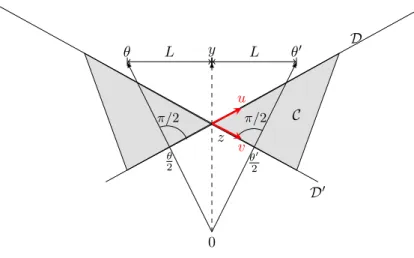
Step 2: a key combinatorial and geometrical argument In order to further bound (51) from below, we now specialize Θ to the set given by Lemma 3 in Appendix B.2, whose proof combines Varshamov-Gilbert’s lemma with simple but key geometrical arguments in dimension two. More precisely, we use Lemma 3 in Appendix B.2 with ε=c/√n andd=
(R2−∆2)n1/(2s+1)
, for some absolute constantc∈(0,1] to be determined later. Two remarks are in order:
• We have d > (R2−∆2)n1/(2s+1)
−1 > 32 log(2) + 1 by the assumption n > (32 log(2) + 2)2s+1/(3R2/4)
>(32 log(2) + 2)2s+1/(R2−∆2) since ∆
6R/2. In particular the conditiond>7 in Lemma 3 holds true.
• The condition ∆>√d εof Lemma 3 holds since by assumption on ∆, we have
∆>R1/(2s+1)n−s/(2s+1)=
q
(R2n)1/(2s+1)/n>pd/n>√d ε ,
by definition ofdandε.
We can thus apply Lemma 3 and find a subset Θ⊆ {∆}×{−ε, ε}d−1⊆
Rdof cardinality|Θ|>e(d−1)/8>
2 such that, for allθ6=θ0∈Θ,
Φθ−Φθ0 L1(Q 0)> √ d−1ε 4π∆ e −∆2 . (52)
Note that our construction of Θ meets our earlier requirement: for all θ ∈ Θ, we have Pd j=2θ 2 jj 2s 6 (d−1)ε2d2s6d2s+1ε26R2−∆2 by definition ofd6 (R2−∆2)n1/(2s+1) andε61/√n. Therefore, Θ⊆
θ∈Rd: θ1= ∆ and Pdj=2θ2jj2s6R2−∆2 as assumed at the beginning of this proof.
Step 3: Reduction to a testing problem with finitely-many hypotheses We now use a classical tool in nonparametric statistics since we reduce the problem to a multiple-hypotheses testing problem. More precisely, using (51) and setting
b θ∈arg min θ∈Θ bΦ−Φθ L1(Q0),
we can see that sup f,g∈Hs(R) kf−gk>∆ n Rf,g(Φ)b −inf Φ Rf,g(Φ) o > δ 2 sup θ∈Θ Eθ h 1{θb6=θ} bΦ−Φθ L1(Qµ) i −10δ ∆ > δ 2 √ d−1ε 8π∆ e −∆2 sup θ∈ΘP θ b θ6=θ −10δ ∆ , (53)
where in the last inequality we used the fact that, on the event{θb6=θ}, we necessarily have bΦ−Φθ L1(Q0)> √ d−1ε 8π∆ e −∆2
by a combination of Inequality (52), the definition ofθb, and the triangle inequality.
We now lower bound the worst-case testing error supθ∈ΘPθ θb6=θ
. Sinceθbonly depends on the training
sample (Xi, Yi)16i6n, whose distribution we denote by Pθ, we can writePθ θb6=θ
=Pθ θb6=θ
. We can thus use Fano’s inequality (cf. Lemma 8 in Appendix B.2.3) with the events Aθ =
b