Boles, Wageeh W. and Beck, Hilary and Hargreaves, Douglas J. (2005) Deploying bloom’s taxonomy in a work integrated learning environment. In: Proceedings of
the ASEE/AaeE 4th Global Colloquium on Engineering Education, 26-30 September 2005, Sydney.
Deploying Bloom’s Taxonomy in a Work Integrated Learning
Environment
Wageeh Boles, Hilary Beck, Doug Hargreaves Queensland University of Technology, Brisbane, Australia
Abstract
The framework of a Work Integrated Learning (WIL) project that involves facilitating a change in the students’ position from detached observers to involved performers and active learners is presented. The project aims at enhancing students’ learning outcomes from the workplace components of their courses in such a way that reflects the contemporary transition from an industrial to a knowledge-based economy and society.
The learning activities at the workplace were categorized as observation, application and reflection. A web interface is designed based on constructivist principles which engage students in ways that require reflection and demonstrated knowledge construction. The web interface offers students access to a range of resources while also providing self-paced training for both academic and industry staff in the areas of consultation and negotiation; experiential learning design; supervision and mentoring; and workplace assessment. The incorporation of Bloom’s taxonomy within the work integrated learning objectives and students’ demonstration of their learning outcomes is made central to the design and
construction of students’ work plans. Considering the cognitive domain of Bloom’s taxonomy, the six levels identified, which range from the lowest level of simple recall of facts to the highest level of evaluation, are utilized to guide the way in which these work plans are developed, executed and reported.
This paper reports on issues and considerations addressed in designing and implementing the project including a web interface in support of work integrated learning, with a focus on engaging the students in active learning processes throughout the main three stages of “before”, “during” and “after” the students’ work integrated learning experience. It provides details of the incorporation of Bloom’s taxonomy in the design of work plan and the
outcomes of its utilization in a pilot study.
Introduction
It is becoming evident that the production and distribution of knowledge are increasingly significant processes that influence economic development and competitiveness. It is also understood that economic performance is largely determined by the ability and capacity of businesses, companies and institutions as well as individuals to engage successfully in learning processes of various kinds (1). This focus on a learning economy has particular implications for universities and other institutions of higher education where formal education processes occur. Specifically these institutions need to provide learning that reflects the needs of a knowledge economy and society.
Practice based professional education largely arose from a movement at the turn of the previous century in an effort to better meet the employment needs of the industrial economy of the time. In an era when the industrial economy is being overtaken by the knowledge economy it is timely to review the nature of the practice education and the inherent skills developed. Also, practice based professional education implies workplace learning.
Learning-by-doing is strongly endorsed because it is relevant to learning and innovation (2). The focus on the learning economy together with the associated transitions and their implications on higher education institutions impacted on workplace learning. This meant that it is timely to re-conceptualise and structure the nature and role of workplace learning and the kinds of skills implied and developed through it. This also calls into question the precise role of workplace learning and its relationship to university curriculum for professional education.
Recent studies demonstrated that professionals move through a developmental continuum in which they progress from novices to experts (3, 4). In addition, the studies suggested that professionals move through five stages of career development namely; "novice", "advanced beginner", "competent", ''proficient", and "expert" (5). This project will draw parallels between this model of progress and students' progress through the academic curriculum. A study of how students move from the level of knowledge and skills at the start of university education with some degree of exposure to discipline knowledge, to beginning professionals at the end of their courses would be very valuable. This project will explore how progress through the curriculum reflects changes in aspects of students’ learning outcomes and performance levels. It seeks to discover if there is a paradigm shift from reliance on abstract principles to concrete understanding and from seeing situations as discrete, unrelated parts to seeing situations and practical problems as part of a whole.
In spite of general agreement on the importance of workplace learning (often referred to as the practicum), assessment remains problematic (6). In the absence of clear objectives for workplace education, assessment could produce misleading outcomes. There is also
confusion about what the practicum contributes to higher education. It is suggested that there are five assessment models; attendance, work history, broad abilities, specific competencies and the negotiated curriculum models (6).
The WIL project features
Against this background, the Faculty of Built Environment and Engineering at QUT has been implementing a teaching and learning development project on Work Integrated Learning (WIL) aimed at enhancing students’ learning outcomes from the workplace components of their courses. The main framework involves facilitating a change in the students’ position from detached observers to involved performers and active learners. This reflects the contemporary transition from an industrial to a knowledge-based economy and society. The project’s approach considers facilitating students’ progression to build knowledge and capabilities through the integration of academic and workplace curricula, thus improving their standing within the novice-expert dimension.
There are several interesting features of the WIL project, designed to achieve these outcomes, that will be examined in this paper including:
• The Web Interface • The Work Plan Tool • The WIL Pilot Workplace Objectives
The WIL program is framed around a set of workplace objectives that students must address in the workplace. In developing the Workplace Objectives, a number of frameworks were considered that represented various viewpoints of stakeholders. In addition to the guidelines of Engineers Australia accreditation criteria and the QUT Graduate Capabilities, the findings of the “Employability Skills for the Future” study (7), conducted by the Australian Chamber of Commerce & Industry and the Business Council of Australia were considered. This study presented an international overview highlighting similarities in generic employability skills aligned with the Australian Mayer Key Competencies. Further, the workplace objectives were reflected in the course objectives, ensuring a continuum of purposeful outcomes for all engineering students.
The project team then considered ways that these frameworks could be represented to
students so that they could readily comprehend the reasons for undertaking work experience, and could report their experiences relative to these frameworks. As we reported earlier, considering the above, it became clear that there were inadequacies in the existing course objectives with some needing to be “unpacked” and others lacking (8) . Therefore, adapting the combined frameworks to represent somewhat extended Graduate Capabilities was a useful process in deciding the subsets for workplace objectives.
The workplace objectives were categorised as Observation, Application and Reflection, and divided into compulsory and elective tasks that would reasonably represent the work students may undertake during work experience. That not all students would enjoy the same kinds of technical tasks was a deciding factor in the development of the compulsory category of workplace objectives. This category therefore became the observation and reflection
category where students not significantly engaged in technical applications, would focus their attention on ‘how things are done in the workplace’. Further, to ensure that students actually read and understood the compulsory items prior to WIL, they were required to prioritise them in the Work Plan tool (discussed later). The elective aspects provided opportunities for the specific application of knowledge and skills, both technical and generic, as well as the capacity to reflect on activities, and students would select one or more items from this category.
To ensure students developed meaningful learning outcomes, each of the workplace objectives was then phrased in accordance with Bloom’s Taxonomy of Educational
Objectives. Bloom’s Taxonomy (9) describes the cognitive domain of educational activities, involving knowledge and the development of intellectual attitudes and skills, as levels that range from the simplest behavioural objectives to the most complex, but these cannot be used as absolutes. Bloom classified educational goals to encourage thought processes at six
different levels of cognitive ability from the simple recall of knowledge, to the high level abilities of analysis, synthesis and evaluation. To these levels he applied verbs
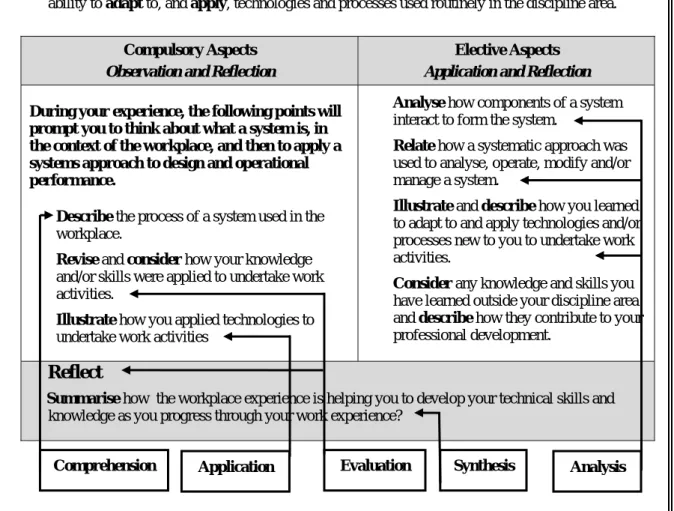
commensurate with the levels of skill. These levels are seen as very useful for developing the critical thinking skills and enhancing the students’ learning outcomes. Table 1 shows a sample of the objectives students need to address for Observation, Application and Reflection in the various stages of their work experience.
Table 1: Sample objectives with Observation, Application and Reflection tasks utilising Bloom’s taxonomy.
Graduate Capability A: Demonstrateknowledge and skills relevant to Engineering disciplines,
sufficient for entry to the profession, including:
• sound theoretical and practical knowledge across the discipline.
• comprehensive theoretical and practical knowledge in one or more areas of specialisation within the
discipline.
• ability to adapt to, and apply, technologies and processes used routinely in the discipline area.
Compulsory Aspects Observation and Reflection
Elective Aspects Application and Reflection During your experience, the following points will
prompt you to think about what a system is, in the context of the workplace, and then to apply a systems approach to design and operational performance.
• Describe the process of a system used in the workplace.
• Revise and consider how your knowledge and/or skills were applied to undertake work activities.
• Illustrate how you applied technologies to undertake work activities
• Analyse how components of a system interact to form the system.
• Relate how a systematic approach was used to analyse, operate, modify and/or manage a system.
• Illustrate and describe how you learned to adapt to and apply technologies and/or processes new to you to undertake work activities.
• Consider any knowledge and skills you have learned outside your discipline area and describe how they contribute to your professional development.
Reflect
Summarise how the workplace experience is helping you to develop your technical skills and knowledge as you progress through your work experience?
The next phase examined the various objectives and how they were developed across the breadth of each course. Research was conducted into the work of other faculties in relation to student skill development. In particular, the work of the schools of Architecture, Law and Education were examined for insights into their development frameworks. From this basis, a framework was conceptualised so that generic and technical capabilities could be mapped in a staged manner over the period of the course. This would lead to the final stage of
demonstrating qualities identified as those of reflective engineering practitioners at an ‘advanced beginner’ level.
This skill development is regarded as crucial to informing industry hosts, with confidence, of the precise capabilities of students at any given point in the course. Since students may undertake their workplace learning at different stages of their course, the interaction between the work environment and the student (during the industrial experience) will depend on the knowledge and skill level they have at that time. That skill level would also be a factor in
Evaluation
Application Analysis
determining the tasks that they might be given at the workplace.
This understanding helped determine the learning objectives and the expected learning outcomes. Underpinning this process is the need to provide students and industry supervisors with clear learning objectives that can be measured against carefully designed criteria and standards.
The Web interface
The project specifically targets improving the quality of our courses through a structured and integrated approach to workplace learning with well defined objectives and learning
outcomes supported by appropriate assessment. The practical experience and capabilities (generic and discipline-specific) gained by our students will considerably increase their employability. Students are guided, through specific steps and activities that are presented to them through short face-to-face introductory sessions and require them to interact with material presented to them on the web interface.
The web interface design is based on constructivist principles that engage students in ways which required reflection and demonstrated knowledge construction. A multi-disciplinary team was formed with the clear goal of creating a flexible, web based system applicable across a range of courses and work based experiences from site visits to work placements. With sustainability in mind, the web interface offers students access to a range of resources while also providing self-paced training for both academic and industry staff in the areas of consultation and negotiation; experiential learning design; supervision and mentoring; and workplace assessment.
A major part of the development process was to determine the set of workplace learning activities and the expected levels of achievement of those activities. This was to be realised through the work plan tool within the project.
The Work Plan Tool
The Work Plan Tool is a feature of the web interface that allows students to address the workplace objectives, both elective and compulsory, they will focus on in the workplace. Discussions with an industry focus group provided invaluable input to how the WIL objectives are to be addressed in the work plan tool. One important point was the
understanding that generic capabilities were more likely to be addressed on a wide scale than discipline specific objectives. There was also the fact that student placements in industry will dictate the focus of any engineering application that the student would be able to address. The work plan interacts with and is complimented by the QUT Student Portfolio which is a tool for students to record workplace and life experiences and to demonstrate specific capabilities. It enables students to record experiences and achievements during their university life. By recording these experiences and achievements students have the
opportunities to demonstrate and reflect on the skills they have developed while at QUT. The Student Portfolio record provides evidence to employers that students have the essential skills to do the job for which they have been engaged, including academic performance and the necessary graduate capabilities.
Stages of the work plan
The work plan tool is a web based facility designed to structure the process of preparing, performing and reporting on work experience as well as enhancing the learning outcomes. (a) Before commencing WIL
This section of the work plan guides students through the following steps:
1. Complete the placement details such as company details and duration of appointment. When students have theses details, the web system updates the status of the work plan to indicate that it is “In Progress”. Several discrete periods of WIL can be recorded in this way.
2. Negotiate their placement with a potential employer.
3. Examine the list of compulsory and elective workplace objectives. For compulsory objectives, they are required to prioritize them to suit their placement circumstances. Students then select only a sub set of the elective objectives that are applicable for observation and application during the work experience.
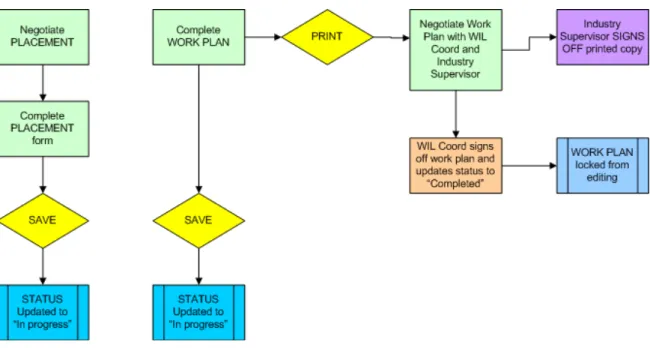
Figure 1: Steps of building and completing the work plan
An “In Progress” work plan is able to be updated by the student based on feedback received from the employer. Students are instructed on whom to contact and the deadlines involved. Once the work plan is completed the WIL coordinator will change its STATUS on the system to "Completed". The work plan will then be locked and cannot be edited further. Figure 1 graphically shows this part of the work plan.
(b) During WIL
During their period of work in industry, students are required to:
1. Apply technical knowledge and skills to the required technical tasks. 2. Observe a range of workplace objectives, both elective and compulsory. 3. Reflect on the selected workplace objectives using the Student Portfolio
4. Add any artifacts such as calculations, drawings, video clips, photographs, reports [non-confidential] to the Student Portfolio to build up a complete profile of the experience
(c) After WIL experience
This section contains information about the activities students should complete after their workplace experience.
1. Finish adding reflections to the Student Portfolio about their WIL experiences based on the workplace objectives they selected.
2. Ensure that their Industry Supervisor has completed the Student Evaluation sheet. 3. Complete the Self Assessment Matrix to assess their progress in meeting the graduate
capabilities they selected. When they save their Self Assessment Matrix, the STATUS tool will automatically update the interface to show that they have started work. 4. Once the Self Assessment Matrix has been verified by the WIL Coordinator, then the
status of the self assessment matrix will be changed to "Completed". 5. Complete the WIL report using the template provided.
6. Give feedback on the WIL process to the WIL coordinator.
The main requirement for compulsory objectives is for students to observe while being at the workplace, while the elective objectives allow students to apply their theoretical knowledge to practical problems in the workplace. Students are required to reflect on both the
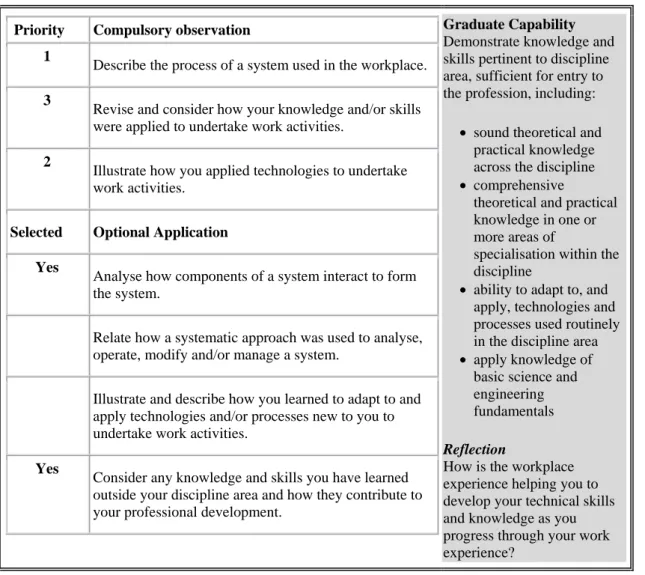
compulsory and elective objectives. All objectives are presented to the students in the work plan tool in terms of Bloom’s six levels of knowledge, comprehension, application, analysis, synthesis, and evaluation. Table 2 shows an extract from the work plan tool with priortised compulsory observations and selected optional applications.
After building and executing the work plan, students are required to submit a report on their work experience. A template is provided that ensures that they respond to the various levels as prescribed in terms of Bloom’s taxonomy.
The Pilot
A pilot study on the developed WIL program was conducted with a small number of students and industry participants over the summer vacation from December 2004 to February 2005. Students who volunteered for the pilot study were provided with training in the features of the program and supporting computer facilities, and regular contact was maintained with them throughout this time.
Training was provided to students before they started the process of preparing for and seeking employment for work experience using the developed WIL program. This included a two-hour workshop, of which half was on the use of the QUT Student Portfolio and was followed by manual training on using the WIL program. Training was conducted by an Information Technology specialist and programmers and project development personnel who addressed the use of Student Portfolio. Training was also conducted by QUT staff from Careers & Employment on strategies for writing reflections, ie STAR-L strategy: The Situation, the specific Task student had to do, the Aim of doing this, the specific Reflection [what you thought about and how you questioned where this activity fitted within your knowledge framework] and what the student Learnt from this activity. This is a classic interview technique that can easily be applied to the reflection task and used for specific analysis of all activities. In addition, The WIL Project Officer provided training to students in the use of the WIL program and provided supporting documentation, in the absence of a fully functioning website at that time.
Table 2: Extract from the work plan tool showing priorities set by a student and optional applications selected.
Priority Compulsory observation 1
Describe the process of a system used in the workplace.
3
Revise and consider how your knowledge and/or skills were applied to undertake work activities.
2
Illustrate how you applied technologies to undertake work activities.
Selected Optional Application Yes
Analyse how components of a system interact to form the system.
Relate how a systematic approach was used to analyse, operate, modify and/or manage a system.
Illustrate and describe how you learned to adapt to and apply technologies and/or processes new to you to undertake work activities.
Yes
Consider any knowledge and skills you have learned outside your discipline area and how they contribute to your professional development.
Graduate Capability
Demonstrate knowledge and skills pertinent to discipline area, sufficient for entry to the profession, including:
• sound theoretical and
practical knowledge across the discipline
• comprehensive
theoretical and practical knowledge in one or more areas of
specialisation within the discipline
• ability to adapt to, and
apply, technologies and processes used routinely in the discipline area
• apply knowledge of
basic science and engineering fundamentals
Reflection
How is the workplace experience helping you to develop your technical skills and knowledge as you progress through your work experience?
Students were provided with clear instructions on the use of the Student Portfolio, by way of printed “How to” brochures. They were also directed to Resume Builder on QUT Virtual, and provided with substantial written notes on the WIL program, eg, workplace objectives, report template, draft Work Plan, employer evaluation form. Further information was also provided, as required, via email.
The pilot was managed by the WIL Project Officer who monitored students’ progress through constant contact with them via phone and e-mail to:
• Follow up on students from whom nothing was heard, ie, no queries, to make sure they were comfortable with the system and not experiencing difficulties;
• Keep students informed of the progress of the website and its readiness for use; • Instruct students on how to use the work plan tool;
• Arrange appointments with students requiring assistance with their report;
• Field specific queries from students on what to do with Work Plans once completed, who to give reports to, how to address certain issues in the reports, what could be changed to suit, etc;
• Clarify conflicting information they had received elsewhere;
• Enlighten the faculty’s Students Services to the new report formats and the process for having these evaluated.
During the pilot process, some students found it difficult to capture their reflections in the workplace on a regular basis, because they either did not have access to a computer and the Student Portfolio tool, or they simply did not have the time to focus on this during work hours. Few were so motivated as to capture their experiences by use of a manual log. Overall, students acknowledged the benefits of the program and its learning focus but many found it too complex and time-consuming, particularly when there were no academic points attached to it. It is considered that the fully-functioning website, as was its design, would have made this task very much easier and less time-consuming for students. Also, students found that while the program provided good guidelines, it was difficult to comply with all aspects of the reflection and writing task so they opted for the briefer Industrial Experience version of the work experience report.
As for industry participants, the original intention was to allow industry access to the WIL site to view the Work Plan and Workplace Objectives and for the purpose of evaluating students on-line. This was in response to industry’s resistance to support a program that demanded more time from them. As a result, students were required to have industry
complete the Student Evaluation Form manually, and to submit this with the report. Because web interface was not operational during WIL pilot, it was difficult to encourage industry to be involved when there was no real function for them during this phase. However, Industry seemed pleased with the structure of the program and comments domestically and
internationally reflect a genuine appreciation of the attempts to structure the experience for both students and industry. They also welcomed the opportunity to evaluate student
performance.
Industry participants were supportive of direction of student learning during work experience within the framework of the Graduate Capabilities which, when broken down into Workplace Objectives, give students a real focus for their workplace learning.
For this pilot program, one academic who was involved in the assessment of the student work experience reports, claimed that the report was relatively easy to mark because all the
information providing direction for the writing task was included and all reports complied with the same format.
Conclusions
This paper reported on issues and considerations addressed in designing a web interface in support of work integrated learning, with a focus on engaging the students in active learning processes throughout the main three stages of “before”, “during” and “after” the students’ work integrated learning experience. It provided details of the incorporation of Bloom’s Taxonomy in the design of the work plan tool and the outcomes of its utilisation in the pilot study.
The pilot study involving a small number of students and industry participants has been conducted to have a preliminary idea on how the project objectives are being met and to also identify problem areas that would require attention. A further major pilot is planned for second semester 2005 with a fully-functioning web interface. At the conclusion of the work
experience, students met with the WIL Project Officer to debrief and share their experiences and provide comments on the functionality of the system.
Overall, there was favourable support for the WIL approach that aims at ensuring that students’ work in industry forms an important and integral part of the students’ learning experience. However, outcomes varied depending on the students’ placements and access to computer and internet facilities. As a result of the pilot study, some refinements will be implemented.
The inclusion of a WIL component, either as a core or elective opportunity, is a feature of all new courses within the Faculty of built Environment and Engineering. The WIL program has been designed to service all courses, with particular emphasis initially on Engineering. This is therefore a timely addition to the repertoire of development facilities available to assist students in their transition from university to the workplace.
References
1. OECD (1996) “Transitions to Learning Economics & Societies”, Paris: OECD. 2. OECD (2000), “Learning Regions & Cities: Knowledge, Learning & Regional
Innovation System”, Paris: OECD.
3. Daley, B.J. (1999), “Novice to Expert: An Exploration of How Professionals Learn”,
Adult Education Quarterly, Vol. 49, Issue 4, pp. 133-148.
4. Chi, M.T.H., Feltovich, P.J., & Glaser, R. (1980), “Categorization and Representation of Physics Problems by Experts and Novices,” Cognitive Science, 5, pp. 121-152. 5. Dreyfus, H., & Dreyfus, S. (1985). “Mind over Machine: The Power of Human
Intuition and Expertise in the Era of the Computer”, New York: Free Press.
6. Toohy, S. & Ryan, G. (1996), “Assessing the Practicum,” Assessment and Evaluation in
Higher Education, Vol. 21, Issue 3, pp.215-228.
7. Department of Education, Science & Training (2002), “Employability Skills for the Future”, Canberra.
8. Boles, W. and Emmett, D., “Web Interface in Support of Work Integrated Learning,” Proceedings of the Australasian Association for Engineering Education Conference, AaeE2004, Toowoomba, Australia, September 2004.
9. Bloom, B.S. (Ed.) (1956) Taxonomy of educational objectives: The classification of educational goals: Handbook I, cognitive domain. New York ; Toronto: Longmans, Green.
Acknowledgements
This work is supported by a QUT Large Teaching and Learning Grant awarded to the Faculty of Built Environment and Engineering.
The authors are grateful for the valuable contributions of the other Work Integrated Learning team members: Dr Jonathan Bunker, Mr Chris Lenz, Dr Duncan Campbell, Dr Keith
Hoffman, Dr Ramasamy-Iyer Mahalinga-Iyer, Dr Adriana Bodnarova, Ms Karen Whelan and members of the Project Reference and Industry Focus groups.