Scaling up Retrofit Programs through Web Software Tools and HPXML
Scott Case and Diane Ferington, EnergySavvyDerek Smith, Clean Energy Works Oregon Adam Studdard, Conservation Services Group
ABSTRACT
Finally, the day has arrived for energy efficiency program managers. Software tools that actually meet the needs of energy efficiency program actors and provide at-a-glance dashboards, contractor conversion rates, integrated home modeling and workflow – all without paper forms. This paper conveys the tools employed by an energy efficiency program to drive consumer enrollment, program administration ease, and at-a-glance dashboards that indicate everything from the effectiveness of a particular marketing piece at a cost per lead, to how many people are at what stage of a comprehensive retrofit. Automatic administrative ticklers assist in the management of workflow, contractors can view the number of customers who respond to a particular marketing piece and assess their cost for acquisition as well as customer conversion to comprehensive retrofit work scopes. For program administrators seeking to cost-effectively deliver and scale up whole-home retrofit programs, learning about this technology-enabled approach is a must.
Introduction
“Don’t make me go run that program!” – An unnamed energy efficiency program manager at an unnamed utility being threatened with a transfer to run the utility’s home performance program.
Whole-home retrofit programs have long been considered to be the ugly stepchild of utility portfolios: a complicated multi-step process that homeowners have to follow; high direct program costs with low completion rates; savings often limited to direct installs during the test-in audit because of difficulty tracking causal follow-up; deep collaboration requirements with different contractors and auditors in the field using different software systems; solutions that may work in a small pilot that don’t scale cost-effectively.
This paper follows the growth of a whole-home retrofit program, Clean Energy Works Oregon (CEWO), from a 500-home pilot in Portland, OR, as it has leveraged best practices in web-enabled coordination and program optimization software to become a highly successful Better-Buildings funded statewide initiative. Clean Energy Works Oregon, along with its key partners, EnergySavvy, Conservation Services Group and the Energy Trust of Oregon, is leading the way in using technology to make things simple and effective for all parties: homeowners, contractors and program managers.
The results? Twelve hundred homes retrofitted, with an average per-home retrofit cost of $14,000, energy savings of 30% and 3 tons of CO2 saved annually. The 500 homes in the pilot took 2 years to complete – now the program is completing over 100 home retrofits per month.
Engaging Homeowners Online
Homeowners are comfortable going online today, and they are specifically willing to go to the internet with energy efficiency questions. They may not necessarily go to their utility website, but they do go to Google, and from there, they’ll find locally relevant businesses and information resources that hopefully point them in the right direction.
Clean Energy Works Oregon made an important presumption that homeowners are comfortable with, and in fact, prefer signing up for and managing their home retrofit process online. Phone based enrollment and engagement is supported but not emphasized.
There are three key elements to CEWO’s homeowner online user experience strategy: 1. Broaden the program marketing and outreach beyond the program’s own website by
enabling contractor online co-marketing.
2. Provide a great online pre-qualification experience and program application.
3. Give homeowners their own program portal, with all their documents and program information in one place online.
Enabling Contractor Online Co-Marketing
CEWO has a very strong relationship with its trade allies, both because they are the ones that have the majority of the interaction with homeowners in the program throughout the process, and because they are the leading source of marketing for the program.
Figure 1. CEWO Applicants by Marketing Channel, April 2011 – January 2012
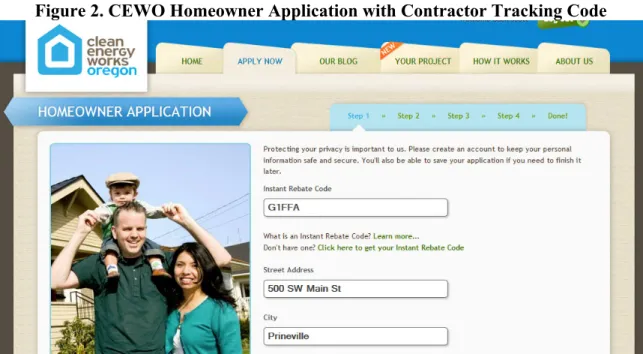
A common concern among contractors working with energy efficiency programs is that if they market for the program, they might lose “their” customer to other contractors in the program. CEWO and EnergySavvy addressed this potential barrier through a system of contractor source tracking codes. These tracking codes can be used in consumer-facing print marketing materials (in which case the consumer is invited to enter their code when they apply),
Figure 2. CEWO Homeowner Application with Contractor Tracking Code
Once a program applicant has a tracking code that is associated with a contractor, they are automatically tagged to that contractor throughout the program unless they specifically ask to change as a result of a bad experience. This removes the biggest barrier to contractor co-marketing on the program’s behalf, which means that CEWO reaches anyone that its contractors reach in their marketing, and that it dominates the Google results page for all homeowners searching for energy efficiency topics in its geographic areas.
Figure 3. Google Search Results for “Energy Audit Portland OR”
Online Pre-Qualification
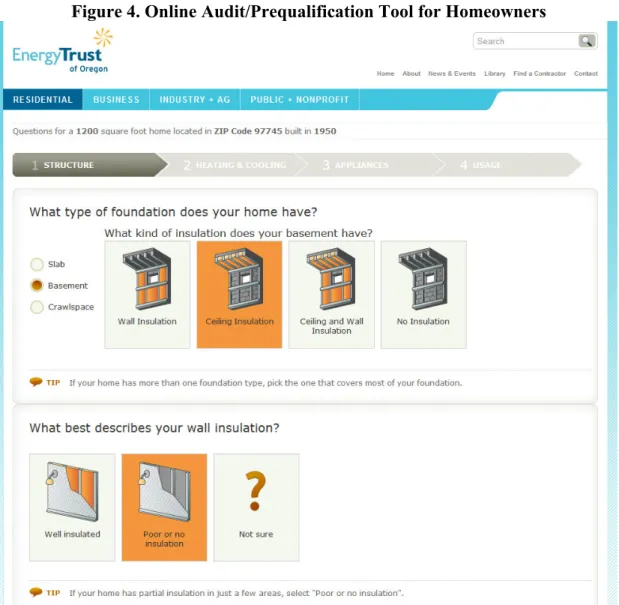
Energy Trust of Oregon uses EnergySavvy’s Online Audit tool to allow homeowners to pre-qualify themselves for energy savings potential.
Figure 4. Online Audit/Prequalification Tool for Homeowners
Shown as implemented on Energy Trust of Oregon. Will be updated to reflect CEWO deployment.
The tool is a short, self-serve online audit that engages homeowners by gathering initial information about their home before they apply for the program. This approach has several distinct benefits to the program.
Unqualified (from an energy savings potential) homes are off-ramped immediately to other less comprehensive programs offered by the Energy Trust of Oregon. Because in-home audits are subsidized by the program, this means that few homes that can’t achieve the minimum savings target end up receiving comprehensive in-home audits, thus costing the program unnecessary expenditures.
While data isn’t yet available for CEWO, in a similar implementation with the Utah Home Performance with ENERGY STAR program, 16% of program applicants were disqualified for low energy savings potential, leading to a cost savings to the program of over $200,000 (in test-in audit subsidies that weren’t paid out unnecessarily). The customer service impact is very positive as well, because homeowners who are unlikely to achieve enough savings to qualify for the program don’t have to pay their part of the in-home audit cost.
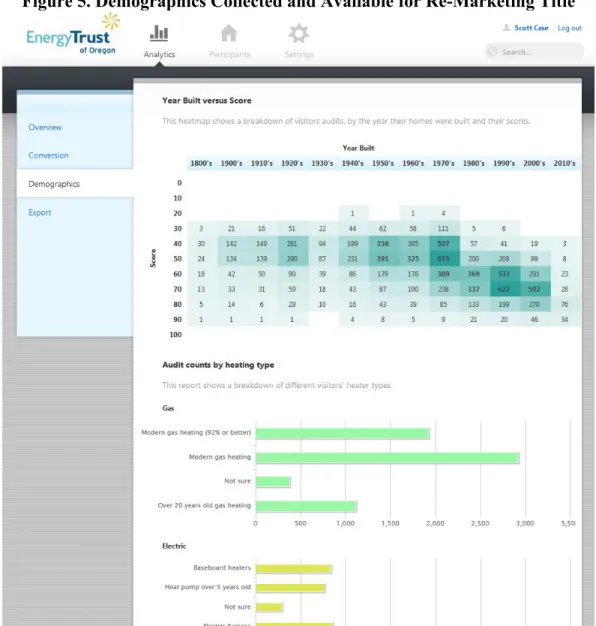
Homeowners that are qualified from an energy savings potential but don’t apply immediately can be re-marketed to via targeted email re-marketing, since most homeowners provide their email address at the end of the Online Audit survey. The email address given is associated with their Online Audit results and can then be used for follow-up communications that are segmented and personalized based on their specific conditions of their home: leading to a far more effective marketing engagement than undifferentiated email follow-up.
Figure 5. Demographics Collected and Available for Re-Marketing Title
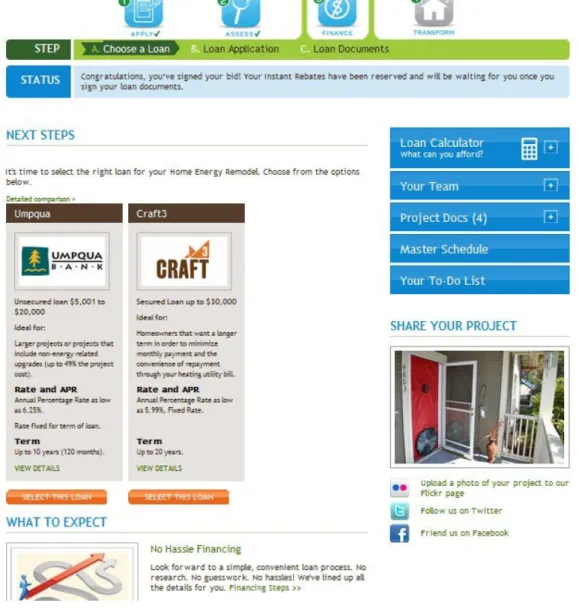
Homeowners that do qualify and apply for the program immediately receive log-in credentials for a secure and dynamic program portal, powered by EnergySavvy’s Program Optix software, that helps guide them through the retrofit process. All their program documents (audit reports, bids, loan documents, etc) are available to them, and the general flow of the program along with a “You Are Here” indication is always shown, so they can see what is happening currently and what is next for them. At key moments in the program, such as the selection of a lender from among competing banks, the homeowner does their research and makes their selection in the portal.
Figure 6. An Example Homeowner Portal Interaction – Selecting a Lender
Automatic email follow-up acts as an extension of the homeowner portal, communicating with the homeowner at key milestones and decision points. More significantly, email contact is made automatically to homeowners if they don’t follow up within a specified time (for instance
at bid selection or loan signing). These gentle nudges keep homeowners moving through and reduce program drop-off without needing a customer service representative to remember when to remind homeowners to respond.
Figure 7. An Example Homeowner Email Template
This robust homeowner program portal and automatic email engagement is allowing the program to scale up while limiting customer service costs.
Online Contractor Management
The second key to CEWO’s approach is to facilitate contractor-program interactions through an online contractor portal. This portal, powered by EnergySavvy Program Optix, allows contractors to interact with homeowners and other program personnel throughout the audit and retrofit workflow.
Lead Tracking, Service Level Agreement Management
Whether contractors bring their own leads to the program (through the tracking code mechanism) or they are assigned homeowner leads that the program generates through its own
marketing, the contractor portal provides a consistent place to see the status of their projects and enter required program data at various stages throughout a project lifecycle.
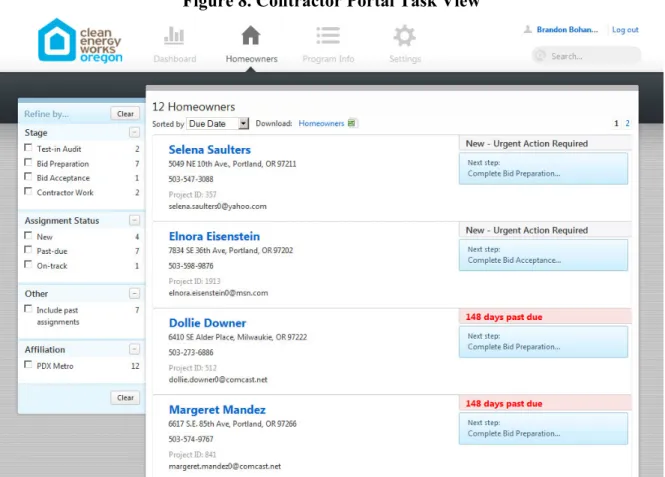
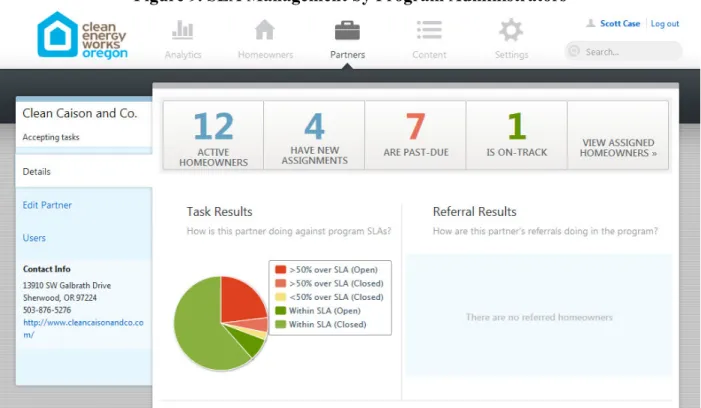
Since all contractor activity (task assignments, due dates and completions) are tracked centrally, a contractor’s performance against agreed upon service level agreements (SLAs) can be monitored, both by the contractors themselves and by the program administrators. This allows for the concept of “soft” and “hard” SLA enforcement. “Soft” SLA enforcement comes from contractors themselves – they see that their own tasks are coming due (or past due) and take pre-emptive action to stay on track. And since any homeowner’s current project status is visible to all parties assigned to that homeowner (contractors, energy advisors, lenders, customer service representatives, etc) and a successful outcome benefits them all, there’s a shared sense of responsibility to keep projects on track.
Figure 8. Contractor Portal Task View
Actual homeowner names, emails addresses and phone numbers have been replaced by fake information in this screenshot.
If “soft” SLA enforcement doesn’t suffice, the program administrator has clear information on how contractors are performing against their SLAs, and can take “hard” enforcement actions – contractor by contractor quarterly reviews, prioritizing lead distribution by SLA performance, or even kicking out contractors that consistently don’t hit their SLAs.
Figure 9. SLA Management by Program Administrators
HPXML Data Exchange
A critical part of most whole-home retrofit programs is the process of collecting existing conditions, modeling home energy savings, making recommendations and re-modeling after projects are completed. In the CEWO program, Conservation Services Group’s EMHome software is used for energy modeling. In order to facilitate data transferability and analytics, EnergySavvy and CSG collaborated to implement an HPXML-based data exchange for energy modeling data throughout the project workflow.
• Successful program applicants tracked by EnergySavvy Program Optix appear in EMHome for modeling.
• When audit appointments and other homeowner interactions are scheduled by the program in the Program Optix platform, those interactions are synchronized into EMHome.
• Existing home conditions data collected by contractors is modeled by program Energy Advisors, and automatically transferred into EnergySavvy via web service in HPXML format.
• Recommendations, work bids, notes and other data entered by contractors are similarly transferred when available, so that they are immediately available for review by program personnel and accessible to homeowners through the secure homeowner portal.
• Test-out results are also transferred via web service.
The impact of the use of HPXML for this data interchange is clear: the program administrators can run comprehensive analytics and reporting; data is never double-entered for homeowner projects due to different software tools being employed; and the program can pick
and choose different software components for data collection, reporting, modeling and analysis as changing needs dictate, rather than being locked into any single tool.
Program Administration Benefits
The benefits of the central technology platform to homeowners and contractors, as described so far in this paper, have a secondary, but possibly more important impact. By capturing all the project interactions that homeowners and contractors have, CEWO program administrators develop a deep and rich data-based understanding of how their program is running on a near real-time basis.
Marketing Optimization
The contractor tracking code system used to enable contractor co-marketing are also used to track other marketing campaign results. This allows for visibility not just into the lead volume by marketing source, but also the lead quality by marketing source: the program can optimize for customer acquisition channels that might drive low volume of high quality applicants that are most likely to complete a retrofit project, rather than high volume of low quality leads.
Figure 10. Marketing Results by Contractor, CEWO, April 2011 – January 2012
Green indicates that a homeowner brought in by a contractor completed the program, yellow that a homeowner is still in progress, and red that a homeowner dropped out of the program before completing. (Actual contractor names
Identifying Program Bottlenecks
Access to stage by stage conversion analytics is extremely important to CEWO as they make decisions about program tuning over time. A time-based view of the program funnel’s conversion rate allows the program managers to understand where most people are dropping out or are being stalled. And as they make policy changes as a result, new applicants experience the program slightly differently – allowing for a cohort-based analysis of the program.
Figure 11. CEWO Applicant Status for Applications between June 2011 and Jan 2012
Green arrows indicate homeowners from an initial date-based cohort that successfully advanced from stage to stage. Red arrows indicate dropouts at particular stages, and grey arrows are for manual stage overrides.
Empowering Dynamic Resource Allocation
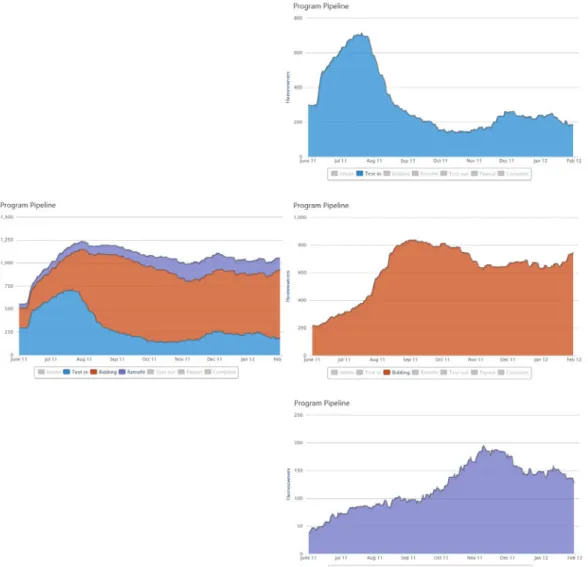
Seasonality and marketing campaign timing can cause bursts of new applicants, and those bursts of new applicants move through the program pipeline like a “pig moving through a python” (in the colorful language of one program administrator). Understanding where the “pig” is at any given time allows Clean Energy Works to redirect floating program CSR and Energy Advisor resources to ensure that homeowners aren’t getting ignored.
Figure 12. Program Pipeline Disaggregation, CEWO, June 2011 – January 2012
The combined pipeline view on the left shows three stages (Test-In, Bidding and Retrofit). To the right, each stage is shown by itself, clearly pointing out the “pig in the python” effect.
Summary
Clean Energy Works Oregon has been a model of success as a Better Buildings initiative – not just for its job creation and home retrofit results, but for its innovative approach to administering an effective whole-home program enabled by a web software platform. This paper highlighted some of the features of CEWO’s implementation and innovative use of the software platform developed by EnergySavvy, as well as the HPXML-based web service integration with the Energy Trust of Oregon and CSG.
While we’re by no means done with our work, we believe we’ve created a home performance program and platform that is effective, transparent, a positive experience for all participants (homeowners, contractors and administrators).