The Program Administrator
Cost of Saved Energy for Utility
Customer-Funded Energy
Efficiency Programs
Megan A. Billingsley, Ian M. Hoffman, Elizabeth Stuart,
Steven R. Schiller, Charles A. Goldman, Kristina LaCommare
Environmental Energy Technologies Division
March 2014
The work described in this report was funded by the National Electricity Delivery Division of the U.S. Department of Energy’s Office of Electricity Delivery and Energy Reliability under Lawrence Berkeley National Laboratory Contract No. DE-AC02-05CH11231.
E
RNEST
O
RLANDO
L
AWRENCE
BERKELEY NATIONAL LABORATORY
The Program Administrator Cost of Energy Saved for Utility
Customer-Funded Energy Efficiency Programs
Prepared for the U.S. Department of Energy
National Electricity Delivery Division of the Office of Electricity Delivery and Energy Reliability
Principal Authors
Megan A. Billingsley, Ian M. Hoffman, Elizabeth Stuart, Steven R. Schiller, Charles A. Goldman, Kristina LaCommare
Ernest Orlando Lawrence Berkeley National Laboratory 1 Cyclotron Road, MS 90R4000
Berkeley CA 94720-8136
March 2014
The work described in this report was funded by the National Electricity Delivery Division of the U.S. Department of Energy’s Office of Electricity Delivery and Energy Reliability under Lawrence Berkeley National Laboratory Contract No. DE-AC02-05CH11231.
i
Disclaimer
This document was prepared as an account of work sponsored by the United States Government. While this document is believed to contain correct information, neither the United States
Government nor any agency thereof, nor The Regents of the University of California, nor any of their employees, makes any warranty, express or implied, or assumes any legal responsibility for the accuracy, completeness, or usefulness of any information, apparatus, product, or process disclosed, or represents that its use would not infringe privately owned rights. Reference herein to any specific commercial product, process, or service by its trade name, trademark,
manufacturer, or otherwise, does not necessarily constitute or imply its endorsement,
recommendation, or favoring by the United States Government or any agency thereof, or The Regents of the University of California. The views and opinions of authors expressed herein do not necessarily state or reflect those of the United States Government or any agency thereof, or The Regents of the University of California.
Ernest Orlando Lawrence Berkeley National Laboratory is an equal opportunity employer.
Acknowledgements
The work described in this report was funded by the National Electricity Delivery Division of the U.S. Department of Energy’s Office of Electricity Delivery and Energy Reliability under
Lawrence Berkeley National Laboratory Contract No. DE-AC02-05CH11231.
The authors would like to first and foremost thank Larry Mansueti and Cyndy Wilson of the U.S. Department of Energy for their support of this work. We would also like to thank Caitlin
Callaghan, Judy Greenwood, George Edgar, Scott Johnstone, Barbara Alexander, Maggie
Molina, Tim Woolf, Rich Sedano, Howard Geller, Nick Hall, M. Sami Khawaja, Stan Price, Lara Ettenson, David Goldstein, Peter Miller, Cecily McChalicher, Jim Lazar, Natalie Mims, and Peter Narog for providing comments on a draft of this report. We also thank Anthony Ma for assistance with graphic design and Dana Robson for copyediting. Any remaining omissions and errors are, of course, the responsibility of the authors.
Table of Contents
Acknowledgements ... iii
Table of Contents ... iv
List of Tables ... vi
List of Figures ... vi
Acronyms and Abbreviations ... viii
Executive Summary ... ix
Results ... xi
Observations and Recommendations on Reporting ... xvi
1. Introduction ...1
1.1 Assessing Energy Efficiency as a Resource ...1
1.2 Objectives and Scope ...2
1.3 Report Organization ...3
2. Approach ...4
2.1 Data Summary ...4
2.2 Program Typology and Standardized Definitions ...7
2.3 Challenges in Consistent and Standardized Reporting of Program Data ...11
2.4 Calculating and Using the Cost of Saved Energy ...12
2.4.1 Levelized Cost of Saved Energy ...14
2.5 Treatment and Adjustments for Missing Data ...15
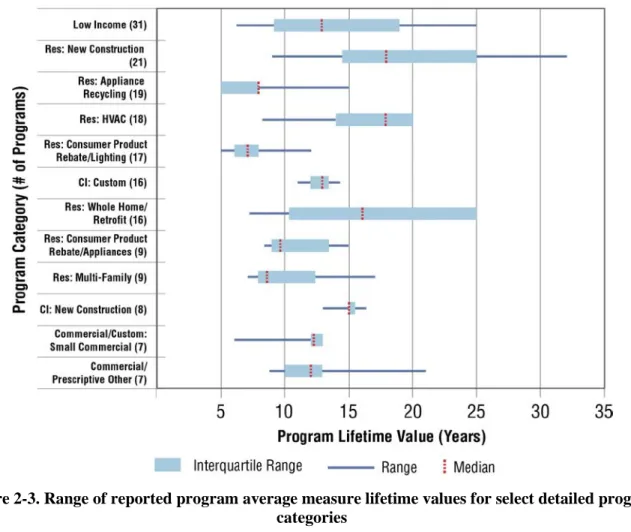
2.5.1 Program Average Measure Lifetime ...16
2.5.2 Cost Data for Combined-Fuel Programs...18
2.5.3 End-Use versus Source and Busbar Energy Savings ...18
3. Results—Utility Customer-Funded Programs: Costs and Savings ...19
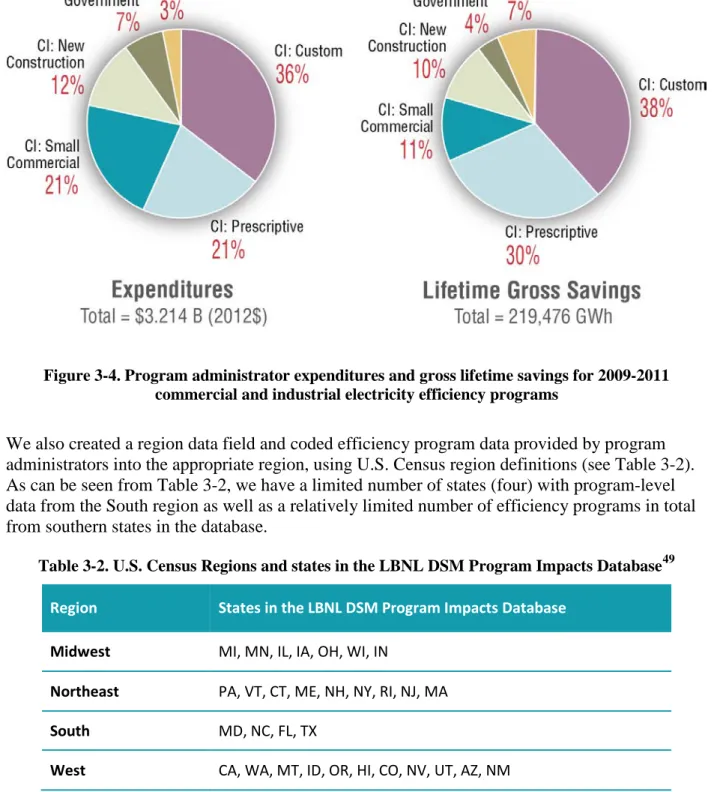
3.1 Energy Efficiency Program Administrator Expenditures and Savings...19
3.1.1 Electric Programs ...19
3.1.2 Gas Program Expenditures and Savings ...25
3.2 Observations on the Cost of Saved Energy...27
3.2.1 National Observations ...27
3.2.2 Sector and Program Level Observations for Electricity Efficiency Programs ...30
3.2.3 Regional Observations in Electricity Efficiency Programs ...35
3.2.4 Sensitivity Analysis: Impact of Measure Lifetime ...41
3.2.5 Program Administrator and Participant Cost Analysis: The Total Resource Cost of Saved Energy ...42
4. Testing Influences on the Costs of Saved Energy ...44
4.1 Hypotheses ...45
4.2 Approach ...46 4.3 Preliminary Results: Analysis of Factors that May Influence the Cost of Saved Energy .47
4.3.1 Program Administrator Experience ...47
4.3.2 Scale of Program ...48
4.3.3 Labor Costs ...50
4.4 Analytical Challenges ...51
5. Discussion of Key Findings and Recommendations ...52
5.1 Key Findings ...52
5.2 Discussion: Program Data Collection and Reporting ...54
6. References ...58
List of Tables
Table ES-1. The program administrator cost of saved energy (CSE) for electricity efficiency programs for 2009-2011 data in the LBNL DSM Program Impacts Database
(2012$/kWh) ... xi Table 2-1. Summary of energy efficiency program data in LBNL DSM Program Impacts
Database ... 5 Table 2-2. Abridged definitions for selected program cost and savings data ... 10 Table 2-3. Program administrator cost of saved energy metrics: definitions and potential uses.. 13 Table 3-1. Program administrator expenditures for 2009–2011 electricity efficiency programs . 20 Table 3-2. U.S. Census Regions and states in the LBNL DSM Program Impacts Database ... 23 Table 3-3. Program administrator expenditures for 2009-2011 natural gas efficiency programs 26 Table 3-4. The program administrator CSE for electricity efficiency programs by sector: national savings-weighted averages ... 28 Table 3-5. The program administrator CSE for gas efficiency programs by sector: national
savings-weighted averages ($/therm) ... 29 Table 4-1. Factors that may influence the cost of saved energy ... 45
List of Figures
Figure ES-1. CSE for electricity efficiency programs by sector for 2009-2011 data in the LBNL DSM Program Impacts Database ... xii Figure ES-2. National levelized CSE for C&I sector simplified program categories ... xiii Figure ES-3. National levelized CSE for residential sector simplified program categories ... xiv Figure ES-4. Levelized savings-weighted average CSE for electricity efficiency programs that
include program administrator costs vs. total resource costs for select program categories ... xv
Figure 2-1. LBNL DSM Program Impacts Database coverage as compared to national efficiency spending reported by Consortium for Energy Efficiency (CEE) ... 6 Figure 2-2. Selected program types in the LBNL program typology ... 8 Figure 2-3. Range of reported program average measure lifetime values for select detailed
program categories ... 17 Figure 3-1. Program administrator expenditures, first year and lifetime gross savings for 2009–
2011 electricity efficiency programs ... 20 Figure 3-2. Program administrator expenditures and lifetime gross savings by simplified program
category for 2009–2011 residential electricity efficiency programs ... 21 Figure 3-3. Lifetime gross electricity savings for 2009-2011 residential consumer product rebate
programs ... 22 Figure 3-4. Program administrator expenditures and gross lifetime savings for 2009-2011
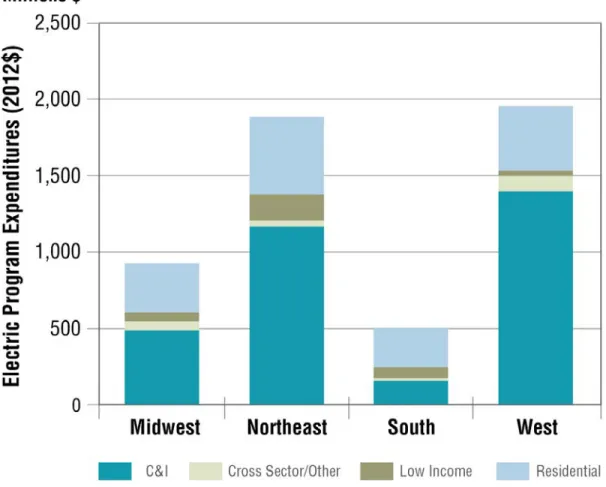
commercial and industrial electricity efficiency programs ... 23 Figure 3-5. Program administrator expenditures by region for 2009-2011 electricity efficiency
programs ... 24 Figure 3-6. Program administrator lifetime savings by region for 2009-2011 electricity efficiency ... 25
Figure 3-7. Program administrator expenditures, first- year and lifetime gross savings for 2009– 2011 natural gas efficiency programs ... 26 Figure 3-8. National savings-weighted average CSE for electricity efficiency programs by sector
... 28 Figure 3-9. CSE for natural gas efficiency programs by sector ... 30 Figure 3-10. National levelized CSE for electricity efficiency programs by sector ... 31 Figure 3-11. National levelized CSE for commercial and industrial sector simplified program
categories ... 32 Figure 3-12. National levelized CSE for residential sector simplified program categories ... 33 Figure 3-13. National levelized CSE for residential whole home detailed program category ... 34 Figure 3-14. National levelized CSE for residential consumer product rebate detailed program
categories ... 35 Figure 3-15. Levelized CSE for electricity efficiency programs by region ... 36 Figure 3-16. CSE values by state for electricity efficiency programs (excluding low-income
programs) ... 37 Figure 3-17. Percent of regional lifetime savings by climate zone and levelized CSE for
electricity efficiency programs ... 38 Figure 3-18. Levelized CSE for residential new construction programs compared to residential
building energy codes adopted by states in each region ... 39 Figure 3-19. Regional levelized CSEs for commercial new construction programs compared to
commercial building energy codes adopted by states in each region ... 40 Figure 3-20. Impact of different program average measure lifetime assumptions on the levelized
CSE for electricity efficiency programs ... 42 Figure 3-21. Levelized savings-weighted average CSE for electricity efficiency programs that
include program administrator costs vs. total resource costs for select program categories ... 43 Figure 4-1. First-year portfolio-level CSE and program administrator experience, as measured by
years of program spending above a minimal level. ... 48 Figure 4-2. First-year CSE for appliance recycling programs and the reported number of
recycling program participants ... 49 Figure 4-3. First-year portfolio-level CSE values and state average wages for construction
industry employees ($/hour) ... 50 Figure 5-1. Components of annual energy efficiency program reporting ... 56
Acronyms and Abbreviations ACEEE American Council for and Energy-efficient Economy C&I commercial and industrial (private sector)
CCE Cost of conserved energy
CEE Consortium for Energy Efficiency CSE Cost of saved energy
DOE U.S. Department of Energy DSM Demand-Side Management
EIA Energy Information Administration EERS Energy Efficiency Resource Standards HVAC heating, ventilation, air conditioning LCOE Levelized cost of energy
MUSH Municipal and state governments, universities and colleges, K-12 schools, and healthcare markets
WACC Weighted average cost of capital
Executive Summary
End-use energy efficiency is increasingly being relied upon as a resource for meeting electricity and natural gas utility system needs within the United States. There is a direct connection between the maturation of energy efficiency as a resource and the need for consistent, high-quality data and reporting of efficiency
program costs and impacts. To support this effort, LBNL initiated the Cost of Saved Energy Project (CSE Project) and created a Demand-Side Management (DSM) Program Impacts Database to provide a resource for policy makers, regulators, and the efficiency industry as a whole.
This study is the first technical report of the LBNL CSE Project and provides an overview of the project scope, approach, and initial findings, including:
• Providing a proof of concept that the program-level cost and savings data can be collected, organized, and analyzed in a systematic fashion;
• Presenting initial program, sector, and portfolio level results for the program administrator CSE for a recent time period (2009-2011); and
• Encouraging state and regional entities to establish common reporting definitions and formats that would make the collection and comparison of CSE data more reliable.
The LBNL DSM Program Impacts Database includes the program results reported to state regulators by more than 100 program administrators in 31 states, primarily for the years 2009– 2011. In total, we have compiled cost and energy savings data on more than 1,700 programs over one or more program-years for a total of more than 4,000 program-years’ worth of data,
providing a rich dataset for analyses. We use the information to report costs-per-unit of electricity and natural gas savings for utility customer-funded, end-use energy efficiency programs. The program administrator CSE values are presented at national, state, and regional levels by market sector (e.g., commercial, industrial, residential) and by program type (e.g., residential whole home programs, commercial new construction, commercial/industrial custom rebate programs).
In this report, the focus is on gross energy savings and the costs borne by the program
administrator—including administration, payments to implementation contractors, marketing, incentives to program participants (end users) and both midstream and upstream trade allies, and
Cost of Saved Energy (CSE) vs. Cost Effectiveness
The program administrator’s cost of saved energy is a useful metric for comparing the relative costs of efficiency programs and for comparing an energy efficiency option to other demand and supply choices for serving energy needs. The CSE is comparable to the levelized cost of energy (LCOE), which represents the per-kilowatthour cost (in real dollars) of building and operating a generating plant over an assumed financial life and duty cycle.
The cost of saved energy is not a direct test of cost effectiveness, however, and is not a benefit-cost analysis, like the Program Administrator’s Cost Test or Utility Cost Test, because it does not purport to capture the monetized value of efficiency to utility customers and shareholders.
evaluation costs.1 We collected data on net savings and costs incurred by program participants. However, there were insufficient data on participant cost contributions, and uncertainty and variability in the ways in which net savings were reported and defined across states (and program administrators). As a result, they were not used extensively in this report. It is also important to note that savings metrics reported by program administrators draw heavily from estimated values.2
Key Definitions
Program administratorcosts include administrative, education, marketing and outreach, and evaluation, measurement and verification (EM&V) costs as well as financial incentives paid to customers or contractors. The CSE values exclude participant costs, and program administrator performance incentives, and, thus, do not represent the total resource cost unless indicated otherwise.
Program savings are based on claimed gross savings reported by the program administrator unless indicated otherwise. For program administrators that only reported net savings values, we calculated gross savings values using net-to-gross ratios if those were available from the program administrator.
Savings values are also based on savings at the end-use site and not at the power plant or natural gas pumping station and thus do not account for transmission and distribution losses.
Lifetime energy savings, when not reported by the program administrator, were calculated per the protocol described in Chapter 2.
Cost of First-Year Energy Savings (First-Year CSE):
The cost of acquiring a single year of annualized incremental energy savings through actions taken through a program/sector/portfolio. The cost of efficiency as a function of first-year energy savings may be useful for program design or budgeting to meet incremental annual savings targets.
Levelized Cost of Lifetime Energy Savings (Levelized CSE): The cost of acquiring energy savings that accrue over the economic lifetime of the actions taken through a program/sector/ portfolio, amortized over that lifetime and
discounted back to the year in which the costs are paid and the actions are taken.
1
Researchers who have estimated the cost of saved energy for efficiency programs have typically focused on the program administrator’s costs because data on participant costs are often not available (Friedrich et al. 2009). Gross savings are those associated with the program participants’ efficiency actions, irrespective of the cause of those actions. Net savings is defined as the total change in energy use that is attributable to a program (for both program participants and non-participants).
2 Savings metrics rely heavily on estimated values because “….energy and demand savings as well as non-energy benefits resulting from efficiency actions cannot be directly measured. Instead, savings and benefits are based on counterfactual assumptions. Using counterfactual assumptions implies that savings are estimated to varying degrees of accuracy by comparing the situation (e.g., energy consumption) after a program is implemented (the reporting period) to what is assumed to have been the situation in the absence of the program (the “counterfactual” scenario, known as the baseline). For energy impacts, the baseline and reporting period energy use are compared, while controlling (making adjustments) for factors unrelated to energy efficiency actions, such as weather or building occupancy. These adjustments are a major part of the evaluation process; how they are determined can vary from one program type to another and from one evaluation approach to another. “ (SEE Action Network 2012)
x
Results
The CSE values presented in this study are retrospective and may not necessarily reflect future CSE for specific programs, particularly given updated appliance and lighting standards. The CSE values are presented as either (a) the savings-weighted average values; (b) as an inter-quartile range with median3 values across the sample of programs; or (c) both.
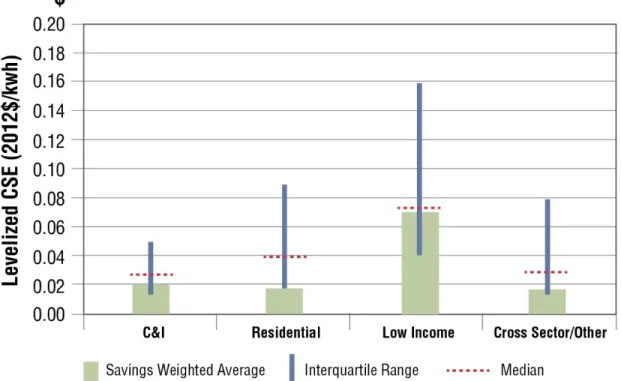
Table ES-1 provides an overall indication of national, savings-weighted average program administrator CSE values by sector using two indicators (e.g., levelized CSE 6% real discount rate and first-year CSE).4 Figure ES-1 indicates the savings-weighted averages, medians and inter-quartile ranges for levelized CSE values using a 6% discount rate.
Table ES-1. The program administrator CSE for electricity efficiency programs for 2009-2011 data in the LBNL DSM Program Impacts Database (2012$/kWh)
Sector ($/kwh; 6% discount rate) Levelized CSE First-Year CSE ($/kwh)
Commercial & Industrial (C&I) $ 0.021 $ 0.188
Residential $ 0.018 $ 0.116
Low Income $ 0.070 $ 0.569
Cross Sectoral/Other $ 0.017 $ 0.120
National CSE $ 0.021 $ 0.162
Values in this table are based on the 2009-2011 data in the LBNL DSM Program Impacts Database. CSE values are for program
administrator costs and based on gross savings.
3 The inter-quartile range is the middle 50 percent of the range of program CSE values. The median is the numerical value separating the upper half of a data sample from the lower half.
4
We calculated a levelized CSE using two discount rates that are rough proxies for different perspectives on energy efficiency investments: a 6% real discount rate that can reflect the utility weighted average cost of capital (WACC) and a 3% real discount rate that can be a proxy for a societal perspective.
xi
Figure ES-1. CSE for electricity efficiency programs by sector for 2009-2011 data in the LBNL DSM Program Impacts Database
Our key national and regional findings are:5
• The U.S. average levelized CSE was slightly more than two cents per kilowatt-hour when gross savings and spending is aggregated at the national level and the CSE is weighted by savings.
• Residential electricity efficiency programs had the lowest average levelized CSE at $0.018/kWh. Lighting rebate programs accounted for at least 44% of total residential lifetime savings with a savings-weighted average levelized CSE of $0.007/kWh. The residential CSE, when the lighting programs were removed, was $0.028/kWh. Low-income programs have an average levelized CSE at $0.070/kWh.
• Commercial, industrial and agricultural (C&I) programs had an average levelized CSE of $0.021/kWh.
• Not surprisingly, the levelized CSE varies widely, both among and within program types. We find that the median value is typically higher than the savings-weighted average for nearly all types of programs. One possible explanation is that our sample includes a number of very large programs and for any given program type, larger efficiency programs have lower CSE than smaller programs because administrative costs are spread over more projects (e.g., economies of scale).
• In reviewing regional results, efficiency programs in the Midwest had the lowest average levelized CSE ($0.014/kWh), while programs in northeast states had a higher
5
Key findings in this section use savings-weighted average CSE values that include program administrator costs (in 2012$) and reported gross savings, which are levelized using a 6% real discount rate.
xii
average CSE value ($0.033/kWh). Programs in western states are at $0.023/kWh and for the southern states included in the database, the comparable program CSE was $0.028/kWh.
• Natural gas efficiency programs had a national, program administrator savings-weighted average CSE of $0.38 per therm, with significant differences between the C&I and residential sectors (average values of $0.17 vs. $0.56 per therm,
respectively).
• The cost of saved energy may vary across program administrator portfolios for reasons that have little to do with programmatic efficiency. In some jurisdictions, a policy mandate of acquiring all reasonably available cost-effective energy efficiency can lead to a focus on more comprehensive programs which will tend to have a higher CSE because they are serving more diverse constituencies and technologies. In other jurisdictions, the focus may be on acquiring the cheapest savings possible.
Program-level results
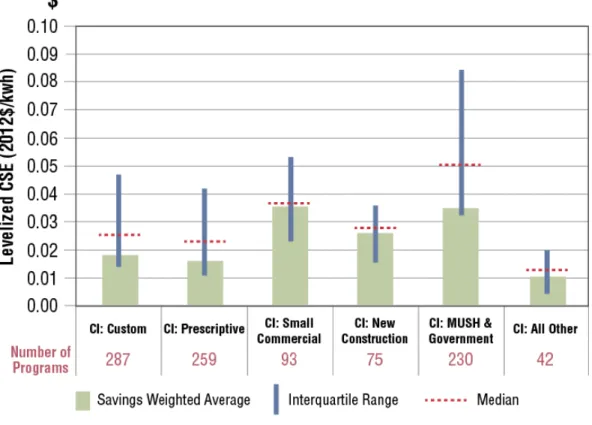
We also examined the cost of saved energy by program type for both residential and C&I programs (see Chapter 3). Figure ES-2 shows an example for the C&I programs, including savings-weighted average (pale green bar) CSE values, the inter-quartile ranges (blue line) and median (red dotted line) CSE values. The median value and inter-quartile ranges for CSE are based on calculations for each individual program and gives equal weighting to programs irrespective of their relative size in terms of either savings or costs.
Figure ES-2. National levelized CSE for C&I sector simplified program categories
The simplified C&I programs have median values for program administrator CSE that range from $0.01/kWh to $0.05/kWh. It is worth noting that the savings-weighted average CSE values for custom and prescriptive rebate program categories are $0.018/kWh and $0.015/kWh,
respectively. Since these two program categories account for almost 70% of C&I sector savings, they tend to drive the overall CSE results for the C&I sector (less than $0.02/kWh).
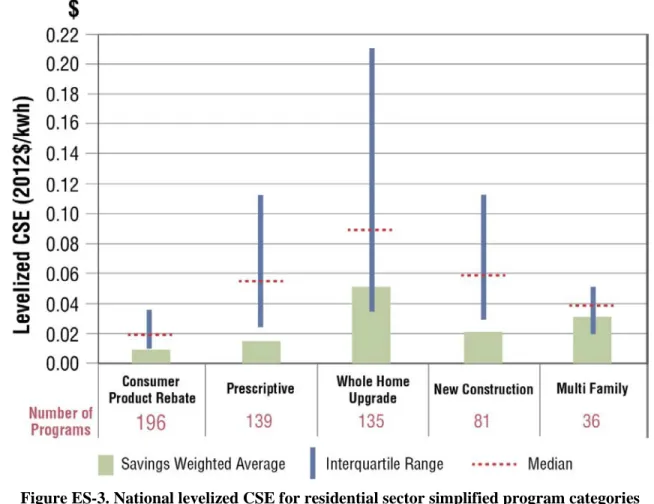
For the residential programs, several program categories have a relatively tight range of program CSE values (see Figure ES-3). For example, Consumer Product Rebate programs have an inter-quartile range of $0.01/kWh to $0.04/kWh and a low savings-weighted average (~$0.01/kWh). However, the residential prescriptive ($0.03/kWh to $0.11/kWh), new construction ($0.03/kWh to $0.11/kWh) and whole-home upgrade ($0.03/kWh to $0.21/kWh) program types have significantly larger ranges. There are several possible reasons for the range of CSE values in each of these program categories. The prescriptive simplified program category includes detailed program types that implement a wide variety of measures (e.g., HVAC, insulation, windows, pool pumps) as well as some generic “prescriptive” programs6 that often include measures also found in the consumer product rebate category. This broad measure mix—and the variation in costs and measure lifetimes associated with those measures—are possible drivers for the wide range of CSE values for the prescriptive category.
Figure ES-3. National levelized CSE for residential sector simplified program categories
6
Some programs include all their rebated measures under the same program title and it is not possible to determine where the majority of the savings is coming from. In these cases, the programs were categorized as “Residential Prescriptive.”
xiv
For the Whole-Home Upgrade program category, the broad range of program designs and delivery mechanisms (this category includes audit, direct install, and retrofit/upgrade programs) may help explain the relatively wide range of CSE values. Overall, most C&I program categories have a relatively smaller inter-quartile range of CSE values compared to residential program categories.
Total resource cost of saved energy
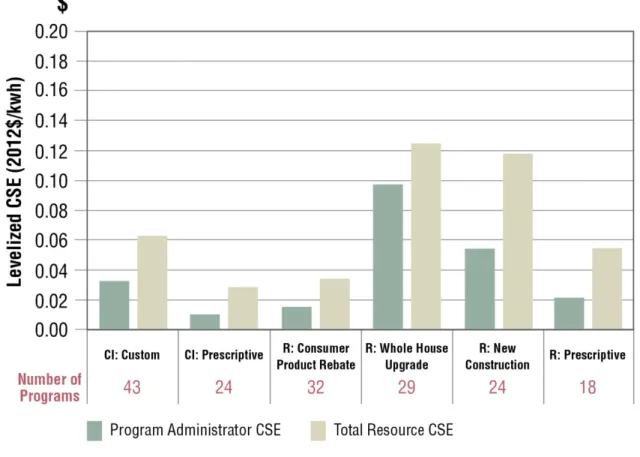
Although we focus on program administrator costs in this report, it is important to note that these metrics do not reflect a total cost perspective since program administrators infrequently report participant costs. We were able to collect participant cost data from a handful of program administrators. However, given small sample size and uncertainty in how participant costs were derived, it is difficult to confidently assess the “all-in” or total resource cost of efficiency or analyze potential influences on the total cost of the efficiency resource. For these reasons, in Figure ES-4, we compare the program administrator’s levelized CSE vs. a total resource levelized CSE for illustrative purposes only. We calculate this total resource CSE for the simplified program categories where both program administrator and participant costs are available for more than 18 program years.7
Figure ES-4. Levelized savings-weighted average CSE for electricity efficiency programs that include program administrator costs vs. total resource costs for select program categories8
7 The “n” of 18 was selected because there was a natural break in the data and there were a meaningful number of programs from which to calculate average values.
8
This chart includes a very small sample of programs from 11 states; thus, results may not reflect current practices in many jurisdictions.
xv
For this small sample of programs, we found that the levelized total resource CSE values are typically double the program administrator CSE with the exception of the Residential Whole Home Upgrade program category (which has a savings-weighted total resource CSE that is about 25-30% higher than the program administrator CSE). Further data collection and analyses could better characterize the way in which the ratio of program administrator costs to participant costs varies as a function of sector, measure types, and market maturity; and how incentives and direct support might be optimized to pay no more than is necessary to meet a state’s efficiency policy objectives.
Observations and Recommendations on Reporting
In calculating the CSE, we utilized information on program administrator costs, annual energy savings, estimated lifetime of measures installed in a program, and an assumed discount rate. However, with respect to current program reporting practices, we observed several challenges to the collection of this data for the purposes of calculating the CSE:
• Inconsistencies in the quality and quantity of the costs and savings data led LBNL to develop and attempt to apply consistent data definitions in reviewing and entering program data:
o Program administrators in different states did not define savings metrics (e.g., varying definitions of net savings) and program costs consistently; and
o Market sectors and program types were not characterized in a consistent fashion among program administrators.
• Many program administrators did not provide the basic data needed to calculate CSE values at the program level (i.e., program administrator costs, lifetime savings, or program-average measure lifetimes), which can introduce uncertainties into the calculation of CSE values (as we developed and utilized methods to impute missing values in some cases).
As a practical matter, the quality and quantity of program data reported by program
administrators is an important factor in assessing energy efficiency as a resource in the utility sector. Additional rigor, completeness, standard terms, and consensus on at least essential elements of reporting could pay significant dividends for program administrators and increase confidence in energy efficiency savings among policymakers and other stakeholders—
particularly in situations where efficiency is treated as a resource in utility procurement
decisions, ISO/RTO forward capacity markets, or as an environmental compliance or mitigation option by state or federal environmental agencies.
Of the 45 states currently running utility-customer funded efficiency programs (Barbose et al. 2013), only 31 states provided reporting with sufficient transparency to complete a program-level CSE analysis, and almost all of the 31 states’ data required some interpretation for purposes of regional or national comparison. With more consistent and comprehensive reporting of
program results, additional insights can quite possibly be obtained on trends in the costs of energy efficiency as a resource as program administrators scale up efforts, what saving energy costs among an array of strategies, and what and how cost efficiencies might be achieved.
Therefore, we urge state regulators and program administrators to consider annually reporting certain essential data fields at a portfolio level and more comprehensive reporting of program-level data in order to facilitate the comparison of efficiency program results at state, regional, and national levels. A diagram illustrating this reporting hierarchy approach can be found in Chapter 5, Figure 5-1.
As part of the LBNL CSE Project, we intend to continue collecting energy efficiency program data and analyzing and reporting the CSE for efficiency actions funded by utility customers. We also plan to:
• Work with state, regional, and national stakeholders to encourage the collection of program cost and impact data using a common terminology and program typology as defined in this report and a companion policy brief (Hoffman et al. 2013). This is important for organizing program data into appropriate and consistent categories so that programmatic energy efficiency, as a regional and national resource, can be reliably assessed.
• Annually compile data reported by program administrators and state agencies from across the United States.
• Conduct additional analyses to help increase understanding of factors that influence EE program impacts, costs and the cost of saved energy.
1. Introduction
Demand side management (DSM), and end-use energy efficiency specifically, is increasingly being relied upon as a resource for meeting electricity and natural gas system needs within the United States, often because efficiency is quite cost-effective compared to other resource options. For example, 15 states have enacted long-term, binding energy savings targets, often called Energy Efficiency Resource Standards (EERS), and another five states have mandates that program administrators must acquire “all cost-effective energy efficiency.”9 In 2011, U.S. energy efficiency program administrators that manage utility customer-funded efficiency programs spent about $5.4 billion on electric and gas energy efficiency programs (CEE 2013), with spending projected to possibly more than double by 2025 (Barbose et al. 2013).
Electric and natural gas energy efficiency in the United States is pursued through a diverse mix of policies and programmatic efforts, which support and supplement private investments by individuals and businesses. These efforts include federal and state minimum efficiency standards for electric and gas end-use products; state building energy codes; a national efficiency labeling program (ENERGY STAR®); tax credits; and a broad array of largely incentive-based programs for consumers, funded primarily by electric and natural gas utility customers (Dixon et al. 2010) (Barbose et al. 2013).10
These utility customer-funded efficiency programs are overseen by state regulators and
administered by more than 100 different entities (e.g., utilities, state energy agencies, non-profit and for-profit third parties) and are the focus of this study. Policymakers, regulators, program administrators and implementers rely on information about lifetime costs and savings of these customer-funded efficiency programs to assess efficiency’s potential, to design and implement programs in a cost-effective manner or to improve program cost effectiveness. Given the expected growth in efficiency funding and the importance of understanding the cost of saved energy (CSE), we initiated this LBNL Cost of Saved Energy Project (CSE Project) to provide a resource for policy makers, regulators and the efficiency industry as a whole.
1.1 Assessing Energy Efficiency as a Resource
The cost and cost effectiveness of utility-customer funded end-use efficiency programs depend on perspective. From the perspective of a participant in a program, their cost is the cost of an efficiency project net of any incentives or support that might be provided by a program
administrator. From the program administrator’s perspective, it is the cost of planning, designing, and implementing a program and providing incentives to market allies and end users to take actions that result in energy savings; costs incurred by participants are not considered as part of the program administrator’s costs. The total resource or societal cost perspective takes into
9 States with an EERS as of the date of this report are: AZ, CA, CO, HI, IL, IN, MD, MI, MN, MO, NM, NY, OH, PA, and TX. Six states have a mandate to achieve all cost-effective savings: CA, CT, MA, RI, VT, and WA. 10
For additional energy efficiency market background, please see: The Future of Utility Customer-Funded Energy Efficiency Programs in the United States: Projected Spending and Savings to 2025.
http://emp.lbl.gov/publications/future-utility-customer-funded-energy-efficiency-programs-united-states-projected-spend
1
account the costs paid by both the program administrator and the participant to implement the efficiency action.
Numerous researchers have estimated the CSE for efficiency programs funded by utility
customers (see Appendix A for a description of past and current efforts). These researchers have typically focused on the program administrator perspective (i.e., the program administrator CSE), for two primary reasons. First, in some cases, participant costs are often not collected or reported by program administrators in annual reports (see Chapter 2). Second, when comparing efficiency with supply side resources, some consider that the proper metric is the money paid to obtain the resource by the program administrator as supply-side resources do not consider, or have, participant costs. For this report, primarily because of the first reason, we present program administrator CSE data and analyses.
Another consideration for assessing efficiency as a resource is whether CSE values are based on net or gross savings. Net savings are those attributed to a program (for both program participants and non-participants). Gross savings are those associated with the program participants’
efficiency actions, irrespective of the cause of those actions. There is debate about the proper use of net and gross savings in CSE calculations (SEE Action 2012); however, since there is neither sufficient nor consistent data available on net savings, we present CSE values based on gross savings in this study.
1.2 Objectives and Scope
This CSE Project presents and analyzes the costs of acquiring energy savings for different efficiency program types and in different market sectors across the United States. Our objectives are to provide insight into the costs associated with saving a unit of energy and the potential factors that influence those costs. To this end, we hope our work will:
• Benefit policy makers, system planners and other stakeholders by providing
continually improving CSE indicators that enable projections of future spending and savings.
• Enable more cost-effective efficiency programs by:
o Benchmarking and comparing program implementation approaches across different markets (e.g., industrial, commercial, small commercial), delivery
mechanisms (e.g., direct install versus do it yourself), and design approaches (e.g., prescriptive versus custom rebates);
o Analyzing contextual factors that affect CSE, such as types of programs, measures, program administrator experience, changes in building energy codes and standards, labor costs, climate, state-level policies, and the scale of efficiency investments.
This study is the first technical report of the LBNL CSE Project and provides an overview of project scope, approach and initial findings, including:
• Providing a proof of concept that the program-level cost and savings data can be collected, organized and analyzed in a systematic fashion;
• Presenting initial program, sector and portfolio level results for the cost of saved energy for a recent time period (2009-2011); and
• Encouraging state and regional entities to establish common reporting definitions and formats that would make the collection and comparison of CSE data more reliable.
Specifically, this report includes and discusses elements of our approach, including the following:
• Developing the data collection, documentation, and analyses procedures LBNL used to calculate the CSE (Chapter 2);
• Defining program categories as well as cost and savings definitions that allow for consistent, standardized entry of program administrator data into a CSE database (Chapter 2);
• Developing a database of program-level data on energy efficiency program impacts and costs from states with significant utility customer-funded energy efficiency programs (Chapter 2);
• Presenting the range of regional-, state-, sector-, and portfolio-level energy-efficiency program administrator CSE and program-level CSE for a defined set of over 60 program categories (Chapter 3);
• Exploring potential relationships between the program administrator costs of saved energy for specific types of programs and climate zones and adopted building energy codes (Chapter 3);
• Conduct a preliminary statistical analysis that explores factors that may be associated with and influence the cost of saved energy at the portfolio or program level and set the stage for future analyses that will assess additional hypotheses and a broader, more refined range of factors (Chapter 4); and
• Present recommendations for future data collection and analyses (Chapter 5). 1.3 Report Organization
The remainder of this report is organized as follows. Chapter 2 provides an overview of approach used to collect data in the LBNL DSM Program Impacts Database and the challenges associated with collecting, organizing and analyzing the data in a consistent fashion. In Chapter 3, we present descriptive statistics on efficiency program costs and savings followed by presentation of CSE statistics at a national, sector, regional, and state level and for certain program types and in relation to climate zones and building code status. In Chapter 4, we discuss our efforts to define and statistically test some factors that may influence the CSE. Chapter 5 presents a discussion of the key findings and recommendations for regulators and program administrators to consider with respect to CSE-related data collection and reporting.
The appendices contain documentation on topics covered in the chapters, including tables of CSE metrics by region, sectors, and program types in Appendix E.
2. Approach
The state-by-state evolution of utility customer-funded energy efficiency programs has fostered diversity in these programs’ oversight, design, administration and evaluation. Thus, not
surprisingly, information provided to state regulators by program administrators on the impacts and costs of efficiency programs is diverse with respect to the level of specificity and detail required as well as terms and definitions used to describe the costs and impacts of individual programs. In this chapter, we summarize our assembled program data, discuss our approach to compiling, organizing and analyzing the data in a manner that addresses the diversity in reporting practices yet allows for consistent reporting on the cost of saved energy across the country and on the basis of region, market sector, and type of program. This approach included developing an energy efficiency program typology and adopting standard definitions for program characteristics, cost and savings data. We also discuss several major challenges associated with collecting and analyzing program cost and impact data and calculating CSE values given data quality issues.
2.1 Data Summary
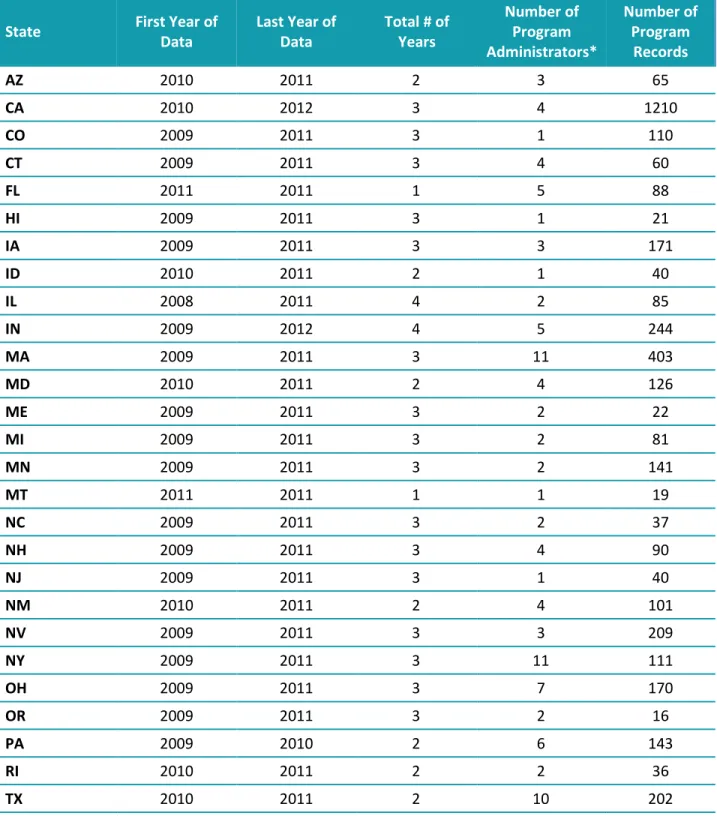
The data for this study were drawn from annual reports, mostly for the years 2009–2011, which were prepared by program administrators of efficiency programs funded by the customers of U.S. investor-owned utilities in 31 states. Our energy efficiency program data set comprises expenditure, energy savings and program participation data (where available) reported by 107 program administrators, for a total of 4,184 program records (see Table 2-1).
We relied primarily on annual DSM or efficiency reports filed by program administrators with state regulatory agencies because they both typically include data for a portfolio of programs and are publicly available from state regulatory commission filings.11 In some cases, when data were not found or were ambiguous in annual reports, we consulted other reports (e.g., other
performance metrics reports filed by investor-owned utilities in California) or solicited additional information directly from the program administrator or regulatory staff. Where required data were not provided in a program administrator’s filed annual report, but provided in third-party program evaluation reports that were included as attachments to the program administrator annual reports, we used data from both to populate what we are calling the LBNL DSM Program Impacts Database (database).12,13
11
The states included in this analysis were selected based on the availability and transparency of program cost and savings data at the individual program level as identified by LBNL researchers in a recent review of customer-funded energy-efficiency programs (Barbose et al. 2013). To the extent that reports were accessible, we collected data for all investor-owned utilities (IOUs) in the target states. Many program administrators had not yet released 2012 program year results during the data collection period for this study; thus our analysis focuses on the 2009-2011 period. We did not include program data from publicly-owned electric utilities and rural electric cooperatives because these utilities often do not report program level data that is publicly available. Future efforts may include data collected from public utilities.
12 We did not rely on individual impact evaluation studies of efficiency programs because the data of interest to this project are usually reported in relatively easily accessible summary form and per program in the annual reports filed with regulators. Moreover, evaluations of individual programs are not always publicly available nor do they always include program or portfolio-related costs.
13
Appendix C describes data that was collected for this research effort, the database configuration, and the data quality assurance/quality control process and procedures.
4
Table 2-1. Summary of energy efficiency program data in LBNL DSM Program Impacts Database14
State First Year of Data Last Year of Data Total # of Years Number of Program Administrators* Number of Program Records AZ 2010 2011 2 3 65 CA 2010 2012 3 4 1210 CO 2009 2011 3 1 110 CT 2009 2011 3 4 60 FL 2011 2011 1 5 88 HI 2009 2011 3 1 21 IA 2009 2011 3 3 171 ID 2010 2011 2 1 40 IL 2008 2011 4 2 85 IN 2009 2012 4 5 244 MA 2009 2011 3 11 403 MD 2010 2011 2 4 126 ME 2009 2011 3 2 22 MI 2009 2011 3 2 81 MN 2009 2011 3 2 141 MT 2011 2011 1 1 19 NC 2009 2011 3 2 37 NH 2009 2011 3 4 90 NJ 2009 2011 3 1 40 NM 2010 2011 2 4 101 NV 2009 2011 3 3 209 NY 2009 2011 3 11 111 OH 2009 2011 3 7 170 OR 2009 2011 3 2 16 PA 2009 2010 2 6 143 RI 2010 2011 2 2 36 TX 2010 2011 2 10 202
14 “Number of Program Records” includes programs that produced energy savings (e.g., residential or commercial rebate programs), programs for which the program administrator did not claim savings (e.g., education and outreach programs or pilot programs), and, in some cases, sector- or portfolio-wide activities (e.g., marketing or internal program evaluation activities).
5
State First Year of Data Last Year of Data Total # of Years Number of Program Administrators* Number of Program Records UT 2009 2011 3 1 41 VT 2009 2011 3 1 18 WA 2010 2011 2 1 42 WI 2009 2011 3 1 42 Totals 107 4184
* In some cases, program administrators who run both gas and electric programs are counted twice for the purposes of separating the reported effects of each program.
Figure 2-1. LBNL DSM Program Impacts Database coverage as compared to national efficiency spending reported by Consortium for Energy Efficiency (CEE)15
15 CEE Annual Industry Reports can be found here: http://www.cee1.org/annual-industry-reports
6
The efficiency program data that were compiled by LBNL staff into the database represent a significant share of all efficiency programs funded by utility customers in the United States. The database contains programs with total program administrator expenditures of about $7.6 billion (see light and dark blue shading in Figure 2-1). Programs in the LBNL database represent about 25% ($1.1 billion) of 2009 national program expenditures by gas and electric utilities and about 50% of program expenditures in 2010 and 2011 ($2.9B in 2010 and $3.2B in 2011), compared to national efficiency spending as reported by the Consortium for Energy Efficiency (CEE) (see Figure 2-1).16
2.2 Program Typology and Standardized Definitions
We developed program categories in order to characterize and analyze similar types of efficiency program types, as defined by market sector and technology, action, delivery approach, or other common themes. Examples of program categories include commercial prescriptive HVAC programs, low-income programs, and residential whole home direct-install programs. Some program categories are relatively well defined and include a narrow set of technologies (e.g., high-efficiency windows or pool pumps), while other categories are cross-cutting, may span a wide variety of activities (e.g., statewide marketing, take-home energy efficiency kits), and/or target several market sectors (e.g., in-school education programs, lighting technology market transformation programs).
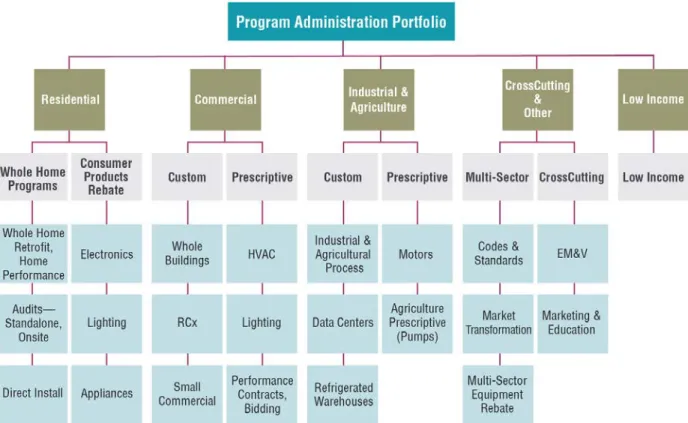
The typology grouped and classified energy efficiency programs into three tiers: (1) sector; (2) simplified program categories; and (3) detailed program categories. Figure 2-2 provides a partial snapshot of this three-tiered program typology approach: seven sectors (including one for
demand response programs, which are not addressed in this report), 31 simplified efficiency program categories (27 for efficiency programs) and 66 detailed categories (62 for efficiency).17 LBNL has prepared a policy brief that describes the typology in more detail as well as the standardized definitions (Hoffman et al 2013). Appendix B also includes the complete typology and set of definitions.
We determined that a three-tiered hierarchy was appropriate because it allowed for flexibility in grouping programs for comparison (e.g., single-measure versus comprehensive whole-building programs or by technology such as lighting vs. HVAC programs) and provides options for different levels of analysis. Moreover, in some cases, the detailed program category tier narrowed the range of installed measures for a program type, thus reducing the uncertainty in derivation of measure savings and lifetime savings across measures installed in that program. For example, we defined three detailed program categories that fall under the simplified program
16 However, as noted below and in Chapter 3, some of the data were not utilized for the data presentations, CSE metrics and analyses due to missing data. For example, the programs indicated as Combined Fuel in this figure were not included in the cost of saved energy analyses, because the costs borne by electricity and gas utility customers could not be determined for this subset of programs. Without the useable data, the database still contains about 45-50% of the national spending estimate.
17 The relatively large number of simplified and detailed categories was necessary to capture the wide range of common program offerings throughout the country. We also included some program types in the detailed typology because they have regional significance (e.g., pool pump programs in the Southwest, data center programs in New York, Washington and California), or the program types appear to be emergent (e.g., financing programs, residential behavior-based efficiency programs).
7
category of “Whole Home Upgrades”: Whole Home Audit Programs; Whole Home Direct-Install Programs; and Whole Home Retrofit Programs.18
Figure 2-2. Selected program types in the LBNL program typology
Note: Not all sectors and simplified and detailed program categories are shown
We have relatively high confidence in the categorization of most programs. However, there are some programs where we were either not able to obtain much information about the measures offered under that program or where there was a wide array of measures offered under a single umbrella program. In both situations, programs were generally categorized under “prescriptive” or “other” categories. The mix of programs and measures in these two types of categories are likely to be less consistent than in other program categories.
The data fields and specification for the database and program categories were developed through an iterative process which included review of program administrator annual reports and review of several other sources that contain typologies and/or definitions, including the State and Local Energy Efficiency Action Network (SEE Action 2012), the Consortium for Energy
Efficiency (CEE 2012), the Regional EM&V Forum of the Northeast Energy Efficiency
18
We found that program names were not always indicative of the appropriate program category. Thus, in many cases, we reviewed program information as part of the process of classifying programs into program category. We defined a specific set of guidelines for classifying programs by type. For example, when the program name was ambiguous (e.g., EnergySaver) or when the program description indicated savings could fall into more than one detailed or simplified category (e.g., a single program that offered both prescriptive and custom rebates), we looked at the measure-level savings reported for that program (if available) and categorized the program according to the reported measure mix.
8
Partnerships (NEEP 2011), and the NEEP Regional Energy Efficiency Database (REED 2013). We shared a draft of our categories and definitions and had several discussions with
representatives from CEE, NEEP and the American Council for an Energy-Efficient Economy (ACEEE); and made revisions based on their input. For the demand-response program
categories, we relied on program categories defined by the Federal Energy Regulatory
Commission (FERC) for its national surveys (FERC 2012), although demand-response program data are not included in this study.
We also defined program cost and energy savings (impacts) data fields as part of our effort to classify and report program information in a consistent fashion across program administrators and states.19
• Program Administrator Costs: The primary cost data used in this report are the program administrator costs which include: (1) program administration planning and delivery; (2) engineering or technical support; (3) services provided by
implementation contractors; (4) marketing, education and outreach; (5) direct rebates or financial incentives to program participants; and (6) evaluation, measurement and verification costs (see Table 2-1).20 Program administrator costs exclude participant costs and performance incentives for program administrators (e.g., utility shareholder incentives).21 For each program we collected from one to four years of data.22 We made inflation adjustments to the program cost data provided by program
administrators so that all cost data are reported in 2012$.23 We chose to use 2012 as our base year because 2012 is the most recent year for which an annual implicit price deflator for GDP is available from the U.S. Bureau of Economic Analysis. We would have preferred to also report CSE values based on participant, as well as program administrator, costs; however, we found that few program administrators reported participant costs in their annual reports (see Appendix C).
• Program Savings: The State and Local Energy Efficiency Action Network’s Energy Efficiency Program Impact Evaluation Guide (SEE Action 2012) was the primary source used to describe and define the program energy savings indicators in a
consistent fashion.24 The SEE Action Guide was particularly important for providing
19 Program cost and savings definitions tend to be consistent within a state, even if there are multiple program administrators.
20
Some program administrators did not include program-level costs for activities such as marketing/outreach, education, and evaluation, but instead accounted for those expenditures at the sector or portfolio level.
21 We did not report program administrator performance incentives because actual awards of performance incentives are not often included in annual reports filed by program administrators, and are frequently awarded at a
significantly later date.
22 Some program administrators included prior years’ data in their reports in addition to the 2009–2011 period. 23 Costs can be presented in nominal (or current) or real (or constant) dollar terms. Nominal values are economic units measured in terms of purchasing power of the date in question. Real dollar values are economic units measured in terms of constant purchasing power. A real value is not affected by general price inflation and can be estimated by deflating nominal values with a general price index, such as the implicit deflator for gross domestic product or the Consumer Price Index. From OMB Circular A-94 Guidelines And Discount Rates For Benefit-Cost Analysis of Federal Programs. We used the GDP implicit price deflator published regularly by the U.S. Bureau of Economic Analysis.
24
The SEE Action Guide describes common terminology, structures, and approaches used for determining savings from energy efficiency programs guide. The definitions in the SEE Action Guide incorporated input from program
9
data definitions for net and gross energy savings and lifetime energy savings, which for this report are assumed to take place at the end-use site where the efficiency actions were implemented.
Table 2-2 provides abridged definitions for key program data in the Database (see Appendix B for the complete glossary of energy efficiency program data fields).
Table 2-2. Abridged definitions for selected program cost and savings data
Term Definition
Program Administrator
Costs Program administrator costs include the costs of designing programs and portfolios; directing, managing and paying implementation contractors; marketing, education and outreach (ME&O); program and portfolio
evaluations; and incentives to both program participants (or end users) and to both mid-stream and upstream allies in the market (e.g., financing and services such as installations or free audits).
Program Average
Measure Lifetime Weighted average economic lifetime (years) of all measures installed in a program year in a specified program.
Annual Gross Savings Gross annual incremental savings (kWh or therm) as reported by the program administrator using their own staff or evaluation firm, after the subject energy efficiency activities have been completed. Gross savings are the change in energy consumption resulting from program-related actions taken by program participants regardless of why they participated. Note that these are annualized “full-year” savings, regardless of when measures were installed during the program year. Per the SEE Action reference (SEE Action 2012) these may be Claimed or Evaluated Savings.
Lifetime Gross Savings The expected gross savings (GWh or therm) over the lifetime of the measures installed under the subject program. For our analysis, where available, we relied on lifetime savings reported by the program administrator.
The detailed program categories and data definitions described in this section have been adapted by CEE for its own 2013 annual surveys of the efficiency program industry.25 We hope that other entities will consider using them as well and to support that objective, as part of the CSE Project, LBNL plans to gather feedback from stakeholders via an annual or biennial process to modify, add or subtract program categories as program offerings change or to address potentially needed clarifications in the definitions and categories.
administrators, state regulators, and other stakeholders from a number of states and regions and included a review and synthesis of definitions used in a broad set of energy efficiency glossaries.
25
As part of its 2013 annual “State of the Industry” survey, CEE is collecting program-level energy efficiency and demand response program data from program administrators using the LBNL program categories described in this report as well as the definitions from the SEE Action guide.
10
2.3 Challenges in Consistent and Standardized Reporting of Program Data When data are compiled from multiple states and program administrators, terminology differences can potentially make it difficult to conduct comparative analysis across states or program administrators. This was a primary rationale underlying our effort to develop a program typology and standardized definitions so that we could conduct a comparative analysis of energy efficiency program impacts and costs. However, even with the typology and definitions, there are two key data challenges.
First, we assume that all expenditure, savings and participation data reported by a program administrator are accurate. Given our time and resources, this is a reasonable starting
assumption; however, it should be noted that the range of effort placed into documenting impacts by program administrators varies significantly among states (SEE Action 2012).
Second, in reviewing information on efficiency programs funded by U.S. utility customers, we found that program data are often not defined and reported consistently among states.
Specifically, we identified three key concerns in compiling and analyzing program information on a regional or national basis, some of which are addressed by the common typology and standardized definitions:
1. Energy savings and program costs are not defined consistently. The most common discrepancies can be found in the definitions of net energy savings. Examples of other program data where differences are found across states include:
• The term “annual energy savings” typically is understood as shorthand for annualized incremental energy savings, but some entities—including resource planners—apply a different meaning that includes savings resulting from prior years’ activities.
• The definition of measure lifetime, how a program’s average measure lifetime is determined, and the estimated measure lifetime values for the same measures or program types varies among states.
• Some program administrators report end-use site savings and others report savings at the power plant bus bar (for electricity efficiency programs).
• Most program administrators do not count their own performance incentives among program costs, although some do. The definitions of other cost categories (e.g., marketing costs, general consumer education, and evaluation) also vary among states. 2. Program data are not reported consistently across states. For example, some states
report just gross or net energy savings; others report both. Similarly, many efficiency annual reports only include first-year savings and not lifetime savings.26 With respect to cost data, program administrators often classify costs differently among administration, marketing and outreach, incentives and participant costs. Some program administrators
26 We found that only about a quarter of the program reports that were reviewed included information on measure lifetimes or lifetime savings, although this information is required to assess program cost effectiveness. See below, in the section on adjustments for missing data, for discussion of how measure lifetime variation creates uncertainty in the calculation of CSE.
11
also report certain costs (e.g., marketing, evaluation) at the portfolio or sector level, while others account for those costs at the program level.
3. Programs and sectors are not characterized in a standardized fashion. Programs targeting specific building types or consumers can be included under different sectors from state to state (e.g., multi-family residential structures are sometimes categorized as commercial programs). Moreover, the types of activities and measures that are included under the same program title (e.g., custom vs. combination custom/prescriptive
programs) also vary.
We suggest that readers consider these above issues when utilizing the information in this report for their own uses and understanding of the cost of saved energy.
2.4 Calculating and Using the Cost of Saved Energy
The program administrator’s CSE is a useful metric for comparing the relative costs of efficiency programs and for comparing an energy efficiency option to other demand and supply choices for serving electricity and natural gas needs27. However, the cost of saved energy is not a test of cost effectiveness (e.g., one of the screening tests used by program administrators) because: (1) it does not capture the full benefits to utility customers and shareholders (e.g., avoided generation capacity, avoided transmission and distribution investments, avoided environmental compliance costs); (2) benefits are not monetized but reflected simply in energy units of kilowatt hours or therms, the cost of which will vary by utility; and (3) energy is saved at the end use, not the power plant.28
In this report, we use gross energy savings (rather than net savings) in the CSE calculations primarily because of data availability and comparability reasons: (1) more administrators reported gross savings than net; and (2) net savings are defined relatively inconsistently, as compared to gross savings, among program administrators and states.
We also report savings at the end-user level (and not at the busbar or power plant source),
because this is what most program administrators report. It is important to note that savings from electricity efficiency programs reported at the busbar would be higher than at the end-use level because we are accounting for distribution and transmission losses (losses also occur in the natural gas network as well).29
27
According to the Energy Information Administration, “levelized cost is often cited as a convenient summary measure of the overall competiveness of different generating technologies. It represents the per-kilowatt hour cost (in real dollars) of building and operating a generating plant over an assumed financial life and duty cycle. Key inputs… include overnight capital costs, fuel costs, fixed and variable operations and maintenance (O&M) costs, financing costs, and an assumed utilization rate for each plant type.
http://www.eia.gov/forecasts/aeo/electricity_generation.cfm 28
The equation also is inverted, with costs in the numerator and benefits (in energy units) in the denominator—the reverse of the benefit/cost ratios that are a key determinant of cost effectiveness.
29
This is an important consideration if the CSE values were to be compared with costs of electricity generation resources, which typically are indicated as busbar values.
12
We calculate the cost of saved energy (CSE) metrics in three ways: (1) a cost of lifetime saved energy; (2) a levelized cost of energy savings using two discount rates (3% and 6% real); and (3) a cost of first-year energy savings. See Table 2-3 for definitions of these CSE metrics and their common uses.
Table 2-3. Program administrator cost of saved energy metrics: definitions and potential uses
Program Administrator Cost Metric
Shortened
Term What is Measured Potential Uses
Cost of Lifetime
Energy Savings Lifetime CSE The cost of acquiring energy savings that accrues over the economic lifetime of the actions taken through a program/sector/portfolio. Calculated by dividing program administrators’ costs by the gross savings.
• Used by program
administrators for designing programs and portfolios, e.g., for depth of savings and cost effectiveness
• Used by planners and other stakeholders to project efficiency as a resource, develop load forecasts, etc.
Levelized Cost of
Energy Savings Levelized CSE The cost of acquiring energy savings that accrue over the economic lifetime of the actions taken through a program/sector/portfolio, amortized over that lifetime and discounted back to the year in which the costs are paid and the actions are taken
• Same uses as lifetime savings
• Useful to program
administrators, regulators and other stakeholders who want to compare particular demand-side options with other demand, and supply-side, resources
Cost of First-Year
Energy Savings First-Year CSE The cost of acquiring a single year of annualized incremental energy savings through actions taken through a
program/sector/portfolio. Calculated by dividing the program administrators’ costs by the first year incremental savings.
• Useful for program
administrators in program design
The cost of saved energy can be useful to various stakeholders. For example, state regulators can use both first-year and lifetime CSE values as quick metrics for assessing whether a program or portfolio looks like a reasonable expenditure of utility customer funds. A program administrator that is considering offering a comprehensive residential energy upgrade program may want to compare that program’s estimated per-unit cost performance against average costs and the range of costs for similar programs. Based on the comparison, the program administrator may want to
look at the design of comparable programs for potential cost efficiencies. Regulators and resource planners can use the levelized CSE in the initial screening analysis of various supply- and demand-side resources. Resource planners also can use the lifetime CSE to convert approved budgets for demand-side management plans into energy savings estimates that then can be used in scenario or sensitivity analysis of future load forecasts.
Finally, based on the limited participant cost data reported by program administrators, we
calculate a total resource CSE for illustrative purposes in Chapter 3. This calculation presents the net total costs, including both program and participant costs, for the efficiency resource. A levelized total resource CSE might also be useful to program administrators, regulators and other stakeholders who want to compare particular demand-side options with other demand and
supply-side resources.
2.4.1 Levelized Cost of Saved Energy
The lifetime cost of energy savings metric is a simple, straight-forward calculation although it ignores changes in the value of money between an initial investment and future energy savings. Meier (1982) included the time value of money (discount rate) to calculate the “cost of
conserved energy” (CCE) or what we are calling the “levelized cost of saved energy”. Meier found that inclusion of the discount rate raises the CCE because of discounting future benefits, yet provides a basis for comparing the CCE for measures that have different lifetimes and can be compared to retail rates and levelized costs of supply-side resources.30 A similar accounting framework, the levelized cost of energy (LCOE), often is applied to assessing the economic competitiveness of diverse generation sources (U.S. Energy Information Administration 2013).
We calculated a levelized CSE using two discount rates31 that are rough proxies for different perspectives on energy efficiency investments: a 6% real discount rate that can reflect the utility weighted average cost of capital (WACC) at present and a 3% real discount rate that can be a proxy for a societal perspective. The levelized CSE calculation is as follows:
𝐿𝑒𝑣𝑒𝑙𝑖𝑧𝑒𝑑𝐶𝑆𝐸 (𝑖𝑛 $/𝑢𝑛𝑖𝑡𝑒𝑛𝑒𝑟𝑔𝑦,𝑒.𝑔. ,𝑘𝑊ℎ,𝑡ℎ𝑒𝑟𝑚,𝐵𝑡𝑢) = (𝐶𝑥 (𝐶𝑎𝑝𝑖𝑡𝑎𝑙𝑅𝑒𝑐𝑜𝑣𝑒𝑟𝑦𝐹𝑎𝑐𝑡𝑜𝑟))/(𝐷) 𝐶𝑎𝑝𝑖𝑡𝑎𝑙𝑅𝑒𝑐𝑜𝑣𝑒𝑟𝑦𝐹𝑎𝑐𝑡𝑜𝑟 = [𝐴 ∗(1 +𝐴)^𝐵]/[(1 +𝐴)^𝐵 −1] Where:
A = Discount rate
30 See Appendix A for further discussion of the history of efficiency CSE analyses
31 Discount Rate: An interest rate applied to a stream of future costs and/or monetized benefits to convert those values to a common period, typically the current or near-term year, to measure and reflect the time value of money. It is used in benefit-cost analysis to determine the economic merits of proceeding with a proposed project, and in cost-effectiveness analysis to compare the value of projects. The discount rate for any analysis is either a nominal or a real discount rate. A nominal discount rate is used in analytic situations when the values are in then-current or nominal dollars (reflecting anticipated inflation rates). A real discount rate is used when the future values are in constant dollars and can be approximated by subtracting expected inflation from a nominal discount rate (SEE Action Network 2012).
14