LBNL-63434
E
RNEST
O
RLANDO
L
AWRENCE
B
ERKELEY
N
ATIONAL
L
ABORATORY
Wind Project Financing Structures:
A Review & Comparative Analysis
John P. Harper, Birch Tree Capital, LLC
Matthew D. Karcher, Deacon Harbor Financial, L.P.
Mark Bolinger, Lawrence Berkeley National Laboratory
Environmental Energy
Technologies Division
September 2007
Download from http://eetd.lbl.gov/ea/emp
The work described in this report was funded by the Office of Energy Efficiency and Renewable Energy, Wind & Hydropower Technologies Program of the U.S. Department of Energy under Contract No. DE-AC02-05CH11231.
Disclaimer
This document was prepared as an account of work sponsored by the United States Government. While this document is believed to contain correct information, neither the United States Government nor any agency thereof, nor The Regents of the University of California, nor any of their employees, makes any warranty, express or implied, or assumes any legal responsibility for the accuracy, completeness, or usefulness of any information, apparatus, product, or process disclosed, or represents that its use would not infringe privately owned rights. Reference herein to any specific commercial product, process, or service by its trade name, trademark, manufacturer, or otherwise, does not necessarily constitute or imply its endorsement, recommendation, or favoring by the United States Government or any agency thereof, or The Regents of the University of California. The views and opinions of authors expressed herein do not necessarily state or reflect those of the United States Government or any agency thereof, or The Regents of the University of California.
Ernest Orlando Lawrence Berkeley National Laboratory is an equal opportunity employer.
Acknowledgements
The work described in this report was funded by the Office of Energy Efficiency and Renewable Energy, Wind & Hydropower Technologies Program of the U.S. Department of Energy under Contract No. DE-AC02-05CH11231. The authors would particularly like to thank Steve Lindenberg, Alejandro Moreno, and Jack Cadogan (retired) of the U.S. Department of Energy for their support of this work. For contributing information and reviewing earlier versions of this manuscript, the authors thank (in alphabetical order, by last name): Jeff Chester (Kaye Scholer LLP), Karlynn Cory (NREL), Mike Davies (FreeStream Capital LLP), Ed Ing (Law Offices of Edwin T.C. Ing), Tim MacDonald (Meridian Investments), Alejandro Moreno (U.S. DOE), Ric O’Connell (Black & Veatch), Kevin Pearson (Stoel Rives LLP), Liz Salerno (AWEA), Ryan Wiser (LBNL), and one anonymous reviewer. Of course, any remaining errors or omissions are the sole responsibility of the authors.
Table of Contents
Executive Summary ... i
1. Introduction... 1
2. A Recent History of Modern Wind Project Finance ... 5
2.1 1998-2002: Strategic Investors Dominate the Market ... 6
2.2 2003-2006: Rise of the Institutional Investor ... 7
2.3 Recent Equity Financing Developments... 9
2.4 Recent Debt Financing Developments... 11
2.5 Summary ... 13
3. Description of Current Financing Structures ... 14
3.1 Corporate Structure... 15
3.2 Strategic Investor Flip... 18
3.3 Institutional Investor Flip... 22
3.4 Pay-As-You-Go ... 25
3.5 Cash Leveraged... 28
3.6 Cash & PTC Leveraged ... 31
3.7 Back Leveraged ... 34
3.8 Summary: Choosing a Structure ... 36
4. The Impact of Financing Structure on the Levelized Cost of Wind Energy... 39
4.1 Overview of Pro Forma Financial Model ... 39
4.2 Levelized Cost of Energy Comparisons ... 40
5. Conclusions – Observations & Future Trends... 48
References... 52
Appendix A: Glossary ... 54
Appendix B: Description of Pro Forma Financial Model and Assumptions... 57
Executive Summary
Wind power capacity in the United States has grown substantially in recent years. From 1998 through 2006, almost 9,900 megawatts (“MW”) of new wind capacity was added, accounting for 85% of the 11,575 MW cumulative total capacity as of the end of 2006. In 2006 alone, 2,454 MW of new wind capacity was installed, representing a 27% increase in cumulative capacity. This rapid expansion has required the mobilization of a tremendous amount of capital to finance wind project costs. Roughly $18 billion (in real 2006 dollars) has been invested in wind project installation in the U.S. since the 1980s, with more than $3.7 billion invested in 2006 alone. Looking ahead, wind project developers will need to raise close to $6 billion in 2007 in order to finance the expansion projected by the American Wind Energy Association (“AWEA”), and the required amount of capital will likely continue to increase in future years if market growth continues.
The financing of new wind projects varies from that of fossil-fueled power projects due to the different cost characteristics of each. Specifically, wind projects are capital-intensive to build but have no ongoing fuel costs, while fossil-fueled power projects are less capital-intensive (per unit of production) but have higher operating (e.g., fuel) costs. Furthermore, whereas Federal tax incentives for fossil-fueled power plants can be (and generally are) distributed throughout the entire fuel cycle (e.g., from exploration and extraction to transportation, power production, and emissions controls), tax incentives for wind projects are instead targeted almost exclusively at the power production stage. The two principal Federal tax incentives available to wind projects are the production tax credit (“PTC”) and accelerated depreciation deductions (together with the PTC, the “Tax Benefits”). These Tax Benefits provide a significant value to wind projects, but also complicate wind project finance, since most wind project developers lack sufficient Federal income tax liability to use the Tax Benefits efficiently.
In response, the wind sector has developed multiple financing structures to attract various investors to projects, manage project risk, and allocate Tax Benefits to entities that can use the Tax Benefits most efficiently. Some of these structures are intended to attract actively involved large equity investors with a strategic interest in the wind sector, labeled here as “Strategic Investors.” Others are designed to tap into more-passive equity capital from “Institutional Investors,” which are primarily interested in the Tax Benefits. Still others enable developers and equity investors to layer on debt financing to leverage their equity exposure and returns.
This report surveys the seven principal financing structures through which most new utility-scale wind projects in the United States have been financed from 1999 to the present, excluding projects owned by investor-owned and publicly-owned utilities where the project becomes part of the utilities’ internal generating portfolio and rate base. The report defines utility-scale wind projects as those designed to sell electricity directly to utilities or into power markets on a wholesale basis. The report does not cover financing structures used for smaller community-based wind power projects, though it may have some indirect utility for parties considering such projects, as several financing options used for smaller projects are derived from structures first conceived for larger projects. Finally, this report is relevant only to the U.S. market, since the
presence and structure of the Tax Benefits have driven the development of financing structures in ways not applicable for other national markets.
The report has three primary objectives: (1) to survey recent trends in the financing of utility-scale wind projects in the United States, (2) to describe the seven principal financing structures through which most utility-scale wind projects have been financed from 1999 to the present, and (3) to explain each structure’s relative impact on the levelized cost of wind energy. The year 1999 is used as a starting point because it marks the recent upsurge in wind power growth in the United States.
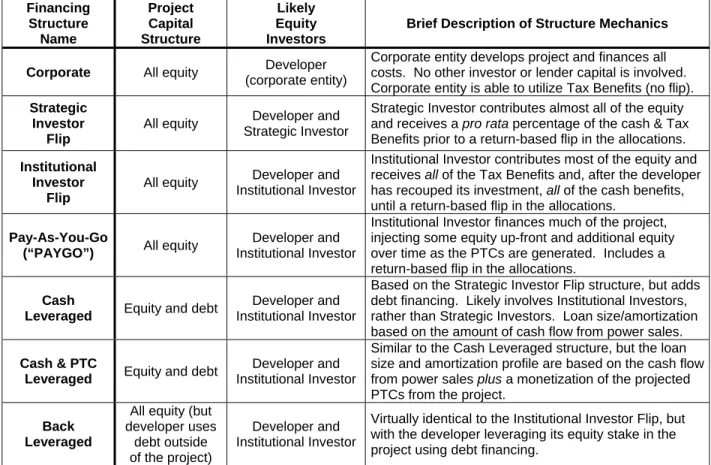
The seven structures, summarized briefly in Table ES-1, feature varying combinations of equity capital from project developers, third-party tax-oriented investors (both Strategic and Institutional Investors, jointly known as “Tax Investors”), and commercial debt. Their origins stem from variations in the financial capacity and strength, as well as the business objectives, of wind project developers. The structures have received various names in the industry. The names given in this report are intended to reflect a defining characteristic. For the first three structures in Table ES-1, it is the nature of the Tax Investor. The Pay-As-You-Go (“PAYGO”) structure name reflects the delayed timing of the Tax Investor contribution. For the three structures involving leverage, the name refers to the type of debt financing provided. Other names are feasible and in use; care should therefore be taken to specify structures other than solely by name.
Table ES-1. Description of Seven Financing Structures Financing Structure Name Project Capital Structure Likely Equity Investors
Brief Description of Structure Mechanics
Corporate All equity Developer (corporate entity)
Corporate entity develops project and finances all costs. No other investor or lender capital is involved. Corporate entity is able to utilize Tax Benefits (no flip).
Strategic Investor
Flip
All equity Developer and Strategic Investor
Strategic Investor contributes almost all of the equity and receives a pro rata percentage of the cash & Tax Benefits prior to a return-based flip in the allocations.
Institutional Investor
Flip
All equity Developer and Institutional Investor
Institutional Investor contributes most of the equity and receives all of the Tax Benefits and, after the developer has recouped its investment, all of the cash benefits, until a return-based flip in the allocations.
Pay-As-You-Go
(“PAYGO”) All equity
Developer and Institutional Investor
Institutional Investor finances much of the project, injecting some equity up-front and additional equity over time as the PTCs are generated. Includes a return-based flip in the allocations.
Cash
Leveraged Equity and debt
Developer and Institutional Investor
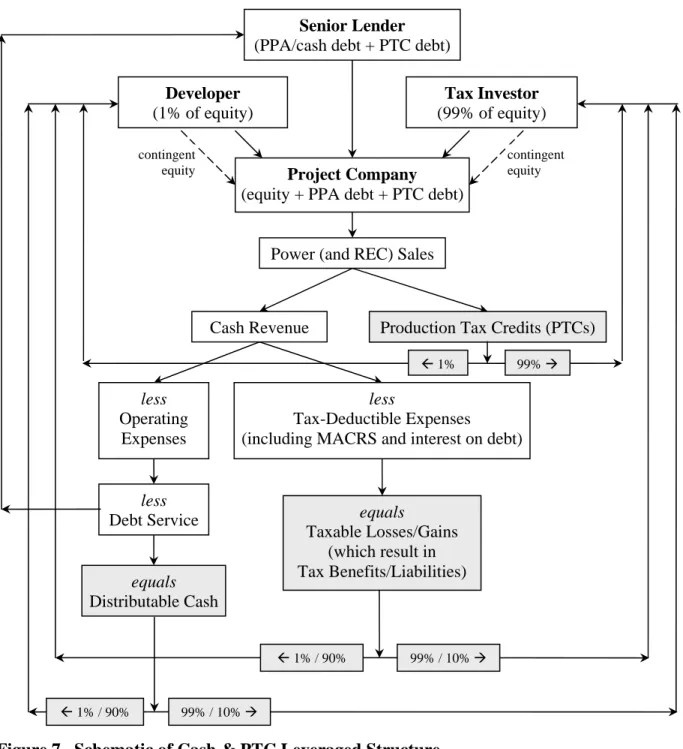
Based on the Strategic Investor Flip structure, but adds debt financing. Likely involves Institutional Investors, rather than Strategic Investors. Loan size/amortization based on the amount of cash flow from power sales.
Cash & PTC
Leveraged Equity and debt
Developer and Institutional Investor
Similar to the Cash Leveraged structure, but the loan size and amortization profile are based on the cash flow from power sales plus a monetization of the projected PTCs from the project.
Back Leveraged
All equity (but developer uses
debt outside of the project)
Developer and Institutional Investor
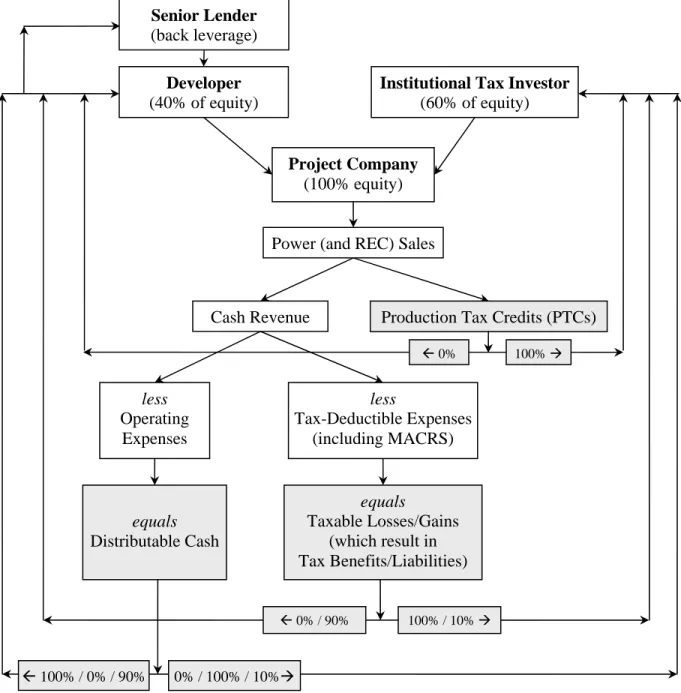
Virtually identical to the Institutional Investor Flip, but with the developer leveraging its equity stake in the project using debt financing.
The list of financing structures shown in Table ES-1 and covered in this report is not intended to be exhaustive. Various permutations of these structures, as well as other structures altogether, are possible. That said, the initial construction costs of most new utility-scale wind projects in the United States from 1999 to the present have been financed using one or another of these structures.
To compare the levelized cost of wind energy under each structure, a simplified Excel-based pro forma financial model of an indicative or template wind power project was constructed. The template project is based on a set of assumptions intended to reflect market conditions for projects coming on-line in 2007 and 2008 for items such as non-financing capital costs, operating costs, energy production, taxes, and revenue flows. The template project is then customized to reflect each financing structure. For the six financing structure involving third-party equity or debt capital, the analysis includes assumptions for: (1) the cost and terms of debt (if any); (2) the cost and terms of equity from Tax Investors; and (3) any financing-related transaction, or “soft” costs. The model then estimates the power prices needed to comply with those terms. For these six structures (i.e., all but the Corporate structure), the model calculates the minimum 20-year levelized cost of energy (“LCOE”) that yields the 10-year internal rate of return (“IRR”) requirement for the Tax Investors in each structure, while not violating any lender constraints.i For these structures, the 10-year Tax Investor IRR is used as a key metric, as it is a key negotiating point between developers and investors.ii For the Corporate structure, the model calculates the minimum LCOE that yields the developer’s 20-year IRR target. Using a 20-year target for the Corporate structure is consistent with the assumption that the developer, as sole project participant, evaluates the project on a longer-term basis than do pure Tax Investors. The use of a standardized template project enables the observed variations in LCOE to reflect the impact of the different financing structures.
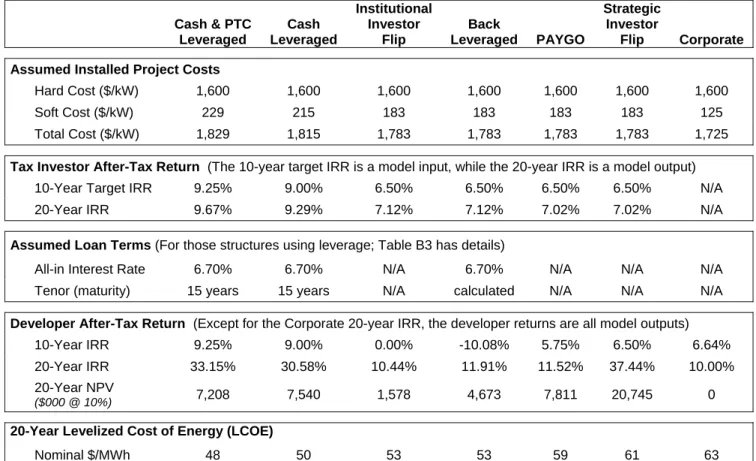
Table ES-2 summarizes key inputs and outputs from the model for each structure. The key inputs listed are the project costs, the Tax Investor’s 10-year IRR target (except for the Corporate structure, where the relevant input is the developer’s 20-year IRR target), and the assumed interest rates and tenor of debt for the three structures using debt financing. Discussion of these and other debt and equity financing input assumptions are described in Chapter 4 and Appendix B. The outputs are the 20-year LCOE, the Tax Investor’s 20-year IRR, and the developer’s 10-year and 20-10-year IRR (again, except for the Corporate structure, where the developer’s 20-10-year IRR target is a model input). In practice, negotiations with Tax Investors focus principally on the Tax Investor’s IRR. The developer’s return calculations are presented (in both IRR and NPV terms) primarily for informational purposes, though some Tax Investors will monitor the developer’s return to ensure a reasonable allocation of project returns between the parties.
i
In turn, for each structure involving third-party Tax Investor capital, the developer’s return in the model (and in actual negotiations) is the residual, or what is left after satisfying the Tax Investor’s return requirements. In practice, developer returns also reflect relative project attributes, e.g., capacity factors, power prices, etc.,
ii
To simplify the modeling task, the model treats the 20-year Tax Investor IRR as an output. In reality, the Tax Investor’s 20-year IRR is linked to its 10-year IRR and both IRR targets are highly negotiated between the Tax Investor and the developer and will reflect market conditions.
As shown in Table ES-2, our analysis finds significant variation – ranging from $48 per megawatt hour (“MWh”) to $63/MWh – in the 20-year LCOE required under the various financing structures. This variation is principally a function of:
(1) financing-related transaction costs (shown in Table ES-2 as “soft costs”);
(2) assumed 10-year Tax Investor IRR target rates, and Corporate 20-year IRR target; and (3) the relative terms of each structure (not shown in Table ES-2, but discussed in Chapter 3
and Appendix B), including the level of equity contributions and pre- and post-flip allocations of both cash and Tax Benefits.
Table ES-2. Project Costs, Investor Returns, and LCOE by Financing Structure Cash & PTC Leveraged Cash Leveraged Institutional Investor Flip Back Leveraged PAYGO Strategic Investor Flip Corporate
Assumed Installed Project Costs
Hard Cost ($/kW) 1,600 1,600 1,600 1,600 1,600 1,600 1,600
Soft Cost ($/kW) 229 215 183 183 183 183 125
Total Cost ($/kW) 1,829 1,815 1,783 1,783 1,783 1,783 1,725
Tax Investor After-Tax Return (The 10-year target IRR is a model input, while the 20-year IRR is a model output)
10-Year Target IRR 9.25% 9.00% 6.50% 6.50% 6.50% 6.50% N/A
20-Year IRR 9.67% 9.29% 7.12% 7.12% 7.02% 7.02% N/A
Assumed Loan Terms (For those structures using leverage; Table B3 has details)
All-in Interest Rate 6.70% 6.70% N/A 6.70% N/A N/A N/A
Tenor (maturity) 15 years 15 years N/A calculated N/A N/A N/A
Developer After-Tax Return (Except for the Corporate 20-year IRR, the developer returns are all model outputs)
10-Year IRR 9.25% 9.00% 0.00% -10.08% 5.75% 6.50% 6.64%
20-Year IRR 33.15% 30.58% 10.44% 11.91% 11.52% 37.44% 10.00%
20-Year NPV
($000 @ 10%) 7,208 7,540 1,578 4,673 7,811 20,745 0
20-Year Levelized Cost of Energy (LCOE)
Nominal $/MWh 48 50 53 53 59 61 63
Although these results are intended to be illustrative of current market conditions, they are, of course, a function of the modeling assumptions. These assumptions, which are merely indicative and do not reflect a specific project, are detailed in Chapter 4 and in Appendix B. Using a different set of input parameters will generate different results.iii Finally, the model does not undertake detailed tax-oriented partnership accounting analysis. Accordingly, the returns should not be assumed as likely for specific projects using the various financing structures. Instead, the comparative nature of the analysis means that these LCOE results are best considered relative to
iii
For example, the template wind project assumes a 36% net capacity factor (as described further in Appendix B). Capacity factor, a measure of energy production, is an important determinant in the profitability of a wind project, as it drives both revenue and PTC generation. Reducing the capacity factor to 32% causes the calculated LCOEs to rise anywhere from 13% to 20% to compensate for the lower wind production. The relative relationships among the LCOE for the individual financing structures, however, do not change.
one another – i.e., to illustrate the relative impact of financing structures – rather than individually or on an absolute basis.
Table ES-2 suggests that leverage at the project level provides the lowest required LCOE, with the Cash & PTC Leveraged structure coming in at $48/MWh. In other words, given the assumptions used in the analysis, our template project – when financed using this structure – requires a flat $48/MWh for the next twenty years of operation to cover its capital and operating costs, and to meet the return requirements of the Tax Investor as well as the financing terms of the debt provider. The next-lowest LCOE is found with the Cash Leveraged structure, at $50/MWh (with the slightly higher LCOE reflecting slightly less leverage, due to the absence of PTC-backed debt).
The fact that the two structures with the lowest LCOEs have project debt is not unexpected, and suggests that leveraged structures should be popular in the market. Debt has a cheaper cost of capital than does equity. Other matters held equal, the more debt a project can secure, the lower the LCOE. This is true despite the fact that, as reflected in Table ES-2, required equity returns are higher when leverage is involved, to account for the extra risk that is imposed on equity providers when debt is used. Moreover, the investors still receive the full amount of the Tax Benefits as if the project had been financed with all equity and no debt. Additionally, the interest payments on debt are tax-deductible, so they increase the tax loss (which equates to tax benefits for the Tax Investor) in the early years of the project.
Interestingly, this finding is not consistent with actual market practice. Most new wind projects have not featured project-level debt. In 2006, for example, only about 20% of the deals in the market appeared to include project-level debt. Many developers and Tax Investors prefer other structures. The reasons given vary, but include both factors in favor of other structures (perceived simplicity, standardization, speed) and factors against using debt (perceived cost, complexity, loss of control, little-improved IRR). This divergence in the implications of our LCOE results from market practice suggests that while the generic cost assumptions used for the model may reflect general market conditions, project-specific cost assumptions are central in the decision on financing structure. Factors not easily quantifiable in a financial model, e.g., a parent company’s corporate financing strategy and project risk considerations, also play major roles.
The Institutional Investor Flip and Back Leveraged structures have the next lowest LCOE at $53/MWh. These all-equity structures are identical with the exception of the developer’s company-level debt in the Back Leveraged structure. Because this debt is not at the project level, the project returns, Tax Investor returns, and required LCOEs do not differ between these two structures. The only variation is in the developer’s returns. For the Institutional Investor Flip structure, the developer has no return on its capital prior to the flip point due to the allocation of cash under the structure. In the Back Leveraged structure, the developer has a negative 10-year IRR (reflecting repayment of the company-level debt). Twenty years out, the developer under the Back Leveraged structure has a 20-year IRR (11.9%) that is about 150 basis points higher than the developer’s 20-year IRR (10.4%) using the Institutional Investor Flip structure. This reflects the positive impact of leverage on returns.
The PAYGO structure – where the Tax Investor pays the developer an annual amount equal to a fixed percentage of the PTCs generated – is found to be the next-cheapest, with a LCOE of $59/MWh. This LCOE, as well as the developer’s own return, are greatly affected by the assumed PTC payment percentage (in reality, the specific payment rate is set to achieve the negotiated respective return requirements).
The Strategic Investor Flip structure has the next highest LCOE, at $61/MWh. The LCOE is highly dependent on the Strategic Investor’s target return requirement. As the Strategic Investor does not take development-stage risks, and only contributes funds when the project is operational, the return requirements should be lower than required for a Corporate structure investment (in which the Corporate entity takes development risks). The equity return to the developer under the Strategic Investor Flip structure is artificially magnified by the small amount of capital contributed. Finally, the Strategic Investor Flip structure results in a higher LCOE than does the Institutional Investor Flip structure because the former provides the developer with a pre-flip pro rata return on investment, whereas the latter only provides the developer with a pre-flip return of its investment.
The highest LCOE of $63/MWh resulting from the analysis is associated with the Corporate structure, and is largely a function of the fact that the model assumes a 20-year target return for the developer/Corporate entity of 10%. A developer’s return requirement is used under this structure in part because there is no involvement by a separate Tax Investor. A single owner bears all of the project risks – i.e., there is no separation of the risks (and returns) between two equity parties, with one party having lower risks and, hence, lower returns, than the other. In this way, the 10% developer’s target return might be thought of as a blended equity hurdle rate, reflecting a melding of the typical returns to Tax Investors and developers in other all-equity structures. The single return figure also can be viewed as a blend of developer’s equity and lower-cost debt sourced at the corporate level. Other things held equal, a decrease in the developer’s required return will reduce the corresponding LCOE.
Variations in the LCOE across financial structures (assuming the same underlying template project) reflect the different assumptions made about the equity returns and debt financing costs required by Tax Investors and lenders in the marketplace. Investors and lenders require higher returns to invest in wind projects that use structures deemed more risky, e.g., those that defer returns until later in the life of the project, or that use leverage. Thus, assuming all other cost and operating parameters are held equal,iv the LCOE for a given financing structure is a proxy for the relative cost of equity and, if used, debt financing for the project. As with other maturing sectors, the cost of financing becomes a competitive differentiator among project developers. Those with access to cheaper money will be able to offer lower-cost power to their customers. The variation in LCOE across structures also indirectly touches upon an apparent contradiction of the wind financing marketplace. Financial theory suggests that an efficient market will eliminate differences in net financing costs, returns, and LCOE across different financing structures, once all risks and costs are taken into account. However, the U.S. wind sector has seen an expansion in the types of wind financing structures available to project developers, as
iv
This assumption is important: variations in other assumptions about the underlying template project – including turbine and balance-of-plant costs, capacity factors, and operating costs – will also impact the resulting LCOE.
well as variations in the relative popularity across structures over time and among different developers and capital providers. These attributes suggest that inefficiencies and differing risk perceptions remain in financing wind projects.
More broadly, this analysis highlights the fact that developers decide which financing structure best meets their needs for a given project based on multiple considerations. The decision reflects both the developer’s own relative ability to use the Tax Benefits and to provide the capital funding, as well as the financial robustness of the project itself, e.g., whether debt leverage is needed to boost projected returns to satisfy return requirements. The amount of time before the next expiration date of the PTC has also played a role: pending PTC expiration dates led some developers earlier in the decade to adjust their financing strategies and shy away from debt so as to avoid transaction delays and increase the prospects of meeting in-service deadlines for the PTC. Secondary factors also influence the decision, e.g., the relative preference for realizing value up-front via a development fee or capital gain on the sale of the project, or over time from the net cash flows from operations. The relative importance of these various considerations, however, differs from developer to developer and from project to project. Furthermore, some developers’ preferred financing structures have evolved over time, especially as their own financial situations have changed. In short, there is no single “correct” structure for all developers for all projects for all time.
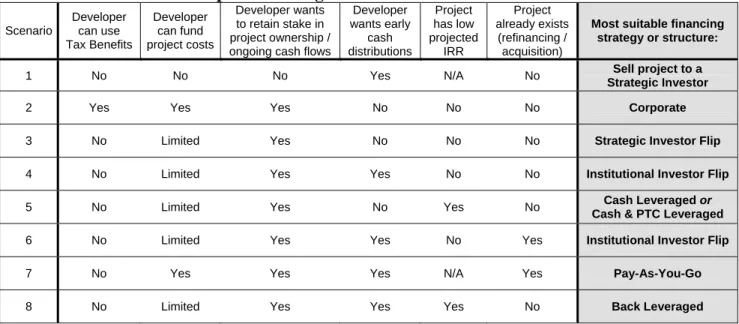
That said, the varying rationales for each financing structure can be illustrated by looking at the decision process faced by wind developers in choosing a financing structure. Table ES-3 provides a list of several key corporate and project-level considerations. Depending on a given developer’s views on each consideration, one or more financing structures are likely to be more suitable than other structures to meet the needs of the developer. Table ES-3 lists several non-exhaustive scenarios with differing combinations of these developer considerations. The financing structure(s) most typically used for each scenario is identified in the final column. Section 3.8 describes the scenarios in more detail.
Table ES-3. Wind Developer Financing Structure Decision Matrix
Scenario Developer can use Tax Benefits Developer can fund project costs Developer wants to retain stake in project ownership / ongoing cash flows
Developer wants early cash distributions Project has low projected IRR Project already exists (refinancing / acquisition)
Most suitable financing strategy or structure:
1 No No No Yes N/A No Sell project to a
Strategic Investor
2 Yes Yes Yes No No No Corporate
3 No Limited Yes No No No Strategic Investor Flip
4 No Limited Yes Yes No No Institutional Investor Flip
5 No Limited Yes No Yes No Cash Leveraged or
Cash & PTC Leveraged
6 No Limited Yes Yes No Yes Institutional Investor Flip
7 No Yes Yes Yes N/A Yes Pay-As-You-Go
For example, a developer that cannot use a project’s Tax Benefits, does not have the financial resources to carry the project through construction, and prefers an early return rather than an ongoing stake in the project will likely find it most convenient to sell the entire project to a Strategic Investor (Scenario 1). A second developer in a similar position but more interested in retaining a long-term stake in the project than in an early cash-out might instead pursue the Strategic Investor Flip structure (Scenario 3) or, if the project returns look low, the Cash Leveraged or Cash & PTC Leveraged structures (Scenario 5). Which of these two leveraged structures is used will generally reflect project economics (i.e., whether the incremental PTC monetization is needed to achieve requisite equity returns), as well as the relative interest of Tax Investors in taking on the incremental contingent financial obligations associated with PTC debt. A developer lacking the ability to use the Tax Benefits, but with more cash to invest and interested in both a long-term stake and early cash returns, instead might opt for the Institutional Investor Flip or the Back Leveraged structures (Scenarios 4 and 8), with Back Leverage employed to reduce the developer’s stake and/or to boost the developer’s return. Those developers that own existing projects but are seeking Tax Investors to monetize the Tax Benefits might opt for the Institutional Investor Flip or Pay-As-You-Go structures (Scenarios 6 and 7), with the choice depending in part upon how quickly the developer wants to recoup its investment in the project. Finally, for a developer (or its corporate parent) willing to commit the cash resources and able to use the Tax Benefits efficiently on its own, the Corporate structure (Scenario 2) may prove to be most advantageous.
This interplay of a variety of considerations, both monetary and qualitative, underscores the value of ongoing monitoring of wind project financing trends. Even in the short period since 1999, financing structures have risen and declined in their relative popularity among developers and investors. The current diversity of financing structures is in response to the evolving needs of developers and new investors in the wind sector. Existing financing structures will continue to evolve, and new structures will be developed to meet the emerging needs of the market. This ongoing evolution, combined with the prospect of external developments – e.g., Congressional changes to the structure or existence of the PTC – and the fact that choice of financing structure can, as demonstrated in this report, have a significant impact on LCOE, suggests that it will be useful for the U.S. Department of Energy to stay abreast of changes in the market and to periodically review the impact of financing structures on the cost of wind energy.
1. Introduction
After a long period of relative stagnation that began in the late 1980s and lasted throughout much of the 1990s, the U.S. wind power market has grown rapidly in recent years (Figure 1). From 1998 through 2006, almost 9,900 MW of new wind capacity was added, accounting for 85% of the 11,575 MW cumulative total at the end of 2006. In 2006 alone, 2,454 MW of new wind capacity was installed, representing a 27% increase in cumulative capacity.
igure 1. Annual and Cumulative Growth in U.S. Wind Power Capacity
he boom in this segment of the renewable energy market shows no signs of slowing in the near
he rapid expansion in U.S. wind power capacity in recent years has required the mobilization of
0 500 1,000 1,500 2,000 2,500 3,000 19 82 19 83 19 84 19 85 19 86 19 87 19 88 19 89 19 90 19 91 19 92 19 93 19 94 19 95 19 96 19 97 19 98 19 99 20 00 20 01 20 02 20 03 20 04 20 05 20 06 A nnua l C apac it y ( M W ) 0 2,000 4,000 6,000 8,000 10,000 12,000 C u m u la ti v e C a p a c ity ( M W)
Annual US Capacity (left scale) Cumulative US Capacity (right scale)
F
T
term. AWEA’s August 2007 forecast projects record growth of more than 3,000 MW of new wind capacity in 2007.1 Furthermore, anecdotal evidence indicates that the major wind turbine
manufacturers have sold much, if not all, of their production capacity through early 2009, suggesting that 2008 could be another record year for U.S. wind power installations.
T
a tremendous amount of capital to finance project costs. Roughly $18 billion (in real 2006 dollars) has been invested in new wind projects in the U.S. since the 1980s, with more than $3.7 billion invested in 2006 alone.2 Looking ahead, wind project developers will need to raise close to $6 billion in 2007 in order to finance the expansion projected by AWEA, and the required amount of capital will likely continue to increase in future years if market growth continues. Moreover, these figures do not include financing raised to support acquisitions or refinancings of existing wind turbine assets.
1
AWEA Quarterly Market Report dated August 8, 2007, available at
http://www.awea.org/newsroom/releases/AWEA_Quarterly_Market_Report_080807.html
2
See Ryan Wiser and Mark Bolinger (2007), Annual Report on U.S. Wind Power Installation, Cost, and Performance Trends: 2006, available at http://eetd.lbl.gov/ea/ems/reports/ann-rpt-wind-06.pdf
Accessing sufficient amounts of capital to finance the build-out of wind project pipelines has historically been a challenge for many wind developers, due in large part to the importance of Federal tax incentives to the project’s return. Specifically, qualifying commercial wind projects are eligible to receive a 10-year stream of Federal production tax credits (“PTCs”), and can also depreciate (for tax purposes) the vast majority of project assets using an accelerated 5-year schedule. These two major Federal tax incentives, described in more detail in Text Boxes 1 and 2, are collectively referred to in this report as the project’s “Tax Benefits.” As a general rule of thumb, investor returns from a wind project often derive as much or more from these combined Tax Benefits than from cash revenue from the sale of power and renewable energy credits (“RECs”).3
Historically, most wind project developers have been small single-purpose entities without a tax base of sufficient size to make
efficient use of the Tax Benefits generated by a wind project. As a result, for several years, one of the few options available to such developers was to develop a project up to the point of construction and then sell it to a larger entity with not only access to the capital required to build the project, but also a tax base large enough to efficiently use the project’s Tax Benefits.
Text Box 1. The Federal Production Tax Credit
As authorized by the Energy Policy Act of 1992 and amended over time, Section 45 of the Internal Revenue Code provides a production tax credit for power generated by certain types of renewable energy projects, including wind power. For wind power, the PTC provides an inflation-adjusted 1.5¢ per kilowatt hour (“kWh”) credit for a 10-year period. The credit amounts vary for other renewable power technologies. For 2007, the IRS announced the inflation-adjusted PTC rate at 2.0¢/kWh, or $20/MWh. To qualify to receive the credit, a project must meet several factors to demonstrate that the turbines have been placed in service. Certain limitations exist on use of the PTC in combination with other public sector incentives. There are also ongoing requirements, including that power from the project must be sold to an unrelated party.
Together with state-level renewable portfolio standards, the PTC has been a key driver of wind power development in the United States. The PTC enhances equity returns to owners of wind and other qualifying projects by providing an additional financial benefit not directly tied to power prices. In practice, however, competitive pressures have led developers to pass most of the benefits of the PTC though to utility customers by charging less for the project’s power output.
Since its original expiration in mid-1999, the PTC has subsequently expired and been extended several times. In recent years, the Energy Policy Act of 2005 modified the credit and extended it through December 31, 2007. In December 2006, the credit was extended for another year through December 31, 2008 by Section 207 of the Tax Relief and Health Care Act of 2006.
More recently, as the market has grown and matured, multiple financing structures have been developed in order to attract various investors to projects, manage project risk, and allocate Tax Benefits to entities that can use them most efficiently. These structures balance the varying needs for financial return, risk, and operating control presented by wind power project developers, tax-oriented investors, and, where utilized, debt providers.
While these new financial structures have enabled more wind power projects to attract capital, the diversity in the purpose, framework, and economics of such financing structures has made comparing the cost of energy from wind projects more opaque. Traditional tools for assessing relative costs across projects include comparing the price per MWh of the electricity sold or the IRR of the investors in the projects. These new wind financing structures, however, feature varying allocations of investment obligations, risk, and cash and Tax Benefits, both among the owners and over time. As a consequence, the structures effectively create different returns for
3
As wind project installed costs have increased in recent years, the returns coming from accelerated tax depreciation – which is tied to installed costs – have become a larger proportion of the overall Tax Benefits relative to the PTC benefits, which are tied to electricity output and are independent of installed costs.
the various investors. In turn, this creates uncertainty over what structure is being assumed in the presentation of any given return or cost of energy figure. The different risk and timing profiles for a project’s cash returns and Tax Benefits further complicates these assessments. The purpose of this report is three-fold: (1) to survey recent trends in the financing of utility-scale wind projects in the United States, (2) to describe in some detail the seven principal financing structures through which most utility-scale wind projects (excluding utility-owned projects) have been financed from 1999 to the present, and (3) to help understand the potential impact of these seven structures on the effective cost of energy from wind power.4
The year 1999 is used as a starting point because it marks the advent of the recent expansion in wind power growth in the U.S. (see Figure 1).
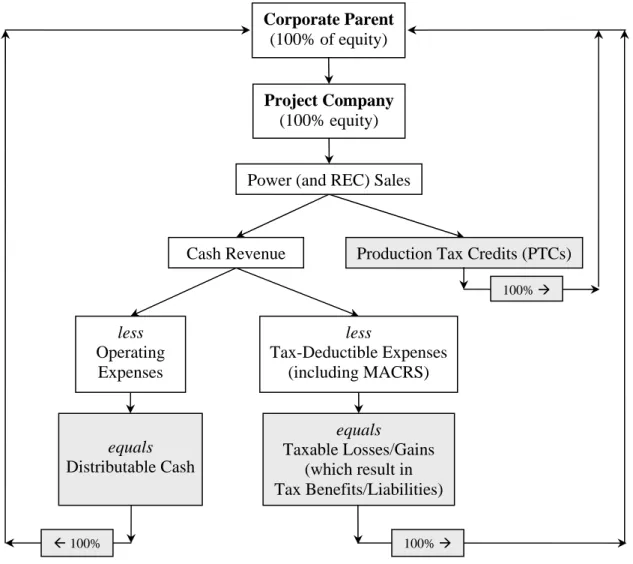
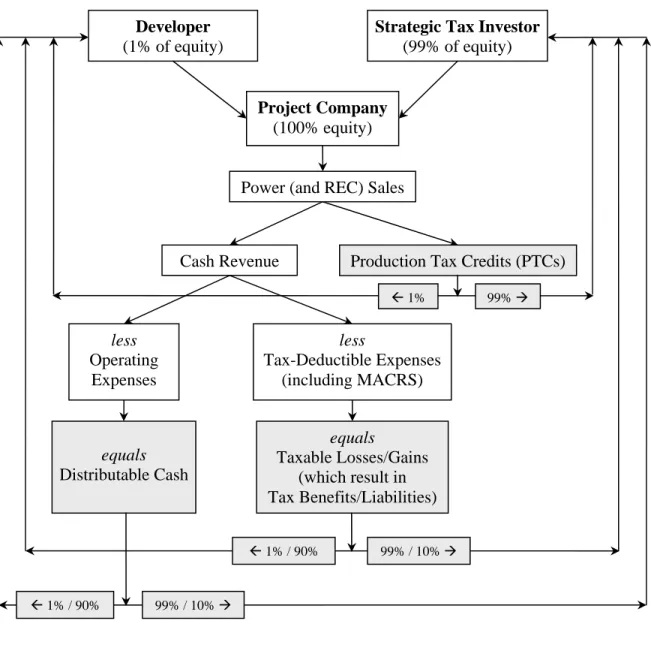
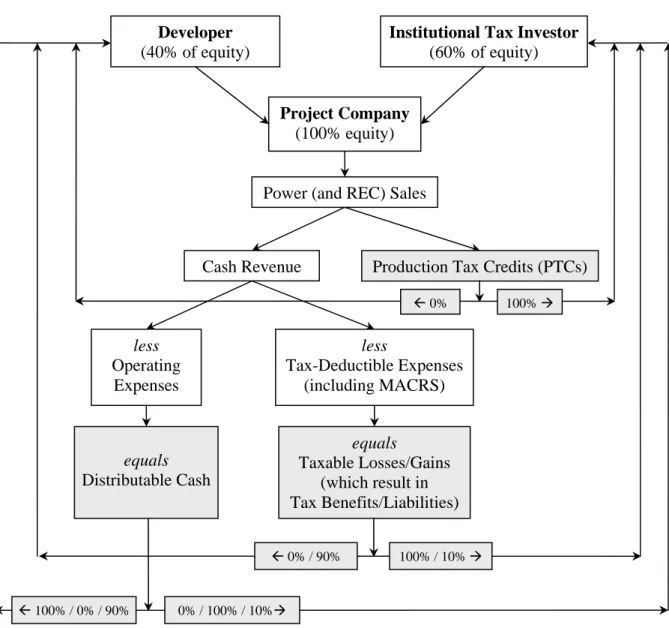
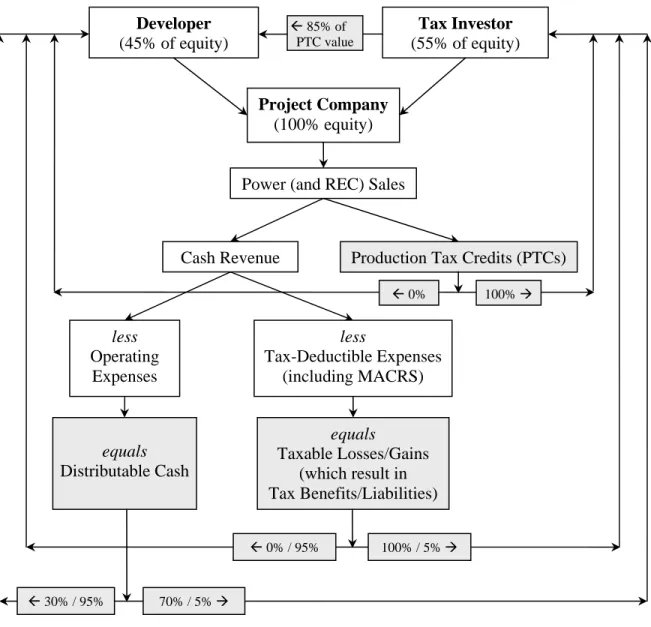
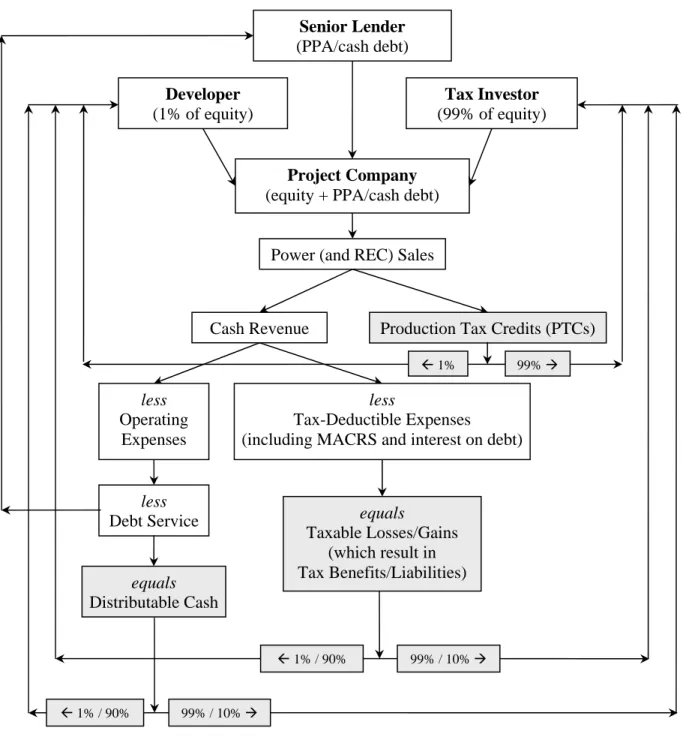
The remainder of this report is organized as follows. Chapter 2 provides a historical overview of the recent evolution of wind project financing in the U.S., providing a broader context for the financing structures examined in this report. Chapter 3 describes the seven structures principally used in the market. The chapter reviews the impetus for and application of each structure, and presents a schematic diagram of the mechanics of each structure and of the flow of key benefits streams. Chapter 4 introduces an Excel-based pro forma financial model (described in more detail in Appendix B), and presents the results of using the model to compare the levelized cost of energy under each structure. Chapter 5 concludes the report with some broader assessments of the financial model review and of current trends in the development of wind power projects that may affect how future wind projects are financed.
Text Box 2. Accelerated Depreciation
Section 168 of the Internal Revenue Code provides a Modified Accelerated Cost Recovery System (“MACRS”) through which certain investments in wind (and other types of) projects can be recovered through accelerated income tax deductions for depreciation. Under this provision, which has no expiration date, certain wind project equipment – including the turbines, generators, power conditioning equipment, transfer equipment, and related parts up to the electrical transmission stage – may qualify for 5-year, 200 percent (i.e., double) declining-balance depreciation. A typical rule of thumb is that 90% - 95% of the total costs of a wind project qualify for 5-year MACRS depreciation, with much of the remaining amount depreciated over 15 years.
Along with the PTC, this Federal depreciation incentive enhances equity returns to owners of wind and other qualifying projects by providing an additional financial benefit. This value – equal to between one-third and one-half the amount of revenue that can be earned through a long-term power purchase agreement – enables wind developers to charge less for power, while still generating competitive returns for equity investors.
Depreciation deductions in excess of net income generated by a project can be carried forward to future years under certain circumstances. However, due to the time value of money and the fact that a significant share of overall project returns come from accelerated tax depreciation and PTCs, it is important for an investor to be able to utilize such Tax Benefits in the years in which they are generated.
Before proceeding, three notes on the scope of this work merit mention:
1) This report is focused on the financing of large utility-scale wind projects designed to sell electricity directly to utilities or into power markets on a wholesale basis. As such, it does not review how investor-owned or publicly-owned utilities finance their own wind projects, where the project becomes part of the utilities’ internal generating portfolio and rate base.
4
This report is intended – in part – to assist policy makers in the U.S. Department of Energy (“DOE”) in understanding how financing structures used in the wind power marketplace affect the cost of wind energy. It is not intended to replace the DOE’s ongoing internal evaluations of the cost of energy from various electric power generation technologies, though the authors hope that this report will help to inform that work.
2) This report also does not cover financing structures used for smaller community-based wind power projects, or for distributed generation or behind-the-meter wind power projects. Several reports have been released that profile the financing options – which are typically simpler than those presented here – available to these smaller projects.5 Still, this report
may have some indirect utility for parties considering such projects, as several financing options used for smaller projects are derived from structures first conceived for larger projects.
3) Finally, this report is relevant only to the U.S. market, since the presence and structure of the Tax Benefits have driven the development of financing structures in ways not applicable to other national markets.
5
For example, see http://www.energytrust.org/RR/wind/OR_Community_Wind_Report.pdf and http://www.elpc.org/documents/WindHandbook2004.pdf
2. A Recent History of Modern Wind Project Finance
The financing of utility-scale wind power projects in the United States has evolved significantly in the last ten years, reflecting a widening and deepening of the capital markets for wind power. Prior to roughly 1999, the financing community generally perceived the wind market as exotic, i.e., complex, small, and risky. Earlier difficulties and financial losses experienced by projects and manufacturers had soured the market for several years. Few financial institutions were interested in the sector. There were relatively few financing transactions, the structures were simple, and debt and equity terms were expensive. In contrast, the market now features multiple new equity and debt sources, offers developers and capital providers a variety of tested financing structures from the simple to the highly complex, includes more and larger transactions, and has recorded a marked reduction in the cost of equity and (to a lesser extent) debt. Overall, these changes mark the transition of the wind industry from one perceived to be essentially a niche sector by the capital markets to a substantive, increasingly mature, market. These changes have reinforced the growth of the U.S. wind market and are likely to endure, absent unforeseen technical problems or broader financial market changes.
There have been three principal developments in financing trends and structures in the U.S. wind market since the burst of wind project development in the 1998/1999 time period. These developments, along with variations on these themes, have fostered the creation of the multiple financing structures profiled in this report. Two concern the equity side: (i) the entrance of large companies with strong balance sheets interested in actively developing and owning wind power projects (“Strategic Investors”) and, (ii) the entry of large, but more-passive investors principally interested in investing in wind projects for the Tax Benefits (“Institutional Investors”).6 The third development has been the entry of multiple European commercial banks to compete for wind project debt financing opportunities in the United States market.
While these developments cannot be tied to a particular moment in time, two distinct phases in wind project financing practices from 1998 to the present can be described. The first phase was from 1998 through 2002, when Strategic Investors dominated the market. The year 2003 was somewhat of a transition year, while 2004 through 2006 saw the second and third developments described above – i.e., the entry of Institutional Investors and the expansion of debt offerings – come into full force.
This chapter describes the evolution of modern wind project financing within these two distinct periods, followed by more detailed observations on specific developments within the equity and debt markets. The purpose is to provide the context required to better understand the seven specific financing structures described in detail in Chapter 3.
6
Typically (but not always), both Institutional and Strategic Investors can use the Tax Benefits. The primary differences between the two groups of investors concern their relative level of control and participation in project management and the integration of the wind project investments with their main business activities.
2.1 1998-2002: Strategic Investors Dominate the Market
The 1998/1999 time period marked the beginning of the current era of substantial new growth in U.S. wind power capacity (see Figure 1). For the ten years prior to 1998, annual capacity additions had been modest, averaging around 40 MW per year. Driven in part by the then-scheduled expiration of the PTC on June 30, 1999, however, the wind sector added more than 800 MW of new capacity in 1998 and 1999. Half of this increase was concentrated in the four Lake Benton and Storm Lake projects in Minnesota and Iowa, respectively. All were developed by a single independent developer (Enron Wind). Averaging 100 MW each, these transactions were among the largest in the world at the time. The remaining capacity additions in that period were through much smaller projects. Utilities such as PacifiCorp, Public Service Company of Colorado, Platte River Power Authority, and Madison Gas & Electric installed projects for their own account. A few private independent developers (“developers” or “sponsors”) and utility subsidiaries developed the remaining utility-scale projects. Little capacity came on line after June 30th, 1999 through the end of 2000, as the Congress did not renew the PTC until late in 1999, and developers needed time to develop a new round of projects.
The financing structures for most wind projects during this period were not complex. Although the PTC was available to projects coming on line prior to June 30, 1999, most developers lacked the financial strength to fund a project or to make efficient use of the Tax Benefits. As a result, their main financing option was simply to sell the project to those few unregulated subsidiaries of electric power utilities that were entering the wind market during this time as Strategic Investors – i.e., investors with experience in the power sector who intended to take an active, if not controlling, management role in wind projects. Although only a handful of such entities were in the market during this period, e.g., FPL Energy, Edison Mission Energy, and Cinergy, the equity market was dominated primarily by these Strategic Investors, who used their internal financial resources to fund the equity share of capital costs (and all of the costs if no project-level debt was used). Institutional Investors – i.e., those entities interested in passively investing in wind projects primarily for the Tax Benefits – had not yet entered the market to any significant degree. Indeed, GE Capital was the only major Institutional Investor in the market during this period.
While a few projects used debt financing to fund a portion of the capital costs, there were only a small number of debt providers interested in the sector. One institution, Fortis Capital, drew upon its success in financing European wind projects to dominate wind sector debt financing in the United States. Plain-vanilla, uncomplicated, construction and senior term debt financing were the principal offerings. A few deals included PTC loan monetizations. This new type of debt allowed a project to borrow against PTCs generated by the project. Such monetizations require the owner receiving the PTCs to commit to make periodic equity contributions for the term of the PTC loan, if needed to support the related debt service obligations. While PTC loan monetizations can be attractive in boosting the amount of debt that a project can support, the number of PTC loan monetizations completed in this period was limited by the few developers and Strategic Investors with the requisite financial strength and willingness to provide the related
guarantees.7 Overall, much of the new capacity added from 1998-2000 was financed on balance sheet, with no project debt (i.e., using the Corporate structure described later in Section 3.1). New capacity additions surged in 2001, as developers raced again to complete projects prior to the new December 31, 2001 expiration date of the PTC. A major equity-related development occurred in this year. Shell, a multi-national petroleum company, entered the U.S. wind market as a Strategic Investor. A few electric utilities also made their first acquisitions of wind projects as investors (rather than for internal generation purposes). These included American Electric Power and Entergy. Equity financing structures did not change significantly, however. In each case, these new investors typically acquired wind projects developed initially by smaller, independent developers unable to utilize the Tax Benefits. In most cases, the larger Strategic Investor acquired the projects outright. Joint venture collaborations involving two larger companies were used for some projects, but this structure was the exception rather than the rule. Also in 2001, bond market financing was used for the first time to finance a large wind project. A group of public utility districts in Washington State sourced $70 million in non-recourse tax-exempt bond financing to pay for the costs of the Nine Canyon wind project.8 The bond was
notable in that the proceeds directly financed construction costs, rather than being merely a take-out of other construction debt.
There was little new project activity in 2002, as the PTC was not available for part of the year and the electric sector grappled with problems of overcapacity and financial strains from the previous excess in thermal capacity, as well as disenchantment with power sector financings related to the Enron collapse. Several utility-based Strategic Investors and some early European lenders withdrew from the market in reaction to these financial strains. These power sector issues, the uncertain prospects for extension of the PTC, and the perceived complexity of wind projects relative to other tax credit investment opportunities (e.g., tax credits supporting affordable housing) all restrained interest by potential Institutional Investors.
2.2 2003-2006: Rise of the Institutional Investor
The burst of new capacity additions in 2003 fostered paradigm shifts in the debt and equity markets for wind projects. New projects grew in average size, requiring more capital. Several new, independent developers entered the sector around this time. With little or no ability to make efficient use of the Tax Benefits, some of these developers nonetheless sought structures that allowed them to finance their projects in a tax-efficient manner, while retaining an ownership stake. With many of the earlier utility-based Strategic Investors still financially constrained due to the difficulties in the merchant power sector, developers of larger projects sought tax-oriented Institutional Investor capital.
Three developments assisted in this effort. First, from September 11, 2001 through the end of 2004, the Federal Government offered a temporary bonus depreciation option for certain assets, including wind projects, first placed in service during that period. This incentive was put in place to boost economic growth after the 9/11 terrorist attacks. By boosting the near-term return to investors, this incentive enhanced the attractiveness of wind and other capital investments.
7
Section 3.6 provides more background on the PTC loan monetization concept.
8
Second, private letter rulings issued by the Internal Revenue Service (“IRS”), while officially only pertinent to specific transactions and not intended to set precedents, nevertheless also helped to resolve investor questions regarding ambiguities in the interaction of the PTC with state incentives, as well as the viability of some of the tax-oriented financing structures being implemented. Finally, financial intermediary firms such as Babcock & Brown and Meridian Investments, with experience in mobilizing tax-oriented equity, entered the wind sector to assist in sourcing capital for new projects. As a result of this confluence of events, 2003 and 2004 saw the closing of the first large transactions involving simple partnership flip structures. Institutional Investors remained few in number, however. Most projects in these years were still financed using the simplest equity structures, i.e., via internal corporate funds, or by sale of the project outright to a larger Strategic Investor.
Debt-financing structures also deepened and matured beginning in 2003. The entry of additional commercial banks at both the arranging and participant levels facilitated new transactions and loan facilities, and pushed interest rate margins lower. Lenders began to offer bridge financing, such as turbine supply loans and construction loans, as means to compete for term-lending opportunities. Debt arrangers devised different loan facilities to enable single projects to attract capital from both commercial banks and institutional lenders (e.g., insurance companies).
The year 2003 also saw the first debt financing of a portfolio of new wind projects. In this type of structure a holding company houses the interests in several wind projects, and the financing is obtained at the holding company level (rather than for each project individually). Portfolio financings can offer developers several benefits. These include potential transaction cost savings by negotiating a single set of financing documentation, more favorable financing terms due to perceived lower aggregate risks of the portfolio, and the enabling of financing of projects otherwise too small or risky to attract financing on their own.
In addition, a transaction in 2003 combined two different financing sources for the first time: PTC debt financing and Institutional Investor equity capital. The transaction required the three parties contributing funds to the project – the developer, the Institutional Investor, and the lender – to identify and allocate project risks. In particular, the lender and the Tax Investor had to craft their respective rights and risks with respect to the PTC debt financing. Previous transactions had involved simpler, bilateral negotiations between just two entities, e.g., between a buyer and a seller of a project, or between an owner and a lender.
Since 2003, these financing trends have continued, stimulated by the broader expansion of the overall wind sector and the focus of project developers on developing larger and more-costly projects. While a 100 MW wind project was stunning in 1998/99 and still unusual in 2003, such projects were commonplace by 2006. The evolution towards larger projects reflects multiple factors, including economies of scale in development costs and an up-scaling of turbine size.9 Most importantly, the effort, cost, and time to develop wind projects do not increase in step with project size; thus, developers have been able to reduce costs on a per-MW basis by focusing on
9
According to Wiser and Bolinger (2007), the average turbine size installed in 2006 was 1.6 MW (with turbines exceeding 2 MW used for many projects), which is more than double the 0.7 MW average turbine size installed in 1998/99.
larger projects. For their part, Tax Investors also have been able to achieve economies of scale in financing by deploying larger blocks of capital in single transactions.
Increased project development activity has put upward pressure on turbine prices in the last few years. The demand for turbines both nationally and globally has led to a scarcity of supply. At the same time, the cost of building a turbine has increased due to higher global prices for manufacturing inputs such as steel. In response, turbine manufacturers have raised prices and required developers to make early turbine commitments and cash down-payments in order to secure access to turbines. In addition to turbine price increases, interconnection costs have risen for projects being sited further away from transmission lines. All of these factors have raised wind project financing requirements substantially since 1999. AWEA estimated that the 663 MW of capacity installed in 1999 represented some $700 million in investment, resulting in an average cost of $1,056 per kilowatt of capacity.10 By contrast, AWEA estimated that $4 billion
in investment capital was mobilized to finance the 2,454 MW installed in 2006, yielding an average cost of $1,630 per kilowatt of capacity.11 Anecdotal information suggests that installed
costs for some projects in 2007 and 2008 could reach or exceed $2,000 per kilowatt of capacity.
2.3 Recent Equity Financing Developments
Wind developers have responded to this increased development pace and associated increase in capital requirements in various ways. Changes have taken place both at the project level and at the corporate level. Most directly, fewer developers have the internal capital to cover their project capital expenses. Instead, more third-party equity is being tapped, and at earlier points in the development life-cycle, to finance projects than in earlier years. Separately, companies seeking to enter the wind sector in the U.S. are using their financial strength either to offer development financing directly to smaller developers or to buy them outright.
A key method for financing new construction has continued to be the single-entity, all-equity financing structure, referred to herein as the “Corporate” structure. This reflects both a continuing pattern and two newer trends. The largest investor in the U.S. wind market, FPL Energy, continues to finance the initial construction costs of its projects using internal funds.12
At the same time, several other large developers that have entered the market in the last few years also have used internal funds to cover at least the initial capital costs of their projects. These large developers include foreign companies, e.g., BP, Iberdrola, Acciona, and Enel, as well as domestic entities such as PPM Energy and Horizon Wind Energy. The ability to finance new construction without having to tap third-party capital has emerged as a useful competitive advantage by reducing transaction costs and time to operation.
The continued use of this form of financing structure has been accentuated by the marked consolidation in the industry since 2002. Large entities, including especially foreign entities, 10 See www.awea.org/news/news000430w2k.html 11 See www.awea.org/newsroom/releases/Wind_Power_Capacity_012307.html 12
In the last few years, FPL Energy has closed several privately-placed long-term debt refinancings of portfolios of its existing and new projects. The refinancings appear principally to be limited-recourse in nature, but include credit support from FPL Energy on certain aspects. In August, the company was reported as considering a tax equity monetization for five projects, including one under construction.
have forged alliances with, or acquired outright, several smaller developers as a way of obtaining a pipeline of project investment opportunities. Previously, these smaller developers had either sold their projects outright to Strategic Investors, or partnered with Tax Investors. This consolidation trend has accelerated in the last few years: at least thirteen mergers or acquisitions totaling 35,000 MW of wind project pipeline were announced in 2006, compared to nine such transactions totaling 12,000 MW in 2005 and just four transactions totaling 4,000 MW from 2002 through 2004.13 In July 2007, Goldman Sachs sold its 100% share interests in Horizon
Wind Energy to EDP-Energias de Portugal SA, the largest utility in Portugal, in a transaction valued at $2.7 billion.14 One of the largest wind developers in the U.S., Horizon expects to have over 1,500 MW gross installed wind capacity by the end of 2007.
Separately, some investor-owned utilities such as MidAmerican Energy and Puget Sound Energy have become interested in directly owning wind power generation capacity, and have acquired several projects from developers. Their motives vary, but include an ability to use the Tax Benefits, and a willingness to use their own internal corporate funds to finance capital costs. In addition, some utilities are seeking outright project ownership in part because their state regulators allow them to earn a return on the investments. Another incentive is a desire to avoid potential complications with rating agencies wanting to reflect credit risks of buying power from unrated project entities by establishing a debt equivalency value for power purchases.
At the same time, Institutional Investor capital sources have increasingly been asked to finance new construction. In 2006, thirteen companies developed 99% of the 2,454 MW of new wind projects.15 Of these thirteen companies, only five had the tax appetite to retain ownership of
their projects;16 the remaining eight partnered with Tax Investors to make efficient use of the
projects’ Tax Benefits. JPMorgan Capital Corporation, a leading Institutional Investor in wind projects, estimates that third-party Tax Investor financing was tapped for 1,291 MW of new construction in 13 transactions from 2003 through 2005.17 By contrast, the firm has estimated
that 15 tax equity transactions were closed in 2006 alone, with an aggregate value of about $3.1 billion.18
Along with deal flow, the number and capacity of Institutional Investors also have expanded since 2003. Whereas there were only three prominent Institutional Investors in 2003, tax equity transactions in 2006 involved 13 participants. Moreover, more participants are showing a willingness and capacity to structure and lead a transaction. Of the thirteen participants, six firms acted as lead investor in transactions, up from only one or two just three years earlier. The increases in the number and quality of Institutional Investors reflect several factors either specific to the wind sector or broader in nature. Wind sector-specific factors include greater familiarity with wind technology, the implicit comfort of seeing major multinational corporations
13
Wiser and Bolinger (2007), op. cit.
14
See: http://www.edp.pt/EDPI/Internet/EN/Group/Investors/News/2007/Com02072007.htm.
15
These figures focus on the project owner at the point at which projects are financed and built; they do not reflect sales by smaller developers to the final owners that may have occurred at earlier stages of project development.
16
See “The Tax Equity Market” in Chadbourne & Parke, LLP’s April 2007 Project Finance Newswire, available online at http://www.chadbourne.com.
17
JPMorgan Capital Corporation presentation, AWEA Wind Power Finance & Investment Workshop, April 2006.
18
such as GE, Siemens, and Goldman Sachs assume leading roles in manufacturing and/or project development, the creation of more tools for analyzing wind resource risk, and a standardization of financing structures. Broader market factors in the rise of Institutional Investors include an increasing comfort that Federal and state tax and other incentives for renewable power will remain in place or be expanded, Congressional action in 2003 that granted investors the ability to use the PTC against alternative minimum tax obligations during the first four years of a wind project, and declining attractiveness of alternate tax-oriented investment opportunities for Institutional Investors (e.g., in the low-income housing sector).
Such broadening of the investor pool has added to the competitiveness of the market for capital. Developers have been able to secure equity financing from Tax Investors at steadily lower rates. At the AWEA wind power conference in May 2003, Meridian Investments estimated that Institutional Investor returns would need to be in the range of 12-13% in order to attract capital for wind projects. Currently, the requisite ten-year equity hurdle rates for high-quality, well-structured transactions has declined to less than 7% for all-equity deals and less than 10% for leveraged deals.19 This decline is not likely to be reversed, absent the emergence of a
previously-unforeseen material technical issue with wind technology, a major project default with implications for other projects, broader capital market changes, or the like. At the same time, further material declines may be limited as project returns approach rates of alternate investments such as low-income housing and even risk-free Treasury securities.
2.4 Recent Debt Financing Developments
Debt has remained mostly a secondary consideration in the financing activity of recent years. When developers have sought third-party capital, securing a Tax Investor typically has been the primary, if not only, goal. While there have been a few debt-leveraged projects each year, these transactions have represented the minority of the financings.
Several factors account for this. A key factor has been the reluctance of leading Institutional Investors to invest in projects that include limited-recourse debt at the project level. Specifically, they have been uneasy with the allocation of cash flow and control between project lenders and the Institutional Investors in loan default situations. The concern is the potential risk of their up-front equity investment being squeezed out by lenders seeking to recover the value of their loans. Additionally, some Institutional Investors fear that the increased transaction costs associated with debt may erode much of the value associated with leverage. There is also a timing issue associated with debt. Debt leverage not only costs more up-front, it also takes more time to close the financing transaction. The repeated expirations in the PTC, and short-term renewals of several of the PTC extensions, have given a competitive advantage to developers not needing to obtain debt financing as a condition of commencing construction.
With term debt not in high demand, the debt market has expanded principally in the types of loan financing made available to project developers. Several developers, for example, have accessed shorter-term turbine supply loans, construction financing, and letter of credit support from
19
several commercial banks in support of their new wind projects.20 Additionally, lenders
committed to limited-recourse financing for several transactions in 2006 using the Back Leveraged structure. The Back Leveraged financing structure – with debt incurred by the developer, rather than at the project level (described in more detail later in Section 3.7) – balances developer interest in using leverage with reticence by Institutional Investors in seeing debt at the project level. The Back Leveraged structure does not affect project-level returns or risks, since the debt only finances a portion of the developer’s equity contribution to the project company. These debt facilities principally assist the developer by stretching its capital, thereby enhancing its ability to expand operations. Developers and investors are also beginning to tap debt financing to refinance existing projects. FPL Energy has issued private limited-recourse secured bonds and notes for two portfolios of existing projects.21
While term debt financing has not been the primary financing tool, the number of institutions providing debt financing of all types, as well as the average size of loan transactions, has risen in recent years. Eleven financial institutions acted as lead arranging lender for debt transactions in the wind sector that closed in 2006. This was up from earlier years when only two or three lenders were willing and able to assume such lead-arranging functions. Transaction loan commitment amounts in 2006 routinely were in the hundreds of millions of dollars; one developer secured $1 billion in construction loan facilities to support a portfolio of projects. Anecdotal information by loan arrangers at industry conferences indicate that the number of banks participating in loan syndications and average loan participation levels have both risen as well since 1998/1999. Overall, the expanding pool of debt arrangers competing to arrange debt financing for projects suggests a continuation of current trends. Banks are competing to provide debt capital at competitive rates and are innovating in terms and structures in order to win such competitions.
European commercial banks have dominated lending activity in the U.S. wind sector. One bank, Fortis, virtually originated the term cash flow and PTC monetization debt financing structures in the U.S. market during the 1998-2001 time period. Since then, the informal mantle of most-active lead arranger has always been held by one or another European bank such as Dexia Crédit Local or HSH Nordbank. Of the eleven institutions that led one or more debt financing syndications in 2006, only three were U.S. financial institutions, and one of those three only acted as a lead arranger for a transaction developed by an affiliate. A few insurance companies also have provided institutional debt financing, but the majority of project leverage has come from commercial banks.
Relative to the dramatic decrease in equity returns, debt terms have not changed as significantly. The typical loan term (or duration) remains a function of the length of the underlying power and REC purchase agreements. For projects with long-term power purchase agreements (e.g., twenty years) with creditworthy utility buyers, commercial bank lenders are willing to extend loans with
20
Jeff Chester presentation (“Wind Power Market Overview 2006”) at Infocast’s Wind Power Finance & Investment Summit 2007, La Jolla, CA, February 7-9, 2007.
21
http://www.fplenergy.com/news/contents/05020.shtml,
http://findarticles.com/p/articles/mi_m0EIN/is_2005_Feb_9/ai_n9509206. Also, see Form 8-K filing by FPL Group, Inc. to the U.S. Securities & Exchange Commission, June 26, 2006,
a term of up to fifteen years. Institutional lenders, e.g., insurance companies, have been willing to go as long as nineteen years for comparable transactions. For projects involving shorter term power purchase agreements (“PPAs”) or utilizing power marketing contracts in lieu of power purchase agreements, loan terms are shorter and/or involve mandatory prepayments using any excess cash flow.
The standard debt service coverage ratio (“DSCR”)22 has widened slightly from 1.40:1 in 1998/99 to 1.45:1 more recently. The increased DSCR reduces default risk by lowering the borrowing capaci