MPRA
Munich Personal RePEc Archive
Determinants of Moral Hazard in
Microfinance: Empirical Evidence from
Joint Liability Lending Programs in
Malawi
Simtowe, Franklin and Zeller, Manfred
12. October 2006
Online at
http://mpra.ub.uni-muenchen.de/461/
Determinants of Moral Hazard in Microfinance: Empirical Evidence from Joint Liability Lending Programs in Malawi
Franklin Simtowe1 Manfred Zeller2
. Abstract
Moral hazard is widely reported as a problem in credit and insurance markets, mainly arising from information asymmetry. Although theorists have attempted to explain how group lending with joint liability can be an important tool for mitigating moral hazard among the poor, empirical studies are rare and sometimes give mixed results. In Malawi, for example, although, group lending with joint liability has been practiced for nearly four decades, the unwillingness to repay loans remains the single major cause of default. This paper examines the extent of occurrence of moral hazard and investigates its determinants of occurrence among joint liability lending programs from Malawi, using group level data from 99 farm and non-farm credit groups. Results reveal that peer selection, peer monitoring, peer pressure, dynamic incentives and variables capturing the extent of matching problems explain most of the variation in the incidence of moral hazard among credit groups. The implications are that joint liability lending institutions will continue to rely on social cohesion and dynamic incentives as a means to enhancing their performance which has a direct implication on their outreach, impact and sustainability.
Key words: moral hazard, joint liability, dynamic incentives, group lending, Malawi .
1. Introduction
Imperfect information causes at least four problems in credit markets, namely, adverse selection, moral hazard, lack of insurance and lack of enforcement. It is now common knowledge that, moral hazard, coupled with the lack of collateral by the poor is the key reason why credit markets fail for them. The problem of moral hazard may arise when individuals engage in risk sharing under conditions such that their privately taken actions affect the probability distribution of the outcome. It occurs in a principal-agent relationship when actions taken by an agent are not pareto-optimal (Holmstrom, 1979).
Joint Liability Lending (JLL) is celebrated as a contractual innovation that has achieved the apparent miracle of enabling previously marginalized borrowers to lift themselves up by their own bootstraps by creating ‘social collateral’ to replace the missing physical collateral that excluded them from access to more traditional forms of finance (Conning 2000). Nevertheless, the problem with joint liability lending programs is that the poor are given access to credit without collateral, and in the event of default, they can not be punished
1
Fellow, University of Bonn, Center for Development Research, Germany, and Research Fellow, University of Malawi, Bunda College of Agriculture.
2
beyond a mere denial of future access to credit. This form of limited liability can induce borrowers to take risky decisions.
In an effort to fully explain the success of JLL in mitigating moral hazard and enhancing repayment, theorists have proposed models that attempt to explain how this is possible. Among the most notable theories of moral hazard are models by Stiglitz (1990) and Ghatak and Guinnane (1999). Stiglitz shows how peer monitoring under joint liability lending can be used to mitigate moral hazard. Through JLL, it is assumed that group members, who are jointly liable to the loan, will be induced to monitor each other’s investment decisions and effort, thereby, reducing the cost of monitoring by the lending institution and consequently mitigating moral hazard. Thus, borrowers are given tasks of both managing their loan, and monitoring peers to ensure that they take safe decisions that would protect them from falling into repayment problems. However, in reality, monitoring can be costly and thus the assumption made by Stiglitz cannot hold.
As a diversion from a model by Stiglitz, Ghatak and Guinnane (1999) propose a modification on the assumptions of costless monitoring, by showing that peer monitoring is costly. Further, they show the condition under which optimal contracts can still be achieved taking into account the cost of monitoring. They also add that a borrower’s willingness to repay the loan will depend on how they value the access to further loans from the same institution. Ghatak and Guinnane observe that if a borrower’s project yields enough output so that he/she is able to repay the loan, he/she will do it only if the benefit of defaulting, the interest, is less than the (discounted) net benefit of continued access to credit. This raises the question: ‘To what extent does the value of future access to credit reduce the incidence of moral hazard?’ Following the proposed theories of moral hazard, only a limited number of empirical studies have been conducted to test their validity.
In Malawi moral hazard is common occurrence among credit groups. Diagne et al (2000) note that peer monitoring rarely occurs in credit groups from Malawi and that when it occurs it does not lead to improvements in repayment because the main reason for default in the Malawi Rural Finance Company (MRFC) credit groups is the unwillingness to repay (moral hazard) and not the inability to repay. The unwillingness to repay was found to be the first cause of default among the MRFC credit groups. It accounted for 25 percent of all defaults in MRFC credit groups. However, no study has been conducted in Malawi to assess the driving forces behind such high incidences of moral hazard. Thus, the objective of this paper is to examine the extent to which moral hazard occurs in credit groups and analyse determinants of the likelihood of its occurrence. It is an attempt to contribute to moral hazard literature by testing the extent to which peer selection, peer monitoring, social ties, peer pressure, dynamic incentives and matching problems influence the incidence of moral hazard. We adopt a theoretical framework proposed by Ghatak and Guinnane(1999) with some extensions proposed by Diagne (1998), Paxton (1996) and de Aghion (1999). We use data from Malawi, collected by the International Food Policy Research Institute (IFPRI) in 1999. The data comes from 99 credit groups, all of which are beneficiaries of the Malawi Rural Finance Company’s (MRFC) farm and non-farm loans. In section 2, we present a brief review of literature. The theoretical framework and the description of data are presented in section 3 and 4, respectively. In section 5, we present and discuss results, while section 6 concludes.
2. Moral hazard in group based credit: a review of theories and related research 2.1 The dynamics of joint liability lending
Matin (1997) describes joint liability as a contract in which the provision of the private good, such as an individual’s access to credit, is made conditional on the provision of the public good, such group repayment. It refers to a situation in which two or more parties are liable for repayment of a debt or obligation and a creditor can be compensated from them either individually or jointly. Most group loan contracts in developing countries have a joint liability clause. This partly explains the belief that joint liability lending is a potential break through strategy in economic development as it enables the poor, for example without land title or collateral to access group loans that they would otherwise never access individually. The premise of group lending with joint liability is that if one borrower cannot pay a loan, then other members of the joint liability group will do so (Ahlin and Townsend 2003).
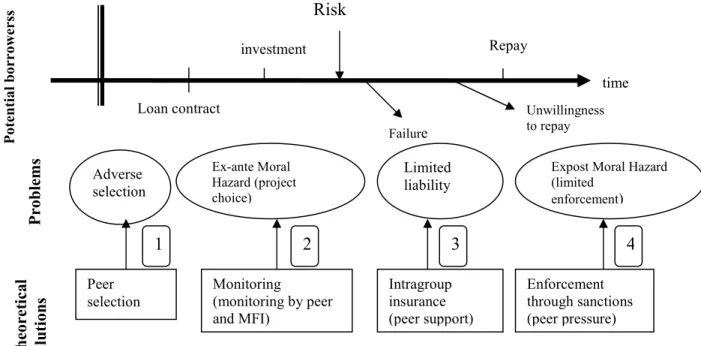
Figure 1 shows a relational presentation of loan transactions and stages in the joint liability lending model starting from identification of borrowers through to repayment. Each stage in the figure is associated with a problem that the joint liability clause is assumed to address, and a hypothetical or theoretical solution. Following the loan receipt are the stages of monitoring, return realization, repayment or non-repayment. The process ends with penalties of non-refinancing in case of default.
At the beginning of the period you have a pool of potential borrowers trying to access credit. However, borrowing is conditioned upon group affiliation. Realizing that a borrowing group will sign a joint liability contract with the lender, each borrower, through peer selection tries to match with members of similar risk type. As proposed by Ghatak (1999a), the self-section process reduces the incidence of adverse selection.
Peer selection Adverse selection Loan contract investment Ex-ante Moral Hazard (project choice) Repay Failure Limited liability Unwillingness to repay
Expost Moral Hazard (limited enforcement) Monitoring (monitoring by peer and MFI) Intragroup insurance (peer support) Enforcement through sanctions (peer pressure)
Figure 1: A dynamic presentation of problems and solutions in a multistage joint liability loan Source: Adopted with some modification from Sadoulet (2004)
Risk P ro b le m s T h eo re ti ca l so lu ti o n s time P o te n ti a l b o rr o w er ss 1 2 3 4
Following the selection stage is the investment period. At this stage, the lender is faced with an
ex ante
moral hazard problem. This occurs when a borrower either decides to invest in a risky project or misuses the funds or when the borrower does not apply enough effort to manage the investment, which may lead to low returns. In theory peer monitoring can be used to mitigate this problem. However, complementary monitoring by the officers from microfinance institutions (MFIs) can also significantly reduce the incidence ex-ante moral hazard. Since monitoring by MFI officers is assumed to be costly and unsustainable, joint liability lending emphasizes on monitoring by peers.The third stage involves investment outcomes. The investment may fail due to a number of reasons, some of which are beyond the control of the borrowers such as idiosyncratic shocks. The problem now is that there exists limited liability. Under joint liability lending members that do not have repayment problems can assist in paying the defaulters’ loan (intra-group insurance). The final problem is related to ex-post moral hazard. This is a second dimension of the general moral hazard issue in lending contracts. It occurs when the levels of effort have been carried out and the returns of the investment have been realized, when a borrower finds it optimal to diverge the funds for repayment of the loan to other purposes. In joint liability loans, implementing peer pressure and social sanctions can solve the problem of ex-post moral hazard.
2.2 Empirical studies
A very limited number of empirical studies have been conducted on determinants of moral hazard in JLL schemes. Among the few attempts are studies by Wydick (1999) and Hermes et al (2005). Wydick assesses the incidence of moral hazard among credit groups in Guatemala and provides evidence that joint liability works because of social cohesion and better information flow. Nevertheless, the study fails to assess the extent to which other key variables of group dynamics such as, dynamic incentives, sanctions and matching problems influence the incidence of moral hazard. Hermes et al (2005) study the incidence of moral hazard among credit groups from Eritrea and observe that social ties and peer monitoring are key factors influencing the likelihood of moral hazard among borrowers.
The role of peer selection in mitigating adverse selection and hence moral hazard is discussed by Ghatak (1999b). Ghatak argues that despite information asymmetry, joint liability lending allows for pareto superior equilibrium in credit markets if group formation is conducted appropriately. Ghatak shows how groups formed through self selection will result into members with homogenous quality. Ghatak shows that through the assortative matching process, groups end up with less risk borrowers, directly reducing moral hazard, which leads to a lower equilibrium interest rate leading to a pareto superior outcome relative to individual lending.
The significance of peer monitoring in improving repayments in group credit is highlighted by a number of authors. Stiglitz (1990), for example, observes that the major problem facing MFIs is ensuring that borrowers exercise prudence in the use of the funds so that the likelihood of repayments is enhanced. Stiglitz notes that a partial solution to this problem is peer monitoring: giving neighbours or group members the responsibility to monitor each other. The incentive for peer monitoring comes from the fact that peers are supposed to pay loans for any defaulting group members. Studying the incentive rationale for the use of group lending as a method of financing liquidity-constrained entrepreneurs,
Che (2002) observes that the joint liability lowers the liquidity risk of default but creates a free-riding problem. Che points out that in the static setting, the free-riding problem dominates the liquidity risk effect, thus making group lending unattractive. However, when the projects are repeated over time, the joint liability feature provides the group members with a credible means of exercising peer monitoring and sanctioning, which can make the group lending attractive, relative to individual lending.
In contrast to the emphasis on peer monitoring, Fuglesang et al., (1993) argue that the monitoring by lending institutions is all that matters most when it comes to improving repayment rates. They observe that even micro lenders that are famous for the joint liability methodology such as the Grameen of Bangladesh do in fact also rely heavily upon highly motivated and locally recruited loan staff officers as monitors and organizers. Following this observation, Conning (2000) questions whether such delegated monitors might not be just as good at monitoring, and perhaps better at enforcing loan repayment than peer monitors, in which case joint liability clauses my be superfluous or may be serving other purposes.
The role of peer pressure is discussed by Diagne (1998). Diagne proposes a peer pressure model in which borrowers are incompletely informed about their partners willingness to apply or tolerate social sanctions and shows how peer pressure can be used to mitigate default in situations where potential defaulters are intolerant of sanctions. An extension of the model by Diagne (1998) and Paxton (1996) further proposes the importance of dynamic incentives and incentive match in inducing safe behaviour among borrowers.
The role of sanctions in enhancing the willingness of individuals to repay their loans is also discussed in Besley and Coate (1995). They show how moderately successful group members may wilfully decide not to repay their loans because of the burden of having to repay the unsuccessful members´ loan. They note however, that in the presence of strong social ties among group members, wilful default is minimized because potential defaulters are afraid of facing sanctions from both the bank and the community.
Ahlin and Townsend (2003) further attempt to extend existing repayment models by testing some unexamined dimensions of the models. One such test is the introduction of productivity differences across groups. Based on the assumption that the production function can be decomposed multiplicatively into a piece related to the risk factor and a piece related to productive inputs, such as loaned capital and human capital, they assign the derivative of the utility difference with respect to human capital. In their empirical analysis they find that productivity represented by the average level of education positively influences repayment. However, the average land holding size (another productivity variable considered in the model) had no effect on repayment performance. In the next section we present a theoretical framework on moral hazard and its extensions.
3. Theoretical and empirical framework
Following Salanie (2000), the standard moral hazard model assumes that the principal cannot directly observe the effort level of the agent. Once a contract has been signed the agent must choose between n possible actions ai,...,an.These actions produce one among m outcomes which we may denote x1,...,xm. Assume further that when the agent chooses action ai, the Principal observes the outcome xjwith a probability pij that is
positive. The agent receives a wagewj when the Principal observes the outcome xj. The income for the principal is (xj −wj). The specification for the Agent’s von Neumann-Morgenstern utility function can be written as
a w
u( )− , where u is increasing and concave. Assuming neutrality for the principal as in most of the literature, his von Neumann-Morgenstern utility function is written as
w
x− . When the Principal offers a contract wj the agent’s utility maximization problem
can be written as : −
∑
= = m j i j ij n iMax p u w a 1 ) ,... 1 ( ) (1)If the agent chooses ai then the (n-1) incentive constraints is
∑
= − m j i j iju w a p 1 ) (∑
= − ≥ m j k j kju w a p 1 ) ( (ICk) (2) where k=1, …..n and k ≠i.The agents’ utility maximization problem is also subject to the following (individual rationality constraint) participation constraint:
µ
≥ −∑
= m j i j iju w a p 1 ) ( (IR) (3)where µ is the utility derived from taking an outside option. Building on the basic principles stated in the standard model specified above, Stiglitz (1990) proposes a moral hazard model for credit markets which can be presented in two stages. First the model is presented under individual lending and then later a scenario under group lending is presented. The model shows that joint liability lending can be used to mitigate the moral hazard problem among group members. The model starts by assuming a single borrowers loan (individual liability) under the assumption that borrowers are risk neutral. Output takes two values, high YH and lowYL. Normalizing the low output values to 0, the output is high with probability p and 0 otherwise. Assuming that each project requires 1 unit of capital, then the repayment to the lender plus interest equals ρ >1. Borrowers will only be willing to borrow if the utility from borrowing (which results from the payoffs) is no smaller than some utility µthat represents the utility the agent can obtain by taking on an outside option. This participation constraint, which also implies that the projects are socially profitable, can be expressed as follows:
µ
ρ
≥ − HpY (5)
Borrowers choose actions, which can be thought of as a level of effort p∈
[ ]
0,1 , for which they incur a disutility cost of 22 1
p
γ (where γ >0). Following this specification a social surplus and the equilibrium p which is subject to moral hazard can be computed. Under individual lending the following equilibrium value of p will be chosen3
γ
ργ
2 4 ) ( 2 − + = H H Y Y p (6)Under joint liability scenario it is assumed that when a borrower’s project fails the partner is liable for the amount q. This is an incentive for each member to care about the safety of the project chosen by the peers and it is acknowledged as a justification for peer monitoring. If
3
one of the members chooses an action p´ then the payoff function of a borrower who chooses action p is . 2 1 ´) 1 ( max 2 ) ( pY rp qp p p H p − − − − γ (7)
Assume that the borrower chooses action p to maximize his individual payoff, taking his partner’s action p' as given. Then her best response function is given by:
'. p q q r Y p H
γ
γ
+ − − = (8)At the equilibrium the p under joint liability just like under individual liability has two values while the denominator of the joint liability expression is lower than that of the individual liability. The model shows how the equilibrium value of p and hence repayment rate is higher under joint liability compared to individual lending.
The model outlined above assumes that members can monitor each others actions perfectly at no cost, as well as they enforce any agreements regarding their choice of p.
However, in reality, peer monitoring can be costly. In addition, joint liability lending allows for the imposition of sanctions on group members that renege on their repayment promises. Ghatak and Guinnane (1999), therefore, make an extension of this model by including the cost of monitoring and considerations for the effect of sanctions in choosing the level of p4. Diagne (1998) further makes extensions to the model by including the impact peer pressure and dynamic incentives in inducing repayment. Ahlin and Townsend (2003) propose the inclusion of productivity differences across groups and show how high productivity leads to a reduction in moral hazard through an increase in payoffs for safe projects.
Guided by this theoretical framework we identify variables that are associated with the incidence of moral hazard from the data set. The empirical strategy focuses on testing whether or not particular covariates, vector X =(X1...Xn)are associated with the incidence of moral hazard.
The probability of moral hazard in a specific group g as a function of covariates can be written as P(Hg =1|Xg). This leads to the following likelihood function:
[
]
g g g g H H g g G g X H P X H P − = = − = ∏ 1 1 ) | 1 ( 1 ) | 1 ( (9)The moral hazard model P(Hg =1|Xg) can thus be written as a functionP(
β
'Xg),where
β
is an Mχ
1 vector of parameters and Xg is an Mχ
1 vector containing group g´s values for the M covariates.The likelihood of a group reporting the incidence of moral hazard is assumed to be determined by a latent variable y* which can be expressed as follows in a regression relationship: i i i i y *=
β
' Χ +µ
(10) 4where X is a vector of characteristics, which, it is hypothesized that they affect the likelihood of the occurrence of moral hazard,
β
'i is a vector of coefficients for variables associated with moral hazard.In practice y* is unobservable. What we observe is a dummy variable defined as
1 = y if yi*>0 (11) 0 = y otherwise
From the relations 2 and 3 we get
i i i ob u X y ob( 1) Pr ( ' Pr = = >−
β
(12) = 1−F(−β
'Xi)In this case the observed values of y are just realizations of a binomial process with probabilities given by ( 12) (Maddala 1997). Hence the likelihood function is
[
1 ( ' )]
) ' ( 1 0 i y i y F X F X L i iβ
β
Π − − − Π = = = . (13)The functional form of F in (13) will depend on the assumptions made about
µ
i in (10). In this study we assume thatµ
i are IN(0,δ
2). Because of this assumption of a cumulative normal distribution of the error terms, the estimation of determinants of moral hazard is done using the probit model.The moral hazard model was specified as follows: (14)
i i Ctr i i i i i i Dinc i i i pp i i i st i i i pm i i i Scr i i i i x x x x x x x x 8 8 5 1 7 7 3 Im 1 6 6 2 1 5 5 2 1 4 4 6 1 3 3 3 1 2 2 4 1 1 1 2 Pr 1 1) (y Prob β β β β β β β β α = = = = = = = = = = = = = = = = ∑ + ∑ + + ∑ + ∑ ∑ + ∑ + ∑ + ∑ + = = Where: 1
x ´s are a set of variables (Pr=2) that measure group productivity
2
x ´s are a set of variables (Scr=4) that measure the quality of screening
3
x ´s are a set of variables (pm=3) that measure the quality of peer monitoring
4
x ´s are a set of variables (St=6) that measure the strength of social ties within the group
5
x ´s are a set of variables (Pp=2) that measure the quality of peer pressure
6
x ´s are a set of variables (Dinc=2) that measure the quality of dynamic incentives
7
x ´s are a set of variables (Im=3) that the proxy the degree of incentive match
8
x ´s are a set of variables (Ctr=5) that are control variables
4. Data
The study is based on data collected by the International Food Policy Research Institute (IFPRI) in 1999 from 99 MRFC credit groups located in 4 of the 27 satellite offices of MRFC. The four satellite offices are located in 4 different districts of Malawi. The groups were randomly selected based on information obtained from MRFC’s Management Information System. The four sites cover the three regions of Malawi (Central , South and
North)5. Because of logistical constraints, the sample frame of the groups in each satellite
office was restricted to 2 field offices only6.
Using the 1997 repayment status, groups were classified into 3 categories: fully-paid groups, partially-paid groups and nothing-paid groups. A stratified random sampling procedure was then used to randomly select the sample groups from the three selected strata. A group was classified as fully paid if the 1997 group loan was fully paid. It was classified as a partially-paid group if only part of the 1997 group loan had been paid at the time of the survey. And a group was classified as nothing-paid if no member had paid anything for the 1997 loan. For each group, a group leader and three randomly selected members were interviewed for each group. One non-participant and one past participant randomly selected but living in the same village were also interviewed. A detailed structured questionnaire covering the formation, composition and repayment history of the group was administered to each respondent. The questionnaire specifically included questions aimed at quantifying the degree of information asymmetry within each group and the extent to which peer selection, peer monitoring and peer pressure had been taking place. Also collected using the questionnaire was the extent to which the joint-liability has been enforced in each loan cycle.
4.1 Formation structure and conduct of the groups
The sample consisted of both farm and non-farm credit groups. As indicated in Figure 2, the majority were tobacco credit groups (47%), followed by the non-farm business groups (28%). Maize and cotton groups accounted for 17 percent and 8 percent of the sample, respectively.
These four types of credit groups belong to three different joint liability programs operated by MRFC: MRFC seasonal agricultural loans, Mudzi seasonal agricultural loans, and Mudzi non-farm businesses. There are significant differences in the design, orientation, and target population of the programs. There are also significant differences in the design
5
See Map of Malawi in Appendix 1 for the study sites
6
The average number of offices per satellite office is 5
Tobacco, 47
Maize, 17 Cotton, 8
Non-farm business, 28
and operation between the groups in the seasonal agricultural programs depending on the type of crop for which the loans are intended (tobacco, maize, cotton and rice ( Diagne et al 2000).
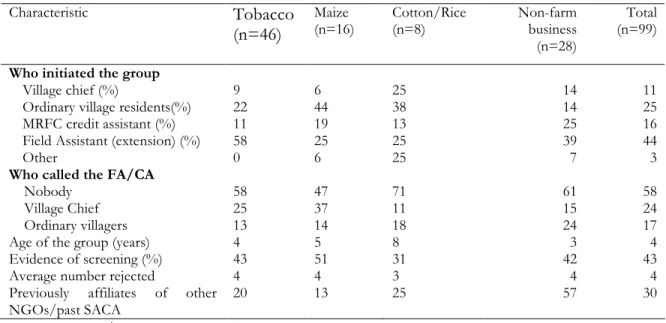
Based on information from group leaders, Table 1 indicates that only 25 percent of the groups were formed by ordinary village residents on their own (through peer selection). The agricultural extension workers (Field Assistants) and the Credit Assistants formed 44 percent and 16 percent of the groups, respectively7. The importance of the FA’s in the formation of
the groups is consistent with the policy followed by MRFC with respect to group formation. The policy consists of letting the agricultural extension workers, who are under the ministry of Agriculture and are called Field Assistants (FA) in Malawi, identify and propose to its Credit Assistants (CA) the groups wanting to borrow from MRFC. The CAs then perform the screening and undertake the group training activities. It is generally assumed from the perspective of MRFC that groups identified and proposed by the FAs have been endogenously formed through a peer selection process. It is however not clear as to the extent to which such groups whose formation was initiated by FAs and CAs can be considered to be endogenously self formed. Anecdotal stories during the field survey, however, indicated that FAs exerted a lot of influence on who to be included in the groups. In a number of cases FAs included friends and relatives in the credit groups which led to group default in some cases. It appeared, however, that the CAs were usually more objective when selecting members in a group than the FAs as stories of default due to biased selection were rarely reported in groups formed by CAs. Village chiefs formed about 11 percent of the credit groups. In some cases chiefs were also reported to be involved in the same malpractices of including relatives and friends during group formation. In addition although chiefs only formed 11 percent of the groups, their influence is also felt in groups that were formed by the FAs or CAs because as indicated in Table 1, in about 24 percent of the groups formed by the FAs/CAs, village chiefs had called them to the village to come and form the groups. Ordinary villagers were reported to have called the FAs/CAs in only 17 percent of the groups.
Due to the nature of their main job, FAs appear to have more influence in initiating the formation of tobacco groups (47%) and maize groups (41%) compared to cotton groups (27%) and business groups (23%). In contrast, the CAs are more influential in the formation of non-farm business groups (25%) compared to tobacco (12%), cotton (15%) and maize (19%).
The issue of screening was addressed by asking group leaders if some individuals that had wanted to join the group had their applications turned down. Results indicate that about 43 percent of the groups showed some evidence of screening, as indicated by the positive number of membership applications rejected when the group was being formed. On average about 4 members per group were rejected. Screening is more evident in maize groups (51%) than in tobacco (43%), non-farm business (42%) and cotton (31%). The evidence of high levels of screening among maize groups may be attributed to the fact that maize groups lack a built-in mechanism for self selection because maize is a main staple food in Malawi and has
7 Diagne et al 2000, emphasizes that Agricultural Extension workers, also known as Field Assistants in Malawi,
play a very important role in the formation of MRFC credit groups. For planning and administration purposes, Malawi is divided into Extension Planning Areas (EPAs) headed by an Agricultural Development Officer (ADO). MRFC field credit offices (which are the first contact points of borrowers) are located in the EPA offices and handle both the farm and non-farm groups. In all EPAs both the Credit Assistant and the Field Assistant work under the direct supervision of the ADO although the first is a paid employee of MRFC while the Field Assistant and the ADO are employees of the Ministry of Agriculture.
to be grown by almost all farmers. On the other hand the capital and labour intensive nature of tobacco allows for the self selection process to start earlier.
About 30 percent of the groups had been previously affiliated to other credit institutions before joining MRFC. Thus despite the screening process members from past failed credit programs where loans may not have been rigorously collected, leading to default were part of the existing MRFC groups. A matter of fact according to Diagne et. al (2000) about 80 percent of the groups surveyed included past members of SACA or another NGO. Overall about 41 percent of group members were either past SACA members or members from another NGO. The nature in which group formation takes place is evidence of how difficult it can be to exclude risky borrowers from groups since village chiefs or other local authorities can impose themselves to the groups either directly or indirectly through their relatives and friends. Potentially good borrowers are usually left with no choice except joining a group that is full of risky borrowers for purposes of receiving credit.
Table 1: Characteristics of groups by type
Characteristic Tobacco (n=46) Maize (n=16) Cotton/Rice (n=8) Non-farm business (n=28) Total (n=99)
Who initiated the group
Village chief (%) 9 6 25 14 11 Ordinary village residents(%) 22 44 38 14 25 MRFC credit assistant (%) 11 19 13 25 16 Field Assistant (extension) (%) 58 25 25 39 44 Other 0 6 25 7 3
Who called the FA/CA
Nobody 58 47 71 61 58 Village Chief 25 37 11 15 24 Ordinary villagers 13 14 18 24 17 Age of the group (years) 4 5 8 3 4 Evidence of screening (%) 43 51 31 42 43 Average number rejected 4 4 3 4 4 Previously affiliates of other
NGOs/past SACA
20 13 25 57 30
Source: RDD/IFPRI 1999 Rural Finance Survey
4.2 Group composition
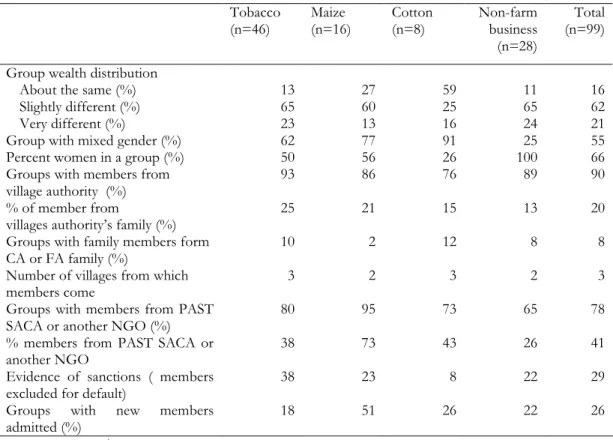
Questions on group composition mainly focused on homogeneity of groups in terms of wealth, social status gender and kinship. Results in Table 2 indicate that 62 percent of the groups contained members that were slightly heterogeneous in terms of wealth while only 21 percent indicated that the group members were very heterogeneous. The remaining 17 percent indicated that group members were homogenous. With regards to gender composition, 55 percent of the groups were mixed with about 66 percent women composition.
As regards the social status, 90 percent of the groups included members from families of their respective village authorities (village chiefs or other traditional authorities). About 8% included members from families of FAs or CAs. Groups are generally composed of members from more than one village. In about 21 percent of the groups where members came from more than one village the average number of villages from which members came
was 3. About 78 percent of the groups contained members from previous credit programs. In general PASTSACA members accounted for 41 percent of the group members. A good proportion of groups exercise sanctioning (members are excluded for default) as witnessed by 29 percent of the groups in which members were excluded for default. As a result of the exclusion of defaulting members, groups allow new members to join. As indicated in Table 2, 26 percent of the groups admitted new members in their groups during the respective loan cycle.
Table 2: Group composition
Tobacco (n=46) Maize (n=16) Cotton (n=8) Non-farm business (n=28) Total (n=99)
Group wealth distribution
About the same (%) 13 27 59 11 16 Slightly different (%) 65 60 25 65 62 Very different (%) 23 13 16 24 21 Group with mixed gender (%) 62 77 91 25 55 Percent women in a group (%) 50 56 26 100 66 Groups with members from
village authority (%)
93 86 76 89 90 % of member from
villages authority’s family (%)
25 21 15 13 20 Groups with family members form
CA or FA family (%)
10 2 12 8 8 Number of villages from which
members come
3 2 3 2 3 Groups with members from PAST
SACA or another NGO (%)
80 95 73 65 78 % members from PAST SACA or
another NGO
38 73 43 26 41 Evidence of sanctions ( members
excluded for default)
38 23 8 22 29 Groups with new members
admitted (%)
18 51 26 22 26
Source: RDD/IFPRI 1999 Rural Finance Survey
4.3 Peer monitoring and peer pressure
Peer monitoring is an important aspect of joint liability lending. In the IFPRI study peer monitoring was assessed by examining the extent to which members have access to information and by assessing the extent to which group members are willing to engage in peer monitoring activities to enforce proper loan use and report misuse of loans. The extent of peer monitoring was also assessed by observing rules followed by groups. One such rule that directly relates to monitoring is a rule on joint enterprise ownership. Groups were asked whether they had any rules that encouraged joint ownership of enterprises.
Table 3 shows the extent of group members general knowledge of the composition of groups. As can be seen, 14 percent of the members did not have any general knowledge of the sizes and demographic composition of their respective groups. Also about 15 percent lacked knowledge about the sizes and terms of their group loans. Lack of knowledge on the general characteristics of the group is an indication that members are not actively involved in monitoring. The results also reveal that even among members that claimed to know
something about the characteristics in question there was a wide variation in their responses regarding group characteristics indicating that information flow among members belonging to the same group was limited to some extent. The average number of group meetings attended by the CA in each group per year was 14. This translates into slightly more than a visit per year per month. Field Assistants were said to be more influential in their monitoring activities because of the nature of their work. The average number of meetings held by members without the presence of the CA was 21 per year while the average number of non-meeting follow-up visits to the chairpersons and defaulting members by the CA was 11 per year.
Peer pressure was defined to take place when members complained to the village authorities or took (threatened to take) punitive action against defaulters. As indicated in Table 3, peer pressure was applied in 39% of all groups before or after the due date.
Although peer pressure was applied in 57 percent of the groups where loans were partially paid before due date, it was only successful in inducing some defaulters to repay in 37% of the groups. This shows how less frequent peer pressure takes in joint liability groups from Malawi and how more likely it is to fail than succeed in inducing defaulters to repay their loans.
Table 3: Extent of group members’ general knowledge of the composition of groups and peer pressure Characteristic Tobacco (n=46) Maize (n=16) Cotton (n=8) Non-farm business (n=28) Total (n=99) Peer Monitoring
Proportion with no general knowledge of composition (%)
8 34 32 13 14 Proportion with no knowledge of total
Group loan size and terms of the loan (%)
11 25 29 16 15 Number of meting by CA per year 14 13 16 16 14 Number of meetings without CA 20 19 28 22 21 Number of non-meeting visits by CA 11 11 11 10 11 Rules encourage joint enterprise ownership 66 53 50 43 56
Peer pressure
Groups where peer pressure was applied after or before due date(%)
35 54 39 37 39 Peer pressure before due date (fully paid
groups) (%)
17 29 11 18 19 Peer pressure before due date (not fully paid
groups) (%)
55 87 45 47 57 Peer pressure applied successfully (%) 23 80 45 36 37
4.5 Group repayment outcomes and moral hazard
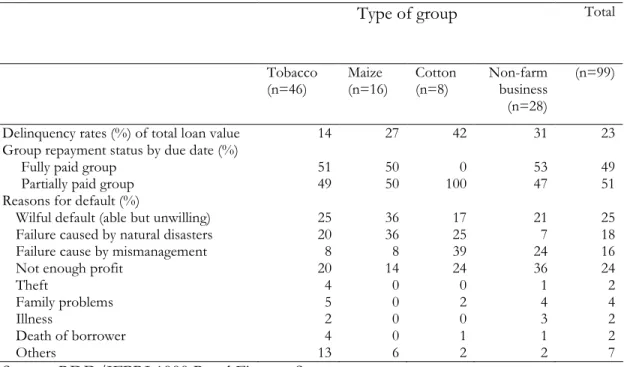
Table 4 shows ex-post group repayment outcomes. In general, 23 percent of the total loan was defaulted. Delinquency rates were lowest among tobacco groups (14%) mainly due to the fact that MRFC makes direct loan deductions from tobacco sales at the point of sale. The delinquency rates were highest among cotton (42%), and non-farm business groups (31%). With regards to group repayment status, results indicate that 51 percent of the groups were partially paid while 49 percent were fully paid groups. There are no significant differences in group repayment status across the four types of groups.
Table 4: Ex-post group repayment out comes and incidence of moral hazard
Type of group Total
Tobacco (n=46) Maize (n=16) Cotton (n=8) Non-farm business (n=28) (n=99)
Delinquency rates (%) of total loan value 14 27 42 31 23 Group repayment status by due date (%)
Fully paid group 51 50 0 53 49 Partially paid group 49 50 100 47 51 Reasons for default (%)
Wilful default (able but unwilling) 25 36 17 21 25 Failure caused by natural disasters 20 36 25 7 18 Failure cause by mismanagement 8 8 39 24 16 Not enough profit 20 14 24 36 24 Theft 4 0 0 1 2 Family problems 5 0 2 4 4 Illness 2 0 0 3 2 Death of borrower 4 0 1 1 2 Others 13 6 2 2 7
Source: RDD/IFPRI 1999 Rural Finance Survey
As regards the reasons for default, twenty five percent defaulted wilfully. Wilful default occurs when individuals have enough return to repay the loan but are unwilling to pay which is a form of ex-post moral hazard. Loan default due to miss-management (ex-ante moral hazard) was reported in 16 percent of the groups. This gives a total of 41 percent of the loan defaults caused by moral hazard. The incidence of moral hazard is highest among maize groups (36%) implying that they probably lack some mechanism of enforcing screening and repayment. Other major causes of default include low profits (24%) and failure caused by natural disasters (18%). The high incidence of moral hazard is used as a justification in this study to assess factors that can be used to explain such high incidences.
4.6 Description of Variables in the model Dependent Variable
The dependent variable is dichotomous taking the value of one if the group reported the incidence of moral hazard and it is zero otherwise. The incidence of moral hazard in each credit group was captured by asking the chairperson of each group about whether some members had defaulted wilfully, or whether they had misused loan funds that were meant for an investment. Normally, group leaders know the behaviour of all members in the group and thus we expect the information they provide to be reliable. Following this question, it was possible to observe both ex post and ex ante moral hazard. From the 99 credit groups, 46 groups reported the incidence of moral hazard. It should be pointed out, however, that not all moral hazard leads to group default as members may contribute to pay the defaulters’ loan.
Explanatory variables
From the theoretical framework discussed earlier, the empirical specification is based on 8 categories of explanatory variables whose full descriptions and a priori expectations of their effect on moral hazard are defined below. The explanatory variables in the model include peer selection, peer monitoring variables, screening, variables that capture the extent of social ties, peer pressure and sanctions. In addition to these variables we use this study to test the significance of extra variables, which have been reported in literature as having potential for inducing or mitigating moral hazard behaviour among borrowers. Such additional variables are in the following categories: productivity variables, dynamic incentives and variables that capture matching problems. Descriptive statistics of the explanatory variables are presented in Appendix 2
a) Factors of production
Following Ahlin and Townsend (2003) we include factors of production in the model. The intuition is that higher productivity increases the payoff of safe projects relative to risky projects. This leads to the softening of the moral hazard problem and it makes monitoring more effective. For this study we use two variables to capture group productivity, namely, the land holding of group members in acres, (AVGLAND) and the average years of education of the group members (EDUCATION). We expect a negative sign for all the productivity related variables. Thus, we expect moral hazard incidence to decline with the increase in the level of productivity. This is because highly productive groups are more likely to get payoffs higher than the critical values to repay both their loan and that of any defaulting members.
In concurrence with this line of thinking, Holmstrom (1979) in his paper on moral hazard and observability, shows that default penalties decrease with the increase in payoffs such that the incentive for moral hazard also decreases with a decline in penalty. In less productive groups, it is more likely that some members will not get enough returns (above the critical value for repayment to occur) to pay their loan, which will induce other members who have enough returns to avoid paying their loan too (strategic default).
b) Screening
The following variables were considered as proxies for the extent of screening: SCREEN is a variable which measures whether or not there are some non-members that were rejected by the group when they wanted to join the group. In addition there are three variables that capture the extent to which self selection is taking place during the group formation process. The variable PEERSELECT is used to capture whether or not a group was self-formed by the members. Ghatak (1999b) shows how adverse selection problems can be solved through group lending schemes that provide incentives for similar types to group together through self-selection. Peer selection is thus seen as key to improving repayment. We expect that the likelihood of incidence of moral hazard will be low among groups that are self formed.
However, the implementation group lending with joint liability can be affected by a number of institutional and social cultural values in the communities. While the ideal situation requires group formation through the self selection process, it may not be possible under certain conditions. In this survey, for example, less than a third of the groups were formed by ordinary village residents (self-selection or peer selection), while the rest were formed either by the village chiefs or by the agricultural officers and credit assistants. In this regard we include two extra variables to capture the extent of screening as follows: FASCREEN and VHSCREEN capturing the formation of groups by the extension workers and the village chief, respectively. All screening variables are dummies. We expect peer selection to have a negative impact on the incidence of moral hazard. However the impact of the two other screening variables is undetermined as it depends on the quality of screening and the influence that leaders have on the group.
c) Peer monitoring
Following Stiglitz (1990), Conning (1999) and Aghion de (1999) we test the significance of peer monitoring variables in the moral hazard model. We construct peer monitoring indicators following Diagne (1998) who notes that in order for peer monitoring to be an effective substitute to the lender’s own monitoring activities, group members must: 1) have better access to relevant information and 2) be willing to engage in peer monitoring activities to enforce proper loan use or report any incidence of moral hazard. The survey used two methods to obtain evidence of the two components.
First, we capture the proportion of members responding “I don’t know” to specific questions on group composition and loan characteristic variables. The percentage of members from each group indicating that they lack knowledge of the group and loan characteristics is taken as a measure of poor access to relevant information and the quality of information flow within groups, respectively.
As described above the variable GCOMPDNI measures the percent of group members not knowing group composition, while GLONCDNI measures the proportion of group members that don’t know the characteristics of the loan. With regards to loan characteristics the variable captured the knowledge of sizes, duration and interest rates. Both variables are assumed to be good indicators of monitoring. We expect the likelihood of moral hazard to increase with the proportion of individuals in a group reporting that they don’t know their group composition and loan characteristics.
Second, the survey captured the extent of monitoring by asking members whether they owned joint enterprise at group level (PMJOINTENT). This is a dummy variable and it is
equal 1 when it is reported that at least some members have joint enterprises within the group, and 0, otherwise. We expect that the incidence of moral hazard will be lower in groups that have joint enterprises due the effect of peer monitoring
d) Social ties and social capital
Coleman (1993) observes that social capital functions as a source of social control. In concurrence with this notion Olomola (2000) notes that through social homogeneity, rule enforcement, and trust can.be reinforced, both of which will enhance social capital. Olomola observes that the capacity to enforce rules (social control) in groups where members are socially homogenous is higher than in groups with membership heterogeneity. The proposition, leads to presumption that groups that are homogenous in terms of wealth, social status or kinship should have lower default rates than heterogeneous groups. Floro and Yotopolous (1991) show how the success of group lending can be attributed to its ability to harness social ties between borrowers to improve loan repayment. This is based on the presumption that people that are close in terms of social ties know each other better and are more likely to be averse to harming each other through default. It is for this reason that most joint liability lending institutions will encourage homogenous group formation in terms of social status and wealth. We use six variables to capture the magnitude of social ties within a borrowing group. COWEALTHHOMO is a proxy for wealth homogeneity of the group. It is equal 1 if the group is homogenous in terms of wealth and zero, otherwise. The incidence of moral hazard should be lower in groups that are homogenous in terms of wealth. VILLAGENUMBER measures the number of villages from which group members come. The larger the number of villages relative to the group sizes the smaller the social ties. This variable can also be a measure of the ease of monitoring. Groups composed of members from the same village are likely to know each other better and much easier to monitor than members coming from many villages.
This variable is expected to have a positive sign. PMFAMVG measures the presence of some members that come from the clan or family of a village headman in a group. The village chiefs have considerable influence on the operations of seasonal loans because of the MRFC requirements for their signatures before the fertilizer loan packages are delivered to club officials. The presence, therefore, of a village chief in the group or indeed his/her relative will have significant effects on the quality of interactions within the group. Considering the potential influence of the village chief on the behaviour of group members, we expect that moral hazard will be low if the chief is honest and high if the chief is dishonest as other members would want to default when they see that the chief has defaulted. However we don’t capture the extent of honest by the village chief. As such the expected sign for this variable is undetermined.
POLITCLAN measures the presence in a group of members that are from the clan of a politician. Political leaders in Malawi have a significant impact on the way loan are perceived by the borrowers and this can have a significant impact on moral hazard behavior and hence repayment. The collapse in 1994 of a government administered credit program, the Smallholder Agricultural Credit Administration (SACA) was mainly attributed to the political influence. Politicians were blamed for sending conflicting messages to the borrowers during their political campaigns, such that most borrowers believed that the loans were donations from government. We, therefore, expect some political influence on groups that have social ties with politicians, although we don’t have a predetermined expectation as the type of influence will depend on the honesty of the politician in consideration.
CHAIRFAMILY represents the number of group members that belong to the family of a group chair person. Considering the strength of influence that the chairperson has on group members we expect that such influence could have implications on moral hazard. Nevertheless, the expected effect on moral hazard is undetermined because it depends on the character and values of the chairperson.
The variable GENDERHOMO is a dummy capturing the homogeneity of gender in the group. It is equal one where the gender of the group is mixed and zero otherwise. We expect that gender homogeneity will reduce the incidence of moral hazard.
e) Peer pressure and sanctions
The existence of peer pressure was captured by asking group leaders whether members in a group ever exerted pressure on their peers before and after the due date for the loan repayment. Active peer pressure was said to exist when members complained to the village authorities or threatened to take punitive action against defaulters. The way the question was phrased implies that peer pressure may only be captured in groups that had default problems. A theoretical paper by Diagne (1998) predicts that peer pressure should be relevant only in groups that are heterogeneous in the incentive compatibility of the dynamic incentive constraints of its members. This only occurs in groups that are heterogeneous in risk. However, in order to reduce that bias we only focus on peer pressure before the due date of the loan (PRESUDUEDATE). We expect peer pressure to have a negative impact of the incidence of moral hazard in the group.
In addition, the presence of sanctions in the group was captured as an extra variable called LEFEXCMG. This variable captures the number of members that were excluded from the group in the previous loan cycle as a result of loan default or non-cooperative behaviour. We assume that this provides a picture on the extent to which sanctions are implemented among groups. We expect that the likelihood of moral hazard will decline with the evidence of sanctions in the group.
f) Dynamic incentives and further access to credit
Dynamic incentives are based on stated preferences and willingness to pay as opposed to the actual behaviour. We expect the dynamic incentive constraints resulting from joint liability to create incentives for peer selection, peer monitoring and peer pressure. The value of future access to credit can best be captured by discounting benefits from future access to credit and comparing with benefits from not repaying. However, in the IFPRI survey, a revealed preference approach was used by asking the following question:
If you are in a group where some members have defaulted but you have fully repaid your loan, and you were asked, in addition to loosing you 15 percent required deposit, to choose among the following three options, which one will you choose?
1. Contribute to repay in full the loans of defaulters, and be part of a new group where the defaulters are excluded
2. Pay another 10% penalty and be part of a new group where the defaulters are excluded
3. Accept a lower loan size next time and be part of a new group where the defaulters are excluded
The first option is directly related to the full joint liability principle (no loans to non defaulters until all loans are paid). The two other options were aimed at exploring alternative liability options (limited liability) which would maintain the same incentives for peer monitoring and peer pressure, both of which have direct relevance to the mitigation of moral
hazard. Diagne et al (2000) notes that the key difference between the three options is that in the first one the penalty is dependent on the total amount of defaulted loans while it is not in the two other ones. The rationale behind these two alternative options is that they should lead to fewer strategic defaults compared to the first option. Therefore, the first option should lead to higher penalties among non-defaulters in a group where there are more defaulters. Groups choosing the first option are likely to attach higher value of the future access to credit. The second option is assumed to be more costly than the third option, as such those choosing the second option are assumed to attach a much higher value to future access to credit than those choosing the third option in which they would be willing to accept a lower value of the loan.
We expect that the choice of either of the options is a good indicator of the importance or value that the group attaches to future access to credit. The inclusion of these variables in our model also helps us to explore the potential of limited liability contracts (as substitutes to full joint liability) in mitigating moral hazard. The two options are entered as dummy variables. CONTRIB is equal 1 when the first option is chosen and PAY is equal 1 when the second option is chosen.
An extra variable is included to capture dynamic incentives and the value of future access to credit. PASTACA captures the presence of at least one member in a group, who was from the past failed credit program where people defaulted and therefore the program was discontinued. The presence of such members in a group should increase the probability of moral hazard in the group as they may not attach the same value to credit access from the current institution following their past experience in a failed program. It is generally accepted that if clients have experienced former failed programs in which loans were never rigorously collected, there might be little incentive for them to comply to contracts in the new credit program (Buckley 1996).
g) Mismatching
In order to capture incentive match in a group we introduce two variables in the model. First we include a measure of the age of the group (LONCYCLE). Theoretically, the age of a credit group is negatively associated with repayment. Paxton (1996) notes that as the age of the group increases group members acquiring different skills in their areas of entrepreneurship, such that they start developing divergent credit requirements. The matching problems arise when the demand and supply for credit among group members can no longer match, which could lead to default by some members whose supply of credit is not incentive compatible. In most cases group lending starts with high repayment rates. However, this declines with time. Therefore, we expect the likelihood of moral hazard to increase with loan cycle.
Second, we include a variable that captures the presence of new members in a group (NEWMMBAVG) at the beginning of the loan cycle. Screening among groups is continuous as group members continue to exclude bad risk borrowers and replace them with safe ones. However, this could also lead to a matching problem sighted by Paxton (1996). The matching problem arises when credit terms and conditions are no longer appropriate for each member as credit is repeated again. Though not necessarily in the same context as mentioned by Paxton, the presence of new members in a group potentially introduces the same problem since they enter the group after their colleagues have already developed
several entrepreneurship skills that also change their credit requirements. We expect that the presence of a matching problem in a group will increase the likelihood of moral hazard. h) Control variables
In addition, we included in the model control variables that are program dummies for the maize group (MAIZE), cotton group (COTTON), and non-farm income generating activity group (NONFARM ). Group size (GPSIZE) is the number of members in a group. Following de Aghion (1999) the effect of groups size on loan repayment can be multifaceted with opposing effects. As indicated in the literature review we expect that group size will affect moral hazard behaviour in 4 ways as follows: 1) the free-riding effect, 2) the joint responsibility effect, 3) cost sharing effect and the commitment effect. Thus the expected sign for group size on moral hazard is undetermined. We also include the value of the maximum amount of credit a group can access at any time, known as the credit limit (CREDLIMIT), as a control variable. Its impact on moral hazard is ambiguous.
5. Empirical results and discussion
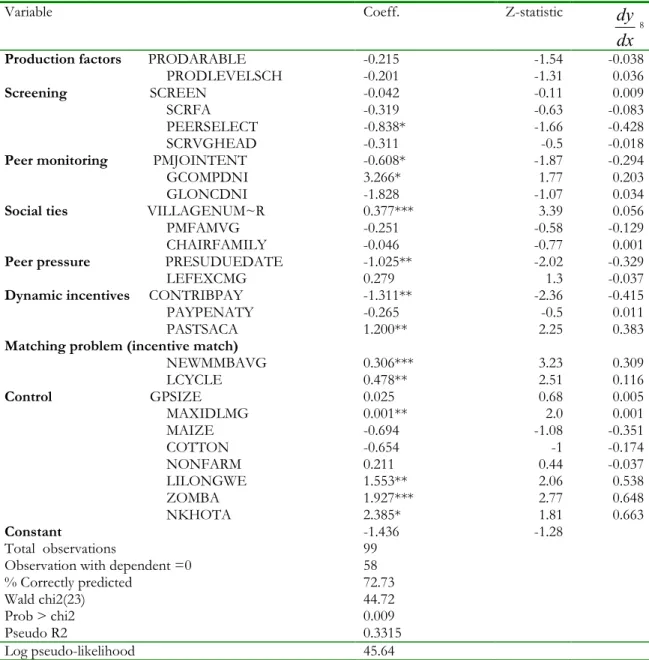
The maximum likelihood probit estimates of the above moral hazard equation are presented in Table 5.
In line with a priori expectations, results indicate that groups formed through peer selection have a lower incidence of moral hazard. This implies that peer selection enables groups to screen risky borrowers which is in concurrence with Ghatak’s theory of adverse selection. Ghatak (1999a) observes that self selection process leads to the emergence of a pool of safe borrowers which can lead to a reduction in the likelihood of moral hazard. Both peer monitoring variables are significant and their signs conform to the a priori expectations. First the proportion of group members reporting that they do not know the composition of the group has a positive and significant coefficient. This signifies the non-occurrence of monitoring in some groups, which increases the likelihood of moral hazard. The presence of individuals with joint enterprises has a reducing effect on the incidence of moral hazard. This conforms to a priori expectations that moral hazard is less likely in groups with joint enterprises because members are more likely to monitor each other’s investment decisions and the levels of output.
Only one of the variables measuring levels of social ties , the number of villages from which group members come is significant, with an a priori expected sign. As a spatial variable, this implies that groups with members from villages that are further apart face difficulties in peer monitoring. Secondly, the members from different villages are less likely to exhibit strong pre-existing social ties, such that they may not know each other well which would lead to the inclusion of risky borrowers within the group.
Table 5: Determinants of Moral hazard-Maximum likelihood Probit estimates
Variable Coeff. Z-statistic
dx dy
8
Production factors PRODARABLE -0.215 -1.54 -0.038 PRODLEVELSCH -0.201 -1.31 0.036
Screening SCREEN -0.042 -0.11 0.009 SCRFA -0.319 -0.63 -0.083 PEERSELECT -0.838* -1.66 -0.428 SCRVGHEAD -0.311 -0.5 -0.018
Peer monitoring PMJOINTENT -0.608* -1.87 -0.294 GCOMPDNI 3.266* 1.77 0.203 GLONCDNI -1.828 -1.07 0.034
Social ties VILLAGENUM~R 0.377*** 3.39 0.056 PMFAMVG -0.251 -0.58 -0.129 CHAIRFAMILY -0.046 -0.77 0.001
Peer pressure PRESUDUEDATE -1.025** -2.02 -0.329 LEFEXCMG 0.279 1.3 -0.037
Dynamic incentives CONTRIBPAY -1.311** -2.36 -0.415 PAYPENATY -0.265 -0.5 0.011 PASTSACA 1.200** 2.25 0.383
Matching problem (incentive match)
NEWMMBAVG 0.306*** 3.23 0.309 LCYCLE 0.478** 2.51 0.116 Control GPSIZE 0.025 0.68 0.005 MAXIDLMG 0.001** 2.0 0.001 MAIZE -0.694 -1.08 -0.351 COTTON -0.654 -1 -0.174 NONFARM 0.211 0.44 -0.037 LILONGWE 1.553** 2.06 0.538 ZOMBA 1.927*** 2.77 0.648 NKHOTA 2.385* 1.81 0.663 Constant -1.436 -1.28 Total observations 99
Observation with dependent =0 58 % Correctly predicted 72.73 Wald chi2(23) 44.72 Prob > chi2 0.009 Pseudo R2 0.3315 Log pseudo-likelihood 45.64
Source: Own calculation from RDD/IFPRI 1999 Rural Finance Survey
Note: * P<0.10; ** P<0.05; *** P<0.01 ,
8
The marginal effects measure the changes in a regressor on the conditional probability that y=1. The marginal effect of regressor xi is expressed as follows:
i dx x y dPr( =1| ) =
φ
(β
'xi)β
j, whereβ
j is the sign of the marginal effectThe presence of peer pressure has a significant and negative impact on the incidence of moral hazard. This is in conformity with our a priori expectation. This finding also conforms to the finding by Wydick (1999), in which he observes that the willingness to apply peer pressure has a significant effect on reducing moral hazard within borrowing groups from Guatemala. The presence of social sanctions returned a conflicting sign but it is insignificant. The dynamic incentives captured by the willingness to pay a full value of defaulted loans, which is also a measure of the willingness to accept full joint liability is negative and significant. The implication is that the full joint liability clause is a key mechanism through which the incidence of moral hazard can be minimized. The variable capturing the preference for limited liability where individuals are only required to pay 10 percent penalty is insignificant. The findings are consistent with a priori expectations in that full joint liability strengthens togetherness in the group which makes it less likely that individuals would want to harm each other through default. The presence of members from past failed programs in a group has a significant and positive coefficient. This conforms to a priori expectations that members that have ever participated in previously failed credit programs where loans were not rigorously collected have a tendency to take risky actions that have a negative impact on repayment. In the same context, Buckley (1996) discusses the abandonment of offers in joint liability lending programs. Buckley notes that a problem arises with JLLIs in that the institution sometimes keeps the group but abandons the joint liability which is the pillar of group lending. Buckley likens the situation to the abandonment of joint liability in Smallholder Agricultural Credit Administration (SACA) in Malawi. He notes that at first SACA lent to individuals under joint liability and the repayment was good. However, in 1992 SACA adopted a policy of allowing any individual that had repaid his or her own loan to access further credit even if one or more of the borrowers in his/her group was in default. This led to a severe drop in repayment rates.
Both variable capturing mismatching problems conform to a priori expectations by returning positive and significant coefficients. First, the presence of new members in a group is likely to introduce a matching problem as the loan demand for new members may not match those of old members due to differences in the levels of business skills. This in turn makes it difficult for the lending institutions to meet the loan demand for such a diverse group of individuals leading to an erosion of incentives for repayment among some members whose loan supply does not create the incentive to repay. Second, the variable that measures the age of a group has a positive effect on moral hazard. Again this is related to the matching problem in loan cycles proposed by Paxton (1996). In the first meeting every one agrees to the terms and conditions of the loan. However, as members continue to receive loans from a lending institution; they develop skills at different levels. This leads to a diversity in their loan requirements which in turn makes it difficult for the lender to match the demand and supply of credit among group members. As more members become unsatisfied, the incentive for repayment declines leading to moral hazard. Both productivity variables had no significant impact on the incidence of moral hazard, although they returned expected signs.
The maximum loan size available to the group increases the likelihood of moral hazard. This is consistent with theoretical proposition by Stiglitz(1990) in which it is observed that the expected utility of risky projects increases faster in loaned funds than that of a safe project. This assumes that an increase in the loan size increases the relative attractiveness of risky projects leading to moral hazard. Other control variables such as group size and program dummies were insignificant.