PRESERVICE ELEMENTARY TEACHERS’ PERCEPTIONS OF THEIR UNDERSTANDING OF SCIENTIFIC INQUIRY-BASED PEDAGOGY AND THEIR
CONFIDENCE TO TEACH SCIENCE: INFLUENCE OF ELEMENTARY SCIENCE EDUCATION METHODS COURSE AND SCIENCE FIELD EXPERIENCE
_____________________________________ A Dissertation
Presented to
The Faculty of the Graduate School University Of Missouri-Columbia _______________________________
In Partial Fulfillment of the Requirements for the Degree
Doctor of Philosophy
______________________________
By TINA VARMA
Dr. Mark Volkmann, Dissertation Supervisor
© Copyright by Tina Varma 2007 All Rights Reserved
The undersigned, appointed by the Dean of the Graduate School, have examined the dissertation entitled
PRESERVICE ELEMENTARY TEACHERS’ PERCEPTIONS OF THEIR UNDERSTANDING OF SCIENTIFIC INQUIRY-BASED PEDAGOGY AND THEIR
CONFIDENCE TO TEACH SCIENCE: INFLUENCE OF ELEMENTARY SCIENCE EDUCATION METHODS COURSE AND SCIENCE FIELD EXPERIENCE
Presented by Tina Varma
A candidate for the degree of Doctor of Philosophy
And hereby certify that in their opinion it is worthy of acceptance.
_____________________________________________ Professor Mark Volkmann
_____________________________________________ Professor Judy Wedman
_____________________________________________ Professor Peggy Placier
_____________________________________________ Professor Danna Vessell
_____________________________________________ Professor Deborah Hanuscin
ii
ACKNOWLEDGEMENTS
I would like to thank Dr. Mark Volkmann for very kindly agreeing to take over the chairmanship of my Dissertation Committee in the middle of my research write-up and for providing in-valuable input, guidance and support throughout my proposal and dissertation write up.
I would also like to thank Dr. Judy Wedman for taking me under her wing as an
Elementary Education Ph.D student in the Department of Curriculum and Instruction and for guiding me through my research proposal process.
I am also grateful to Dr. Debi Hanuscin for guiding me through my research and teaching internships. I am grateful to her for mentoring me like a student but treating me like a peer. I will always value and remember her friendship, support and guidance throughout my research internships and research.
I would also like to thank Dr. Peggy Placier and Dr. Danna Vessell for agreeing to serve on my dissertation committee, for their support and valuable input into my research proposal and my research dissertation.
Last but not least, I would like to thank my family: my dad, my mom and my sister for their undying love, understanding and support throughout my research and their commitment to my well-being, education and career.
iii
TABLE OF CONTENTS
ACKNOWLEDGEMENTS... ii
LIST OF TABLES ... viii
LIST OF FIGURES ... ix
LIST OF APPENDIXES...x
ABSTRACT... xi
CHAPTER ONE ...1
Introduction...1
National Science Education Standards...2
Abilities Necessary to do Inquiry ...4
Understanding about Inquiry...5
Teaching Science through Inquiry ...5
Status-Quo 0f Science Education in US Schools... 7
State of Inquiry Instruction in US Elementary Schools... 8
Confidence of Elementary Teachers to Teach Science Through Inquiry...9
Effect of Status-Quo in Elementary Schools on NSES Goals...10
Status of Programs to Prepare Elementary Teachers...11
What Inquiry Gets Taught to Elementary Teachers...13
Confidence of Elementary Teachers to Teach Science...14
iv
Statement of the Problem ...16
UMC Elementary Teacher Preparation Program ...18
Purpose statement ...18
Research Questions ...19
CHAPTER TWO ...20
Theoretical Framework ...20
Inquiry and the Constructivist Perspective ...20
Self-Efficacy and Bandura’s Theory of Social Learning...25
Field Experience and John Dewey’s Experiential Learning...29
Review of Related Research ...31
Inquiry Experiences in the Elementary Science Methods Course ...32
Inquiry Experiences in the Science Field Experience...33
Self-Efficacy and the Elementary Science Methods Course...35
Self-Efficacy and the Science Field Experience...38
Review of Related Literature ...40
Science Education Reforms...40
Elementary Preservice Teacher Preparation...42
Elementary Preservice Teacher Preparation in Science Pedagogy...45
Types of Inquiry within the Classroom...47
Science Instructional Models...51
Research on Science Field Experience...57
v
CHAPTER THREE ...65
Research Design...65
Participants...67
Elementary Science Education Methods Course...68
Data Sources...70
Methodology ...72
Focus Groups...72
Interviews...73
Evaluation of Science Education Methods Course Syllabus...74
STEBI-B Instrument...75
Study Specific Questionnaire (SSQ)...76
Data Analysis...77
CHAPTER FOUR...81
Findings...81
Section I Analysis of Data in Support of Research Question 1...84
Elementary Science Methods Course Syllabus Analysis...85
Interview Transcripts Analysis...94
Multiple inquiry-based activities...94
Guiding & focusing inquiries...98
5E learning cycle instructional model...99
Questioning strategies...100
Classroom discussions...102
vi
Use of science notebooks...103
Evaluation of instructional material...103
Assessment strategies...106
Section I Summary...108
Section II Analysis of Data in Support of Research Question 2...111
Prior Exposure to Inquiry...112
Exposure to Inquiry through the Science Methods Course...116
Contribution of the Science Methods Course to Learning Inquiry Based Pedagogy...120
Contribution of the Science Field Experience to Learning Inquiry Based Pedagogy...123
Understanding of Scientific Inquiry and Inquiry-Based Pedagogy...129
Fundamental abilities necessary to conduct inquiry...130
Fundamental understanding about inquiry...131
Understanding value of inquiry-based pedagogy in science...136
Understanding the NSES recommendations for inquiry ...141
Reflections on Learning Science through Inquiry...143
Intent to teach science through inquiry...147
Inquiry-based pedagogy versus teaching from the text...153
Apprehensions about using inquiry-based pedagogy ...155
Section II Summary...160
Section III Analysis of Data in Support of Research Question 3...162
Confidence to Teach Science...162
vii
Section III Summary...175
Chapter Four Summary ...176
CHAPTER FIVE ...180
Discussion ...182
Integration of NSES Recommendations...183
Understanding about Inquiry...188
Exposure to Inquiry...188
Abilities Necessary to Do Inquiry...189
Understanding about Inquiry...190
Understanding Inquiry-Based Pedagogies...192
Learning in a Constructivist Environment...194
Classroom Management ...195
Overcoming Frustrations of Learning in a Constructivist Environment196 Overcoming Apprehension about Teaching with Inquiry...198
Personal Pedagogy Development...201
Confidence to Teach Science...204
Conclusion ...210
Implications...211
Study Limitations...212
Future Research Ideas ...213
APPENDIXES ...214
BIBLIOGRAPHY...238
viii
LIST OF TABLES
Table Page
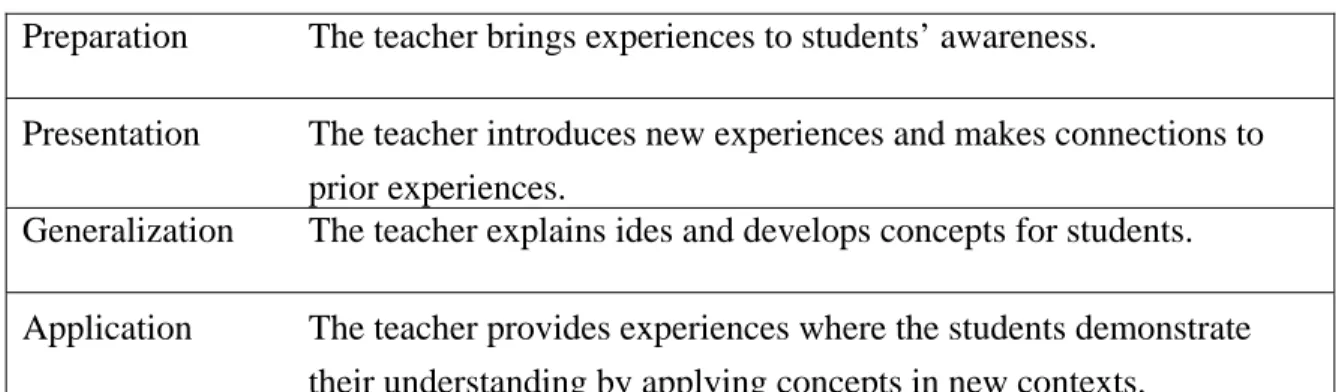
1. Herbart’s Science Instructional Model ...51
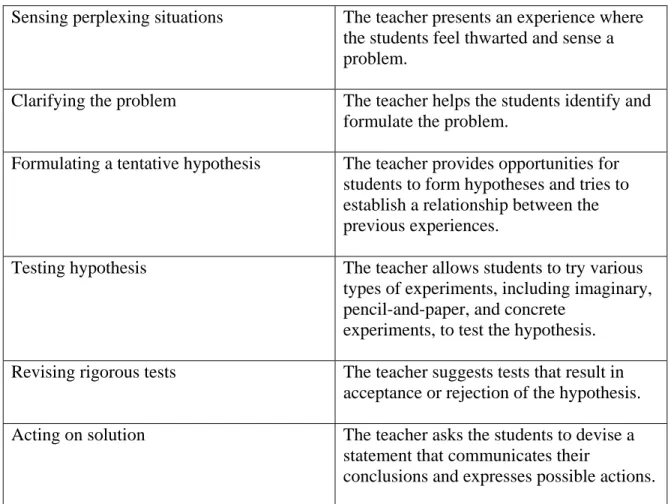
2 Dewey’s Instructional Model ...52
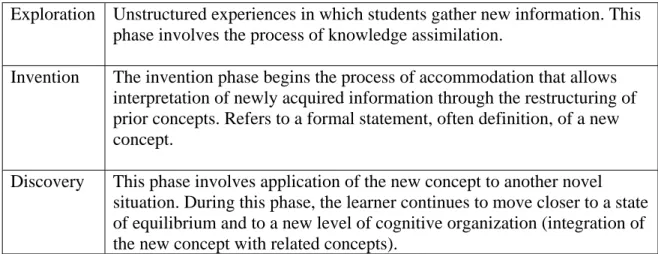
3. Piaget’s Learning Cycle Model ...53
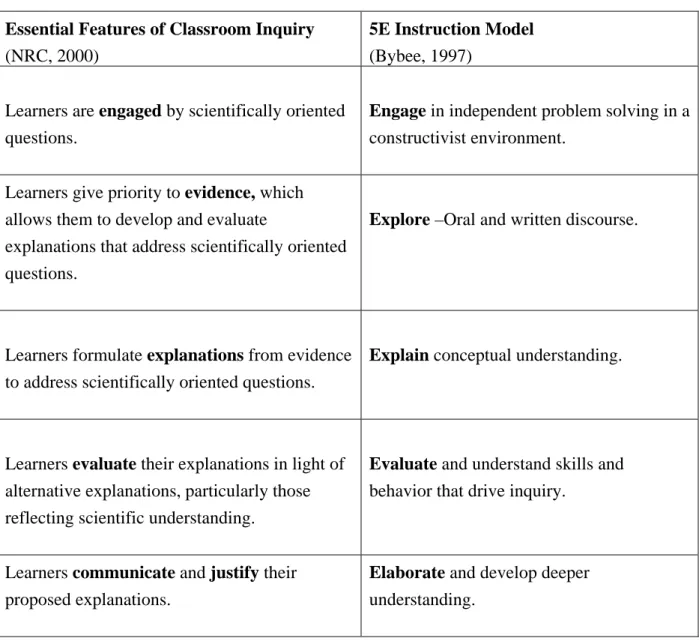
4. NSES Essential Features for Classroom Inquiry vs 5E Instructional Model...55
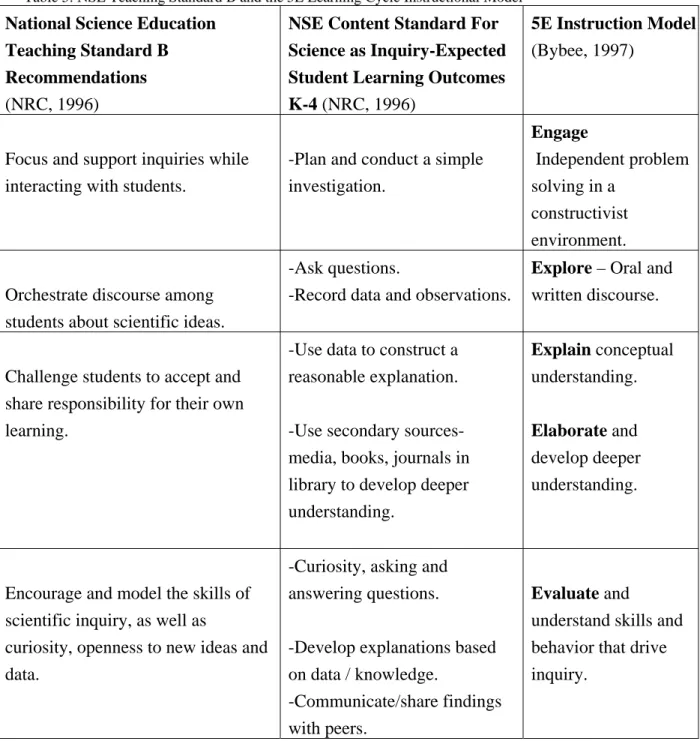
5. NSE Teaching Standard B and the 5E Learning Cycle Instructional Model ...56
6. Summary: Research Questions, Data Collection and Data Analysis ...71
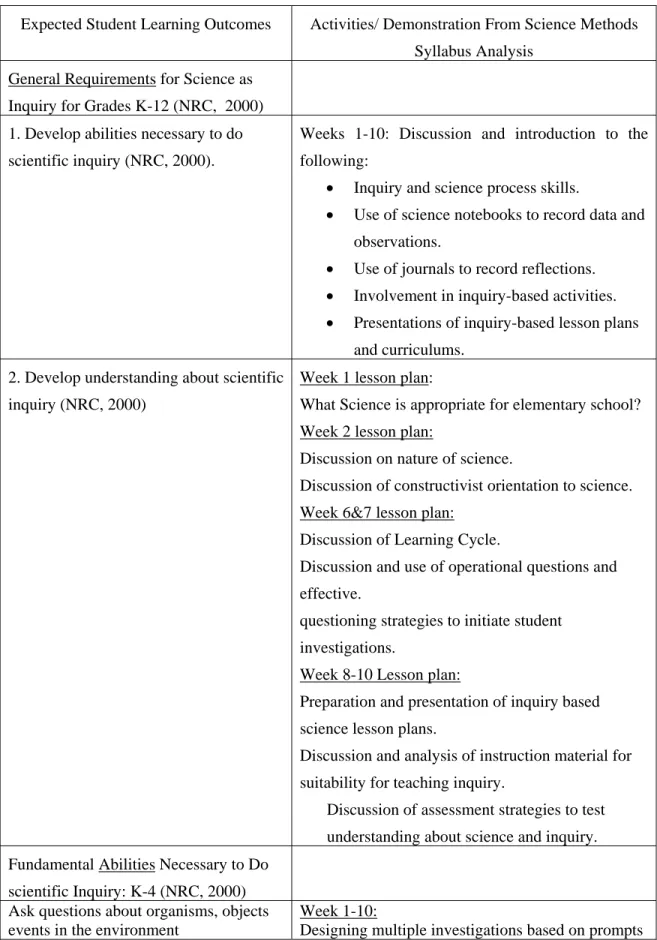
7. Elementary Science Methods Course Syllabus Analysis ...86
8. Activities and Inquiry Types ...92
9. SSQ: Similarities Between Instructional Strategies Modeled and Observed ..125
10. SSQ: Preservice Teachers’ Understanding of Inquiry ...135
11. SSQ: Preservice Teachers’ Confidence to Teach Science ... 171
12. STEBI-B: Personal Science Teaching Efficacy (PSTE) ...172
13. STEBI-B: Science Teaching Outcome Expectancy (STOE) ...173
ix
LIST OF FIGURES
Figure Page
1. SSQ: Similarities Between Instructional Strategies Modeled and Observed ..125
2. SSQ: Preservice Teachers’ Understanding of Inquiry ...135
3. SSQ: Preservice Teachers’ Confidence to Teach Science. ...171
4. STEBI-B: Personal Science Teaching Efficacy (PSTE) ...172
5. STEBI-B: Personal Science Teaching Outcome Expectancy (STOE) ...173
6. STEBI-B: Confidence Indicator Dimensions ...174
x
LIST OF APPENDIXES
A. Focus Group Protocol -Preservice Teachers ...214
B. Interview Protocol – Methods Instructors ...215
C. STEBI FORM B ...216
D. Study Specific Questionnaire ...219
E. UMC Recruitment Email-Preservice Teachers ...222
F. UMC Informed Consent- Students ...223
G. UMC Informed Consent- Methods Instructors ...226
H. Elementary Science Education Methods Course Syllabus ...228
xi
PRESERVICE ELEMENTARY TEACHERS’ PERCEPTIONS OF THEIR UNDERSTANDING OF SCIENTIFIC INQUIRY-BASED PEDAGOGY AND THEIR
CONFIDENCE TO TEACH SCIENCE: INFLUENCE OF ELEMENTARY SCIENCE EDUCATION METHODS COURSE AND SCIENCE FIELD EXPERIENCE
Tina Varma
Dr. Mark Volkmann, Dissertation Supervisor ABSTRACT
The purpose of this research was to determine from elementary preservice teachers’ perspectives their understanding of inquiry-based pedagogy and their confidence to teach science after concurrently completing a traditional elementary science education methods course and the associated science field experience. Results of this study indicate that when multiple inquiry-based experiences and instructional strategies, consistent with the National Science Education Standards, are integrated into a traditional elementary science methods course and reinforced through observations of classroom practice in the field, preservice teachers develop an understanding of scientific inquiry and inquiry-based science instruction, develop an appreciation for the benefits of teaching and
learning science in a constructivist environment, develop confidence to teach science and indicate intent to use inquiry-based science teaching strategies in their own classroom practice. Findings from this research study have implications for the design of the
1
CHAPTER ONE Introduction
The National Science Teachers’ Association (NSTA) surveys found in literature indicate serious deficiencies in the science preparation of elementary teachers (Weiss et al., 2001; 2003; Wilson et al., 2001; NSTA, 1998). The National Assessment of
Educational Progress (NAEP): Report Card for the Nation and States (O’Sullivan,
Reese, & Mazzeo, 1997) indicates that preservice teachers do not have a clear understanding of the teaching of science. Research also indicates that students K-12 possess inadequate understanding of scientific inquiry (Lederman, 1998). To achieve knowledge and understanding about science, the National Science Education Standards (NSES) emphasize teaching and learning science through inquiry (NRC, 1996).
Literature indicates that scientific inquiry complements science instruction and that the inquiry form of science instruction can be used to teach students the concepts and processes of the nature of science (Bianchini & Colburn, 2000). It has been proposed that teachers who lack a functional and conceptual understanding of scientific inquiry would not be able to teach science in a constructivist environment recommended by the NSES (Lederman, 1998). The NSES define scientific inquiry as the “diverse ways in which scientists study the natural world and propose explanations based on evidence derived from their work” (NRC, 1996. p. 23). Lederman (1998) defines scientific inquiry as the science process that utilizes scientific knowledge, reasoning and critical thinking to conduct investigations resulting in the development of scientific knowledge.
Contemporary reform efforts in science education emphasize the importance of children learning science through inquiry (American Association for the Advancement of
2
Science (AAAS), 1990; 1992; 1993; National Research Council (NRC) 1996; 2000). Science educators in the United States have long recommended that teaching science as inquiry should be a priority in science education and that inquiry be placed at the core of science instruction (DeBoer, 1991; DeBoer & Bybee, 1995; Lawson, 1995; Tamir, 1983). Science education research on inquiry related experiences of teachers (Abell, 2000; Crawford, 2000; Simpson, 2000), inquiry related experiences of students (Lehrer et al., 2000; Wild, 2000) and classroom inquiry (Anderson, 2002) support inquiry-based science instruction. Inquiry has been used to describe a method of science instruction
(Chiappetta, 1997; DeBoer, 1991; NRC, 1996; Schwab, 1962; Tamir, 1983). Instruction using inquiry is believed to develop students’ science process skills, promote their
understanding of science content, scientific inquiry, and science (NRC, 1996). Therefore, understanding inquiry and exposure to inquiry-based pedagogies is important for the training of prospective elementary teachers.
National Science Education Standards
One of the major outcomes of the national science education reform efforts was the promulgation of the National Science Education Standards (NSES). These standards advocate a constructivist approach to teaching and learning where science is learned through exploring and discovery (NRC, 1996; 2000). Inquiry in the NSES is defined as “a multifaceted activity that involves making observations; posing questions; examining books and other sources of information to see what is already known; planning
investigations; reviewing what is already known in light of experimental evidence; using tools to gather, analyze, and interpret data; proposing answers, explanations, and
3
as the “activities of students in which they develop knowledge and understanding of scientific ideas, as well as understanding of how scientists study the natural world” (NRC, 1996, p.23).
The NSES vision for science education is scientific literacy for all students. Scientific literacy in the NSES document, includes both the abilities required to do science and the understanding of what science is, what science is not, what science can and cannot do, and how science contributes to culture (NRC, 1996). For students to grasp these concepts the NSES recommend that teachers use inquiry-based science pedagogies to teach science as these instructional strategies engage students in constructing and learning from their experiences. This is based on the premise that student understanding of science is actively constructed through individual and social processes. However, the NSES document does not operationally define inquiry-based teaching; instead the NSES provide guidance on what science students should know, how teachers should teach science, and how teachers should assess students (Abd-El-Khalick, 2004; Anderson, 2002).
According to the NSES students’ inquiry-based experiences should develop their abilities to conduct inquiry, their critical thinking abilities, their scientific reasoning and a deeper understanding of science (NRC, 2000). Thus, the goal of the NSES is three fold, one to develop students’ abilities to do inquiry, second to help students understand science content and third to help students understand the nature or concepts of scientific inquiry (NRC, 2000). To develop fundamental abilities required to do inquiry as
recommended by the NSES, teachers of science must provide multi investigational opportunities for their students (Barrow, 2006).
4
Inquiry in the NSE standards is addressed both in the content standards for science as inquiry and in the science teaching standards (NRC, 1996; 2000). Inquiry included as a content area is viewed from two perspectives: what students should understand about scientific inquiry, and the abilities students develop based on their experiences with scientific inquiry (NRC, 1996; 2000; Barrow, 2006). Inquiry included in the teaching standards addresses teaching strategies associated with inquiry-oriented science activities (NRC, 1996).
Abilities Necessary to do Inquiry
The general recommendations for science as inquiry under the content standards for all three grade spans (K-4, 5-8, 9-12) require students in grades K-12 to develop abilities necessary to do scientific inquiry and to develop understanding about what constitutes scientific inquiry (NRC, 2000). However, even though the general requirements for science as inquiry are the same for grades K-12 the fundamental abilities to do and understand scientific inquiry become more complex from one grade level to another, reflecting the differential expected cognitive development of students at different grade levels. According to the NSES recommendations, the fundamental abilities that students in grades K-4 should develop to do scientific inquiry are as follows (NRC, 2000, p. 19):
• Ask a question about objects, organisms, and events in the environment.
• Plan and conduct a simple investigation.
• Employ simple equipment and tools to gather data and extend the senses.
• Use data to construct a reasonable explanation.
5 Understanding about Inquiry
The fundamental understanding about scientific inquiry that students in grades K-4 should have is as follows (NRC, 2000, p. 20):
1. Scientific investigations involve asking and answering a question and comparing the answer with what scientists already know about the world.
2. Scientists use different kinds of investigations depending on the questions they are trying to answer.
3. Simple instruments, such as magnifiers, thermometers, and rulers, provide more information than scientists obtain using their senses.
4. Scientists develop explanations using observations (evidence) and what they already know about the world (scientific knowledge).
5. Scientists make the results of their investigations public; they describe the investigations in ways that enable others to repeat the investigations.
6. Scientists review and ask questions about the results of other scientists’ work. Teaching Science through Inquiry
To develop students’ abilities necessary to do inquiry and their understanding about inquiry, the NSES emphasize teaching science through inquiry-based pedagogy. The teaching standards outlined below “describe what teachers of science at all grade levels should know and be able to do” (NRC, 1996, p.4):
Teaching Standard A: Teachers of science plan an inquiry-based science program for their students.
6
Teaching Standard C: Teachers of science engage in ongoing assessment of their teaching and of student learning.
Teaching Standard D: Teachers of science design and manage learning
environments that provide students with time, space, and resources needed for learning science.
Teaching Standard E: Teachers of science develop communities of science learners that reflect the intellectual rigor of scientific inquiry and the attitudes and social values conducive to science learning.
Teaching Standard F: Teachers of science actively participate in the ongoing planning and development of school science programs. To guide and facilitate inquiries, the NSES (NRC, 1996, p. 32) recommend that teachers
1. Focus and support inquiries while interacting with students. 2. Orchestrate discourse among students about scientific ideas.
3. Challenge students to accept and share responsibilities for their own learning. 4. Recognize and respond to student diversity and encourage all students to
participate fully in science learning.
5. Encourage and model the skills of scientific inquiry, as well as curiosity, openness to new ides and data, and skepticism that characterize science.
Even though the National Science Education Standards emphasize scientific inquiry as a way to learn and teach science, they do not recommend a single approach to teaching science, but instead emphasize that “teachers should use different strategies to develop the knowledge, understanding, and abilities described in the content standards.
7
Conducting hands-on science activities does not guarantee inquiry, nor is reading about science incompatible with inquiry” (NRC, 1996, p. 2). According to the National Science Education Standards (NRC, 1996) understanding of teaching inquiry-based pedagogy means that teachers should know that they “can focus inquiry predominantly on real phenomena, in classrooms, outdoors, or in the laboratory settings, where students are given investigations or guided toward fashioning investigations that are demanding but within their capabilities,” or that they can use an inquiry approach to “guide students in acquiring and interpreting information from sources such as libraries, government documents, and computer data-bases.” (NRC, 1996)
Status-Quo of Science Education in U.S. Schools
National surveys indicate that only 33% of elementary teachers in practice indicate familiarity with the NSES document (Weiss et al., 2001). Also, about 25% of elementary teachers surveyed indicated not teaching science at all, and those who did, indicated devoting little classroom time to science instruction (Tilgner, 1990; Weiss et. al., 2001; Wilson et al., 2001).A survey conducted to evaluate the status of science and mathematics education in the nation indicates that though the national standards in science and mathematics are influencing instruction, the extent of impact is limited, that more attention is given to the mathematics standards than the science standards in
schools, and that the penetration of the NSES into the American school system is shallow (Weiss et. al., 2001). Additionally, only one-third of the schools surveyed for each grade span, reported making changes in keeping with the NSES. Of these only half reported discussing the NSES thoroughly among the teachers in school, and only 23-30 % of the science program representatives reported being prepared themselves to explain the NSES
8
to their colleagues. In addition, only one-third or fewer schools in each grade span report that their districts are planning staff development based on the NRC Standards (Weiss et. al., 2001).
State of Inquiry Instruction in U.S. Elementary Schools
From the above description of the state of science education in the nation, it is not surprising to note that inquiry has not yet become a characteristic of science practice and that “in classrooms where it does take place, confirmatory exercises and structured inquiries are by far more common than guided or open inquiries” (Windschitl, 2002 p.115). For example, a U.S. Department of Education survey, (1999) on student work and teacher practices in American schools indicates that 69% of the 12th graders surveyed had “never” or “hardly ever” designed and carried out their own investigation. Thirty-seven and 32% of students surveyed in grades 8 and 12 respectively reported that they did not “conduct science projects or investigations that took more than a week or more.
Similar findings were made by a study conducted to evaluate quality of science and mathematics lessons in grades K-12. Specifically, the authors found that reform-based lessons were only minimally implemented at all grade levels. The authors ranked 59 % of the science lessons evaluated nationally as low quality, 27 % as medium quality and only 15 percent as high quality. Science lessons that were judged high quality shared a number of key elements such as giving students experience with phenomena, making real-life connections, activities that focus on important learning goals, and using
contrived contexts to motivate the learners (Weiss et al., 2003). The authors pointed out that “some high quality lessons are ‘traditional’ in nature, incorporating the use of lectures and worksheets; other high quality lessons were ‘reform-oriented’, involving
9
students in more open-ended inquiries. In all cases, the lessons that were judged high quality started where the students were, and provided opportunities for students to deepen their understanding” (Weiss et al., 2003, p.103). According to this study, only 16% of the elementary teachers, 27% of middle school teachers, and 20% of high school teachers initiate inquiry in their classroom (Weiss et al., 2003).
Research indicates that many teachers avoid teaching inquiry-based science because their own experiences did not stimulate their interest in science, and what little science is taught in elementary school is done so primarily through lecture and textbooks rather than through exploration and experimentation (Jarret, 1999). In a survey of
elementary teachers only about 25% indicated some comfort with using textbooks as a resource rather than as the primary instructional tool even though 99% of the respondents asserted that hands-on manipulative activities should be an important aspect of science instruction (Jarret, 1999). Therefore, one can assume that the inquiry form of teaching and learning science is probably not practiced in most elementary schools today. Confidence of Elementary Teachers to Teach Science through Inquiry
There are numerous reports in literature indicating that elementary in-service teachers show a lack of confidence and interest in science and in their ability to use the inquiry form of instruction. On a survey conducted to ascertain the science efficacy of in-service teachers, only 27% of elementary teachers surveyed felt qualified to teach life science while an even smaller percentage (18%) felt qualified to teach physical or earth science (Weiss, 1987). Recent surveys of Science and Mathematics Education in the USA report that elementary teachers, though assigned to teach science, mathematics, and other academic subjects to their class, do not feel equally qualified to teach all these subjects
10
and have less extensive backgrounds in science than do their middle school counterparts (Weiss et.al., 2001; 2003; Wilson et al., 2001).
Also, majority of elementary preservice teachers are not familiar with inquiry-based science instruction (Weiss, 2001; 2003). One reason given for this is that efforts to date in science teacher preparation have centered more on teaching scientific content or central concepts and principles and their hierarchy of organization in science than on learning through exploring (Smith, 1999). Additionally, literature reports that the requirement of training preservice teachers in inquiry presents challenges in that (1) scientific inquiry has not been a prominent feature of science teacher preparation (Zembal-Saul et. al., 2000), (2) that prospective teachers have never been engaged in learning science as inquiry or been exposed to effective, inquiry-based instruction and therefore do not understand it (Haefner & Zembal-Saul, 2004), therefore, preservice teachers are not prepared to incorporate scientific inquiry into their teaching practices (Roth et al., 1998). Consequently, literature reports that most elementary teachers are not confident to teach science, especially science through inquiry.
Effect of Status Quo in Elementary Schools on NSES Goals
Surveys indicate that only 52 percent of elementary teachers in grades K-4 meet the recommendations of the National Science Teachers Association (NSTA). Thus, the NSES recommendations for teaching and learning science through inquiry are either not being implemented or being implemented minimally in the K-12 classroom (Weiss et.al. 2003).
It is believed that for teachers to focus and support scientific inquiry
11
inquiry-based science learning and must experience a constructivist learning environment (NRC, 1996). Therefore the National Science Education Standards for teaching and learning science recommend that “prospective teachers must take science courses in which they learn science through inquiry, having the same opportunities as their students will have to develop understanding (NRC, 1996, p. 60). Therefore, research is urging educators to provide teacher education programs that help elementary preservice teachers develop pedagogical practices and beliefs /dispositions that are consistent with
understanding the nature of science (Hart, 2002) and that preparation of elementary and middle school science teachers in addition to coursework in science education should also include balanced conceptual content among life, earth/space, physical, natural resources, and environmental science (NSTA, 1998 as reported in Weiss, et.al., 2001).
Status of Programs to Prepare Elementary Teachers
Exposure to the inquiry form of instruction for elementary preservice teachers occurs through the elementary science education methods course or science field experience internships. Research suggests that methods courses have the potential to shape the practice of new teachers (Abell & Bryan, 1997; Gess-Newsome, 1999). However, literature indicates that in the past only 26 percent of the 50 states required a separate elementary science education methods course for elementary certification and 17 percent required no methods course at all and that opportunities existed for preservice elementary teachers to take a general methods course or no methods course at all (Stedman & Dowling, 1982). Contemporary elementary science teacher preparation programs, require prospective teachers to successfully complete a varying number of courses in arts and sciences in addition to the core of professional courses which typically
12
includes the foundations courses, the methods courses and practice teaching. However, even when an elementary science education methods course is required, it is not known how aligned this course is with the inquiry-based science learning and instruction recommended by the NSES (Barrow, 2006).
Smith and Gess-Newsome (2004) in their review of literature on elementary teacher preparation report that although there are suggested general standards of practice representing “what teacher educators should think about, know and be able to do” (Association of Teacher Educators, 2003, p.1) and existing program standards for the preparation of elementary science specialists (National Science Teachers Association, 1998), there are no explicit standards or universally accepted expectation for elementary science methods courses pointing out that the NSES are not uniformly implemented in the science methods course syllabi (Smith and Gess-Newsome, 2004). Barrow (2006) in his review of the brief history of inquiry points out that same pattern could exist for the implementation of inquiry-based pedagogy in the elementary science education methods courses. For elementary preservice teachers to graduate with the understanding of the NSES recommendations for science as inquiry, it is important to know how the elementary science education methods course syllabi are fulfilling the NSES recommendations for learning and teaching science through inquiry.
Literature indicates that most elementary preservice teachers are placed for the field experience in schools where science is taught by generalists who are required to teach a number of subjects (Jarret, 1999). These mentor teachers therefore do not have time to develop or implement inquiry-based instruction for science or to develop innovative strategies to teach science. Thus, it is possible that pedagogy in elementary
13
classrooms might not provide adequate exposure to inquiry-based science for preservice teachers (Abell, 2006; Anderson, 1997).
What Inquiry Gets Taught to Elementary Teachers
Windschitl (2002) points out that the model of inquiry that preservice science teachers are exposed to in undergraduate science classes are “not unlike the confirmatory laboratory experiences found in high school”(p. 116). Others point out that undergraduate science laboratory class experiences are highly structured inquiry (Trumbull & Kerr, 1993) and that preservice teachers are rarely exposed to discussions about science as a discipline at the college level and do not participate in discussions of how new
knowledge is brought into the field (Bowen & Roth,1998). In a study conducted with an elementary science methods class, Shapiro (1996) found that 90% of her students had never experienced science as an investigation, and most of those who had, did so in school science fairs. In another study Roth (1999) found that when elementary preservice teachers with science degrees were asked to conduct an independent inquiry on an
ecology topic, they had considerable trouble creating research questions. Thus, there have been calls to integrate inquiry experiences not only into undergraduate science courses but also into teacher education courses (Bencze & Bowen, 2001; van Zee, Lay, & Roberts, 2000). Volkmann et al. (2005) point out that for inquiry-based science to become a reality in today’s schools, “university science courses must model inquiry so that elementary preservice teachers may experience it” and that “breaking the cycle of teacher-centered didactic science instruction is well worth the effort required to initiate inquiry practices” (p. 867).
14
Confidence of Elementary Teachers to Teach Science
One of the most documented difficulties facing the majority of elementary school teachers is their low level of confidence in teaching science (Appleton, 2006; Abell & Roth, 1992). Research indicates that as a result of low self-efficacy in science, some elementary teachers simply avoid the teaching of science, while others pass on negative attitudes toward science to their students (Czerniak & Chiarelott, 1990; Westerback, 1982).
A national survey of the status of science and mathematics education in the U.S. indicates that only 18-29% of elementary teachers indicate feeling well qualified to teach science, compared to the 76% who indicate feeling very well qualified to teach
reading/language arts, and 60% who indicate feeling well qualified to teach mathematics (Weiss et al., 2001). This survey also indicates that about 80 percent of elementary teachers do not major in sciences but major in elementary education completing less than 6 semester hours in science courses Estimates indicate 25% of elementary teachers do not teach science at all, and little classroom time is devoted to science in the classrooms of those who do (Tilgner, 1990). A needs assessment survey, conducted at Kansas State University, to evaluate the elementary preservice teacher education program in science, mathematics and technology education, indicated that most preservice and mentor teachers ranked science, mathematics, and technology teaching lowest in terms of confidence and experience (Parker et.al., 1989).
Effect of Science Education Status-Quo on NSES Goals
Literature informs us that the vision of science education in the U.S is to
15
and learning science through inquiry-based pedagogy is the way to achieve this national vision (NRC, 1996). Research indicates that both preservice teachers and elementary teachers report anxiety and negative attitudes about teaching science (Westerback, 1982; Czerniak & Chiarelott, 1990), that most elementary preservice teachers have not engaged in learning science as inquiry or been exposed to inquiry-based instruction (Haefner & Zembal-Saul, 2004; Hayes, 2002; Weiss, 2001; Anderson, 2002), that elementary teachers do not receive adequate preparation in the theory and practice of inquiry (Radford, 1998; Rutherford & Ahlgren, 1990), that the majority of elementary teachers are not familiar with the NSES recommendations, do not devote much time to teaching science (Weiss et.al., 2001) and struggle to implement inquiry because of personal dilemmas or other barriers, (Anderson, 2002; Colburn, 2000; Newman et al. 2004; Wee et al., 2007; Crawford, 2007; Newman et. al., 2004) Consequently inquiry is not being implemented by elementary teachers in their classrooms (Weiss et al., 2003; Hayes, 2002).
Research also informs us that the elementary science methods course is a good avenue for providing exposure to inquiry-based pedagogy and for improving preservice teachers’ self-efficacy to teach science (Palmer, 2006; Hunker & Madison, 1997;
Bleicher, 2006; Wheatley, 2000; 2001; Rice & Roychoudhury, 2003). However, literature indicates that the NSES teaching standards and hence inquiry-based teaching strategies for science, are not uniformly incorporated into the elementary science education methods courses across the country (Smith & Gess-Newsome, 2004; Barrow, 2006) and that preservice teachers placement for the field experience in schools where science is taught by generalists, might not provide exposure to inquiry-based science pedagogy
16
recommended by the NSES (Abell, 2006). Taken together these findings indicate that prospective elementary teachers graduating from teacher preparation programs might not be prepared or confident about understanding of inquiry or inquiry-based pedagogies for teaching science.
Thus, literature informs us that even though learning to teach is a difficult task in itself (McDonald, 1992), implementation of inquiry in the classroom presents its own challenges (Volkmann & Abell, 2003; Hayes, 2002). Therefore, the goals of the NSES standards are only being met minimally (Weiss et.al.,2003). Some of the reasons cited in the literature why teachers are not implementing inquiry in the science classroom include the beliefs, values, and goals that support their teaching orientation being at odds with those that support inquiry (Volkmann et. al., 2005), the lack of self-efficacy to teach science (Enochs, Scharmann, & Riggs, 1995, Weiss et al., 2001), lack of class time to implement inquiry, lack of school support and school systems to implement inquiry and the increased extent of time it takes to prepare inquiry-based lessons. However, no research study to date has examined understanding of teachers and preservice teachers about inquiry or inquiry-based pedagogy or its possible relationship to implementation of inquiry within the classroom.
Statement of the Problem
Most research in literature on teaching of nature of science focuses on the preservice or inservice teachers’ understanding of the nature of science (Bianchini & Colburn, 2000; Kelly, Chen, & Crawford, 1998; Lederman, 1992; Lederman, Wade & Bell, 1998) and their reflections on learning science in a constructivist environment or their confidence to teach science after going through a methods course, field experience
17
or specialized inquiry-based science content courses (Bebout et.al., 1992; Downing & Filer, 1999; Friedrichsen, 2001; Hancock & Gallard, 2004; Jarret, 1999; Lee, Hart, Cuevas & Enders, 2004; McLoughlin & Dana, 1999; Jones, et.al., 1997; McArthur, Duran & Hook, 2004).
To date no research exists that has specifically examined preservice teachers’ perceptions regarding their understanding of inquiry and inquiry-based pedagogy and their confidence to teach science after concurrently completing the elementary science education methods course and the science field experience, two avenues available for prospective elementary teachers to learn, observe or formulate pedagogical strategies in science consistent with the NSES recommendations for inquiry-based instruction and learning in science (NRC, 1996).
A previous study conducted by the author to examine experiences of elementary preservice teachers in a content-specific field-based experience with elementary
specialists indicates that preservice teachers embrace the reform-based pedagogy of the specialists (Varma & Hanuscin, 2007) who mentor them in the field experience.
Therefore, as preservice teachers begin to form their beliefs about learning and teaching science, their perceptions of their experiences in the elementary science education methods course and science field experience can provide valuable information for the evaluation of the elementary science education methods course and the associated science field experience in meeting the recommendations of the NSES for teaching and learning science as inquiry.
18
UMC Elementary Teacher Education Program
At the University of Missouri-Columbia, elementary education majors are required to take 12 semester hours of biological, physical and mathematical science courses.
Laboratory courses in biological and physical sciences are required. In addition, students take subject specific elementary education methods courses such as the elementary education science methods course (3 semester hours) along with the associated field experience. The science methods course and its science field experience are taken within the same semester.
Purpose Statement
The purpose of this research was to determine from elementary preservice
teachers’ perspectives their understanding about inquiry and inquiry-based pedagogy and their confidence to teach science after concurrently completing the traditional elementary science education methods course and science field experience at the University of Missouri-Columbia (UMC).
Specifically, the intent was to find out what the elementary preservice teachers report regarding their understanding of scientific inquiry, their understanding of the value of inquiry-based pedagogy for teaching science, their comfort with using the inquiry form of instruction and their confidence to teach science after concurrently completing the traditional elementary science education methods course and its associated science field experience. This is especially important since inquiry-based instruction and learning is believed to help students learn about the nature of science and scientific concepts and is the vision of national science education reforms (AAAS, 1990, 1992; NRC, 1996, 2000).
19
The findings from this research study have implications for the design of the elementary science education methods course and its associated field experience.
Research Questions This research was guided by the following questions:
1. In what ways are inquiry-based science teaching and learning strategies recommended by the National Science Education Standards integrated / emphasized in the elementary science education methods course at the University of Missouri-Columbia?
2. What do elementary preservice teachers report regarding their understanding of inquiry and inquiry-based science instruction after concurrently completing the elementary science education methods course along with the science field experience at the University of Missouri-Columbia?
3. What do elementary preservice teachers report regarding their confidence (self-efficacy) to teach science after concurrently completing the elementary science education methods course and science field experience at the University of Missouri-Columbia?
20
CHAPTER TWO
This chapter is organized into three parts. The first part presents the theoretical framework guiding this research study. The second part covers the review of specific research that was used to inform the current study, while the third part is a review of literature related to this research study.
Theoretical Framework
This research study is framed in the literature for elementary preservice teachers’ efficacy to teach science, the importance of the inquiry form of science instruction recommended by the NSES (NRC, 1996) and in the ability of individuals to draw
meaning from their experiences. The theoretical perspective most relevant to this research is the phenomenological perspective. However, other perspectives such as Bandura’s (1977) theory of social learning, the constructivist perspective, and Dewey’s (1938) theory on experiential learning are also relevant to this research study.
Inquiry & the Constructivist Perspective
Inquiry-based pedagogical strategies are framed by the cognitive constructivist theory. According to this theory, learning is a process of building up structures of experience where prior knowledge and experiences add to new understandings (Shank, 1993). The theoretical perspective of cognitive constructivism enables one to examine changing thinking about science teaching and learning. This study examines preservice teachers’ perceptions regarding their understanding of inquiry and inquiry-based pedagogy in three dimensions: the abilities that students should possess to do scientific inquiry, the understanding students should have about scientific inquiry and how teachers should teach science through inquiry.
21
Inquiry in science learning has been a recurring theme in science education (Bybee 2000; Chiappetta & Adams, 2000; DeBoer, 1991; Schwab, 1962; Trowbridge & Bybee, 1990). The premise is that in order to provide more hands-on, minds-on
experiences where students are central to the learning process, inquiry-based teaching techniques must be used (Tamir, 1990). Therefore, research is urging educators to provide teacher education programs that help preservice teachers develop pedagogical practices and beliefs/dispositions that are consistent with the current education reform (Hart, 2002).
Inquiry is very prominent in both the NSES teaching and content standards (NRC, 1996). Teaching and learning by inquiry has been referred to the way in which teaching and learning is executed, the nature of classroom instructions and to the practice of inquiry skills (Chiappetta & Adams, 2000; Downing & Filer, 1999; Tamir, 1990). Understanding of scientific inquiry includes both processes for testing knowledge and also processes for generating knowledge (NRC, 1996; Duschl, 1990).
Developing an inquiry-based science program is a central tenet of the NSES. According to Colburn (2000) and Barrow (2006), the most confusing thing about inquiry is its definition. There is a lack of agreement on the meaning of inquiry in the field of science education (Martin-Hauser, 2002; Minstrell & van Zee, 2000). For example, Barnam (2002, as referenced in Barrow, 2006) considers inquiry as a teaching strategy and set of student skills (i.e. individual process skills), while Lederman (2002, 2003 as referenced in Barrow, 2006) equates inquiry with the knowledge about inquiry, and Minstrell (2000 as referenced in Barrow, 2006) defines inquiry as: encouraging inquisitiveness, a teaching strategy for motivating learning, hands-on and minds-on,
22
manipulating materials to study particular phenomena and stimulating questions by students (Barrow, 2006).
Anderson (2002) raises the question: “what does it mean to teach science as, through, or with inquiry? Is the emphasis on science as inquiry, learning as inquiry, teaching as inquiry or all of the above?” (p.1).The NSES note this dichotomy in the definition of inquiry below:
A multifaceted activity that involves making observations; posing
questions; examining books and other sources of information to see what is already known; planning investigations; reviewing what is already known in light of experimental evidence; using tools to gather, analyze, interpret data; proposing answers, explanations, and predictions; and communicating the results” (NRC, 1996, p.23)
According to Anderson (2002), there are several usages of inquiry in the NSES, but only three main ones, each being distinct from the other, namely: scientific inquiry which is the “diverse ways in which scientists study the natural world and propose explanations based on evidence derived from their work” (NSES, 1996, p. 23); inquiry learning which is a learning process in which students are engaged in active hands-on, minds-on learning through a “range of activities” (NSES, 1996, p. 23) and is directly related to the nature of scientific inquiry; while inquiry teaching refers to the “activities of students in which they develop knowledge and understandings of scientific ideas, as well as an understanding of how scientists study the natural world” (NSES, 1996, p. 23).
Anderson (2002) points out that inquiry in the teaching context is “seen both as a characteristic of a desired form of teaching and as a central kind of activity. In either case, there is no precise operational definition and even though the NSES has some specific teaching examples, the reader is left to create his or her own images of what constitutes this form of teaching” (p. 3). Thus, inquiry teaching is defined differently by
23
different researchers in that researchers might use a term for an approach that others would identify with the inquiry label (Anderson, 2002).
The NSES document emphasizes that inquiry-based teaching “does not imply that all teachers should pursue a single approach to teaching science” (p.2), instead, the NSES state that “Inquiry into authentic questions generated from student experiences is the central strategy for teaching science” (p.2). Additionally, the NSES document acknowledges that not all inquiries are the same and distinguishes between a “full inquiry” and a “partial inquiry” and between a “guided inquiry” and an “open inquiry” (p.143).
Barrow (2006) in his brief review of history of inquiry points out that the inclusion of inquiry into the K-12 science curriculum was first recommended by John Dewey who encouraged an emphasis on science thinking and teaching science with inquiry where the teacher’s role was to facilitate and guide learning, and that Schwab was the first to propose that science be taught in a way that was consistent with the way modern science operates suggesting the use of inquiry-based science instruction. Schwab called this instruction “enquiry into enquiry” (Duschl & Hamilton, 1998, p. 1060).
Inquiry as a goal for scientific literacy for all was first articulated in the NSES (1996) policy document. The NSES provide guidance on what science students are to know, how teachers are to teach science and how teachers are to assess students. Inquiry in the NSES is for the first time included as a content area that is viewed from two perspectives: what students should understand about scientific inquiry and the abilities that students should develop based on their experiences with scientific inquiry. Inquiry in the NSES also includes teaching strategies associated with inquiry-oriented science
24
activities. The NSES encourage combining of science processes with scientific knowledge, reasoning and critical thinking so students can develop a richer, deeper understanding of science (NRC, 1996; Bybee, 1997).Thus, contemporary reform efforts in science education, including the NSES, emphasize the importance of children learning science through inquiry (NRC, 1996).
Literature indicates that scientific inquiry complements the nature of science instruction and that the inquiry form of science instruction can be used to teach students the concepts and processes of the nature of science (NRC, 1996; Bianchini & Colburn, 2000). It is also known that greater emphasis on inquiry methods as a medium for development of personal meaning can lead to higher student achievement in the sciences (Anderson, 1997; Von Secker, 2002). The inquiryform of instruction is believed to be important because it engages students in the investigative processes which help them learn science through doing (NRC, 1996; Haefner & Zembal-Saul, 2004). Inquiry-based experiences are believed to help students learn science concepts and to understand how science knowledge is generated and accepted (Haefner & Zembal-Saul, 2004). Yet inquiry remains largely unimplemented in the classrooms (Weiss et.al., 2001).
The main route for preservice teachers to learn pedagogy in specific subjects is through the education methods courses for that subject. Evidence exists indicating that a mathematics methods course can change preservice teachers’ beliefs and attitudes to be more consistent with the current reform movement in mathematics education and positively impact their self-efficacy towards the subject (Wilkins & Brand, 2004). Similarly, in a study conducted to examine the impact of science methods courses, student teaching and science content courses on elementary preservice teachers’ science
25
teaching self-efficacy, researchers found significant gains in the Personal Science Teaching Efficacy (PSTE) for elementary preservice teachers and attributed these gains in self-efficacy to the program design (Morrell & Carroll, 2003). It is not known how aligned the elementary science education methods courses and science field experiences are with the inquiry-based science learning and instruction recommended by the science reform movement and the NSES. Accordingly, one of the goals of this study was to examine the reflections of preservice elementary teachers’ regarding their understanding of science as inquiry and teaching science as inquiry following the elementary science education methods course and science field experience.
Self-Efficacy & Bandura’s Theory of Social Learning
Research recommends that preservice elementary teachers possess a high degree of self-efficacy in teaching science in order to positively influence their students about learning science (Cannon, 1999). Science self-efficacy is defined as one’s self-confidence in relation to teaching science (Enochs, Scharmann, & Riggs, 1995). Self-efficacy or the extent to which teachers believe they can influence student learning is important for effective teaching (Enochs & Riggs, 1990). A low self-efficacy of a teacher to teach elementary science can result in stress and anxiety about teaching science (Enochs & Riggs 1990). Several studies suggest that teacher self-efficacy beliefs may account for individual differences in teacher effectiveness (Palmer, 2006; Huinker & Madison, 1997; Rice & Roychoudhury, 2003; Bleicher, 2006; Armor et. al., 1976; Brookover et.al., 1978; Brophy & Evertson, 1981) and student achievement (Ashton & Webb, 1982).
Surveys indicate that one reason inquiry is not being implemented in the elementary classroom is because of low teacher self-efficacy in science (Weiss et. al.,
26
2003). Research has found positive relationships between a variety of productive teacher behaviors and high self-efficacy ratings (Tschannen-Moran, Hoy, & Hoy, 1998).
Therefore, one way to encourage implementation of inquiry-based pedagogy in the classroom could be to improve self-efficacy of teachers to teach science through inquiry. Preparing prospective teachers, who possess self-efficacy in inquiry, may increase the likelihood of them teaching science using inquiry-based pedagogy.
The self-efficacy or confidence of preservice elementary teachers to teach science is framed by Bandura’s (1977) theory of social learning which suggests that people develop a generalized expectancy concerning action-outcome contingencies based upon their own life experiences. They also develop specific beliefs concerning their own ability to cope. Behavior of people is dependent on both types of beliefs. Therefore, according to Bandura, people’s behavior is consistent with the desired outcomes and the belief in their own ability to perform or their own self-efficacy. When the theory of Bandura is applied to the study of teachers, it is believed that teachers “who believe student learning can be influenced by effective teaching (outcome expectancy beliefs) and who also have confidence in their own teaching abilities (self-efficacy beliefs) should persist longer, provide a greater academic focus in the classroom, and exhibit different types of feedback than teachers who have lower expectations concerning their ability to influence student learning” (Gibson & Dembo, 1984, p.570).
Literature indicates that self-efficacy is a predictor of behavior (Tschannen-Moran, Hoy, & Hoy, 1998). Bandura (1981) defines self-efficacy as a situation-specific construct. Enochs and Riggs (1990) contend that specificity is especially important when
27
studying elementary science teaching behavior and beliefs since elementary teachers teach all subjects and may not be equally effective in teaching all of them.
Bandura presents four potential sources that may impact self-efficacy and outcome expectations: performance accomplishment or mastery experiences, vicarious experience, verbal persuasion, and physiological and emotional cues (Bandura, 1977). Bleicher (2006) points out that performance accomplishment derives from personal practical experience, that vicarious experience involves a person observing another’s performance and gaining confidence, that verbal persuasion from others can influence one’s confidence either positively or negatively and that the stress of performance relays emotive information that can affect one’s self-efficacy. Bandura (1977) points out that ‘perceived self-efficacy’ contributes significantly to the level of motivation and
performance accomplishments. According to Bandura, self-efficacy of individuals can be enhanced through modeling and successful mastery experiences such as those acquired through methods courses and field experiences (Bandura, 1981). This contention is substantiated by research that has shown that the science field experience is important in improving preservice teachers’ self-efficacy to teach science (Wilson, 1996).
A number of studies have examined the relationship between the science methods course and the development of science teaching self-efficacy as defined by Enochs & Riggs (1990). For example, Enochs, Scharmann and Riggs (1995) found evidence that self-confidence, or self-efficacy, could be developed through activities in which science teaching methods were modeled. Similarly, Huinker & Madison (1997) found that elementary education students’ science teaching efficacy improved when their mathematics and science methods courses modeled student-centered, inquiry-based
28
teaching strategies. Others have called for a more comprehensive and fundamental vision for changing the science methods course that challenges the traditional roles of teacher and student (Abell & Bryan, 1997).
Reports in literature indicate that field experiences help preservice teachers
become more reflective (Hines & Mussington, 1996; Abell & Bryan, 1997), reinforce and challenge beliefs held by them (Hancock & Gallard, 2004), positively affect their
personal science teaching efficacy beliefs (Cannon, 1999), and enhance their ability to understand and explain instructional observations (Pryor & Kuhn, 2004). In addition it has been reported that teachers rate student teaching or field experience as the most valuable aspect of their teacher education program (McIntyre & Byrd, 1996).
Consistent with these findings, research suggests that one method of improving the attitudes and self-efficacy of teacher trainees towards science is the inclusion of an early science field experience during the preservice program (Cannon, 1999) where preservice teachers are placed for the field experience with mentor teachers who possess positive attitudes about the nature and teaching of science (Ginns & Foster, 1983) and the second is the involvement of preservice teachers in student-centered, inquiry-based activities through the methods courses ( Huinker & Madison, 1997). Accordingly, one of the goals of this study was to understand how the traditional elementary science
education methods course, along with its associated science field experience, contributes to the preservice elementary teachers’ confidence/self-efficacy to teach science. The findings can provide valuable insight into the design of the science methods course and its associated field experience.
29
Field Experience and John Dewey’s Experiential Learning
According to Bandura (1977), mastery experiences such as those obtained through the science field help improve self-efficacy of preservice teachers. Further, literature indicates that when field experience is integrated into the methods course, the preservice teachers’ abilities to understand and explain instructional observations increase (Pryor & Kuhn, 2004). Therefore, the quality of the field experience for preservice teachers is important not only to their self-efficacy but also to their understanding of science pedagogies.
The rationale for a quality field experience for preservice teachers is grounded in the work of John Dewey (1938) who emphasized learner-centered instruction and was an advocate of providing experiential training to teachers. According to literature, Dewey viewed teachers as learners and consequently advocated the need for these learners to be provided experiences through which they could construct their own learning (Huling, 1998). Field experiences are a step in the fulfillment of this vision. However, according to research reports, field experiences have often been fragmented and lack coherence (Smith, 1992). It has been pointed out that sending prospective teacher candidates to observe in schools does not result in substantive learning needed to become successful science teachers (Huling, 1998). According to research, for elementary preservice teachers to understand the critical aspects of science teaching and interactions they must be exposed to quality science instruction within the classroom and must be encouraged to interpret or reflect on instructional strategies they observe in the field (Abell & Bryan, 1997). Reflection can help preservice teachers build the complex schema required to effectively teach science at the elementary level (Hufford, 2000; Abell & Bryan, 1997).
30
Studies have shown that disconnect between coursework and field experience is a barrier to the development of the ability to frame a theoretical explanation of classroom practice (Metcalf & Kalich, 1996; Goodlad et.al., 1990; Beyer, 2001). Thus, educators point out that observation of classroom practice can help elementary preservice teachers understand how to teach (Clift & Thomas, 1996; Rauch & Whittaker, 1999). Therefore, to develop pedagogical practices consistent with the recommendations of the NSES, participation in a quality science field experience is important for preservice elementary teachers.
Literature indicates that when field experience is integrated (in this case held at the school site) into the methods course, the preservice teachers’ abilities to understand and explain instructional observations increase (Pryor & Kuhn, 2004). At the University of Missouri-Columbia, the elementary science education methods course and the science field experience though not integrated on a school campus are required to be taken concurrently in the same semester. Taking these two courses concurrently should help students anchor their science pedagogy theory with field observations of teaching.
Therefore, the overreaching goal of this study was to examine from the preservice teachers’ perspectives how the elementary science education methods course and the science field experience, taken concurrently in the same semester, help the preservice teachers construct and refine their ideas about science teaching and learning, or help their understanding of the inquiry form of instruction, or help them develop confidence to teach science at the elementary level.
31
Review of Related Research
In this section, I present a review of specific research that informed my study. The papers I discuss in this section cover two dimensions namely: (1) elementary preservice teachers’ experiences with inquiry in the science methods course (Newman et. al., 2004) and the science field experience (Hayes, 2002) and (2) elementary preservice teachers’ self-efficacy beliefs as a result of the science methods course (Huinker & Madison, 1997) and the science field experience (Cantrell, Young, & Moore, 2003).
The Huinker & Madison (1997) research paper used the STEBI-B instrument to capture self-efficacy and outcome expectancy data for preservice teachers to teach science. This study was relevant to my study because it used the STEBI-B instrument to measure self-efficacy and also because the science teaching self-efficacy assessment was done in context of the science methods course. The paper by Cantrell et. al. (2003) is relevant to my research because it evaluates the factors affecting science teaching
efficacy of preservice teachers after their science field experience and the methods course and also because it addresses gender specific differences related to self-efficacy.
The paper by Newman et. al. (2004) is relevant to my research because it talks about the dilemmas faced by elementary preservice teachers and instructors in an inquiry-based science methods course. This research helped me put into perspective the findings from my research. The paper by Hayes (2004) is relevant to my research because it
articulates preservice teachers’ struggles to define inquiry-based pedagogy during implementation of inquiry-based lessons in the field. This research was used to put into context the frustrations and apprehensions faced by preservice teachers in my study.
32
Inquiry Experiences in the Elementary Science Methods Course
Most studies have not directly addressed inquiry in preservice science teacher education (Newman et. al., 2004). One of the aims of this research study was to capture elementary preservice teachers’ understanding of inquiry-based pedagogy after
completing an elementary science education methods course. Newman et al. (2004) point out that the purported lack of teacher understanding and skills must be addressed in the methods course and that the potential challenges that face future teachers in inquiry teaching must be an explicit part of science methods instruction. Thus, because of the multiple definitions for inquiry in science education literature and in the classroom practice, examining how inquiry is taught in the elementary science methods course , and how the students respond and understand inquiry-based pedagogy is important in creating a successful teacher education program.
Newman et al. conducted a study to capture the experiences/dilemmas faced by the instructors and the students (preservice teachers) during the study of inquiry in an elementary science methods course and how inquiry is taught in the elementary science methods course. The researchers deigned an elementary science methods course to examine how they taught inquiry in the science methods course. The elementary science methods course under study was built on a reflection orientation (Abell & Bryan, 1997) that provides opportunities for students to build theories of science teaching and learning. This course had been used by the researchers previously to examine the development of teacher thinking about science teaching and the nature of science (Abell & Bryan, 1997; Abell, Bryan & Anderson, 1998; Abell, George & Martini, 2001).The research questions that guided the study included the following: “How are we currently teaching inquiry?
33
What aspects of inquiry instruction seem to be working well and what aspects are not working well? What factors influence inquiry instruction in our course? How can we address any identified problems? ”(p. 260). The science methods instructors in this study created fictional journal entries, using field notes, instructor anecdotal notes, student products, and course artifacts, to represent the experiences of both the instructors and the students during the instruction on inquiry. Results of this study identified seven
dilemmas namely: (1) varying definitions of inquiry; (2) instructors’ struggle to provide sufficient inquiry-based science experiences, (3) perceived time constraints, (4)
determining how much course time should be slated for science instruction versus pedagogy instruction, (5)instructors’ and students’ lack of inquiry-based learning experiences, (6) grade versus trust issues, and (7) students’ science phobias. This study provides important insight into experiences of both students and instructors involved in an elementary science methods course. Knowledge of the dilemmas faced by both
preservice teachers and the instructors in the elementary science methods course will help put the findings of my study in proper perspective.
Inquiry Experiences in the Science Field Experience
Teaching science through inquiry recommended by the NSES, demands that preservice teachers engage in a much more difficult process of re-conceiving their roles and identities as teachers. As a result, conflicts and struggles permeate preservice teachers’ articulations of their professional roles and identities as a science teacher (Helms, 1998). Literature indicates that the struggle for science teachers to construct a particular kind of identity is often articulated as tension between competing versions of good teaching practice which are combinations of personal visions and cultural
34
expectations (Hayes, 2002).Volkmann & Anderson ( 1998) suggest that the teacher in their study worked to negotiate the tensions between possible versions of science teacher identity, such as the caring teacher who is expected to nurture the students and the tough teacher who is expected to maintain control in the classroom. Similarly, Bryan and Abell (1999) describe the conflicts and struggles a preservice teacher in their study faced developing her professional identity.
The apprehensions and concerns preservice teachers face regarding the
implementation of inquiry-based science in their classrooms, was informed by the study conducted by Hayes (2002) to examine how one class of elementary preservice teachers engaged in productive struggles to understand and implement an inquiry teaching unit in their field-placement setting. Twenty-two elementary preservice teachers enrolled in the elementary science methods course and in their third semester of a four-semester
intensive field-based teacher education program were the participants in this study. Preservice teachers’ experiences of implementing inquiry-based lessons in their field placement were captured through their reflections in journals, written documents, the final project produced by the preservice teachers to meet the course requirements and the instructor’s reflections about his observations of events that occurred during his guiding of inquiry in class (Hayes, 2002). The preservice teachers were required to keep daily journals of their experiences implementing their inquiry projects then produce a three to five page summary of the project. Methods of qualitative analysis were used to organize the contents of these documents into descriptive categories which were used to identify themes around which the preservice teachers organized their experiences (Hayes, 2002).