LRBAC: A Location-Aware Role-Based Access Control
Model
Indrakshi Ray, Mahendra Kumar, and Lijun Yu Department of Computer Science
Colorado State University Fort Collins, CO 80523-1873
iray,kumar,lijun @cs.colostate.edu
Abstract. With the growing use of wireless networks and mobile devices, we are moving towards an era where location information will be necessary for access control. The use of location information can be used for enhancing the security of an application, and it can also be exploited to launch attacks. For critical appli-cations, a formal model for location-based access control is needed that increases the security of the application and ensures that the location information cannot be exploited to cause harm. In this paper, we show how the Role-Based Access Control (RBAC) model can be extended to incorporate the notion of location. We show how the different components in the RBAC model are related with location and how this location information can be used to determine whether a subject has access to a given object. This model is suitable for applications consisting of static and dynamic objects, where location of the subject and object must be considered before granting access.
1 Introduction
With the increase in the growth of wireless networks and sensor and mobile devices, we are moving towards an age of ubiquitous computing where location information will be an important component of access control. For instance, when a user moves away from his computer in a smart room, the access should be automatically denied. When a computer containing top secret information is placed in a public place, the com-puter should automatically become inaccessible. The traditional access control models, such as Discretionary Access Control (DAC) or Role-Based Access Control (RBAC), cannot provide such location-based access control. These traditional models need to be augmented so that they can provide location-based access.
Denning and MacDoran [4] and other researchers have advocated that location in-formation can be used to provide additional security. For instance, a user should be able to control or fire a missile from specific high security locations only. Moreover, the mis-sile can be fired only when it is in a certain location. For such critical applications, we can include additional checks, such as verification of the location of the user and the location of the missile, that must be satisfied before the user is granted access. With the reduction in cost of Geo-Positional Systems (GPS) and infra-red sensors, this indeed is a viable option.
Using location information for providing security has its own drawbacks as well. For example, information about the location of a user can compromise his privacy. Alternately, malicious users can observe the presence of a person in a certain location and infer the activities being performed by the person. The use of location information must be carefully controlled to prevent malicious users from launching attacks. Such attacks may have disastrous consequences for critical applications such as the military. In short, a formal model is needed for performing location-based access control.
In this paper we propose one such formal model that is suitable for commercial applications. Our model is based on RBAC. We show how RBAC can be extended to incorporate the concept of location. We illustrate how the different components in RBAC are related with location and how location impacts these different components. Finally, we show how this location information can be used to determine whether a user has access to a given object. The correct behavior of the model is formulated in terms of constraints that must be satisfied by any application using this model.
The remainder of the paper is organized as follows. Section 2 illustrates how we rep-resent location in our model, and how to protect location information. Section 3 shows how the different components of RBAC are related with location and the constraints that location-based access control imposes on these components. Section 5 mentions some work related to this area. Section 6 concludes the paper with pointers to future directions.
2 Our Approach to Location Formalization
In order to perform location-based access control, we need to perform operations on location information and protect the location information. We begin by formalizing the concept of location. Locations can be specified at different levels of granularity. The smallest granularity of location is a point. A location is formally defined as follows.
Definition 1. [Location]A location Loci is a non-empty set of points pi
pj pn where a point pkis represented by three co-ordinates.
We define three kinds of relations that may exist between a pair of locations. The first one is thecontained inrelation, the second one is theoverlappingrelation, and the third one is theequality relation. . The contained in relation formalizes the idea whether one location is enclosed by another. The overlapping relation formalizes the idea whether two locations have one or more points in common. The equality relation determines whether a given pair of locations are the same. These are formally defined below.
Definition 2. [Contained in Relation]Location Locj is said to be contained in Lock,
denoted as, Locj Lock, if the following condition holds: pi
Locjpi Lock. The location Locjis called the contained location and Lockis referred to as the containing
or the enclosing location.
Definition 3. [Overlapping Relation]Location Locjis said to overlap Lock, denoted
as, Locj Lock, if the following condition holds: pi
Definition 4. [Equality Relation]Two locations Lociand Locjare equal, denoted as
Loci Locjif Loci Locjand Locj Loci.
The contained in relation is reflexive, transitive, and anti-symmetric. The overlap-ping relation is reflexive, symmetric, and non-transitive. The equality relation is re-flexive, symmetric, and transitive. Note that, for any two locationsLoci andLocj, the
following holds true: (i)Loci Locj Loci Locjand (ii)Loci Locj Loci Locj. We denote the set of all locations asLoc. The locations form a partial order where the ordering is described by the contained in relation . Since the set of locationsLoc form a partial order, they can be arranged in the form of a hierarchy. IfLoci Locjand Loci Locj, thenLocjis higher up in the hierarchy thanLociandLocjis said to be an ancestor ofLoci. IfLoci Locjand there is noLocksuch thatLoci Lock Locj, then Locjis said to be the parent ofLoci. The root of this hierarchy is occupied by a special
location termed “universe” that contains every other location.
3 Extending RBAC to Incorporate Location-Based Access Control
Core RBAC embodies the essential aspects of RBAC. The constraints specified by Core RBAC are present in any RBAC application. The model requires that users (human) be assigned to roles (job function), roles be associated with permissions (approval to perform an operation on an object), and users acquire permissions by being members of roles. The model does not place any constraint on the cardinalities of the user-role assignment relation or the permission-role association. Core RBAC also includes the notion of user sessions. A user establishes a session during which he activates a subset of the roles assigned to him. Each user can activate multiple sessions; however, each session is associated with only one user. The operations that a user can perform in a session depend on the roles activated in that session and the permissions associated with those roles.
In this section we show how RBAC can be extended to incorporate location-based access control. The different components of RBAC areUsers,Roles,Sessions, Permis-sions,ObjectsandOperations. We discuss how each of these components are associated with location. Figure 1 illustrates how these components are related withLocation. The multiplicity of these relationships are indicated by presence or absence of an arrow-head. The absence of an arrowhead indicates a multiplicity of “one” and the presence of arrowhead indicates a multiplicity of “many”. Later in Section 4 we formalize these relationships and list the constraints imposed by our model. The operations in Core RBAC that need modification to provide location-aware access are also described in details Section 4.
Users
We assume that each valid user carries a locating device which is able to track the location of a user. The association between user and location is indicated by the edge labeledUserLocation in Figure 1. Each user is associated with one location at any given instant of time. However, a single location may be associated with multi-ple users. Our formalization of this relationship includes defining a function in Sec-tion 4 calledUserLocationthat gives the location associated with a valid user. That is, UserLocationu returns the location of useruwhereuis a valid user.
s Role Locations AssignLocation PermAssign PermRoleLoc PermObjLoc PermObject UserAssign UserSession ActivateLocation UserLocation SessionRole PermOper ObjLocation Permissions Users
Sessions Objects Operations
Fig. 1.Relationship of RBAC entities with Location
Roles
In our model, roles are associated with locations. In fact, there are two kinds of as-sociations roles can have with locations. These asas-sociations are indicated by the labeled edge AssignLocationand ActivateLocationin Figure 1. In the following we explain these associations.
Often times, the assignment of user to roles is location dependent. For instance, a person can be assigned the role of U.S. citizen only in certain designated locations. To get the role of conference attendee, a person must register at the conference location. Thus, for a user to be assigned a role, he must be in certain designated locations. In our model, each valid role is associated with a set of locations where the role can be assigned. We define a functionAssignLocationthat takes as input a role and returns the set of locations in which that role can be assigned. In other words,AssignLocationr returns the set of locations where a user can be assigned the roler. The assignment of some role s may not be location dependent. In such cases, AssignLocations
universe, which implies that the location of the user can be anywhere for it to be as-signed the roles. The location of a userumust be contained withinAssignLocationr foruto be assigned the roler. Since users can be assigned to roles only if they have satisfied the location constraint, the functionAssignUser in the core RBAC must be changed to include the extra precondition that verifies this.
Some roles can be activated only if the user is in some specific locations. For in-stance, the role of audience of a theater can be activated only if the user is in the theater. The role of conference attendee can be activated only if the user is in the conference site. Each role is associated with a set of locations from where this role can be activated. The functionActivateLocationtakes as input a rolerand returns the set of locations where the rolercan be activated. For a roleswhose activation is not location depen-dent,ActivateLocations equals universe. Before a userucan activate a roler, we must
check whether the location ofuis contained inActivateLocationr. This requires an additional precondition check in the operationActivateRolein the Core RBAC. Sessions
A user initiates a session. To create a session, a user submits a set of roles that must be activated in that session. If the location of the user satisfies the location constraints for all the roles he is trying to activate, then the session will be created. Otherwise he is notified and the session will not be created. The location associated with the ses-sion is the location associated with the user when he created that sesses-sion. The function CreateSessionin the Core RBAC needs to be changed because the session creation de-pends on successful role activation, which, in turn, dede-pends on the location of the user. Objects
Objects can be physical or logical. Example of physical object is a computer. Files are examples of logical objects. Physical objects have devices that transmit their loca-tion informaloca-tion. Logical objects are stored in physical objects. The localoca-tion of a logical object is the location of the physical object containing the logical object. For the sake of simplicity, we assume that each object is associated with one location only. Each loca-tion can be associated with many objects. This is shown by the associaloca-tionObjLocation in Figure 1. The functionObjLocationtakes as input an object and returns the location associated with the object. Formally,ObjLocationo returns the location of objecto. Permissions
Location-based access control models provide more security than their traditional counterparts. This happens because the location of a user and that of an object are taken into account before making the access decisions. Location-based access control also al-lows us to model real-world requirements where access is contingent upon the location of the user and object. For example, a vendor may provide some free services only to the local customers. Our model should be capable of expressing such requirements.
In the Core RBAC model, permissions are associated with roles, objects and opera-tions. These associations are labeled asPermAssign,PermObjectandPermOper respec-tively in Figure 1.PermAssignis a function that takes as input a permission and returns the set of roles assigned to that permission.PermOperis a function that takes as input a permission and returns the set of operations associated with this permission.PermObjis a function that takes as input a permission and returns the set of objects associated with the permission. A role can perform an operation on an object, if there is a permission that authorizes the role to perform the operation on the object. To incorporate location-aware access, we associate a permission with two locations: allowable role location and allowable object location. These associations are indicated by the edges labeled PermRoleLocandPermObjLocin Figure 1. The functionPermRoleLoctakes as input a permissionpand returns the set of allowable locations for the role associated with this permission. The functionPermObjLoctakes as input a permissionpand returns the set of allowable locations for the object.
In location based access control, a useruis allowed to perform an operationop on an objectoin a sessions, if there is a permission psuch that PermAssignp in-cludes an activated role r,PermOperp includesop,PermObjectp includeso, the UserLocationu is contained inPermRoleLocp and theObjLocationo is contained inPermObjLocp . This requires changing the operationCheckAccessin Core RBAC.
Set of Natural Numbers
A Powerset of SetA
Set Difference (Also schema ‘hiding’) x y Ordered Pairx y
A BPartial Function fromAtoB
B ! A RelationAwith SetBRemoved from Domain A" B RelationAwith Range Restricted to SetB domA Domain of RelationA
ranA Range of RelationA
A# B FunctionAOverridden with FunctionB x? Variablex? is an Input
x! Variablex! is an Output
x State Variablexbefore an Operation x$ State Variablex$ after an Operation ∆A Before and After State of Schema A ΞA ∆Awith No Change to State
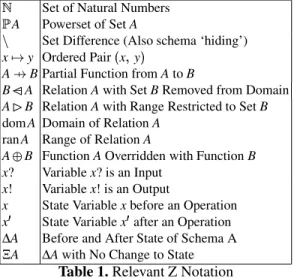
Table 1.Relevant Z Notation
%
USERROLESESSIONLOCATIONOBJECTOPERATIONPERMISSION& BOOLEAN::' True(False
4 A Formal Model
In this section, we propose a formal model that extends the core RBAC with location constraints. We use theZspecification language [7] for presenting our formal model. Zis based on set theory, first order predicate logic, and a schema calculus to organize large specifications. Table 1 briefly explains theZnotations used in our examples. Other specification and analysis conventions peculiar toZare explained as the need arises.
The specification assumes the given typesUSER,ROLE,SESSION,PERMISSION, LOCATION,OBJECT,OPERATION, which enumerate all possible users, roles, ses-sions, permisses-sions, locations, objects and operations respectively. In addition, we have the enumerated type BOOLEAN that can take on any two valuesTrueorFalse.
InZ, states, as well as operations, are described with a two-dimensional notation called a schema. The declarations for the various objects appear in the top part and the constraints on these objects appear at the bottom part. The objects in the location-aware RBAC are listed in the schemaLRBAC, which defines the state of the access control system. The objectsUsers,Roles,Sessions,Permissions,Objects,Operations andLocationsstore the set of users, roles, sessions, permissions, objects, operations, and locations, respectively, of the system. The objectUserLocationandObjLocation are functions that record the location of the user and the location of the object respec-tively. The functionAssignLocationmaps a role to a set of locations – these are the locations in which the role can be assigned to some user.ActivateLocationis a function mapping a role to the set of locations from where the role can be activated.UserSession
is a function that returns the set of sessions associated with any user. The function UserAssignmaps a user to the set of roles assigned to the user.SessionRolemaps a ses-sion to the set of roles that are activated in a sesses-sion. The functionSessionUsermaps a session to the user associated with that session. The functionsPermObject,PermOper, andPermAssigngive the set of objects, operations, and roles, respectively, associated with a given permission. The functionsPermRoleLocandPermObjLocgive the set of allowable locations for the role and object respectively associated with a given permis-sion. LRBAC Users: USER;Roles: ROLE;Sessions: SESSION;Objects: OBJECT Permissions: PERMISSION Operations: OPERATION;Locations: LOCATION
UserLocation:USER LOCATION;ObjLocation:OBJECT LOCATION AssignLocation:ROLE
LOCATION;ActivateLocation:ROLE
LOCATION UserSession:USER
SESSION;UserAssign:USER
ROLE SessionRole:SESSION
ROLE;SessionUser:SESSION USER PermObject:PERMISSION
OBJECT;PermOper:PERMISSION
OPERATION PermAssign:PERMISSION
ROLE;PermRoleLoc:PERMISSION
LOCATION PermObjLoc:PERMISSION
LOCATION
domUserLocation' Users; domObjLocation' Objects; ranObjLocation) Locations domAssignLocation' Roles;* l: ranAssignLocation+ l) Locations
domActivateLocation' Roles;* l: ranActivateLocation+ l) Locations domUserSession) Users;* l: ranUserSession+ l) Sessions
domUserAssign) Users;* r: ranUserAssign+ r) Roles domSessionRole' Sessions;* r: ranSessionRoles+ r) Roles * s:Sessions+,SessionRoles-) UserAssignSessionUsers.
domSessionUser' Sessions; ranSessionUser) Users; domUserSession' ranSessionUser domPermObject' Permissions;* r: ranPermObject+ r) Objects
domPermOper' Permissions;* r: ranPermOper+ r) Operations domPermAssign' Permissions;* r: ranPermAssign+ r) Roles domPermRoleLoc' Permissions;* r: ranPermRoleLoc+ r) Locations domPermObjLoc' Permissions;* r: ranPermObjLoc+ r) Locations
The bottom of the schemaLRBAC gives the constraints that are imposed on the objects. The first one states that the domain ofUserLocationequals the set of users in the system. In other words, all users are associated with a location. The next one states that the domain ofObjLocationequals the set of objects in the system – this is because all objects are associated with locations. Each location associated with an object must be in an allowable location. This is imposed by requiring that the set of locations in the range of functionObjLocationis a subset ofLocations. The next one states that the domain ofAssignLocationequals the set ofRoles. This implies that each role in Rolesis associated with a set of locations where the role can be assigned. Each set in the range ofAssignLocation must be a subset of locations of interest in the system.
Similar constraints are imposed for the functionActivateLocation. Since all users in the setUsersmay not have an active session, the domain ofUserSessionis a subset of the setUsers. Each set in the range ofUserSessiondenotes the sessions associated with a particular user. Each such set must be a subset ofSessions. The functionUserAssign maps a user to the set of roles assigned to him. Not all users inUsersmay have roles assigned to them, hence the domain ofUserAssignis a subset ofUsers. Each set in the rangeUserAssigncorresponds to roles associated with a user – each such set is a subset ofRoles. The functionSessionRolemaps a session to a set of roles associated with the session. Each session must be associated with some roles; the domain ofSessionRole therefore equalsSessions. Moreover, each set in the range ofSessionRoleis a subset ofRoles. The domain ofSessionUser must equal Sessionsbecause every session in Sessionsmust be associated with a user. The range ofSessionUseris a subset ofUsers because not all users in the system may have an active session. Also, the domain of UserSessionmust equal the range ofSessionUser. For all sessions, the roles associated with the session must be a subset of the roles assigned to the user associated with that session. Each permission must be associated with a set of objects; thus the domain of PermObjectequalsPermissions, and each set in the range ofPermObjectis a subset of Objects. Similar constraints are placed forPermOper,PermAssign,PermRoleLoc, and PermObjLocation.
AddRoleAssignLocation
∆LRBAC;r? :ROLE;l? :/ LOCATION r? Roles;l? 0 Locations;Operations1 Operations;Permissions 1 Permissions Roles1 Roles;Users 1 Users;ActivateLocation 1 ActivateLocation AssignLocation1 AssignLocation 23 r45 AssignLocationr?76 l? Locations1 Locations;UserLocation 1 UserLocation;UserSession 1 UserSession PermAssign1 PermAssign;SessionRole 1 SessionRole;SessionUser 1 SessionUser PermObject1 PermObject;PermOper 1 PermOper;PermRoleLoc 1 PermRoleLoc ObjLocation1 ObjLocation;PermObjLoc 1 PermObjLoc UserAssign1 UserAssign;Sessions 1 Sessions;Objects 1 Objects
We next describe the operations for performing the administration commands for the Location Aware RBAC. For lack of space, we do not specify all the operations. We show only those operations that are significantly different from the Core RBAC and those that are not present in the Core RBAC. The operationsAddUser,DeleteUser,AddRole, DeleteRoleare similar to that specified in CoreRBAC. Since roles are associated with an assignment location and an activation location, we must have operations that add and delete these associations. The operationAddRoleAssignLocationassociates a new set of locations with a role. The operation takes as input a roler? and a set of locationsl?. It has two preconditions. The first verifies whetherr? is a valid role by checking whether r? is in the setRoles. The second checks whetherl? is a subset ofLocations. The post condition changes the objectAssignLocation. The roler? is now mapped to the set of original locations unionl?. All the other objects remain unchanged.
The operationDeleteRoleAssignLocationalso takes as input a roler? and a set of locationsl?. This has two preconditions. The first one verifies roler? is a valid role by
checking whetherr? is in the setRoles. The second one checks whetherl? is a subset of the locations that are associated with the assignment of roler?. The postcondition removesl? from the set of roles associated withr?. No other objects are changed. The operationsAddRoleActivateLocandDeleteRoleActivateLocare specified in a similar fashion.
DeleteRoleAssignLocation ∆LRBAC;r? :ROLE;l? :
LOCATION
r?8 Roles;l?) AssignLocationr?;Users$9' Users;Roles$:' Roles AssignLocation$9' AssignLocation#<; r AssignLocationr?
l?= Permissions$ ' Permissions;Sessions$ ' Sessions;Objects$ ' Objects
Operations$9' Operations;Locations$:' Locations;UserLocation$:' UserLocation UserSession$:' UserSession;SessionRole$>' SessionRole;PermAssign$:' PermAssign ActivateLocation$ ' ActivateLocation;SessionUser$ ' SessionUser;PermOper$ ' PermOper PermObject$ ' PermObject;PermRoleLoc$ ' PermRoleLoc;ObjLocation$ ' ObjLocation PermObjLoc$ ' PermObjLoc;UserAssign$ ' UserAssign
AddRoleActivateLoc ∆LRBAC;r? :ROLE;l? :
LOCATION
r?8 Roles;l?) Locations;PermObjLoc$ ' PermObjLoc;Users$ ' Users
ActivateLocation$ ' ActivateLocation#<; r ActivateLocationr?:? l?=;Objects$ ' Objects Operations$ ' Operations;Locations$ ' Locations;UserLocation$ ' UserLocation
UserSession$ ' UserSession;PermAssign$ ' PermAssign;Sessions$ ' Sessions Roles$9' Roles;AssignLocation$9' AssignLocation;ObjLocation$9' ObjLocation Permissions$9' Permissions;SessionRole$>' SessionRole;SessionUser$:' SessionUser PermObject$:' PermObject;PermOper$:' PermOper;PermRoleLoc$@' PermRoleLoc
DeleteRoleActivateLoc ∆LRBAC;r? :ROLE;l? :
LOCATION
r?8 Roles;l?) AssignLocationr?;Users$9' Users;Operations$>' Operations AssignLocation$9' AssignLocation#<; r AssignLocationr?
l?=
Objects$9' Objects;Locations$:' Locations;UserLocation$:' UserLocation Sessions$9' Sessions;UserSession$>' UserSession;PermAssign$9' PermAssign
ActivateLocation$:' ActivateLocation;ObjLocation$:' ObjLocation;PermOper$:' PermOper SessionRole$ ' SessionRole;SessionUser$ ' SessionUser;PermObject$ ' PermObject PermRoleLoc$ ' PermRoleLoc;Roles$ ' Roles;PermObjLoc$ ' PermObjLoc
AddPermission
∆LRBAC;p? :PERMISSION;obj? :
OBJECT r? : ROLE;op? : OPERATION;rl?ol? : LOCATION
p?A8 Permissions;obj?) Objects;op?) Operations;rl?) Locations
AssignLocation$9' AssignLocation;ol?) Locations;ActivateLocation$:' ActivateLocation Users$ ' Users;Permissions$ ' Permissions?B;p?= ;Sessions$ ' Sessions
PermAssign$ ' PermAssign?B; p? r?= ;PermObject$ ' PermAssign?B; p? obj?= PermOper$ ' PermAssign?B; p? op?= ;PermRoleLoc$ ' PermRoleLoc?B; p? rl?= PermObjLoc$ ' PermObjLoc?B; p? ol?= ;Objects $ ' Objects;Roles $ ' Roles ObjLocation$ ' ObjLocation;Operations $ ' Operations Locations$ ' Locations;UserLocation $ ' UserLocation;UserSession $ ' UserSession UserAssign$9' UserAssign;SessionRole$>' SessionRole;SessionUser$>' SessionUser
DeletePermission
∆LRBAC;p? :PERMISSION
p?8 Permissions;Users$ ' Users;Roles$ ' Roles;Sessions$ ' Sessions Permissions$ ' Permissions ; p?= ;PermAssign$ 'C; p?=D ! PermAssign PermObject$ 'E;p?=D ! PermObject;PermOper$ 'C;p?=F ! PermOper PermRoleLoc$ 'C; p?=D ! PermRoleLoc;PermObjLoc$ 'C; p?=F ! PermObjLoc
Operations$ ' Operations;UserLocation$ ' UserLocation;UserAssign$ ' UserAssign Locations$ ' Locations;Objects$ ' Objects;AssignLocation$ ' AssignLocation ActivateLocation$:' ActivateLocation;UserSession$>' UserSession
ObjLocation$9' ObjLocation;SessionRole$:' SessionRole;SessionUser$>' SessionUser
The operationAddPermissionadds a new permission to the setPermissions. It takes as input the new permissionp?, the set of rolesr? which must be assigned this permis-sion, the set of objectsobj? and the set of operationsop? associated with this permis-sion, the set of role locationsrl? and the set of object locationsol? associated with this permission. There are five preconditions associated with this operation. The first one checks thatp? is not an existing permission, the second and third check whetherobj? andop? are valid sets of objects and operations respectively, and the fourth and fifth check whetherrl? andol? are valid sets of locations. The postconditions change the setPermissionsto includep?, change the functionPermAssignto include the new map-pingp?45 r?. The functionPermObject,PermOper,PermRoleLoc, andPermObjLoc are updated to include the mappings of permissionp? to objectobj?, operationop?, role locationrl?, and object locationol? respectively. The other objects remain unchanged.
The operationDeletePermissionremoves a permissionp? from the setPermissions. It takes in one input: the permissionp? to be removed. The precondition checks whether p? is an existing permission by checking if it is in the setPermissions. The postcondition removesp? fromPermissions. It also changes the objects PermAssign,PermObject, PermOper,PermRoleLoc,PermObjLocby removing the entries associated withp? in each of these objects.
The operationAssignUsermust also be changed. It takes in two inputs: the user u? to whom the roler? must be assigned. This operation has four preconditions. The first two check whetheru? andr? are valid user and role respectively. The third one ensures thatr? is not in the set of roles assigned tou?. Sincer? can be assigned only in certain locations, the last precondition checks whether the location of the user is con-tained in the locations wherer? can be assigned. The postcondition is that the function UserAssign is changed so that u? maps to the set consisting of the roles previously assigned tou? andr?. The other objects remain unchanged.
AssignUser
∆LRBAC;u? :USER;r? :ROLE
u?8 Users;r?8 Roles;r?A8 UserAssignu?;UserLocationu?,8 AssignLocationr? PermObjLoc$@' PermObjLoc;Roles$@' Roles;Objects$9' Objects;Operations$:' Operations UserAssign' UserAssign#<; u? UserAssignu?9?B; r?=G=;PermRoleLoc$@' PermRoleLoc Locations$ ' Locations;Permissions$ ' Permissions;UserLocation$ ' UserLocation UserSession$:' UserSession;PermAssign$:' PermAssign;ObjLocation$:' ObjLocation ActivateLocation$:' ActivateLocation;SessionRole$:' SessionRole;SessionUser$:' SessionUser PermObject$:' PermObject;PermOper$:' PermOper;Users$9' Users;Sessions$>' Sessions
AddLocation
∆LRBAC;l? :LOCATION
l?A8 Locations;Users$:' Users;Roles$9' Roles;Locations$>' Locations?B; l?= Objects$9' Objects;Operations$:' Operations;UserLocation$>' UserLocation
UserSession$:' UserSession;PermAssign$:' PermAssign;ActivateLocation$9' ActivateLocation Sessions$ ' Sessions;SessionRole$ ' SessionRole;SessionUser$ ' SessionUser
PermObject$ ' PermObject;PermOper$ ' PermOper;PermRoleLoc$ ' PermRoleLoc ObjLocation$ ' ObjLocation;PermObjLoc $ ' PermObjLoc;Permissions $ ' Permissions DeleteLocation ∆LRBAC;l? :LOCATION
l?8 Locations;l?A8 ranObjLocation;l?A8 ranPermRoleLocl?A8 ranPermObjLoc l?A8 ranAssignLocation;l?A8 ranActivateLocation;Locations$ ' Locations
; l?= Operations$ ' Operations;UserLocation$ ' UserLocation;UserSession$ ' UserSession PermAssign$@' PermAssign;ActivateLocation$9' ActivateLocation;ObjLocation$:' ObjLocation SessionRole$:' SessionRole;SessionUser$>' SessionUser;PermObject$9' PermObject
PermOper$9' PermOper;Permissions$9' Permissions;Roles$9' Roles;PermRoleLoc$@' PermRoleLoc Users$9' Users;PermObjLoc$@' PermObjLoc;Sessions$:' Sessions;Objects$9' Objects
Two operations, not present in the Core RBAC, are added to this model. The first is AddLocationwhich adds a new location to the set Locations. The precondition is that the inputl? is not among the existing setLocations. The postcondition is that the setLocationsis changed to includel?. The rest of the objects remain unchanged. The
second operation is DeleteLocation. It removes a locationl? from the set Locations. The first precondition is thatl? must be an existing location. The second one checks thatl? must not be the location of any object. The next four preconditions check that l? must not be a location which is associated with some permission, role assignment or role activation. The postcondition removesl? from the setLocations. Other objects remain unchanged.
CreateSession
∆LRBAC;u? :USER;s? :SESSION;rset? : ROLE
u?8 Users;rset?) Roles;s?A8 Sessions;rset?8 UserAssignu?
* r8 rset?+,UserLocationu-8 ActivateLocationr.;Sessions$ ' Sessions?B; s?= Users$ ' Users;UserSession$ ' UserSession#H; u? UserSessionu?9?B;s?=@= SessionRole$:' SessionRole?B; s? rset?= ;SessionUser$>' SessionUser?B; s? u?= AssignLocation$9' AssignLocation;Objects$:' Objects;Operations$>' Operations
Permissions$9' Permissions;PermAssign$:' PermAssign;ActivateLocation$9' ActivateLocation Roles$9' Roles;PermObject$:' PermObject;UserLocation$9' UserLocation
PermOper$9' PermOper;UserAssign$9' UserAssign;PermRoleLoc$:' PermRoleLoc PermObjLoc$@' PermObjLoc;Sessions$>' Sessions;ObjLocation$:' ObjLocation
ActivateRole
∆LRBAC;u? :USER;r? :ROLE;s? :SESSION
u?8 Users;r?8 Roles;s?8 Sessions;r?8 UserAssignu?;s?8 UserSessionu? UserLocationu?F8 ActivateLocationr?;Users$ ' Users;Objects$ ' Objects Sessions$9' Sessions;SessionRole$:' SessionRole#<; s? SessionRoles?:?B; r?=@= Operations$9' Operations;UserLocation$:' UserLocation;UserSession$>' UserSession Roles$ ' Roles;PermAssign$ ' PermAssign;ActivateLocation$ ' ActivateLocation SessionRole$:' SessionRole;SessionUser$>' SessionUser;PermObject$9' PermObject PermOper$9' PermOper;UserAssign$9' UserAssign;PermRoleLoc$:' PermRoleLoc PermObjLoc$@' PermObjLoc;ObjLocation$9' ObjLocation;Permissions$9' Permissions
CheckAccess
ΞLRBAC;s? :SESSION;op? :OPERATION;o? :OBJECT;res! :BOOLEAN s?8 Sessions;o?8 Objects;op?8 Operations
I
r:ROLE+Jr8 SessionRoles?LKM
I
p:PERMISSION+,r8 PermAssignpNK op?8 PermOperp K o?8 PermObjectpOK ObjLocationo?F8 PermObjLocp
K UserLocationSessionUsers?.,8 PermRoleLocp.NP res!' TRUE
A
I
r:ROLE+,r8 SessionRoles?OK<
I
p:PERMISSION+,r8 PermAssignpNK op?8 PermOperp K o?8 PermObjectpOK ObjLocationo?F8 PermObjLocp
K UserLocationSessionUsers?.,8 PermRoleLocp..NP res!' FALSE
Next, we specify the operations for system functions for the Location Aware RBAC. Here again, we specify only those operations that differ from the Core RBAC. The
first one is theCreateSessionoperation. This operation takes as input a useru? whose session is being created, the sessions? that must be created, and a set of rolesrset? that must be activated. This operation has three preconditions. The first ensures that u? is a valid user, that is, it must belong to the setUsers. The second checks whether rset? is a subset of Roles. The third ensures that s? is not an existing session. The fourth precondition checks thatrset? is a subset of the roles assigned to the user. The fifth checks that for each rolerin the setrset?, the location of useru? is contained in the activation location ofr. The post condition changesSessionsby includings?. The functionUserSessionis changed – useru? is now associated with the set of pre-existing sessions ofu? together with the sessions?. The functionSessionRoleis also changed; a new mappings?45 rset? is added toSessionRole. SimilarlySessionUseris changed to include the mappings?45 u?. All other objects remain unchanged.
The other operation that is significantly different isActivateRole. The input to this operation are the user u?, the role r?, and the session s? in which the role must be activated. The first three preconditions check whetheru?,r?, ands? are existing user, role and session respectively. The fourth and fifth preconditions check whetherr? is a role assigned to the useru?, ands? is a session initiated by useru?. The last precondition checks that the location ofu? is within the activation location ofr?. The postcondition is that the functionSessionRoleis updated;s? is now associated withr? and also the roles that were previously activated. The other operations remain unchanged.
The next operation is theCheckAccessoperation. This function takes in three inputs: the sessions?, the operationop? and the objecto?. The operation has three preconditions that check whethers?,op? ando? are valid session, operation, and object, respectively. The postcondition does not change any object. This operation produces an outputres! which is BOOLEAN. If there is a rolerthat is activated in the sessions?, and there is a permissionpsuchr,op? ando? are associated with permissionp, and the location of the user and the object are contained inPermRoleLocp andPermObjLocp, respectively, thenres! returns true. Otherwiseres! returns false.
5 Related Work
Denning and MacDoran [4] propose many motivating examples as to why location-based security is important for applications. Their argument is that use of location in-formation can enhance the security of applications. The authors discuss how location-based authentication can be achieved using GPS and a tool called Cyberlocator.
Hengartner and Steenkiste [5] design an access control mechanism for a people location system. The authors say that an individual is associated with two kinds of location policies. The first are the location policies that are specified by individuals. The second are the policies that are specified by institutions. For instance, if a person is at the mall, his individual location policies are in effect. When he is at work, the institutional policies of the organization are in effect. The access control policy is enforced using digital certificates.
Leonhardt and Magee [6] discuss how location-based access can be provided over existing matrix-based access control models and mandatory access control models. The proposed approach consists of three parts: controlling access, controlling visibility and
controlling anonymity. The visibility policy specifies what location information gets returned to the user who is querying about the location of an entity. The anonymity policy specifies what information gets returned to the user querying about some other user. The access policy specifies how location information can be used to control access. Although this paper has presented some nice ideas, it lacks details and formalisms. For instance, the authors do not discuss how the different components of an access control model are impacted by location and what constraints are necessary on the location-based model. In our work we try to address these issues and complement the above mentioned work.
Sampemane et al. [9] present a new access control model for active spaces. Active space denotes the computing environment integrating physical spaces and embedded computing software and hardware entities. The active space allows interactive exchange of information between the user and the space. Environmental aspects are adopted into the access control model for active spaces, and the space roles are introduced into the implementation of the access control model based on RBAC. The model supports spec-ification of RBAC policies in which system administrator maintains the access matrix and DAC policies in which users create and update security policies for their devices.
Covington et al. [3] introduce environment roles in a generalized RBAC model (GR-BAC) to help control access control to private information and resources in ubiquitous computing applications. The environments roles differ from the subject roles in RBAC but do have similar properties including role activation, role hierarchy and separation of duty. In the access control framework enabled by environment roles, each element of permission assignment is associated with a set of environment roles, and environ-ment roles are activated according to the changing conditions specified in environmen-tal conditions, thus environmenenvironmen-tal properties like time and location are introduced to the access control framework. In a subsequent work [2], Covington et al. describes the Context-Aware Security Architecture (CASA) which is an implementation of the GR-BAC model. The access control is provided by the security services in the architecture. In CASA, polices are expressed as roles and managed by the security management ser-vice, authentication and authorization services are used to verify user credentials and determine access to the system resources. The environmental role activation services manage environmental role activation and deactivation according to the environment variables collected by the context management services.
Ray et al.[8] briefly describe the impact that location has on the various compo-nents of RBAC. However, the paper does not provide any formal treatment of the topic. Bertino et al.[1] describe the GEO-RBAC model which extends RBAC to incorporate spatial and location information. Each role is associated with an extent which defines the boundary at which the role is effective. Our model not only associates locations with role activations, but also associates locations with role assignments and permissions.
6 Conclusion
In this paper, we have proposed a location-based access control model that is based on RBAC. This model will be useful for pervasive computing applications in which the role of the user as well as his location will be used to determine if the user has access to
some resource. We have shown how the different components of the core RBAC model are related with location, what new operations are needed and how existing operations must be changed to perform location-based access. We have formalized our model using the Z specification language. In future, we would like to extend this model by taking into account the effects of the constraints imposed by role hierarchy, static separation of duty, and dynamic separation of duty. We also plan to propose mechanisms by which such a model can be implemented. Typically location of a user or an object changes with time. Our future plans include proposing a model that takes into account these kinds of temporal constraints.
References
1. Elisa Bertino, Barbara Catania, Maria Luisa Damiani, and Paolo Perlasca. GEO-RBAC: A Spatially Aware RBAC. InProceedings of the ACM Symposium on Access Control Models and Technologies, Stockholm, Sweden, June 2005.
2. Michael J. Covington, Prahlad Fogla, Zhiyuan Zhan, and Mustaque Ahamad. A Context-Aware Security Architecture for Emerging Applications. InProceedings of the Annual Com-puter Security Applications Conference, pages 249–260, Las Vegas, NV, USA, December 2002.
3. Michael J. Covington, Wende Long, Srividhya Srinivasan, Anind Dey, Mustaque Ahamad, and Gregory Abowd. Securing Context-Aware Applications Using Environment Roles. In Proceedings of the 6th ACM Symposium on Access Control Models and Technologies, pages 10–20, Chantilly, VA, USA, May 2001.
4. Dorothy E. Denning and Peter F. MacDoran. Location-Based Authentication:Grounding Cy-berspace for Better Security. InComputer Fraud and Security,Elsevier Science Ltd, February 1996.
5. Urs Hengartner and Peter Steenkiste. Implementing Access Control to People Location Infor-mation. InProceeding of the SACMAT’04 Yorktown Heights,California,USA, June 2004. 6. Ulf Leonhardt and Jeff Magee. Security Consideration for a Distributed Location Service.
Imperial College of Science, Technology and Medicine, London, UK, 1997.
7. B. Potter, J. Sinclair, and D. Till.An Introduction to Formal Specification and Z. Prentice-Hall, New York, NY, 1991.
8. Indrakshi Ray and Lijun Yu. Short Paper: Towards a Location-Aware Role-Based Access Control Model. InProceedings of the IEEE Conference on Security and Privacy for Emerging Areas in Communications Network, Athens, Greece, September 2005.
9. Geetanjali Sampemane, Prasad Naldurg, and Roy H. Campbell. Access Control for Active Spaces. InProceedings of the Annual Computer Security Applications Conference, pages 343–352, Las Vegas, NV, USA, December 2002.