Identity-Based Cryptography for Grid Security
Hoon Wei Lim and Kenneth G. Paterson
Information Security Group
Royal Holloway, University of London
Egham, Surrey TW20 0EX, UK
{
h.lim, kenny.paterson
}
@rhul.ac.uk
Abstract
The majority of current security architectures for grid systems use public key infrastructure (PKI) to authenticate identities of grid members and to secure resource alloca-tion to these members. Identity-based cryptography (IBC) has some attractive properties which seem to align well with the demands of grid computing. This paper presents a com-prehensive investigation of the use of identity-based tech-niques to provide an alternative grid security architecture. We propose a customised identity-based key agreement pro-tocol which fits nicely with the Grid Security Infrastructure (GSI) and provides a more lightweight secure job submis-sion environment for grid users. Single sign-on and dele-gation services are also supported in a very natural way in our identity-based architecture.
1 Introduction
Continual improvements to computing power, storage capacity, and network bandwidth are allowing computing technologies of previously unheard of levels of sophistica-tion. Nevertheless, there remain increasing demands for ac-cess to more computational power and resources, much of this being driven by the demands of large and complex new problems. Grid computing [9, 11] has been proposed as a mechanism to provide such demands. In essence, grid computing aims to provide an infrastructure allowing ac-cess to a wealth of sharable resources such as proac-cessing power, storage, databases, applications and any other de-vices (hardware) or components (software); all of which can be reached by remote users wishing to solve urgent and/or resource-intensive problems in computational science and engineering, experimental science, industrial engineering, corporate communications, and so forth.
Public key infrastructure (PKI) is presently deployed in most grid implementations as it is perceived as a stable and mature technology which is widely supported and can be
easily integrated with different applications on various plat-forms. In the Grid Security Infrastructure (GSI) [10] for the Globus Toolkit (GT) [8], the leading toolkit used in devel-oping grid applications, proxy certificates [27] have been designed and deployed in addition to standard X.509 public key certificate [16], to compensate some of the shortcom-ings in the conventional PKI setting and to provide addi-tional properties that align with the requirements for secure communications among grid entities within a dynamically changing environment. The motivations for the proxy cer-tificates which carry short-term public keys are twofold: (i) to limit exposure of long-term credentials, and (ii) to enable single sign-on (or unattended authentication) and delegation services. It is not clear, however, if the extensive use of cer-tificates in the hierarchical PKI setting within a dynamic grid environment offers the best possible solution for public key management.
Independent of grid computing, a variant of traditional public key technologies called identity-based cryptogra-phy (IBC) [2, 25] has recently received considerable at-tention. Through IBC, an identifier which represents a user can be transformed into his public key and used on-the-fly without any authenticity check. The potential of IBC to provide greater flexibility to entities within a se-curity infrastructure and its certificate-free approach may well match the dynamic qualities of grid environments. In other words, it seems that the development of IBC may of-fer more lightweight and flexible key usage and manage-ment approaches within grid security infrastructures than traditional PKI does. The aim of this paper is to propose and investigate an identity-based grid security architecture that aligns with the security services provided by the GSI adopted in the GT version 4 (GT4). Our proposal make uses of both long-term and short-term identity-based keys, by exploiting some properties from hierarchical identity-based cryptography (HIBC) [14, 15]. The proposal incorporates a certificate-free key agreement protocol based on the TLS handshake [5] and a lightweight delegation protocol.
Related Work. The idea of applying IBC within a grid se-curity infrastructure was initially explored in [17, 20]. How-ever, the supposedly dynamic use of identity-based keys has been hindered by some traditional limitations of IBC such as key escrow and the need to distribute private keys through secure channels. In addition, the proposals in [17, 20] do not address some of the essential security requirements desired in the GT such as using proxy credentials for single sign-on and delegation. In [18], Lim and Robshaw proposed a hy-brid approach combining identity-based techniques at the user level and traditional PKI to support key management above the user level. In this hybrid setting, each user pub-lishes a fixed parameter set through a standard X.509 cer-tificate; this parameter set then allows users to act as their own Trusted Authorities for the purposes of delegation and single sign-on. This framework solves the two issues of key escrow and distribution of private keys in IBC, but has the limitation that the original dynamic and lightweight qual-ities that IBC offers are partially lost, because users now need to authenticate and verify other parties’ parameter sets before they can be used.
Recently, Chenet al.[3] revisited the GSI in the GT ver-sion 2 (GT2) and presented some improvements to the se-curity architecture. Their work is related to [18] in which each user has a static long-term credential which can be used by other parties to derive dynamic public keys on-the-fly. Chenet al.modified the security protocols in [10] and the improved protocols seem to offer better performance. In addition, they also proposed an interesting application of aggregate signature to save computational costs in verifying chained signatures. As with [18], however, each user is re-quired to get hold of the intended communicating party’s authentic certificate before a dynamic public key can be computed and used.
Contributions. The application of IBC in grid security is an emerging and interesting area but the potential of IBC has only been partially investigated to date. Here we exam-ine what can be achieved in a fully identity-based approach. Our contributions can be summarised as follows.
• We propose a fully identity-based key infrastructure for grid (IKIG). It inherits attractive properties from IBC such as being certificate-free and having small key sizes. This potentially offers a more lightweight key management approach.
• We present a customised identity-based authenticated key agreement protocol for grid environments. This protocol can support single sign-on and credential del-egation and has a restricted escrow-free1property. We 1A malicious trusted authority can always impersonate a user to other
users. We define restricted escrow-free protocol as a protocol which resists passive but not active attacks from the trusted authority.
build our protocol using some properties from HIBC and the protocol is integrated with the widely used TLS protocol so that it can be implemented in existing grid infrastructures.
• We design a lightweight one-pass delegation proto-col that supports short-term identity-based keys. This protocol does not require transmission of a short-term public key from a delegation target to a delegator, yet the public key can be bound to the delegator’s creden-tial.
• We identify and discuss the performance trade-offs in terms of computational and communication overheads of IKIG as compared to the GSI.
Paper Outline. The remainder of this paper is organised as follows. Section 2 explains some fundamental concepts of identity-based cryptography. In Section 3, we present in-depth identity-based key management and usage methods for the GSI. Section 4 discusses the performance analyses of our proposal. In Section 5, we consider the impact of IBC on web services security and some integration issues with existing technologies. Lastly, Section 6 presents our concluding remarks.
2 Identity-Based Cryptography
Identity-based cryptography (IBC) was first introduced by Shamir [25] in 1984. Recently, there has been an in-creased intensity in research on IBC. This was mainly due to the seminal discovery of a practical and secure identity-based encryption (IBE) scheme which uses pairings over elliptic curves by Boneh and Franklin [2] in 2001. Follow-ing the publication of [2], many proposals for identity-based schemes related to signatures, signcryption, key agreement, and so on have been proposed.
The main stimulus for this trend is the perceived problem of managing certificates and associated keys within PKI. In an identity-based cryptosystem, public keys can be derived from arbitrary strings, e.g. a user’s identity, whilst the cor-responding private keys are generated and distributed by a Trusted Authority (TA) in possession of a system master se-cret. This TA roughly corresponds to the Certificate Author-ity/Registration Authority (CA/RA) combination in a tradi-tional certificated-based PKI. An identity-based cryptosys-tem enjoys most of the functionality of public key cryp-tography without the need for certificates and the problems that these bring. Thus it promises a more lightweight ap-proach to deploying public key cryptography. A compari-son of the certificate-based PKI and the identity-based PKI can be found in [23]. In the remainder of this section, we re-cap some basic concepts of pairings and outline the
Gentry-Silverberg hierarchical identity-based encryption and signa-ture schemes (HIBE and HIBS) [14] which we will apply in subsequent sections.
2.1
Overview of Pairings
LetG1andG2be two groups of orderqfor some large
primeq, where G1 is an additive group andG2denotes a
related multiplicative group. A pairing, which can be either a modified Weil pairing [2] or a Tate pairing [12] is a map ˆ
e:G1×G1→G2with the following properties.
• Bilinear: GivenP, Q, R∈G1, we haveˆe(P, Q+R) =
ˆ
e(P, Q)·ˆe(P, R)andˆe(P+Q, R) = ˆe(P, R)·eˆ(Q, R).
Hence, for anya, b ∈Z∗
q,ˆe(aP, bQ) = ˆe(abP, Q) =
ˆ
e(P, abQ) = ˆe(aP, Q)b= ˆe(P, Q)ab.
• Non-degenerate: There exists a P ∈ G1 such that
ˆ
e(P, P)6= 1.
• Computable: IfP, Q∈G1,eˆ(P, Q)can be efficiently
computed. For anya∈Z∗
q andP ∈G1, we writeaP as the scalar
multiplication of group elementP by integera. Typically, G1 is obtained as a subgroup of the group of points on a
suitable elliptic curve over a finite field, andG2is obtained
from a related finite field.
2.2
The Gentry-Silverberg HIBE & HIBS
Gentry and Silverberg proposed hierarchical identity-based cryptography (HIBC) in [14] to ease the private key distribution problem and improve the scalability of the orig-inal IBE scheme proposed in [2]. In the HIBC setting, a root Private Key Generator (PKG) is only required to produce private keys for domain-level PKGs, who in turn generate private keys for users in their domains in the next level.
We describe Gentry and Silverberg’s hierarchical identity-based encryption (HIBE)2 and signature (HIBS) schemes as follows.
ROOTSETUP: The root PKG chooses a generator P0 ∈
G1, picks a random s0 ∈ Z∗q, and setsQ0 = s0P0.
It also selects cryptographic hash functions H1 :
{0,1}∗ → G1, H2 : G2 → {0,1}n for some n,
and H3 : {0,1}∗ → G1. The root PKG’s
mas-ter secret key is s0 and the system parameters are
hG1,G2,ˆe, P0, Q0, H1, H2, H3i.
LOWER-LEVELSETUP: A lower-level entity (lower-level PKG or user) at leveltpicks a randomst∈Z∗q which
will be kept secret.
2We only present a basic HIBE scheme. See [14] for the full and
ap-propriately secure HIBE scheme.
EXTRACT: For an entity at level t with ID-tuple
hID1, . . . ,IDti, where hID1, . . . ,IDiiis the ID-tuple
of the entity’s ancestor at leveli(1 ≤i≤t), the
en-tity’s parent computesPt =H1(ID1, . . . ,IDt)∈ G1,
sets the secret pointStto beP t
i=1si−1Pi, and defines
Q-values asQi =siP0for1≤i≤t−1.
ENCRYPT: Given a message m with the ID-tuple
hID1, . . . ,IDti, the message can be encrypted by first
computingPi =H1(ID1, . . . ,IDi)∈G1for1 ≤i≤
t; then choosing a randomr ∈Z∗
q; and the ciphertext
is set to:
c=hrP0, rP2, . . . , rPt, m⊕H2(gr)i,
whereg = ˆe(Q0, P1)∈G2in which its value can be
pre-computed.
DECRYPT: Given a ciphertext hU0, U2, . . . , Ut, Vi
en-crypted using the ID-tuplehID1, . . . ,IDti, the
cipher-text can be decrypted by computing:
m=V ⊕H2 ˆ e(U0, St) Qt i=2ˆe(Qi−1, Ui) ! .
SIGN: Given a private keyStand a messagem∈ {0,1}∗,
the signer with ID-tuplehID1, . . . ,IDticomputesh=
H3(ID1, . . . ,IDt, m) ∈ G1 andSt+sth. The
algo-rithm outputshσ =St+sth, Q1, . . . , Qtias the
sig-nature.
VERIFY: Given a signature hσ, Q1, . . . , Qtiof a message
m signed by an entity who has a public key Pt =
H1(ID1, . . . ,IDt)∈G1, the verifier checks if:
ˆ e(P0, σ) = ˆe(Q0, P1)ˆe(Qt, h) t Y i=2 ˆ e(Qi−1, Pi),
where h = H3(ID1, . . . ,IDt, m). To
im-prove the verification performance, eˆ(Q0, P1) and
Qt
i=2ˆe(Qi−1, Pi)can be pre-computed. That means
there will be only two pairing computations when the verification is performed.
It is worth noting that other HIBE and HIBS schemes are available. We have selected the schemes from [14] because they are efficient and their security is based on reasonable computational assumptions.
3 Identity-Based Key Infrastructure for Grid
We now apply both the HIBE and the HIBS schemes in the context of the GSI and examine how identity-based keys can be used and managed in different ways from conven-tional public key management.3.1
Key Generation
In our identity-based key infrastructure for grid (IKIG), we propose to replace the CA in the current certificate-based grid systems with a TA. The TA’s roles including acting as the PKG and supporting other user related administration and management. It is a common proposal (see for example the European DataGrid (EDG) project3) that each nation has one CA to serve members within the country. If IKIG is to be deployed at such a scale, we expect that the root TA’s system parameters will be bootstrapped in the grid system, while the other TAs’ public information can be downloaded by the users through their grid clients.
During the initial system setup phase, each TA runs a parameter generator on input k to generate groups G1,
G2 of large prime order q and an admissible pairingeˆ :
G1 × G1 → G2, where k is a security parameter. It
then performs the ROOT SETUP described in Section 2.2 to produce a master secret keys0and its system parameters
hG1,G2,ˆe, P0, Q0, H1, H2, H3i.
Currently the GT uses 1024 bit RSA public keys in pub-lic key certificates and 512 bit keys in proxy certificates. Smaller key sizes are used in proxy certificate mainly due to its frequent use for job submissions and also because of the computationally intensive RSA key pair generation [28]. Since IBC primitives use much smaller key sizes and have efficient key generation algorithms, our proposal has the luxury of using parameters of roughly similar security level as 1024 bit RSA keys for both users’ long-term and short-term credentials. This can be achieved by working with a supersingular elliptic curve of embedding degree 4 over finite field F2271 [13]. This choice results a correspond-ing group of prime order q approximately equal to 2252.
Elements of this group can be represented using 272 bits. Since all arithmetic is carried out in fields of characteristic 2, group operations and pairing computations can be imple-mented very efficiently [1, 24].
When a new grid user Alice (A) goes to a nearby RA,
the RA performs the following steps:
1. The RA verifiesA’s identity by checking her passport
(or national ID-card). Once the check succeeds, the RA comparesA’s identity with its global identity list
and subsequently assigns her a distinguished IDA ∈
{0,1}∗. The identifier is in the form of
/C=UK/O=eScience/OU=RHUL/CN=Alice/Y=2005 (using the syntax from [16]).
2. The RA generatesA’s long-term private key asSA =
s0PA, where PA = H1(IDA) is the matching
long-term public key. The long-long-term credential forA and
3The European DataGrid Project,http://www.edg.org/
her TA’s system parameters which have been signed by the root TA are distributed to her through a temporary storage medium such as a floppy disk.
3. A performs the LOWER-LEVEL SETUP algorithm to pick a randomsA ∈ Z∗q which she will keep secret.
She then defines her Q-values as(Q0 =s0P0, QA =
sAP0).
The user’s client must create a proxy credential every time when the user “signs on” to the grid system. This is done as follows:
1. A runs the EXTRACT algorithm to generate a short-term private keySA¯ = s0PA+sAPA¯, wherePA¯ =
H1(IDAkLTA)is the corresponding short-term public
key. LTAdenotes the lifetime ofA’s key in some fixed
format.
2. She also performs the LOWER-LEVEL SETUP algo-rithm, picking a random sA¯ ∈ Z∗q which will be
kept secret. The Q-values forA’s proxy are(Q0 =
s0P0, QA = sAP0, QA¯ = sA¯P0). Note thatA’s TA
does not knowSA¯andsA¯, and thus key escrow is
lim-ited, unless the TA behaves maliciously in mounting an active attack to impersonate the user to other entities. Only then isAready and allowed to submit job requests.
We remark that in our approach, the keys are allocated as they would be in HIBE/HIBS schemes with the TA at level 0, the user at level 1 and the user’s proxy at level 2.
3.2
Key Usage
Consider a simple scenario where Awants to submit a
job request J_req to a target resource X with
identity-based key sets as shown in Table 1.
Table 1.A’s long-term and proxy credentials. Credential Public Key Private Key
Long-term PA=H1(IDA) SA=s0PA
Short-term P¯
A=H1(IDAkLTA) S¯
A=SA+sAP¯
A
We now illustrate how the grid security services are per-formed via IKIG to secure a job invocation process. Single Sign-on The first step in a job submission is to
cre-ate a user proxy credential. With the proxy credential,
Adoes not need to sign on (i.e. access her encrypted
long-term private key SA with her passphrase) again
until the expiry of her short-term public/private key pair. Acan store her short-term private key SA¯ in a
client can use the key as it wishes. Single sign-on can be seen as the preliminary but important step before mutual authentication or delegation are performed be-tweenAand another entity. At any point in time during
the job submission session,A’s client can prove
pos-session ofSA¯onA’s behalf when challenged by other
entities during execution of key agreement and delega-tion protocols.
Authorization Agenerates an identity-based signature
us-ing the Gentry-Silverberg IBS scheme onJ_reqwith her short-term private keySA¯. She then submits the
signed request to a Managed Job Factory (MJF) that resides onX through a Grid Resource Allocation and
Management (GRAM) service.
A→X :IDA,LTA,J_req, SigA¯(J_req)
Here we useSigA¯(.)to denote a signing operation
us-ingA’s short-term private key. The signed request is
of the form ofhσ, QA, QA¯i, whereσ = SA¯+sA¯h,
h=H3(IDAkLTAkJ_req),QA=sAP0, andQA¯=
sA¯P0. Note that the MJF can verifyσby computing
PA¯on-the-fly, assuming it has knowledge of the
sys-tem parameters forA’s TA. The signature verification
can be done by checking if: ˆ
e(P0, σ) = ˆe(Q0, PA)ˆe(QA¯, h)ˆe(QA, PA¯).
Subsequently, the MJF mapsA’s identifier to its
grid-map file before granting access toA. When the check
succeeds, the MJF instanstiates a managed job service for the job request and returns an endpoint reference toA. Clearly, this technique does not require standard
or proxy certificates which certify the respective pub-lic keys. Note thatˆe(Q0, PA)andˆe(QA, PA¯)can be
pre-computed and used many times for other purposes such as key agreement and delegation. Thus, our ap-proach can achieve some real-time computation sav-ings.
Mutual Authentication and Key Agreement Before the job can be started,Amust perform mutual
authentica-tion with the created managed job service. We present an identity-based authenticated key agreement proto-col based on the TLS handshake protoproto-col [5]. Pro-tocol 1 shows our key agreement proPro-tocol which uses the Gentry-Silverberg HIBE and HIBS schemes for en-cryption and signing operations, respectively.
Protocol 1 Identity-based authenticated key agreement based on the full TLS handshake
(1)A→X: ClientHello (2)X→A: ServerHello ServerIdentifier ServerHelloDone (3)A→X: ClientIdentifier ClientKeyExchange IdentityVerify ClientFinished (4)X→A: ServerFinished
Protocol 1 is analogous to the TLS protocol which uses the RSA key exchange algorithm as specified in [5]. As with the current TLS specification, Pro-tocol 1 begins with A (the client) sending X (the
server) aClientHellomessage. The message con-tains a fresh random number, nA, a session
identi-fier, and a cipher specification extended from TLS ver-sion 1.0 to handle the HIBE and HIBS schemes, e.g.
TLS_HIBC_WITH_DES_CBC_SHAwhich defines a HIBC-supported cipher specification that uses DES-CBC and SHA as the symmetric encryption algorithm and hash function, respectively. It also includes infor-mation such as an elliptic curve selection and other security parameters that we have discussed in Sec-tion 3.1.
X responds with a ServerHello message which contains a new random number, nX, a session
iden-tifier, and its supported ciphersuite. X also forwards ServerIdentifier = (IDX,LTX) to A. The
ServerHelloDonemessage is sent to indicate the end of step (2).
In step (3), A first forwards her short-term
public key information, e.g. (IDA,LTA), in
ClientIdentifier to X. She then chooses
a pre-master secret and encrypts it with X’s
short-term public key using the HIBE scheme, where X’s
short-term public key PX¯ = H1(IDXkLTX).
The encrypted pre-master secret is transmit-ted to X as ClientKeyExchange. Next, a signed handshake_messages is generated for
IdentityVerifyto provide explicit verification of
A’s identifier. Herehandshake_messagesrefers to all handshake messages sent or received starting at
ClientHelloup to but not including this message.
Acompletes step (3) by sendingClientFinished
that contains a verification value. This allows X
to confirm that it has indeed received the previous handshake messages with the correct contents. As with the ClientFinished, X should
ServerFinished. A master secret KAX, the
shared secret key between A and X which will
eventually be used for protecting application data can be calculated as:
KAX=PRF(pre_master,“master secret”, nA, nX),
where PRF is a pseudo-random function.
Protocol 1 can be executed byAwhen she connects to
the managed job service to initiate her job without any use of certificates, in contrast to the current certificate-based TLS protocol.
Delegation Amay, at her discretion, delegate her
creden-tial toX for later use when necessary. Currently, the
GSI delegation protocol [27, 28] requires a round-trip between a delegator and a delegation target. We pro-pose a one-pass delegation protocol which works in the same way as the GSI in the sense that the delegator signs a new public key of the delegation target. As we depicted earlier in Protocol 1, the client can eas-ily predict and compute the server’s short-term public key and vice versa. With the same reasoning, the del-egator can straightforwardly predict and sign the dele-gation target’s new short-term public key which will be used for delegation purposes. This can be done without having the delegation target transmit its cho-sen short-term public key to the delegator through an authenticated and integrity protected channel. In order to compensate for the removal of certain types of pol-icy enforcement which could have been done through a proxy certificate, we suggest the use of a delegation token. The delegation token is a 5-tuple containing identifiers of the delegator and the delegation target, the job request, any policy which the delegator wants to enforce on the delegation target, and the validity period of the token. Let DelegationTokenX =
(IDA,IDX,J_req,Policy,LTAX), where LTAXis
a lifetime which A imposes on X. Protocol 2 then
shows our one-pass delegation protocol.
Protocol 2 Credential delegation
A→X : DelegationTokenX, Sig¯
A(DelegationTokenX)
Note that A can naturally bind X’s short-term
public key PX¯ = H1(IDXkLTAX) to the
del-egation token without acquiring the key from X.
The signed delegation token is of the form of hσ, QA, QA¯i, where σ = SA¯ + sA¯h, h =
H3(IDAkLTAXkDelegationTokenX), QA =sAP0,
andQA¯=sA¯P0.
X’s status as the delegation target can be confirmed
by a third party by: (i) verifying the signed delegation token usingPA¯, and (ii) challengingX for a proof of
possession of the private component associated toPX¯,
normally via a TLS handshake.
3.3
Key Update
We expect that the user’s long-term public key is fixed as PA = H1(IDA), where its associated long-term
pri-vate key is s0PA and s0 is the master secret of the TA.
In a grid environment, it is a normal practice to renew the user’s long-term keys on a yearly basis. In our pro-posal, this can be done through the TA issuing a new pri-vate keys0PA0 (we have discussed in Section 3.1 that the
user’s identifier includes the year, ‘Y’ field) directly to the user through a secure channel which can be established via Protocol 1. This is a more proactive approach as compared to current practice in PKI because the TA can easily com-pute the user’s new long-term public key without requesting a new public key from the user. This once-a-year key up-date method seems to be secure since Protocol 1 achieves forward-secrecy as with the standard TLS protocol. That means compromise of the user’s long-term private key does not allow the adversary to recover any past session keys. However, we have to enforce a policy whereby in the event of compromise of the user’s current private key right before the issuance of a new private key, the user must, upon her discovery of the incident, contact her RA in person to obtain a new long-term private key.
The user creates a new short-term public/private key pair every time she signs on to the system. As with the current GSI setting, we assume the default lifetime for the keys is 12 hours. These short-term keys are used for various secu-rity services such as mutual authentication, single sign-on, and delegation. Upon expiry of the proxy credential, these keys will be deleted from the local file system where they are temporarily stored. Should the validity of the proxy cre-dential need to be extended due to an unforeseen longer than 12 hours job execution, the user needs to be notified before the credential expires so that it can be renewed by the user.
3.4
Key Revocation
For key revocation in the GSI, the user is expected to check a certificate revocation list (CRL) stored in a trusted directory or the CA’s web site periodically depending on the policy enforced by his local administrator. However, many users do not bother doing this in reality. This may not cause serious concern as the CA can always instruct the user’s entry in a grid Gatekeeper’s (or a Resource Bro-ker’s) grid-map file to be removed when the CA is notified about key compromise of the user. In the IBC setting, a
number of revocation mechanisms are possible. We could use a more fine-grained identifier [2] such as extending the user’s identifier to another level which specifies a month, ‘M’ field such as “/C/O/OU/CN/Y/M”. This allows auto-mated expiry of public keys after one month (hence win-dow of exposure is also limited to a month). However, should this approach prove insufficient, e.g. in some high security applications, then existing PKI revocation mecha-nisms can easily be adapted to the IBC setting. See [23] for a longer discussion of key revocation in identity-based and certificate-based PKIs.
Revocation of short-term keys is a minor concern here as these keys will be destroyed upon expiry of their validity periods.
4 Performance Analysis
We have seen how conventional public key usage and management can be replaced by identity-based techniques. Here we discuss the performance trade-offs between the GSI and our proposed IKIG.
Communication Costs. In terms of communication over-head, we summarise the performance trade-offs between the two different settings in Table 2. Note that we only con-sider the dominant communication costs between the job requestor and the resource, i.e. signed or encrypted mes-sages, which may have the biggest contributions to the net-work bandwidth. We estimate that the size of a standard certificate which comprises an RSA public key and the is-suer’s signature, is roughly 1.5 kilobytes (12 kilobits), and 0.8 kilobytes (6.4 kilobits) for a proxy certificate. Here, we ignore small fields in a certificate such as issuer, subject, and validity period. An encrypted or a signed message with a short-term RSA key is 512 bits in size assuming the length of the message is smaller than the 512-bit block size. On the other hand, the size of a ciphertext and a signature produced by the HIBE and HIBS schemes of [14] in our IKIG setting are 1056 bits and 816 bits, respectively.
Table 2. Performance trade-offs in communi-cation costs (in kilobits) between the GSI and IKIG.
Operation GSI IKIG
Key agreement 37.8 1.9 Delegation 7.4 0.8
From Table 2, the communication cost for the TLS proto-col in the GSI is estimated to be2(12)+2(6.4)+2(0.512) = 37.8 kilobits, since there are two public key certificates,
two proxy certificate, one encrypted pre-master secret (for
ClientKeyExchange), and one signed message (for
CertificateVerify) being transmitted over the net-work. In the case of IKIG, the figure of 1.9 kilobits refers to the encrypted pre-master secret and the signed message in Protocol 1. This clearly shows that an execution of the TLS protocol in the GSI is significantly more costly than our Pro-tocol 1 in terms of bandwidth requirements. We remark that IKIG uses short-term key sizes which offer roughly double the security level of 512 bit RSA keys, an additional benefit of our approach. The communication overhead for delega-tion between the delegator and the delegadelega-tion target can be estimated straightforwardly from our discussion on delega-tion protocols in Secdelega-tion 3.2.
We have shown that, in general, the resulting commu-nication overheads from a job submission through IKIG is significantly lower than the GSI. The main reason for this is that in the IBC setting, there are no long-term and short-term public keys or certificates being transmitted between the user and the resource.
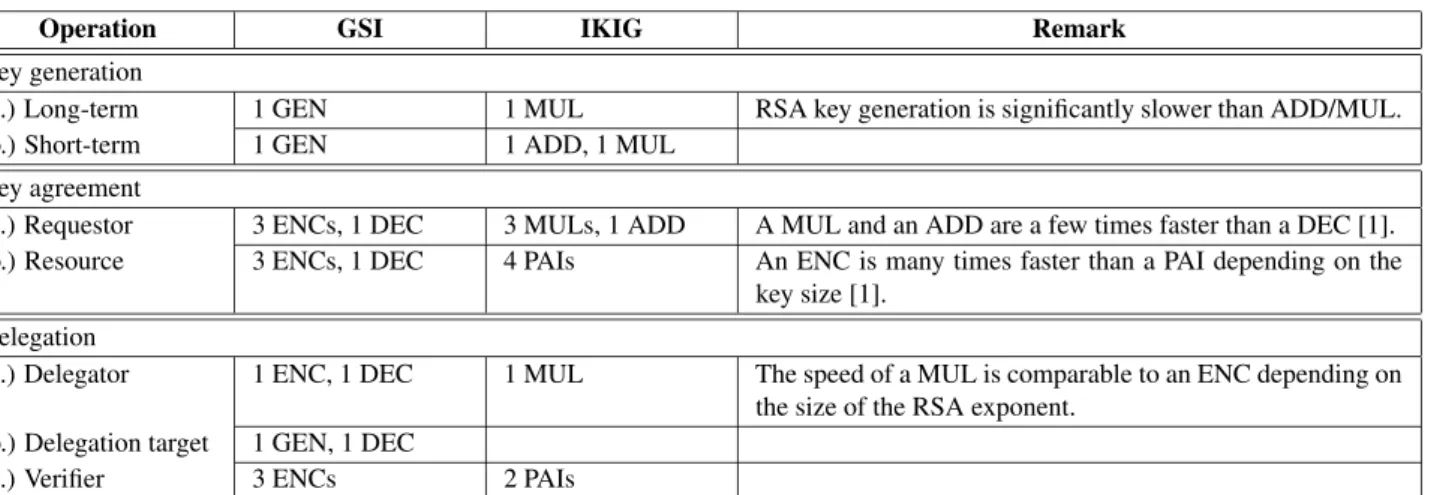
Computational Costs. We break down the computational complexity in both the GSI and our proposed IKIG in Ta-ble 3. Note that hashing is not a dominant operation and only adds minimal overheads to the overall computational costs. Thus it is excluded from the table. We assume that small public exponent is used for RSA encryption and pre-computation of pairing values is possible. Also, for simplic-ity, we limit the length of the delegation chain to one.
From Table 3, we can see that key generation and del-egation in the GSI are considerably slower than IKIG be-cause of the dominant computational costs in generating fresh RSA key parameters. Significant computational sav-ings can be achieved by the resource provider in the IKIG setting when it is needed to createndistinct proxy
creden-tials (used by the managed job services) for performingn
mutual authentications with ndifferent users at the same
time. Nevertheless, it seems that Protocol 1 is slower than the actual TLS protocol mainly because of the pairing com-putations. Fortunately in our proposed IKIG, the compu-tationally intensive pairing computations are performed at the high-performance resource’s side. Operations or com-putations at the user’s side appear to be lightweight, e.g. a HIBE encryption requires two MULs and a HIBS sign-ing needs one ADD and one MUL. We note that RSA and HIBE/HIBS schemes are very different from each other in terms of their mathematical properties and in some ways cannot be fairly compared. Therefore, we believe that it is fair to conclude that the overall computational costs for the IKIG setting is comparable to the GSI. Recent results (see for example [24]) have shown improvements in computing pairings with the use of various optimisation techniques and this should give hope to faster HIBE and HIBS schemes in
Table 3. Performance trade-offs in computational costs between the GSI and the IKIG settings in terms of cryptographic operations performed by the job requestor and the resource provider.
Operation GSI IKIG Remark
Key generation
(a.) Long-term 1 GEN 1 MUL RSA key generation is significantly slower than ADD/MUL. (b.) Short-term 1 GEN 1 ADD, 1 MUL
Key agreement
(a.) Requestor 3 ENCs, 1 DEC 3 MULs, 1 ADD A MUL and an ADD are a few times faster than a DEC [1]. (b.) Resource 3 ENCs, 1 DEC 4 PAIs An ENC is many times faster than a PAI depending on the
key size [1]. Delegation
(a.) Delegator 1 ENC, 1 DEC 1 MUL The speed of a MUL is comparable to an ENC depending on the size of the RSA exponent.
(b.) Delegation target 1 GEN, 1 DEC
(c.) Verifier 3 ENCs 2 PAIs
GEN = RSA parameter generation ENC = RSA encryption (modular exponentiation) DEC = RSA decryption (modular exponentiation) ADD = Elliptic curve point addition
MUL = Elliptic curve point multiplication PAI = Pairing computation the near future.
5 Discussion
In this section, we look into some practical issues sur-rounding the use of our IKIG approach.
5.1
Impact on Web Services Security
In the GT4, the GSI supports both transport-level and message-level security. The recommended use of transport-level security as the default option instead of fully web ser-vices based security is driven by the relatively poor perfor-mance of message-level security implementations which is clearly shown in [26]. XML representations of data tend to be significantly larger than their equivalent binary for-mats. An XML message can expand roughly 4 to 10 times over its equivalent binary representation [4]. This can sub-stantially increase the communication costs, the latency of sending/receiving SOAP messages, and the time needed for parsing the XML data.
By looking at using IBC for supporting the GSI as an al-ternative approach to the recommended RSA public key en-cryption and signature schemes, we envisage that the sizes of SOAP headers may well be reduced substantially. This is especially true considering the fact that two types of cer-tificates are used within a grid environment. Moreover, an identity-based public key is predictable, self-describing, and human-readable. Thus no tools are needed to parse and
render the key information. This is indeed a very desirable property and it matches a fundamental objective of XML.
5.2
Implementation Issues
Here, we identify some implementation issues that need to be addressed in IKIG. The features or functions available from current technologies and mechanisms used to support and implement the GSI need to be modified and extended to support identity-based techniques.
GSS-API. Currently, the GSI is built on top of Generic Security Service Application Program Interface (GSS-API) [19] that allows security services to be easily added into grid applications through a set of callers in a generic fashion [10]. GSS-API, which is both transport (communi-cation protocols) and mechanism (cryptographic schemes) independent, provides functions for obtaining credentials, performing authentication, encrypting and signing mes-sages, and so on. However, extensions to the standard GSS-API are needed to meet some of the GSI requirements, such as credential extensions handling and delegation at any time [21].
To implement IKIG, we envisage that a couple of ad-ditional functions may need to be included in GSS-API to support the proposed Protocols 1 and 2. One is when a client callsGSS_Init_sec_context()to establish a security token with a server, the server should be able to extract the client’s identifier rather than obtaining a X.509 certificate in the credential acquisition step. Secondly, we
require a delegation credential handle which can manage the use of signed delegation tokens in Protocol 2. Current standard GSS-API only uses a simple Boolean parameter for handling a delegation credential. This does not provide enough control over a delegation target. Since we have re-placed proxy certificates with signed delegation tokens, the delegation handle should be able to support mechanisms that offer better control including duration of delegation, constraints on the tasks that may be performed by the dele-gation target, and so on.
OpenSSL. The authentication library of the GSI is based on OpenSSL [22] with some modification for supporting the use of X.509 proxy certificates. This library, in turn, make uses of GSS-API (and some extensions) to perform mutual authentication and key agreement between two parties com-plying with the standard TLS handshake protocol of [5].
In the IKIG setting, we must define and include the
TLS_HIBC_WITH_DES_CBC_SHA cipher suite that we proposed for Protocol 1 to the current TLS specification. The IKIG-enabled OpenSSL library should be able to in-terpret system parameters used for the HIBE and HIBS schemes and allow creation of identity-based proxy creden-tials. A client and a server that are engaged in a run of Proto-col 1 must also be provided with the ability to construct pub-lic keys based on identifiers extracted through the GSS-API. Moreover, it is clear that the OpenSSL library will need to support message encryption/decryption and signature gen-eration/verification using HIBC in order to implement Pro-tocol 1.
XML Signature & Encryption. In GT4, the optional message-level security provided by the GSI is based on WS-Security standard and various specifications which make use of XML signatures and encryption as the building blocks. The current XML Signature and Encryption speci-fications cover only RSA and DSA based algorithms [6, 7]. In order to support web services security using HIBC, we need to define the syntax and processing of XML signatures and encryption for the HIBS and HIBE schemes. The HIBS and HIBE XML schema definition should include syntax used for paramaters for key generation, system parameters, group and element sizes, key values, and so on.
6 Conclusions
The development of grid computing and identity-based cryptography are amongst today’s most important techni-cal problems in the field of computer science and cryptol-ogy. We have discussed at length how identity-based tech-niques can replace conventional PKI and be used to offer an alternative security infrastructure for grid. The overall
computational overheads for our proposed identity-based key infrastructure seem to be comparable to PKI. Interest-ingly, the computational costs that would be incurred at the user’s client in our proposal is roughly a few times less than it is with PKI, at the expense of increased computation at the server side. This aligns well with the whole idea of grid computing to allow the user with an average- or low-end platform to “outsource” her computational tasks or op-erations to more powerful and high-performance servers. In terms of communication costs, our proposal appears to be significantly more lightweight and less bandwidth-consuming than PKI because of its certificate-free nature and small key sizes.
Acknowledgements
The authors would like to thank Steven Galbraith for helpful discussions about parameters selection in IKIG and anonymous referees for their useful feedback.
References
[1] P.S.L.M Barreto, H.Y Kim, B. Lynn, and M. Scott. Efficient algorithms for pairing-based cryptosystems. In M. Yung, editor, Advances in Cryptology - Pro-ceedings of CRYPTO 2002, pages 354–368. Springer-Verlag LNCS 2442, 2002.
[2] D. Boneh and M. Franklin. Identity-based encryption from the Weil pairing. In J. Kilian, editor,Advances in Cryptology - Proceedings of CRYPTO 2001, pages 213–229. Springer-Verlag LNCS 2139, 2001.
[3] L. Chen, H.W. Lim, and W. Mao. User-friendly grid security architecture and protocols. InProceedings of the 13th International Workshop on Security Protocols 2005, to appear.
[4] K. Chiu, M. Govindaraju, and R. Bramley. Investi-gating the limits of SOAP performance for scientific computing. InProceedings of 11th IEEE Symposium on High Performance Distributed Computing, pages 246–254. IEEE Computer Society Press, 2002. [5] T. Dierks and C. Allen. The TLS protocol version
1.0.The Internet Engineering Task Force (IETF), RFC 2246, January 1999.
[6] D. Eastlake, J.M. Reagle, and D. Solo. (Extensible Markup Language) XML-Signature syntax and pro-cessing.The Internet Engineering Task Force (IETF), RFC 3275, March 2002.
[7] D. Eastlake and J.M. Reagle, editors.XML Encryption Syntax and Processing, December 2002. Available at
http://www.w3.org/TR/xmlenc-core/, last accessed in June 2005.
[8] I. Foster and C. Kesselman. Globus: A metacomput-ing infrastructure toolkit.International Journal of Su-percomputing Applications, 11(2):115–128, 1997. [9] I. Foster and C. Kesselman, editors. The Grid 2:
Blueprint for a New Computing Infrastructure. Else-vier, San Francisco, 2004.
[10] I. Foster, C. Kesselman, G. Tsudik, and S. Tuecke. A security architecture for computational Grids. In Pro-ceedings of the 5th ACM Computer and Communica-tions Security Conference, pages 83–92. ACM Press, 1998.
[11] I. Foster, C. Kesselman, and S. Tuecke. The anatomy of the Grid: Enabling scalable virtual organizations.
International Journal of High Performance Comput-ing Applications, 15(3):200–222, 2001.
[12] S.D. Galbraith. Supersingular curves in cryptography. In C. Boyd, editor,Advances in Cryptology - Proceed-ings of ASIACRYPT 2001, pages 495–513. Springer-Verlag LNCS 2248, 2001.
[13] S.D. Galbraith, K. Harrison, and D. Soldera. Imple-menting the Tate pairing. In C. Fieker and D. Kohel, editors,Proceedings of the 5th International Sympo-sium on Algorithmic Number Theory (ANTS-V), pages 324–337. Springer-Verlag LNCS 2369, 2002. [14] C. Gentry and A. Silverberg. Hierarchical ID-Based
cryptography. In Y. Zheng, editor,Advances in Cryp-tology - Proceedings of ASIACRYPT 2002, pages 548– 566. Springer-Verlag LNCS 2501, 2002.
[15] J. Horwitz and B. Lynn. Towards hierarchical identity-based encryption. In L. Knudsen, editor, Advances in Cryptology - Proceedings of EUROCRYPT 2002, pages 466–481. Springer-Verlag LNCS 2332, 2002. [16] R. Housley, W. Polk, W. Ford, and D. Solo. Internet
X.509 public key infrastructure certificate and certifi-cate revocation list (CRL) profile. The Internet Engi-neering Task Force (IETF), RFC 3280, April 2002. [17] H.W. Lim and M.J.B. Robshaw. On identity-based
cryptography and GRID computing. In M. Bubak, G. Albada, P. Sloot, and J. Dongarra, editors, Proceed-ings of the 4th International Conference on Computa-tional Science (ICCS 2004), pages 474–477. Springer-Verlag LNCS 3036, 2004.
[18] H.W. Lim and M.J.B. Robshaw. A dynamic key infras-tructure for GRID. In P. Sloot, A. Hoekstra, T. Priol,
A. Reinefeld, and M. Bubak, editors,Proceedings of the European Grid Conference (EGC 2005), pages 255–264. Springer-Verlag LNCS 3470, 2005. [19] J. Linn. Generic security service application program
interface version 2, update 1. The Internet Engineer-ing Task Force (IETF), RFC 2743, January 2000. [20] W. Mao. An Identity-based Non-interactive
Authenti-cation Framework for Computational Grids. HP Lab, Technical Report HPL-2004-96, June 2004. Avail-able at http://www.hpl.hp.com/techreports/2004/HPL-2004-96.pdf.
[21] S. Meder, V. Welch, S. Tuecke, and D. Engert. GSS-API Extensions. Global Grid Forum (GGF) Grid Secu-rity Infrastructure Working Group, June 2004. Avail-able at http://www.ggf.org/documents/GFD.24.pdf, last accessed in September 2005.
[22] The OpenSSL Project. OpenSSL: The Open Source Toolkit for SSL/TLS, 2005. Available at http://www.openssl.org/, last accessed in September 2005.
[23] K.G. Paterson and G. Price. A comparison between traditional public key infrastructures and identity-based cryptography. Information Security Technical Report, 8(3):57–72, 2003.
[24] M. Scott. Computing the Tate pairing. In A. Menezes, editor, Proceedings of the RSA Conference: Topics in Cryptology - the Cryptographers’ Track (CT-RSA 2005), pages 293–304. Springer-Verlag LNCS 3376, 2005.
[25] A. Shamir. Identity-based cryptosystems and sig-nature schemes. In G. Blakley and D. Chaum, editors, Advances in Cryptology - Proceedings of CRYPTO’84, pages 47–53. Springer-Verlag LNCS 196, 1985.
[26] S. Shirasuna, A. Slominski, L. Fang, and D. Gannon. Performance comparison of security mechanisms for grid services. InProceedings of 5th IEEE/ACM Inter-national Workshop on Grid Computing (GRID 2004), pages 360–364. IEEE Computer Society Press, 2004. [27] S. Tuecke, V. Welch, D. Engert, L. Pearman, and
M. Thompson. Internet X.509 public key infrastruc-ture proxy certificate profile.The Internet Engineering Task Force (IETF), RFC 3820, June 2004.
[28] V. Welch, I. Foster, C. Kesselman, O. Mulmo, L. Pearlman, S. Tuecke, J. Gawor, S. Meder, and F. Siebenlist. X.509 proxy certificates for dynamic delegation. In Proceedings of the 3rd Annual PKI R&D Workshop, 2004.