Project Management Software: Allocation and Scheduling Aspects
C. Chantrapornchai, D. Sawangkokrouk and T. Leadprathom
Department of Computing
Faculty of Science, Silpakorn University, Thailand
[email protected]
Abstract
We discuss experiences in building the prototype of the project management software. We particularly investigate the aspect of resource allocation and scheduling. We attempt to integrate the automatic allocation and task scheduling to it. The database containing the information about the project, tasks, resource is designed. The tasks may be concurrent and requires many skills. Many employees can have many skills and may be available at different time. The allocation must be able to compromise this. Two scheduling schemes such as ASAP and ALAP are implemented in the tool. The case demonstration of the task assignment and scheduling are presented.
Keywords: Scheduling, ASAP, ALAP, Project Management
1. Introduction
Traditional project management deals with many phases: definition, planning, executing, control and closure of the project [1]. Each of them is important. One of the interesting issues is the scheduling and allocation which is in the planning phase. Scheduling is the process where tasks in the project are ordered to execute by the time. Allocation is the process where available resources in the project are assigned in order to execute the given task.
Scheduling and allocations are usually complex depending on constraints and factors considered in a project. The general problem of them is known to be NP-complete [2]. However, they are very important to many fields including project management. In this work, we discuss the issue of automatic scheduling and allocation and the integration into the project management software. We assume the schedule and allocation are separated steps to clarify the issues.
2. Backgrounds
There are many existing powerful and commercial project management software [3-7] To mention a few, RAMP is a staff allocation system developed by AirIT [8]. It includes the scheduling and planning features and operates in a client-server platform. In-step CoreProcess is a power project management software which includes all related phases in it such as project management, change management, risk management, etc. [9]. Microsoft project is another popular one which includes many key things such as Gantt charting, resource planning, etc.
Primavera is another project planner which contains planning and scheduling [10]. It includes the feature about budget and cost control.
In a theory of scheduling and allocation, they have been intensively used in many fields such as production and manufacturing, hardware design, project management, etc. [11-13]. (
Hagras and Janeček presented a dynamic and static list scheduling approach comparison for task scheduling in multiprocessors [14]. Bierwirth and Mattfeld proposed the production scheduling in manufacturing [15]. The approach uses the genetic algorithm and considers rescheduling. Herrmann also studied production scheduling from the organization perspectives which also related to the decision making [16].
Many work focused on the resource allocation only [17]. Some of them are related to project management and staff planning in certain application [18-21]. Sendt presented the applications of staff allocation in police rostering [22]. The allocation needs to consider the budget and the work time. Smith and Pyle proposed a project scheduling with the precedence constraint and resource constraint [20]. Eiselt and Marianov presented the employee and task allocation methods [23]. The problem is modeled with multiple objective integer linear programming. The approach is test with real world data from DICTUC S.A.. Herrmann discussed the previous three important works in the field by Taylor, Gantt, and Johnson who took different roles in the field related to production scheduling. Taylor discussed about planning in the organization while Gantt proposed a chart to help the scheduling and Johnson talked about the scheduling as an optimization problem [24].
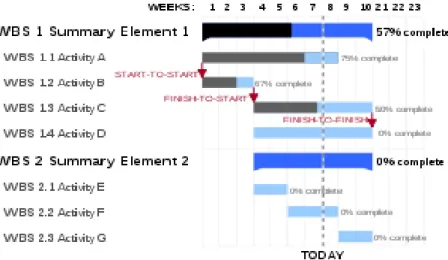
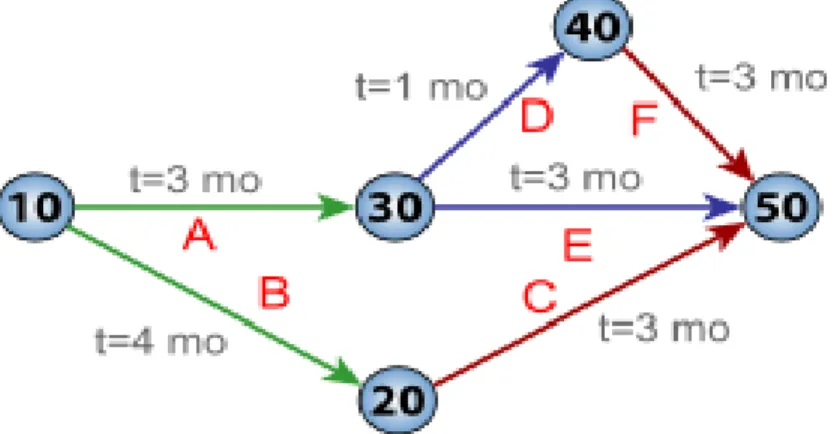
In project management, the Gantt chart was very commonly. It was developed by Henry Gantt in 1931. It presents the start time and the ending time of each task in the project (See Figure 1). The precedence relation between tasks may also be shown. PERT diagram is another tool develop by US Navy in 1950. It was intended to use to analyze the critical path (See Figure 2).
Figure 2. Example of PERT Diagram
http://upload.wikimedia.org/wikipedia/commons/thumb/3/37/Pert_chart_colored.svg/309px-Pert_chart_colored.svg.png
3. Methodology
The components that affect the scheduling and allocation are the criteria and constraints. Criteria are factors that need to be considered in the problem. The constraints are the conditions that the scheduling or allocation must meet. Certain criteria must be optimized to generate the optimal schedule/allocation.
3.1. Exploring Problem Definition
Relating to the project management, many information must be collected. Some may be identified as constraints and some may be identified as factors. Typical information are typical skills, staff and their skills, project details and their tasks as well as task information. The details may vary but most of the time, it is found that tasks’ deadline is needed for scheduling. Besides, each task may need more than one skill and each staff may have many skills. The available date of each staff is also not the same. Thus, the data needs to be known in priori before the schedule and allocation can be done. However, in reality, such information may be changed during the project execution. For example, staff may be reduced or some task may require more staff to keep up with the plan and so on. Then, the created schedule/allocation may need to be adjusted.
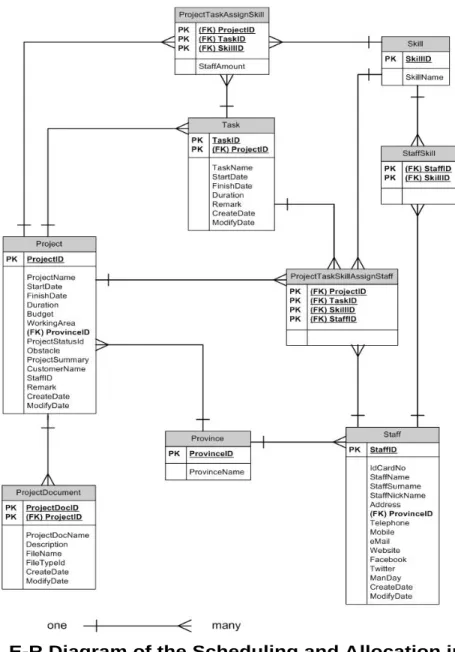
Figure 3 shows the E-R diagram of the prototype problem in this paper. The main issues are the timing of each task and skills of each tasks which are required to perform scheduling and allocation. Note that the previous assignment of the tasks to the staff must be included to show the date that each staff is not available. This assumes one staff can hold one task at a time in general.
Figure 3. E-R Diagram of the Scheduling and Allocation in Project Management
3.2. Allocation and Resource Assignment
Based on the earlier problem domain, the allocation of each task in the project can be created using the existing algorithm. In the project management, the approach is basically to match the appropriate available staff to each task. The complication occurs when there are more than one staff available for such a task and when there are many tasks that require the staff with the particular skill. Another issues may be the case when one task requires many staff of the same skill, etc.
3. Assume that one skill of a task requires one staff. For each skill of the task, find the staff that has the skill. If there are many staff that hold such a skill and each staff has more than one skill, we pick the staff with the least number of skills. This assumes the staff with the least number of skills have a limited choice to do other tasks.
4. From 3), if there are many staff, we pick the staff with the least payrate.
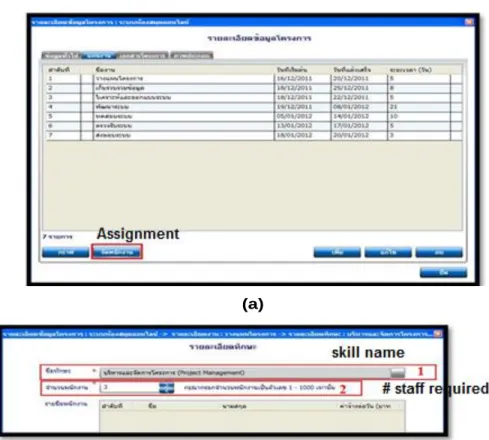
Note that steps 3-4 may be interchanged or updated depending on the criteria or business rules. Figure 4(a) shows the details of each task in the project. For each task, the skills and the number required are specified in Figure 4(b).
(a)
(b)
Figure 4. (a) The User Interface Showing the Details of each Task in the Project. The Highlight Button is the Staff Assignment Button (b) The User Interface Showing Skills required for each
Task
In Figure 5, the available staff with the skills information is matched with the task. The task is considered one by one to be assigned. Then the results are shown and saved to the database.
(a)
(b)
Figure 5.(a) Staff Details and Skills. (b)The Results of Assignment is Shown for each Task and can be Saved
The allocation results are integrated in the project report as in Figure 6. 3.3. Schedule Creation
In the application, both schedules can be created. A user can be view the schedule using ASAP and ALAP compared with the total task period. In Figure 7 the sample ASAP schedule is created and compared with each task period. At this point, the schedule and allocation are independent.
Figure 7. The Report of ASAP Schedule of Tasks compared with Task Periods
4. Conclusion
In project management software, scheduling and resource allocation are key parts in the planning phase. Scheduling is process that order the tasks according to time frame. Allocation is the process of assigning the proper resource (staff) to each task. Typically, both of them are related to each other. However, in most of the project management software, they are considered separatedly. The allocation may be more complicated since the matching of the skills between tasks and available staff is required. Besides, they are many criteria to be considered such as: Can each staff hold more than one task? Can one task may be assigned to many staff? Can staff be reassigned to the task? Etc. Thus, these criteria are business rules to be integrated in the algorithm. The common goal of the scheduling / allocation to create the assignment that minimizes the total project cost while all the tasks can be finished within the time frame.
To be more effective, considering the scheduling/allocations both at the same time are possible but complicated. For example, the allocation of the task and staff are considered together with the time frame of each task. Also, the staff may be reassigned to some shorter period of the task or the staff may be assigned to more than one task at a time. During the project execution, the schedule/allocation plan may be updated to followup the schedule and resource reassignment may be done to keep up with the plan or changes.
References
[1] “What is Project Management?”, MPUG.com, (2012), http://www.mpug.com/Pages/
WhatisProjectManagement.aspx#.UERQB9bN__I.
[2] M. R. Garey and D. S. Johnson, “Computers and Intractability: A Guide to the Theory of NP -Completeness”, W. H. Freeman, (1979).
[3] “Production Scheduling and Manufacturing Resource Planning System”, Giraffe Production Systems, (2012), http://www.giraffeproductionsystems.net/gssbenefits.htm.
[4] “Project management”, Wikipedia, the free encyclopedia, (2012),
http://en.wikipedia.org/wiki/Project_management.
[5] “Production Scheduling Manufacturing Software for Manufacturers and Precision Engineers ”, KeyVak, (2011), http://www.keyvak.com/.
[6] “Production Scheduling Software and Advanced Planning and Scheduling Software ”, Waterloo Manufacturing Software, (2012), http://www.waterloo-software.com/.
[7] “Manufacturing Resource Planning”, BTerrell Group, LLP, (2012),
http://www.bterrell.com/specialties/manufacturing/.
[8] “Ramp Staff Allocation System”, Air-Transport IT Services, Inc., (2012),
http://www.airit.com/assets/pdfs/Ramp_000.pdf. [9] Microtool.de, in-Step Core Process Edition, (2012). [10] Primavera, Primavera Project Planner, (2004).
[11] C. Artigues, S. Demassey and N. Emmanuel, (Eds.), “Models, Algorithms, Extensions and Applications”, Wiley, (2008).
[12 S. Govindarajan, “Scheduling Algorithms for High-level Synthesis”, (1995).
[13] E. M. Dar-Ela and Y. Tura, “A Multi-Resource Project Scheduling Algorithm”, AIIE Transactions, vol. 9, no. 1, pp. 44-52.
[14] T. Hagras and J. Janeček, “Static vs. Dynamic List-Scheduling Performance Comparison”, Acta Polytechnica, vol. 43, no. 6, (1977), pp. 16-21, 2003.
[15] C. Bierwirth and D. C. Mattfeld, “Production Scheduling and Rescheduling with Genetic Algorithms”, Evolutionary Computation, vol. 7, no. 1, (1977), pp. 1-17.
[16] J. W. Herrmann, “Improving Production Scheduling: Integrating Organizational, Decision -Making, and Problem-Solving Perspectives”, Industrial Engineering Research Conference, Orlando, Florida, (2006).
[17] L. D. Oteroa, G. Centenoa, A. J. Ruiz-Torresb and C. E. Oteroc, “A systematic approach for resource allocation in software projects”, Computers & Industrial Engineering, vol. 56, (2009), pp. 1333– 1339.
[18] N. Margaliot, “A Model for the Computerized Allocation of Personnel Resources among Local Bureaus by a Municipal Department of Social Services ”, Computers in Human Services, vol. 14, no. 2, (1997), pp. 1-16.
[19] D. R. Coleman and J. R. Bolte, “A Theoretical Approach for Internal Allocation of Academic Personnel Resources”, Education Resource Information Center, (1976).
[20] T. B. Smith and J. M. Pyle, “An Effective Algorithm for Project Scheduling with Arbitrary Temporal”, American Association for Artificial Intelligence (www.aaai.org), (2004).
[21] P. L. Little and S. A. Saulmon, Task-oriented staff allocation, Oklahoma city, (1978), pp. 29. [22] R. J. Sendt, “NSW Police Service: Staff Rostering”, Audit Office of New South Wales, New South
Wales, (2000).
[23] H. Eiselt and V. Marianov, “Employee positioning and workload allocation ”, Computers & Operations Research, vol. 35, no. 2008, (2008), pp. 513-524.
[24] J. W. Herrmann, “The Perspectives of Taylor, Gantt, and Johnson: How to Improve Production Scheduling”, IJOQM, vol. 16, no. 3, (2010), pp. 243-254.