Skyline Computing over multiple Data
Streams with a Storm Cluster.
Anders Fredrik Ulvig Kiær
Master of Science in Informatics
Supervisor: Kjell Bratbergsengen, IDI
Department of Computer and Information Science Submission date: March 2014
Problem Description
This project aims to design and implement stream processing algorithms for solving the skyline problem over stream data. It includes a short literature study of existing techniques proposed for this topic. Then, the designed algorithms will be imple-mented using Storm (http://storm-project.net/). The student on this project will become familiar with state-of-the-art technologies for data management and pro-cessing in cloud computing or cluster platforms. A prerequisite is good knowledge of a programming languages (preferably Java), and good knowledge of database systems.
Veileder: Kjell Bratbergsengen.
Abstract
Skyline computing has received considerable attention over the last decade. The skyline of a multidimensional point set, consist of interesting points which are not dominated by any other point within base set. Lately the attention has especially been related to computing over data streams. This thesis targets multiple horizon-tal split streams, using horizonhorizon-tal and vertical scaling provided by Storm, a stream processing framework for cluster. Skylines are incrementally computed when data from streams are received. When multiple layers of skylines are utilized, every increment of a skyline is send onto next layer for further computing. The last layer will contain the final skyline set. Different Storm topologies were proposed, implemented and tested. A discussion of significant observations and an overall conclusion is presented. Some adoptions and optimizations were made towards algorithm completeness to suit an imaged stock exchange setting with limited re-sources available for a stock trader.
Sammendrag
Skylineberegninger1 har f˚att stor oppmerksomhet det siste ti˚aret. Skyliner fra et sett med flerdimensjonale punkt, best˚ar av interessante punkter som ikke er domin-ert av noe annet punkt fra det opprinnelige settet. I det siste har oppmerksomheten særlig vært knyttet til ˚a beregne skyliner over datastrømmer. Denne avhandlingen sikter p˚a ˚a beregne skyliner over horisontalt delte kilder, ved hjelp av horisontal og vertikal skalering levert av Storm, et strømprosessering rammeverk for maskinklyn-ger. Skyliner beregnes trinnvis n˚ar data fra kilder mottas. N˚ar flere lag med pros-essering benyttes for ˚a beregne skyliner, blir hvert inkrement av en skyline sendt til neste lag for videre beregning. Det siste laget vil inneholde det ferdige skyline settet. Forskjellige topologier for Storm ble foresl˚att, implementert og testet. En diskusjon av vesentlige observasjoner og en konklusjon er presentert. Noen tilpas-ninger og optimaliseringer ble gjort med tanke p˚a algoritmefullstendighet. Det ble gjennomført for ˚a tilpasse en skissert situasjon, hvor en aksjemegler p˚a børsen har begrensede ressurser tilgjengelig for dataprosessering.
1Det ble bevisst valgt ˚a bruke det engelske begrepetskyline. Det ville kunne oversettes med
horisont, men det ville nødvendigvis ikke representert beregningen med samme innarbeidede faglige tyngde somskyline.
Preface
This master thesis was submitted to the Norwegian University of Science and Tech-nology, NTNU, as a part of the requirements for a masters degree in Informatics.
Acknowledgements
I would like to thank Prof. Kjell Bratbergsengen and Prof. Kjetil Nørv˚ag from the Department of Computer and Information Science at the NTNU, for their guidance during the work with this thesis. Kjetil guided me at the start of the thesis before he took off for his abroad year of research. Kjell stepped up and guided me through the end. Thanks to you both!
I would like to thank my family and friends for inspiring me and supporting me. An extra thank goes to family and friends lending me some of the needed equipment. I will also give a special tank to my love for bearing with me during the sometimes hectic work periods.
CONTENTS xi
Contents
Problem Description v
Abstract vii
Sammendrag ix
List of Figures xiv
List of Tables xv
Abbreviations xv
1 Introduction 1
1.1 The Era of Big Data . . . 1
1.2 Problem description . . . 2
1.3 The Aim of This Thesis . . . 3
1.4 Computing Resources . . . 3 1.5 Outline . . . 4 2 Background 5 2.1 Skyline . . . 5 2.1.1 Windows . . . 5 2.1.2 Constrained Skyline . . . 6 2.1.3 Runtime . . . 7 2.1.4 Optimizations . . . 7 2.1.5 Input Data . . . 8 2.2 Related work . . . 9
3 State of the Art 10 3.1 S4 . . . 11 3.2 Esper . . . 11 3.3 StreamBase . . . 11 3.4 Hadoop . . . 12 4 Storm 13 4.1 Spouts . . . 14 4.2 Bolts . . . 15 4.3 Topologies . . . 15 4.4 Streams . . . 16 4.5 Clusters . . . 16 4.6 Nodes . . . 18 4.7 Worker breakdown . . . 18
4.8 Workers message passing . . . 19
4.9 Reliability . . . 20
CONTENTS xii
4.11 Scalability . . . 21
4.12 Roadmap . . . 22
5 Programming with Storm 22 5.1 Spouts . . . 23 5.2 Bolts . . . 24 5.3 Topologies . . . 25 5.3.1 Configuration . . . 26 5.3.2 Tick Tuples . . . 28 5.3.3 Building Topologies . . . 29 5.3.4 Walk-through . . . 31 6 Method 32 6.1 Constrained Skyline . . . 33 6.2 Optimizations . . . 34 6.3 Data generation . . . 35 6.4 Basic Components . . . 36 6.4.1 BinFileReadSpout . . . 36 6.4.2 SimpleSkylineBolt . . . 37 6.4.3 FilterForwardSkylineBolt . . . 37 6.4.4 IncrForwardSkylineBolt . . . 37 6.5 Topologies . . . 37 6.5.1 BlackHoleTopology . . . 38 6.5.2 SimpleSkylineTopology . . . 38 6.5.3 FilteredSimpleSkylineTopology . . . 39 6.5.4 ImprovedSkylineTopology . . . 40 6.5.5 FilteredImprovedSkylineTopology . . . 40 6.5.6 BroadcastSkylineTopology . . . 41
7 Results and Discussion 43 7.1 Results . . . 43 7.1.1 BlackHoleTopology . . . 44 7.1.2 SimpleSkylineTopology . . . 44 7.1.3 FilteredSimpleSkylineTopology . . . 45 7.1.4 ImprovedSkylineTopology . . . 45 7.1.5 FilteredImprovedSkylineTopology . . . 46 7.1.6 BroadcastSkylineTopology . . . 47 7.2 Discussion . . . 47 7.2.1 Environment . . . 47 7.2.2 Datasets . . . 49 7.2.3 Weaknesses . . . 49 7.2.4 Performance . . . 51 7.2.5 Trouble . . . 53
8 Conclusion and Recommendations 56 8.1 Conclusion . . . 56
CONTENTS xiii
8.2 Recommendations . . . 57
9 Appendix: Details 62 9.1 Setup of local Storm cluster . . . 63
9.1.1 Make the workstation ready . . . 63
9.1.2 Compiling and packaging of dependencies . . . 63
9.1.3 Setting up a fresh storm project . . . 63
9.1.4 Error probing . . . 65
9.1.5 Fault handling . . . 65
9.2 Setup of remote Storm cluster . . . 65
9.2.1 Requirements for Storm cluster . . . 65
9.2.2 Setup Storm Clusters . . . 66
9.3 Storm CLI . . . 71
9.4 Java Virtual Machines . . . 72
9.5 Changing Storm Parallelism on the fly . . . 73
9.6 Troubleshooting . . . 74
LIST OF FIGURES xiv
List of Figures
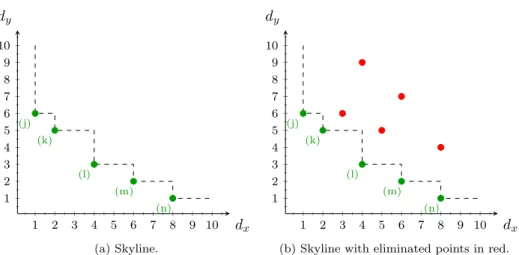
1 A two dimensional skyline. . . 6
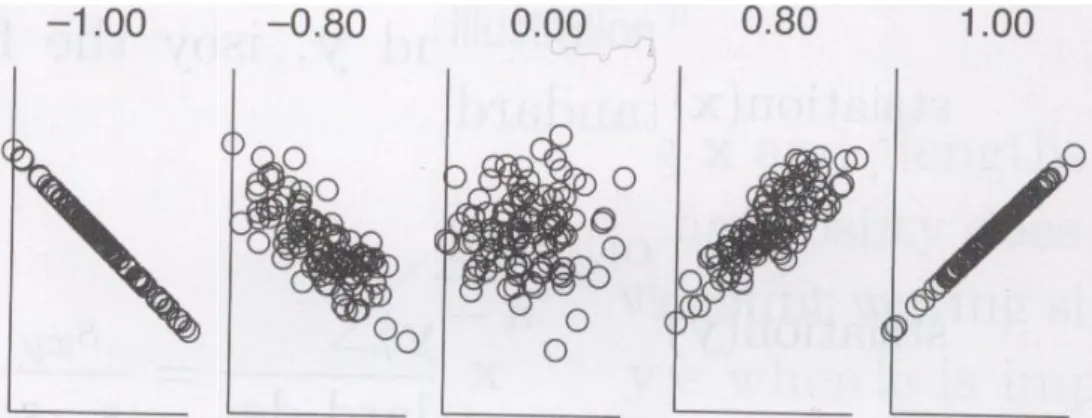
2 Scatter plots illustrating different correlation. . . 8
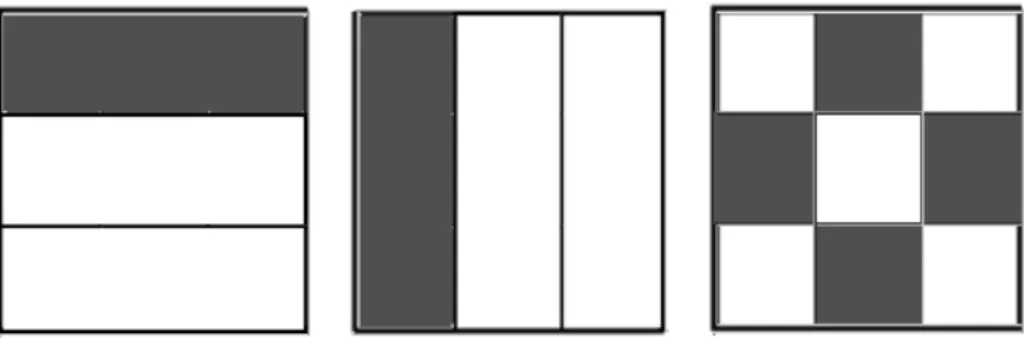
3 Data splits. . . 9
4 BOCS distributed monitoring architecture. . . 10
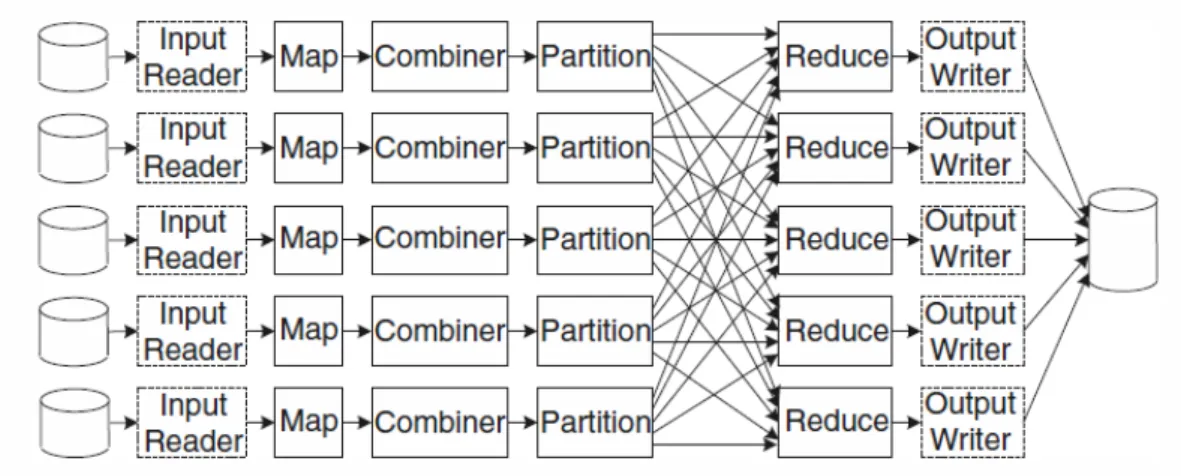
5 Dataflow in Map-Reduce. . . 13
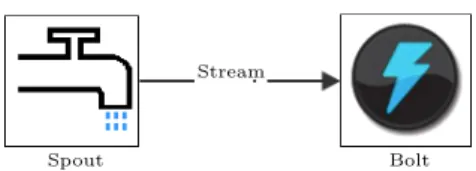
6 Basic topology with spout stream and bolt. . . 15
7 Star network topology. . . 17
8 Fat tree network topology. . . 17
9 Mesh network topology . . . 17
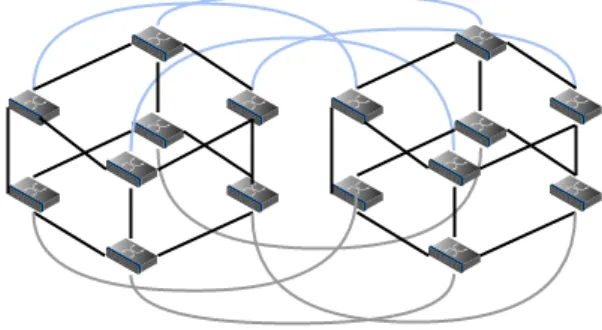
10 4D Hypercube network topology . . . 18
11 Storm cluster nodes. . . 18
12 Supervisor andWorker breakdown. . . 19
13 Inter-worker communication. . . 20 14 Generate-Dataset-Topology. . . 36 15 Black-Hole-Topology. . . 39 16 Simple-Skyline-Topology. . . 39 17 Filtered-Simple-Skyline-Topology. . . 40 18 Improved-Skyline-Topology. . . 41 19 Filtered-Improved-Skyline-Topology. . . 41 20 Broadcast-Skyline-Topology. . . 42
21 Storm cluster environment. . . 48
22 Possible utilization on single CPU node. . . 52
LIST OF TABLES xv
List of Tables
1 BlackHoleTopology results. . . 44 2 SimpleSkylineTopology results. . . 45 3 FilteredSimpleSkylineTopology results. . . 45 4 ImprovedSkylineTopology results. . . 46 5 FilteredImprovedSkylineTopology results. . . 46Abbreviations
API Application Programming Interface
CLI Command Line Interface
CPU Central Processing Unit
DRPC Distributed Remote Procedure Call
DSL Domain Specific Language
GC Garbage Collector
HDD Hard Disk Drive
JDK Java Development Kit
JVM Java Virtual Machine
MPS Messages per second
NTNU Norwegian University of Science and Technology
RAM Random Acess Memory
SQL Structed Query Language
UI User Interface
1 INTRODUCTION 1
1
Introduction
1.1
The Era of Big Data
Rapid advances in data collection and storage technology together with a huge in-crease of devices containing sensors connected at the edges of networks, made the world generate over 1 ZB of data in 2010, and amazing 2.8 ZB in 2012 and by 2014 we will generate 7 ZB a year [62]. Technology advancement has enabled organi-zations and government agencies to generate, capture and utilize huge amounts of data.
To handle the increasing flood of data, the trend has been to scale up by in-creasing storage and processing power in mainframes. As Moores law hit the wall, naturally mainframes did the same. For batch processing, the breakthrough came with Google-filesystem, followed by Hadoop-filesystem, and Hadoop Map-Reduce. Big clusters processing through the big data overnight, with Hadoop, gave an ad-mirable advantage of knowledge. Data that had been considered worthless waste accumulated over time, could now produce useful information. The advantages in-clude showing better search results, more appropriate advertises for products and much more.
It is no big secret that search of knowledge from fresh data is even more valu-able. In a competitive market with close to real-time processing of data streams, sometimes two minutes can be too late. E.g. for time-sensitive problem instances like detecting and catching fraud, it is obvious that big data must be used as soon as it streams into your enterprise, in order to maximize its value [17].
1 INTRODUCTION 2
1.2
Problem description
With the entrance of high-frequency trading robots to the stock exchange, day trading literally became impossible without help from computers to extract useful information from the stock exchanges’ order books. An order book can simply be imagined as a two sided electronic list, to keep track of sellers and buyers interests. At given times, one or more matching engines would run, using the list as input, and fulfil a deal when the interest match.
Most stock exchanges only take a commission when a trade is conducted, allow-ing robots to flood order books with illegitimate interests that has no other purpose than trying to manipulate the market and deceive humans and other robots. Direct manipulation of stocks is illegal, but the robots are getting away with this behavior. This behavior is rather a political problem.
To face the change, big trading companies put millions of dollars into razor sharp equipment and well educated mathematicians, without facing the resource constraints as individuals or small businesses. The amount of knowledge they are able to extract give them an admirable advantage.
This thesis was done with the following constraints in mind, a stock exchange setting, and a rather limited level of resources available. The problem input was defined as one or multiple data streams, originating from one or multiple stock exchanges, and containing information about stocks and interest changes. The resources available would put an efficient constraint on how much consumption of data that is possible. The data streams are considered endless and may have a higher data rate and throughput, than what available resources can consume. In reality, packages with information would be skipped. In my test cases, the input is tuned or throttled close to the utilized equipment’s maximum possible throughput. With a flood of arriving data one adaptation was utilized. Data considered not useful at the time of arrival are not accumulated for later use. It exist no chance to run over old data a second time, as new and more precious data is already available from the streams. That again imply that we can not get an algorithm output, that can be considered complete.
1 INTRODUCTION 3
1.3
The Aim of This Thesis
The aim of this thesis, derived from problem description above, is to introduce low latency skyline computation in a stream environment on an endless stream of generated data. Calculating skylines continuously on the fly instead of calculating it on requests. That will be done on a small cluster using Storm [27], a cluster stream processing framework. This work is hopefully highlighting some of the pitfalls and many challenges on the road.
1.4
Computing Resources
NTNU offered shared access to one of their small clusters. That offer was appreci-ated but not utilized because of a set of reasons including:
• The ability to utilize the cluster exactly at the time when it was needed. Storm has the ability to run locally for debugging, however some issues is directly related to, or first visible when running distributed.
• The ability to modify all needed software and underlying operative system configuration in any needed way. Including cherry picking a Storm version with specific dependencies.
• Available resources in reach to assembly a personal cluster.
A personal cluster was therefore built in a shared student flat. The cluster network was composed of spare parts originating from participation in organizing computer gatherings. The compute nodes were spare computers both my own and computers supplied by friends and family.
1 INTRODUCTION 4
1.5
Outline
Section 1 gives an introduction to this thesis. The remainder is organized as fol-lows: Chapter 2 contains background information on skylines and related work. Section 3 gives a short review on state of the art stream processing frameworks. Section 4 describes core concepts of Storm framework. Section 5 introduces some essential parts of Storms programming interface. Section 6 describes method and implementations. Section 7 present results and a related discussion. Chapter 8 concludes this thesis.
Notices:
• The complete appendix is my work and covers solutions to tasks I ran into during setup, configuring and controlling one small personal Storm cluster. It is meant as a starting point guide for easing replication, and giving possible future projects a smoother start.
2 BACKGROUND 5
2
Background
2.1
Skyline
The Skyline operator has been around for a while in the database research world. It has been a hot research topic over at least the last decade. The problem was known as the maximum vector problem, before [46] introduced it as the skyline operator [52] [46]. Skylines have been found suitable for applications doing multi criteria based optimizations, decision making and finding user preferences [47] [52]. A common example for usage is the stock trader that needs to know which stocks that are worth investing in, based on trading records [47]. The skyline problem was first studied in a centralized way, but as evolution has pushed ahead for storing and processing in a distributed way, distributed approaches have also been covered [52].
Definition 1 (The Skyline operator):
The Skyline operator filters out an interesting set of points from a potential large set of points. A point is interesting if it is not dominated by any other point [46]. A pointp1 is dominating pointp2, if pointp1 is found to be equal or better than pointp2 in all dimension and is at least better in one of the dimensions [46].
A commonly used problem instance is querying on a hotel distance price rela-tion, a users preference may be to get the cheapest hotels with the shortest distance to the beach [47] [46] [52]. In many cases will the preference for a dimension be a vector containing signs for each dimension that can be used to decide what is better, lower or higher values. It is also possible to implement logic in a domain specified function for handling the comparison and decision. For prototype imple-menting a skyline is the feature not extremely relevant as it only adds a different constant to the runtime of eachp1 comparisonp2. So from now on will the thesis stick with the simplification, that the lower values is best. An example skyline is shown in Figure 1 on page 6.
2.1.1 Windows
”A data stream is a real-time, continuous, ordered (implicitly by arrival time or explicitly by timestamp) sequence of items. It is impossible to control the order in which items arrive, nor is it feasible to locally store a stream in its entirety.” [51]
As a stream is considered endless, it is obvious that in most cases the problem instance will be constrained to return results from a specific portion of the stream that we are able to keep in memory, called a window. The window could be de-fined to, e.g. process and return results based on information arrived the last 15 minutes, hour, day or even seconds. Such a window is called a time based window,
2 BACKGROUND 6 1 2 3 4 5 6 7 8 9 10 1 2 3 4 5 6 7 8 9 10 (j) (k) (l) (m) (n) dx dy (a) Skyline. 1 2 3 4 5 6 7 8 9 10 1 2 3 4 5 6 7 8 9 10 (j) (k) (l) (m) (n) dx dy
(b) Skyline with eliminated points in red. Figure 1: A two dimensional skyline.
also known as physical window. Windows can also be based on count, or other metrics. A count based window could limit the window to the last ten, hundred, thousand, ten thousand... or even million last received packets. This is also known as a logical window [51].
Windows can be classified with the following domains. The direction of move-ment and update interval. First the movemove-ment, if the window has two fixed end-points it is defined as afixed window. If it has one fixed and one moving endpoint it would be defined as alandmark window and finally if it has two moving endpoints, either forwards or backwards, it is defined as a sliding window [51]. Second, the update interval: Eagerorlazy. The eager interval updates the window upon arrival of each new item, also called tuple. The lazy interval is like batching, and induces a jumping window. In the case the interval is larger than the window size, it will result in a non-overlapping series of tumbling windows [51].
When using a query model it is typical to define how often, or at what interval, the operator should run the query over the defined window.
2.1.2 Constrained Skyline
A constrained skyline is calculated with constraints on one or multiple specified dimensions. In a stock trade example a stock trader might want to only obtain skyline points, imitating stocks, with last trading prices between X and Y [47]. Depending on requirements, a subspace can be defined and points failing the con-straint can be optimized away. A range specifying a concon-straint does not need to be
2 BACKGROUND 7
closed. A constraint on skyline points may be applied by a complex function that includes usage of knowledge from other data sources, and is therefore not limited to number ranges.
[63, J. Lin and J. Wei] bring up some of the typical assumption connected with computing skylines and highlights constrained skylines as one of them. They also suggest a method for efficient compute constrained skyline points over streams against a count-based sliding window.
2.1.3 Runtime
If the skyline operator is implemented as defined inDef.1 (on page 5) using nested loop construct, runtime of theddimensional Skyline will be number of input points
nmultiplied with points in Skylinem. Runtime will be equal toO(nm), with the compression of points to be done in constant time.
For the special case: one dimensional Skyline, runtime would be trivial. The Skyline m can only hold instances of the current minimum value, that all would have the same numeric value. That taken into account, runtime for this case will be nmultiplied with m, andm defined as 1 andndefined as problem input size. So the runtime with one dimension will be equal toO(n).
2.1.4 Optimizations
Many skyline implementations over data streams utilize a count or time based sliding window. Updating a sliding window is expensive and therefore many of the proposed optimizations are directly targeted towards an update of the sliding window as it progresses. One possible way of doing that builds on the idea of memorizing relationships between current skyline points and its successors [59]. It also exist optimizations targeting static datasets, datasets where the entire prob-lem input is available. Existing optimizations strategies towards a static dataset includes usage of; Indexes, R*tree, presorting, divide and conquer (dividing into incomparable partitions), distribution, P2P, usage of filterpoints (thereunder killer tuples), scoring filter and calculations of area of a dominated region. Some of those optimization strategies used for static data can also be utilized over streams.
An optimization for processing points with a high dimensionality over streams, is to vertically split points to temporary disconnect them from dimensions not needed for computing. That will save both bandwidth and increase data locality.
2 BACKGROUND 8
Figure 2: Scatter plots illustrating different correlation. Stripped down figure from, [57, p.78].
2.1.5 Input Data
There exist many forms of input data. Input data can be based on synthetic data or real data, or a mix. Real datasets, are datasets captured from real world events without any modifications. A modified real dataset is considered to be a synthetic dataset. Synthetic datasets are normally not originating from a real world source. They are typically generated in a sub random way to have a given distribution and comply to a given set of predefined attributes that necessarily would not show up in real world data.
It is common to describe the linear relationships between dimensions in a dataset. That is done statistically with calculating correlation coefficient. A lin-ear coefficient is always in the range -1 to 1. There are more ways to calculate the coefficient depending on the data type. What they all share is that a correlation co-efficient of one means that the data points have a perfect correlation. Zero means none correlation found and negative means that the data is anti-correlated [57, p.76-78,375]. Scatter points illustrating different correlations are shown in Figure 2 on page 8.
When big amounts of multidimensional data are processed, they are often sub-jected to horizontal and vertical split. Horizontal data-split indicates that a dataset with data-points represented as rows, is split into subsets containing complete rows. Vertical split, may be a split on specific dimensions or columns. Vertical split is often done on multi-dimensional data to disconnect dimensions that are not needed for the calculation you want to do on the dataset. Most times an identifier is kept or created, to make it possible to rejoin data-points with its other dimensions at a later point. A mixed split utilize both vertical and horizontal data-splits. The splits are represented graphically in Figure 3 on page 9.
2 BACKGROUND 9
Figure 3: Data splits.
First datasheet is showing a horizontal split on rows. Second a vertical split on columns. Third a mixed split on columns and rows. Grey indicates a possible
portion.
2.2
Related work
[52, K. Hose and A. Vlachou] present a great overview over what has been done and some topics that require more attention in research on the skyline operator in highly distributed environments.
[59, Sun et al.] propose BOCS, an algorithm to address continuous skyline queries over multiple distributed data streams. BOCS distributed monitoring ar-chitecture is represented in Figure 4. (on page 10). BOCS consists of two parts, a communication protocol named as the algorithm, and a centralized algorithm named GridSky. The BOCS name derives from how the communication protocol is designed. It is Based On Changes of Skyline. As the name indicates, only in-cremental changes also named delta skylines will be sent from remote sites to a coordinator site. The receiving coordinator site preserves the delta skylines and utilizes GridSky to update the global skyline. GridSky is also used on remote sites to do a progressive update of their local skylines.
GridSky is an algorithm for efficiently creating and updating a skyline under a sliding window. It uses an event list to memorize and handle expiration of skyline points, and to replace points with their proper successors. GridSky organizes its data objects in a basic grid. On arrival of new points that grid is utilized for efficiently finding dominated objects and the amount of time it will maximum stay in the window.
The approach of this thesis differs from [59] in multiple ways. With the utilized stream processing framework, a shared nothing can be combined with a shared strategy. BOCS uses a shared nothing architecture. In this thesis a horizontal Central Processing Unit (CPU) scaling over nodes will have a shared nothing
ar-3 STATE OF THE ART 10
Increases sent to global skyline
Cordinator site 0 Remote site 0 Remote site i Remote site m
Set of objects, observed on remote stream.
Set of objects, observed on remote stream. Set of objects, observed on
remote stream.
Figure 4: BOCS distributed monitoring architecture. [59]
chitecture, and vertical CPU scaling on nodes will utilize shared level two caches. This thesis also stands out with its choice of filter usage and the usage of a tumbled landmark window. However, validity of points might be better ensured for general purpose skylines with usage of a sliding window.
3
State of the Art
This part will show some major differences from Storm to other state of the art close to real-time stream processing alternatives. Processing Big Data is not new, and has been done for a while with Hadoop. Therefore Hadoop basics will be covered to some extent to make it clear: Hadoops batch processing, (with Map-Reduce) is very different. A modification of Hadoop can not turn Hadoop in to a high throughput stream-processing framework like Storm.
3 STATE OF THE ART 11
3.1
S4
”S4 is a general-purpose, distributed, scalable, fault-tolerant, pluggable platform that allows programmers to easily develop applications for processing continuous unbounded streams of data.” [24] S4 might be the closest competitor to Storm. The biggest difference is its lack of support for guaranteed message processing [22]. S4 has the disadvantage of having complex xml to set up its streams, and is also more complex to debug. S4 has automatic load-balancing, but it comes with the disadvantage of opaque task distribution. So overall Storm seems to be superior. We might see a slowly death of S4 as the founder, YAHOO, seems to have taken Storm into production for some of its own loads [20]. The overall activity, and the activity on mailing lists on [25, S4 Project Incubation Status] is not looking too promising.
3.2
Esper
Esper is a component for complex event processing (CEP) and event series analysis. Esper is designed to be highly scalable and fault tolerant. Still the design goal of Esper core is not to scale across distributed Java Virtual Machines (JVM) [53]. Esper can be queried continuously in a Structed Query Language, SQL, like style and contains a lot of the operators we are familiar with from the database domain. Esper leaves it up to the user to feed it with data in a distributed and failsafe way. Esper has a lot of different aggregation-functions that can be done on streams. Where it falls short, Esper was not designed for horizontal scalability on distributed clusters.
3.3
StreamBase
Streambase is a CEP that originate from a high frequency stock trading system for use on the Wall Street, to a fully featured CEP. Streambase is fronting domain specific language, built on the JVM, with a graphical graph based data-flow. It allows extending through an API and is shipped with a pluggable message system supporting guaranteed message passing. StreamBase has cluster scalability, reli-ability, low latency and high throughput. It can typically process 100 thousand of messages per second. It comes loaded with a great feature set of options, and solutions to typically predefined sets of problems [9] [61].
Compared to Storm, StreamBase is complex software. It is also proprietary and the source code is not publicly available. StreamBases reliability relies on a hot standbys. Hot standby enables a very fast recovery and lower guaranteed latency in the case of failure [61].
3 STATE OF THE ART 12
3.4
Hadoop
Hadoop is a batch orientated framework for distributed computing, processing massive amounts of data in parallel. Hadoop provides high scalability and re-liability for computational problems that can be expressed in the Map-Reduce paradigm [18] [43].
Map-Reduce
The core concepts of Map-Reduce is a mapping phase followed by a reduce phase. The map phase transforms an input data row of key and value to an output list of key/value pairs:
Listing 1: ’The Map [16]’
1 map(key1,value) -> list<key2,value2>
For an input row the Map returns a list containing zero or more (key,value) pairs.The output can have a different key from the input, and the same key may have multiple entries [16].
In the reduce phase, ”a reduce transform is provided to take all values for a specific key, and generate a new list of the reduced output.” [16]
Listing 2: ’The Reduce [16]’
1 reduce(key2, list<value2>) -> list<value3>
Map and reduce processes need to be stateless, not depending on any data generated in the same Map-Reduce job to achieve maximum parallelism. It is no feature to control in which order maps or reductions runs. The reduce operation will not happen until all the Maps are done, implying that results are unavailable until the entire mapping phase is finished [18].
The parallel dataflow in a Map-Reduce is excellently shown in Figure 5 on page 13, taken from [48]. The figure shows the enter and exit points for the stored data. The combiner function is an optional function to do partial merging based on keys, having pairs with the same key value to be handled as one group by the reducer. The optional partitioning function is provided to make user-defined partitioning in cases where the general partitioning falls short [48].
4 STORM 13
Figure 5: Dataflow in Map-Reduce. Copied from [48].
Filesystem
Hadoop also provides a distributed file system that stores multiple copies of the data distributed on the compute nodes. It enables Hadoop applications to reliably work with petabytes of data [16].
4
Storm
Storm is a distributed, reliable, fault-tolerant system for processing streams of data [54]. The Storm project is free and got open-sourced 17th September 2011 and is lead by Nathan Marz. It consisted then of approximately 15 thousand lines of code, roughly divided fifty-fifty between Java and Clojure [36] [1]. Storm can be used with many programming languages as it utilizes Apache Thrift for service deployment [6]. Storm also comes with a great and simple API [5].
”Storm exists in the same space as complex event processing systems like Esper, Streambase, and S4. Among these, the most closely comparable system is S4. The biggest difference between Storm and S4 is that Storm guarantees messages will be pro-cessed even in the face of failures whereas S4 will sometimes lose messages.” [55]2
Storms message reliability have the ability to guarantee that every tuple emitted 2 [55] was discovered to be temporary offline or unavailable on 31.03.14
4 STORM 14
by a spout(source), will be fully processed by topologies when making use of Storms ”at-least-once processing guarantee”. Storms ”at-least-once processing guarantee” tracks every tuple as they travel through the topology. It is one of Storms core mechanisms, and can be imaged done with a tuple tracking tree or a directed acyclic graph (DAG), as a tuple is allowed to anchor to multiple other tuples. One tracking tree will be created for every tuple emitted by spouts. Those tracking trees will receive acknowledgements from bolts. When a tree is fully acknowledged within a given time-limit, the tracker of that tuple will notify the spout so the tuple is not replayed from its source [2]. In the other case, when the tuple is not fully processed or lost, a time-out will occur and the message will be replayed from its source [2]. This basic message reliability achieved from ”at-least-once processing guaran-tee”, is equal the guarantee from a queue based system [2]. Storm also comes with Trident, a higher level of abstraction that can obtain exactly once processing [2].
Storm comes with no built-in data storage layer. Therefore Storm would typi-cally need an external distributed database like Cassandra [7] or Riak [23], alongside topologies for persistent storage or ability to do a stateless playback from a source (spout) [55]. Storm comes without a storage layer, because it is impossible for one data storage layer to satisfy all different applications that might have different data models and access patterns. Storm is a computing system and not a storage sys-tem. ”However, Storm does have some powerful facilities for achieving data locality even when using an external database.” [55]
Storm has many possible use cases like low latency analytic, online machine learning, continuous computation, Distributed Remote Procedure Calls (DRPC), Extract Transform Load (ETL) and more [12] [27]. Some Storm functionality like the DRPC is not covered as it is not considered to be directly relevant for my problem scope.
4.1
Spouts
A spout act as a source, it will typically generate or get data from external sources, and emit them onto one or multiple streams. Where a spout gets its data from is up to the implementation of it. A spout typically implements an interface or extends an abstract implementation to guarantee the basic functionality and the rest is left to the designer. A spout can be designed to read from different queue types like Kestrel(”a simple, distributed message queue system”[42]), RabbitMQ(a reliable enterprise messaging broker[21]) and more. There already exist good example of such implementations. Spouts may read from an external API, like twitters steraming API, a database or simply a file [3] [5]. Spouts may emit zero, one or many tuples on to the desired streams when the next tuple is requested [54]. A spout can be defined in any language, Non-JVM implementations talk to Storm over a JSON-based protocol over stdin and stdout [6].
4 STORM 15
Bolt Spout
Stream
Figure 6: Basic topology with spout stream and bolt.
4.2
Bolts
Logical operations are supposed to be implemented in bolts. A bolt typically implements an interface or extends an abstract implementation to guarantee the basic functionality and the rest is left to the designer. Typical logical functions that could take place in bolts are; filters, aggregations, joins, persistence of state or tuples with the use of databases, functions and so on. A bolt can process any arbitrary number of given input streams and produce output on any arbitrary number of streams, including new streams [5]. When bolts are processing an input tuple from a stream, it can according to implemented logic legally emit zero, one or many tuples on to the desired streams [54]. A bolt can also be defined in any language as Non-JVM implementations talk to Storm over a JSON-based protocol over stdin and stdout [6].
4.3
Topologies
A topology is the top level abstraction of a multi-stage stream computation. A topology expresses the network of spout and bolts, where every edge in the network indicates a bolt subscribing to the output stream of some other spouts or bolts. Storm does allow cycles in topologies. A Storm topology will also run indefinitely, or until manually killed when first deployed [5]. A simple visual understanding of how topologies and bolts will be presented can be found in Figure 6 on page 15.
Storm has multiple different Topology abstractions, one higher level abstrac-tions is Trident. Trident provides ”exactly-once processing, ’transactional’ datas-tore persistence, and a set of common stream analytics operations” [37] through its interfaces. Trident support aggregations, groupings, filters and functions. Topolo-gyBuilder is a lower level abstraction. It is very basic and has the ability for ”at least once processing” of tuples. TopologyBuilder and Trident is bundled as parts of Storm. It is also worth to mention the transactional topologies that introduced ”exactly once processing” of tuples to Storm. Transactional topologies have be-come superseded by Trident in Storm 0.8.0, and will therefore be deprecated and scheduled for removal soon [28].
4 STORM 16
4.4
Streams
Streams in Storm topologies will consist of tuples. A tuple is a named list of values. It will typically contain the values emitted, the tasks ID, the stream ID and the message ID. The stream tuples can carry any object as long as the object has a defined serializer available. Storm uses the Kryo [13] framework for its serialization, but also has the possibility to fallback on Java’s slow built in one. ”Kryo is a fast and efficient object graph serialization framework for Java.” [13] Storm automatically includes serializations for the basic datatypes [5]. For more complex types is it possible to extend Kyro to understand them, write an object description for Kyro and register the extension with Storm.
When setting up Storm streams, how streams are consumed by bolts, Storm has predefined stream groupings for multiple standard applications. This grouping will imply how the bolts running in parallel will share the input streams among them. The bolts can have different patterns of sharing for the different input streams. When assigning an input stream to a bolt it will be identified with the component ID of the producing component [54].
4.5
Clusters
Storm is designed to run on compute clusters. A cluster computing environment uses off the shelf hardware and software connected, often over fast Ethernet con-nections [49]. The number of computer nodes in a cluster may range from a few to thousands. The nodes will run their own operative system and co-operate in solving larger problems.
For clusters consisting of higher numbers of nodes, the chosen network topology will affect overall performance. The ideal network would have low latency, high-bandwidth, and low overhead protocols. Small clusters typically use star topology (see Figure 7 on p.17). Star topology can be achieved with the use of a single switch. The network can be scaled up to a high number of nodes using tree topology. A downside of tree topology is that it is not suitable for communication intensive applications. The root node will quickly become bottleneck and enforce a different topology. Some switches will let you bind links to obtain fat tree topology (Figure 8 on p.17) and can by that alleviate the problem, but not eliminate it.
Mesh topologies (Figure 9 on p.17) have the benefit of multiple paths giving redundancy. In a full mesh it will be nodes(nodes−1)/2 connections, implying a high cost. A partial mesh benefits from some of the redundancy at a reduced cost, but can not match the benefits of the next topology. There exist cube topolo-gies, but more important hypercube topologies (Figure 10 on p.18). Hypercubes close to eliminate the earlier mentioned bottleneck interconnect problem. In a d
-4 STORM 17
Figure 7: Star network topology.
Figure 8: Fat tree network topology.
dimensional hypercube a node will direct connect to dother nodes. The shortest path from a node to another node, will be the Hamming distance. The distance is calculated as the number of bits that differ in the source and the destination ad-dress. There are other high performance network topologies related to hypercubes. The hypercube is a toroidal topology with the number of nodes equal two along each dimension. The torus topology is defined as a n-dimensional grid topology connected circular in more dimensions [15]. Both torus and grid based topologies are exploited in high performance clusters.
4 STORM 18
Figure 10: 4D Hypercube network topology
Nimbus Zookeper Supervisor
Figure 11: Storm cluster nodes.
4.6
Nodes
The Storm cluster is composed of one master node and worker nodes. The master node runs a daemon called ”Nimbus” which is responsible for distributing code, assigning tasks, and checking for failures. Each worker node runs a daemon called ”Supervisor” which listens for work and starts and stops local worker processes. Nimbus and Supervisor daemons are fail-fast and stateless, which makes them robust, and coordination between them is handled by Apache ZooKeeper [41]. For a visual understanding of the nodes please see Figure 11 on page 18. For a deeper understanding of the fault handling see section 4.9 on page 20.
4.7
Worker breakdown
The supervisor daemon starts and stops worker processes. A worker process is a physical JVM process that executes a subset of all the tasks for the topology [10]. A worker process spawns Executors as threads. Those threads will contain one or more instances of the logic from one type of spouts or bolts. The predefined ratio between Executor and tasks is normally 1:1. For a visual breakdown of the supervisor and workers please see Figure 12 on page 19.
4 STORM 19 Supervisor Worker (process) Worker (process) Executor (threads) Executor (thread) Tasks
Figure 12: Supervisor andWorker breakdown.
If the combined parallelism of the topology exceeds the number of allocated workers, each workersExecutor will execute multiple tasks within a thread. When a sufficient number of workers exist, Storm will try to evenly distribute the tasks (spouts and bolts), across the assigned workers. Figure 12 points out that task is not equal with thread in the Storm architecture. However, in the old Storm architecture task was equal thread, but this complicated the semantics. How? Imagine a stream of words having field grouping performed on it. All equal words will always go to the same bolt so you can easily count them. The problem arise when dynamic scaling of a counting task is needed. It would require creation of another thread and spliting of the existing task. That would not be possible to do dynamically without affecting semantics. The same trouble will also arise with the old model when bolts contain state information [29].
4.8
Workers message passing
Workers are using JØMQ [45] for their direct communication with other work-ers, over network or socket when on same node. JØMQ is the Java binding for ØMQ [44]. ØMQ is pronunced zeromq and is the name of a socket library that also act as a concurrency framework [44] [45].
Communication within a worker process is different. The communication be-tween threads is done with LMAX Disruptor [11]. That is an awesome high perfor-mance inter-thread messaging library, inspired by the principles from more known ring buffer, with some clever modifications on how access to ring buffer is controlled. It also differs from traditional ring buffer in data structure as pointer to the end of the buffer is taken out of the data structure [50]. It is also worth to mention that it avoids locks using semaphores instead. (Compare And Swap/Set (CAS) opera-tions). That gives a admirable boost as it does not include the operative system calls, that leads to context switches and in worst case rescheduling on a different core with plausible lost cache. An explanation of exactly how LMAX Disruptor works can be found in the talk by Martin Thompson and Michael Barker [60]. A
4 STORM 20
Figure 13: Inter-worker communication. [56, (c) Michael. G. Noll]
more in depth representation of the overall internal worker massage passing archi-tecture is represented in Figure 13 on page 20. (Used with approval, thanks Michael.)
4.9
Reliability
Some of Storms fault-tolerance relies on its use of the architectural fail-fast pattern. Fail-fast implies that execution should fail fast and die visible, instead of trying to recover from an event and potentially reach and unstable state where you might fail slowly [58]. Storm is using this pattern for its components, as it is even harder to debug an unstable distributed problem. Storm is not strictly following the design pattern, as it supplies standard values for parts of it’s configuration.
4 STORM 21
The Storm deamons, ”Nimbus” and ”Supervisor” needs to be run under the watch of an external supervisor service on their representative nodes. If components on a computing node continuously fails and fails to heartbeat, will Storm assign the process to an another available computing node, if none is available will it dictate existing Supervisors to create the dead workers tasks across the cluster as threads [14].
So when workers die will the Storm Supervisor handle the situation. Both the Nimbus and Supervisors are designed to be stateless so when Storm Supervisors resign, the local supervisor service can not manage to bring the Supervisor back online, will Nimbus handle the situation. When Nimbus dies should the local supervisor service bring it back up, should it repeatedly fail will the Storm cluster administrator be dead. In theory, on the first hand do we have a single point of failure here, as it is only one Nimbus instance, with no node to take over the job on a failure. On the other hand is it not posing any big threat to a running cluster, as no worker processes are affected by the death of Nimbus or their Supervisor as the cluster communication and heartbeats are done through the Zookeeper cluster [14].
4.10
Measuring Performance
The Storm User Interface (Storm UI) when running on the Nimbus node, will provide capacity metrics for the topologies bolts and total number of tuples seen on different streams. It will report bolts performance capacity as a percentage of full capacity, calculated by how much time the bolt spent executing tuples, over the last ten minute time interval. If a bolt is close to 100% in the Storm UI, it could be a plausible solution be to increase the parallelism of that bolt [29]. The Storm UI will also provide information of totally acknowledged and transferred tuples on a component level for all running topologies.
4.11
Scalability
Storm is easy to scale, it is just to add new nodes to the cluster and storm will reassign tasks to new machines [29]. You also have options to tweak different parts of a running topology parallelism on the fly [4].
Storm is designed with inherent parallel topologies in mind, making Storm able to process very high amount of messages with low latency. The Storm project has reported Storm to be able to process one million, 100 byte sized messages per second, per node on hardware with 24GB memory and two 12 threads Intel E565@2,4GHz [4]. It is however notable, that Storm Wiki [22, Rationale] page states close to the same for a cluster consisting of ten nodes.
5 PROGRAMMING WITH STORM 22
4.12
Roadmap
Storm is on its entry path to become under the umbrella of The Apache Software Foundation. That will most likely increase the ecosystem around Storm and boost its development. It also signals that it is safe to rely on Storm, as Storm most likely will be around for the next years [35].
The upcoming version 0.9.0 has implemented some new interesting features. Ranging from making the messages between workers pluggable, the move from ØMQ to Netty [19], and the added support for blowfish encryption based tuple se-rialization [39]. Netty is ”an asynchronous event-driven network application frame-work for rapid development of maintainable high performance protocol servers & clients” [19]. Blowfish is a symmetric-key block cipher that can be used to encrypt data streams.
Other features that might see light is; peer to peer torrent file sharing protocol to spread submitted topologies on cluster. Static swap of running topologies as dynamic swap is rather complex and Storm strives to keep complexity low. One thing that for sure will show up is a resource aware queuing on workers, giving at least the ability to queue on worker node with a specific hardware available. It is also likely to see work being done to increase the parallelism of Nimbus and remove the potential single point of failure [14]. We might see Online Machine Learning Algorithms like what Apache Muppet is for Apache Hadoop for Storm [34]. A Suite of performance benchmarks is also likely to develop and become merged [34].
5
Programming with Storm
An explanation of Storms most basic API is needed for better understanding of the implementations of the skyline-topologies and their representative spouts and bolts.
There are Domain Specific Languages (DSL) for implementing spouts, bolts and topologies in Storm. The focus here will be on Java, as Java has the ma-jority of the interfaces and my implementations are done with Java. The main interfaces of Storm API is the two Java interfaces IRichBolt and IRichSpout, and TopologyBuilder. Storm follows the naming conventions to prefix Java Interfaces with ”I” because Storm also includes a set of base classes that provides the default implementation that can be extended. They can be found in Storm jar under back-type/storm/topology/base/’*’.java and are mainly meant as templates that can be extended.
5 PROGRAMMING WITH STORM 23
5.1
Spouts
IRichSpout is the main interface for creating spouts with Java, it extends the interface ISpout and IComponent [33]. The main difference between IRichSpout
and ISpout is that IRichSpout adds the method declareOutputFields, that serves the purpose of making the user able to declare output stream fields as a part of their implemented spout [38].
A spout run as a task inside an executor. The executors run their assigned
tasks in an asynchronous loop. Implying that spout logic in task also run as an asynchronous loop, also named a tight loop. Ifexecutor has only one spout task, the execution path in an active spout will be ack(), fail() and at last nextTuple(). All of them inherited from theISpout interface.
ISpout interface has the following characteristics:
Functions are void, and will not return any values on completion.
• ack()is taking messageID as a java.lang.Object to identify that tuple with that identifier have been fully processed and should be taken out of the tuple queue.
• nextTuple() is not taking any argument. When function is called it is supposed to put one or more tuples into its output streams.
• fail() is taking messageID as a java.lang.Object to identify that the tuple with that identifier have failed to be fully processed and should be sutured to outgoing tuple queue.
• open() It is called when spout is initialized within worker, it provides an environment for spout. Function can be used to prepare the spout be-fore processing. First argument provides topology configuration. Second argument provides topology context. Third argument provides SpoutOut-putCollector.
• close()Has no argument and is executed when spout is about to shutdown. However it has no guarantee to be called before shutdown because Storm Supervisors ’kill -9’ workers. (’kill’ sends a signal to a process, the -9 flag sends a non-blocking exit. In a non-blocking exit the kernel may remove the process without informing the process of it.)
Two more functions are worth mentioning: Activating,activate()and for deac-tivating,deactivate(). Both functions have no parameters, and can be invoked from Storm UI and Storm Command Line Interface. Those Storm UI commands pur-pose is to toggle if Storm invoke the nextTuple() function or not. Simply explained
5 PROGRAMMING WITH STORM 24
those functions in the API are used to arrange access to run code before Storm stops calls to nextTuple() and before it starts calls of nextTuple(). In addition to be invoked on toggling of textitnextTuple() calls, the corresponding logic in spouts declared deactivate will be run on spout creation and activate function will be run before topology starts it initial processing.
5.2
Bolts
IRichBolt is the main interface for creating bolts with Java, it extends the interface
IBolt and IComponent [32]. The main difference between IRichBolt andIBolt is that IRichBolt adds the method declareOutputFields, that serves the purpose of making the user able to declare output stream fields as a part of their implemented bolt [38]. In cases where guaranteed message passing is turned off, or when auto acknowledging of received tuples is wanted, can the slightly simpler interface IBa-sicBolt be used. IBasicBolt extends IComponent like IRichBolt but it does not extendIBolt.
IBasicBolt andIRichBolt require the following functions in bolts implementing one of them;prepare(),execute()andcleanup(). HoweverIBasicBolt andIRichBolt
differ in the arguments. IBasicBolt require theBasicOutputCollector to be a part of theexecute()function andIRichBolt require itsOutputCollector to be a part of theprepare() function. OutputCollectors does what the name indicates, object is used to emit tuples on to streams.
Bolts as spouts, run as one or multipletasks inside anexecutor. Executors run their assigned tasks in an asynchronous loop. Implying that logic in thetask run as asynchronous loop.
IRichBolt and IBasicBolt have the following in common:
Functions are void, and will not return any values on completion.
• prepare(); It is called when bolt is initialized within a worker, it pro-vides bolt with an environment. Function can be used to prepare bolt for processing. First argument provides topology config. Second argument provides topology context.
• execute(); It is called every time bolt is processing a tuple. Received tuple is first argument of the function.
• cleanup(); Has no argument and is executed when bolt is about to shut-down. However it has no guarantee to be called before shutdown because Storm Supervisors ’kill -9’ workers.
5 PROGRAMMING WITH STORM 25
5.3
Topologies
Storm has multiple different abstraction levels. TopologyBuilder is the most basic one and will be covered to some extent here. The TopologyBuilder class exposes the Java API to ease process of creating a Thrift structure. Thrift is a interface definition language that is used to define and create services. Thrift is capable of creating a complete stack for servers and client services [8]. More details of Storms Thrift usage can be found in [36]. The TopologyBuilder hide the complexity of the underlying Thrift structure and thereby greatly eases the process of creating topologies [40].
Stream groupings available for use when crating stream networks in topologies are:
1. Shuffle grouping: Tuples are randomly distributed across the bolt’s tasks in a way such that each bolt is guaranteed an equal number of tuples.
2. Fields grouping: The stream is partitioned by the fields specified in the group-ing. For example, if the stream is grouped by the ”user-id” field, tuples with the same id” will always go to the same task, but tuples with different ”user-id”’s may go to different tasks.
3. All grouping: The stream is replicated across all the bolt’s tasks. Use this grouping with care.
4. Global grouping: The entire stream goes to one single task. Specifically, it goes to the task with the lowest id.
5. None grouping: Specifies that it is not important how the stream is grouped. Currently, none groupings are equivalent to shuffle groupings. Eventually though, Storm will push down bolts with none groupings to execute in the same thread as the bolt or spout they subscribe from (when possible).
6. Direct grouping: This is a special kind of grouping. A stream grouped this way means that producer of tuple decides which task of the consumer will receive this tuple. Direct groupings can only be declared on streams that have been declared as direct streams. Tuples emitted to a direct stream must be emitted using one of the emitDirect methods. A bolt can get task ids of its consumers by either using the provided TopologyContext or by keeping track of the output of the emit method in OutputCollector (which returns task id that tuple was sent to).
7. Local or shuffle grouping: If the target bolt has one or more tasks in the same worker process, tuples will be shuffled to just those in-process tasks. Otherwise, this acts like a normal shuffle grouping.
[10, List and explanation, copied with minor modifications from Consepts, Storm Wiki.]
5 PROGRAMMING WITH STORM 26
5.3.1 Configuration
Storm has an extensive set of available configuration options for different compo-nents. When guide in the appendix is used to set up a Storm cluster, those options can be defined on nodes in the file”/home/stormuser/storm-0.8.2/conf/storm.yaml”.
A more practical way that allows options to be topology bound instead of node specific, is to set options from within Java. That can be done using a plain Java Map that is attached when submitting topology to the cluster. The same way can be utilized to submit options from a command line interface. I found it preferable to keep settings local to topology and attaching plain Java Map on submit of topologies to the cluster.
The different ways to set options are illustrated below. Listing 3: ’topology config example code’
1 // The Config class is a Java Class that extends java.lang.HashMap. 2 Config configObject = new Config();
3
4 // Some configuration options have their own setters.
5 // Enable debug output. Bolts and spouts will log eg. every tuppel they
emit.
6 configObject.setDebug(true); 7
8 // The Java Map put way, with one of my Enum types.
9 // What type of generator shall be used. /* UNIFORM, ANTICORRELATED,
CORRELATED */
10 configObject.put(CustomConfig.GeneratorType,
DistributionType.ANTICORRELATED.getId());
11
12 // The Java Map put way, with a value.
13 configObject.put(conf.TOPOLOGY_EXECUTOR_RECEIVE_BUFFER_SIZE,1024); 14
15 // Make sure to attach the created configObject when submitting the
topology.
16 // StormSubmitter.submitTopology(topologyName, configObject,
builder.createTopology());
There are numerous possible configuration options for Storm. This part will highlight some options used, the rest is found in [31, Storm api - Config]. Storm ignores any unknown configuration options. Storm encourage users to extend avail-able configuration options to suit their personal needs, as the configuration can be reached from within spout and bolts. I made use of this feature and cover those extended configuration options as well.
5 PROGRAMMING WITH STORM 27
Storm configuration options:
1. Config.TOPOLOGY ACKER EXECUTORSThis option sets the number of executers to spawn for acknowledging tuples in the topology. Setting it to 0 will disable reliability and tuples will be instantly acknowledged when they leave spouts.
2. configObject.setDebug(value); Vale is False or True. This option toggle logging of emitted messages in Storm topology.
3. configObject.setMaxSpoutPending(value);Sets the maximum number of pending tuples for one spout. This option has no effect when reliability is turned off.
4. configObject.setNumWorkers(value); Set number of worker processes to utilize for this topology.
5. Config.TOPOLOGY TICK TUPLE FREQ SECS Set the frequency in seconds, for how often a component shall receive a tick tuple from the ” system” component and ” tick” stream. Option is meant to be component-specific and can be set with creating a configuration object in components getComponent-Configuration method. After creating the configObject and setting this option, return the configObject.
6. Config.TOPOLOGY FALL BACK ON JAVA SERIALIZATION: In a production environment it should be set false. Using the standard Java serializa-tion is extremely expensive for tuples. It is made available only for prototyping. 7. Config.TOPOLOGY SKIP MISSING KRYO REGISTRATIONS:
When set to true, Storm will ignore Kryo serializer registrations that ain’t available on the JVM classpath.
8. configObject.registerSerialization(double[].class); This object setter can be used to register Kryo serialization classes. The parameter given,double[].class register a pre-implemented Kryo serialization for an array of the primitive double datatype.
9. Config.TOPOLOGY WORKER CHILDOPTS: Topology specific, JVM processes started by the Storm Worker will have the given string attached as a command line argument when JVM process starts. This will come in addition to theConfig.WORKER CHILDOPTS.
10. Config.WORKER CHILDOPTS: Workers started by this Storm Supervisor will have the given string attached as command line argument to the JVM process when started.
11. Config.TOPOLOGY EXECUTOR RECEIVE BUFFER SIZE: Chang-ing executor’s in queue size. Maximum number of tuples held by executor await-ing for local processawait-ing of task. Takes a value of the form 2n. A to high value typically will lead to starvation of heartbeats, as heartbeat is queued as normal tuples.
12. Config.TOPOLOGY EXECUTOR SEND BUFFER SIZE: Changing the executor’s out queue size. Maximum number of tuples processed by task, awaiting transfer to shared network transfer queue. Takes a value of the form 2n.
5 PROGRAMMING WITH STORM 28
13. Config.NIMBUS TASK TIMEOUT SECS: The time in seconds before Nimbus time out a not answering task.
14. Config.ZMQ HWM: Worker to worker communication. ØMQ Buffer size in items before it takes action eg. blocking.
15. Config.ZMQ THREADS: Number of ØMQ IO-threads that should be used by the ØMQ in each worker process.
16. Config.ZMQ LINGER MILLIS: Setting the timeout for ØMQ in millisec-onds.
Extended configuration options:
1. CustomConfig.DimensionMaxValue: Highest value for a dimension in the point. Only relevant for spouts in GenerateDatasetTopology.
2. CustomConfig.PointDimensions: Indicates which dataset to load, and therefore also how many dimensions a point in the dataset have. Used by all components that need to know dataset dimensionality.
3. CustomConfig.GeneratorType: Indicates the distribution to be used. It is used by the spouts reading a dataset or generating a dataset.
4. CustomConfig.ToggleSleepValue: This is used as a throttle for BinFileRead-Spout. It is a basic counter that adds one each time the spout runnextTuple(). When it reaches the limit, spout sleeps for a short period of time and sets counter back to zero. Default value when not specified is 10 times. The value−1 disables the throttle.
5. CustomConfig.ToggleSleepTime: SetBinFileReadSpouts sleep time in mil-liseconds, default: 1 ms whenToggleSleepValueis enabled, and this configuration option is unset.
The relevant code can be found in the supplied jar under the source folder, in the packageno.stud.util.
5.3.2 Tick Tuples
This subsection introduces Tick tuples to hopefully ease the understanding of how theSimpleSkylineBolt (described in section 6.4.2 on page 37) outputs the cardinal-ity of bolt’s skyline on a 10 second interval.
Tick tuples are tuples generated on time based intervals to have components do a certain task on a fixed interval. The time interval is set in seconds with configura-tion opconfigura-tion TOPOLOGY TICK TUPLE FREQ SECS. The configuration option is local to component, implying that different bolts have the possibility of having different time intervals. An example is shown below:
5 PROGRAMMING WITH STORM 29
Listing 4: ’getComponentConfiguration’
1 public Map<String, Object> getComponentConfiguration() { 2 Config configObject = new Config();
3 configObject.put(Config.TOPOLOGY_TICK_TUPLE_FREQ_SECS, 10); 4 return configObject;
5 }
Tick tuples originate from ” system” component and should be received from ” tick” stream. One way to check if received tuple is a Tick tuple is shown below:
Listing 5: ’Tick tuple check’
1 // An example bolt execute method:
2 public void execute(Tuple tuple, BasicOutputCollector collector) { 3 // Check if tick tuple:
4 if(tuple.getSourceComponent().equals(Constants.SYSTEM_COMPONENT_ID) && tuple.getSourceStreamId().equals(Constants.SYSTEM_TICK_STREAM_ID)) { 5 \\ It is a Tick tuple. 6 } else { 7 \\ It is a normal tuple. 8 } // End if 9 } // End function
Testing of tuples can be further simplified. Implementing the logical expressions in a method returning one boolean value will result in a test like e.g: ”if(isTickTuple(tuple))...”.
5.3.3 Building Topologies
When building topologies the first step is to decide on which topology abstraction to use. As mentioned, in this case the TopologyBuilder abstraction will be used. To build a topology with two spouts, emitting onto two streams, and one bolt consuming those streams will the following be needed:
An instance of theTopologyBuilder, lets name itbuilder. That is done in line #1 in thetopology example code below.
Next we need to create two spouts and give them a unique ID. The ID is referenced by bolts that consume the output of those spouts. Spouts are give IDs
SpoutOneandSpoutTwo. That is done in lines #3 and #4 with the first argument of setSpout. The setSpout functions second parameter is a class implementing
5 PROGRAMMING WITH STORM 30
a spout interface, with other words an implementation of a spout. The third parameter should be a number that indicates the parallelism of that spout in terms of how many executors to allocate for it. The builder.setSpout()function returns the declared spout-object so additional settings for the spout can be submitted directly to the returned object. Appending .setNumTasks(n) on the object will give spout a total ofntasks across topology.
In line #3 a spout is created with the component ID SpoutOne, having one initial executor running one task. Line #4 creates a spout with the component ID
SpoutTwo, having four initial executors running 128 tasks spread on executors. It is time for a quick recap; Task parallelism is static for the lifetime of a topology, and thereby can not be changed on the fly with the Storm rebalance command. In the example code, a rebalance could be used to adjust the number of executors forSpoutTwo to a number between one and 128. The same could not be done for SpoutOne as it only has one task. When parallelism or task parallelism hints are not set, both will be set to one.
Line # 6 adds a bolt to the topology. The setBolt function has the same characteristic for its arguments as the setSpout function. First is component ID, second a class implementing one of the available bolt interfaces, followed by the executor parallelism hint. The setBolt function returns the declared bolt-object making it easy to set additional options for the declared bolt on the same line of code. In addition to define bolts IDs and parallelism hints when declaring bolts, it is usual to declare what stream(s) they should subscribe to and consume.
BoltOne declared on line #6 is initially assigned one executor, but has two tasks. It is assigned to consume the default streams fromSpoutOneandSpoutTwo. The stream groupings are described in section 5.3 on page 25. In this example
Shuffle grouping is used, and the two tasks will get an equal number of tuples from both spout streams. Imagine the bolt is programmed to sum up all seen tuples and output the final sum to standard output once every 10 second. In this case with two bolt tasks it would be one executor running those sequential inside an executor. Two tasks will therefore lead to two partial sums that have to be added together for a total sum. In cases requiring a total sum, there are two obvious ways to reach it; Either set the task parallelism to one, or add additional bolt that subscribe to the output of BoltOne with taskParallelism equal one. In last case
BoltOne would also require modification to output its partial results to a stream instead of standard out.
Listing 6: ’Topology example code’
1 TopologyBuilder builder = new TopologyBuilder(); 2
3 builder.setSpout("SpoutOne", new MySpoutOne(), 1).setNumTasks(1); 4 builder.setSpout("SpoutTwo", new MySpoutTwo(), 4).setNumTasks(128); 5
5 PROGRAMMING WITH STORM 31
.shuffleGrouping("SpoutOne").shuffleGrouping("SpoutTwo");
5.3.4 Walk-through
This subsection will walk through the most essential parts ofSimpleSkylineTopology
described in section 6.5.2 on page 38. Having the explanation of ”Topology example code” from section 5.3.3 starting on page 29 fresh in mind is advantageous. The complete implementation ofSimpleSkylineTopology can be found in the appendix on page 78. SimpleSkylineTopology is illustrated in Figure 16 on page 39. In the figure is spout indicated with S and bolt with B.
”SimpleSkylineTopology.java”
19 TopologyBuilder builder =newTopologyBuilder(); 20 String topologyName =”SimpleSkylineTopology”;
Line # 19 creates an instance of TopologyBuilder with the most basic topology abstraction level and line # 20 specifies the topology name.
26 builder .setSpout(”Generator”,newBinFileReadSpout(), 1);
Line # 26 declares aBinFileReadSpoutspout in the topology. It is given component ID ”Generator”. The spout is set to have one executor and no task parallelism is indicated, making it one task.
28 builder . setBolt(”Simple−SL”,newSimpleSkylineBolt() , 1).
localOrShuffleGrouping(”Generator”);
Line # 28 declares a SimpleSkylineBolt in the topology. It is given component ID ”Simple-SL”. It is set to have same parallelism as the spout above. Line # 28 also specify that declared bolt should subscribe to component with the ID ”Generator” using the local or shuffled grouping. The grouping does not matter in this case, as it is only one task to receive the stream.